Battlecard Examples: 5 Cards, the Proof on Each, and 4 Rivals' Own Words
Battlecard examples built on 5 kinds of proof, from discovery questions to a 64-deal count, plus the one line from 4 rivals' 10-Ks a rep can use on a call.

Paycom's own annual report says price matters most to small businesses, while the scope of features and customization matters more to large ones. Read that as a rep selling against Paycom and you get two battlecards, one for each kind of buyer. The five battlecard examples below each carry one kind of proof, from discovery questions to a count of 64 deals, and each one tells you when to reach for it. Further down, one line like Paycom's from each of 4 rivals' 10-K filings is matched to the card it belongs on. Start from a free one pager template.
One‑Pager examples
Real One-Pagers made with MakeOnepagers. Open any one to edit it as your own.
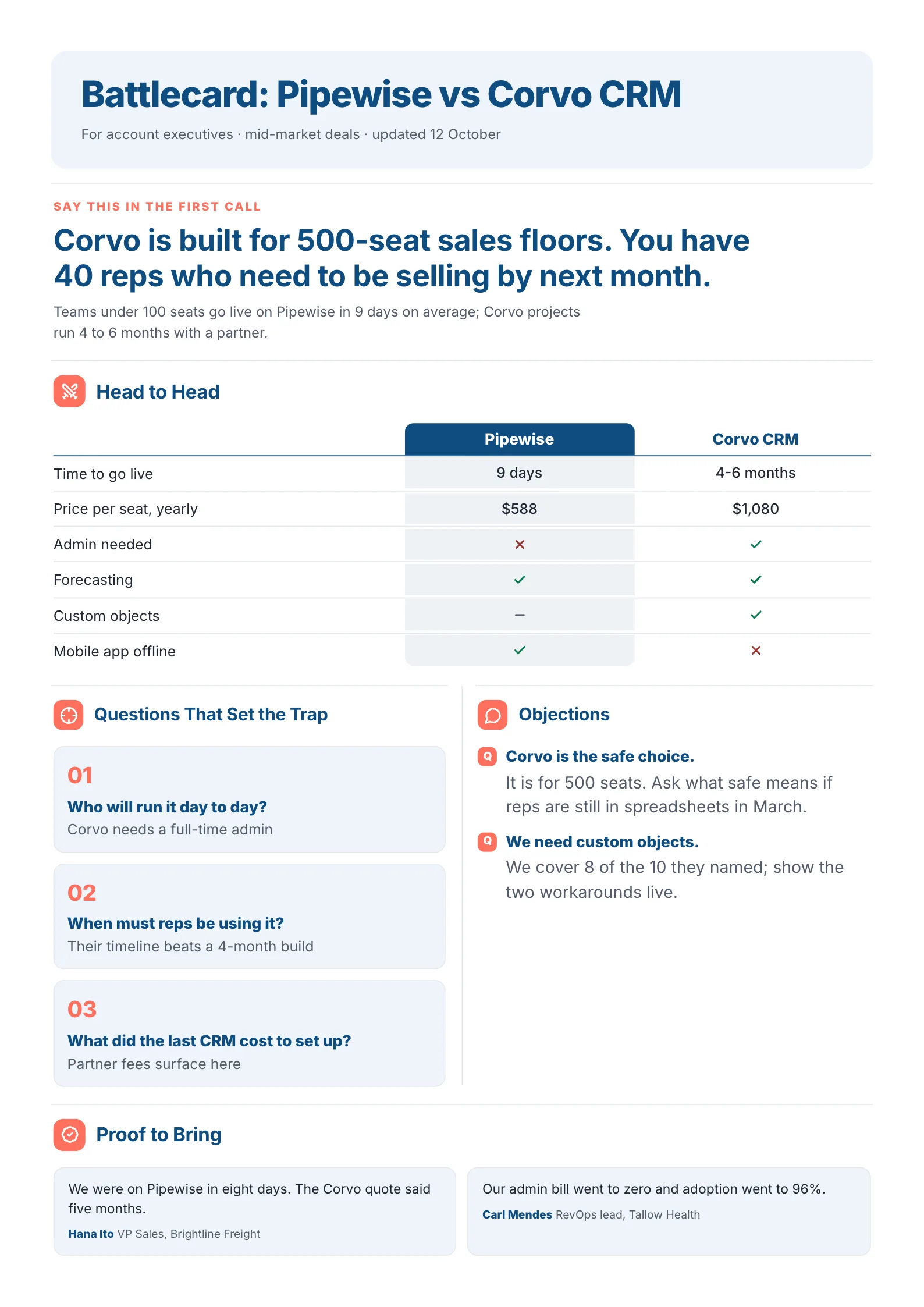 SaaS Sales BattlecardEdit for free(opens in a new tab)
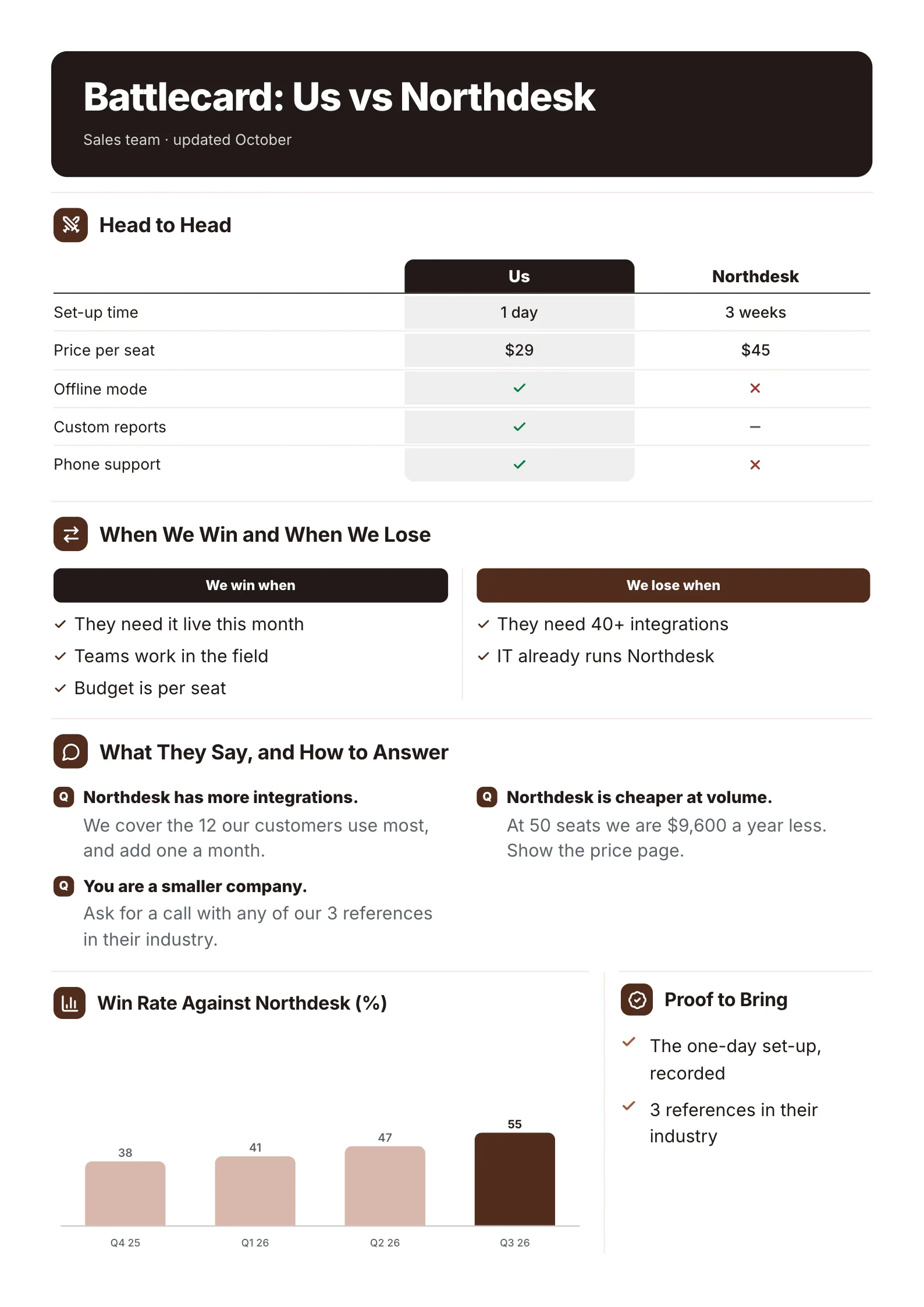 Competitive BattlecardEdit for free(opens in a new tab)
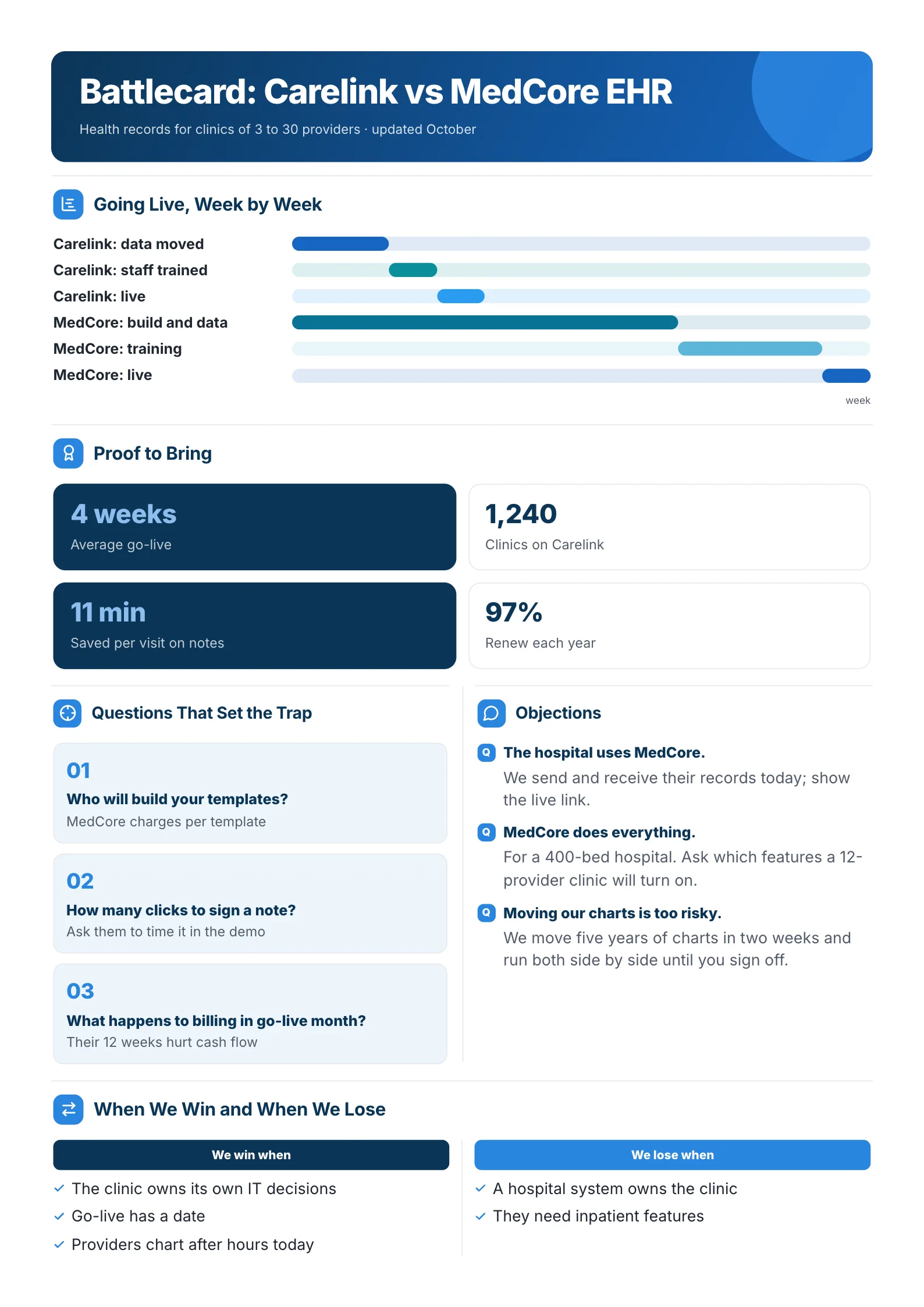 Healthcare Software BattlecardEdit for free(opens in a new tab)
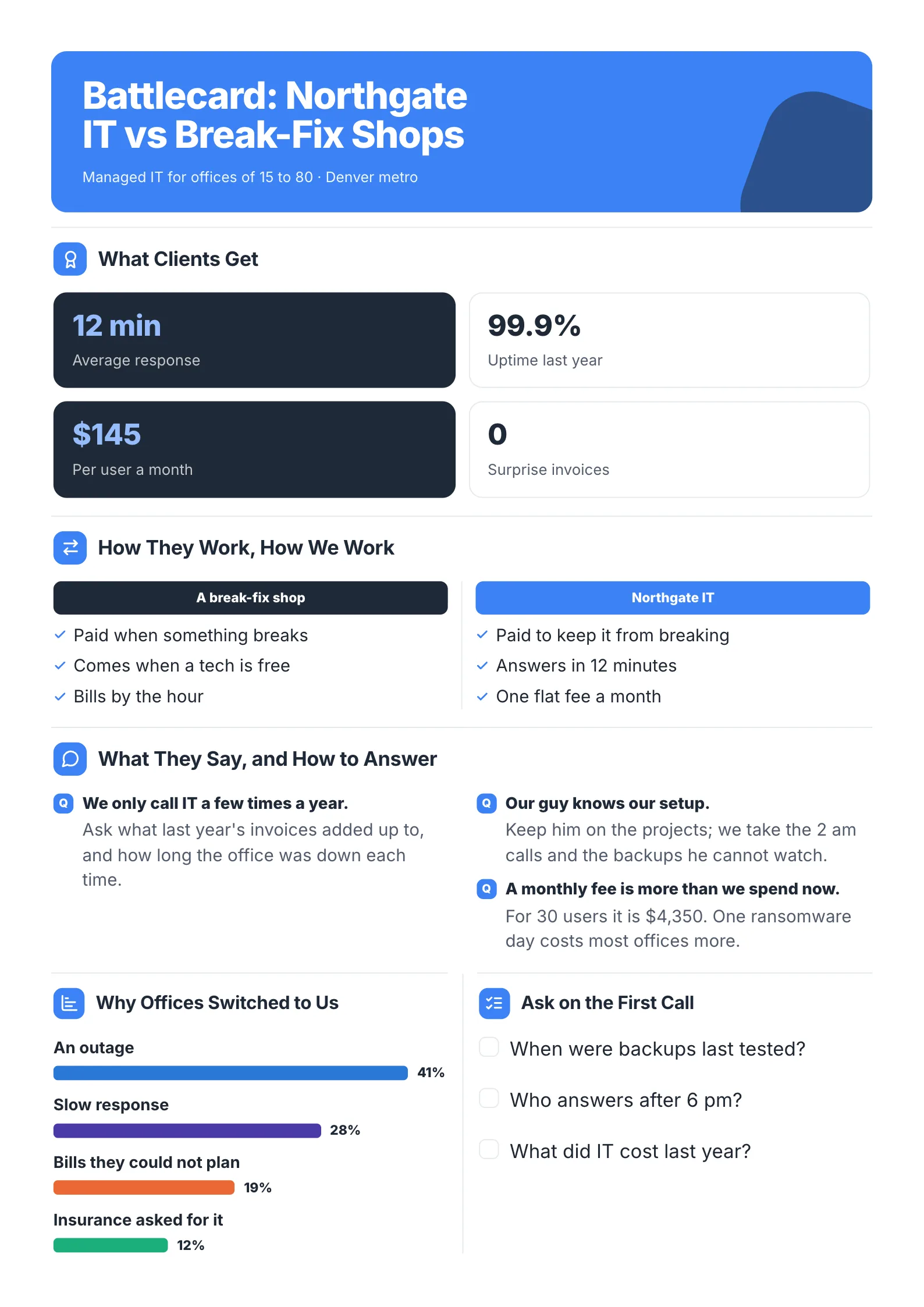 Managed IT BattlecardEdit for free(opens in a new tab)
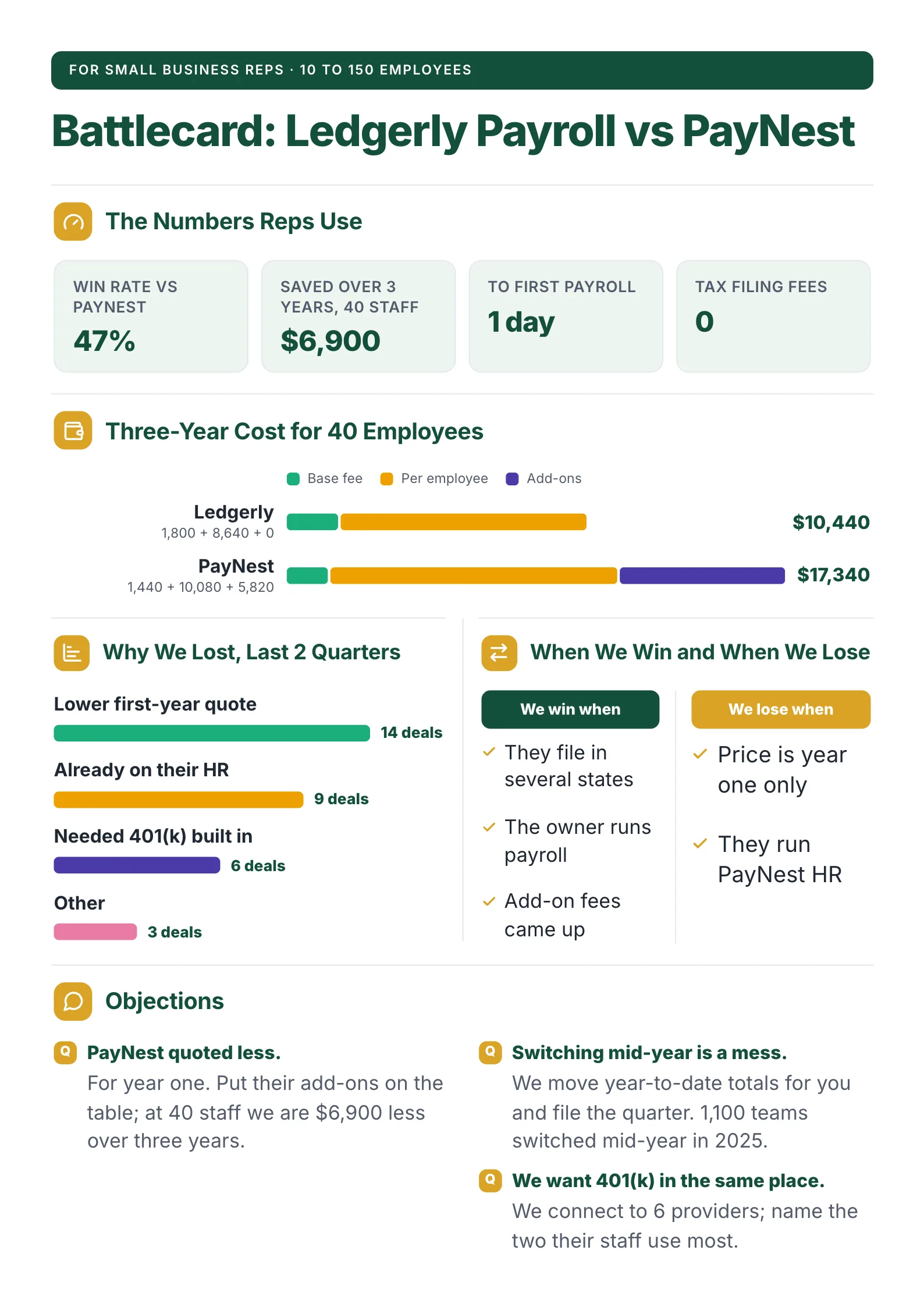 Payroll Software BattlecardEdit for free(opens in a new tab)
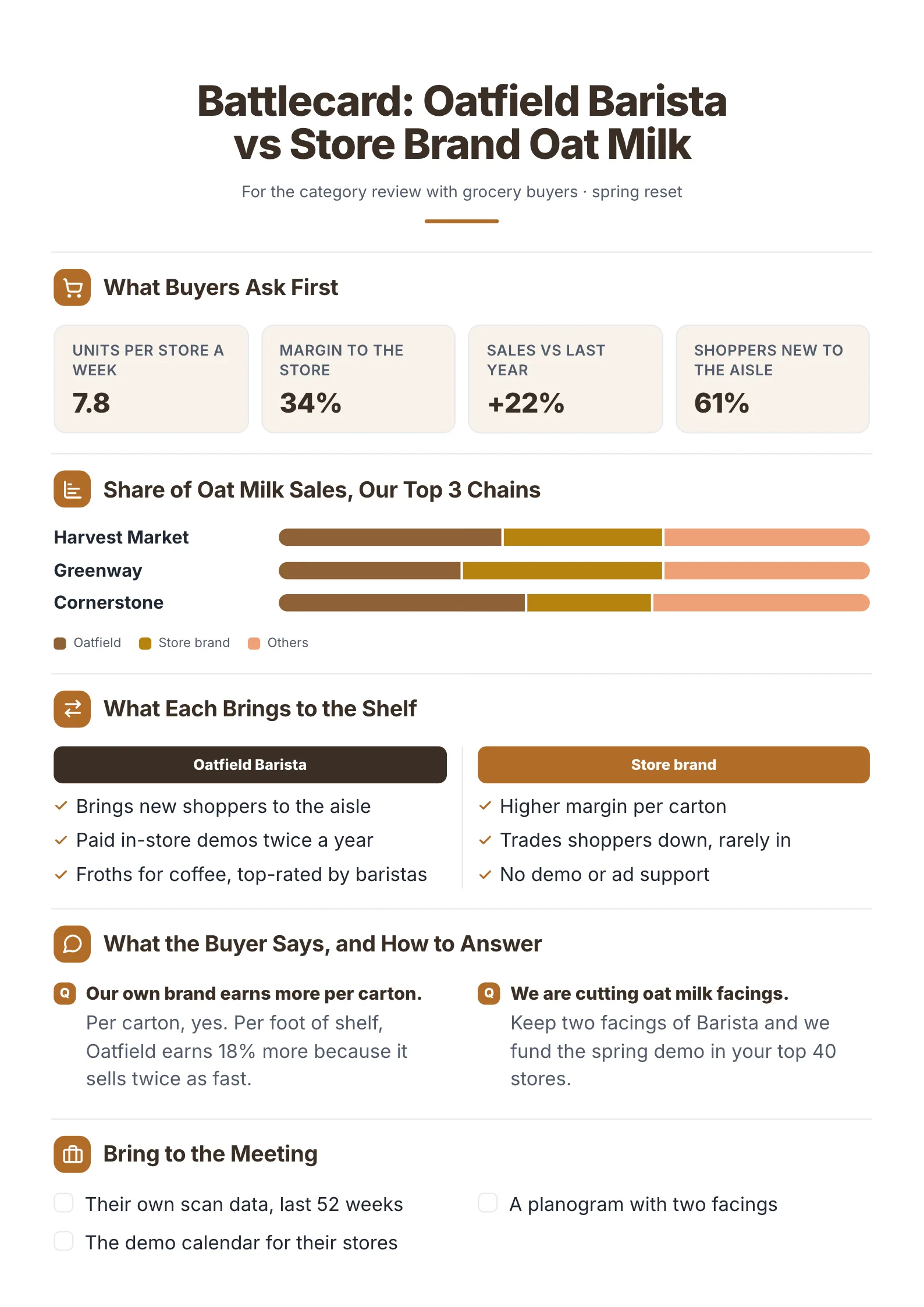 Retail Buyer BattlecardEdit for free(opens in a new tab)
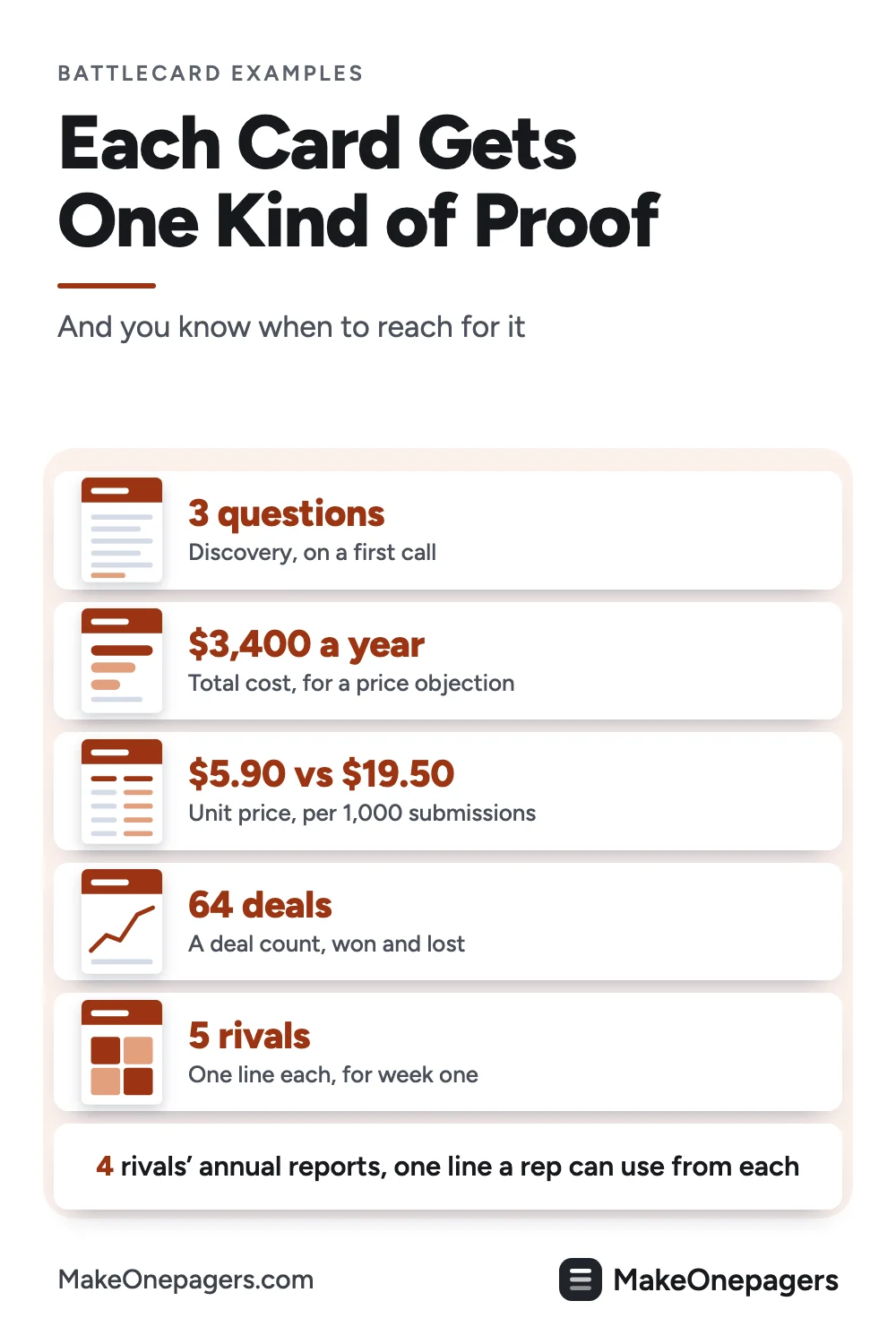
Discovery questions: the Sentrel card
On a first call you don't know enough to compare yet. The card's job is to help you ask the questions that reveal which rival you're up against and how good your odds are.
 Edit this template
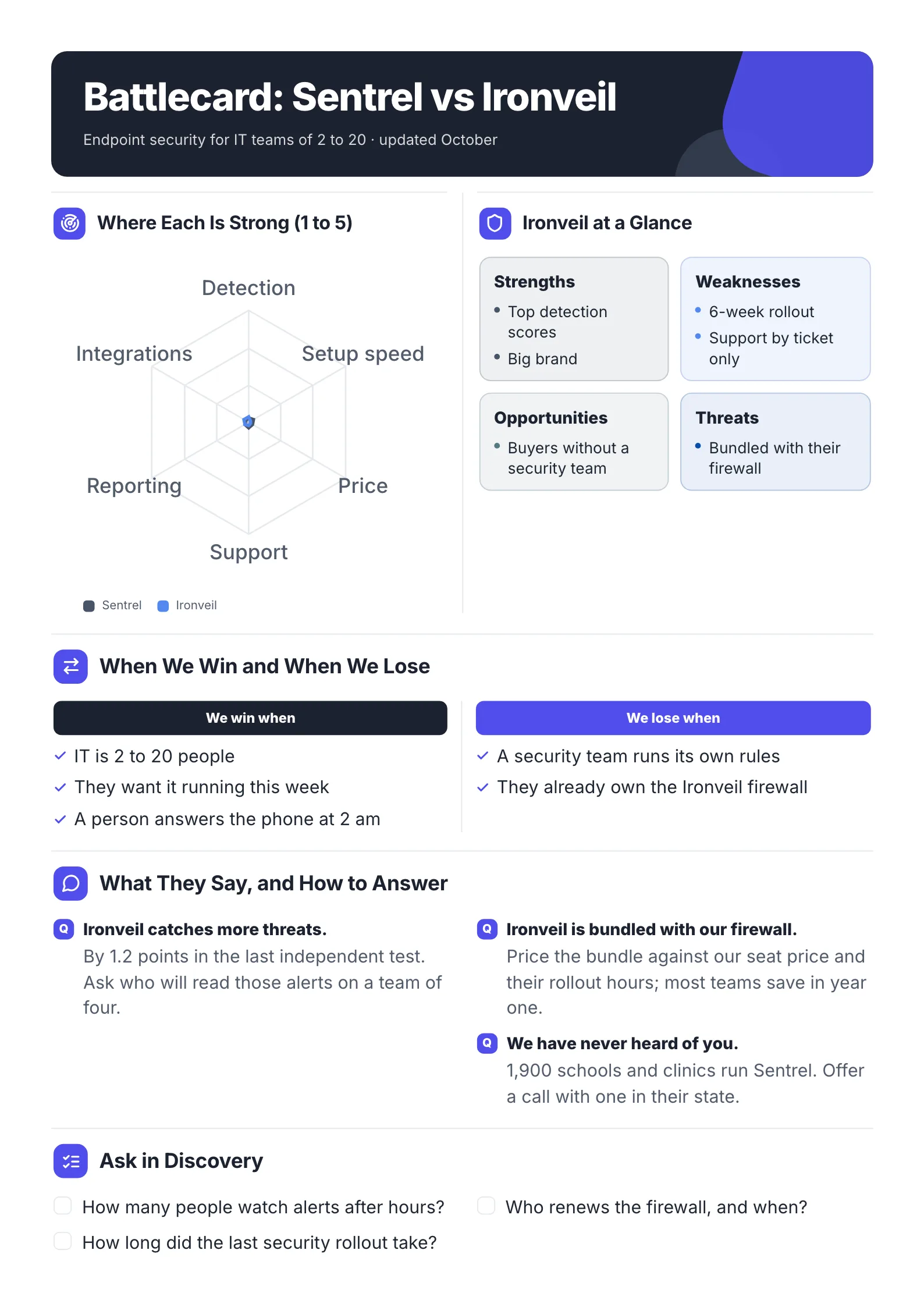
Sentrel and Ironveil are invented. The discovery questions at the bottom do the most work for you on a first call.
This card is for IT teams of 2 to 20 people. Its best box is "When We Win and When We Lose." Sentrel wins when the team is small and wants it running this week. It loses when a security team runs its own rules, or when the buyer already owns Ironveil's firewall.
So the discovery questions point straight at those answers. How many people watch alerts after hours? How long did the last security rollout take? Who renews the firewall, and when? You learn your odds in three questions.
The card is honest about the rival, too. Ironveil really does catch more threats, by 1.2 points in the last independent test. So the suggested answer agrees with the buyer first, then asks who on a team of four is going to read all those extra alerts at night.
Total cost: the Ridgeway card
An objection card lists the things your buyers say most, each with a short answer and a number to back it.
 Edit this template
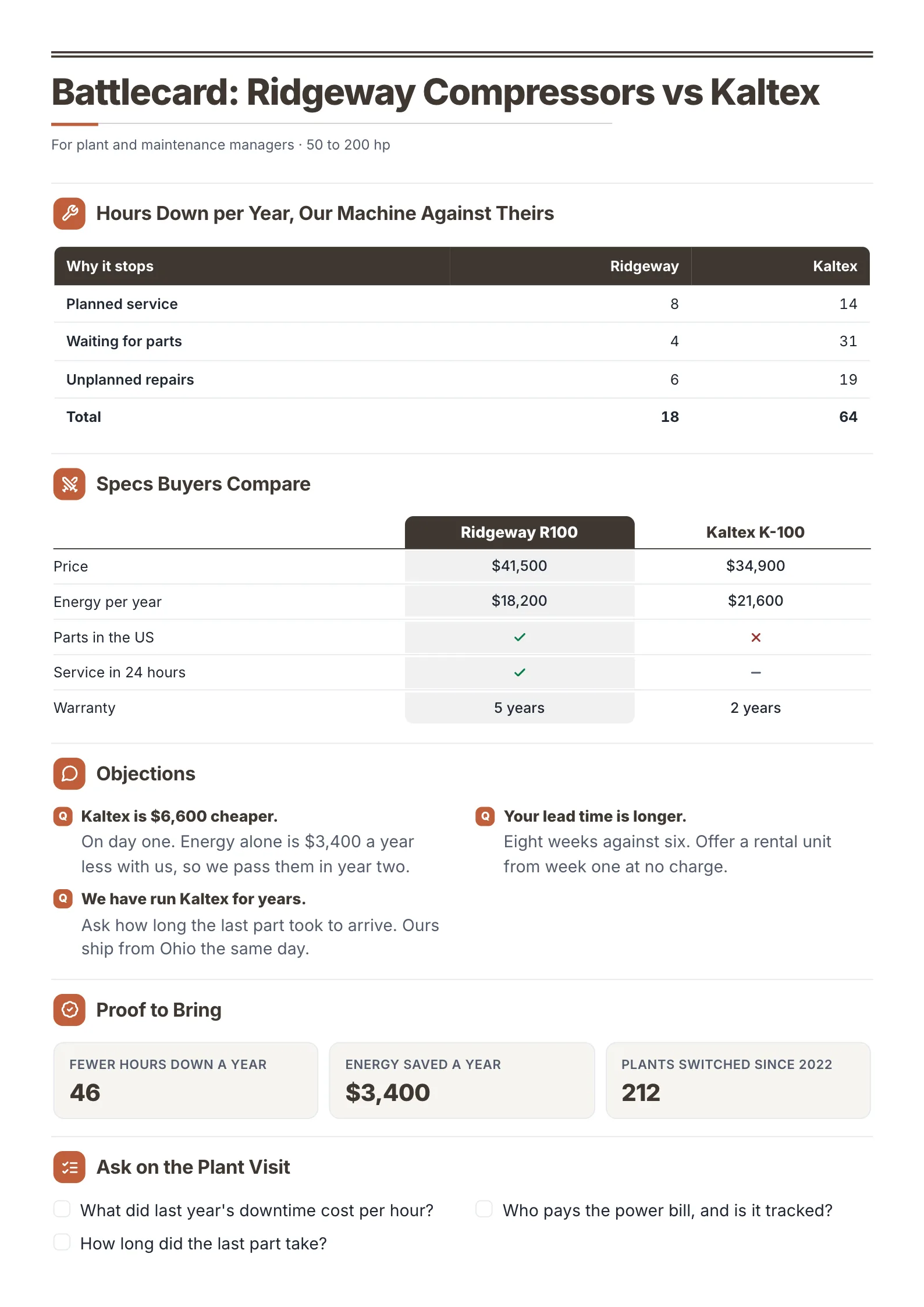
A made-up compressor maker and rival. Read the first objection, then find its proof two boxes down.
The objection every Ridgeway rep hears first is price, because the Kaltex machine is $6,600 cheaper on the quote the buyer is holding. The card's answer starts with two words, "On day one." Energy costs $3,400 a year less with Ridgeway, so it passes Kaltex in year two.
The proof box gives your rep three numbers to say out loud. That's 46 fewer hours down a year, $3,400 in energy saved, and 212 plants switched since 2022. The chart above it shows where the hours come from. Waiting for parts costs Kaltex owners 31 hours a year, against 4 for Ridgeway.
Use this layout when your product costs more upfront. Your answer is the total cost, and your card should hand reps the math.
Unit price: the Formline card
Price talk goes wrong when every rep makes up a discount on the spot, and a buyer who hears three different numbers from three reps stops trusting any of them. A pricing card sets the rules once.
 Edit this template
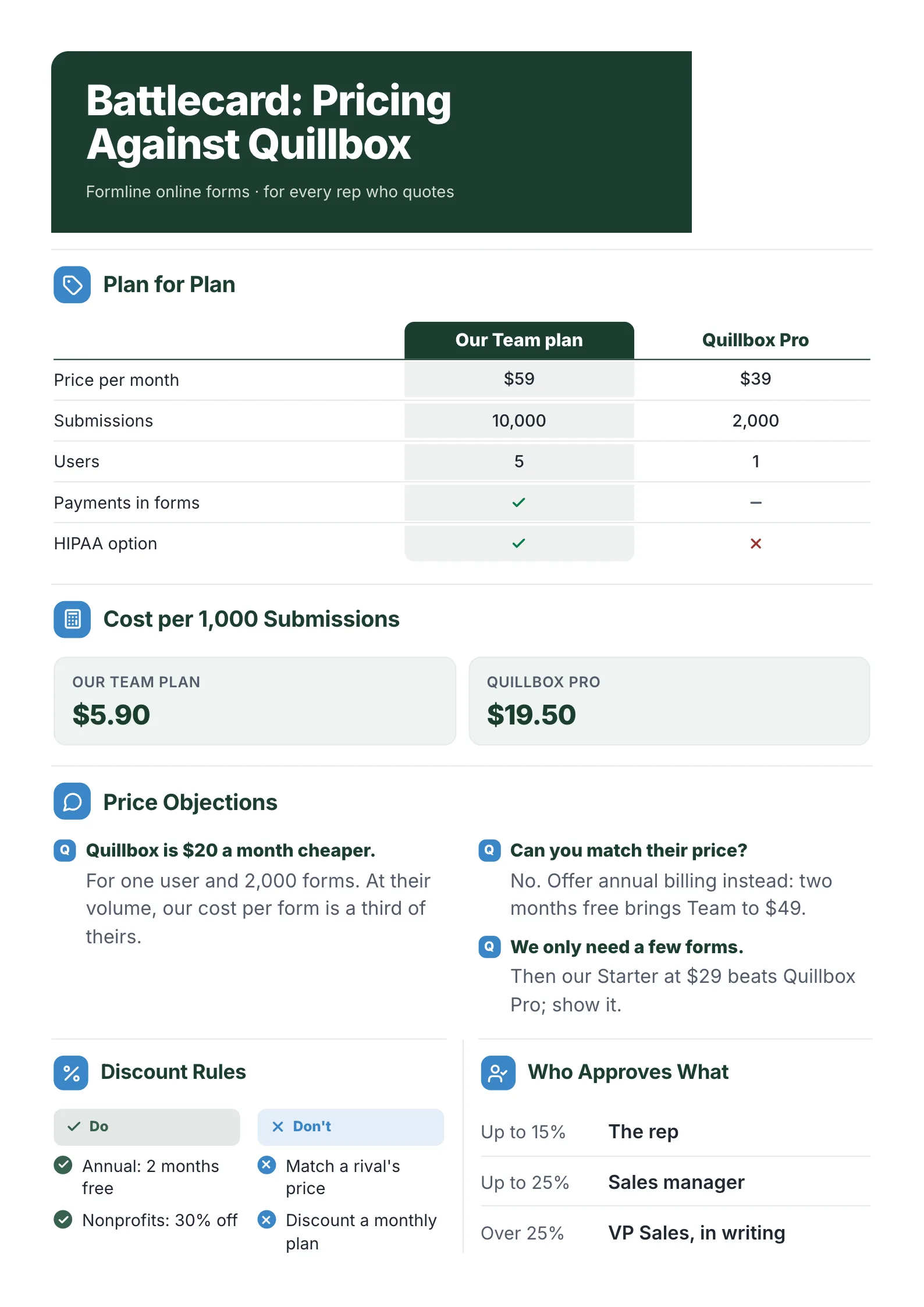
Formline and Quillbox are samples. The cost per 1,000 submissions turns a higher price into a lower one.
Formline's Team plan is $59 a month and Quillbox Pro is $39, so a buyer who only reads the top line of each quote will pick Quillbox every time. But the plan includes 10,000 submissions against 2,000. That works out to $5.90 per 1,000 submissions, against $19.50 for Quillbox. Your rep leads with the second number.
The card also answers "Can you match their price?" with a plain no. It offers annual billing instead, which brings Team to $49. And the approval box ends the guessing. A rep can give up to 15%, a sales manager up to 25%, and anything more needs the VP of Sales in writing.
A deal count: the Brightpath card
Reach for this card at the end of a quarter, when you've met one rival often enough to count. It tells your reps which of the rival's old advantages you've since answered, so a buyer who raises one hears what changed.
 Edit this template
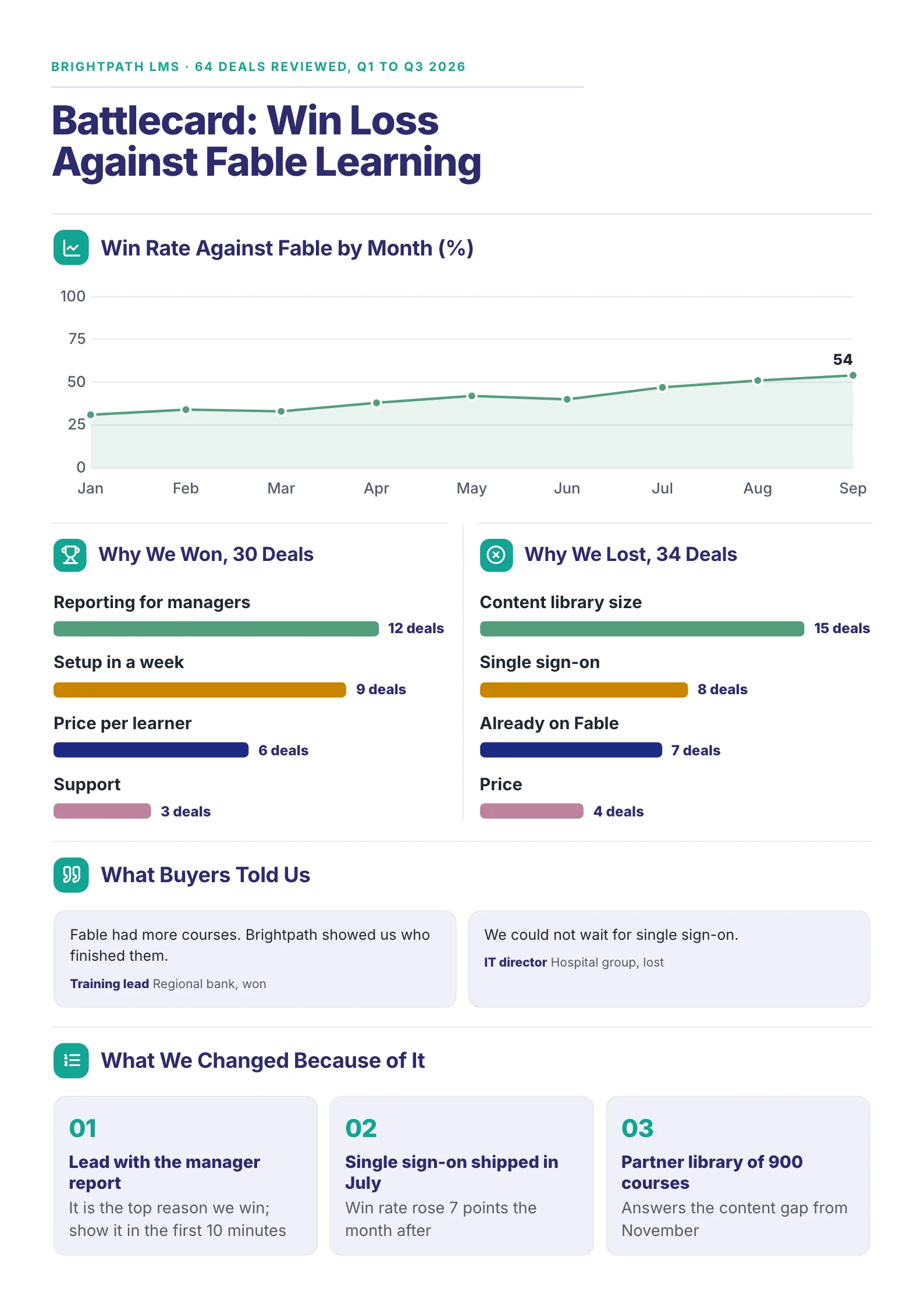
Brightpath, Fable Learning and every deal count here are invented. Read the changes at the bottom to see which loss reasons a rep can now answer.
Brightpath reviewed 64 deals against one rival over three quarters, from January to September, and found it had won 30 of them and lost 34. The biggest reason for losing was the rival's larger content library, which cost 15 deals. Seven more were lost because the buyer was "Already on Fable," which no feature list can fix on its own.
The card shows what changed because of the review. Single sign-on shipped in July, the month the win rate jumped 7 points, from 40% to 47%. A partner library of 900 courses answers the content gap. Over nine months, the win rate climbed from 31% to 54%.
Two short quotes from buyers sit in the middle. "We could not wait for single sign-on," said a hospital IT director, in a deal that was lost. Words like that make your team take a loss reason seriously.
One line per rival: the Shiftly card
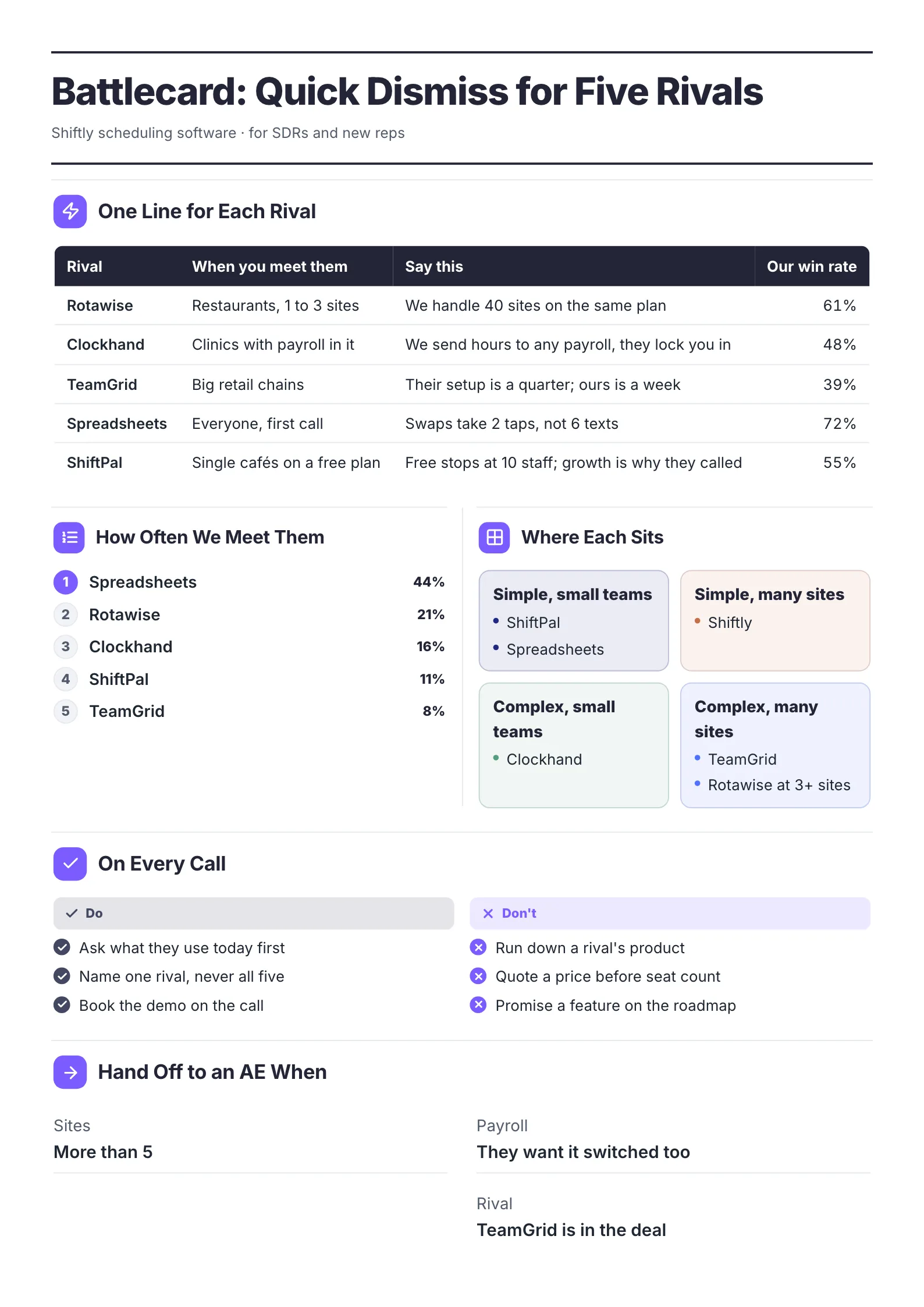
New reps meet every rival in their first week, often before they've finished training. A quick dismiss card gives them one line for each, and a rule for when to hand off.
 Edit this template
Shiftly and its rivals are made up. The "How Often We Meet Them" ranking tells you which line a new rep should learn first.
The most common rival here isn't a company at all, since plain spreadsheets come up in 44% of the deals where Shiftly meets a rival, more than any two named rivals combined. The line to say is short. Swaps take 2 taps instead of 6 texts. Shiftly wins 72% of those deals.
Every rival gets one row, with when you meet them, what to say and your win rate. The do's and don'ts keep it fair. Name one rival, never all five. Don't run down a rival's product, and don't promise a feature that's still on the roadmap.
What a rival's own filings tell you
Four companies that sales teams often sell against each put a line about their own market into their latest annual report, and every one of those lines can go on a card. We read the four filings on October 30, 2026, and matched each line to the card it belongs on.
| Rival | The line in its 10-K | The card it belongs on |
|---|---|---|
| HubSpot, 2025 | "some prospective customers may elect to combine disparate point applications" | One line per rival, if you sell one of those tools |
| Paycom, 2025 | "Price tends to be the most important factor of competition for smaller businesses" | Unit price, for reps who sell to small firms |
| Paychex, fiscal 2026 | Payroll client retention "in the range of 82% to 83%" | A deal count, for the clients who switch |
| CrowdStrike, fiscal 2026 | "we do not believe any of our competitors currently have a true platform offering equivalent to the Falcon platform" | Discovery questions that test the platform claim |
HubSpot's line is for reps who sell one of those separate tools. Its 2025 10-K warns that some buyers will combine point products instead of buying its platform, which is your opening on a one-line-per-rival card. The same report lists 15 factors and says, "We believe we compete favorably with respect to all of these factors." Don't try to argue all 15. Pick the two your buyers bring up.
Paycom's line splits your card in two. Price leads with small firms, and features and customization lead with large ones. Give your small-business reps a unit price card like Formline's, and give your enterprise team a card built on features.
Paychex's line is a switching number. Its fiscal 2026 10-K counted about 800,000 payroll clients on May 31, 2026, and says it kept 82% to 83% of the clients it started the year with, so 17 or 18 of every 100 left. If you sell payroll, count how many of your wins came from those switchers, the way Brightpath counted its deals, and ask each one what made them go.
CrowdStrike's line is a claim to test. Its fiscal 2026 10-K says no rival has a platform equivalent to Falcon. Expect a buyer to repeat that, and put a discovery question on your card that tests it, such as which parts of the platform their team uses every week. Its risk factors also discuss the July 19 Incident. Keep that kind of thing off your card, since the Shiftly card's own rules say not to run down a rival's product.
Build your first card in an hour
You can draft a useful battlecard before lunch if you work from what you already know and keep it to one rival. Here's the order, with a rough time for each step.
- Pick one rival, 5 minutes. Choose the one you meet most. If your CRM logs it, count. Shiftly met spreadsheets in 44% of its deals against a rival.
- Read their own words, 15 minutes. If they're public, the table above shows the kind of line to look for. If not, read their pricing page and their last three press releases.
- Write when you win and when you lose, 10 minutes. Two short lists, like the Sentrel card. Be honest on the losing side.
- List the top three objections, 10 minutes. Ask your reps what buyers say. Write one short answer for each.
- Add proof, 10 minutes. One number per answer, like Ridgeway's 46 fewer hours down a year.
- Write three discovery questions, 5 minutes. Each question should reveal a reason you win.
- Date it, 5 minutes. Put the month on the card, and a date to count wins and losses again next quarter.
That's one card, for one rival, in an hour. Our battlecard template post explains each section in more detail, and a competitive analysis is the place for the bigger picture behind it.
Start with the question your reps dread
Ask your reps which question they dread on a call. Often it's price, or one rival they keep losing to. A page that sells your own product is a different job, and a sales one-pager covers it.
The next time a buyer holds up Quillbox's $39 quote, your rep can answer with $5.90 per 1,000 submissions against Quillbox's $19.50, the two numbers Formline's card in MakeOnepagers sets side by side.




