Unit Economics vs Contribution Margin: One HelloFresh Order
Unit economics vs contribution margin, worked on one real order: HelloFresh's 2025 report keeps €16.80 an order before marketing and €4.42 after it.

Contribution margin is what one sale keeps after the costs of making and delivering it. Unit economics takes that number and keeps going: it subtracts what you spent to win the sale and asks if the whole unit pays off. So contribution margin is one line inside your unit economics. Start from a free one pager template.
One‑Pager examples
Real One-Pagers made with MakeOnepagers. Open any one to edit it as your own.
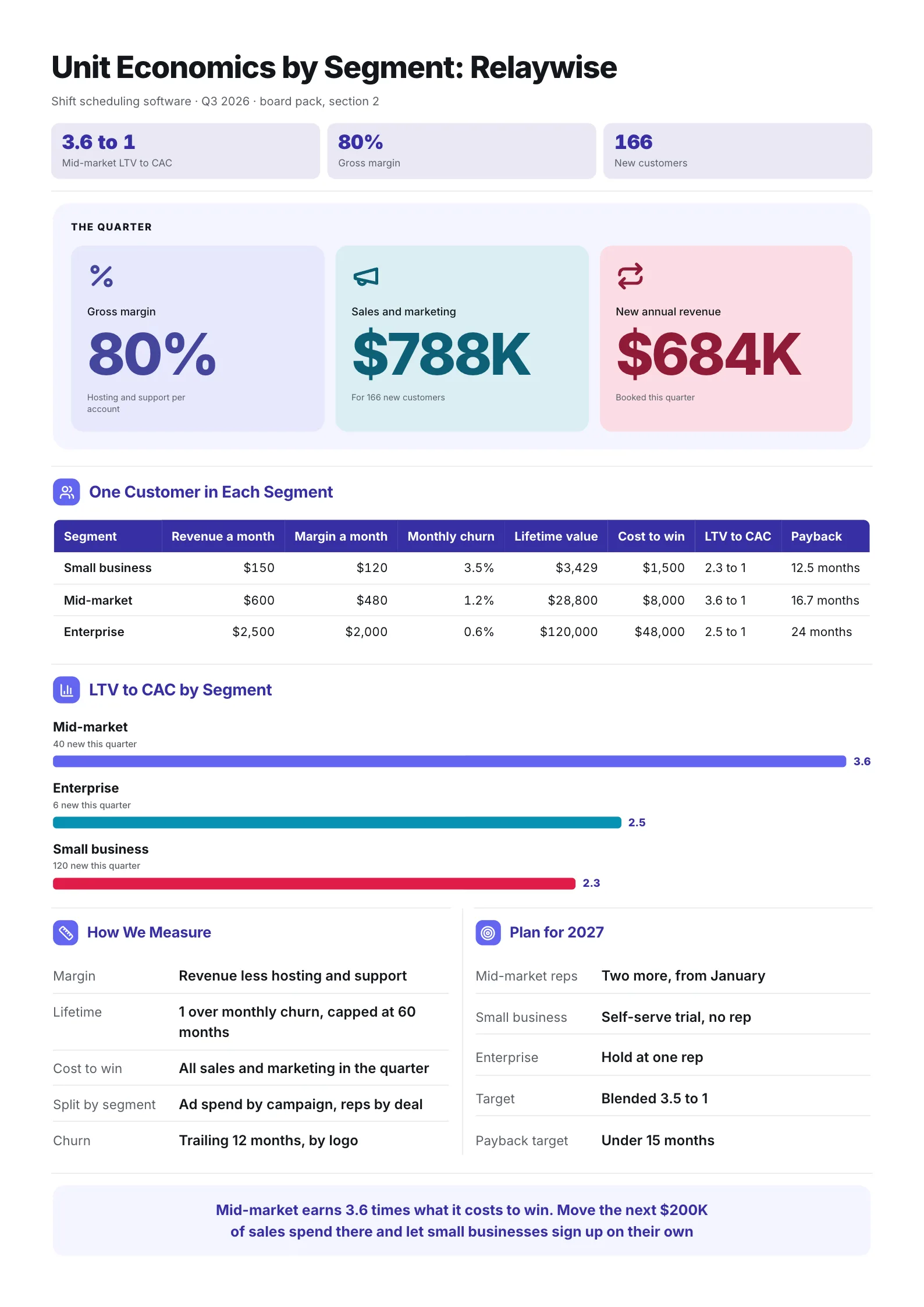 Unit Economics: SaaS by SegmentEdit for free(opens in a new tab)
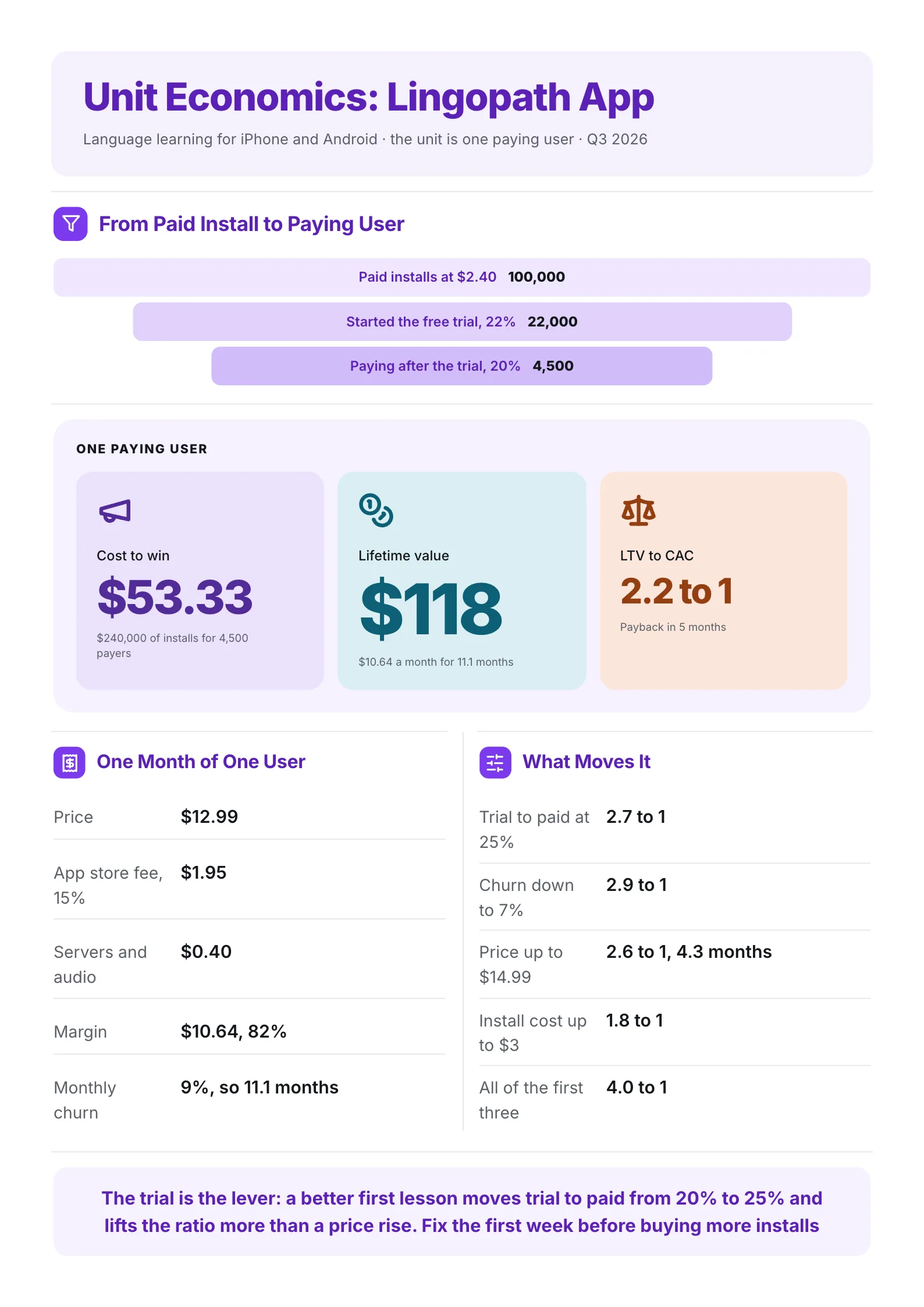 Unit Economics: Mobile AppEdit for free(opens in a new tab)
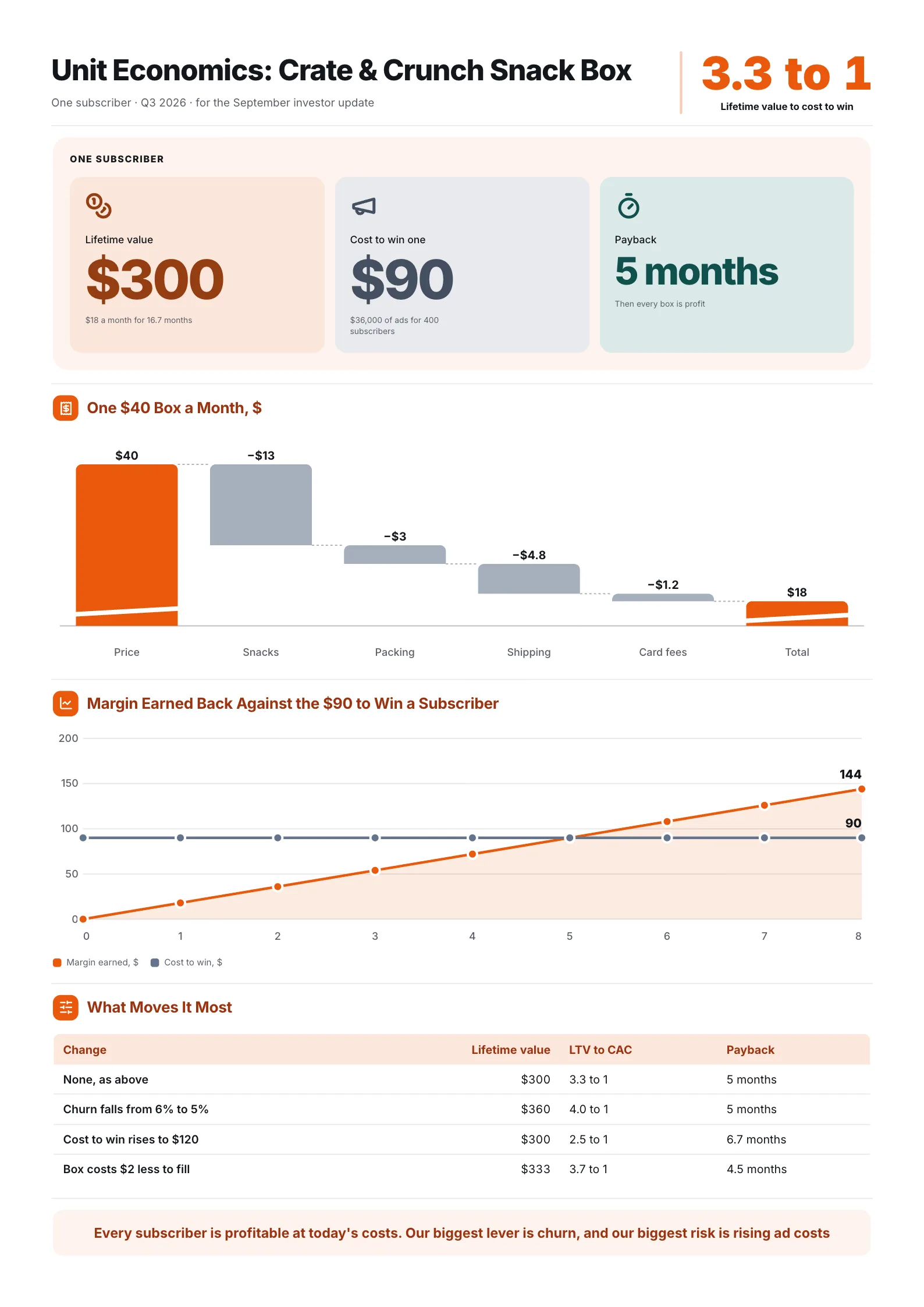 Unit Economics: Subscription BoxEdit for free(opens in a new tab)
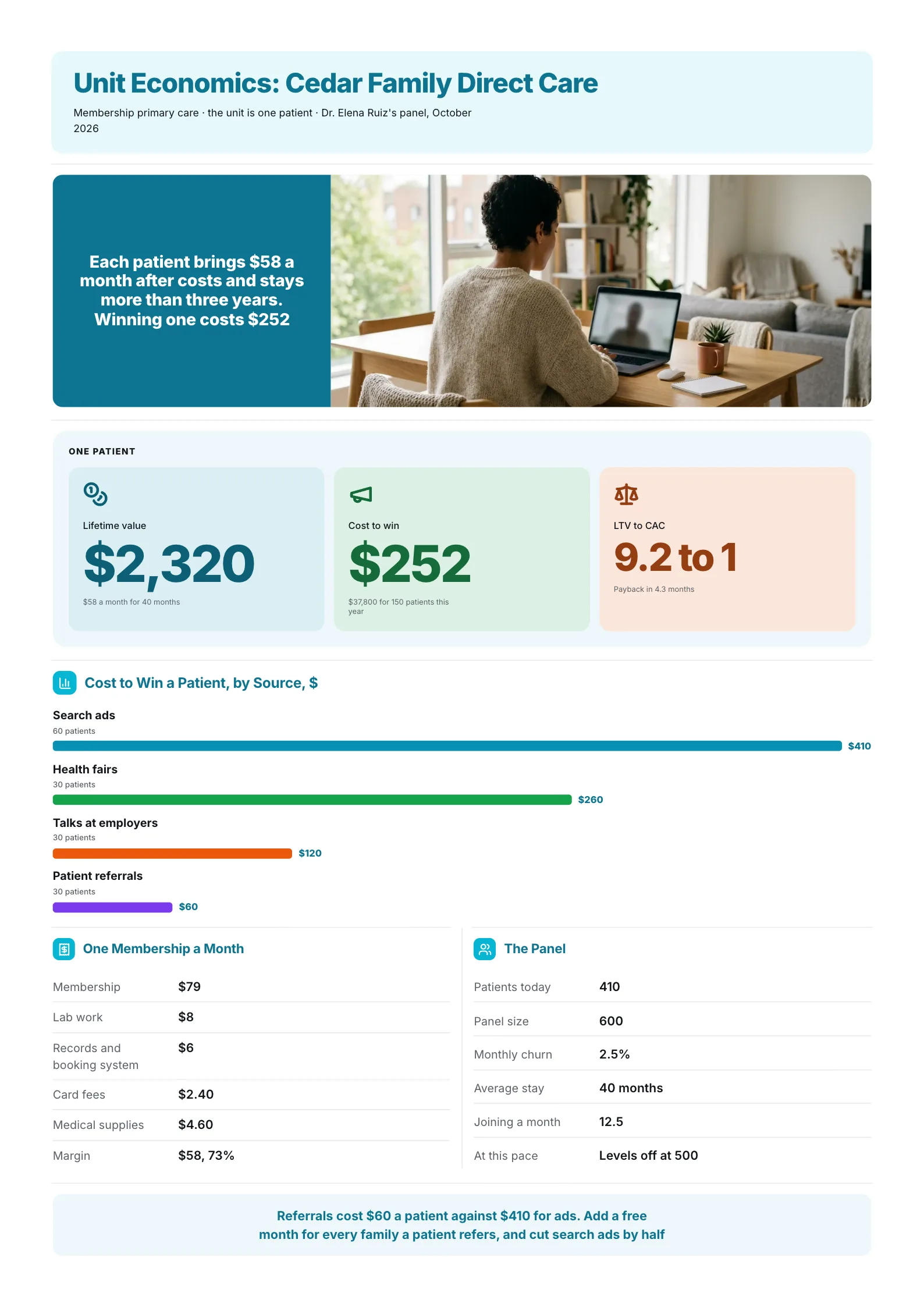 Unit Economics: Membership ClinicEdit for free(opens in a new tab)
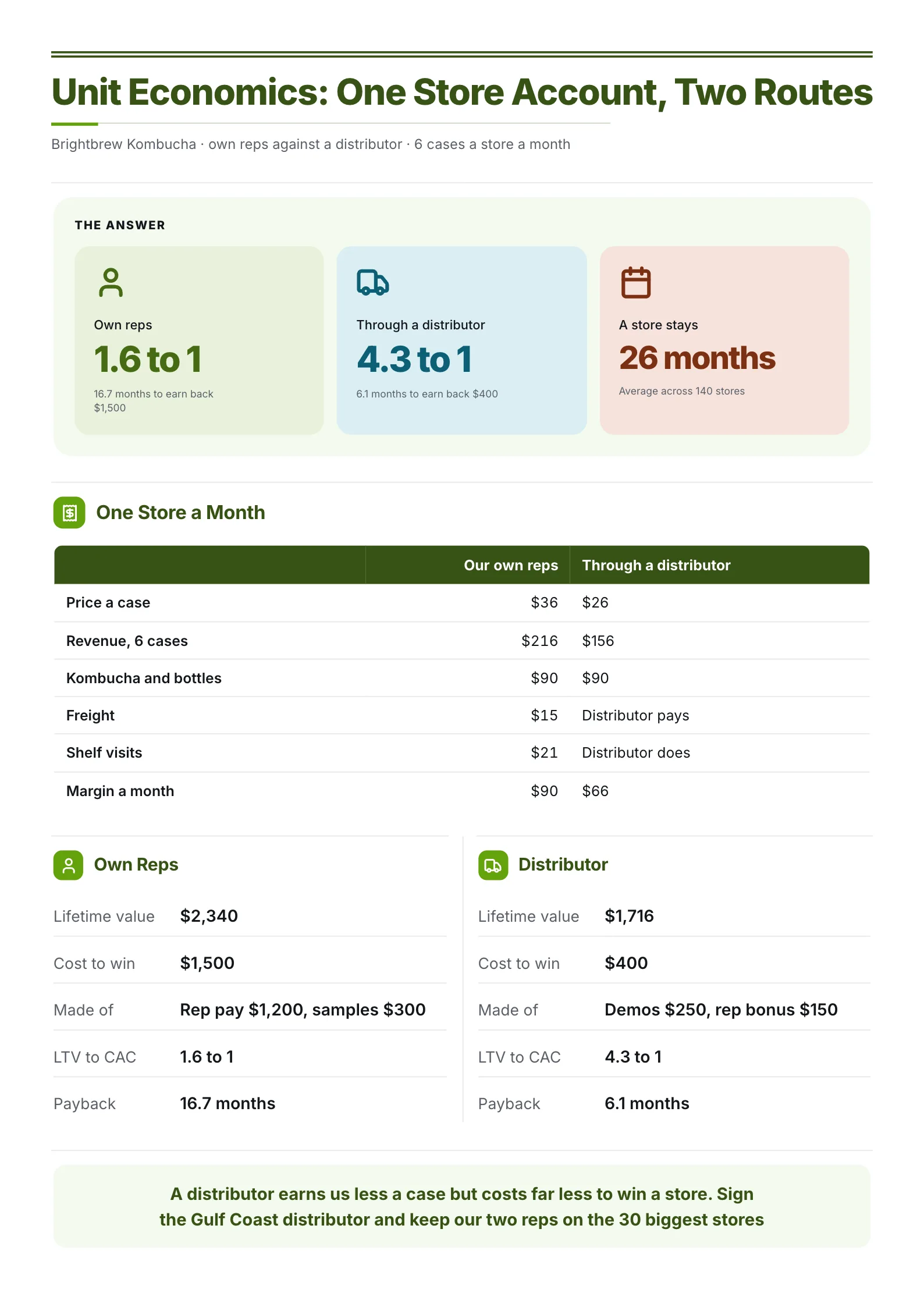 Unit Economics: Wholesale, Two RoutesEdit for free(opens in a new tab)
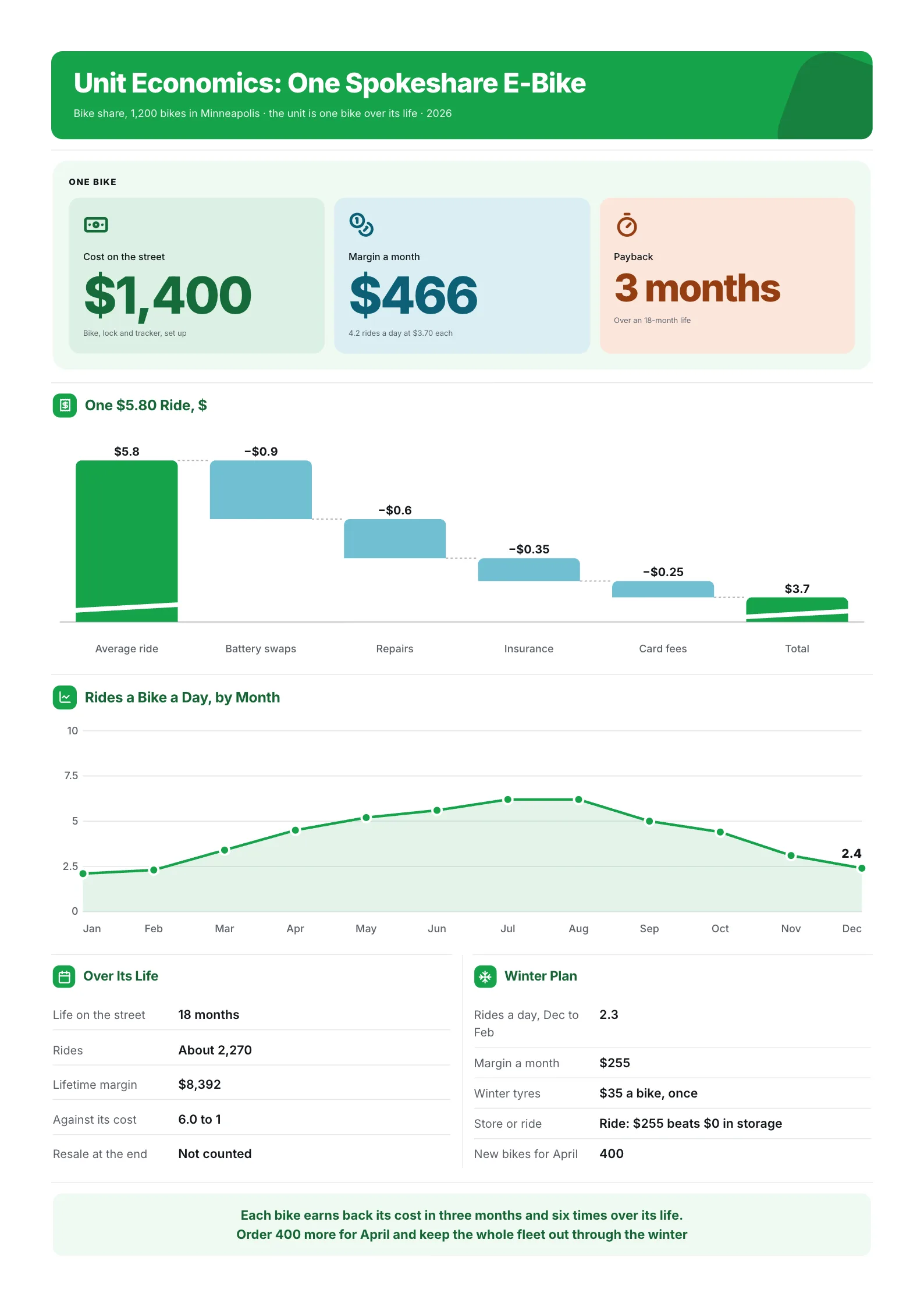 Unit Economics: Bike Share per BikeEdit for free(opens in a new tab)
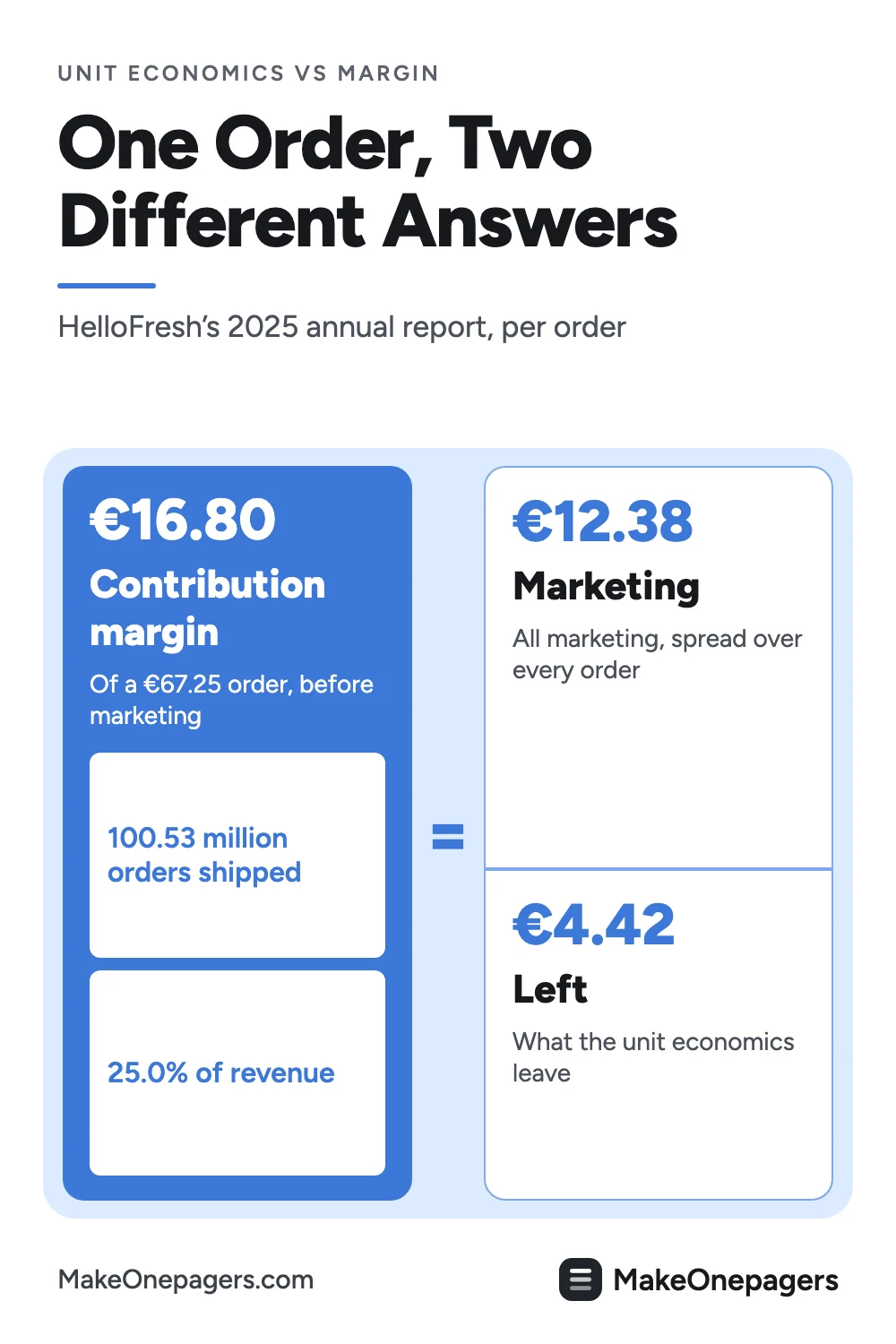
The gap shows up clearly in a real report. HelloFresh shipped 100.53 million orders in 2025, says its 221-page annual report. Divide the report's numbers by those orders and each one kept €16.80 of contribution margin. Marketing then took €12.38 an order, which left just €4.42. Same order, two very different answers.
| Contribution margin | Unit economics | |
|---|---|---|
| What it measures | What one sale keeps after its own costs | Whether one unit (an order, a customer) pays off |
| Subtracts | Costs that rise with each sale: goods, packing, delivery, card fees | All of those, plus the cost to win the unit |
| Leaves out | Marketing, rent, salaries, overhead | Rent, salaries and overhead (usually) |
| Shown as | A dollar amount or a % of the price | A set of numbers: margin, cost to win, lifetime value, payback |
| Answers | Does each sale pay for itself? | Is it worth paying to get more sales? |
How HelloFresh defines its contribution margin
HelloFresh is a good place to start, because its 2025 annual report writes its rule down. In its table of performance measures, contribution margin is "Revenue less procurement and cooking expenses and fulfilment costs." The same box adds that it shows "margin development before marketing and G&A."
So the company stops counting before two big costs you'd want to know about: what it spends on marketing, and its general and admin costs (G&A). That's the classic line. The free OpenStax accounting textbook, Principles of Managerial Accounting, says the same thing at the smallest scale: "Contribution margin is the amount by which a product’s selling price exceeds its total variable cost per unit."
The report also uses the phrase "unit economics" four times, and never as a line in a table. It's the goal the numbers serve. The letter at the front says the company "structurally lowered our fixed cost base and improved unit economics per order." That's the difference in one sentence. Contribution margin is a figure you can look up. Unit economics is the question you answer with it.
Follow one order from €67.25 to €4.42
The report gives yearly totals only. So we divided each line by the 100.53 million orders it shipped. (HelloFresh counts the orders it shipped, and an order "typically consists of several meals.")
| One 2025 order | € per order | From the report, € millions |
|---|---|---|
| Revenue | 67.25 | 6,760.8 |
| Procurement and cooking | 25.78 | 2,591.4 |
| Fulfillment | 24.67 | 2,480.4 |
| Contribution margin | 16.80 | 1,688.9 |
| Marketing | 12.38 | 1,245.0 |
| Left after marketing | 4.42 | 443.9 |
| General and admin, and other costs | 4.43 | 445.8 |
Read it from the top and you'd call the margin healthy. A quarter of every order (25.0%) is left once the food costs and the fulfillment costs are paid. Read one line further and you see a tighter story. Marketing takes almost three-quarters of that margin. Once general and admin costs are paid too, the order about breaks even: the report's operating result for the year is a loss of €2.0 million on €6.76 billion of sales.
Keep two cautions in mind. The revenue figure includes retail sales, so our €67.25 sits a little above the report's own €66.8 average order value. And HelloFresh doesn't split its marketing between winning new customers and keeping old ones. So treat the €12.38 as all of its marketing spread over every order. The true cost to win one new customer isn't in the report.
What changed from 2024 to 2025
Next to the year before, the two numbers move at different speeds. Here's the same math on 2024's 114.63 million orders:
- Contribution margin: €15.36 an order in 2024, €16.80 in 2025.
- Marketing: €12.69 an order in 2024, €12.38 in 2025.
- Left after marketing: €2.67 in 2024, €4.42 in 2025.
The margin rose by €1.44 an order. What's left after marketing rose by €1.75, because marketing per order fell at the same time. The report says the 12.3% drop in orders came from "a deliberate shift toward marketing discipline," and that the company "prioritized the acquisition of customers with high Return on Investment (ROI)." In plain words, it sold fewer orders, spent less marketing on each one, and each order left more behind.
You can only see that choice in unit economics. If you looked at contribution margin alone, you'd call 2025 a small step up. Look at what's left after marketing, and you'll find it's 66% bigger per order than the year before.
Five small businesses, both numbers on one One-Pager
A big company's report shows the idea at scale. These five samples, made with MakeOnepagers, show it the way you'd lay it out for your own business. Each one shows the margin and the cost to win on the same page. The companies are invented and every sum checks.
 Edit this template
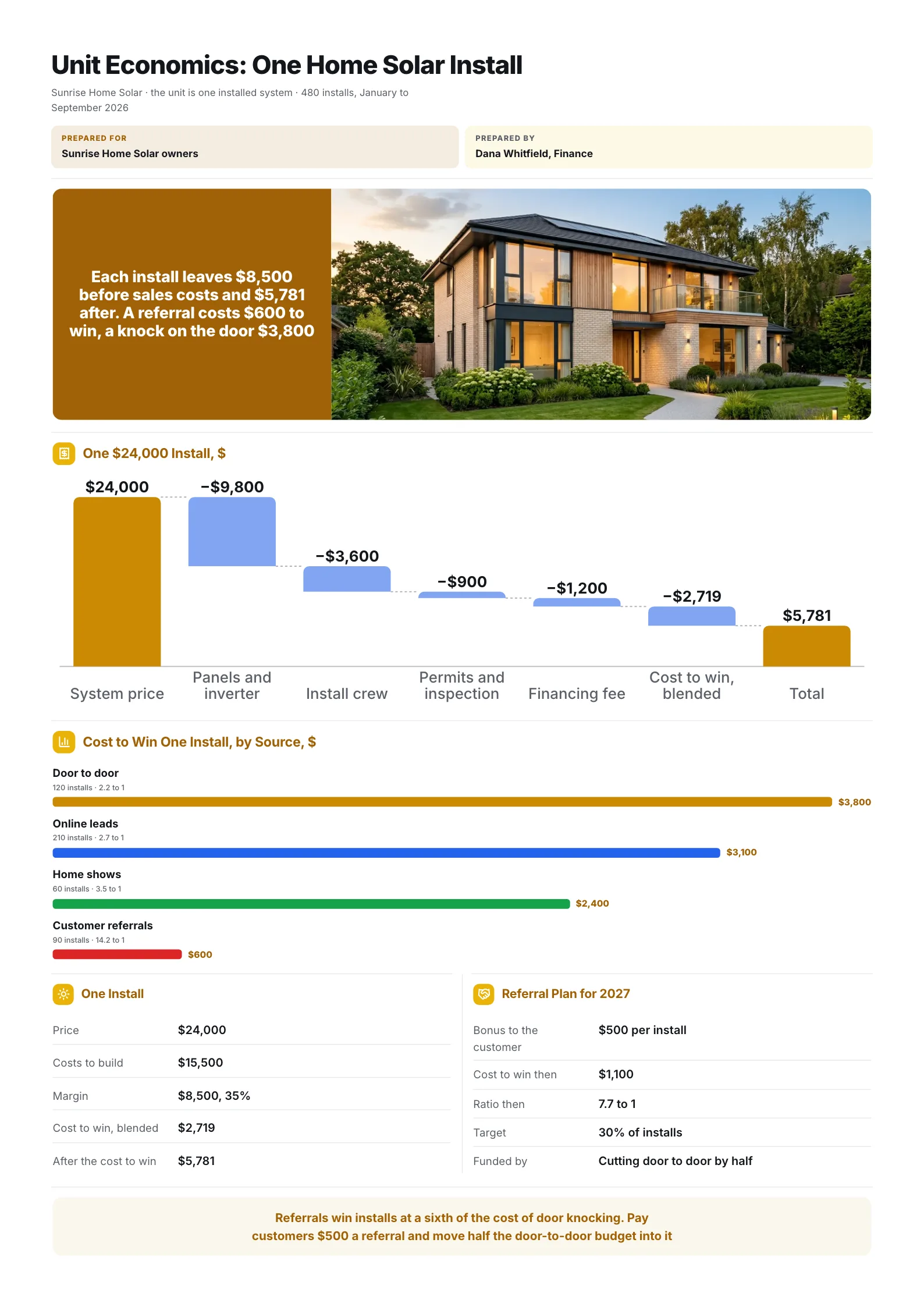
If you sell big jobs, this home solar unit economics sample shows you the two numbers as two lines. A $24,000 install costs $15,500 to build, so its margin is $8,500, or 35%. Take off the blended cost to win, $2,719, and $5,781 is left. The margin doesn't depend on how the customer was found. The cost to win does: a referral costs $600, a knock on the door $3,800.
 Edit this template
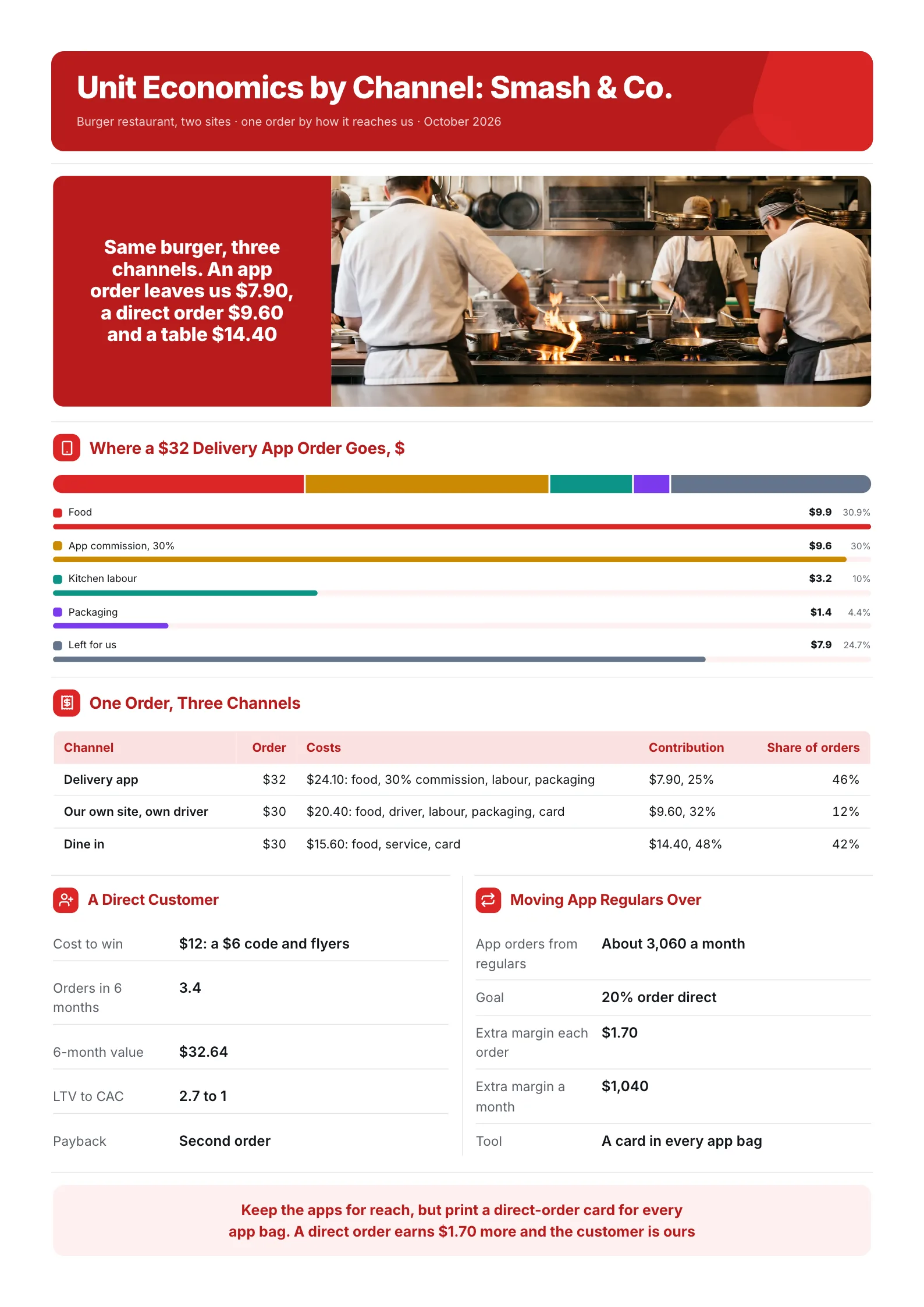
Your contribution margin can change with the channel, even for the same burger. This restaurant unit economics sample keeps $7.90 from a $32 app order, $9.60 from a direct order and $14.40 from a table. Then it adds the unit economics question. A direct customer costs $12 to win and orders 3.4 times in six months, so they're worth $32.64, or 2.7 times what they cost.
 Edit this template
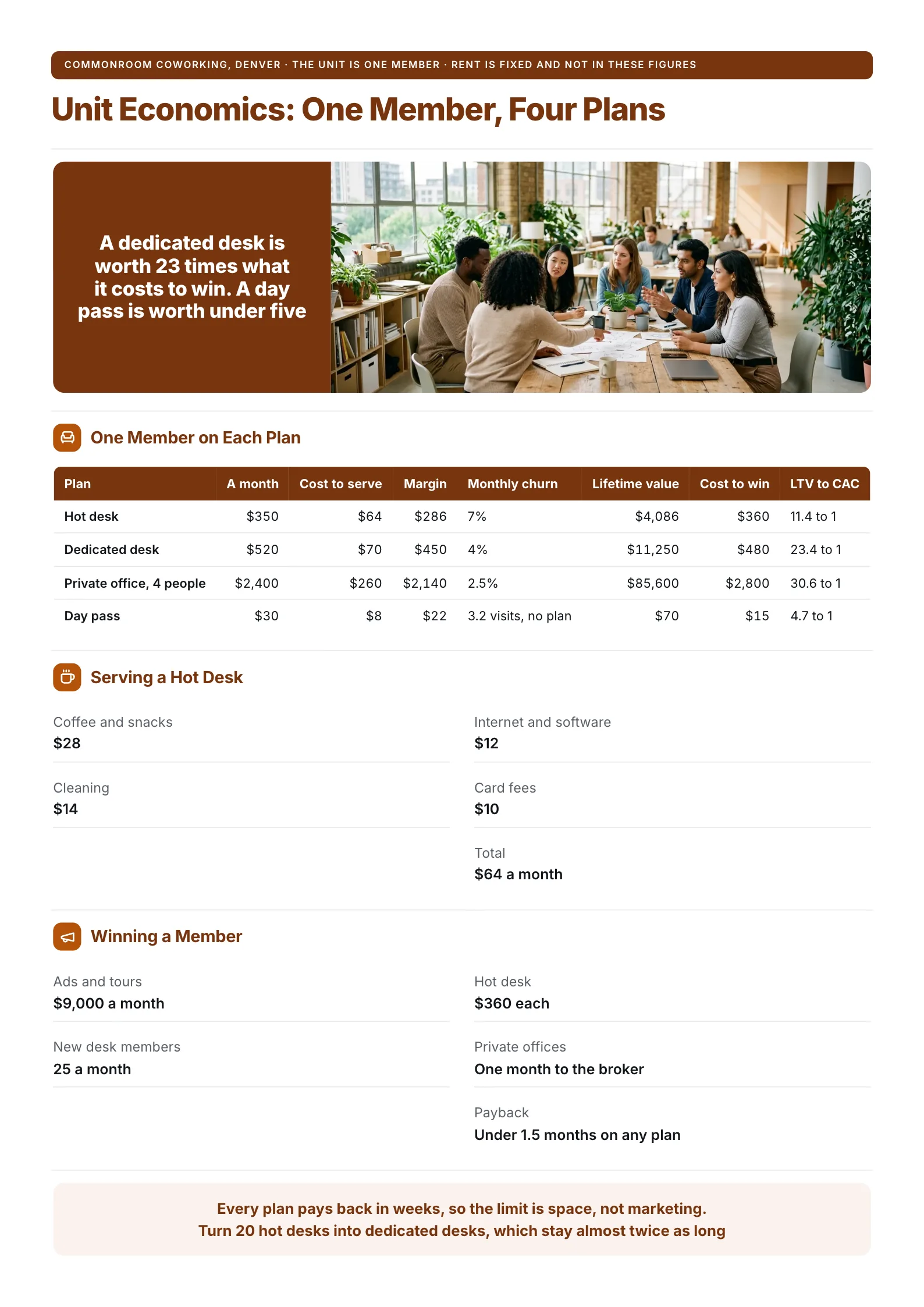
This coworking unit economics sample says what both numbers leave out in its subtitle: "rent is fixed and not in these figures." A hot desk at $350 a month costs $64 to serve, so its margin is $286. A member stays long enough to be worth $4,086, against $360 to win, or 11.4 to 1. Rent still has to be paid, and it comes out of the margin all the members bring in together.
 Edit this template
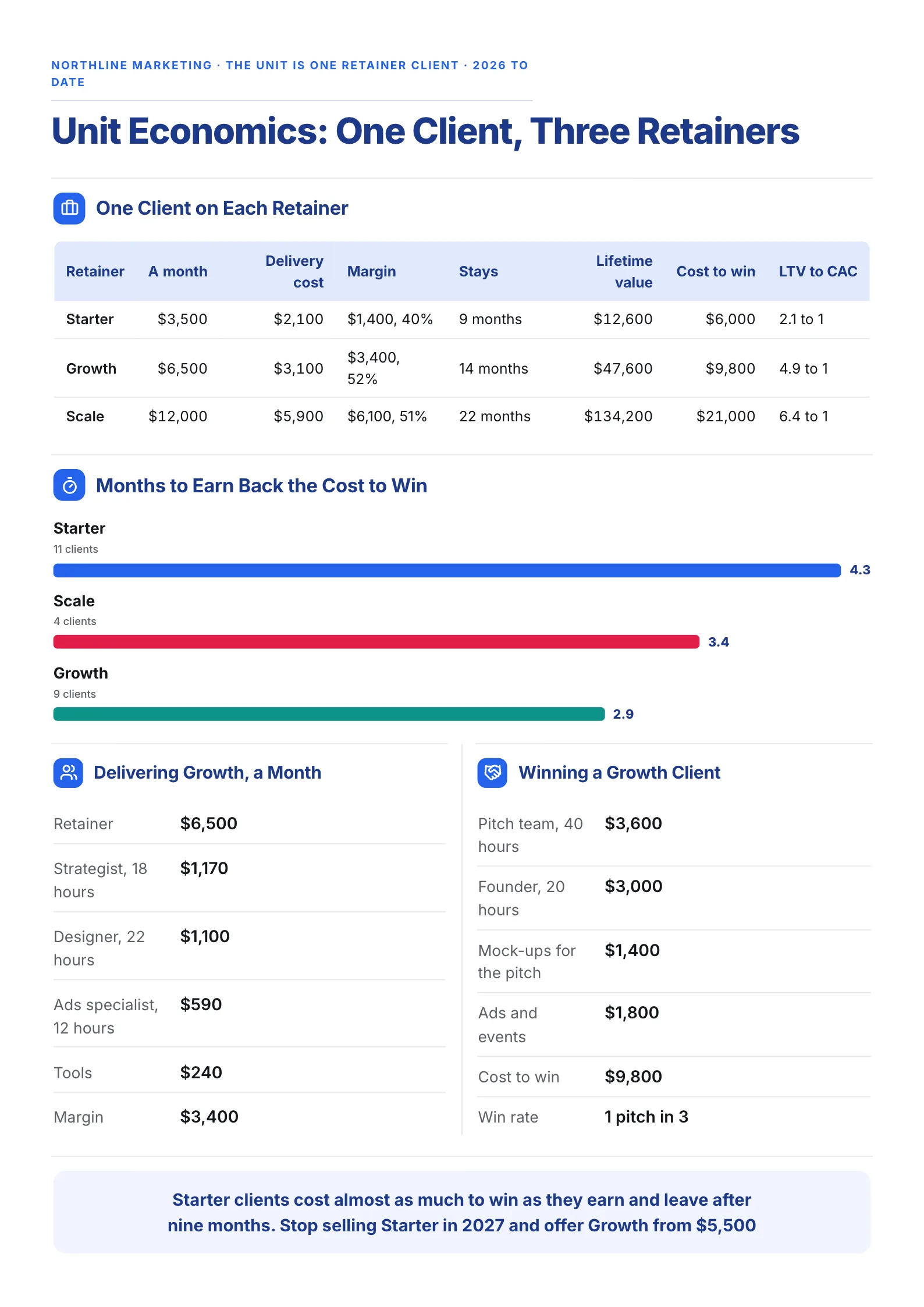
A monthly margin is only half of a plan's story. In this agency unit economics sample, a Growth retainer brings in $6,500 a month, costs $3,100 to deliver and leaves $3,400, a 52% margin. Winning that client costs $9,800, earned back in 2.9 months. How long clients stay changes the rest. Scale clients stay 22 months and return 6.4 times their cost to win, while Starter clients stay 9 and return 2.1.
 Edit this template
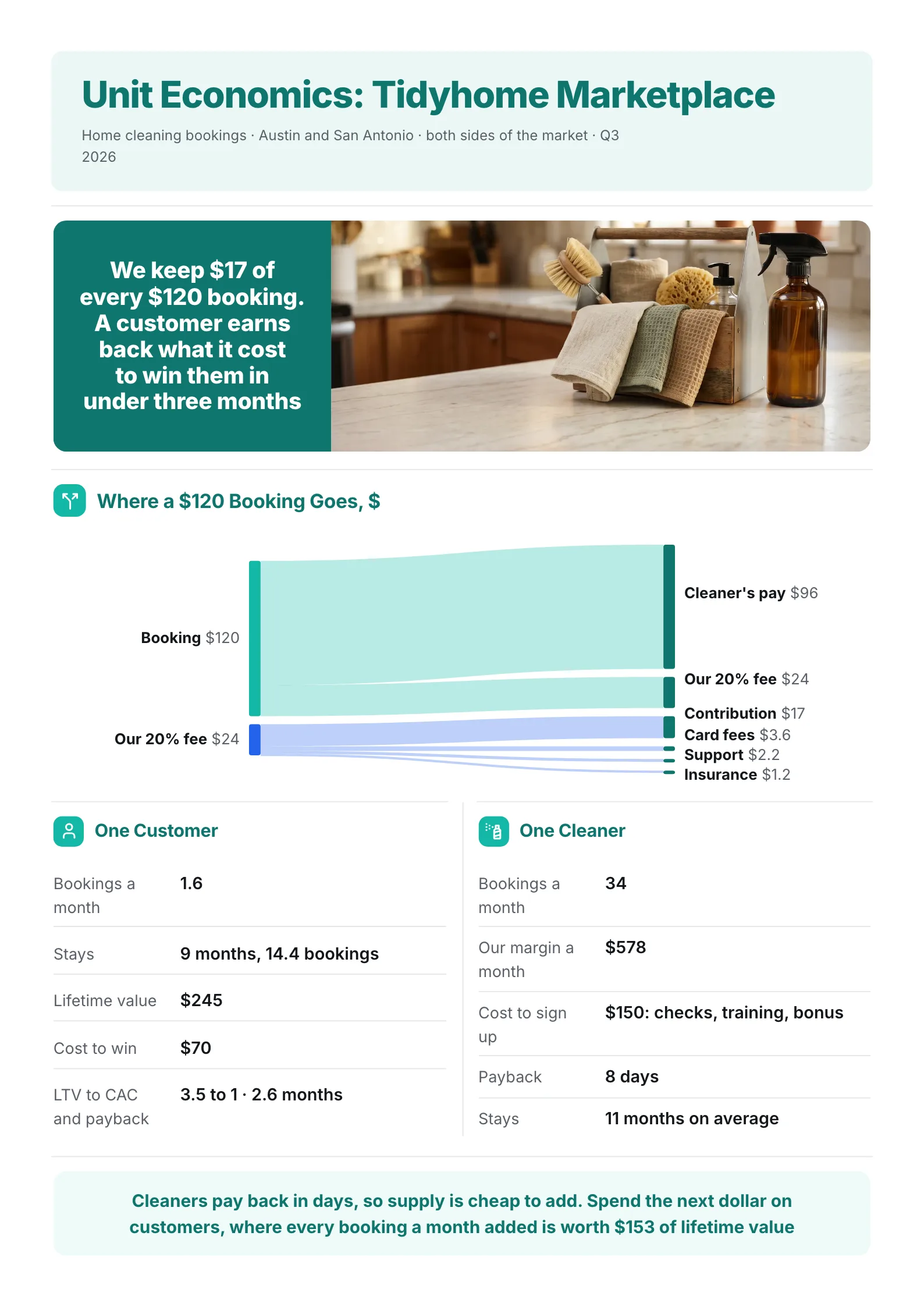
If you run a marketplace, most of the price was never yours. This marketplace unit economics sample keeps $17 of every $120 booking. That's the per-booking margin. The unit economics turn it into a customer: 1.6 bookings a month for 9 months makes 14.4 bookings and $245 of value, against $70 to win them. You'd earn that back in 2.6 months.
Which number answers your question
Use contribution margin when the question is about one sale:
- Pricing: will this price cover the goods, packing and delivery, with room left?
- A discount: how far can you cut before a sale stops paying for itself?
- Which product or channel: which one keeps the most from each sale, like the restaurant's tables against its app orders?
Use unit economics when the question is about growth:
- Ad spend: can you afford to pay more to win a customer, and how long until you earn it back?
- Which plan or segment to push: which customers stay long enough to repay their cost to win, like the car wash's Ultimate plan?
- Raising money: can you show that each new customer pays back what it cost to win?
Neither number usually counts general and admin costs. HelloFresh's report shows why those still matter. Its orders each left €4.42 after marketing, and general and admin and other costs took €4.43.
Put both numbers on one One-Pager
Open one of the MakeOnepagers unit economics samples above and type your own figures over the invented ones. Keep your contribution margin at the top and your cost to win on the line right under it, so nobody quotes one without the other. Already tracking orders and ad spend in Excel? Paste those rows into the free AI One-Pager generator and let it set out the margin and the cost to win side by side. For every formula step by step, read how to calculate unit economics. To pick your unit, browse these unit economics examples.
Frequently asked questions
Is contribution margin part of unit economics?
Yes. It's usually the first number in it. Unit economics starts with what one sale keeps, then adds what it cost to win that sale and how long the customer stays.
Does contribution margin include marketing costs?
Usually not. HelloFresh's annual report calls its contribution margin "margin development before marketing and G&A." Companies draw the line in slightly different places, so write down what yours includes and keep it the same every year.
Can a business have a good contribution margin and bad unit economics?
Yes. If winning each customer costs more than they'll ever bring in, a strong margin on every sale won't save you. In HelloFresh's 2025 numbers, marketing took €12.38 of each order's €16.80 margin.
Are fixed costs in either number?
Usually not. Rent, office salaries and other fixed costs sit outside both. The OpenStax textbook's example sells a birdbath for $100 with $20 of variable cost, leaving $80 "to contribute toward covering fixed costs, such as rent, insurance, and manager salaries."




