How to Calculate Unit Economics in 5 Steps
How to calculate unit economics in 5 steps: pick your unit, find its margin, its cost to win and its lifetime value, then check it against 2 real filings.

To calculate unit economics, you find out what one customer, order or subscription earns you, then compare that to what it cost you to get it. You need your margin, your spend, your new customers and how long a customer stays, and you can work them out with a calculator and last quarter's books. Start from a free one pager template.
One‑Pager examples
Real One-Pagers made with MakeOnepagers. Open any one to edit it as your own.
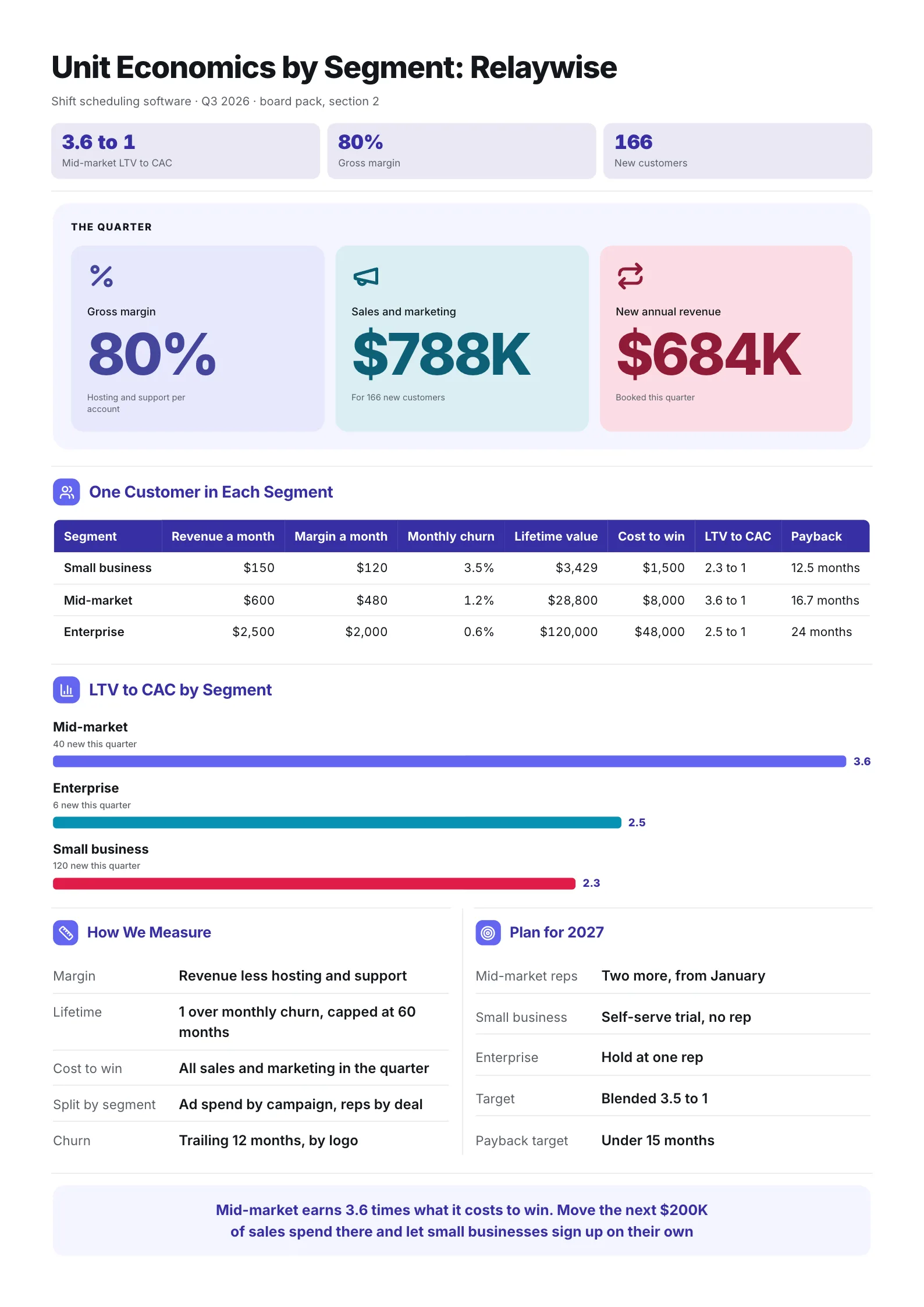 Unit Economics: SaaS by SegmentEdit for free(opens in a new tab)
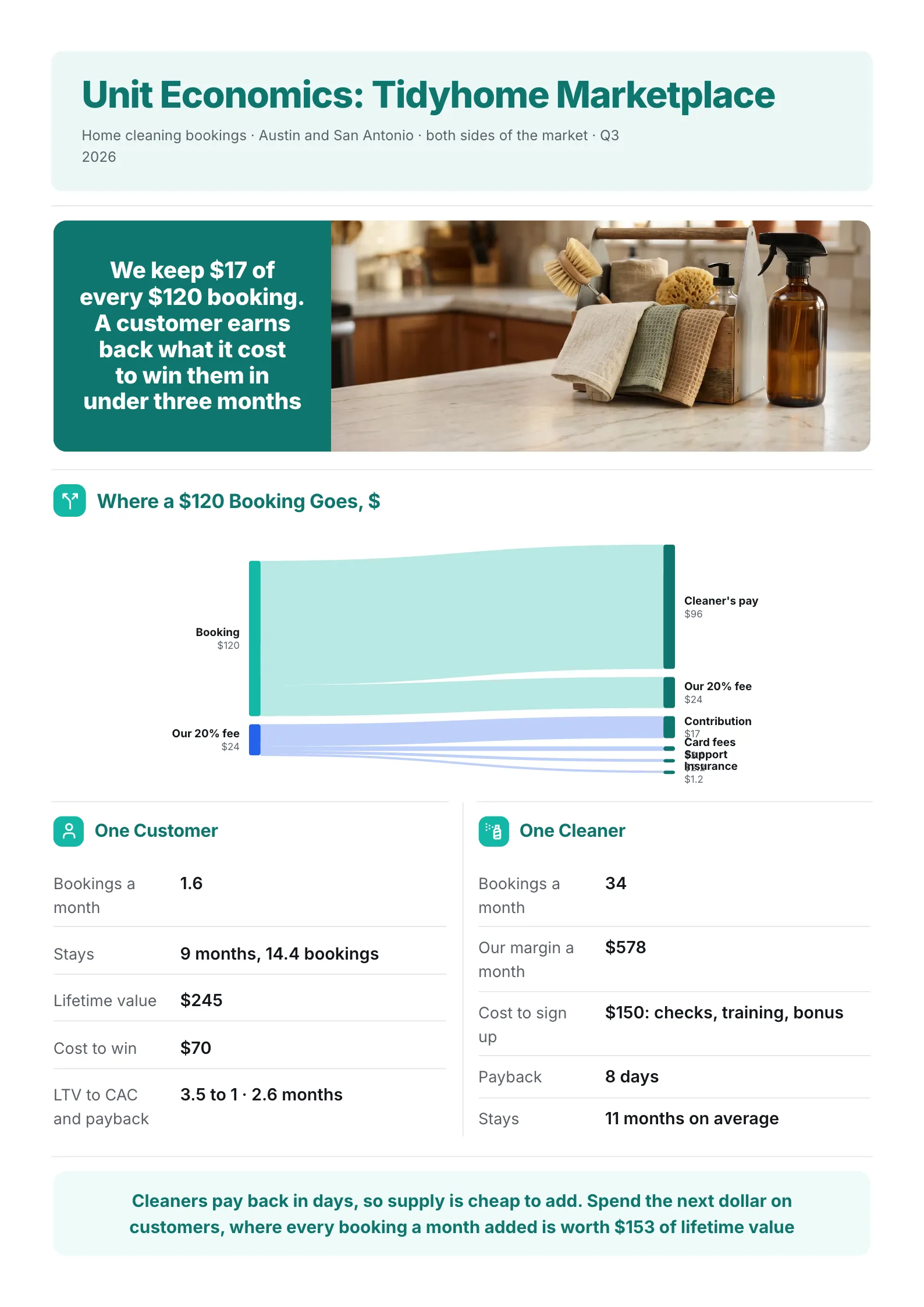 Unit Economics: Two-Sided MarketplaceEdit for free(opens in a new tab)
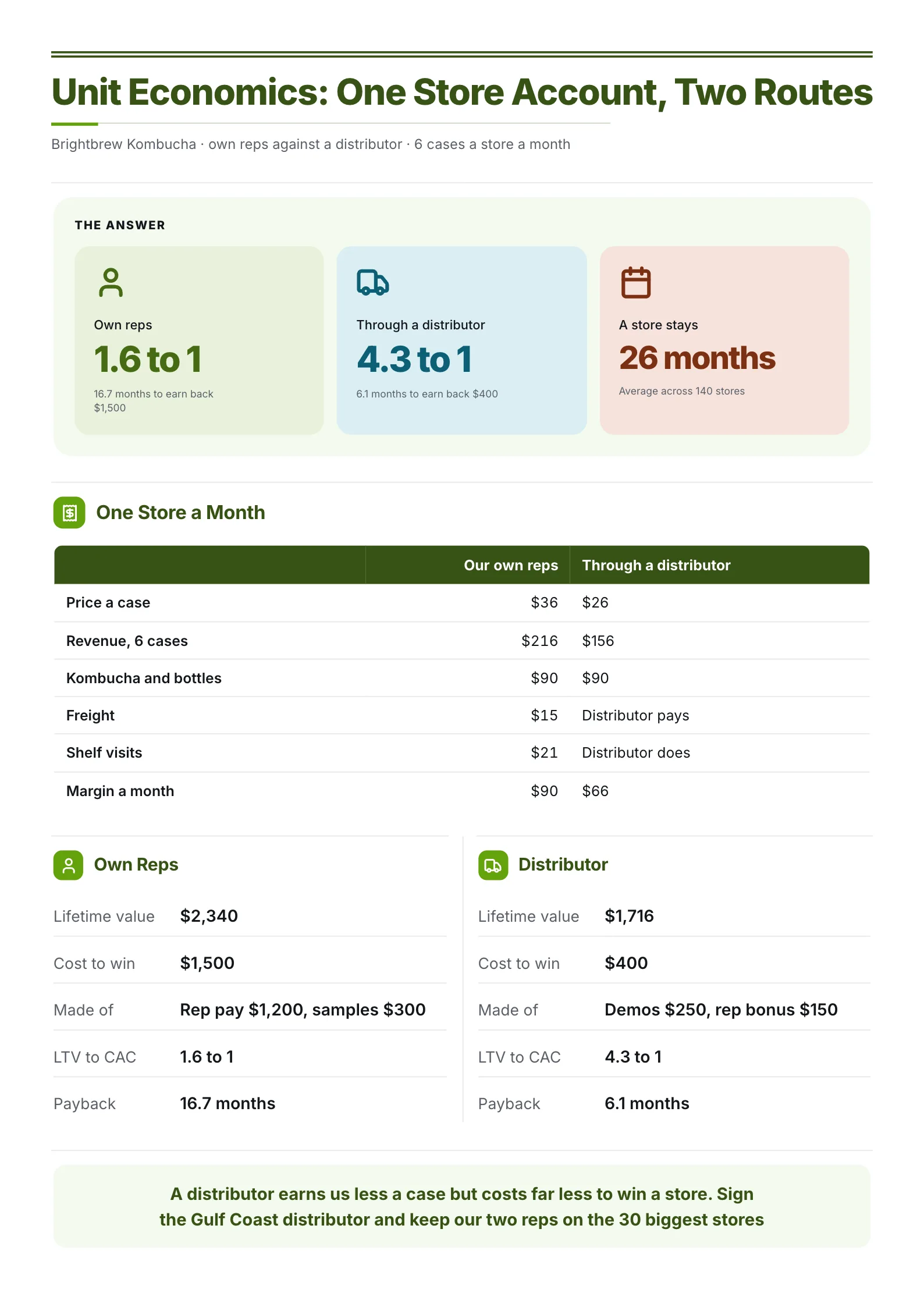 Unit Economics: Wholesale, Two RoutesEdit for free(opens in a new tab)
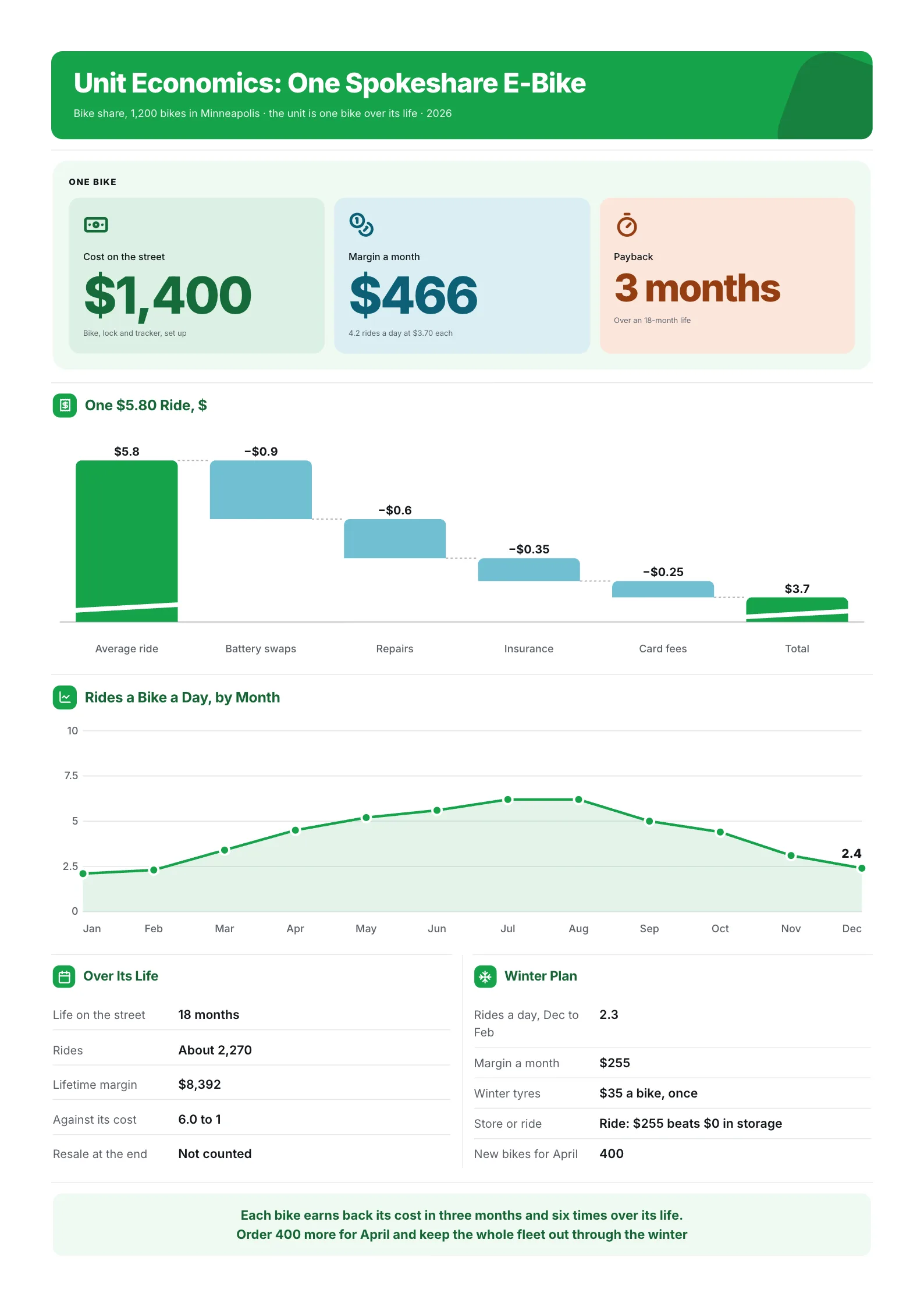 Unit Economics: Bike Share per BikeEdit for free(opens in a new tab)
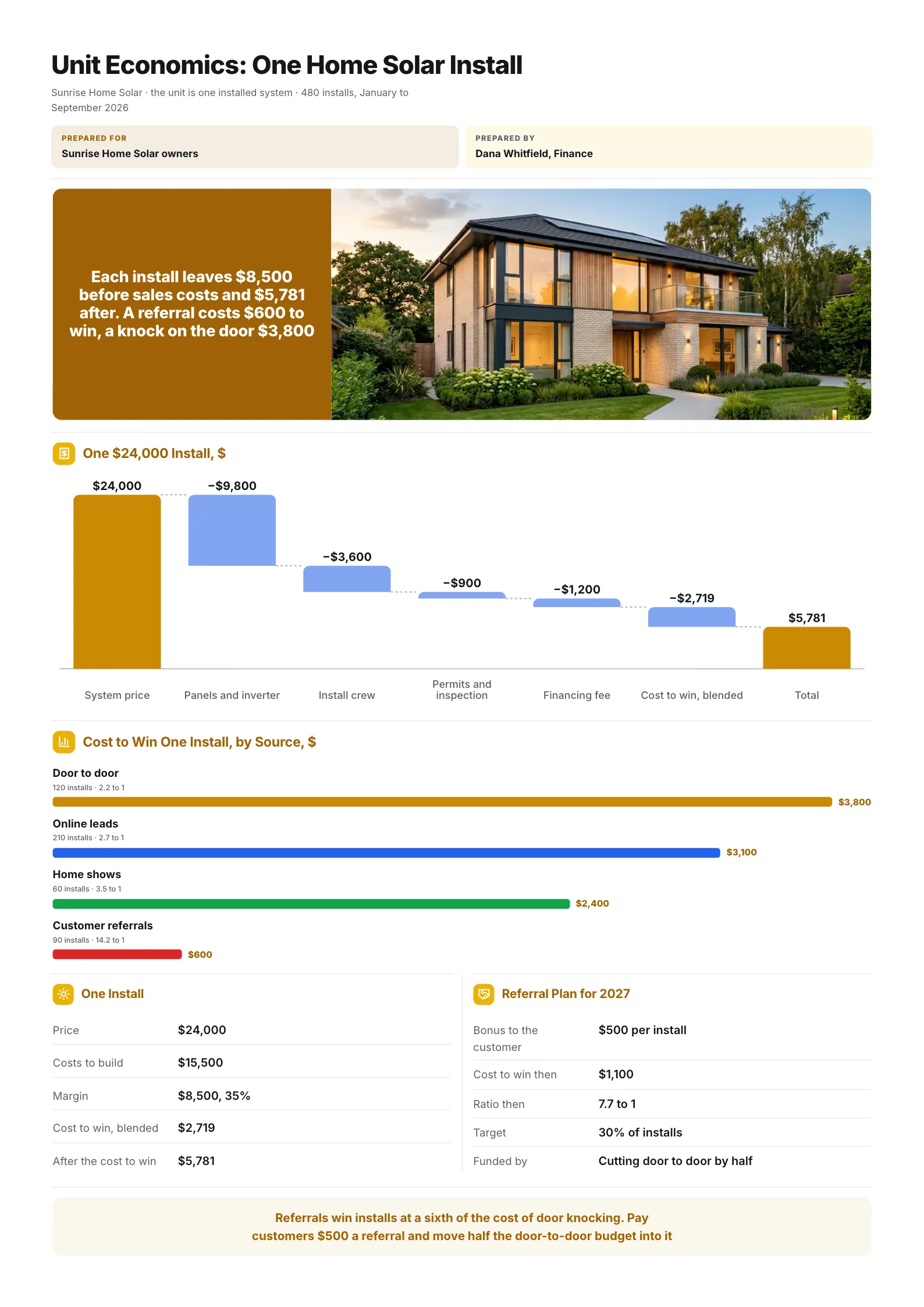 Unit Economics: Home Solar per SaleEdit for free(opens in a new tab)
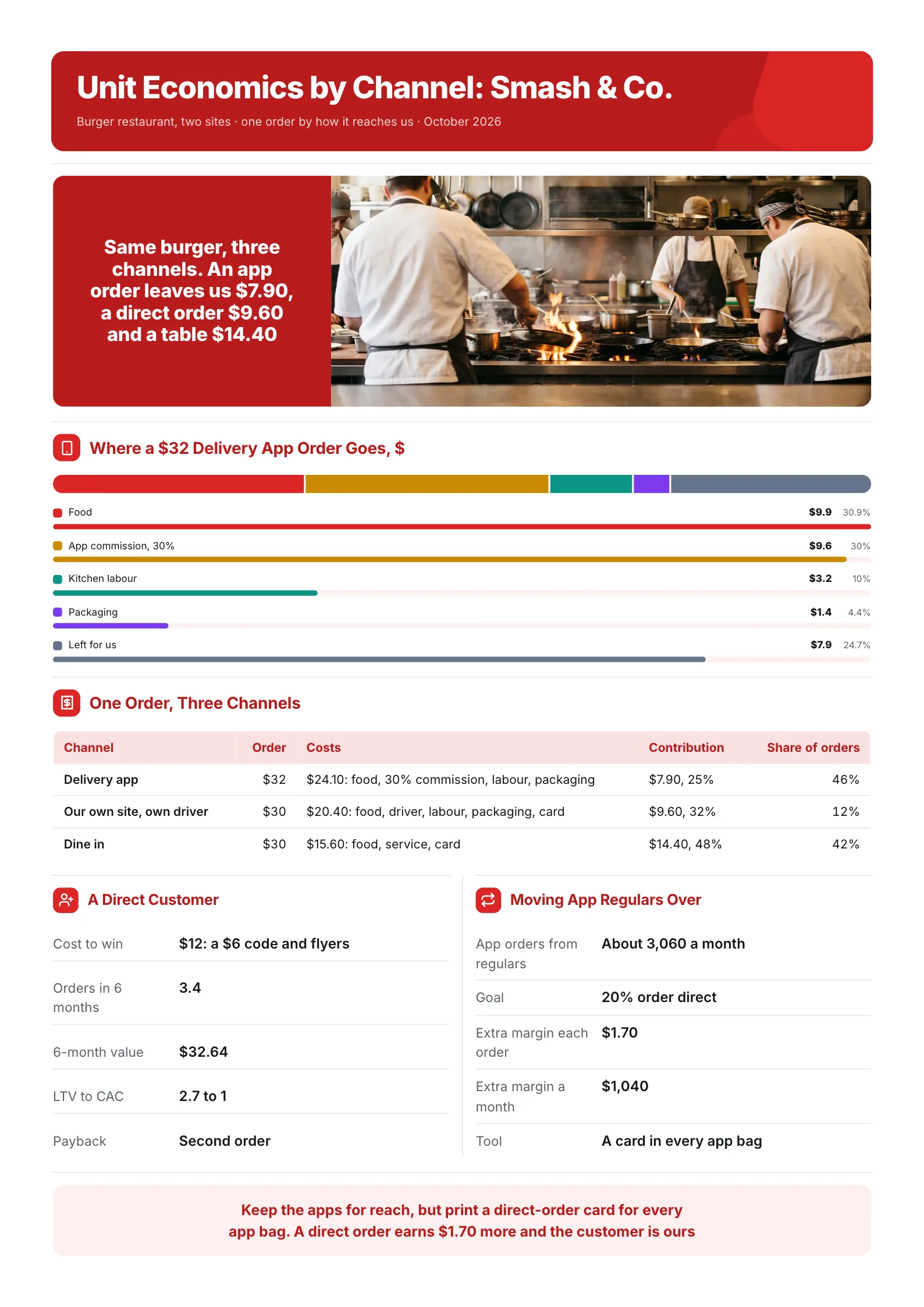 Unit Economics: Restaurant by ChannelEdit for free(opens in a new tab)
We also read how two public companies report these numbers to the SEC, because a 10-K can show what's counted, and MarketWise's does. That shows you where your math can go soft. The worked examples below are one-page samples from MakeOnepagers, with invented companies and sums you can check.
What two 10-Ks tell you to count
| Company | What it reports | What's inside the number |
|---|---|---|
| MarketWise, financial research subscriptions, 2025 | LTV/CAC of about 2.0x, against 1.3x a year earlier; lifetime billings of about $2,031 per paid subscriber | CAC is direct marketing, revenue share, retention and renewal expenses, copywriting and marketing salaries, telesales pay and customer service commissions |
| Dave, banking app, 2025 | About $19 to win a member; payback in under four months | The filing gives the two results, without the breakdown |
MarketWise's list is the useful part for you. Its cost to win a customer includes salaries. If your number counts only ad spend, it will look better than theirs and mean less.
The same filing explains why people quote 3 to 1. MarketWise says a ratio "above 3x is considered to be indicative of strong profitability and marketing efficiency," and then reports its own at about 2.0x. Treat 3 to 1 as a common yardstick, and read your payback beside it.
Step 1: Pick your unit
Your unit is whatever you sell that repeats. It might be one subscriber, one order, one patient or one bike. Choose the one your costs follow.
 Edit this template
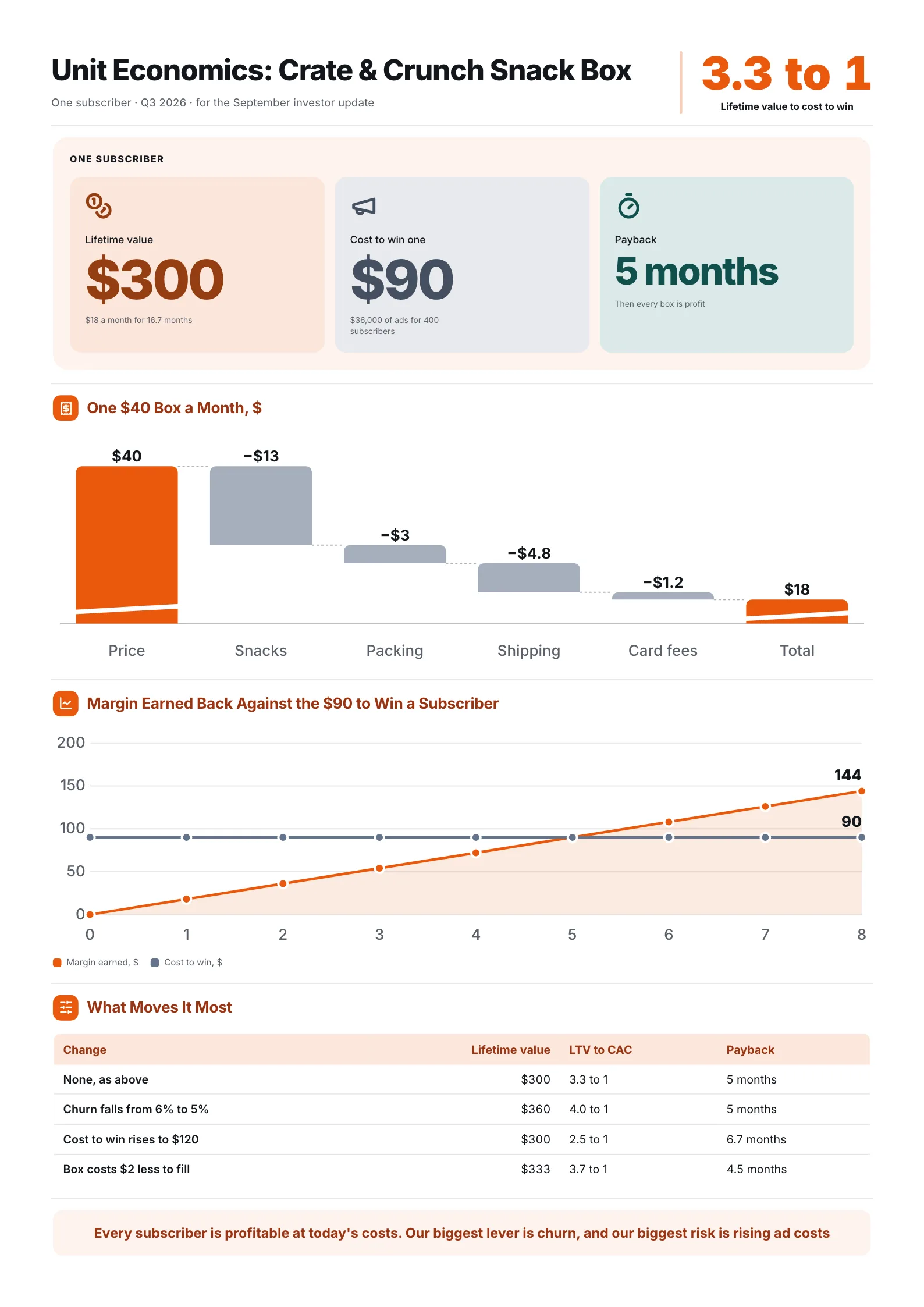
One subscriber is the unit here, because each one brings a box a month and a set of costs that repeats.
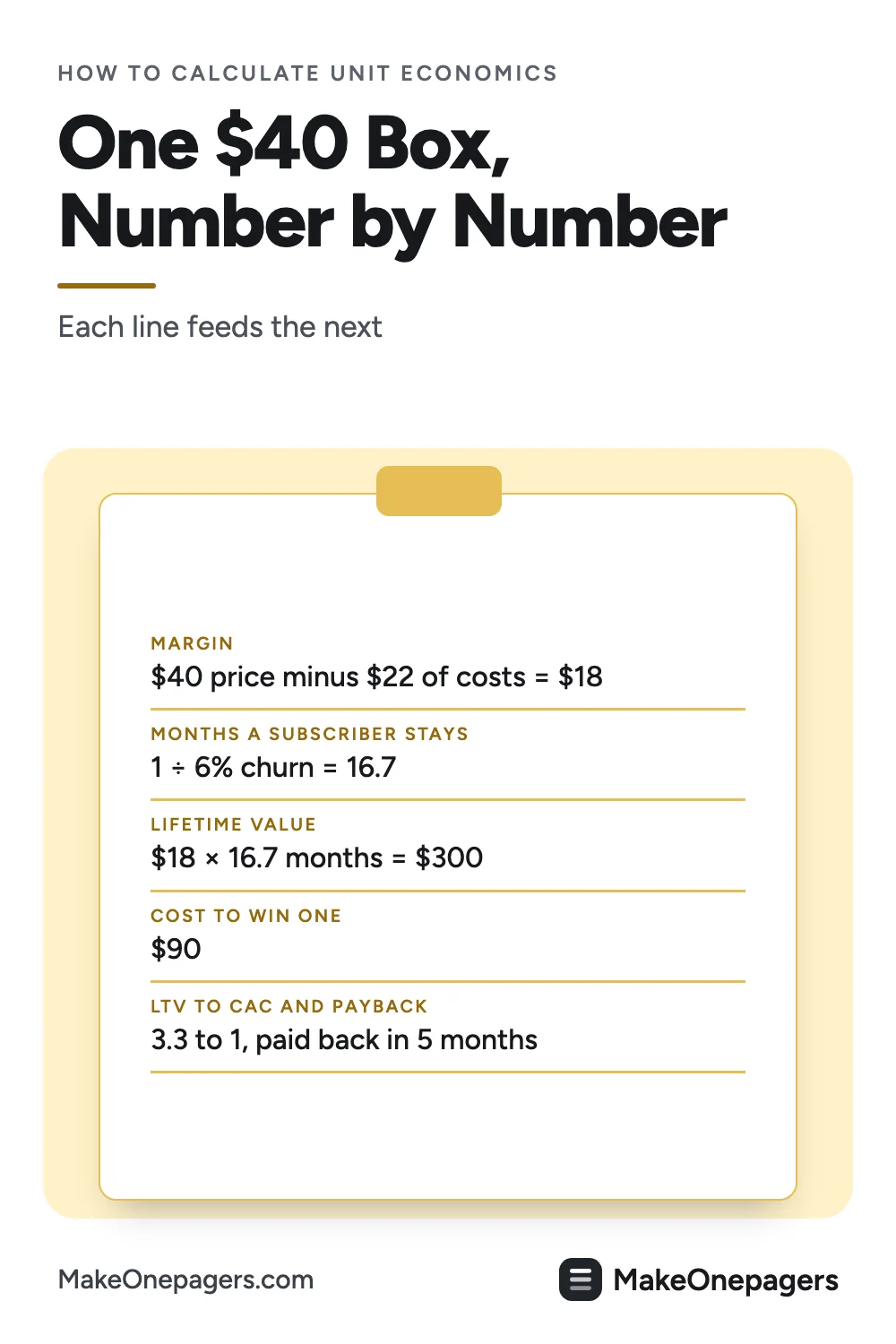
We'll use this snack box for the math below. Follow along with your figures.
Step 2: Find the margin on one unit
Take your price and subtract every cost that happens only because you sold that unit. For a box, that's snacks, packing, shipping and card fees. Leave out rent and your salary, since those stay the same at 400 subscribers or 500.
Margin = price minus variable costs
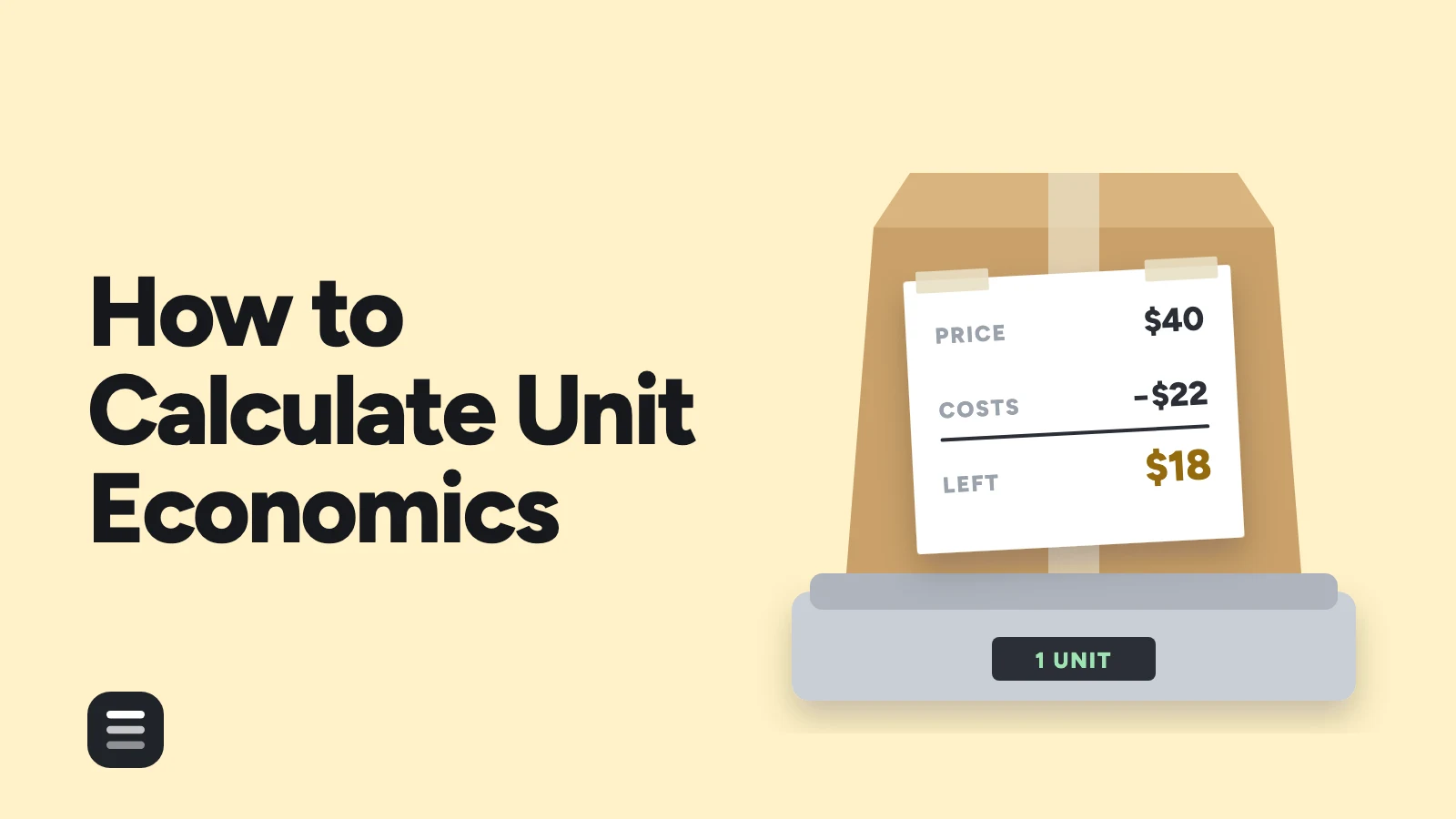
Crate and Crunch charges $40 and keeps $18 a month after those costs. Run this on your best seller first, because your busiest product is where a small error costs the most.
Step 3: Work out your cost to win one
Add everything you spent on sales and marketing in a period, then divide by the new customers you won in that period.
CAC = sales and marketing spend ÷ new customers
The snack box spent $36,000 on ads and won 400 subscribers, so each one cost $90. Now look again at MarketWise's list and ask what your number leaves out. Add your salesperson, your agency fee and the commissions you pay.
 Edit this template
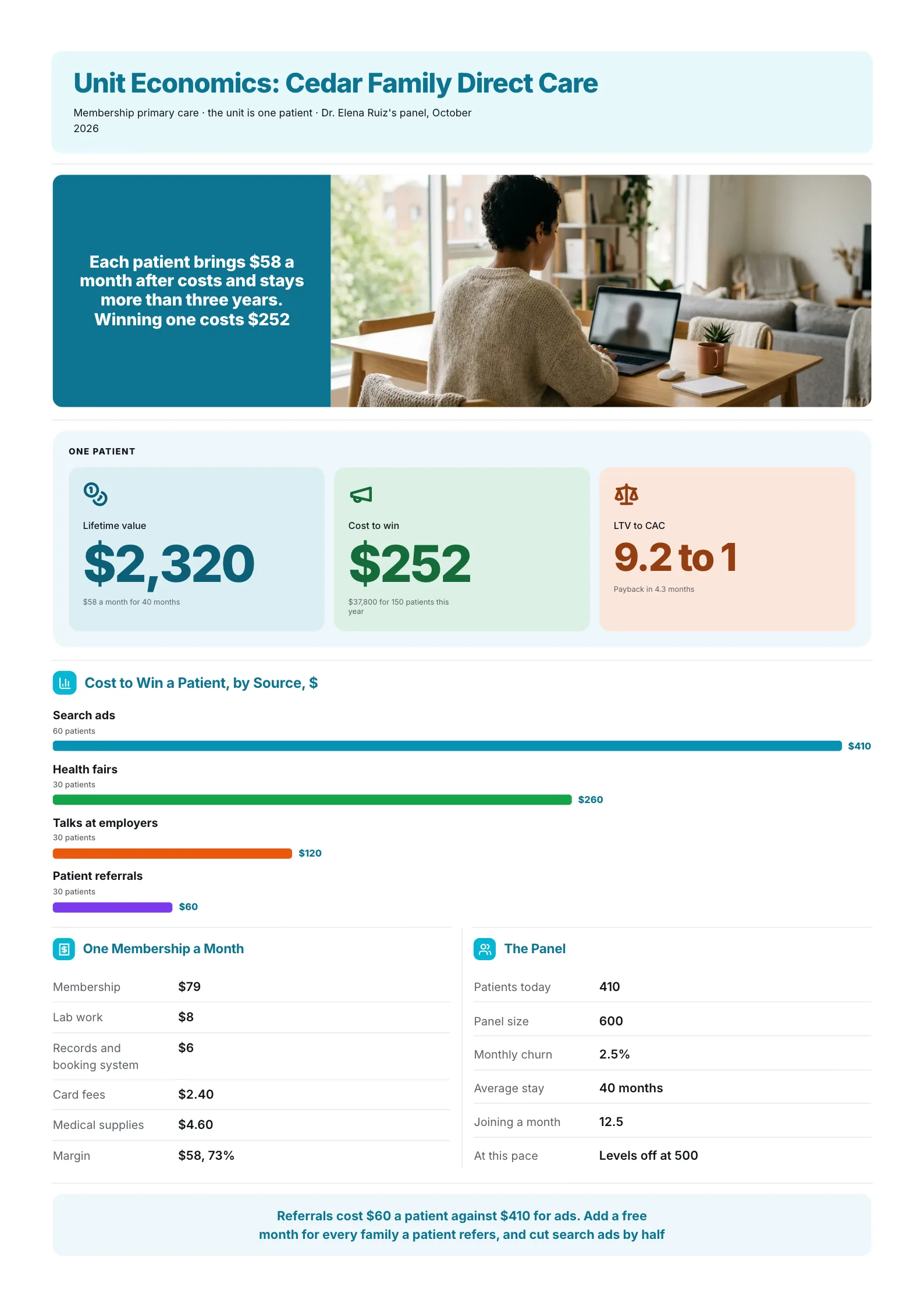
$37,800 divided by 150 patients gives $252, and the sheet prints that sum so a reader can check it.
Step 4: Work out what one customer is worth
Multiply your monthly margin by how long a customer stays. If you don't know how long they stay, divide 1 by your monthly churn rate. At 6% of subscribers leaving a month, the average one stays about 16.7 months.
Lifetime value = margin a month × months a customer stays
So the snack box gets $18 × 16.7, or about $300. Notice this uses margin and leaves revenue alone. MarketWise defines lifetime value the same way, as "the average margin on average customer lifetime Billings." Using revenue instead would make your number look far better than it is.
Customers who buy now and then need a different sum, because they don't pay monthly. Multiply your margin per order by the orders a typical customer places in a window you can see, such as 12 months, and print that window on the page. That's a sensible limit when your data is young, since you can't yet know who'll still be buying in year three.
When margin and length of stay change by price tier, do the sum once per tier.
 Edit this template
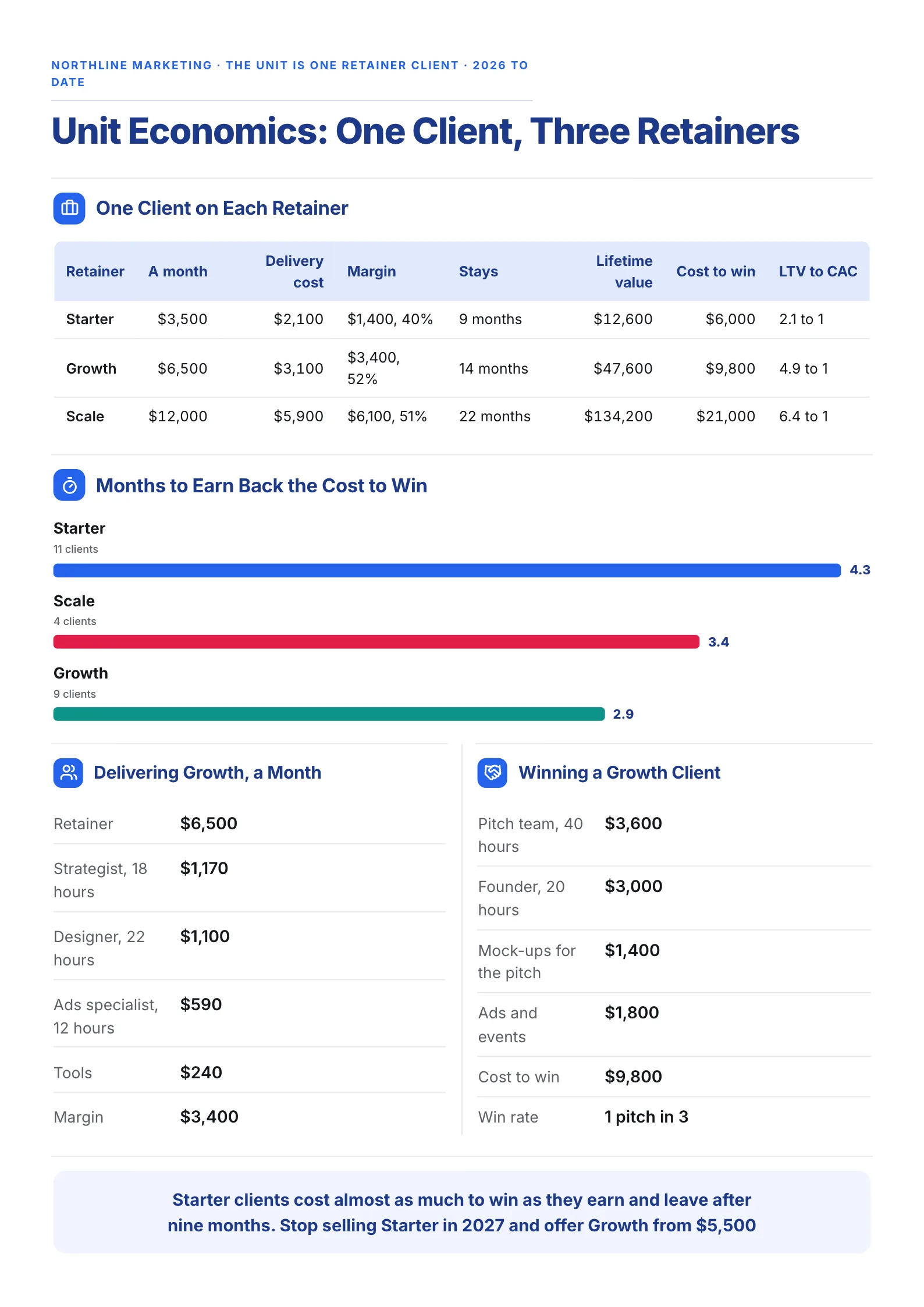
Starter's $12,600 of lifetime value against $6,000 to win comes to 2.1 to 1, the weakest of the three.
Step 5: Compare the two, and find your payback
You now have the two sums that matter.
LTV to CAC = lifetime value ÷ cost to win
Payback in months = cost to win ÷ margin a month
For the snack box, that's $300 ÷ $90, or about 3.3 to 1, and $90 ÷ $18, or 5 months. Payback tells you how long your cash is out. Dave's filing reports it beside CAC, at under four months, and it matters most when you're paying for growth out of your bank account.
 Edit this template
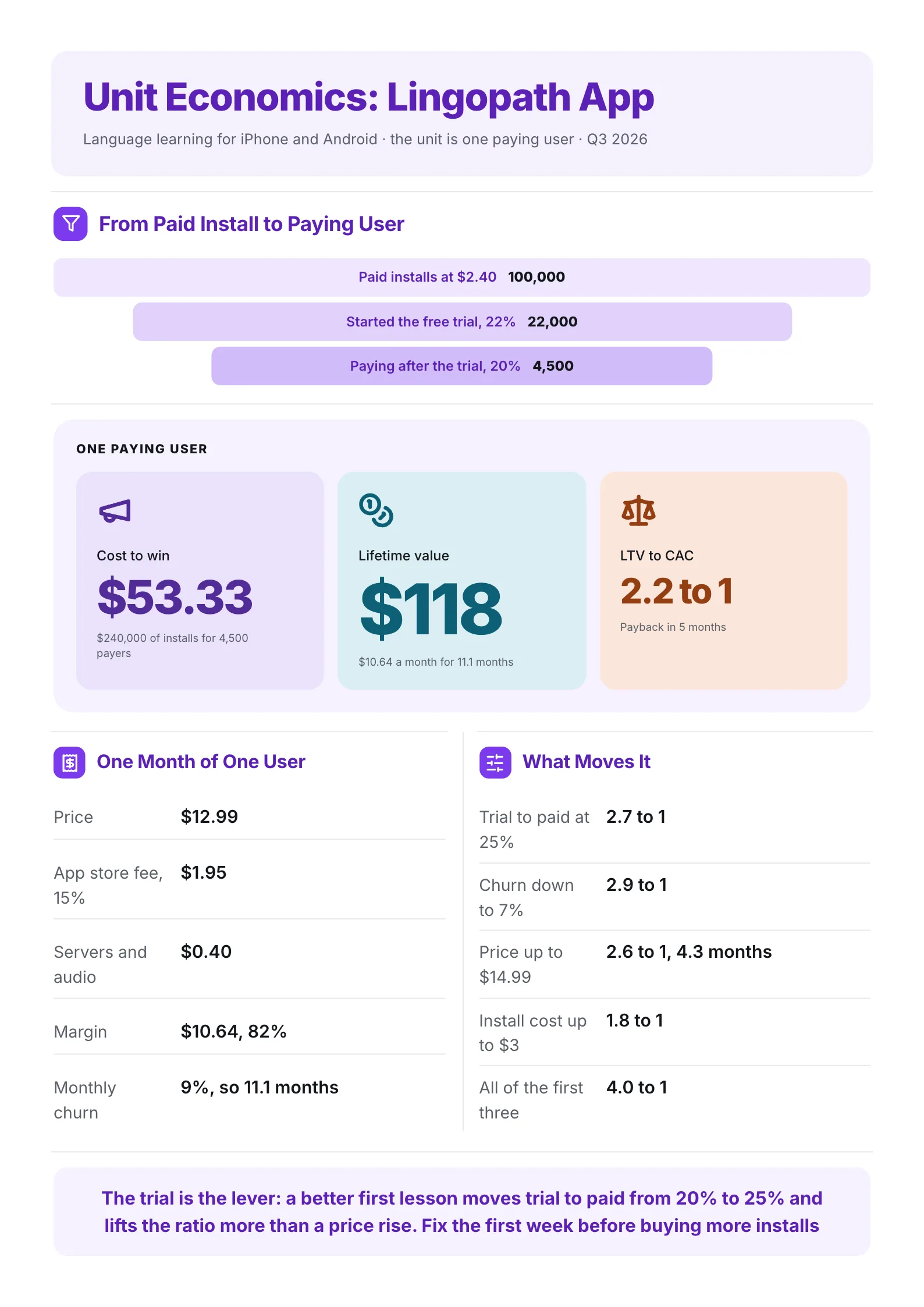
This app sits at 2.2 to 1, below the common yardstick, with the same 5 month payback as the snack box.
Compare Lingopath to the snack box. Their payback is the same, yet the ratio is far lower, because app users leave after 11 months. A single number would have hidden that, so print both on your page.
Split the number before you trust it
A blended average can hide a channel that loses money. Run the five steps again for each ad channel, plan or customer type you sell to.
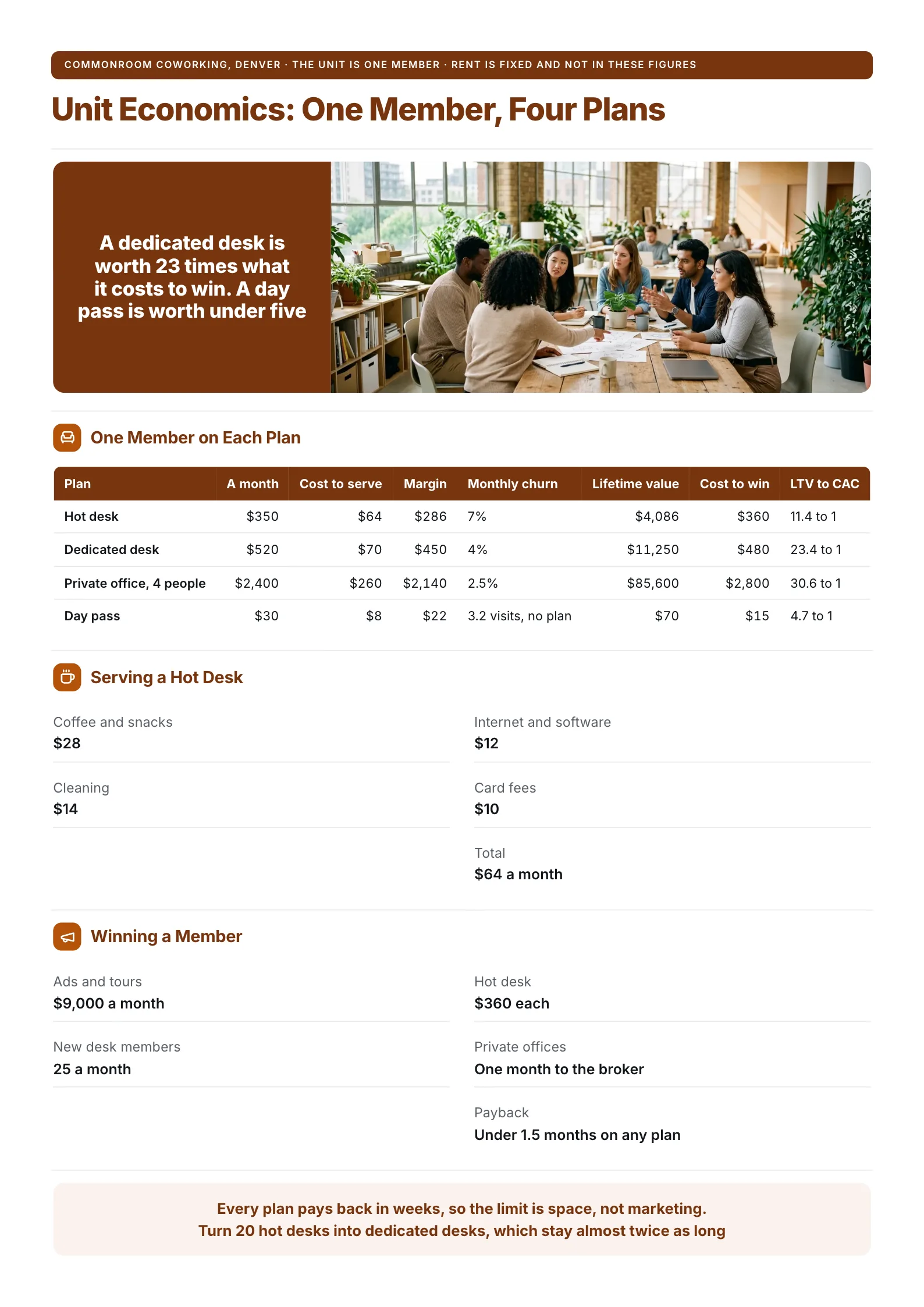 Edit this template
Same building, four plans, and very different answers.
Commonroom's rent is fixed, so the sheet says plainly that it isn't in these figures. Your page should say what you left out, too.
Frequently asked questions
Does salary count in CAC?
Count the pay of anyone whose job is winning customers. MarketWise includes marketing salaries, telesales pay and commissions in its own figure. Founders doing the selling themselves can estimate what a salesperson would cost, so the number holds up when you hire one.
Should you use gross margin or contribution margin?
Use the margin after every cost that rises with each sale. That often sits below your gross margin, since shipping, card fees and support may not be in your cost of goods.
What if you have no churn data yet?
Use a short window. Count only 12 months until you have a longer record, and say so on the page.
Is lifetime value based on revenue or margin?
Margin. MarketWise defines it as "the average margin on average customer lifetime Billings," and revenue would flatter your number.
How do you calculate customer acquisition cost?
Divide your sales and marketing spend for a period by the new customers you won in that period. Include pay and commissions along with your ads.




