BlogGuide
Science One Pager: What to Include, With a Real Example
A science one pager template and a real example: the water cycle built only from the USGS Water Science School, every number traced to its source.

By MakeOnepagers Team
Updated · 7 min read
A science one pager explains one concept on a single sheet: what it is, the numbers that matter, how the process works step by step, the words a student needs, a diagram, and why it matters. The top results for this search on 12 October 2026 were a short teacher blog post with photos of student work and a product page, so this guide builds a real one instead: the water cycle, written only from the USGS Water Science School, with every number traced to its source. Below: what to include, the example, a template, topic ideas and the mistakes to avoid.
One‑Pager examples
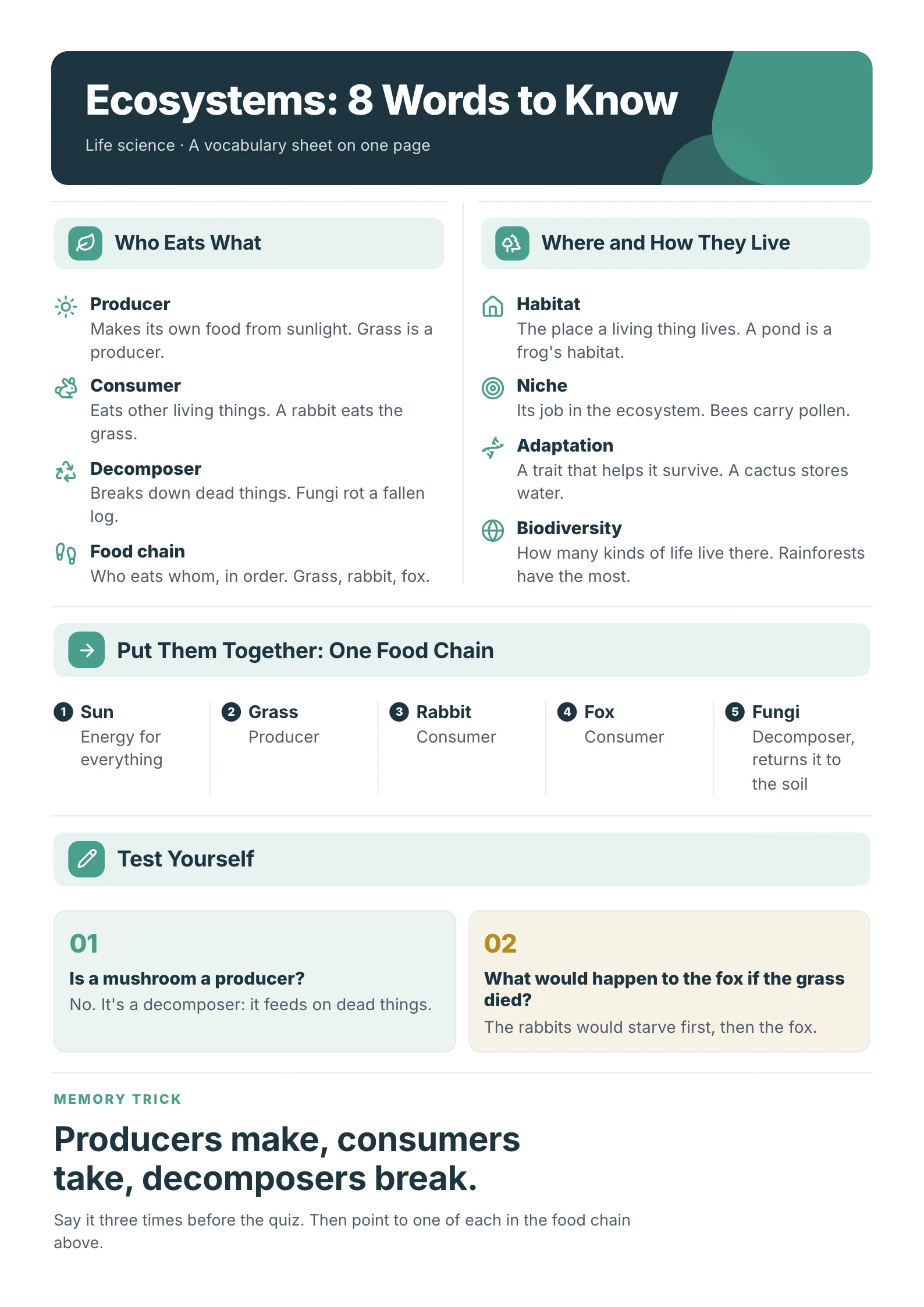
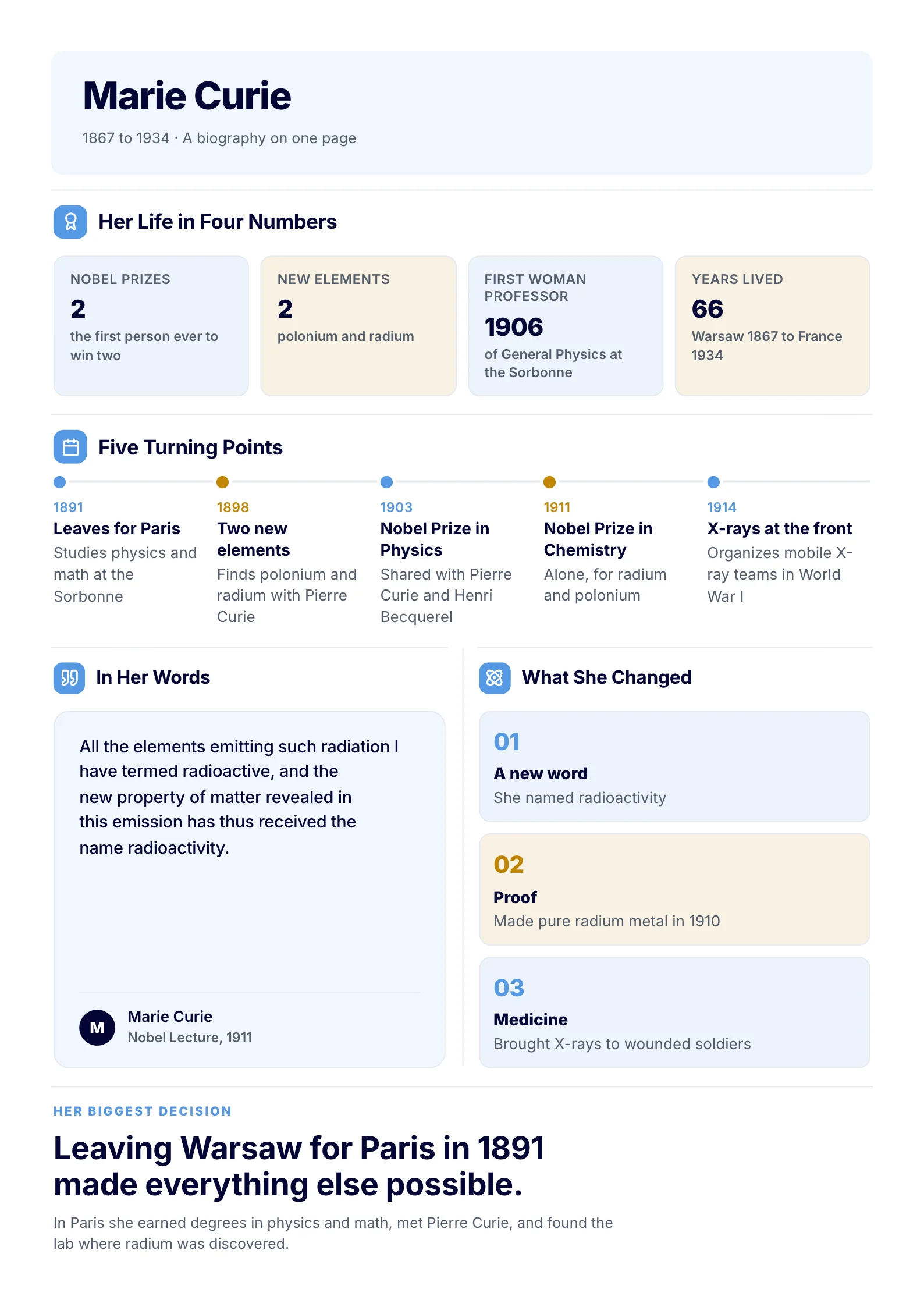
Real One-Pagers made with MakeOnepagers. Open any one to edit it as your own.


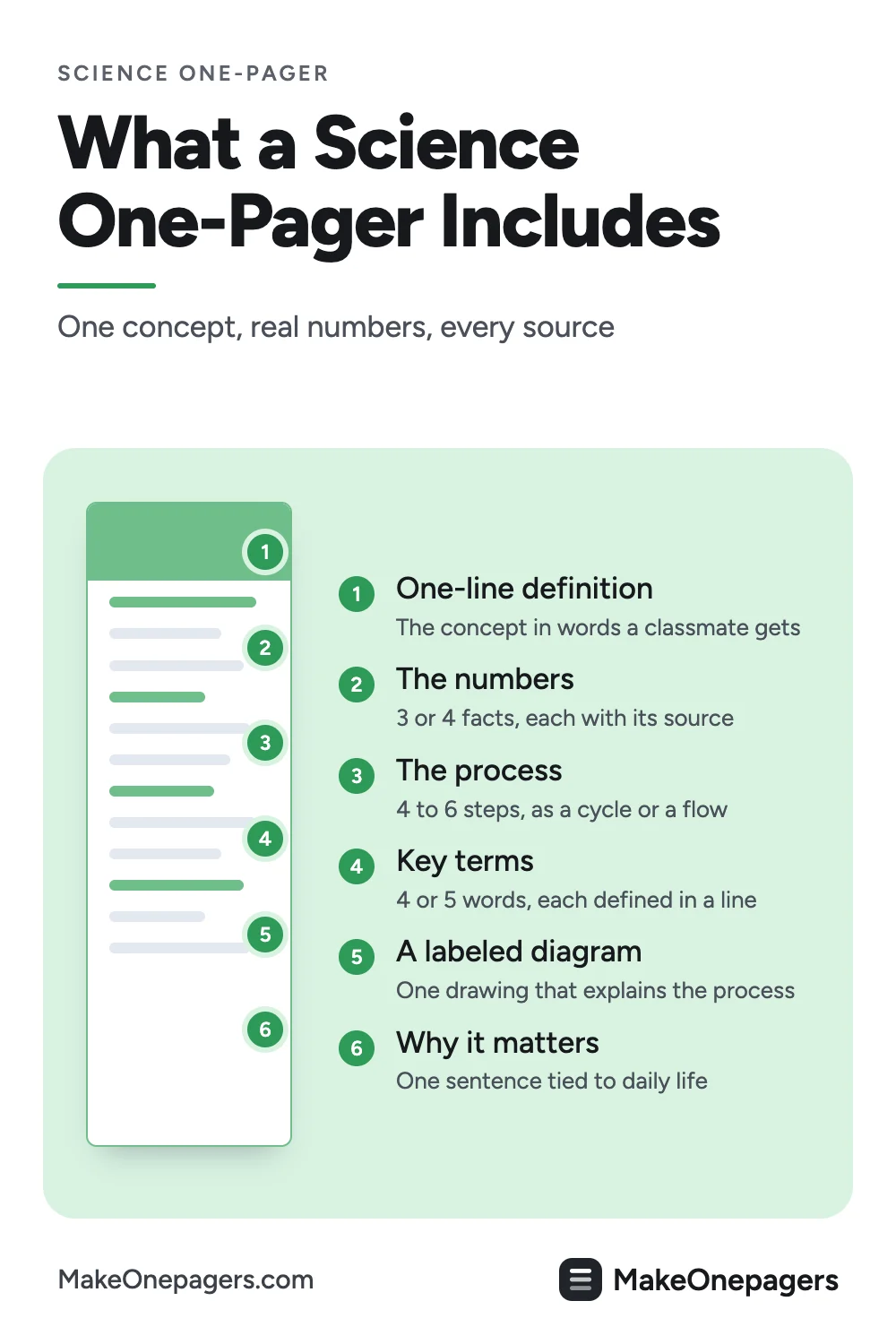
What a science one pager includes
| Part | What it shows |
|---|---|
| Title and one-line definition | The concept, in one sentence a classmate would understand |
| The numbers | Three or four facts that are easiest to remember as numbers, each with its source |
| The process | The steps in order, as a cycle, a flow or a timeline |
| What drives it | The cause or energy behind the process |
| Key terms | Four or five words, each defined in a line |
| A diagram | One drawing that explains the process, labeled |
| Why it matters | One sentence connecting the concept to daily life |
| Source | Where the facts came from |
The difference from a reading one pager is the evidence. A science one pager should carry real measurements, and each one should say where it came from.
A real example: the water cycle
Every fact below is from two USGS Water Science School pages, "Where is Earth's Water?" and "The Fundamentals of the Water Cycle", read on 12 October 2026. The numbers in the USGS table come from a 1993 estimate by Igor Shiklomanov, published in Water in Crisis, edited by Peter H. Gleick.
The big idea
The water cycle describes where water is on Earth and how it moves between the places it is stored.
Where Earth's water is, in numbers
| Number | What it means |
|---|---|
| About 332.5 million cubic miles | All the water on Earth |
| 96.54% | The share in oceans, seas and bays, which is salty |
| 2.5% | The share that is fresh water |
| 68.7% | The share of fresh water locked in ice caps, glaciers and permanent snow |
| 30.1% | The share of fresh water that is underground |
The USGS notes that its percentages are rounded, so they do not add to exactly 100.
How water moves
- Evaporation: the sun's energy turns liquid water into water vapor.
- Evapotranspiration: the main way water moves into the air from the land and oceans.
- Condensation: water vapor condenses in the air and forms clouds.
- Precipitation: rain, snow and hail fall back to the surface.
- Runoff and streamflow: water moves across the land into rivers.
- Infiltration: water soaks into the ground and recharges groundwater.
What drives it
Two forces, according to the USGS: energy from the sun, which evaporates water, and gravity, which makes rain fall and water flow downhill.
Key terms
- Pool: a place where water is stored, such as an ocean, a glacier or an aquifer.
- Flux: the movement of water from one pool to another.
- Aquifer: rock that holds groundwater in its cracks and pores.
- Saline: salty. Ocean water is saline.
Why it matters
Rivers and lakes hold about 22,300 cubic miles of fresh water, roughly 1/150th of one percent of all Earth's water, yet the USGS says they are the source of most of the water people use every day.
That fits on one sheet. The USGS pages hold far more: a 15-row table, a section on how people change the cycle and one on climate change. The one pager keeps the facts that explain the concept and leaves the rest for a second sheet.
The layout: what one page looks like
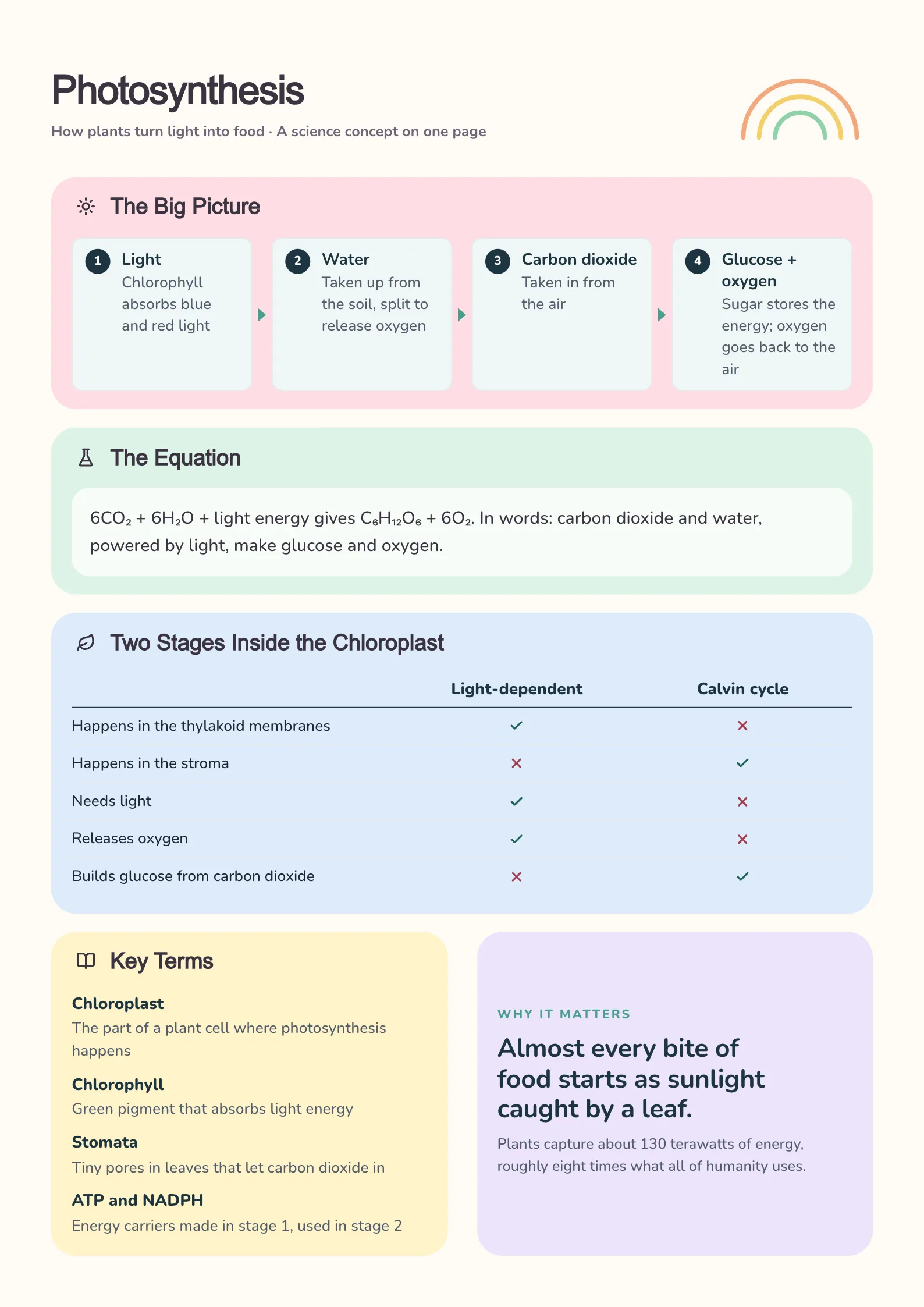
Our library's science concept template uses the same parts for a different concept:
 Edit this template
A sample science concept on one page: the process in four steps, the equation, a comparison table, key terms and a closing line.
What to copy:
- The process as numbered steps with arrows between them, right under the title.
- The equation or rule written in words as well as symbols.
- A comparison table when a concept has two stages or two types.
- Key terms in their own box, one line each.
- A large closing line on why it matters.
Open it: science concept template.
A free science one pager template
| Part | What to write |
|---|---|
| Title | The concept, and one line on what it is |
| The numbers | 3 or 4 facts as numbers, each with a label and source |
| The process | 4 to 6 steps, in order, one line each |
| What drives it | 1 or 2 causes |
| Diagram | One labeled drawing of the process |
| Key terms | 4 or 5 words, one-line definitions |
| Why it matters | One sentence |
| Source | The organization, page title and date you read it |
How to make it in 6 steps
- Choose one concept, not a whole unit. "The water cycle" fits; "Earth science" does not.
- Find one reliable source: a government science agency, a museum, a university or your textbook.
- Write down every number with where you found it.
- Put the process in order and draw it once, with labels.
- Pick four or five terms a classmate would need, and define each in a line.
- Write the "why it matters" line last, once you understand the concept.
If your teacher allows it, you can type your notes into the free AI One-Pager generator for a first layout, then check every number against your source and add your own diagram.
Science one pager topic ideas
| Subject | Topics that fit one sheet |
|---|---|
| Life science | Photosynthesis, cell division, food webs, the parts of a cell |
| Earth science | The water cycle, the rock cycle, plate tectonics, the seasons |
| Physical science | Potential and kinetic energy, states of matter, Newton's laws, circuits |
| Space science | The phases of the Moon, a planet profile, how stars form |
| Science careers | What a scientist in one field does, the tools they use, the training it takes |
Each one has a process or a structure to draw and a few numbers to check, which is what makes a strong science one pager.
Science one pager mistakes
| Mistake | Fix |
|---|---|
| A whole unit on one sheet | One concept |
| Numbers with no source | Name the source next to each one |
| A decorative drawing | A labeled diagram that explains the process |
| Steps out of order | Number them, or draw them as a cycle |
| Terms copied from a glossary | Define each in your own words, in one line |
| No point | One sentence on why it matters |
Make your science one pager
Pick one concept and one reliable source, fill in the template table above, and draw the process once with labels. To lay it out, open the free science concept template and replace the sample with your concept.
Frequently asked questions
What should be on a science one pager?
A title and one-line definition, three or four numbers with their source, the process in order, a labeled diagram, key terms and one sentence on why it matters.
How do I make a science one pager stand out?
Use real measurements from a reliable source and a diagram that explains something, not just decorates. A clear "why it matters" line does more than extra color.
Where can I find reliable facts for a science one pager?
Government science agencies, museums, universities and your textbook. For the water cycle, the USGS Water Science School publishes the numbers and their source.
How many facts should a science one pager have?
Three or four numbers and four to six process steps fit on one sheet. Keep the rest for your notes.
Can I use a template for a science one pager?
Yes. A template gives you the parts; your research, numbers and diagram make it yours.