BlogGuide
Policy Brief Template: Free, One Page, 3 Examples
A free one-page policy brief template, the 6 parts a decision-maker reads, and 3 examples: a transport policy, a council housing report and a research funding review.

By MakeOnepagers Team
Updated · 6 min read
A policy brief template gives a busy decision-maker what they need in the order they need it: the finding, the evidence behind it, the options, one recommendation and what it costs. Committees, councils, boards and ministers read dozens of papers a week. A brief that fits on one page is the one that gets read before the vote. Below are the six parts every policy brief needs, a free template you can copy, and three examples.
One‑Pager examples
Real One-Pagers made with MakeOnepagers. Open any one to edit it as your own.
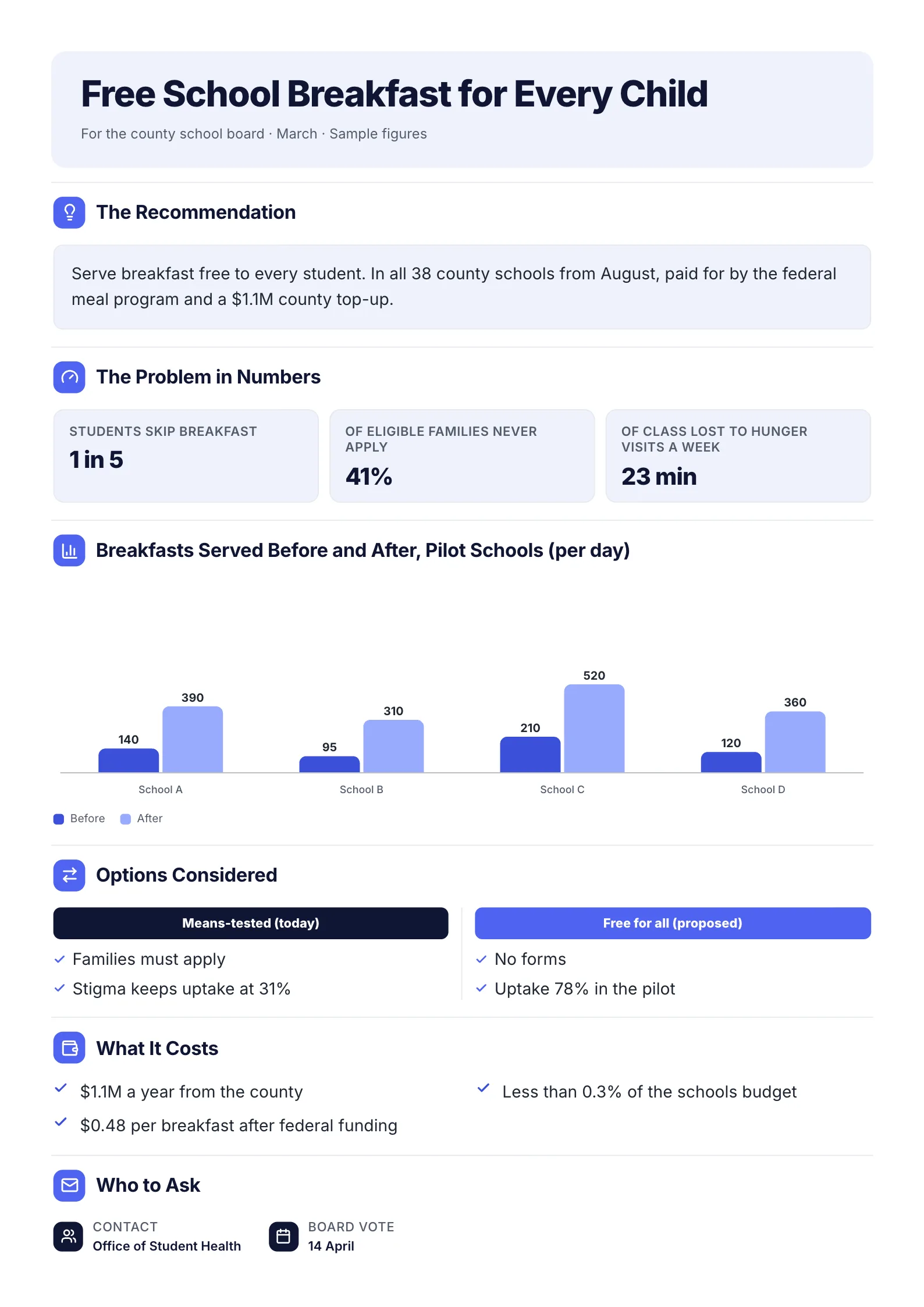 Policy Brief: Free School BreakfastEdit for free(opens in a new tab)
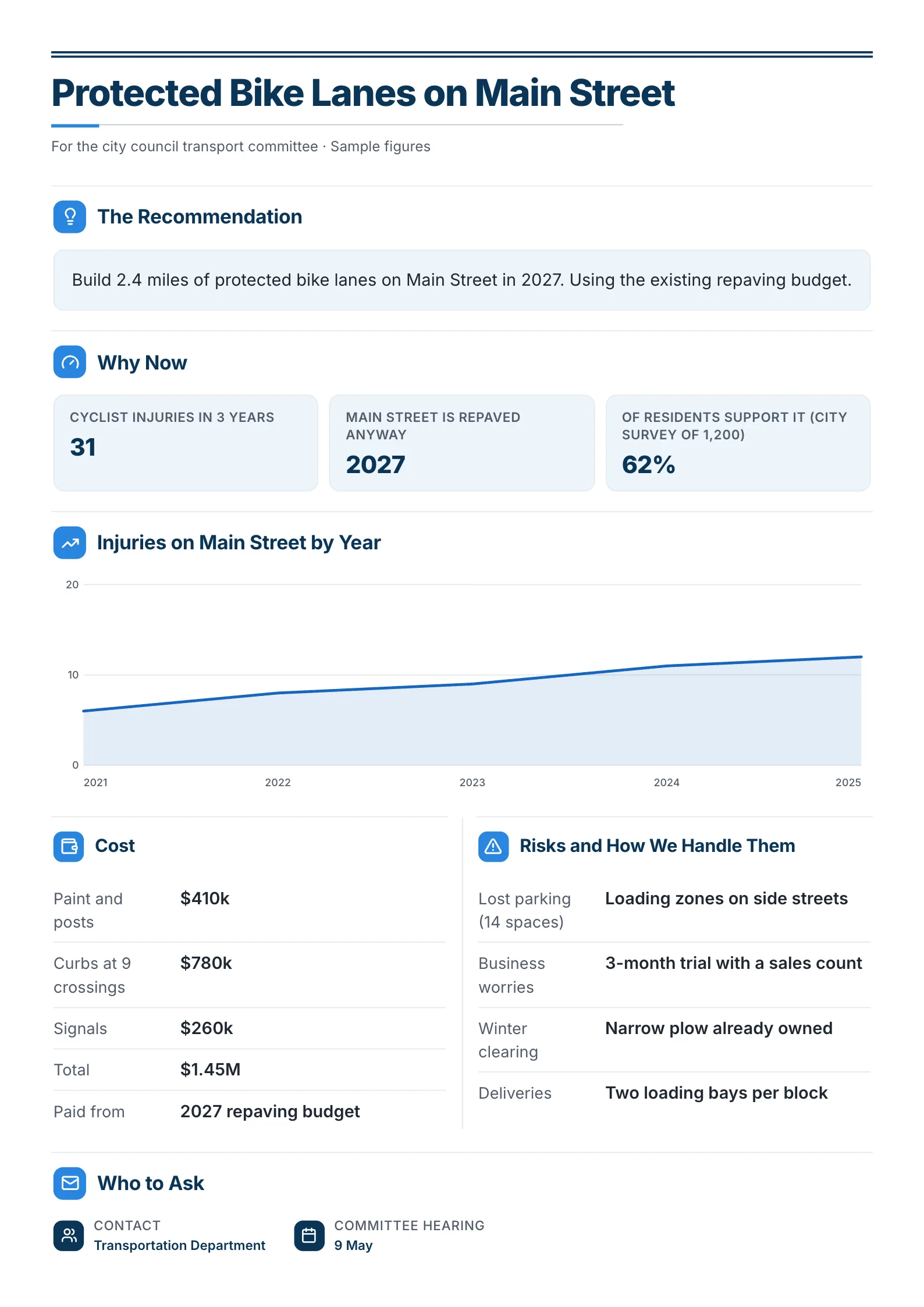 Policy Brief: Protected Bike LanesEdit for free(opens in a new tab)
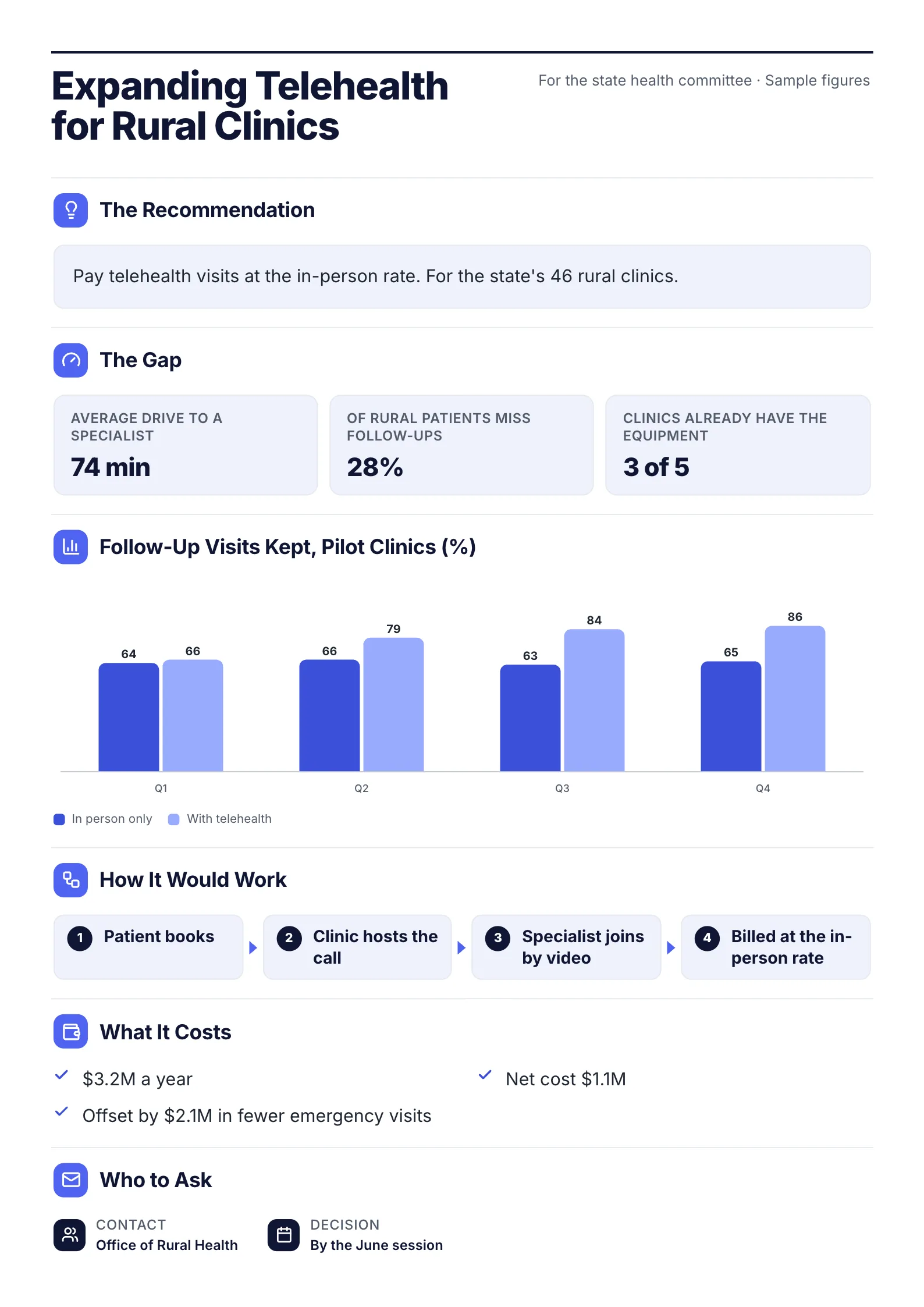 Policy Brief: Rural TelehealthEdit for free(opens in a new tab)
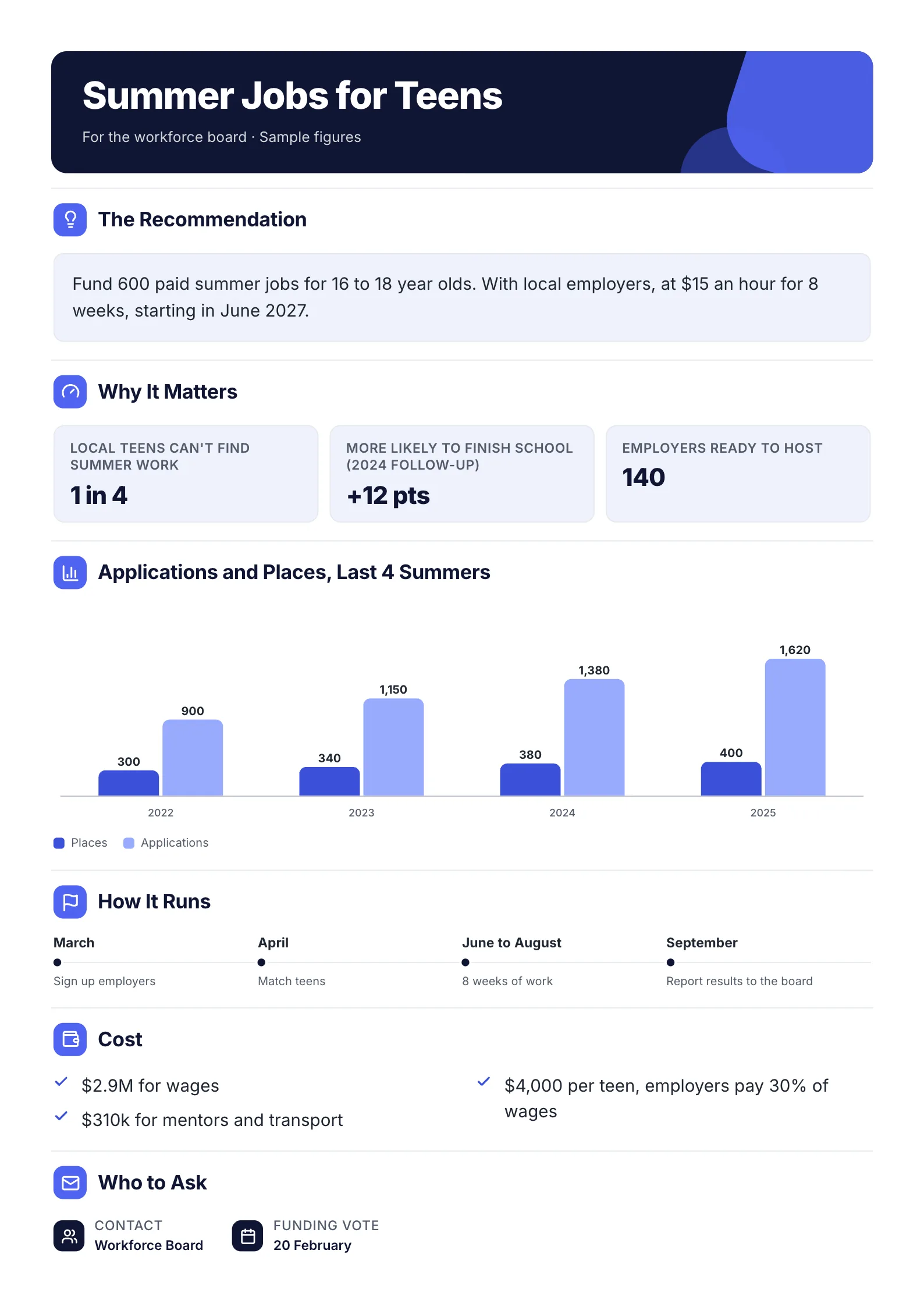 Policy Brief: Summer Jobs for TeensEdit for free(opens in a new tab)
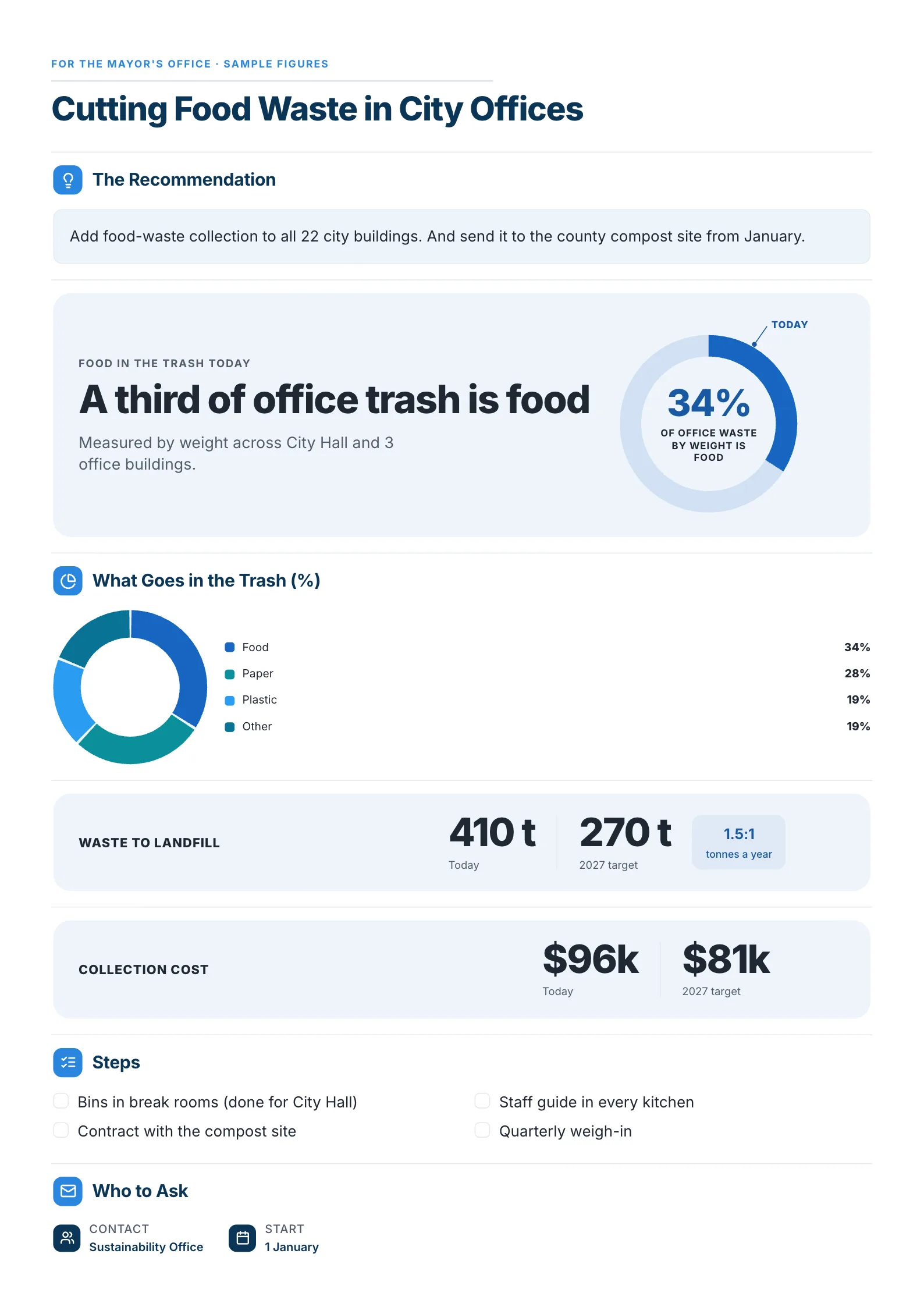 Policy Brief: Food Waste in City OfficesEdit for free(opens in a new tab)
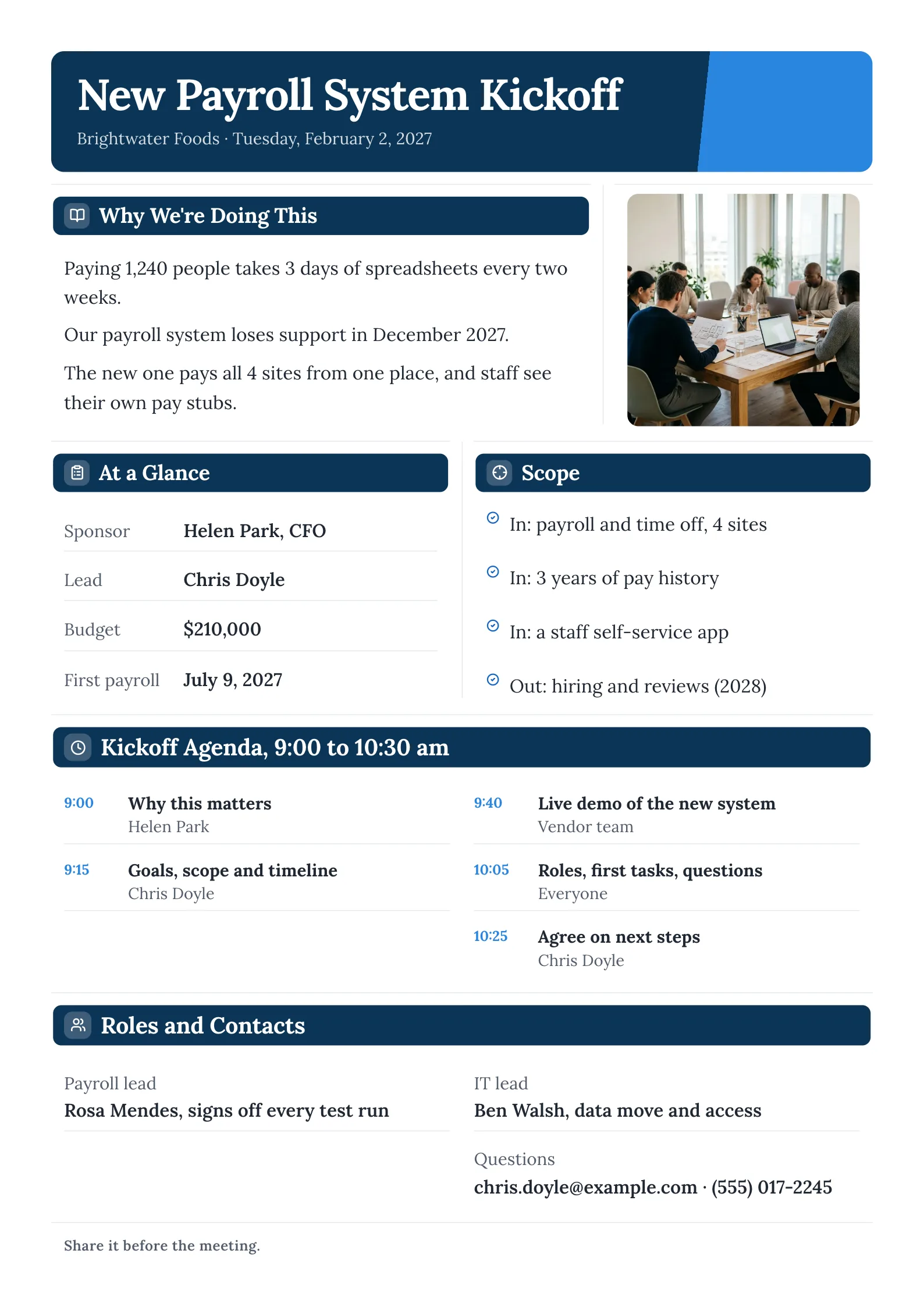 Project Kickoff BriefEdit for free(opens in a new tab)
Every example was made with MakeOnepagers. Each one opens as a template you can edit for free: every word, chart and color.
What is a policy brief?
A policy brief is a short paper that tells people who make decisions what the evidence says and what they should do about it. It is written by analysts, researchers, advocacy groups and public servants, for committees, elected officials, boards and funders.
It is not a research paper. A research paper explains how you found something. A policy brief says what was found, why it matters to the reader and what to do next. The method gets a line, not a section.
The 6 parts of a policy brief
- A title that names the issue and the reader. "Urban Air Quality: Policy Brief. Evidence summary for the transport committee."
- The finding, in two sentences. "Roadside nitrogen dioxide fell 31% in the four zones that charged older vehicles, and 4% in the eight that did not."
- The evidence, as one table or chart: what each option did and what it cost.
- The cause or context, briefly: where the problem comes from.
- The recommendation, one sentence, with its cost and why it beats the alternatives.
- What happens next: how it would be carried out, and the result to expect.
A free policy brief template
Copy this into a document, or open one of the examples below and edit it.
| Part | What to write, with an example |
|---|---|
| Title | The issue and the reader. Urban Air Quality: Policy Brief, for the transport committee |
| The finding | 2 sentences with numbers. NO2 fell 31% in charging zones, 4% elsewhere. The gap has held for three years |
| The cause | One chart. Source of roadside NO2: diesel cars and vans 46%, heavy goods 29% |
| The evidence | A table of options. Each zone's charge, NO2 change and cost to run |
| Recommendation | One sentence and why. Extend peak-only charging to the six inner zones first |
| How it would work | 3 to 5 steps. Camera survey, consultation, signage, charging, review |
| Expected result | One number and its cost. NO2 down 26%, $9.4M a year to run |
3 policy brief examples
1. Policy brief for a committee
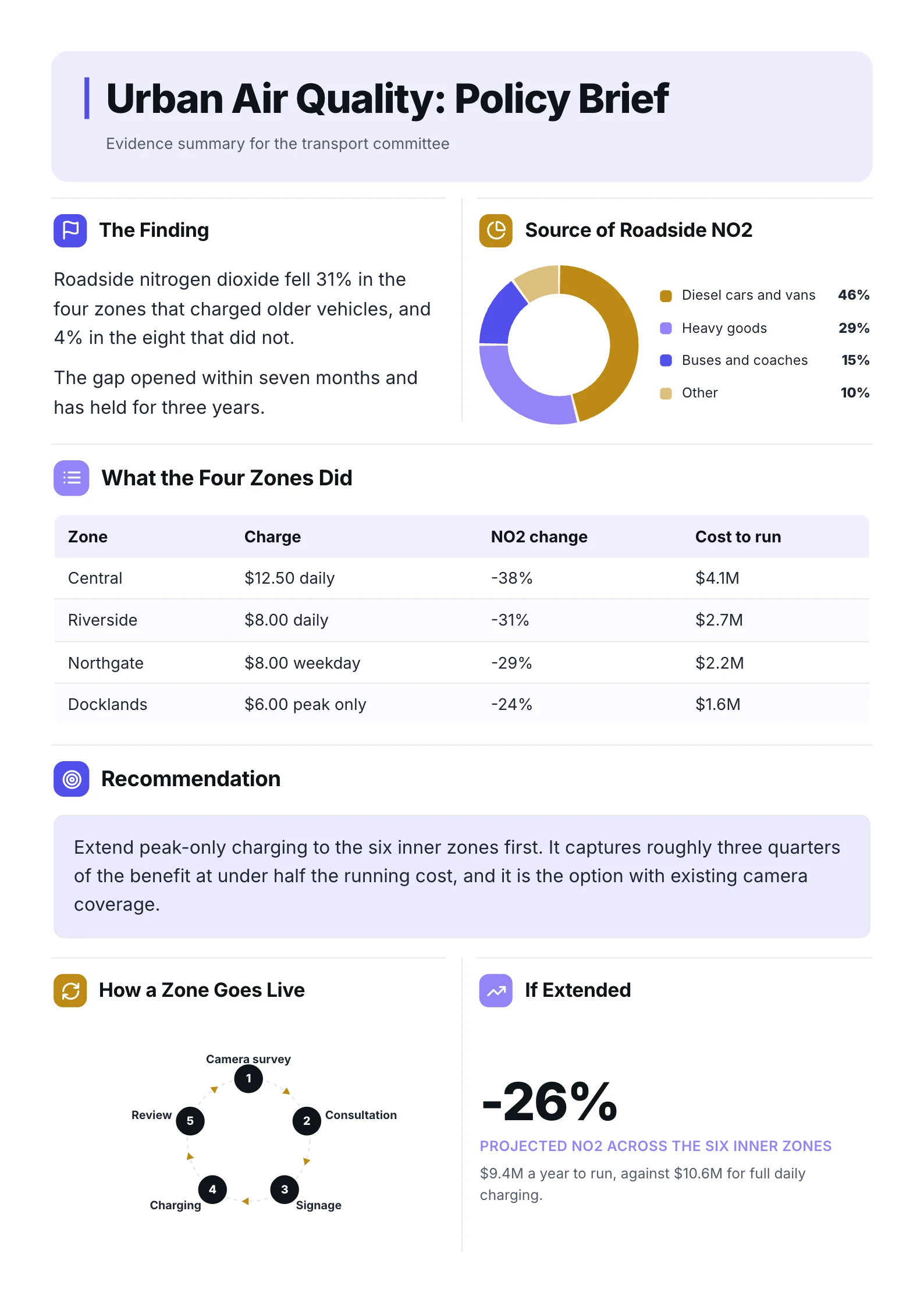
A transport committee briefed on one decision: whether to extend vehicle charging zones, and how.
What to copy:
- The finding as a comparison: 31% where the policy ran, 4% where it did not. A committee member can repeat it in one breath.
- A table where each row is an option, with what it cost and what it achieved. The reader can see the trade-off without being told.
- A recommendation that is not the biggest option. "Captures roughly three quarters of the benefit at under half the running cost." Showing the trade-off builds trust.
Edit for free: policy brief template.
2. Report to a council or cabinet
 Edit this template
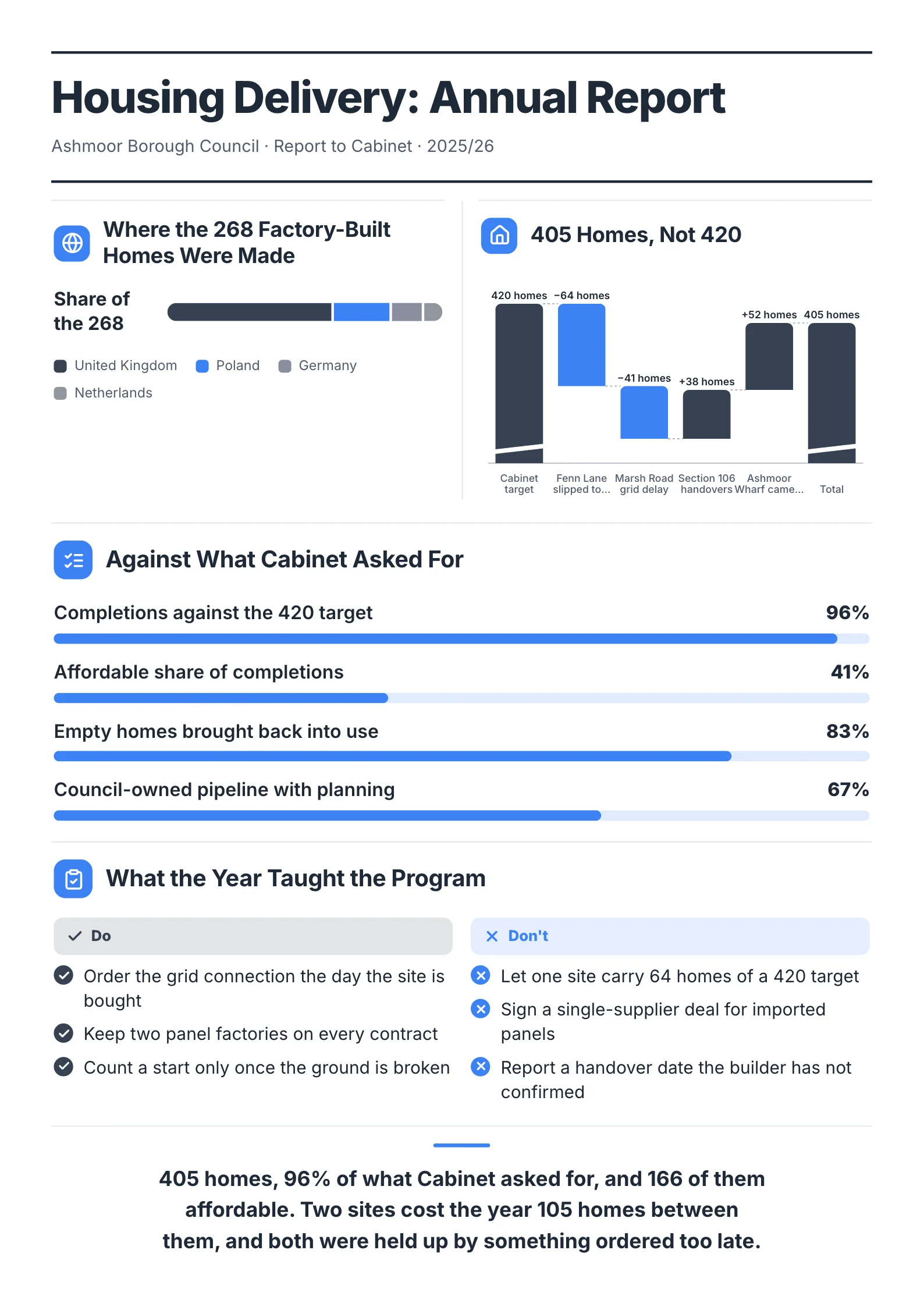
A council's housing program reported to its cabinet: the target, the result, and what to change.
What to copy:
- A headline that admits the miss: "405 homes, not 420." It earns the reader's trust for everything that follows.
- A bridge chart from target to result, with each site that cost or added homes named. It answers "why?" before anyone asks.
- Lessons as "do" and "don't" lists. "Order the grid connection the day the site is bought" is a rule the next year can follow.
Edit for free: council report template.
3. Evidence review for funders or leadership
 Edit this template
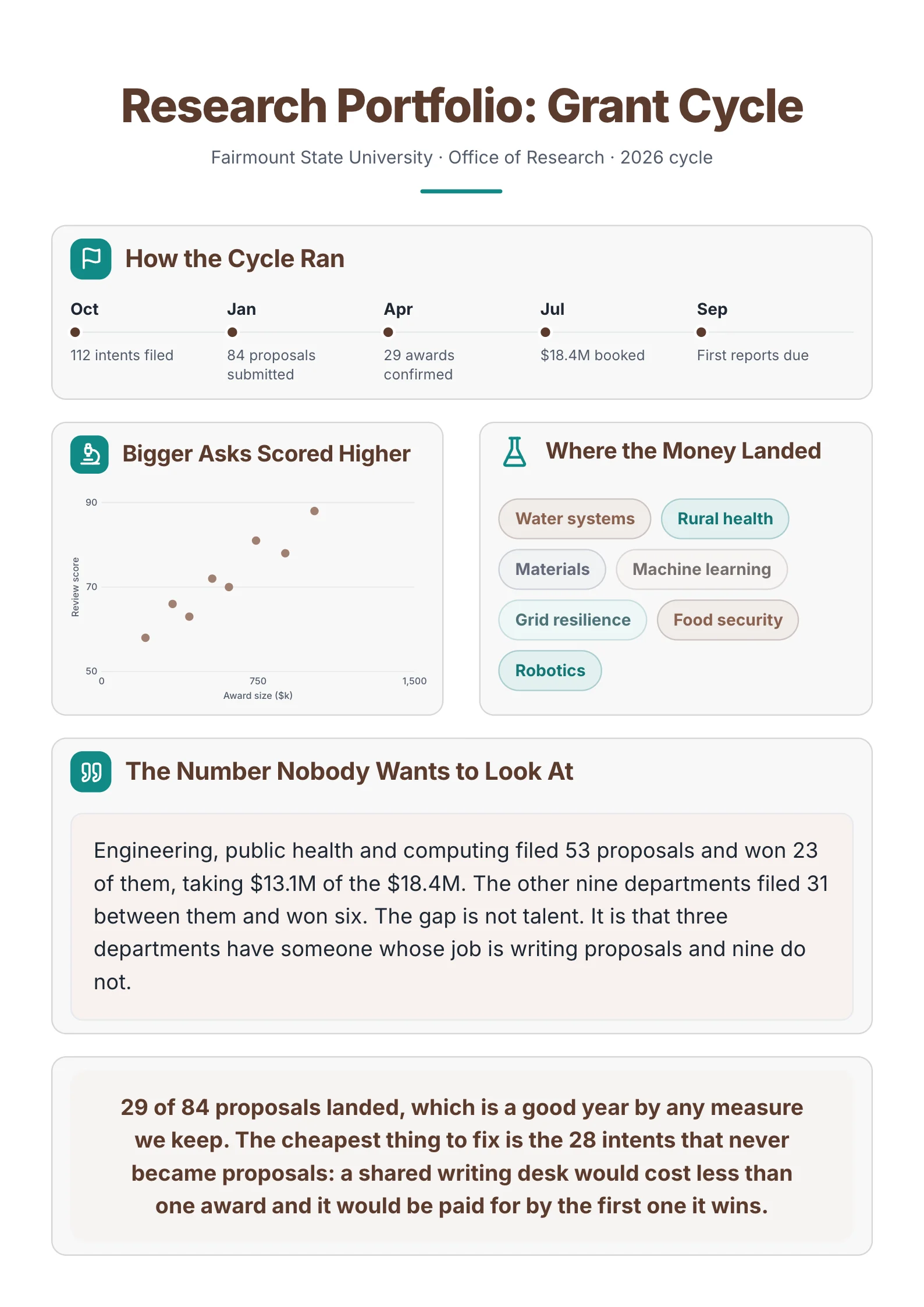
A university reviewing its grant cycle for leadership, with one uncomfortable finding and a cheap fix.
What to copy:
- "The number nobody wants to look at" as its own section. Three departments won 23 of 29 awards. Naming the hard finding is what makes a brief worth reading.
- The cause stated plainly: "The gap is not talent. Three departments have someone whose job is writing proposals and nine do not."
- A recommendation priced against the benefit: a shared writing desk costs less than one award.
Edit for free: research funding review template.
How long should a policy brief be?
Policy briefs range from one page to about six. The longer versions add background, method and references. For the reader who decides, the one-page version is the one that matters, and many organisations send it as the cover of the longer paper.
| One-page brief | Longer brief | |
|---|---|---|
| Reader | The decision-maker | Their staff and advisers |
| Read in | Two minutes | Twenty minutes |
| Contains | Finding, evidence, recommendation, cost | All of that, plus background, method and sources |
If you already have the long paper, the free AI One-Pager generator reads a PDF, Word or PowerPoint file of up to 10 pages and gives it back as a designed One-Pager, with the figures pulled from your file.
How to write a policy brief in 6 steps
- Name the decision the reader is about to make, and by when.
- Write the finding in two sentences with the key number in each.
- Show the evidence as one table or chart, comparing the options.
- Choose one recommendation and say why it beats the others, cost included.
- List how it would be carried out, in three to five steps.
- End with the result to expect, as a number.
Policy brief mistakes
- Starting with background. The reader already knows the issue. Start with what is new.
- Three recommendations of equal weight. The reader will pick none. Recommend one, and mention the others as options you weighed.
- No cost. A recommendation without a price cannot be approved.
- Jargon from the field. Write for the generalist on the committee, not the specialist who wrote the study.
Make your policy brief
Open the free policy brief template and put in your finding and recommendation, or drop your long paper into the free AI One-Pager generator and get a finished brief back.
Frequently asked questions
What should a policy brief include?
A title naming the issue and the reader, the finding in two sentences, the evidence as a table or chart, the cause, one recommendation with its cost, how it would be carried out and the result to expect.
How do you write a one-page policy brief?
Lead with the finding, show one table that compares the options, recommend one of them with its cost, and end with the steps and the expected result. Move background, method and references to an attached longer paper.
What is the difference between a policy brief and a white paper?
A policy brief is short and aimed at a specific decision, usually by a public body. A white paper is longer, explains an issue or a solution in depth and is often used by companies to inform or persuade a wider audience.
Who reads policy briefs?
Elected officials, committee members, ministers and their advisers, boards of public bodies, funders and the staff who prepare their papers.