BlogGuide
Biography One Pager: What to Include, With a Real Example
A biography one pager template and a real example, Katherine Johnson's life from NASA's own biography, with every fact traced to its source.

By MakeOnepagers Team
Updated · 6 min read
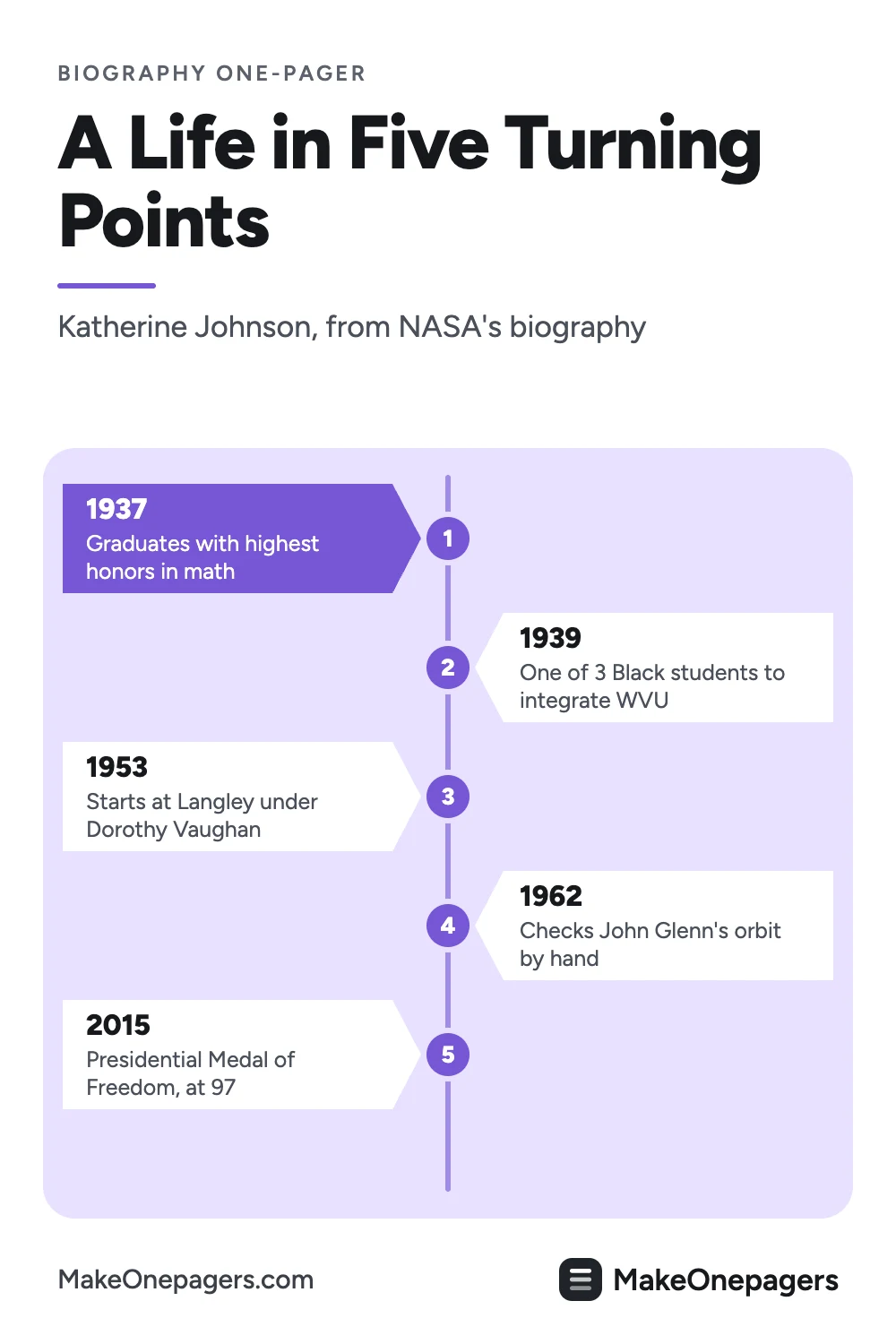
A biography one pager tells a person's life on one sheet: who they were and when they lived, the turning points, what shaped them, what they overcame, what they achieved, a quote in their own words, and why they still matter. The top results for this search on 12 October 2026 were two product pages with one-line descriptions, so this guide shows a real one instead: the NASA mathematician Katherine Johnson, written only from NASA's biography of her, with every fact traced. Below: what to include, the example, a template and how to research your own.
One‑Pager examples
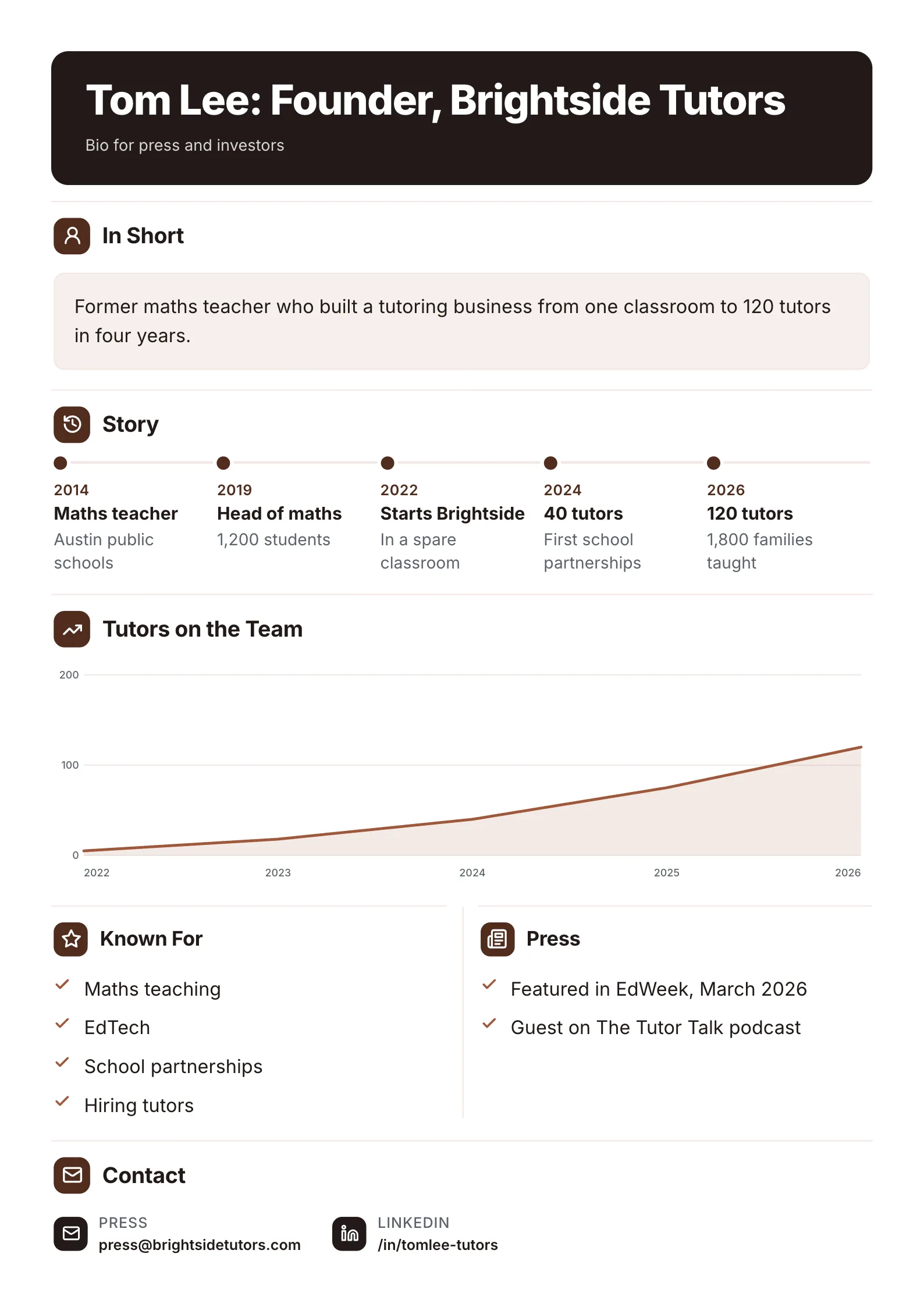
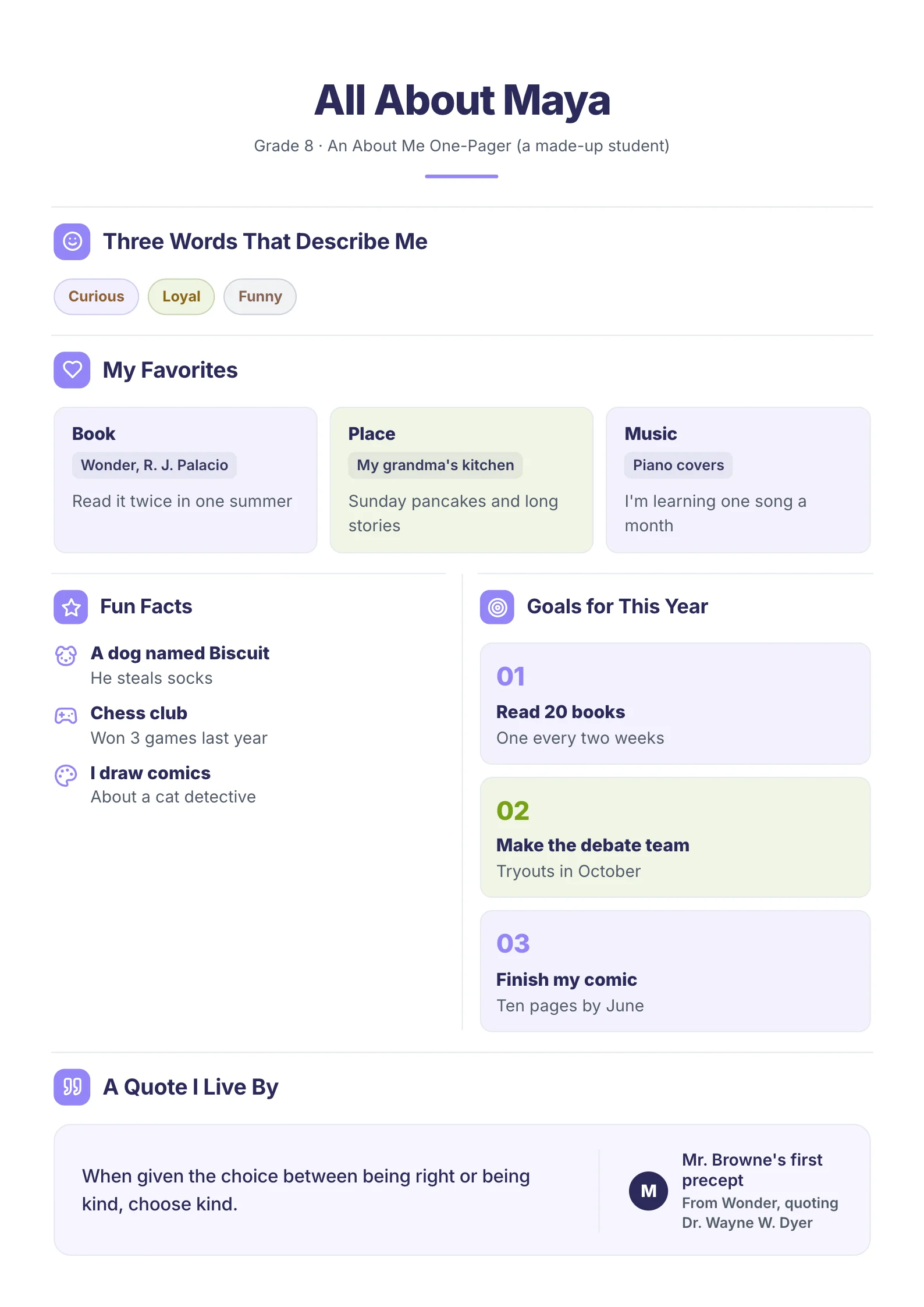
Real One-Pagers made with MakeOnepagers. Open any one to edit it as your own.
What a biography one pager includes
A published classroom assignment we read builds the whole project on three ideas: the person's influences, obstacles and accomplishments. It asks: "Who are they and why are they important." Around those, most biography one-pagers carry:
| Part | What it shows |
|---|---|
| Name and dates | Who, and when they lived |
| Life in numbers | Three or four facts that are easiest to remember as numbers |
| Turning points | Four or five dated moments, in order |
| Influences | The people and places that shaped them |
| Obstacles | What stood in their way, and how they got past it |
| Accomplishments | What they did, specifically |
| A quote | Their own words, with when they said it |
| Why they matter | One sentence on what changed because of them |
A real example: Katherine Johnson
Every fact below is from NASA's biography of Katherine Johnson, written by Margot Lee Shetterly, author of Hidden Figures, and read on 12 October 2026.
Life in numbers
| Number | What it means |
|---|---|
| 1918 to 2020 | Born 26 August 1918 in White Sulphur Springs, West Virginia; died 24 February 2020, at 101 |
| 33 years | At NASA's Langley center, from 1953 until she retired in 1986 |
| 26 | Research reports she wrote or co-wrote |
| 97 | Her age when she received the Presidential Medal of Freedom, in 2015 |
Turning points
| Year | What happened |
|---|---|
| 1937 | Graduates with highest honors from West Virginia State College, in mathematics and French |
| 1939 | One of three Black students chosen to integrate West Virginia University's graduate school |
| 1953 | Starts work in the West Area Computing section at Langley, led by Dorothy Vaughan |
| 1962 | Checks by hand the orbital equations for John Glenn's Friendship 7 flight |
| 2015 | Receives the Presidential Medal of Freedom from President Barack Obama |
Influences, obstacles, accomplishments
- Influences: her math professor and mentor, W. W. Schieffelin Claytor, and Dorothy Vaughan, who led the section she joined at Langley.
- Obstacles: she was among the first Black students offered places at her state's flagship university's graduate school, and she began at Langley in its all-Black West Area Computing section.
- Accomplishments: trajectory analysis for Alan Shepard's 1961 Freedom 7 flight; a 1960 report that was the first in her division to credit a woman as an author; the calculations for John Glenn's orbit; and the work she named as her greatest contribution, helping to sync Apollo's Lunar Module with the Command and Service Module.
In her words
"I loved going to work every single day."
Why she matters
Before John Glenn would fly, he asked for her to check the computer's numbers by hand.
That fits on one sheet. The skill is choosing: the NASA biography has many more facts, and the one pager keeps the ones that tell the story.
The layout: what one page looks like
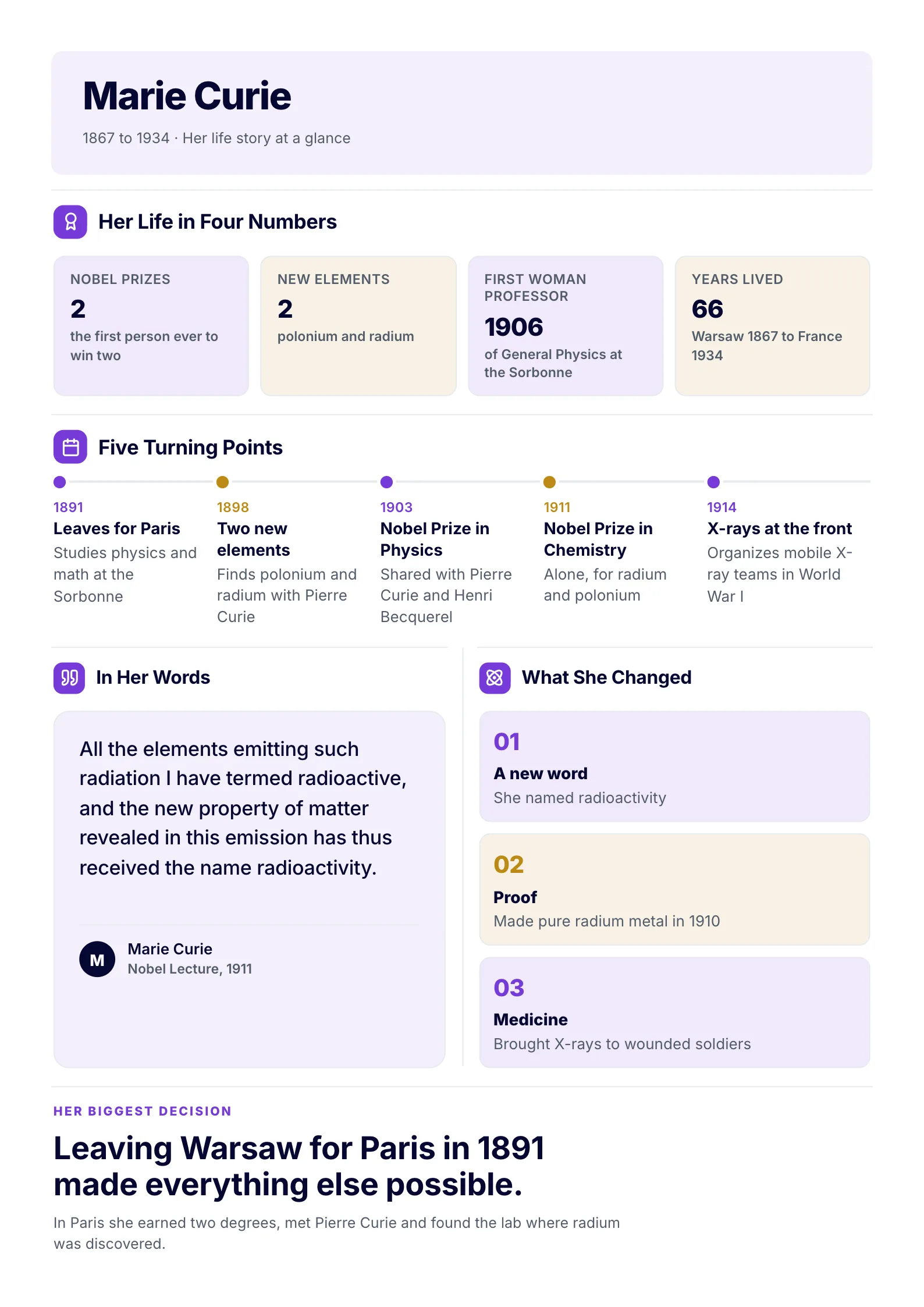
Our library's biography template uses the same parts for a different life:
 Edit this template
A sample biography on one page: four numbers, five dated turning points, a quote with its source, what she changed and her biggest decision.
What to copy:
- Numbers at the top, each with a short label.
- A timeline of five turning points, one line each.
- A quote with its source and date, not just the words.
- A closing line on the decision or moment that mattered most.
Open it: biography template.
A free biography one pager template
| Part | What to write |
|---|---|
| Header | Full name, birth and death years, one line on who they were |
| Life in numbers | 3 or 4 facts as numbers, each with a label |
| Turning points | 4 or 5 dated moments, in order |
| Influences | 1 or 2 people or places, and how they helped |
| Obstacles | 1 or 2, and how they were overcome |
| Accomplishments | 2 or 3, specific |
| Quote | Their words, with where and when they said them |
| Why they matter | One sentence |
| Sources | Where each fact came from |
How to research and write it in 6 steps
- Pick one reliable main source: an official biography, a museum, a university or a well-reviewed book.
- Write down every date and number with where you found it.
- Choose 4 or 5 turning points and put them in order.
- Find one quote with its source and date. Check it against a second source.
- Write the "why they matter" line last, once you know the story.
- List your sources at the bottom or on the back.
If your teacher allows it, you can type your notes and drop them into the free AI One-Pager generator for a first layout, then check every fact against your sources and add your own drawings.
Biography one pager mistakes
| Mistake | Fix |
|---|---|
| A list of facts with no story | Turning points in order, and why they matter |
| Dates with no source | Note where each one came from |
| A quote with no speaker or date | Name who said it, where and when |
| Only accomplishments | Add influences and obstacles |
| A famous quote that cannot be traced | Use one from a reliable source, or leave it out |
| Too many facts | Keep the ones that tell the story |
Make your biography one pager
Pick your person and one reliable source, fill in the template table above, and put the turning points in order. To lay it out, open the free biography template and replace the sample with your person.
Frequently asked questions
What should be on a biography one pager?
The person's name and dates, a few key numbers, four or five turning points, their influences, obstacles and accomplishments, a quote with its source, why they matter, and your sources.
How do I make a biography one pager stand out?
Choose the details that tell the story, put the turning points on a timeline, and pick a quote that shows who the person was. A strong closing line on why they matter does more than decoration.
Where can I find reliable facts for a biography?
Official biographies from organizations the person worked for, museums, universities and libraries. For Katherine Johnson, NASA publishes her biography.
How many quotes should a biography one pager have?
One or two is enough on a single sheet. Some assignments ask for three; follow yours, and cite each one.
Can I use a template for a biography one pager?
Yes. A template gives you the parts; your research and choices make it yours.