Resource Plan Examples: 5 One-Page Plans, One Marked Up
5 resource plan examples, one walked through line by line, plus what Washington State, California and NACCHO staffing guides add to a plan.

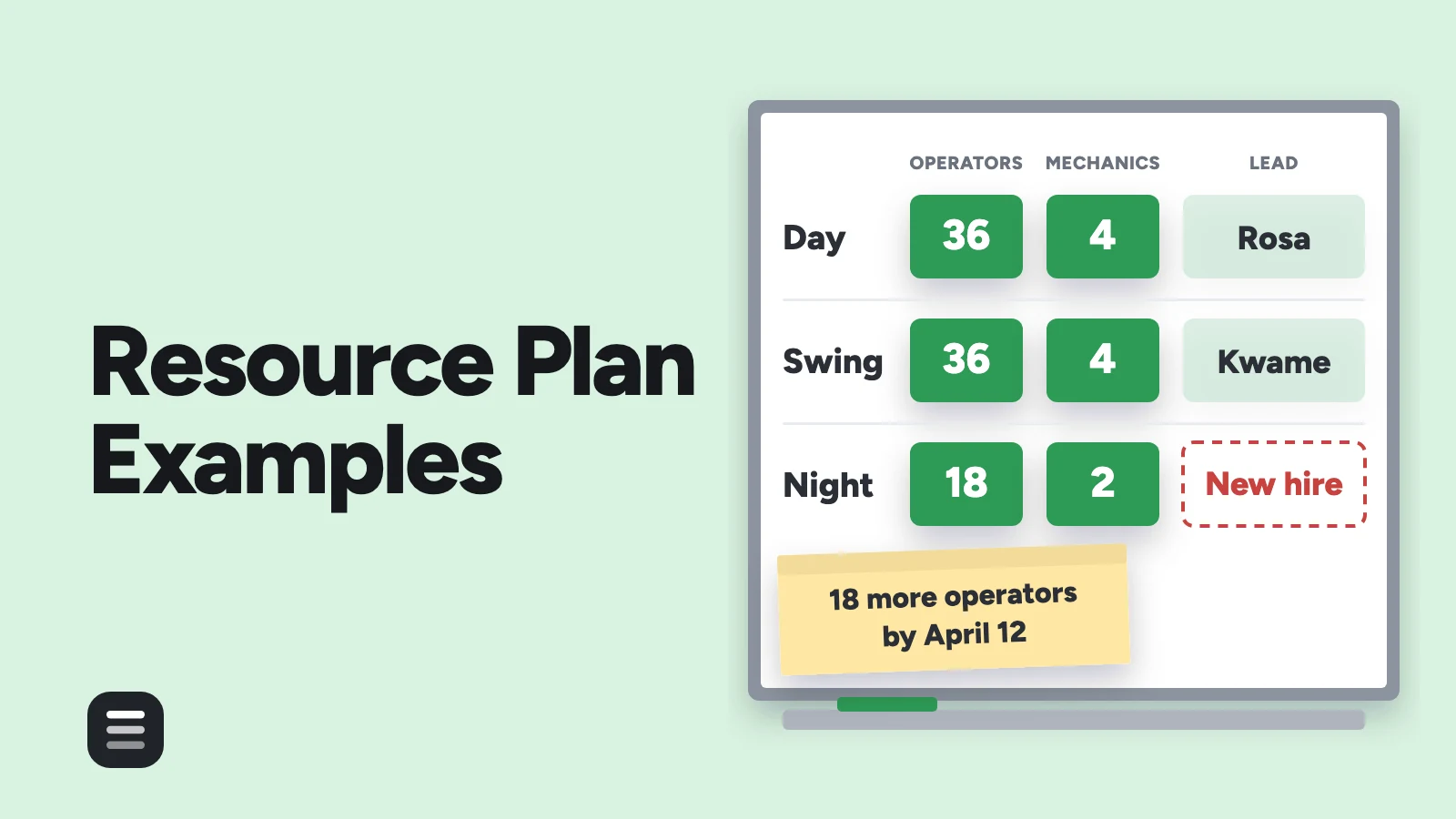
A bottling plant needs 18 more operators by April 12, and its resource plan fits that on one page. The five resource plan examples below cover that plant, a school laptop rollout, a consulting job, a research grant and a call center. We mark up the first one line by line, so you can see what each part is doing. Then we show what three public staffing guides add, including Washington State's ERP program, which planned for about 63 state staff and 88 vendor staff at its peak. Start from a free one pager template.
One‑Pager examples
Real One-Pagers made with MakeOnepagers. Open any one to edit it as your own.
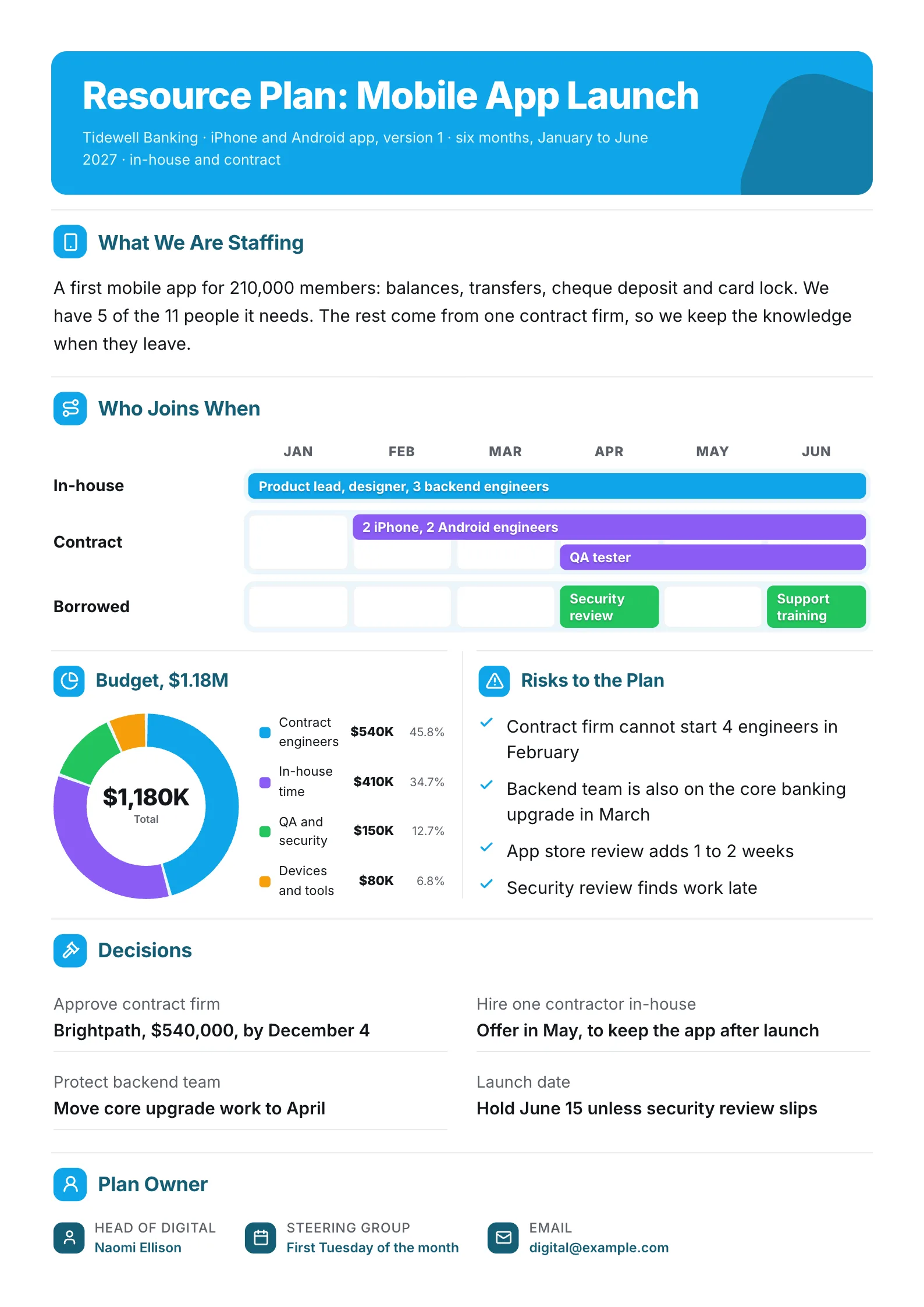 Resource Plan: Software Launch TeamEdit for free(opens in a new tab)
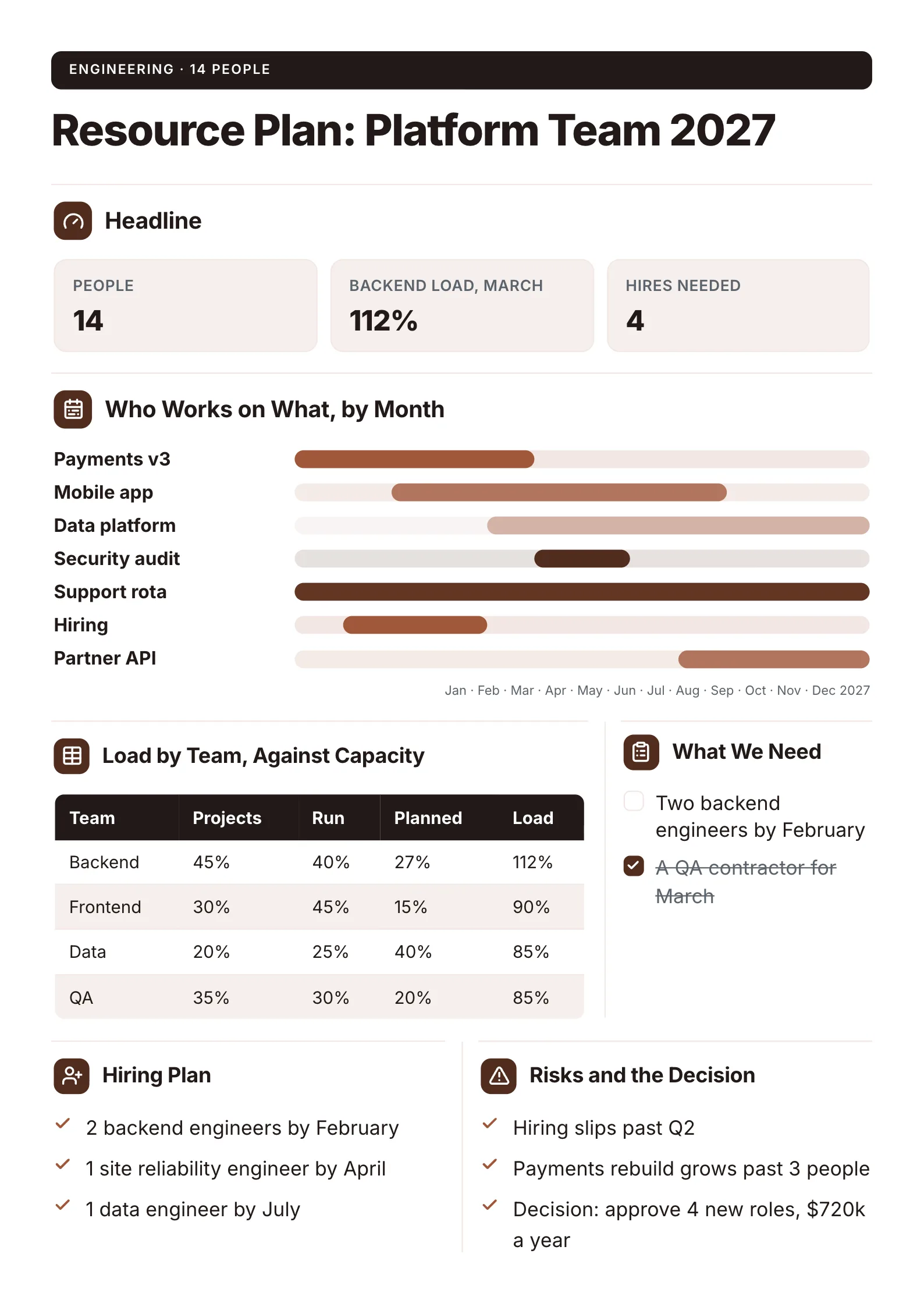 Resource PlanEdit for free(opens in a new tab)
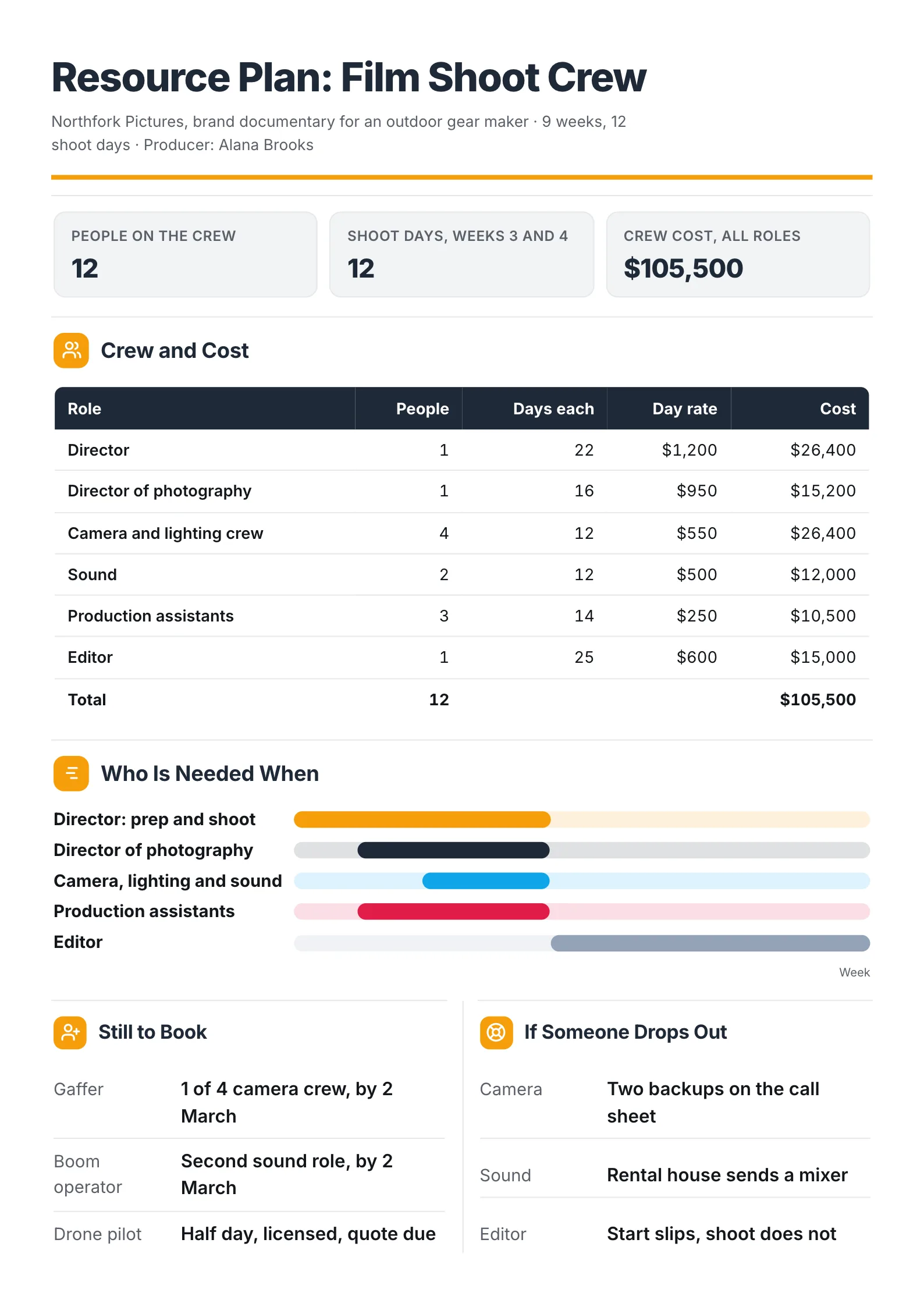 Resource Plan: Film Shoot CrewEdit for free(opens in a new tab)
 Resource Plan: Agency Team CapacityEdit for free(opens in a new tab)
 Resource Plan: Law Firm Trial TeamEdit for free(opens in a new tab)
 Resource Plan: Hospital Nurse StaffingEdit for free(opens in a new tab)
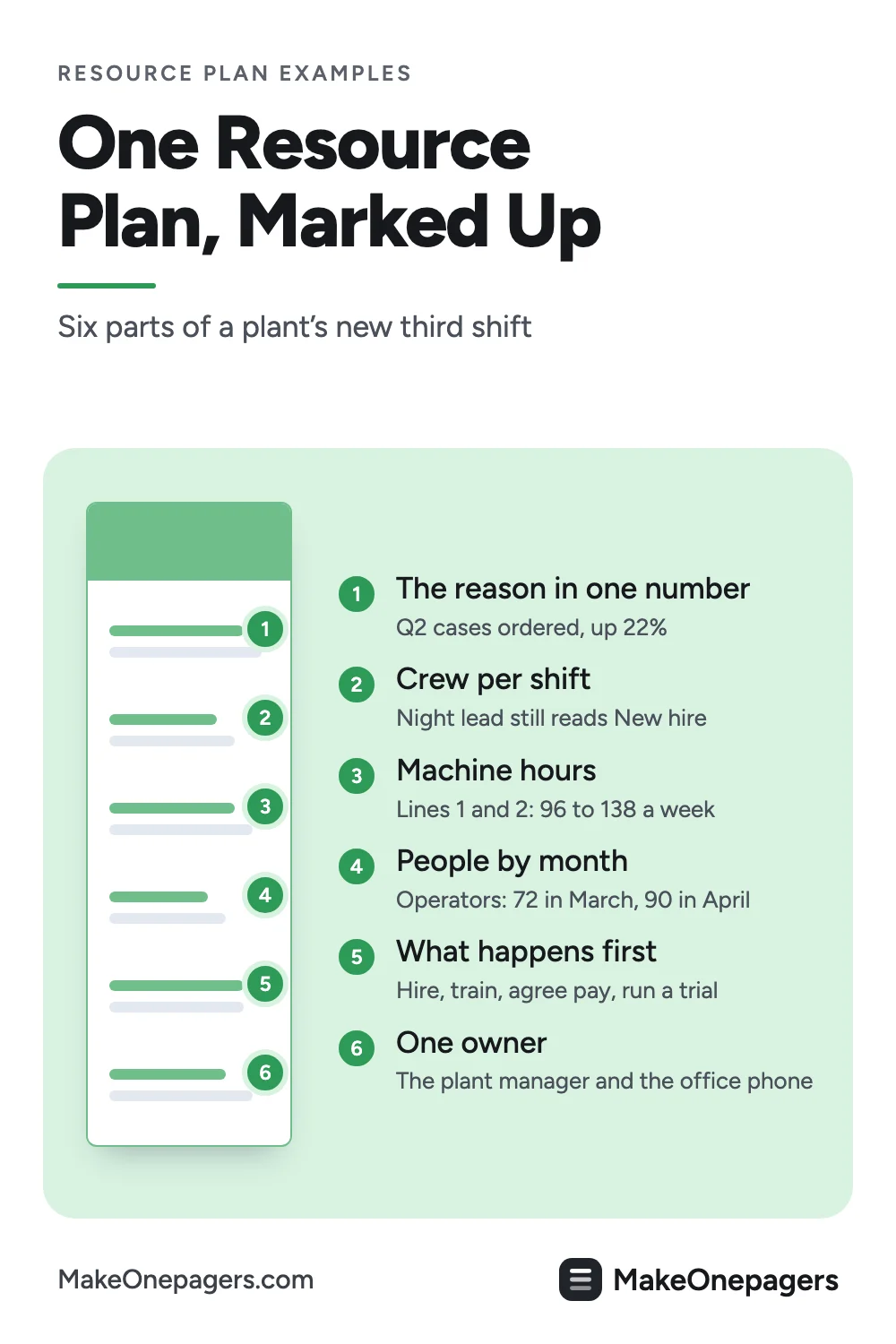
One resource plan, marked up
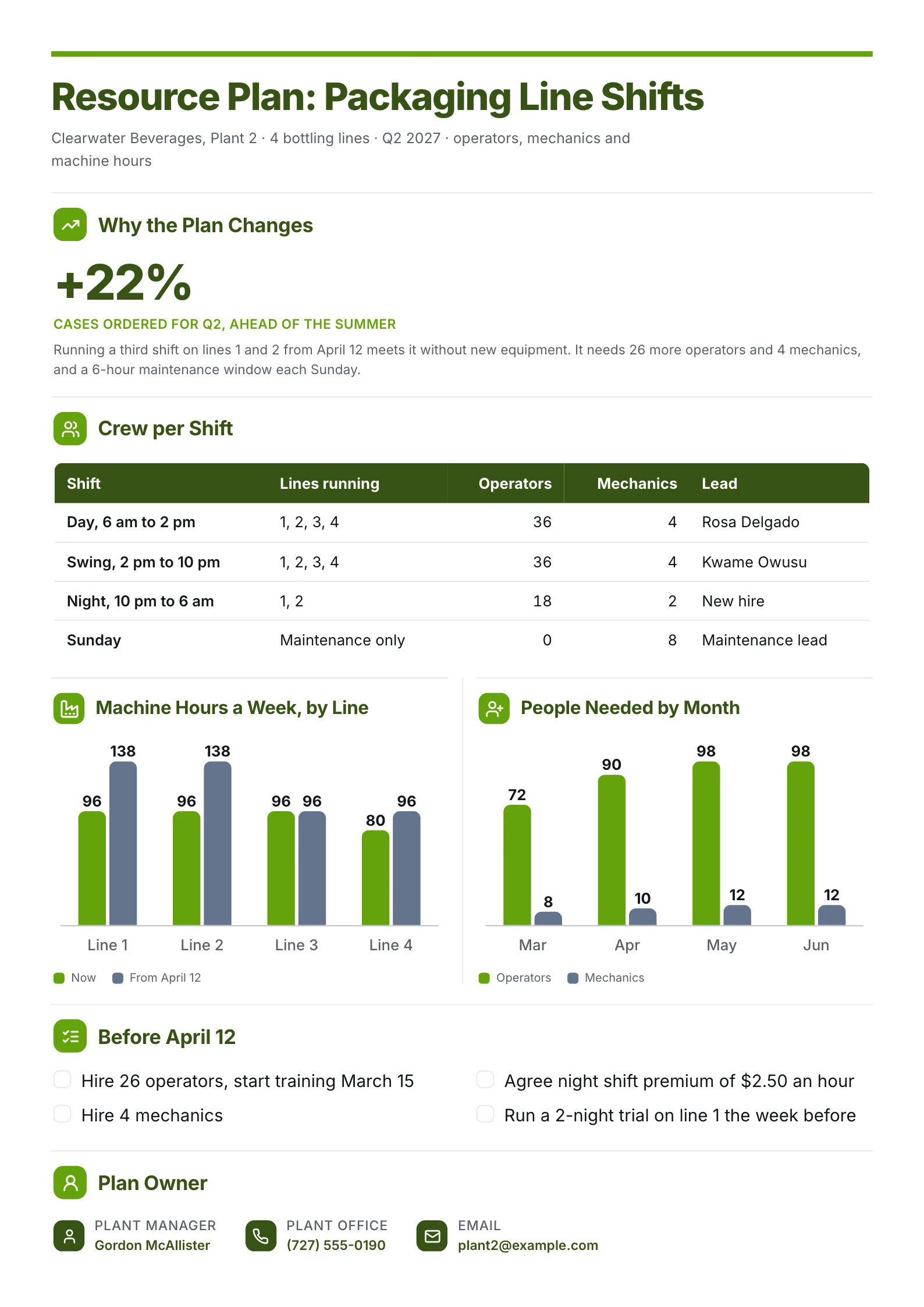
Say your plant needs more output for the summer, like Clearwater Beverages' second plant. Its resource plan fits the whole change on one page. Follow the numbered callouts below, and you'll know what to put in each part of your own plan.
 Edit this template
Sample company, names and figures. The night shift's lead reads New hire, which is the plan's biggest open question.
1. The reason, in one number. The top box says cases ordered for Q2 are up 22% ahead of the summer. One sentence then gives the answer, a third shift on lines 1 and 2 from April 12, with no new equipment. If your reader stops here, they already know why the plan exists and what it costs in people. It needs 18 more operators, 2 more mechanics and a 6-hour maintenance window each Wednesday night.
2. Crew per shift, with a name on each. The table gives you each shift's hours, lines, operators, mechanics and lead. Day and swing each run all four lines with 36 operators and 4 mechanics. The new night shift runs lines 1 and 2 with 18 operators and 2 mechanics. Now look at the lead column, because it's the one you'll want to copy. Rosa Delgado runs days and Kwame Owusu runs swing, while the night lead says New hire. Leave that cell out and nobody asks who runs nights until the week it starts.
3. Machine hours before and after. A bar chart shows you each line's hours a week now and from April 12. Lines 1 and 2 go from 96 hours to 138, line 4 goes from 80 to 96 and line 3 stays at 96. If the night shift runs six 8-hour nights, it adds 48 hours to a line. Take out the 6-hour Wednesday window and you get exactly the 42 extra hours on lines 1 and 2.
4. People needed by month. Operators go from 72 in March to 90 from April to June. Mechanics go from 8 to 10. Those numbers match the top box, since 90 minus 72 is 18 operators and 10 minus 8 is 2 mechanics. They match the shift table too, where the three production shifts add up to 90 operators and 10 mechanics. Run that sum on your own plan before it reaches whoever approves the hiring. The monthly row also shows the whole jump lands in April, so your reader sees it's one big hiring push, not a slow build.
5. What has to happen first. The Before April 12 checklist turns the plan into tasks you can tick off. Hire 18 operators and start training them March 15. Hire 2 mechanics. Agree a night shift premium of $2.50 an hour. Run a 2-night trial on line 1 the week before. None of these are ticked yet, which tells a manager exactly where things stand.
6. One owner. The plan ends with plant manager Gordon McAllister and the plant office's phone number. When someone has a question about the night shift, you want them calling one person.
Four more, and the one thing each does well
Each of these plans fits a different kind of work, so you may find your own job in one of them. Rather than walk through every line again, here's the part of each one worth copying into yours.
School laptop rollout: the load at the busiest week
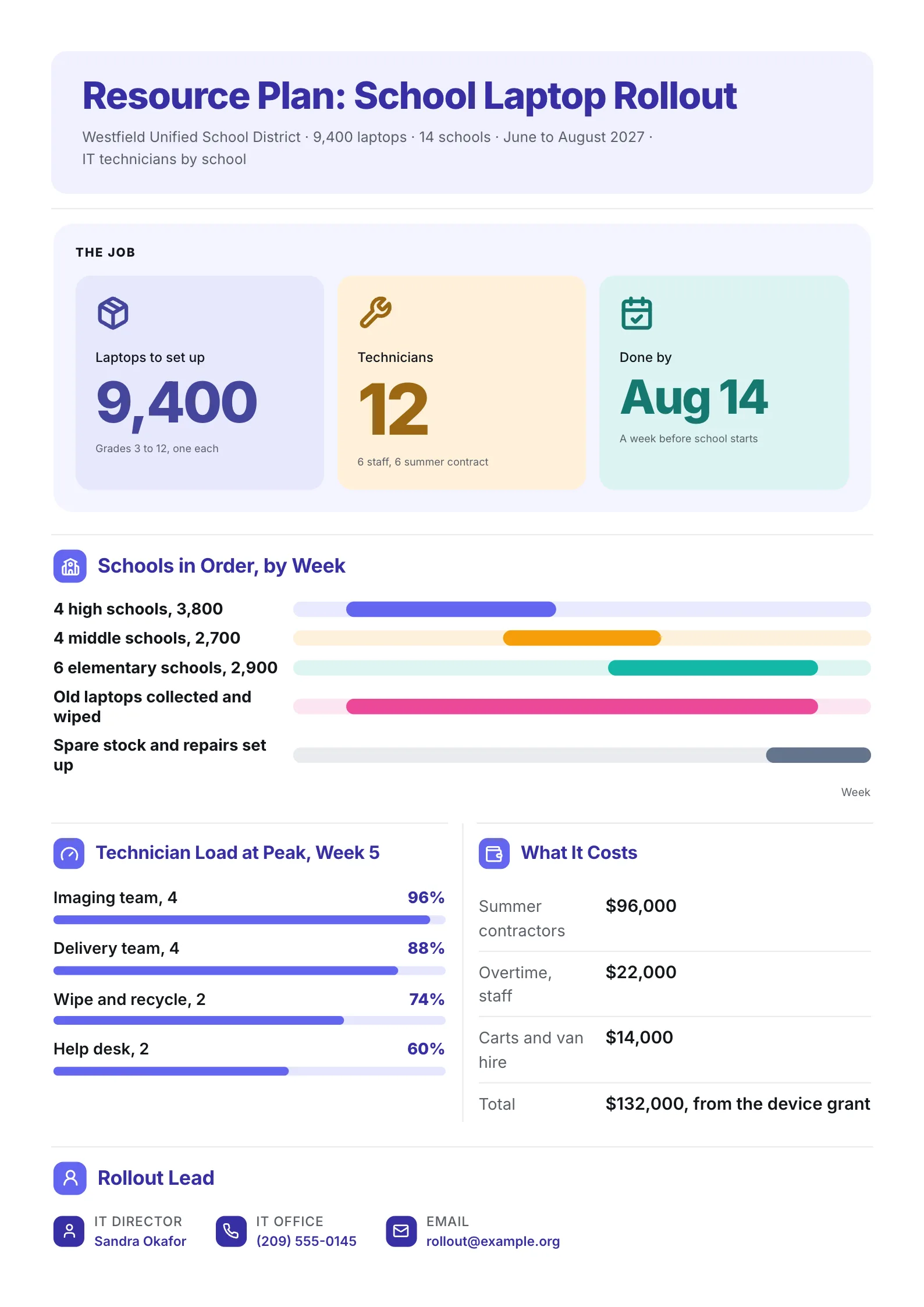
Westfield Unified is setting up 9,400 laptops across 14 schools between June and August 2027, with 12 technicians, 6 on staff and 6 on summer contracts. The idea you should borrow is a chart of each team's load in week 5, the peak. The imaging team of 4 sits at 96%, delivery at 88%, wipe and recycle at 74% and the help desk at 60%.
That one chart tells you where a sick day would hurt, and your manager sees it too. Check your own chart for the team with no room to spare. The plan also shows the schools in order by week, high schools first, and puts a price on the extra people. Summer contractors cost $96,000, staff overtime $22,000 and carts and van hire $14,000, for $132,000 from the device grant.
 Edit this template
Made-up district and staff. The load bars at week 5 show you which team has no room to spare.
Consulting engagement: the client's own time
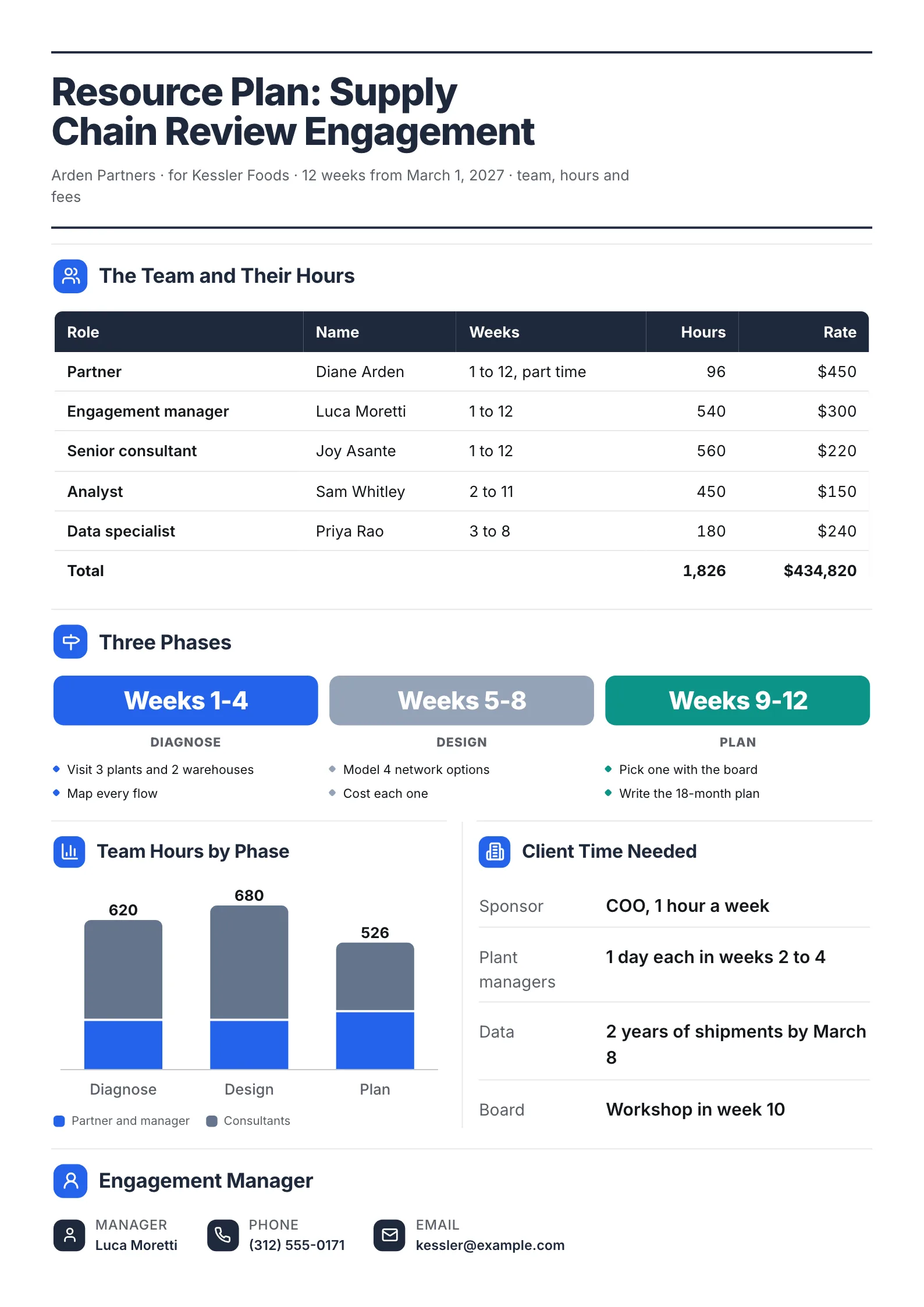
Arden Partners' plan for a 12-week supply chain review lists each person's weeks, hours and rate. The partner bills 96 hours at $450, the engagement manager 540 at $300 and the senior consultant 560 at $220. With the analyst and data specialist added, the team comes to 1,826 hours and $439,100 in fees, and you can multiply out every row.
The part to borrow is the Client Time Needed box. It asks the client's COO for 1 hour a week, each plant manager for 1 day in weeks 2 to 4 and two years of shipment data by March 8. A board workshop is booked for week 10. If your project depends on other people's time, put it in the plan, so their hours are planned like yours.
 Edit this template
Sample firm, client and rates. You can check the fees in the bottom row, which are the hours in each row times its rate.
Research grant: each person's share of time, by year
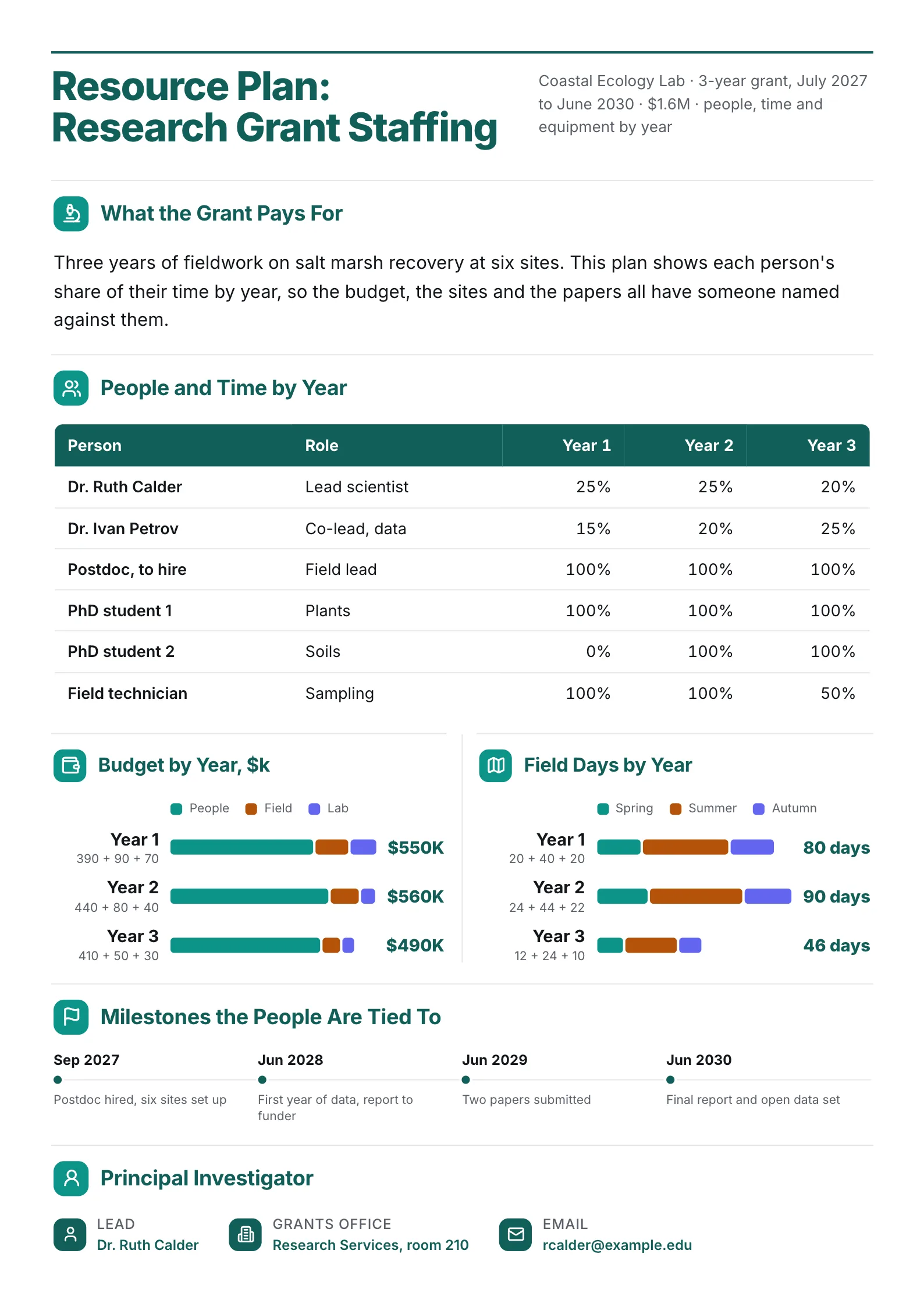
Coastal Ecology Lab's three-year grant is worth $1.6M, and its plan shows you each person's time as a percent for each year. The lead scientist gives 25% in years 1 and 2, then 20%. The co-lead for data rises from 15% to 25%. The second PhD student starts at 0% in year 1, and the field technician drops to 50% in year 3.
Your funder, reading a table like that, sees a team that changes with the work. The budget follows the same shape, $550K in year 1, $560K in year 2 and $490K in year 3. Each milestone is tied to people, starting with the postdoc hired and six sites set up by September 2027.
 Edit this template
Sample lab and grant. The three yearly budget bars you see add up to the $1.6M in the title.
Call center season: the steps if demand runs over
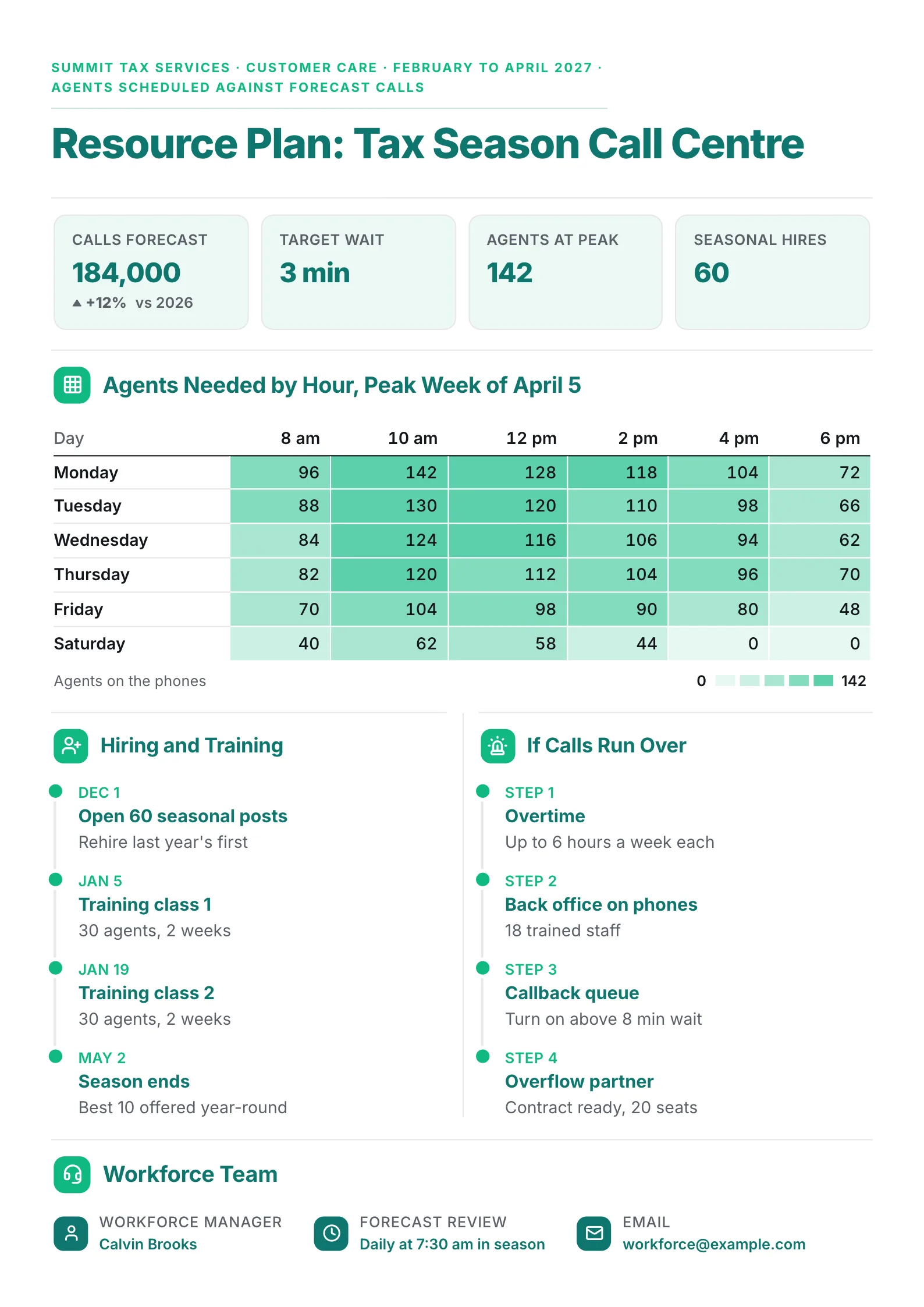
Summit Tax Services forecasts 184,000 calls for tax season, up 12%, with a 3-minute target wait. It plans 142 agents at the peak and hires 60 seasonal agents in two training classes of 30, on January 5 and January 19. A heat map shows agents needed by hour, with the top of 142 on Monday at 10 am.
The part to borrow is its If Calls Run Over list, agreed before the season starts. Step 1 is overtime, up to 6 hours a week each. Step 2 puts 18 trained back office staff on the phones. Step 3 turns on a callback queue above an 8-minute wait. Step 4 opens a contract with an overflow partner for 20 seats. Nobody on your team has to invent a response in the middle of April.
 Edit this template
Made-up company and forecast. The four steps are agreed before the first call of the season.
What three public staffing guides add
Two state agencies and a national group of health departments publish staffing guides, and each has a habit worth taking.
Washington counts only full-time people. The One Washington Staffing Strategy plans the people for the state's new financial system. In its first scenario, state staff peak at about 63 full-time equivalents and vendor staff at about 88, in the 2019 to 2021 fiscal years. Only people assigned to the project 100% go into that count. Agencies get a separate "bucket of hours" for jobs like data clean up, and people who only attend meetings or test the system aren't counted at all. The plan also says to backfill the day jobs of people moved onto the project. If your plan mixes full-time and part-time help, give them separate lines so your totals mean one thing.
California rates every skill. The CA-PMF HR and Staff Management Plan template, from the California Department of Technology, asks for each role's skills with a proficiency score from 1, Proficient, to 4, Novice. It also suggests a chart of hours by role for each week, and it tells you to allow lead time for state hiring. A hiring step that takes weeks earns its own row and date. You could add that score to Clearwater's 18 new operators, so the plan shows how many arrive able to run a line on their own.
NACCHO sets triggers in advance. The Emergency Staffing Plan Template from NACCHO, published in April 2023, gives local health departments four thresholds based on the share of staff working on a response.
| Share of staff on the response | What the department does |
|---|---|
| 10% to 24% | Uses existing staff and volunteers only |
| 25% to 49% | Also recruits more volunteers |
| 50% to 74% | Also pursues contracts for extra help |
| 75% or more | Also hires temporary or permanent staff |
That's the same idea as Summit's If Calls Run Over steps, written for a public health emergency. You decide the trigger while you're calm, then follow it when you're busy. The template also sets a yearly review by December 1, which is a good habit for any plan that sits on a shelf until it's needed.
Our guide on how to write a resource plan has the step-by-step process, read against three more government documents: a WaTech template, a GSA template and a California tax board sample.
Three rows are enough to begin
You don't need every section above for a first conversation with your manager. Three rows will carry it: the reason for the change in one number, each role with how many people it needs, and the month each one has to start. The load at your busiest week, the owner and your backup steps can follow once those rows hold up. Our resource plan template guide has a blank version.
Write down when the extra people stop, too. Clearwater's plan starts its night shift on April 12 to meet a 22% jump in Q2 orders, and its monthly row runs only to June, so whoever approves 18 new operators will ask what they do once the summer orders pass. Your answer might be an end date, a move to another line or a second busy season. Put it beside the start date in your plan from MakeOnepagers, so the hiring is approved with the end in view.




