Project Timeline vs Roadmap: What Python, Rust and Washington State Put on Each
Project timeline vs roadmap, read from real plans: Python's 3.14.0 schedule gives 16 exact days, Rust's roadmap gives 41 goals and no dates. When to use each.

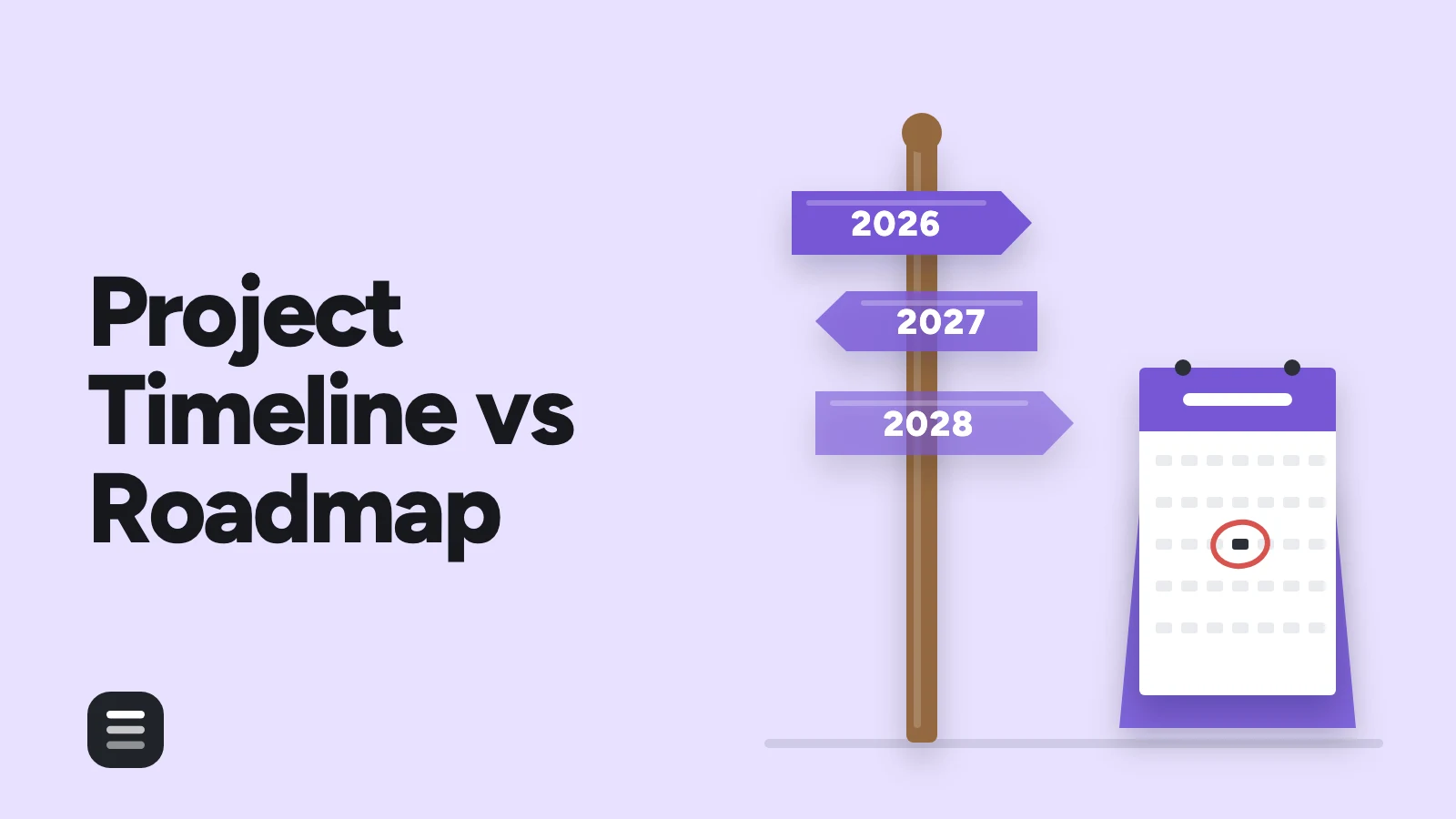
To settle project timeline vs roadmap for any plan in front of you, look for days. A roadmap tells your readers what you're aiming for and in what order, usually by quarter or year. A project timeline puts every step on a calendar day and names who owns it. If your plan has neither days nor owners, you've written a roadmap. Start from a free one pager template.
One‑Pager examples
Real One-Pagers made with MakeOnepagers. Open any one to edit it as your own.
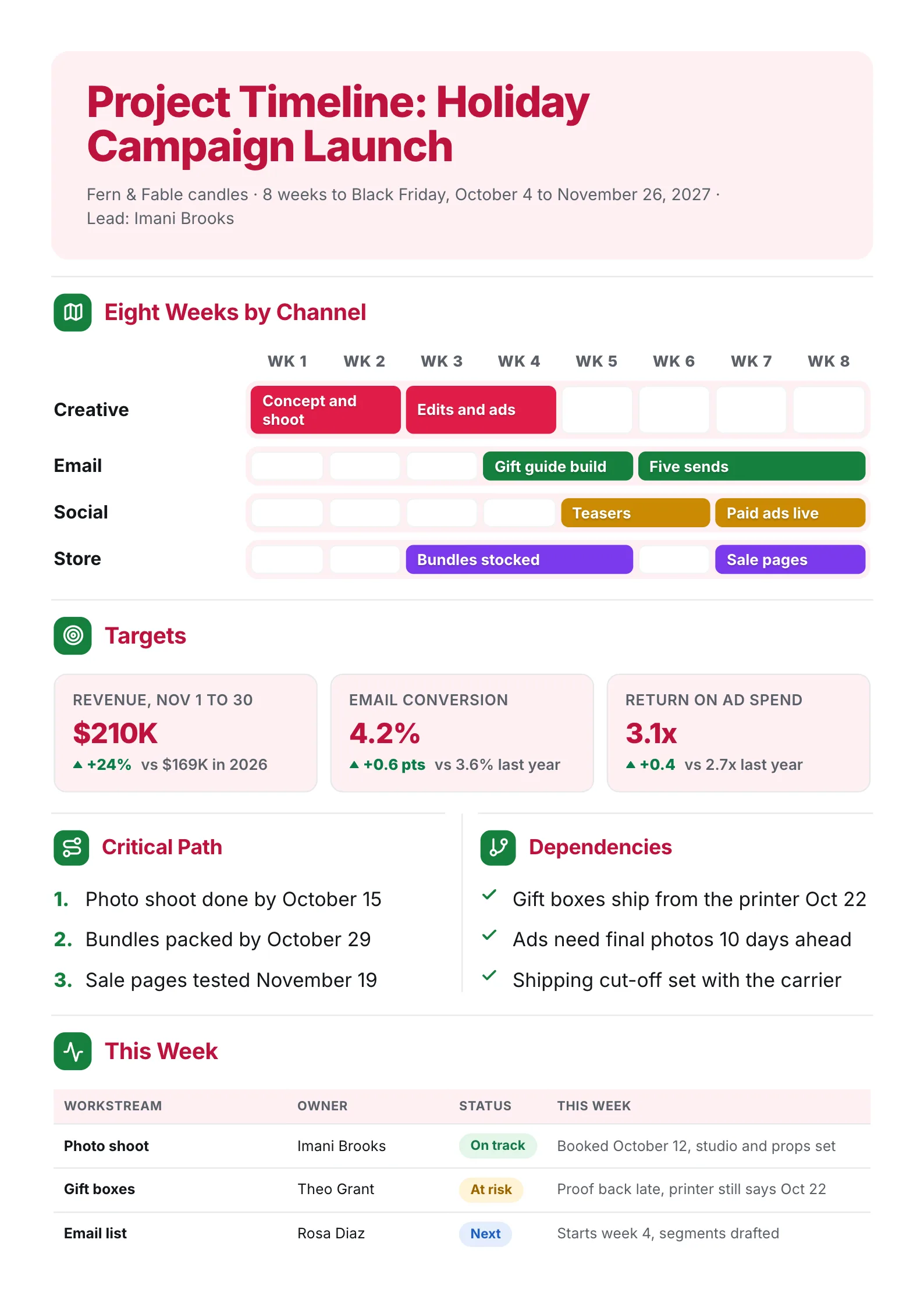 Project Timeline: Holiday Campaign LaunchEdit for free(opens in a new tab)
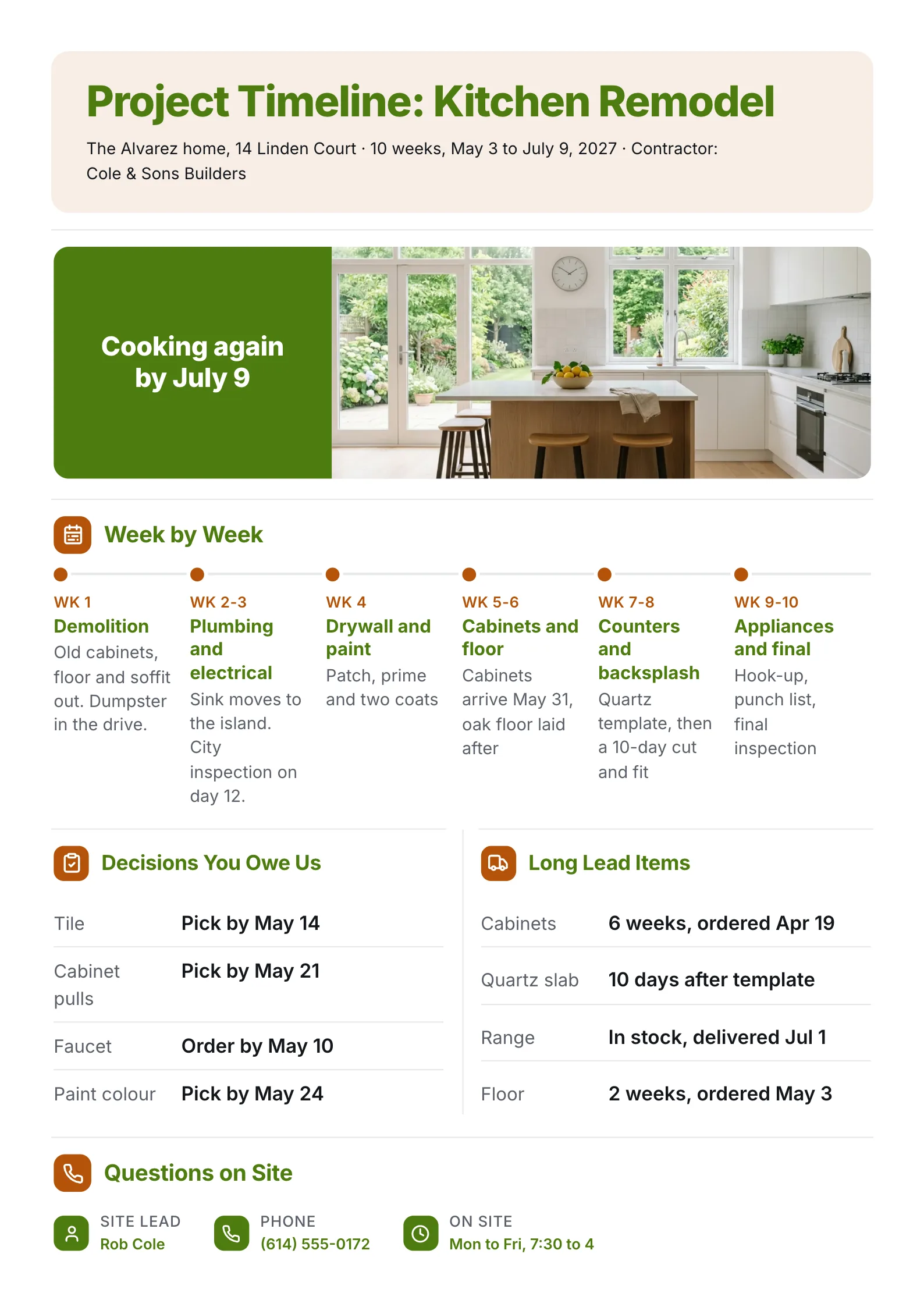 Project Timeline: Kitchen RemodelEdit for free(opens in a new tab)
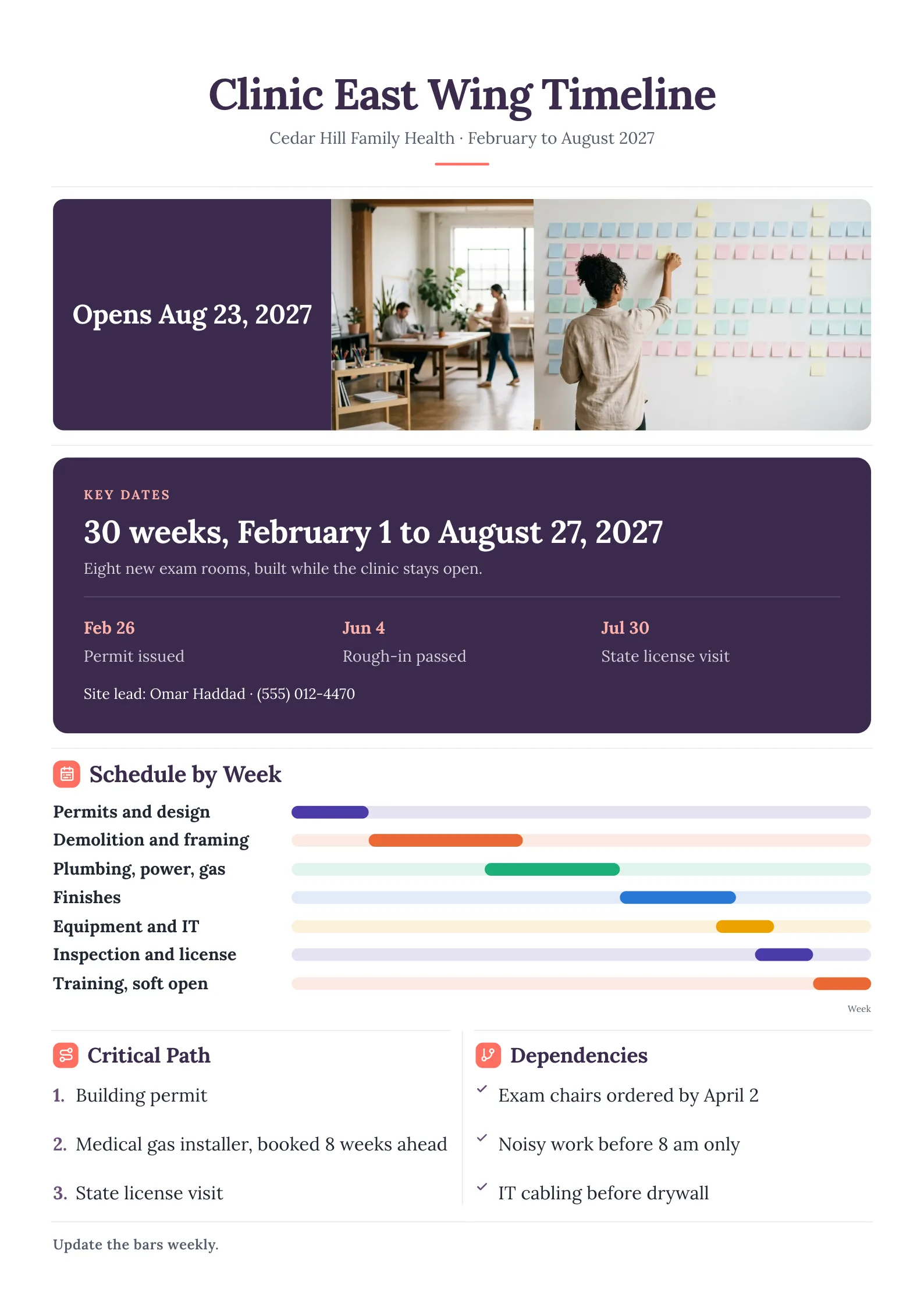 Project TimelineEdit for free(opens in a new tab)
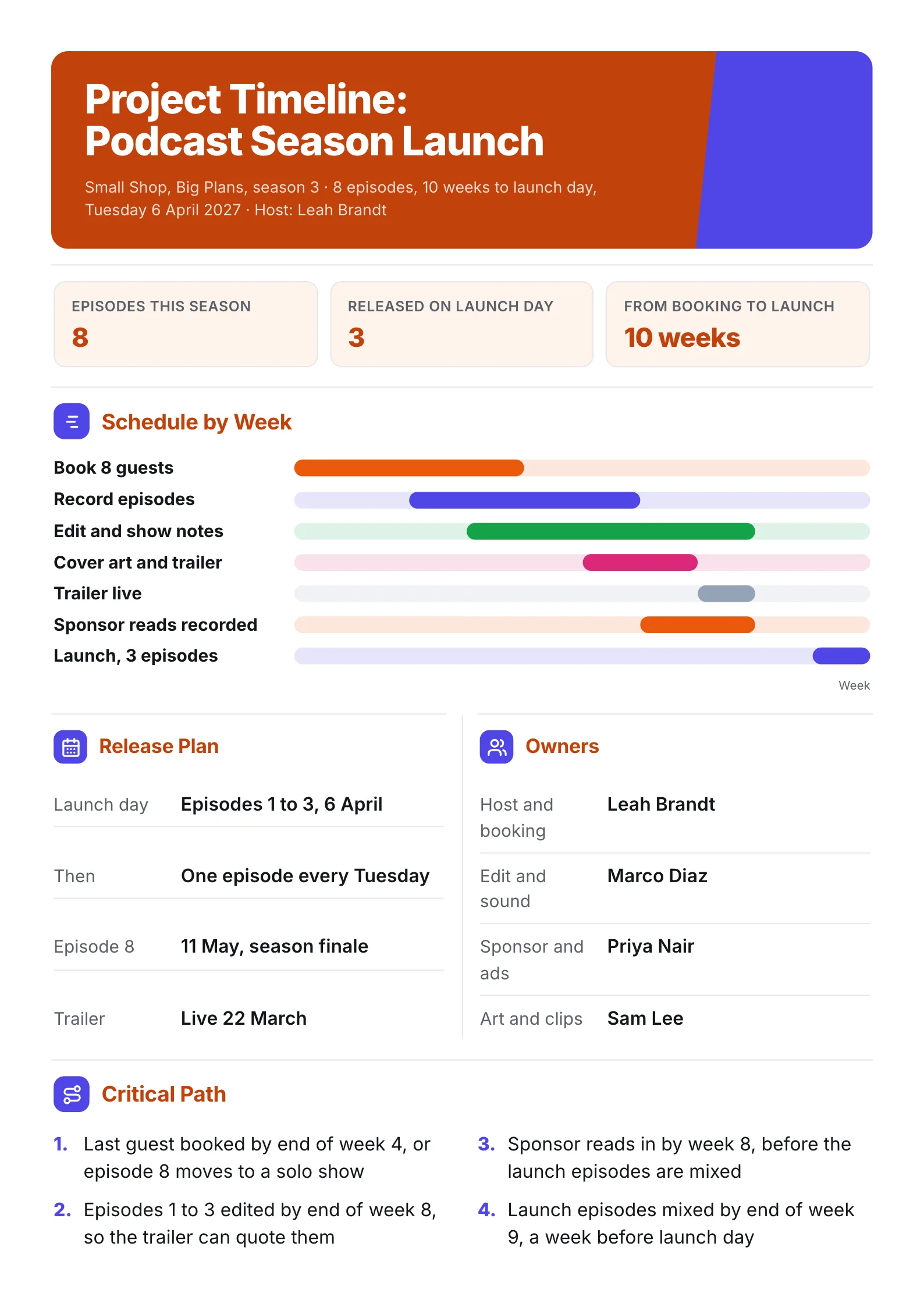 Project Timeline: Podcast Season LaunchEdit for free(opens in a new tab)
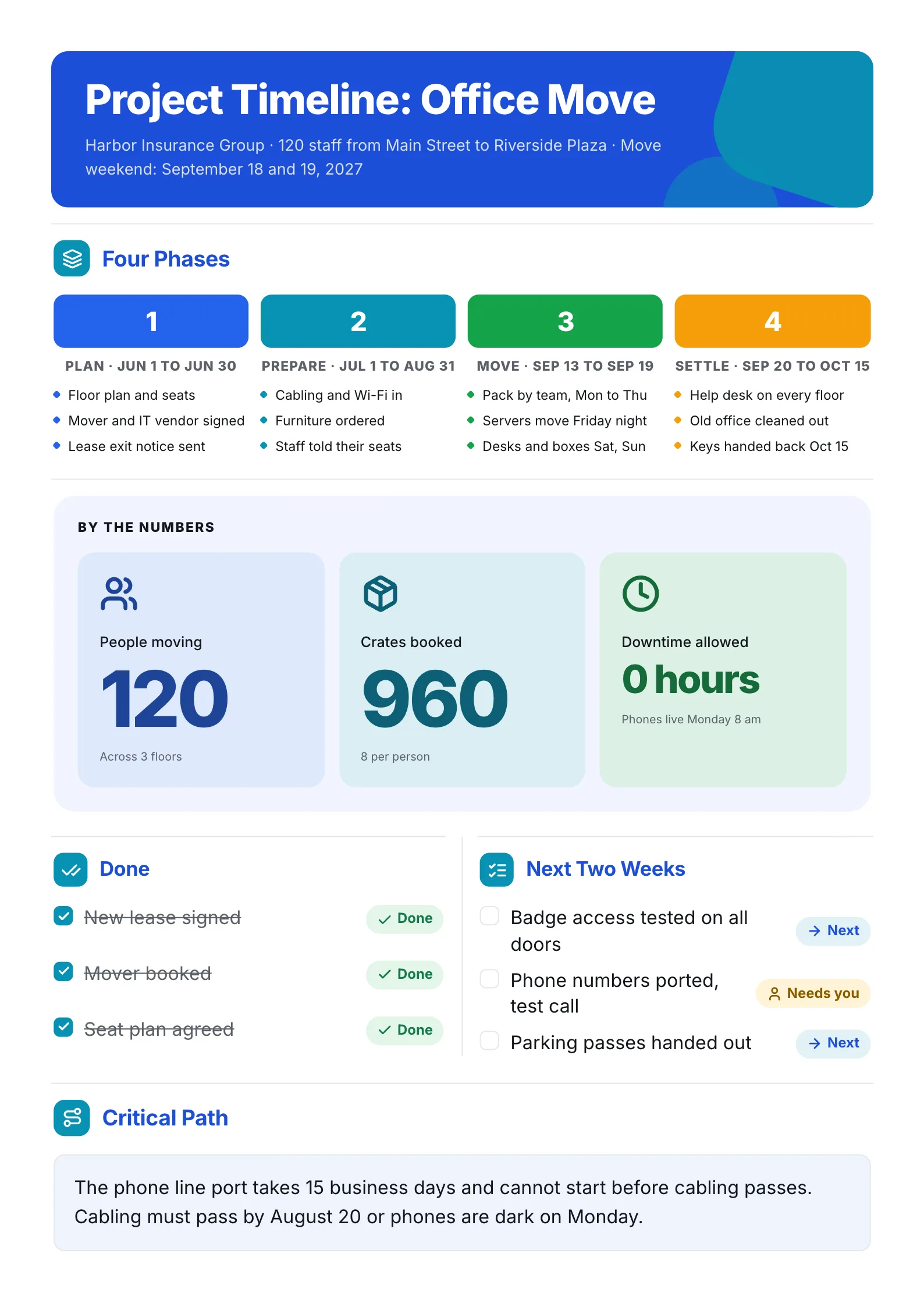 Project Timeline: Office MoveEdit for free(opens in a new tab)
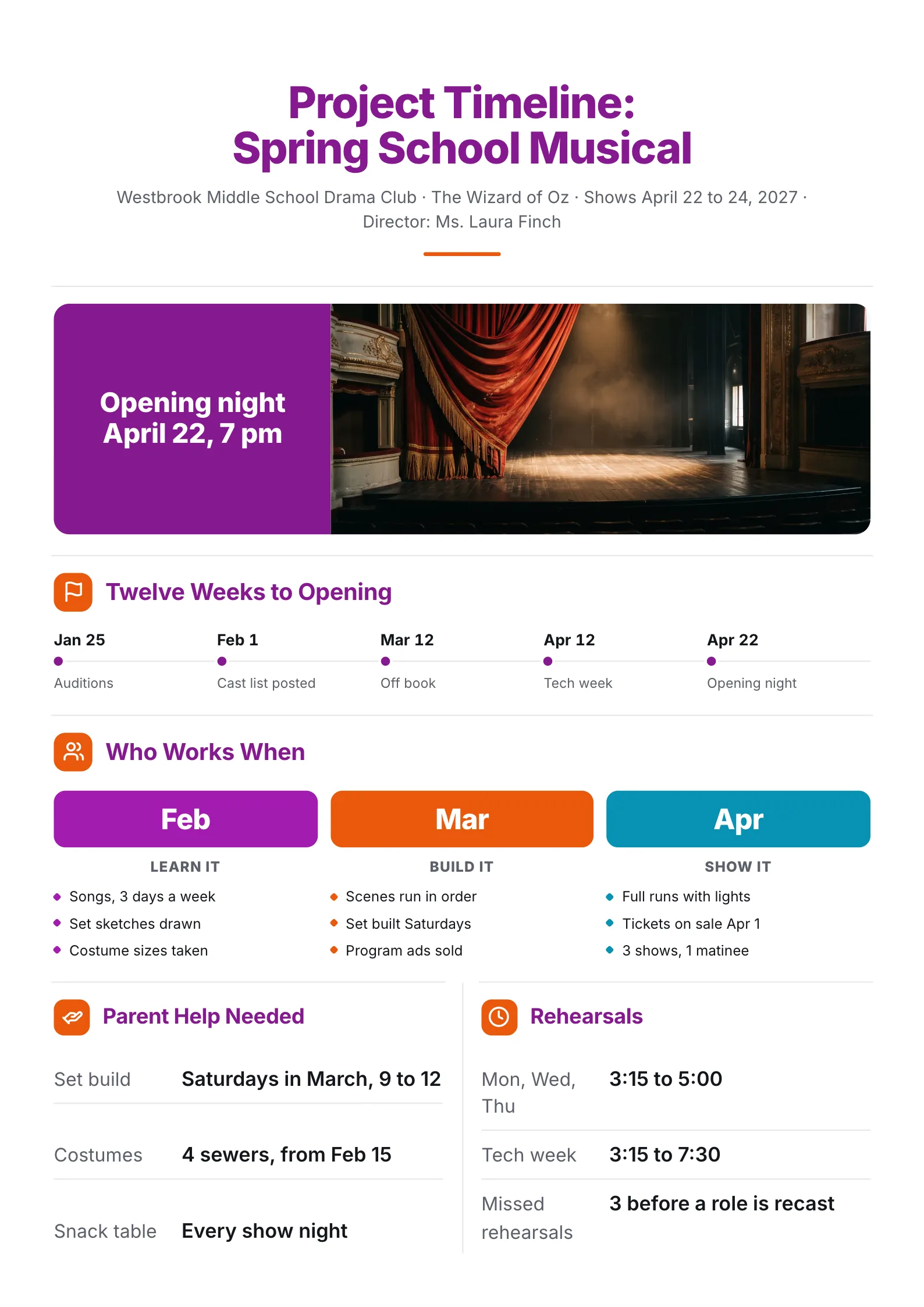 Project Timeline: Spring School MusicalEdit for free(opens in a new tab)
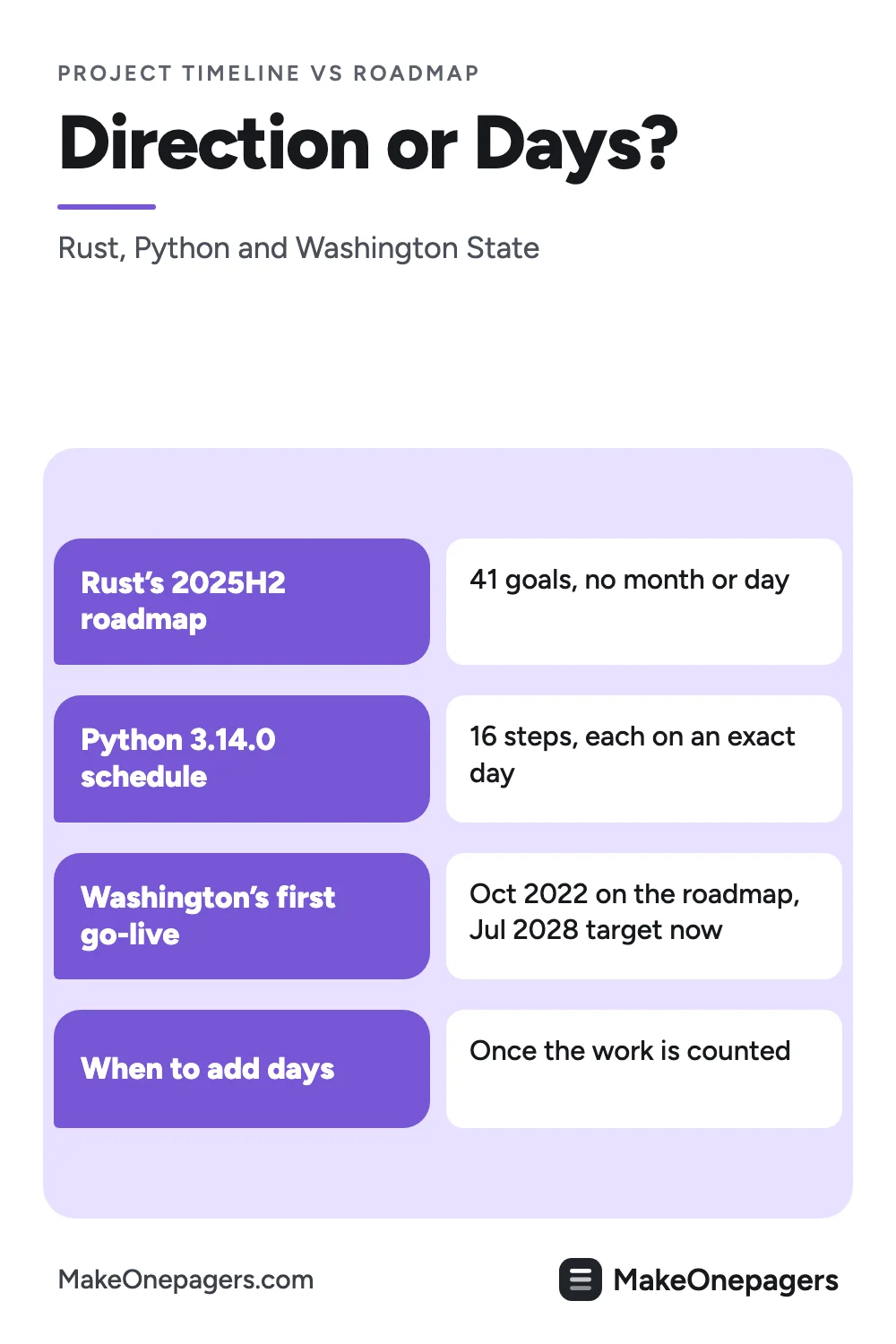
We read real public plans to see how firm that line is, so you can borrow what works. Rust's roadmap for the second half of 2025 lists 41 goals and names no month or day for any of them. Python's schedule for version 3.14 lists 16 steps up to the 3.14.0 release, and every one sits on an exact day, weekday included.
| Roadmap | Project timeline | |
|---|---|---|
| Answers | Where are we going, and in what order? | What happens on which day, and who does it? |
| Time unit | Quarters, half-years, years | Days and weeks |
| Typical span | 1 to 5 years | One project, start to finish |
| Main reader | Leaders, funders, customers | The team doing the work |
| When a date moves | Expected, and often said up front | A problem someone has to explain |
| Written | Before the work is scoped | Once the work is scoped |
A roadmap with 41 goals and no dates
The Rust programming language plans its work in half-year goal periods. Its 2025H2 project goals open by saying an approved proposal set "41 total Rust project goals for 2025H2." Then they pick out the ones that matter most: "This period we have 14 flagship goals, broken out into four themes."
The four themes read like a roadmap should. "Beyond the &" is about smart pointers. "Unblocking dormant traits" is about the trait system. "Flexible, fast(er) compilation" is about build speed, and "Higher-level Rust" is about making higher-level uses of Rust easier.
Here's what the page leaves out. We searched its roughly 4,700 words for month names, calendar dates and years. No goal has a month or a day. The only year, apart from the 2025H2 in the title, is a hope that one feature will be "ready for stabilization in 2026."
What it does have is a name on every flagship goal. Each row lists a contact plus task owners and champions. So your roadmap can stay loose about time and still be clear about who's responsible. Give each goal a name before you give it a date.
A timeline with 16 exact days
Python works the other way. PEP 745, the release schedule for Python 3.14, is a project timeline in its purest form. It explains its own rhythm first: "The dates below use a 17-month development period that results in a 12-month release cadence between feature versions."
Then it lists the steps:
- Development begins: Wednesday, May 8, 2024
- Alphas 1 to 7: October 15, 2024 to April 8, 2025
- Beta 1: Wednesday, May 7, 2025, marked "(No new features beyond this point.)"
- Betas 2 to 4: May 26 to July 8, 2025
- Release candidates 1 to 3: July 22 to September 18, 2025
- Final: "3.14.0 final: Tuesday, 2025-10-07"
That's 1 start, 7 alphas, 4 betas, 3 candidates and 1 final, so 16 dated steps. Below them, a list of bugfix releases puts 17 more on exact days, out to October 2027. Every one carries its weekday. The schedule also names its crew: a release manager, a Windows installer lead, a Mac installer lead and a documentation lead.
Read to the end of the schedule and you'll see the tone change. Under "3.14 lifespan," Python says the version "will receive bugfix updates approximately every two months for approximately 24 months," with security fixes until "approximately October 2030." The word "approximately" appears 3 times on the page, and all 3 are in that section. Past the next couple of years, even Python stops naming days and starts talking like a roadmap.
That's the clearest lesson in this whole comparison. You don't pick one document forever. Give your near work a timeline, and keep your far work on a roadmap.
One program, both documents, six years apart
Washington State's One Washington program shows what happens when the two get mixed up. It's the state's project to replace its administrative systems, from accounting to HR, with one cloud-based system.
The 2021 roadmap
On December 1, 2021, the program published a one-page Modernization Roadmap. It has 6 bars, from agency readiness through Phase 3 budget preparation. It also has 6 dated markers:
- Software selected, March 2020
- Integrator selected, October 2020
- Implementation begins, January 2021
- Phase 1a go-live, October 2022
- Phase 1b go-live, July 2023
- Phases 2 and 3 go-live, June 2025
All six are a month and a year. None has a day. A footnote warns that "The plan is subject to 1) funding approval and 2) anticipated adjustments based on scope/schedule revisions that may emerge during the program."
That's an honest roadmap. It gives the order, a rough size for each phase and a warning that the dates will move.
What the dates became
By September 2024, the Phase 1a date was no longer October 2022. Slides for the state's Technology Services Board say "Schedule execution progresses towards a July 2025 Phase 1a Go Live" and note a "Completed schedule rebuild in June." On the same deck, a concerns list includes "Lack of Confidence in the July 2025 Go-Live Date."
In March 2025, the board's One Washington one-pager listed "Finalizing the go-live date" as a key risk. Its chart was titled "Hi-level Roadmap: Draft as of 3/4/25" and carried a line saying "Planning in process dates are subject to change."
Then, on October 8, 2026, the program announced a new go-live range. "In September 2026, One Washington baselined the schedule for Phase 1A." The range now runs from April to October 2028, "with the program driving toward July 2028." Go-live can only happen in April, July or October. January is left out on purpose, because of year-end processing in the state's old HR and accounting systems.
From October 2022 on the roadmap to July 2028 on the baselined schedule is 69 months. We're not pointing at Washington to mock it. The program warned that dates would move on its very first roadmap. We're pointing at it because it shows the handoff in public. The roadmap said "Oct 2022." The timeline, once someone had counted the work, said something else.
What each one is for
Put the three plans side by side and you can see which job each one does.
Use a roadmap when your question is direction. Rust's 41 goals tell contributors what the project cares about this half-year. Washington's 2021 page showed the order of six phases. Neither needed a day to do its job.
Use a project timeline when your question is coordination. Python's 16 dates tell volunteers around the world when to freeze features, when to test and when to ship. Without a day on beta 1, nobody would know when "No new features beyond this point" starts.
Move from one to the other once you've counted the work. Washington's dates only firmed up when the program "baselined the schedule." That's the moment a roadmap item turns into a timeline. Until you reach that point, treat any month on your roadmap as an estimate.
Five project timelines that do what a roadmap can't
The five MakeOnepagers samples below are project timelines for invented teams. Each one shows something you'd leave off a roadmap, such as an exact day, a gate you must pass or a window you can't miss. Copy the part that fits your project.
An ERP rollout with a test for every gate
 Edit this template
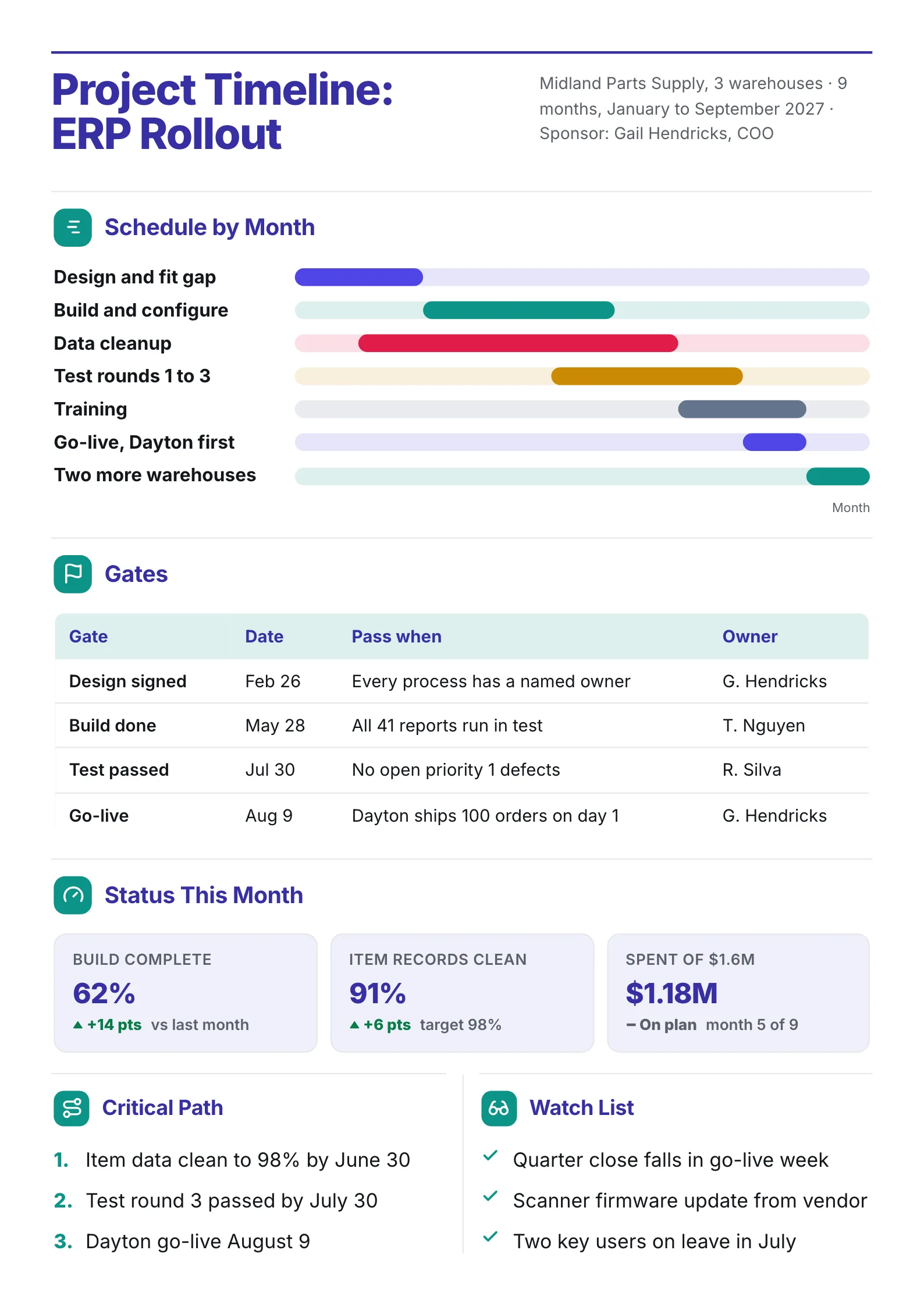
This ERP rollout timeline is the small-company version of Washington's project. It has four gates, and each one has a date, an owner and a rule for passing. Design is signed on February 26 when "every process has a named owner." Go-live is August 9, and it passes when "Dayton ships 100 orders on day 1." Its watch list flags quarter close falling in go-live week, the same kind of clash that keeps Washington's go-live out of January. If your roadmap says "new system next year," this is the page that says how you'll know you're ready.
A mobile app launch with the store review built in
 Edit this template
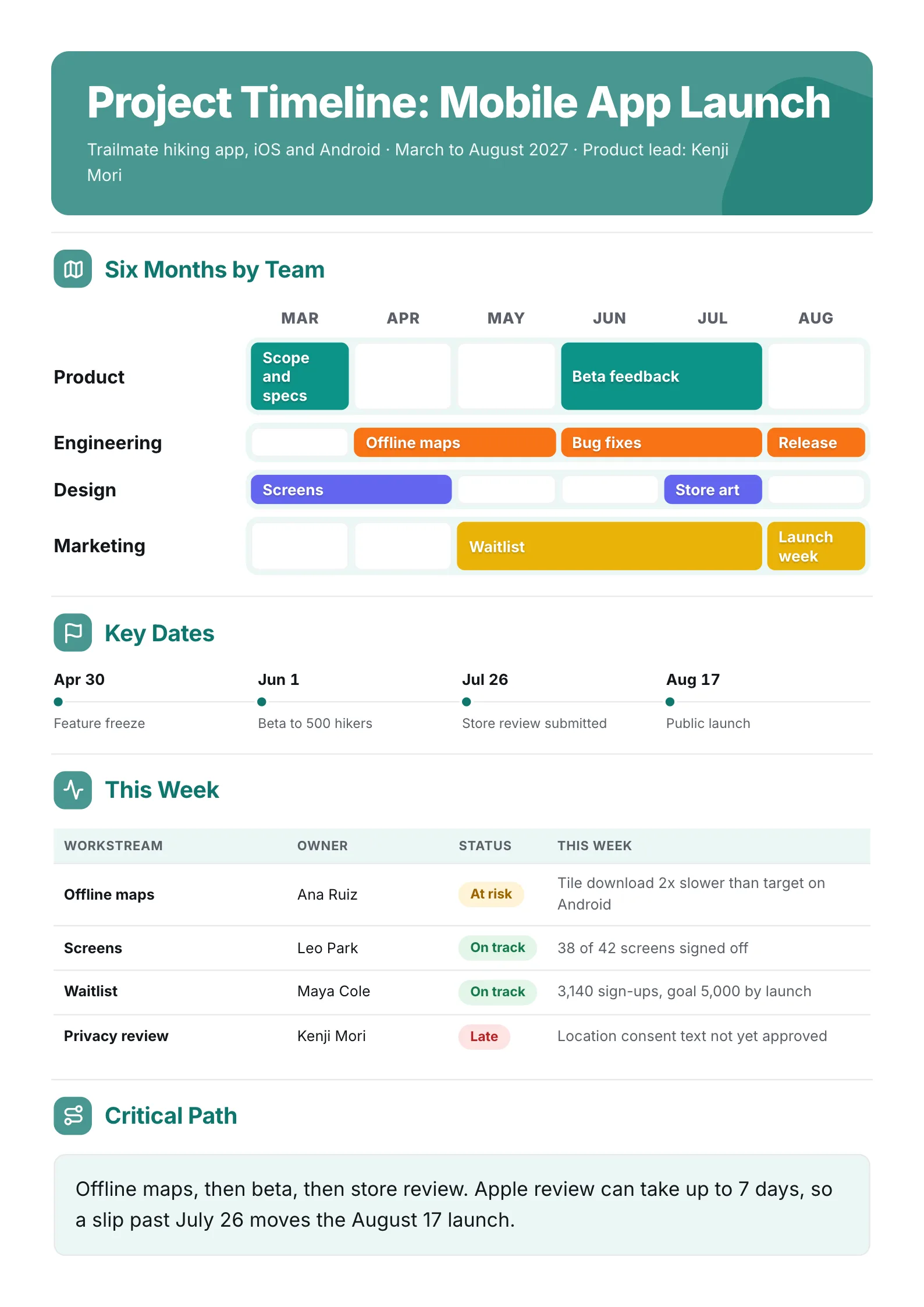
This mobile app launch timeline has the same shape as Python's schedule, at a smaller size. Feature freeze is April 30, beta goes to 500 hikers on June 1, the store review is submitted July 26 and public launch is August 17. Its critical path explains the gap. "Apple review can take up to 7 days, so a slip past July 26 moves the August 17 launch." On your roadmap, this would read "launch in summer," and that's all your leaders need.
A data center move with one weekend that can't slip
 Edit this template
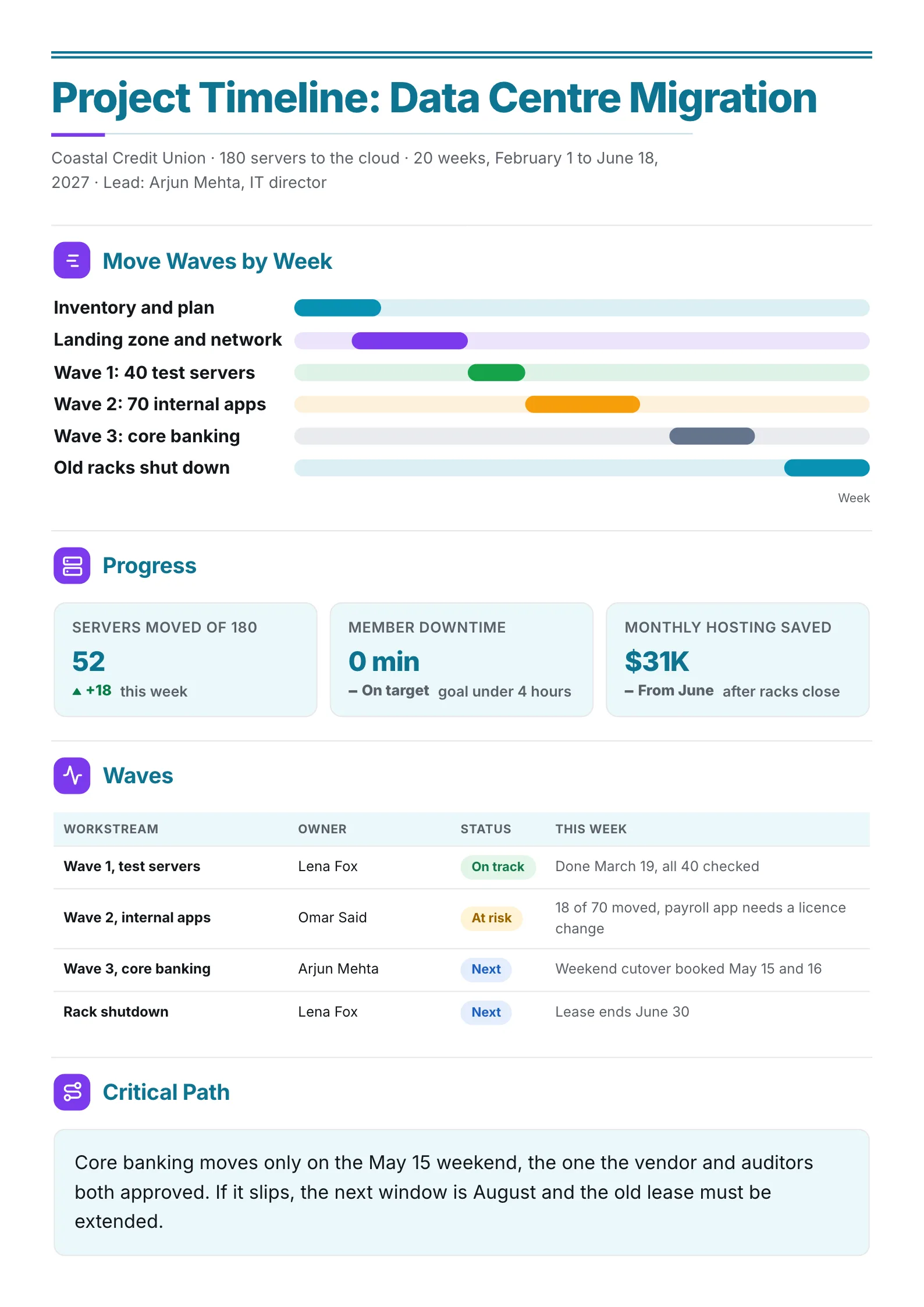
Like Washington's April, July and October windows, this data center migration timeline works around fixed openings. It moves 180 servers in 20 weeks, from February 1 to June 18, 2027. Core banking moves "only on the May 15 weekend, the one the vendor and auditors both approved." If that slips, "the next window is August and the old lease must be extended." When a date has a cost like that, put it on a timeline and write the cost beside it.
A gala with a weekday on every date
 Edit this template
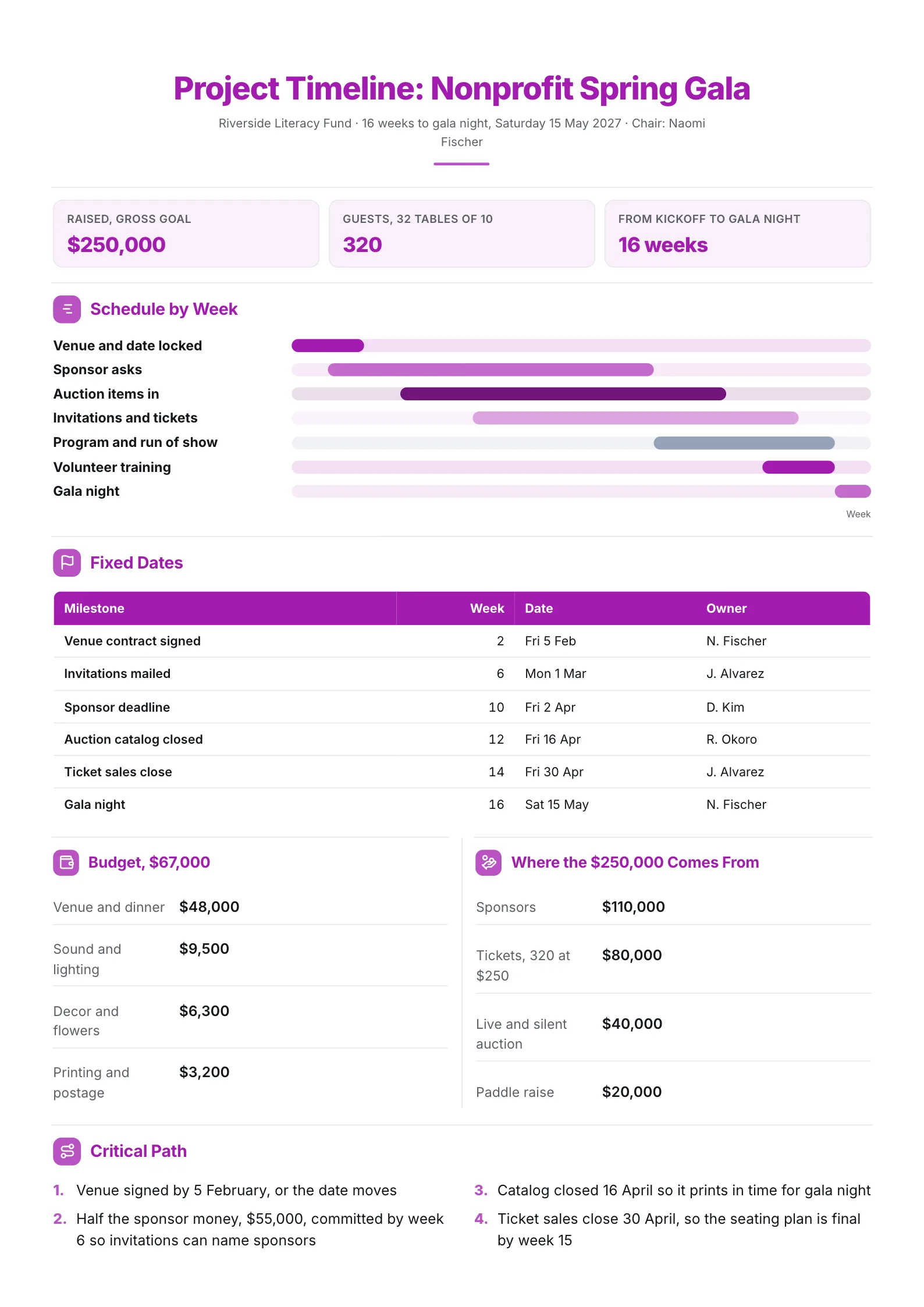
Python writes the weekday next to every date, and so does this nonprofit gala timeline. Its six fixed dates run from the venue contract on Fri, Feb 5 to gala night on Sat, May 15, and each has an owner's name. The critical path is blunt: "Venue signed by February 5, or the date moves." Add the weekday to your own dates too, so a volunteer can check it at a glance.
A two-year study that mixes both
 Edit this template
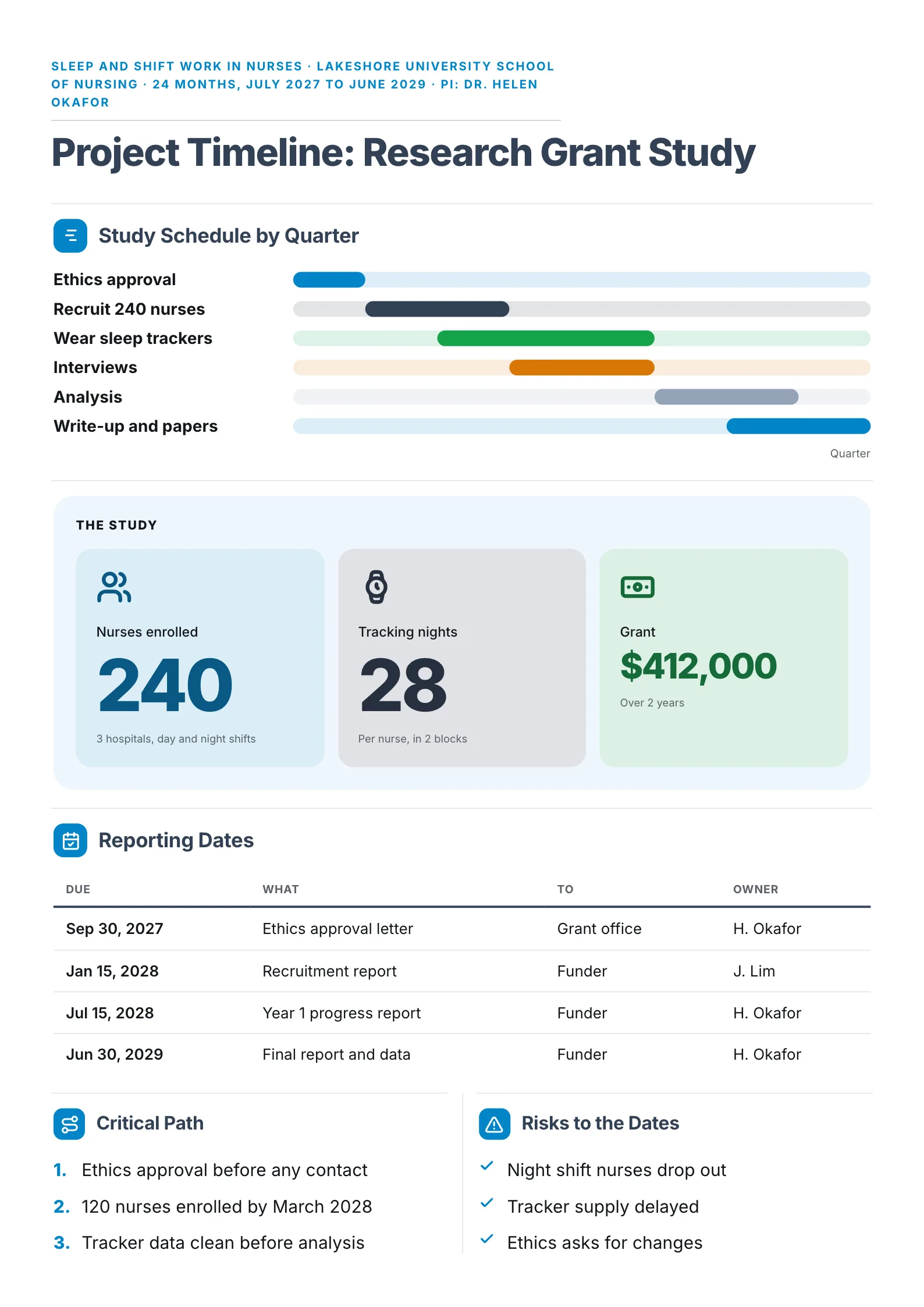
This research grant study timeline runs 24 months, from July 2027 to June 2029. The work is shown by quarter, roadmap style, from ethics approval to write-up. The reporting dates are exact, from September 30, 2027 for the ethics letter to June 30, 2029 for the final report. That's Python's lesson on one page. Use days for what you're sure of, and give the rest bigger blocks.
How to turn a roadmap item into a timeline
When a roadmap item gets close, run it through these steps before anyone promises a date.
- Count the work first. Washington set its range only after it "baselined the schedule." List the tasks, size them and find the longest chain.
- Name the fixed points. Some dates belong to someone else, like a store review, a lease or a year-end close. Put them on first, then plan around them.
- Give every step a day and a name. Python names its release crew and dates all 16 steps. Do the same, even on a small project.
- Keep a range until you're sure. Washington publishes a range, April to October 2028, and a target inside it. That's more honest than one confident date.
- Leave the far end on the roadmap. Python switches to "approximately" for anything past its next couple of years. Don't fake precision about work you haven't scoped.
For a full walk-through of steps 1 to 3, read how to write a project timeline. If your team also needs the task-by-task bars, our post on project timeline vs Gantt chart covers that next step.
Map it, then date it
Start your plan as a short roadmap, then build a timeline for whatever's next. Pick a MakeOnepagers project timeline and put your own days and owners on it, or keep a whole year on a one page roadmap. Have notes or a task list already? The free AI One-Pager generator can lay them out as a first draft.
Frequently asked questions
Is a roadmap the same as a project timeline?
No. A roadmap shows goals and their order over quarters or years. A project timeline schedules one project's steps on exact days. Rust's half-year roadmap has 41 goals and no dates, while Python's 3.14.0 schedule gives 16 steps on named days.
Should a roadmap have dates at all?
Months, quarters or years, yes, if your readers need a sense of when. Washington State's 2021 roadmap used month and year only, with a note that the plan could change. Leave out exact days until the work has been counted.
Which comes first, the roadmap or the timeline?
The roadmap. It sets direction while the work is still loose. When a roadmap item gets near and the team has sized the tasks, you write its timeline.
Who reads a roadmap and who reads a timeline?
Leaders, funders and customers read the roadmap to see where things are going. The people doing the work read the timeline every week to see what's due and who owns it.
What should you do when a roadmap date turns out to be wrong?
Say so, and give the new range with a target inside it. Washington State moved from a single 2022 month to a published 2028 range with a July target and three allowed windows. Readers trust a range with a reason more than a date that keeps slipping quietly.




