Process Map Questions: What Two State Governments Ask
Process map questions from Connecticut's public health QI team and Missouri's lean program, for the current map, each step and the fix.

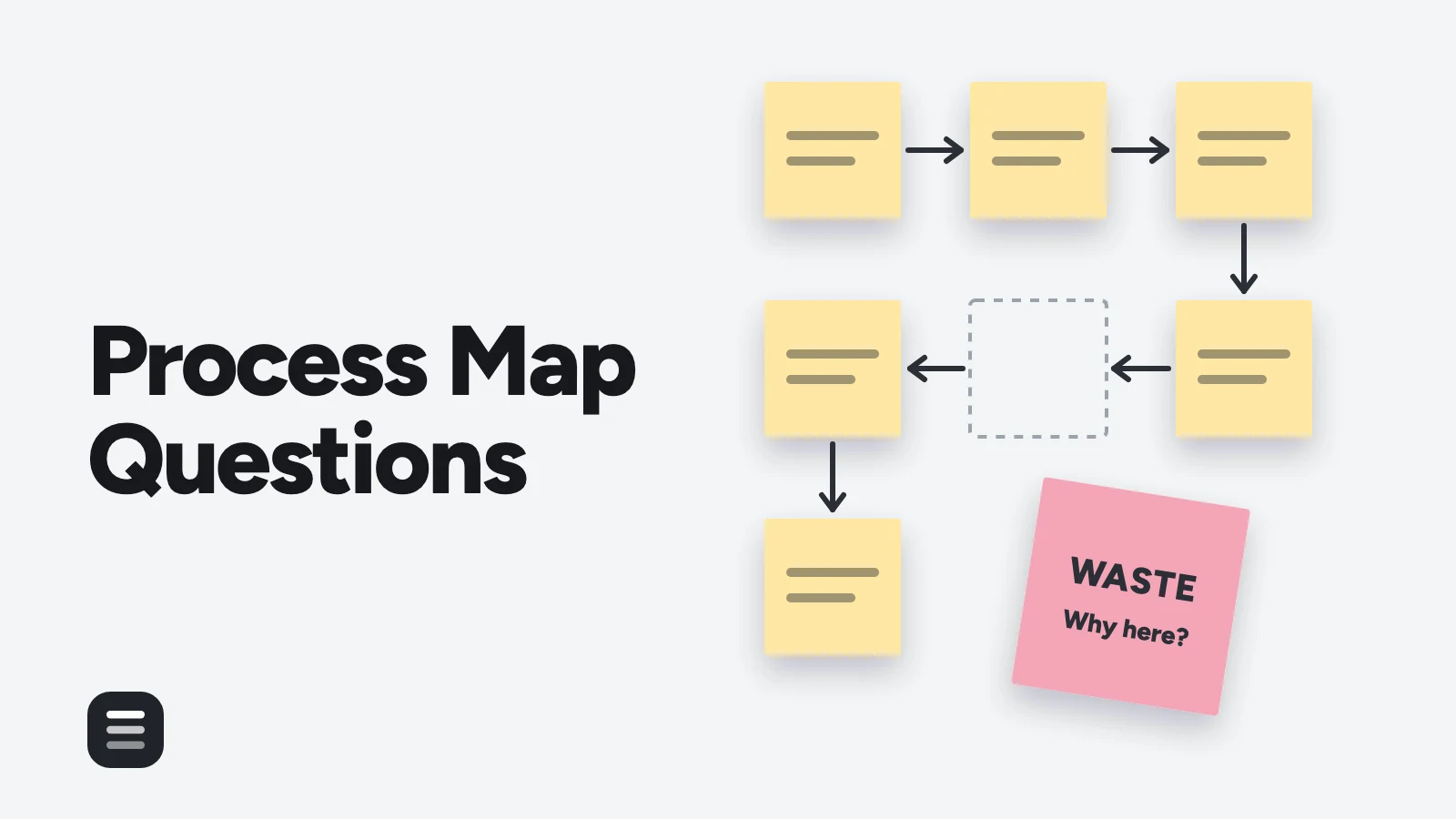
Drawing a process map takes an afternoon. Knowing what to ask while you draw it is what makes the map worth the afternoon. Start from a free one pager template.
One‑Pager examples
Real One-Pagers made with MakeOnepagers. Open any one to edit it as your own.
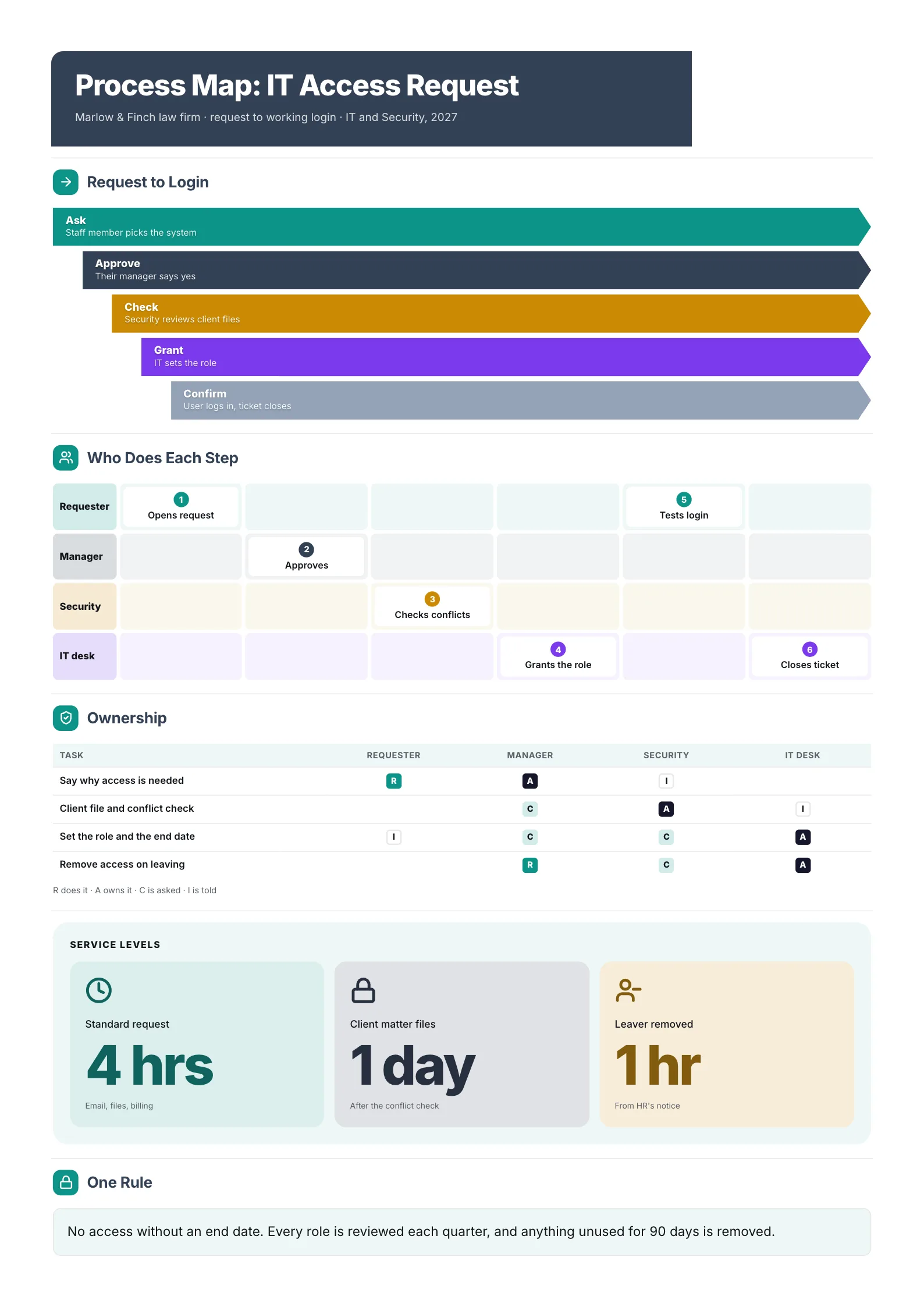 Process Map: IT Access RequestEdit for free(opens in a new tab)
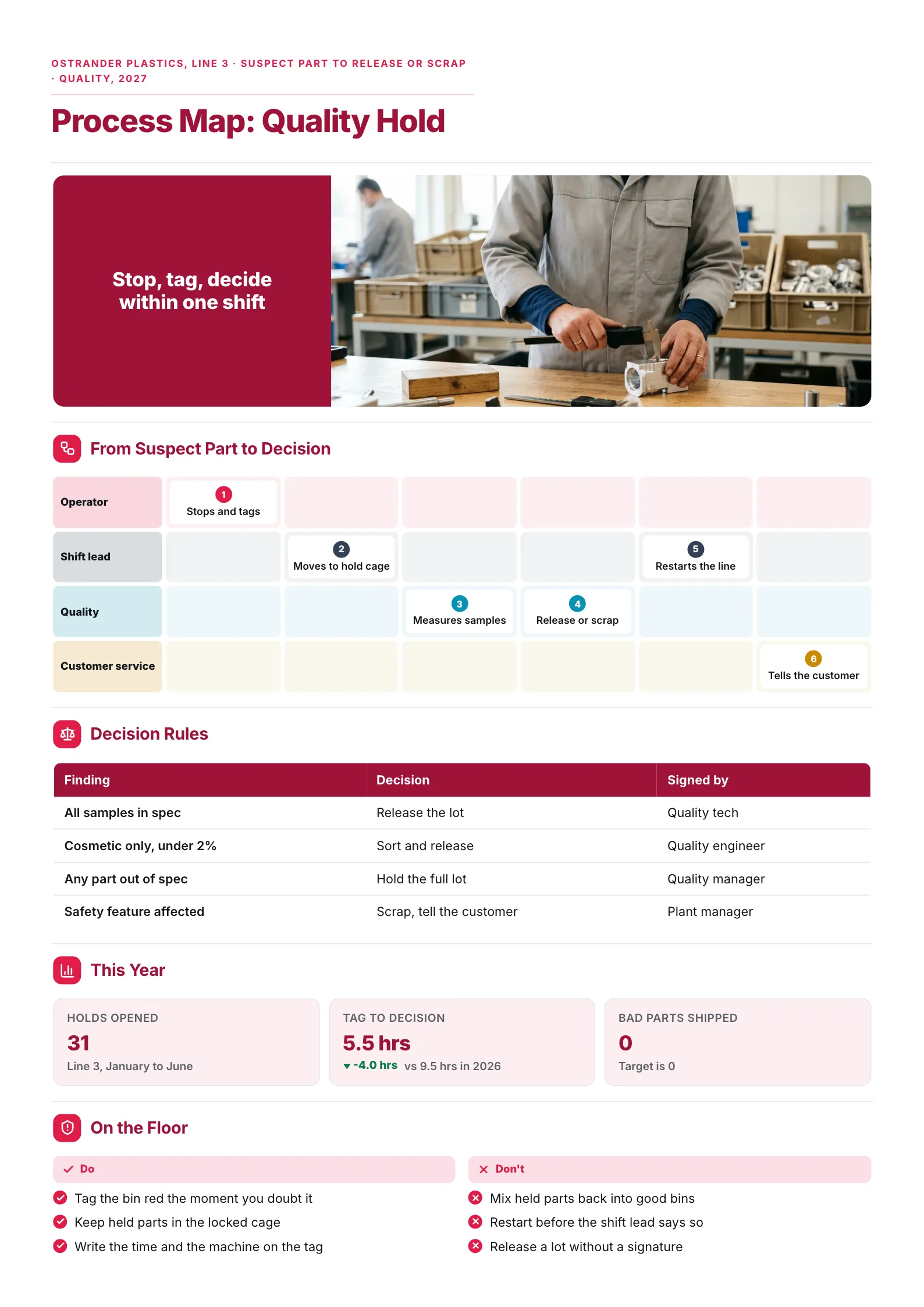 Process Map: Quality HoldEdit for free(opens in a new tab)
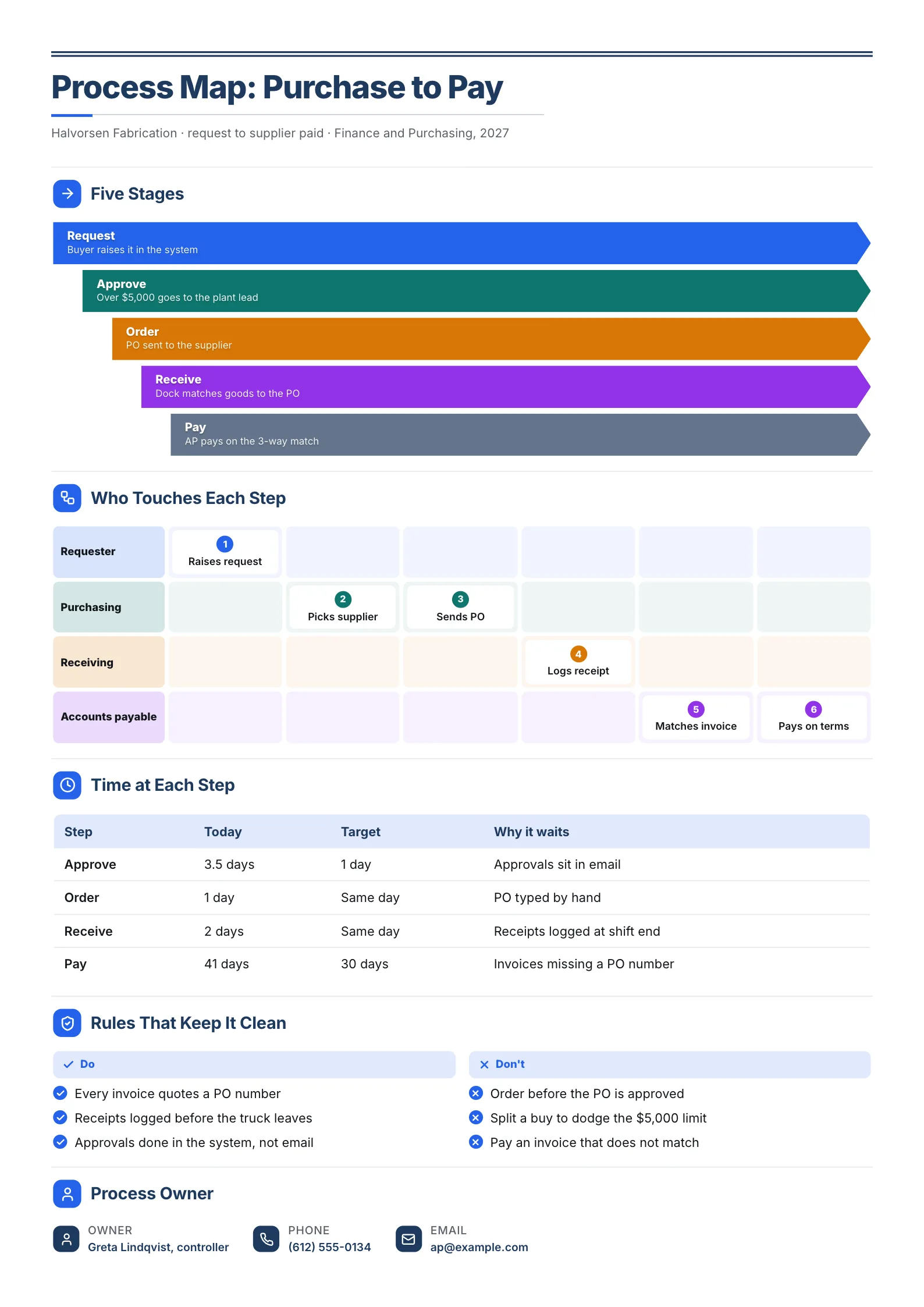 Process Map: Purchase to PayEdit for free(opens in a new tab)
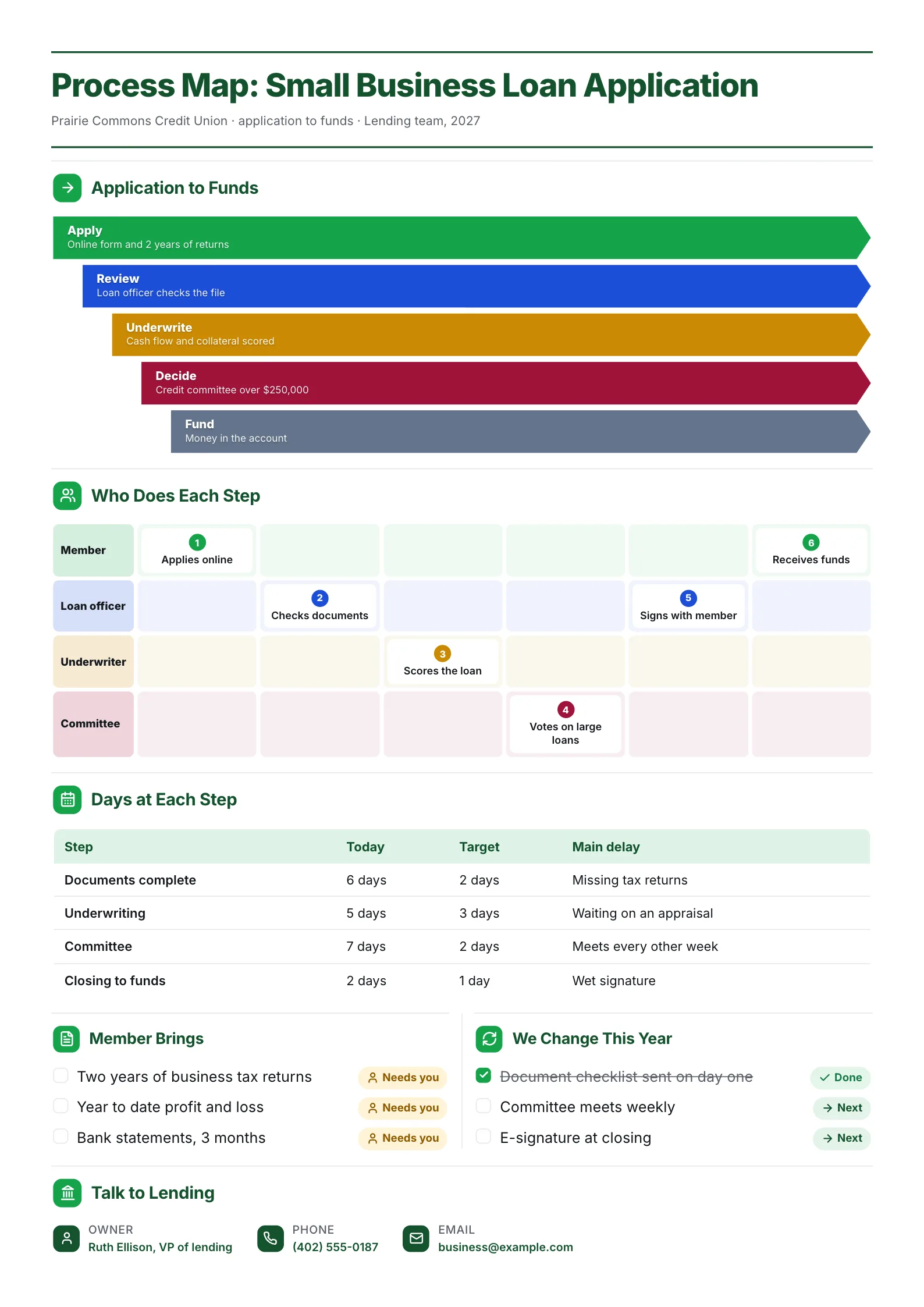 Process Map: Small Business Loan ApplicationEdit for free(opens in a new tab)
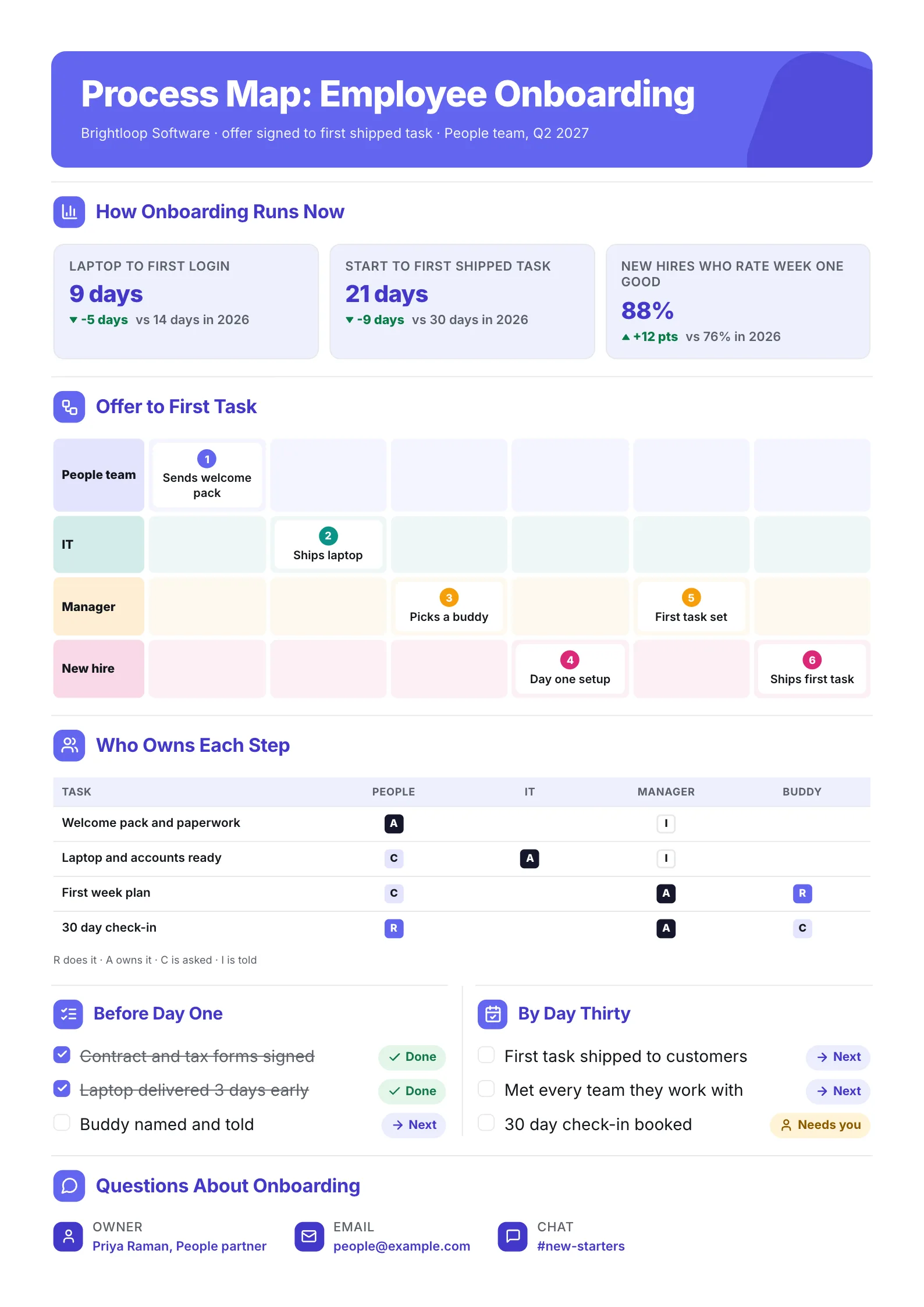 Process Map: Employee OnboardingEdit for free(opens in a new tab)
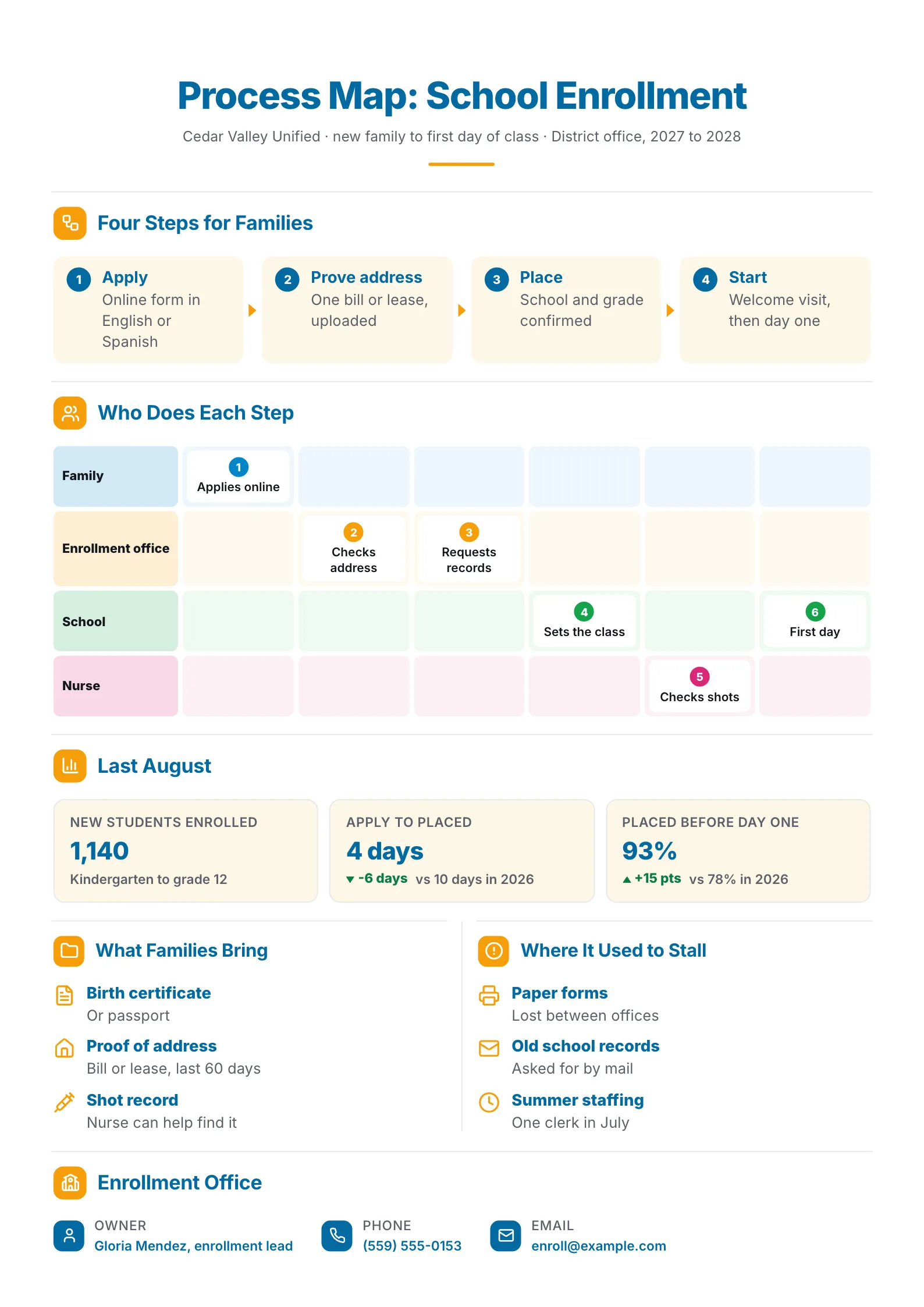 Process Map: School EnrollmentEdit for free(opens in a new tab)
Two state governments publish their answer. The Connecticut Department of Public Health runs quality improvement training for local health departments, and its November 2017 slideset walks them through mapping a process on its Accreditation Learning Community call. Missouri's Show Me Excellence program publishes a two-page Process Mapping sheet for its white belt course. We pulled every question from both and put them in the order you'll need them.
Before you draw anything
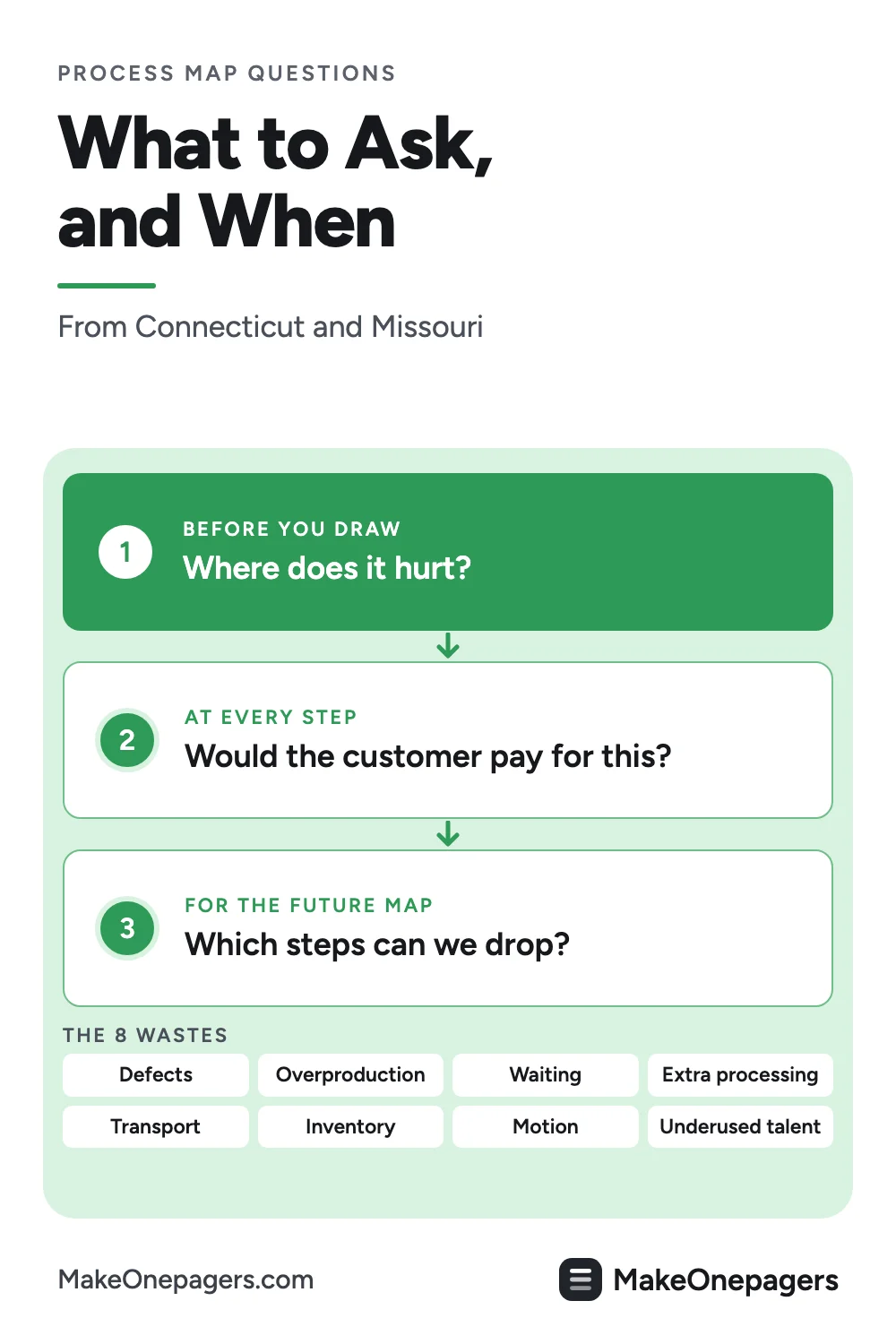
Missouri's sheet lists five steps, and the first two are questions you answer before any sticky note goes up:
- Who actually does this work? Get those people in the room.
- Where does the process start and where does it end?
Connecticut adds three more, under a slide titled "Questions to Ask":
- What do our customers care about?
- What are their pain points?
- What are OUR pain points?
The capital letters are theirs. Write the answers on a flip chart and leave it up. Every step you draw later gets checked against it.
Connecticut's slides also warn that "your current and future state maps are as strong as the people you have in the room." If the person who handles the hand-off isn't there, the map will show the hand-off the way a manager imagines it.
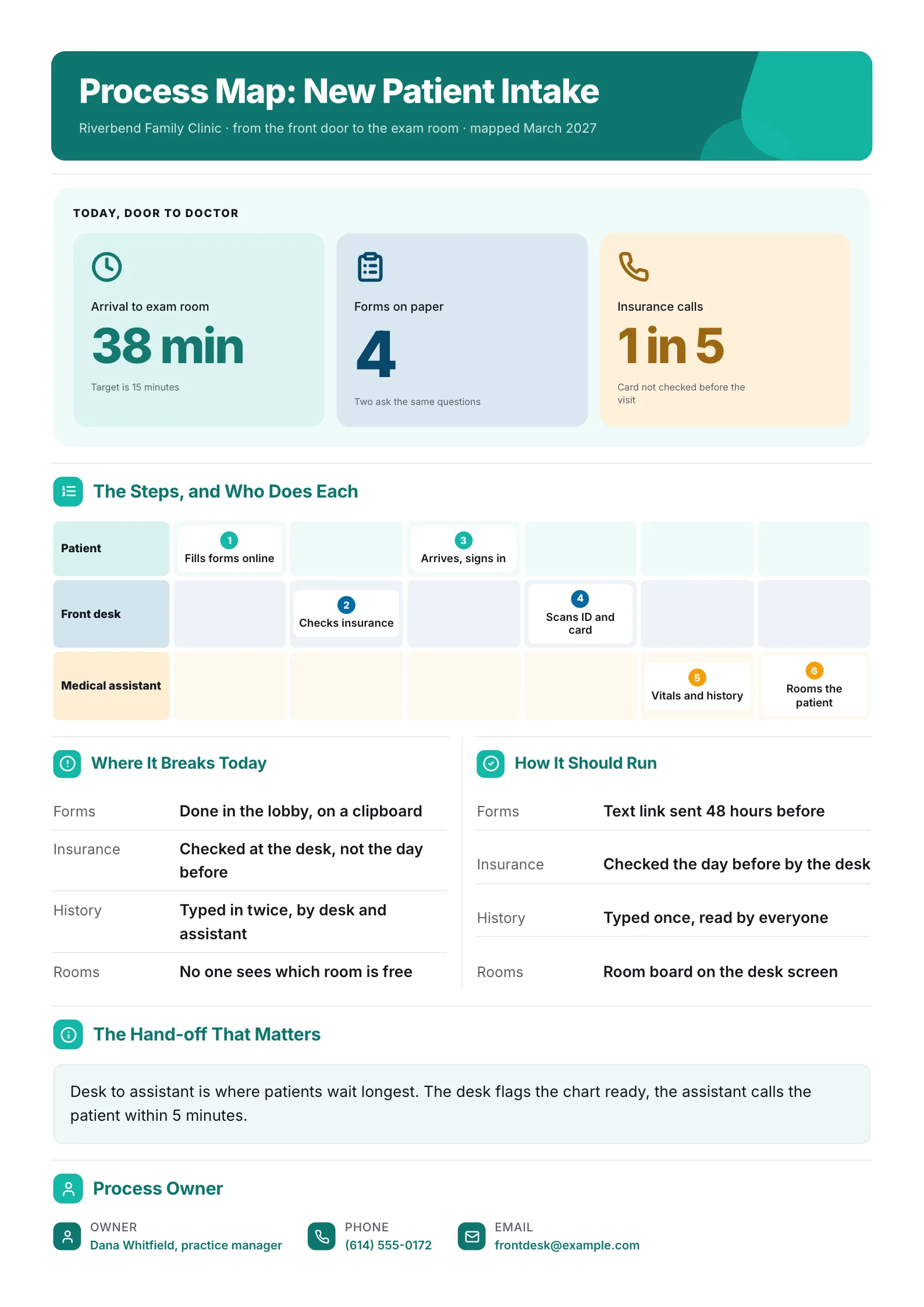 Edit this template
Sample names and figures. The three numbers at the top answer the customer question first, before a single step is drawn.
The question for every step
Once the steps are up, ask one question of each: does this add value for the customer? Connecticut's slides split steps into value-added and non-value-added, and the examples of non-value-added work are ones you've probably sat through. Double checking. Multiple signatures.
To help you spot them, both states use the same list, the 8 wastes of lean. Here they are with the example Connecticut gives for government work and a question you can ask about your own map.
| Waste | Connecticut's example | Ask about your step |
|---|---|---|
| Defects | Incomplete information | How often does this come back because something was missing? |
| Overproduction | Multiple forms, forms instead of computers | Are you making something nobody uses next? |
| Waiting | Idle time, decisions, responses | How long does the work sit before someone touches it? |
| Non-value-added processing | Multiple approvals, forwarding calls | Would the customer pay for this step if they saw it? |
| Transportation | Handoffs on documents, walking between buildings | How many times does the work change hands? |
| Inventory | Too many files | What's piling up between steps? |
| Motion | Searching for information | How much time goes to looking for things? |
| Underused talent | Employee underutilization | Is a skilled person doing work a form could do? |
Source: Connecticut DPH QI slideset, November 2017, and Missouri Show Me Excellence Process Mapping overview, both read October 30, 2026. Missouri names the last one for talent that goes unused.
You don't need to ask all eight about every step. Ask waiting and transportation everywhere, since those two are the easiest to measure in minutes and hand-offs. Save the rest for the steps that feel slow.
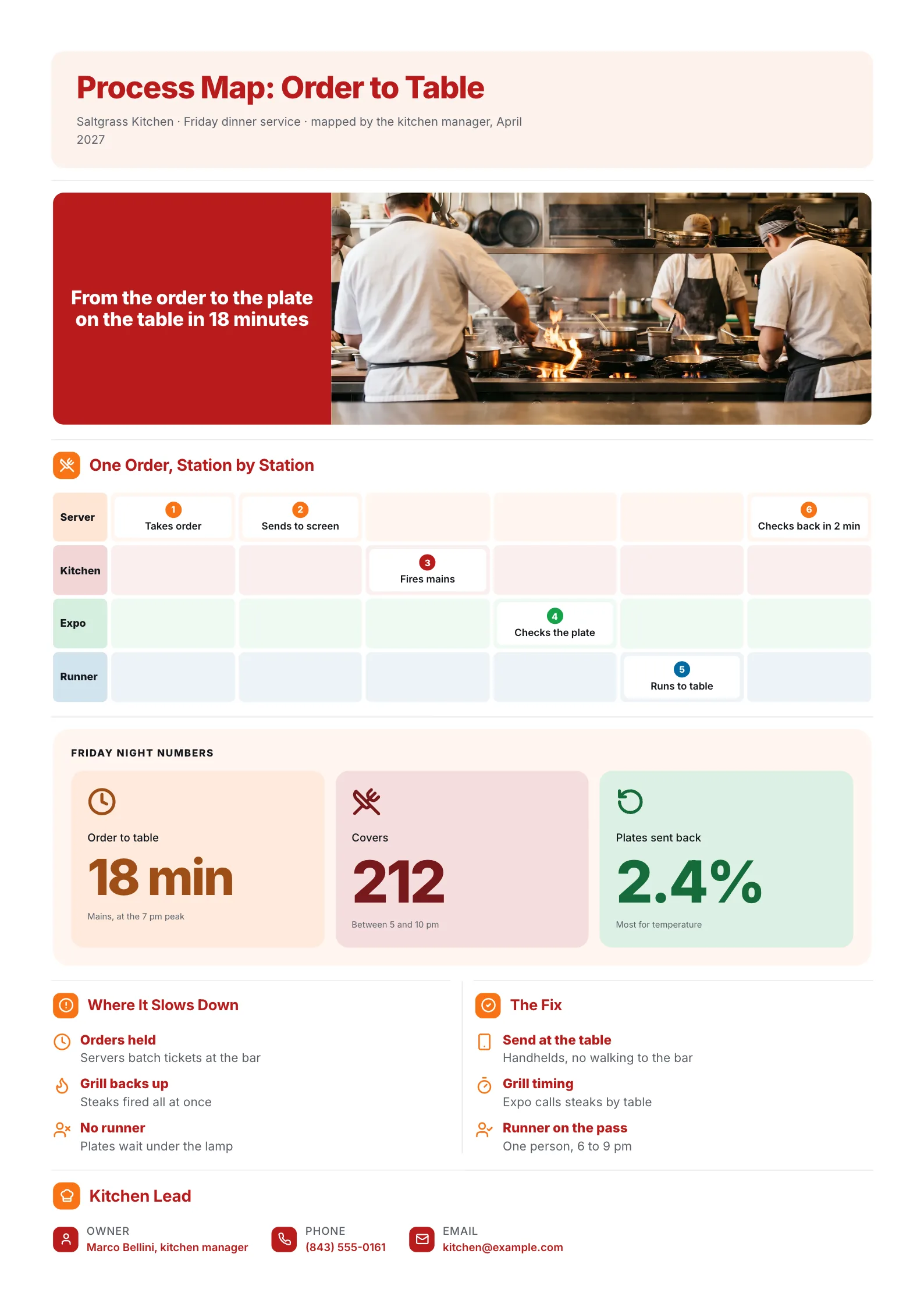 Edit this template
Sample names and figures. Servers batching tickets at the bar is waiting, and plates sitting under the lamp with no runner is waiting too.
Connecticut uses color to make this visible on the wall. Pink sticky notes mark non-value-added steps, purple marks waiting, and blue marks transport. Stand back after an hour and you'll see where the pink clusters.
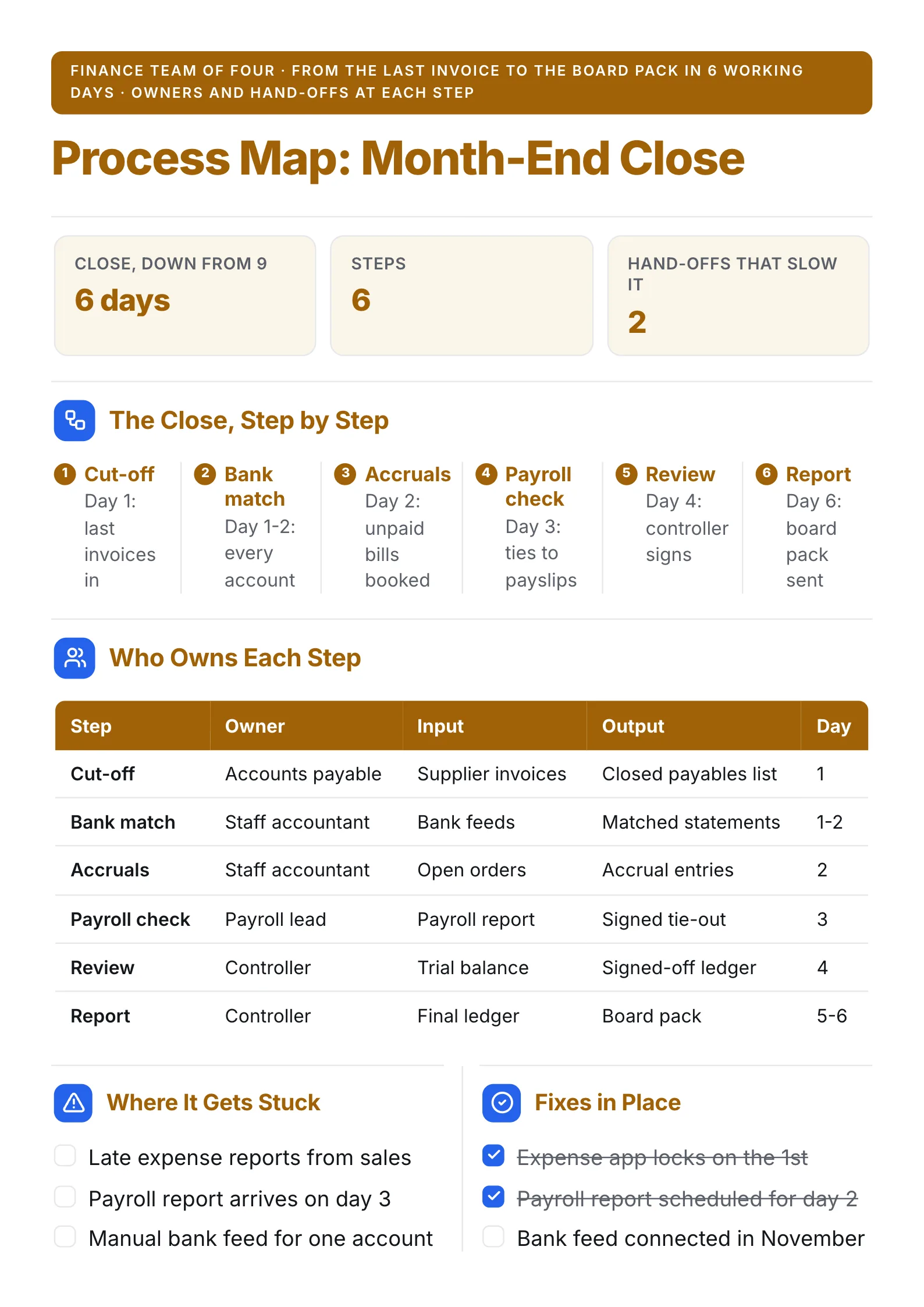 Edit this template
Sample names and figures. The payroll report arriving on day 3 is a waiting problem, fixed by scheduling it for day 2.
The step you can't remove
Some steps add no value for the customer but have to stay anyway. Connecticut calls these "value enabling," meaning the step is required by law, regulation or policy. A signature a statute demands is one.
Here the slides add a warning. "Always make sure you have the data to support a claim that something is required!" So for every step someone defends as required, ask two more questions:
- Which law, rule or policy requires it, by name?
- Does it require this exact step, or only the outcome?
You'll find that some of the "required" steps are habits someone wrote down years ago.
Questions for the future map
Missouri's last two steps are to rewrite the process without the waste, then try it and check. Connecticut gives you the questions for that rewrite:
- Are there steps that can be eliminated?
- Is there an opportunity to standardize something or make it electronic?
- Does that form really need to be approved by three different people?
Add one of your own to each hand-off: who carries the information across, and what do they pass along? One good habit is giving the hand-off its own rule, like the support sample below.
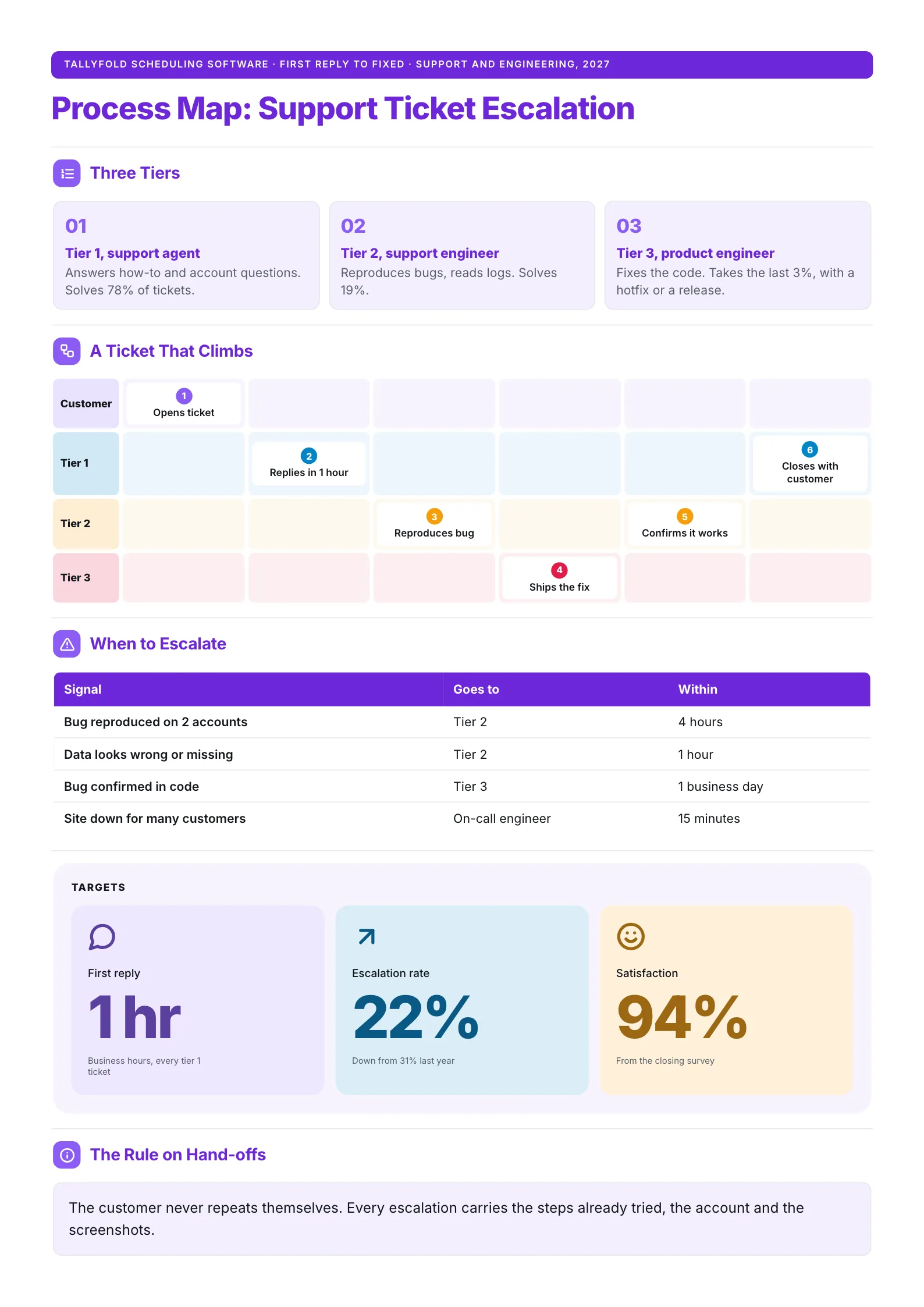 Edit this template
Sample names and figures. Its hand-off rule is that the customer never repeats themselves, because every escalation carries the steps already tried.
Decision points deserve the same care. Missouri's sheet gives you four symbols to draw with. One marks where the work starts or ends, one marks a task, one marks a decision and one connects steps. The decision symbol is where most confusion lives. Write the actual rule inside it, so a reader never has to guess what "approve?" means.
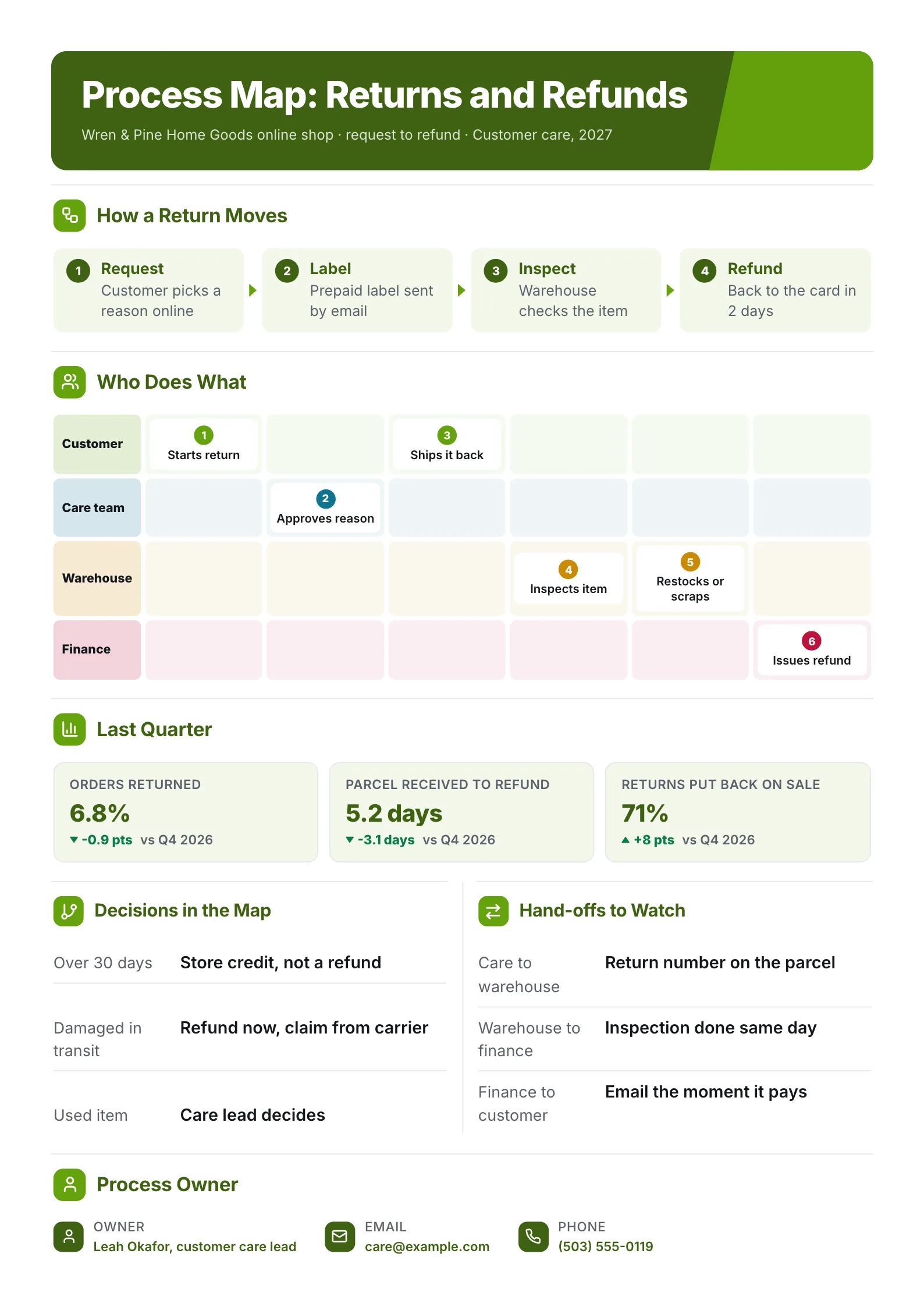 Edit this template
Sample names and figures. Each decision has its rule spelled out, such as store credit for returns over 30 days.
Who owns it, and how will you know it worked?
A future map with no owner drifts back to the old one. Before the session ends, ask two more questions: who owns this process from the first step to the last, and what one number will show the new way works?
Connecticut's slides set the rule for that number. A strong measure "will have baseline data from before improvements began," and each one gets a date to hit. Their own examples are plain, like the average time between a facility site visit and the provider getting the findings. So write today's number on the map before you change anything, or you'll have nothing to compare it with.
Our process map template post shows how a finished map fits on one page. When the new process is settled and you need people to follow it the same way every time, turn it into an SOP.
Count the pink notes
With your map on the wall, count the pink notes and write the number at the top. Then count again after you draw the future map. That one number tells your team whether the session worked, and it's the first thing to put on a MakeOnepagers process map page beside the steps and their owners.
Where these questions come from
| Source | Publisher | What we took |
|---|---|---|
| Quality Improvement slideset, November 2017 | Connecticut Department of Public Health | Three customer questions, 8 wastes with government examples, value enabling steps, future state questions, sticky note colors |
| Process Mapping overview for white belt | Show Me Excellence, State of Missouri | Five steps, the 8 wastes of lean, four map symbols |
We read both documents through on October 30, 2026.
Frequently asked questions
What are the key questions to ask when process mapping?
Start with what your customer cares about and where it hurts. At each step, ask whether it adds value and which of the 8 wastes it shows. For the future map, ask which steps you can drop, standardize or make electronic.
Who should be involved in a process mapping session?
Everyone who touches the work, from the first step to the last, plus someone who can approve changes. Missouri's first step is to assemble a team that does the work, and Connecticut says the map is only as strong as the people in the room.
What is the difference between a current state and future state map?
The current state map shows how the work runs today, waste included. The future state map shows how it should run once the waste is removed. Connecticut's training has you build both.
How do you check a process map is accurate?
Walk the process and watch it happen. Missouri's last step is to try the new process and check it. Compare what you see with the sticky notes, and fix the map wherever the two disagree.




