Process Map Template: Free One-Page Process Map
A free one-page process map template, the symbols and parts every process map needs, four types from basic to swimlane, a worked order to cash example and the mistakes that make maps useless.

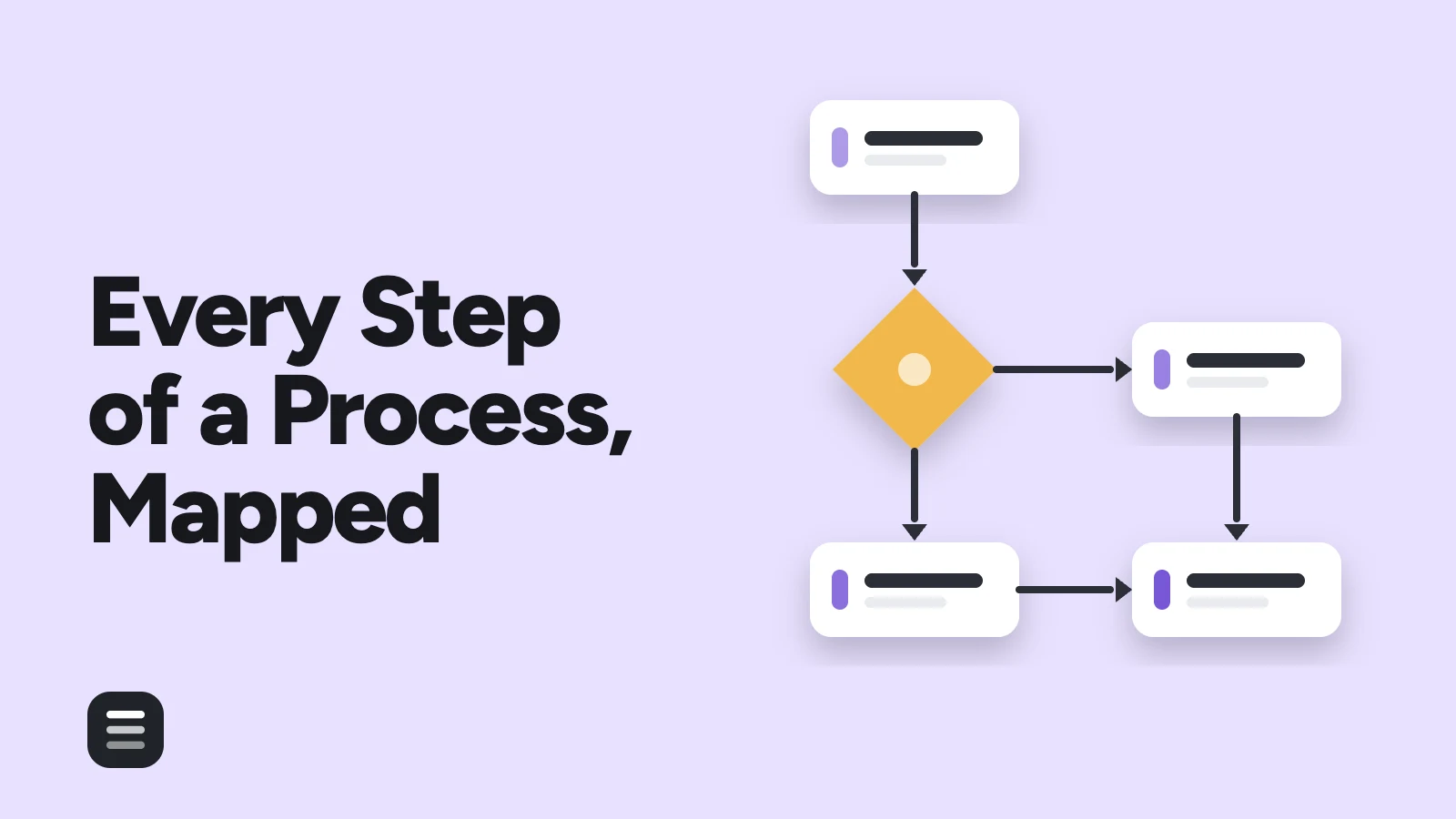
A process map template gives you a ready layout for showing how a piece of work moves from start to finish: each step in order, the decisions along the way, who does what and where the work changes hands. A good process map fits on one sheet, so anyone can follow it in a minute. Below are the parts of a process map, the four common types, a free process map template you can copy, a worked order to cash example and how to make your own. Start from a free one pager template.
One‑Pager examples
Real One-Pagers made with MakeOnepagers. Open any one to edit it as your own.
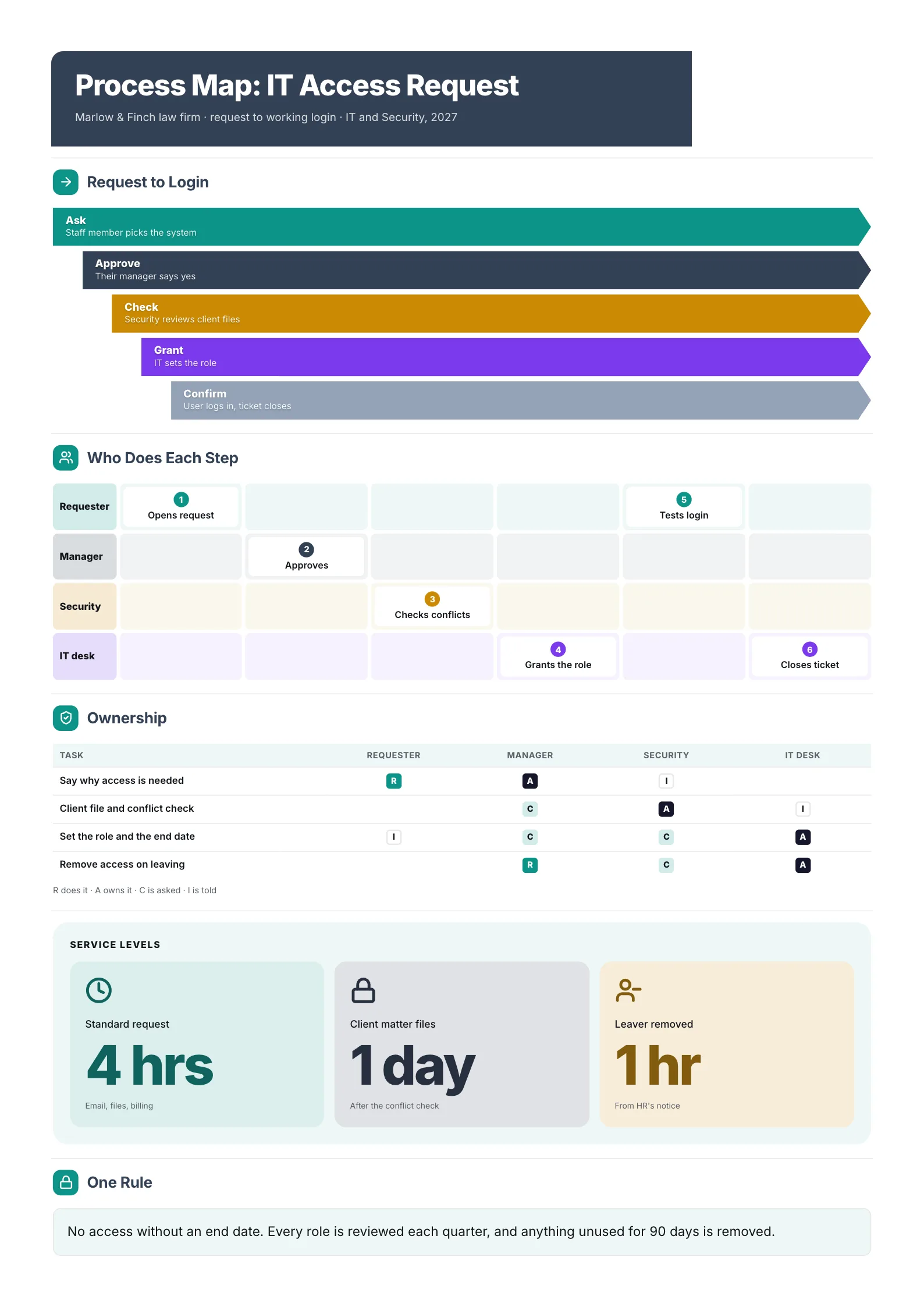 Process Map: IT Access RequestEdit for free(opens in a new tab)
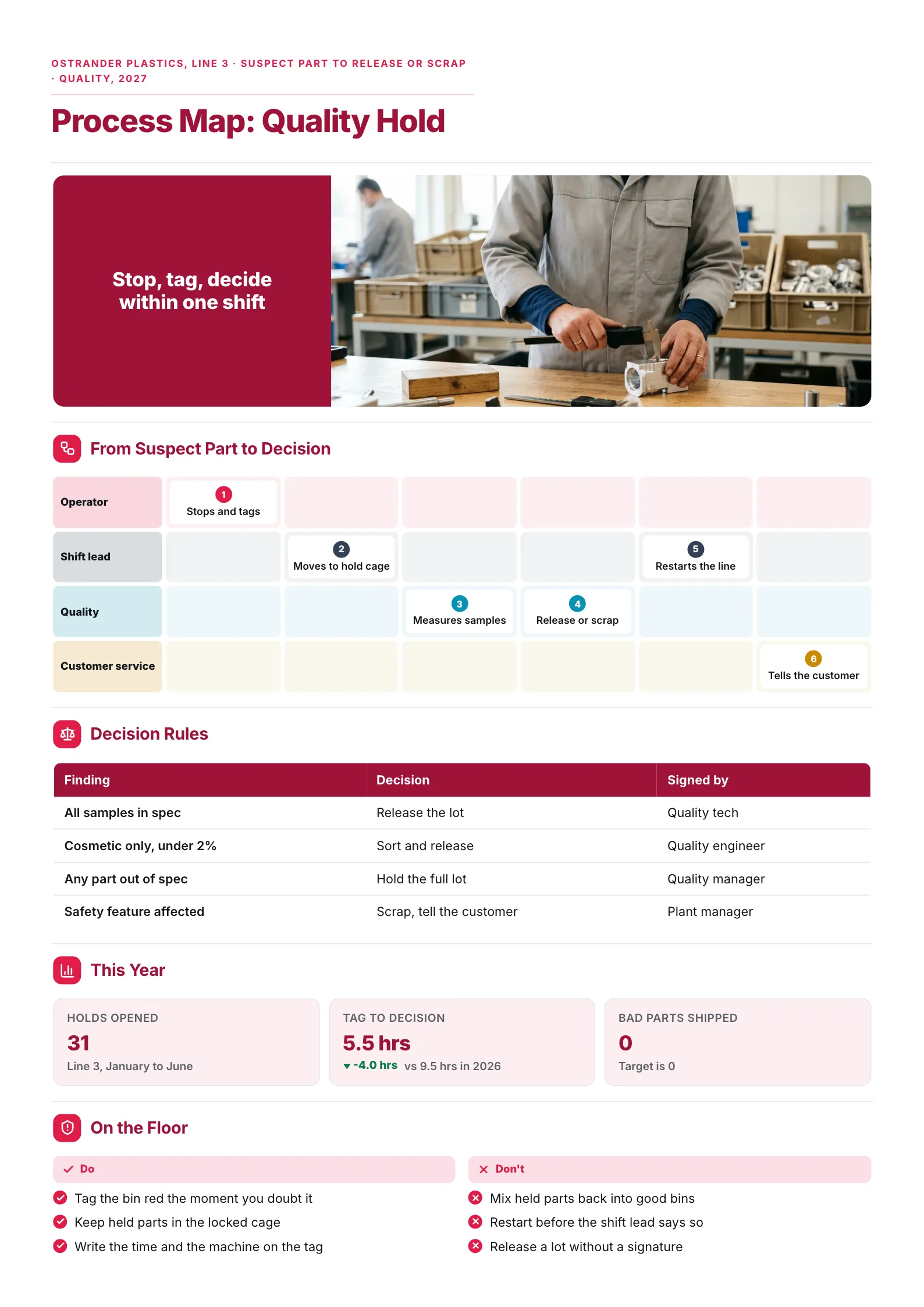 Process Map: Quality HoldEdit for free(opens in a new tab)
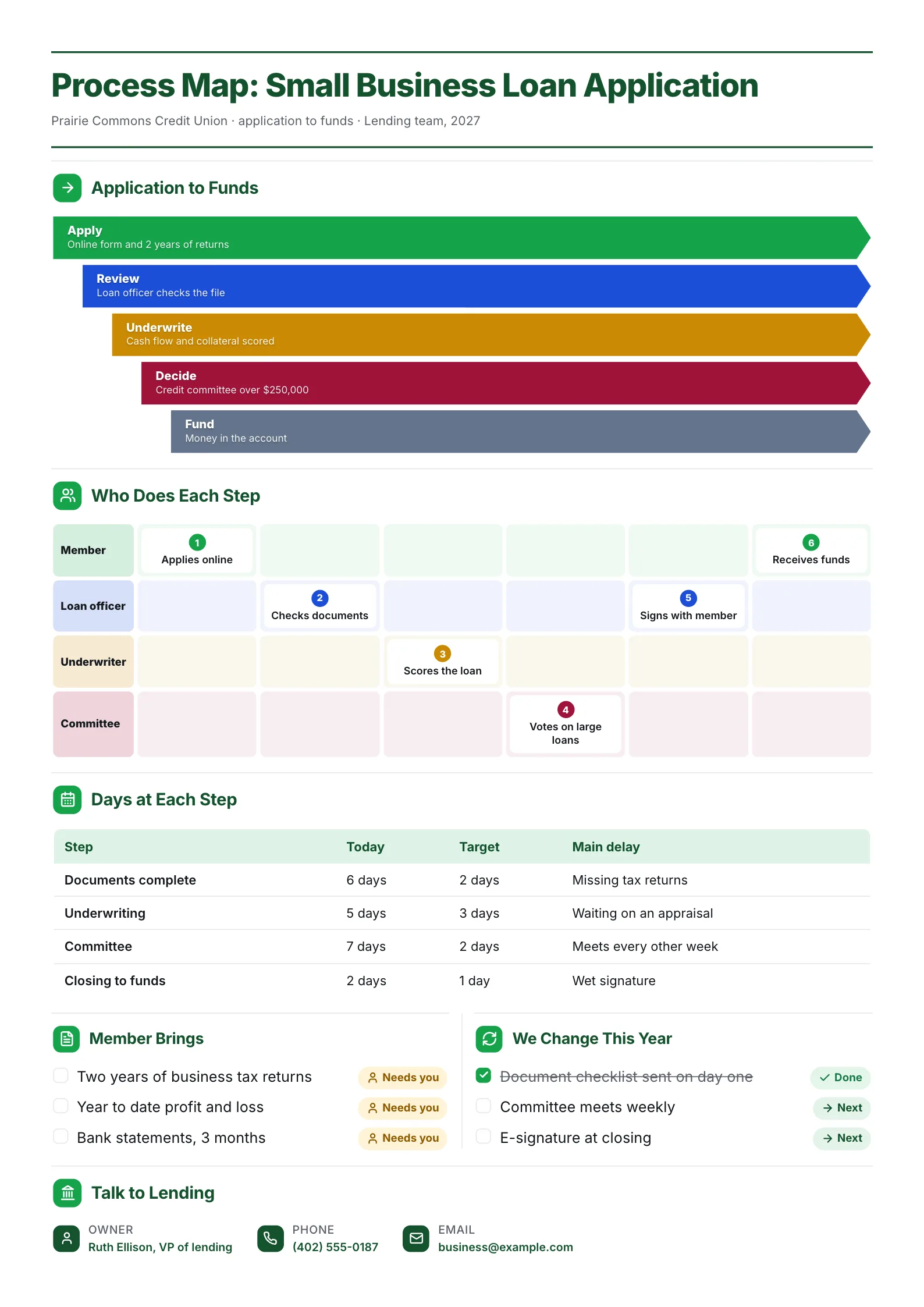 Process Map: Small Business Loan ApplicationEdit for free(opens in a new tab)
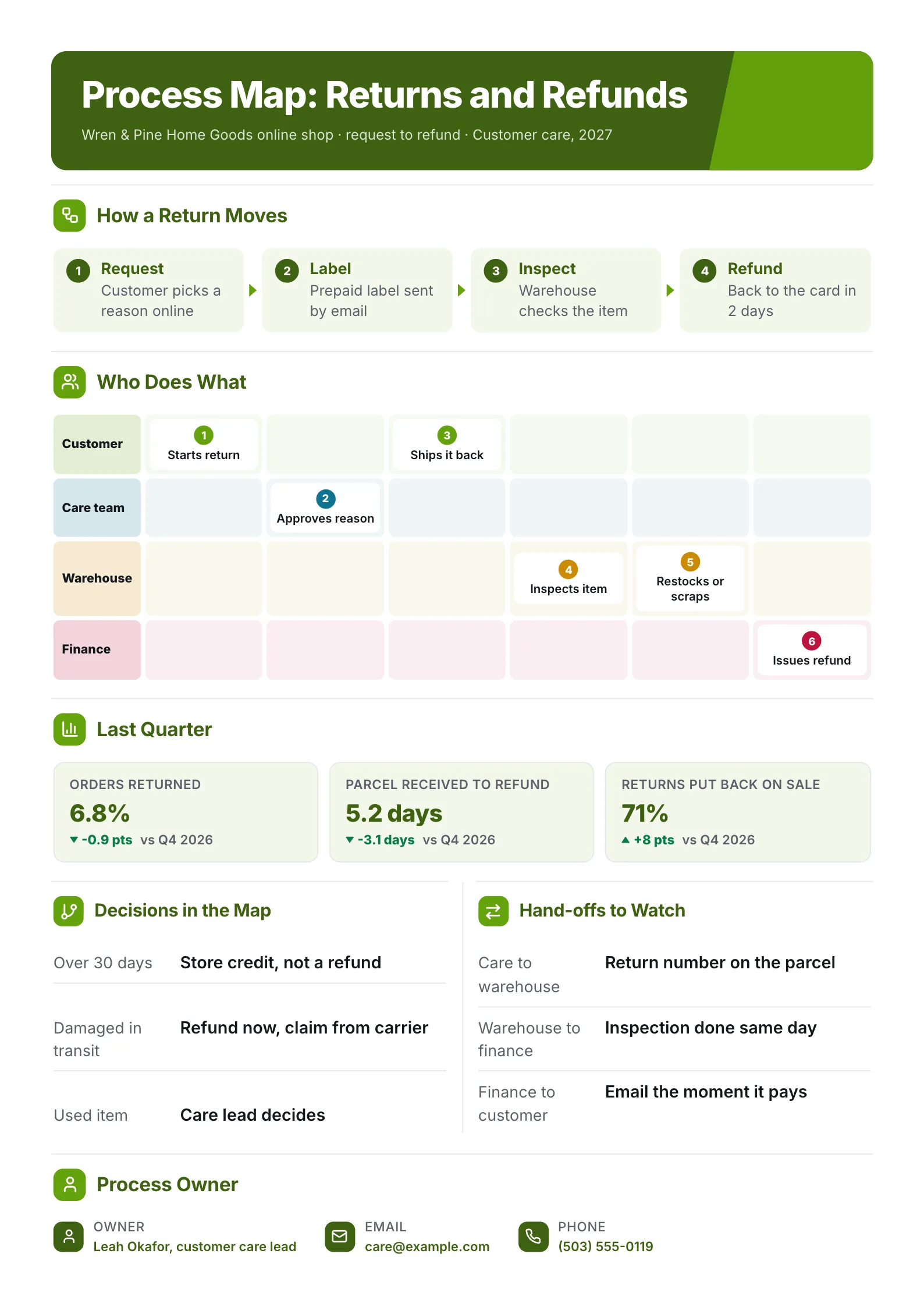 Process Map: Returns and RefundsEdit for free(opens in a new tab)
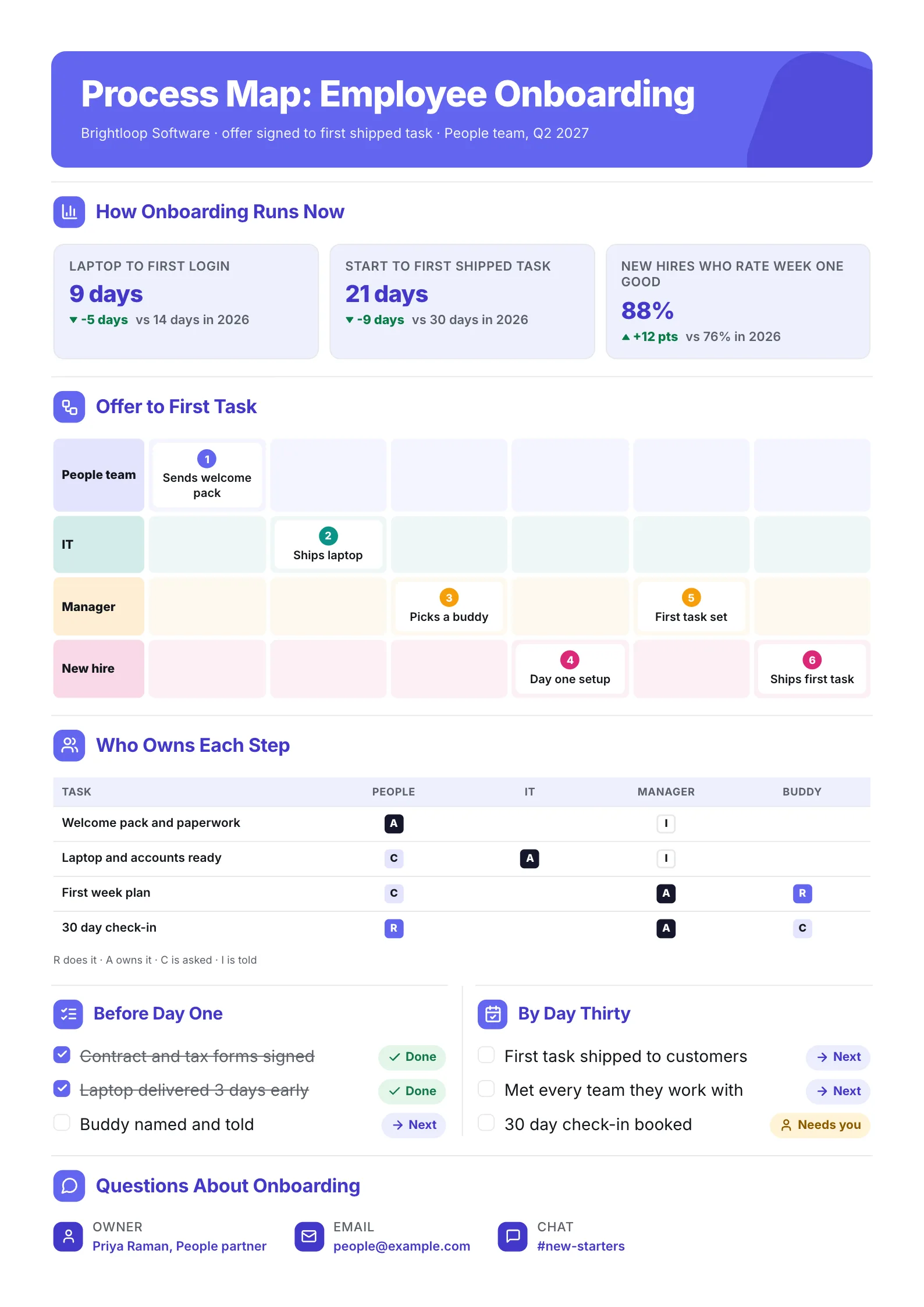 Process Map: Employee OnboardingEdit for free(opens in a new tab)
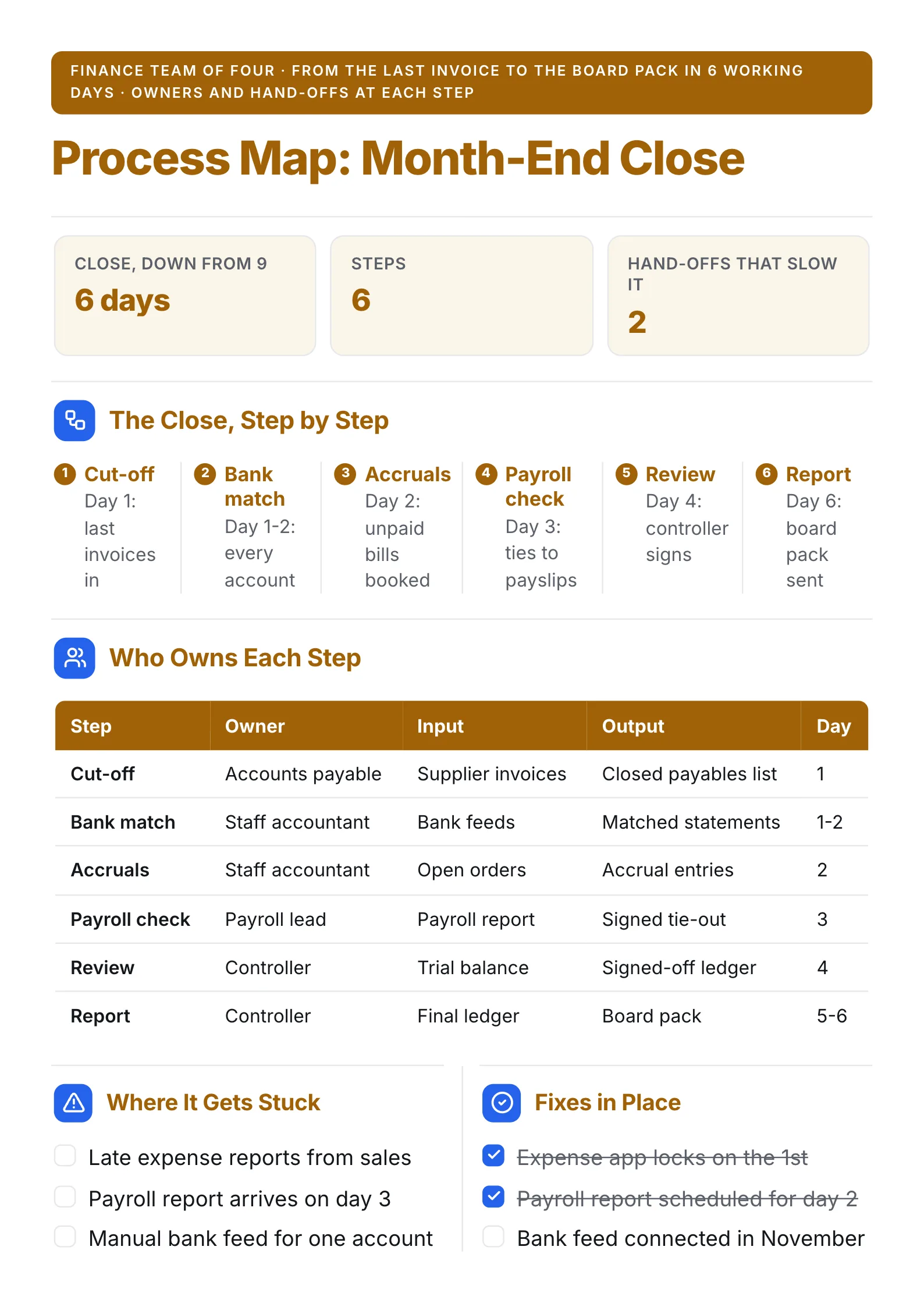 Process Map: Month-End CloseEdit for free(opens in a new tab)
The example was made with MakeOnepagers. It opens as a template you can edit for free: every step, word and color.
What is a process map?
A process map is a picture of a workflow. It shows the steps of a process in the order they happen, joined by arrows, with decisions marked where the path splits. Teams use process maps to train new people, to agree how something should be done and to find where work slows down.
A process map is close to a flowchart, and many people use the words interchangeably. The difference is mostly purpose. A flowchart can describe any logic. A process map describes a business process: who does it, what goes in, what comes out and how long it takes.
Process map symbols
Most process maps use a small set of shapes. Keep to these and anyone can read your map:
| Symbol | Means | Example |
|---|---|---|
| Oval | Start or end | Customer places an order |
| Rectangle | A step or task | Check stock and credit |
| Diamond | A decision, yes or no | Credit approved? |
| Arrow | The flow from one step to the next | |
| Parallelogram | An input or output | Invoice sent |
| Document shape | A form or report | Packing slip |
4 types of process map
- Basic process map. The steps in a line, start to finish. Best for simple, linear work and for a first draft.
- Detailed process map. Adds inputs, outputs, time per step and sub-steps. Best when you are trying to make a process faster.
- Swimlane map. Splits the map into rows (lanes), one per team or role, so every hand-off between teams is visible. Best when work crosses departments.
- SIPOC or value stream map. SIPOC lists suppliers, inputs, process, outputs and customers at a high level. A value stream map adds the time each step takes and the waiting in between. Best for improvement projects.
For most teams, a basic map on one sheet is enough, with a swimlane version for processes where hand-offs cause the trouble.
A free process map template
Copy this into any document, or open the example below and edit it.
| Part | What to write, with an example |
|---|---|
| Title | The process, from trigger to result. Order to cash |
| One-line purpose | How a customer order becomes money in the bank |
| Steps | 4 to 7, verb first. Order: checked against stock and credit |
| Decisions | Where the path splits. Credit approved? If no, hold the order |
| Owners | Who does each step. Sales, warehouse, finance |
| In one line | The whole process as one sentence |
| Key terms | Up to four words a newcomer will not know |
| Why it matters | The number the process moves |
Process map example
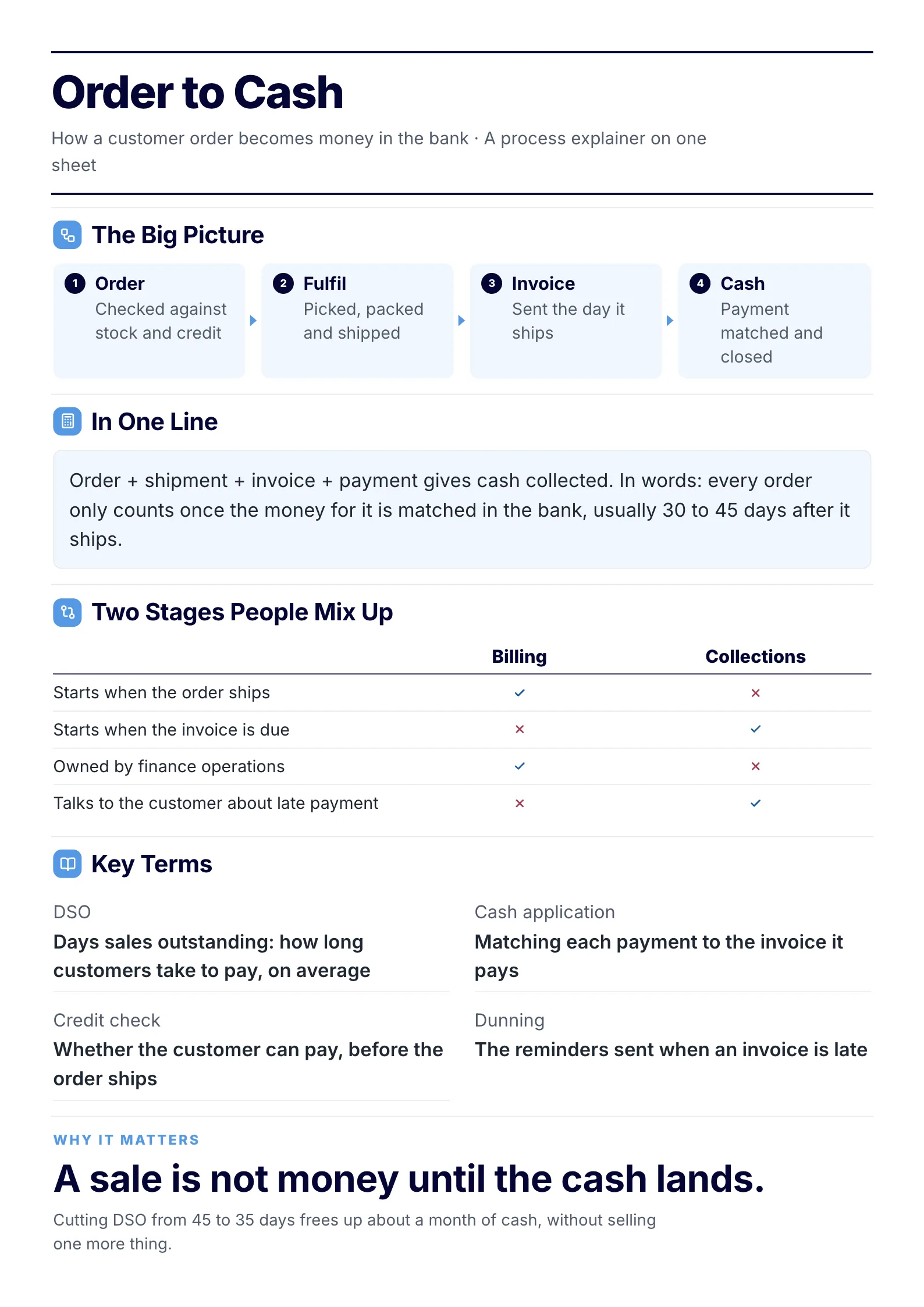 Edit this template
Four steps, one sentence and four terms: enough for a new person in finance to follow the whole process.
This sample explains order to cash, the process that turns a customer order into money received. What it gets right:
- Four steps, each with what happens. Order: checked against stock and credit. Fulfil: picked, packed and shipped. Invoice: sent the day it ships. Cash: matched in the bank and closed. Each step is a verb and a result.
- The whole thing in one line. Every order only counts once the money for it is matched in the bank, usually 30 to 45 days after it ships. Anyone who reads only that line still understands the process.
- The two stages people confuse, side by side. Billing starts when the order ships and is owned by finance operations. Collections starts when the invoice is due and chases the customer when it is late. A four-row table settles an argument most teams have every month.
- Four key terms. DSO (days sales outstanding), cash application, credit check and dunning, each in plain words.
- Why it matters, as a number. In the sample, cutting DSO from 45 to 35 days frees up about a month of cash without selling one more thing. The figures are illustrative; put your own in.
Edit for free: process map template.
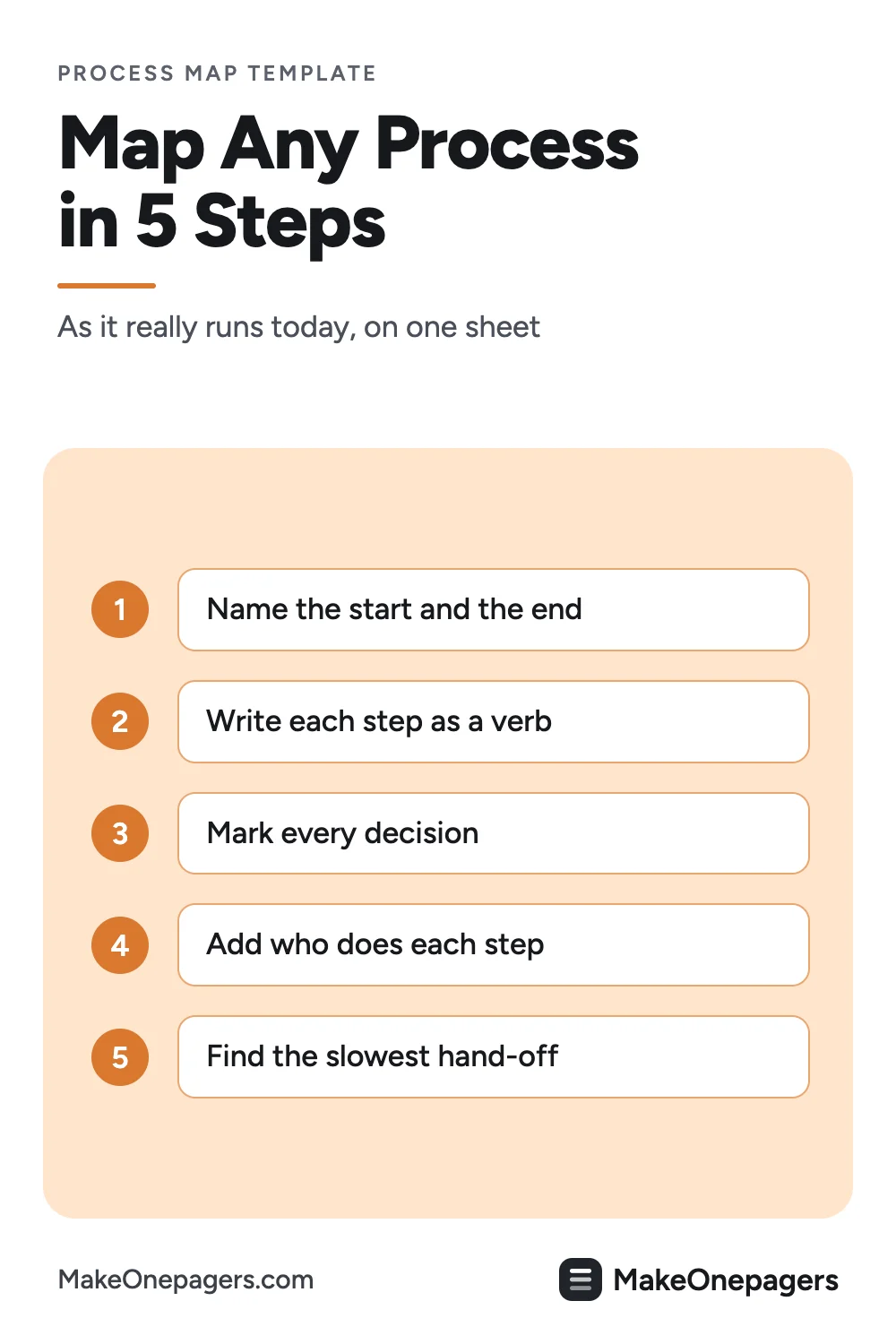
How to make a process map in 6 steps
- Name the start and the end. "Customer places an order" to "money matched in the bank." A map without clear edges keeps growing.
- Walk the process with the people who do it. Ask them what they actually do, in order. Write it down as they say it, not as the policy describes it.
- Write each step as a verb. Check, pick, send, match. Four to seven steps on one sheet; group smaller tasks under them.
- Mark the decisions. Every point where the work can go two ways gets a diamond and both answers.
- Add who does each step. If the work crosses teams, draw it as a swimlane so each hand-off is visible.
- Find the slowest hand-off. Ask where work waits the longest. That is usually the first thing to fix, and the reason to make the map in the first place.
Have a process written up as a long procedure or a set of meeting notes? Drop it into the free AI One-Pager generator and get it back as a designed process map.
Process map vs SOP vs flowchart
| Process map | SOP | Flowchart | |
|---|---|---|---|
| Shows | The whole flow, who and when | Exactly how to do each step | Any logic or decision path |
| Detail | Medium | High | Varies |
| Reader | Team, managers, new hires | The person doing the task | Anyone |
| Best for | Seeing and fixing a process | Doing a task the same way every time | Explaining decisions |
They work together. The process map shows the whole order to cash flow; an SOP explains exactly how to match money received to the invoice it settles.
Process map mistakes
- Mapping the ideal, not the real. If the map shows how the process should work, it hides the problems you made it to find.
- Too much detail. Thirty boxes on one sheet cannot be read. Keep four to seven main steps and put detail in an SOP.
- No owners. A step without a person or team beside it is a step nobody fixes.
- Missing decisions. Real processes branch. A straight line with no diamonds is usually leaving out the exceptions that take the most time.
- Never updated. A map from two years ago describes a process nobody follows. Date it and review it when the process changes.
Make your process map
Open the free process map template and put in your own steps and terms, or drop your process notes into the free AI One-Pager generator and get a finished process map back.
Frequently asked questions
What should a process map include?
A start and an end, the steps in order, the decisions where the path splits, who does each step, and the inputs and outputs. A short summary line and a few key terms help readers outside the team.
What is the difference between a process map and a flowchart?
A flowchart shows any sequence of logic. A process map is a flowchart of a business process, usually with owners, inputs, outputs and sometimes times added.
What is a swimlane process map?
A process map split into lanes, one per team or role. Each step sits in the lane of whoever does it, so every hand-off between teams shows as an arrow crossing a lane.
How many steps should a process map have?
For a one-page map, four to seven main steps. If a step needs more detail, give it its own map or an SOP.
Who should make a process map?
The people who do the work, guided by whoever owns the process. A manager drawing it alone tends to map the policy rather than reality.




