Press Release vs Media Advisory: What NASA Sent, and When
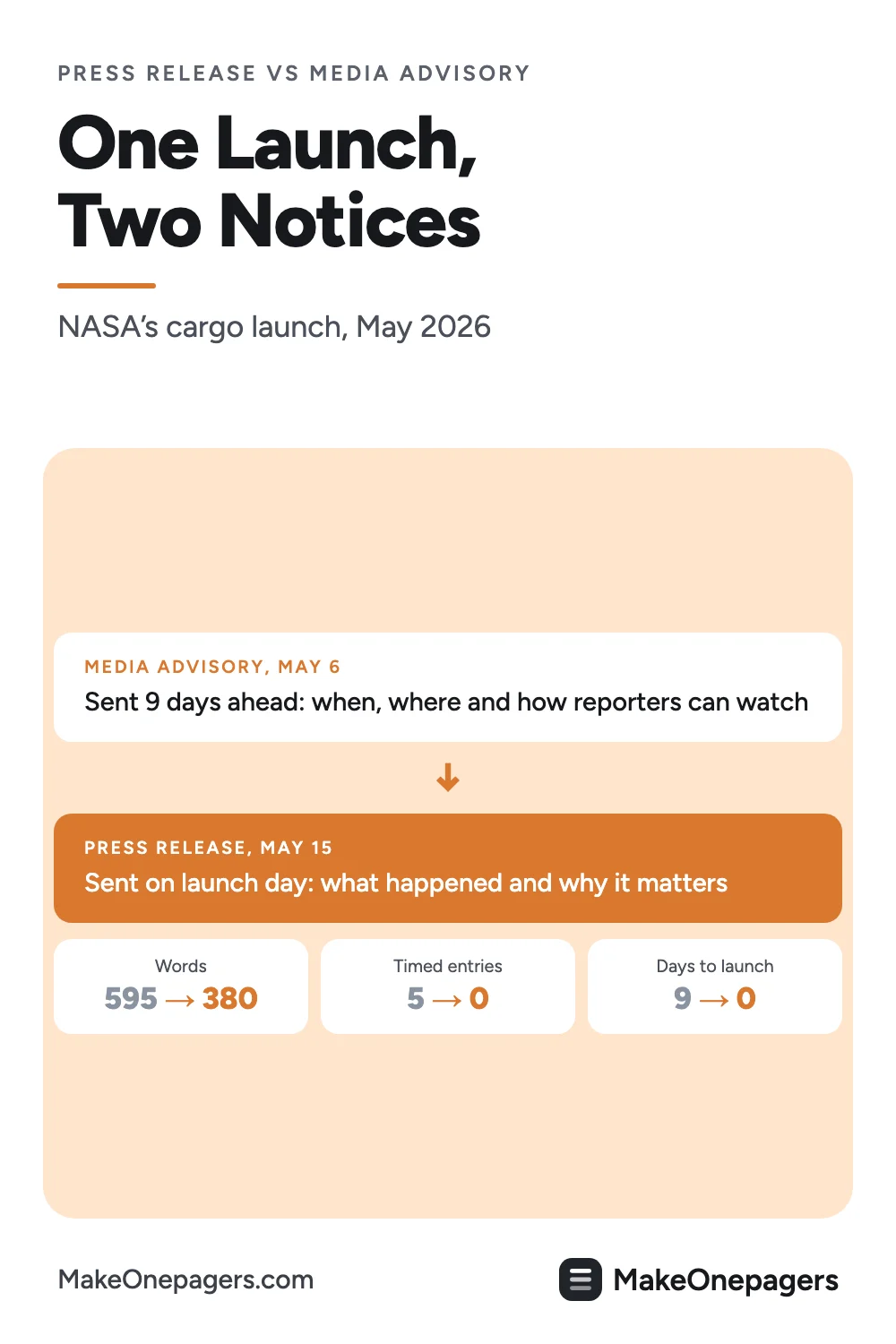
Press release vs media advisory, read from one real NASA pair about the same launch: a 595-word advisory 9 days out and a 380-word release on launch day.

Choosing a press release vs media advisory starts with one question: has your news happened yet? You send a media advisory before something happens, so reporters can plan to be there. You send a press release when there's news to report, so they can write the story. The two often cover the same event, a few days apart. Start from a free one pager template.
One‑Pager examples
Real One-Pagers made with MakeOnepagers. Open any one to edit it as your own.
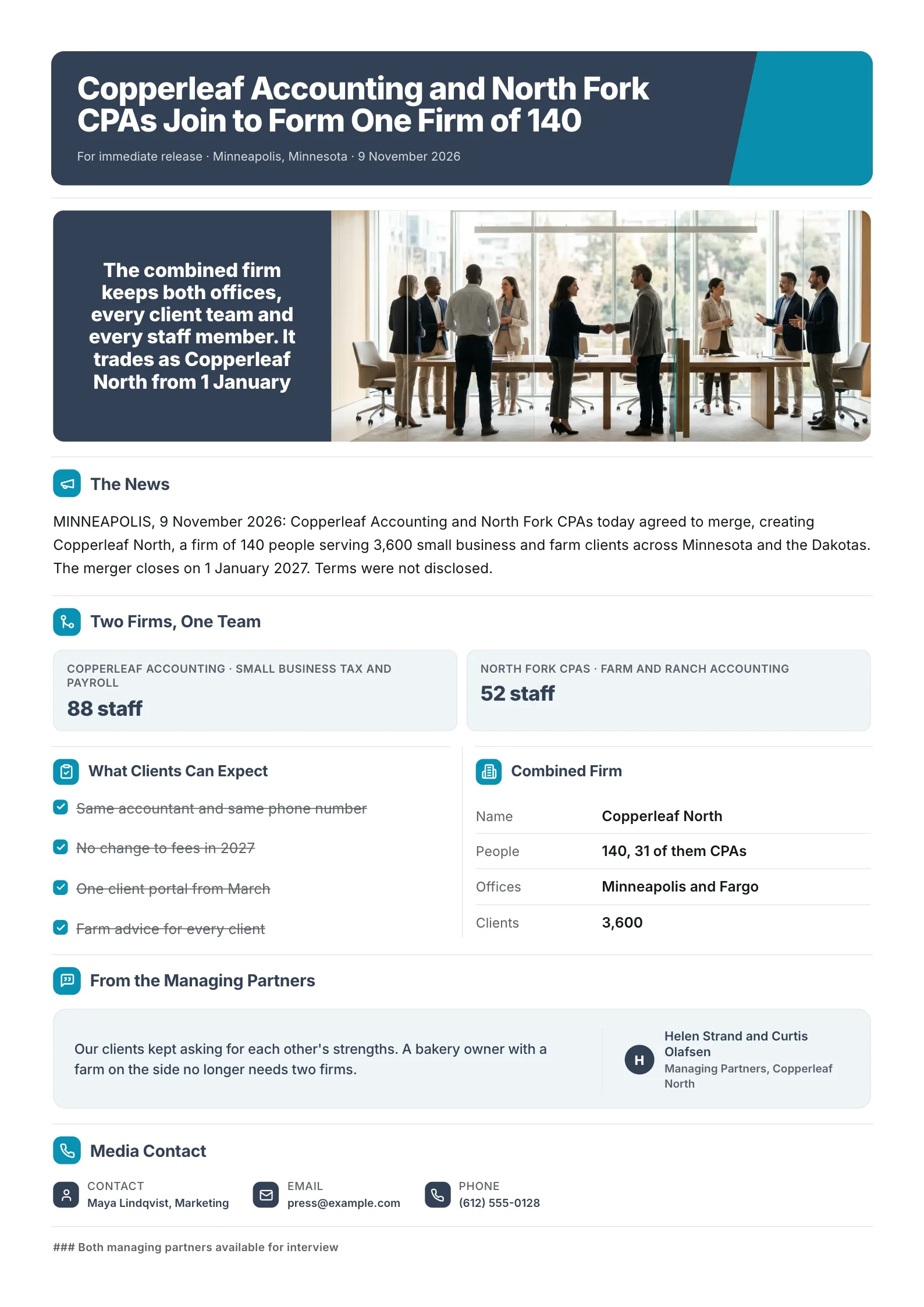 Press Release: Copperleaf North MergerEdit for free(opens in a new tab)
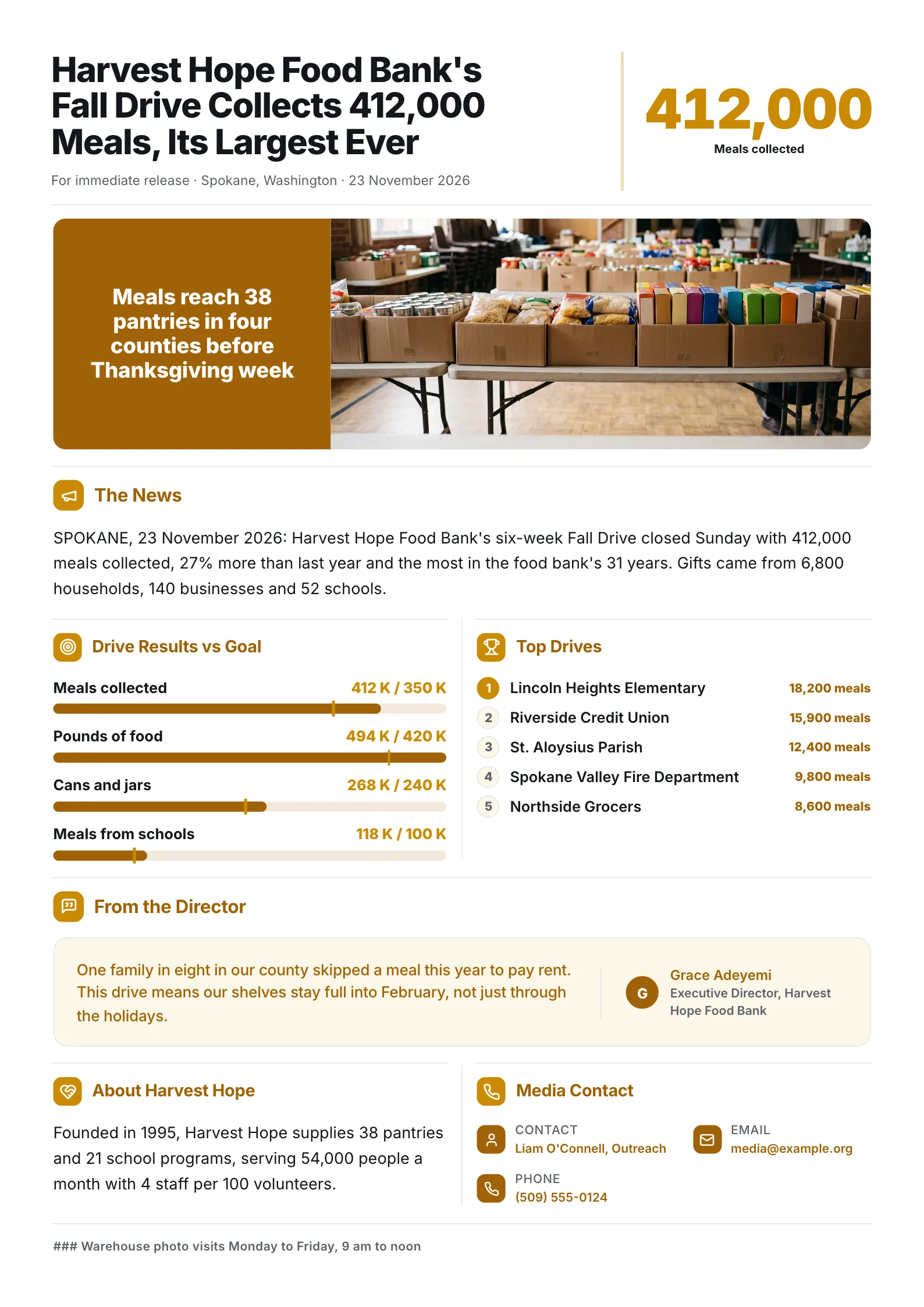 Press Release: Harvest Hope Fundraising ResultsEdit for free(opens in a new tab)
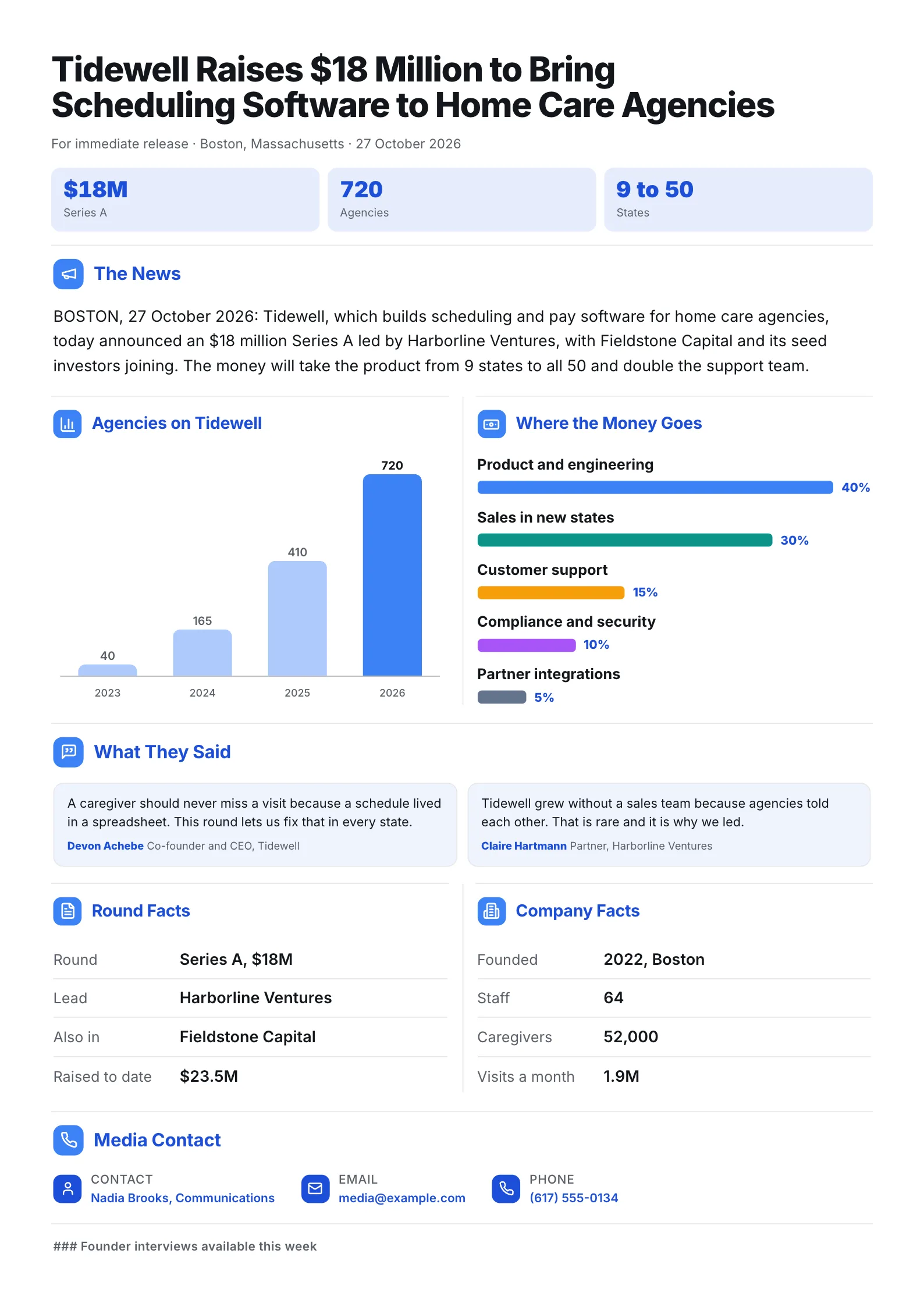 Press Release: Tidewell Series A FundingEdit for free(opens in a new tab)
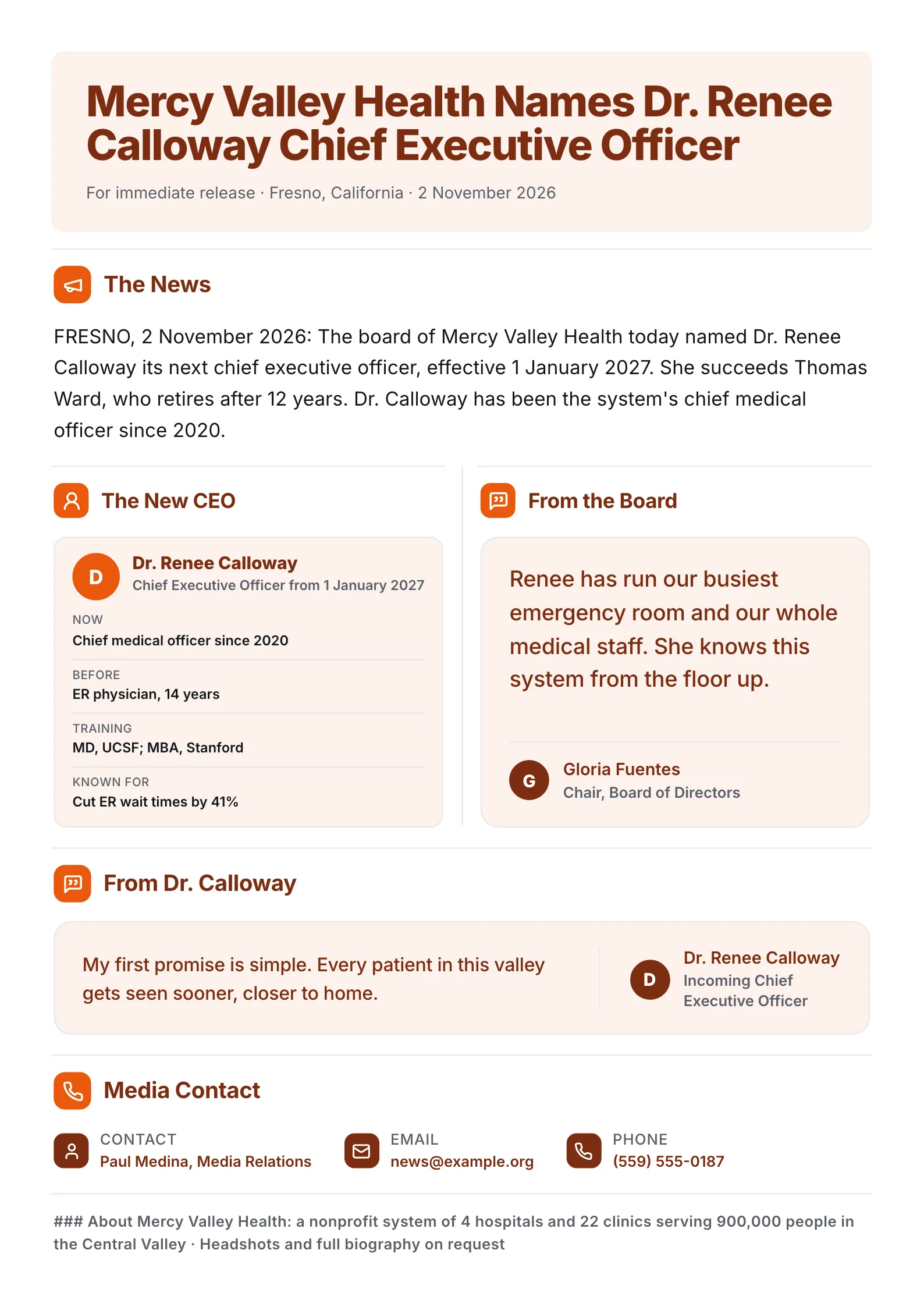 Press Release: Mercy Valley Names New CEOEdit for free(opens in a new tab)
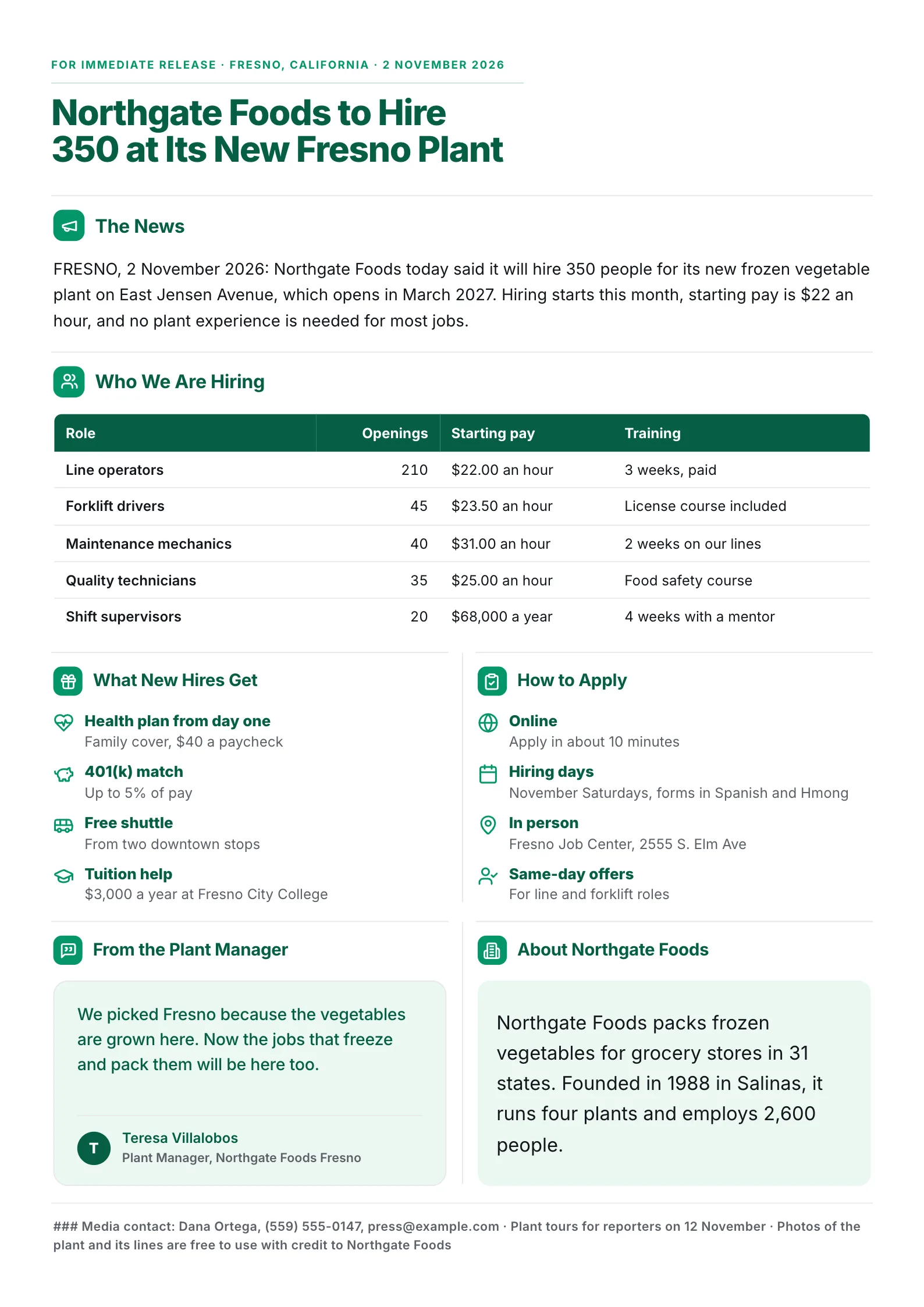 Press Release: Northgate Foods HiringEdit for free(opens in a new tab)
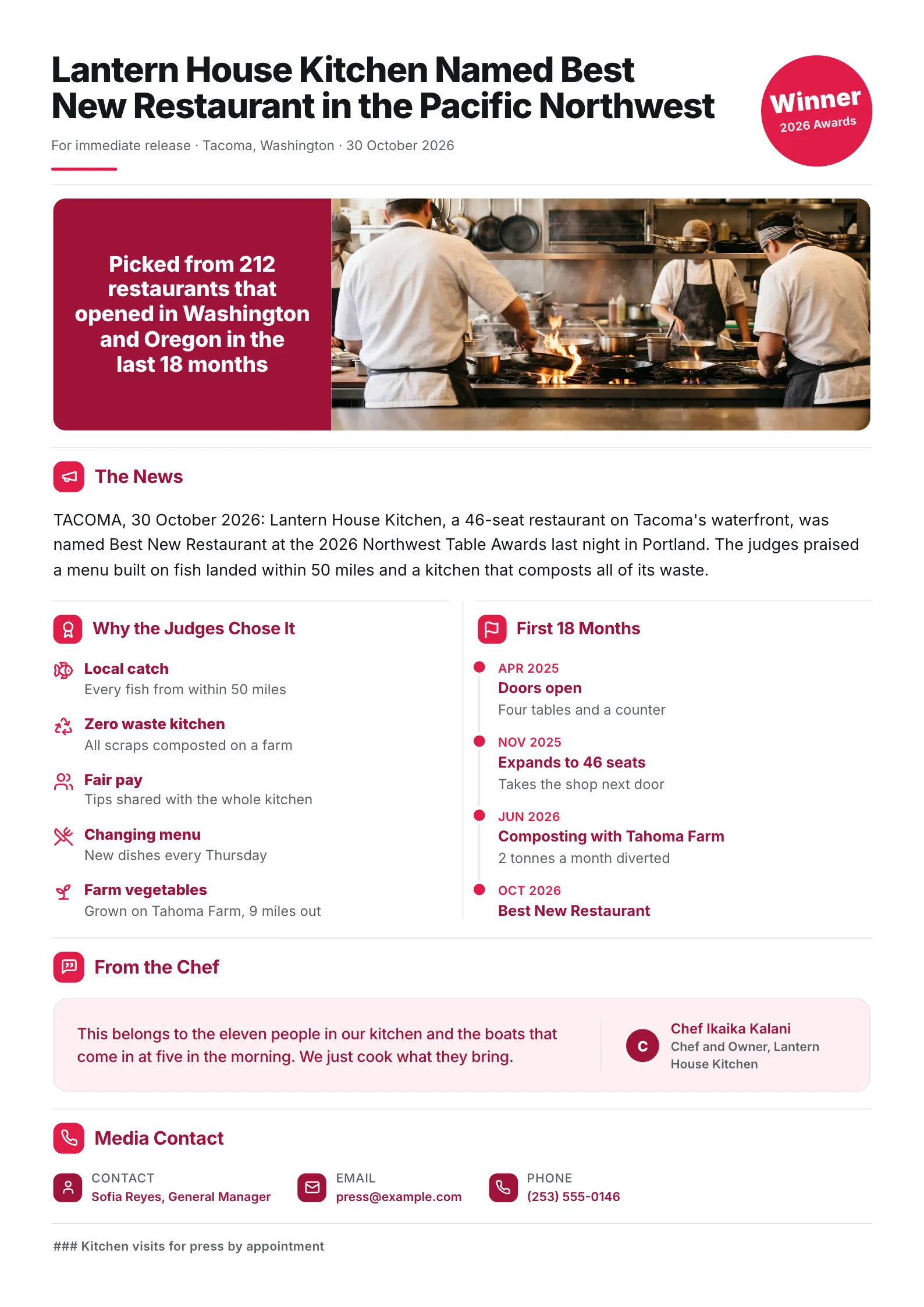 Press Release: Lantern House Award WinEdit for free(opens in a new tab)
The American Association of University Professors puts it in one rule: "an advisory is sent out before an event; a media release is sent out after." UC Berkeley's media relations office describes the advisory as "a one-page alert" with the "who, what, when and where." A release, it says, is "written as a news story."
| Media advisory | Press release | |
|---|---|---|
| Its job | Gets a reporter to show up, dial in or watch | Gives a reporter the story |
| When you send it | Days before the event | When the news happens, or right after |
| Length | One page or less | Often longer, with quotes and background |
| What it's built around | Date, time, place, who's speaking, how to attend | What happened, why it matters, who said what |
| Tense | Future: "will launch," "begins at" | Past or present: "launched," "today announced" |
| Who uses it | Assignment editors planning their day | Reporters and readers |
One launch, two documents
NASA publishes both kinds of notice, and it numbers them, which gives you a clean comparison. We read the pair for the 34th SpaceX cargo flight to the International Space Station in May 2026. Same mission, same writer and the same five press contacts.
The advisory, 9 days before launch
Media advisory M26-037 is dated May 6, 2026. Its headline reads "NASA Sets Coverage for SpaceX 34th Station Resupply Launch, Arrival." The first paragraph gives the target time, 6:05 p.m. EDT on Friday, May 15, and the cargo, about 6,500 pounds.
Then comes the part reporters actually need. A schedule block, "all times Eastern and subject to change," lists 3 days and 5 timed entries:
- May 11, 11 a.m.: a prelaunch teleconference with 4 named speakers. Reporters had to ask for the dial-in "by 10 a.m. on May 11."
- May 15, 5:45 p.m.: launch coverage begins.
- May 15, 6:05 p.m.: launch.
- May 17, 5:30 a.m.: arrival coverage begins.
- May 17, 7 a.m.: docking.
After that, the advisory says where to watch, how the public can sign up as a virtual guest, and which social accounts to follow. We counted 595 words from the first sentence to the "-end-" mark. NASA updated it twice, on May 12 and May 13, each time "with the most recent launch and arrival coverage information."
The release, on launch day
Release 26-039 is dated May 15, the day of the launch. Its headline is "NASA Science, Cargo Launch on 34th SpaceX Resupply Mission to Station." It runs 380 words, which is 215 fewer than the advisory.
Three things changed. The schedule block is gone, along with the teleconference and the virtual guest section. The tense moved to the past: the cargo is on its way "after lifting off at 6:05 p.m. EDT Friday." And one new paragraph explains why the station matters, noting that people have lived aboard it continuously "for more than 25 years."
One paragraph didn't change. The list of experiments on board, from red blood cell studies to research on how planets form, appears in both with only two small edits. That's a habit you can copy. Write your facts paragraph once, put it in your advisory, and carry it into your release.
| Part | Advisory M26-037 | Release 26-039 |
|---|---|---|
| Date | May 6, updated May 12 and 13 | May 15, launch day |
| Words | 595 | 380 |
| Schedule block | 3 days, 5 timed entries | None |
| Tense | Future | Past |
| Experiments paragraph | Yes | Yes, almost word for word |
| Why it matters | No | Yes, one paragraph |
| Contacts | 3 offices, 5 people | The same 3 offices and 5 people |
Does your news need an advisory, a release or both?
You need an advisory only when your news has something to attend, call into or watch. A new hire or a grant has nothing for a camera, so a release on its own does the job. If yours is a ribbon cutting or a launch, it has a time and a place, so your advisory gets the reporters there. Your release then tells everyone else what happened.
Not every piece of news earns either one. The University of South Carolina's communications office sends a university-level release for a gift that will "exceed $10M," or a grant "at or exceeding $2 million." It also says plainly that "publication in an academic journal does not constitute a press release." Your own bar can be lower, and it's still worth writing down.
Five press releases, and the advisory each one could use
These five sample releases from MakeOnepagers are filled with made-up companies and dates. For each, you'll see whether an advisory should go out first, and what yours would say.
A grand opening with a ribbon cutting
 Edit this template
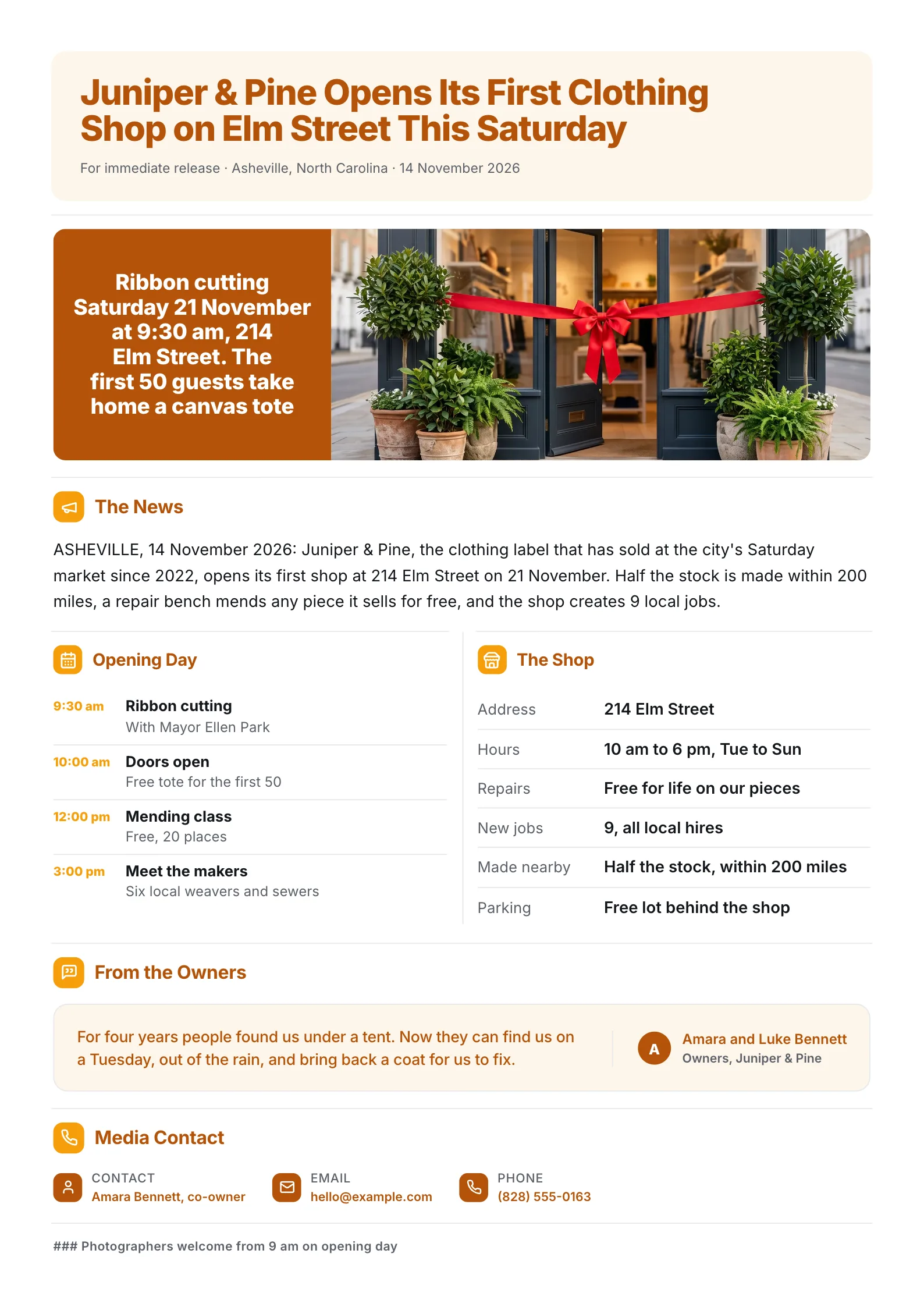
This grand opening press release is dated November 14 for a November 21 opening. It already carries an opening day schedule, from the 9:30 am ribbon cutting with the mayor to "meet the makers" at 3:00 pm. Those times are the advisory. Send them on their own a few days ahead, with the address, the free parking lot and a contact's phone. Save the release, with the owner's quote and the 9 local jobs, for opening morning.
A park reopening
 Edit this template
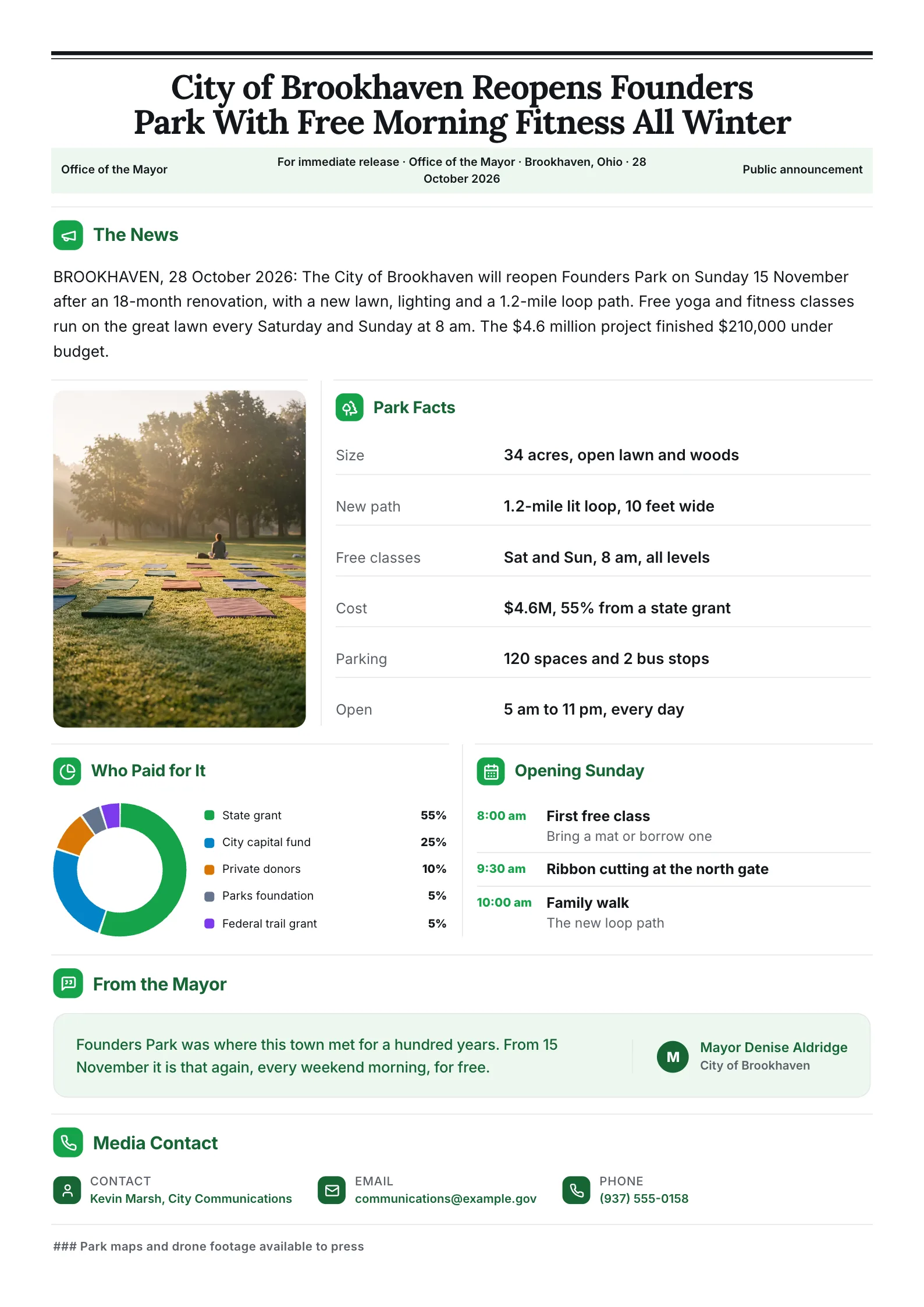
The city announcement has a ribbon cutting at 9:30 am at the north gate, and a first free class at 7:00 am. A TV crew will ask you which one to come for. Your advisory should name the gate, the time and who will speak. The release is where the $4.6 million cost and the 55% from a state grant belong, because those are facts a reporter writes up, not a reason to show up.
A conference with press passes
 Edit this template
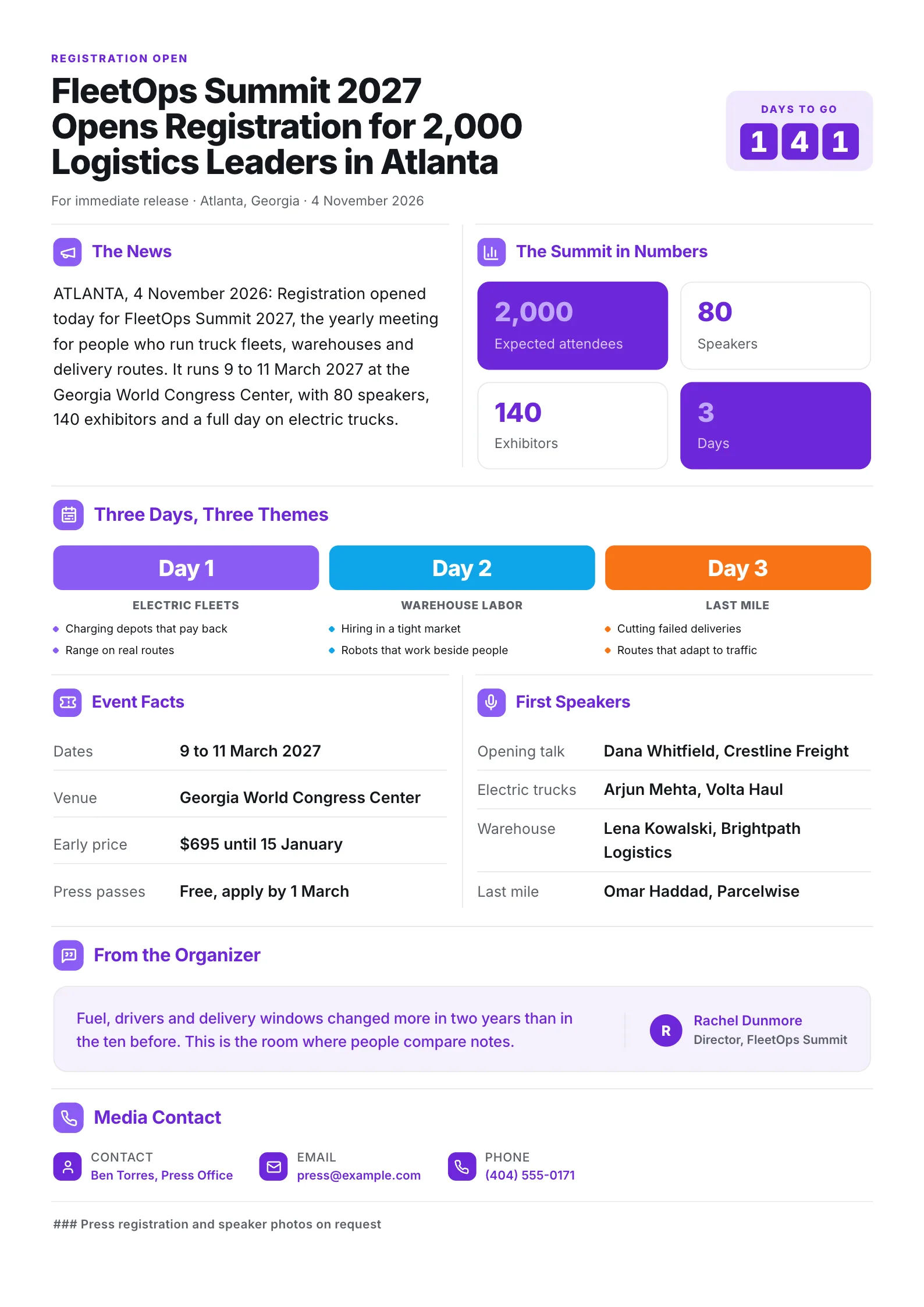
This conference press release went out the day registration opened, four months early. It tells reporters that press passes are free, with applications due March 1. Closer to March 9, you'd send an advisory that lists the opening talk's time and room and where the press desk is. One release opens the year and one advisory fills the room.
A study under embargo
 Edit this template
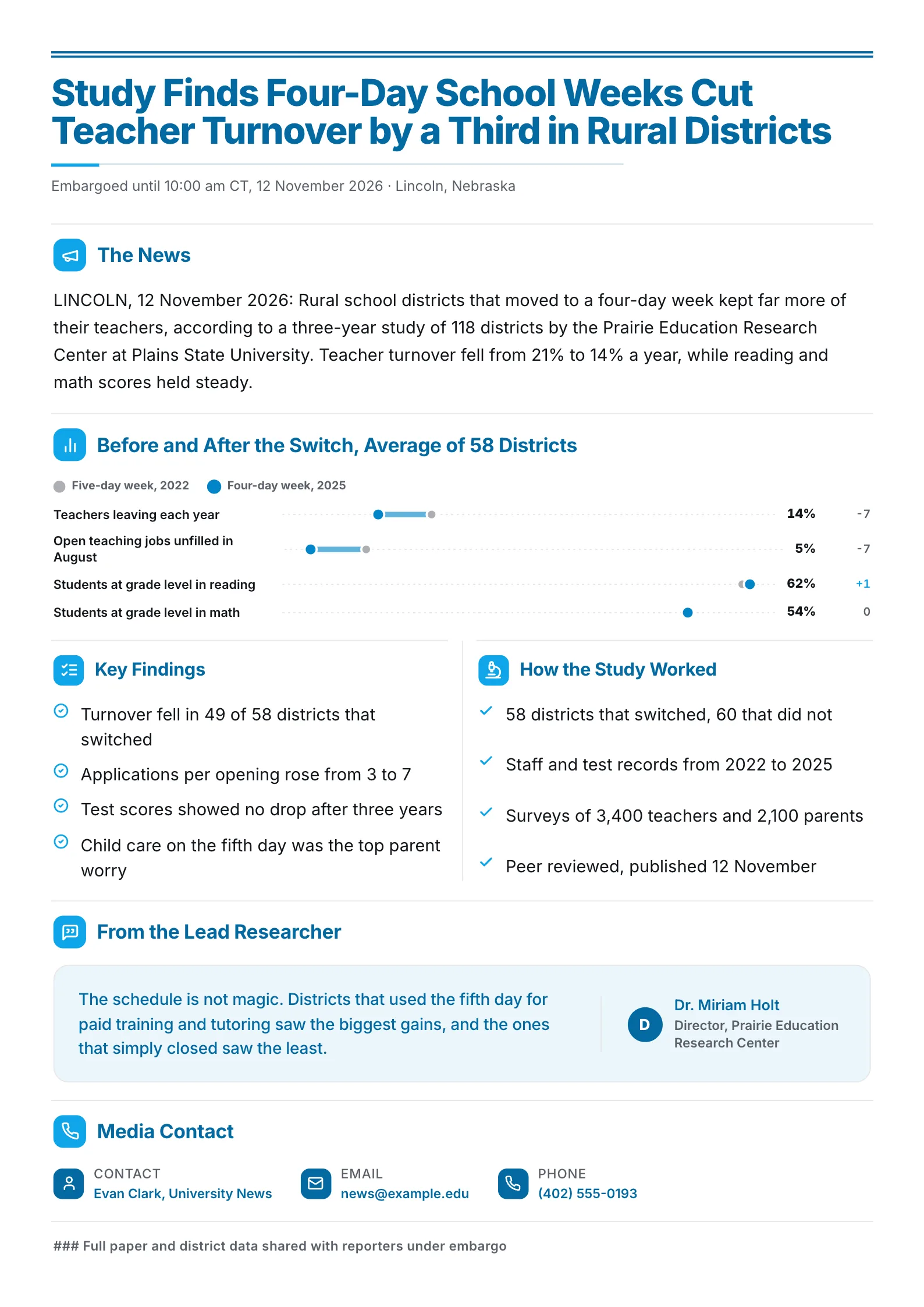
The research findings release has no event. Instead, it's marked "Embargoed until 10:00 am CT, Nov. 12, 2026," which lets reporters read early but publish later. If you hold a briefing call for the study's authors, that call gets an advisory. If you don't, the embargo line does the timing work for you.
A recall that can't wait
 Edit this template
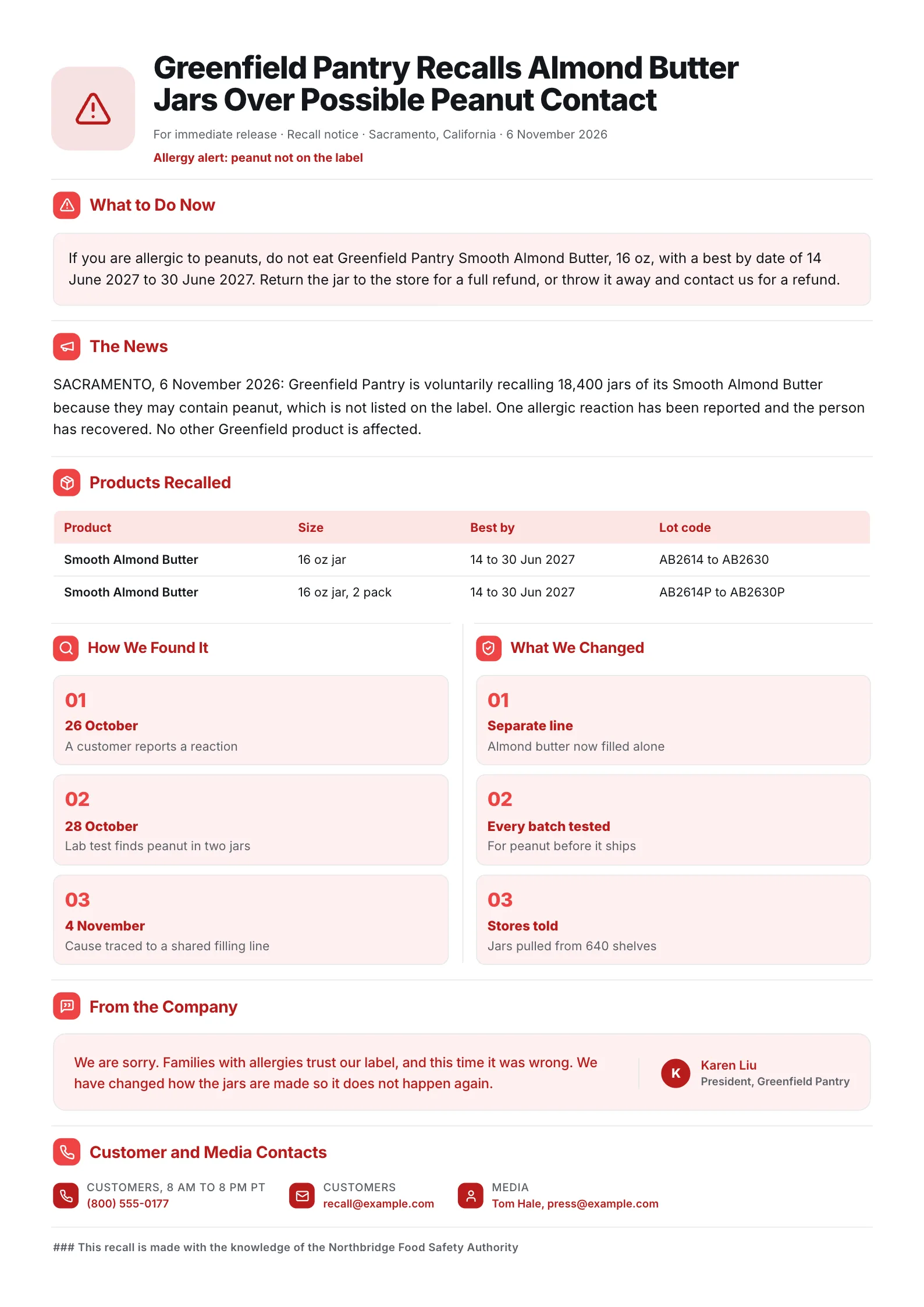
A recall skips the advisory. Your customers with a peanut allergy need to know today, so this product recall release opens with "What to Do Now" before the news paragraph. It lists the jars by size, best by date and lot code. When the news is a warning, you send the release first and answer the phone after.
What goes on a one-page advisory
Take NASA's order and trim it to the one page Berkeley describes. Your advisory needs six things:
- A headline that says what reporters can cover, with the date.
- One paragraph on what's happening.
- When: date, time and time zone, plus any deadline to register or dial in.
- Where: the address, the entrance, parking or the stream link.
- Who will speak, by name and title.
- A contact who answers the phone on the day.
Leave out your quotes and long background. They belong in the release you send later.
Make your press release
Start from whichever MakeOnepagers release matches your news, then put in your own company, dates and figures. Your advisory can start from the same page: keep the headline, the schedule and the contact, and cut the rest. Have notes from a planning meeting? Drop them into the free AI One-Pager generator to lay them out, then trim. To write the lead and pick your quotes, read how to write a press release. To set out the page, see the press release format post.
Frequently asked questions
What is the difference between a press release and a media advisory?
A media advisory invites reporters to an event before it happens, with the who, what, when and where. A press release tells the news itself, usually with quotes and background.
How far ahead should you send a media advisory?
NASA sent its launch advisory 9 days before launch and updated it twice with the latest coverage details. For a local event, a few days ahead gives an assignment editor time to fit you into the day.
Does a media advisory need a dateline?
NASA's didn't. Neither its advisory nor its release had a city dateline. Both carried the date and location tags at the top, and that was enough for a reporter to place the story.
Should a media advisory include quotes?
No. Keep it to the facts reporters need to plan their day. Your quotes go in the press release.
Can you send a press release before an event?
You can, if the announcement itself is the news, like a conference opening registration months ahead. You still send an advisory closer to the day so reporters know where and when to show up.




