How to Write a Press Release: What 38 Real Releases Did and Skipped
How to write a press release, learned from 38 real releases we counted: the headline, dateline, lead, quote, About section and press contact, step by step.

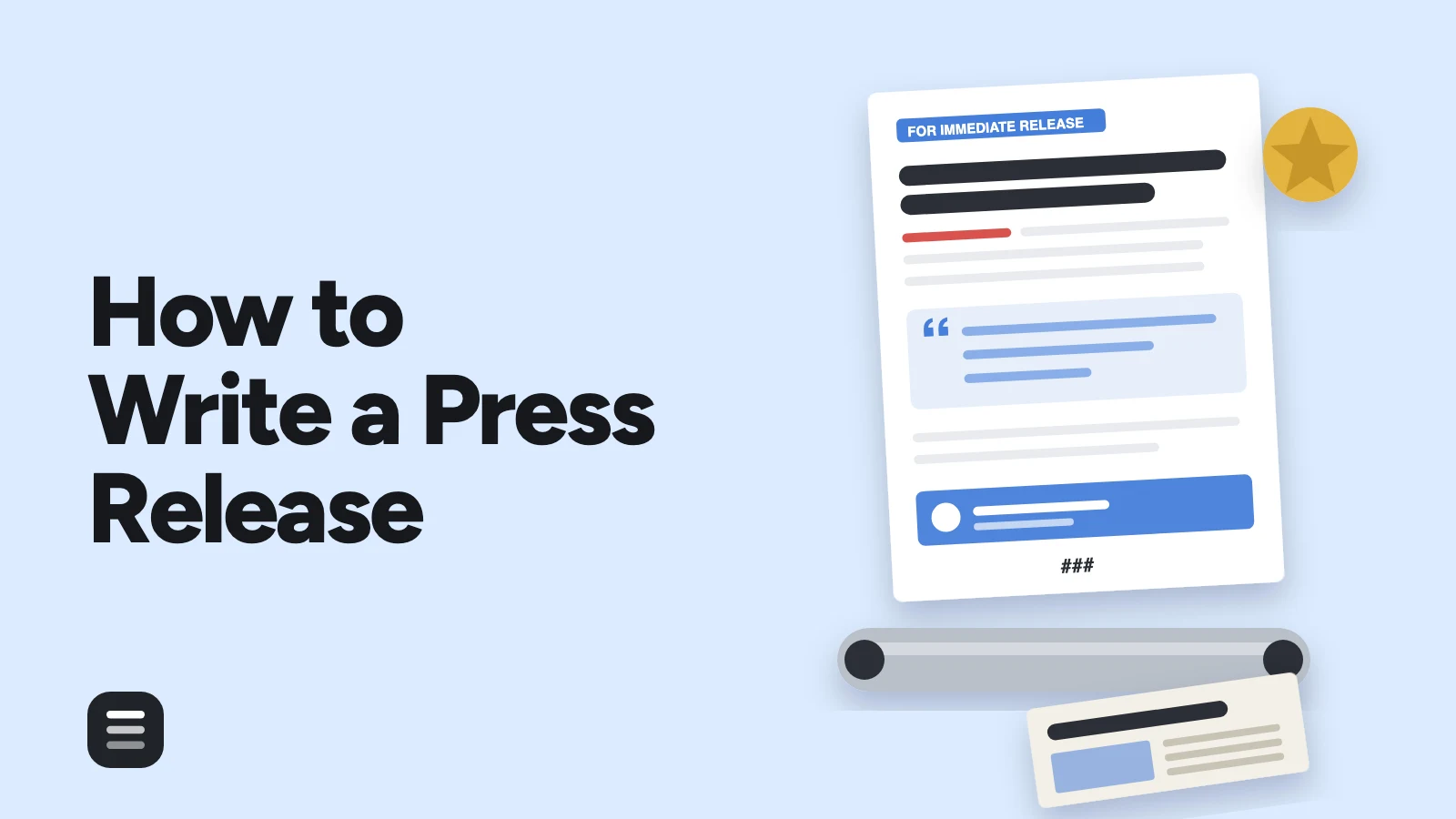
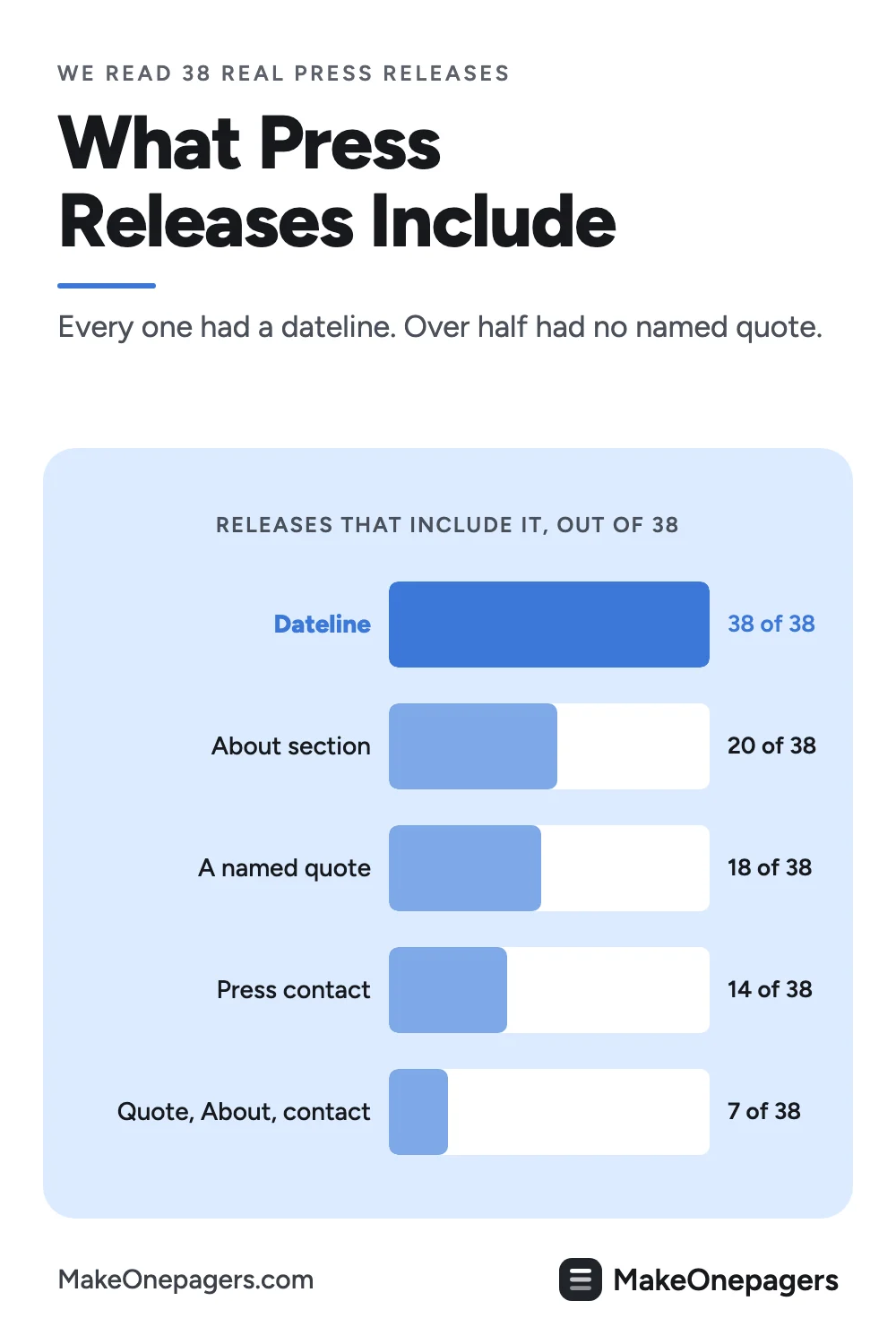
Put your news in the first sentence, and the rest of how to write a press release follows from there. Open that sentence with the city and date, quote a named person, add a short About section, and end with a contact a reporter can reach. To see what real releases actually do, we counted 38 of them on PR Newswire on October 26, 2026. All 38 opened with a city and date. Only 19 quoted anyone, and just 14 told a reporter who to call. Start from a free one pager template.
One‑Pager examples
Real One-Pagers made with MakeOnepagers. Open any one to edit it as your own.
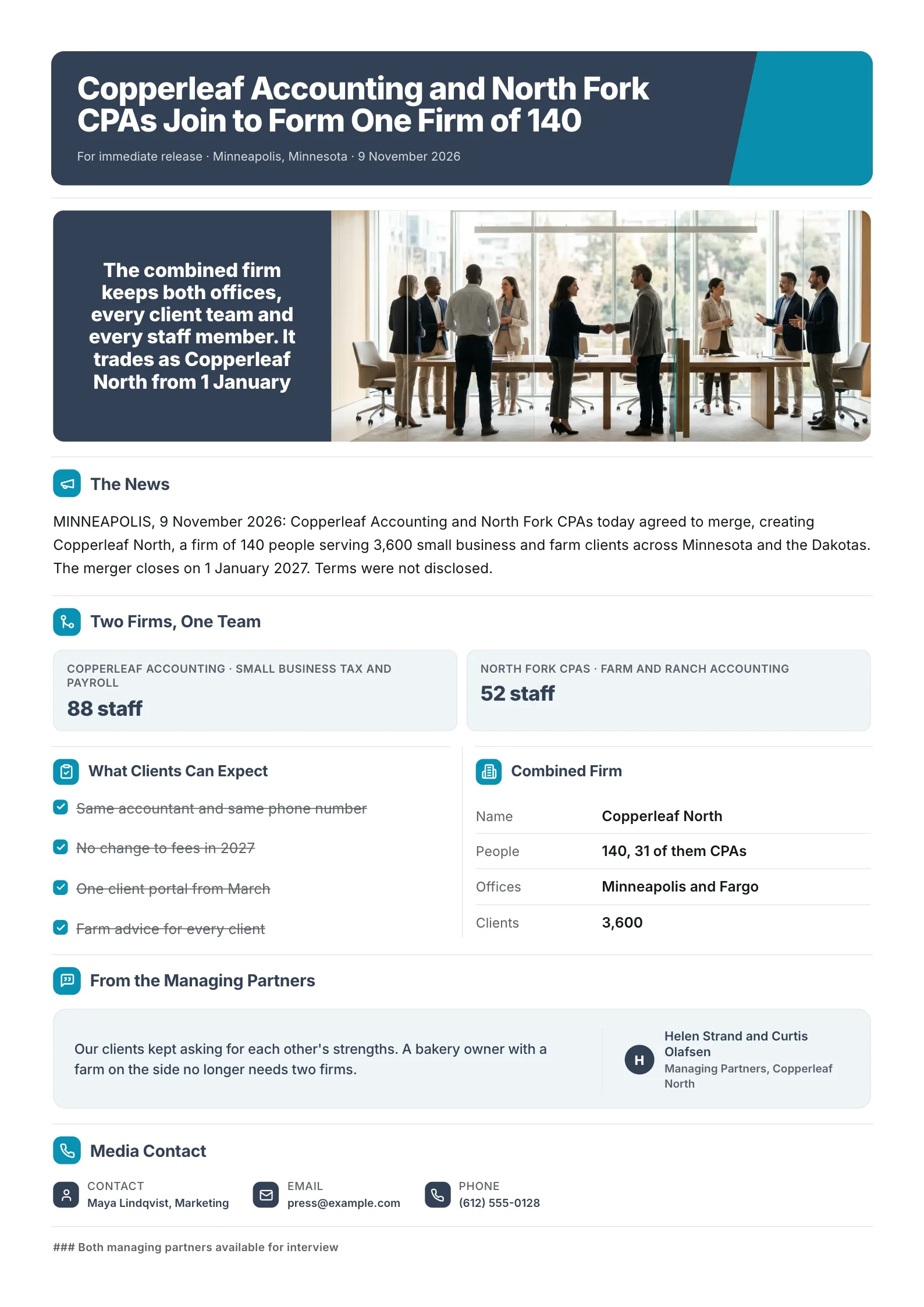 Press Release: Copperleaf North MergerEdit for free(opens in a new tab)
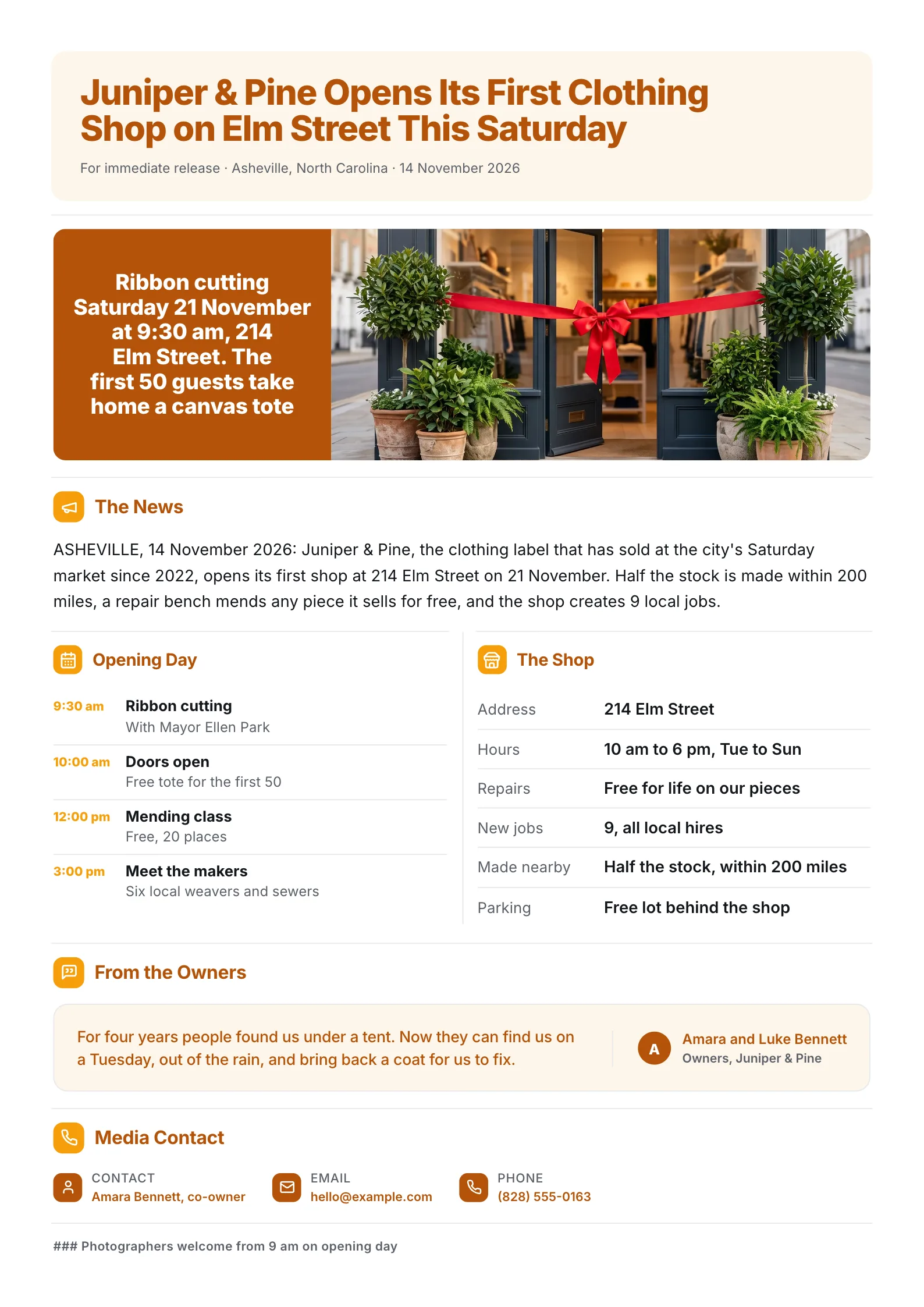 Press Release: Juniper & Pine Grand OpeningEdit for free(opens in a new tab)
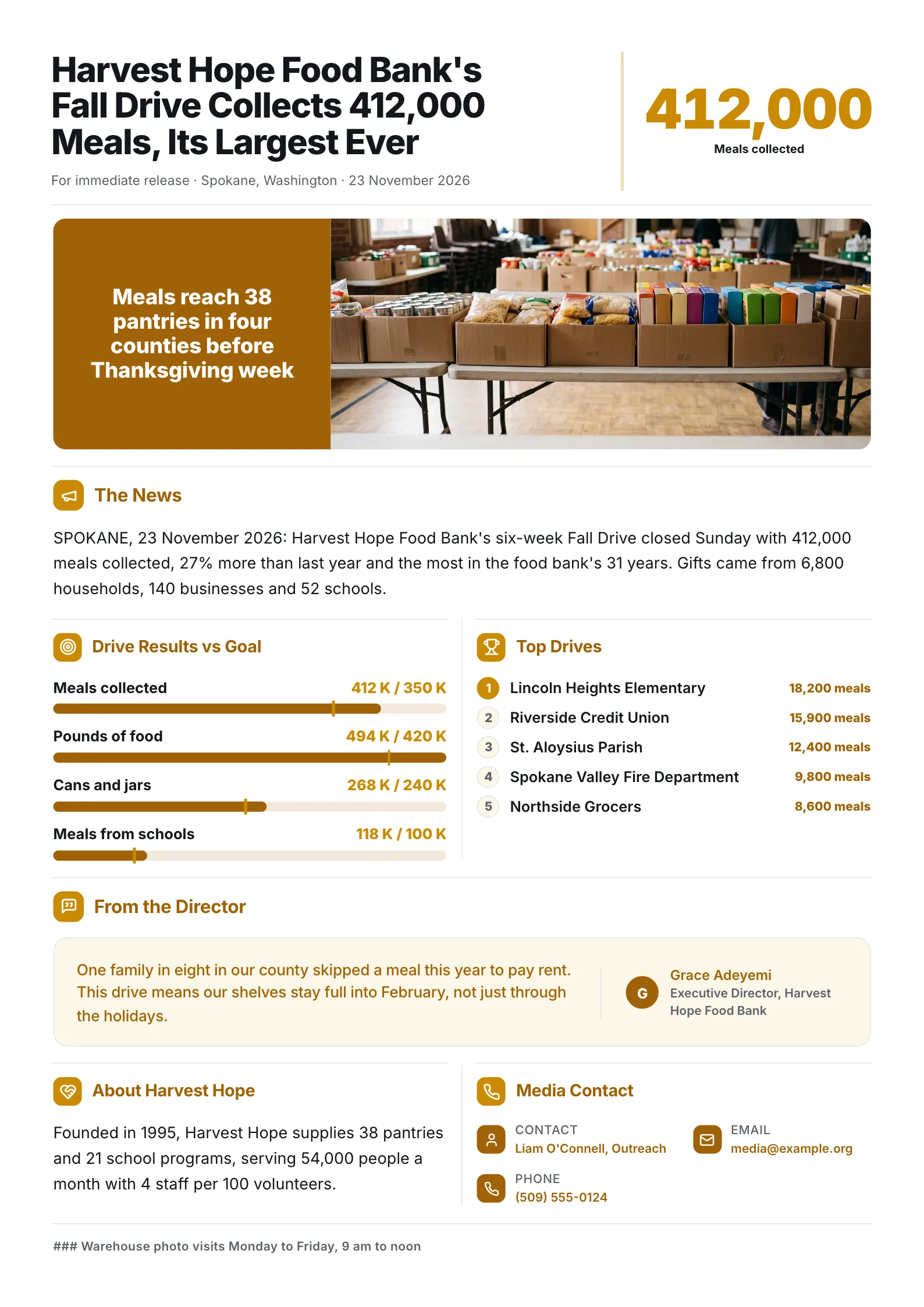 Press Release: Harvest Hope Fundraising ResultsEdit for free(opens in a new tab)
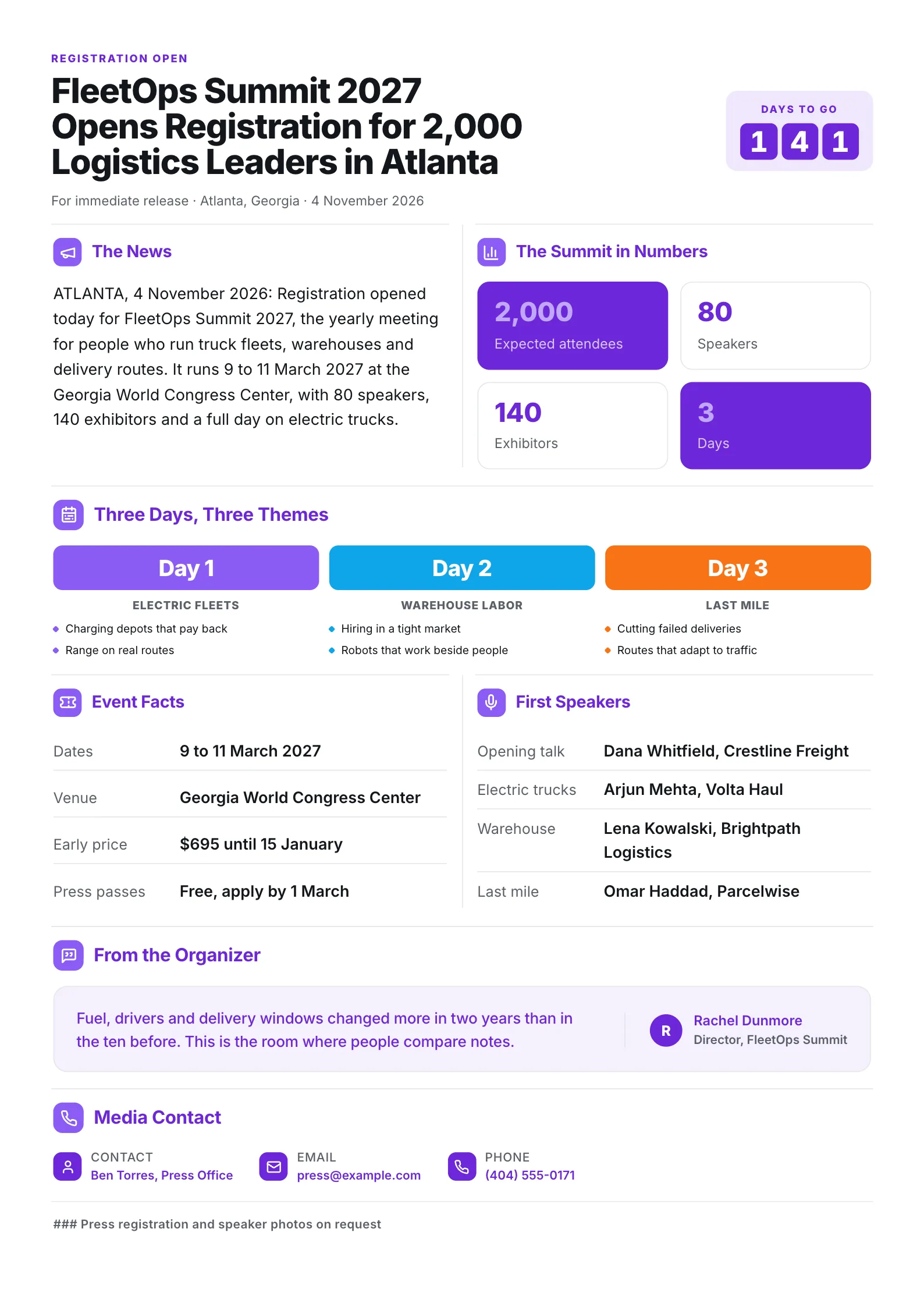 Press Release: FleetOps Summit ConferenceEdit for free(opens in a new tab)
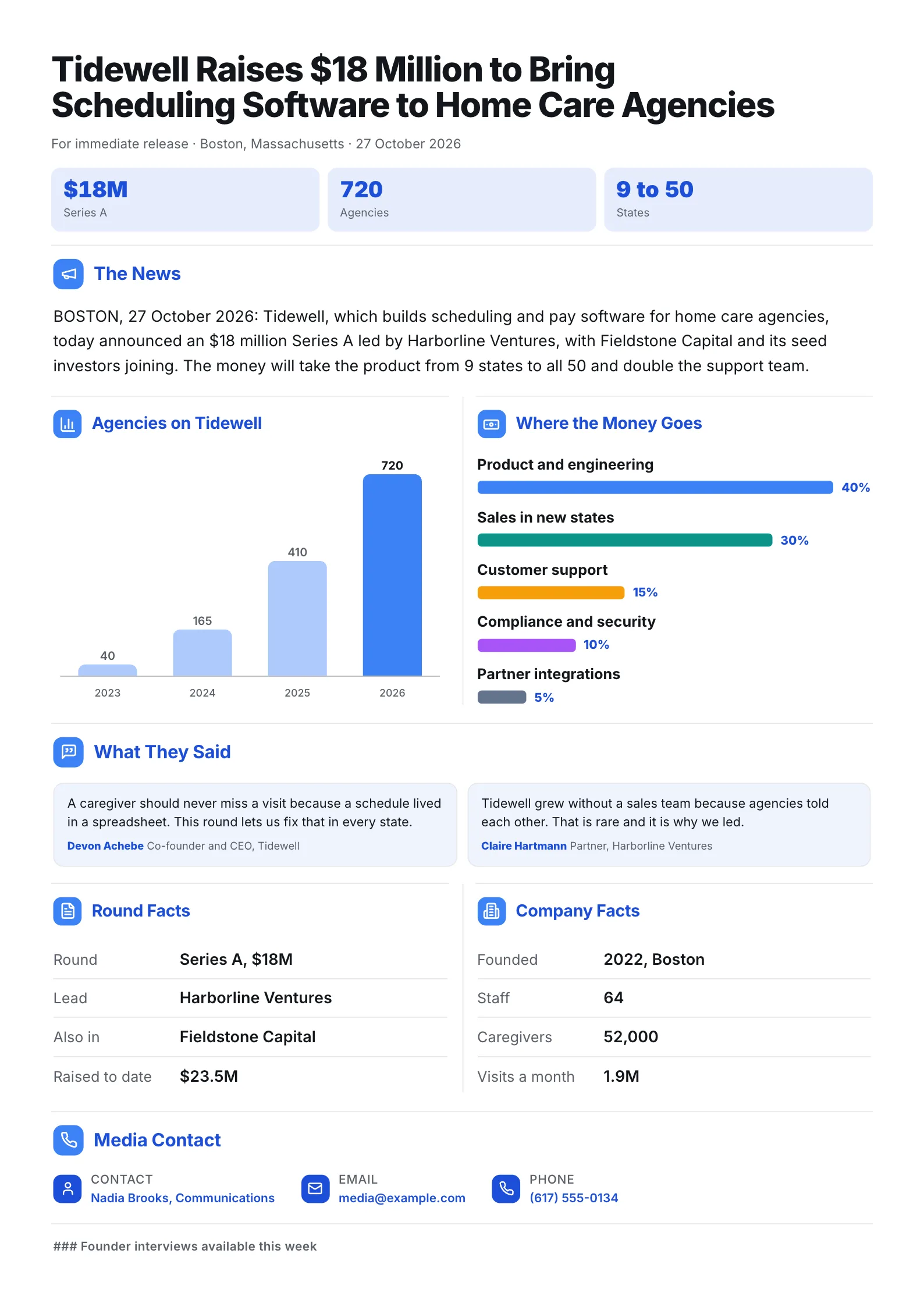 Press Release: Tidewell Series A FundingEdit for free(opens in a new tab)
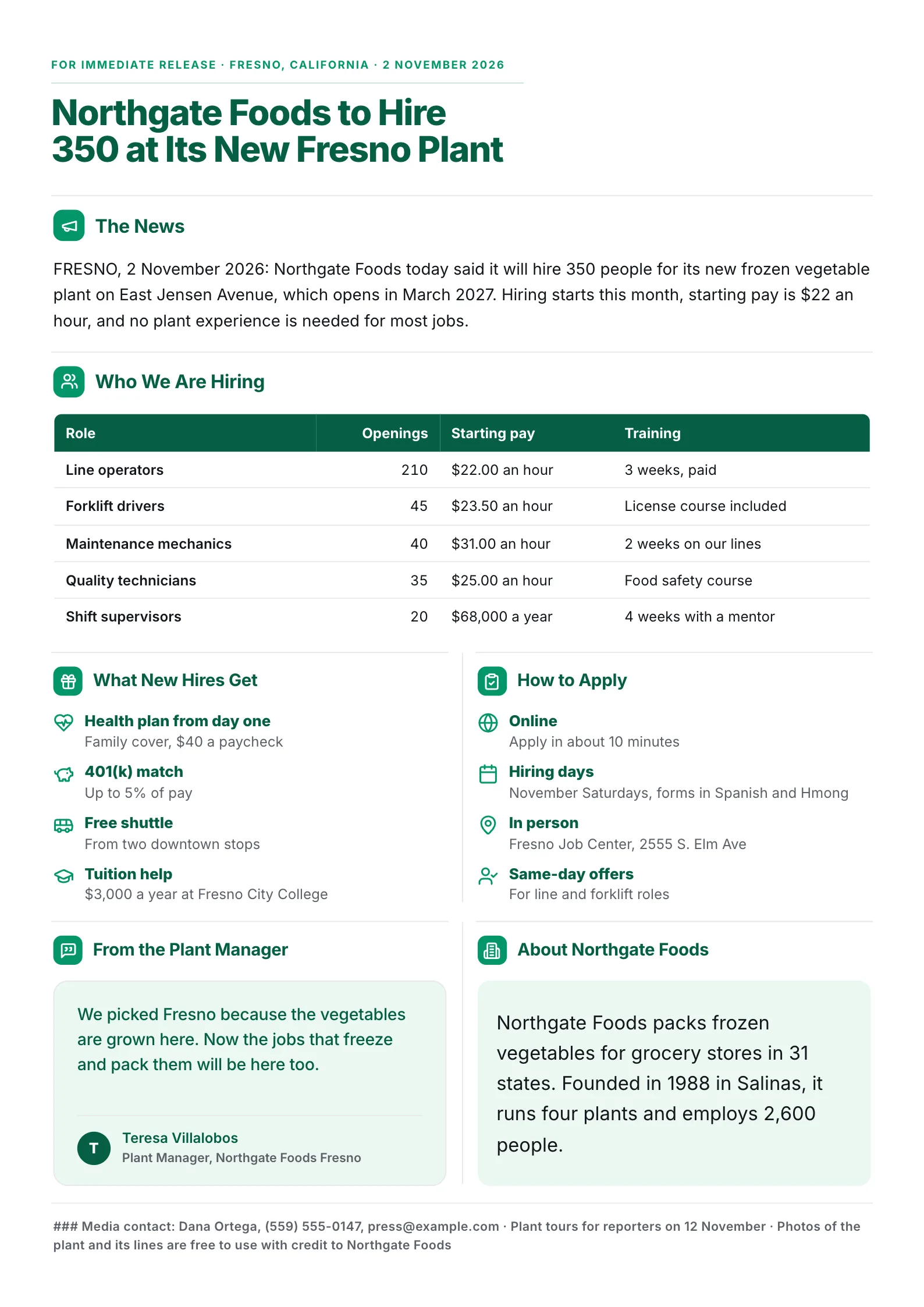 Press Release: Northgate Foods HiringEdit for free(opens in a new tab)
That gap is your opening. Below you'll find what we read, each part of a release in the order a reporter meets it, the numbers behind each one, and five sample releases you can rework for your own news at no cost.
The 38 press releases we read
We opened PR Newswire's list of the latest 100 news releases at 3:31 am Central Time on October 26, 2026, and read every one. Then we set aside the ones that would skew the count:
- 29 were translations into French, German, Spanish, Swedish, Italian and other languages. We kept only the English releases.
- 26 were law-firm investor alerts, the near-identical "investors have opportunity to lead" notices that fill the wire every morning. They read like ads.
- 7 were repeat versions of a story already in the sample, such as the same funding release posted twice.
That left 38 releases from 38 different companies and groups. They range from an air purifier named to TIME's Best Inventions list to a $7.4 million startup funding round, a robot arm milestone and a fall festival weekend in Kansas City. Each one is still in PR Newswire's news release archive, and we kept every count we made so anyone can check them.
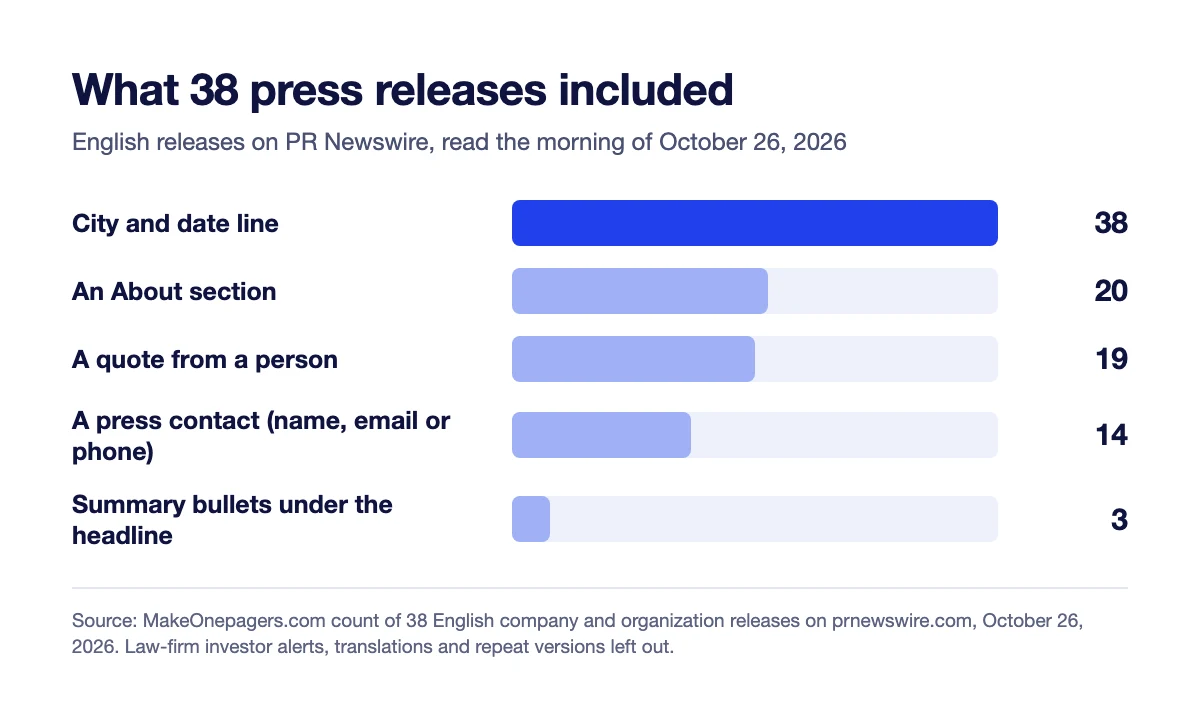
Source: MakeOnepagers.com count of 38 English releases on prnewswire.com, October 26, 2026.
These are the releases reporters actually get in their inbox, good and bad, which makes them a fair test for yours. When a part shows up in only half of them, you can stand out simply by including it.
A press release, top to bottom
A reporter reads a release from the top down, the same way they'd read a news story. So your order matters as much as your words. Here's each part in the order a reporter meets it, with what the 38 releases did.
The headline says what happened
The middle headline in our sample ran 13 words and 93 characters. The shortest ones were the clearest. "ROKAE delivers its 10,000th humanoid force-controlled arm" is 7 words, and you know the whole story. The longest ran 24 words, with a medical conference name, a drug code and a patient count packed into one line.
Write yours as a plain sentence with a subject and a verb: who did what. Keep it under about 100 characters. Sixteen of the 38 ran past that, and those were the hardest to take in at a glance. A number helps when you have a real one: $200 million, 412,000 meals, the 10,000th arm.
The dateline comes first
Every release we read, all 38, opened the first paragraph with a city and a date, like "SEOUL, South Korea, Oct. 26, 2026." This is the one part everyone gets right, and you should too. It tells a reporter where your news happened and whether it's still news.
If you follow AP style, the city goes in capitals and most months are shortened when they have a day, as in Oct. 26, 2026. March, April, May, June and July are always spelled out. That's the form the wire releases we read used, so it's a safe choice when you don't know who'll read yours.
The lead sentence carries the news
The first sentence after the dateline is the lead. In our sample, the median lead was 31 words. Nine ran 45 words or more, and one ran 108, listing a legal entity code before it reached the news.
The best ones are short. "SWI Compute today emerged from stealth to build and operate NVIDIA AI factories, launching first in Europe." That's 17 words, and a reporter could paste it straight into a story. Purdue's writing lab puts the same advice plainly: put the main idea and purpose of the release at the beginning.
A good test for your lead is the five Ws. Who did it, what happened, when, where, and why it matters. If your first sentence answers four of them, you're in good shape. Then use the second sentence for the fifth.
The body backs up the lead
The next three or four paragraphs give the details: the numbers, the people affected, what changes and when. Write them in order of importance, so a reporter who cuts from the bottom loses the least of your story.
Here the releases varied the most, so you have room to choose. The median ran 506 words from the dateline to the end, and the middle half fell between 379 and 751. Fourteen came in under 400 words. Seven ran past 800, mostly product launches listing every feature.
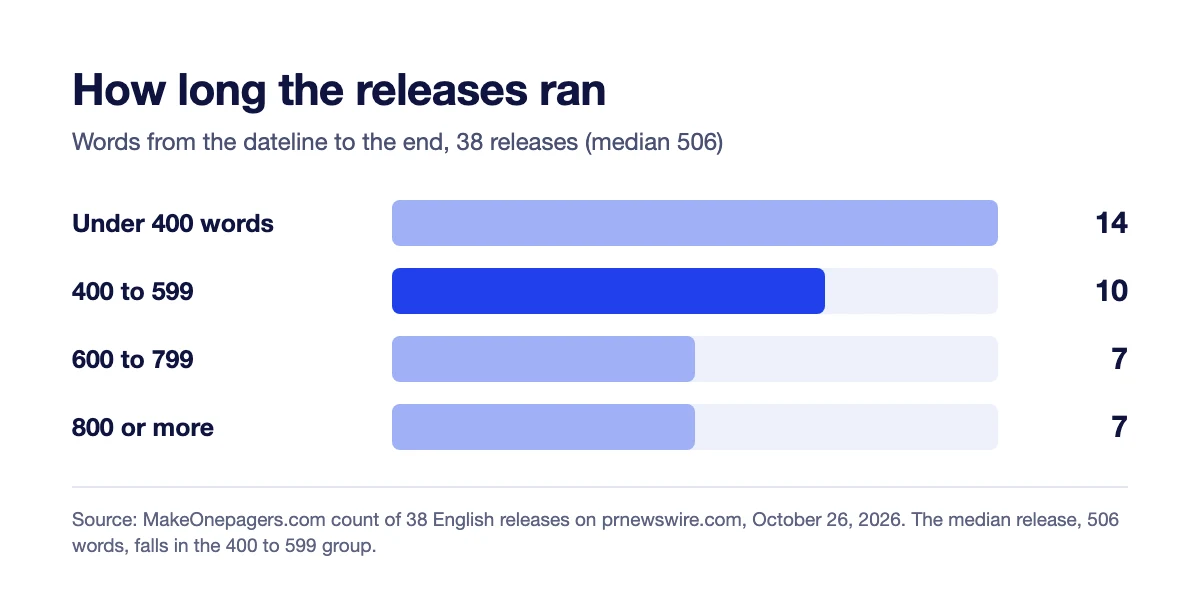
Source: MakeOnepagers.com count of 38 English releases on prnewswire.com, October 26, 2026.
For most news, 300 to 500 words is enough, and it fits on one page. If you need more, it's usually a sign you're telling two stories. Split them, or move the details to a fact sheet a reporter can ask for.
The quote adds a voice
A quote is the one thing a reporter can't write for themselves. It gives them a person to name and an opinion they can use. Yet only 19 of the 38 releases quoted anyone at all.
When they did quote someone, it usually came late. The first quote sat in paragraph 5 in the median release, and only 3 of the 19 put it in the first three paragraphs. One release waited until paragraph 14.
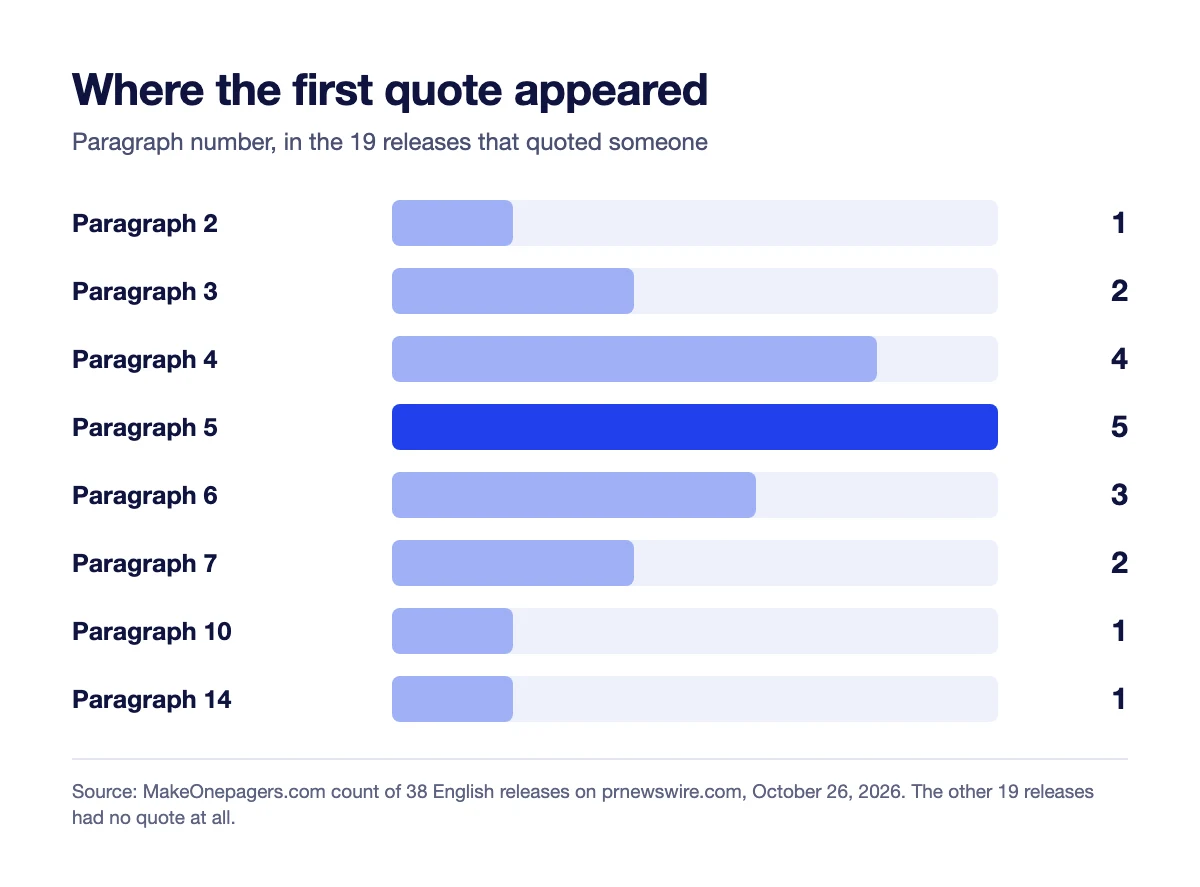
Source: MakeOnepagers.com count of 38 English releases on prnewswire.com, October 26, 2026. The other 19 releases had no quote.
Put yours in the third or fourth paragraph, right after the facts it's reacting to. Name the speaker and give their title. Of the 19 releases with quotes, 18 named the person. One credited "a Coway official," which a reporter can't use without calling to ask who that is.
Make the quote say something only a person would say: why it matters, what it was like, what happens next. "We are thrilled to announce" adds nothing your headline didn't already say. Compare that with the line in our recall template: "Families with allergies trust our label, and this time it was wrong." That's a quote a reporter would print.
The About section says who you are
The About section, sometimes called the boilerplate, is a short paragraph at the end that describes your company or group. Twenty of the 38 releases had one. The rest left a reporter searching your website to learn how big you are or what you do.
Keep yours to two or three sentences. Give the year you started, what you do, and one number that shows your size: customers, locations, staff or years. Then reuse it on every release, updating the number as it changes.
The press contact tells a reporter who to call
This was the biggest gap in the sample. Only 14 of the 38 releases gave a press contact: a name, an email or a phone number for the media. The other 24 left a reporter with nobody to ask.
Purdue's guide is blunt about this. It tells you to always include a media contact address, phone and email. At minimum, give one person's name, an email and a phone number, and make sure that person answers on the day the release goes out.
Only 7 of the 38 releases had all three of the parts above, a quote, an About section and a press contact. Nine had none of them. If yours has all three, it's more complete than four in five releases on the wire that morning.
The end mark closes it
Many releases end with three pound signs, ###, centered under the last line. It's an old newsroom mark that tells an editor there's nothing more. You'll still see it on most templates, and it's a clean way to signal the end of the news before any notes for editors, such as "Photos available on request."
What the wire releases taught us about headlines and leads
Reading 38 releases in a row, the same mistake came up again and again. Many of them opened with a legal name, a stock ticker and a company description before they got to the news. "Elbit Systems Ltd. (NASDAQ: ESLT) (TASE: ESLT) ("Elbit Systems" or the "Company") announced today" uses 13 words before you know what happened.
A busy reporter won't wait that long for your news. So save the full legal name for the About section, and open with the short name your customers use. Twelve of the 38 leads used the word "today," which is fine, as long as the news comes in the same sentence.
The headlines that worked best had three things in common. They named the company, used an active verb, and carried one concrete number or name. "Bitfire Group Reports Q3 Digital Assets Under Management of US$221 Million, Up 60.1%" does all three in 13 words.
Five press release templates that follow these rules
Each of these opens in our editor, and you can edit it for free. We picked them because each one has a named quote and a press contact, two of the three parts most real releases skipped. The product launch and new CEO releases also carry an About section, so add yours to the others. Swap in your own news, keep the structure, and check that your contact is a real person.
 Edit this template
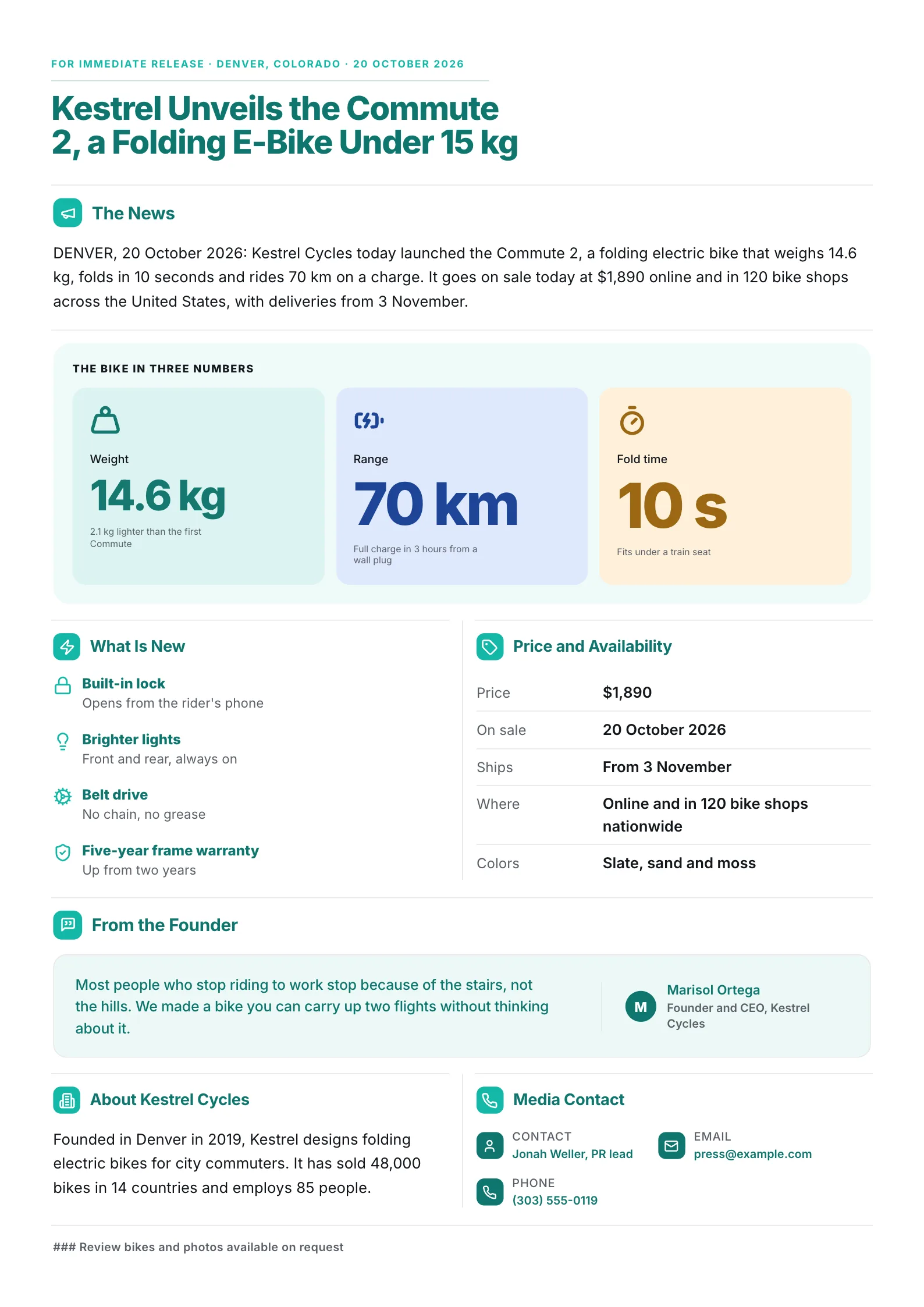
This product launch release puts the bike, its weight and its range in the lead sentence, then the price and where to buy it in the next one. The founder's quote explains why it exists, and it closes with a two-sentence About section and a named PR lead with an email and a phone. You can edit this product launch press release template for free.
 Edit this template
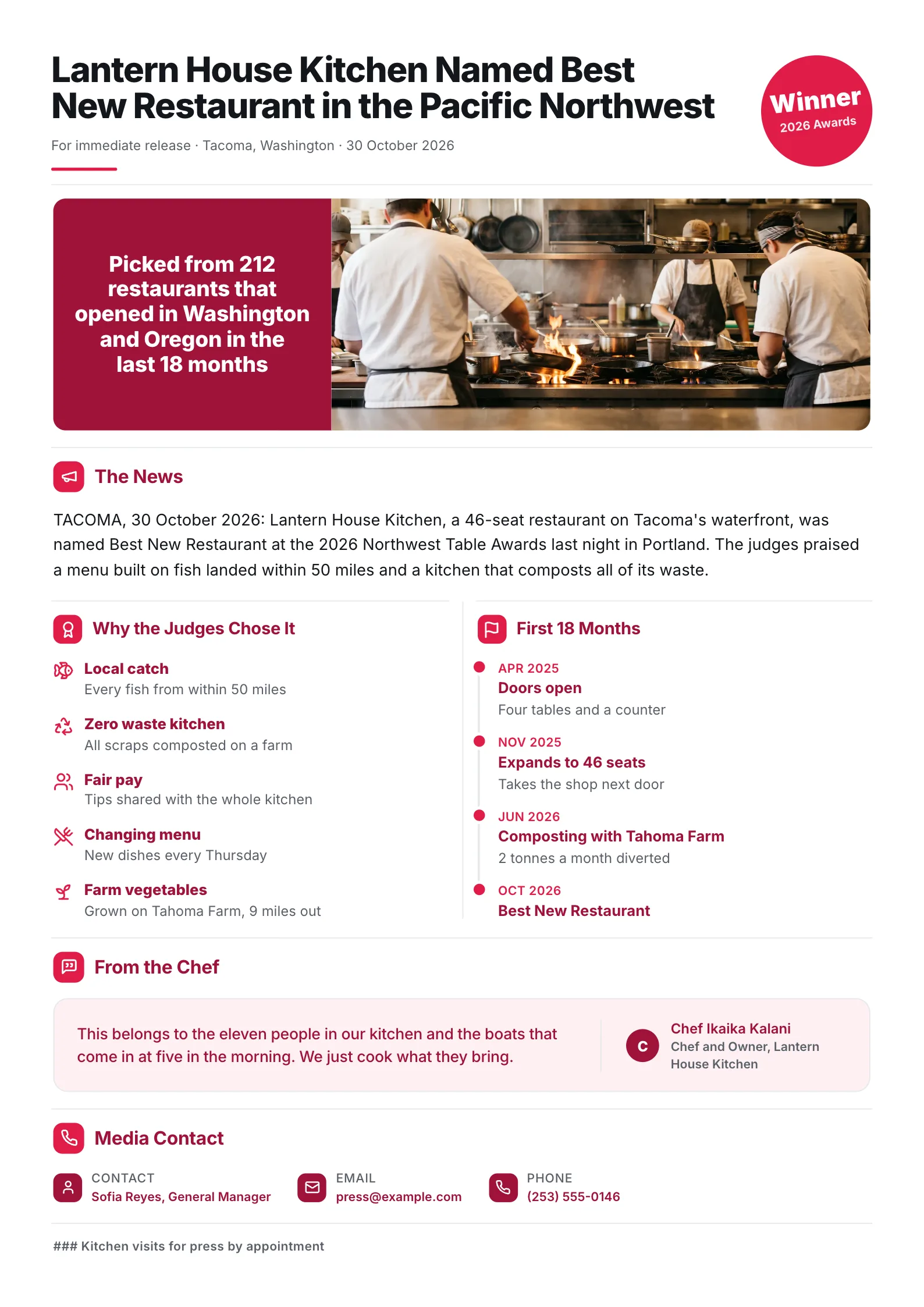
Lantern House names the award and the city in its first sentence, then gives the two reasons the judges named. The chef's quote hands the credit to the kitchen crew and the boats, which is a line a reporter can lift whole. A general manager is the named contact, with an email and a phone. You can edit this award press release template for free.
 Edit this template
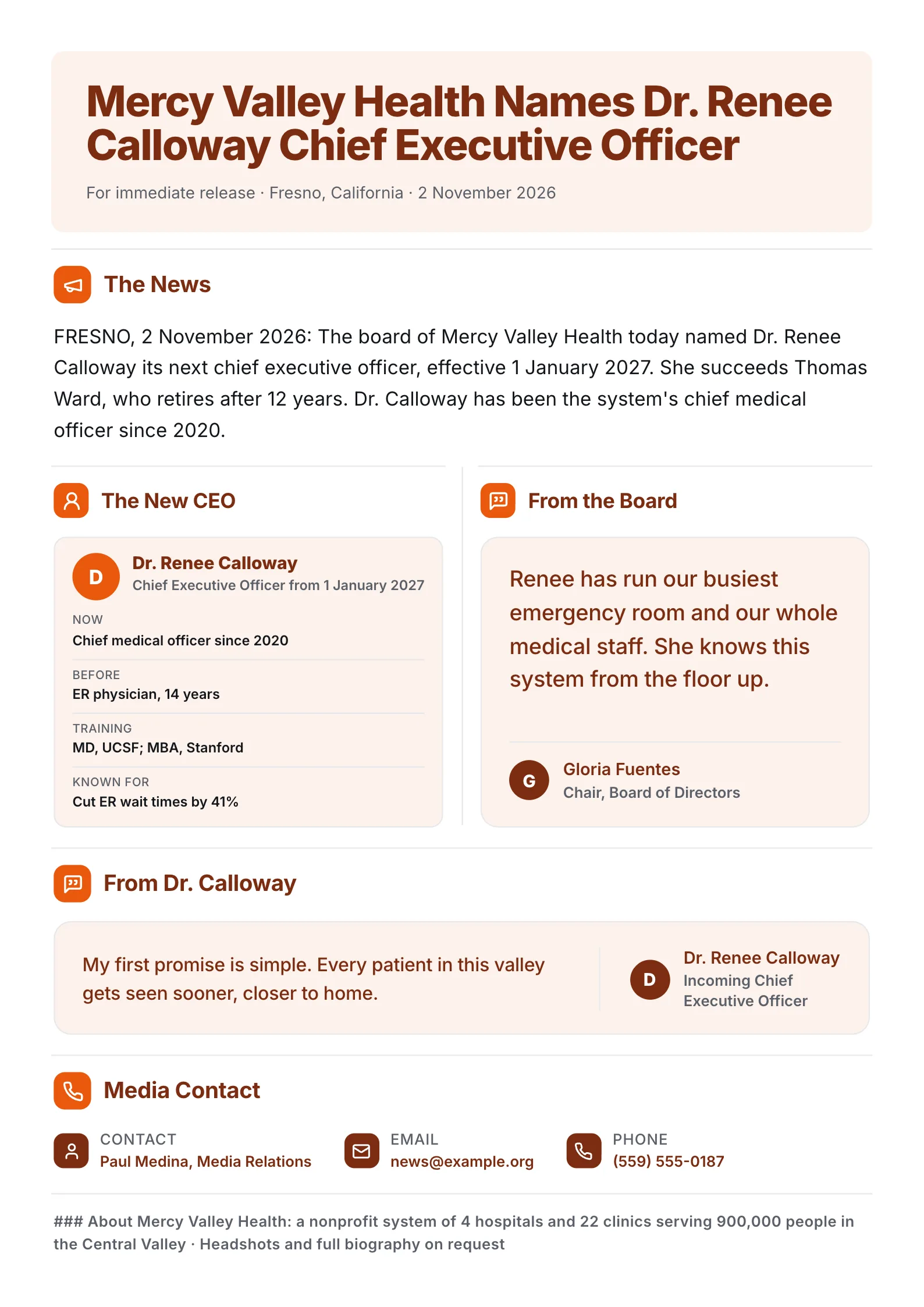
An appointment release needs two voices, and this one has them: the board chair on why they chose her, and the new CEO on her first promise. Both are named with their titles. The About line sits at the foot of the sheet, with a note that headshots are on request. You can edit this new CEO press release template for free.
 Edit this template
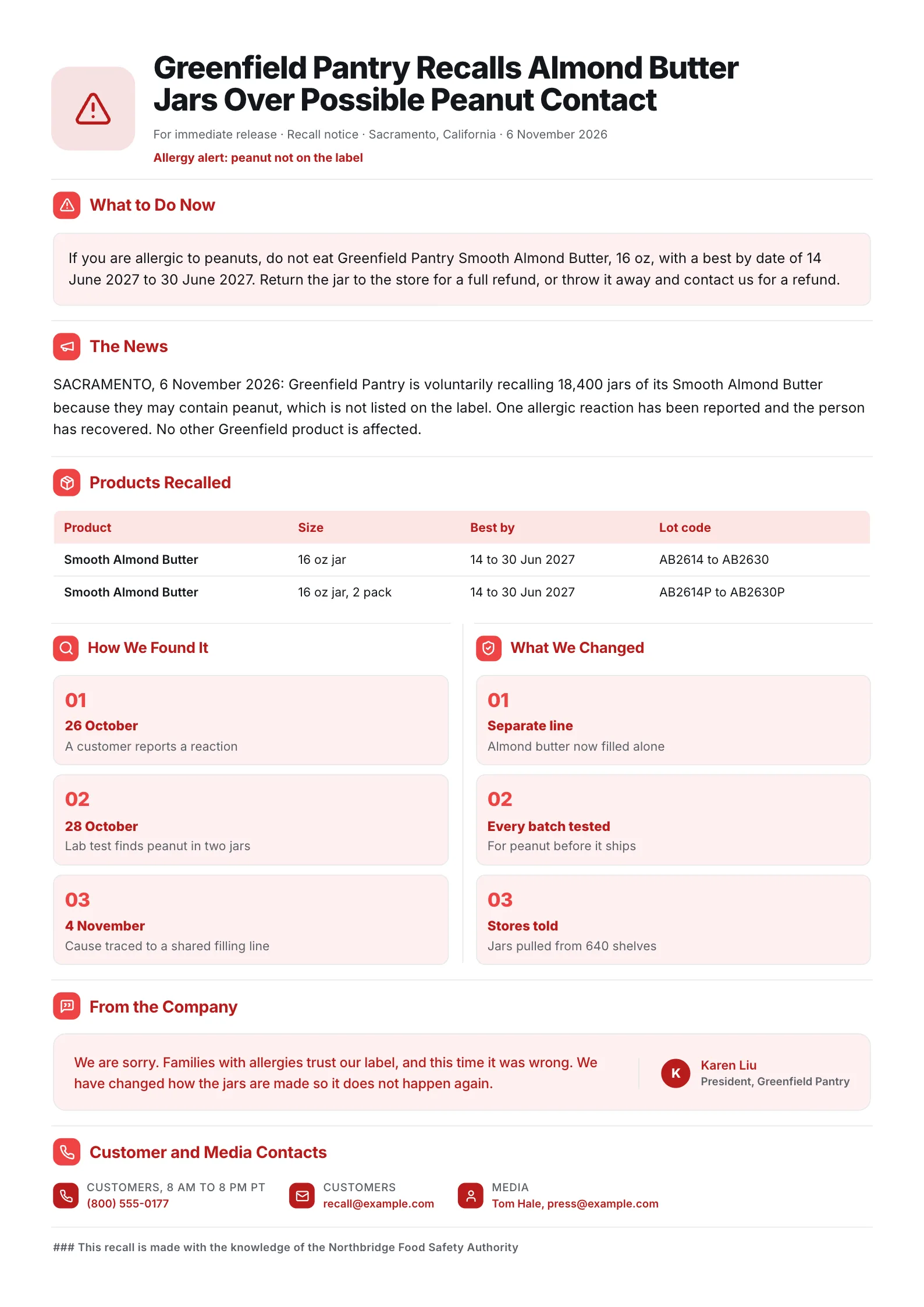
A recall is the one release where the reader's action comes before the news, so this one opens with a What to Do Now box. It then lists the exact lots in a table, says how the problem was found, and gives separate contacts for customers and for the media. You can edit this product recall press release template for free.
 Edit this template
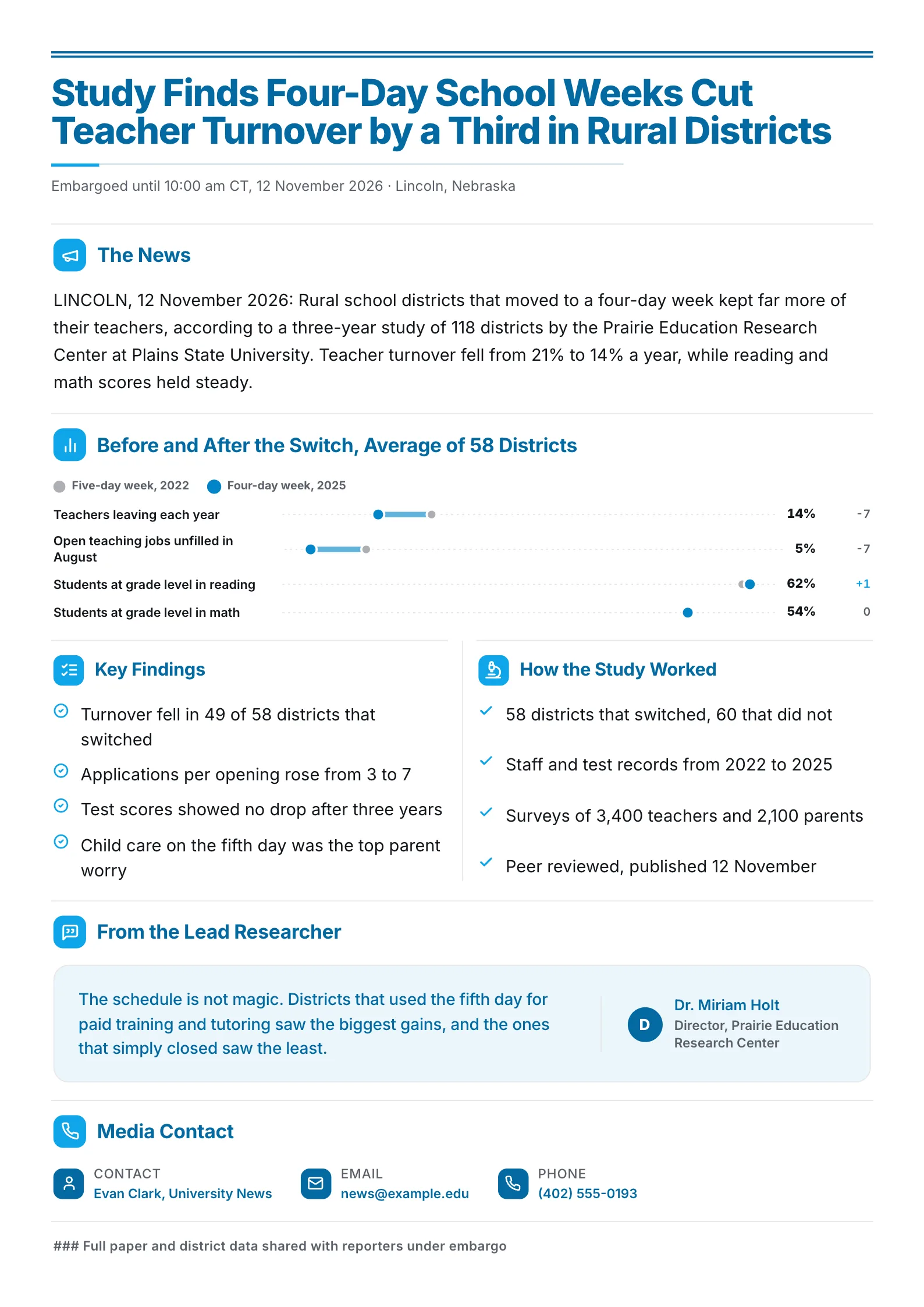
This research release shows how to handle an embargo: the release time sits right in the subtitle, so no reporter publishes early. It explains how the study worked in four short lines, and the lead researcher's quote adds the catch the numbers don't show. You can edit this research findings press release template for free.
How to write your press release, step by step
- Check that it's news. Ask who it affects and what changes for them. A launch, a result, a hire, a recall or a date someone can act on is news. A feeling about your company isn't.
- Write the headline as one sentence. Who did what, with one number or name, in under about 100 characters.
- Add the dateline. Your city, then the date, before the first word of the lead.
- Write the lead in 25 to 35 words. Answer who, what, when and where. Use your short company name, not the legal one.
- Add two or three paragraphs of detail. Put the most important facts first, so the release still works if a reporter cuts the end.
- Add one quote from a named person. Give their title, and put it in the third or fourth paragraph.
- Write a short About section. Two or three sentences with when you started, what you do and one number.
- Add a press contact. A name, an email and a phone number, for someone who'll answer that day.
- Close with ###, then read it out loud. Cut every sentence a reporter wouldn't miss, and check every number against its source.
Questions people ask about writing a press release
How long should a press release be?
Aim for 300 to 500 words, which fits on one page. The releases we read ran a median of 506 words, but the clearest were often the shortest. If yours runs past 800, look for a second story hiding in it.
How do I write a press release in AP style?
Put the city in capitals at the start of the first paragraph, shorten Jan., Feb., Aug., Sept., Oct., Nov. and Dec. when they come with a day (Oct. 26, 2026) and spell out March to July, write numbers one to nine as words, and use "said" for quotes. Keep titles lowercase after a name, like "Marisol Ortega, founder and CEO."
How do I write a press release for an event?
Put the date, time and place in the lead, since that's what a reporter needs to list it. Add what people can do there, one quote from the organizer, and the contact for press passes. If press can attend, say how to get a pass in the contact block.
How do I write a press release for a new business?
Lead with what's new for your customers: the opening date, the address area and what you offer. Then quote the founder on why they started it, and add an About section with one real number, such as the jobs you're creating. Our grand opening press release template shows the shape.
Do I need a quote in a press release?
You don't have to have one, but it helps. Half the releases we read had none. A named quote gives a reporter a voice for their story, and it's the one part they can't write themselves.
Can AI help me write a press release?
Yes. Our generator and other AI tools can shape your facts into a rough release. You still need to check every number, choose who to quote, and make sure the contact is a real person. A named quote and a real contact are the two parts the releases on the wire most often left out.
Write your press release
Choose the release above that is closest to your news and replace its headline, lead and quote with yours. Before it goes out, check the two parts that half or more of the 38 releases left out, a quote from a named person and a contact a reporter can reach. Every design is in MakeOnepagers, and our One-Pager maker can build one from your notes, and the first 7 days cost nothing.




