Press Release Checklist: 15 Checks From 5 Published Lists
A press release checklist built from 5 published lists, 80 items in all. Only 2 checks are on every list. Here's the full set, and what each list adds.

A press release checklist is the last thing you run before you hit send. To build this one, we read 5 checklists published by groups that send releases or teach others to. They come from a public health school, a state health department, a research center, an accounting body and a business group. Together they hold 80 items. Only 2 checks appear on all 5 lists. Put the main news in your first paragraph, and give reporters a way to reach you. Start from a free one pager template.
One‑Pager examples
Real One-Pagers made with MakeOnepagers. Open any one to edit it as your own.
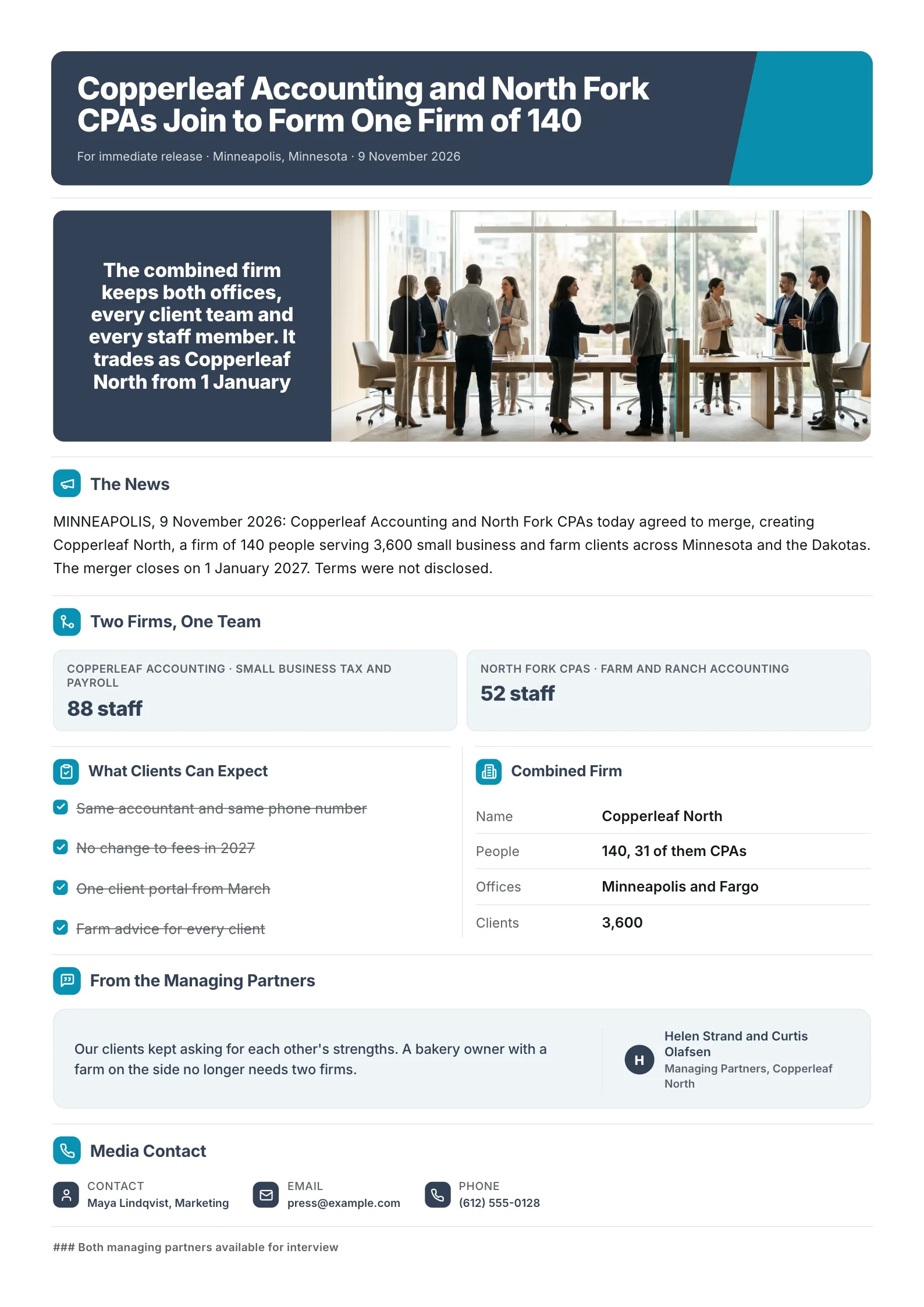 Press Release: Copperleaf North MergerEdit for free(opens in a new tab)
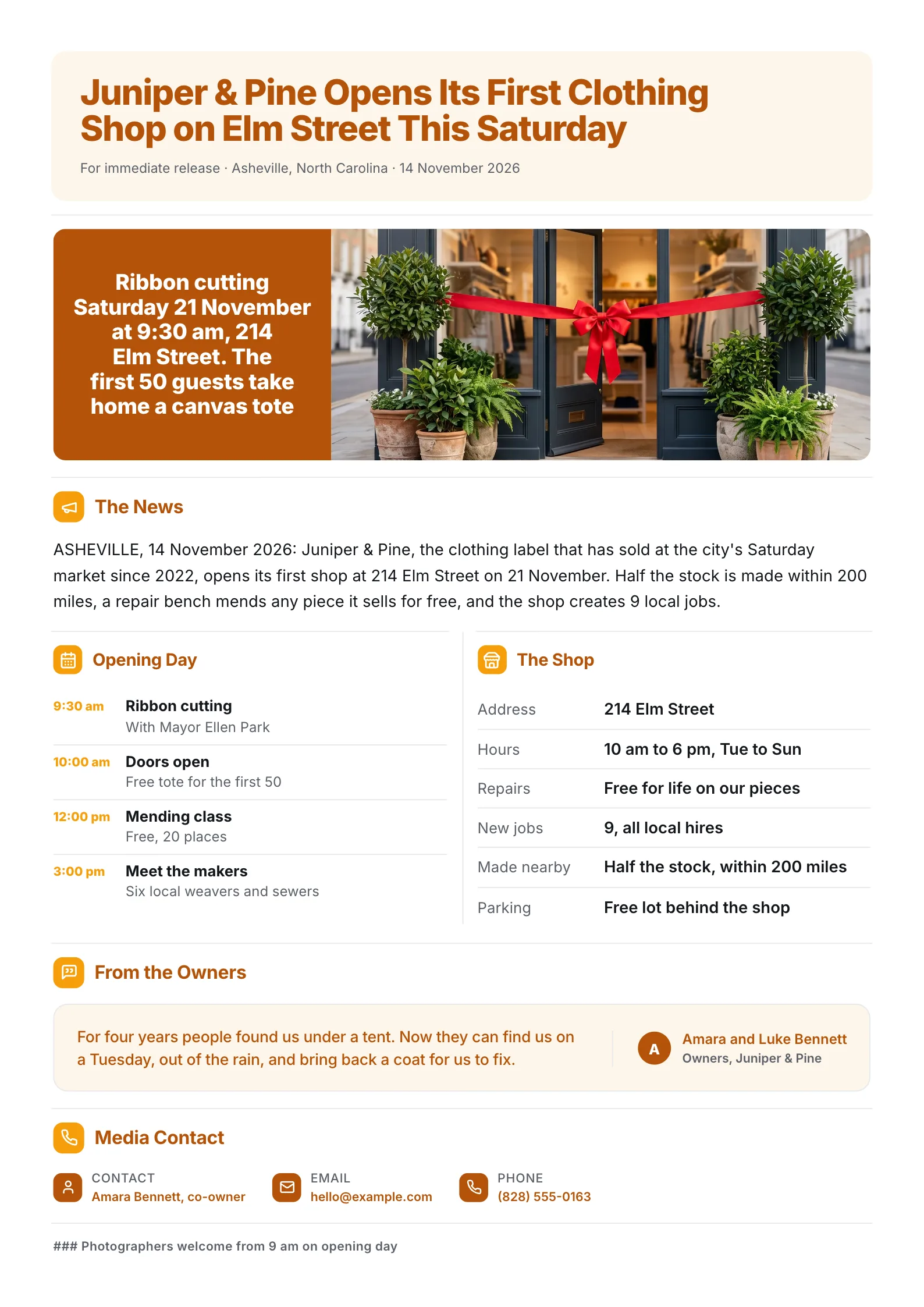 Press Release: Juniper & Pine Grand OpeningEdit for free(opens in a new tab)
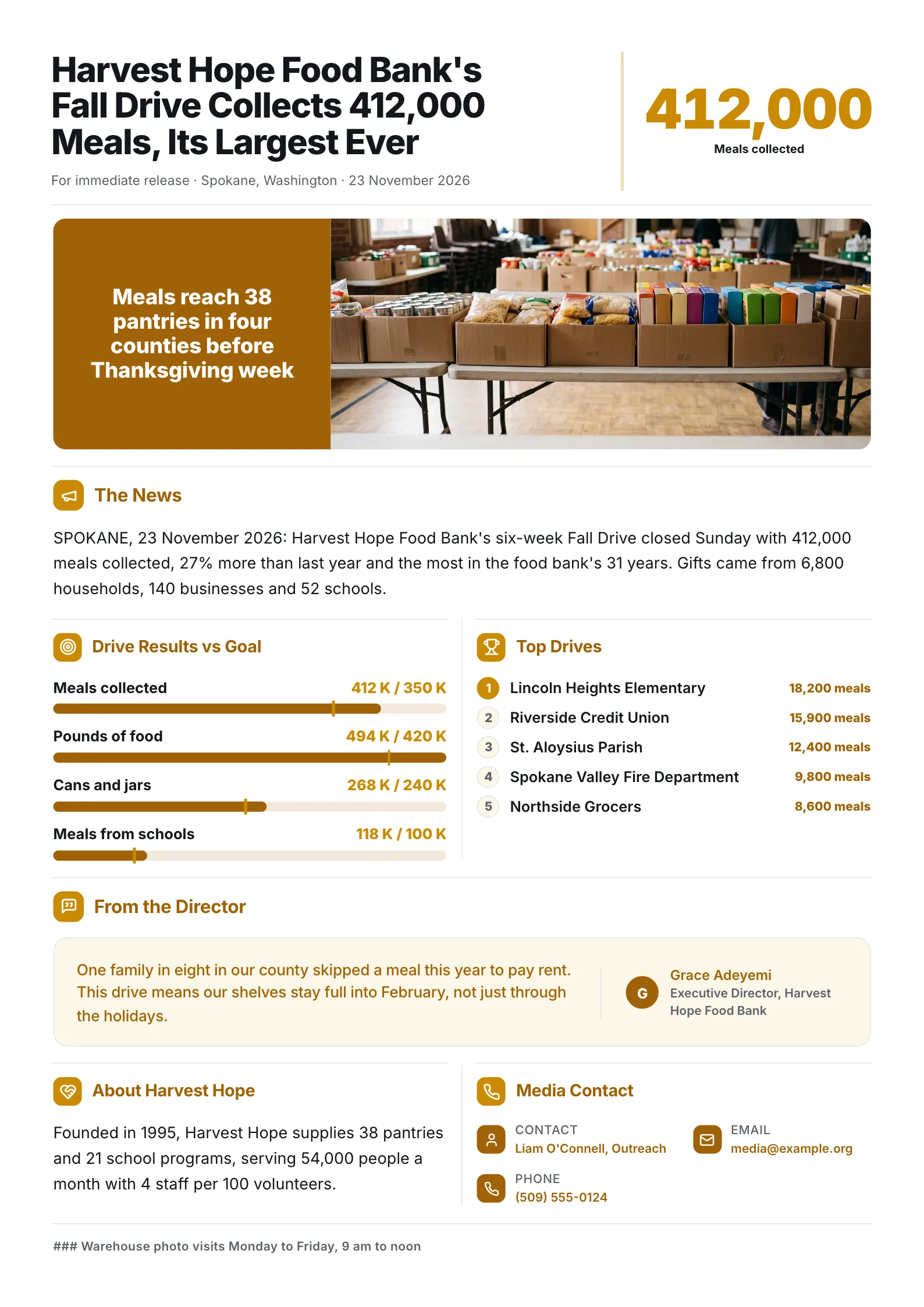 Press Release: Harvest Hope Fundraising ResultsEdit for free(opens in a new tab)
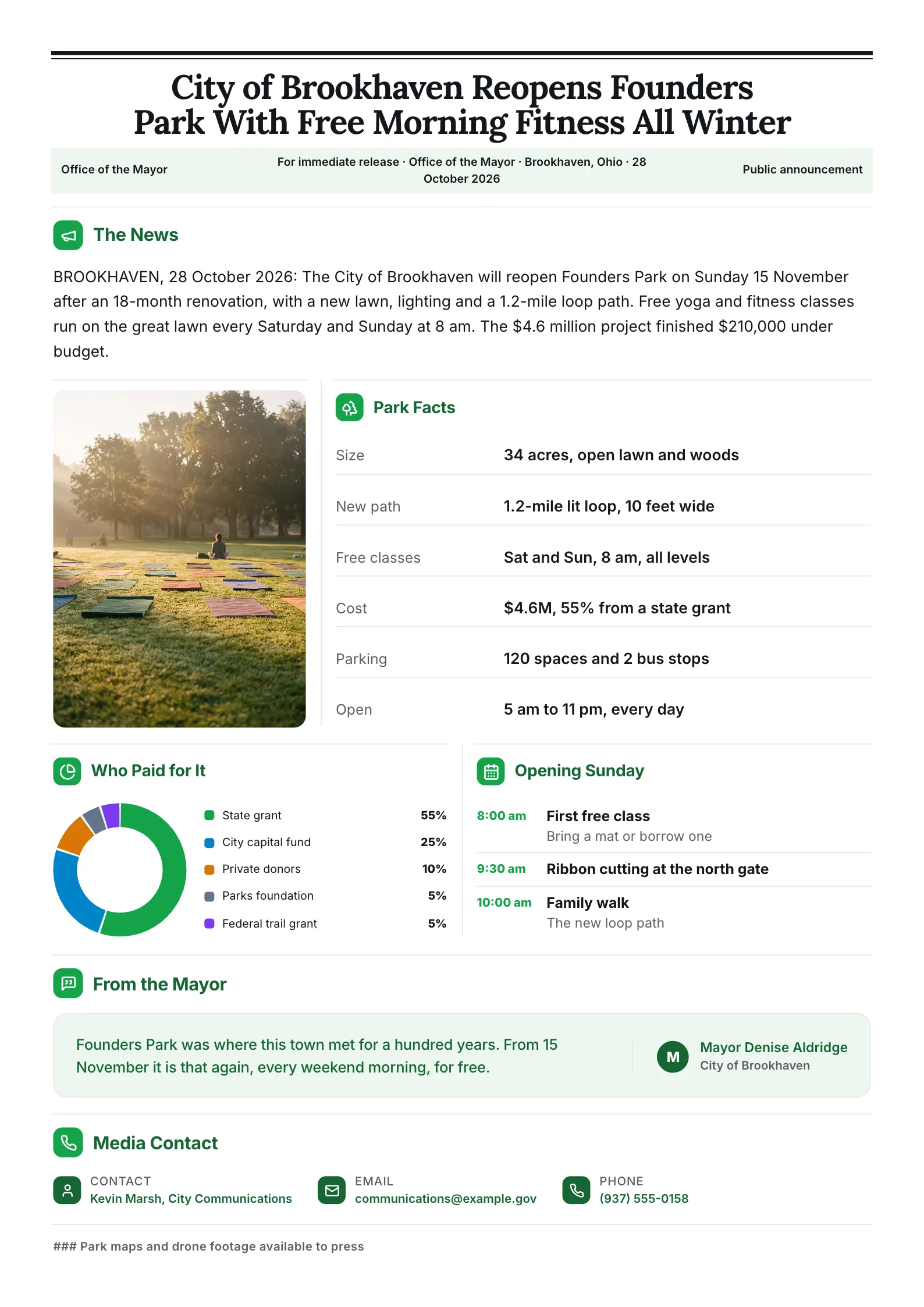 Press Release: Brookhaven Park ReopeningEdit for free(opens in a new tab)
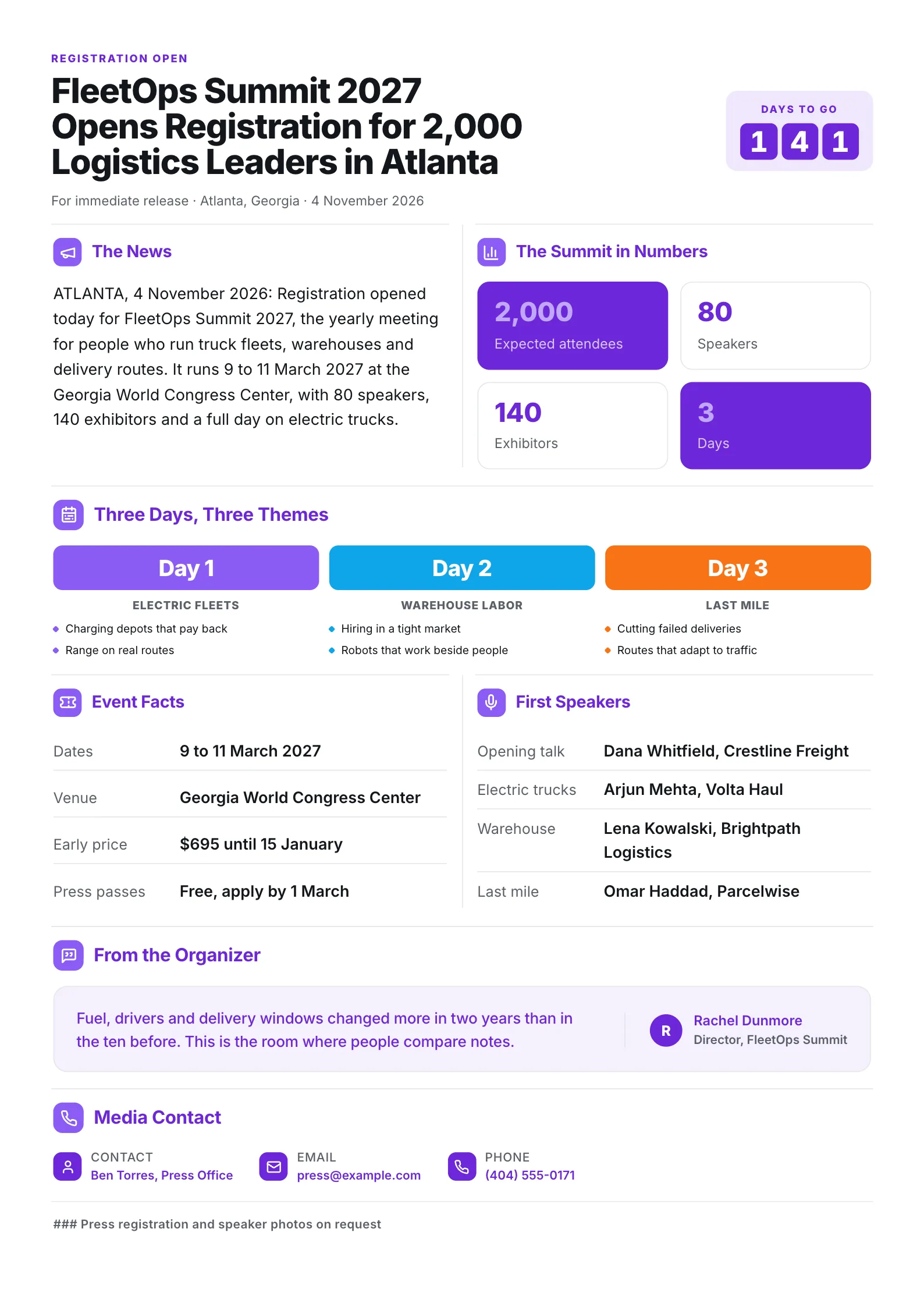 Press Release: FleetOps Summit ConferenceEdit for free(opens in a new tab)
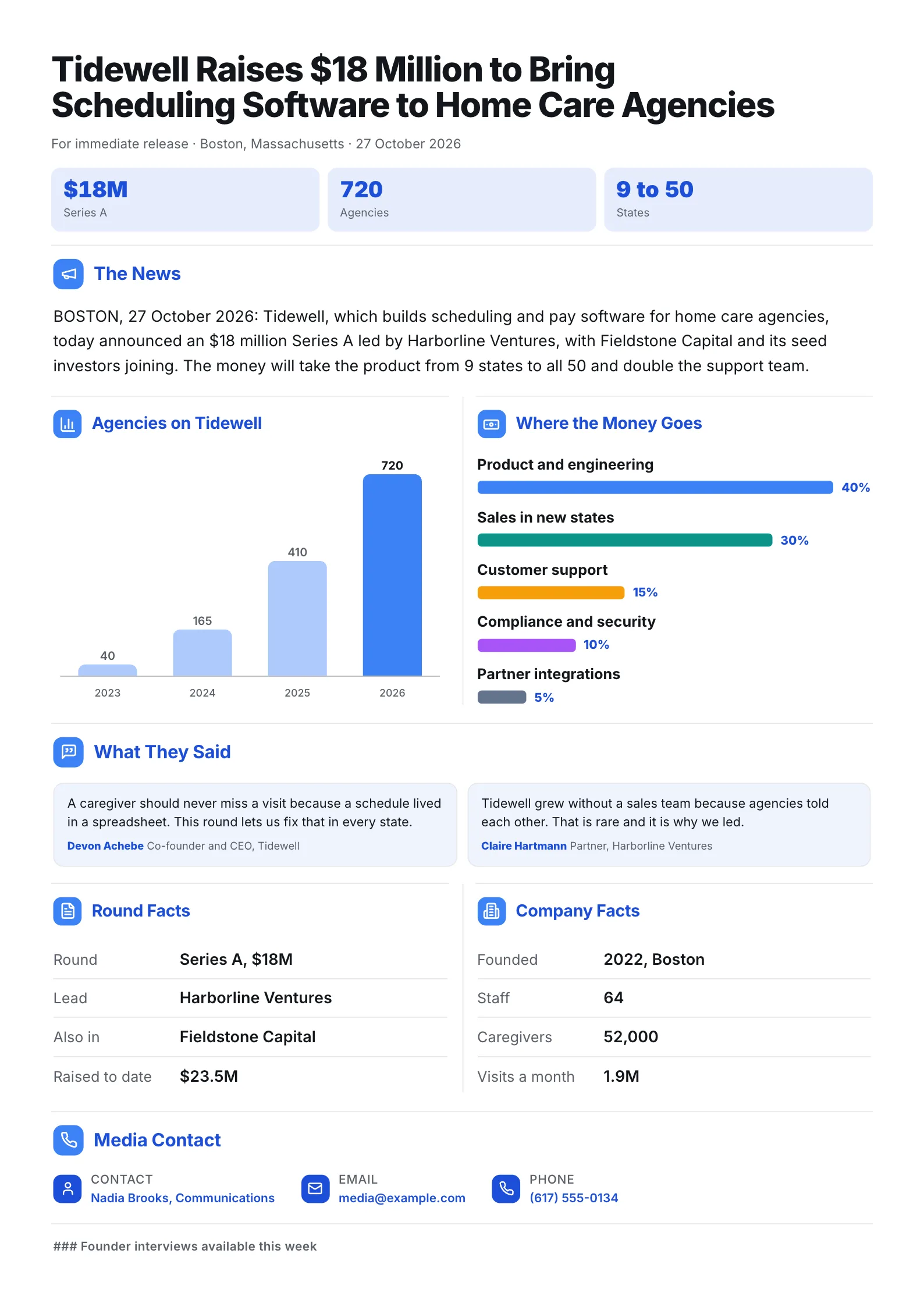 Press Release: Tidewell Series A FundingEdit for free(opens in a new tab)
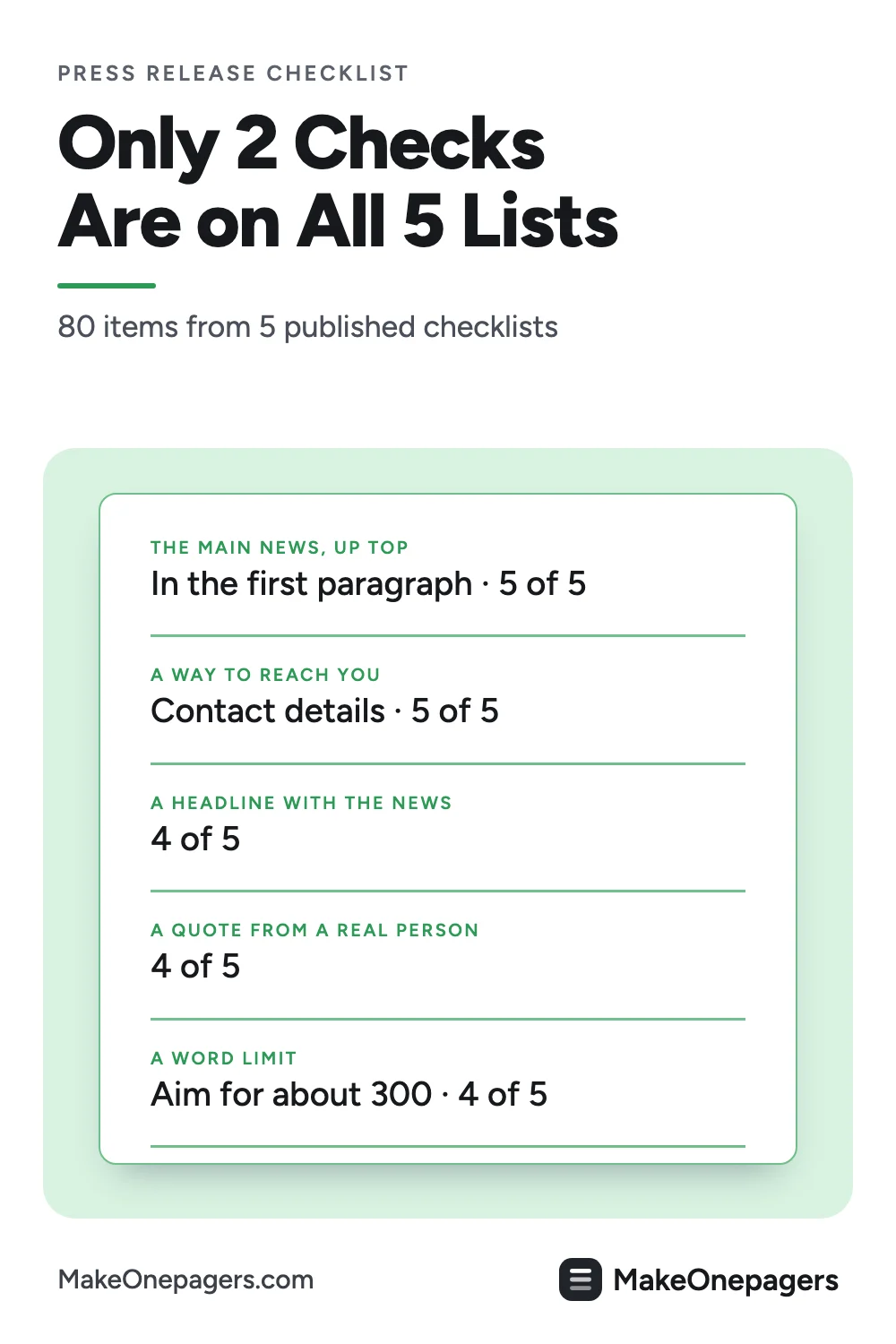
Everything else is on some lists and missing from others. Below is the merged checklist, then which list asks for what, and the places they disagree.
The press release checklist
Run these before you send. The number after each check is how many of the 5 lists ask for it.
- The first paragraph carries the main news. Three lists spell it out as who, what, where, when and why. (5 of 5)
- Contact details are on the release. Four lists ask for a named person and a phone number. (5 of 5)
- The headline tells the news in a few words. (4 of 5)
- A real person is quoted. (4 of 5)
- Sentences are short and the words are plain. No jargon, and every acronym spelled out. (4 of 5)
- It fits a length limit. Three lists set a cap between 300 and 500 words, and one says a page. (4 of 5)
- More detail follows the lead. Two lists say to put the most important first. (4 of 5)
- The release says when it can run. That's "For Immediate Release" or an embargo time. (3 of 5)
- Opinions appear only inside quotes. (3 of 5)
- Every fact, name and spelling is checked. (3 of 5)
- A short About paragraph says who you are. (3 of 5)
- A picture or chart goes with it, if you have a good one. (3 of 5)
- It ends with ###. (3 of 5)
- You know who it's going to. A list of reporters, plus their deadline and the format they want. (2 of 5)
- Someone has signed it off. (1 of 5)
The 5 lists we read
We downloaded each one on November 5, 2026, and counted every item. Each name links to the file we read.
| Published by | List | Items |
|---|---|---|
| Northwest Center for Public Health Practice, University of Washington School of Public Health | News Release Checklist, for emergency risk communication | 14 questions |
| ACCA UK Technical Advisory Service, July 2018 | Checklist: writing a press release, for accountants and their clients | 16 items |
| Connecticut Department of Public Health | How to Write a Press Release | 9 steps and 10 tips |
| East-West Center, in a media handout posted on Hawaii's state climate site | News Release Checklist | 13 items |
| WeBC, 2025 guide for entrepreneurs | Final Checklist: Writing a Media-Ready Press Release | 18 items |
The lists were written for very different senders. Two come from public health, where a release can go out during an emergency. One is for accountants, one for researchers and one for small business owners. That's why the 2 checks they all share are worth trusting. They held up across every kind of sender.
What every list asks for
The lead paragraph
All 5 lists want the core facts at the top. The University of Washington list asks, "Have the who, what, where, when, why and how been answered in the first few paragraphs?" ACCA wants "all the key points of the story in a brief opening paragraph." Connecticut puts it most firmly: "Everything the reader needs to know should be in this paragraph."
Test yours this way. Cover everything below your first paragraph. If a reporter could write a two-line story from what's left, your lead works.
A way to reach you
All 5 also want contact details. Four spell out a name and a phone number. Two of them, the East-West Center and WeBC, add an email. Connecticut says the contact should be your spokesperson, and suggests having your subject expert free when the release goes out "in case you get media calls."
Put the contact where a reporter sees it without scrolling. Use a phone that someone answers on the day you send.
Where the lists split
How long it should be
Four lists set a limit, and no two set the same one.
- ACCA: "typically 300 words at most," with paragraphs of 60 words at most.
- WeBC: 300 to 500 words.
- East-West Center: "Try to keep it under 500 words (250 is better)."
- Connecticut: try to keep it to one page.
If you want one number, aim for about 300 words. That meets all four limits, ACCA's cap included.
Single or double spaced
The University of Washington list asks whether the release has been "typed, double-spaced," in a sans serif font. WeBC says the opposite, a 12 pt font, single spaced, with a blank line between paragraphs. The older list even warns that serif fonts can be hard to read when faxed. For a release you email or post as a PDF, follow WeBC's newer advice.
Whether to add a quote
Four lists want a quote from a person. Connecticut brings one up only in a crisis. Its tip is to show empathy through a quote from an elected official or your health director. The University of Washington adds a rule worth keeping. Any opinion in your release goes "in quotation marks and attributed to the appropriate person." Everything outside the quotes stays plain fact.
Checks only one list makes
Some of the most useful checks show up just once.
- Who signs it off (Connecticut). Every release from the state's health department must be approved by its Director of the Office of Communications, a subject matter expert and the commissioner. Name your own sign-off people before you write, so the release doesn't sit in someone's inbox.
- Number and log every release (University of Washington). Its last question asks if the release has "a consecutively assigned number" and is logged with all the others. A log lets you answer when someone asks what you sent last spring.
- Name the town in the headline (Connecticut). For local news, it says, this raises the odds that a local paper picks it up.
- Say where your numbers came from (East-West Center). It asks for an "Extremely brief description of source of data and methodology," plus the sponsor and funding source.
- Write the email subject line (ACCA). It says to "Craft an attention-grabbing subject line to encourage the journalist or editor to notice and open the email."
- Plan how you'll track coverage (WeBC). Decide before you send what you'll count, such as stories, links or shares.
We ran one list on its own sample release
The East-West Center's handout prints its 13-item checklist on page 1. Later pages carry a sample release, from November 23, 2018, on the Hawaii and Pacific Islands chapter of a national climate report. We checked the sample against the list that came with it.
It passes most of the checks you can measure. "FOR IMMEDIATE RELEASE" and a dated dateline sit at the top. A media contact is given with a phone and an email, and there are two quotes from named experts. It also thanks two groups for their financial support, which covers the funding item. Two misses stand out.
- Length. From the headline to the start of its About section, the sample runs 637 words. The checklist on page 1 says under 500, and 250 is better.
- The end mark. The release closes with two hash marks, "##", where the list asks for three.
A checklist only helps if you run it on the finished release, right before you send it. Do that with yours, even when you wrote the list yourself.
Five sample press releases, scored against the 15 checks
We ran the 15 checks on five press releases from MakeOnepagers. Every company, person and figure in them is invented, so you'd swap in your own. Here's what each does well, and what to look at when you make it yours.
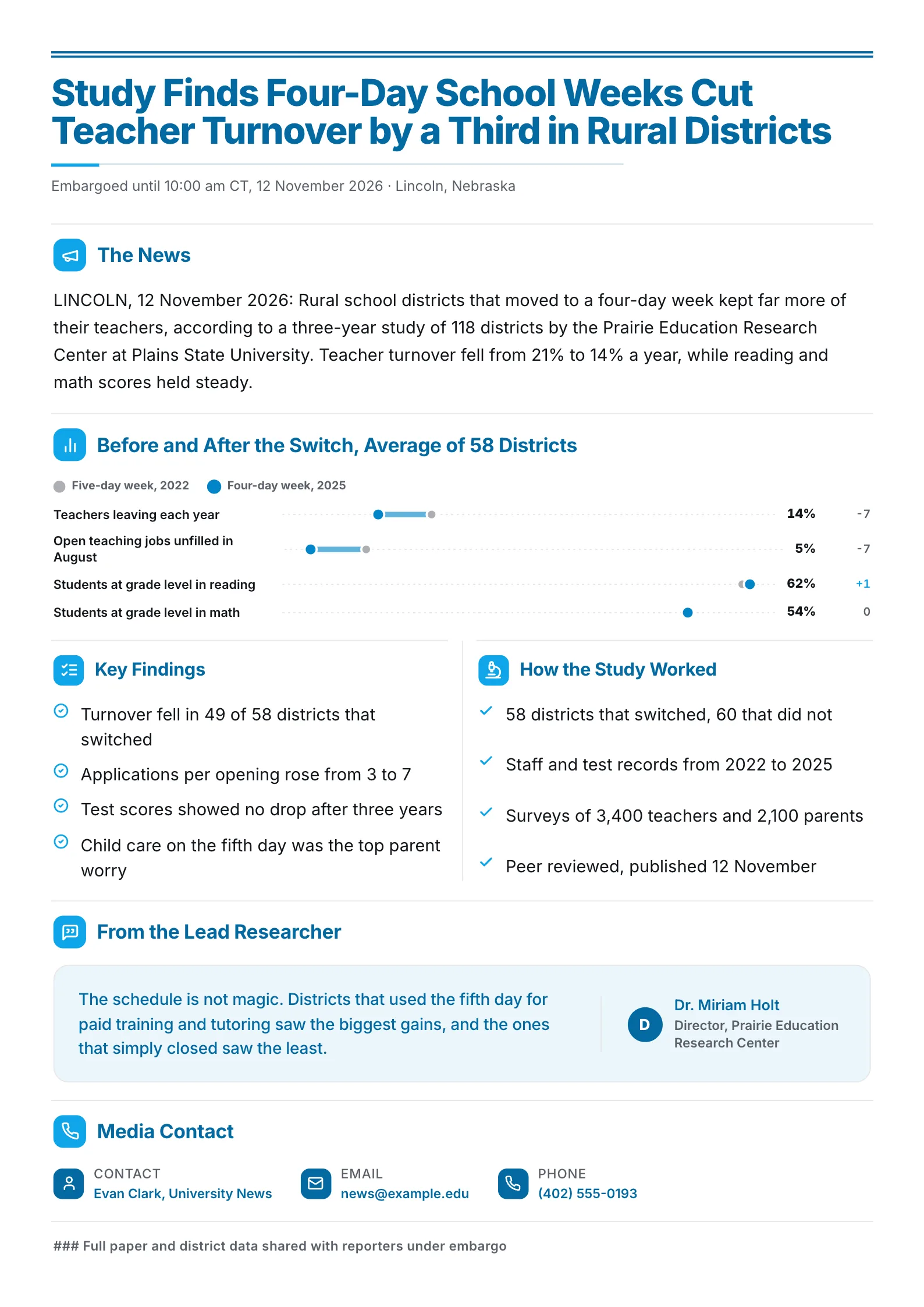
Research findings held until 10 am, with the method shown
 Edit this template
This research findings press release covers check 8 with "Embargoed until 10:00 am CT, Nov. 12, 2026." It also passes the East-West Center's data check. A "How the Study Worked" box names 58 districts that switched and 60 that didn't, plus surveys of 3,400 teachers and 2,100 parents. When you make yours, keep that box short. This one uses four lines.
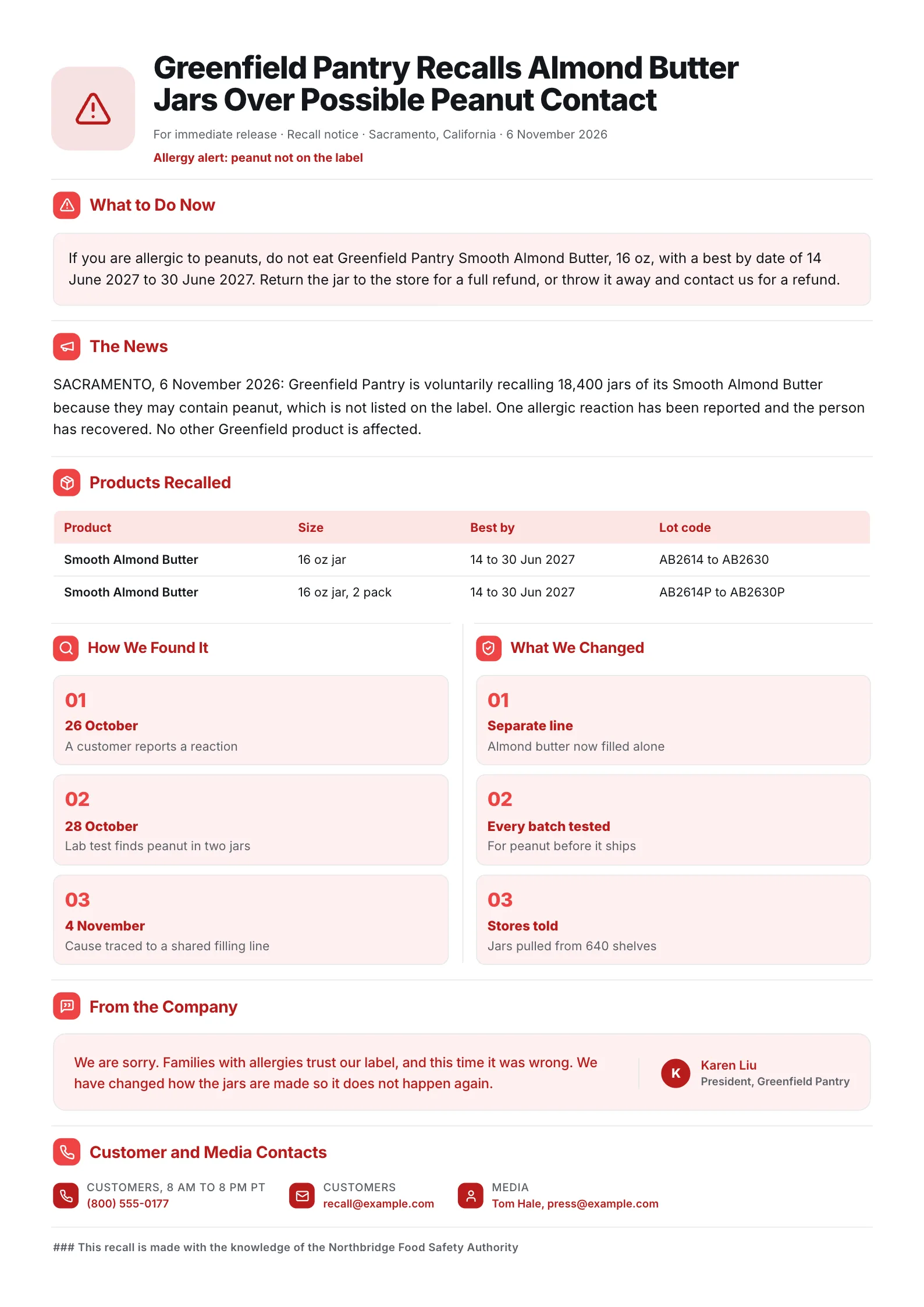
A recall that puts the reader's next step first
 Edit this template
This product recall press release opens with "What to Do Now," before the news itself. It names the 16 oz jars, the best by dates and the refund. Then the lead gives the count, 18,400 jars, and says one allergic reaction was reported. The quote from the president begins, "We are sorry." That's Connecticut's crisis tip in practice. Before you send a release like this, get your sign-off people lined up first (check 15).
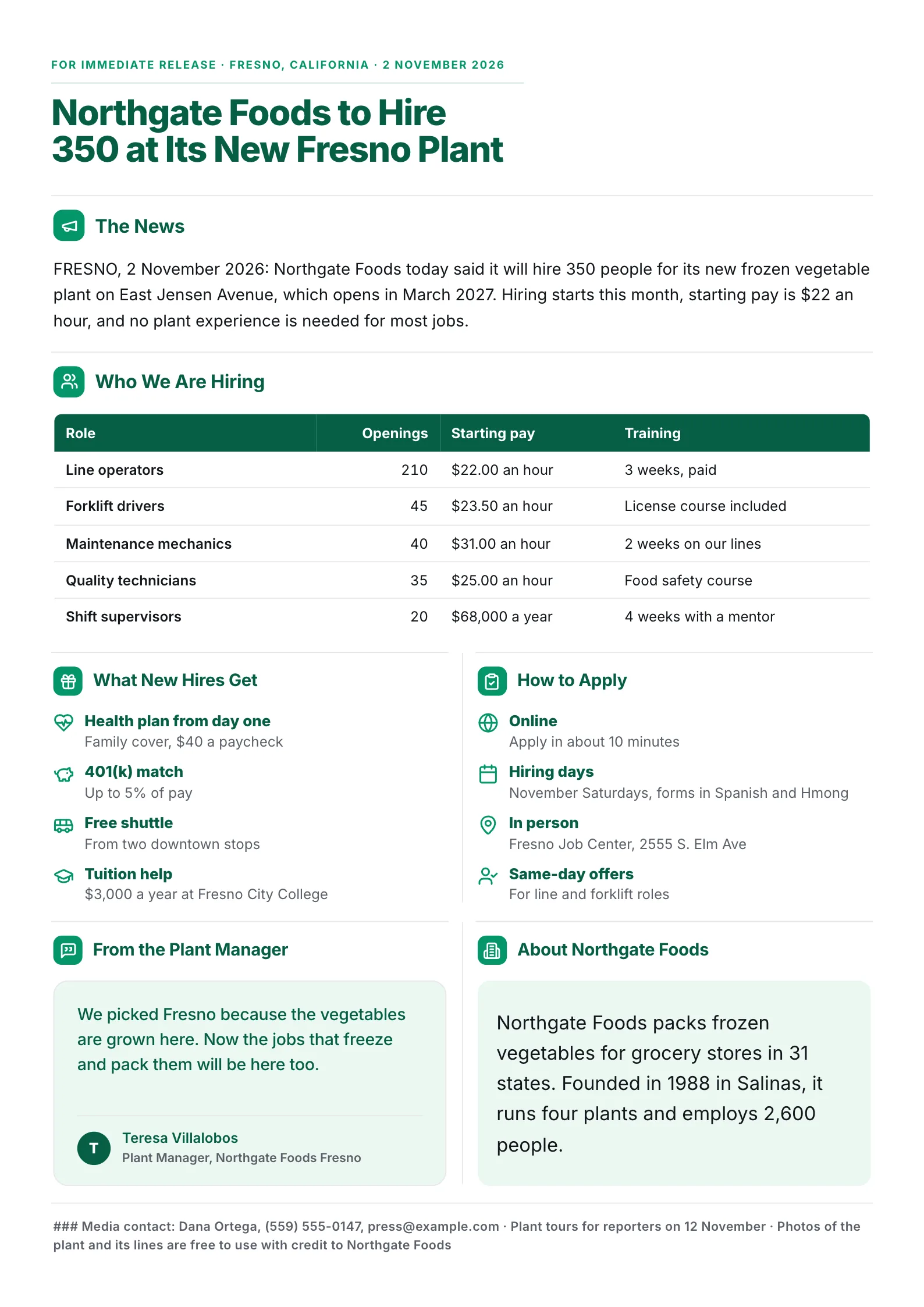
A hiring release whose numbers add up
 Edit this template
The headline of this hiring announcement press release says 350 jobs, and the roles table adds up to exactly that. It lists 210 line operators, 45 forklift drivers, 40 mechanics, 35 quality technicians and 20 supervisors. It also names the city, Fresno, in the headline, which is Connecticut's local news tip. Re-add every table in your own release before you send it (check 10).
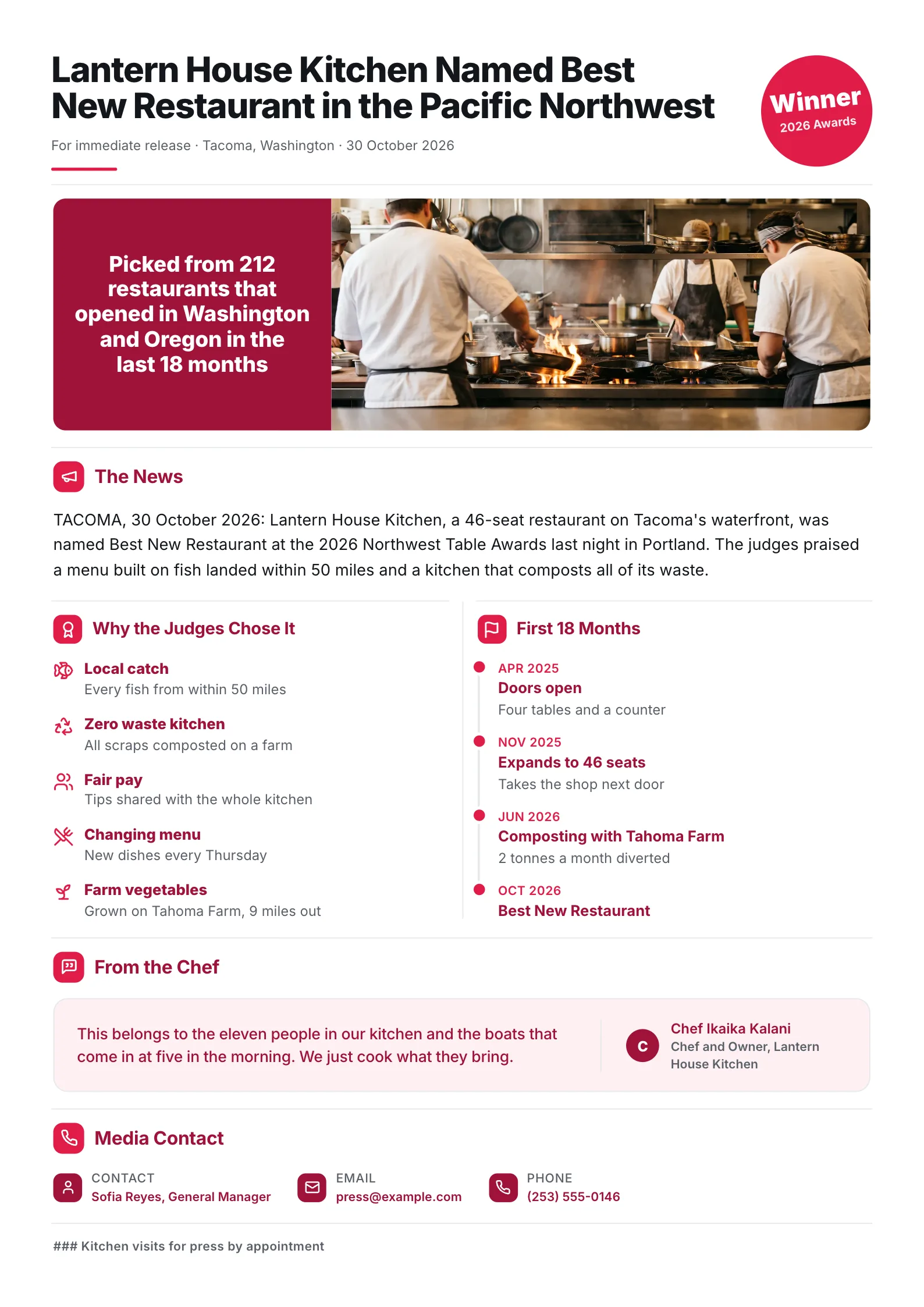
An award release with a photo and a full contact
 Edit this template
This award win press release carries a kitchen photo, which is check 12. Its media contact names Sofia Reyes with an email and a phone number, so it passes check 2 and adds the email two lists ask for. The lead fits the who, what, where and when into one sentence. When you make yours, add one line on how many you beat. This one says it was picked from 212 restaurants.
A product launch with an About paragraph
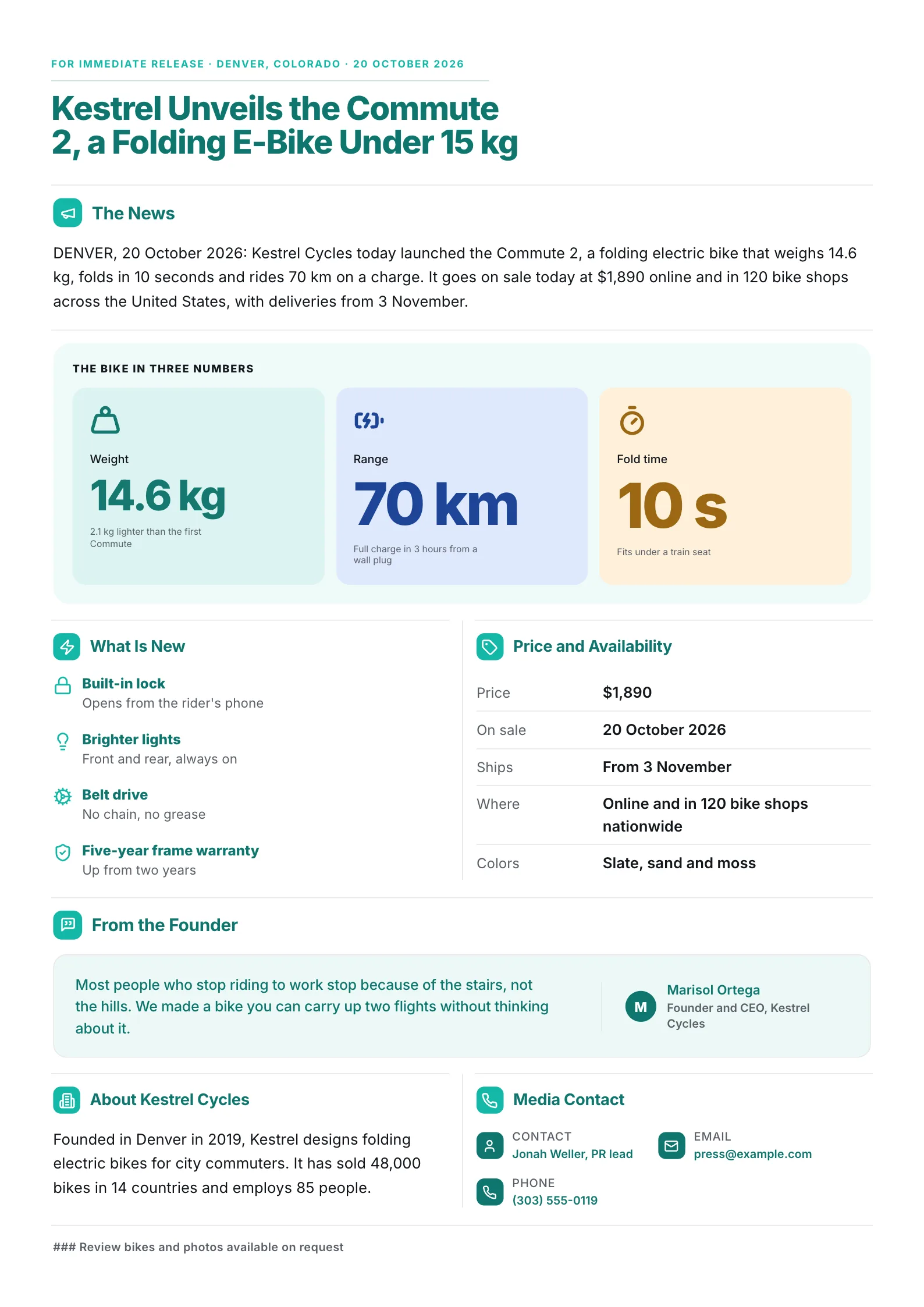 Edit this template
This product launch press release opens with "DENVER, Oct. 20, 2026," then says what launched, what it weighs and what it costs. Its "About Kestrel Cycles" box passes check 11 in two sentences, with the founding year, 48,000 bikes sold and 85 staff. The headline says "Under 33 Pounds," and the lead says 32 pounds. Check your own headline against your lead the same way.
Make your press release
Open a MakeOnepagers press release for the same kind of news as yours, such as a hire, a recall or a launch. Fill it in, print the checklist, and tick it off against the final version. To see where each part sits on the page, read press release format, drawn from 8 federal releases. To decide if you need a release at all, or a media advisory first, read press release vs media advisory. You can also turn your notes into a first draft with the free AI One-Pager generator, then check it line by line.
Frequently asked questions
What should be on a press release checklist?
Start with the two checks all 5 lists share. Put the main news, who, what, where, when and why, in the first paragraph, and give contact details, ideally a named person with a phone number. Then add the headline, a quote, a word limit and a check of every fact. The full 15 are above.
Who should approve a press release before it goes out?
Decide that before you write. Connecticut's health department needs three sign-offs on every release, from its communications director, a subject matter expert and its commissioner. A small business might need only one person. Write the names down so nobody is guessing on the day.
Should a press release be single or double spaced?
The lists disagree. The University of Washington checklist asks for double spacing. WeBC's 2025 guide says single spacing with a blank line between paragraphs. For a release sent by email or as a PDF, single spacing is the newer advice.
Do I need to number my press releases?
You don't have to, but it helps. The University of Washington list asks for a number on each release and a log of them all. A simple numbered log lets you find any release you've sent and see how often you send them.
Should I attach a photo to a press release?
If you have a good one, yes. Three of the 5 lists ask for a picture or a chart. ACCA adds one more step. Check what each outlet asks for, and the file format it wants, before you attach it.




