Pitch Examples: 5 One-Page Pitches Sorted by Reid Hoffman's Rules
Pitch examples for a startup round, a retail buyer and three stock pitches, each set under the rule from Reid Hoffman's notes on LinkedIn's deck it follows.

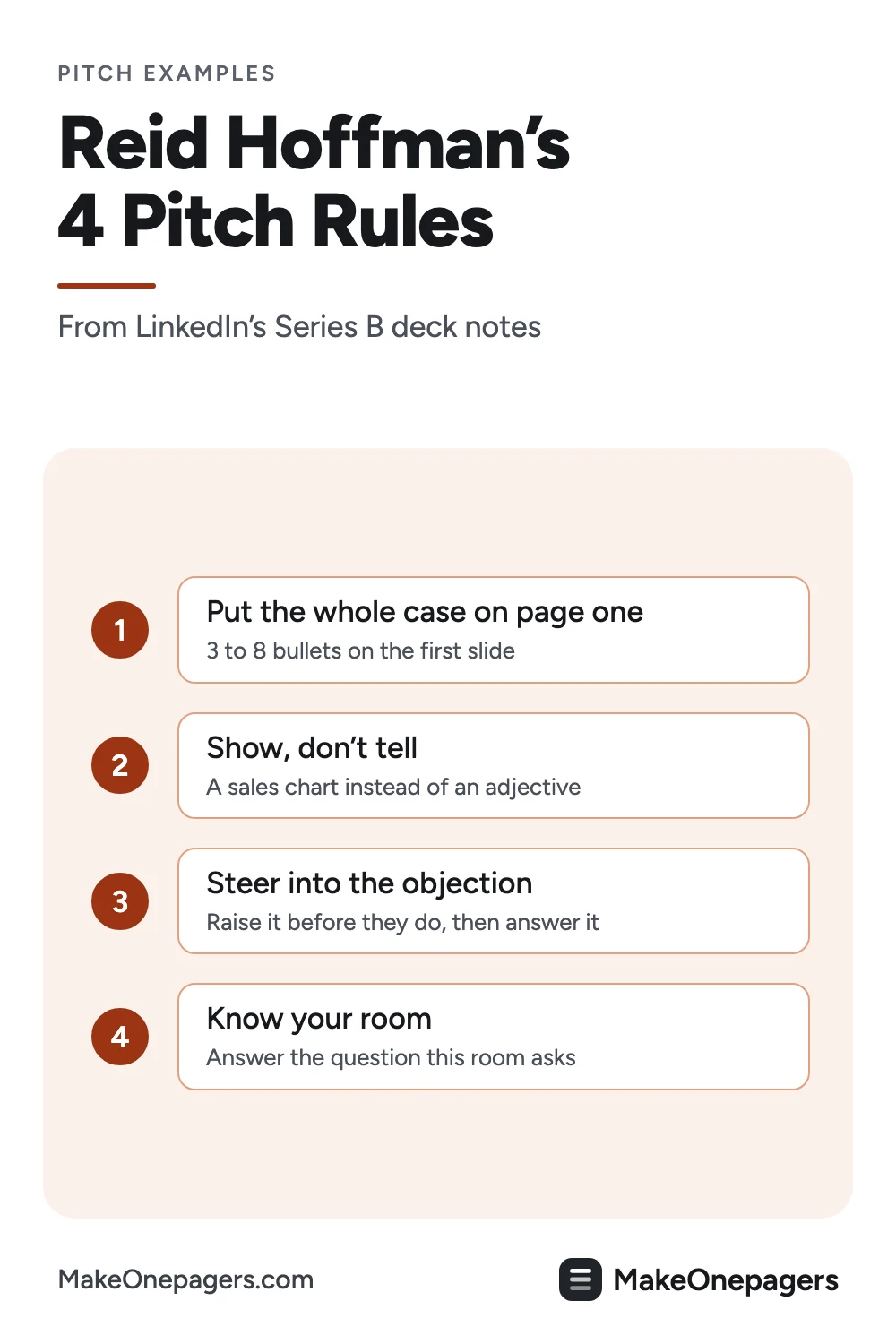
We sorted these five pitch examples by the rule each one follows best. The rules come from Reid Hoffman's notes on LinkedIn's 2004 Series B deck, the pitch that raised money from Greylock. He published the slides with his comments on why they worked. We read them on October 30, 2026, and four of his rules fit on a single page. Start from a free one pager template.
One‑Pager examples
Real One-Pagers made with MakeOnepagers. Open any one to edit it as your own.
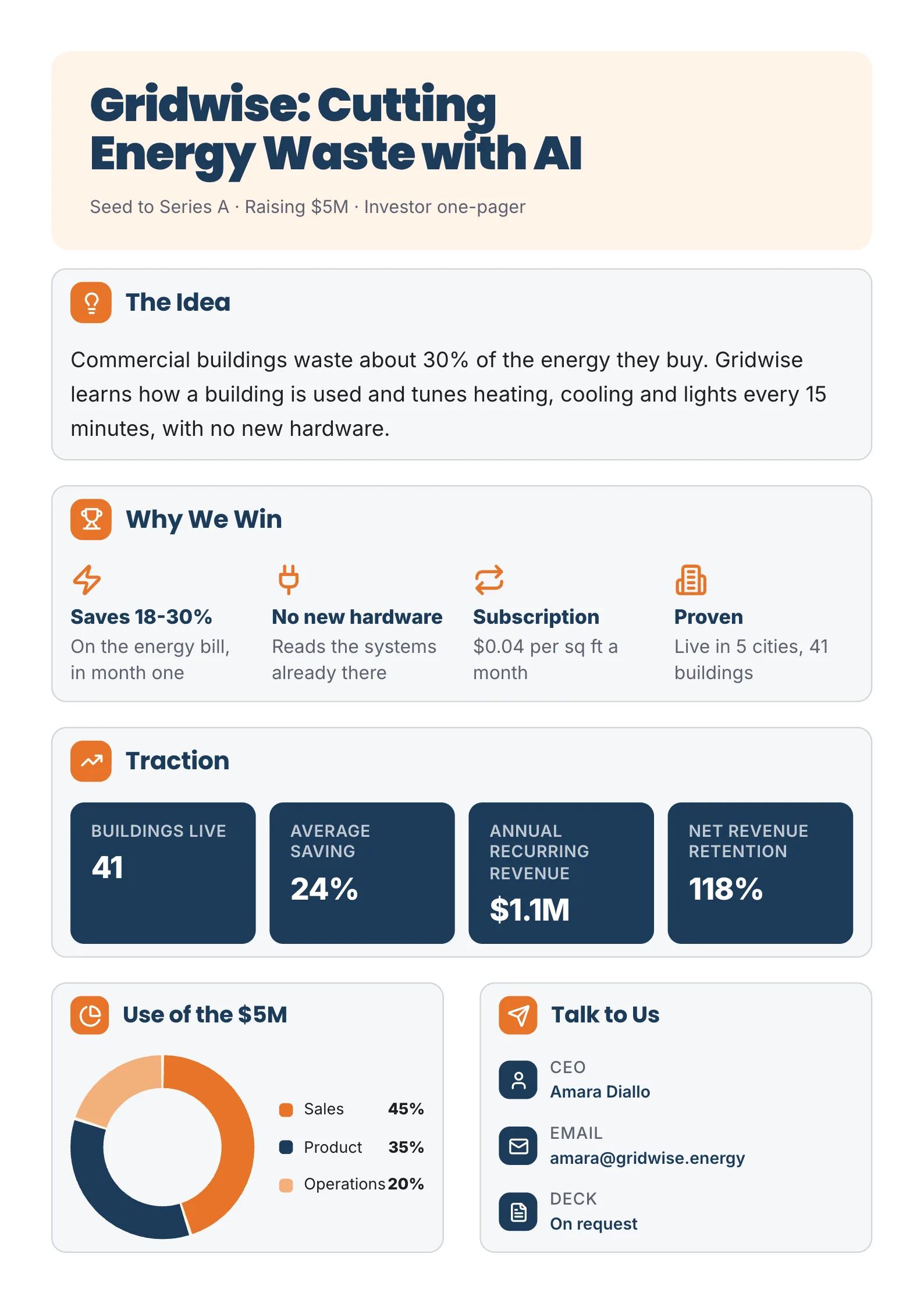 Investor Pitch One-PagerEdit for free(opens in a new tab)
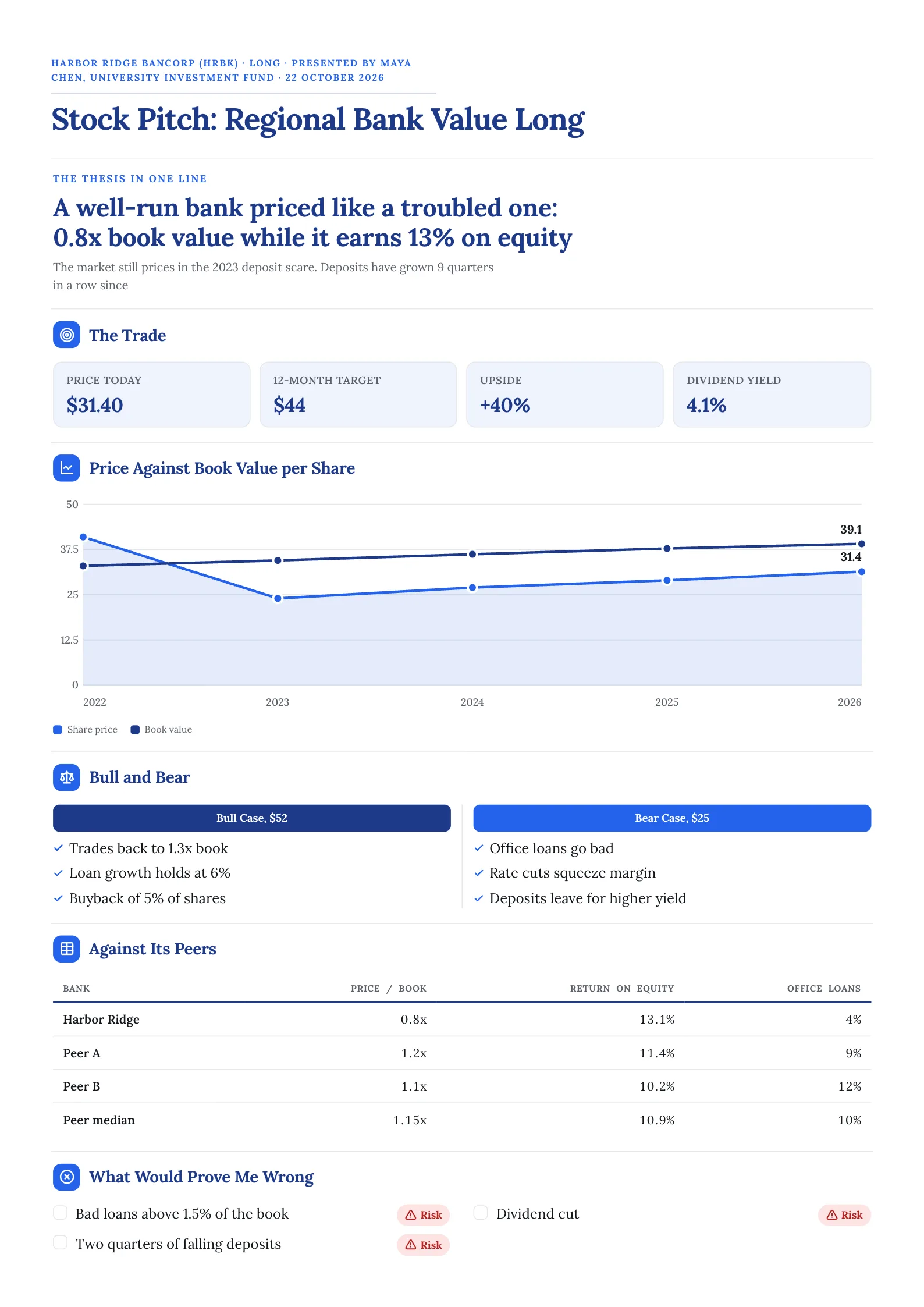 Stock Pitch: Regional Bank Value LongEdit for free(opens in a new tab)
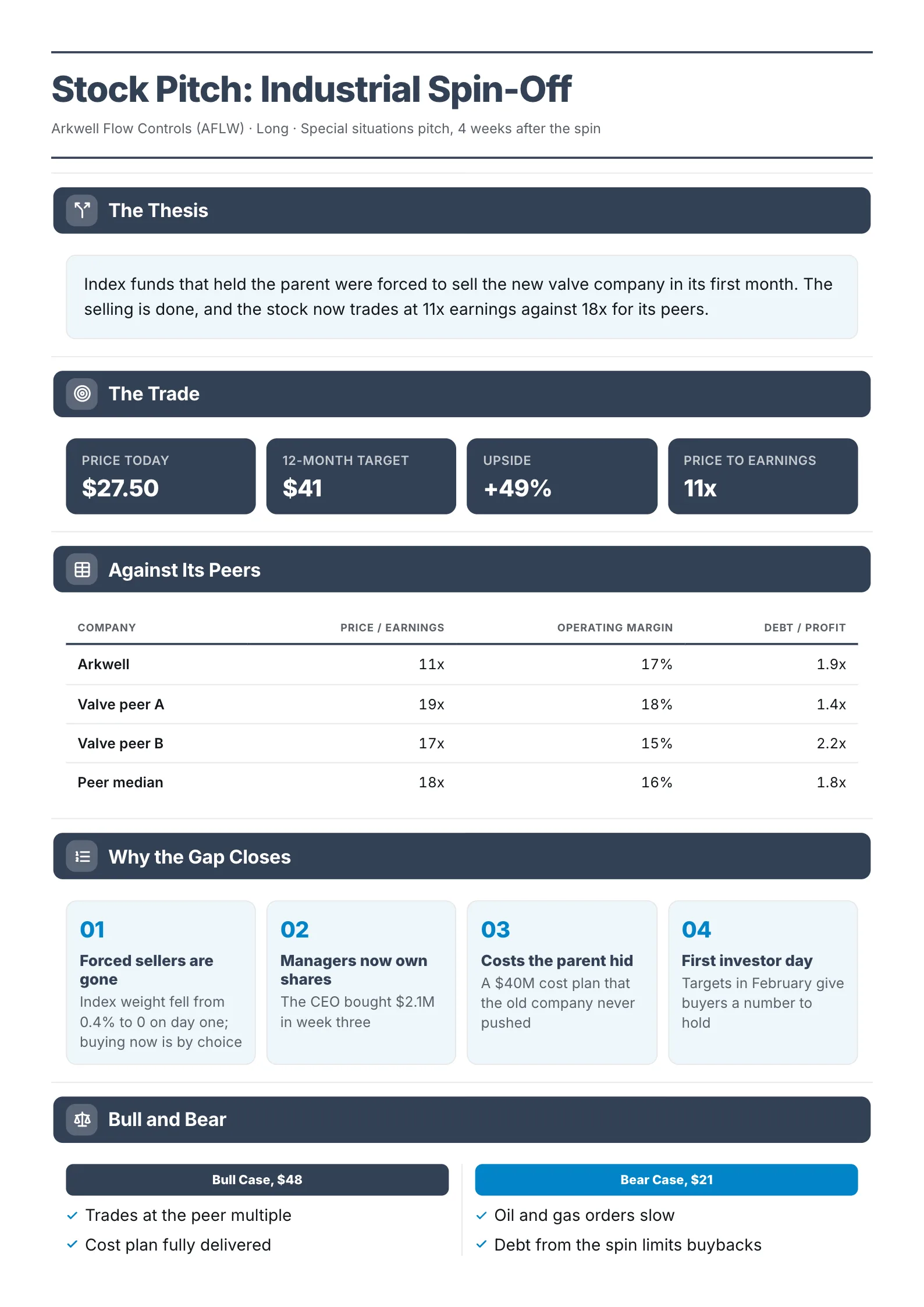 Stock Pitch: Industrial Spin-OffEdit for free(opens in a new tab)
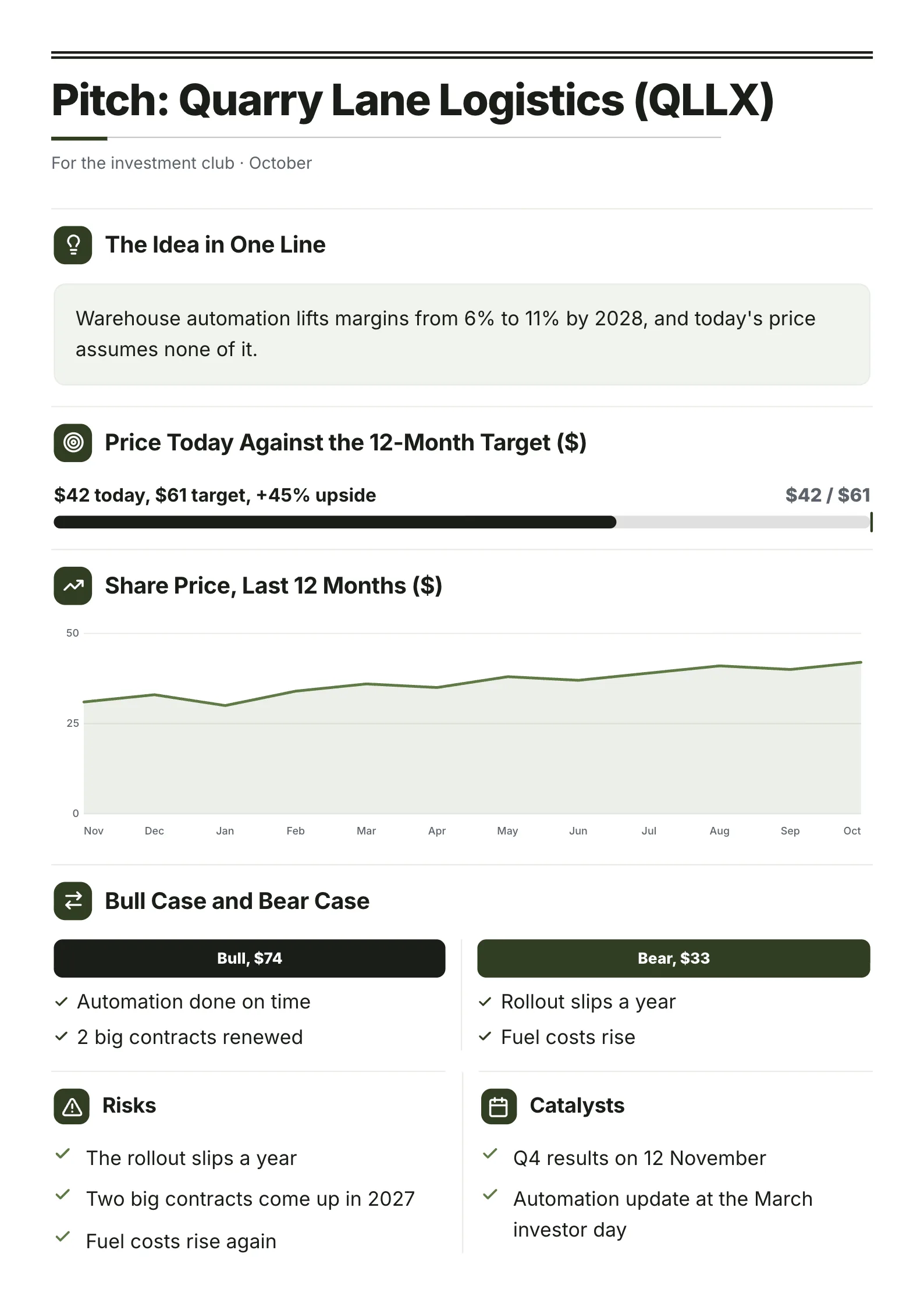 Stock PitchEdit for free(opens in a new tab)
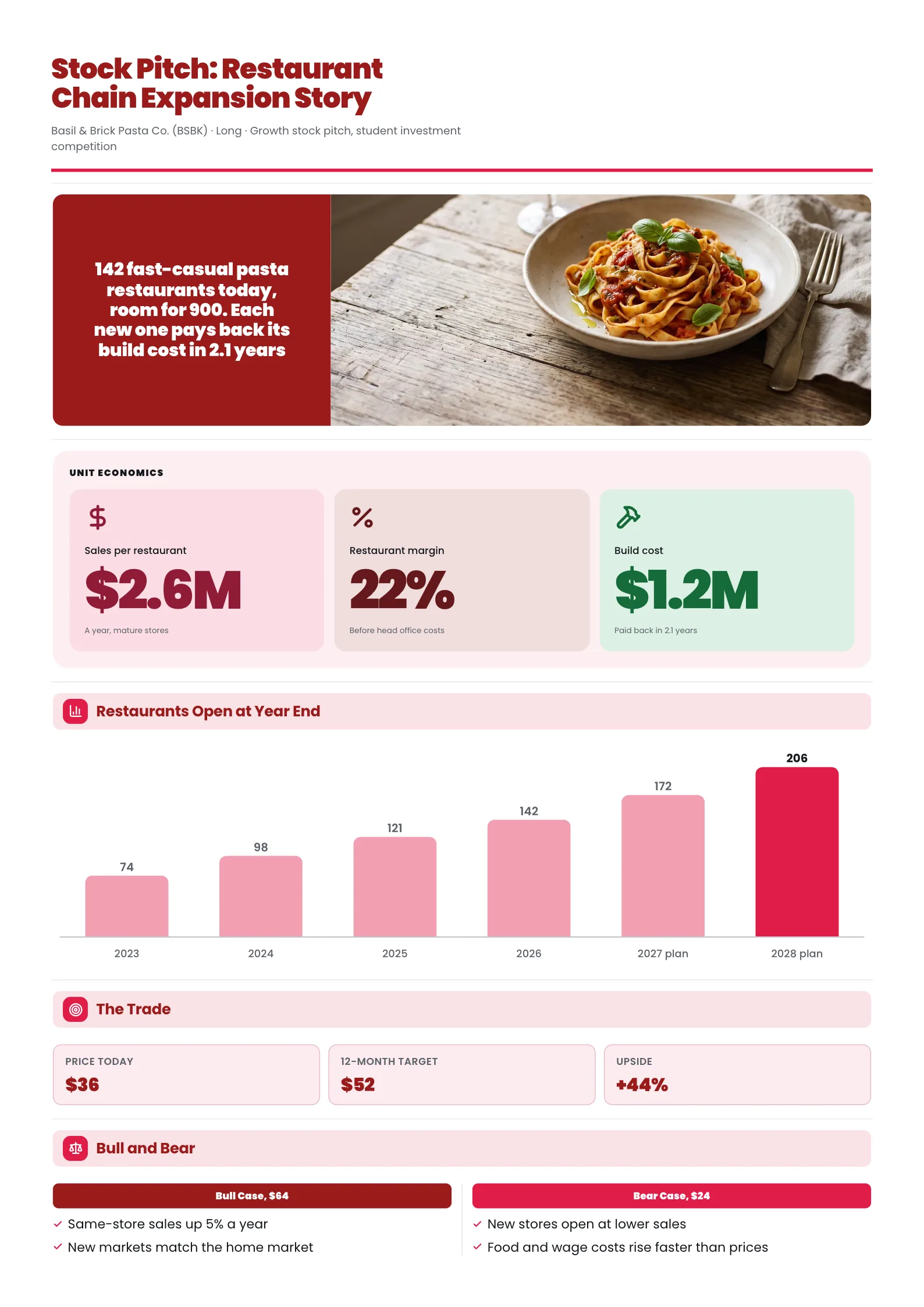 Stock Pitch: Restaurant Chain Expansion StoryEdit for free(opens in a new tab)
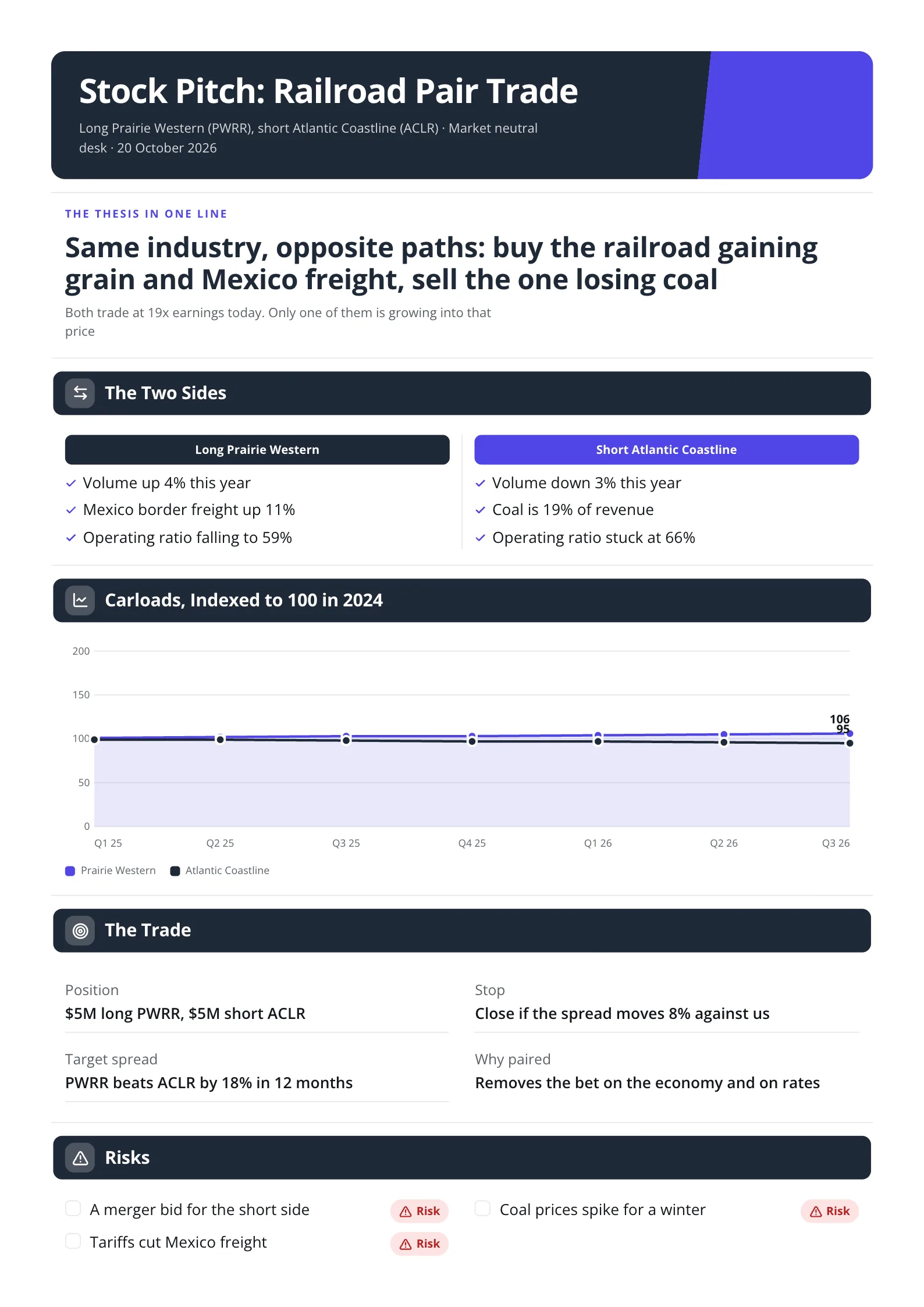 Stock Pitch: Railroad Pair TradeEdit for free(opens in a new tab)
His starting point explains the rest. A typical general partner at a venture firm sees about 5,000 pitches a year, looks closer at 600 to 800 and does 0 to 2 deals. Your reader is tired before you start. The samples here pitch to three kinds of reader, an investor, a grocery buyer and an investment club, and the rules hold for all three.
Rule 1: Put the whole case on page one
Hoffman says the investment case belongs on the first slide, in 3 to 8 bullets. Everything after it is detail for your reader once they're already interested.
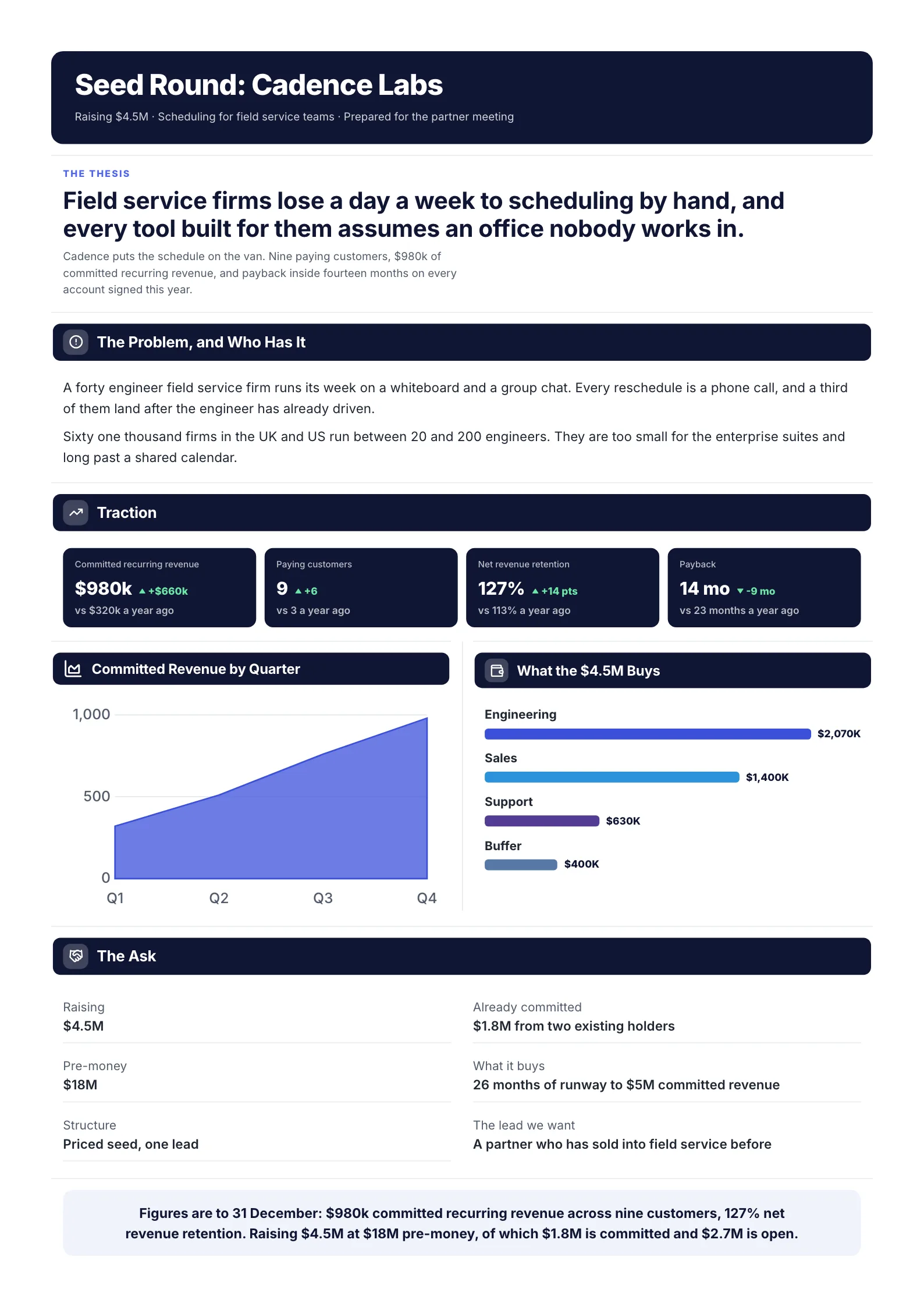
Cadence Labs is raising $4.5 million for scheduling software for field service teams, and its first box is the thesis. In two short paragraphs it says what's broken, what Cadence does and why it's working. That's nine paying customers, $980,000 of committed recurring revenue and payback inside fourteen months. If your reader stops there, they still know the deal.
Under the thesis, the problem is specific enough for you to picture. A forty-engineer firm runs its week on a whiteboard and a group chat. Then the market comes as one number, 61,000 firms in the UK and US with 20 to 200 engineers. For a checklist you can use on the rest, Sequoia Capital's guide to writing a business plan lists 10 parts, from the company's purpose and the problem to the team, financials and vision. Cadence fits most of them on the page, and so can you.
 Edit this template
Each company in these samples is fictional, and so are its numbers. The thesis box carries the whole case before the details start.
Rule 2: Show, don't tell
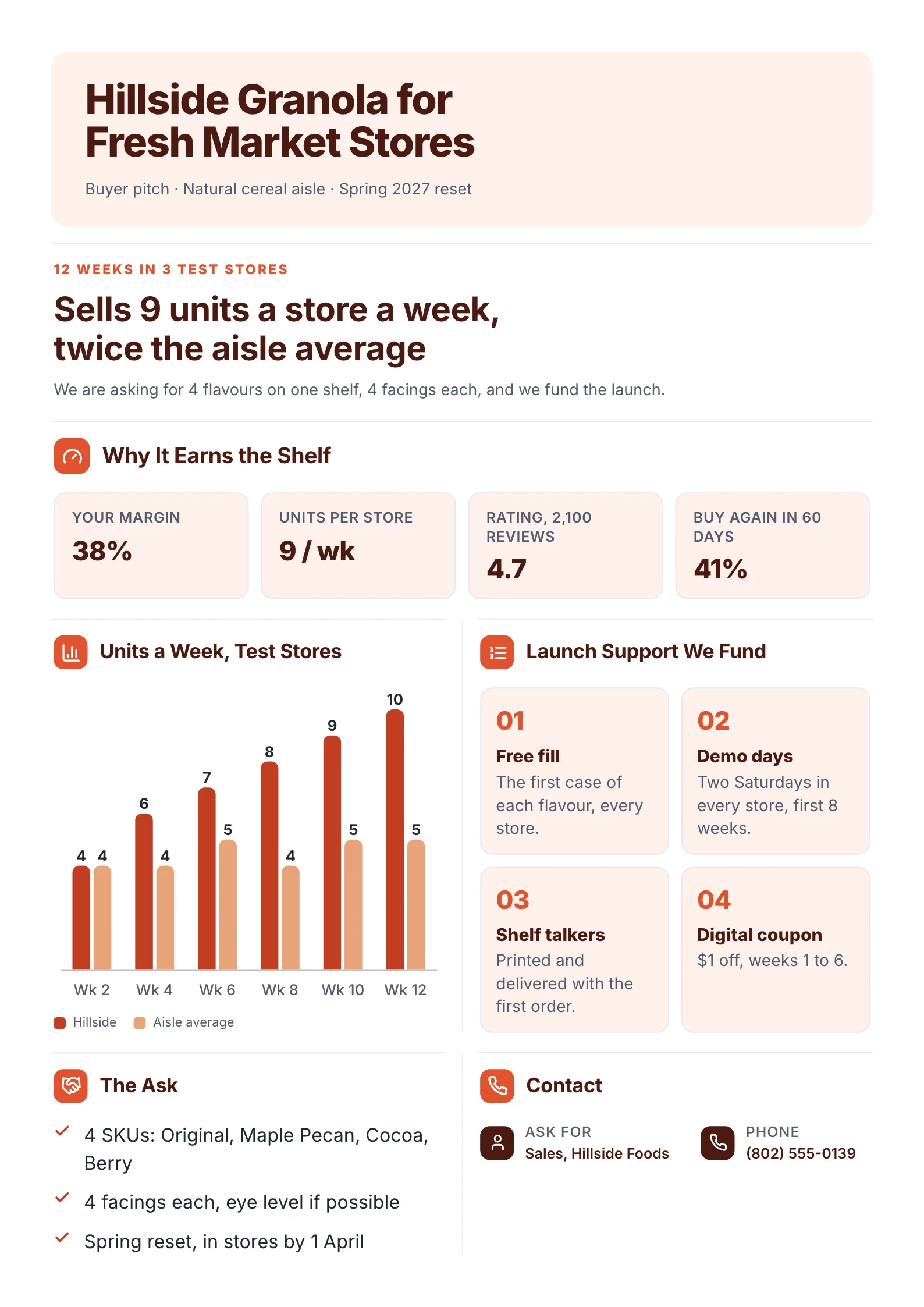
A grocery buyer has a different question from an investor. Will this sell on my shelf, and what will it cost me to try? Hillside Granola's pitch answers with a chart instead of an adjective. Its weekly sales line runs above the aisle average for 12 weeks in 3 test stores, at 9 units a store a week, twice the aisle's rate.
The rest of the proof is in the buyer's own terms. The store keeps a 38% margin, the granola holds a 4.7 rating across 2,100 reviews, and 41% of buyers come back within 60 days. Then the ask is exact, four flavors with four facings each, and the brand pays for the launch. Selling to stores, you copy that chart first. It does the arguing for you.
 Edit this template
Every number answers a buyer's question, and the ask names the shelf space.
Rule 3: Steer into the objection
Hoffman tells you to raise the objection before the investor does, then answer it yourself. Stock pitches need this even more, because the room is paid to doubt you.
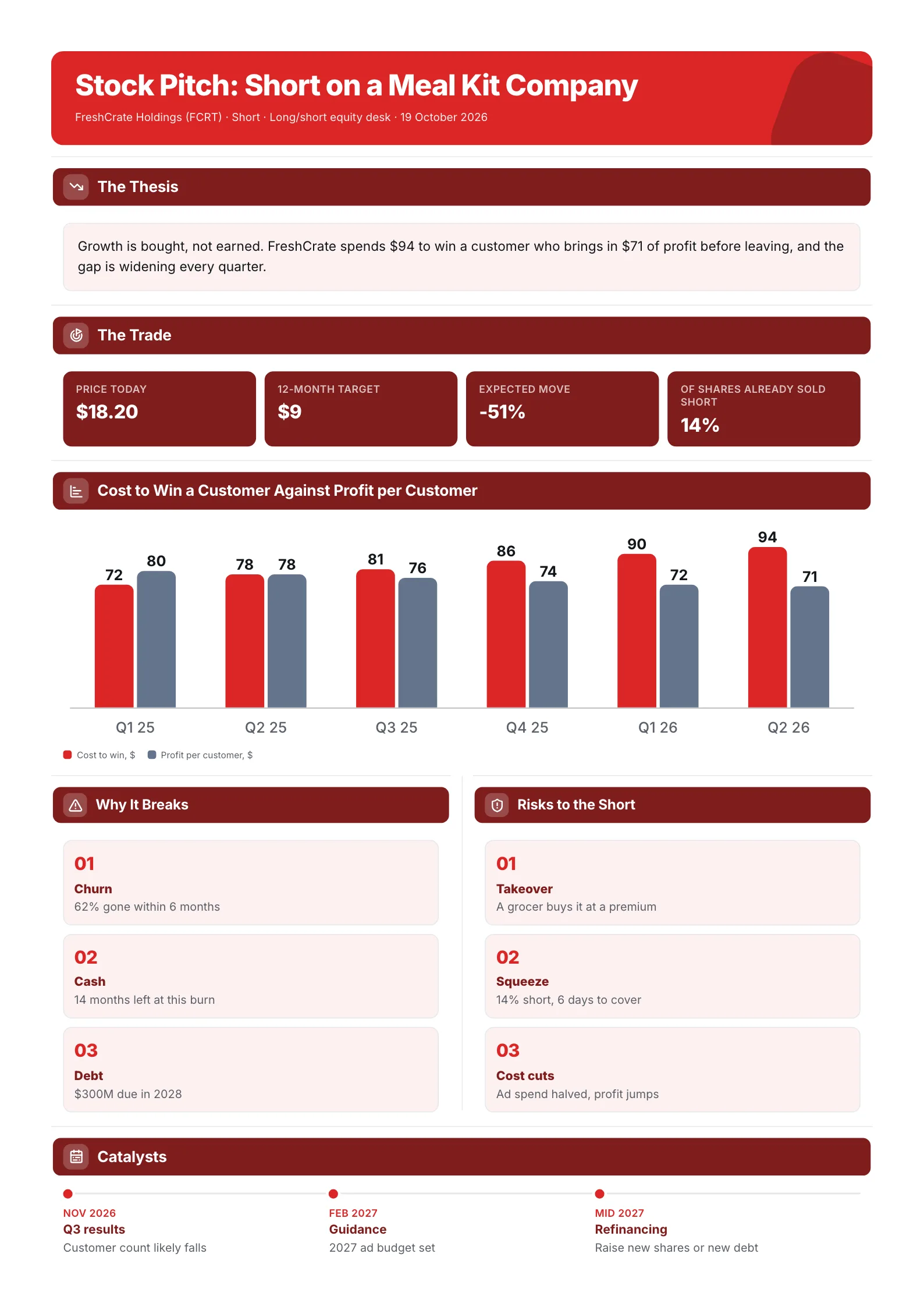
The meal kit short pitch builds its case on one comparison. FreshCrate spends $94 to win a customer who brings in $71 of profit before leaving, and a chart shows the gap widening each quarter. Then comes a Risks to the Short box. A grocer could buy the company at a premium. With 14% of shares already sold short, a squeeze could hit. And cost cuts could halve ad spend and fix the math. Your audience's first worry on a short is getting squeezed, so answer it before they ask.
 Edit this template
The risks to the short sit on the page, so nobody has to ask.
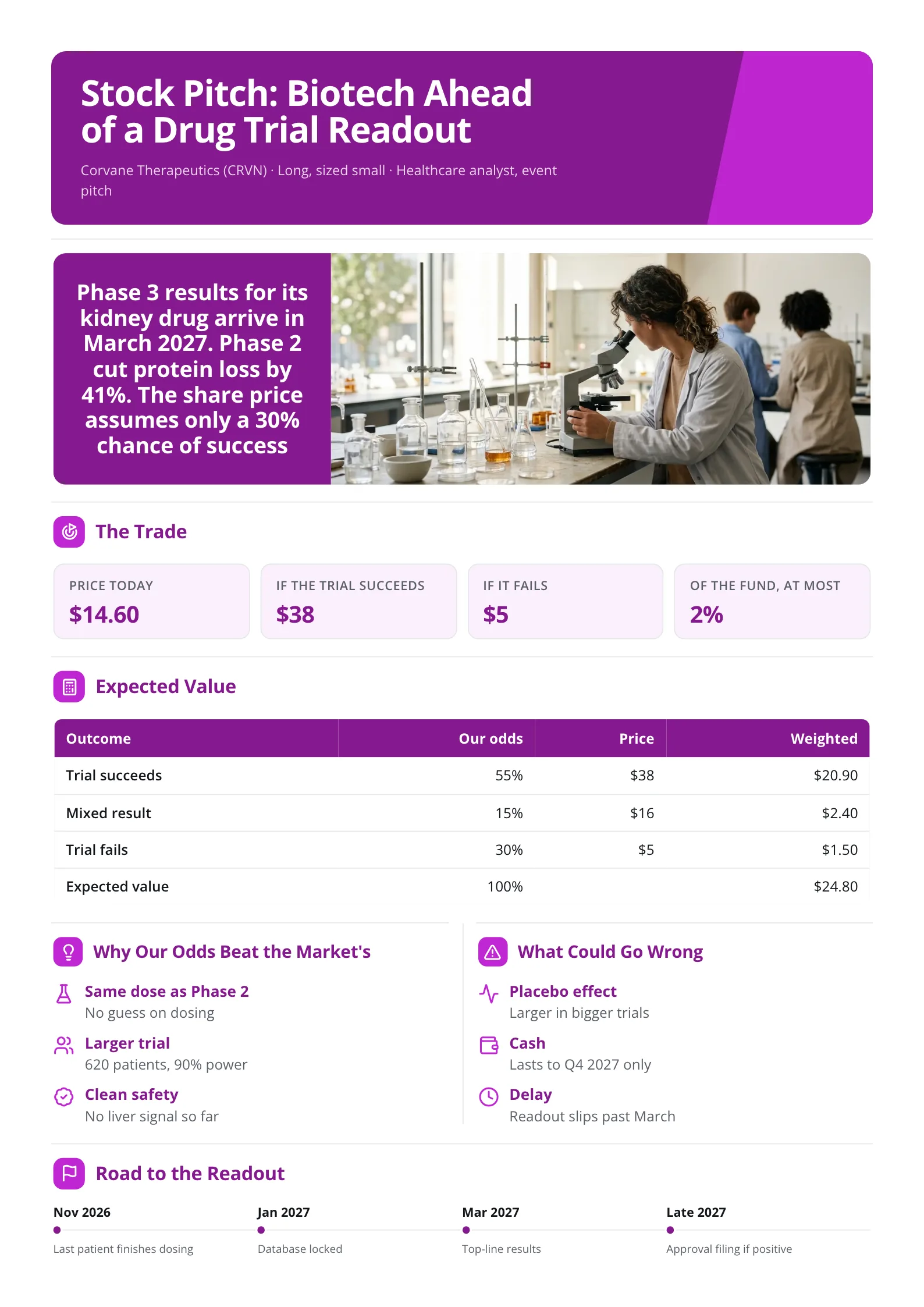
If your idea hangs on one event, the biotech pitch shows you how to steer into a harder objection, that nobody can know how a trial will turn out. Corvane Therapeutics has a Phase 3 kidney drug trial reading out in March 2027. The pitch gives odds instead of a guess. There's a 55% chance of success at $38 a share, 15% for a mixed result and 30% for failure, which weights to an expected value of $24.80 against a price of $14.60.
Then it answers "how do you know?" before anyone says it. It's the same dose as Phase 2 in a larger trial of 620 patients. It even says the position should be "sized small," with a cap on how much of the fund it can take.
 Edit this template
The odds are written down, so the room can argue with the numbers.
Rule 4: Know your room
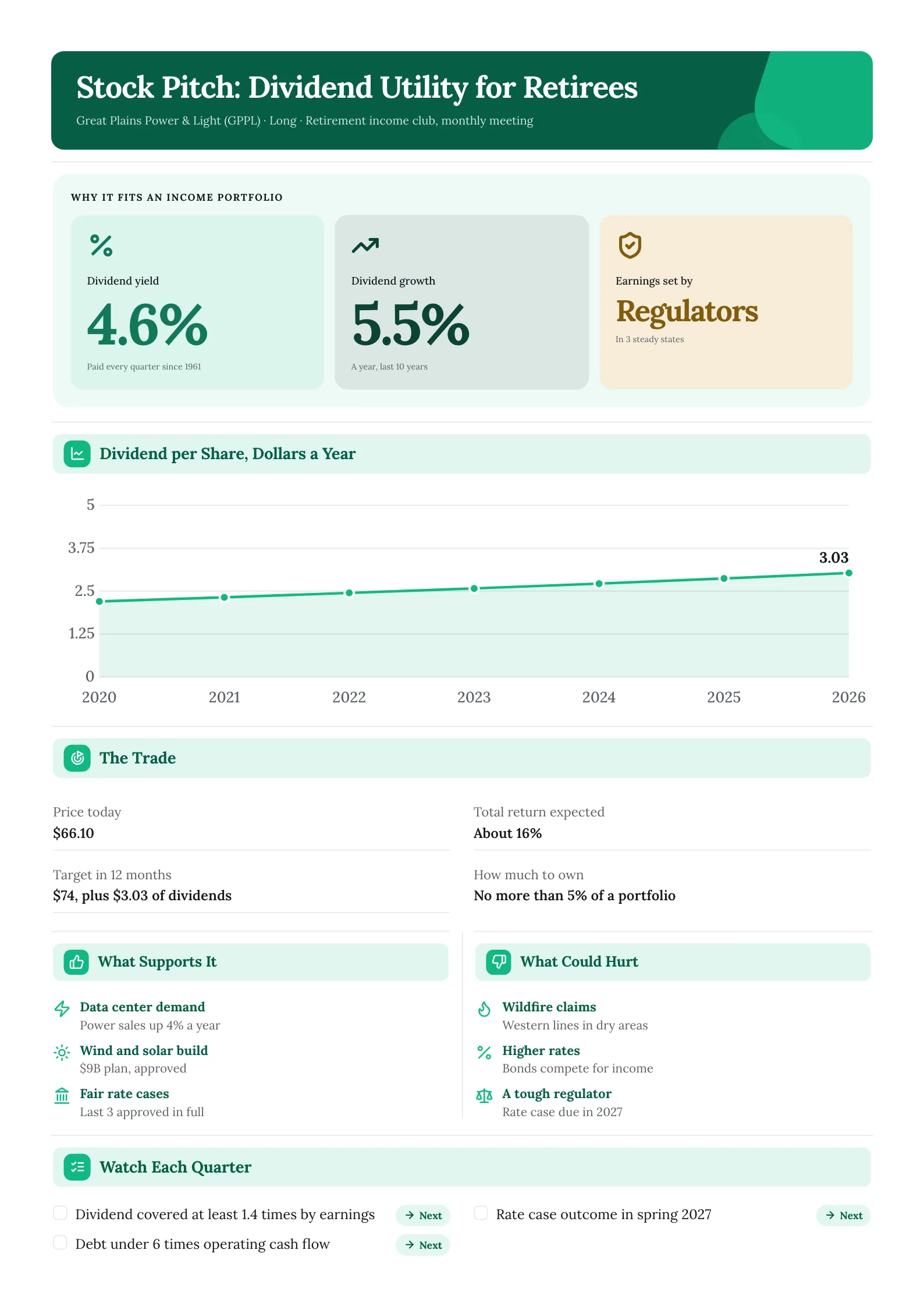
Hoffman's deck was written for one firm, Greylock. The dividend utility pitch shows the same habit for a very different room, a retirement income club. Its first box answers the club's real question, why this fits an income portfolio. The dividend yield is 4.6%, paid every quarter since 1961, and it has grown 5.5% a year for 10 years.
With retirees as your audience, look for the line "How much to own," with an answer of no more than 5% of a portfolio. Few stock pitches say it, and this room needs it more than a price target. A What Could Hurt box starts with wildfire claims, so rule 3 shows up here too.
 Edit this template
It tells retirees how much to own, which matters more to them than the target price.
The slide most founders skip
One more idea from Hoffman's notes doesn't fit any of our five samples, and you should steal it. In LinkedIn's Series B, slides 10 and 11 compared what the company promised at Series A with what it delivered. If you've raised before, that comparison is the most believable proof you have. Your past promises, kept, say more than your forecast.
For the full process, see our guide on how to write a pitch. If yours is a stock pitch, how to write a stock pitch and the stock pitch template post go deeper. The grid below has six more pitches, from a regional bank to a railroad pair trade.
Write your first two sentences now
Write your case as two sentences, what you believe and the number that proves it. Add your biggest risk and your ask, then fill in the proof. Test your pitch on one person before the real meeting and cut anything they skim past. Each pitch above opens as an editable page in MakeOnepagers.
Frequently asked questions
What should a pitch include?
Your case in one or two sentences, the problem, your answer, proof with numbers, the biggest risk and a clear ask. Sequoia's list of 10 parts adds why now, the market, competition, the business model, the team and financials.
How long should a pitch be?
Short enough that the first page carries the whole case. Hoffman's notes say a typical general partner at a venture firm sees about 5,000 pitches a year, so assume your reader stops after the first few lines. A one-page pitch makes you choose what matters.
How do I start a pitch?
Start with the thesis, what you believe and why it's true, in two sentences. Cadence's opens with the problem and then its traction. Stock pitches open with the idea in one line and the price target.
Should I mention risks in a pitch?
Yes. Hoffman tells founders to steer into the objections investors will raise. Naming a risk first shows you've thought about it and lets you frame the answer. The three stock pitches above put their risks on the page.




