How to Write a Stock Pitch: What 12 Student Fund Theses Left Out
How to write a stock pitch, from 12 real student fund theses and 5 judging rulebooks: none of the 12 wrote a target price, and none named a risk.

Put your call at the top of a stock pitch: buy or sell, the price today, your target price and the upside. Then write one sentence on what the market is getting wrong, prove it with numbers, and show how you valued the company. End with the events that will move the price, the risks, and when you'd sell. Start from a free one pager template.
One‑Pager examples
Real One-Pagers made with MakeOnepagers. Open any one to edit it as your own.
 Stock PitchEdit for free(opens in a new tab)
 Stock Pitch: Short on a Meal Kit CompanyEdit for free(opens in a new tab)
 Stock Pitch: Regional Bank Value LongEdit for free(opens in a new tab)
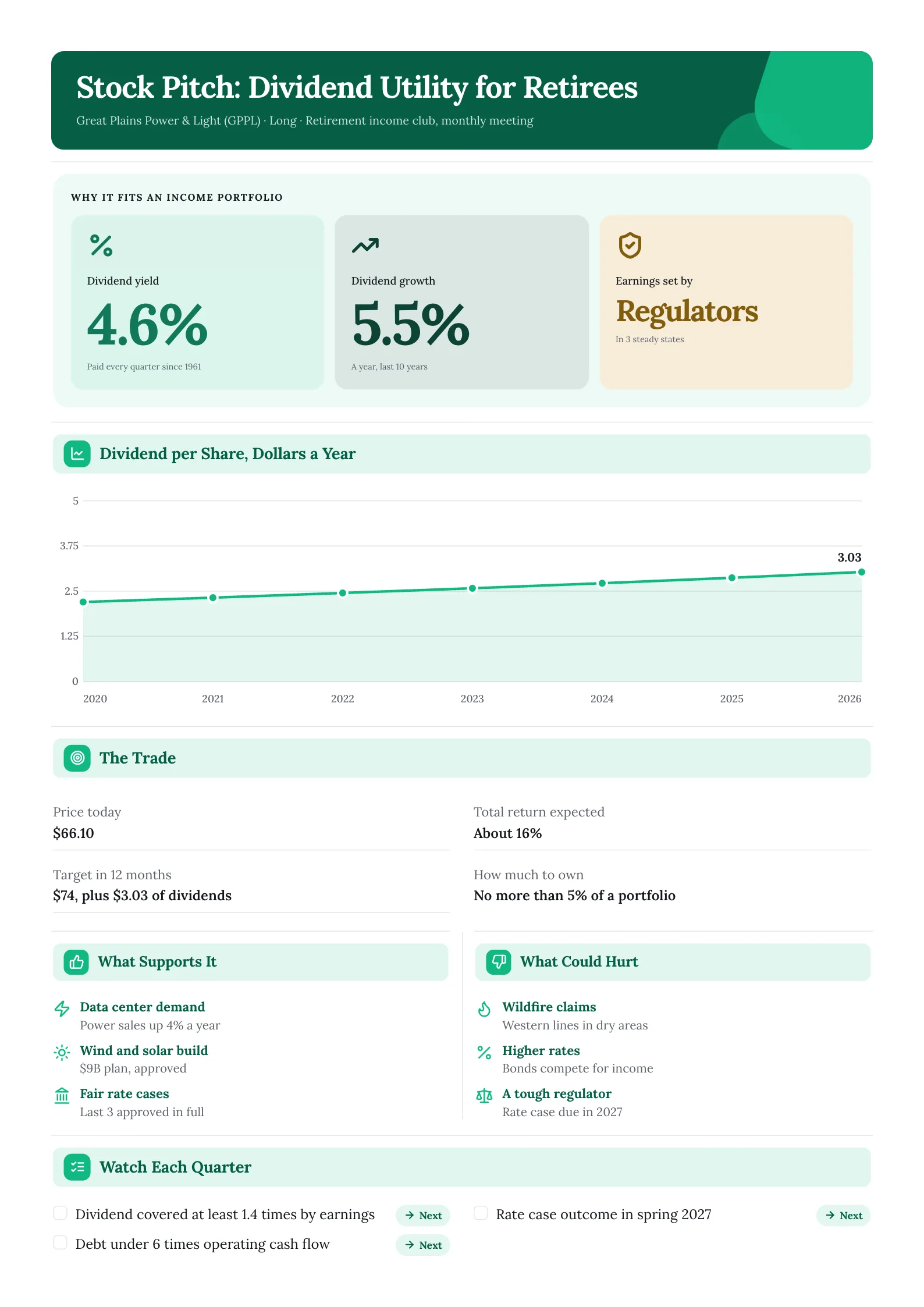 Stock Pitch: Dividend Utility for RetireesEdit for free(opens in a new tab)
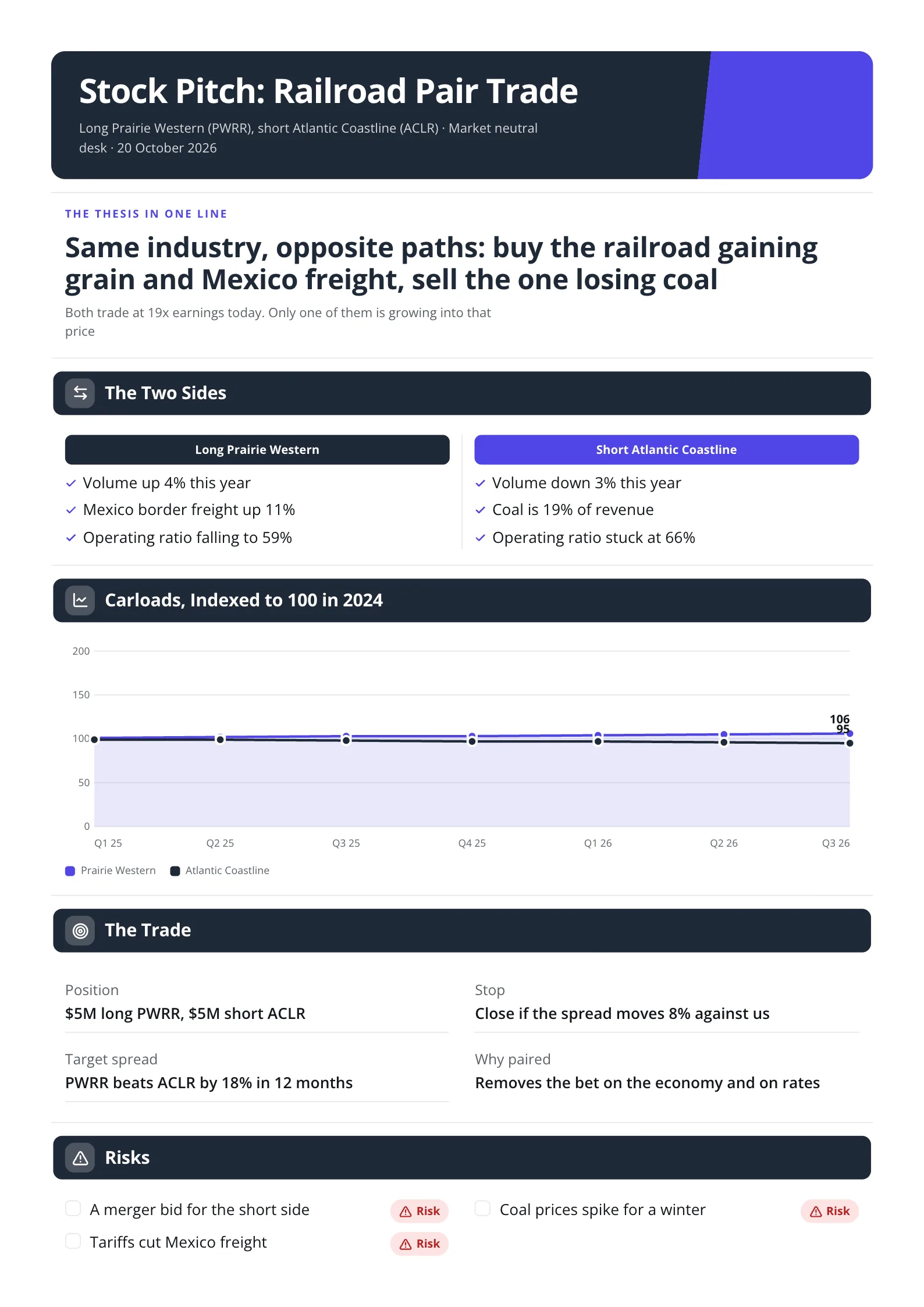 Stock Pitch: Railroad Pair TradeEdit for free(opens in a new tab)
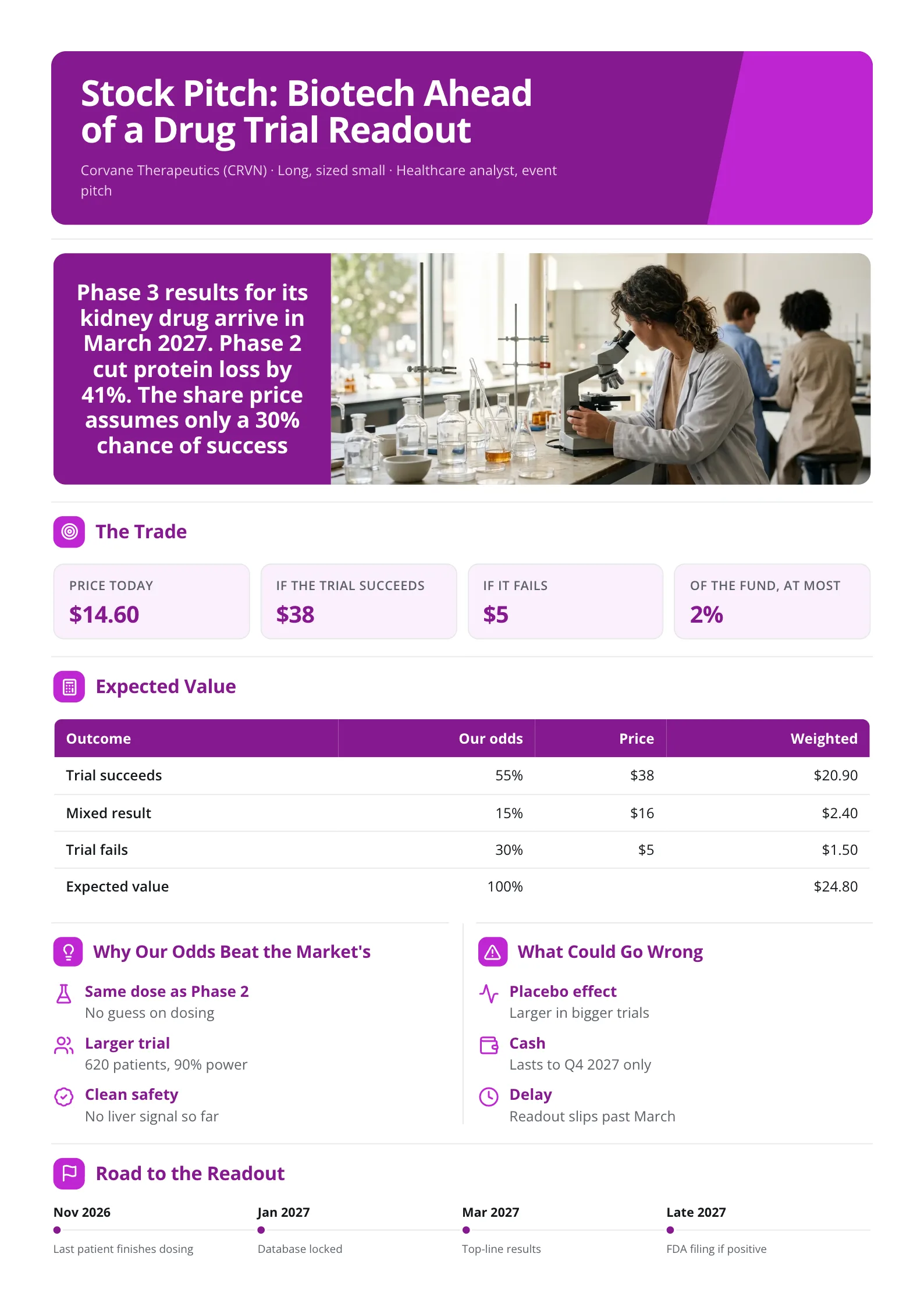 Stock Pitch: Biotech Ahead of a Drug Trial ReadoutEdit for free(opens in a new tab)
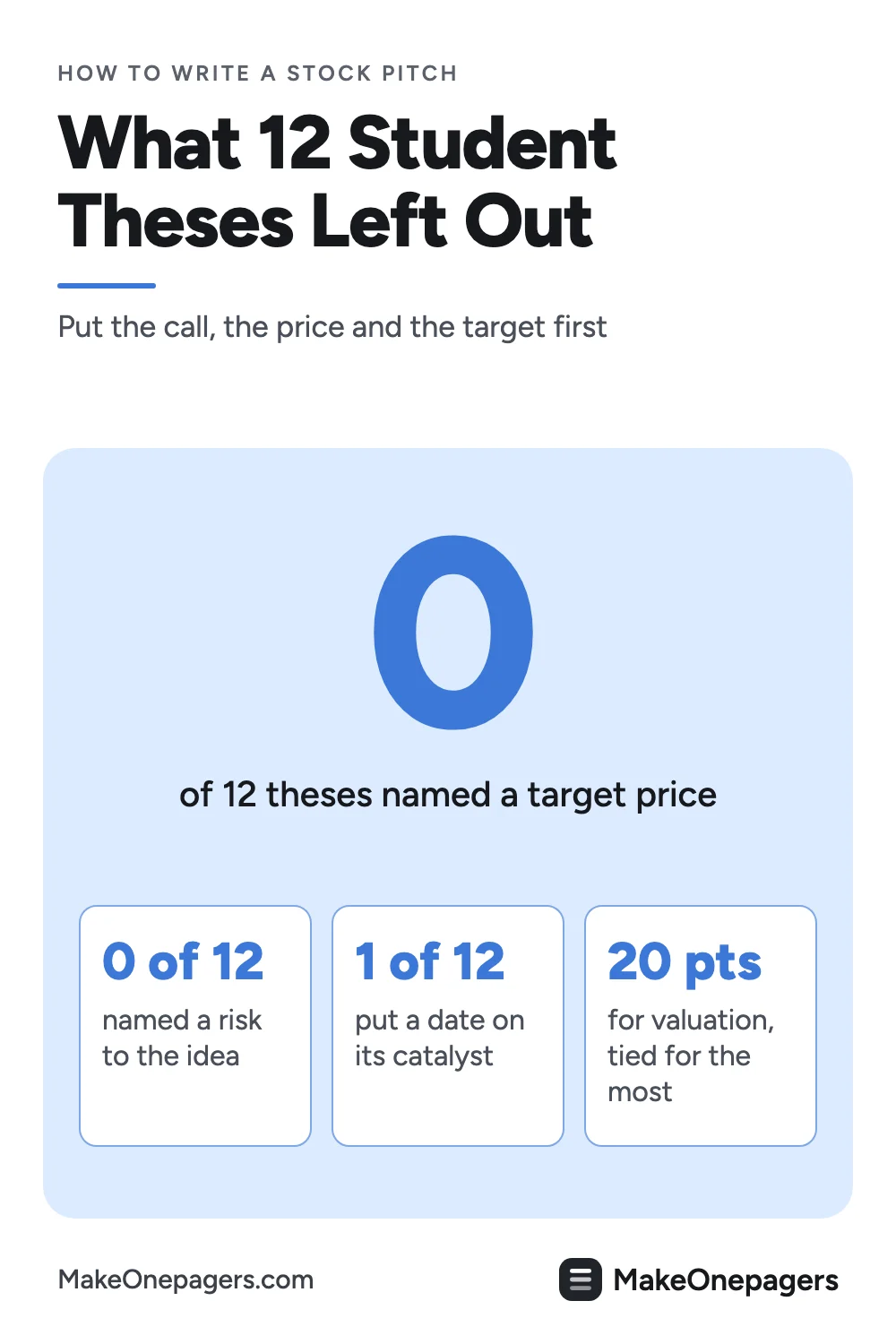
That's what the judges ask for. It's not always what gets written down. We read the 12 new-position theses in the Miami University Student Managed Investment Fund's spring 2022 report, then the judging rules of 5 pitch programs and competitions. None of the 12 theses wrote a target price. None named a risk to the idea. Below is how to cover both, plus the other parts judges score.
What 12 real buy theses wrote down
| What the thesis includes | Theses that include it |
|---|---|
| A target price | 0 of 12 |
| The upside as a percent | 0 of 12 |
| A risk to the idea | 0 of 12 |
| A catalyst that will move the price | 3 of 12 |
| A number backing the idea | 3 of 12 |
| A time horizon | 2 of 12 |
| A catalyst with a date | 1 of 12 |
Source: our count of the 12 new-position write-ups in the Miami University Student Managed Investment Fund spring 2022 report, read October 30, 2026. Every source is linked at the end.
These are short write-ups in a report to the fund's supporters, so the full pitches in the room may have said more. The report shows that targets existed. It says the fund sold Bristol-Myers Squibb when the stock traded around $77, above "the initial target price of $75." The target guided the sale, yet none of the new theses in the same report printed one.
That's the gap to close. Whatever you leave out of the written pitch, your reader can't check later.
What the judges score
The CFA Institute Research Challenge is the best-known student stock pitch contest. Its written report may run 10 pages plus a 10-page appendix. It must include the recommendation, the current price with its date, and the target price with the percent change. Judges score it out of 100:
| Section | Points |
|---|---|
| Valuation | 20 |
| Financial analysis | 20 |
| Investment summary | 15 |
| Investment risks | 15 |
| Environmental, social and governance | 15 |
| Industry and competitive position | 10 |
| Business description | 5 |
Risks are worth three times as many points as the business description. The other four rulebooks we read point the same way. Kentucky's Gatton College asks for the things that could change your opinion, with ways to soften them. Erasmus University's B&R Beurs asks for 2 to 3 specific risks. Duke's FEP worksheet asks you to acknowledge them.
Put the call, the price and the target first
Your first lines should give the reader the whole trade. Write the recommendation (buy, sell or hold), the price today with its date, your target price, the upside as a percent and the time frame. A committee member can stop after that line and still know the vote you're asking for.
Then add the thesis in one sentence. The CFA rules call this the investment summary, and it's worth 15 points. Keep it to the one reason the stock is mispriced.
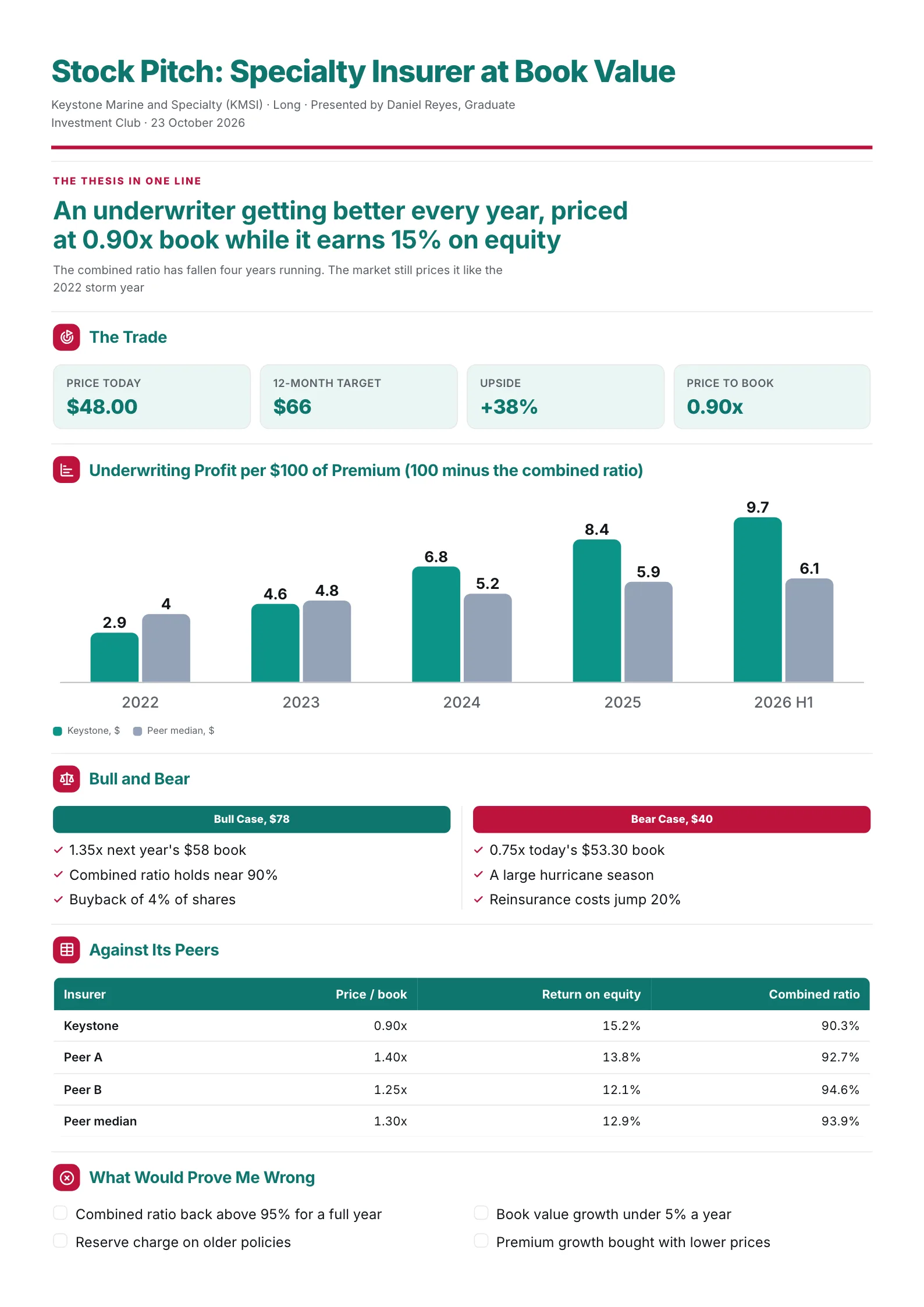 Edit this template
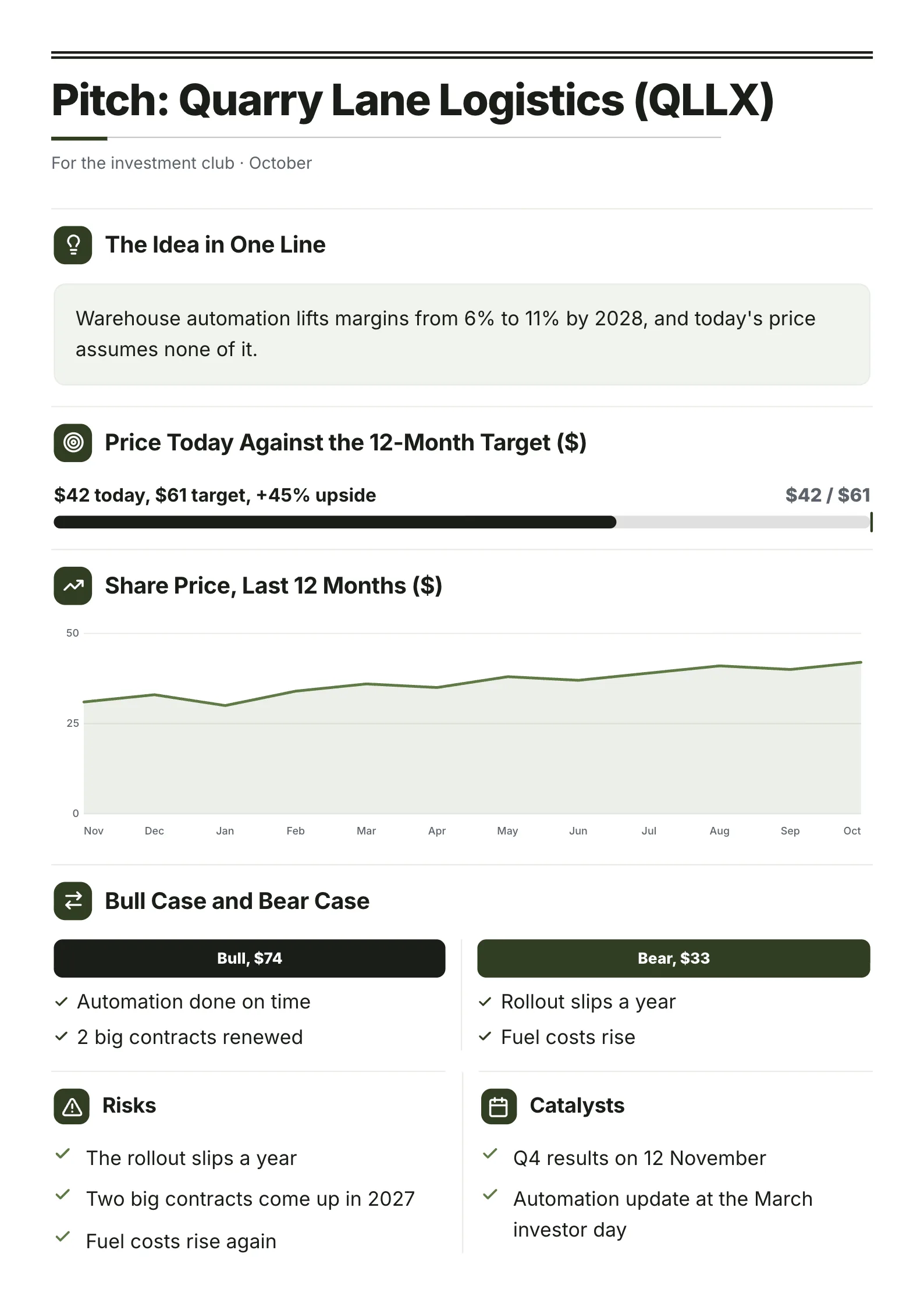
Sample names and figures. The trade sits at the top with the price, target and upside, and a box at the bottom lists what would prove the pitch wrong.
Say what the market is getting wrong
Kentucky's guide puts it as a question: "What is the market getting wrong and why?" Investors call the answer your variant view. If you agree with everyone else, the price already reflects your idea, and there's nothing to gain.
Write your variant view as a contrast between how the market sees the company and what you see. The market thinks it's a slow industrial business, and you see a spin-off that index funds were forced to sell in its first month. Then list the reasons the gap will close.
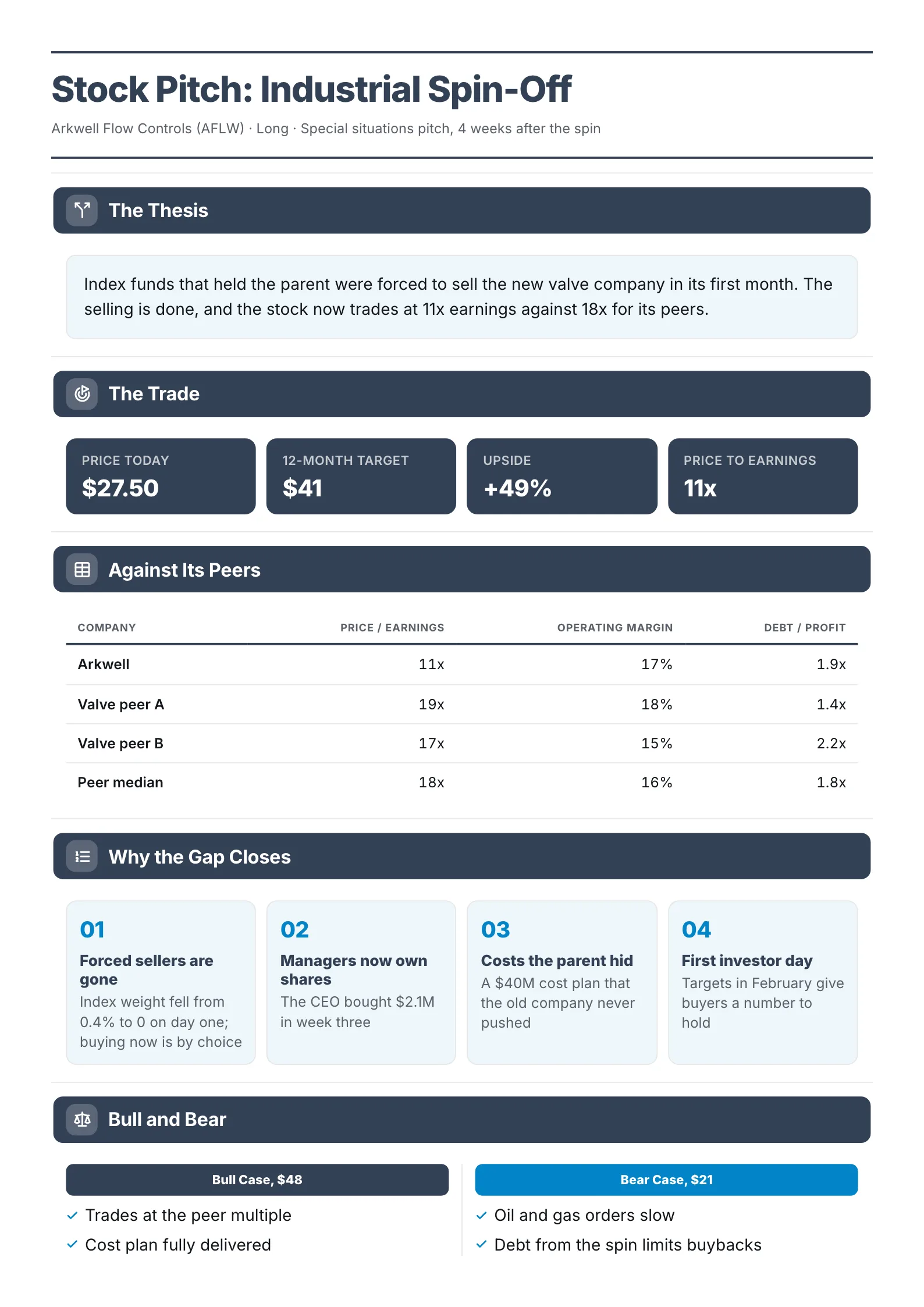 Edit this template
Sample names and figures. The why the gap closes box gives four reasons, and one of them, the February investor day, is a date a reader can watch for.
Back the idea with numbers
Only 3 of the 12 Miami theses gave a figure to support the idea. The Builders FirstSource thesis cited a 17.6% national rise in rent prices as a driver for new homes. The Cisco thesis cited 21% growth in recurring revenue and a $15 billion buyback. The rest relied on words like "strong" and "market leading."
Pick the two or three numbers that prove your variant view. For a software company that might be recurring revenue, growth and how much existing customers spend each year. For a retailer, it might be sales per store and how fast new stores pay back. Show how each one has moved over time, if you can.
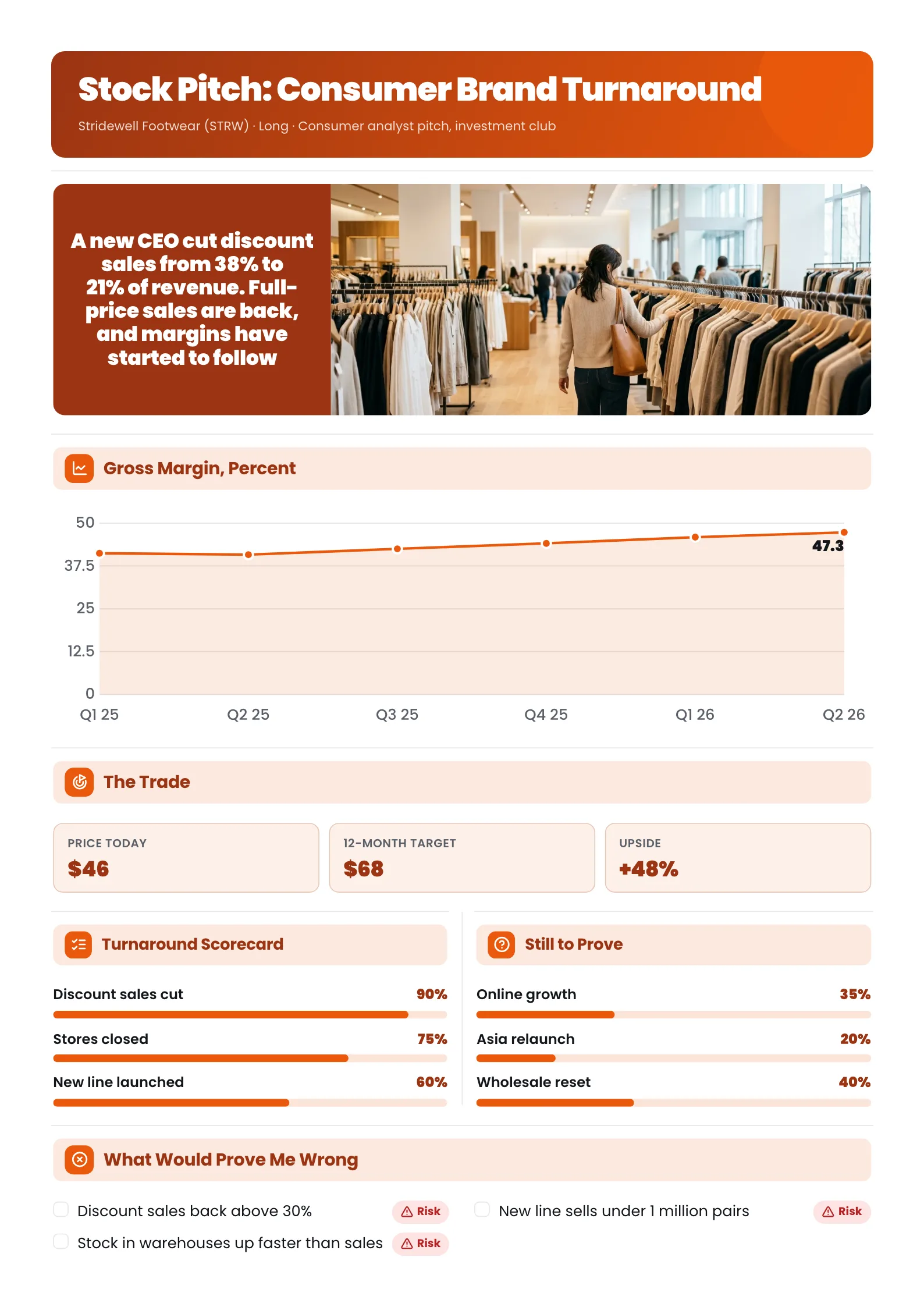 Edit this template
Sample names and figures. Six quarters of gross margin come before the trade, so the reader sees the proof before the price.
Value the company two ways
Valuation and financial analysis are the two biggest sections in the CFA scoring, at 20 points each. Kentucky asks for a number of valuation methods, naming a discounted cash flow and a comparison with similar companies. B&R Beurs asks for both as well.
Using two methods lets you check one against the other. If a cash flow model says $60 and peers trading at 18 times earnings say $40, you need to explain the gap before the committee does. On a one-page pitch, show your target's multiple beside the peers' multiple, and keep the full model in the appendix.
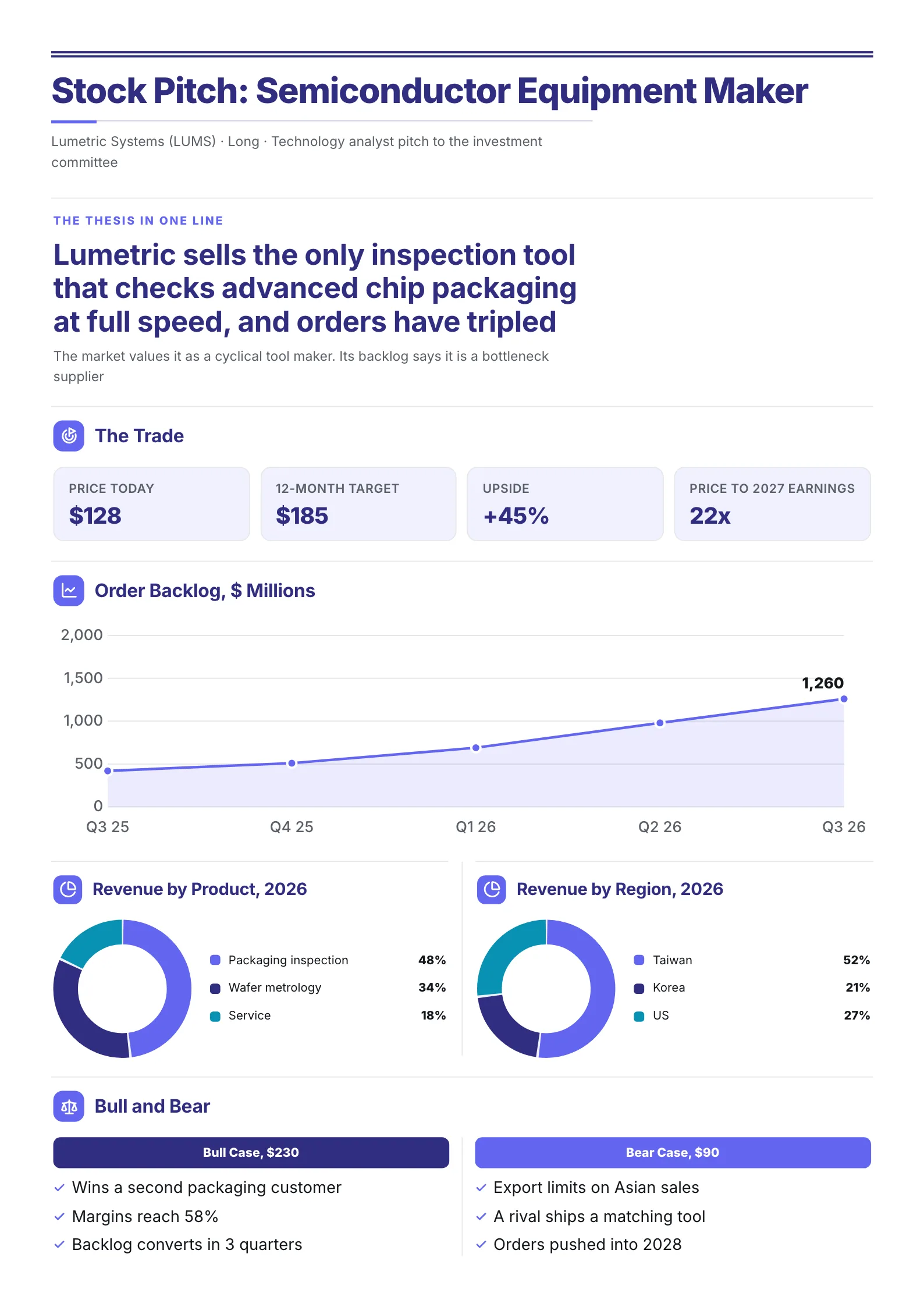 Edit this template
Sample names and figures. The target is shown with the earnings multiple behind it, beside a backlog chart that backs the thesis.
Name the catalysts, with dates
A catalyst is an event that makes the market see what you see. Three of the 12 Miami theses named one, and just 1 gave it a date: Alphabet's 20-for-1 stock split on July 15. B&R Beurs splits catalysts into hard ones, which are definite events, and soft ones, which may happen. Duke's worksheet notes that catalysts matter even more when your time frame is short.
List two or three catalysts in date order. An earnings report, an investor day, a product launch or a court ruling all count. Give the month at least, and say what you expect each one to show.
Name the risks, and what would prove you wrong
Here's the biggest gap. None of the 12 theses named a risk, yet risks carry 15 of the CFA's 100 points. B&R Beurs asks for 2 to 3 specific risks, and Kentucky asks how you'd soften each one.
A simple way to show risk is a bull case and a bear case, each with a price and two or three reasons. Add one line on what would make you change your mind, such as "if new store sales fall below $2 million." Committees trust a pitch more when the presenter has already argued against it.
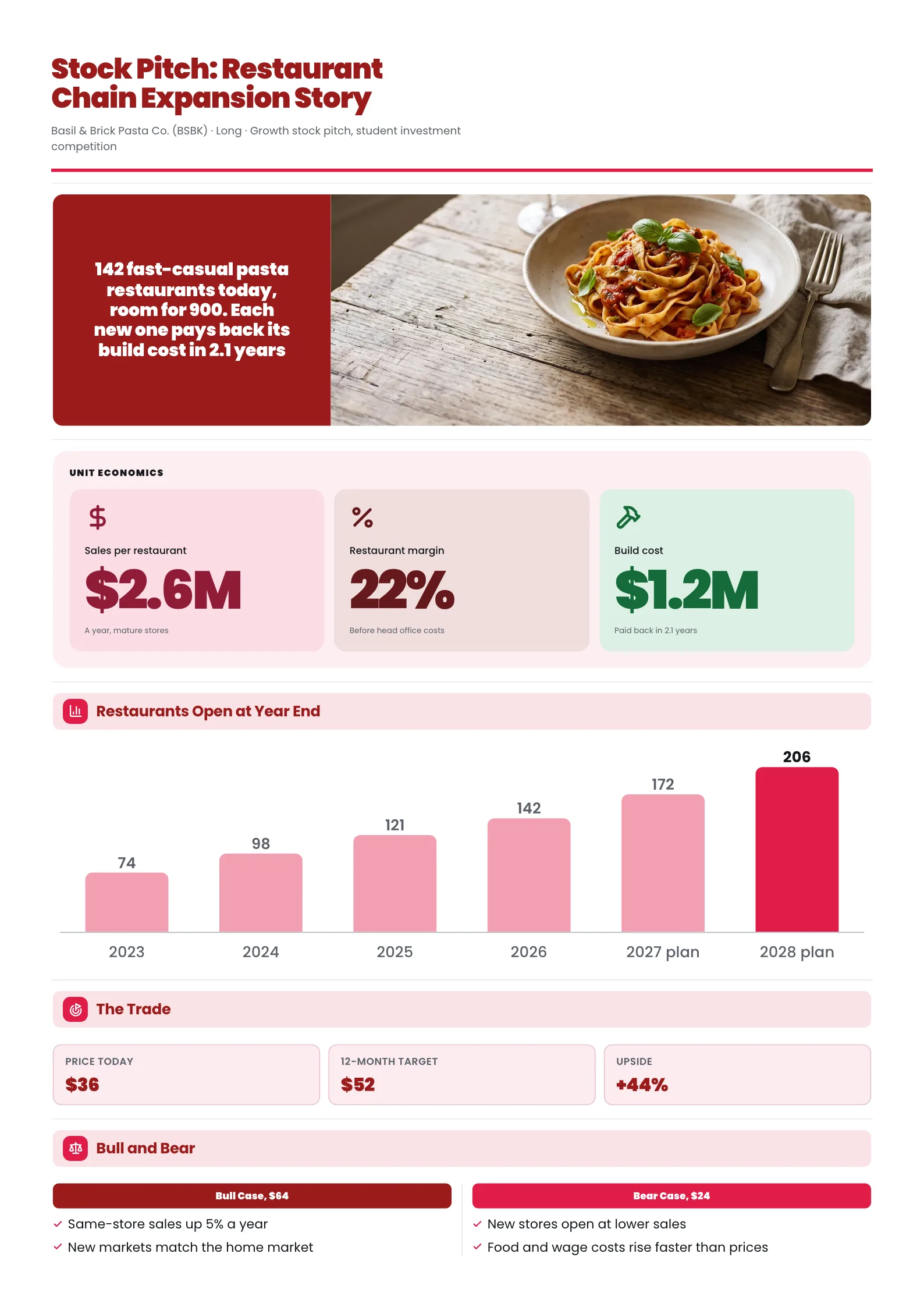 Edit this template
Sample names and figures. The bear case gives a $24 price and two reasons it could happen, right beside the bull case.
Set the time frame and when you'd sell
Two of the 12 theses gave a time frame. The Builders FirstSource write-up looked 6 to 12 months ahead, and Chevron's looked through 2022. B&R Beurs asks for exit criteria tied to your target price or to your catalysts playing out.
Write when you expect the target to be reached, and what you'll do if it's hit early or the thesis breaks. The Miami fund's Bristol-Myers sale is a good model. The stock passed its target, the team judged it fairly valued, and they sold.
Say how much to buy
There's one thing the Miami write-ups did well. Eleven of the 12 gave the size of the trade, as a number of shares and a price. The fund bought 80 shares of AmerisourceBergen at $155 and 34 shares of Costco at $530, for example. A committee voting on real money needs that line.
If your pitch is for a fund or a club, add the position size beside your target. Give it as shares, dollars or a percent of the portfolio. Then say why that size fits the risk. A pitch with a wide gap between the bull and bear cases may deserve a smaller position than one with a narrow gap.
Get ready for the committee's questions
At George Washington University's fund, your pitch passes only if 80% of the committee votes yes. That means the questions after your talk matter as much as the page. Write down the five questions you'd ask if you were on the other side of the table, and answer each in a sentence. These come up again and again:
- Why now? Point to your nearest catalyst and its date.
- What's already in the price? Compare your numbers with what the market expects.
- What's your downside? Give the bear case price and the reason for it.
- Why this stock over a peer? Show the valuation gap from your peers table.
- What would make you sell? Give your exit rule.
If your page already answers all five, the questions become a chance to show you've done the work.
One thesis, rewritten
Here's a sample thesis written the way many student write-ups read:
We are buying shares of a regional grocery chain because it is a strong, well-run company with good growth prospects and a loyal customer base.
It gives no price, no target, no number and no risk. Here's the same idea with every part in place:
Buy at $31 (October 30, 2026), target $42 in 12 months, upside 35%. The market prices it like a stagnant grocer at 12 times earnings. Its new store format earns 40% more per square foot, and 60 stores convert by 2028. Catalyst: first-year results from the 20 converted stores, due in March. Bear case $24, if conversion costs run 30% over plan. Sell at target, or if converted stores miss sales goals two quarters running.
It's still short. Now each claim can be checked, and the trade on the table is clear. In six months, you can also look back and see exactly which part of your thesis played out and which part didn't, which is how you get better at the next pitch.
A stock pitch checklist
Before you present, check that your pitch has:
- The call, the price today with its date, the target, the upside and the time frame, all at the top
- A one-sentence thesis that says what the market is missing
- Two or three numbers that prove it
- A valuation from at least two methods, with peers
- Catalysts with dates
- A bull case and a bear case, each with a price
- What would prove you wrong, and when you'd sell
Our stock pitch designs give you a box for each of these on one page. Our stock pitch template post shows six more filled-in pitches, including a short. For a private company pitched to investors, see our investor one-pager guide instead.
The sources we read
| Source | What it is | Read |
|---|---|---|
| Miami University Student Managed Investment Fund | Spring 2022 report, 12 new-position theses | Counted |
| CFA Institute Research Challenge | Written report rules and scoring | Rulebook |
| University of Kentucky Gatton College | Stock pitch tips and help | Rulebook |
| Duke University FEP | Create a stock pitch worksheet | Rulebook |
| B&R Beurs, Erasmus University | How to craft a stock pitch | Rulebook |
| GW Investment Institute | Stock pitch days, fall 2023 | Rulebook |
We read each source on October 30, 2026. The research file has one row per thesis and per rulebook. The pitches on this page use sample companies and figures to show the format. They aren't recommendations to buy or sell any stock.
Write the top line first
Start your next pitch by writing one line only: the call, the price, the target, the upside and the time frame. If you can't fill it in, your valuation isn't done yet. Once it's written, the rest of the page has something to prove, and a stock pitch design in MakeOnepagers gives it a place to go.
Frequently asked questions
What should a stock pitch include?
The call, the price, the target and the upside, then a one-sentence thesis, the numbers behind it, a valuation, dated catalysts, the risks and your exit. The CFA Institute's scoring puts the most points on valuation and financial analysis, at 20 each.
How long should a stock pitch be?
The CFA Research Challenge allows a written report of up to 10 pages plus appendices. A pitch to a student fund or a club often fits on one page, with the model kept separately.
How do you pick a target price?
Value the company at least two ways, often a discounted cash flow model and a comparison with similar companies' multiples. Your target is where you expect the price to be when the market sees what you see. Give it a time frame, usually 12 months.
What is a catalyst in a stock pitch?
An event that will make other investors notice what you've seen, such as an earnings report, a product launch, a spin-off or an investor day. B&R Beurs calls definite events hard catalysts and possible ones soft catalysts. Give each one a date if you can.
What makes a stock pitch stand out to judges?
A clear variant view, numbers that prove it, and an honest bear case. Only 3 of the 12 theses we read gave numbers, and none gave risks, so covering both already sets your pitch apart.




