PESTLE Analysis Questions: 15 a University Asked Itself
PESTLE analysis questions for all six factors, built from the 15 the University of Greenwich used and CIPD's way to rate each answer.

A PESTLE list of topics is easy to write. Interest rates, new laws, an aging population. The hard part is turning each topic into something you can answer about your own organization. Start from a free one pager template.
One‑Pager examples
Real One-Pagers made with MakeOnepagers. Open any one to edit it as your own.
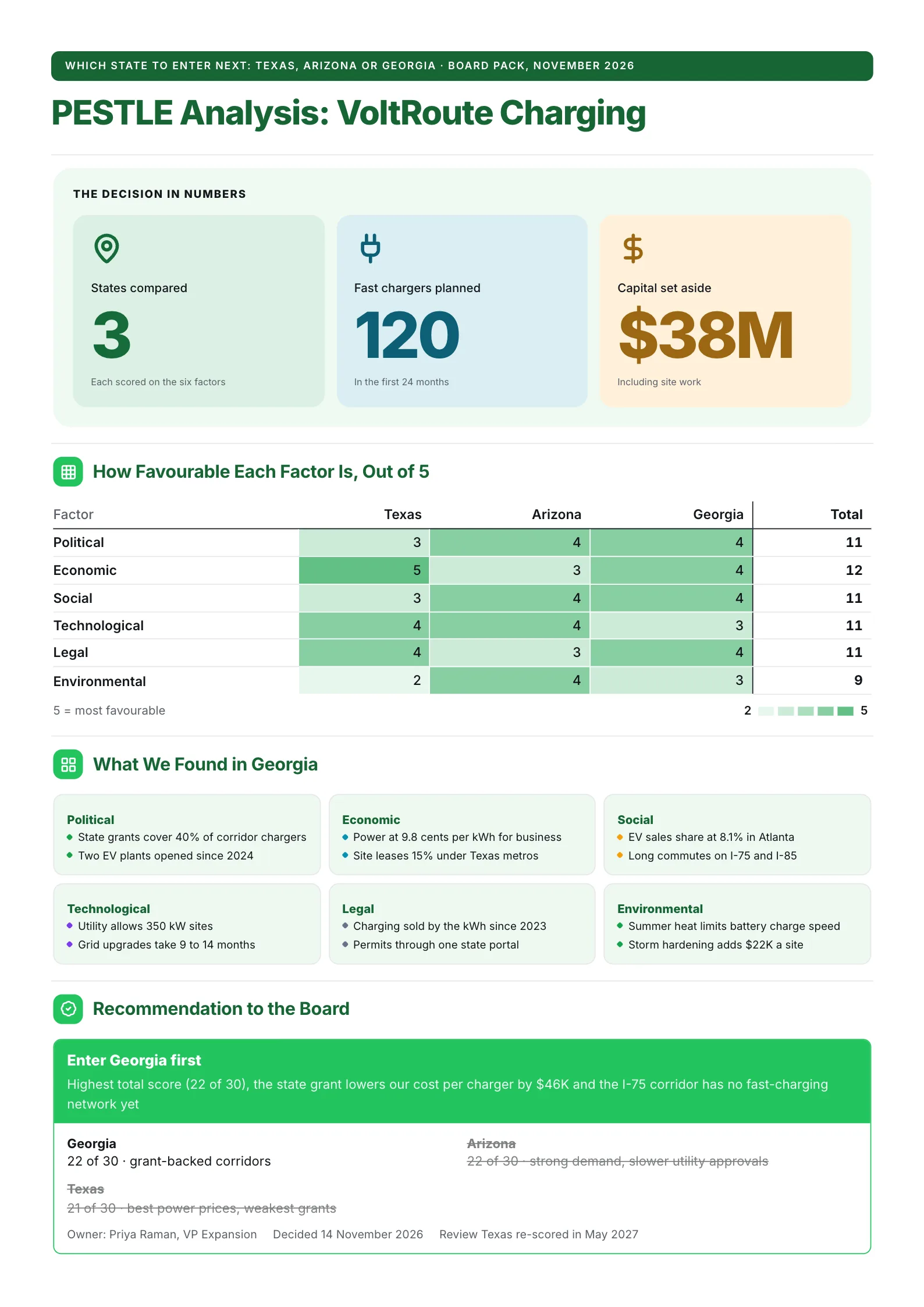 PESTLE Analysis: Market EntryEdit for free(opens in a new tab)
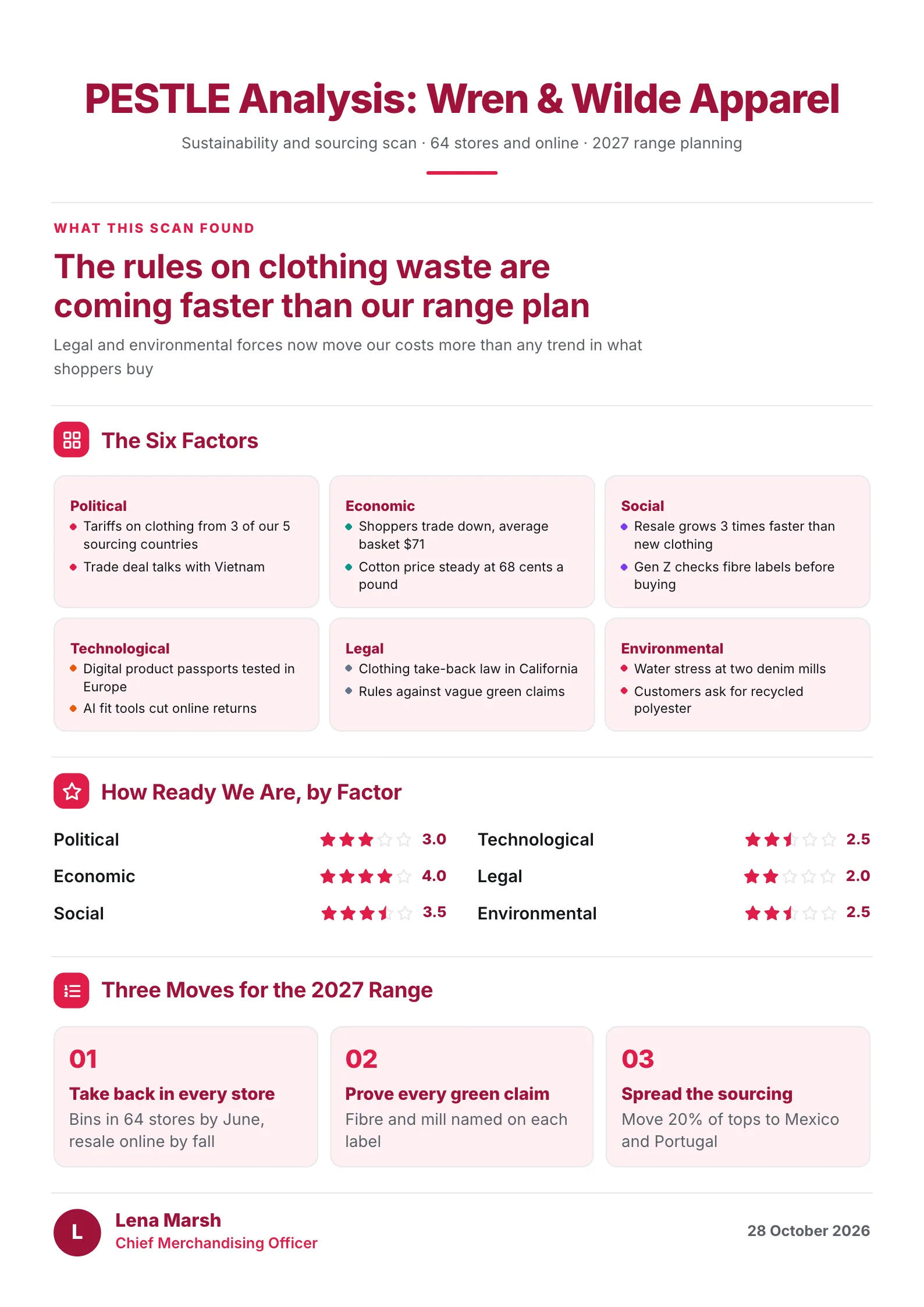 PESTLE Analysis: RetailEdit for free(opens in a new tab)
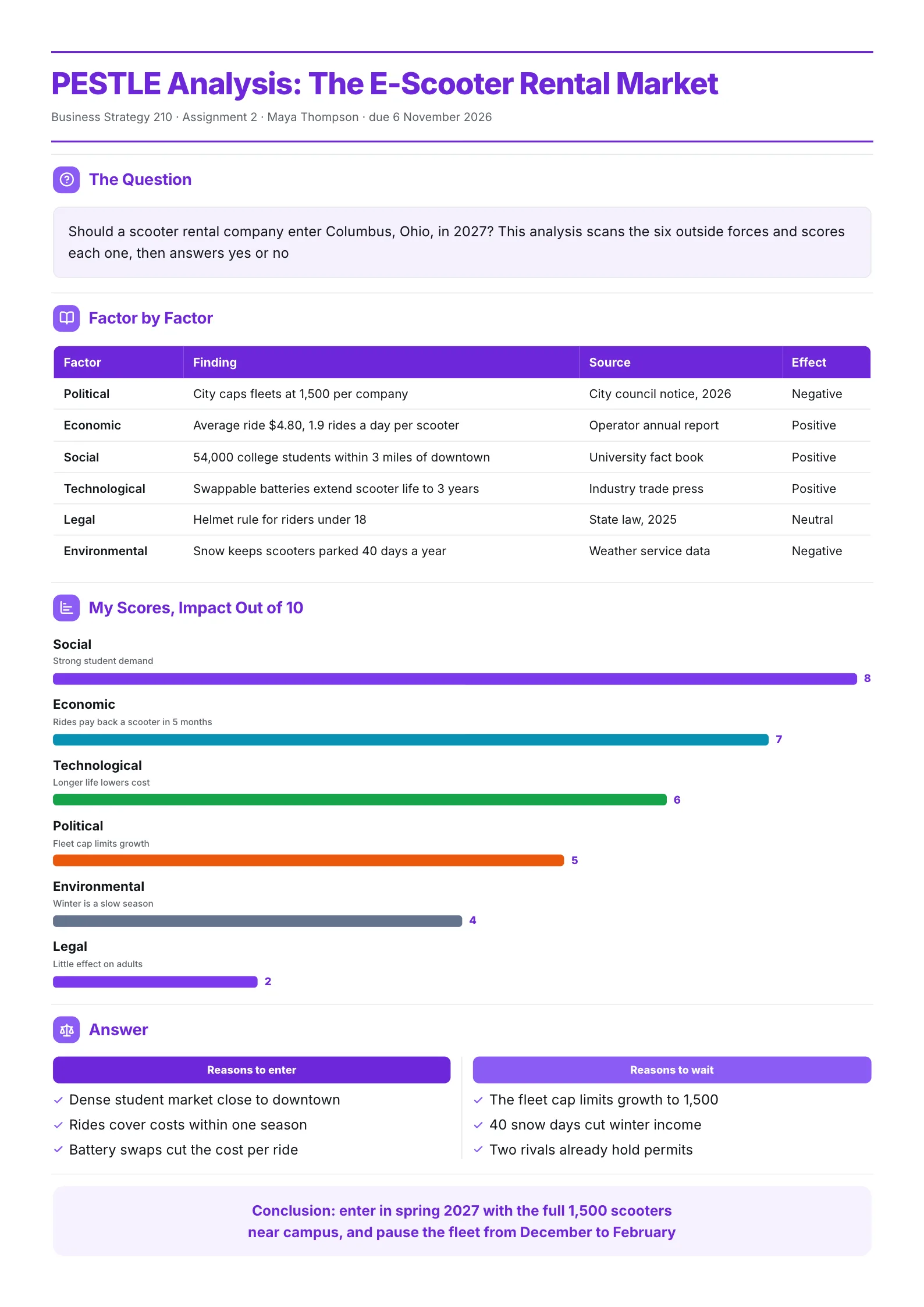 PESTLE Analysis: StudentEdit for free(opens in a new tab)
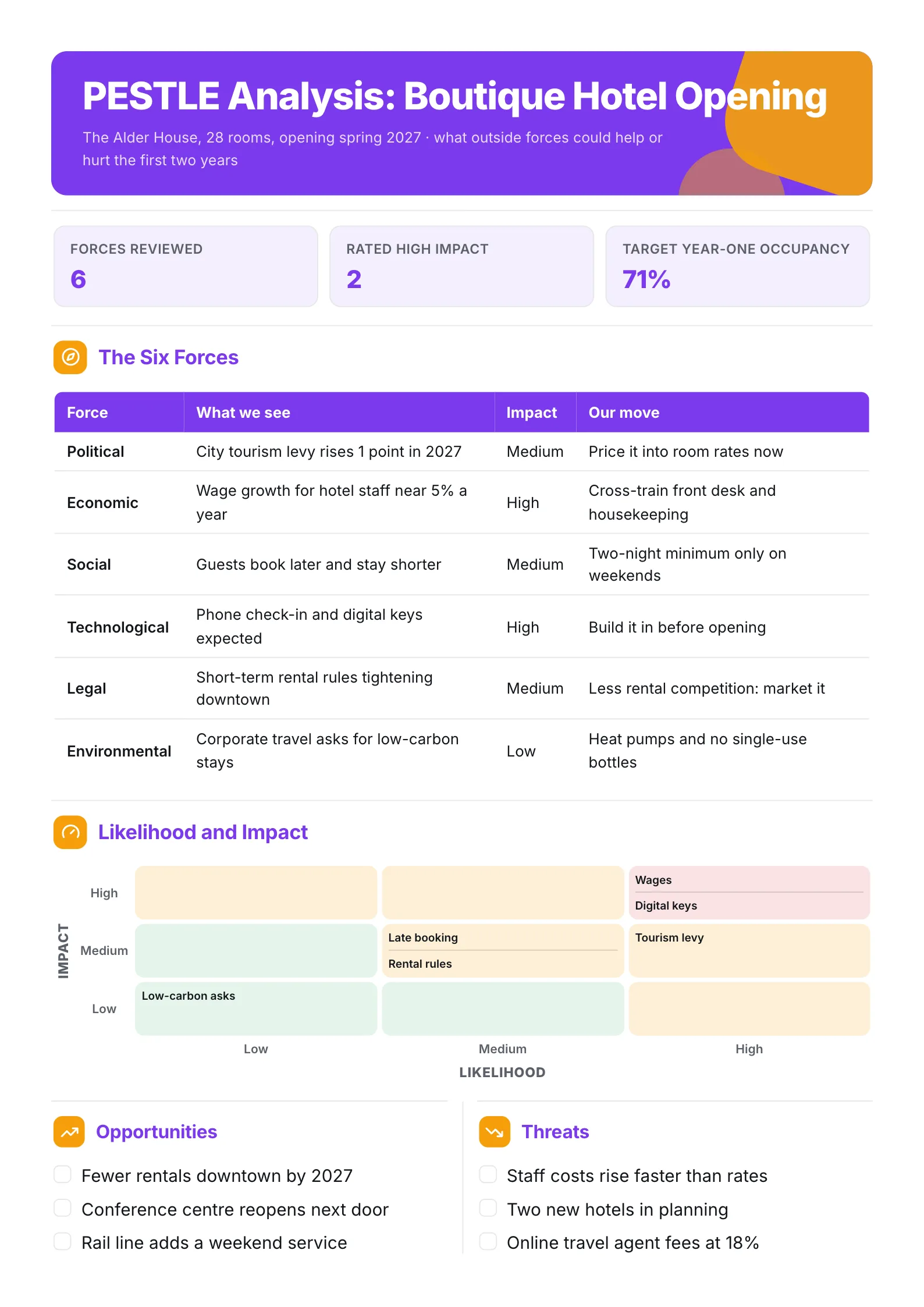 PESTLE Analysis: Boutique Hotel OpeningEdit for free(opens in a new tab)
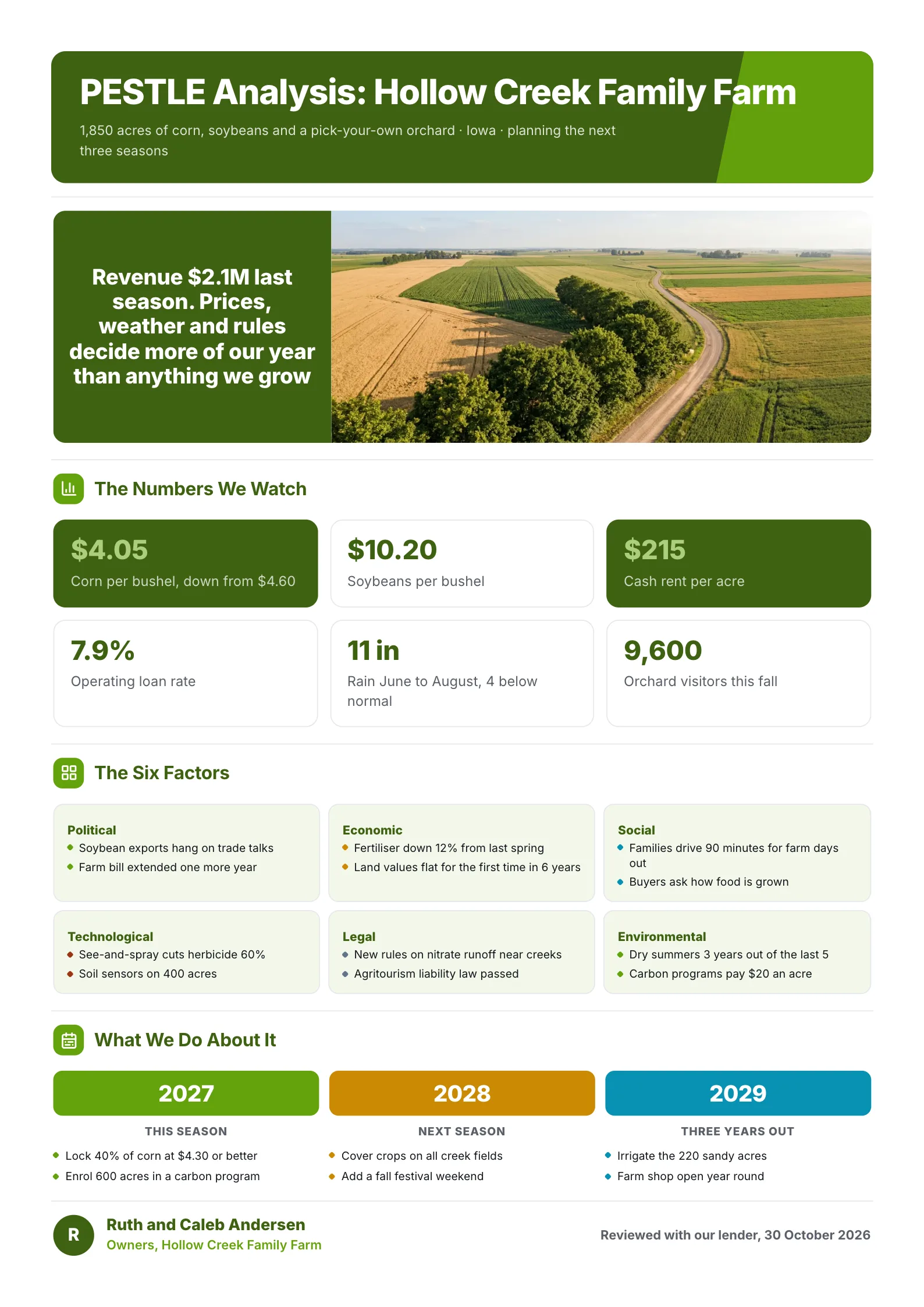 PESTLE Analysis: FarmEdit for free(opens in a new tab)
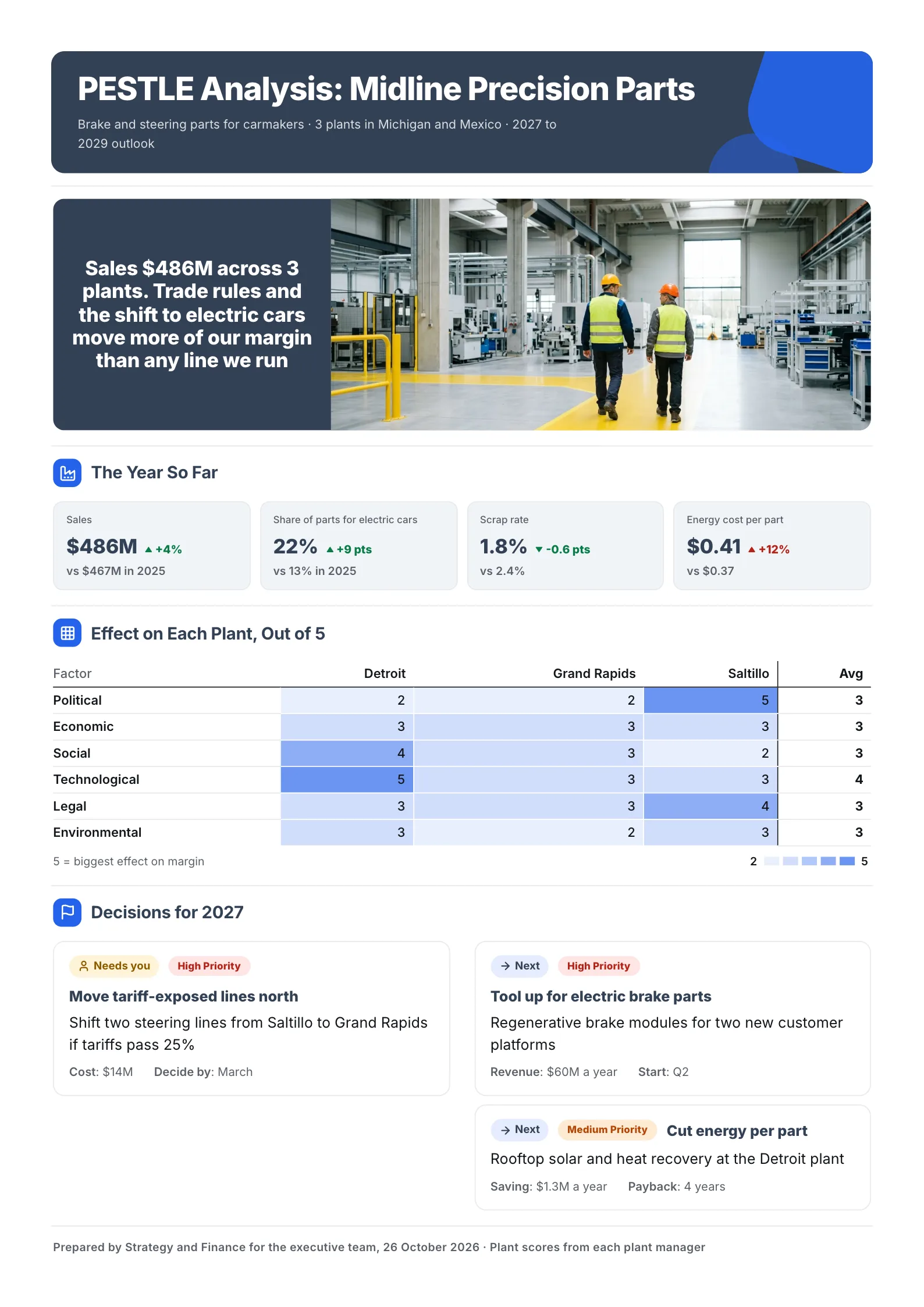 PESTLE Analysis: ManufacturingEdit for free(opens in a new tab)
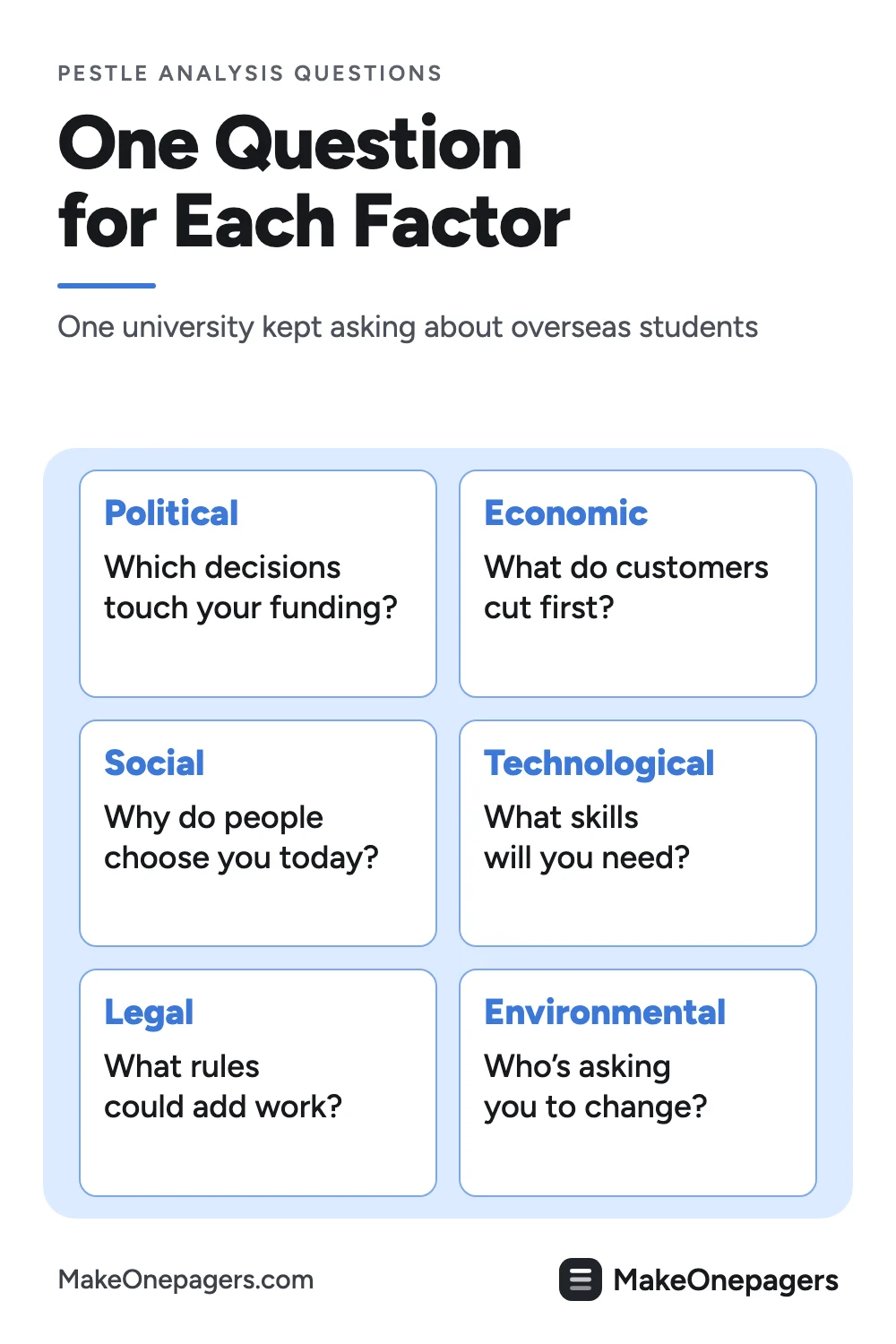
The University of Greenwich publishes a one-page sheet that does exactly that. It's called PESTLE (with questions), and its heading reads "Establishing the reasons for change." It asks 15 questions across the six factors, all aimed at one university's future. Below, we count them, show the pattern you can copy, and add the step the CIPD says comes next.
What one university asked, factor by factor
| Factor | Questions | What they're about |
|---|---|---|
| Political | 2 | How the government views higher education; immigration policy for foreign students and staff |
| Economic | 3 | Funding models; the global economy and overseas students; possible mergers |
| Social | 3 | Why people go to university; more or fewer foreign students; students as fee-paying customers |
| Technological | 3 | Devices and ways of working; staff tech skills in three years; lectures streamed abroad |
| Legal | 2 | HR law and the workforce; the Freedom of Information Act |
| Environmental | 2 | The setting students and staff want; making the university more sustainable |
| Total | 15 |
Source: our count of the University of Greenwich PDF, page updated May 2, 2025, read October 30, 2026. The PowerPoint version on the same page has 14 questions and leaves out the sustainability one.
Look at how the questions are built. Six of the 15 ask outright about "the impact" of an outside change, like "What is the impact of the Freedom of Information Act?" The rest name the change and leave you to say what it means for you. That's the pattern to copy. A topic tells you what's happening. A question asks what it does to you.
The theme hiding in four factors
Read the sheet a second time and one group keeps coming back. Overseas students come up under Political (immigration policy), Economic (the global economy and its effect on overseas students), Social (more or fewer foreign students in the UK) and Technological (students who watch lectures online and stay home).
That's 4 of the 15 questions about one group. A single shift there would move money, campus life and teaching all at once. Your own PESTLE probably has a theme like this too, maybe one big customer, one supplier or one rule. Anything that shows up under three or more factors deserves its own line in the plan.
 Edit this template
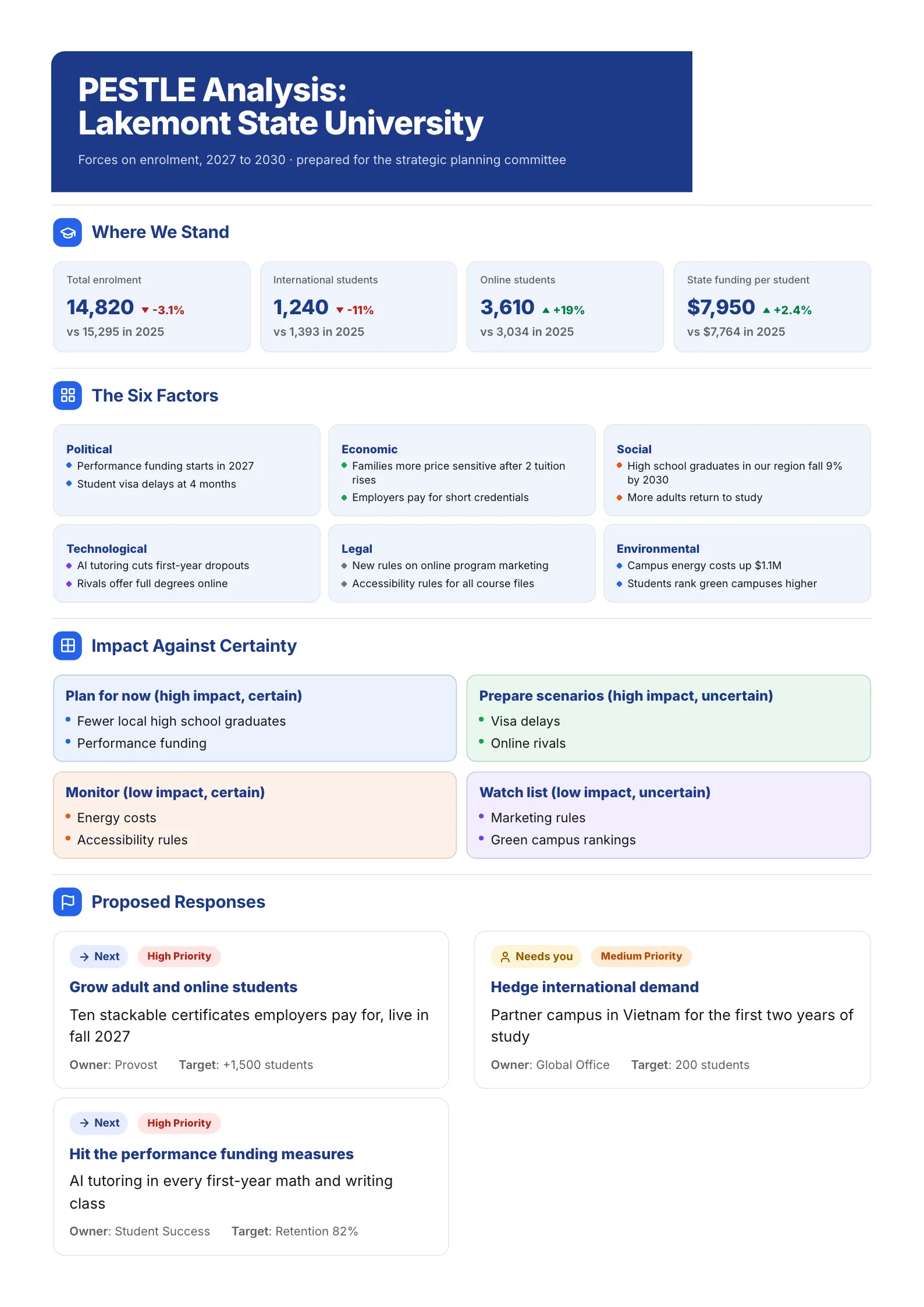
Sample names and figures. Lakemont State plots each factor by impact and certainty, then carries three responses into the plan, one of them a partner campus for 200 students.
Questions you can ask about each factor
Here's the Greenwich pattern applied to any organization. Swap in your own customers, staff and money, and end each one on what the change does to you.
Political
- Which government decisions coming up in the next two years touch your funding, your prices or your customers?
- How does the current government view your sector, and could that view change after an election?
Economic
- If your customers had 10% less to spend next year, which of your lines would they cut first?
- What happens to your costs if interest rates, wages or one key price moves?
- Could a merger, a buyout or a rival's closure change the shape of your market?
Social
- Why do people choose what you offer today, and is that reason getting stronger or weaker?
- How are your customers' expectations changing, now that they compare you with every app on their phone?
Technological
- What devices and tools will your staff and customers expect you to use?
- What tech skills will your team need three years from now that it doesn't have today?
- Could someone deliver what you do from somewhere else, online?
Legal
- Which changes to employment law would change how you hire, pay or schedule?
- What new rules on data, safety or disclosure could add work for you?
Environmental
- What kind of place do your staff and customers want to work in or visit?
- What would it take to make your operation more sustainable, and who's asking you to?
Ask each question twice: once for the next year or two, and once for three to five years out. The Open University's free course on understanding your sector splits its own PEST worksheet that way, and it warns that political and economic factors can change very quickly.
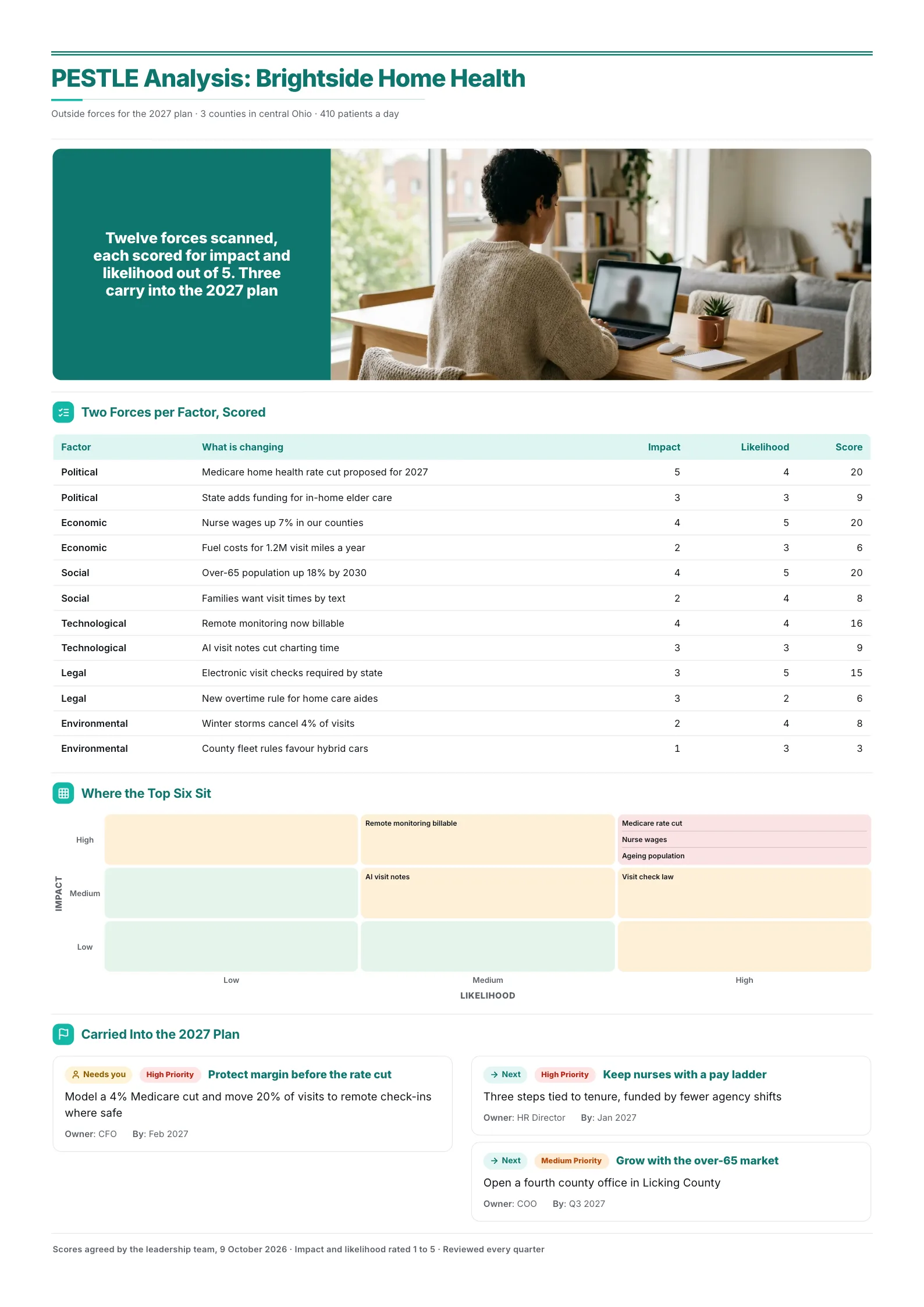
The home health sample below shows what happens after you ask these. It scanned twelve forces, then kept only the three that score highest.
 Edit this template
Sample names and figures. The agency agreed its scores on October 9, 2026, and reviews them every quarter.
Rate every answer before you plan
Greenwich gives you the questions. The CIPD, the UK professional body for HR and people development, gives you the next step. Its factsheet, updated March 21, 2025, lists nine steps for a PESTLE, and one of them is to "mark each item in terms of importance in relation to potential risk."
Its editable template shows what that looks like. It has three columns:
- External factors to consider
- Factors affected within your industry
- Importance to your organization
The worked example is a made-up retailer with 28 items. It rates 12 of them High, 13 Medium and 3 Low. That's a useful reality check for your own list. If everything you wrote down comes out High, you haven't ranked anything yet.
 Edit this template
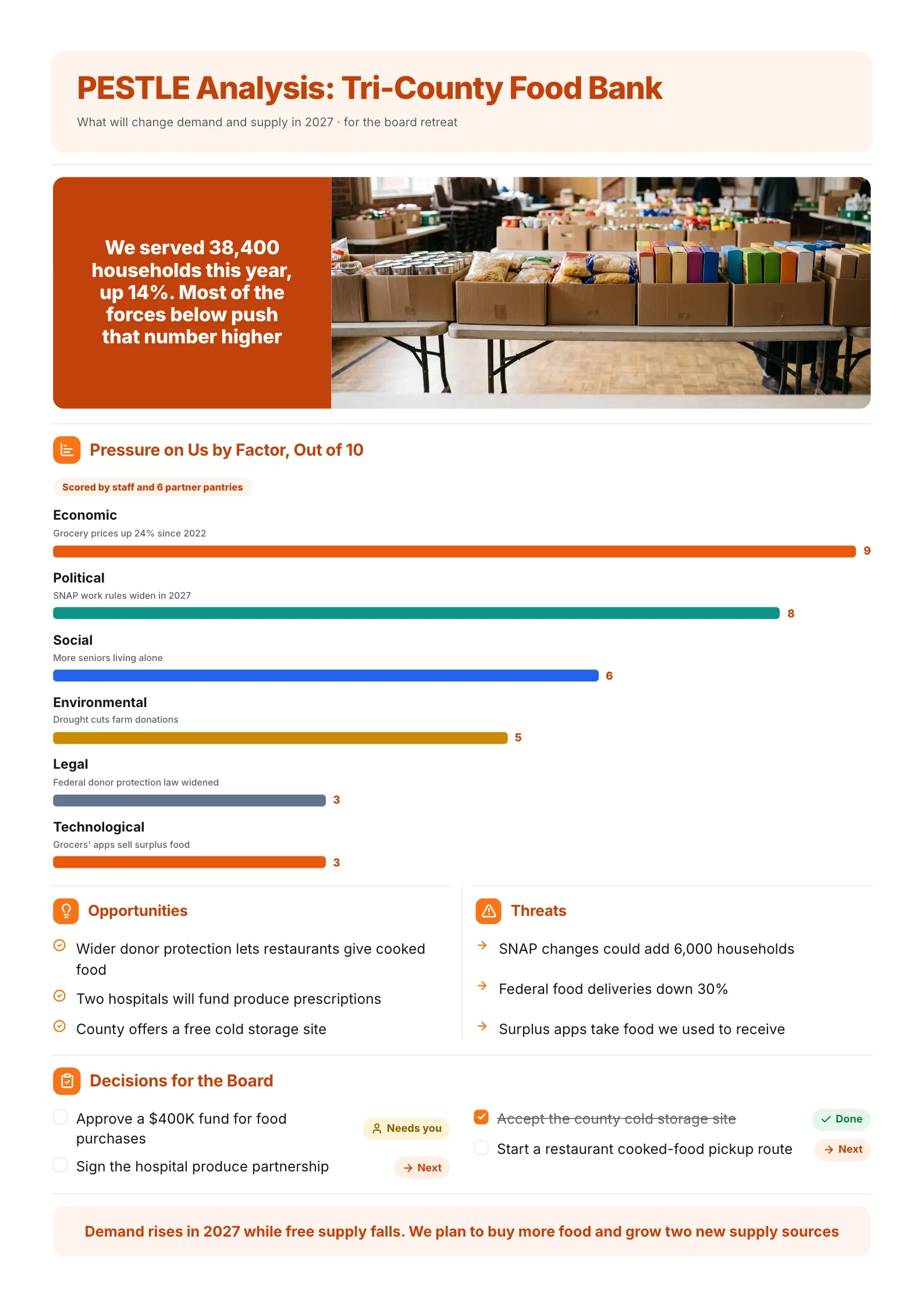
Sample names and figures. Each factor gets one line and a pressure score out of 10, so the board can read all six in a minute.
Three traps the CIPD warns about
The factsheet is short, and these three warnings are worth more than its lists of topics.
Don't assume the future copies the past. In the CIPD's words, "Don't jump to conclusions about the future based on the past or present." A question like "What if this trend reverses?" tests that.
Don't collect data you won't analyze. The CIPD warns against gathering vast amounts of information with no analysis, which it calls "paralysis by analysis." Two or three questions per factor, answered well, beat twenty answered loosely.
Don't do it once. The factsheet says to repeat the analysis regularly. Put a review date on the page, like the home health sample does.
 Edit this template
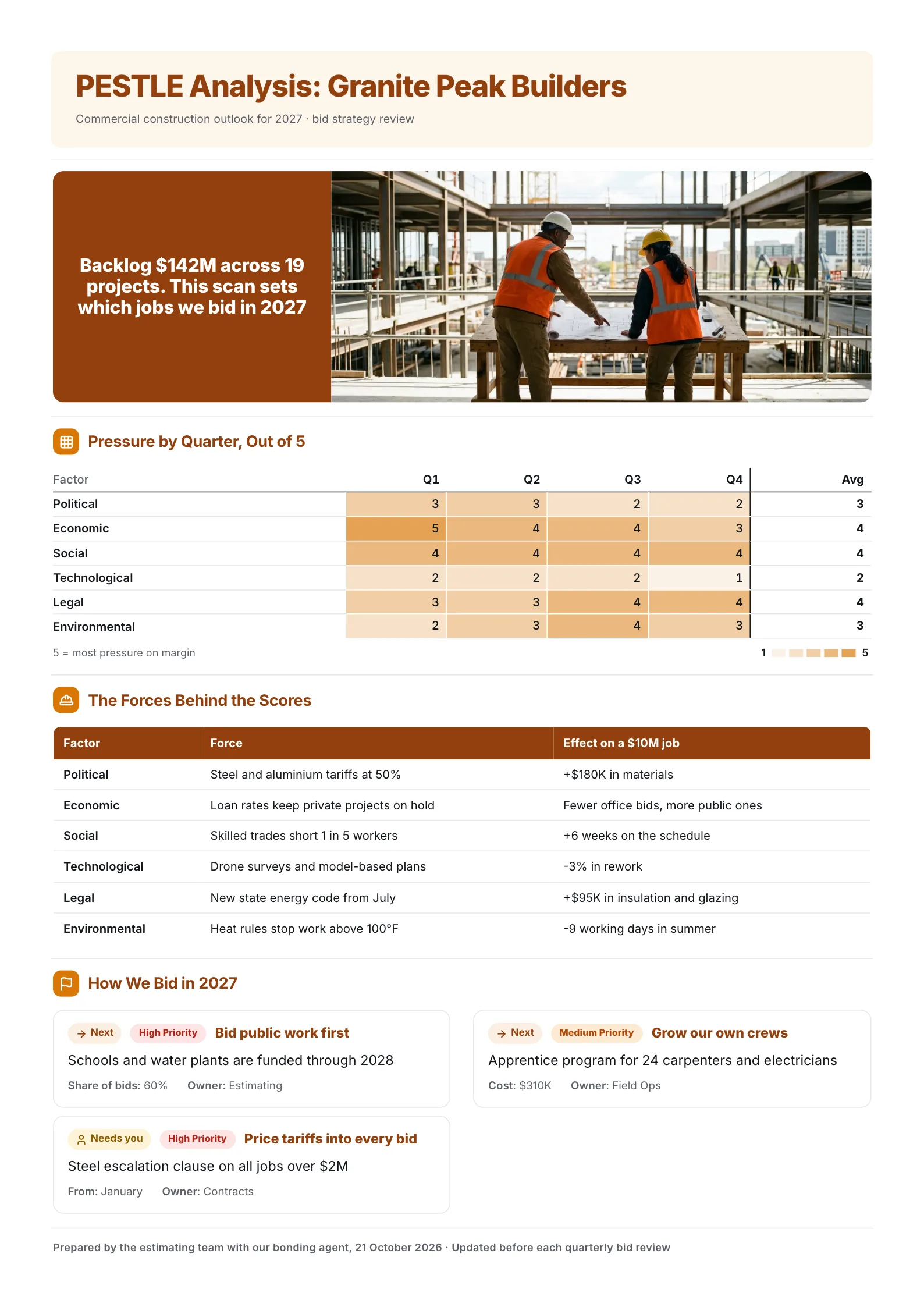
Sample names and figures. Every factor ends in a decision with a dollar figure, like a steel escalation clause on jobs over $2M.
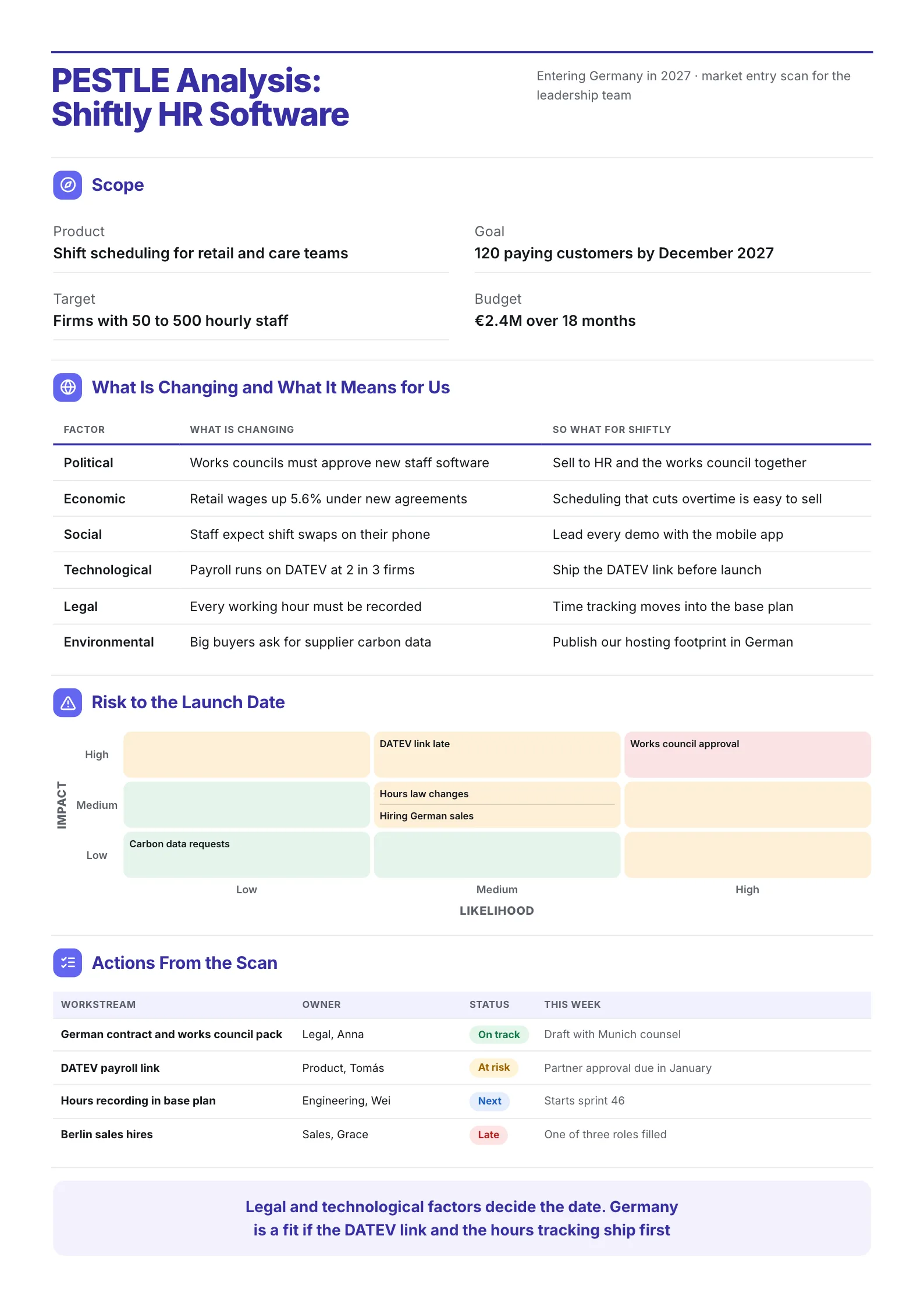
When you're entering a new market
The questions change a little when you're looking at a country or region you don't operate in yet. Ask them about the new place, then add one more to each factor: "How is this different from home?" Labor law, data rules and payment habits are usually where you'll find the biggest gaps.
 Edit this template
Sample names and figures. Its bottom line says legal and technological factors decide the launch date, with works council approval and a DATEV link on the risk list.
Our PESTLE analysis template post shows the full page for more industries. A PESTLE covers what happens outside your walls, so many teams pair it with a SWOT for the inside. Our guide on how to do a SWOT analysis walks through that half.
Find your overseas students
Before you write a single factor heading, ask which one group, supplier or rule your organization leans on most. Then check whether it shows up under three or more factors, the way overseas students did for Greenwich. Put that answer at the top of your page, rate the rest, and lay it all out on a MakeOnepagers PESTLE design your team can read in a minute.
The sources we read
| Source | Publisher | What we took |
|---|---|---|
| PESTLE (with questions), with its one-page PDF | University of Greenwich | 15 questions by factor, 6 that ask about "the impact", 4 questions on overseas students |
| PESTLE analysis factsheet | CIPD | Nine steps, rate each item for importance, repeat regularly, avoid "paralysis by analysis" |
| PESTLE editable template | CIPD | Three columns, a worked retailer example with 28 items rated High 12, Medium 13, Low 3 |
| Questions to ask during the PEST analysis | The Open University | Short term (1-2 years) and longer term (3-5 years) columns |
Each one was opened and read at the source on October 30, 2026.
Frequently asked questions
How many questions should a PESTLE analysis have?
Two or three per factor is plenty, so 12 to 18 in all. Greenwich used 15. More than that usually means you're listing topics instead of asking what they do to you.
What's the difference between PEST and PESTLE questions?
PESTLE adds Legal and Environmental to the original four. If your organization is regulated or uses a lot of energy, materials or land, ask those two. If not, PEST may be enough.
Who should answer the PESTLE questions?
Ask people who see different parts of the outside world, like finance, sales, operations and HR. The CIPD template's middle column asks how each factor plays out in your own industry, which people inside it answer best.
How often should you update a PESTLE analysis?
Once a year at minimum, and any time a big outside event lands, like an election, a new law or a price shock. The CIPD says to repeat it regularly so it stays useful.




