PESTLE Analysis Examples, Factor by Factor Beside 3 Published Strategy Papers
Five PESTLE analysis examples, each factor set beside lines from published NHS and Scottish Parliament papers, plus how many factors to list.

A PESTLE analysis sorts the outside forces that could change your plan under six letters, running from P for political to a final E for environmental. The ones worth reading do more than name a force. They put a number on it and say what it does to the decision in front of you. Start from a free one pager template.
One‑Pager examples
Real One-Pagers made with MakeOnepagers. Open any one to edit it as your own.
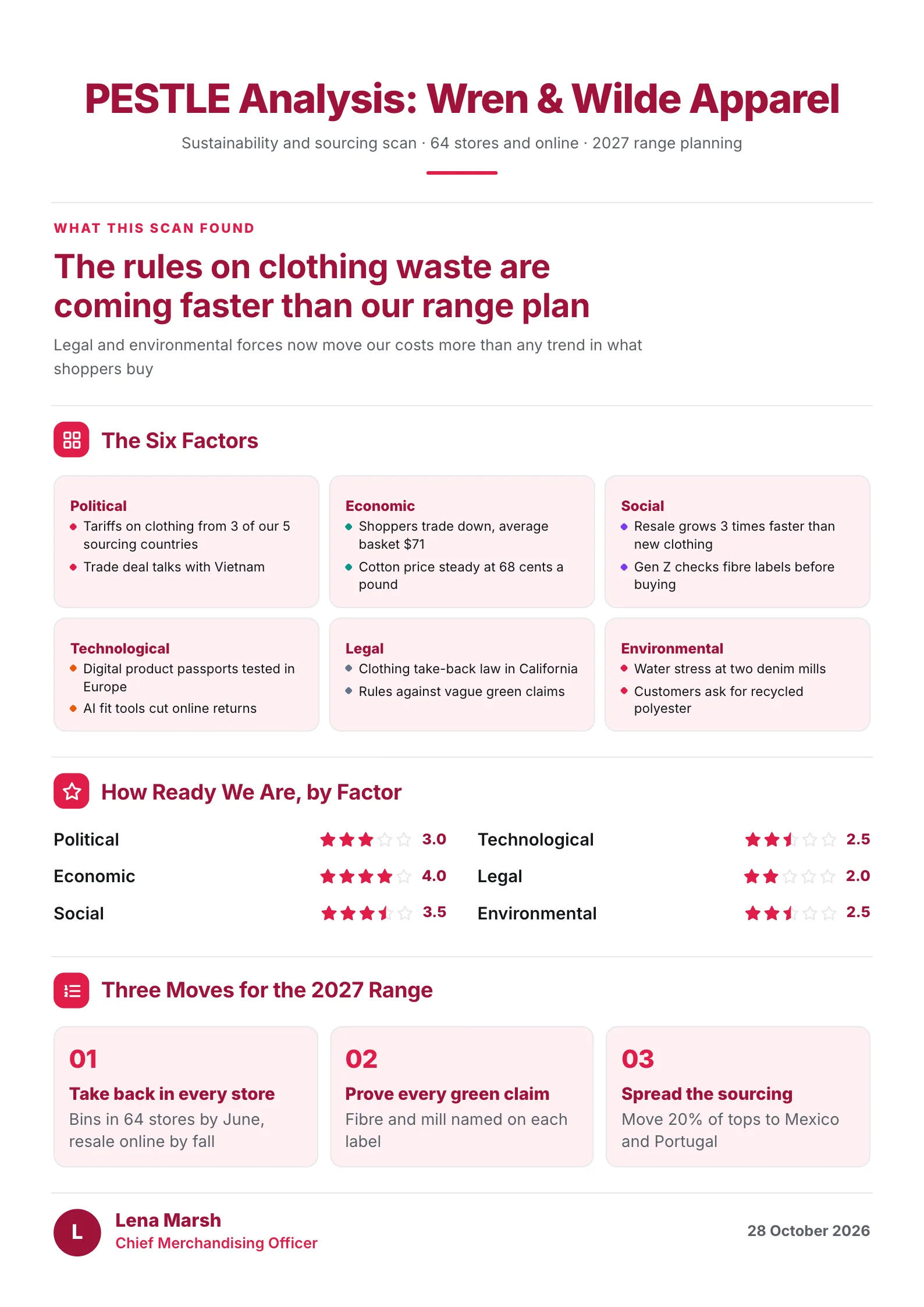 PESTLE Analysis: RetailEdit for free(opens in a new tab)
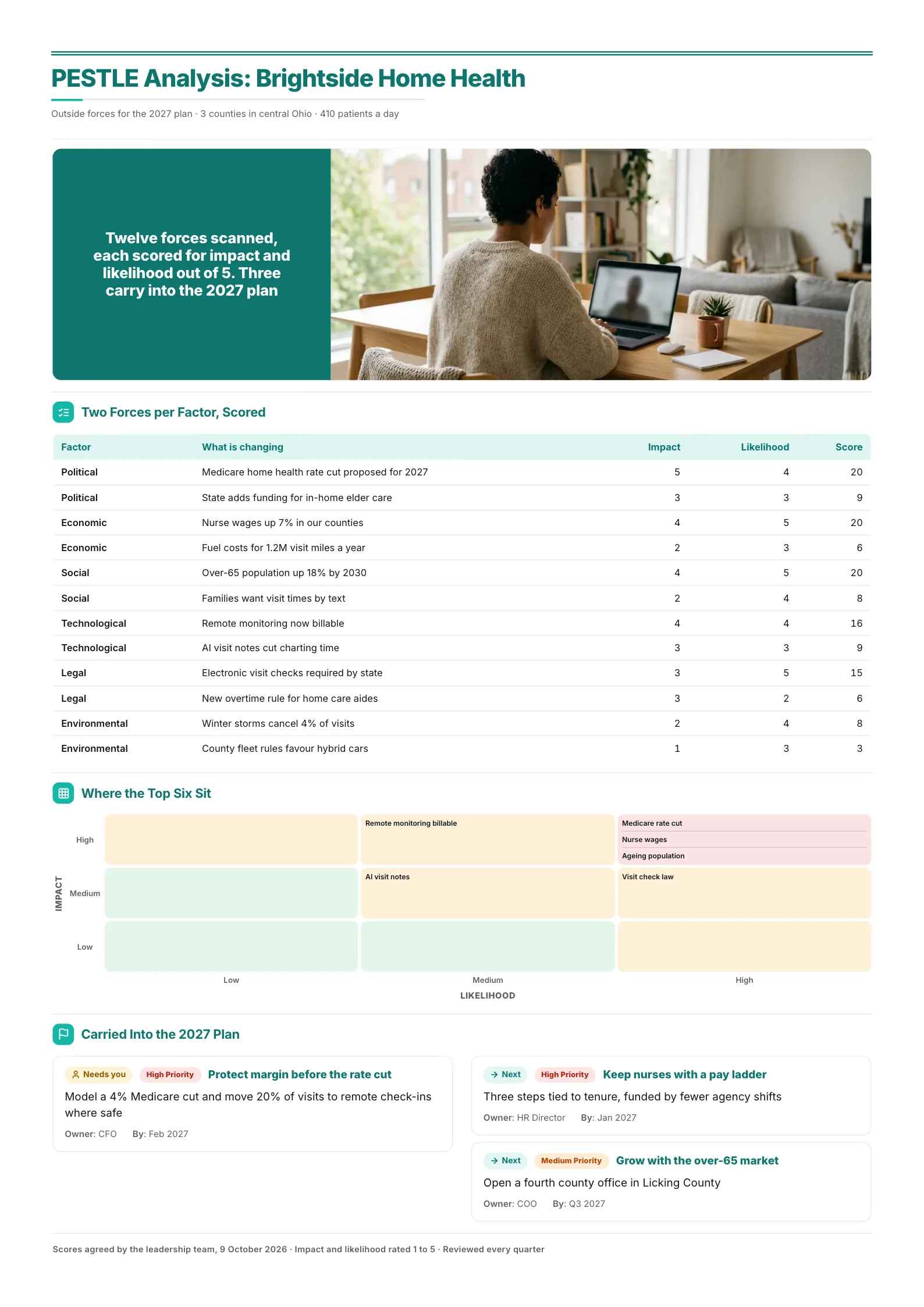 PESTLE Analysis: Home HealthEdit for free(opens in a new tab)
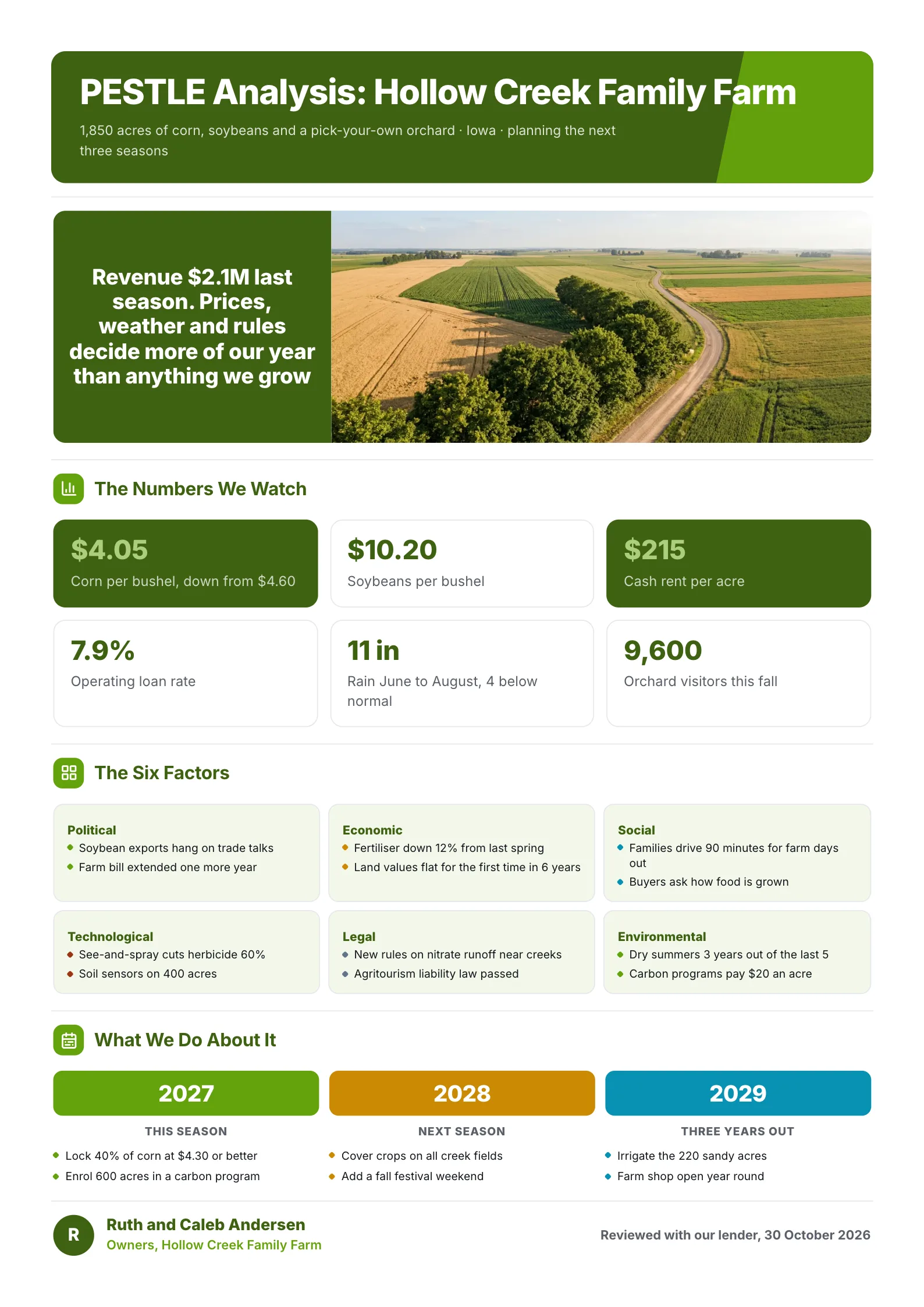 PESTLE Analysis: FarmEdit for free(opens in a new tab)
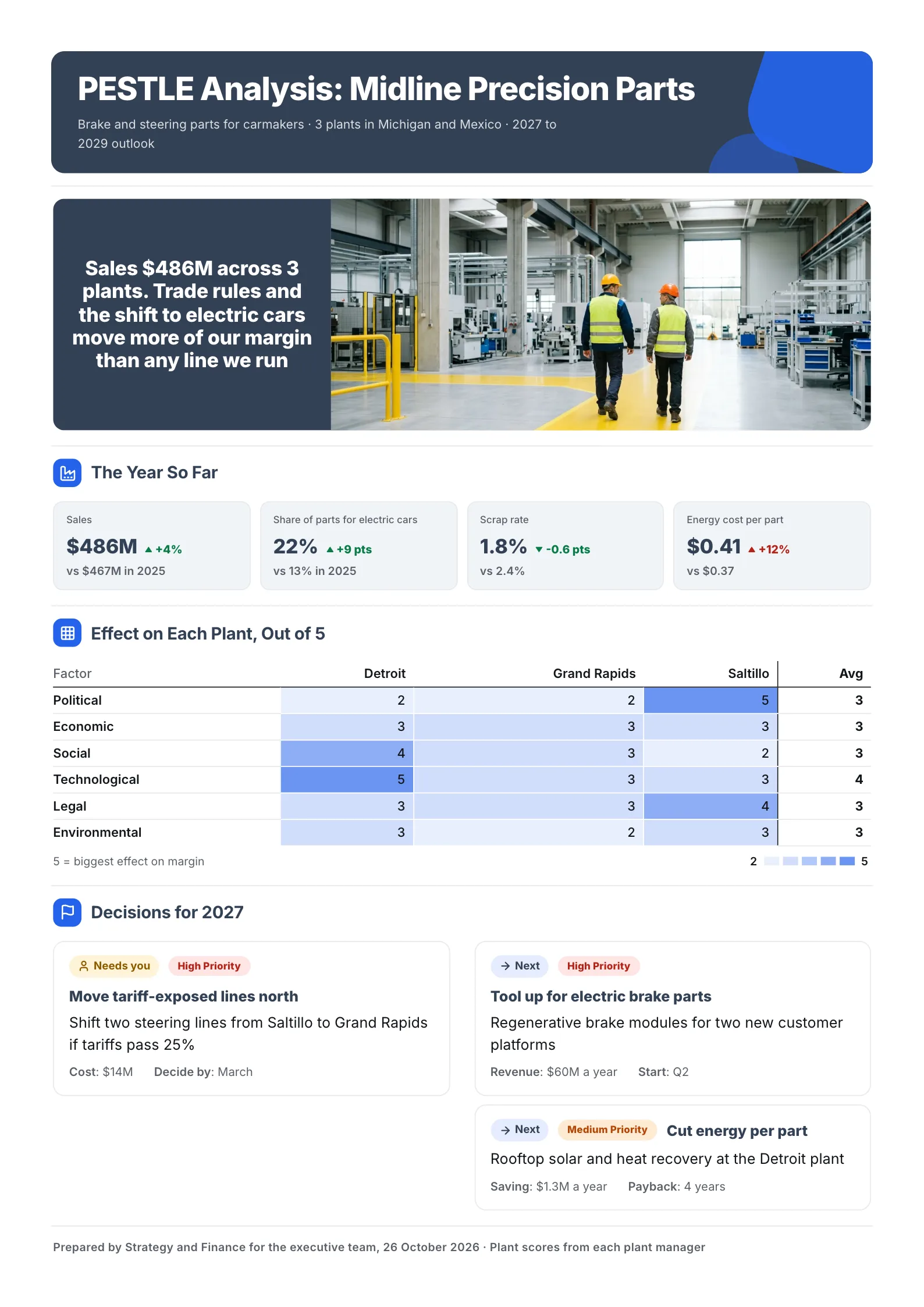 PESTLE Analysis: ManufacturingEdit for free(opens in a new tab)
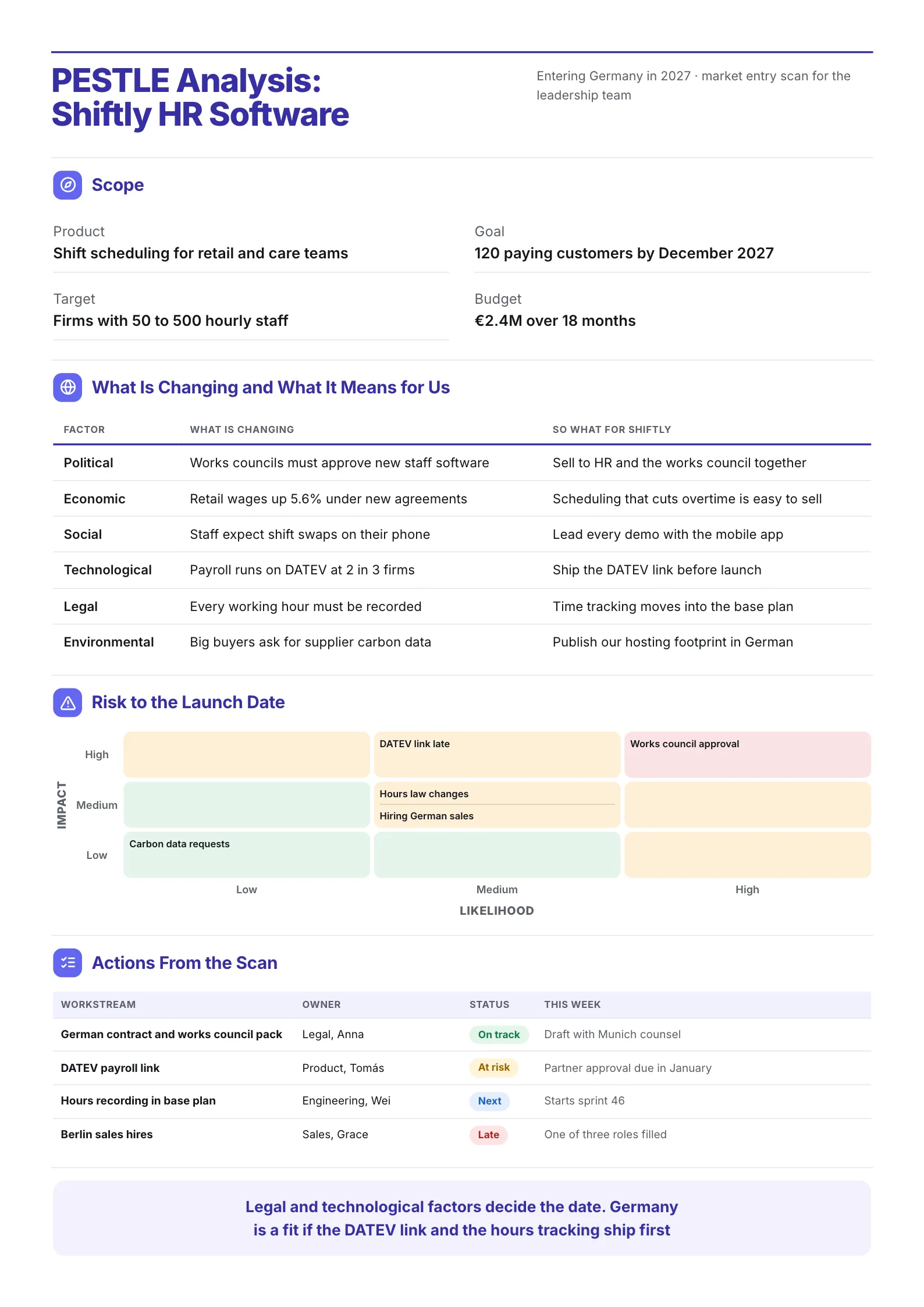 PESTLE Analysis: International ExpansionEdit for free(opens in a new tab)
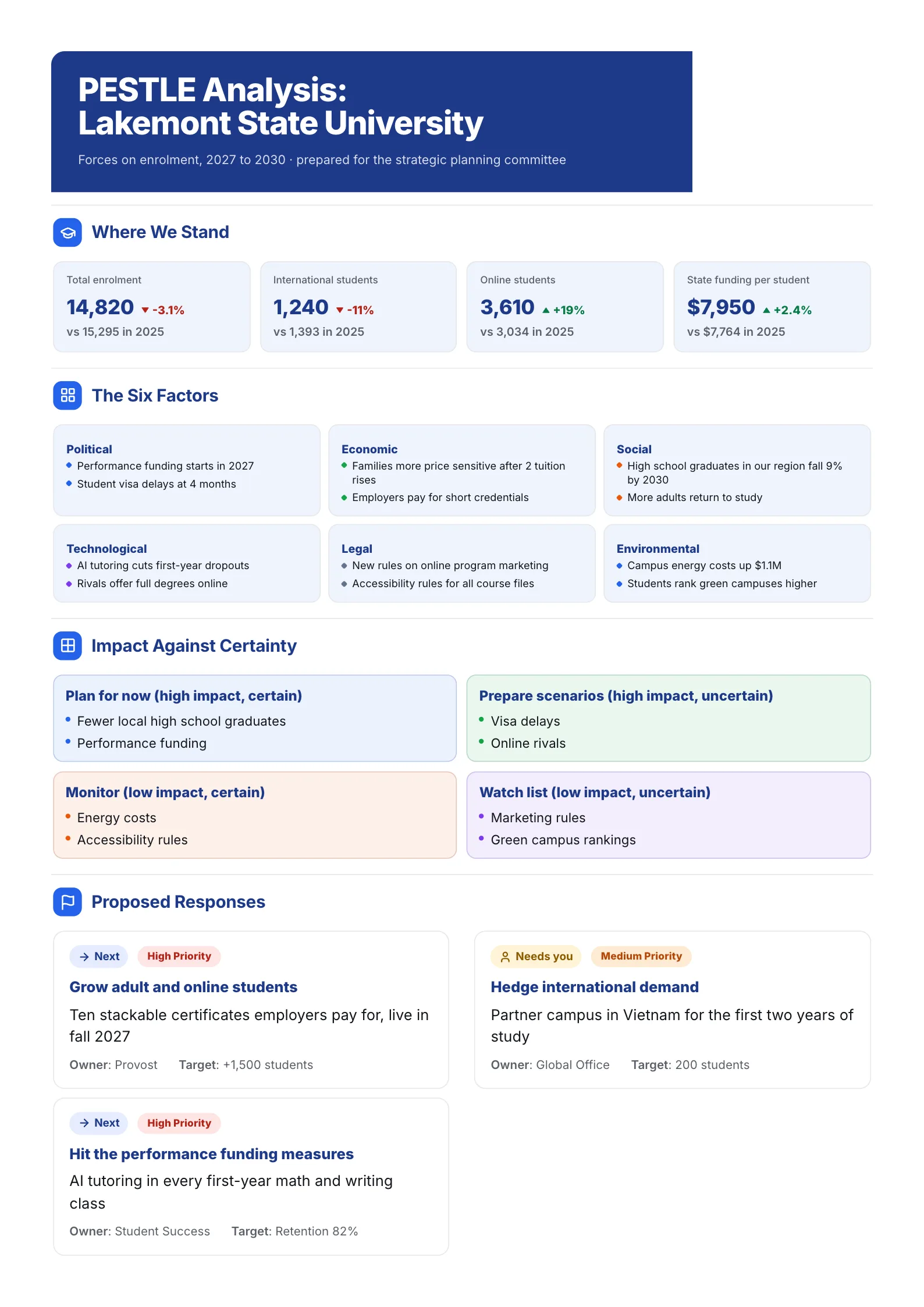 PESTLE Analysis: UniversityEdit for free(opens in a new tab)
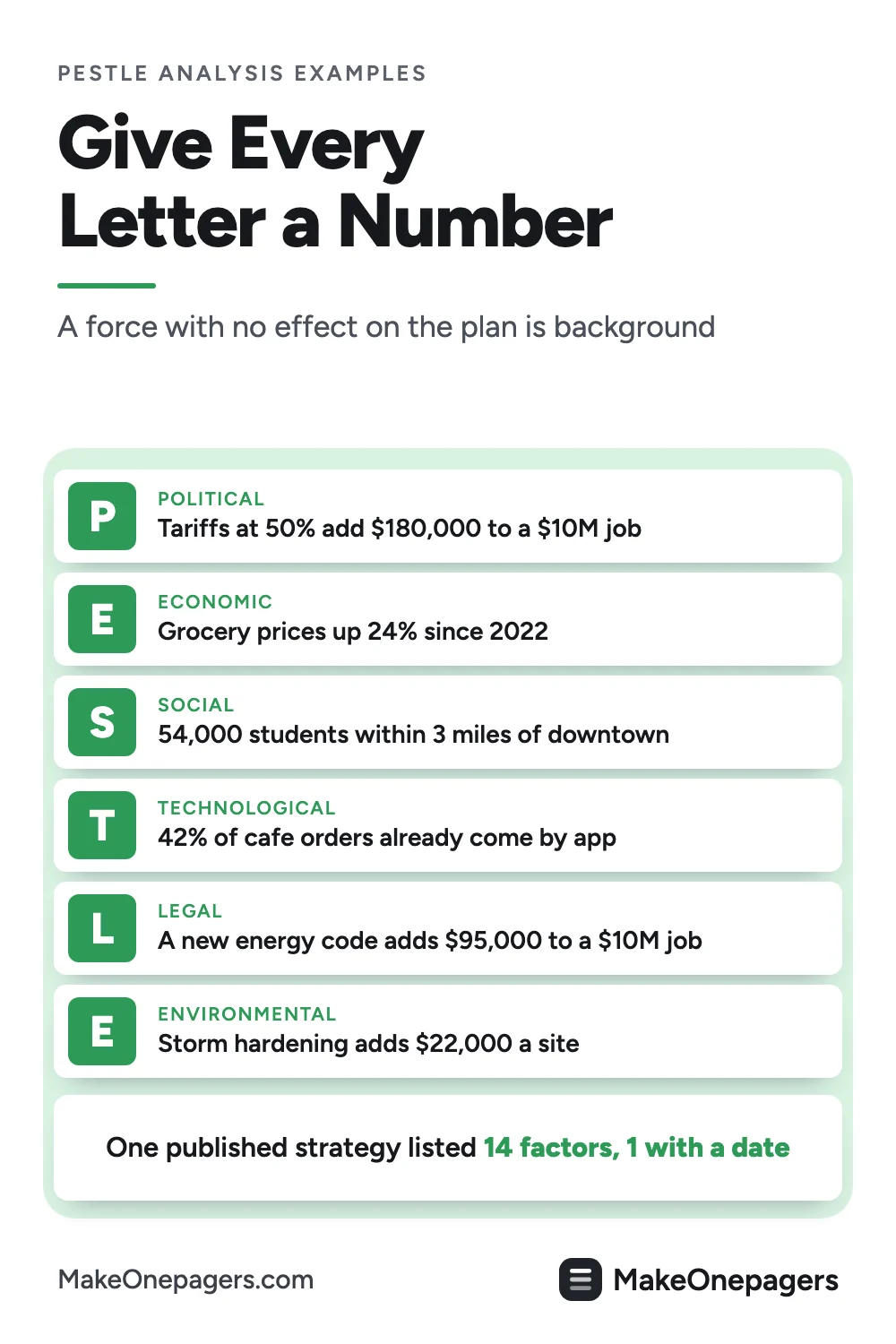
Published strategy papers often stop before that step. One NHS trust's plan lists 14 factors, and only one of them carries a date. The five MakeOnepagers examples here come first. After them, each letter gets its own section, with our strongest line set beside lines from three published papers, two NHS trust strategies and a Scottish Parliament leadership paper, so you can judge the difference yourself.
The five analyses
 Edit this template
Sample company, states and scores. Your options go in the columns.
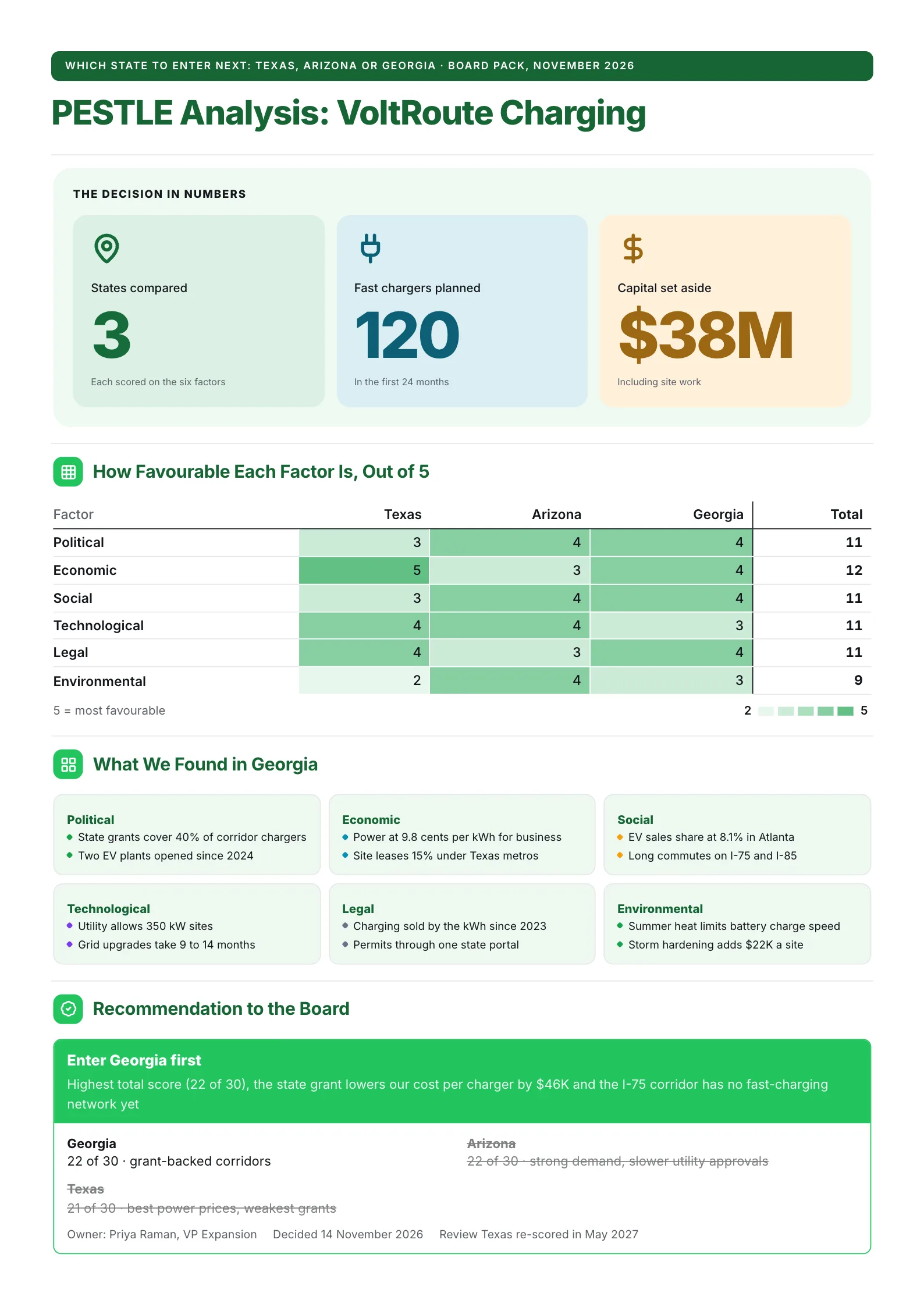
VoltRoute Charging, market entry. This one compares three states on the same six factors, so the heatmap does your arguing for you. Georgia and Arizona both score 22 of 30 and Texas scores 21, and the board recommendation picks Georgia because a state grant lowers the cost per charger by $46,000. Use it when your PESTLE has to choose between places.
 Edit this template
Builder name and backlog are samples.
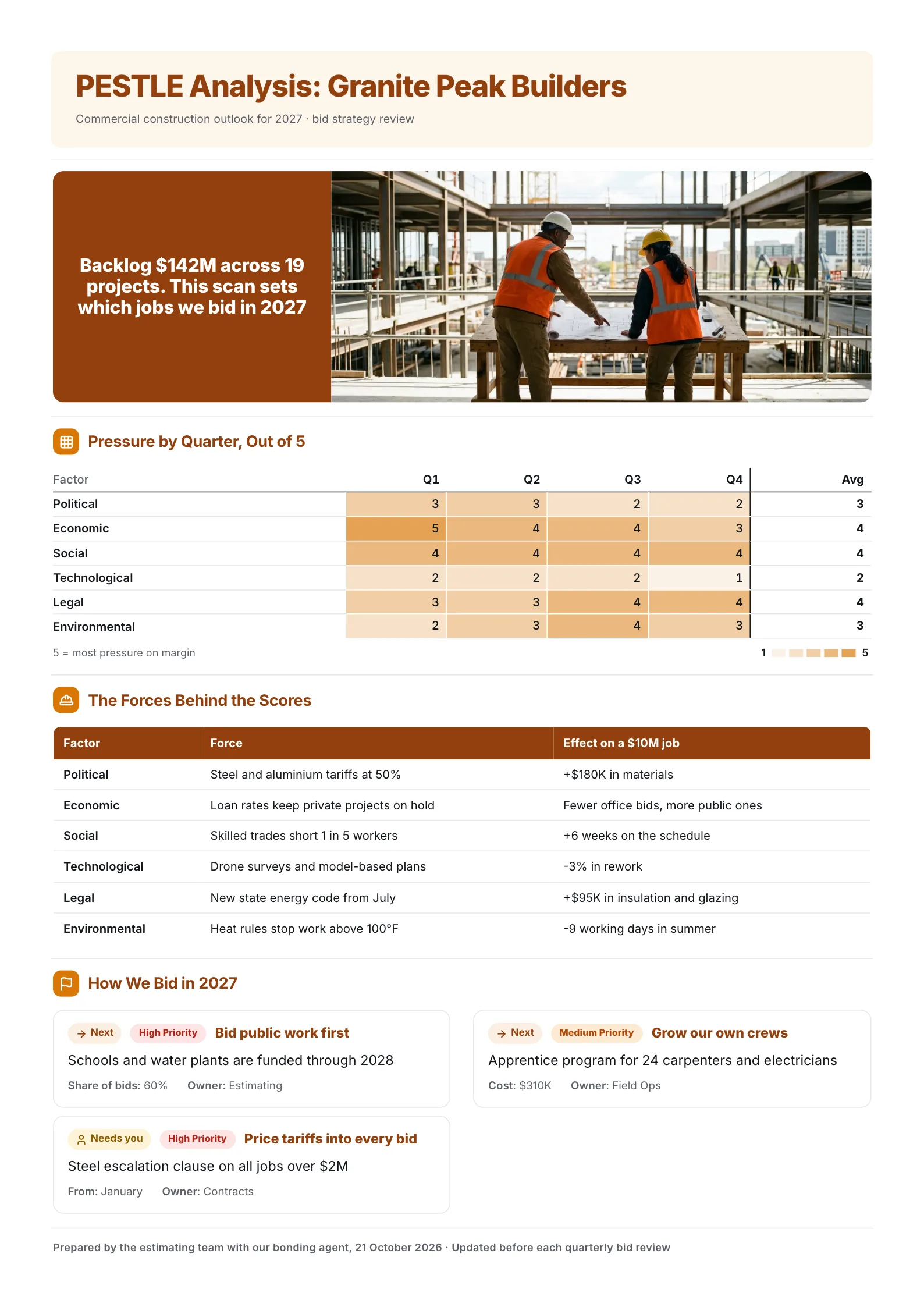
Granite Peak Builders, bid strategy. Every force here is priced on a $10 million job, which makes the table easy for you to act on. Tariffs add $180,000 in materials, and heat rules cost 9 working days in summer. The recommendations then turn the scan into how your company bids next year, starting with public work.
 Edit this template
Food bank, counts and decisions are made up for the demo.
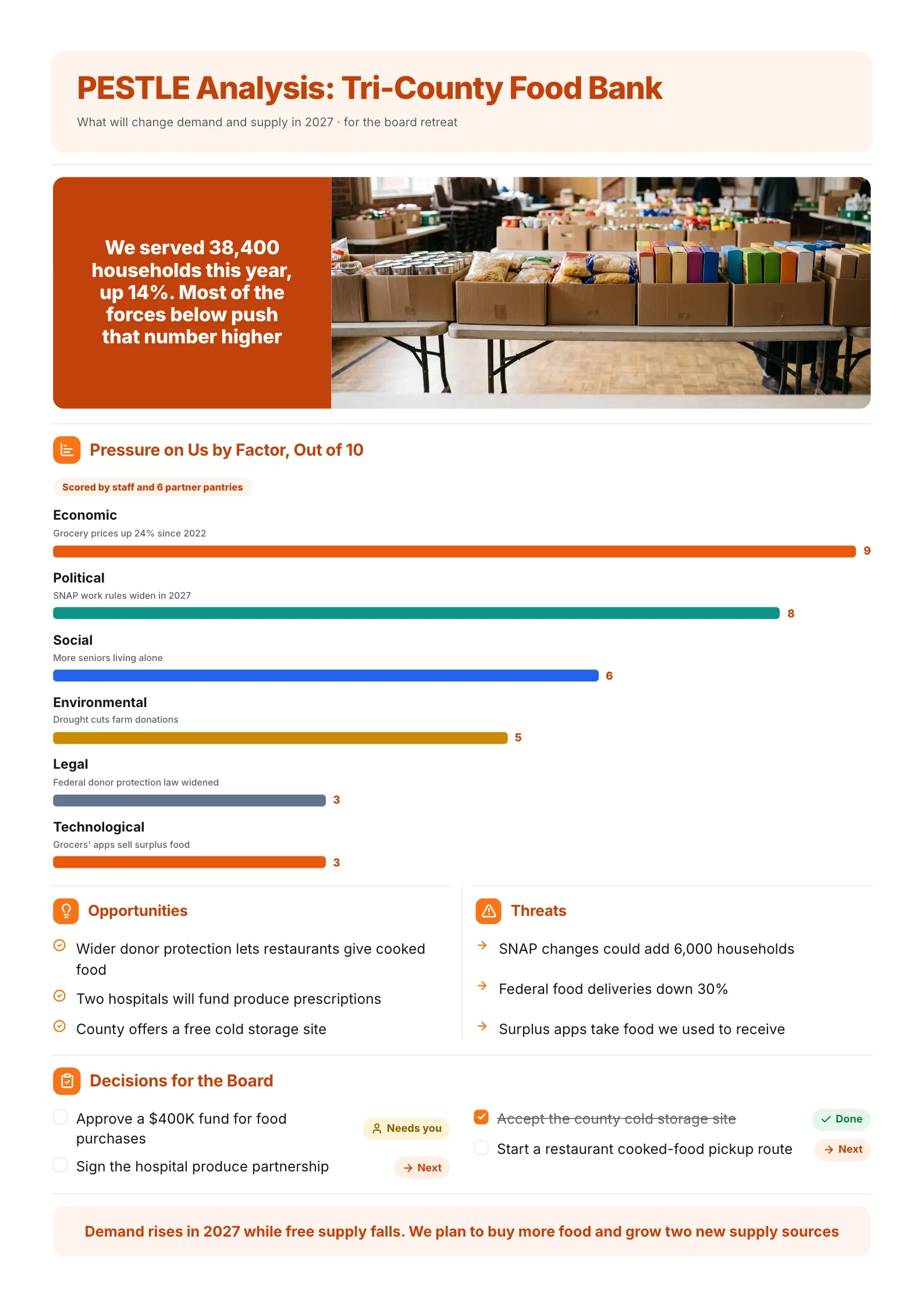
Tri-County Food Bank, board retreat. Staff and 6 partner pantries scored the pressure from each factor out of 10, and the bars sort them from economic at 9 down to legal and technological at 3. It's the clearest way to show your board which forces matter most. The page ends on four decisions, including a $400,000 fund for buying food.
 Edit this template
Café brand and city facts are samples.
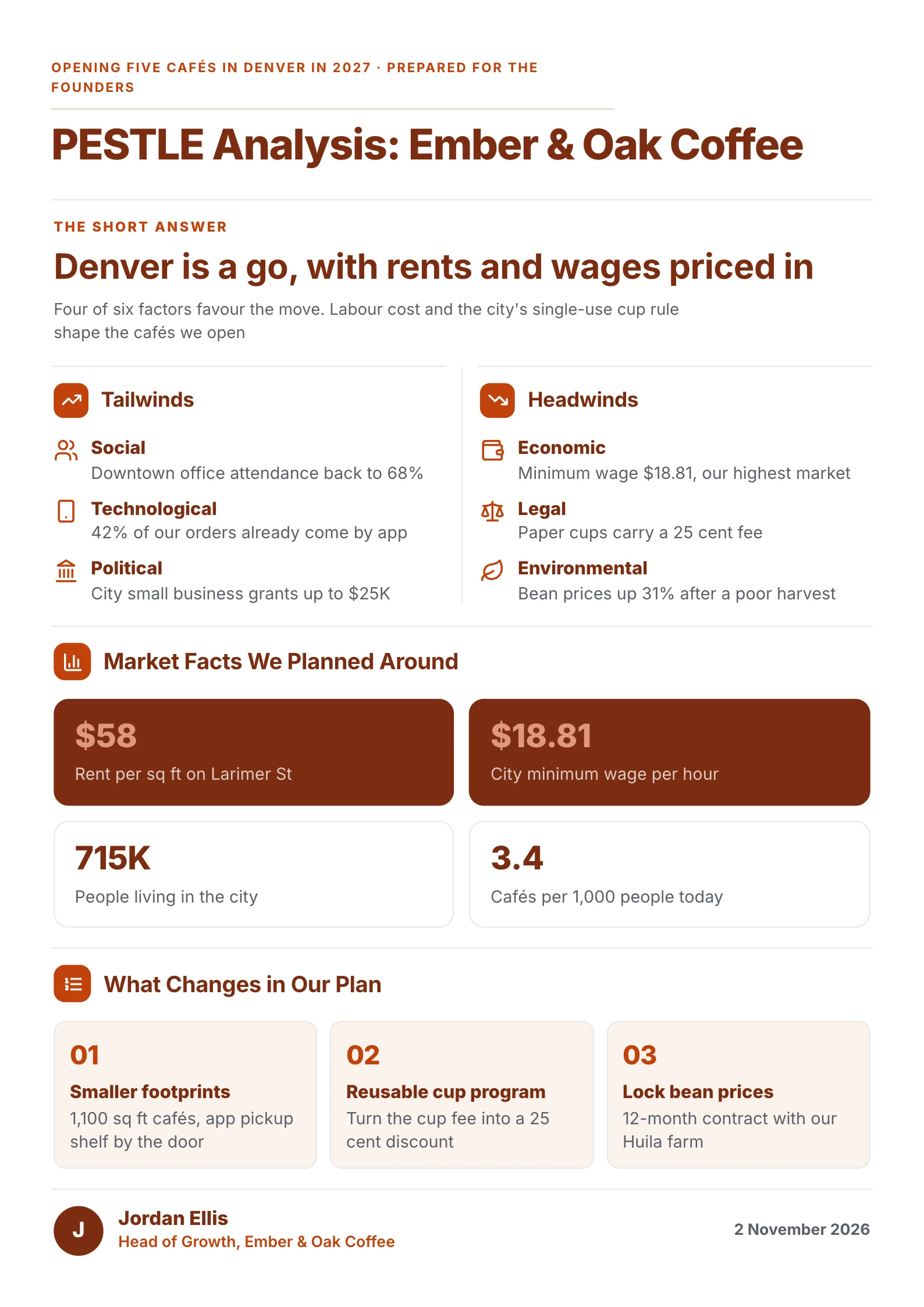
Ember & Oak Coffee, expansion. Your founders get the answer before the analysis. Three factors are tailwinds and three are headwinds, each in its own list. Each headwind turns into a change in the plan, so the 25 cent cup fee becomes a 25 cent discount for reusable cups.
 Edit this template
Student and course details are samples.
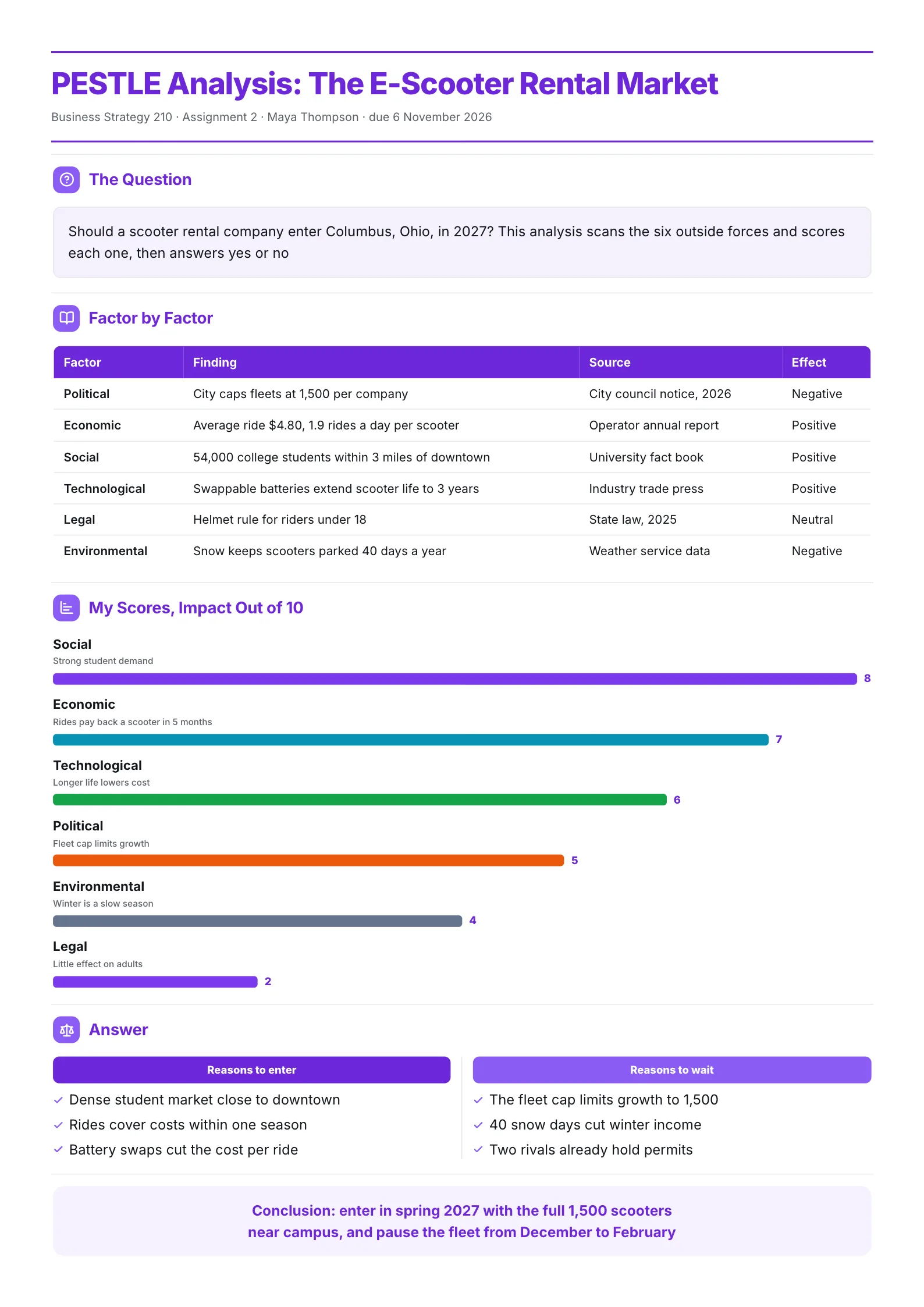
E-scooter market, class assignment. Your professor will look for sources, and this table names one for every finding, from a city council notice to weather service data. The scores and the two-column answer show the student can weigh the factors, and the conclusion picks a season to launch in.
Political
In our examples, you'll find that steel and aluminum tariffs at 50% add $180,000 in materials to a $10 million job (Granite Peak Builders).
In a published paper, the Royal Wolverhampton NHS Trust's estates strategy points to the Grenfell Tower fire in 2017, in which 72 people died, and notes that the trust replaced the cladding on its heart and lung building in 2019.
In a second paper, the Wrightington, Wigan and Leigh trust's plan summary lists "Coalition government may not exist after 2015." It's the only one of its 14 factors with a date, and it never tells you what a new government would change for the trust.
The Wolverhampton line works because it ties a national event to a building the trust owns. The Wigan line has a date and nothing after it. Your political line should do what Wolverhampton did. Name the rule or the pressure, then name the part of your plan it lands on.
Economic
In our examples, you'll see grocery prices up 24% since 2022, which the food bank scores as the biggest pressure, at 9 out of 10.
In a published paper, Wolverhampton cites the government's pledge to "deliver 40 new hospitals" and the trouble many NHS bodies have keeping staff.
In a second paper, the Wigan trust lists "On-going period of economic austerity" and "Local financial pressure will continue," with no figure on either.
All three lines point at money, but only the food bank's tells you how much it moves. Find the percentage or the dollar figure and put it in. Your reader will remember 24% long after they've forgotten "rising costs." The section after Environmental shows how much the Wigan line gains when its own number is added.
Social
In our examples, 54,000 college students live within 3 miles of downtown Columbus, from the university fact book (the e-scooter assignment).
In a published paper, Wolverhampton notes that people are living longer, and that demand for car parking keeps rising as electric vehicles arrive.
In a second paper, the Wigan trust names an "Ageing population with multi-morbidity," the same trend Wolverhampton describes, and stops before telling you what it means for beds or clinics.
The student line wins on two counts, a number and a named source. The trust's point about parking is the stronger idea, though, because it follows a social change all the way to a cost the estate will carry. Try to get both into your own lines.
Technological
In our examples, 42% of Ember & Oak's orders already come by app, which is why the new cafés get an app pickup shelf by the door.
In a published paper, Wolverhampton describes remote consultations by text and video, and a move toward 5G, touch-screens and Wi-Fi registration that the buildings will need to keep up with.
In a second paper, the Wigan trust notes video conferencing and telemedicine "all being widely used," which tells you the trend and leaves you guessing what the trust will buy.
The coffee line is short and finishes with a design choice you can see. The trust's line looks further ahead. For your own scan, a technology factor is only useful once it says what you'll build, buy or change because of it.
Legal
In our examples, a new state energy code from July adds $95,000 in insulation and glazing to a $10 million job (Granite Peak Builders).
In a published paper, Wolverhampton notes that HSE attention on slips, trips and falls has cut claims in that area, and that buying rules may change as the UK leaves EU procurement law behind.
In a second paper, the Scottish Parliament leadership paper is a prompt sheet that leaders read before a strategy workshop, so it lists what to look for. Under legal, it asks its leaders to think about procurement and contracts "in a new regulatory set up in UK post BREXIT," the same change Wolverhampton flags.
Legal factors are often the easiest for you to date, because a law has an effective date. Use it. "From July" tells your estimator exactly which bids carry the extra cost.
Environmental
In our examples, storm hardening adds $22,000 to each charging site in Georgia (VoltRoute), and heat rules stop work above 100°F for 9 days each summer (Granite Peak).
In a published paper, Wolverhampton cut its carbon footprint 16% from the 1990 baseline by 2015, against an NHS requirement of 34% by 2020, on the road to carbon neutral by 2050.
In a second paper, the Scottish Parliament prompt sheet puts "net zero targets" and "Pandemics and other emergencies" under environmental, so this letter can cover sudden shocks as well as carbon.
This is the one letter where a published paper beats most of your likely examples on numbers. It gives a baseline, a result, a target and a deadline. If your environmental factor has a target attached, lay it out the same way so your reader can see the gap.
One vague line, rewritten with its own numbers
Here's the fix for the Wigan economic line, done in full, using only numbers printed in the same plan. The PEST table on page 11 says "Local financial pressure will continue." Six pages later, the plan says the local commissioning group's "starting point is to reduce spend on services at WWL by up to £69 million over five years." The trust disagrees and calls a cut of up to £25 million more realistic. On page 22, it expects its new model of care to save £20 to £25 million.
Put those together and the vague line becomes something your board can act on:
| Version | The economic line |
|---|---|
| As printed in the PEST table | Local financial pressure will continue |
| With the plan's own numbers | The commissioning group wants to cut its spend with us by up to £69 million over five years. We think a cut of up to £25 million is more realistic, and our new care model should save £20 million to £25 million. |
| With what it does to the plan | If the commissioning group holds at £69 million, £44 million to £49 million is left that our care model can't save, so both sides must agree what the hospital will provide before the budget is set. |
The last row is the one for you to aim for. It names the force, gives the number, sets the time frame and says what changes in the plan. The arithmetic is plain subtraction, £69 million less the £20 million to £25 million the new care model is expected to save. Every number was already in the document. It just wasn't in the PEST table, where you'd look first if you were reading for risks.
Try the same with your own draft. For each line, search the rest of your plan, your budget or your board papers for a figure that belongs beside it. You'll often find it's already there.
How many factors to list
There's no fixed number. Here's how the five sources we read handle it.
| Source | How it's laid out | Factors listed |
|---|---|---|
| Wrightington, Wigan and Leigh NHS strategic plan summary | Four boxes, with no legal or environmental box | 14 (3, 4, 3 and 4), one with a date |
| Royal Wolverhampton NHS estates strategy | All six letters, written as prose | About 2,300 words in section 3.4 |
| Carroll Community College handout | Four rows, political with legal and social with environmental, across 1, 3 to 5 and 10 years | A grid of 12 cells |
| Scottish Parliament leadership paper | A named lead for each area, political and legal combined | Gathered in breakout groups |
| CIPD factsheet | A blank template plus an example for a made-up retailer | Six headings |
Our five examples stay on one page. The coffee shop lists 6 factors, one per letter. The student assignment has 6 rows with a source on each, and the VoltRoute canvas has 2 lines for each letter, 12 in all.
So a one-page PESTLE holds 6 to 12 lines, one or two per letter. If you find yourself writing a third line under a letter, check whether it changes your decision. If your decision stays the same without it, move it to your appendix.
It's also fine to merge two letters when you have little to say about one of them. Two of the five sources above do it, and both put political and legal in the same row.
PESTLE analysis FAQ
What's the difference between PEST and PESTLE?
PEST covers four kinds of outside force. PESTLE adds legal and environmental, so you get six. The Wigan trust's plan above is a PEST, with four boxes and no legal or environmental factors at all.
Should a PESTLE analysis include scores?
Scores help when you're comparing options or ranking pressures. The food bank scores each factor out of 10, and VoltRoute scores three states out of 5 on each factor. If your PESTLE describes one setting with no choice to make, a short effect line can do the job instead.
How often should you update a PESTLE analysis?
Whenever the decision it supports comes up again. Granite Peak's page says it's updated before each quarterly bid review, and the Carroll Community College handout looks out 1, 3 to 5 and 10 years. Our guide on how to write a PESTLE analysis covers the steps in order.
Should you do a PESTLE or a SWOT first?
The PESTLE, in both published papers above that use the pair. The Wigan trust's plan sets its PEST table on page 11 and its SWOT table straight after it, then reads the two together and names its strong brand and its new buildings as the openings to use. The Scottish Parliament's leaders ran a PESTLE "with a SWOT lens" in breakout groups, then carried the shared themes into a talk on whether their strategy still held. The order works because the outside forces you list in a PESTLE become the opportunities and threats half of a SWOT analysis.
Fourteen factors, one date
Wigan's plan lists 14 outside forces, and only the one about the government after 2015 says when it might arrive. The other 13 could describe almost any trust in almost any year. A date is what lets your board plan around a force, and it's why Wolverhampton's carbon line, with one target for 2020 and another for 2050, reads like a plan rather than a worry.
Go through your own draft with a pen and write a month or a year beside every line you can. Whatever won't take a date or a number is usually background, so leave it off the six rows you fill in MakeOnepagers.




