How to Write a PESTLE Analysis That Scores Its Factors
We read 4 published PESTLE analyses from an NHS board and three universities. One listed 20 factors, and only 2 of them had a number.

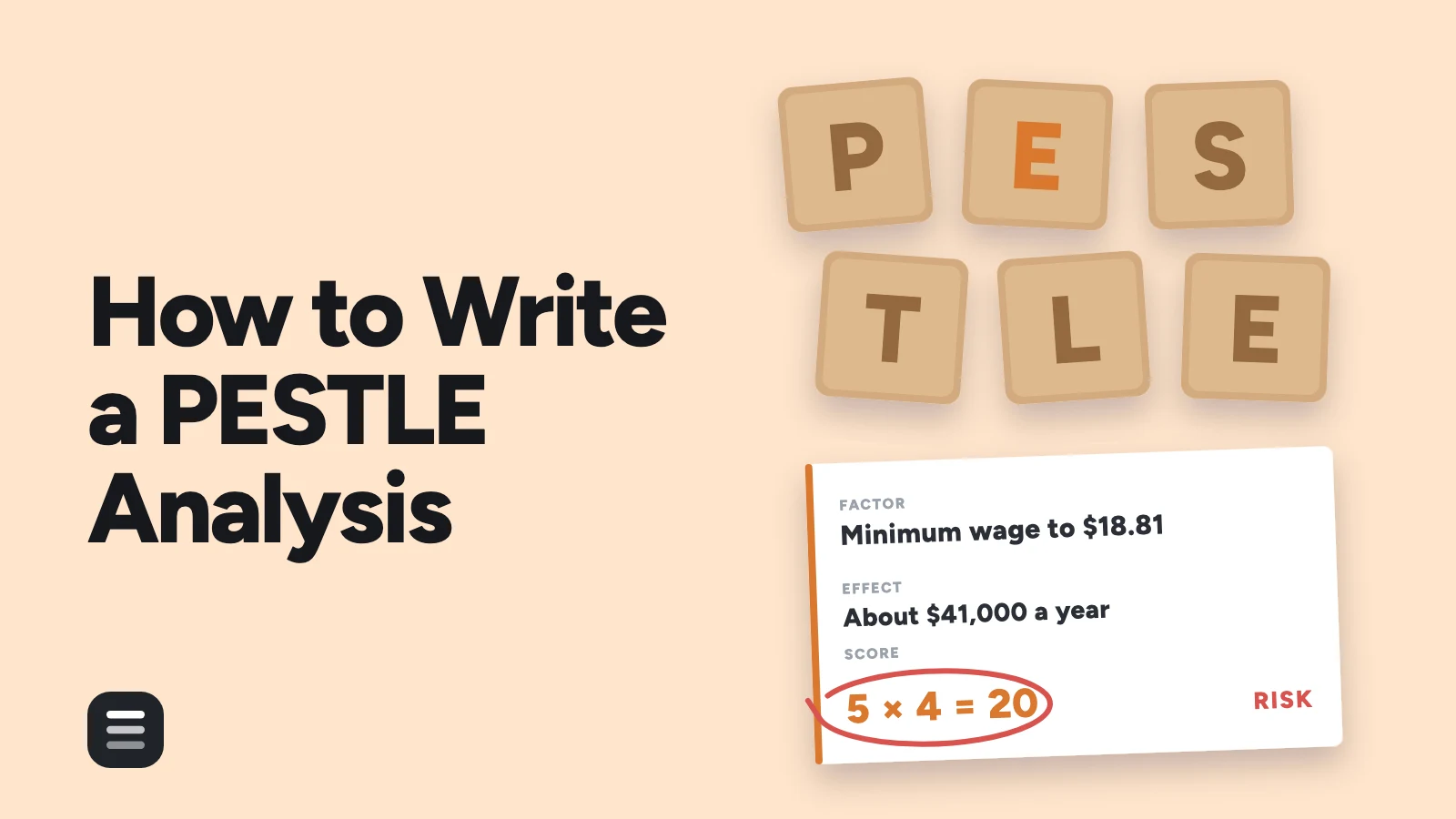
PESTLE stands for political, economic, social, technological, legal and environmental. Each letter is a heading for the forces outside your control that could help or hurt a plan. Filling six boxes is easy. Picking the three facts that should change your decision takes more work. This guide shows how to write a PESTLE analysis around those three. Start from a free one pager template.
One‑Pager examples
Real One-Pagers made with MakeOnepagers. Open any one to edit it as your own.
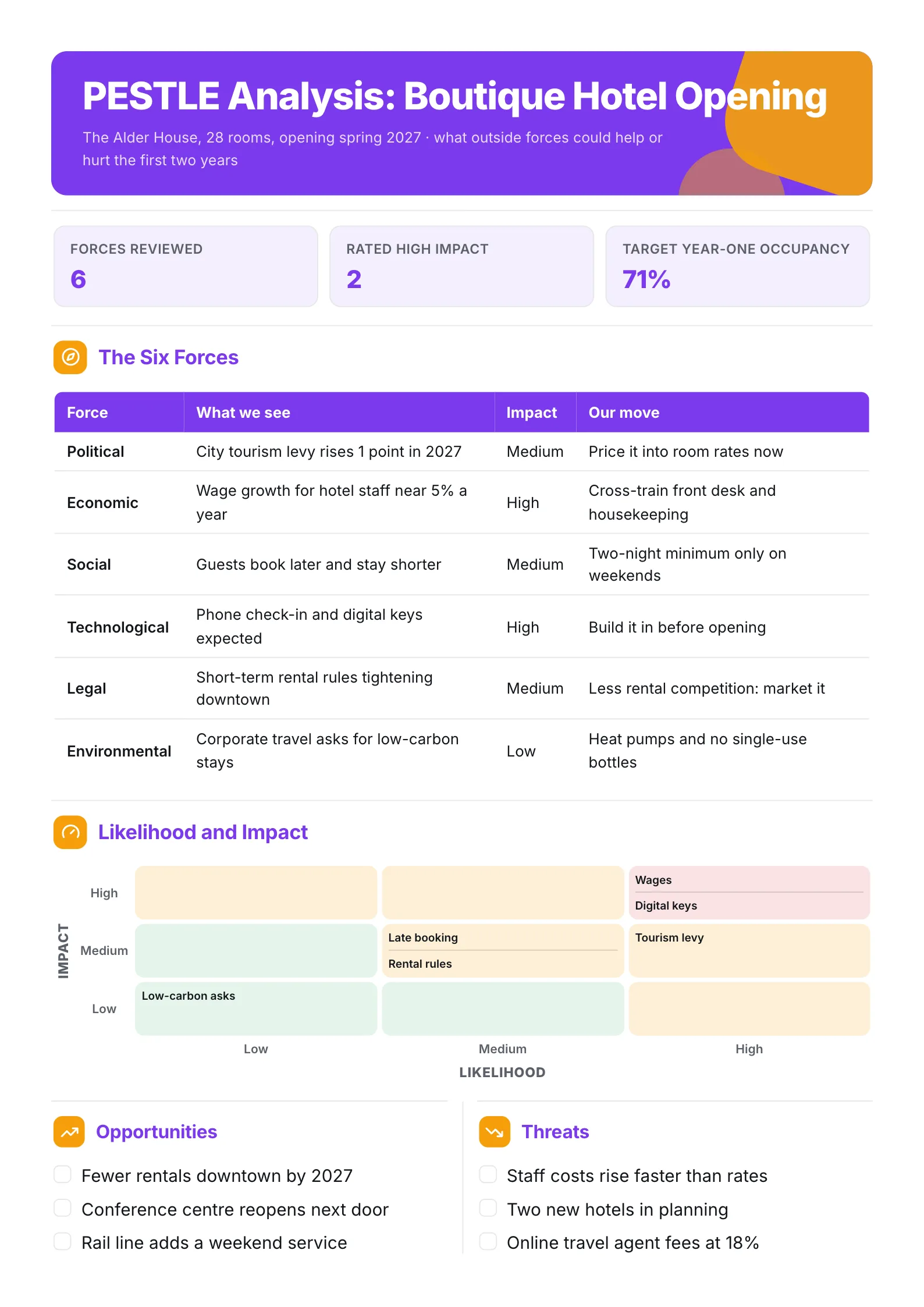 PESTLE Analysis: Boutique Hotel OpeningEdit for free(opens in a new tab)
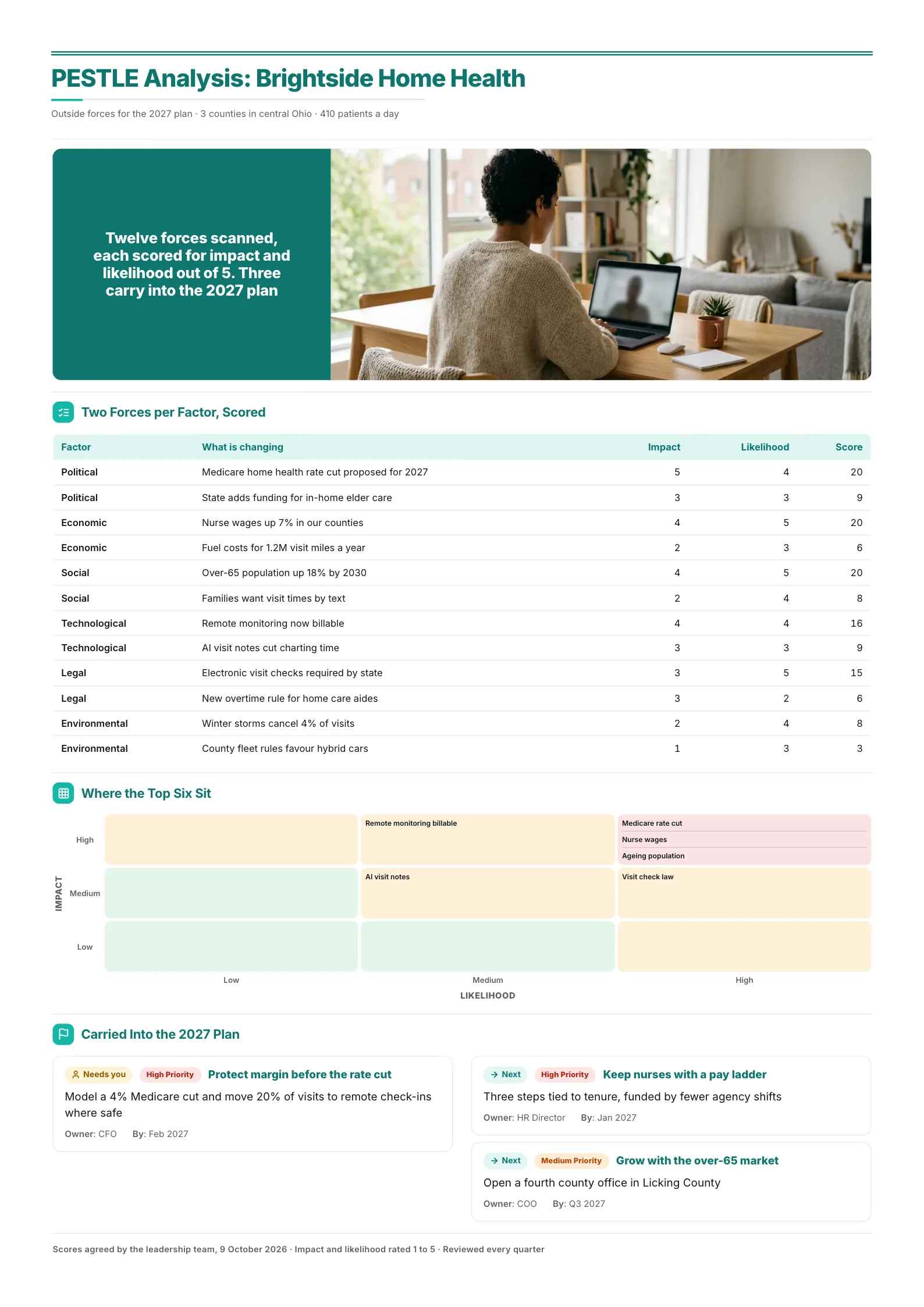 PESTLE Analysis: Home HealthEdit for free(opens in a new tab)
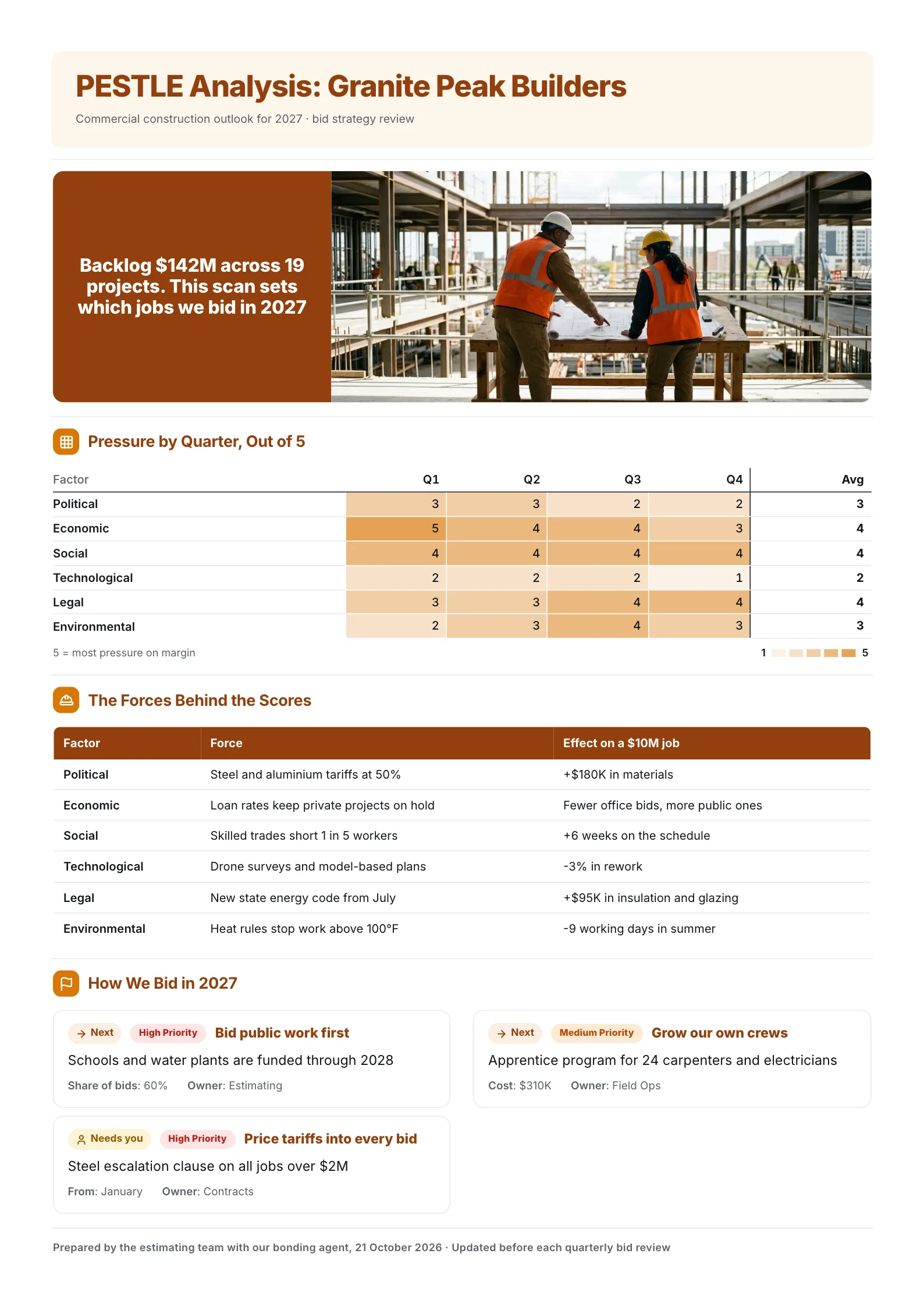 PESTLE Analysis: Construction CompanyEdit for free(opens in a new tab)
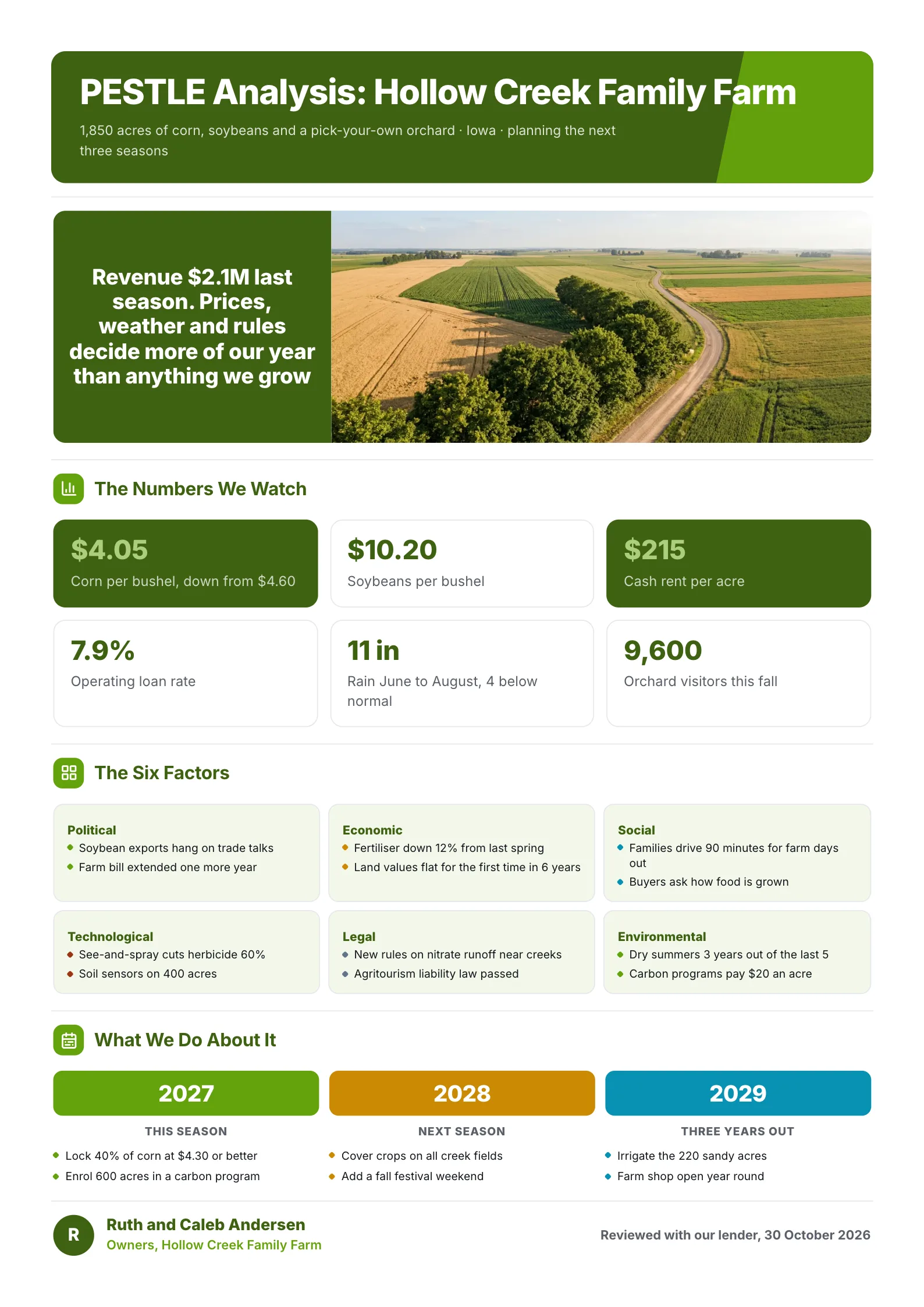 PESTLE Analysis: FarmEdit for free(opens in a new tab)
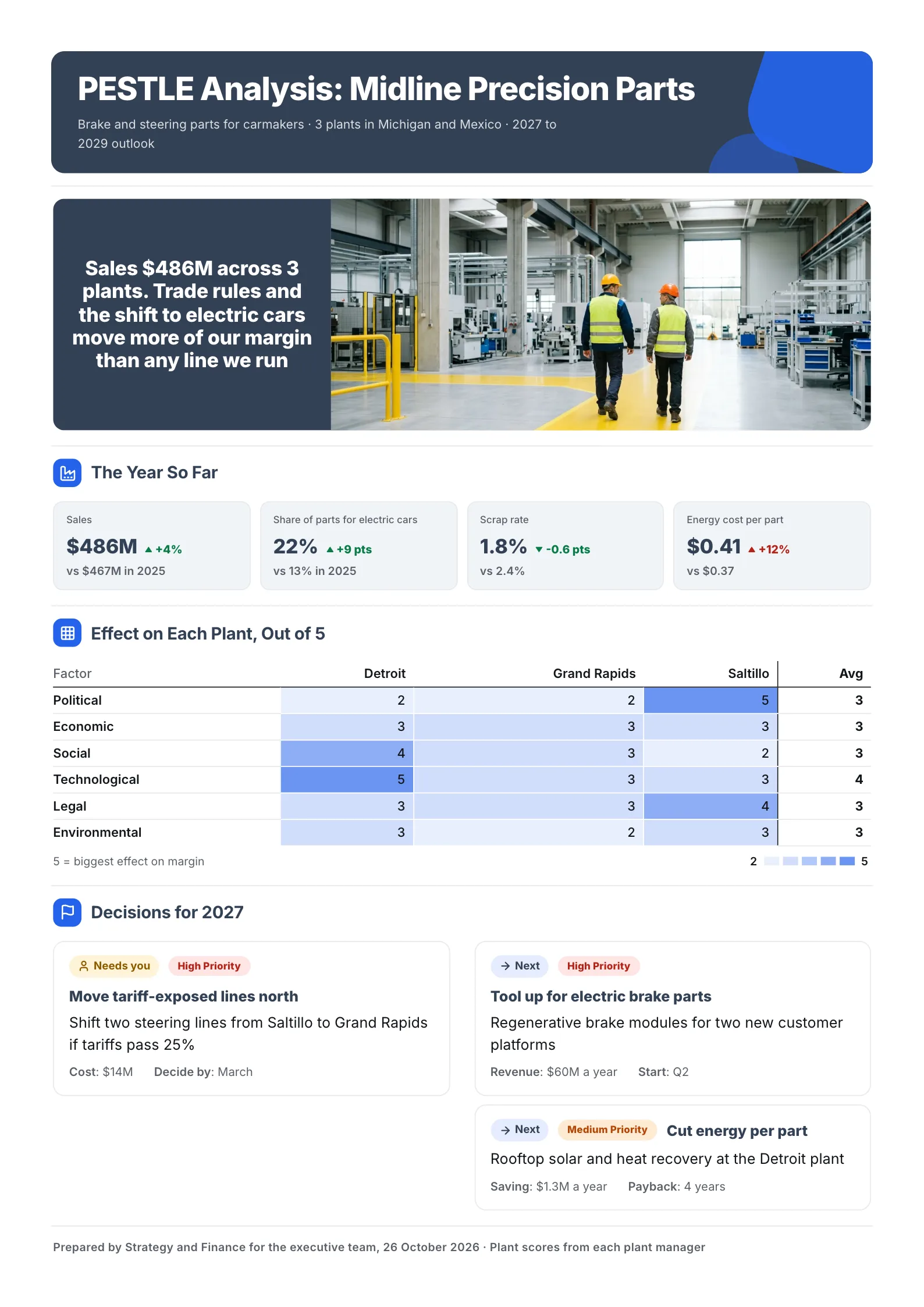 PESTLE Analysis: ManufacturingEdit for free(opens in a new tab)
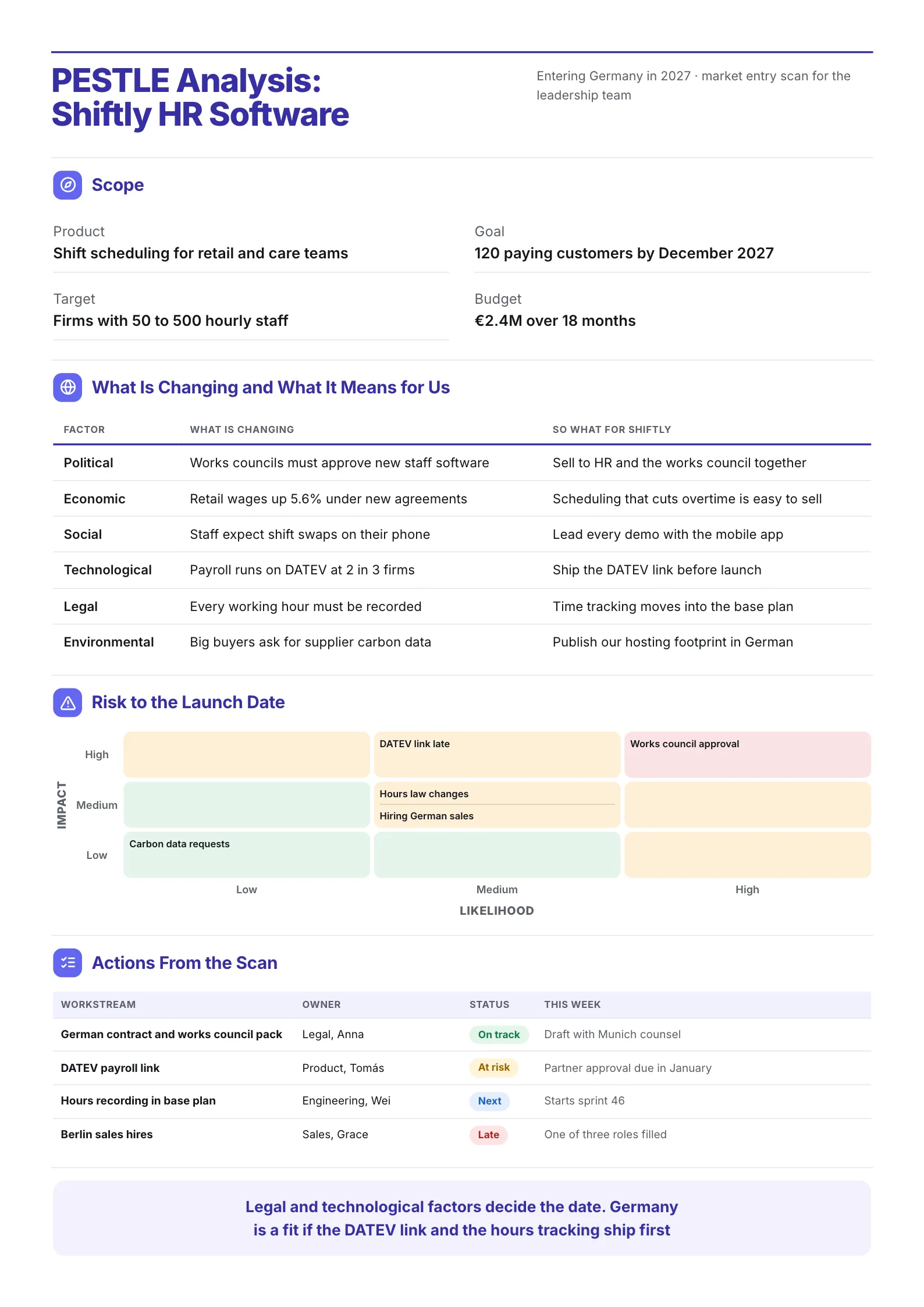 PESTLE Analysis: International ExpansionEdit for free(opens in a new tab)
We read 4 PESTLE documents that real organizations published. One is a one-page appendix from an NHS care board in North East England. One is a 7-page analysis from the University of Worcester. The other two are a 4-page guide from the University of Cambridge and a year-end report from Utah Valley University. The NHS board's page listed 20 factors, and only 2 of them had a number. Worcester's was the only one that split every factor into risks and opportunities.
What 4 published PESTLE documents include
| What it includes | NHS NENC board | Worcester | Cambridge guide | Utah Valley |
|---|---|---|---|---|
| All six letters | Yes | Yes | Yes | Yes |
| A number on most factors | No, 2 of 20 | No | Not a filled analysis | Not shown |
| Each factor as a risk and an opportunity | No | Yes | No | No |
| Each letter split into outside and inside | No | Yes | No | No |
| Steps for gathering the facts | No | No | Yes, nine steps | Yes, a working group per letter |
| Fed into a SWOT or a plan | No | No | Tells you to, with SWOT or Porter's Five Forces | Yes, with Porter's Five Forces |
Source: MakeOnepagers read of 4 published PESTLE documents, October 30, 2026. Each one is linked in the next section.
So the published ones are good at listing forces and weak at weighing them for you. The 6 steps below keep the six boxes and add the two things most of them skip, a number and a score.
Where the 4 PESTLE documents come from
| Document | Pages | Who made it |
|---|---|---|
| Appendix 3, PESTLE analysis of the operating environment | 1 | NHS North East and North Cumbria Integrated Care Board |
| PESTLE Analysis | 7 | University of Worcester |
| PESTLE model | 4 | University of Cambridge |
| UPAC 2021-22 Year-End Report | 6 | Utah Valley University Planning and Advisory Committee |
We downloaded all four on October 30, 2026, and counted every factor and number by hand. Cambridge's is a guide with sample headings, so it has no filled-in factors to count.
Step 1: Start from the decision the PESTLE is for
If your PESTLE has no decision behind it, it turns into a list of everything happening in the world. So write one line at the top. "Should we open a second coffee shop downtown in 2027?" is a decision. "Our market" isn't.
Also set the area and the time frame. A city, a state or a country gives you a border for the research. Pick a window too, like three to five years, so everyone on your team researches the same stretch of time.
The Utah Valley planning committee used its PESTLE for one job. It fed a SWOT analysis that shaped the university's strategy, and the summary went to the president and her cabinet.
Step 2: Split the research by letter
Cambridge's guide gives nine steps, and the first two are about people and sources. Decide how the information will be collected and by whom, then find the right sources. Utah Valley's committee did this by splitting into small working groups, one per PESTLE area. Each group wrote a summary for the co-chairs.
With a small team, you can split the work the same way. Give each person one or two letters and a deadline. Point them to sources like government statistics, new laws and bills, trade groups and your own sales data. Cambridge's model lists sample headings under each letter, from tax policy and interest rates to population growth and minimum wage.
Step 3: Write each factor as a fact with a number
Read the NHS board's appendix and most factors are true but general, like an aging population or budget pressure. Only two carry a number. One says boards are expected to cut running costs by 50% by the third quarter of 2025/26, or 32% for this board. The other notes the area covers fourteen local authorities.
Write yours with a number and a date wherever you can. A line like "the city minimum wage rises to $18.81 in January" tells your reader something. "Labor costs are rising" doesn't. A factor with no number still gets its source and the date you checked it, so your next reader can update it.
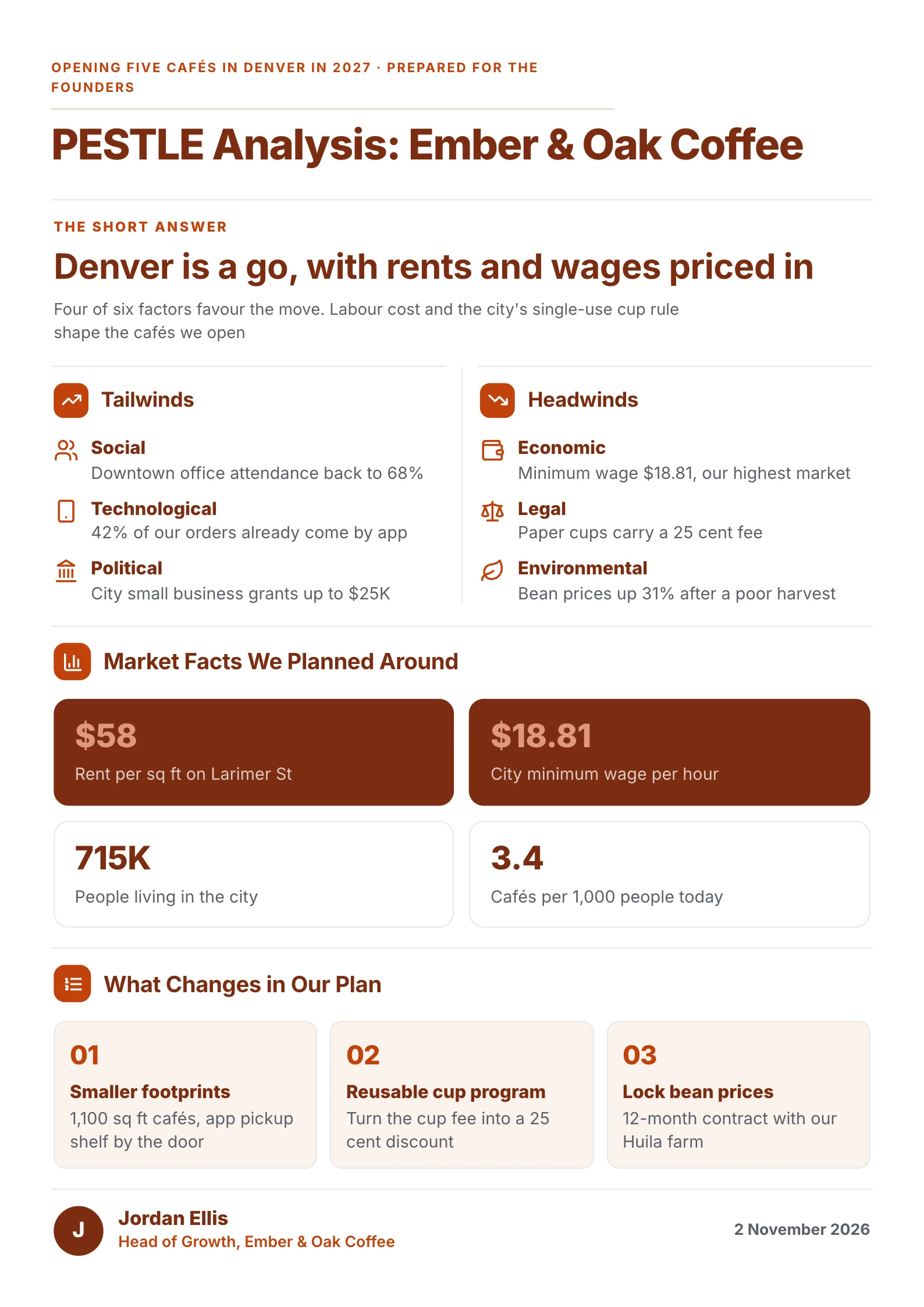 Edit this template
Sample names and figures. Every factor carries a number, so the go verdict at the top has something to stand on.
Step 4: Mark each factor as a risk or an opportunity
The same fact can cut both ways for you. A new energy tax raises your costs, and it might also make your efficient product more attractive. Worcester's analysis handles this with two columns beside every issue, associated risks and associated opportunities. Under changes to taxes, for example, it says a rise could reduce funding but might also push the university to use less energy.
Worcester also splits each letter in two, external and internal. Most guides treat PESTLE as outside forces only, and Cambridge calls it an audit of an organization's environment. Inside issues, when your team wants them, get their own row so they don't blur into the outside ones.
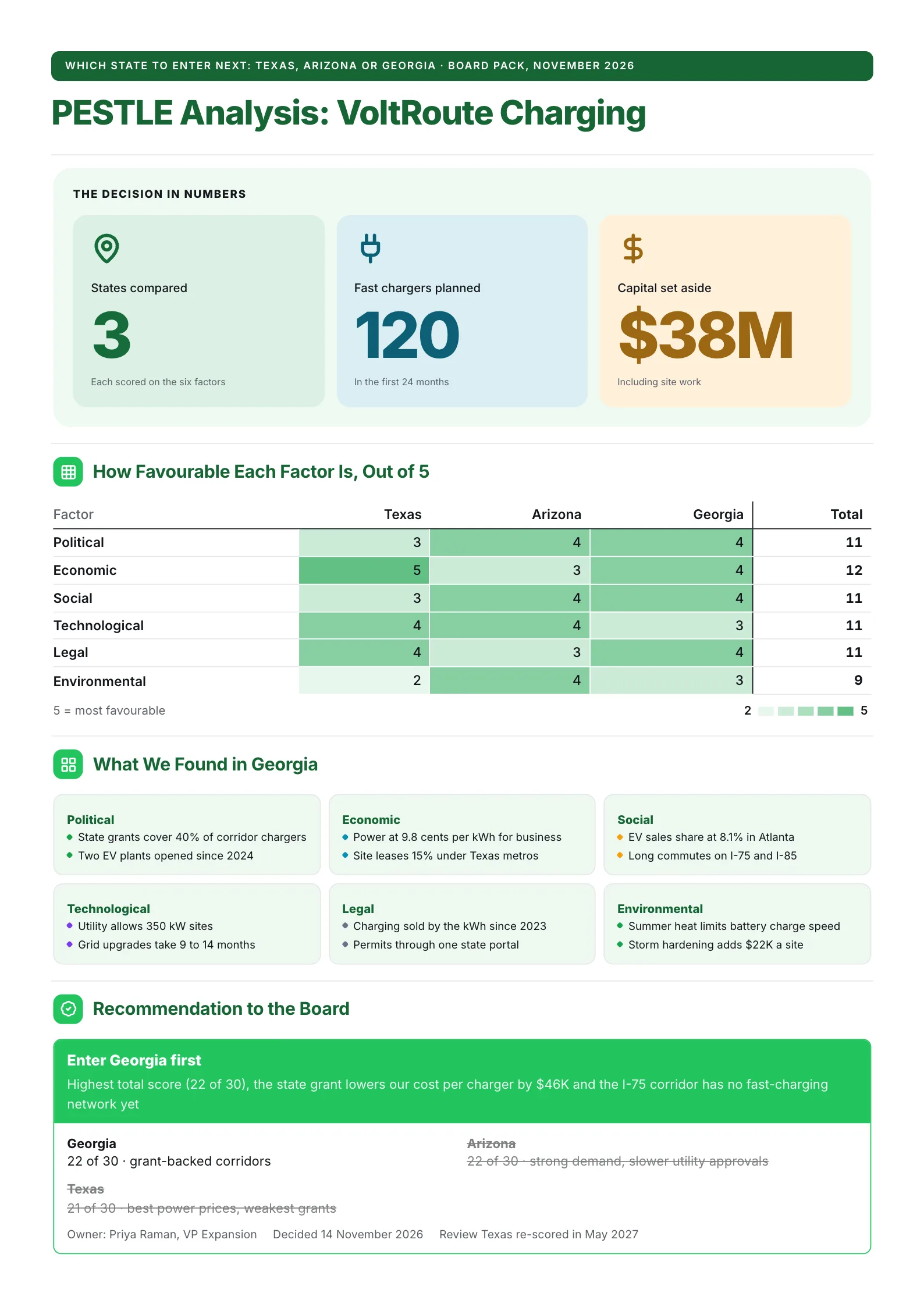 Edit this template
Sample names and figures. Scoring three states on the same six factors turns the PESTLE into a side-by-side choice.
Step 5: Score the factors and pick the top few
Cambridge's fifth step is to identify the most important issues. None of the four documents shows a scoring method, so pick a simple one. Rate each factor on how likely it is and how much it would hurt or help, from 1 to 5. Multiply the two. Anything at 15 or higher goes to the top of the page.
Ask more than one person to score. Your finance lead and your store manager will see the same tax change very differently. Then talk through the biggest gaps between their scores.
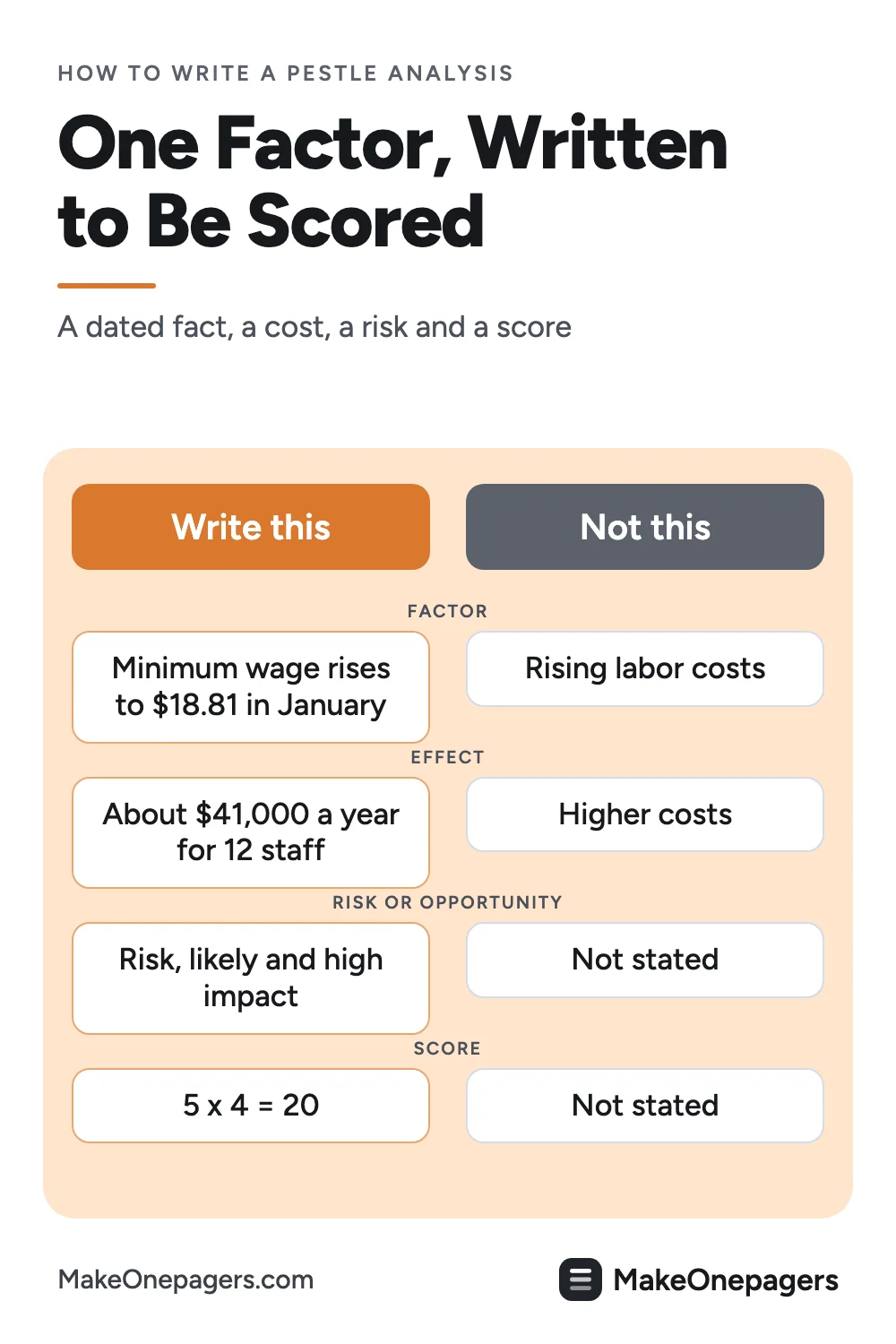
Here's one factor carried through steps 3 to 5, so you can see what each step adds. The figures are made up, for a café with 12 staff.
| What you write | General version | Full version |
|---|---|---|
| Factor | Rising labor costs | The city minimum wage rises to $18.81 in January |
| Effect | Higher costs | Adds about $41,000 a year for 12 staff |
| Risk or opportunity | Not stated | Risk, likely and high impact |
| Score | Not stated | 5 x 4 = 20 |
| Action | Not stated | Raise drink prices 4% and add a kiosk |
The general version is true, but it gives you nothing to do. The full one scores 20, so it lands at the top of your page with an action beside it.
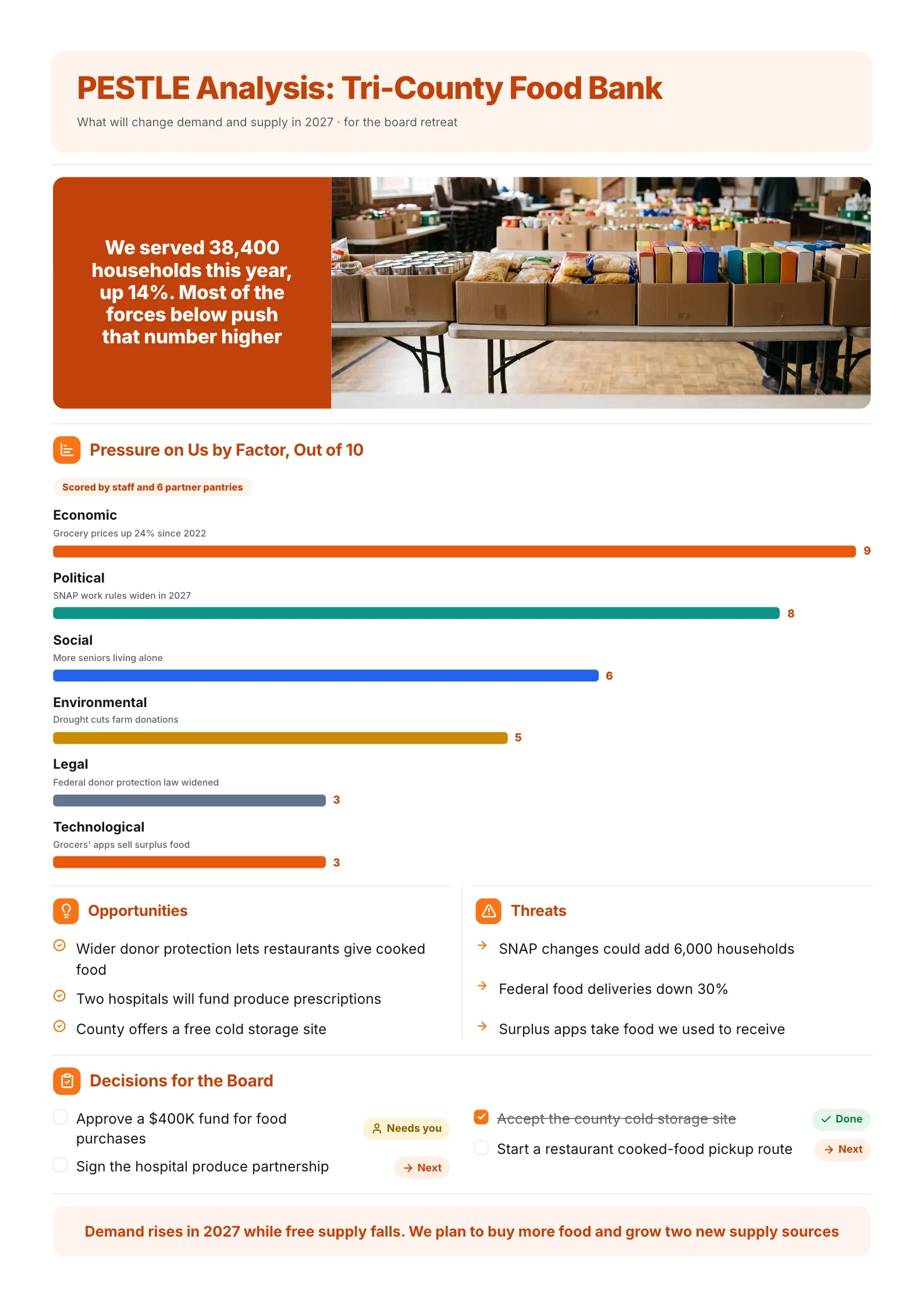 Edit this template
Sample names and figures. Staff and 6 partner pantries scored each factor out of 10, and the board's decisions sit at the bottom.
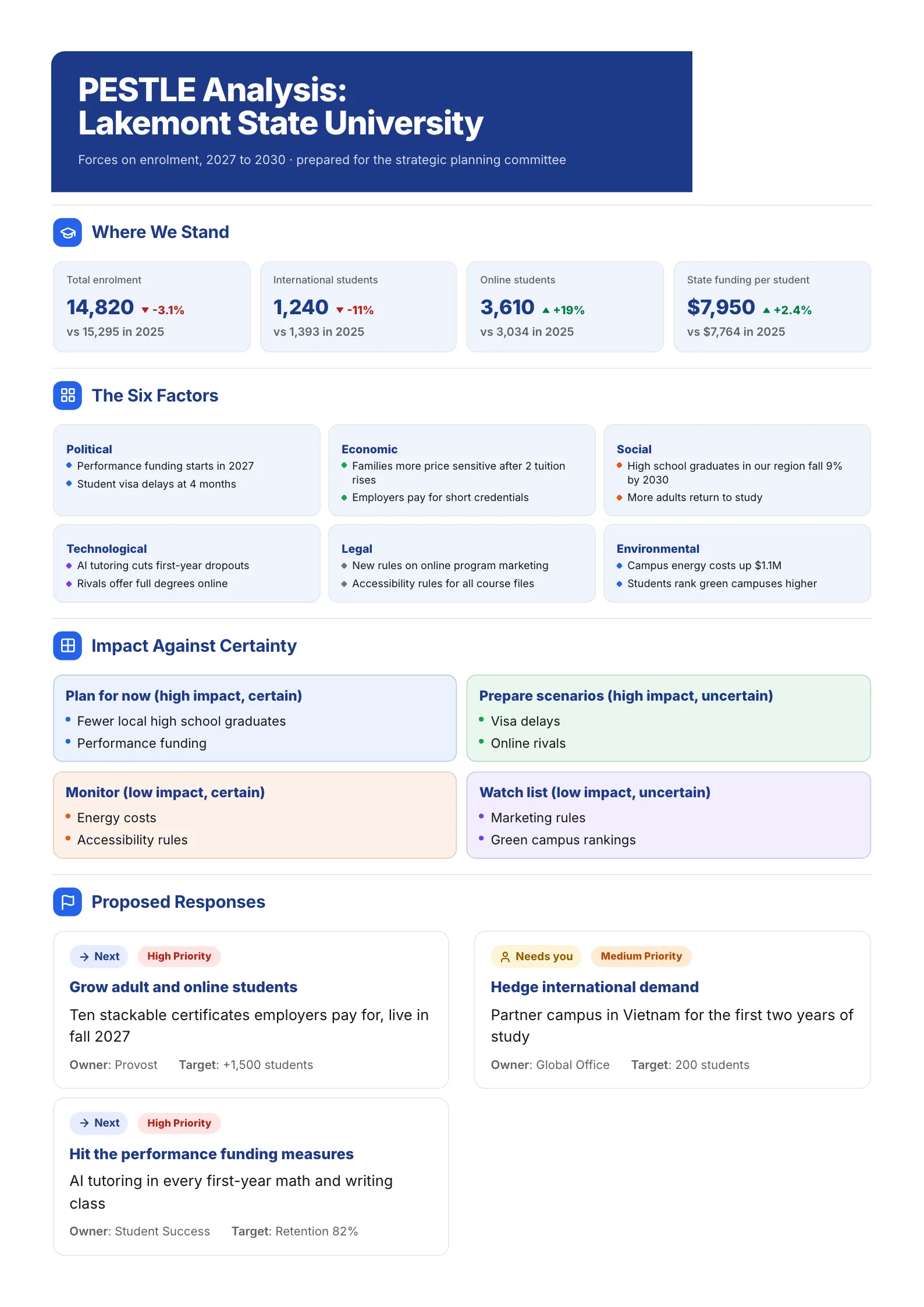 Edit this template
Sample names and figures. Three enrollment numbers sit at the top, and each factor below explains one of them.
Step 6: Carry the top factors into your plan
A PESTLE is an input. Cambridge's guide tells you to use it alongside tools like SWOT and Porter's Five Forces. Utah Valley's committee did exactly that, with a PESTLE, then Porter's Five Forces, then an internal review. It combined all three into a SWOT that set what the university would focus on.
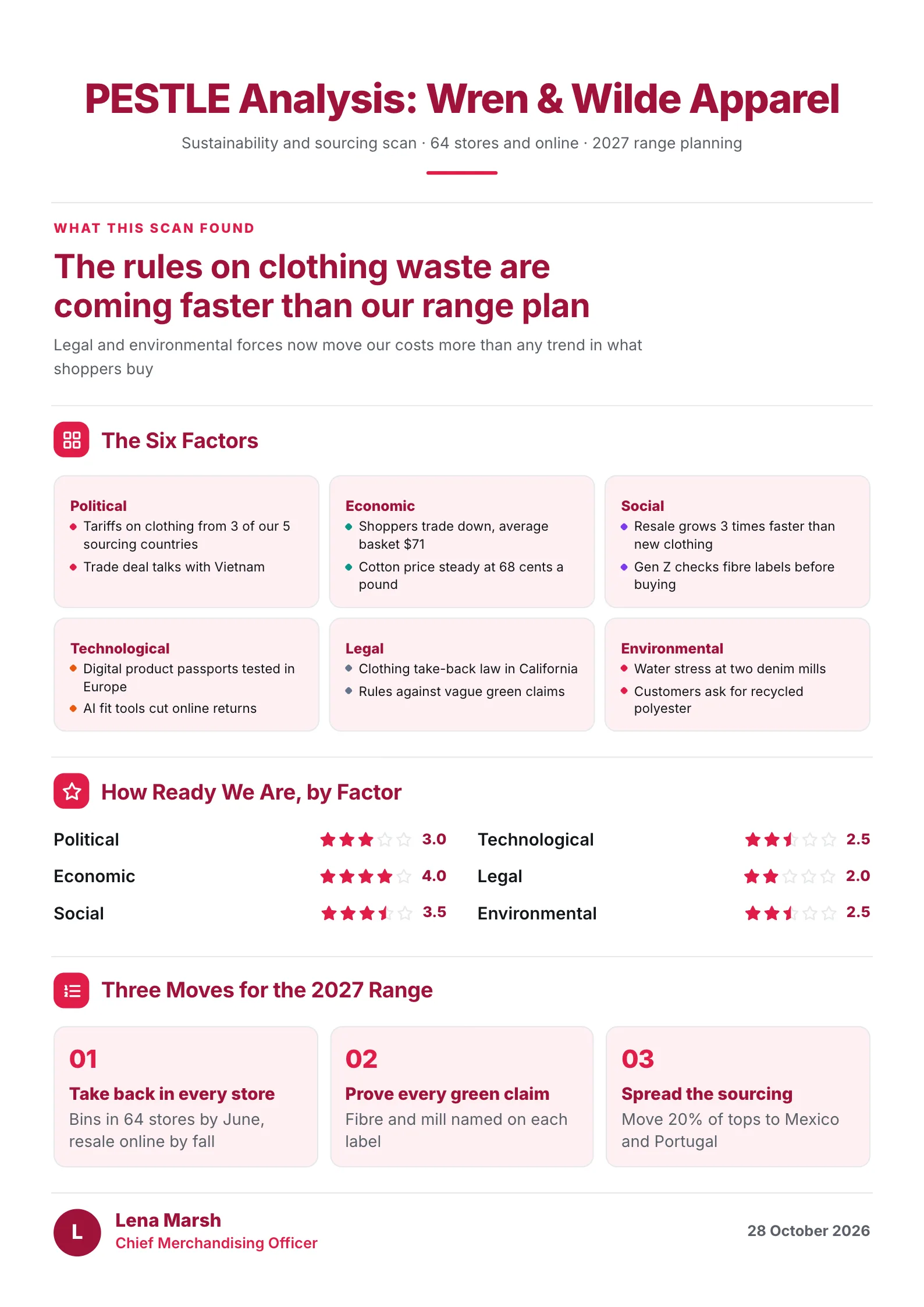
You can keep it lighter. Take your top three to five factors and write one action for each. A tariff on three of your five supplier countries might mean pricing a new supplier this quarter. Put the date you'll review the PESTLE again at the bottom of the page. Six months is a sensible gap for most teams.
 Edit this template
Sample names and figures. The scan ends in three dated moves, so the PESTLE leads straight into the range plan.
Six boxes, one page, three actions
The NHS board fit its whole PESTLE on one page, and that's a good target. Use a row or a column per letter, two to four factors in each and a score beside every factor. Put the decision at the top and the top three actions at the bottom.
Open a PESTLE design in MakeOnepagers and you'll find six boxes with room for a score beside each factor, a verdict line and an action strip at the bottom. You'll find filled-in layouts in our PESTLE analysis template post. Our SWOT analysis guide picks up where this one ends, so you can weigh your own strengths against these forces.
Run your PESTLE before the planning meeting
Write the decision at the top and give each teammate one or two letters. Ask for facts with numbers and dates. Mark each as a risk or an opportunity, score them together and carry the top three into an action list. Put the scored factors on one page in MakeOnepagers and hand it out before the planning meeting.
Frequently asked questions
What is the difference between PEST and PESTLE?
PEST covers political, economic, social and technological factors. PESTLE adds two more, legal and environmental. Use PESTLE when laws or climate and resources could change your plan, which is true for most businesses.
How many factors should each letter have?
Two to four is plenty for a one-page PESTLE. The NHS board's page had three or four under each letter, 20 in all. More than that and the important ones get lost.
Is PESTLE only about outside factors?
Usually, yes. Cambridge and Utah Valley treat it as a scan of the outside world. Worcester added an internal row under each letter. If you do that, keep inside and outside factors on separate lines.
Should a PESTLE come before a SWOT?
It often does. Utah Valley's committee ran its PESTLE first and fed it into a SWOT. The PESTLE gives you the opportunities and threats, and your own review gives you the strengths and weaknesses.




