Performance Review vs Appraisal: What 5 Government Rulebooks Say
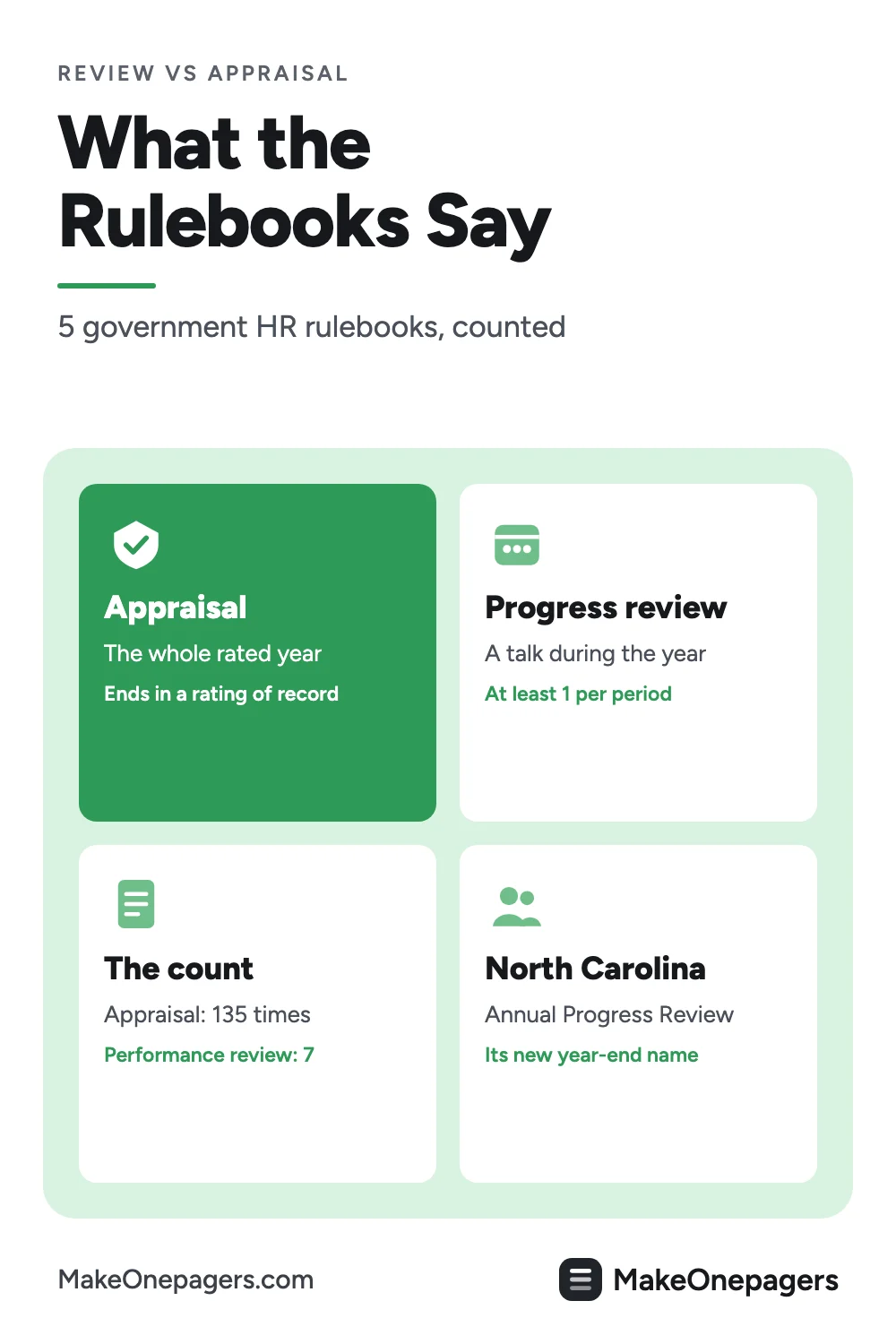
Performance review vs appraisal: we counted both words in 5 government HR rulebooks. Appraisal shows up 135 times, performance review 7. Here's what each means.

In everyday use, a performance review and a performance appraisal are the same thing. Your manager looks back at your work and writes it down. In the rulebooks that run public employers, the two words split. The appraisal is the whole rated year, from the plan at the start to the official rating at the end. A review is usually a conversation along the way. We counted both words in 5 government HR rulebooks. "Appraisal" shows up 135 times, and "performance review" only 7. The federal rule uses appraisal 76 times and performance review 0 times. Start from a free one pager template.
One‑Pager examples
Real One-Pagers made with MakeOnepagers. Open any one to edit it as your own.
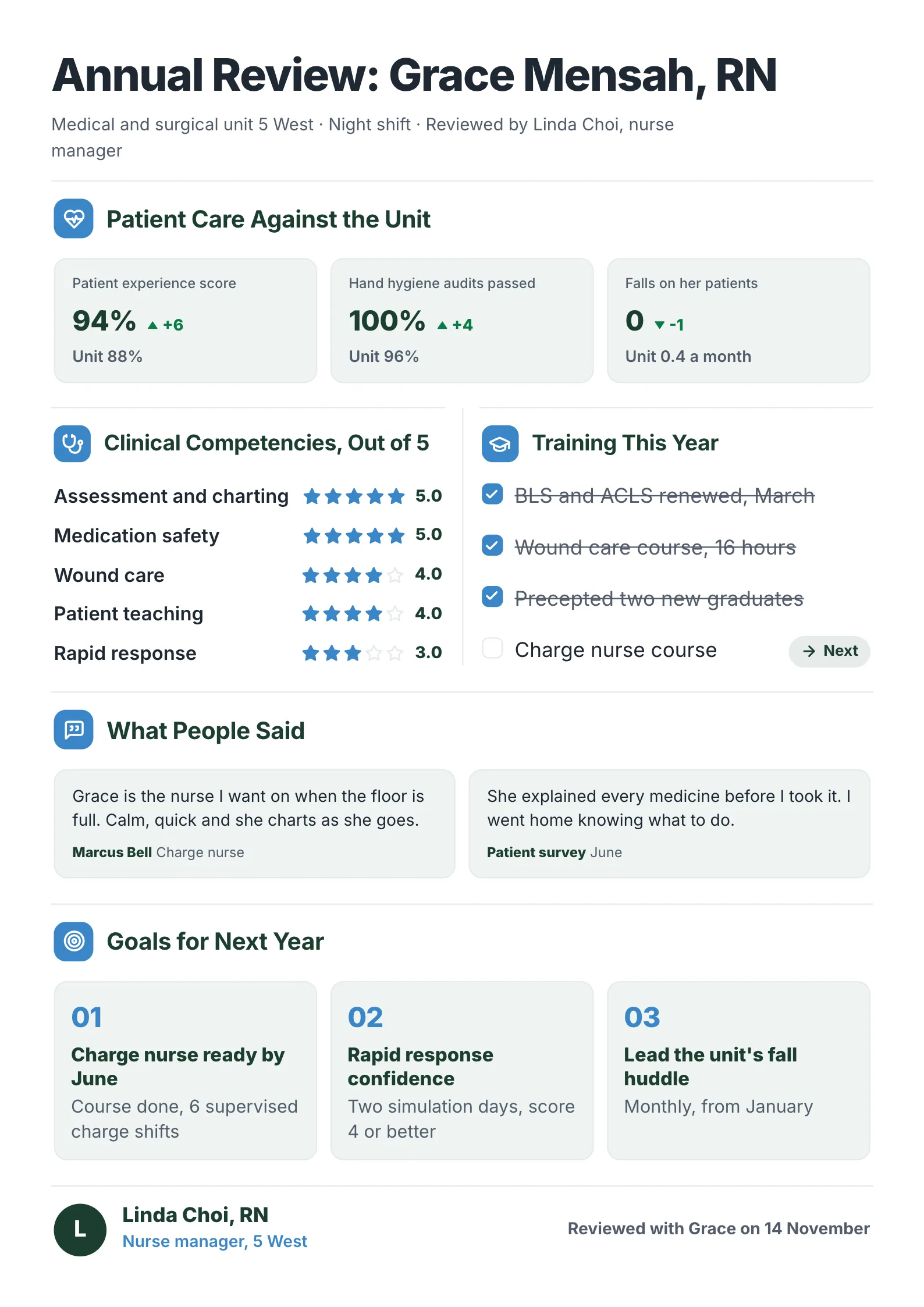 Performance Review: NurseEdit for free(opens in a new tab)
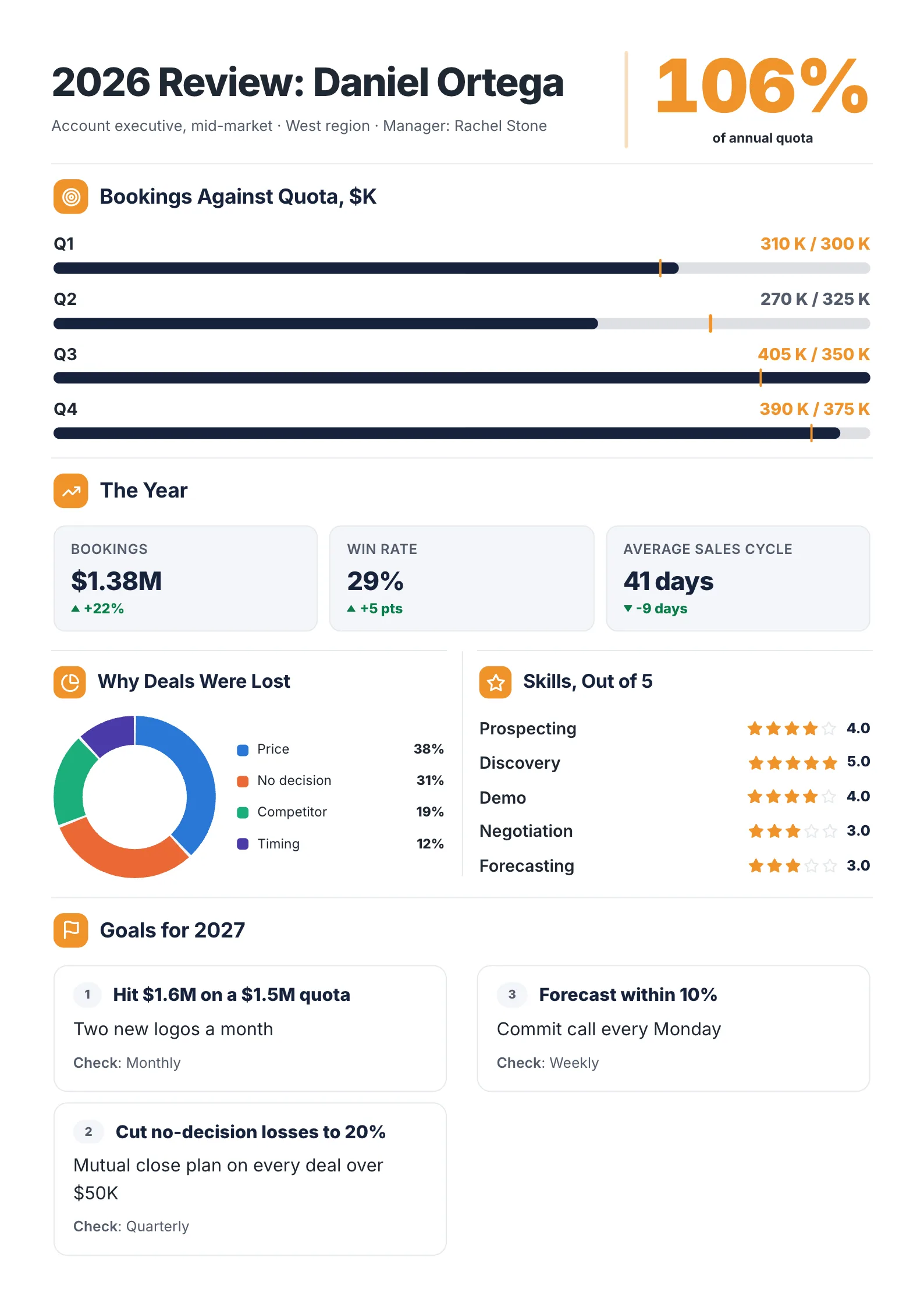 Performance Review: SalesEdit for free(opens in a new tab)
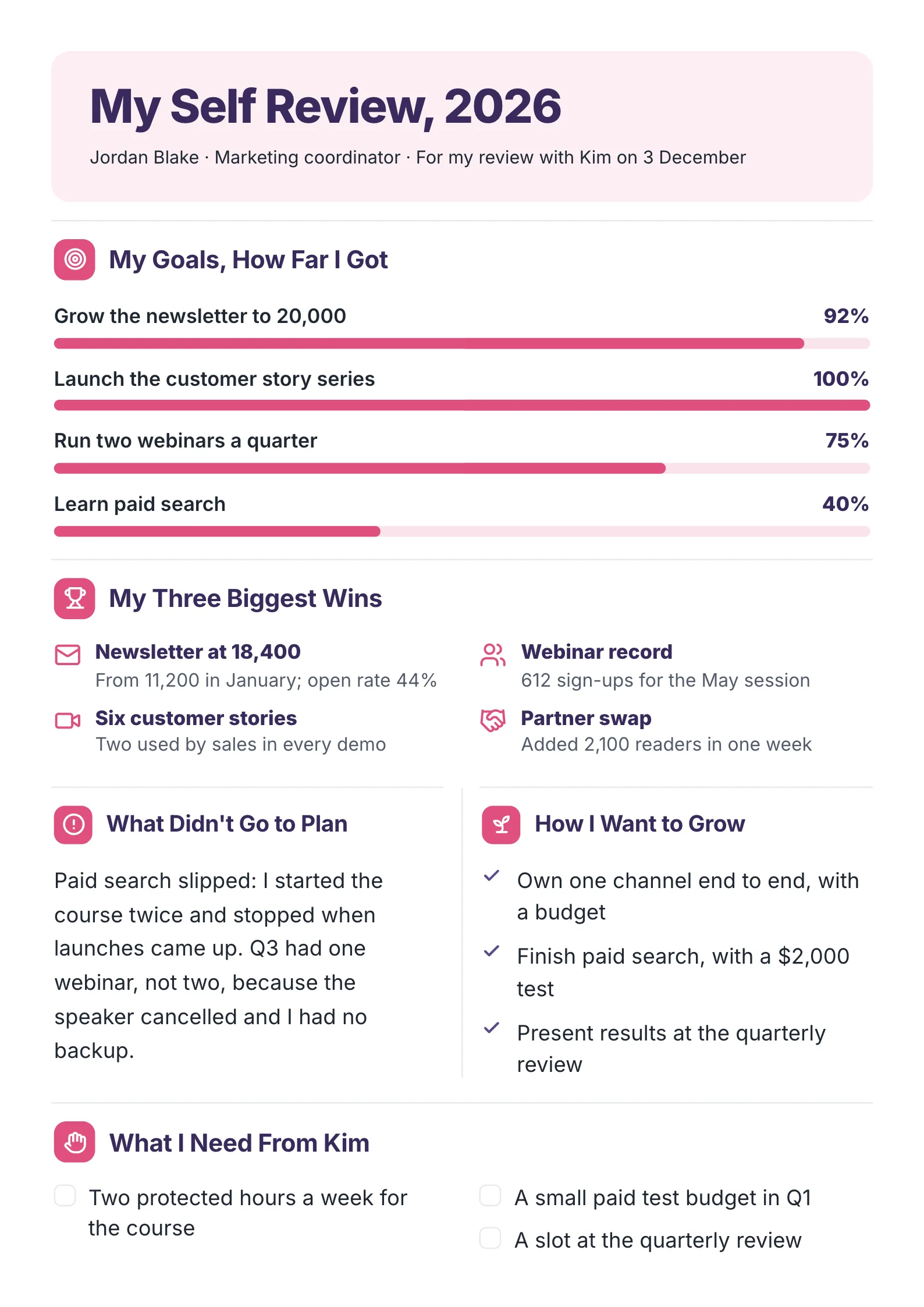 Performance Review: Self AssessmentEdit for free(opens in a new tab)
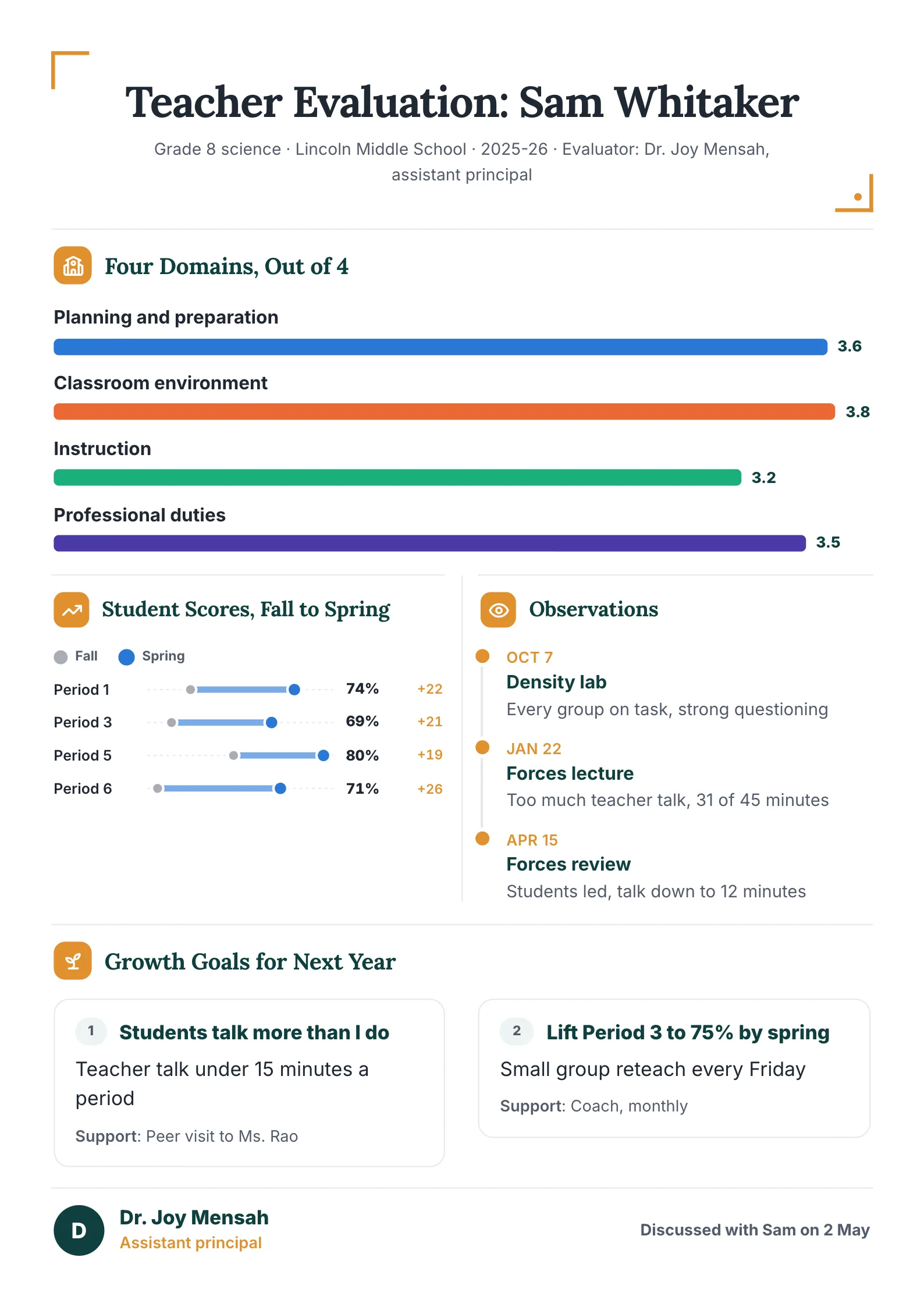 Performance Review: TeacherEdit for free(opens in a new tab)
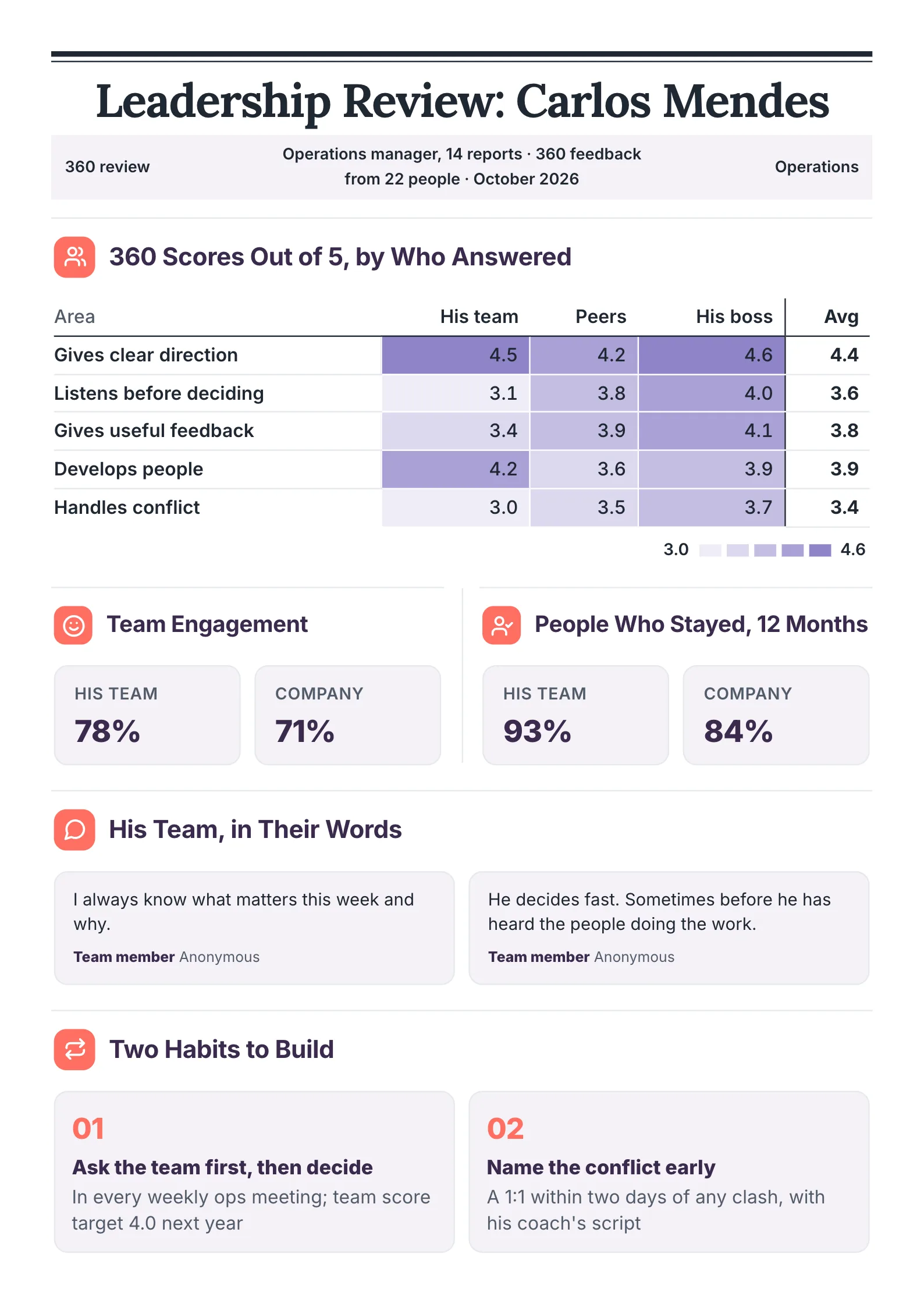 Performance Review: Manager 360Edit for free(opens in a new tab)
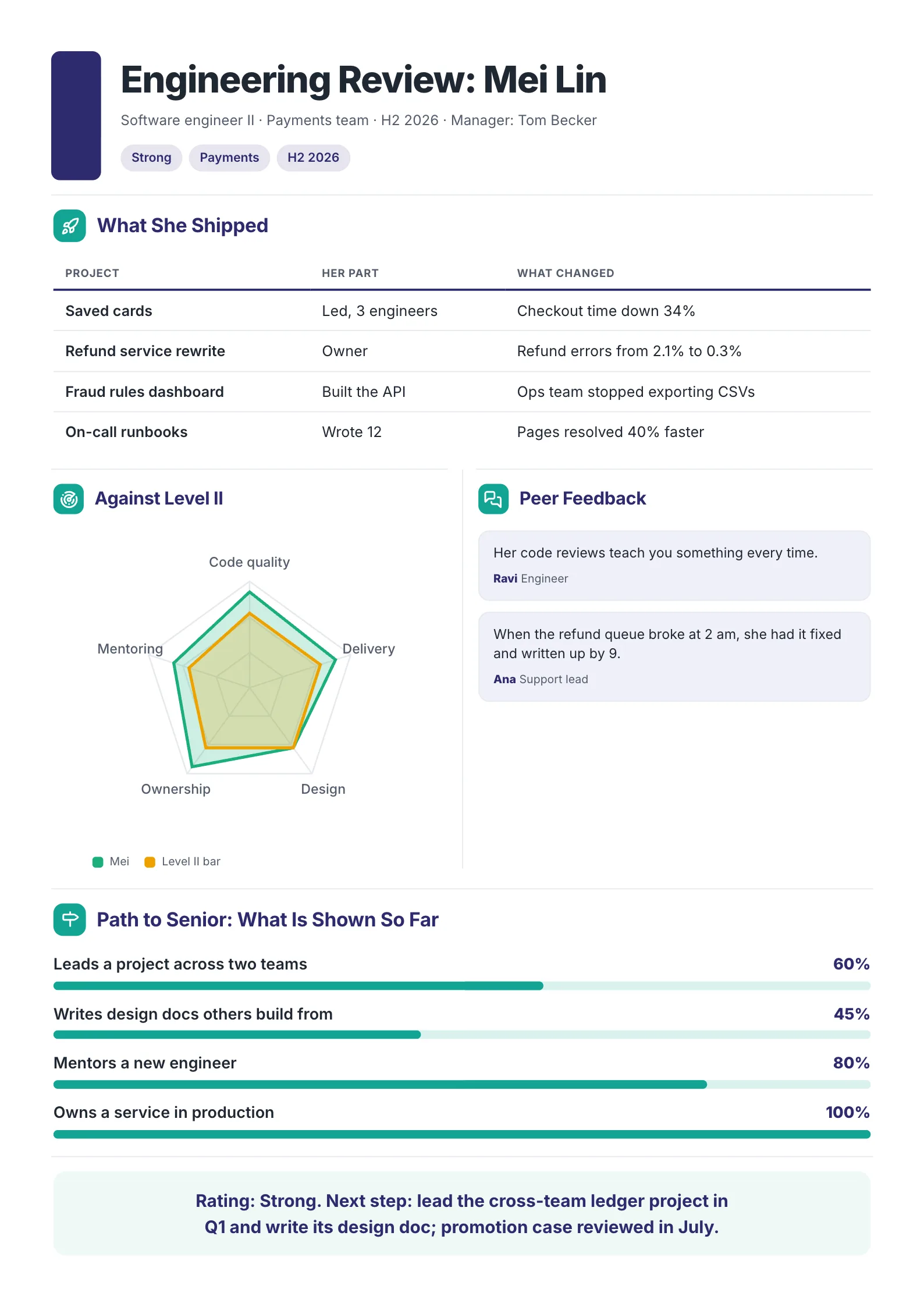 Performance Review: Software EngineerEdit for free(opens in a new tab)
So if your job calls it a review, you're fine. But before you sign your next one, check which meeting sets your rating. If you write the policy, pick one word for each step and stick to it.
| Appraisal | Review | |
|---|---|---|
| What it is, in the federal rule | "the process under which performance is reviewed and evaluated" | A "progress review" means "communicating with the employee about performance" |
| How long | Generally 12 months | One meeting |
| How often | Once a year | "one or more" each year |
| Ends in a rating | Yes, the "rating of record" | Not required |
| Paperwork | A written plan at the start, a written rating at the end | Whatever the employer's program asks for |
The 5 rulebooks we counted
We read five public rulebooks in full on November 5, 2026: the federal regulation for most U.S. government employees, three state policies and one university system's policy. Then we counted how often each one uses the two words, leaving out the title line repeated at the top of each page.
| Rulebook | The year-end step is called | The talks in between are called | "Appraisal" | "Performance review" |
|---|---|---|---|---|
| Federal: 5 CFR 430, subpart B | Rating of record | Progress reviews | 76 | 0 |
| Virginia Policy 1.40 | Annual Performance Evaluation | Interim evaluations | 0 | 2 |
| North Carolina state agencies | Annual Progress Review | Feedback and check-ins | 1 | 0 |
| University of North Carolina staff | Annual performance appraisal | Interim and off-cycle reviews | 58 | 5 |
| Florida rule 60L-35 | Performance evaluation | Coaching and feedback | 0 | 0 |
| All 5 | 135 | 7 |
Look at the second and third columns. The formal year-end step has a different name in every rulebook, and only one of them, the university's, calls it an appraisal. And all 5 of the University of North Carolina's "performance review" uses name a meeting between appraisals: an interim review, a transfer review and three off-cycle reviews. Virginia uses the phrase for the year-end meeting itself: "Meet with the employee to discuss the performance review."
What the federal rule means by each word
The federal regulation is the only one of the five that defines both words. Section 430.203 says:
- Appraisal "means the process under which performance is reviewed and evaluated."
- Appraisal period "means the established period of time for which performance will be reviewed and a rating of record will be prepared."
- Progress review "means communicating with the employee about performance compared to the performance standards of critical and non-critical elements."
The rest of the subpart puts those pieces in order:
- The plan. "Performance plans shall be provided to employees at the beginning of each appraisal period (normally within 30 days)."
- The year. "The appraisal period generally shall be 12 months so that employees are provided a rating of record on an annual basis."
- At least one review. Ongoing appraisal must include "conducting one or more progress reviews during each appraisal period."
- The rating. "As soon as practicable after the end of the appraisal period, a written, or otherwise recorded, rating of record must be given to each employee."
So in federal terms, the review is one step inside the appraisal. You can have a progress review with no rating at all. You can't have a rating of record without the appraisal period behind it.
The rating scale changed in 2026. A July rule cut the summary patterns to three: levels 1 and 3, levels 1, 3 and 5, or levels 1, 3, 4 and 5. None of them uses Level 2. Agencies must follow the new patterns from January 1, 2027. The same rule says OPM may set "a standardized distribution" of rating levels that agencies must apply.
One state, two names
North Carolina shows how fast the words move. Since July 1, 2026, its state agencies run a cycle that ends in an "Annual Progress Review," a phrase the policy uses 17 times. The word appraisal appears once, in a pointer: university staff "should refer to the University SHRA Performance Appraisal Policy."
That university policy, in force since 2020, still uses the word appraisal 58 times. It names three required talks:
- Performance Planning, "to discuss the goals for the cycle."
- Performance Feedback, "to provide guidance and clarity of expectations throughout the cycle."
- Performance Appraisal, "to complete an annual performance appraisal document and assign the employee a final overall rating for the cycle."
Both policies give you a way to ask for a talk. The university version lets you request "one additional off-cycle review per performance cycle," and the manager must hold it if more than 60 days have passed since your last one. The state agency version cuts that to 30 days: "the supervisor shall provide a feedback meeting if it has been more than thirty (30) calendar days" since your last conversation, check-in or Annual Progress Review.
How the rulebooks rate you
Here's what the year-end rating looks like in each one.
| Rulebook | Cycle | Rating levels | Check-ins in between |
|---|---|---|---|
| Federal | Generally 12 months | Up to 4 summary levels, from Unacceptable to Outstanding | At least 1 progress review |
| Virginia | January 1 to December 31 | 5, from Unsuccessful to Extraordinary | Interim evaluations "at any point" |
| North Carolina agencies | Calendar or fiscal year | 3, plus U and T codes | Quarterly for new staff; at the midpoint after a Needs Improvement |
| University of North Carolina | April 1 to March 31 | 3, from Not Meeting to Exceeding Expectations | An interim review at the midpoint after any Not Meeting rating |
| Florida | Set by each agency, up to 4 dates a year | 5 per expectation, averaged into 5 overall bands | "coaching and meaningful feedback" all period |
The rulebooks also split on a second question. Are you rated on your own, or against your coworkers? Florida's rule says the overall rating "shall not be adjusted or affected by the ratings of any other employees being rated." North Carolina's agencies must "calibrate ratings prior to sharing final ratings with employees," with supervisors comparing ratings across similar teams. And federal agencies may now face a standardized distribution set by OPM.
Florida also has the clearest rule for a late appraisal. If you aren't evaluated within 60 days of the agency's evaluation date, you're treated as meeting expectations, with an overall rating of "Satisfactory." The federal rule handles it the other way: "the appraisal period must be extended."
Where the top search results disagree
Two of the pages that rank for this question say opposite things. Keka writes that "the performance appraisals are more focused on the actual performance of the employee in the past year." Qualtrics says a performance review covers "what has happened in the past," while "A performance appraisal looks at the employee's current situation and offers guidance for future growth and development." Its table gives appraisals a cadence of "Quarterly, monthly, weekly, or continuously."
The rulebooks side with Keka on timing. In all five, the formal year-end step looks back over the whole cycle and ends in a rating, and the frequent, forward-looking talks are the reviews, check-ins and feedback in between. Neither page cites a rule, so if your employer has a written policy, its words win.
Five sample reviews, sorted by which step they are
Each sample below is a One-Pager from MakeOnepagers, filled in with sample names and figures. Find the step you're on, and you'll see what that sheet should hold.
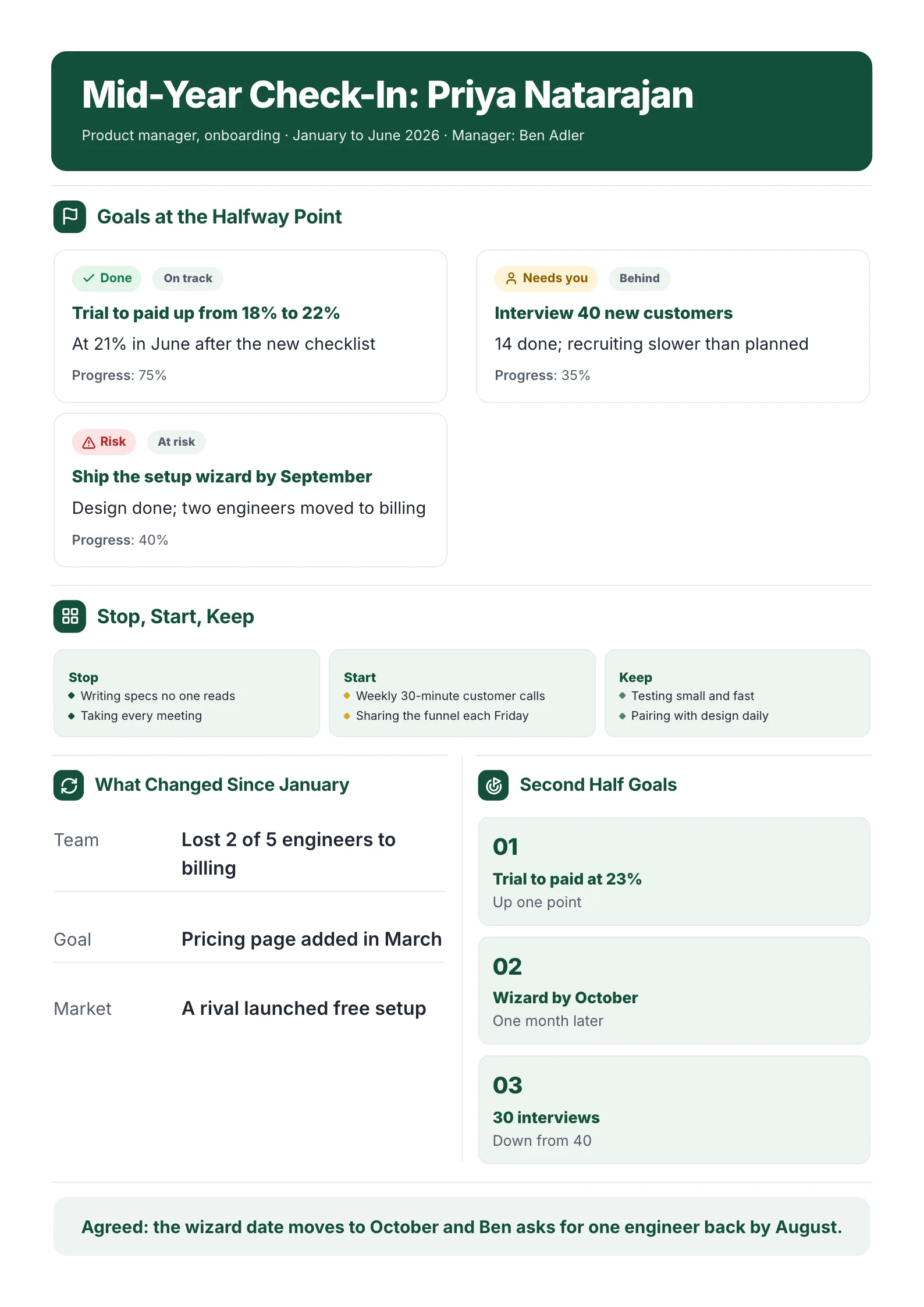
A mid-year check-in: the progress review
 Edit this template
This mid-year performance review is a progress review in the federal sense. It covers January to June and compares three goals with where they stand: trial to paid at 21% against a 22% target, a setup wizard 40% done, and 14 of 40 customer interviews. There's no rating on it. It ends with an agreement instead: the wizard date moves to October, and the manager asks for one engineer back by August.
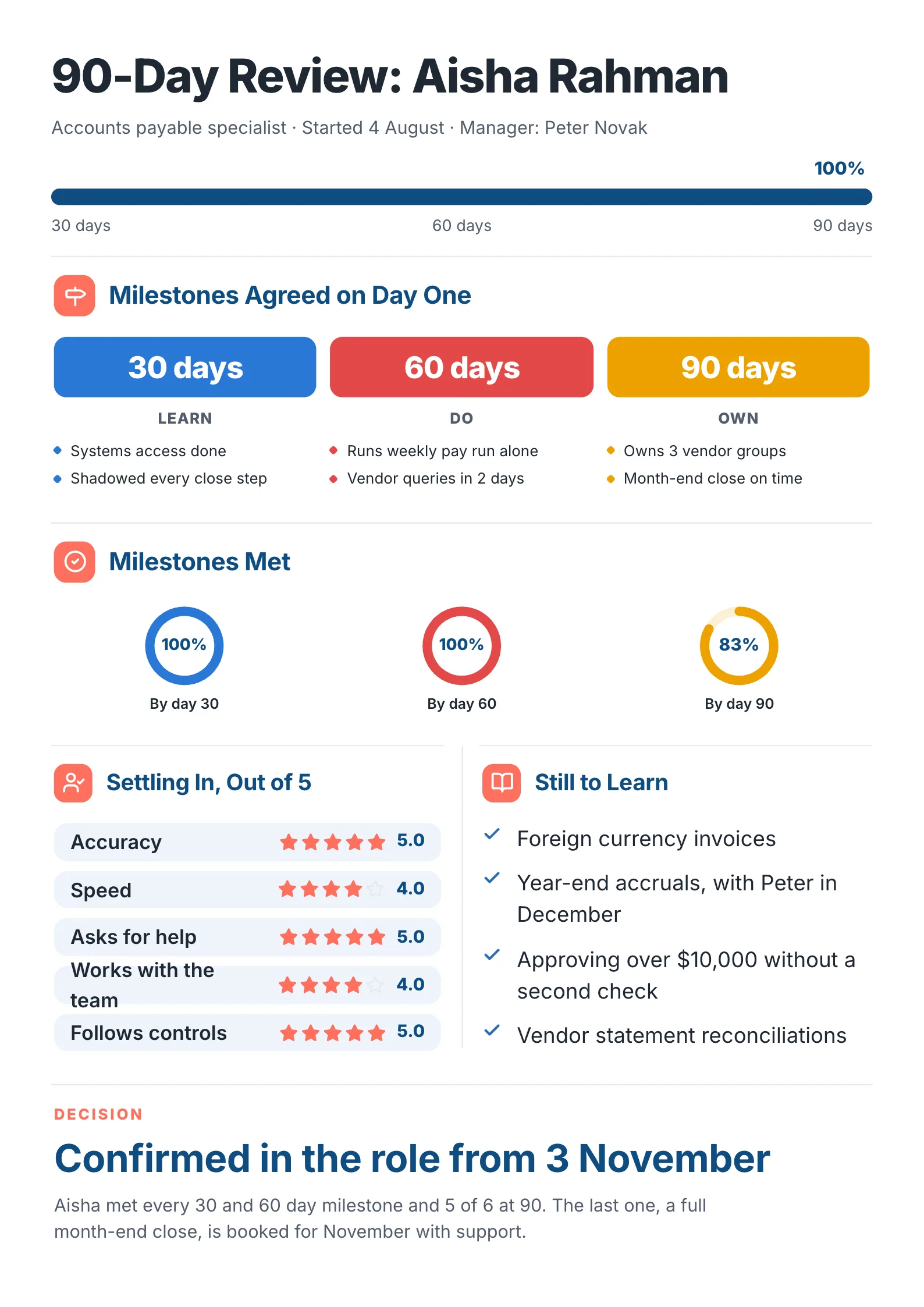
A 90-day review: the minimum period
 Edit this template
Three of the five rulebooks set a minimum stretch before a rating counts. The federal rule makes every program set one, North Carolina's agencies give a "T" for anyone with fewer than 90 days, and the university wants six months under a plan. This 90-day review covers that first stretch for an accounts payable specialist who started August 4. She met every 30 and 60 day milestone and 5 of 6 at 90, and she's confirmed in the role from November 3.
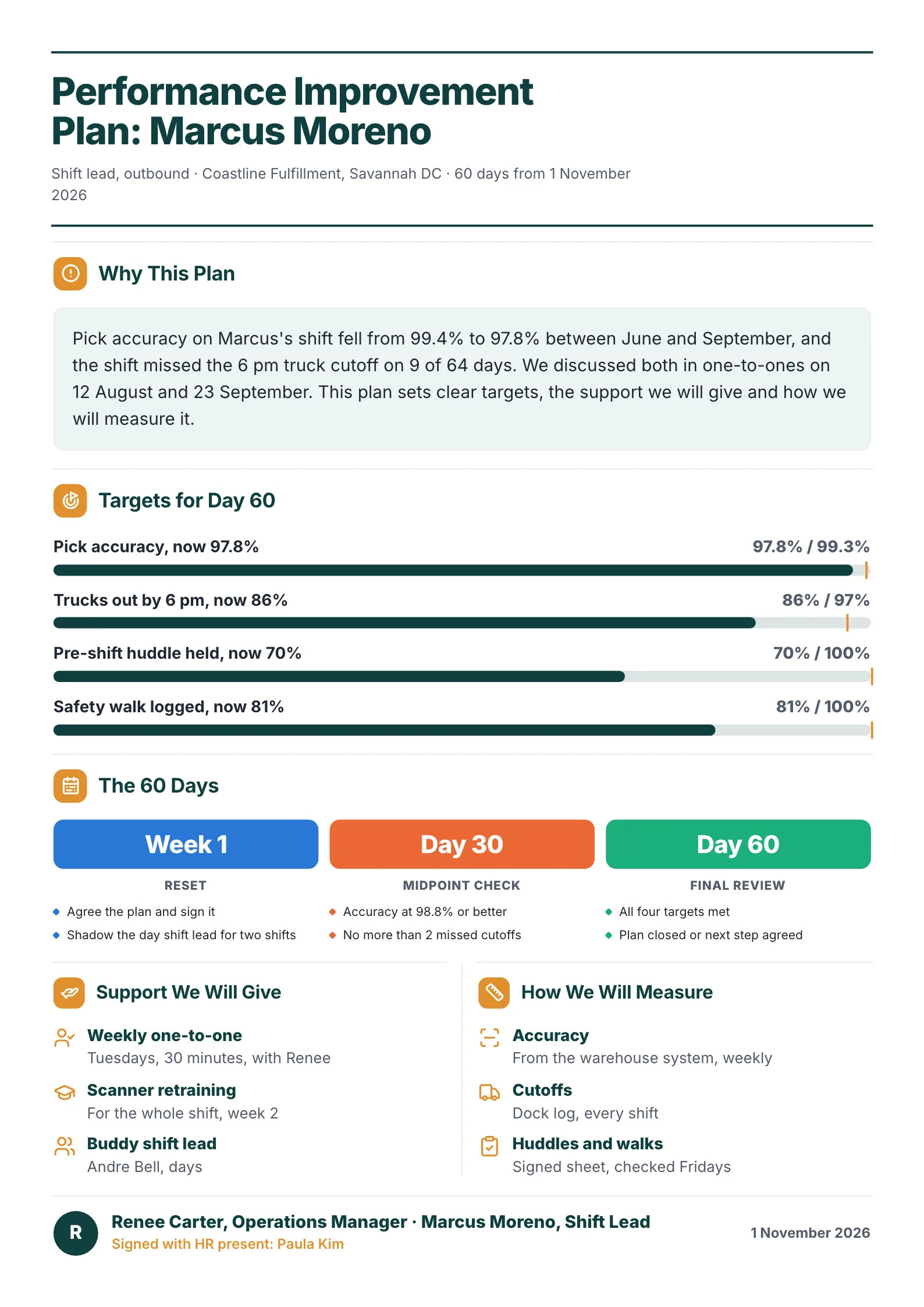
An improvement plan: help before the rating
 Edit this template
The federal rule requires programs to provide for "Assisting employees in improving unacceptable performance at any time during the appraisal period." This performance improvement plan does that for a shift lead whose pick accuracy fell from 99.4% to 97.8% between June and September. It runs 60 days from November 1, 2026, with a midpoint check on day 30 and a weekly 30-minute one-on-one every Tuesday.
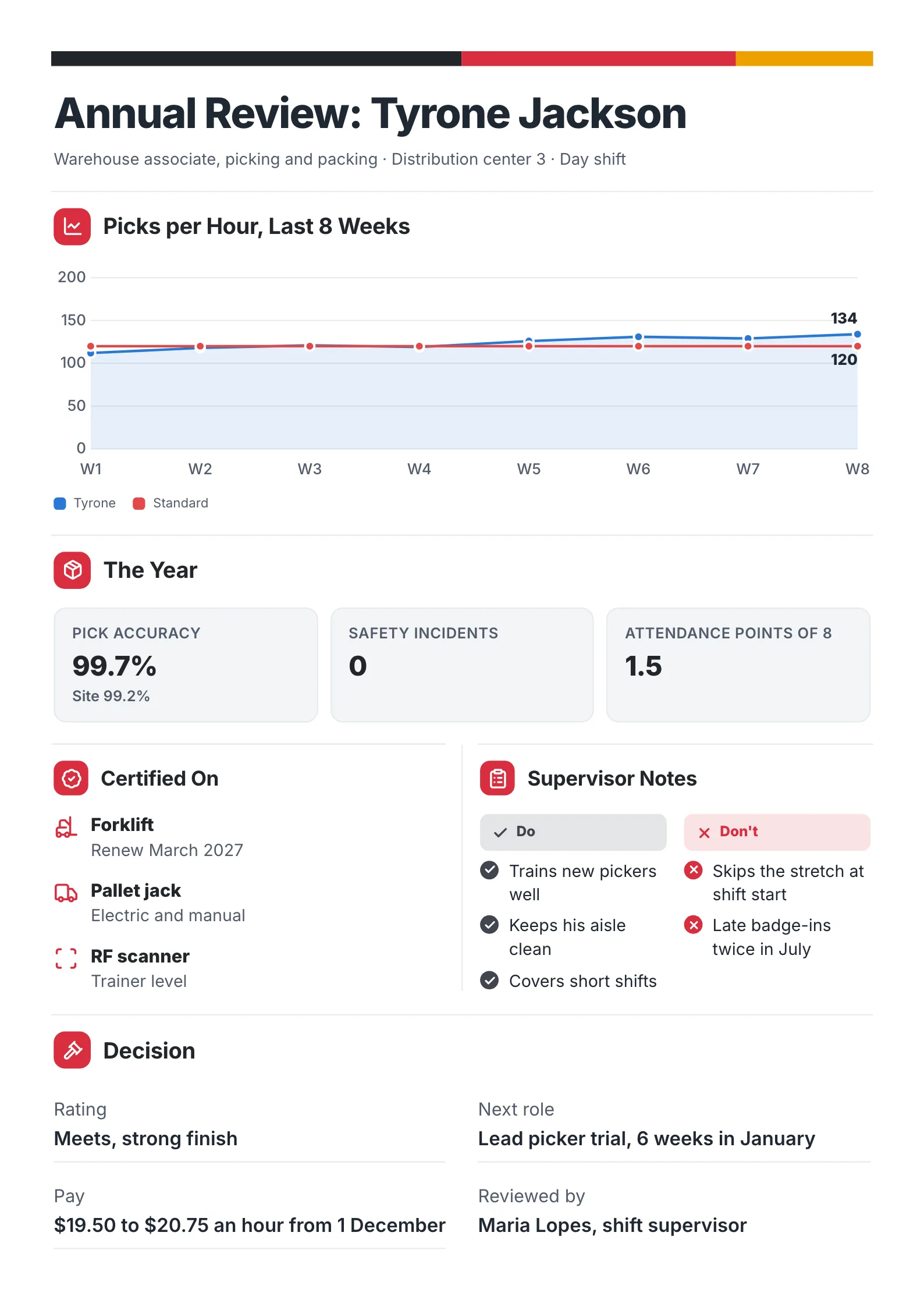
An annual review with a rating and a raise: the appraisal
 Edit this template
This warehouse performance review is called an annual review, but it does an appraisal's job. It covers the year, gives a rating of "Meets, strong finish," and ties a decision to it: pay goes from $19.50 to $20.75 an hour from December 1. The numbers behind the rating sit on the sheet, like 99.7% pick accuracy against the site's 99.2% and 0 safety incidents.
A rating summary: where the scale decides the word
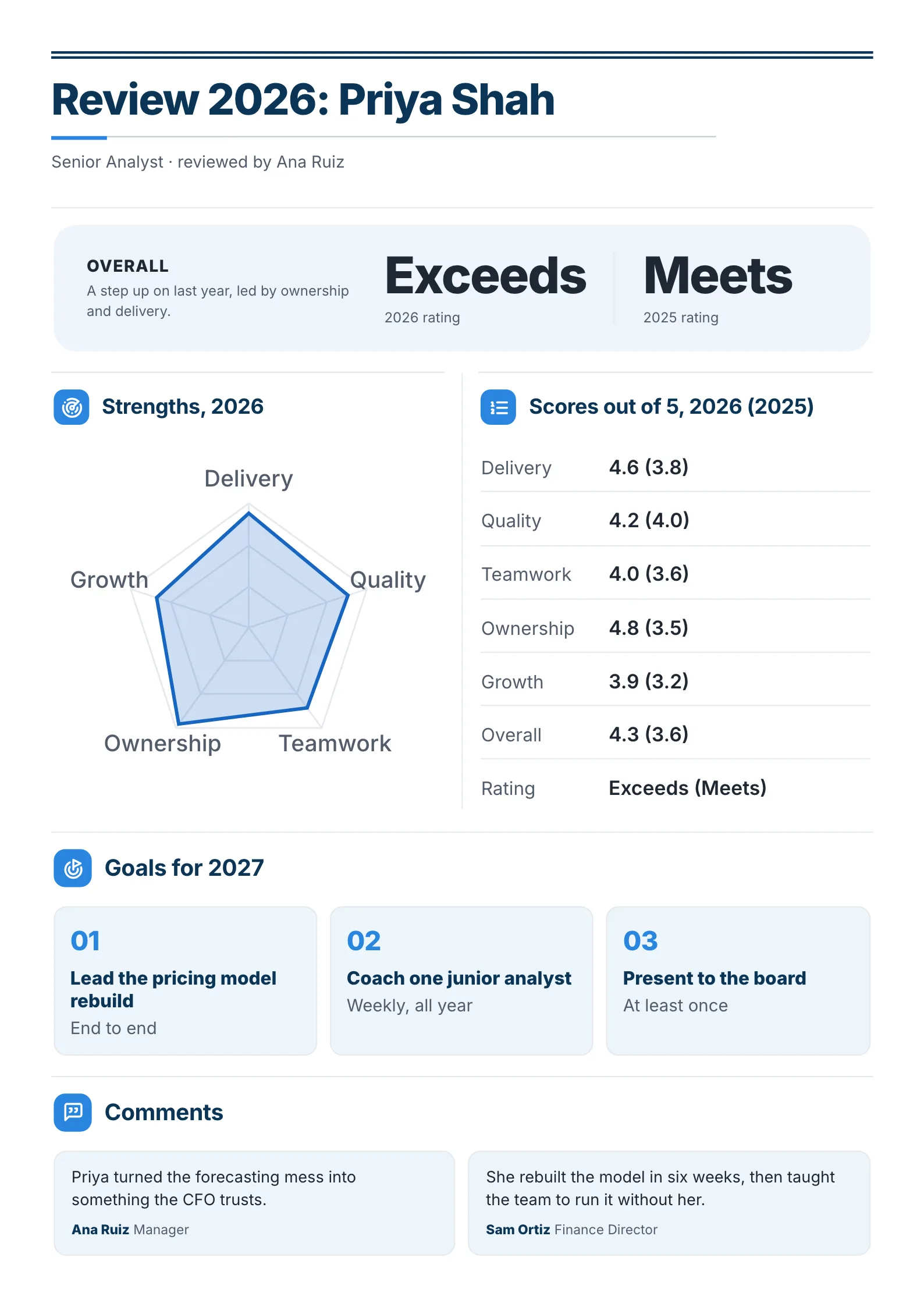 Edit this template
This performance review summary puts two years side by side. The five 2026 scores average 4.3 and earn "Exceeds," up from 3.6 and "Meets" in 2025. Now run your own scores through Florida's rule, which averages them and drops digits after the second decimal place. Do that with these two years, and both land in the same band. Florida calls 3.50 to 4.49 "Commendable." The scores didn't change. The rulebook's words did.
Which word should you use?
Use your employer's word. If its policy says appraisal, a "review" is probably a check-in. If it says review or evaluation for the year-end step, that's the one that counts. Then check these four things in the policy itself:
- The cycle dates. January to December in Virginia, April to March at the University of North Carolina.
- The talk you can ask for. Once 30 days pass without one at North Carolina's agencies, or 60 days at its university.
- The rating scale. From 3 levels in North Carolina to 5 in Virginia.
- What happens if it's late. "Satisfactory" in Florida, an extended period for federal staff.
If you're writing the policy, the federal split is the clearest one to borrow. Call the whole rated year the appraisal, call the talks inside it reviews, and say how many reviews come before the rating.
Make your review
Open the MakeOnepagers review for the step you're on: a check-in, a 90-day review, a plan or the year-end rating. Type in your goals and numbers. Have last year's form? Paste it into the free AI One-Pager generator, and you get a one-sheet draft to edit. Writing one for someone else? Follow how to write a performance review. Filling in your own? Start with the performance review questions real employer forms ask.
Frequently asked questions
Is a performance appraisal the same as a performance review?
In everyday use, yes. In written policies, often not. The federal rule calls the whole rated year the appraisal and the talks inside it progress reviews. Read your employer's policy to see which meeting sets your rating.
Is a mid-year review part of the appraisal?
Under the federal rule, yes. A progress review is one of the "ongoing appraisal methods," and every appraisal period needs at least one. It doesn't have to carry a rating.
Can a rating of record be changed after you get it?
For federal employees, sometimes. Section 430.208 allows a change within 60 days of issuance on the employee's informal request, through a formal proceeding, or when the rating was recorded or calculated wrong.
What happens if my appraisal is never done?
It depends on the rulebook. In Florida, if you aren't evaluated within 60 days of the agency's date, you get "Meets Expectation" on each item and "Satisfactory" overall. Under the federal rule, the appraisal period is extended until a rating can be prepared.
Why do some employers say evaluation instead?
It's the same step under a third name. Virginia's policy uses "evaluation" 79 times and "appraisal" 0 times, and Florida's rule is titled "Performance Evaluation System."




