Performance Review Format: Make the Rating and the Next Date Hard to Miss
A performance review format that fits one page, shown on 5 reviews from a server to a teacher, plus the rating rule federal agencies follow.

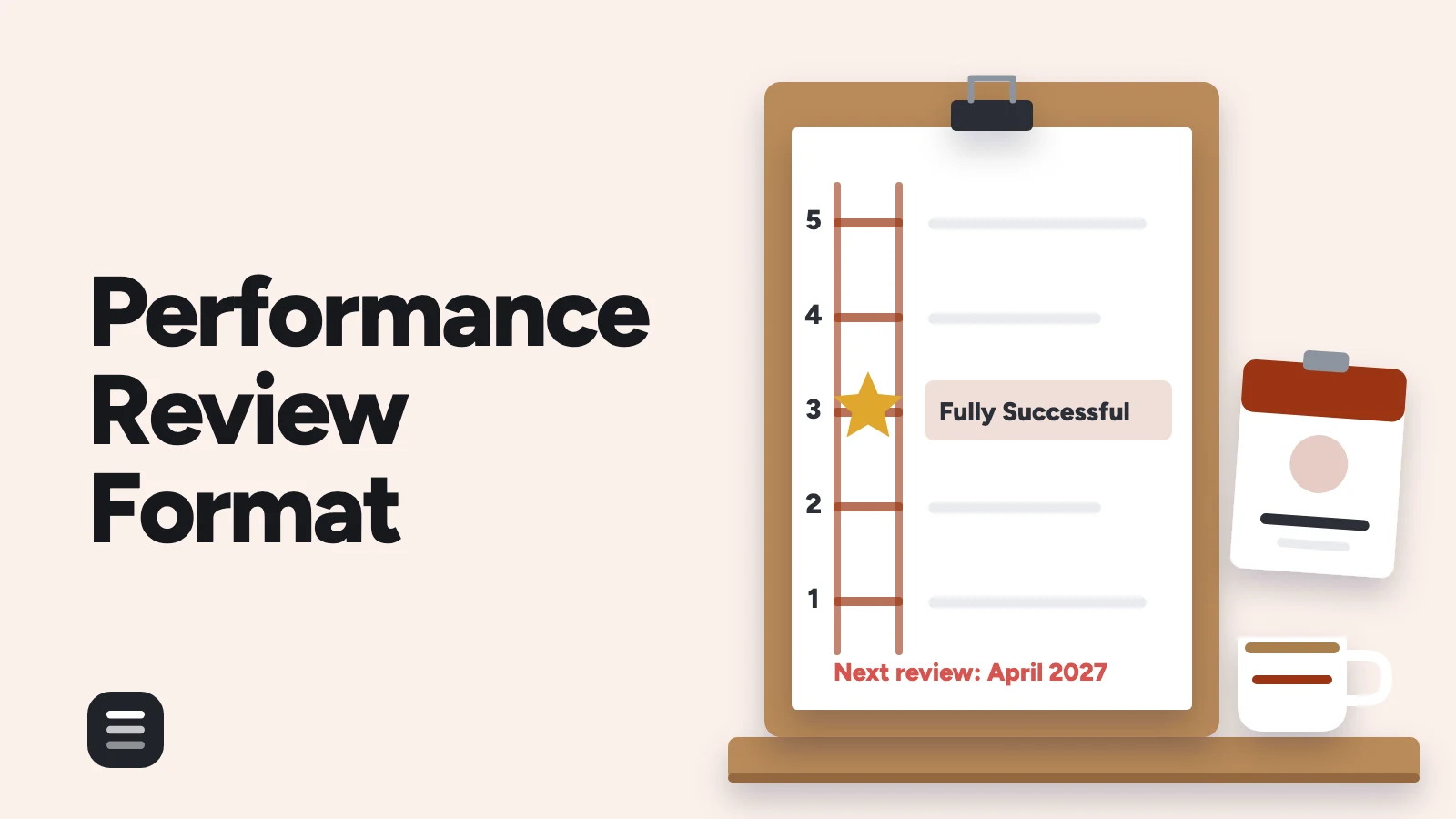
Your employee will read your review once, closely, and then remember two things: the rating and what happens next. A good performance review format puts both where they can't be missed, and backs them with evidence the person recognizes from their own work. Start from a free one pager template.
One‑Pager examples
Real One-Pagers made with MakeOnepagers. Open any one to edit it as your own.
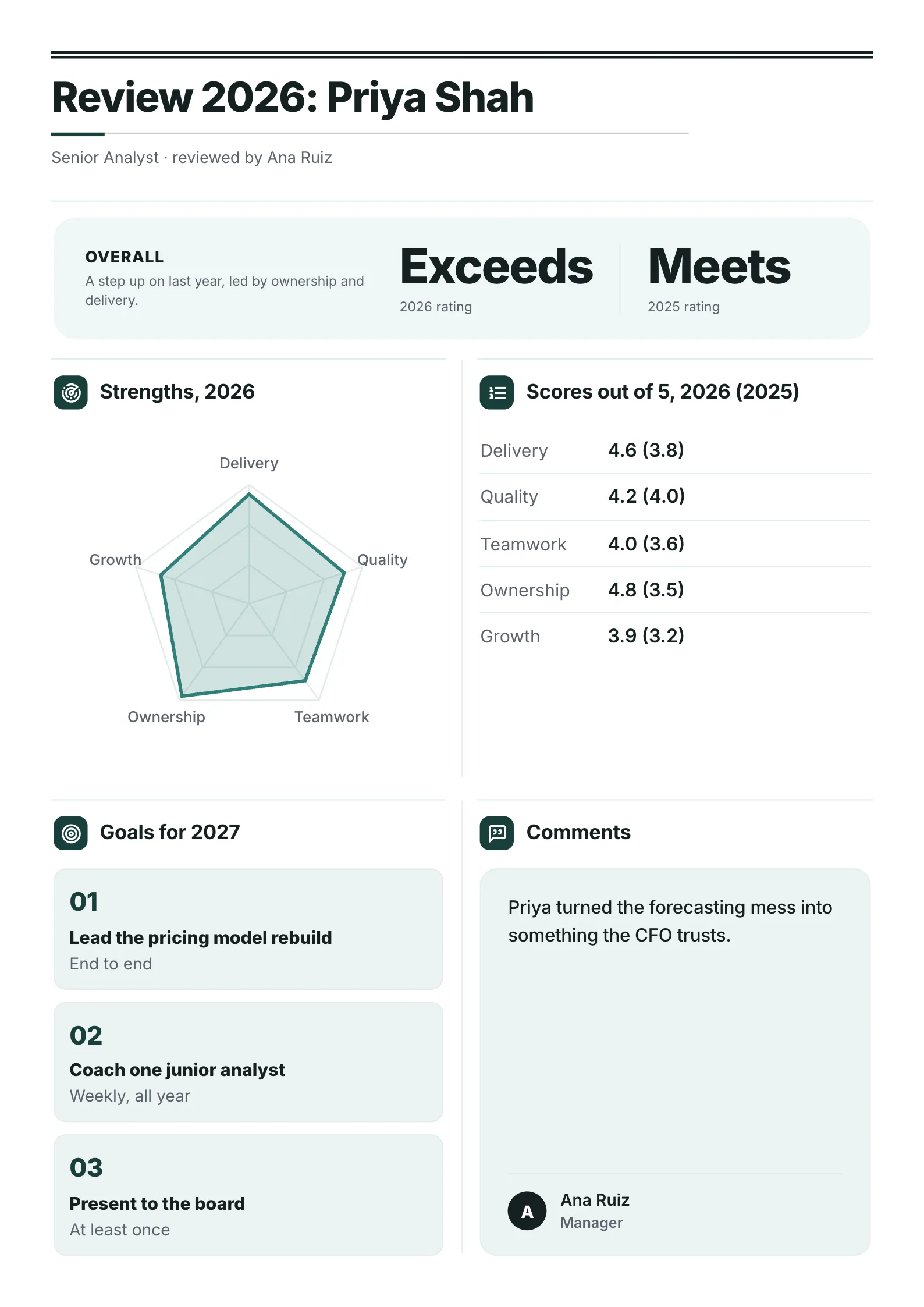 Performance Review SummaryEdit for free(opens in a new tab)
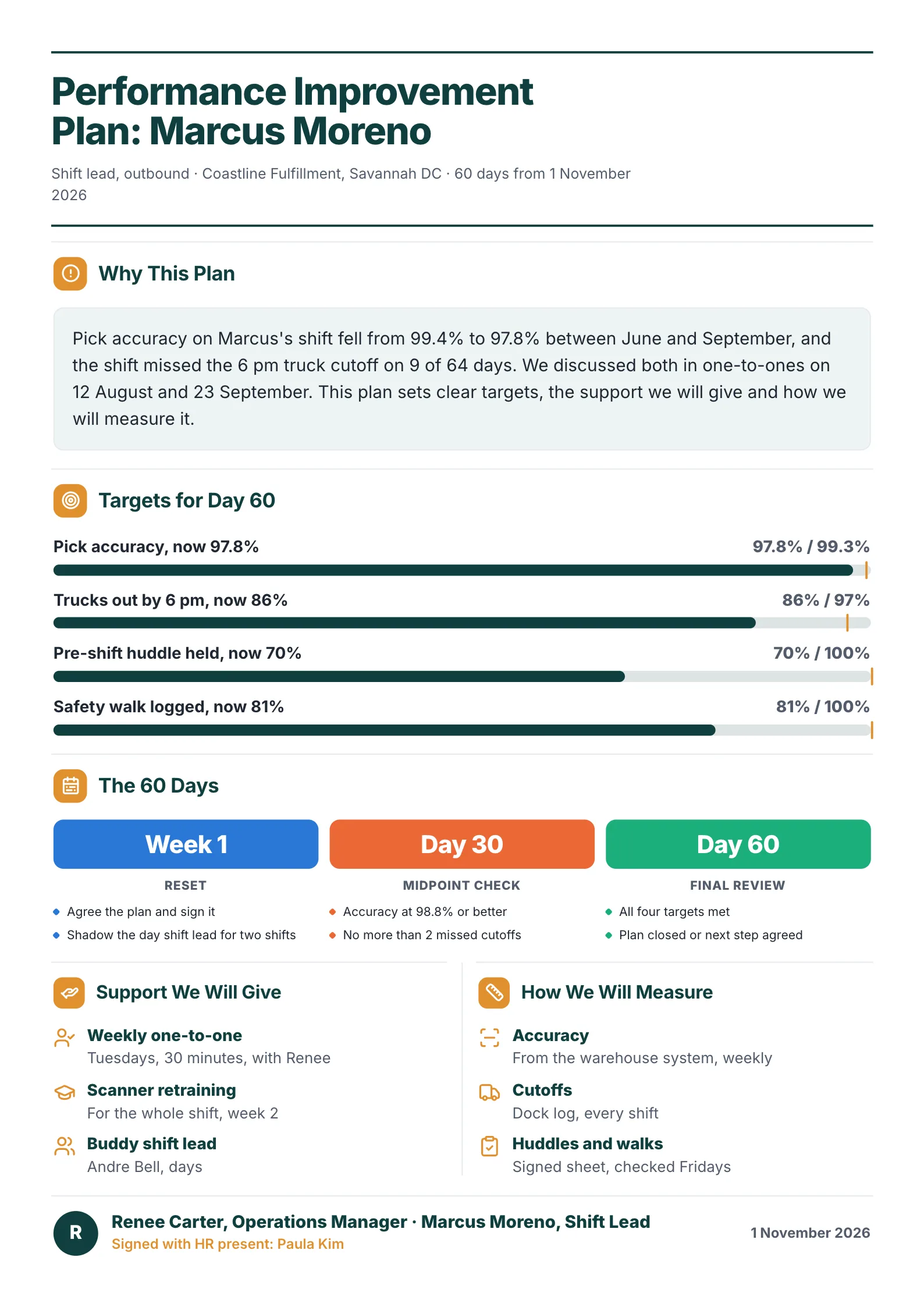 Performance Review: Improvement PlanEdit for free(opens in a new tab)
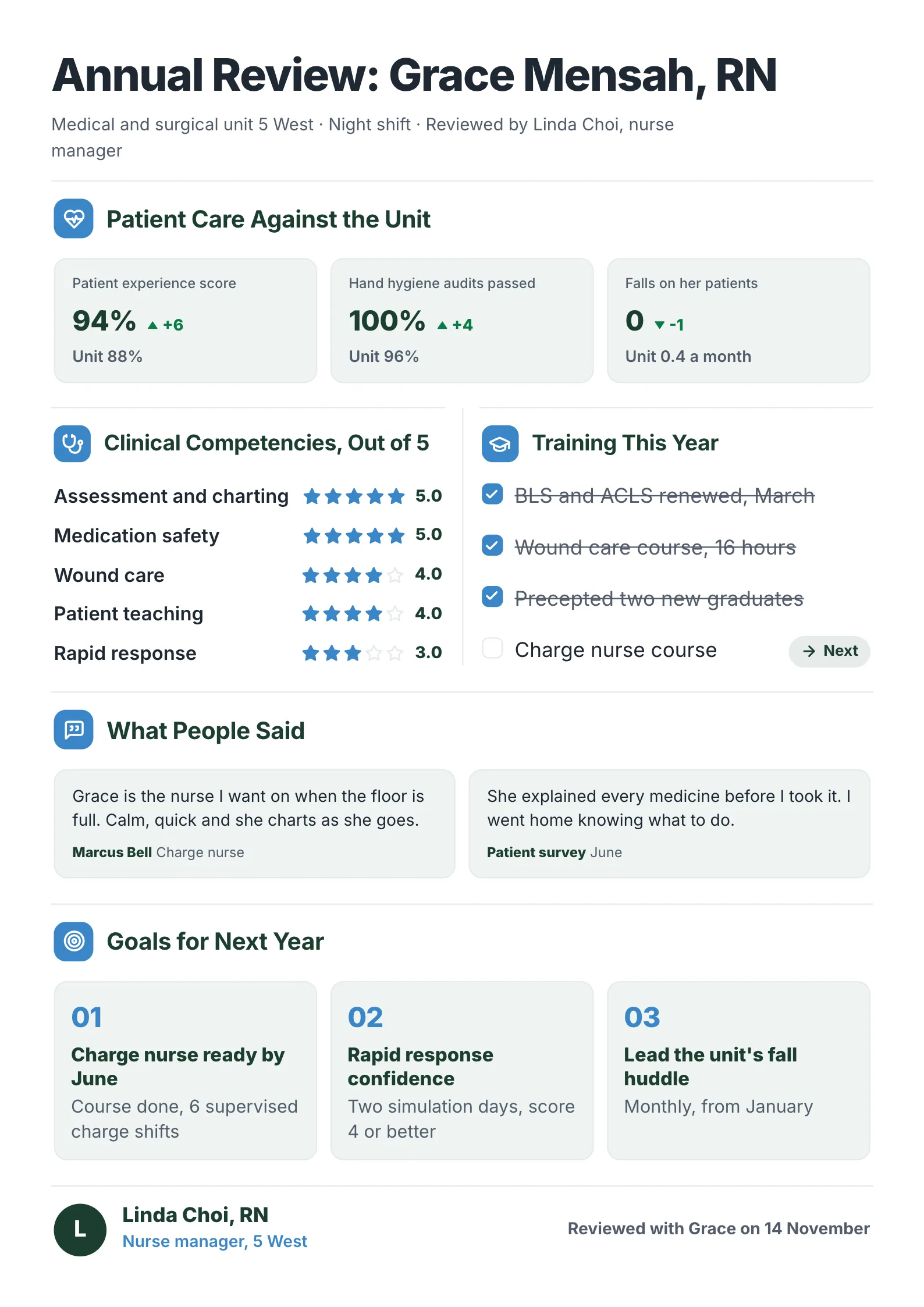 Performance Review: NurseEdit for free(opens in a new tab)
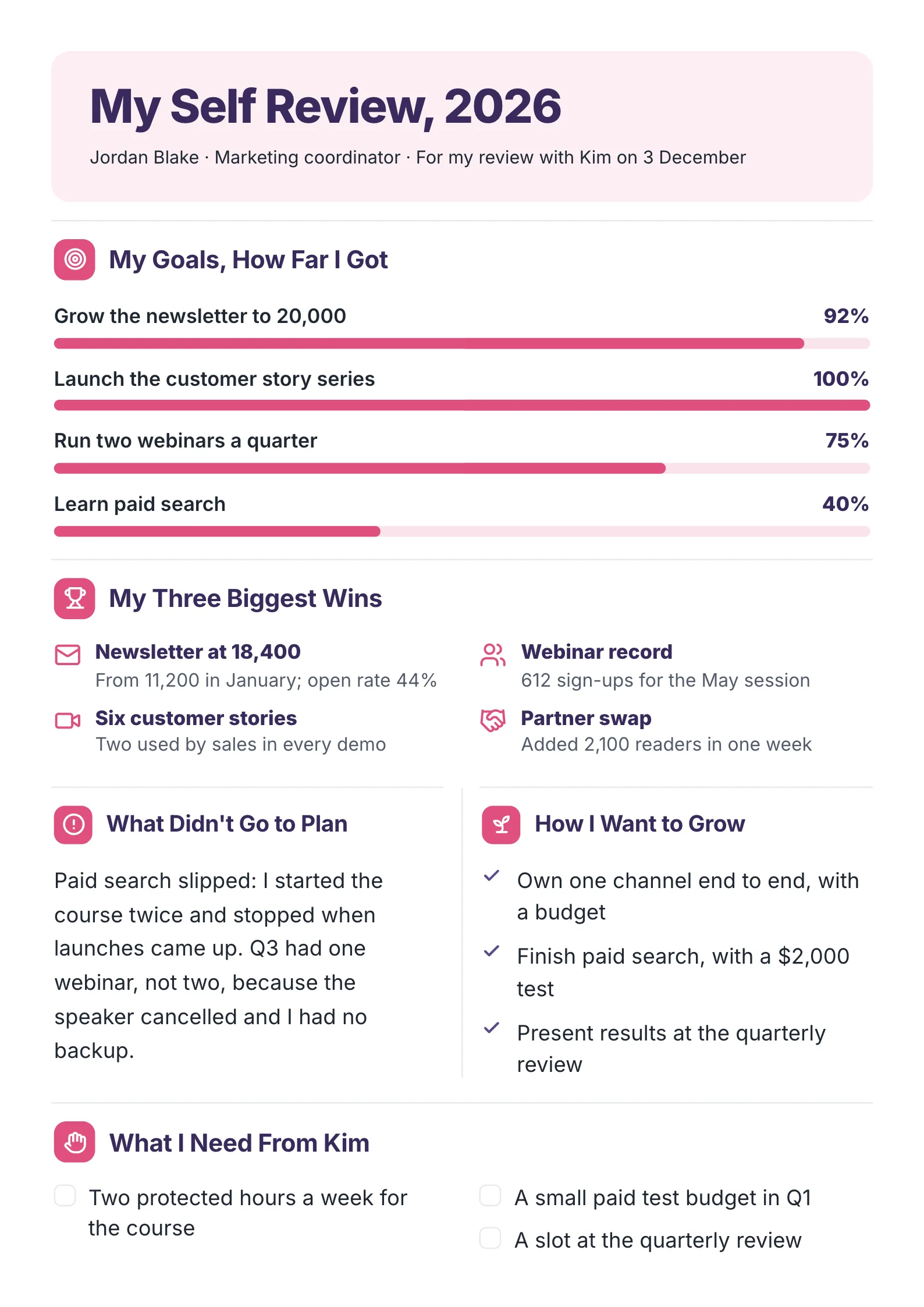 Performance Review: Self AssessmentEdit for free(opens in a new tab)
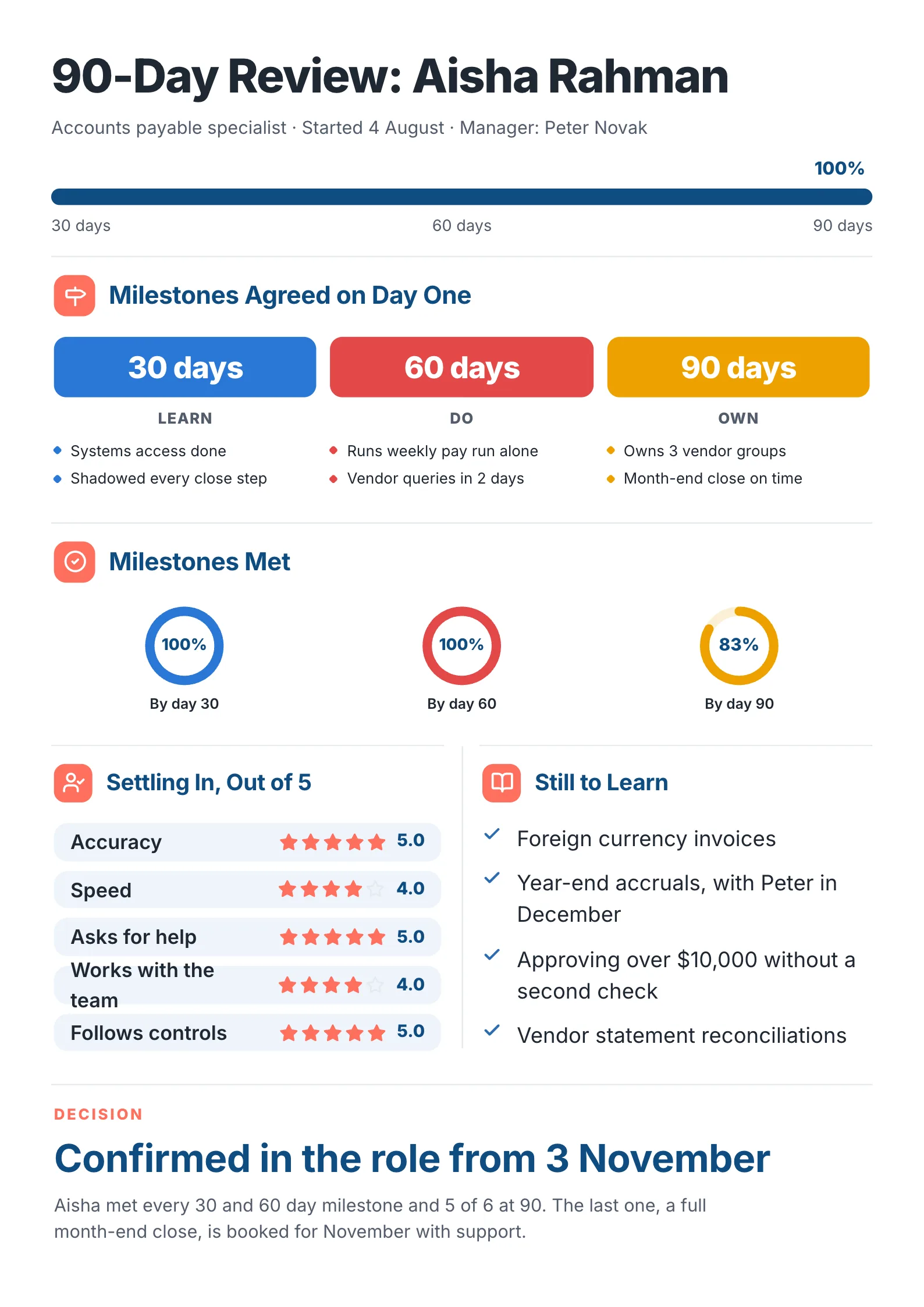 Performance Review: 90 DaysEdit for free(opens in a new tab)
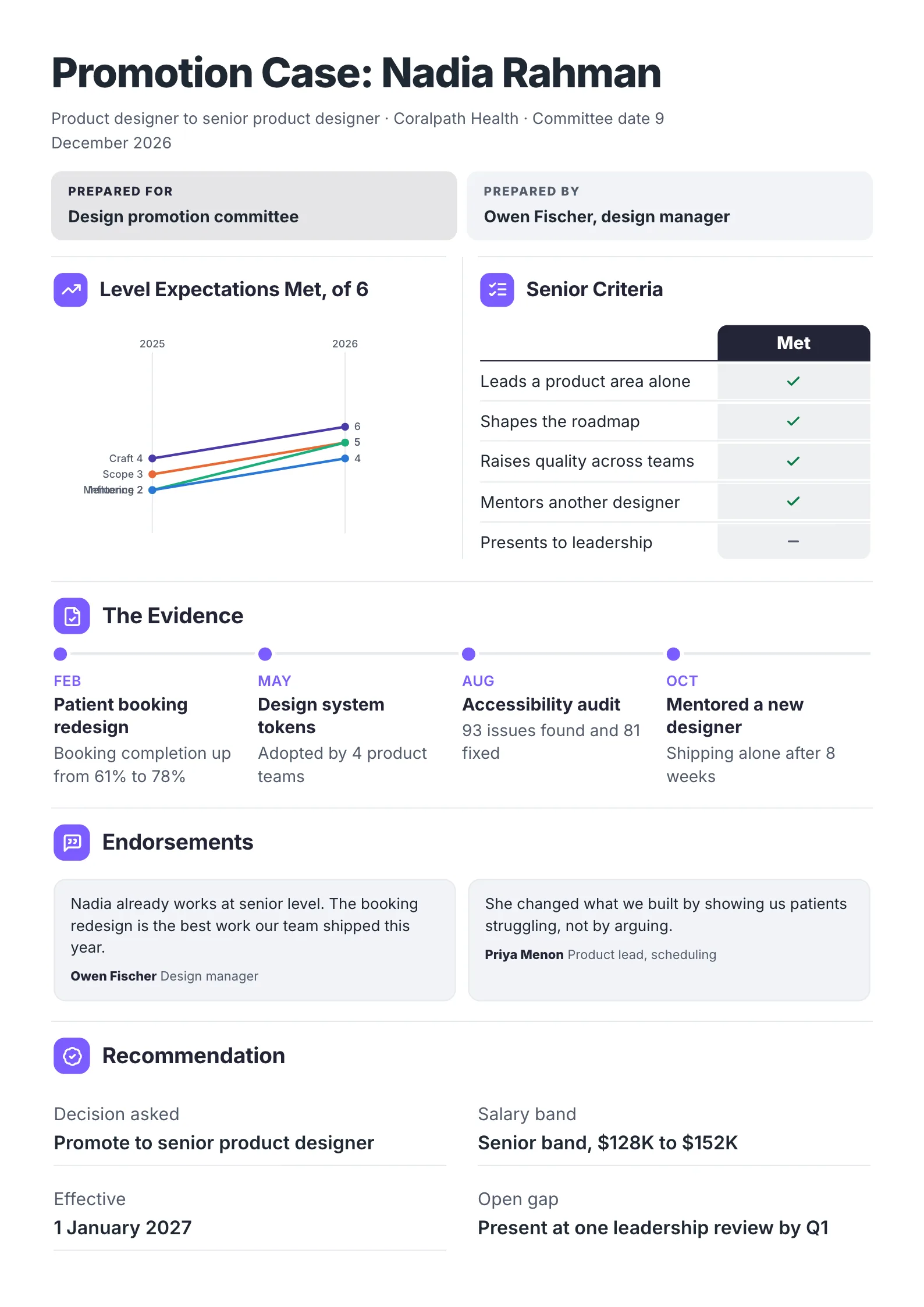 Performance Review: Promotion CaseEdit for free(opens in a new tab)
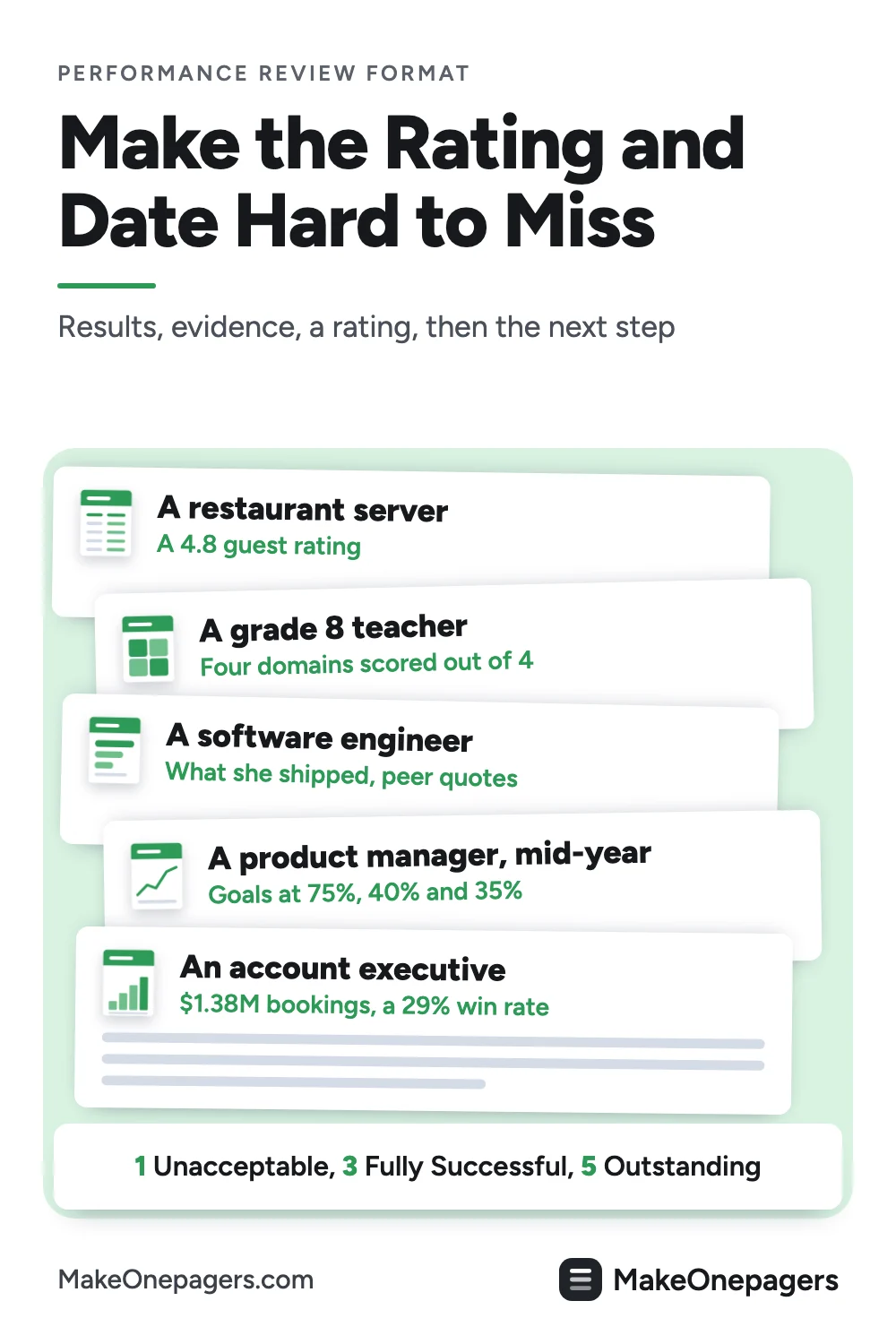
A restaurant server gets scored against the rest of the floor, and a grade 8 science teacher gets timed with a stopwatch. A software engineer sees the path to senior, a product manager gets new goals at mid-year, and an account executive answers to one quota. The scales differ, and each one ends on a next step. After the five reviews we hold them up to the federal rating rule, as a check on your own.
A server's six-month review
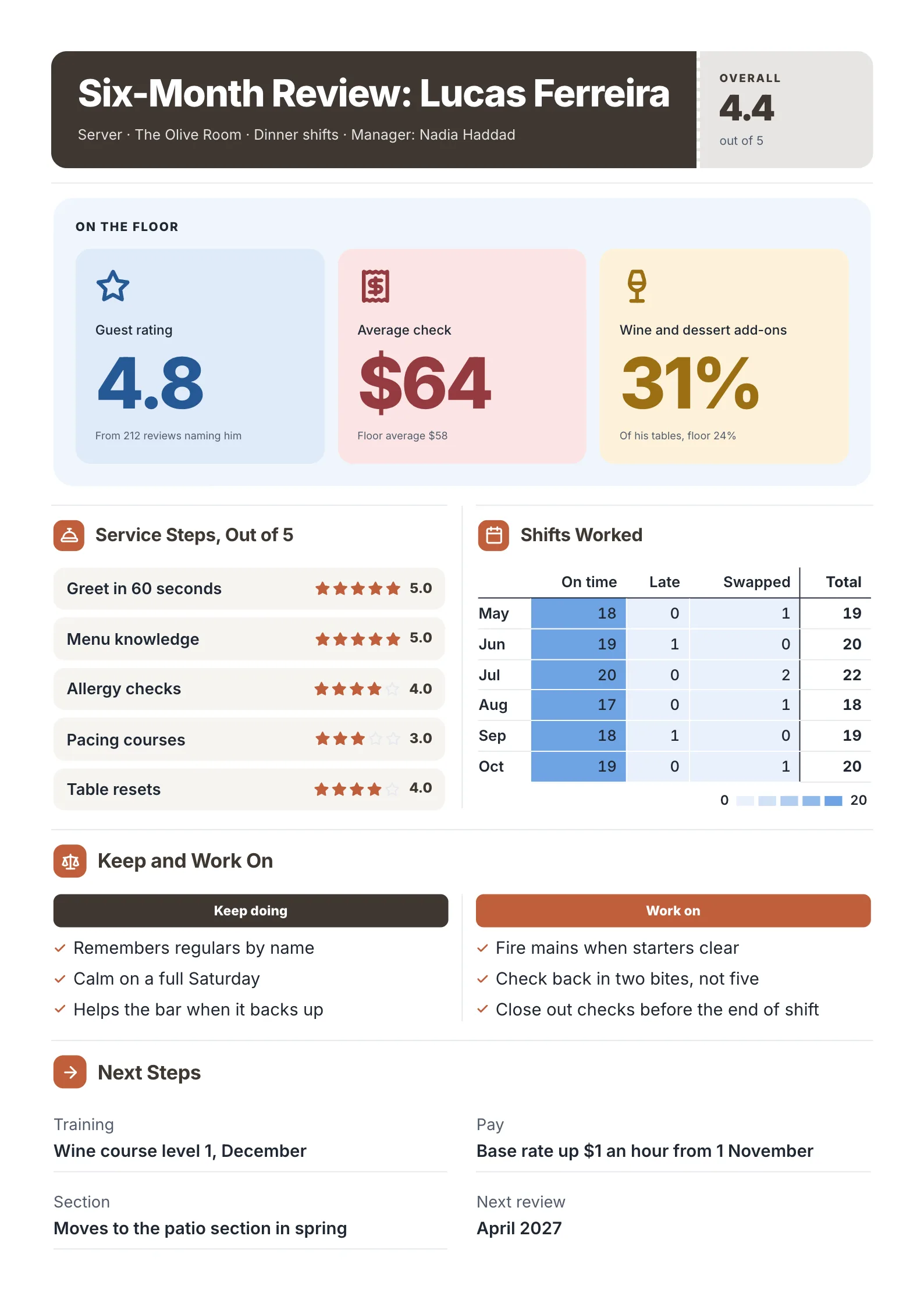
Lucas Ferreira works dinner shifts at The Olive Room, and his manager, Nadia Haddad, wrote this review at six months. It starts with numbers from the floor.
 Edit this template
A sample server with sample scores. Every number compares Lucas to the floor, so it's fair.
"On the Floor" shows you Lucas against everyone else, which is what makes it fair. His guest rating is 4.8, from 212 reviews that name him. His average check is $64 against a floor average of $58. Wine and dessert add-ons come on 31% of his tables, against 24% for the floor.
Service steps are scored out of 5, from greeting in 60 seconds and menu knowledge to allergy checks, pacing courses and table resets. You can see exactly which step to coach.
"Next Steps" makes the review feel like a deal you'd both sign. Wine course level 1 in December. A move to the patio section in spring. Base pay up $1 an hour from November 1. The next review in April 2027. The overall score is 4.4 out of 5.
A grade 8 science teacher's evaluation
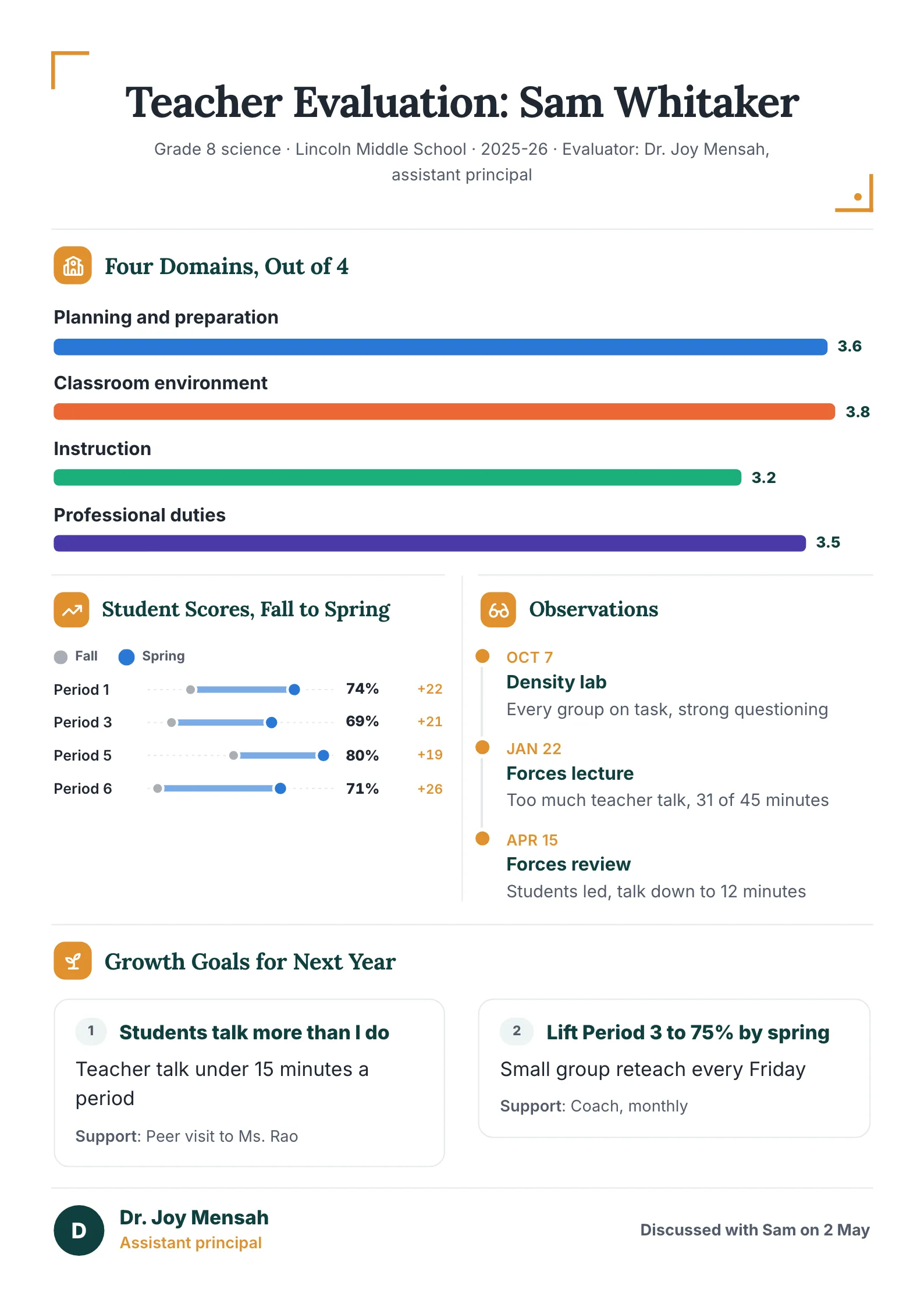
Sam Whitaker teaches grade 8 science at Lincoln Middle School. Dr. Joy Mensah, the assistant principal, evaluated the 2025-26 year across four domains, each scored out of 4.
 Edit this template
Lincoln Middle School is invented. The observations give minutes, not adjectives.
Dr. Mensah's observations come with measurements. In the density lab, every group was on task with strong questioning. In a forces lecture, teacher talk ran 31 of 45 minutes. In the forces review, students led and teacher talk fell to 12 minutes. You can't argue with a stopwatch.
If you're the teacher, that evidence tells you exactly where to grow. Sam's first goal is to keep teacher talk under 15 minutes a period, with a peer visit to Ms. Rao to help. His second is to lift Period 3 to 75% by spring, with a small group reteach every Friday and a monthly coach.
The rating closes it: Effective, 3.5 of 4, and recommended for the mentor teacher program.
A software engineer's half-year review
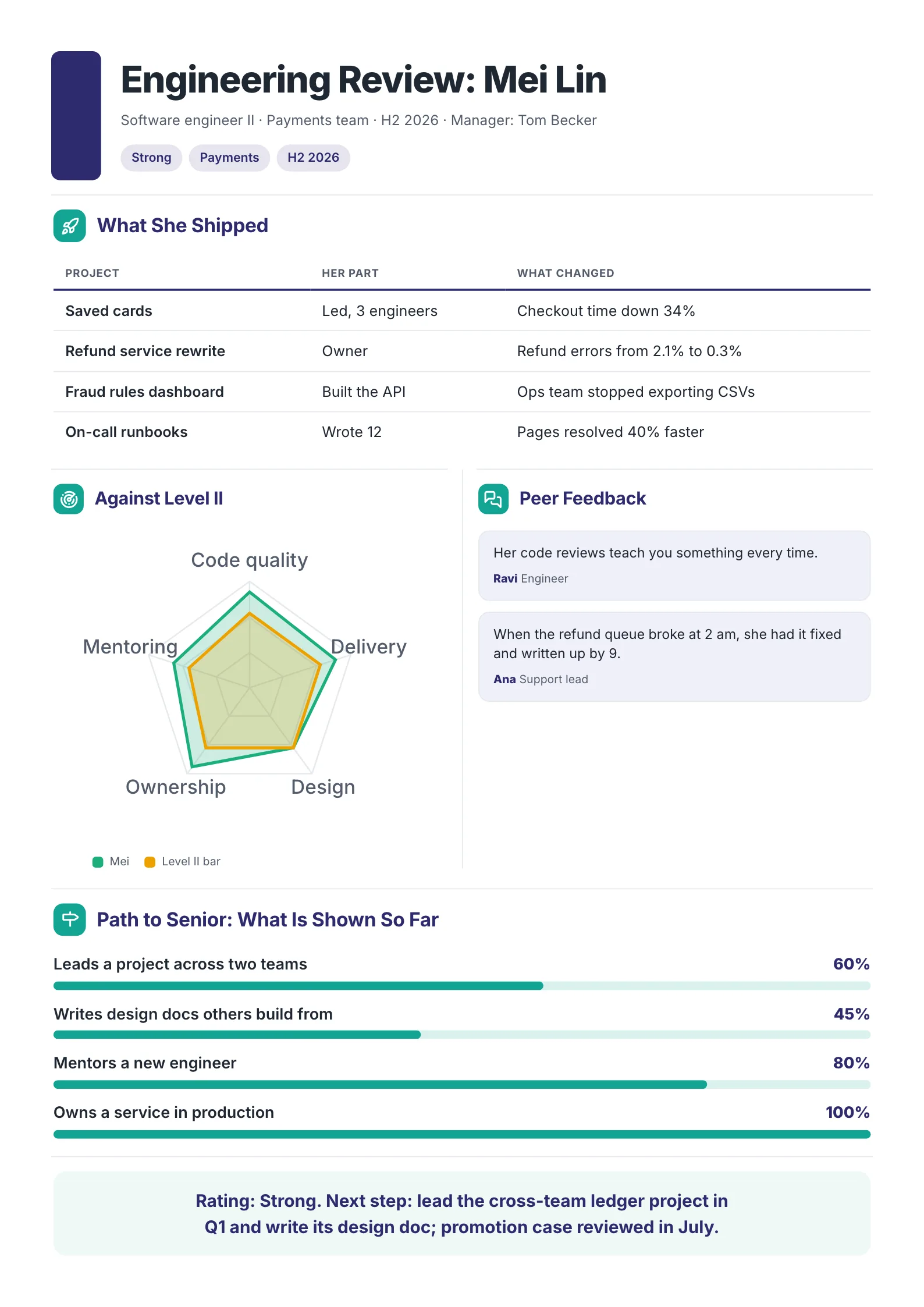
Mei Lin is a software engineer II on the payments team, reviewed for H2 2026 by her manager, Tom Becker. If you manage engineers, you'll notice her review points at the next level.
 Edit this template
A sample engineer. The path to senior shows four checks, so promotion isn't a mystery.
Mei's peers are quoted in full, and they're specific. One teammate says her code reviews teach you something every time. Another says that when the refund queue broke at 2 am, she had it fixed and written up by 9.
"Path to Senior: What Is Shown So Far" lists four things a senior engineer does. Lead a project across two teams. Write design docs others build from. Mentor a new engineer. Own a service in production.
The rating is Strong, and the next step is concrete: lead the cross-team ledger project in Q1 and write its design doc, with the promotion case reviewed in July.
A product manager's mid-year check-in
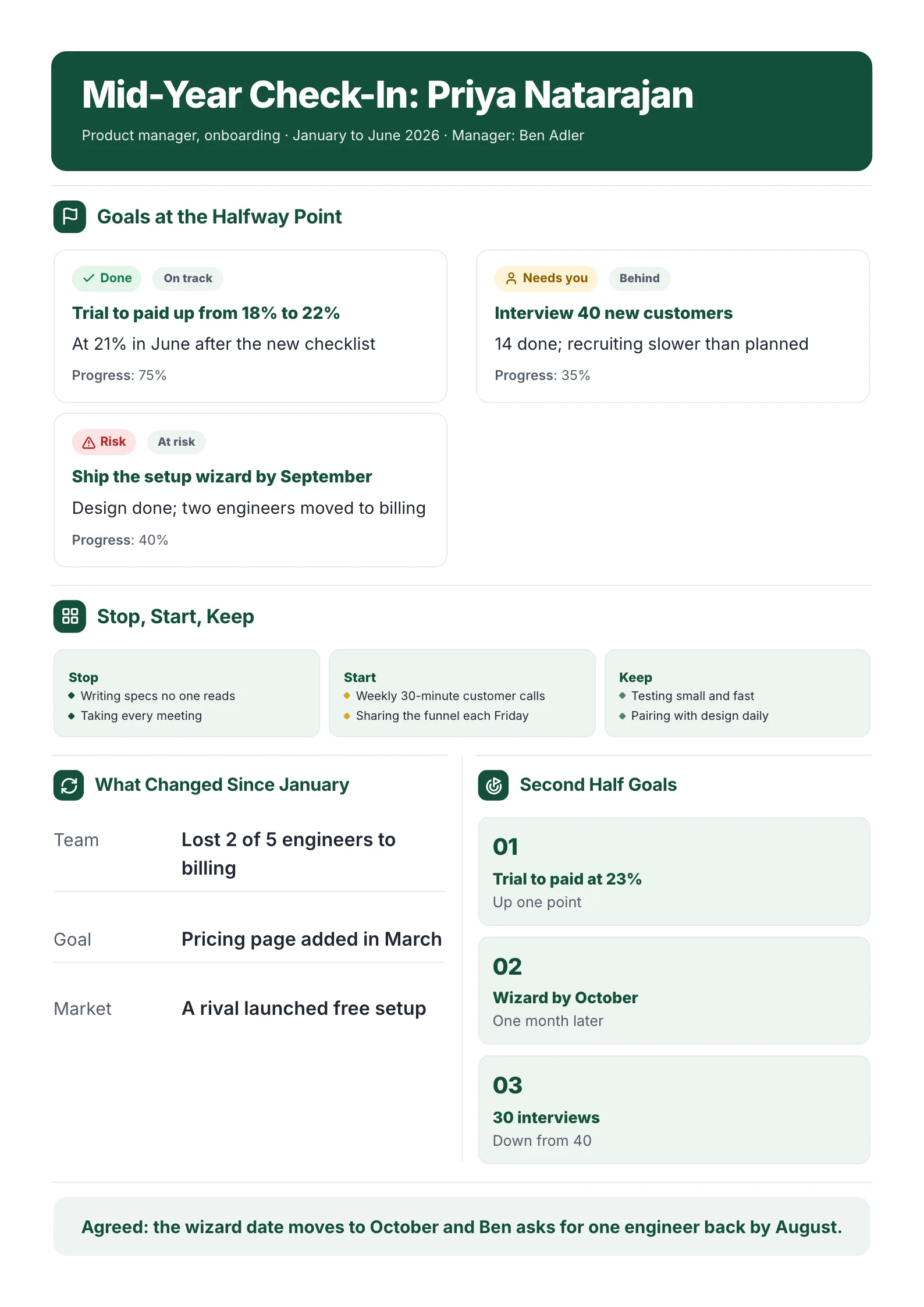
Priya Natarajan is the product manager for onboarding, and this check-in covers January to June 2026 with her manager, Ben Adler. A mid-year review adjusts goals instead of grading them.
 Edit this template
Priya is invented. "What Changed Since January" explains the misses before anyone asks.
Priya's three goals have moved at different speeds. Trial to paid went from 18% to 21% in June against a 22% goal, so 75% there. The setup wizard is at 40%, because two engineers moved to billing. Customer interviews are at 35%, with 14 of 40 done.
"What Changed Since January" is a box your mid-year review needs. The team lost 2 of 5 engineers to billing. A pricing page was added in March. A rival launched free setup. With that context, the second-half goals make sense: trial to paid at 23%, the wizard by October and 30 interviews.
The agreement line tells you the outcome. The wizard date moves to October, and Ben asks for one engineer back by August.
An account executive's year-end review
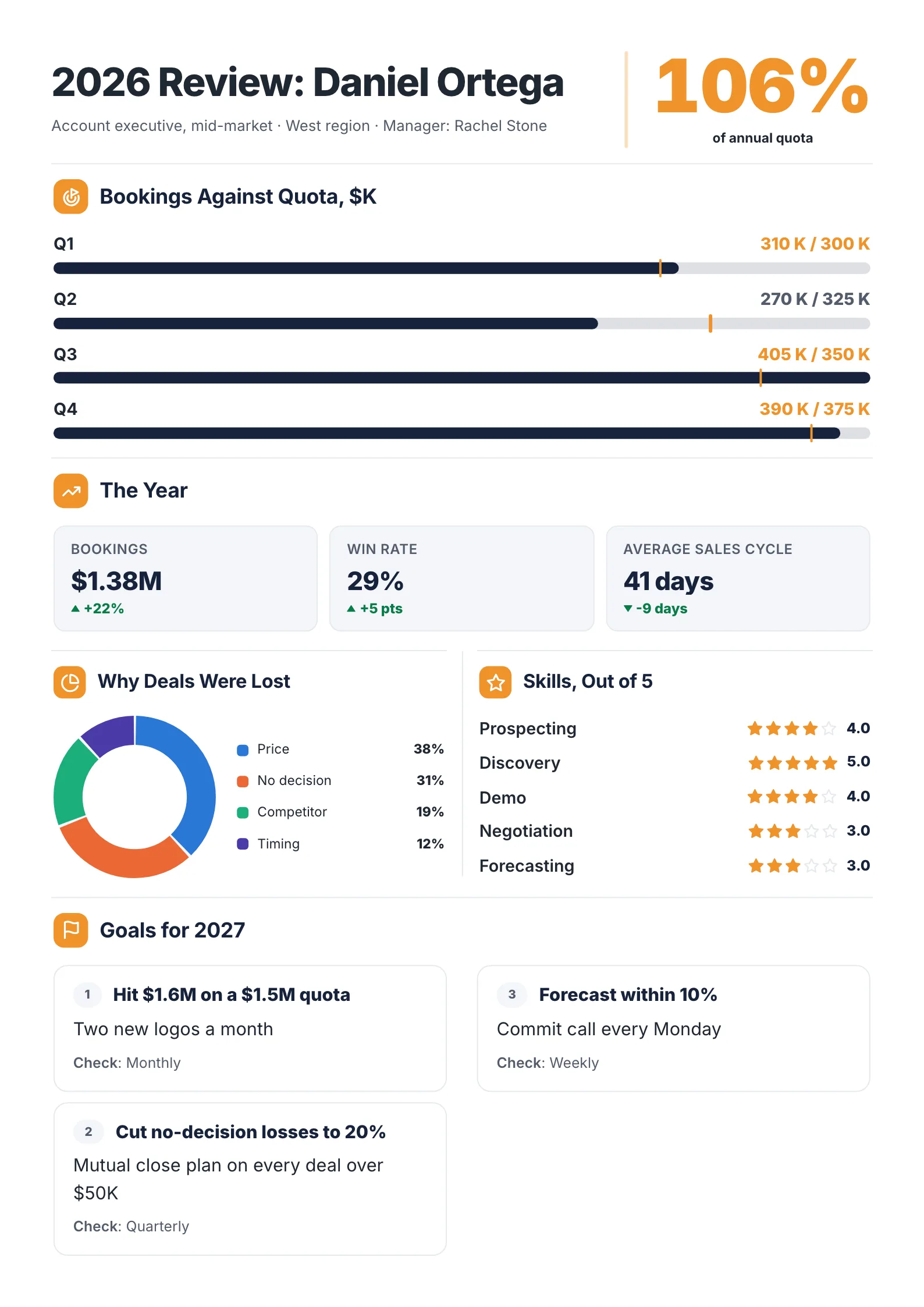
Daniel Ortega is a mid-market account executive in the West region, reviewed for 2026 by Rachel Stone. A sales review turns on one number, and here it's big: 106% of annual quota.
 Edit this template
A sample rep with sample bookings. Each 2027 goal says how often it gets checked.
The year gives you three numbers: $1.38M in bookings, a 29% win rate and a 41-day average sales cycle. "Why Deals Were Lost" puts price at 38% and no decision at 31%, and that second slice explains his second goal.
Each 2027 goal tells you how often it gets checked. Hit $1.6M on a $1.5M quota with two new logos a month, checked monthly. Cut no-decision losses to 20% with a mutual close plan on every deal over $50K, checked quarterly. Forecast within 10%, with a commit call every Monday, checked weekly. That gives Daniel his next step and its date: the first commit call on the first Monday of 2027.
The federal rating rule: numbered 1 to 5, four levels at most
Federal agencies rate employees under one regulation, and it's a good test for your own scale. You can read 5 CFR 430.208 yourself; we read it on October 30, 2026.
| What the rule says | What to borrow for your format |
|---|---|
| A rating must be based only on actual job performance for the appraisal period | Every rating above cites what happened in that period |
| Summary levels are numbered Level 1 (lowest) to Level 5 (highest), and each allowed pattern uses 2, 3 or 4 of them | Pick a scale and print it on the page |
| Level 1 is "Unacceptable," Level 3 is "Fully Successful," Level 5 is "Outstanding" | Name your middle level so "average" doesn't sound like failure |
| "Outstanding" may be used only for Level 5 | Keep your top word for the top level |
| Level 1 is given if and only if a critical element is rated "Unacceptable" | Say which parts of the job are critical |
| A two-level pattern may only be used for seasonal employees, teachers, General Schedule grades 1 to 4 and Federal Wage System employees | Pass/fail suits a few roles; most need more levels |
The five examples above give you 5-point, 4-point and word ratings to choose from. What they share with the federal rule is that each rating sits on evidence from the period.
End every review with a date
Before you hand it over, check that your closing sentence names a next step and when it happens. Lucas's page from MakeOnepagers ends with his next review in April 2027, and Mei's sets her promotion case for July. That date is what turns a rating into a plan.
Frequently asked questions
What is the best format for a performance review?
Role and period at the top, results against goals, evidence, a rating, and the next step with a date. One page keeps the conversation on what matters. Our guide on how to write a performance review walks through each part.
What rating scale should I use?
A 5-point scale is common. The federal rule numbers its levels 1 to 5, but no allowed pattern uses more than four. A 4-point scale, like the teacher's, avoids a middle score nobody wants. Whatever you pick, define each level so your team reads it the same way.
How is a mid-year review different from a year-end review?
A mid-year review adjusts goals and explains what changed. A year-end review rates the full period. For more filled-in reviews, see these performance review examples.




