BlogGuide
One Pager Outline: The 6-Part Structure, With 4 Real Examples
A one pager outline you can copy: the 6 parts in order, then 4 real outlines for a pitch, a product launch, a client review and a student book report.

By MakeOnepagers Team
Updated · 7 min read
A one pager outline is the order of sections that every good one-pager follows: a title, the main point in one sentence, the context or problem, what you are proposing or reporting, the proof, and the next step. Write those six parts in that order and the page reads well whether it's a pitch, a project update or a school assignment. Below is the outline you can copy, then four real One-Pagers taken apart section by section, so you can see the same skeleton under four very different pages.
One‑Pager examples
Real One-Pagers made with MakeOnepagers. Open any one to edit it as your own.
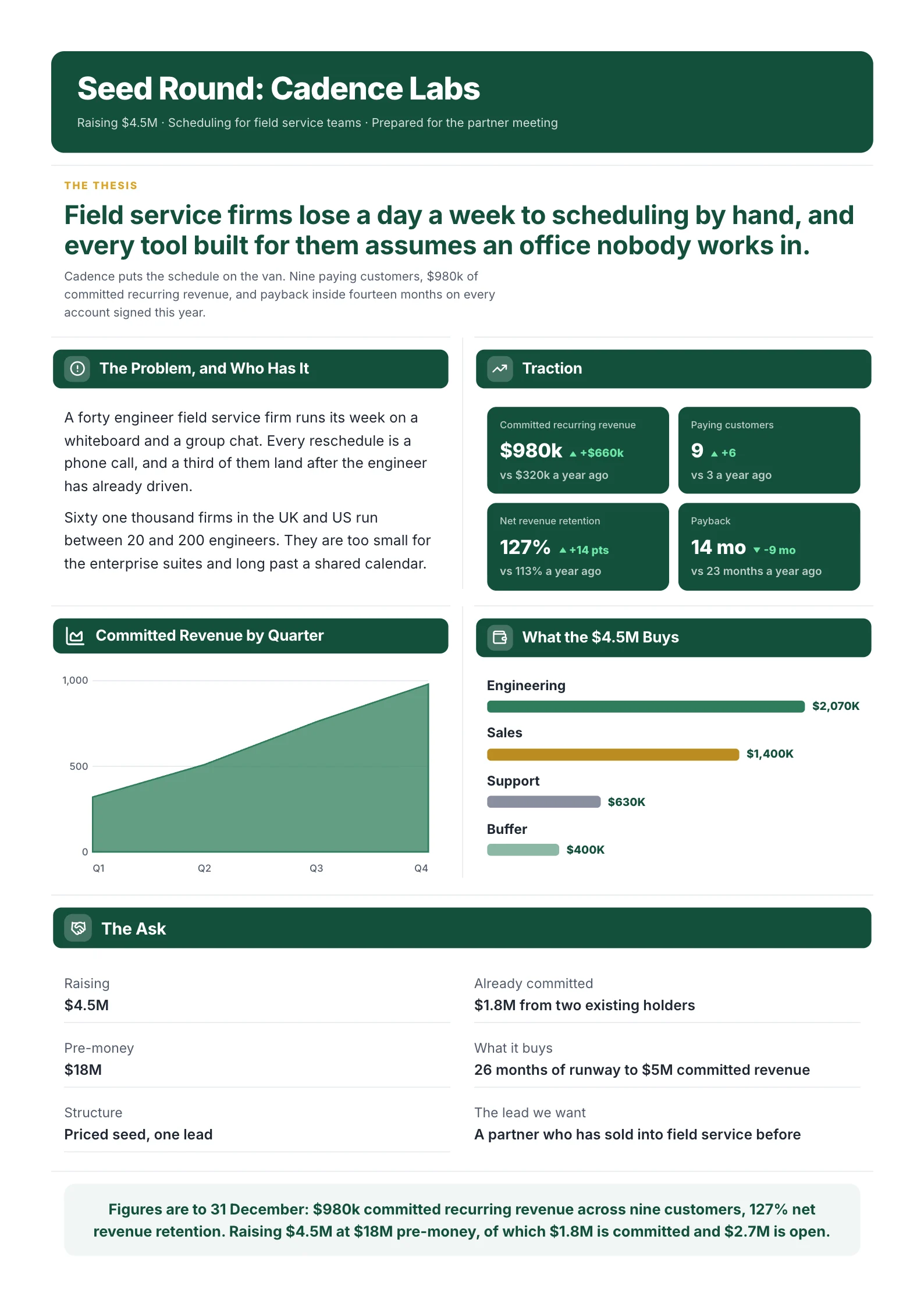 Startup PitchEdit for free(opens in a new tab)
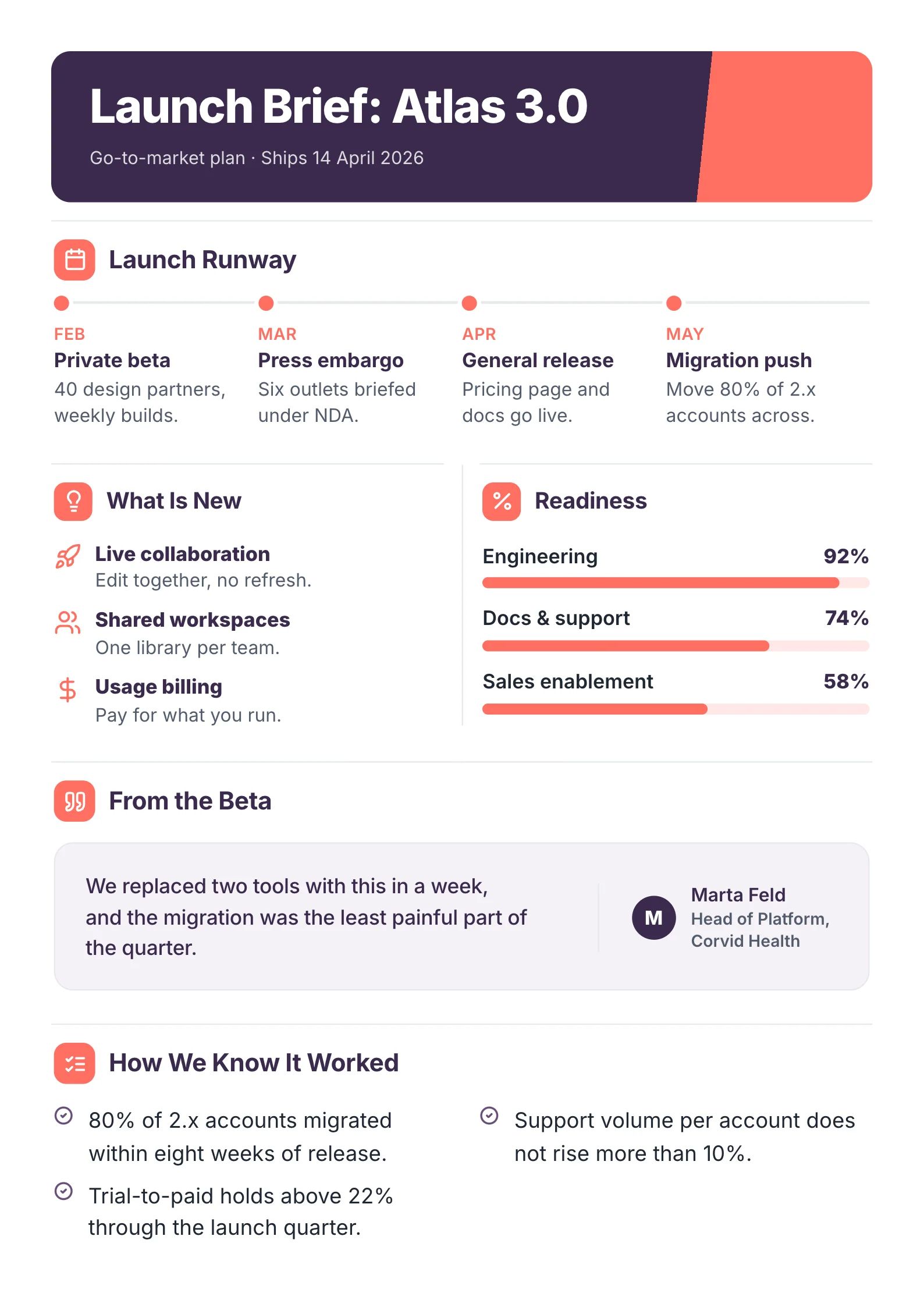 Product Launch BriefEdit for free(opens in a new tab)
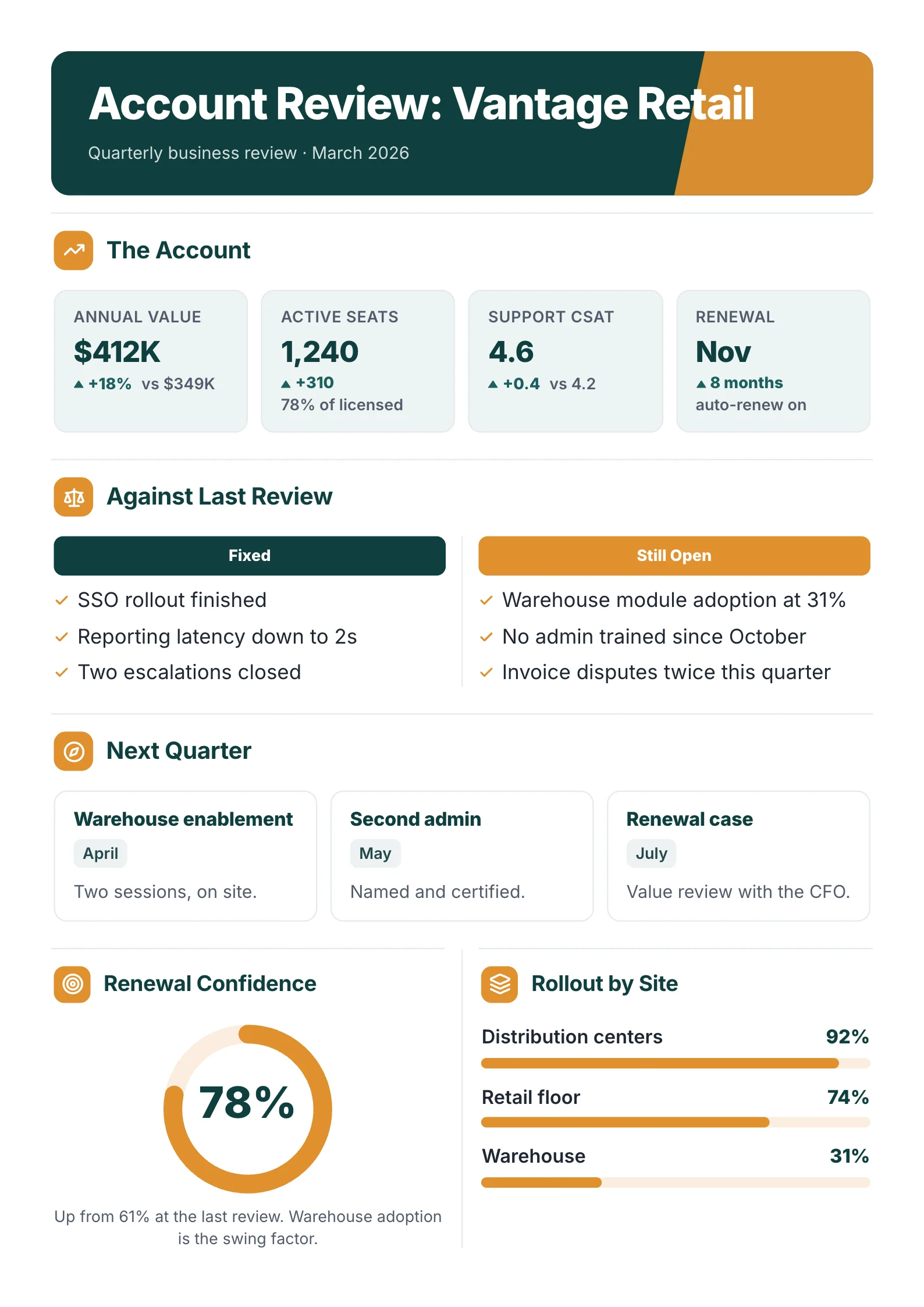 Quarterly Business ReviewEdit for free(opens in a new tab)
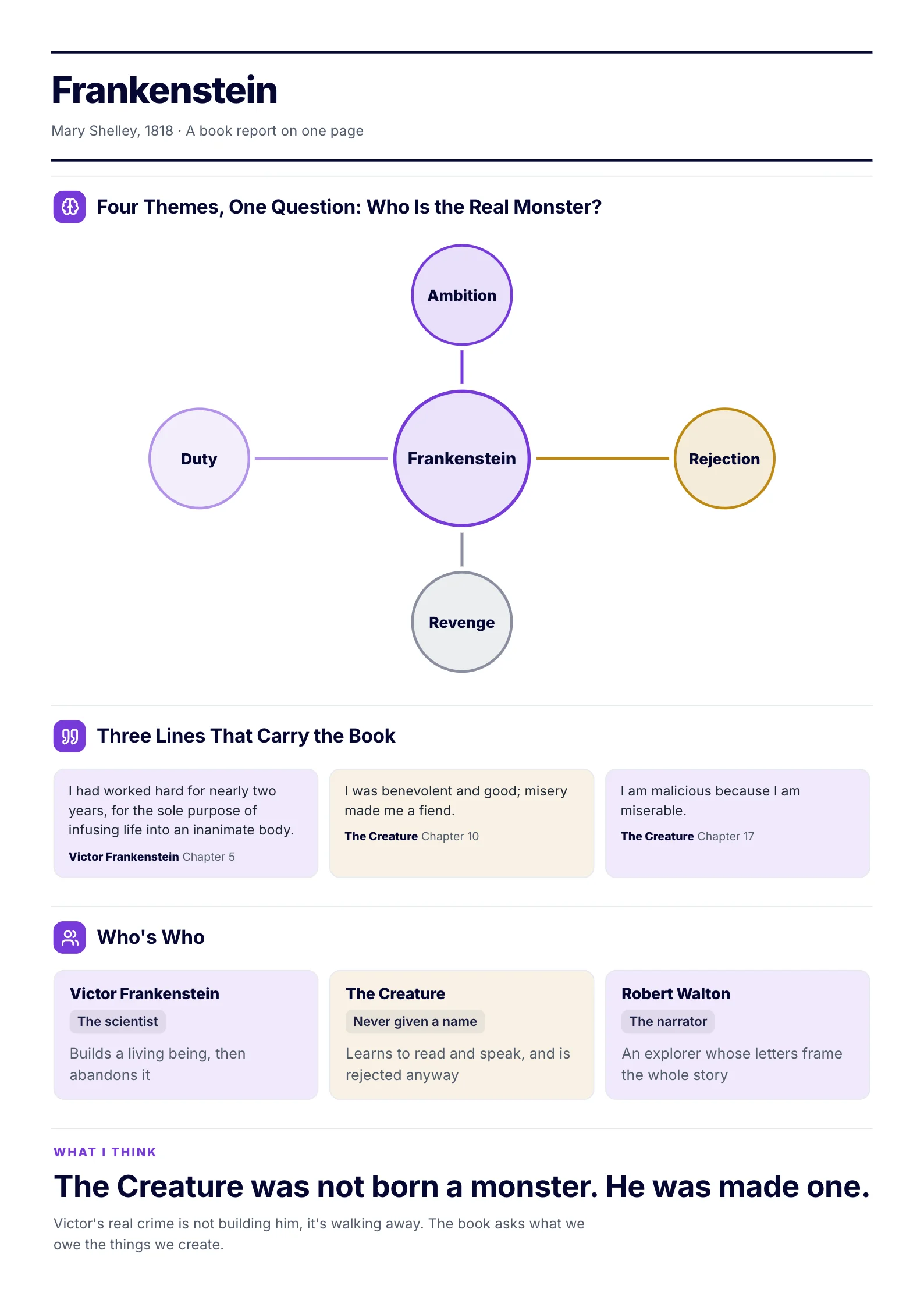 Book ReportEdit for free(opens in a new tab)
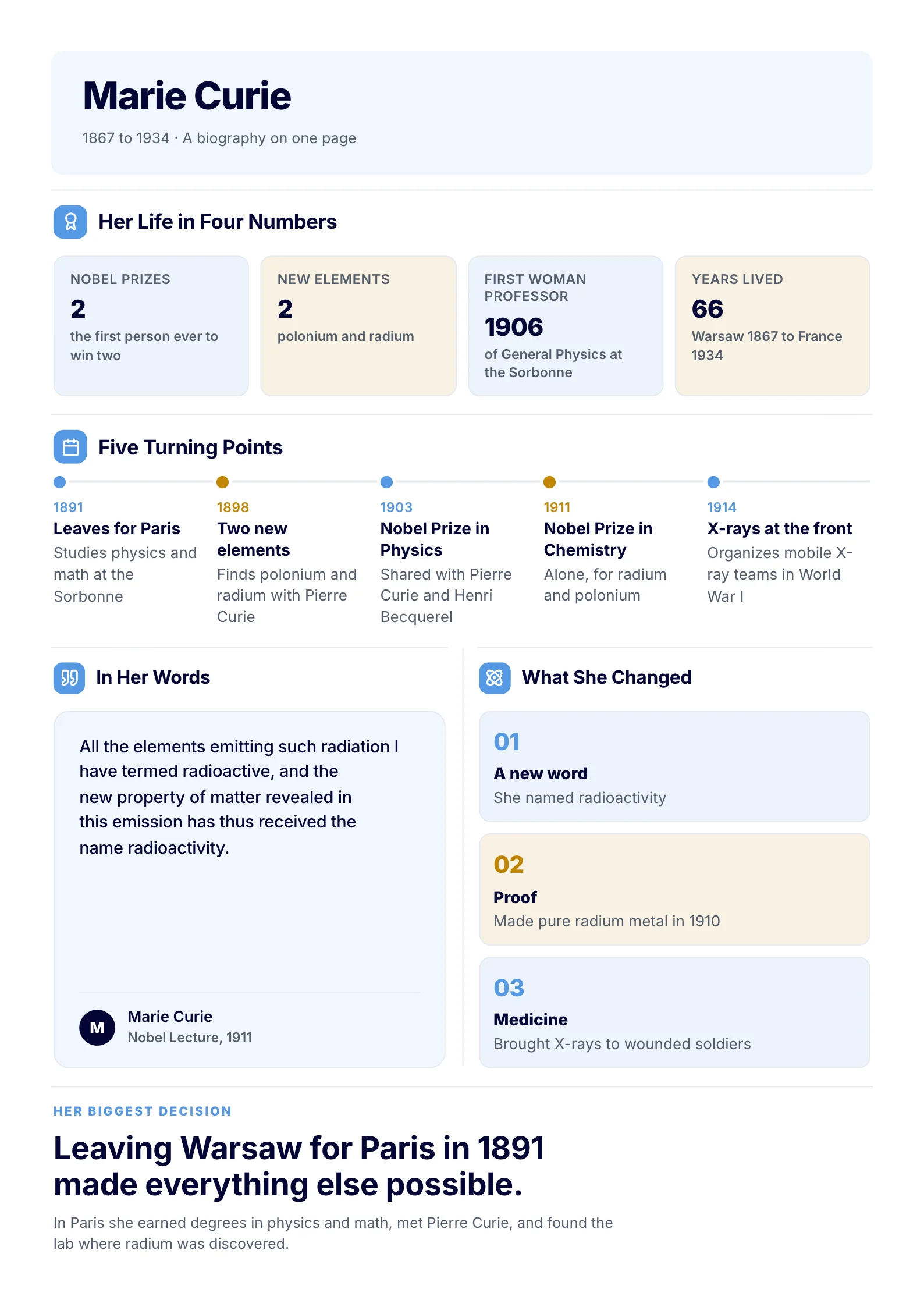 BiographyEdit for free(opens in a new tab)
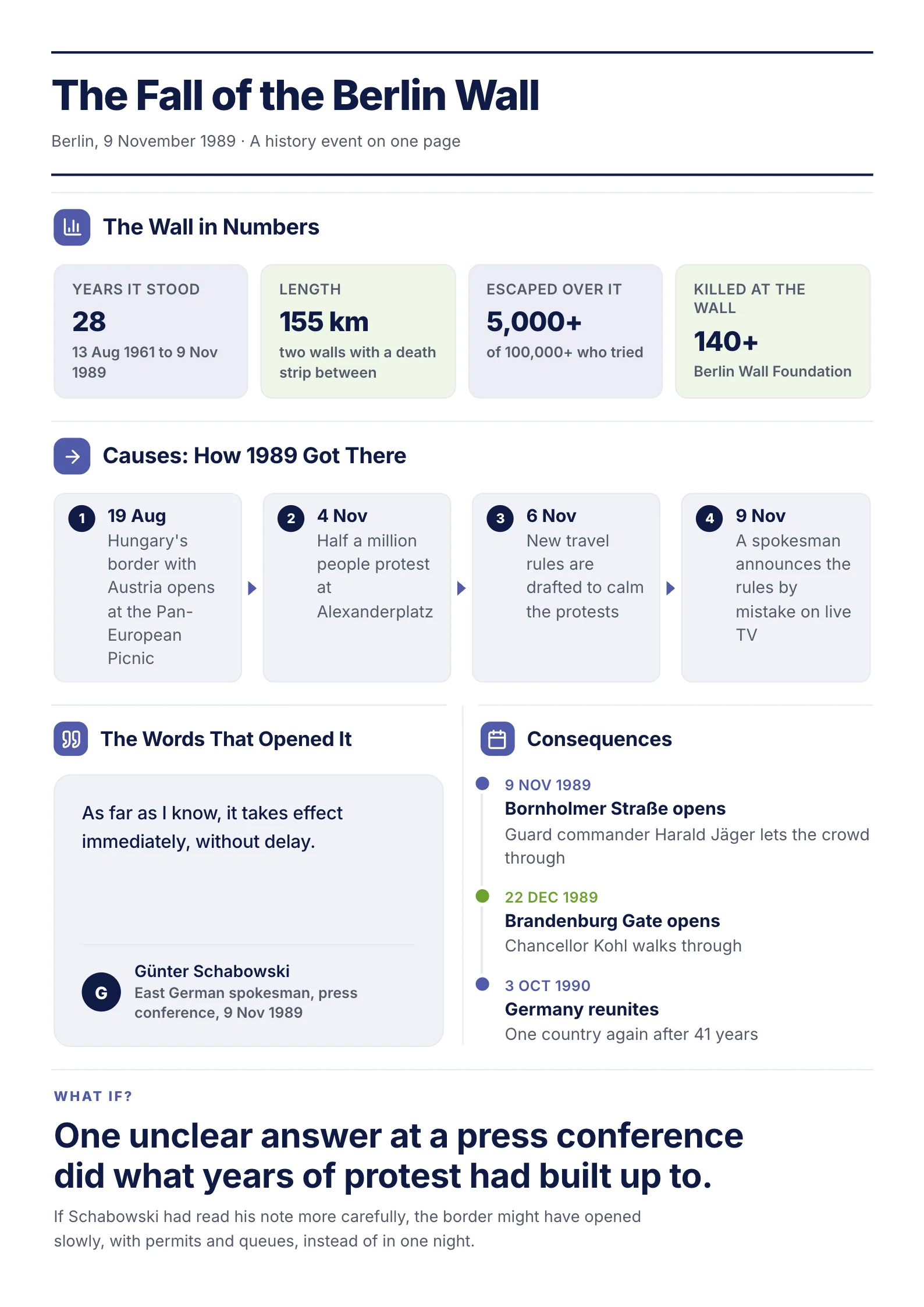 History EventEdit for free(opens in a new tab)
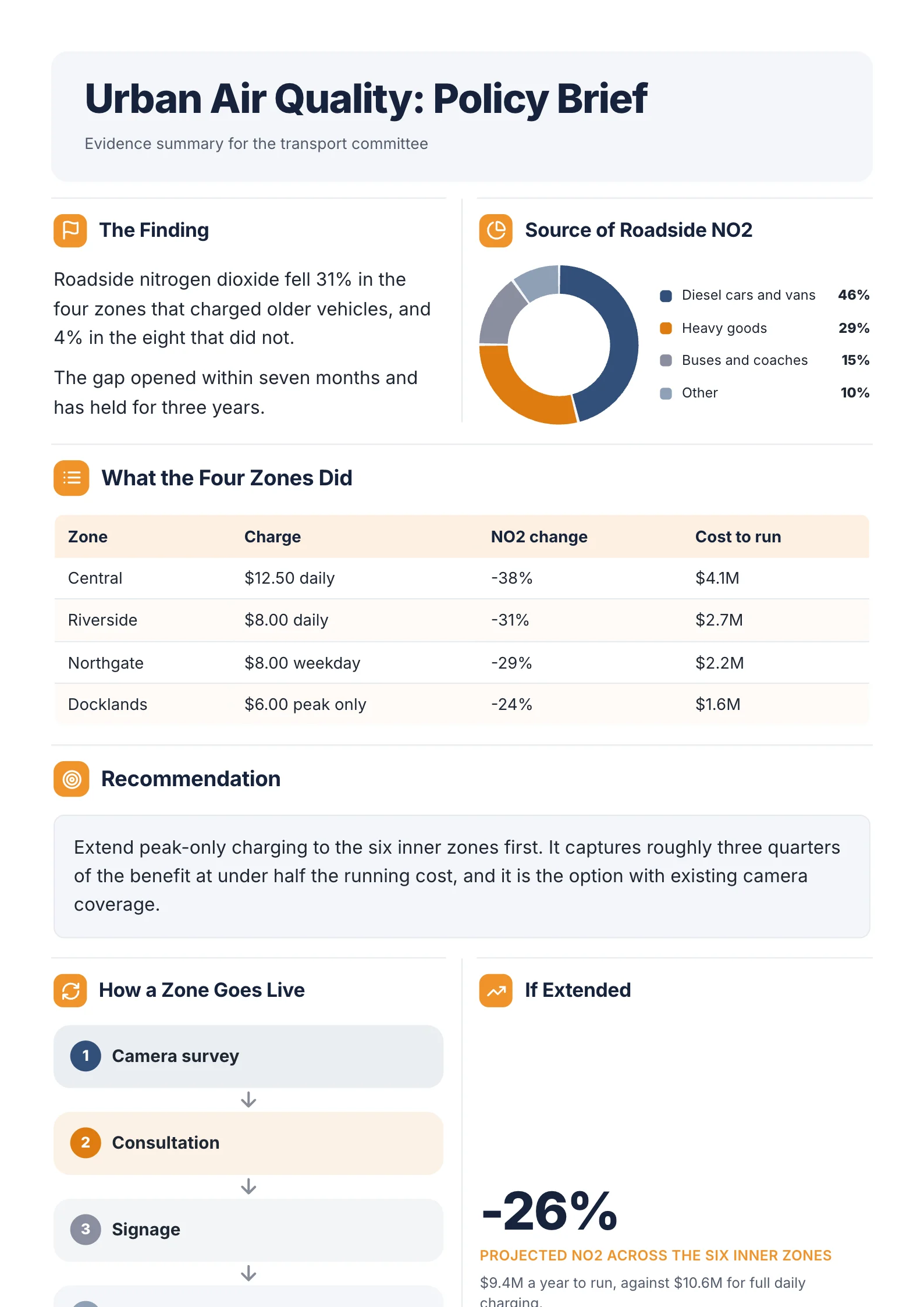 Policy BriefEdit for free(opens in a new tab)
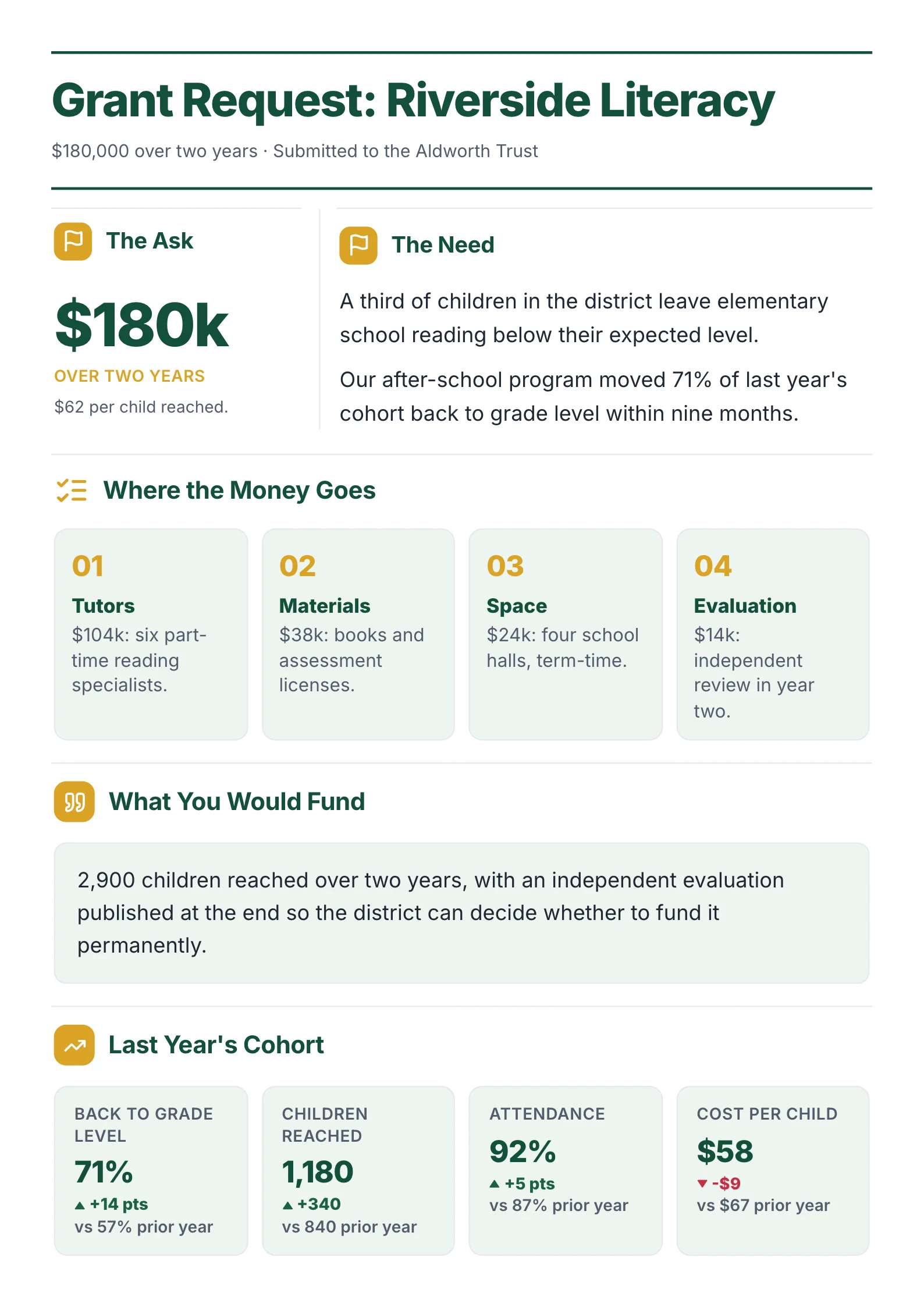 Grant RequestEdit for free(opens in a new tab)
Every example was made with MakeOnepagers. The companies and figures are samples.
The one pager outline, in 6 parts
- Title. What this is and who it's for. "Seed Round: Cadence Labs" or "Launch Brief: Atlas 3.0".
- The point, in one sentence. The thing the reader should remember if they read nothing else. This goes right under the title.
- Context or problem. Why this matters now, in two or three lines or three bullets.
- What you're proposing or reporting. The plan, the product, the results or the argument. This is the biggest part of the page.
- Proof. Numbers, a chart, a quote or a comparison. The part that makes the reader believe section 4.
- Next step. What you want the reader to do, decide or know next, with a name or a date.
Writing the point first is the trick. If you can't say it in one sentence, the page isn't ready, and no amount of design will fix it.
A one pager outline you can copy
| Section | What to write in it |
|---|---|
| Title | What it is and who it's for, in under 8 words |
| The point | One sentence the reader remembers |
| Context | 2 or 3 lines on why this matters now |
| The main part | The plan, product, results or argument, in 3 to 5 short blocks |
| Proof | 3 or 4 numbers, one chart, or one quote |
| Next step | One action, with a name or a date |
Fill it in as plain notes first. Only once every row has words in it should you start laying out the page. If you're new to one-pagers, how to make a one-pager covers the layout step by step.
4 one pager outlines, taken from real examples
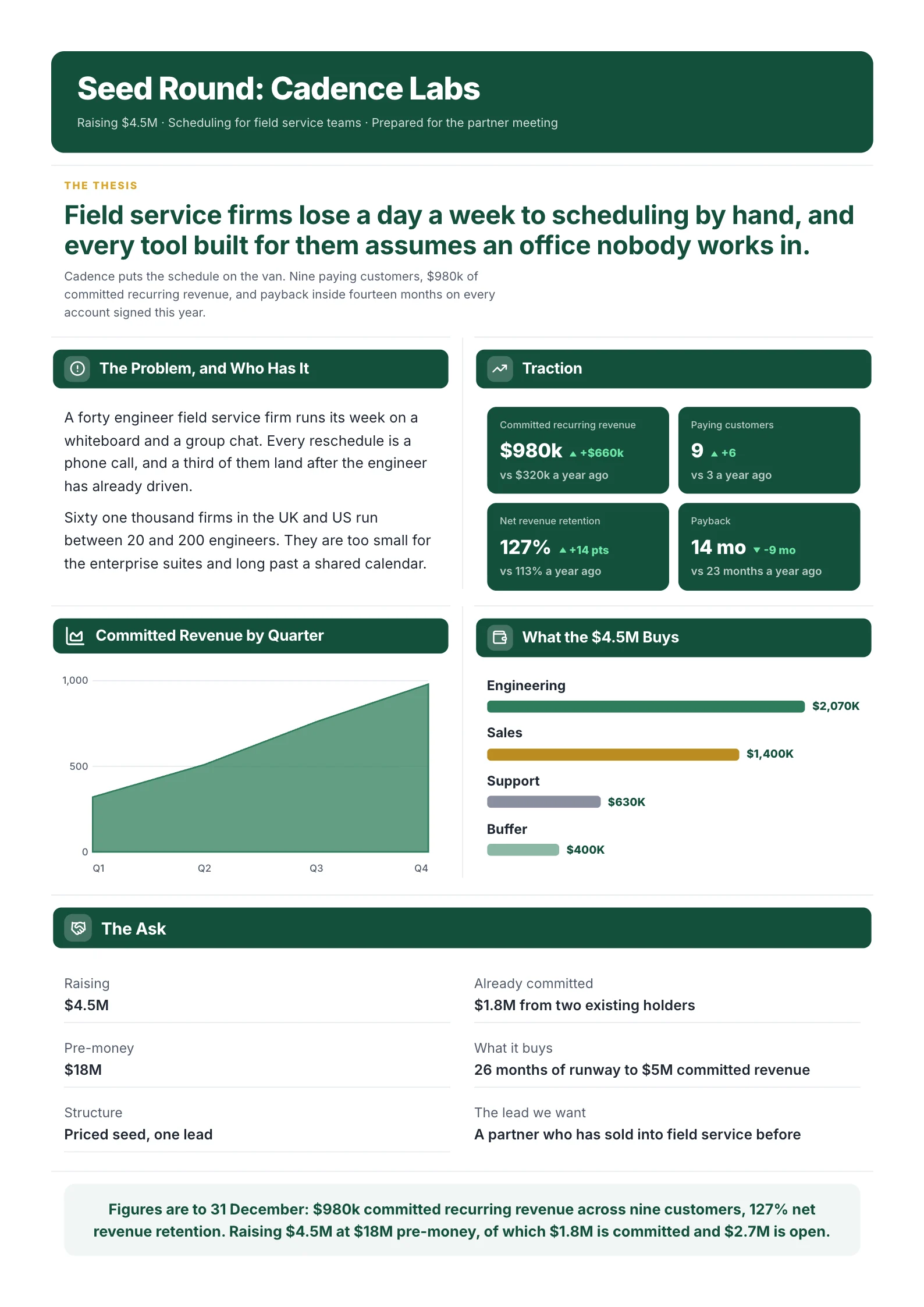
1. Startup pitch outline
 Edit this template
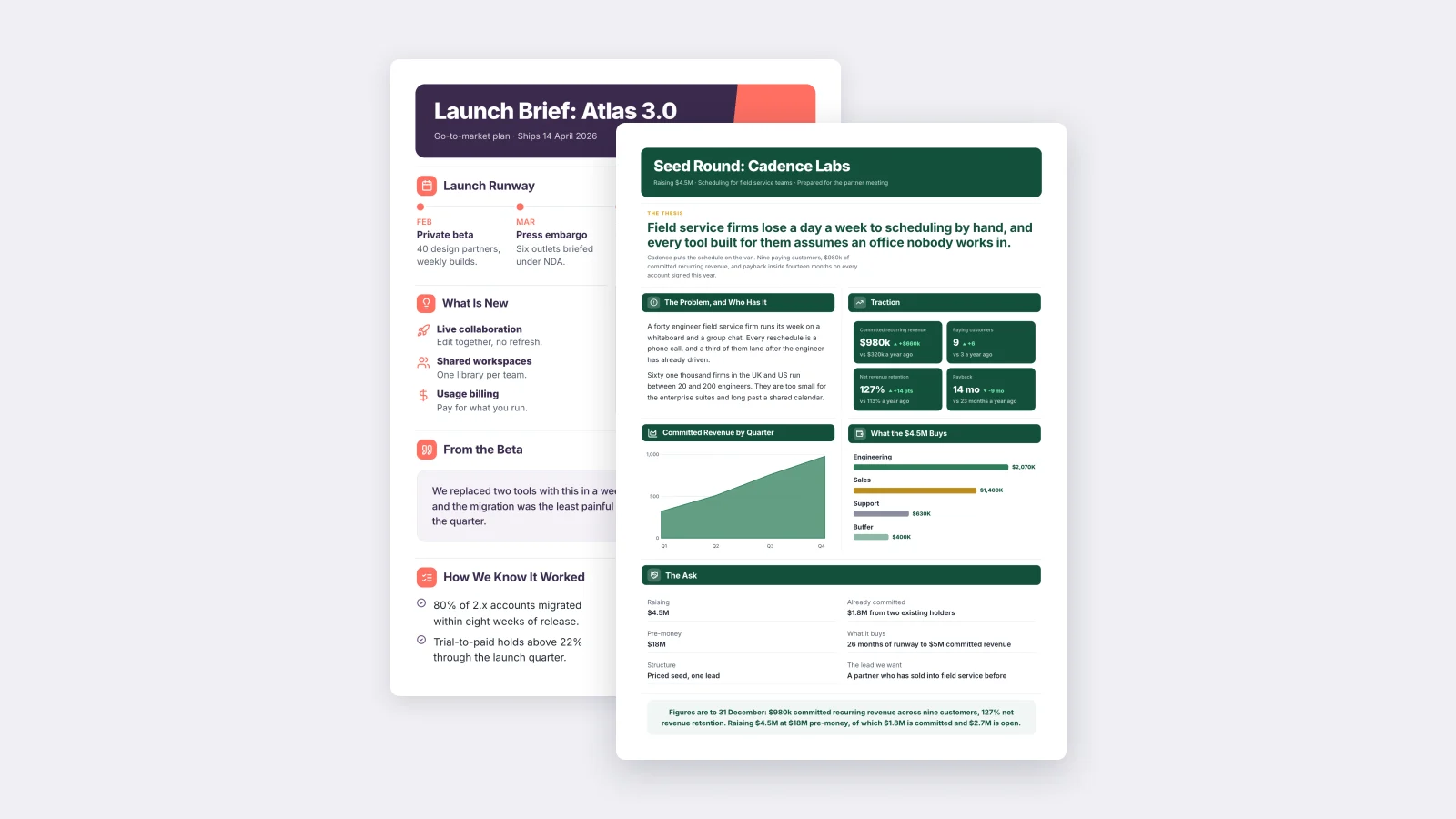
A sample seed round pitch: the thesis in one bold sentence, then the problem, traction, the money and the ask.
The outline under it:
- Title: Seed Round: Cadence Labs, raising $4.5M.
- The point: "Field service firms lose a day a week to scheduling by hand."
- Context: the problem and who has it, in two short paragraphs.
- The main part: what the $4.5M buys, split into engineering, sales, support and buffer.
- Proof: traction in four numbers, each against a year ago, plus revenue by quarter.
- Next step: the ask, with the amount, the price, what's committed and the lead investor wanted.
What to copy: the point is written as the thesis, in the biggest type on the page. An investor who reads only that line knows what the company believes.
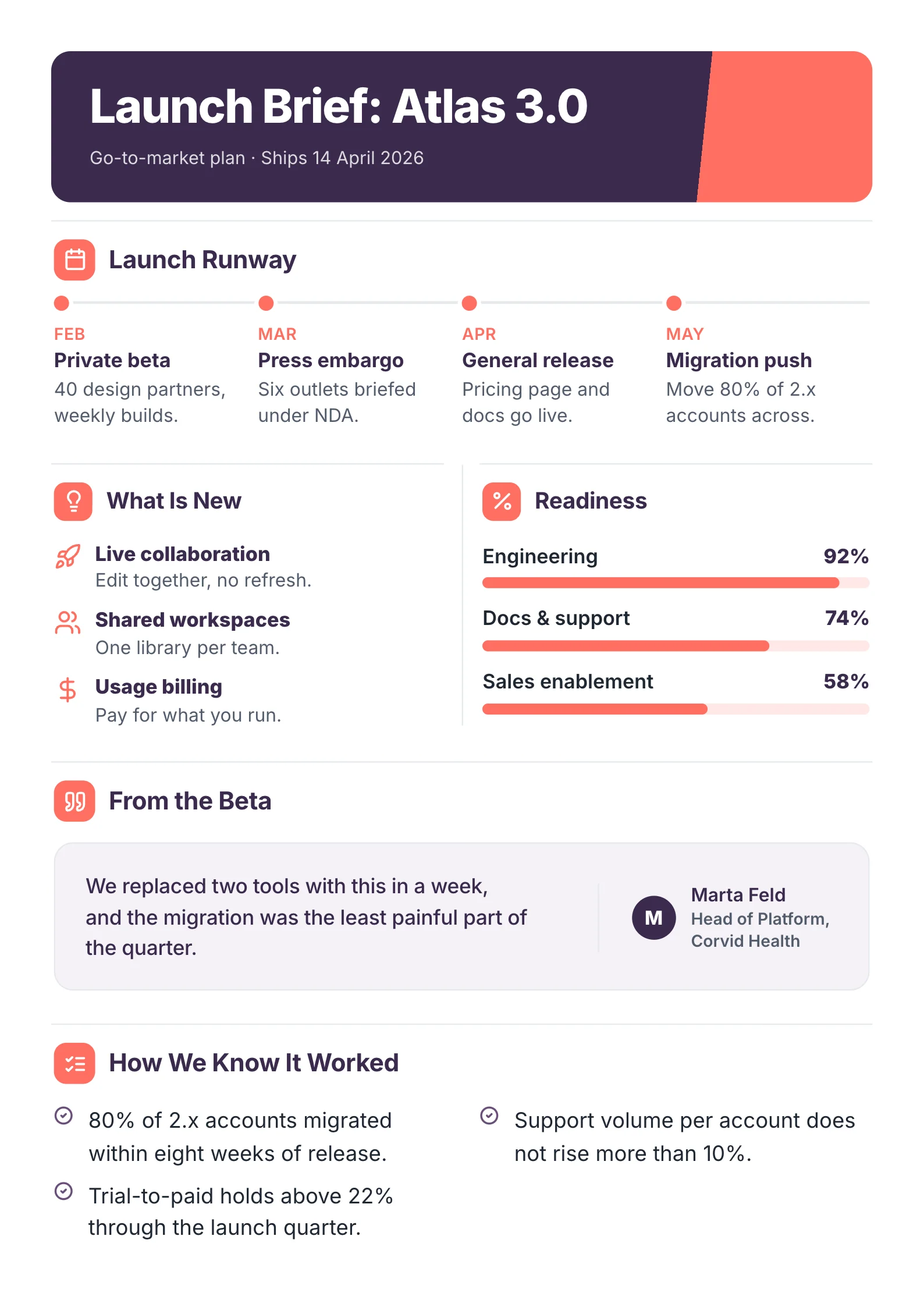
2. Product launch outline
 Edit this template
A sample launch brief: when it ships, the four dates that lead there, what is new, who is ready and how success is measured.
The outline under it:
- Title: Launch Brief: Atlas 3.0, ships 14 April 2026.
- The point: the ship date in the subtitle, so everyone reads it first.
- Context: the launch runway, four months in four steps.
- The main part: what's new, in three features with one line each.
- Proof: readiness by team in percent, and a quote from a beta customer.
- Next step: "How we know it worked", three targets the team will be judged on.
What to copy: the next step is a set of measures, not a request. For an internal page, telling the team what success looks like is the call to action.
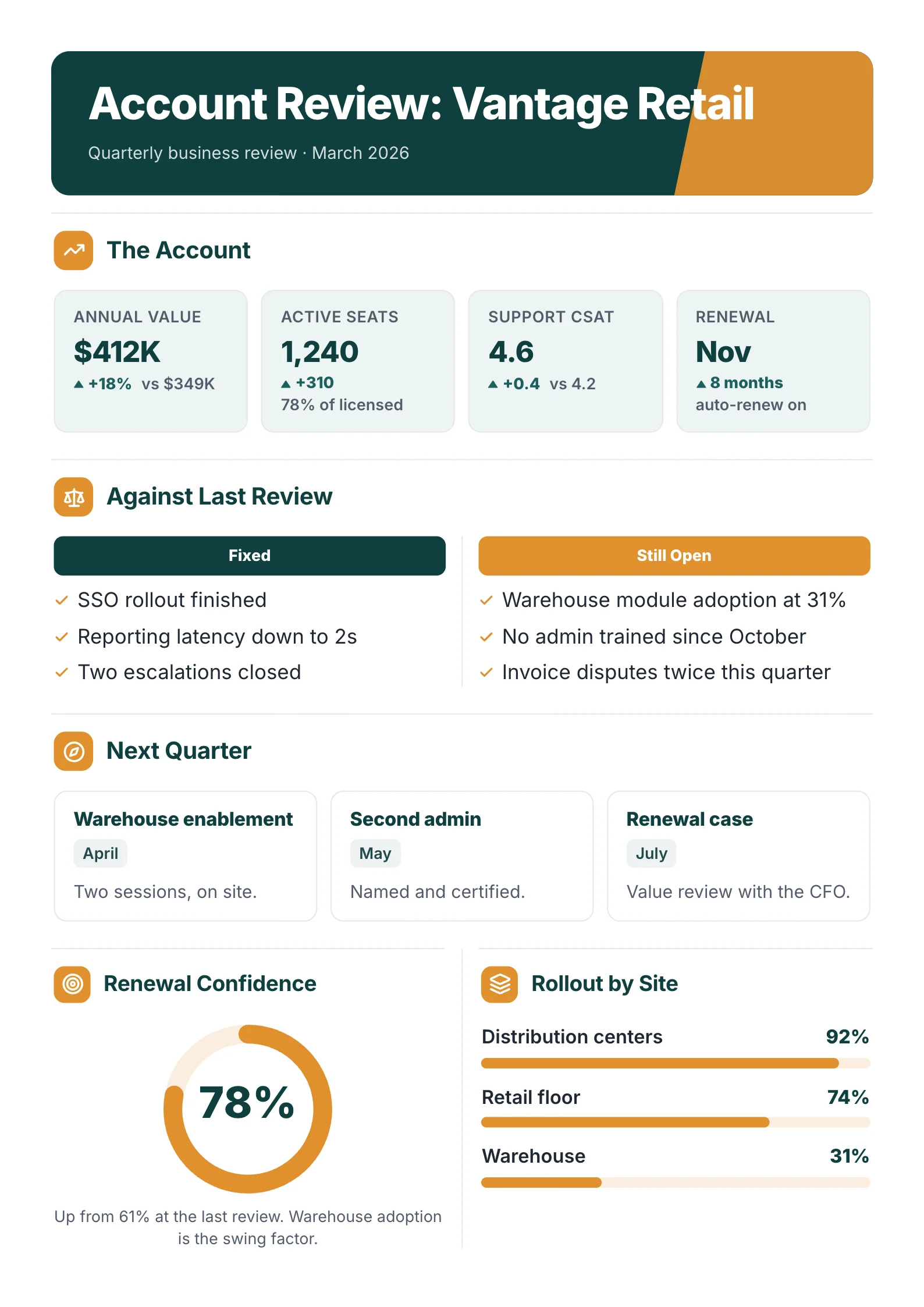
3. Client review outline
 Edit this template
A sample quarterly client review: the account in four numbers, fixed against still open, and the plan for next quarter.
The outline under it:
- Title: Account Review: Vantage Retail, March 2026.
- The point: the account in four numbers: value, seats, support score and renewal date.
- Context: what was fixed since the last review and what is still open, side by side.
- The main part: next quarter's plan, three actions with a month each.
- Proof: renewal confidence at 78%, up from 61%, and rollout by site.
- Next step: the renewal case in July, already on the plan.
What to copy: "Still open" sits next to "Fixed". A review that admits what isn't done is believed on what is.
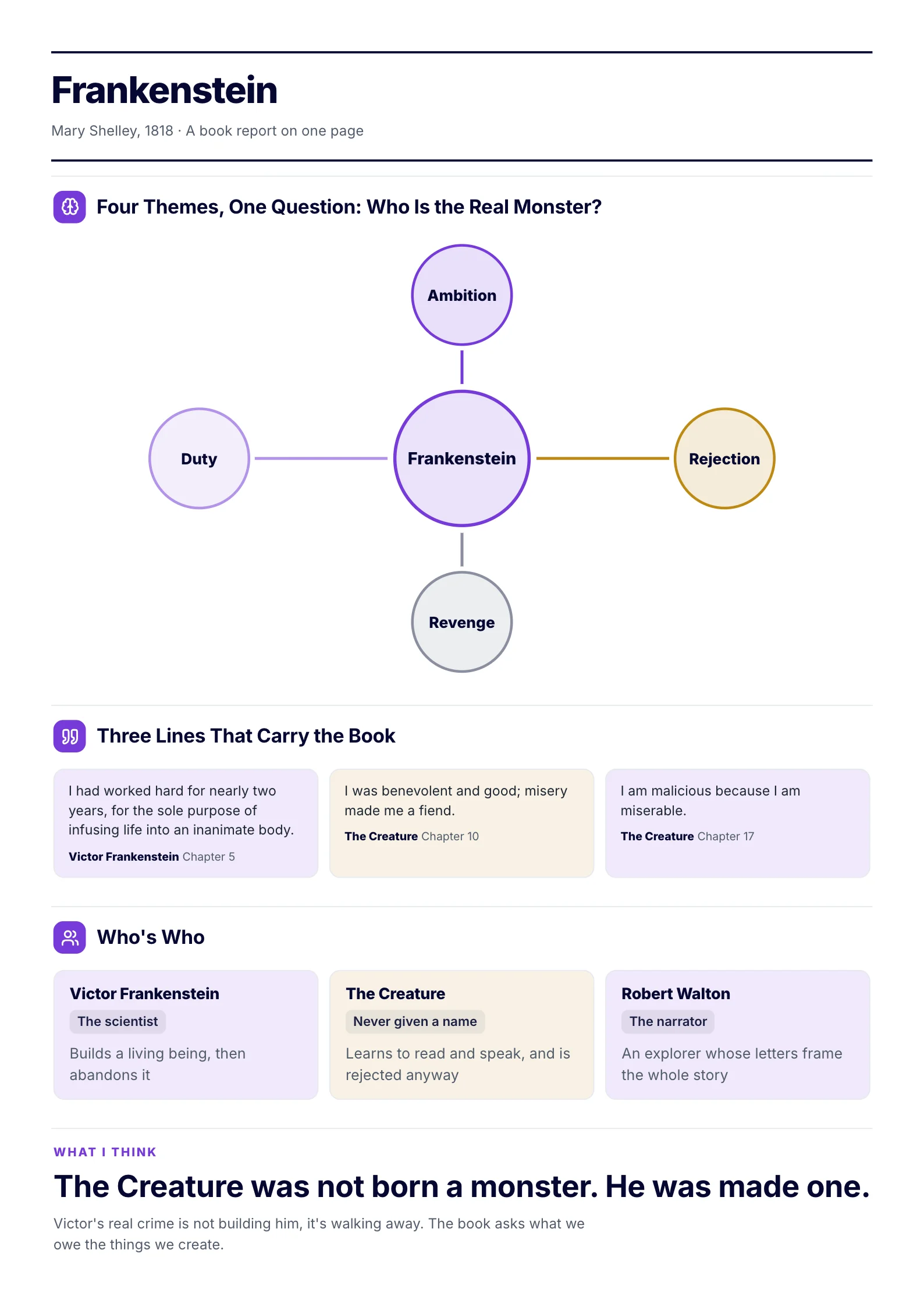
4. Student book report outline
 Edit this template
A sample book report on one page: a question, four themes, three quotes, the characters and the student's own argument.
The outline under it:
- Title: Frankenstein, Mary Shelley, 1818.
- The point: one question the whole page answers, "Who is the real monster?"
- Context: four themes linked to the book, drawn as a map.
- The main part: who's who, three characters with one line each.
- Proof: three quotes from the book, each with the speaker and the chapter.
- Next step: "What I think", the student's answer to the question in one sentence.
What to copy: for a school one-pager, the "next step" is your own conclusion. Teachers grade the argument, so make it the last and largest line.
How to turn an outline into a one-pager
- Write the point first. One sentence. If it takes two, pick the more important one.
- Fill every row of the outline as plain notes. Don't design anything yet.
- Cut each section to its strongest item. Three bullets, not seven. One chart, not four.
- Pick a layout where the point is biggest. Under the title or in the largest type on the page.
- Read it as a stranger would. Can they tell what you want from them in 30 seconds? If not, the point or the next step is unclear.
If you already have a report, a deck or notes, MakeOnepagers reads your file and lays it out in this order for you, using only what's in it. You then edit the words and the layout yourself.
One pager outline mistakes
- Starting with the background. Context is section 3 for a reason. Readers want the point first.
- No single point. A page that makes five points makes none. Choose one and let the rest support it.
- Proof without numbers. "Customers love it" is a claim. "Renewal confidence up from 61% to 78%" is proof.
- No next step. The reader finishes and doesn't know what you want. End with an action, a decision or a date.
- Outlining for the wrong reader. An investor, a teacher and a client need different proof. Decide who it's for before you write the point.
Frequently asked questions
What is a one pager outline?
It's the order of sections a one-pager follows: title, the main point in one sentence, context, the main content, proof and a next step. You fill in the outline as notes before laying out the page, so the content is settled before the design.
What are the parts of a one-pager?
Most one-pagers have six: a title, a one-sentence point, context or the problem, the main content, proof such as numbers or quotes, and a next step. Business one-pagers lean on numbers for proof. School one-pagers use quotes and examples instead.
How do you outline a one-pager for school?
Start with a title and the question or main idea your page answers. Add the context (themes, setting or background), the main content (characters, events or key facts), proof (quotes or data with their sources) and end with your own conclusion. Our one-pager examples for students show several finished versions.
How long should each section of a one-pager be?
Short. The point is one sentence, the context two or three lines, the main part three to five short blocks, the proof three or four numbers or one chart, and the next step one line. If a section needs more, it belongs in a separate document.
Is there a one pager outline template?
Yes. Copy the six-row table above, or open any of the eight examples on this page in MakeOnepagers. Each one is already laid out in this order and you replace the words with your own. Your first One-Pager is free with the AI One-Pager Generator, no account needed, and editing by hand is always free.