BlogGuide
OKR Template: Free One-Page Scorecard, With Example
A free one-page OKR template for setting and scoring objectives and key results, how 0 to 1 scoring works, and a worked quarterly example.

By MakeOnepagers Team
Updated · 5 min read
An OKR template gives a team one page for its goals: three to five objectives for the quarter, two or three measurable key results under each, and at the end, a score from 0 to 1 for how far each one got. OKR stands for objectives and key results. Teams at companies of every size use it to agree what matters this quarter and to see, at a glance, which goals carried and which were quietly dropped. Below is how OKRs work, a free template you can copy, a worked example and the mistakes that sink them.
One‑Pager examples
Real One-Pagers made with MakeOnepagers. Open any one to edit it as your own.
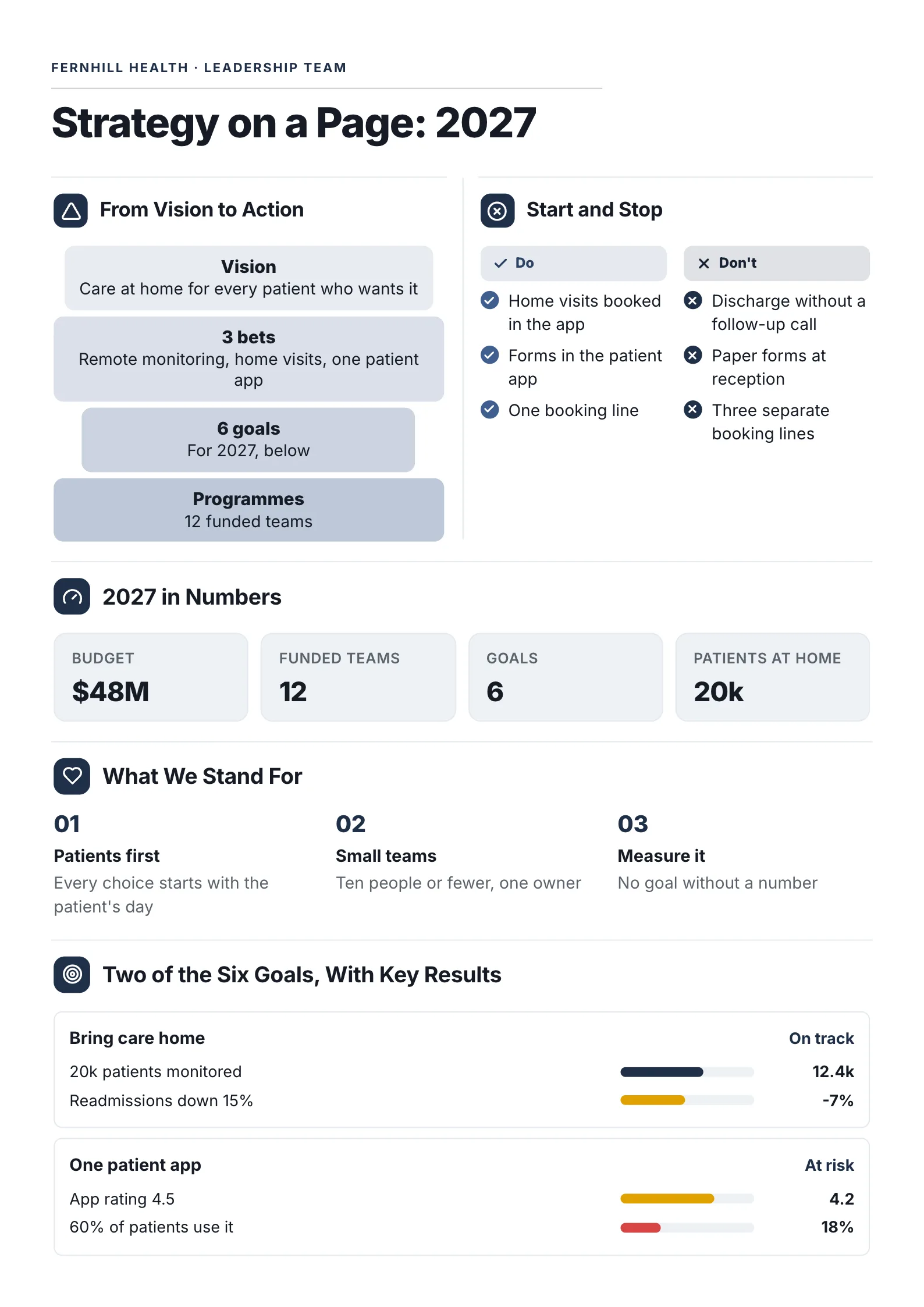
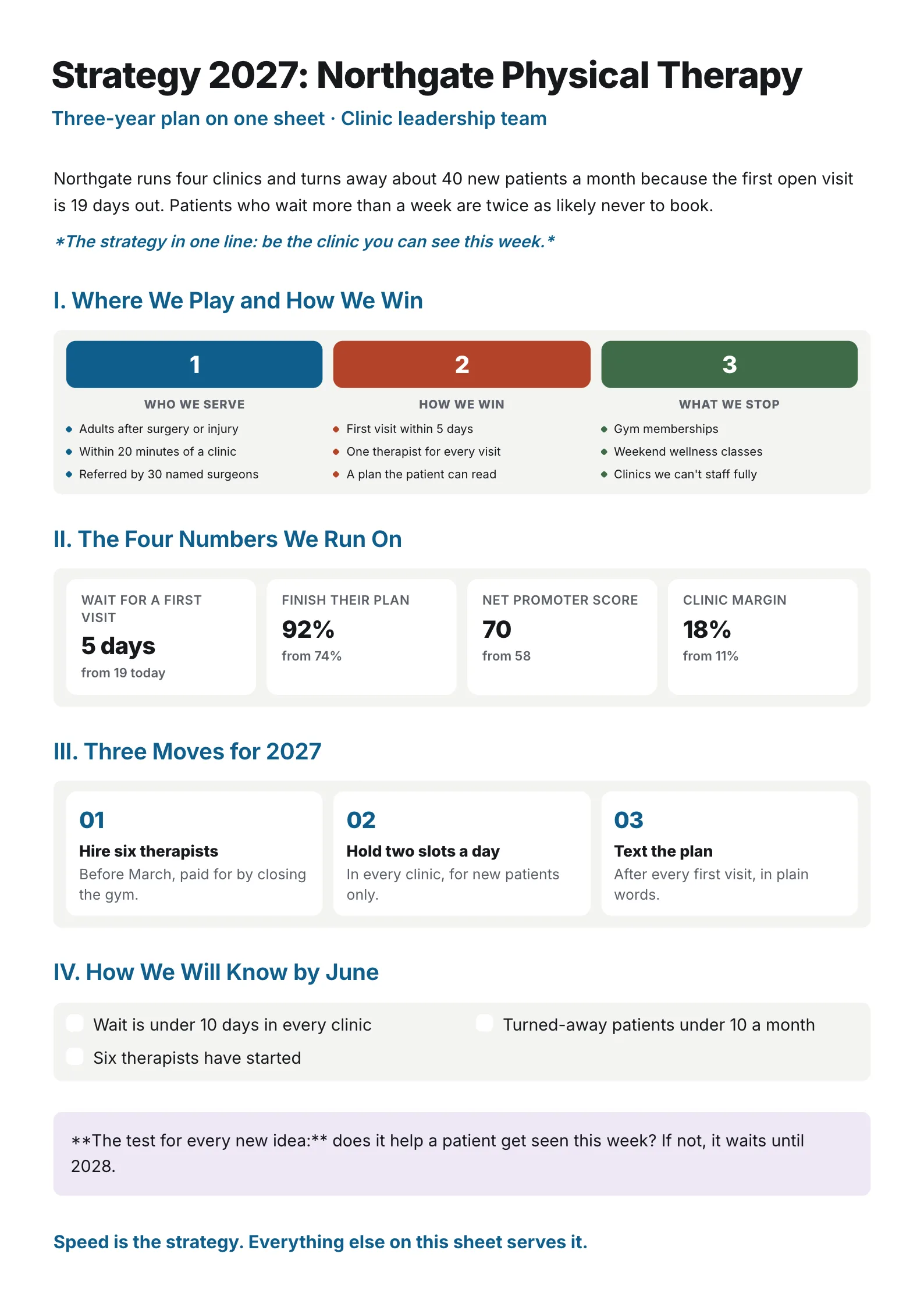
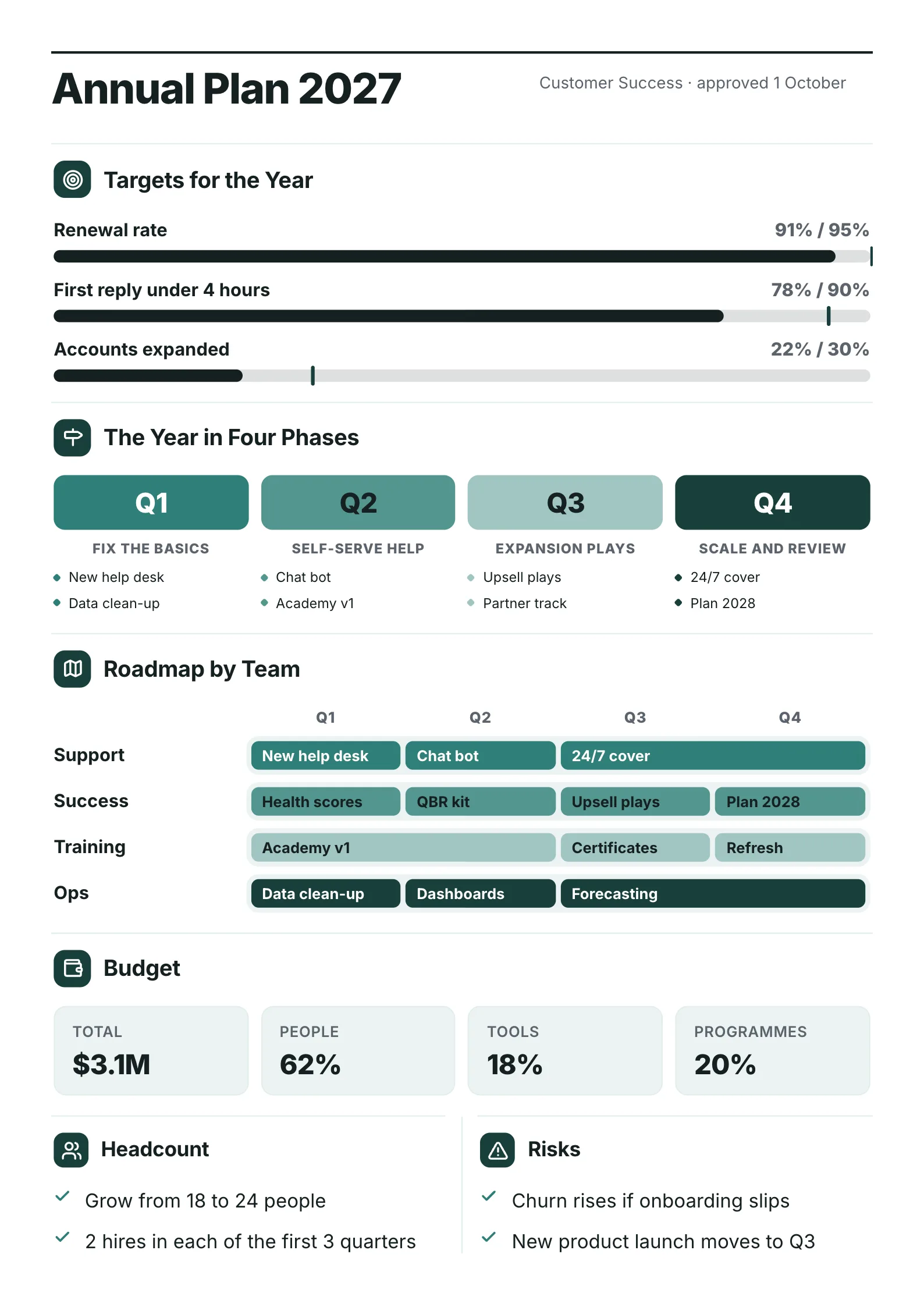
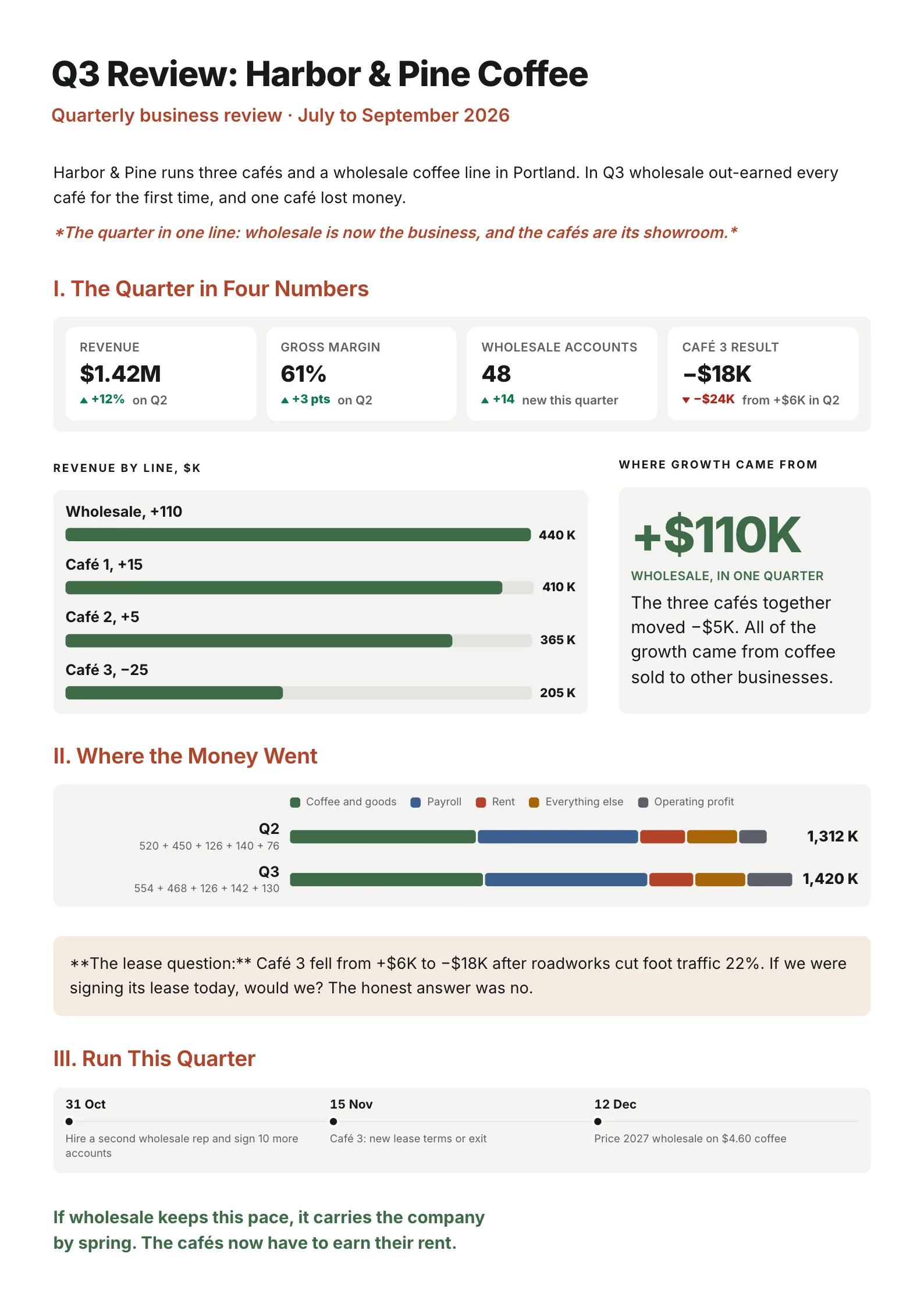
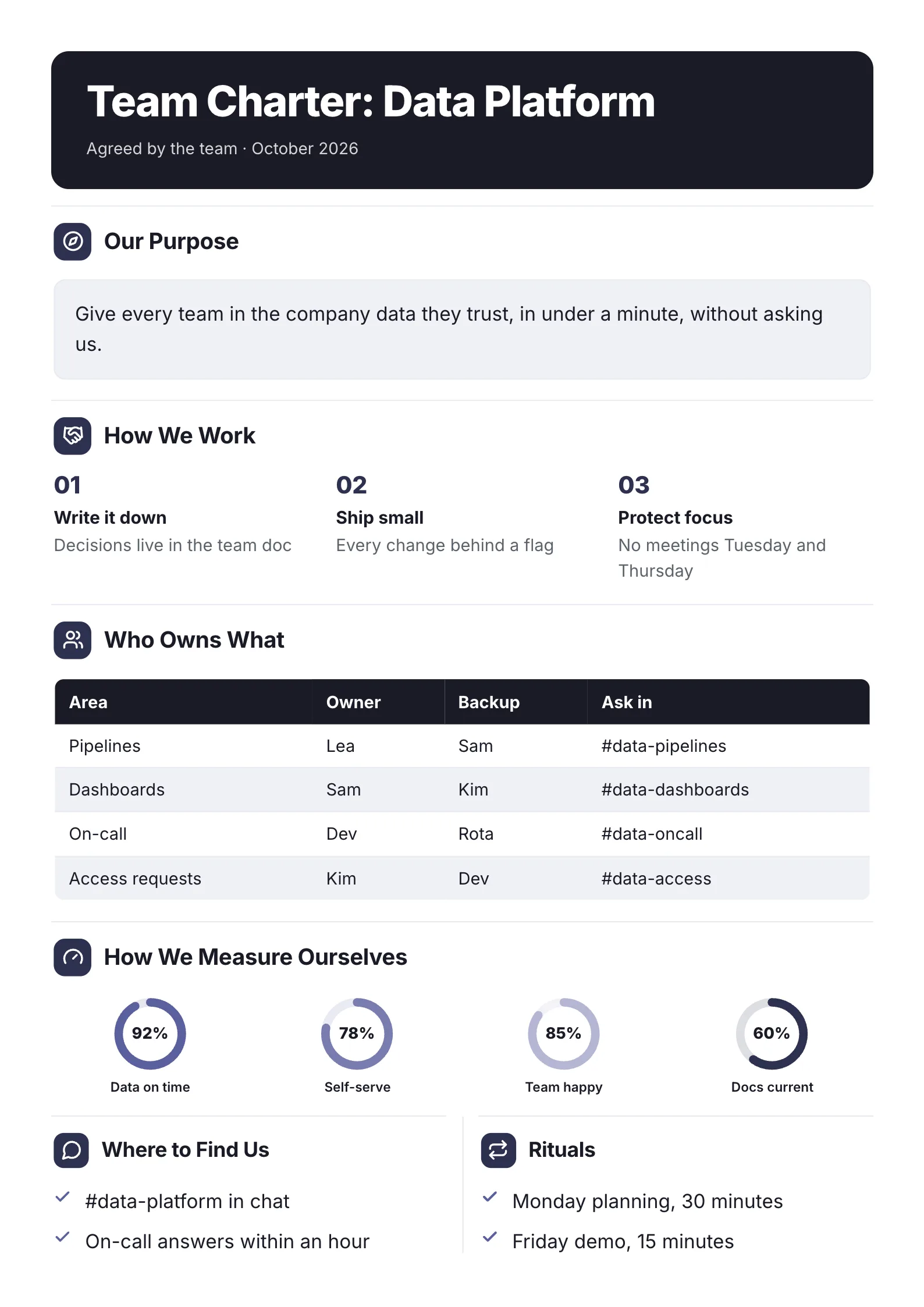
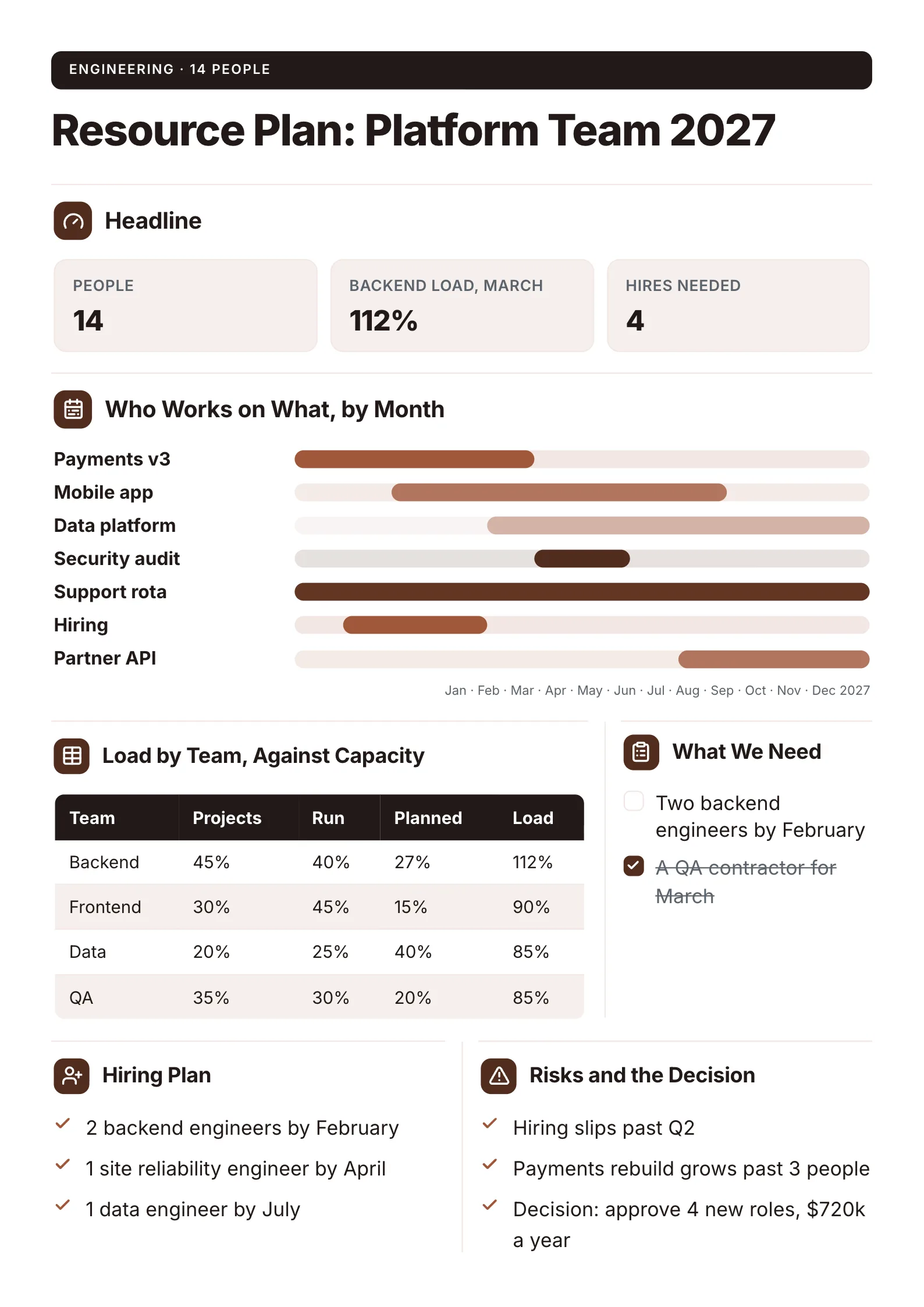
The example was made with MakeOnepagers. It opens as a template you can edit for free: every word, chart and color.
What are OKRs?
| Part | What it is | Example |
|---|---|---|
| Objective | Where you want to go, in words. Ambitious and clear. | Make onboarding self-serve |
| Key result | How you will know you got there. A number with a deadline. | 70% of new customers finish setup alone by 30 September |
| Score | How far each key result got, from 0 to 1 | 58% finished alone, scored 0.6 |
An objective without key results is a wish. Key results without an objective are a list of metrics nobody remembers the reason for. Together they say what you want and how you will measure it.
How OKR scoring works
Each key result is scored from 0 to 1 at the end of the quarter, and the objective's score is the average of its key results.
| Score | What it usually means |
|---|---|
| 0.0 to 0.3 | Missed. Learn why, and decide whether it still matters. |
| 0.4 to 0.6 | Progress, short of the target. |
| 0.7 to 1.0 | Delivered. A team that scores 1.0 on everything set targets too low. |
Many teams aim for an average around 0.7, because OKRs are meant to stretch. The scorecard below lands at 0.68.
A free OKR template
Copy this into a document, or open the example below and edit it.
| Part | What to write, with an example |
|---|---|
| Title | Team and quarter. OKR Scorecard: Q3, growth team, scored 2 October |
| Quarter score | 3 numbers. Average 0.68, key results on track 4 of 8, objectives missed 1 |
| Objective 1 | In words, with its score. Win mid-market customers, 0.8 |
| Key results | 2 or 3, with target and actual. 40 new mid-market accounts: 36 |
| Objectives 2 to 4 | Same shape |
| Next quarter | 2 or 3 changes. Expansion gets an owner and a weekly review |
| What we learned | 2 lines. Trials convert best in week one |
OKR example
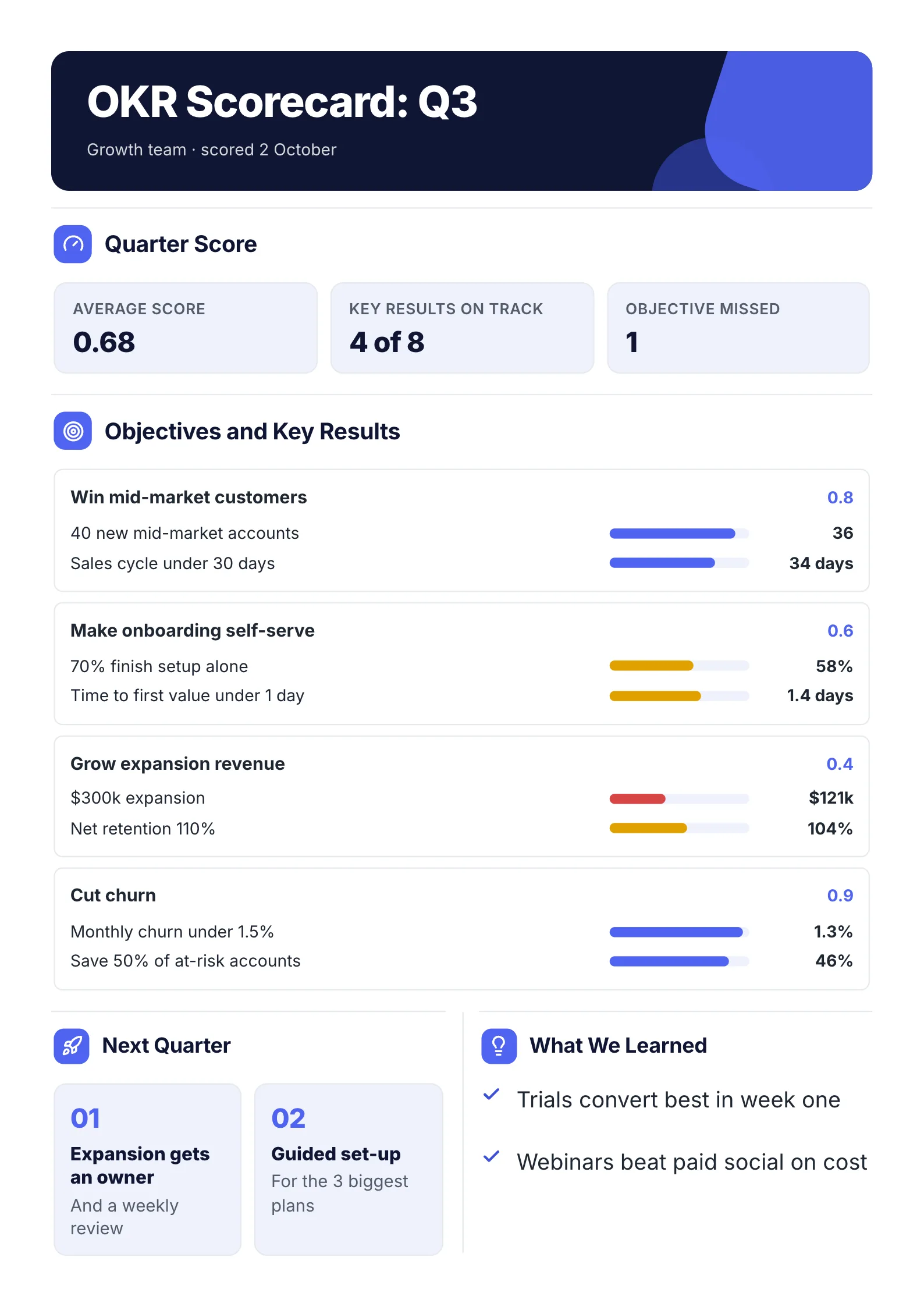 Edit this template
A growth team's quarter on one page: four objectives, eight key results, one honest score.
What to copy:
- Three numbers at the top: average 0.68, 4 of 8 key results on track, 1 objective missed. Leadership reads this and nothing else.
- Every key result with its target and its actual: "40 new mid-market accounts: 36." "Sales cycle under 30 days: 34 days." Nobody has to ask how close it got.
- Colour for the misses: the expansion revenue bar in red at $121k against $300k. The weak spot is the first thing the eye lands on.
- What we learned, turned into next quarter's changes: expansion missed, so next quarter expansion gets an owner and a weekly review.
Edit for free: OKR scorecard template.
OKRs or a strategic plan?
OKRs cover a quarter. A strategic plan covers one to three years and says where the company is going. The OKRs are the steps toward it. For the longer view on one page, the strategy template puts the plan on a single sheet.
How to write OKRs in 6 steps
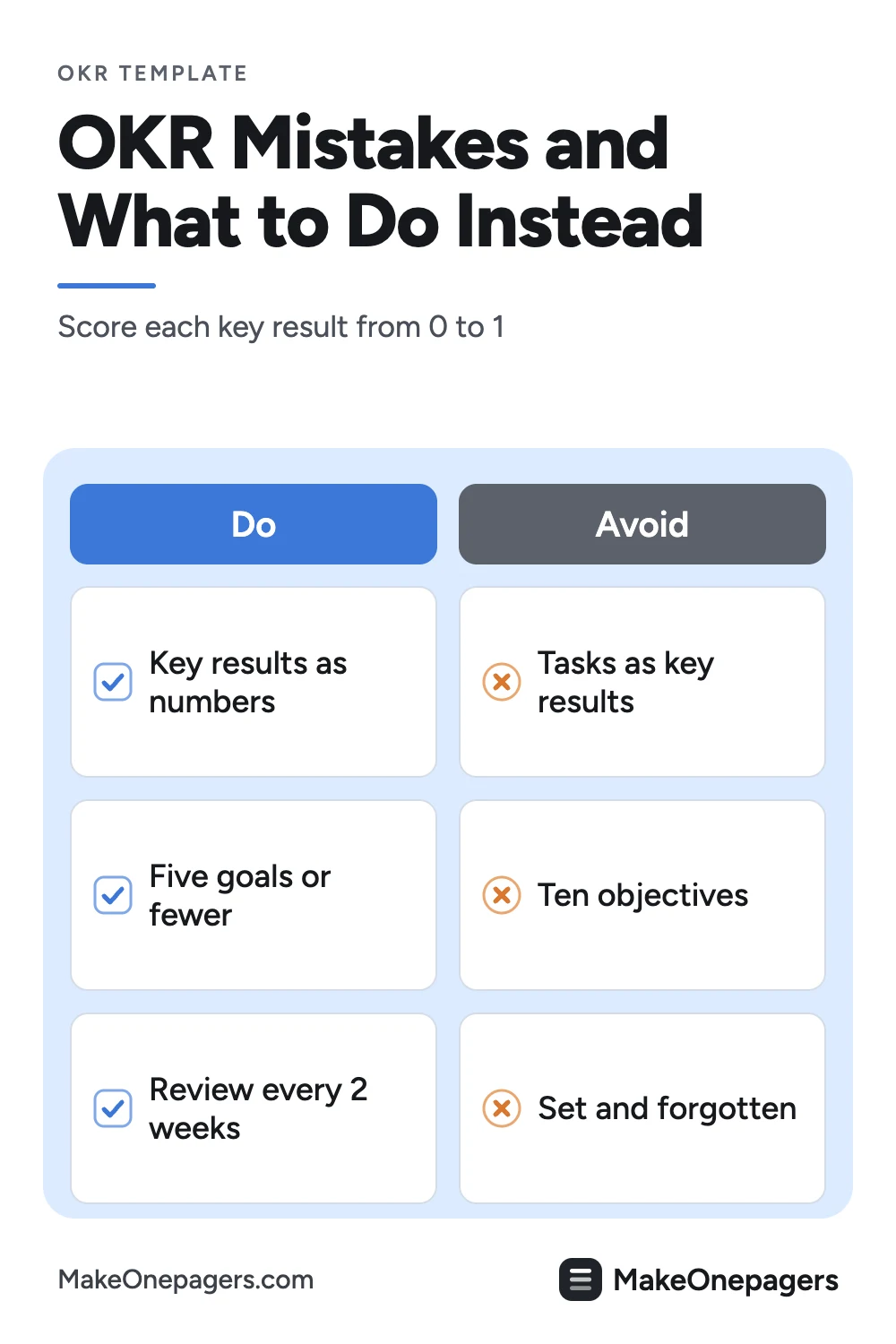
- Pick three to five objectives for the quarter. Fewer is better.
- Write each objective in plain words that someone outside the team would understand.
- Add two or three key results under each, each a number with a deadline.
- Check every key result can be scored from data you will actually have.
- Review progress every two weeks, updating the actual numbers.
- Score at the end of the quarter, write what you learned, and set the next quarter's OKRs from it.
Have your goals in a planning document or a spreadsheet? Drop it into the free AI One-Pager generator and get it back as a designed OKR scorecard.
OKR mistakes
- Tasks as key results. "Launch the new onboarding" is a task. "70% finish setup alone" is a key result.
- Too many objectives. Ten objectives means no priorities. Keep five or fewer.
- Set and forgotten. OKRs nobody looks at until the last week of the quarter score badly and teach nothing.
- Scoring 1.0 on everything. It means the targets were too safe. Stretch them next quarter.
- Tying them to pay. People set easy targets when their bonus depends on hitting them.
Make your OKR scorecard
Open the free OKR scorecard template and put in your objectives and key results, or drop your planning notes into the free AI One-Pager generator and get a finished scorecard back.
Frequently asked questions
What is an OKR template?
A one-page layout for a team's objectives and key results for a period, usually a quarter, with space for each key result's target, progress and final score.
How many OKRs should a team have?
Three to five objectives, each with two to four key results. More than that and the team stops treating them as priorities.
What is a good OKR score?
Around 0.6 to 0.7 on average. OKRs are meant to stretch, so a team that always scores 1.0 is setting targets that are too easy.
What is the difference between OKRs and KPIs?
KPIs are measures you track all the time to see whether the business is healthy. OKRs are goals for a period, built to change something. A key result often moves a KPI.