Lesson Plan Ideas: 10 Moves From a State's 5 Model Reading Units
Lesson plan ideas from Montana's 5 model reading units for grades K to 4: book walks, graded predictions, a paper folded in thirds and 7 more moves to reuse.

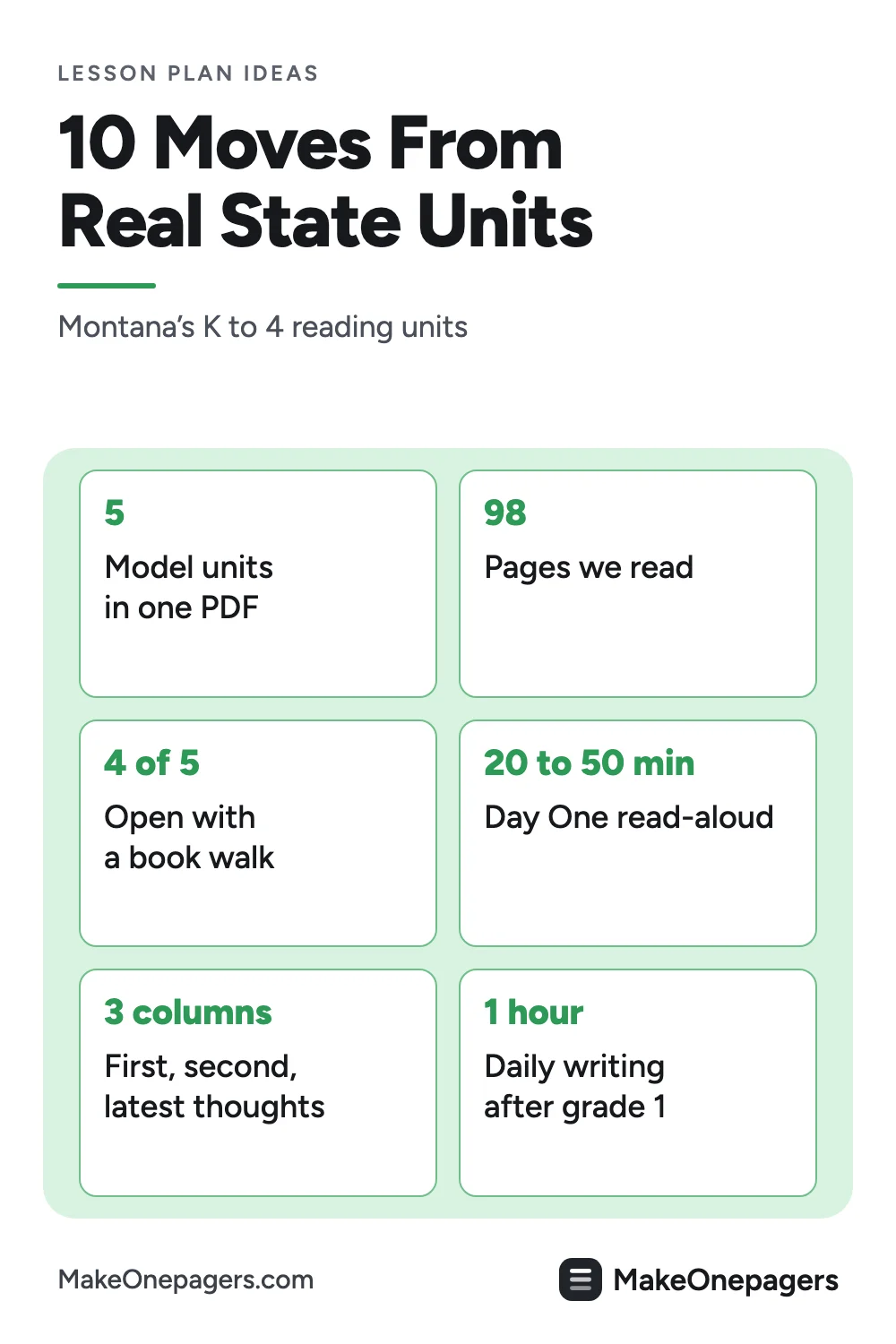
The lesson plan ideas worth keeping are moves you can reuse with any book or topic. Montana's Office of Public Instruction publishes 5 model reading units in a single 98-page PDF, written for kindergarten through grade 4, each built on one picture book. We read all 98 pages and pulled out the 10 moves the units lean on. 4 of the 5 units open Day One the same way, with a book walk and predictions before the first page is read. Start from a free one pager template.
One‑Pager examples
Real One-Pagers made with MakeOnepagers. Open any one to edit it as your own.
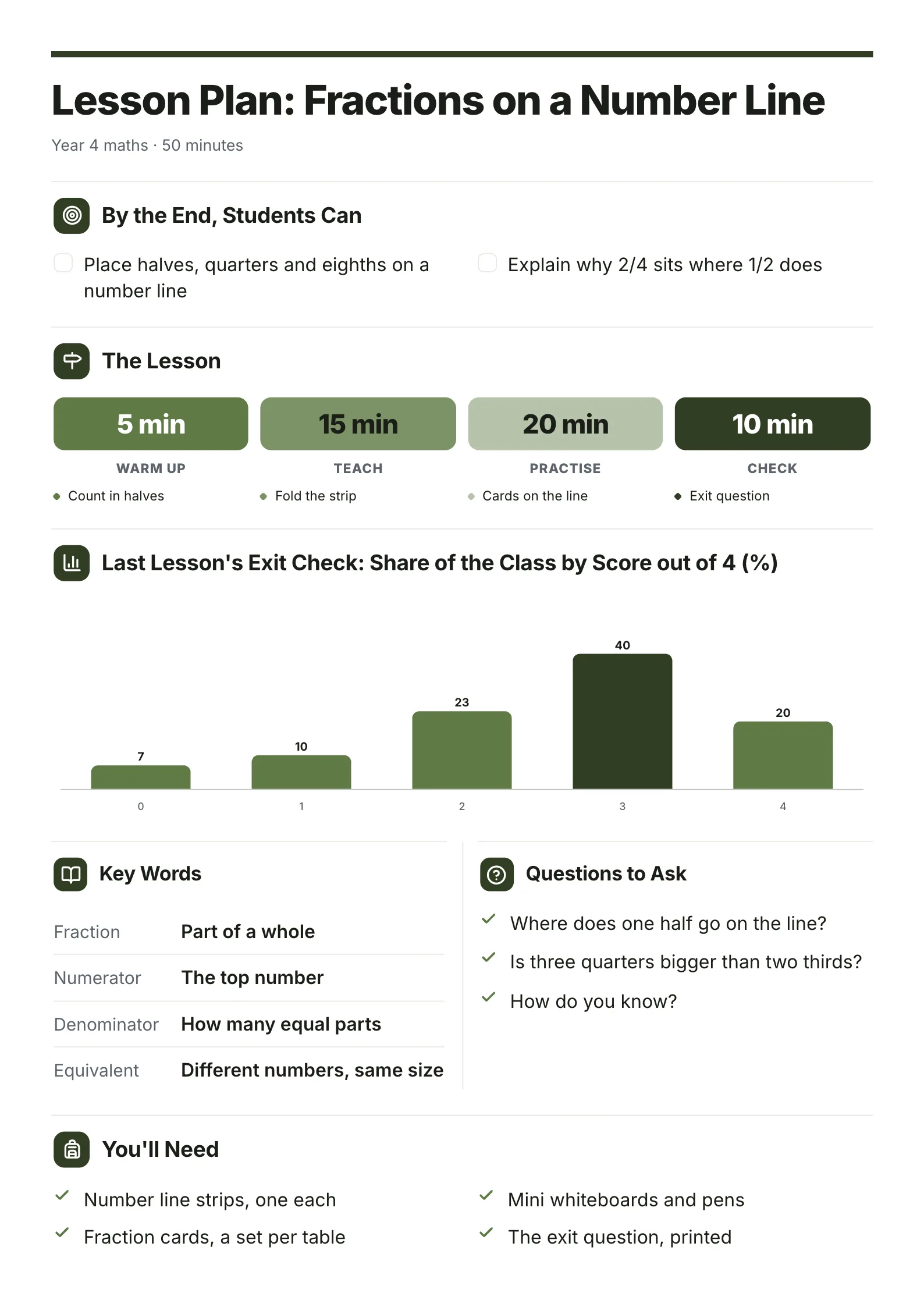 Lesson PlanEdit for free(opens in a new tab)
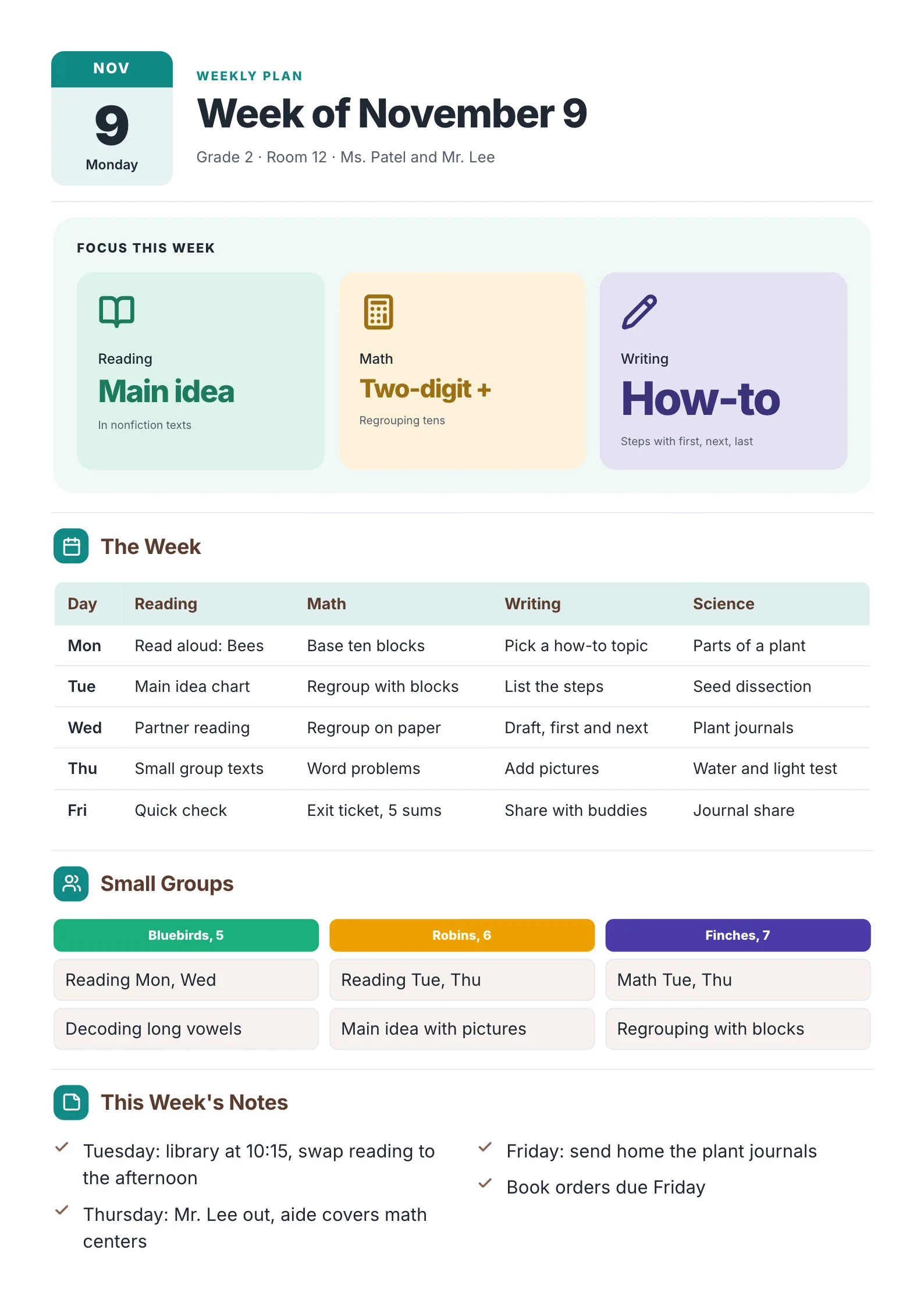 Lesson Plan: WeeklyEdit for free(opens in a new tab)
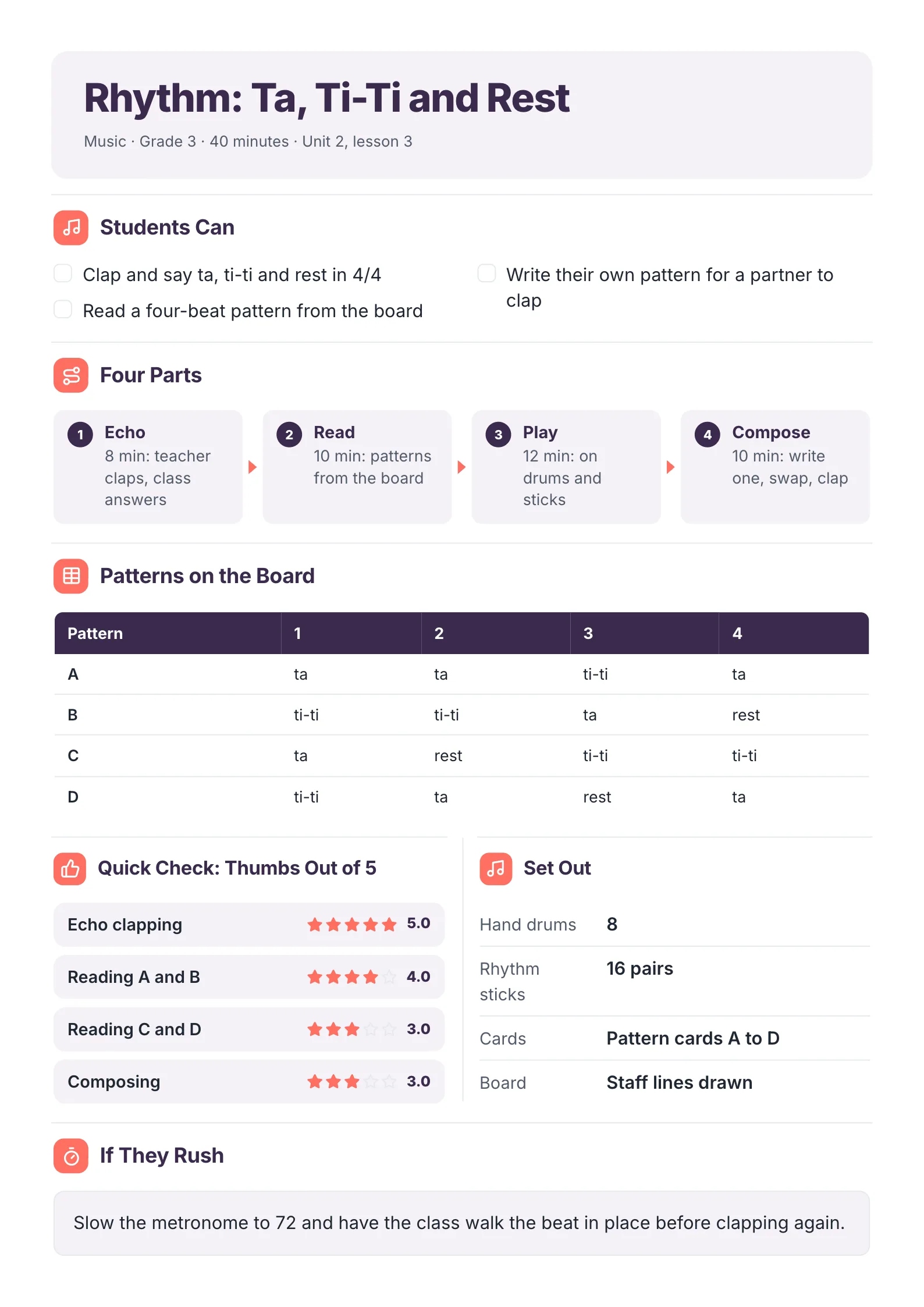 Lesson Plan: MusicEdit for free(opens in a new tab)
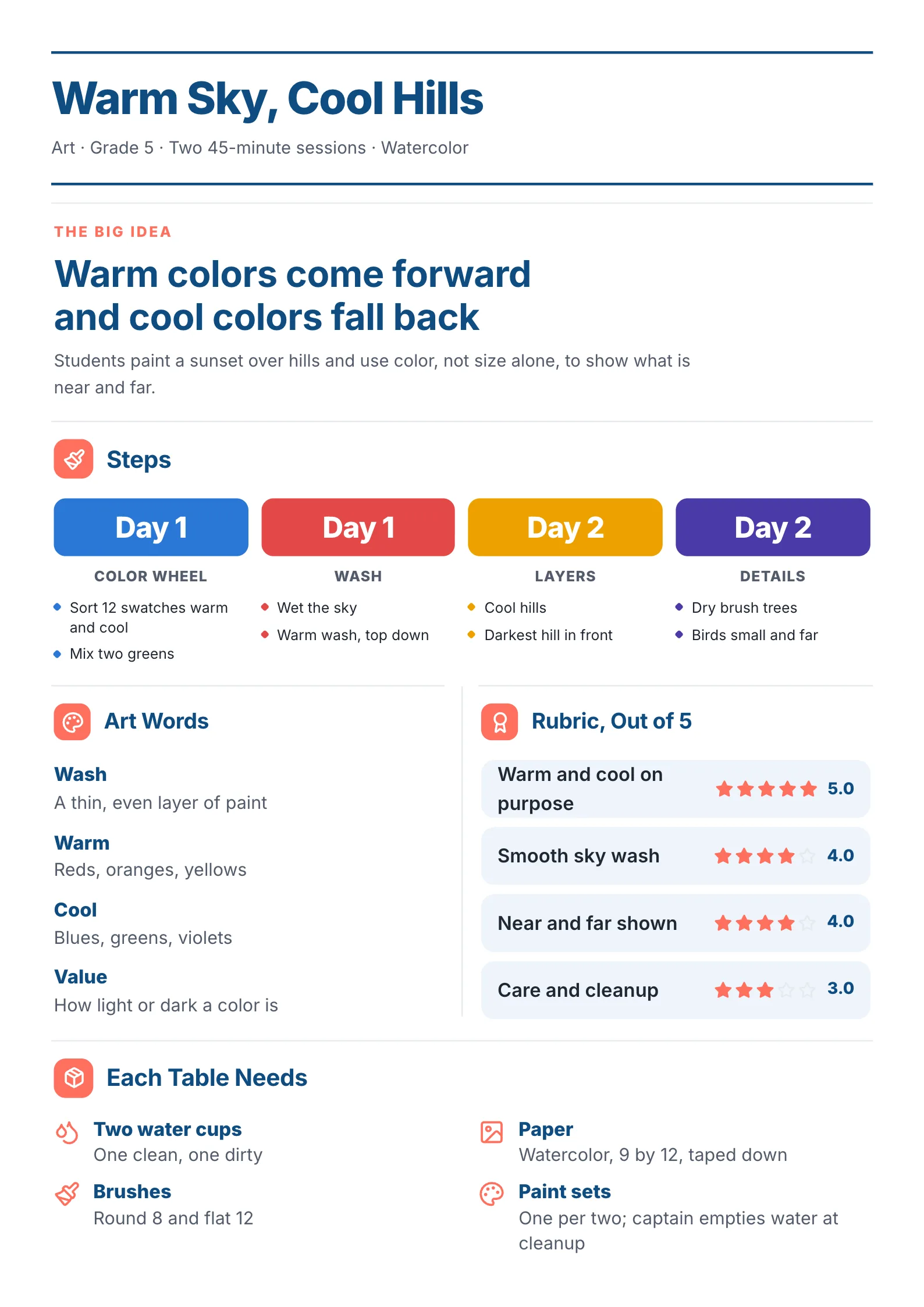 Lesson Plan: ArtEdit for free(opens in a new tab)
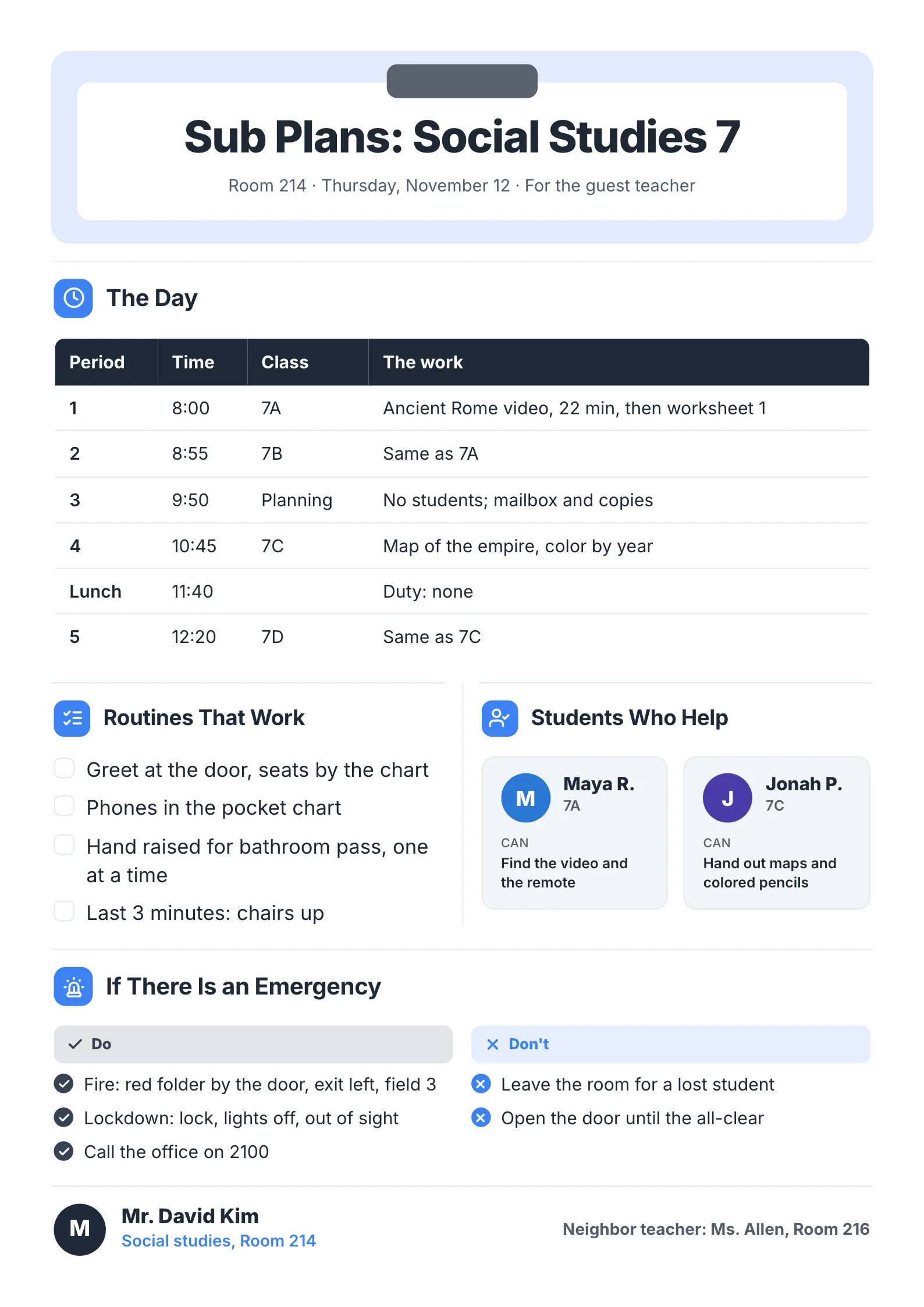 Lesson Plan: Substitute TeacherEdit for free(opens in a new tab)
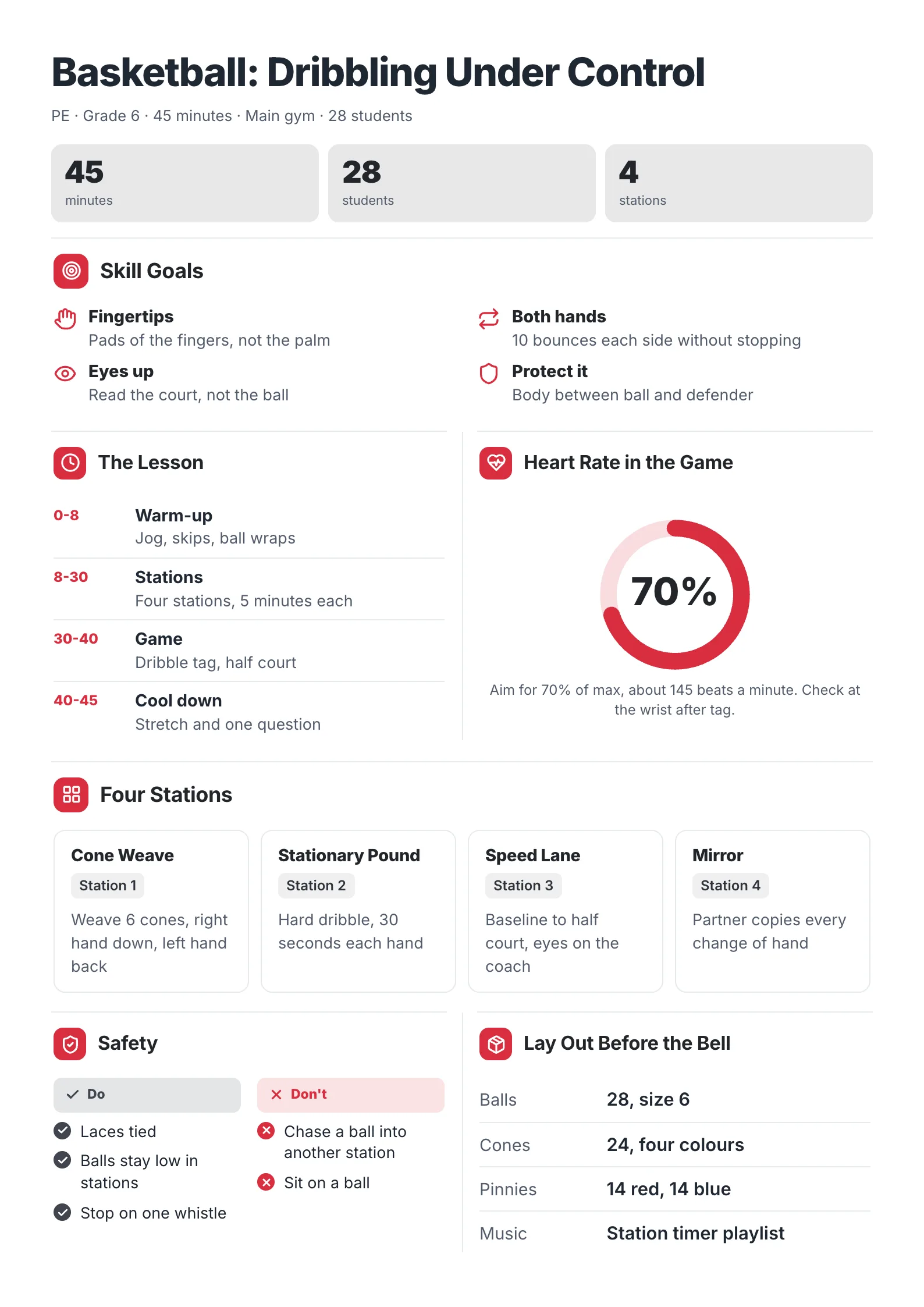 Lesson Plan: PEEdit for free(opens in a new tab)
Each idea below names the unit it comes from and the step as the state wrote it. After the list, look at five sample plans that use the same move in other subjects, so you can take an idea from a kindergarten read-aloud into a lab, a lecture or a training room.
The 5 units at a glance
Every unit is part of the state's Indian Education for All program and uses one picture book as its anchor text. Here's how long each one runs.
| Unit | Grades | Day One as a stand-alone read-aloud | Full plan |
|---|---|---|---|
| The Little Duck (Sikihpsis) | K to 3, built for K and 1 | About 20 to 30 minutes | 5 days, 20 to 30 minutes a day |
| The Good Luck Cat | K to 3 | About 40 minutes | 5 to 7 lessons of 30 to 40 minutes |
| Jingle Dancer | 2 to 4 | About 40 to 50 minutes | A week, 40 to 50 minutes a day |
| The Moccasins | K to 3, built for 1 to 3 | About 30 minutes | 4 or 5 days, with daily writing time |
| Red Parka Mary | 1 to 3, built for grade 2 | 30 to 40 minutes, plus 30 to 40 for follow-up work | 5 days |
So one good book carries a week of lessons. You don't need a new idea every day. Pick a few strong moves and repeat them with each new text.
10 lesson plan ideas from the units
1. Walk through the book before you read it
The Little Duck, The Good Luck Cat, Jingle Dancer and The Moccasins all name a "book walk" in their Day One plans. You show the cover, introduce the author and illustrator, and look at the pictures before reading a word. It builds the background kids need to follow the story.
2. Hook the class with a saying they already know
The Good Luck Cat opens with a question before the book comes out. "Who has heard the saying 'Cats have nine lives'?" You write the saying on the board, list the class's guesses about what it means, then say, "Let us see if this cat has nine lives." Try it with a saying, a headline or a myth from your own subject.
3. Write predictions down, then grade them
Write predictions where students can see them, saying each word as you write it. After the reading, The Good Luck Cat goes back to that list with three questions. "Which of our predictions turned out to be correct? Which ones were partly true? Which ones were not true?" Students then go back to the text and pictures to prove or disprove each one.
4. Reveal the cover in stages
The Moccasins hides the title at first. Students guess from the cover art alone, then you reveal the title and ask again, "Now what do you think this book will be about?" Then you look at the author's dedication together. Give the class one new clue at each stage, and ask for one more guess.
5. Fold a paper in thirds to track changing thoughts
Red Parka Mary uses a "Thinking Guide." Fold an 11 by 17 inch paper in thirds and label the columns "First thoughts," "On second thought" and "Latest thoughts." You stop the reading twice, for no more than three minutes each time, so students can sketch or write. Tell students what the unit tells teachers. Recording a thought quickly matters more than neat handwriting.
6. Write silly sentences with one word family
The Little Duck builds a chart of "uck" words (luck, puck, muck, truck) and then writes silly sentences with them. Its own example is "The duck had luck and did not step in the muck." The Good Luck Cat does the same with the "at" family. You can show the sentences in a pocket chart and reread them for fun.
7. Split the reading into expert groups
Jingle Dancer has small groups read short descriptions of different dances "jigsaw style" and record what they learn on a nonfiction question form. Groups can each research one dance and be the experts. Struggling readers get an easier book on the same topic, At the Pow Wow, and that group prepares a presentation for the class on Day Four.
8. Turn a story detail into math
Jingle Dancer's extension asks, "How many jingles does it require to have 30 inches of ribbon, with jingles attached two inches apart?" It suggests inexpensive ribbon and safety pins so kids can lay it out by hand. Look for one countable detail in your next text and you have a word problem with a story behind it.
9. Role-play the skill, then use it for real
On Day Four of Red Parka Mary, you model a friendly introduction with eye contact, a warm greeting, your name and a handshake, and pairs practice it. On Day Five the class takes part in an activity with elders in the community. Practice comes first, then the real thing.
10. Close with the author's chair
The Little Duck and The Good Luck Cat close a writing day by "inviting students to read to the class their stories" from the author's chair. The Moccasins adds a writing schedule you can copy: 10 minutes of uninterrupted writing a day in kindergarten, at least 30 minutes by first grade, and an hour a day beyond first grade.
The same moves, in five sample plans
These samples from MakeOnepagers are one-page lesson plans with invented classes and names. Each one shows a move from the list working outside a reading lesson.
A kindergarten phonics lesson that previews before it teaches
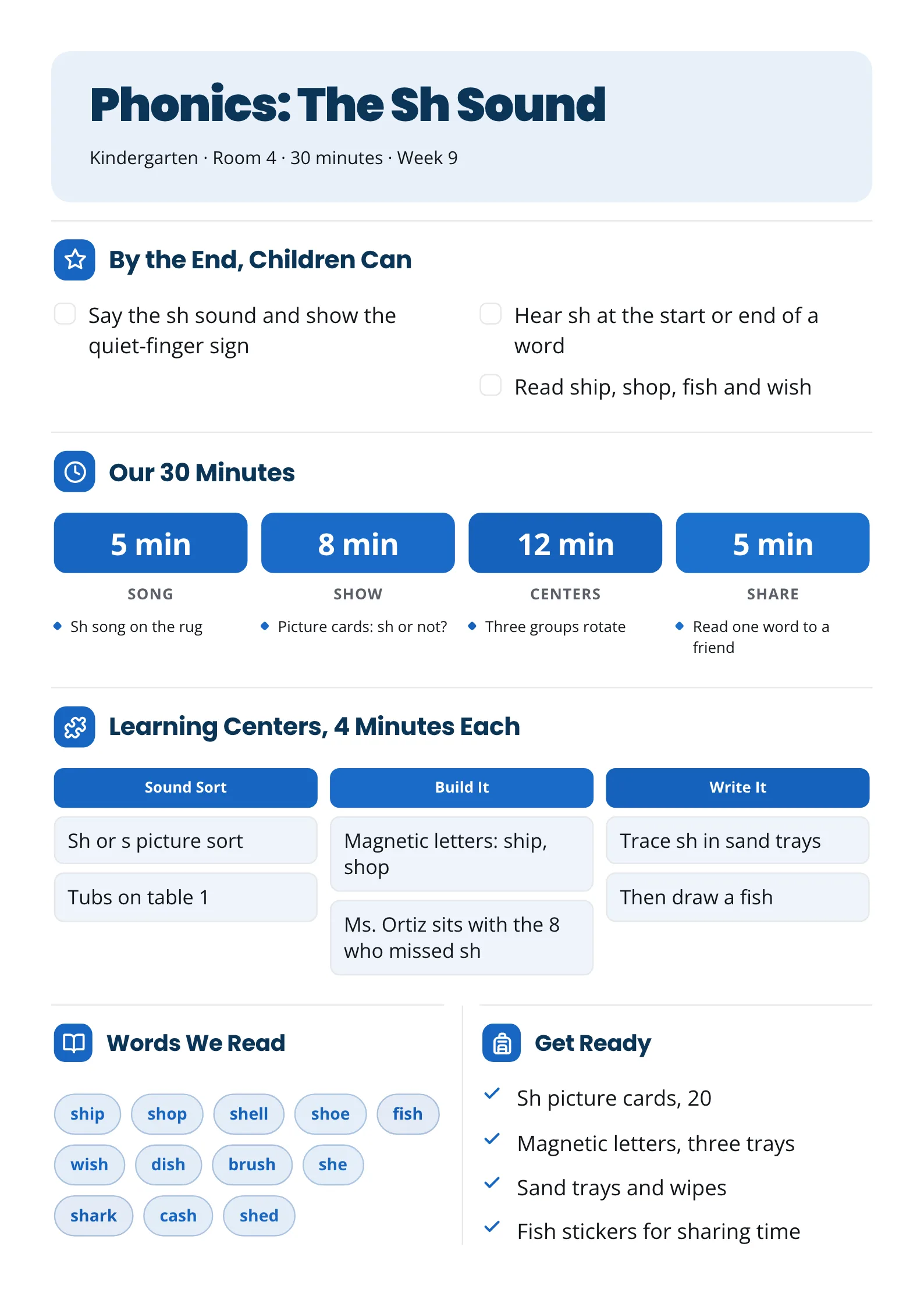 Edit this template
This kindergarten phonics lesson plan previews with pictures before anyone reads (move 1). After a sh song on the rug, an 8-minute "Show" step asks, "Picture cards: sh or not?" before any reading. Then three groups rotate through centers, 4 minutes each, and Ms. Ortiz sits with the 8 children who missed the sound.
A college lecture that opens with a hook
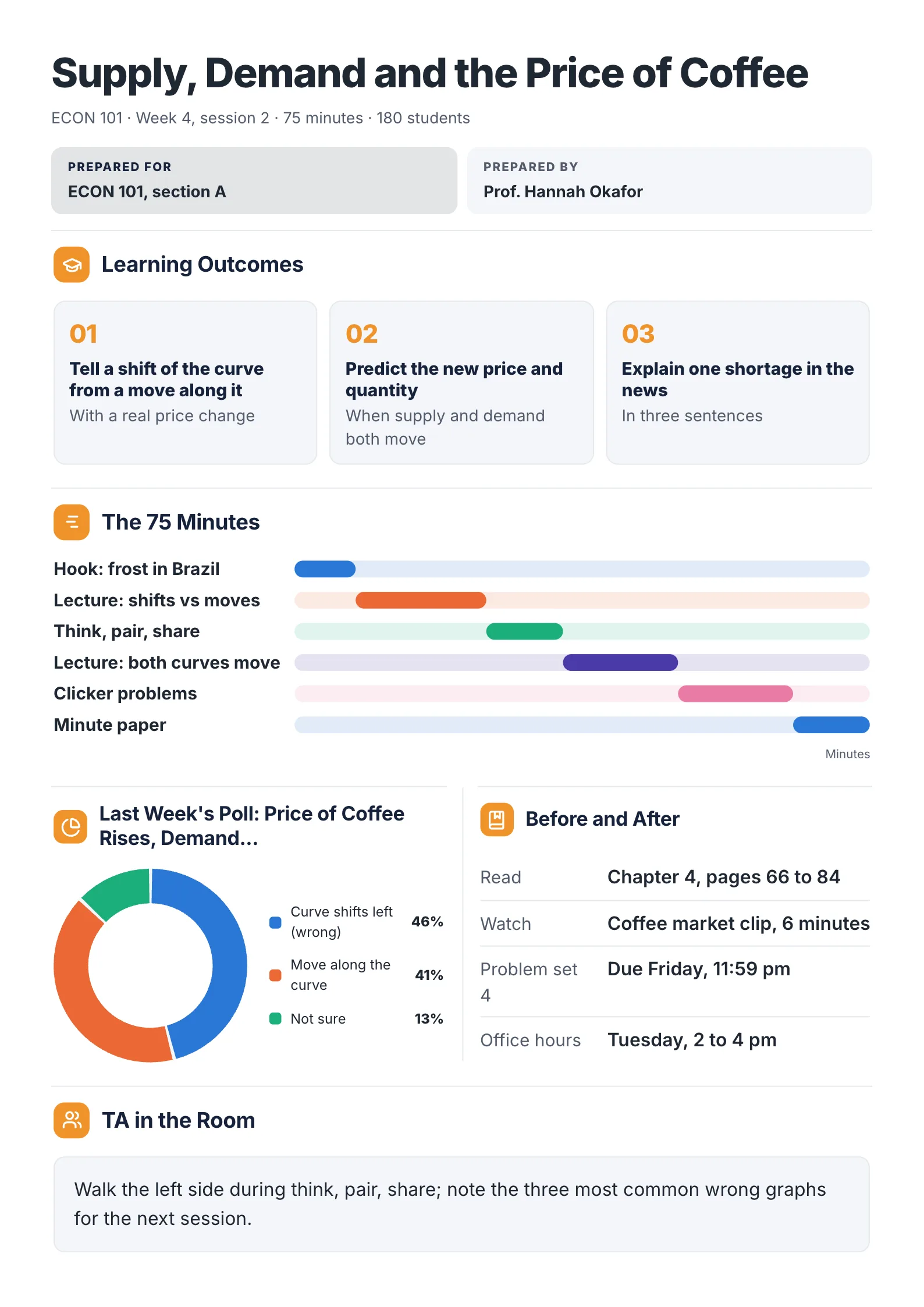 Edit this template
The college lecture lesson plan starts its 75 minutes with "Hook: frost in Brazil" before the first lecture block (move 2). It also shows last week's poll, with the answers "Curve shifts left (wrong)," "Move along the curve" and "Not sure," so the session starts from what students got wrong. The TA's note asks for the three most common wrong graphs, ready for the next session.
A biology lab that checks its own predictions
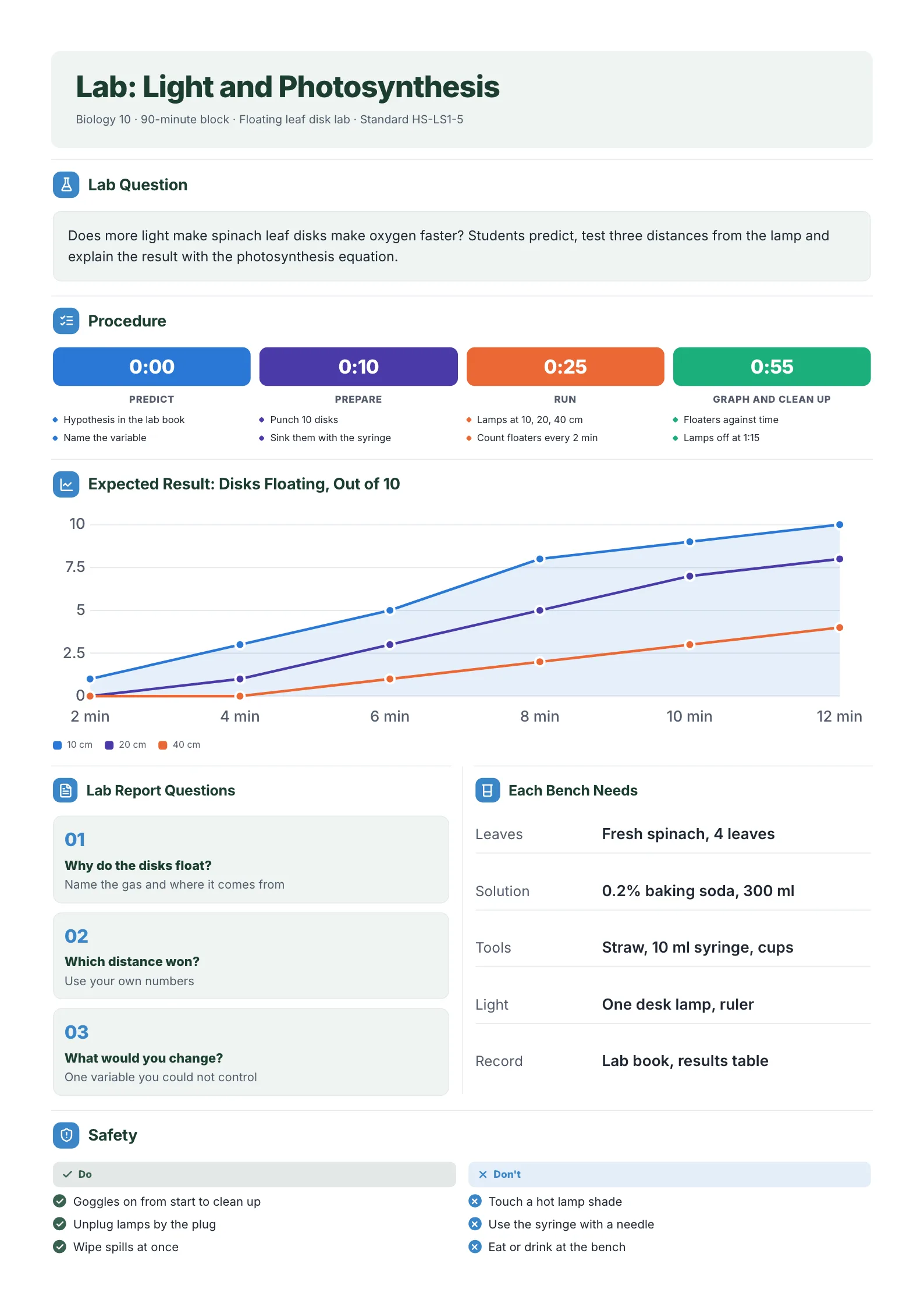 Edit this template
In this biology lab lesson plan, the first step is "Predict," with a hypothesis in the lab book. Students run lamps at 10, 20 and 40 cm and count floating disks every 2 minutes. The lab report then asks "Which distance won?" with the note "Use your own numbers." It's move 3 with data instead of a story.
An ESL lesson that gives every level a job
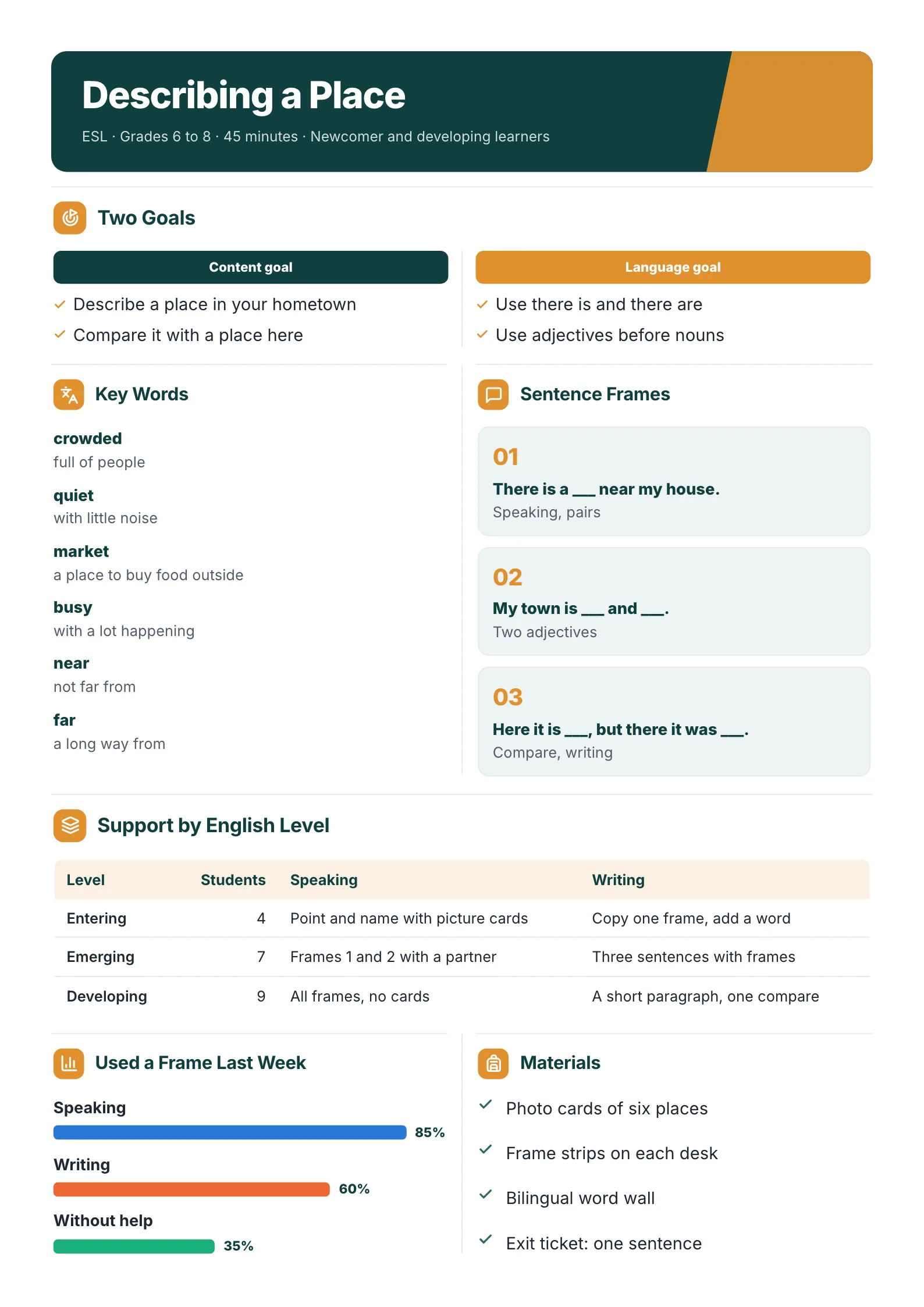 Edit this template
This ESL lesson plan splits the class by English level, the way Jingle Dancer gives struggling readers an easier book (move 7). The 4 Entering students point and name with picture cards. The 9 Developing students use all the sentence frames, with no cards, and write a short paragraph with one comparison.
A staff training session built on role-play
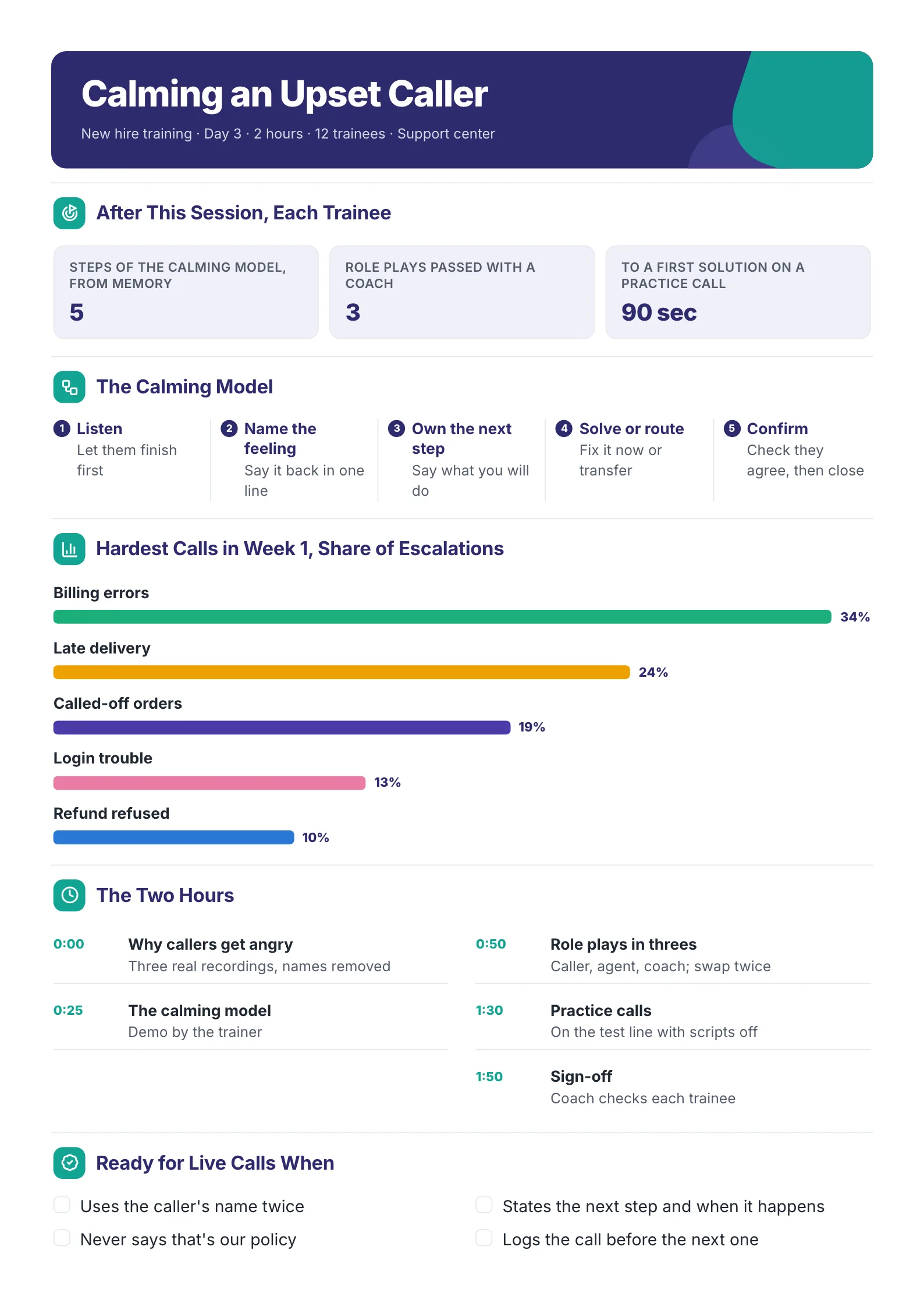 Edit this template
The employee training lesson plan runs move 9 with adults. At 0:50, the 12 trainees do role plays in threes, as caller, agent and coach, and swap twice. At 1:30 they move to practice calls on the test line with scripts off. Rehearse, then do it for real.
How to fit an idea into tomorrow's plan
Pick one move per lesson. The Montana units spread theirs across a week, and each day carries a short list of goals in kid language, such as "I make predictions about a story to support my active listening." Write your goal that way, then choose the move that serves it.
- Opening a new topic: use a book walk, a saying or a staged reveal (moves 1, 2 and 4).
- Checking understanding: graded predictions or the folded paper (moves 3 and 5).
- Mixed reading levels: expert groups with an easier text for some (move 7).
- Linking subjects: one story detail turned into a math problem (move 8).
- Teaching a social skill: role-play first (move 9).
Our lesson plan format post covers the parts every plan needs around the idea, and lesson plan examples walks through full plans from 30 minutes to a week.
Put your next idea on one page
Open the MakeOnepagers lesson plan nearest the class you teach tomorrow. Then make the move you picked your first timed step. Give it minutes, the way the samples do. If you have a picture book or an article in mind, paste your notes into the free AI One-Pager generator and it will lay out a first draft for you to edit.
Frequently asked questions
Where can I find free lesson plan ideas from a state?
Start with your own state education department's website. Montana's Office of Public Instruction posts its Indian Education for All model units as PDFs, and the reading volume used here has 5 units in 98 pages.
What are good lesson plan ideas for kindergarten?
The Little Duck unit was built for kindergarten and first grade. It uses a book walk, predictions written on chart paper, a chart of rhyming "uck" words and silly sentences, at 20 to 30 minutes a day.
How many days can one picture book fill?
In these units, four to seven. The Good Luck Cat runs 5 to 7 lessons of 30 to 40 minutes, and The Moccasins runs 4 or 5 days.
Can a reading lesson idea work in math or science?
Yes. Jingle Dancer turns jingles on a ribbon into multiplication problems. A biology lab can open with predictions and grade them against the class's own data.
How do I check whether students understood a story?
Try the Thinking Guide from Red Parka Mary. Students record first thoughts, second thoughts and latest thoughts in three columns, then use details from the text to explain what changed.




