Lesson Plan Format: The 7 Parts Every Form We Read Asks For
A lesson plan format built from 6 university and state teaching forms: the 7 parts all of them require, the 3 most add, and 5 one-page plans to copy.

Your lesson plan format is the order your plan follows on the page. The one that holds up has seven parts: the skill your class walks out with, the standard it meets, what you need, how you open, the steps you'll teach, how you'll know they learned it, and what you'll change for the students who need it. Add a closing step, minutes for each part and a short note to yourself afterward, and you have the format these programs grade. Start from a free one pager template.
One‑Pager examples
Real One-Pagers made with MakeOnepagers. Open any one to edit it as your own.
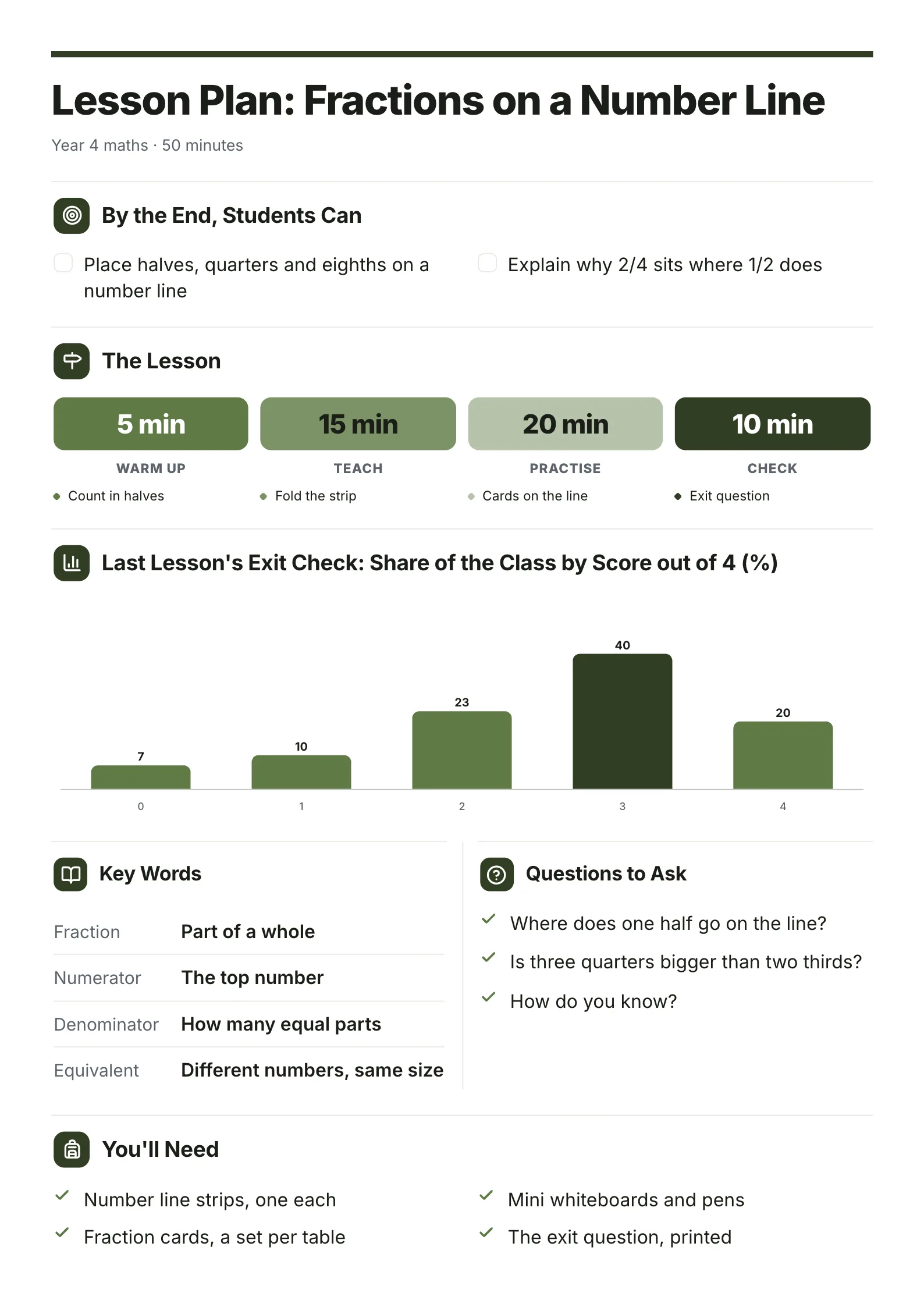 Lesson PlanEdit for free(opens in a new tab)
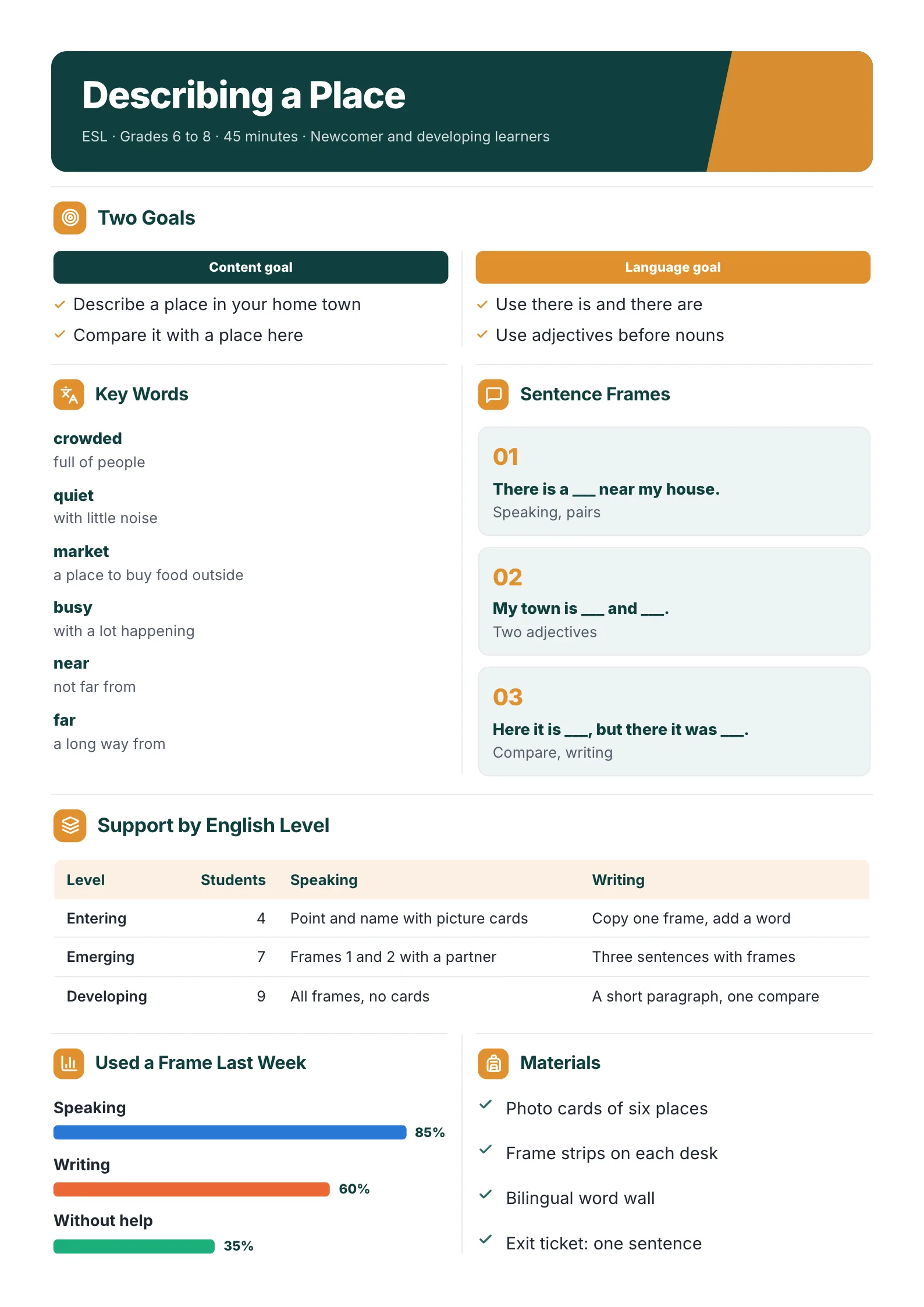 Lesson Plan: ESLEdit for free(opens in a new tab)
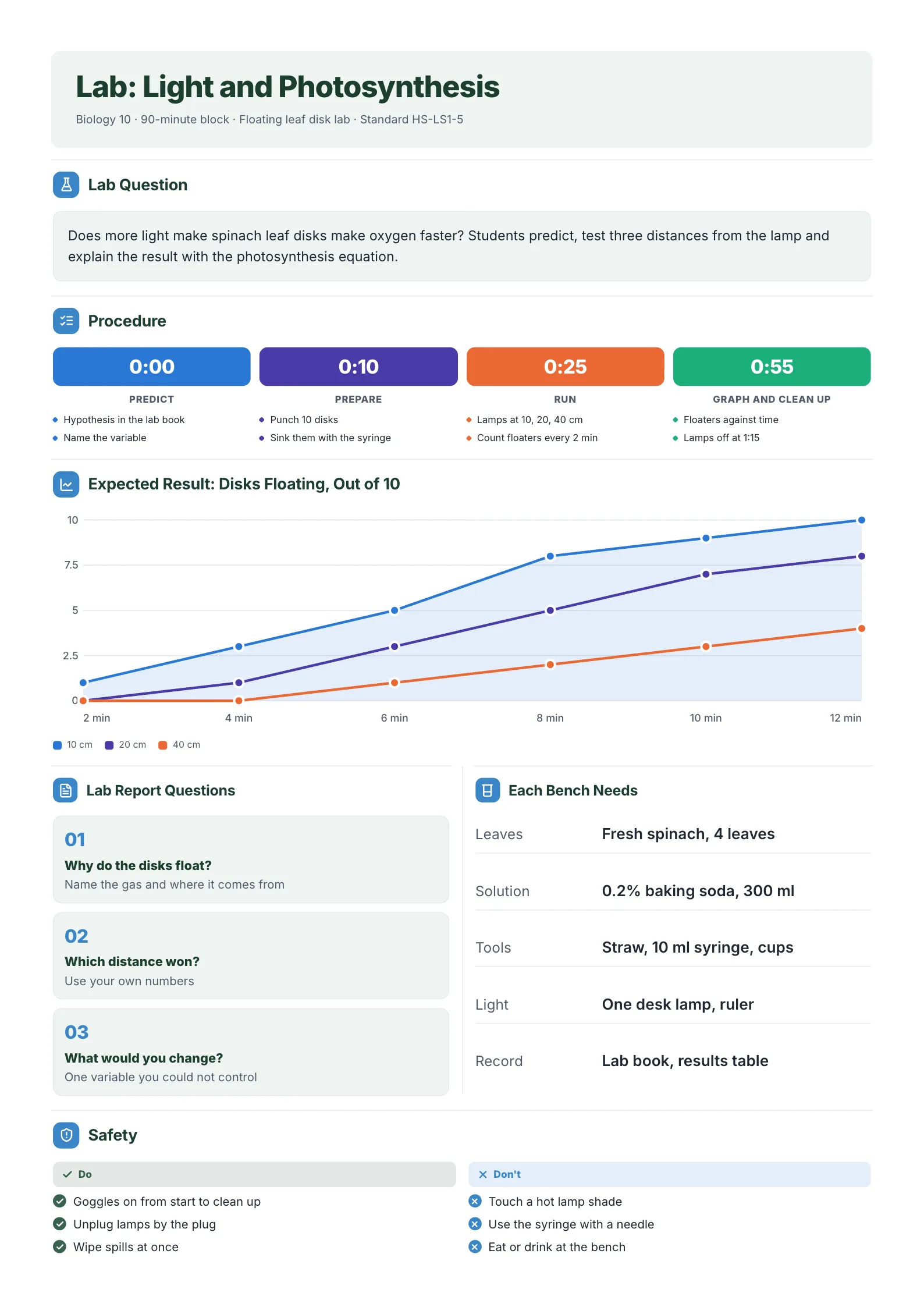 Lesson Plan: Biology LabEdit for free(opens in a new tab)
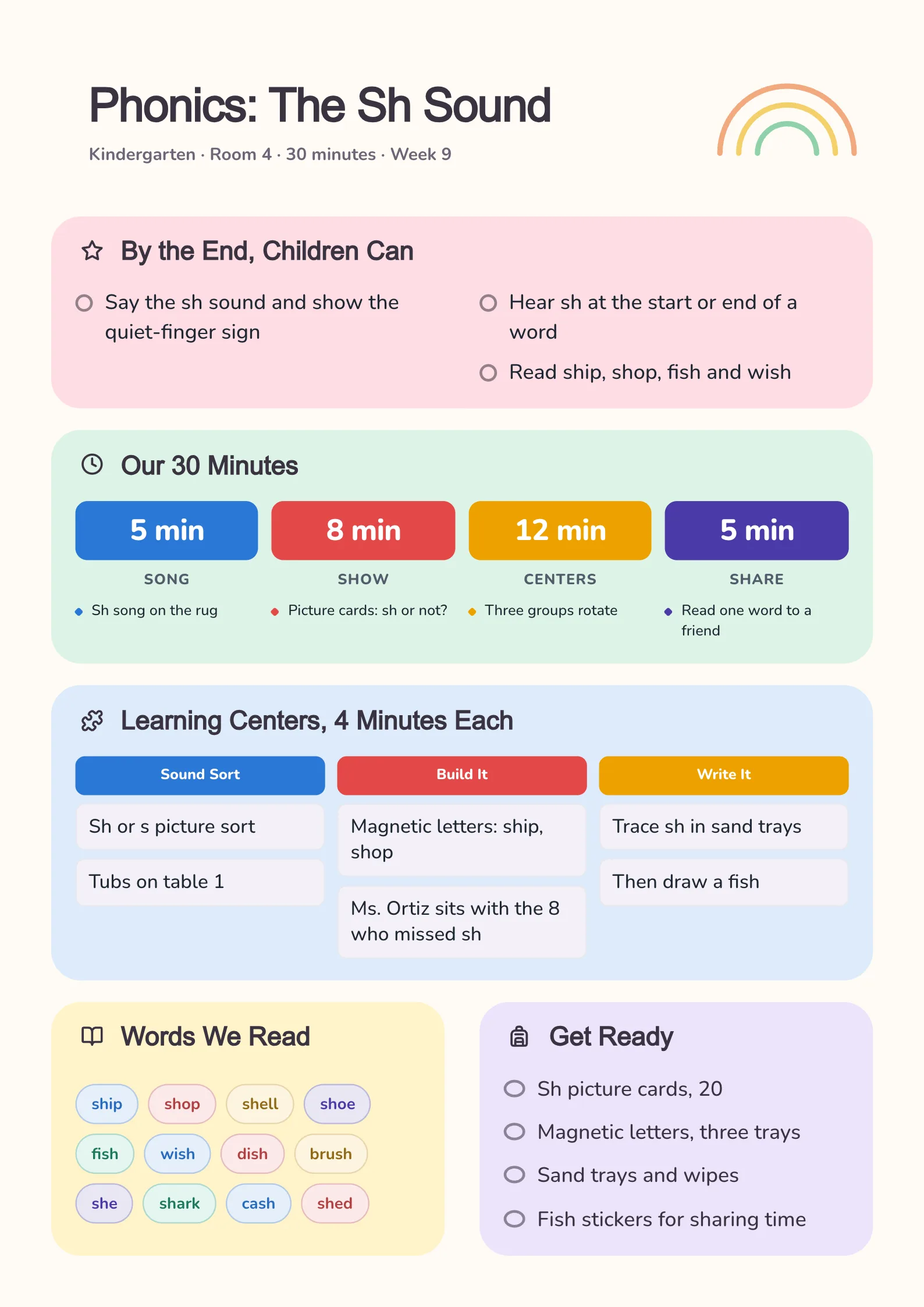 Lesson Plan: Kindergarten PhonicsEdit for free(opens in a new tab)
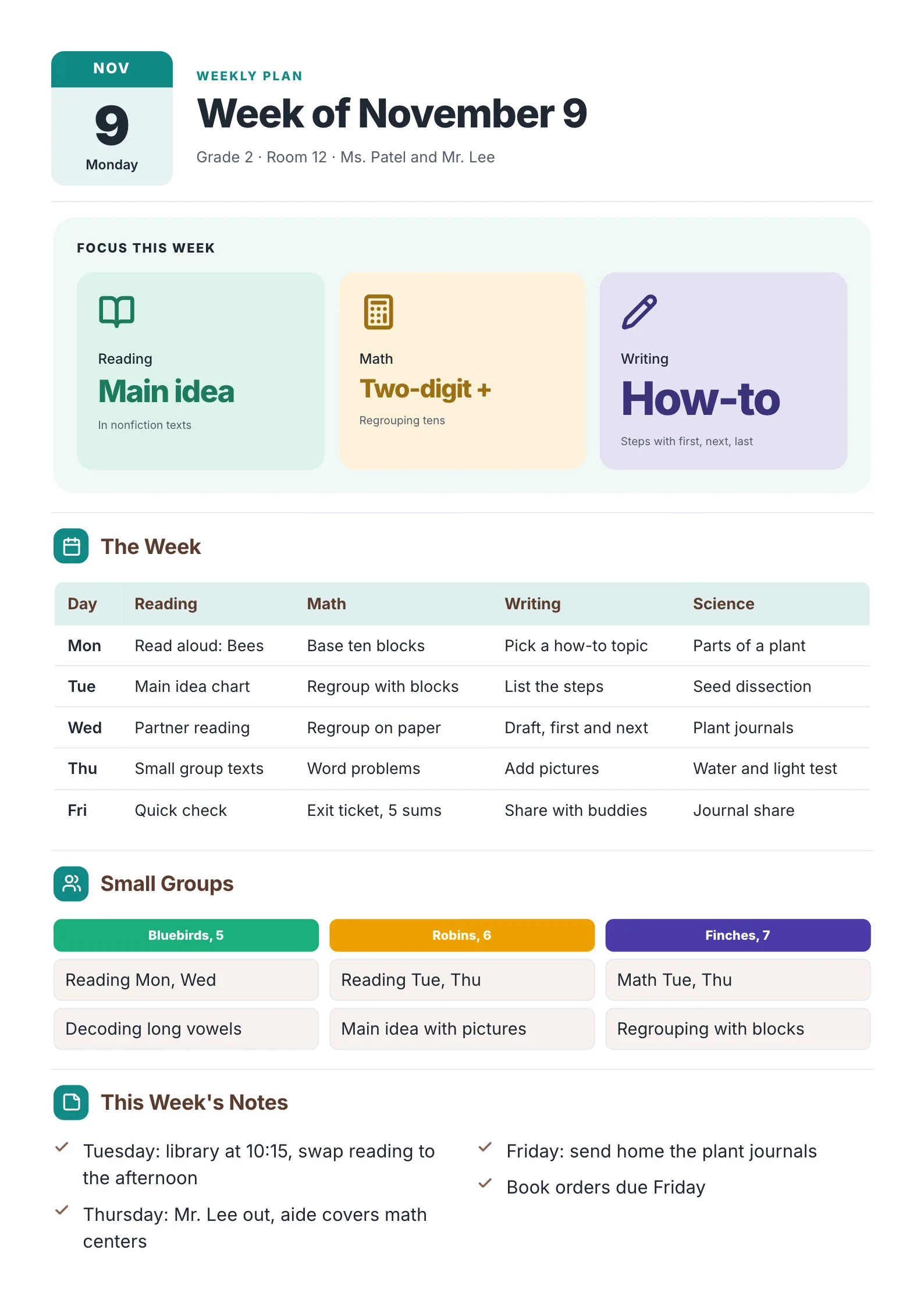 Lesson Plan: WeeklyEdit for free(opens in a new tab)
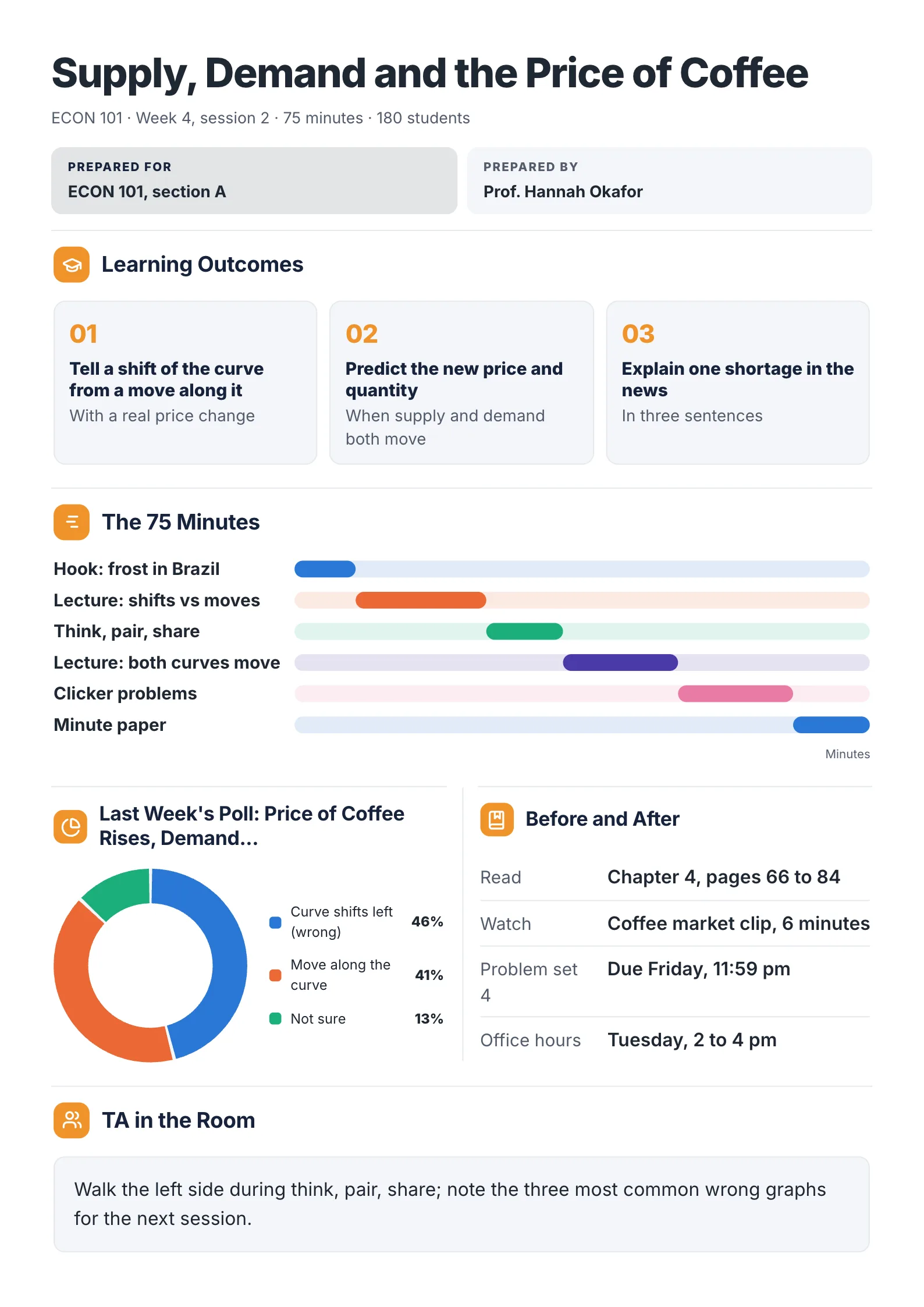 Lesson Plan: College LectureEdit for free(opens in a new tab)
We read the blank forms six teacher programs hand out and counted what each one asks for. Then we laid five one-page plans over that count, so you can see which parts each one already has and which you'd add.
The format, part by part
Here is the order these forms share, as one outline you can copy onto a page.
- Objective: one sentence naming the skill your students will show, written so you can check it.
- Standard: the standard it meets, with its code.
- Materials: everything you set out, with counts.
- Opening: the hook, and how students hear the objective.
- Steps with minutes: what you do and what students do, in order, with minutes that add up to the period.
- Assessment: how you'll check the objective, matched to it.
- Differentiation: one line for students who need more support and one for those who finish early.
- Closure: how the class wraps up and comes back to the objective.
- Reflection: two or three lines after you teach on what worked and what you'd change.
Six forms from teacher programs
Each of these is a real form, downloaded on October 30, 2026. Five come from colleges of education. The sixth is the form Texas uses for adult education classes, which shows the same format works outside a K-12 room.
| Form | Pages | What it asks for |
|---|---|---|
| Idaho State University, student teaching template (revised 2022) | 8 | The longest: standards, what students already know, every objective matched to its assessment, and a timed script with differentiation beside each step |
| University of Central Missouri, lesson plan format | 2 | Six required parts, and it lets you use any layout that includes them |
| University of Kansas, 2025 student teaching format | 2 | 14 elements, from the unit title down to the resources you need |
| University of Pittsburgh at Bradford (September 2023) | 2 | 11 sections, with the teaching itself split into 8 steps |
| Saint Louis University, lesson plan format | 5 | Built on Missouri's statewide test for new teachers |
| TCALL, Texas A&M, adult education blank form | 2 | The teaching split into I do, We do, You do |
We counted these from the six blank forms themselves, all read on October 30, 2026, and every one is linked at the end.
Central Missouri's line is the one to hold on to. Its form says a variety of formats may be used, as long as every plan includes the required parts. The layout is yours. The parts are not.
How many forms ask for each part
| Part | Forms that ask for it |
|---|---|
| Objectives: what students will be able to do | 6 of 6 |
| The standard it meets | 6 of 6 |
| How you'll assess it | 6 of 6 |
| Differentiation: changes for students who need them | 6 of 6 |
| An opening or hook | 6 of 6 |
| Materials | 6 of 6 |
| Teaching steps or sequence | 6 of 6 |
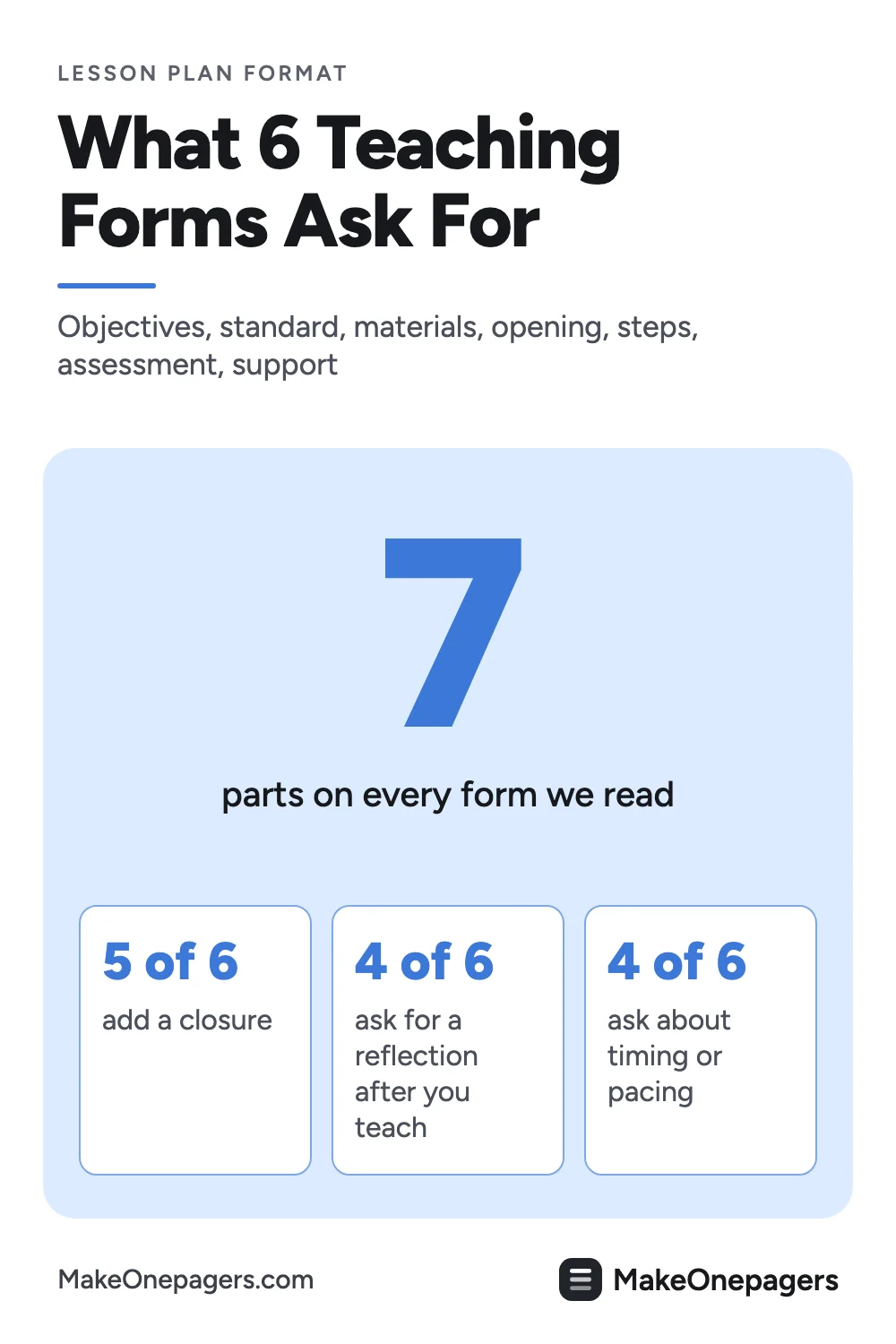
| Closure | 5 of 6 |
| Your reflection after teaching | 4 of 6 |
| Timing or pacing for the steps | 4 of 6 |
| Modeling, then guided practice, then practice on their own | 2 of 6 |
So if your plan has the first seven rows, you've covered the parts every one of these forms asks for. Each form then adds a few boxes of its own, like Kansas's class description or Pittsburgh's Universal Design for Learning box. The next three rows are where your plan gets better.
Idaho State sets the bar for how much detail you write. Your steps should be detailed enough that a substitute could follow them. It also lists five steps it won't accept as written, including "Introduce the lesson," "Play the game" and "Do the worksheet." Each one tells you what happens and leaves out how.
An art lesson that already has its rubric
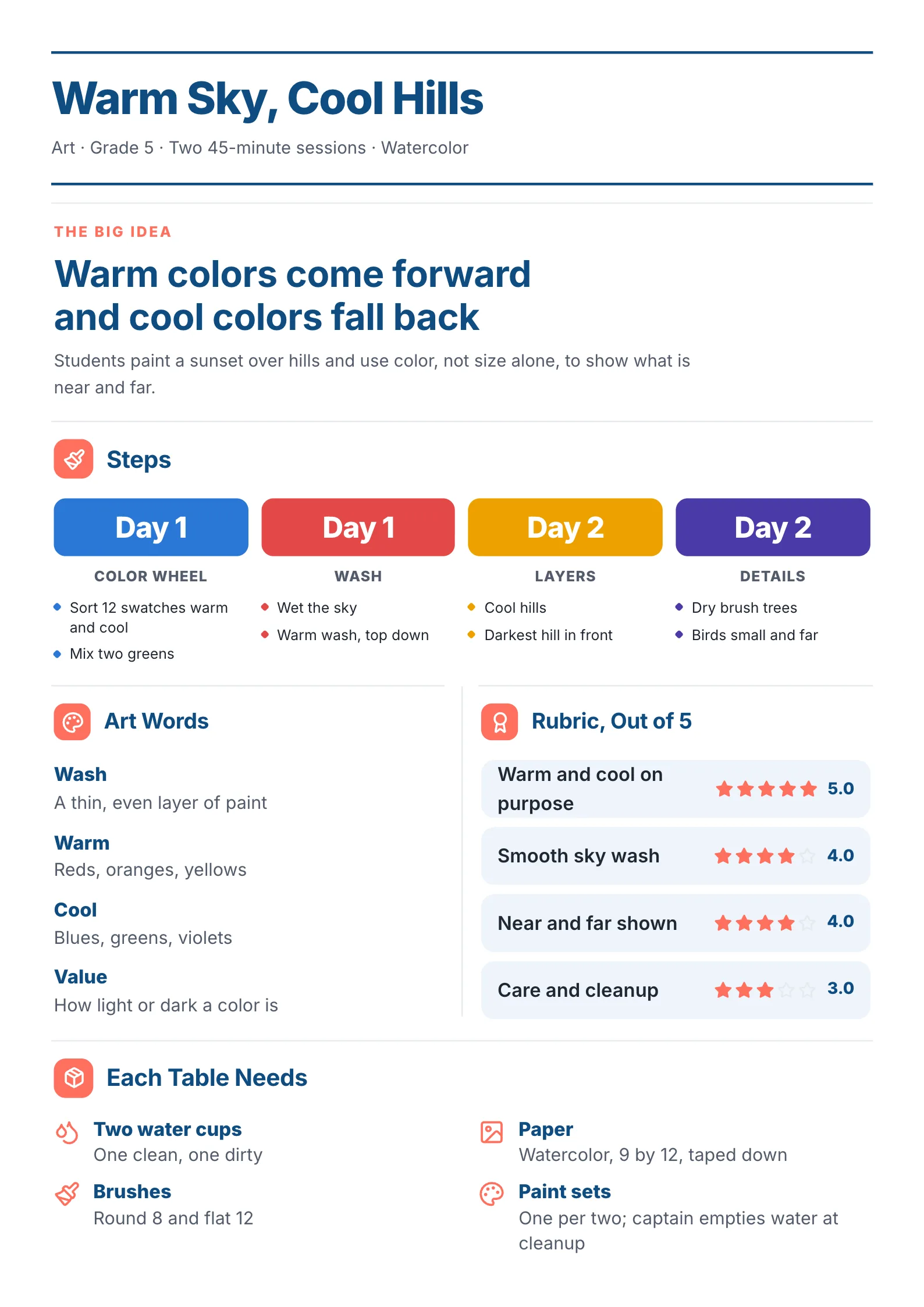
Warm Sky, Cool Hills is a fifth grade watercolor lesson over two 45-minute sessions. Students paint a sunset over hills and use warm and cool color, along with size, to show what is near and what is far.
 Edit this template
Sample names and figures. The objective is one sentence, and the rubric checks that same sentence.
The steps run across two days: the color wheel and a first wash on day one, then layers and details on day two. The rubric scores four things out of 5: warm and cool used on purpose, a smooth sky wash, near and far shown, and care and cleanup.
"Each Table Needs" is the materials part, and it's the most useful box on the page. Two water cups per table, so your brushes rinse in one and clean water stays in the other. A round 8 and a flat 12 brush. Watercolor paper, 9 by 12, taped down. One paint set for every two students, and a table captain who empties the water at cleanup.
Scored on those seven parts, this plan has the objective, materials, steps and an assessment. If your school grades on the full format, add the standard you're teaching to and one line for students who need help, such as a pre-drawn horizon line.
A music lesson with minutes on every step
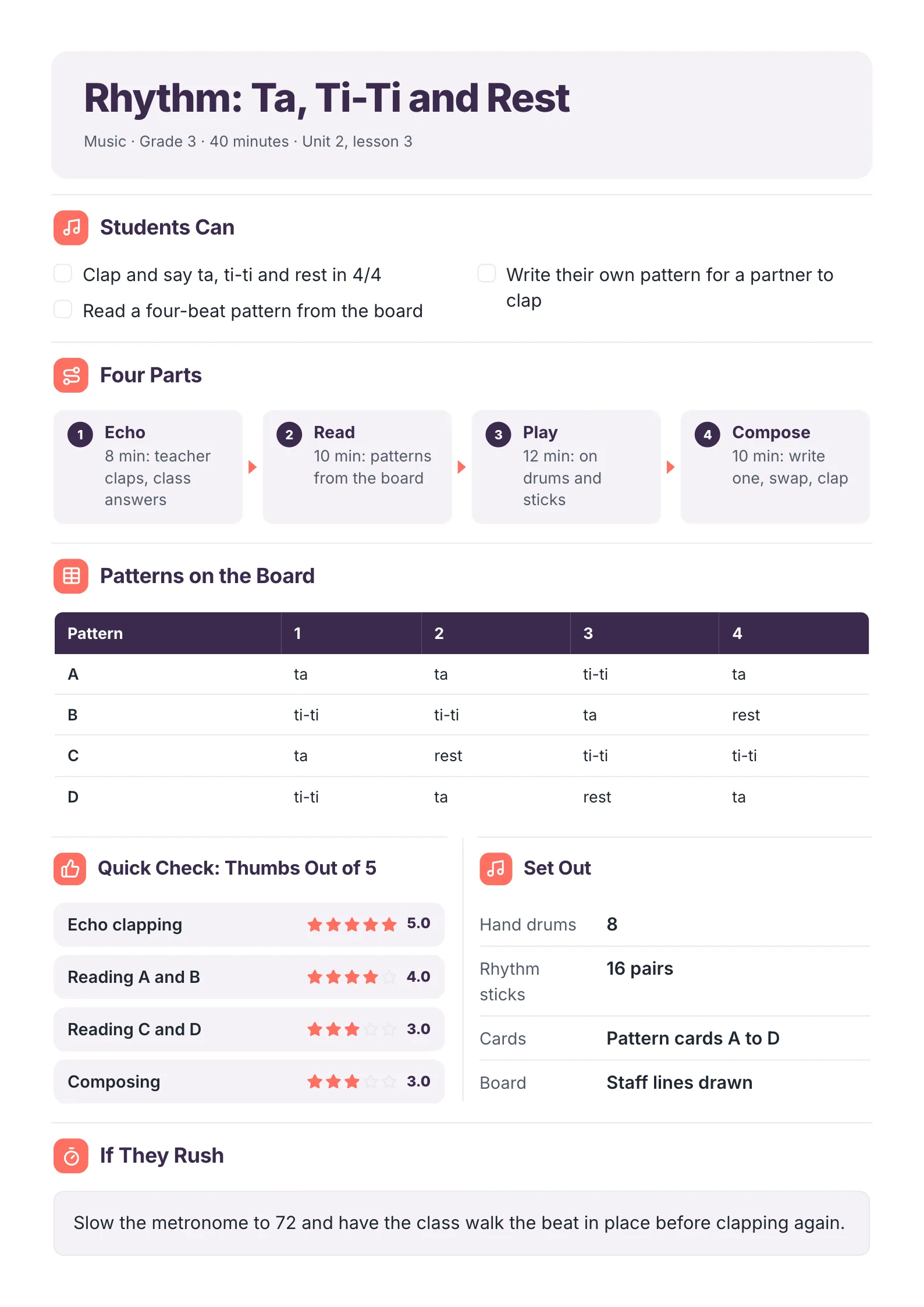
The rhythm lesson you see here, Ta, Ti-Ti and Rest, is a 40-minute third grade lesson, the third in its unit. It's the best of the five for timing, because every part carries its minutes and they add up.
 Edit this template
Sample names and figures. Echo, read, play and compose fill exactly 40 minutes.
The class can clap and say ta, ti-ti and rest in 4/4, read a four-beat pattern from the board, and write their own for a partner to clap. Those are three objectives you can see from the door.
The four parts are Echo for 8 minutes, Read for 10, Play for 12 on drums and sticks, and Compose for 10. The last one doubles as a closure, since every child writes a pattern, swaps it and claps their partner's.
Then comes "If They Rush," which tells you to slow the metronome to 72 and have the class walk the beat in place before clapping again. That's differentiation you can use the second you need it.
Against the count, this plan has six of the seven parts. Add the standard it meets and it has all seven.
A PE lesson built around stations
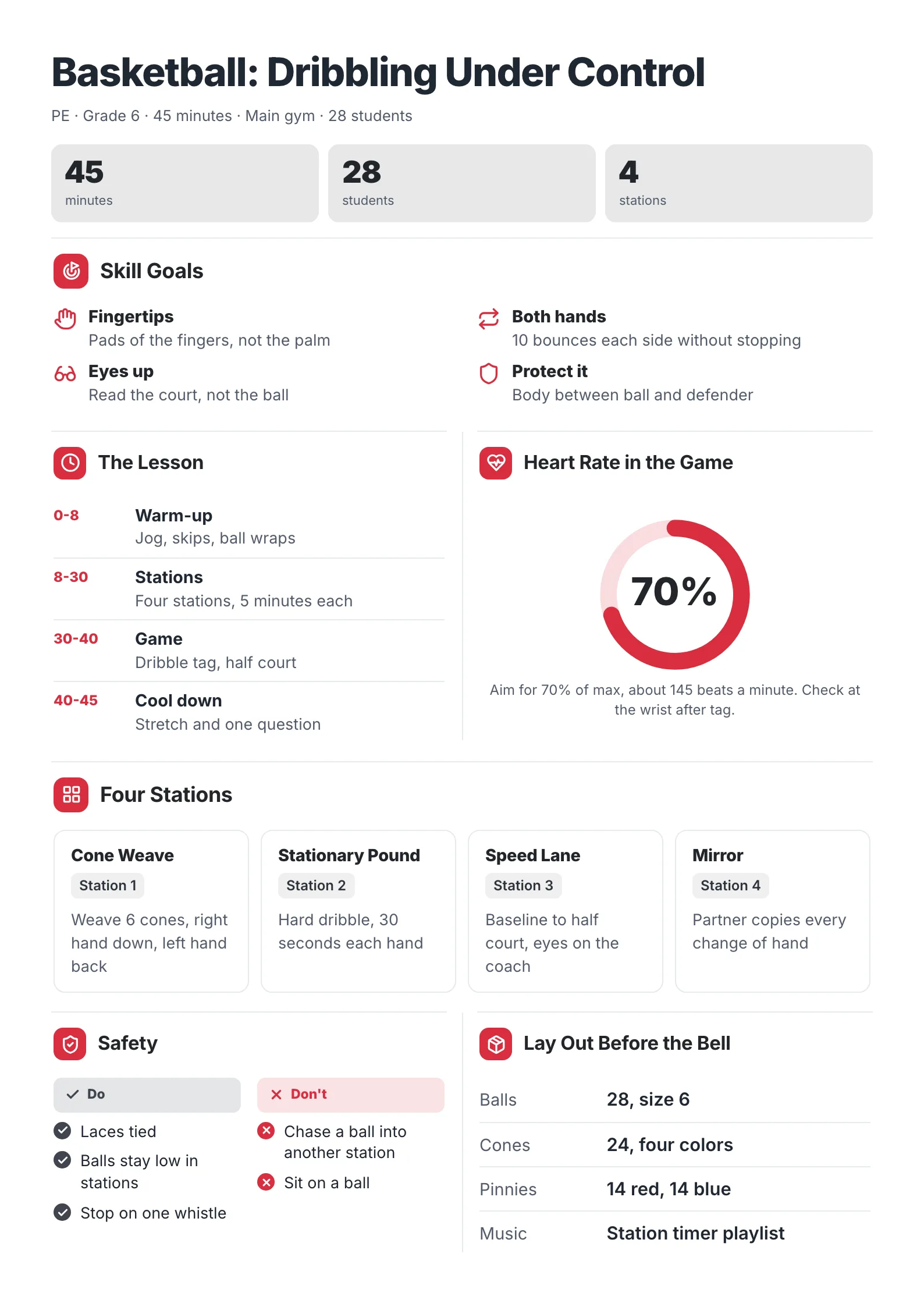
The basketball lesson, Dribbling Under Control, is for a sixth grade class of 28 students, 45 minutes in the main gym. Its four skill goals are short enough to shout across a court: fingertips, eyes up, both hands and protect it.
 Edit this template
Sample names and figures. Four stations at 5 minutes each fill the middle of the period.
The lesson runs warm-up, stations, a half-court game of dribble tag, and a cool down with a stretch and one question. That one question is the closure. Each station has its own line: a cone weave, a stationary pound for 30 seconds each hand, a speed lane from baseline to half court, and a mirror drill with a partner.
The heart rate box gives you a number to check: aim for 70% of max, about 145 beats a minute, taken at the wrist after tag. "Lay Out Before the Bell" covers materials down to the count: 28 size 6 balls, 24 cones in four colors and 14 red and 14 blue pinnies.
That gives it the objectives, the opening, the steps, the materials and a closure. Add the standard, a quick skill check for each goal and one line for students who need a lighter ball or a shorter lane.
A day of sub plans someone else can follow
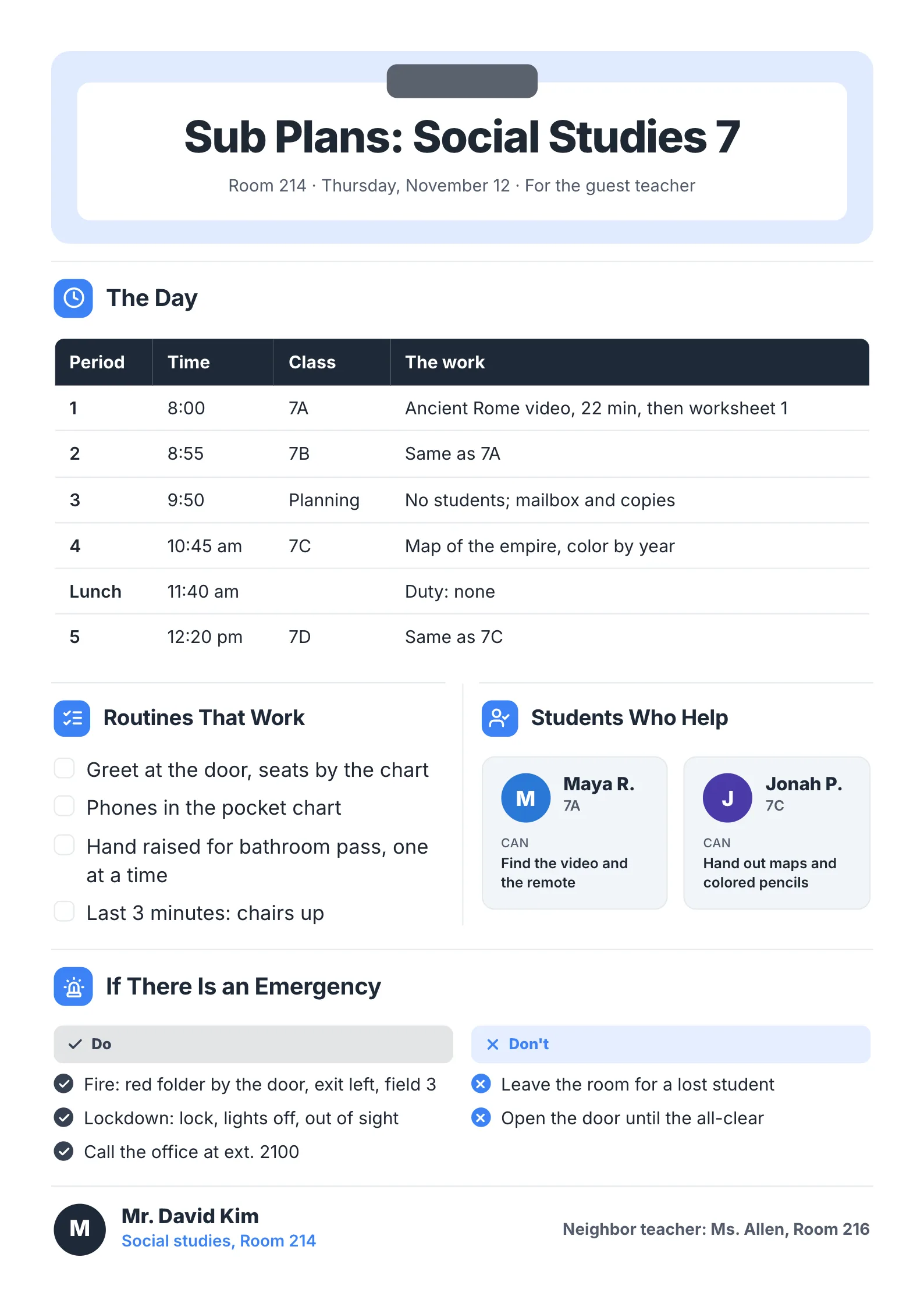
This is Idaho State's test in practice. Sub Plans: Social Studies 7 is written for the guest teacher in Room 214 on Thursday, November 12. Nobody who reads it has met your class.
 Edit this template
Sample names and figures. Each routine is written so a stranger can run it the first time.
"Routines That Work" is four lines: greet at the door with seats by the chart, phones in the pocket chart, a raised hand for the bathroom pass with one student out at a time, and chairs up in the last 3 minutes. "Students Who Help" names Maya R., who can find the video and the remote, and Jonah P., who can hand out maps and colored pencils.
It ends with Mr. Kim's name and a neighbor teacher, Ms. Allen in Room 216, so the guest knows who to ask. On a full plan, this is where your reflection goes. Add one line asking the guest to note who was absent and what went wrong, and you'll know what happened while you were out.
A sub plan isn't graded against the full format, and this one carries no objective or standard of its own. It's here for Idaho State's detail test alone.
A training session that uses the same format
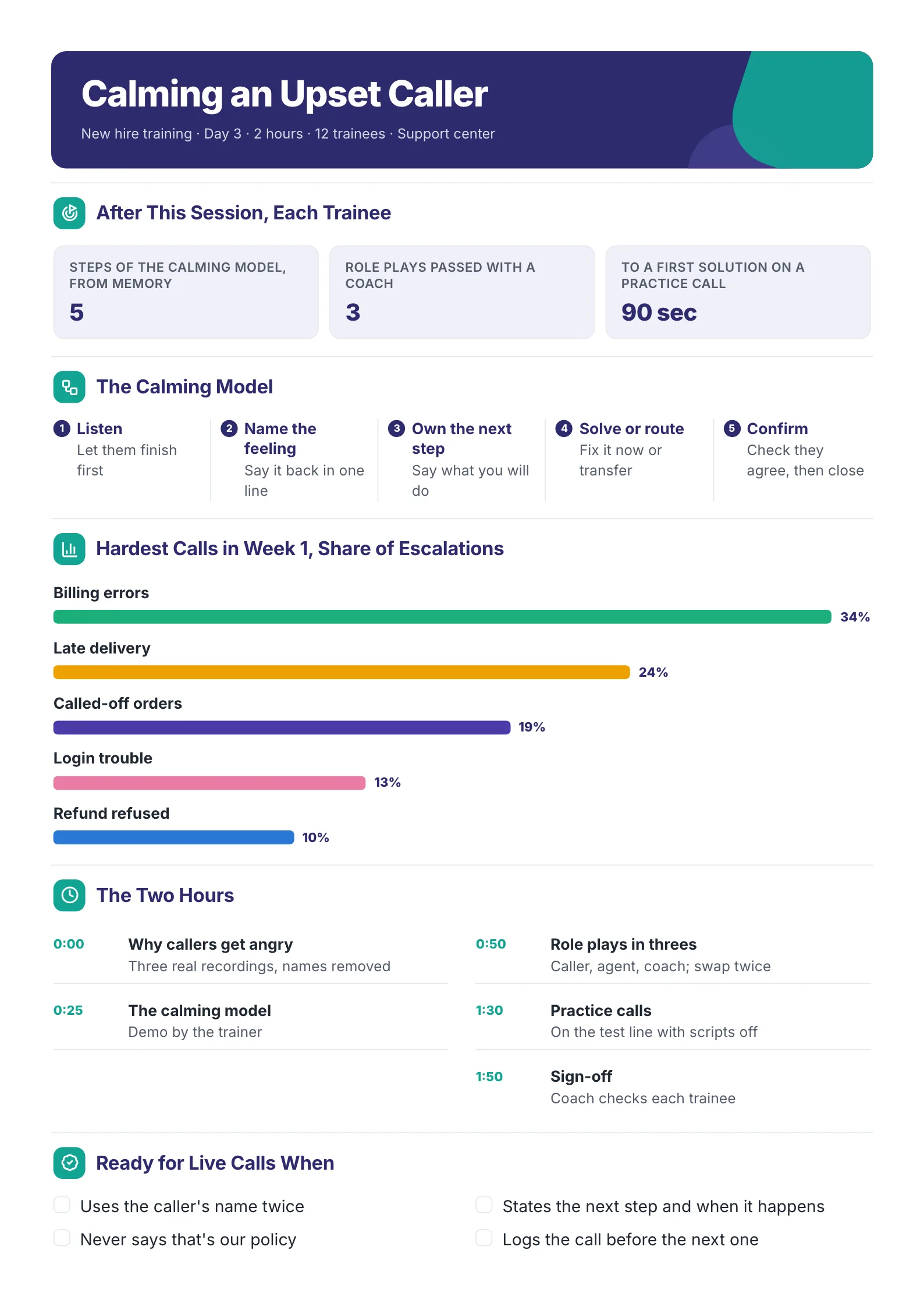
Lesson plans aren't only for schools. Calming an Upset Caller is day three of new hire training at a support center: 2 hours, 12 trainees. Look at the outcomes and you'll see objectives with numbers in them.
 Edit this template
Sample names and figures. Demo, role plays, then practice calls: the same order the Texas form calls I do, We do, You do.
By the end, each trainee knows the 5 steps of the calming model from memory, has passed 3 role plays with a coach and reaches a first solution in 90 seconds on a practice call. The model itself is five words: listen, name the feeling, own the next step, solve or route, confirm.
The two hours follow TCALL's order. The trainer demos the model, then trainees role play in threes as caller, agent and coach, swapping twice, then take practice calls on the test line with scripts off. "Ready for Live Calls When" is the assessment: the trainee uses the caller's name twice, never says "that's our policy," tells the caller what happens next and by when, and logs the call before the next one.
Against the count, it has objectives, an opening, timed steps and an assessment. Add a materials line and a note for trainees who need more practice, and it covers everything but a school standard.
Sources
| Source | Publisher | What we took |
|---|---|---|
| Student teaching lesson plan template | Idaho State University | Its parts, the substitute test for detail and the five steps it won't accept |
| Lesson plan format | University of Central Missouri | Six required parts, any layout allowed |
| 2025 student teaching lesson plan format | University of Kansas | 14 elements |
| Lesson plan template | University of Pittsburgh at Bradford | 11 sections and 8 teaching steps |
| Lesson plan format | Saint Louis University | Its parts, tied to Missouri's new-teacher assessment |
| Blank lesson plan form | TCALL, Texas A&M University | The I do, We do, You do order |
All six were read on October 30, 2026.
Pick the seven parts, then the page
Start with your objective and your check for it, since every form we read wants both and they should match. Then pick a page from MakeOnepagers that already has boxes for materials and timed steps, the way the rhythm lesson and the basketball stations do, and write your standard and your support line before you print it.
Frequently asked questions
What is the standard lesson plan format?
Objectives, the standard, materials, an opening, teaching steps, an assessment and differentiation. Every one of the six forms we read asks for all seven, and five of them add a closure at the end. For a full walk-through of each part, see how to write a lesson plan.
Does a lesson plan have to be a certain length?
No. Idaho State's form runs 8 pages and Kansas fits 14 elements on 2. What matters is that someone else could teach from it. A one-page plan works when every step tells you what students do.
Should I write minutes for each part?
Four forms on our list ask about timing, and Idaho State and Kansas want minutes beside each step. Your plan will run better with them. Add them up before class. The music plan above is 8, 10, 12 and 10, which is exactly its 40 minutes. For more ready plans, browse our lesson plan template page.




