Lesson Plan Examples: 5 One-Page Plans From 30 Minutes to a Week
Lesson plan examples for a kindergarten block, an ESL class, a college lecture, a lab and a full week, plus what 4 state lesson plan forms ask for.

Thirty minutes with kindergartners and a full week of Grade 2 need very different pages, yet both start the same way, with what students will be able to do by the end. These lesson plan examples climb from a 30-minute phonics block through a 45-minute ESL class, a 75-minute college lecture and a 90-minute biology lab to a whole week on one page. Every one gives each part of the lesson its minutes and ends with a check on who got it. Start from a free one pager template.
One‑Pager examples
Real One-Pagers made with MakeOnepagers. Open any one to edit it as your own.
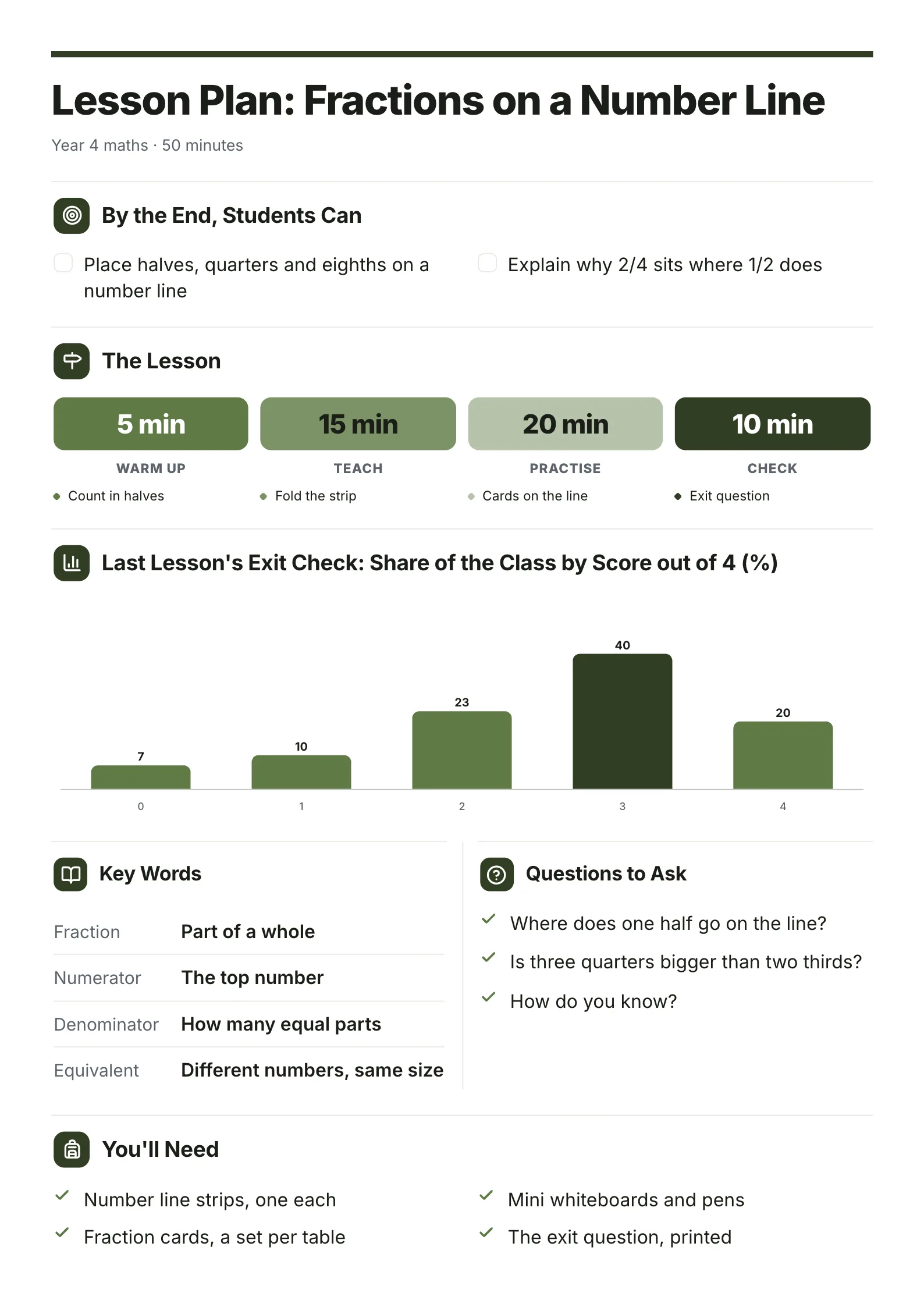 Lesson PlanEdit for free(opens in a new tab)
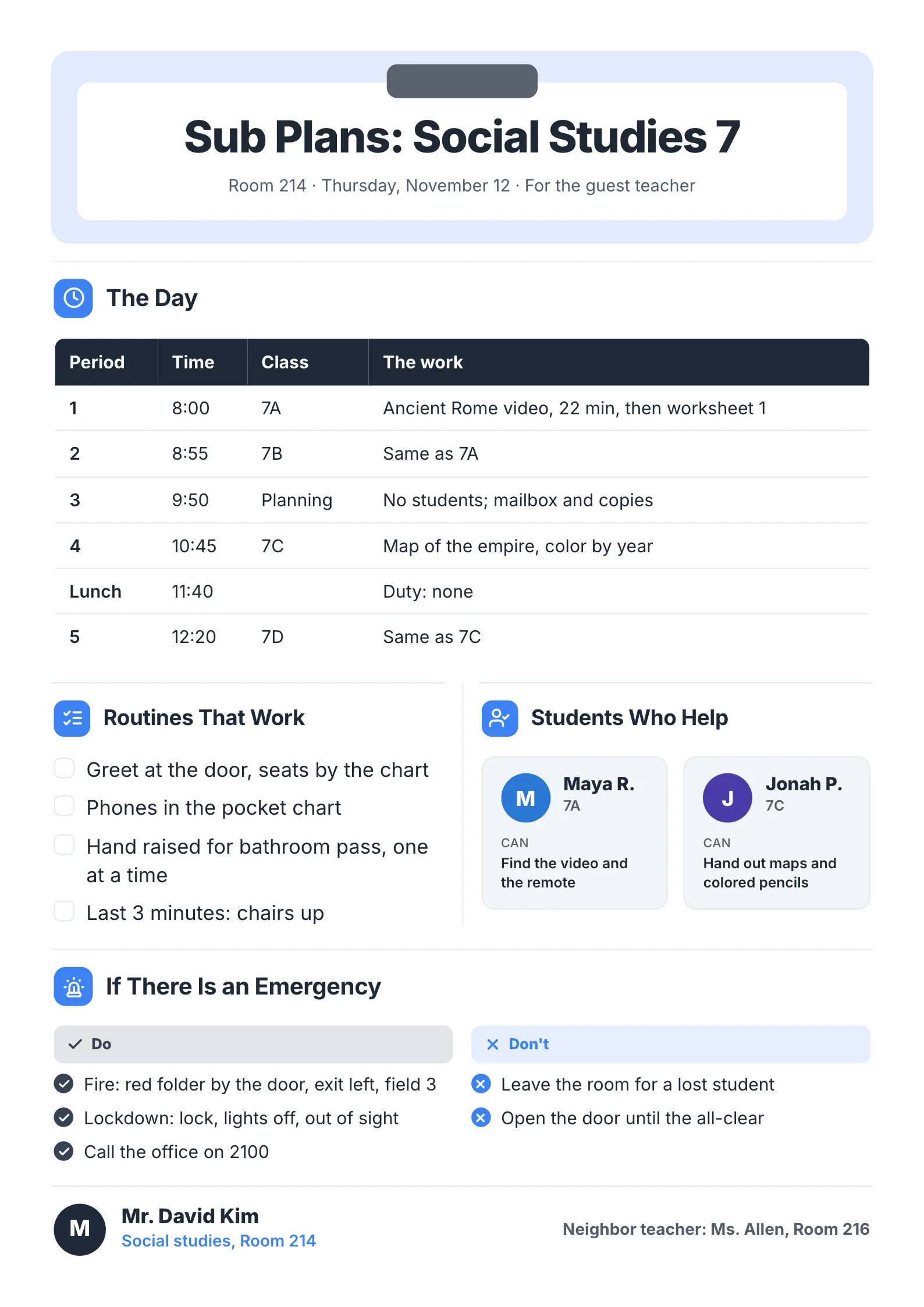 Lesson Plan: Substitute TeacherEdit for free(opens in a new tab)
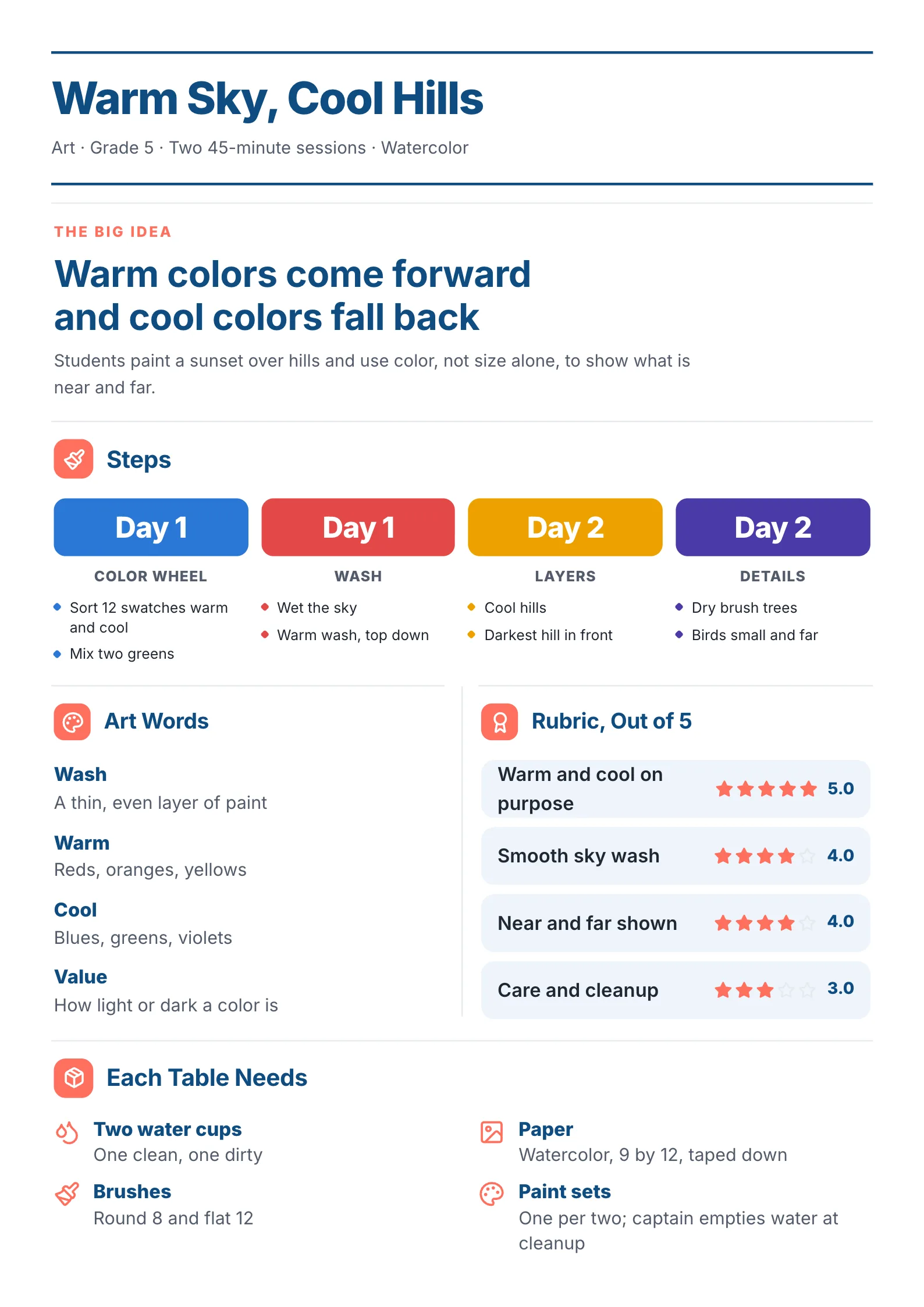 Lesson Plan: ArtEdit for free(opens in a new tab)
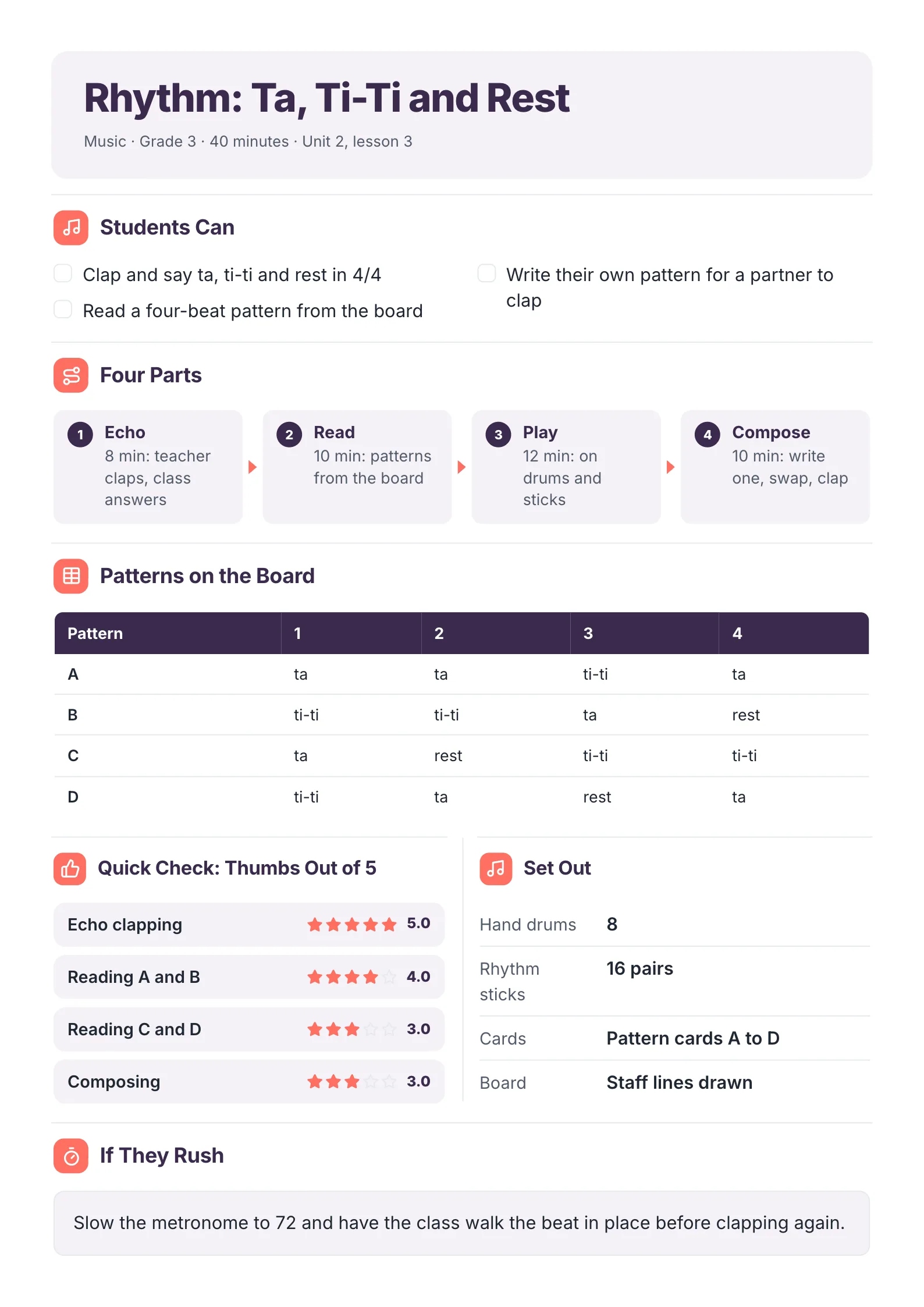 Lesson Plan: MusicEdit for free(opens in a new tab)
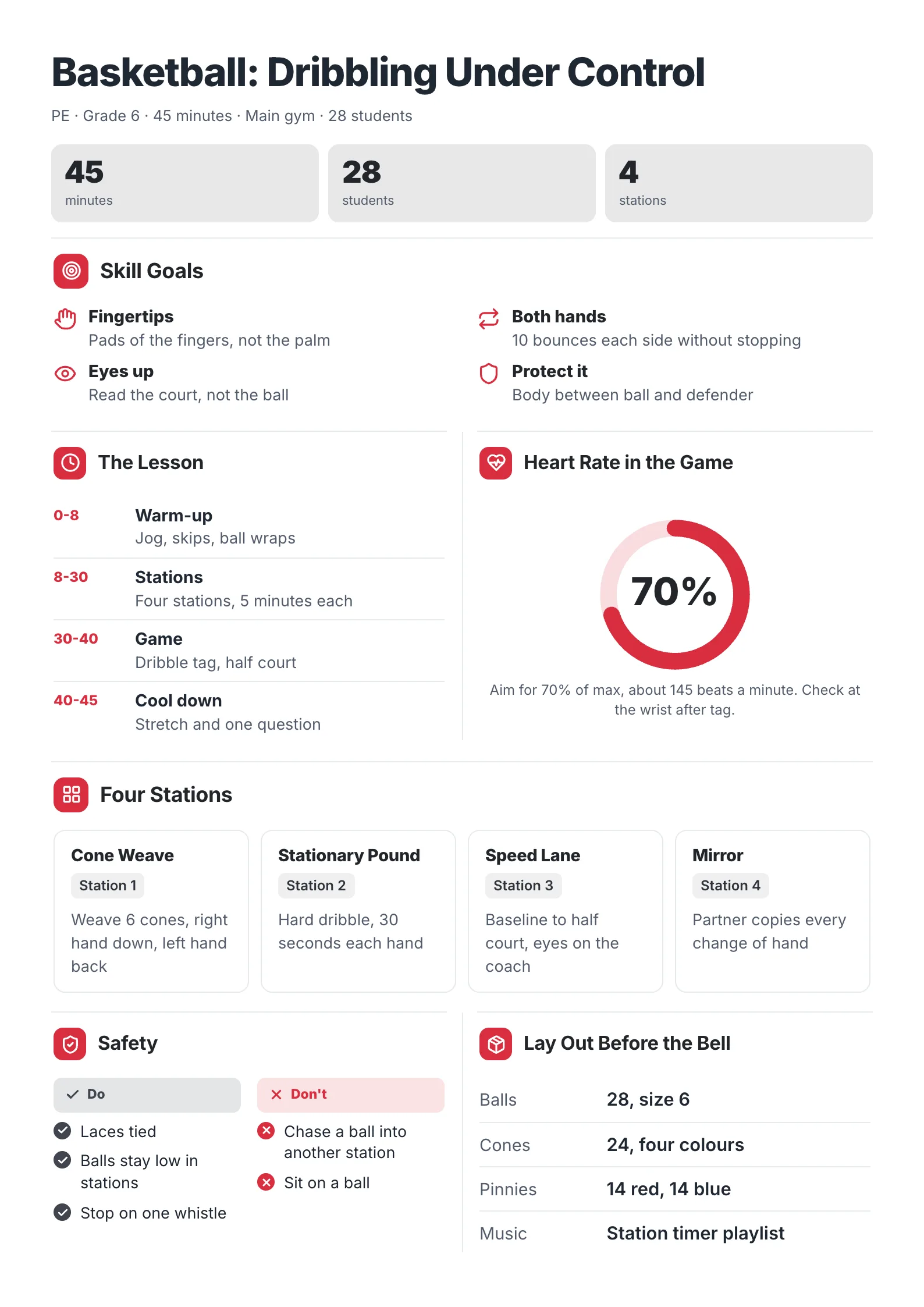 Lesson Plan: PEEdit for free(opens in a new tab)
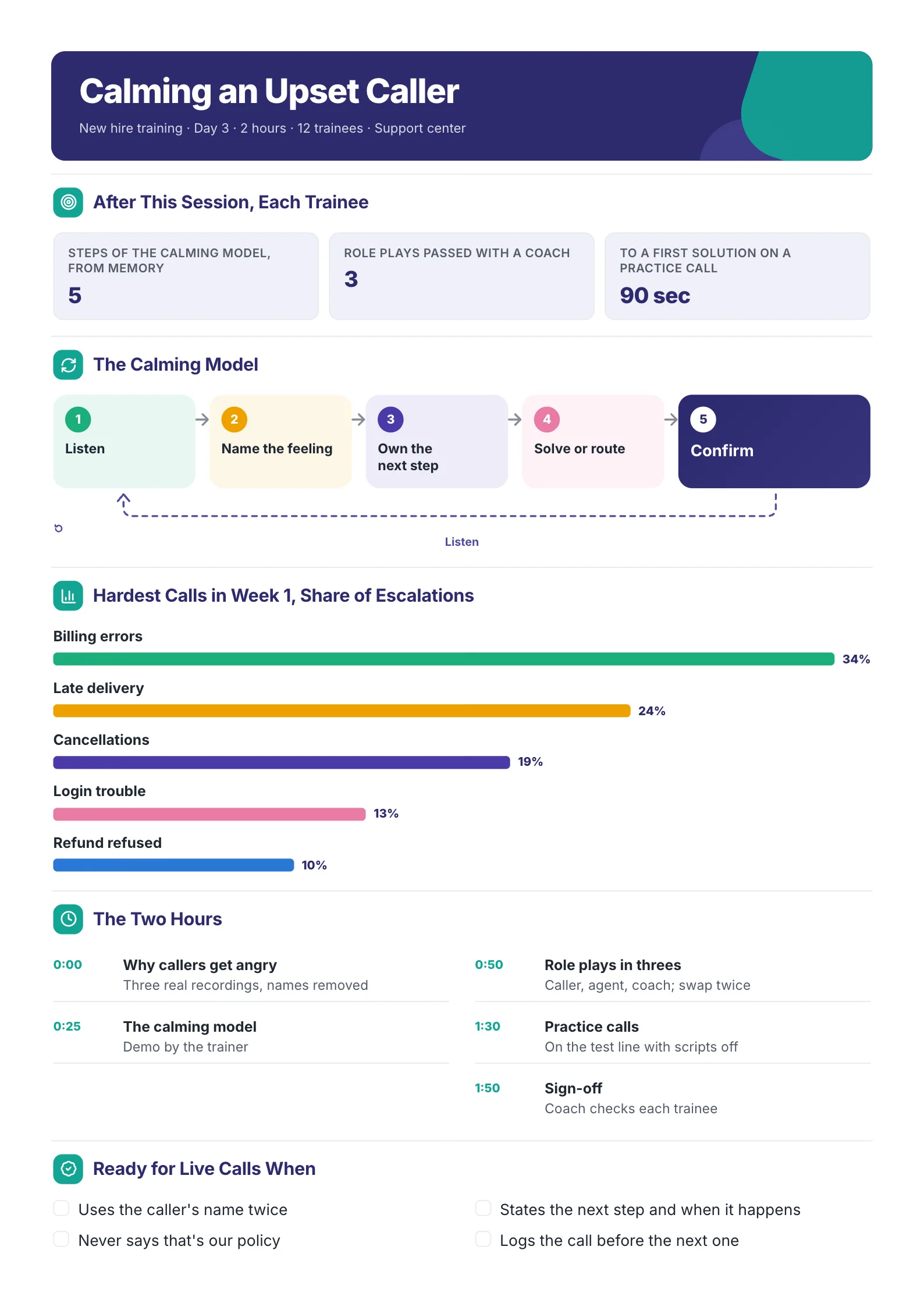 Lesson Plan: Employee TrainingEdit for free(opens in a new tab)
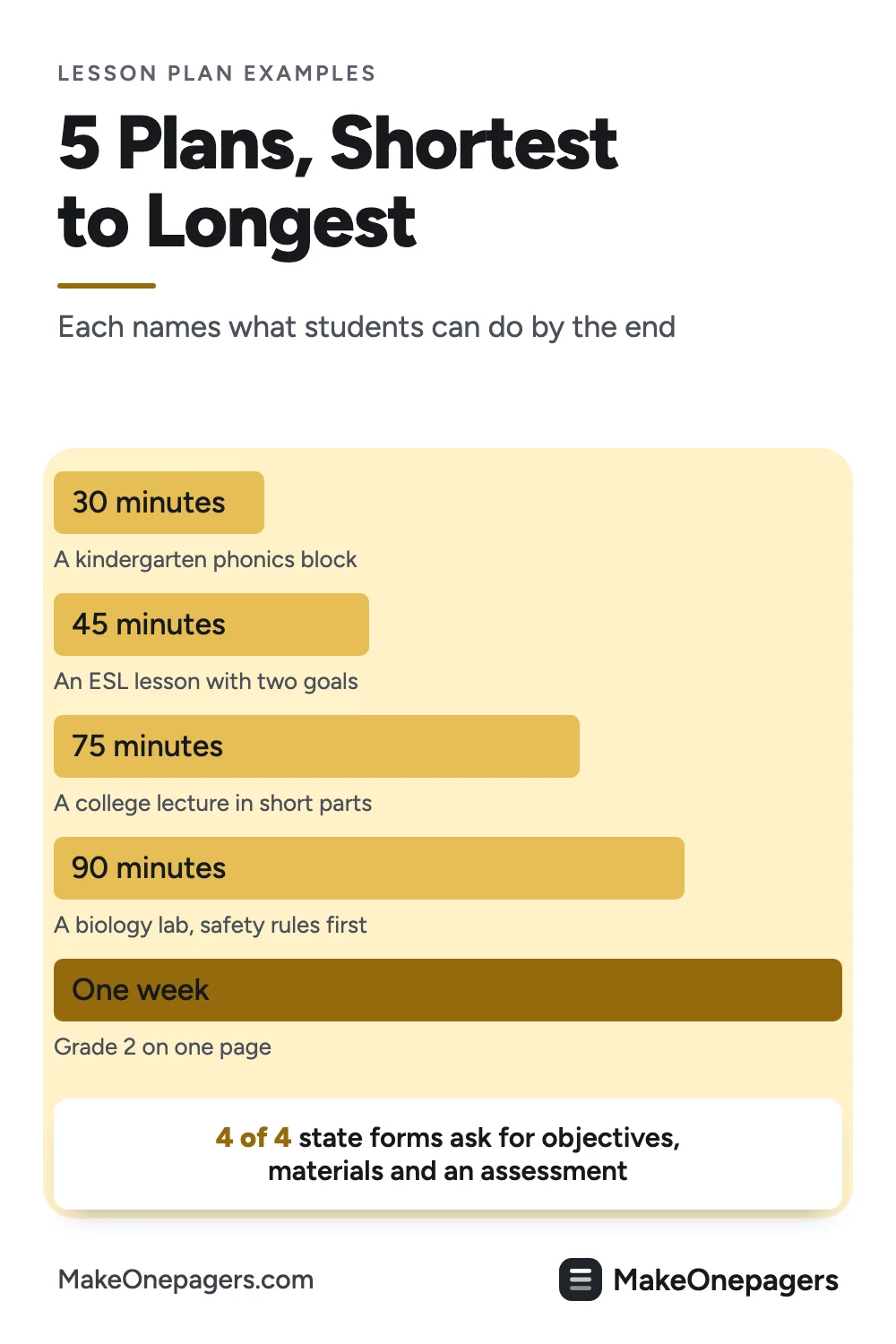
Pennsylvania, Massachusetts, Nevada and New Jersey each publish a lesson plan form, and all 4 ask for objectives, materials and an assessment. Only Massachusetts asks the teacher to write down afterward what the lesson showed about the class. Three of the plans here get the same benefit another way, by building on what last week's lesson revealed.
A 30-minute kindergarten phonics block
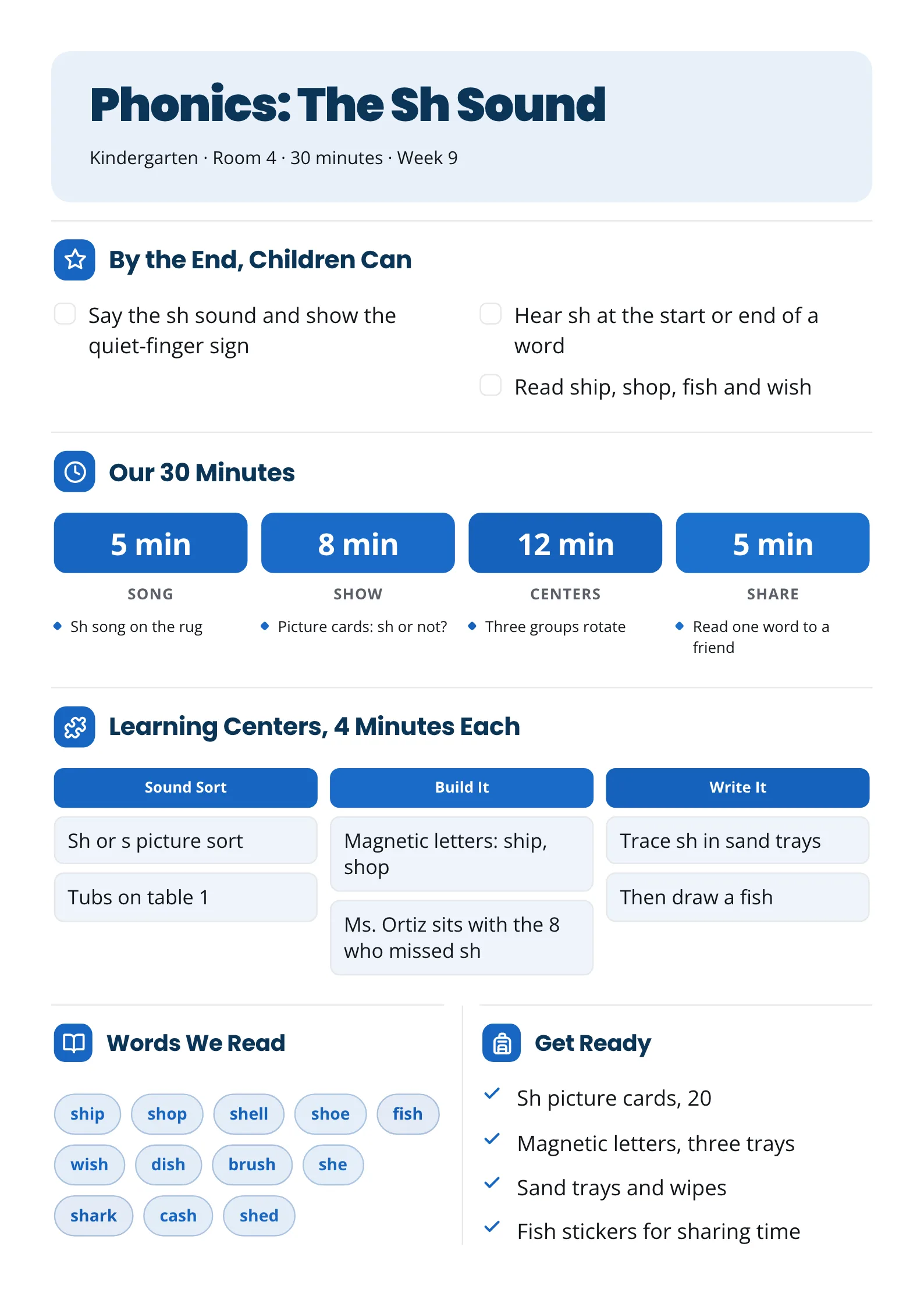
If you teach young children, you already know a short lesson only works when every part is short too. This plan for the sh sound splits 30 minutes into four parts, and none runs longer than 12 minutes. There's a 5-minute song on the rug and 8 minutes of picture cards ("sh or not?"). Then come 12 minutes of learning centers and 5 minutes of sharing, where each child reads one word to a friend.
The centers are where you'll see the plan earn its keep. Three groups rotate every 4 minutes through a sound sort, a word-building table with magnetic letters and a sand tray for tracing. The plan also says who sits where. The teacher sits at the building table with the 8 children who missed sh last time, so the help goes to the children who need it.
The goals are things you can watch a child do, so you know by the end who has it. Children say the sh sound with the quiet-finger sign, hear sh at the start or end of a word and read four words: ship, shop, fish and wish. The word list on the page holds 12, so early finishers have more to read.
 Edit this template
A sample with made-up names. The note in the middle center tells the teacher which 8 children to sit beside.
It suits you if you teach pre-K to Grade 1, work as a reading specialist or run small groups that rotate on a timer.
A 45-minute ESL lesson with two goals
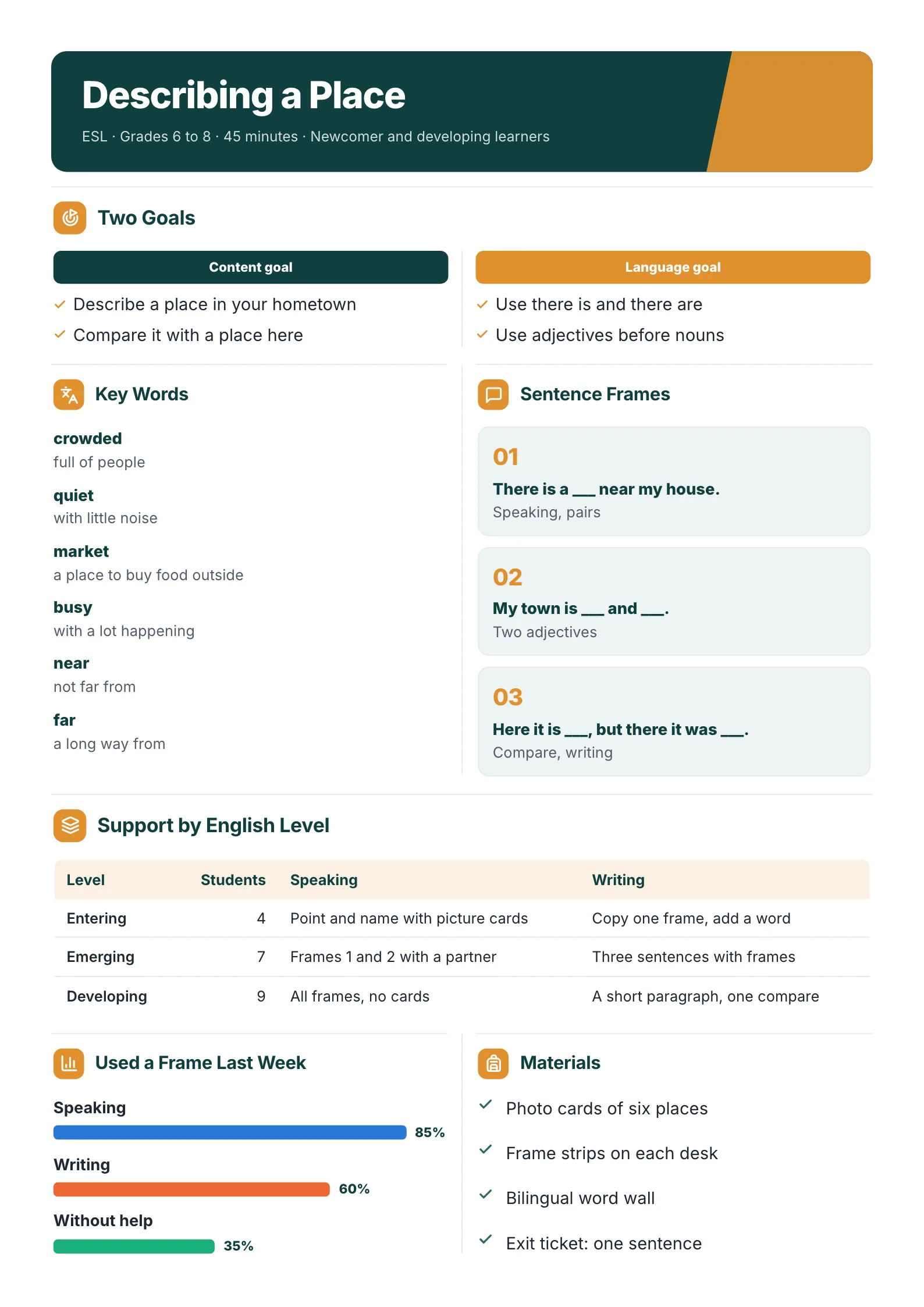
When you teach English learners, your lesson has two jobs, the topic and the language, and this plan gives each one its own goal. The content goal is to describe a place in your hometown and compare it with a place here. The language goal is to use "there is" and "there are" and to put adjectives before nouns.
Three sentence frames carry your lesson, from "There is a ___ near my house" for pairs to a compare frame for writing. A table then plans your support for each English level. The 4 entering students point and name with picture cards. The 7 emerging students use the first two frames with a partner, and the 9 developing students use every frame without cards.
A small chart shows how the class used the frames last week. 85% used one when speaking, 60% when writing and 35% without help. That last number tells you what to work on next, since only about a third of your class can manage alone.
 Edit this template
A sample class. The support table gives each English level its own speaking and writing task.
A 75-minute college lecture broken into short parts
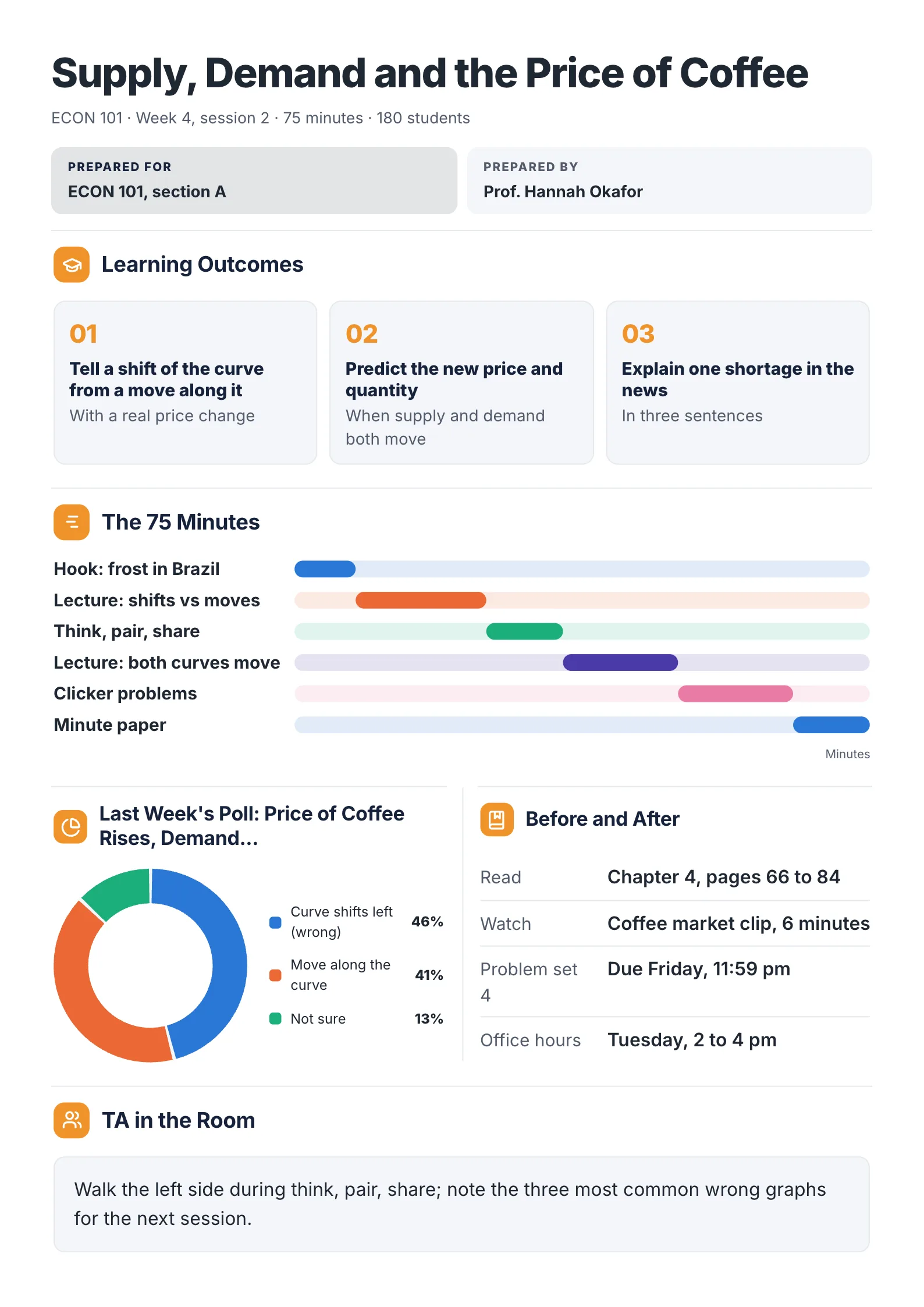
If you face 180 students for 75 minutes, you need a plan that keeps them awake. This economics lecture does it by never lecturing for more than 17 minutes in a row. A timing bar lays out the 75 minutes. It opens with an 8-minute hook about a frost in Brazil and the price of coffee. Two short lectures follow, with a 10-minute think, pair, share between them, then 15 minutes of clicker problems and a 10-minute minute paper to close.
This plan is built on evidence you gathered the week before. A poll asked what happens when the price of coffee rises, and 46% picked the wrong answer, a shift of the demand curve. So the session's first outcome is to tell a shift of the curve from a move along it. If you have a teaching assistant, the plan gives them a job too. They walk the left side during the pair work and note the three most common wrong graphs for next time.
 Edit this template
A sample course and poll. The donut chart shows the misunderstanding the lecture was planned around.
A 90-minute biology lab with the safety rules up front
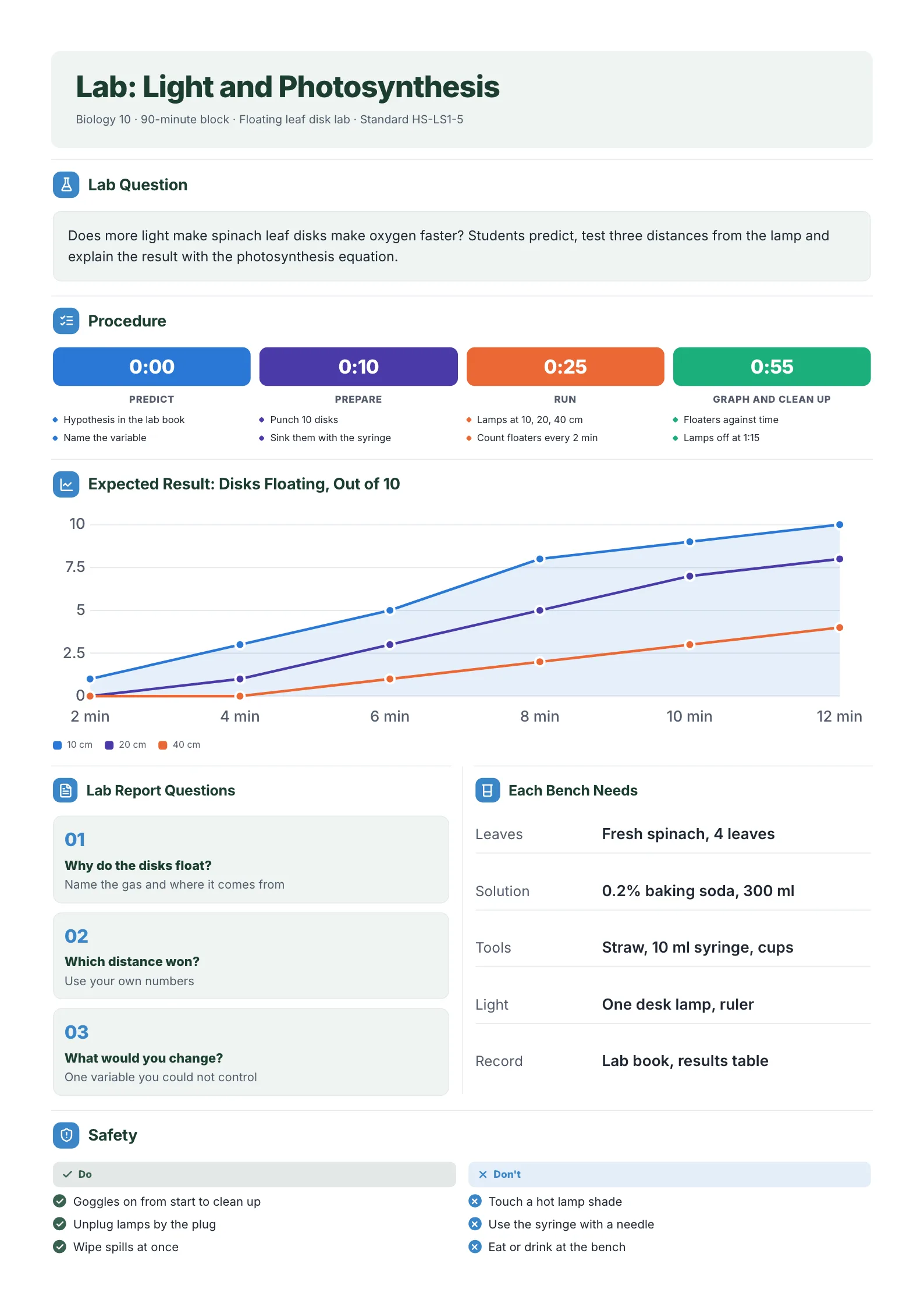
Your lab days have more moving parts, so this photosynthesis lab writes its procedure as clock times rather than minutes. Your students predict at 0:00 and punch 10 spinach leaf disks at 0:10. At 0:25 they run lamps at 10, 20 and 40 centimeters, counting floating disks every 2 minutes. They graph at 0:55, and the lamps go off at 1:15. Anyone covering your room can follow along without asking you.
The page also shows you the result students should get, a line chart where all 10 disks float within 12 minutes at 10 centimeters and only 4 do at 40. Safety rules sit in a do and don't box, like "Goggles on from start to clean up" and never touching a hot lamp shade. The plan names its standard too, HS-LS1-5, which is the kind of line most state forms ask for.
 Edit this template
A sample lab. The expected result chart lets you spot a bench whose setup went wrong before the period ends.
A week of Grade 2 on one page
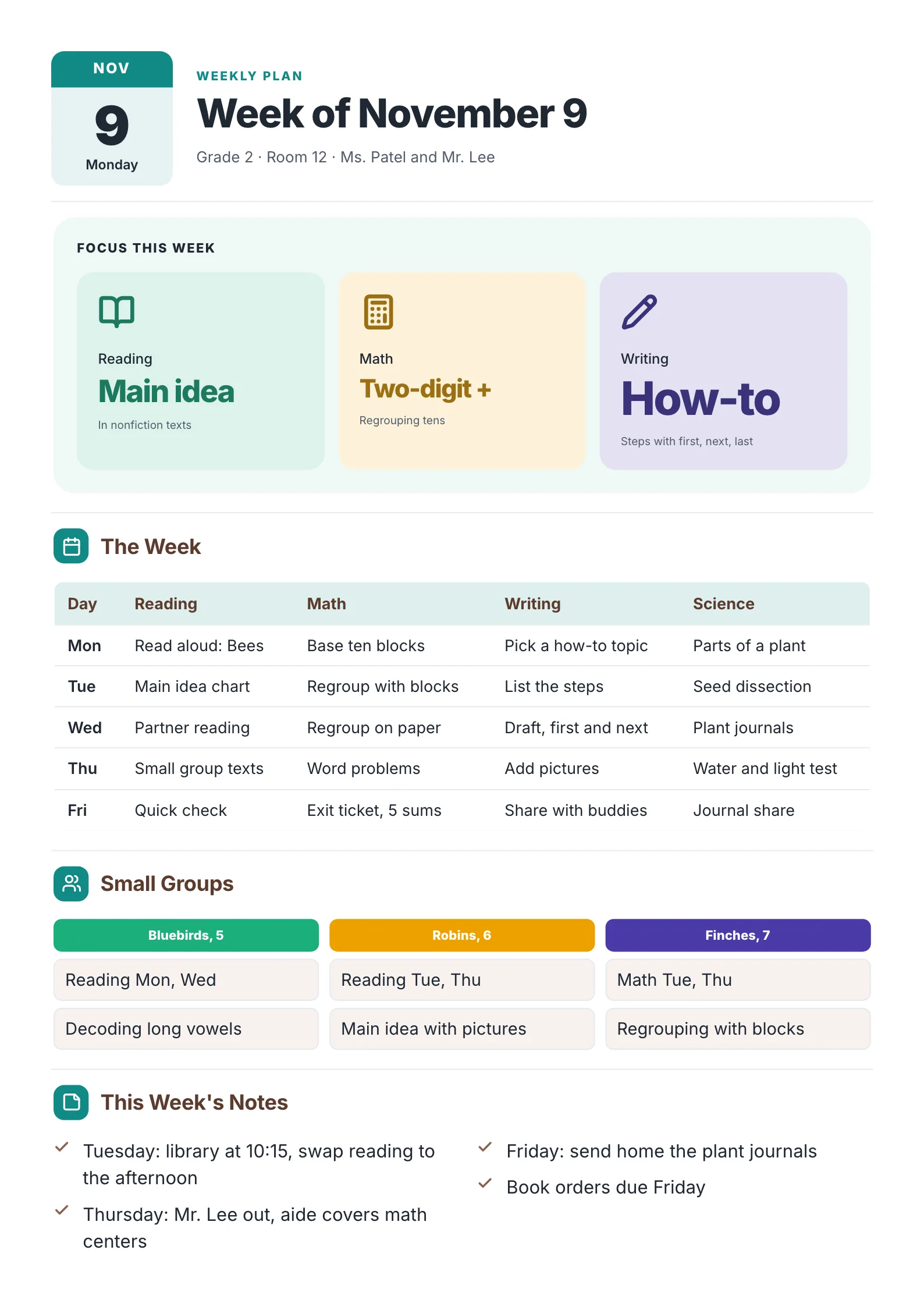
A weekly plan trades detail for the big picture you need before Monday. This one fits five days and four subjects into one table, so you and a co-teacher can see the whole week at a glance. Three focus skills sit at the top: main idea in nonfiction for reading, two-digit addition with regrouping for math and how-to writing.
Your small groups get their own row. The Bluebirds (5 children) meet for reading on Monday and Wednesday. The Robins (6) meet on Tuesday and Thursday, and the Finches (7) do regrouping with blocks on the same two days. Your notes box catches what changes the week, like library moving to 10:15 am on Tuesday and an aide covering math centers on Thursday.
 Edit this template
A sample class with made-up teachers. The notes box is where the week's surprises go, so the table stays clean.
Reach for it if you teach elementary grades, share a room with a co-teacher or plan with a grade-level team.
Objectives worth copying
Every example above starts with what students will do, and your wording matters. A good objective names something you can see or hear by the end of the lesson. Here are lines from the five plans, and two from the gallery, that pass that test:
- "Read ship, shop, fish and wish" (kindergarten phonics)
- "Use there is and there are" (ESL)
- "Tell a shift of the curve from a move along it" (college lecture)
- "Write their own pattern for a partner to clap" (the Grade 3 music plan in the gallery below)
- "5 steps of the calming model, from memory" (the call center training plan, also below)
Compare those with "understand fractions" or "learn about plants." You can't watch someone understand, so you can't check it at the end. Pennsylvania's form puts it plainly, defining an objective as "a subsequent measure of the student's performance."
New Jersey's form adds a habit you'll want to steal. It has room for three objectives and puts a "Checking for Understanding" line under the teaching for each one. So you check your first objective before you teach the second.
What 4 state lesson plan forms ask for
We read the lesson plan forms that four state agencies publish for teachers like you. Pennsylvania's Department of Education lists 13 required elements. Massachusetts publishes separate ELA, math and ESOL forms for adult education. Nevada's form is built around its five teaching standards, and its first line says using it isn't required. New Jersey's is the form students must use in a state agriculture teaching contest.
| What the form asks for | PA | MA | NV | NJ | Forms |
|---|---|---|---|---|---|
| Objectives | Yes | Yes | Yes | Yes | 4 of 4 |
| Standards | Yes | Yes | Yes | Yes | 4 of 4 |
| Materials | Yes | Yes | Yes | Yes | 4 of 4 |
| An assessment | Yes | Yes | Yes | Yes | 4 of 4 |
| How long it runs | Yes | Yes | No | Yes, 50 minutes | 3 of 4 |
| Changes for different learners | Yes | No | Yes | Yes | 3 of 4 |
| An essential question | Yes | No | No | Yes | 2 of 4 |
| A check matched to each objective | No | Yes | No | Yes | 2 of 4 |
| Vocabulary | Yes | No | No | No | 1 of 4 |
| Homework | No | Yes | No | No | 1 of 4 |
| Your notes after teaching it | No | Yes | No | No | 1 of 4 |
Read October 30, 2026. Each form is linked below the table.
Three things stand out for your own plan. First, the basics are universal, so if your plan is missing an objective, materials or a check, it isn't finished. Second, Massachusetts lines up each objective beside the assessment for it, numbered 1 to 4 on both sides. Copy that layout and you'll see at once if something you teach goes unchecked. Third, only Massachusetts asks the teacher to reflect afterward. Its question is "What did I learn about the students' mastery of the learning objectives?" Our college lecture plan is built on last week's poll, the ESL plan on last week's frame use, and the kindergarten plan names the 8 children who missed sh last time, which is what a written reflection gives you.
The four forms:
- Lesson Plan Required Elements and Definitions, Pennsylvania Department of Education, 2 pages, 2013
- ELA, math and ESOL lesson plan templates, Massachusetts Department of Elementary and Secondary Education, May 2017
- NEPF Lesson Plan Template, Nevada Department of Education, 2 pages, October 2021
- Teach Agriculture lesson plan template, New Jersey Department of Agriculture, 2 pages, February 2026
Plan your next lesson on one page
Look at tomorrow's timetable, find the plan above that matches the slot and keep its parts in the same sequence. Write your objective first, as something students will do, and give it a check before the bell. How to write a lesson plan goes through each section with a worked plan, and the lesson plan template post covers the format itself. Tonight, set up tomorrow's first lesson in MakeOnepagers from the phonics, ESL, lecture, lab or weekly plan, then change the subject, the minutes and the names.
Frequently asked questions
What are the parts of a lesson plan?
At minimum, a lesson plan has an objective, the materials, the steps with their timing and a way to check learning. All 4 state forms we read ask for objectives, materials and an assessment, and 3 of the 4 ask how long the lesson runs. Add a standard, vocabulary or changes for different learners when your school asks you for them.
How long should a lesson plan be?
One page is enough for most single lessons, and every example above fits on one. Pennsylvania lists 13 required elements, definitions included, and the whole list fits on 2 pages. A longer plan is harder for you to glance at mid-lesson.
What's the difference between a daily and a weekly lesson plan?
A daily plan times one lesson minute by minute. A weekly plan, like the Grade 2 example, shows what each subject covers each day and who meets in small groups, and leaves the minute-by-minute to each day. You can keep both, with the weekly one pinned by your desk.
Which lesson plan format should I use?
Use your school's form when it has one, since no two of the 4 state forms above ask for the same list. Science teachers often plan in the 5E model, which BSCS, a science education group, has built its curriculum on since the late 1980s. It runs a lesson in five phases, the 5 Es: engage, explore, explain, elaborate and evaluate. For any other single lesson, the timed parts in the examples above work as a format of their own.
How do I write a lesson plan for a substitute?
Write it for someone who has never met the class. Give the bell schedule with the work for each period, the routines that keep the room calm, two students who can help and what to do in a fire drill. The substitute plan in the gallery below does all of that on one page.




