Lesson Plan Checklist: 13 Checks From 3 State Teacher Rubrics
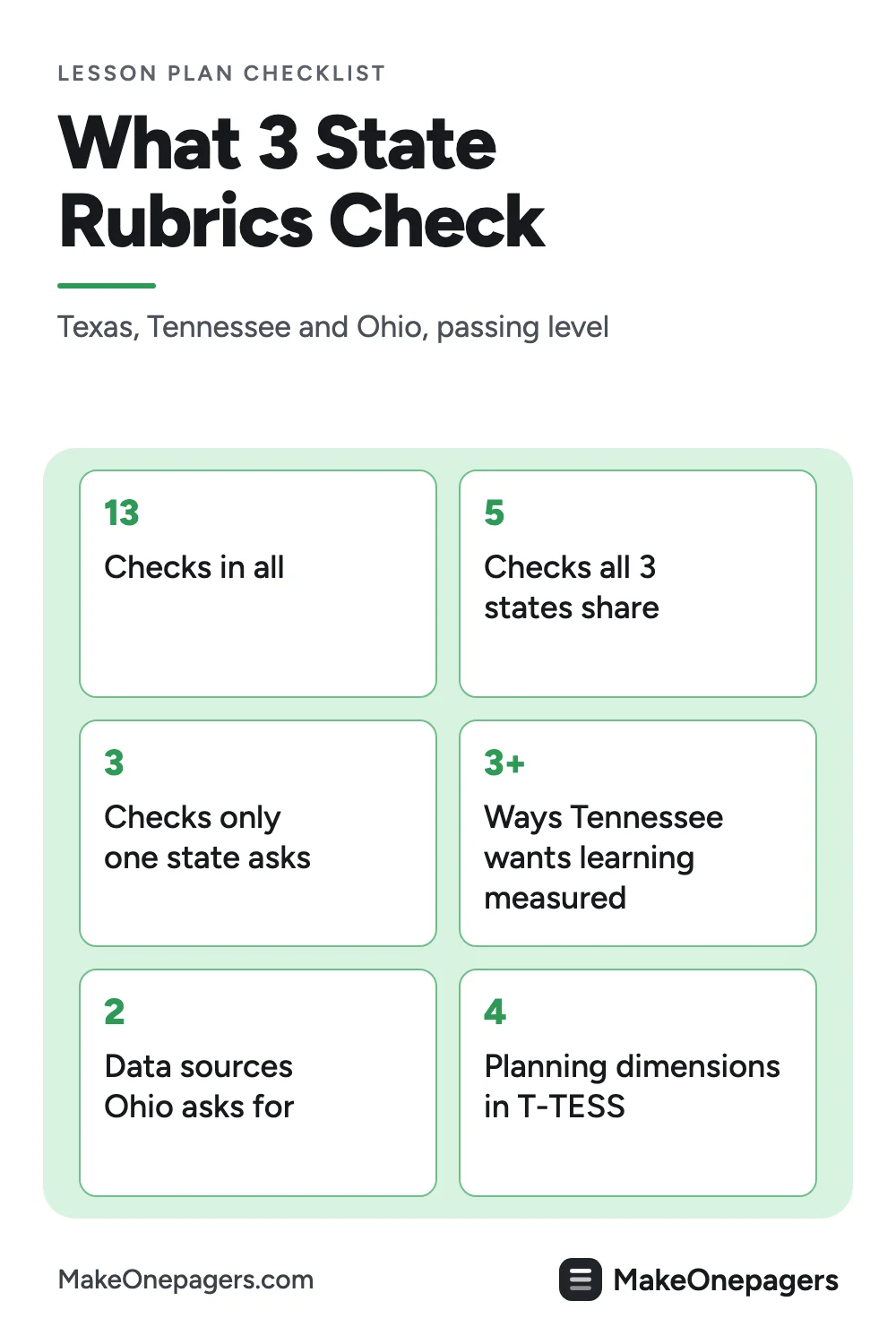
A lesson plan checklist built from the planning rows of the Texas, Tennessee and Ohio teacher rubrics. 13 checks, and the 5 that all three states score.

Before your principal scores a lesson plan, you can score it yourself, and the best lesson plan checklist uses the same questions. So we went to the source. We read the planning rows of three state teacher evaluation rubrics, Texas, Tennessee and Ohio, at the level that counts as passing. Their lines boil down to 13 checks you can run on any plan. All three states ask for 5 of them. Run those 5 first and you've covered what every rubric here scores. Start from a free one pager template.
One‑Pager examples
Real One-Pagers made with MakeOnepagers. Open any one to edit it as your own.
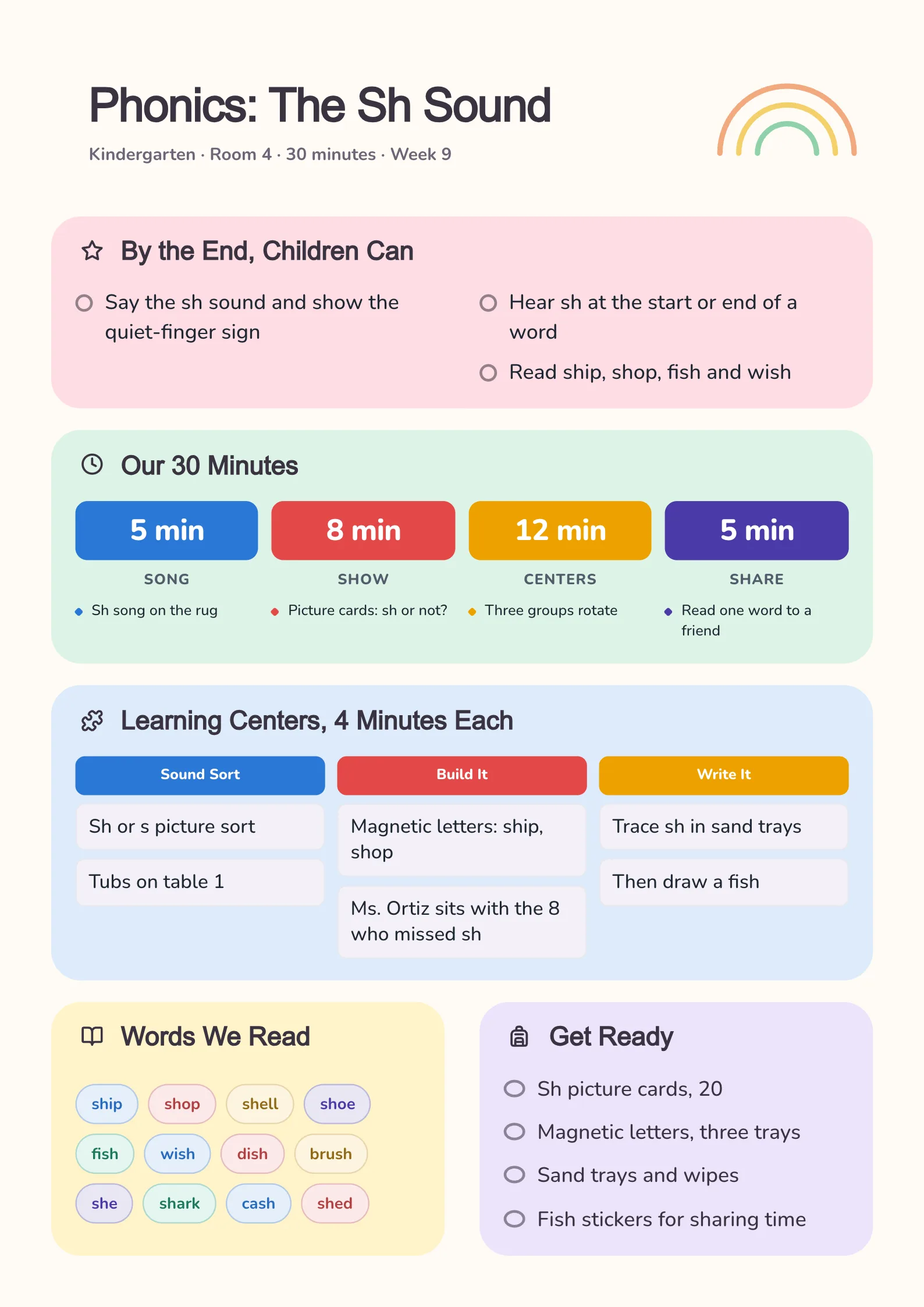 Lesson Plan: Kindergarten PhonicsEdit for free(opens in a new tab)
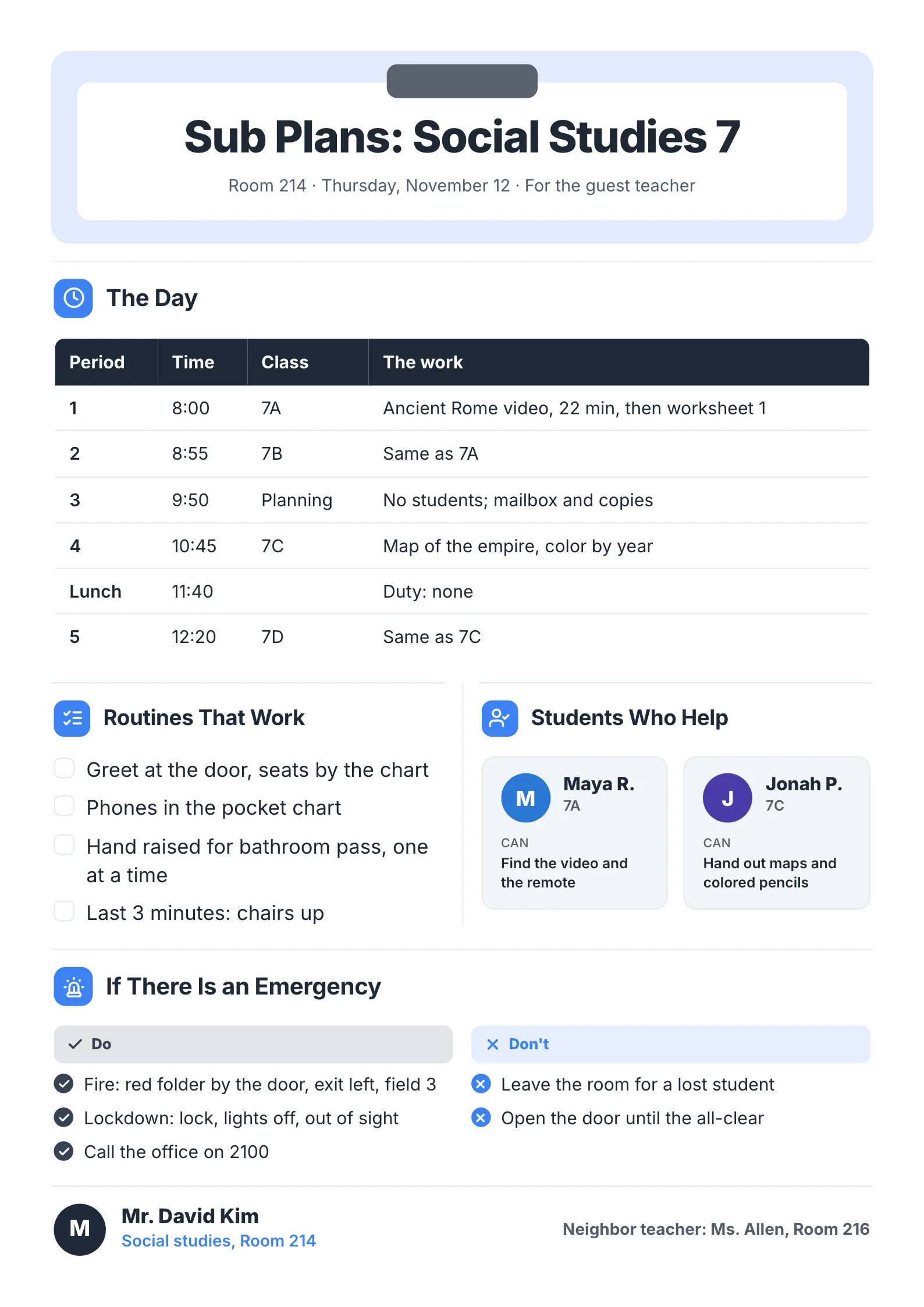 Lesson Plan: Substitute TeacherEdit for free(opens in a new tab)
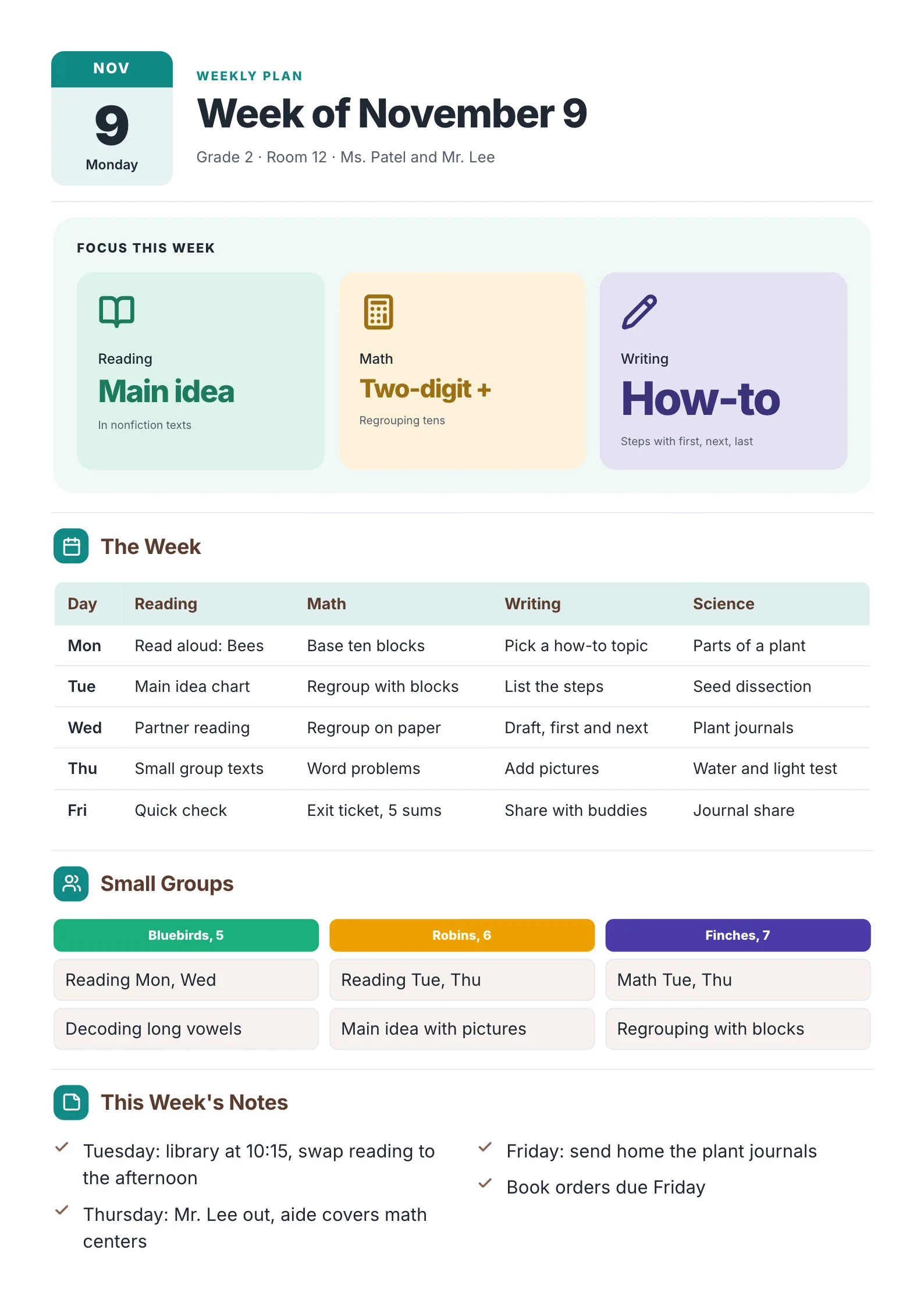 Lesson Plan: WeeklyEdit for free(opens in a new tab)
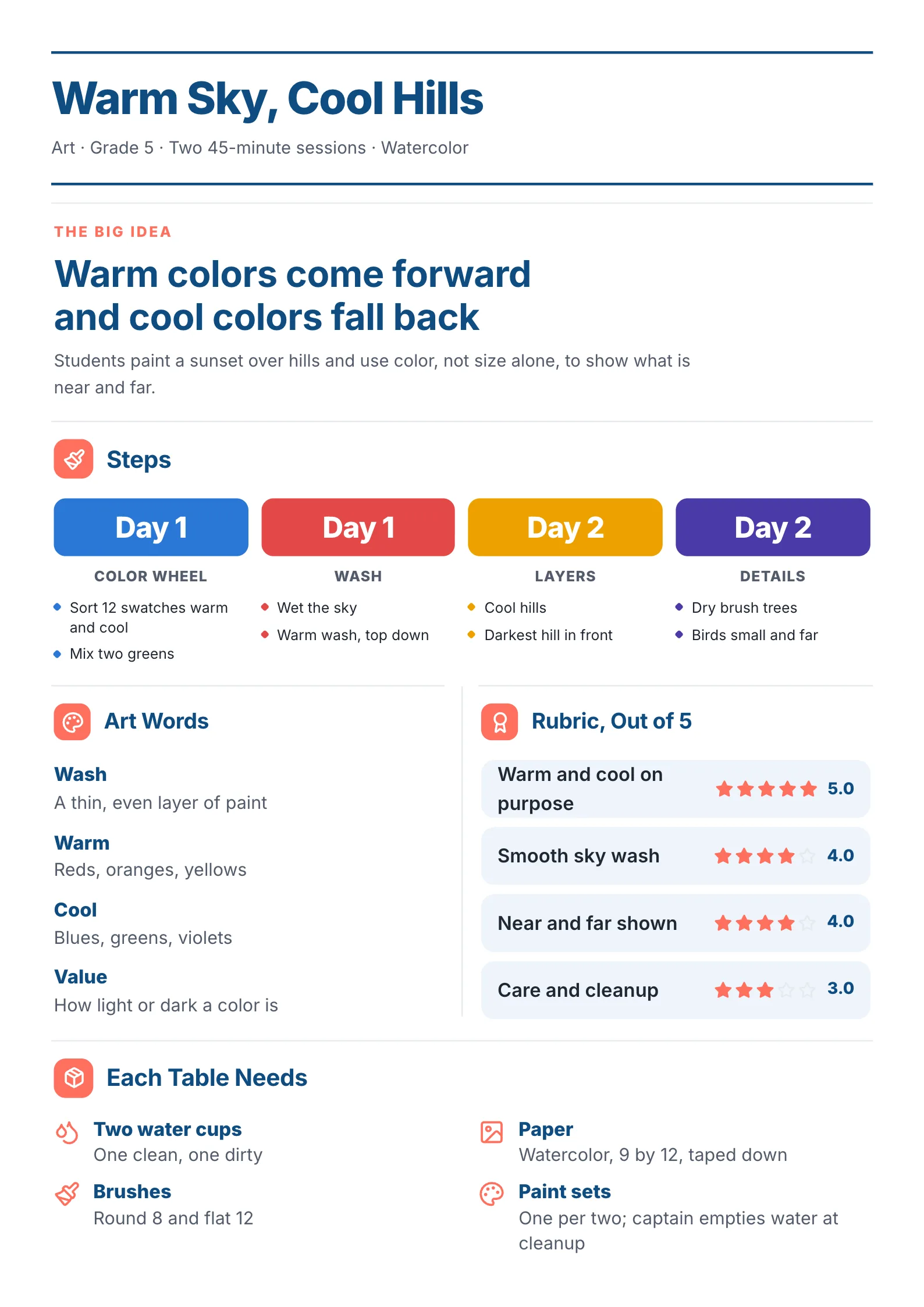 Lesson Plan: ArtEdit for free(opens in a new tab)
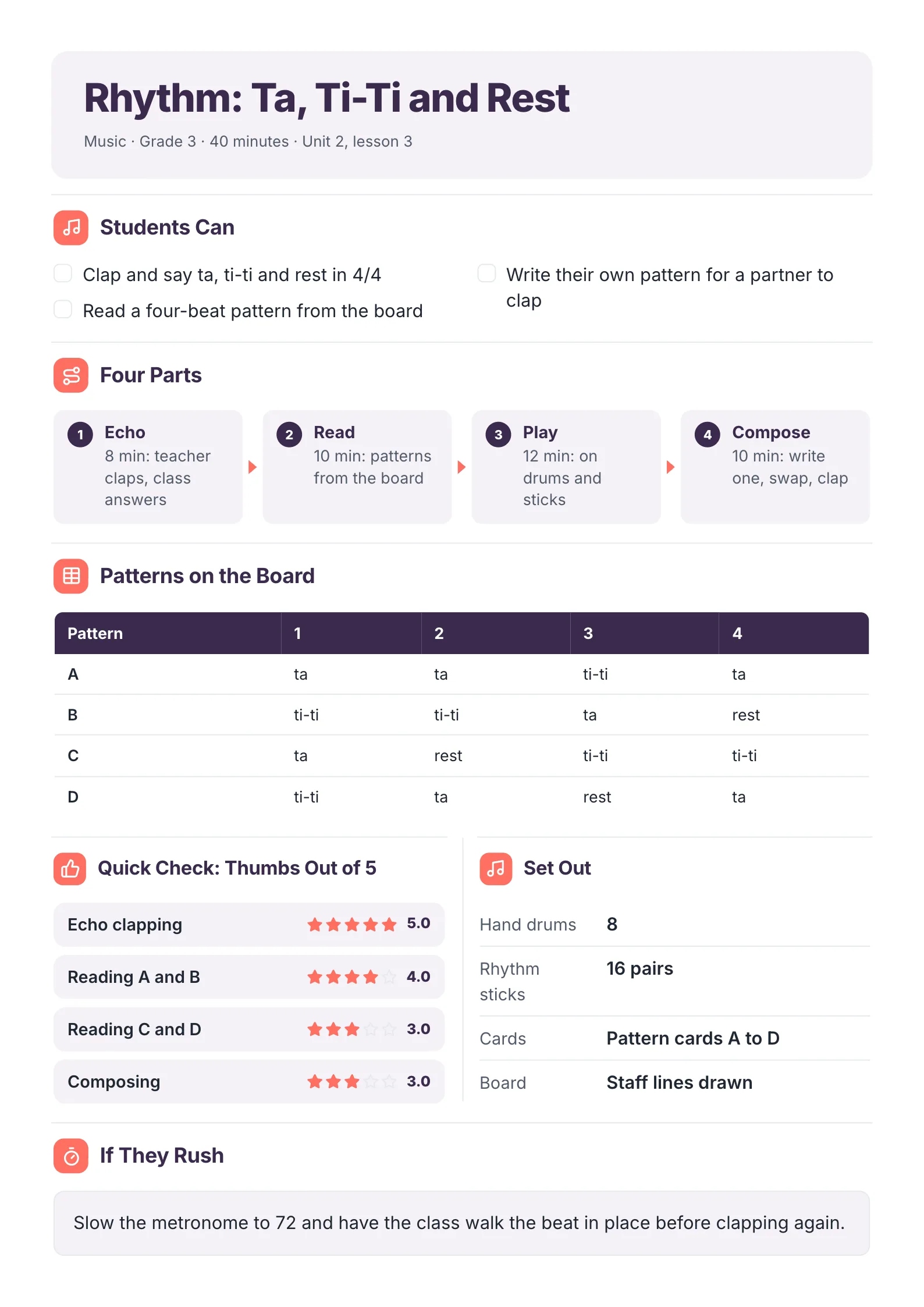 Lesson Plan: MusicEdit for free(opens in a new tab)
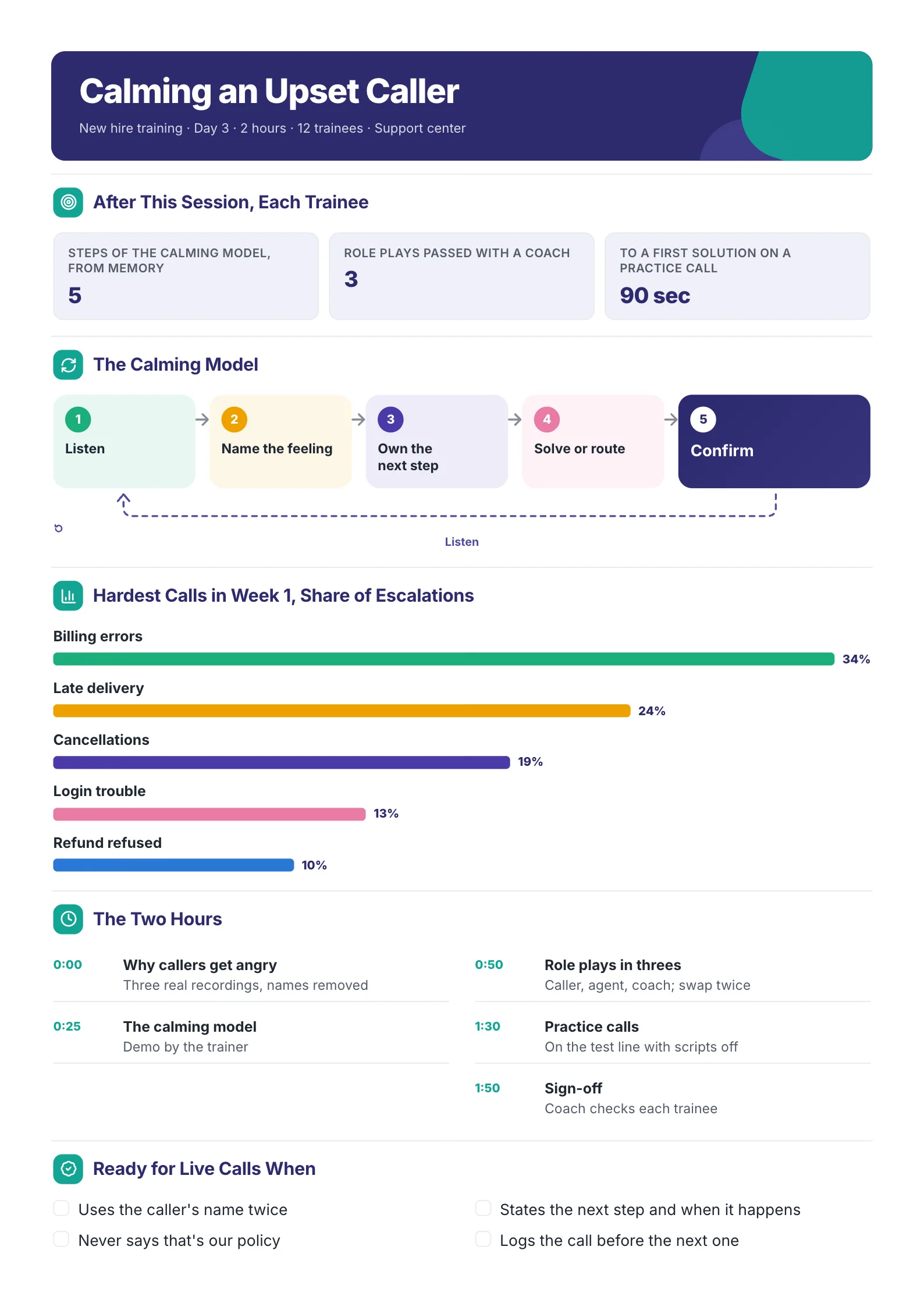 Lesson Plan: Employee TrainingEdit for free(opens in a new tab)
These rubrics judge teachers, so they read like legal text. Below, you'll find each check in plain words, the rubric line it comes from, and a sample One-Pager that passes it.
The three rubrics we read
Each state names its passing level differently. Texas calls it Proficient, Tennessee calls it At Expectations, and Ohio calls it Skilled. We used only that column.
| State | Rubric | Planning part | Passing level | Lines at that level |
|---|---|---|---|---|
| Texas | T-TESS, dated April 22, 2024 | 4 dimensions | Proficient | 13 bullets |
| Tennessee | TEAM General Educator, edited April 2022 | 3 indicators | At Expectations (3) | 12 bullets |
| Ohio | OTES 2.0, February 2026 | 4 components | Skilled | 4 descriptions |
Ohio's rubric lists "lesson plans" among its possible sources of evidence. Texas lists "Classroom Artifacts" and conversations with you. Either way, the written plan is part of what an evaluator looks at.
The 13 checks, and who asks for each
| # | Check | Texas | Tennessee | Ohio |
|---|---|---|---|---|
| 1 | The goal is tied to a state standard | Yes | Yes | Yes |
| 2 | Activities, materials and assessments match the goal | Yes | Yes | Yes |
| 3 | Each objective lines up with the lesson's goal | Yes | ||
| 4 | The lesson starts from what students already know | Yes | Yes | Yes |
| 5 | The plan shows where the lesson leads next | Yes | Yes | |
| 6 | The plan fits the students in your room | Yes | Yes | Yes |
| 7 | There's time for the work and the close | Yes | Yes | |
| 8 | Questions or tasks ask students to think | Yes | Yes | |
| 9 | Students explain their thinking in writing | Yes | ||
| 10 | Groups are planned from student needs | Yes | ||
| 11 | You've planned how to check learning | Yes | Yes | Yes |
| 12 | The plan uses student data | Yes | Yes | |
| 13 | Technology is used where it helps | Yes | Yes |
The 5 checks all three states share
Check 1: Tie the goal to a state standard
Texas wants "All goals aligned to state content standards." Tennessee uses almost the same words. Ohio wants your plan to align with "Ohio's Learning Standards," and its lowest rating describes a plan that "does not reference" them at all. So write the standard's code on the plan, near the goal, where nobody has to hunt for it.
Check 2: Make every activity and material serve that goal
Tennessee asks for "activities, materials, and assessments" that "are aligned to state standards" and "are sequenced from basic to complex." Texas wants them "aligned to instructional purposes." Ohio adds "available technology" to the same list. Read your activity list and ask why each step is there. A fun warm-up that teaches nothing on the goal is the first thing to cut.
Check 4: Start from what students already know
All three use the words prior knowledge or prior learning. Texas wants lessons "that connect to students' prior knowledge and experiences." Tennessee asks that activities "build on prior student knowledge." Ohio goes a step further and wants "strategies that communicate the connections to students." That means saying the link out loud, like "Yesterday we placed halves. Today we add quarters."
Check 6: Fit the plan to the students in front of you
Texas asks for activities "appropriate for diverse learners" and "Adjustments to address strengths and gaps" in what your students know. Tennessee wants the plan to suit "the age, knowledge, and interests of most learners" and to "accommodate individual student needs." Ohio lists what that can include, from "language proficiency" to "interests." On paper, that's a short note on who needs what, and how you'll give it.
Check 11: Plan how you'll check learning
Texas wants "Formal and informal assessments to monitor progress of all students." Tennessee's assessment plan must "have measurement criteria" and measure performance "in more than two ways," such as a project, an essay or a short answer. Ohio wants you to monitor "student progress toward goal(s)." One kind of quiz won't meet Tennessee's bar. Mix a quick check with something written or made.
The 8 checks one or two states add
Read these even if you teach in another state. They're the details that move your plan from passing to strong.
- Point to what comes next (Texas and Ohio). Texas wants activities that "fit into the broader unit and course objectives." Ohio asks for connections to "future learning."
- Leave time for the close (Texas and Tennessee). Both ask you to "provide appropriate time" for lesson closure. Tennessee adds time for student work.
- Ask for thinking (Texas and Tennessee). Texas wants "Questions that encourage all students to engage in complex, higher-order thinking." Tennessee wants students to "interpret information rather than reproduce it."
- Plan from data (Texas and Ohio). Ohio's Skilled teacher analyzes "at least two sources of high-quality student data." Texas wants data "connected to specific instructional strategies."
- Use technology where it helps (Texas and Ohio). Texas says "when applicable," so not every lesson needs a screen.
- Line up each objective with the goal (Texas). Texas asks for "All objectives aligned to the lesson's goal."
- Have students write (Tennessee). Students should "draw conclusions and support them through writing."
- Plan your groups (Texas). Texas wants "Instructional groups based on the needs of all students," with each student knowing their role.
One note for Texas teachers. The Texas Education Agency's June 4, 2026 letter says a new version, T-TESS 2, is being piloted in 15 school systems in 2026 to 2027, with 2027 to 2028 the recommended year to adopt it. Check which version your district uses.
Five sample plans, checked against the list
Each of these samples from MakeOnepagers fits a whole lesson on one sheet. Each one shows a few of the checks clearly.
A biology lab with its standard at the top
 Edit this template
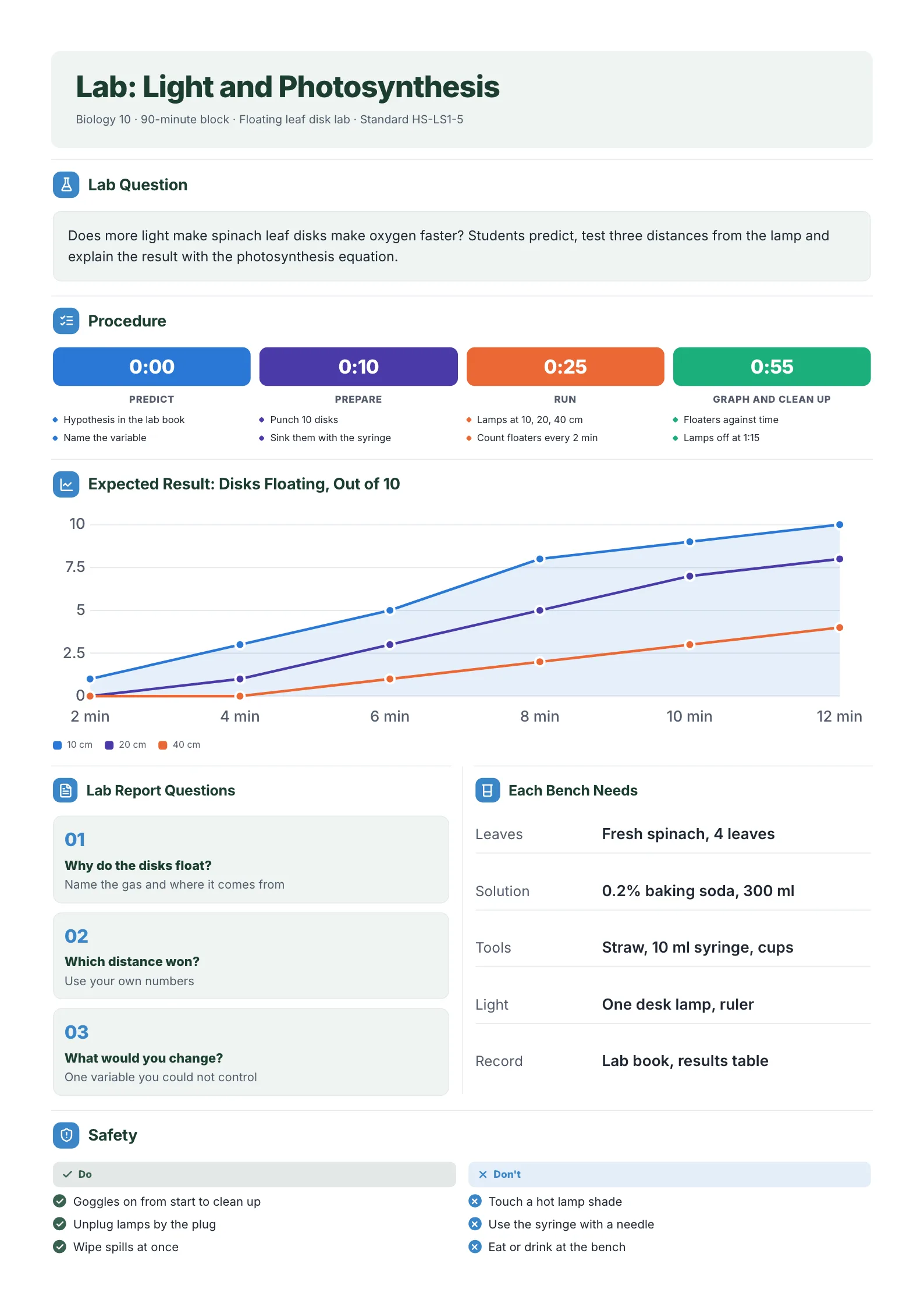
This biology lab lesson plan prints Standard HS-LS1-5 in its header, which covers check 1 at a glance. The procedure is timed from 0:00 to 0:55, with "Lamps off at 1:15," so the close has its own time (check 7). Its lab report questions tell students to "Use your own numbers," which is the written thinking Tennessee asks for.
A math lesson built on last lesson's results
 Edit this template
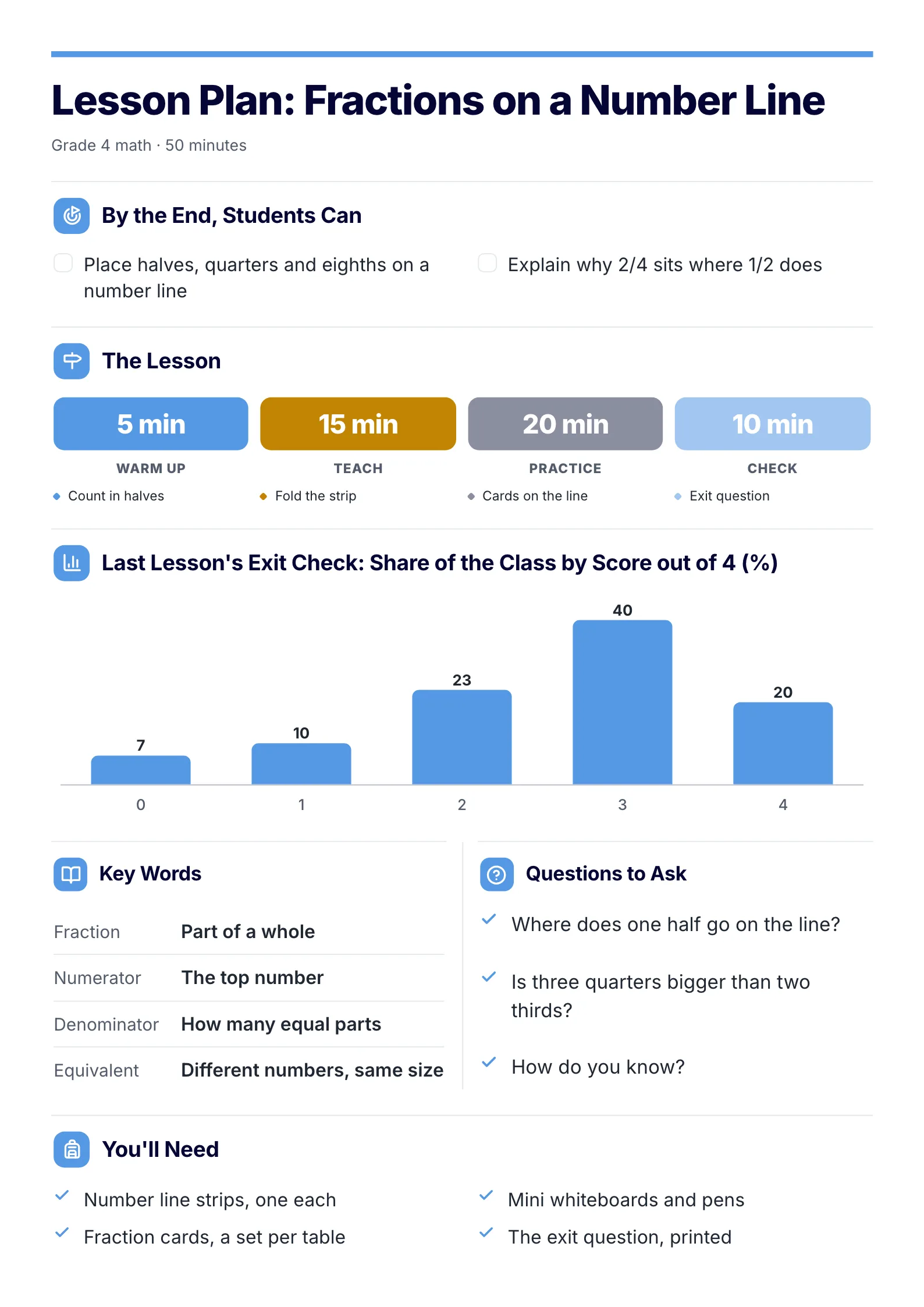
This lesson plan for grade 4 fractions charts "Last Lesson's Exit Check" by score out of 4, so the plan starts from data (check 12). It ends with a 10-minute check and an exit question (check 11). Its questions include "How do you know?" That's the kind of question Texas means by higher-order thinking.
An ESL lesson with support by level
 Edit this template
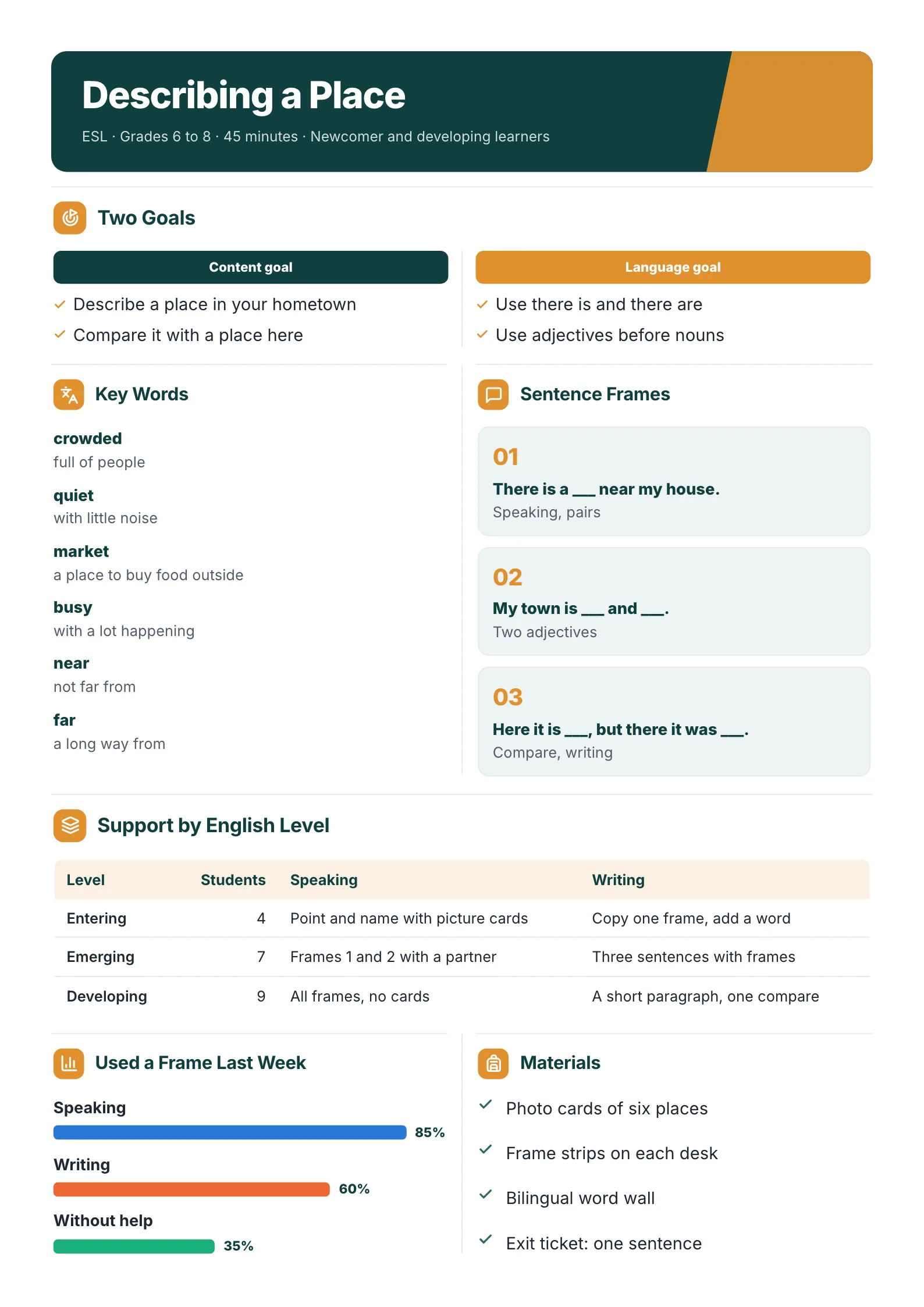
This ESL lesson plan has a table titled "Support by English Level." Its 4 entering students use picture cards to point and name, while its 9 developing students write a short paragraph. That one table answers check 6 and check 10 together. Language proficiency is on Ohio's list, too.
A college lecture that links last week and next week
 Edit this template
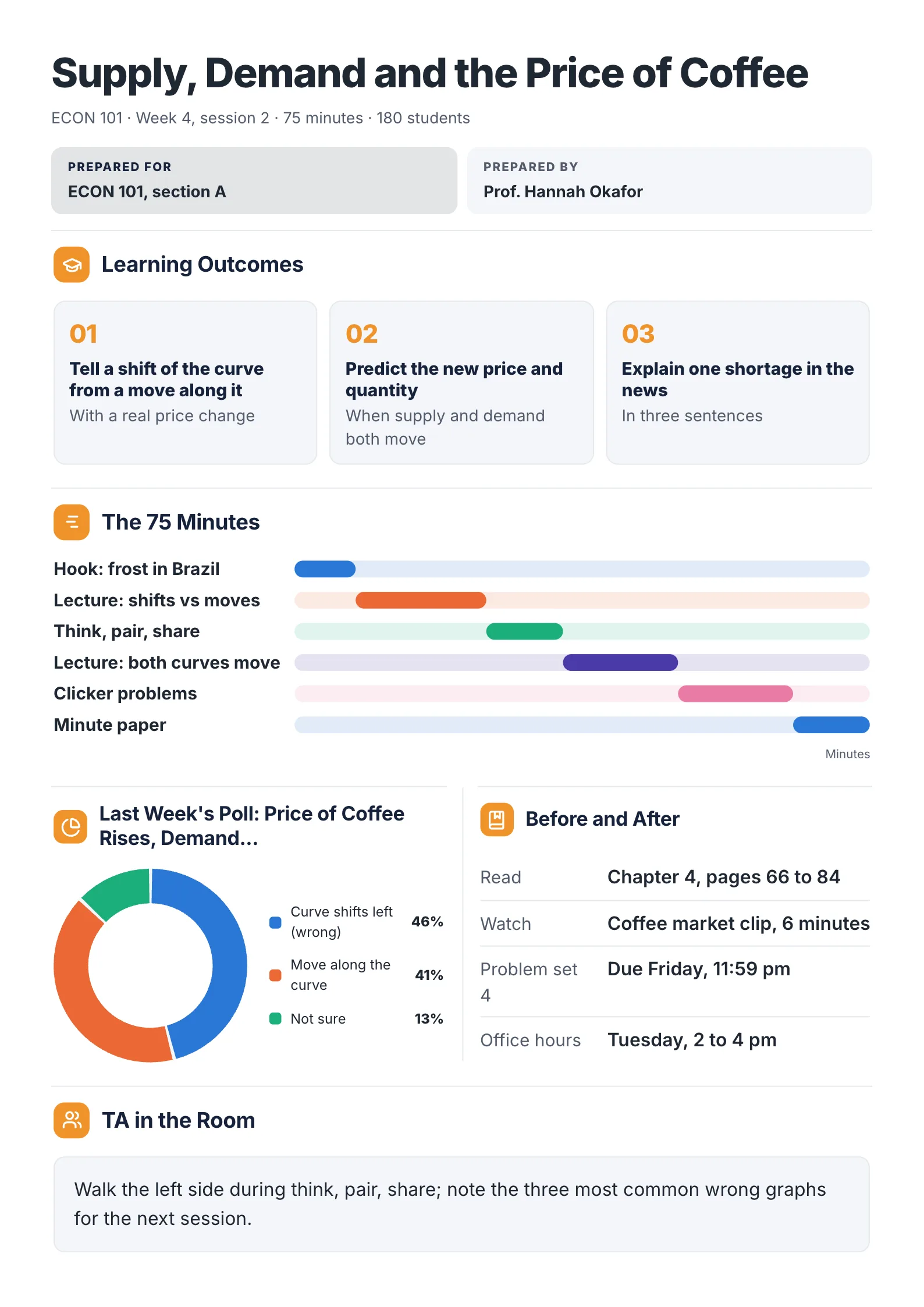
This college lecture lesson plan charts last week's poll, with "Curve shifts left (wrong)" as one answer, so the lecture opens on the mistake the class made (check 4). Its "Before and After" box lists Chapter 4, pages 66 to 84, and Problem set 4, due Friday. That covers where the lesson leads (check 5).
A PE lesson with stations and a cool-down
 Edit this template
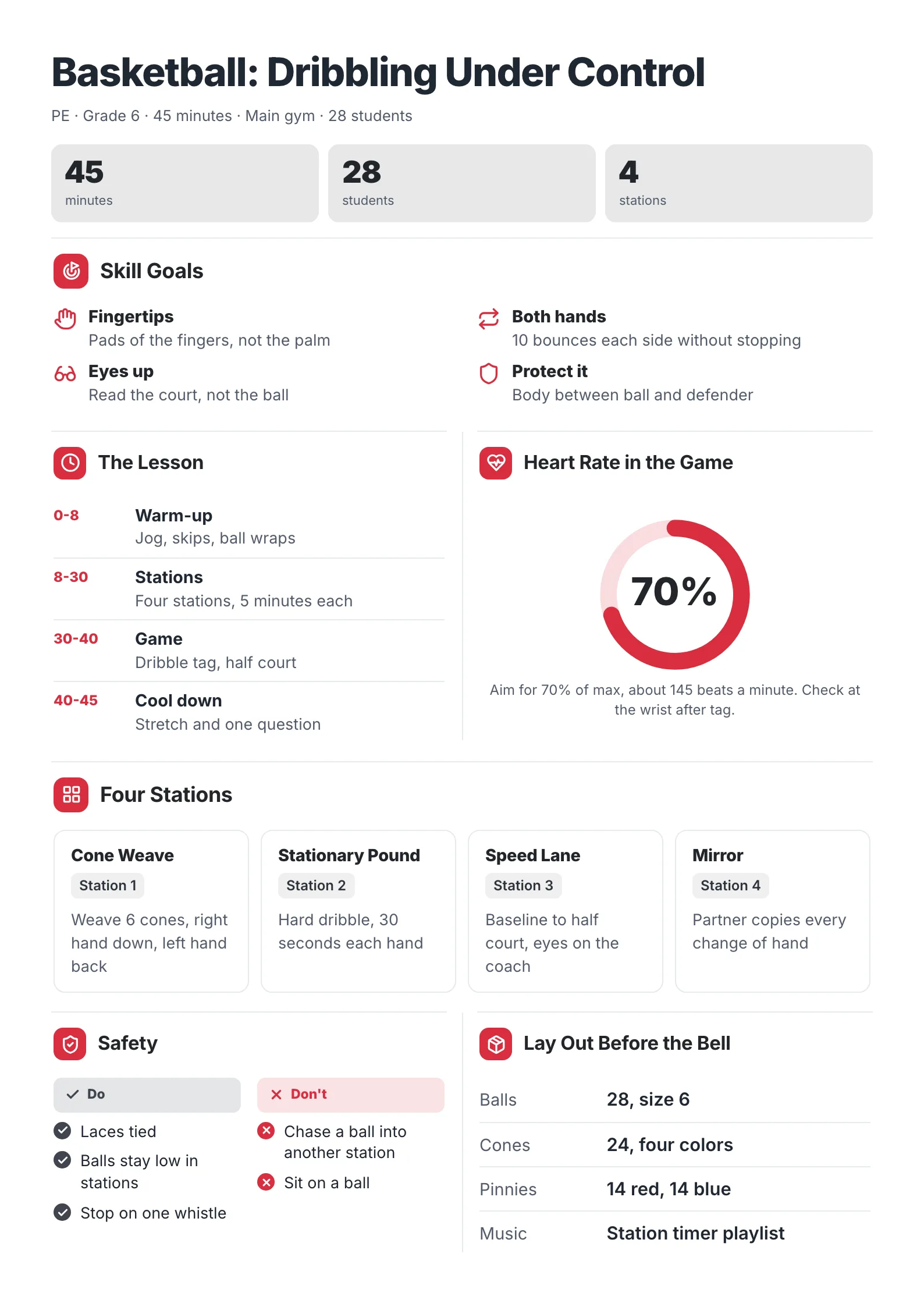
This PE lesson plan lists four skill goals at the top, then runs 28 students through four dribbling stations, 5 minutes each (check 2). Minutes 40 to 45 are a cool-down with "Stretch and one question," which gives the close its own slot (check 7).
How to use the checklist in 10 minutes
- Copy the 13 checks onto a sticky note or the margin of your plan.
- Tick checks 1, 2, 4, 6 and 11 first. If one is missing, fix it before anything else.
- Find your own state's rubric and mark which of the other 8 it scores.
- Read your plan as your evaluator would, with the rubric's own words beside it.
- Keep the plan to a single sheet, so each check is easy to spot.
Our lesson plan format post compares the parts six teacher programs put on their forms. To see how NASA's education team lays out its plans, read how to write a lesson plan.
Build a plan that passes all 13
Open a MakeOnepagers lesson plan in your subject and add your standard, your minutes and your check of learning. Have rough notes or a unit outline? Paste them into the free AI One-Pager generator, then run these 13 checks on what it lays out for you.
Frequently asked questions
What does an evaluator look for in a lesson plan?
In these three rubrics, the shared items are a goal tied to a standard, activities that serve it, a link to prior learning, a fit for your students and a planned check of learning. Texas and Ohio also look at student data.
Do I need to write the standard on my lesson plan?
Every rubric here scores alignment to state standards. Ohio's lowest rating describes a plan that doesn't reference its standards, so naming the standard on the plan is the simplest proof.
How many ways should a lesson check learning?
Tennessee's At Expectations level asks assessment plans to measure performance in more than two ways, such as a project, an essay or a short answer. A single quiz type won't meet it.
What is T-TESS 2?
It's the updated Texas teacher rubric. TEA's June 2026 letter says it keeps four domains with 12 dimensions, is piloted in 15 school systems in 2026 to 2027, and is recommended for 2027 to 2028.
Can I use this checklist if my state uses a different rubric?
Yes. Start with the 5 checks all three states share, then open your own state's rubric and add any row it scores at the passing level.




