Incident Report vs Accident Report: Why OSHA Dropped a Word
Incident report vs accident report: why OSHA says incident, the 18 fields on its Form 301, what a Texas crash report holds, and 5 sample incident reports.

The incident report vs accident report difference is mostly about scope. An accident report records an event that hurt someone or damaged something. An incident report records that kind of event too, and also the close calls where nobody got hurt. So every accident is an incident, but plenty of incidents are never accidents. Start from a free one pager template.
One‑Pager examples
Real One-Pagers made with MakeOnepagers. Open any one to edit it as your own.
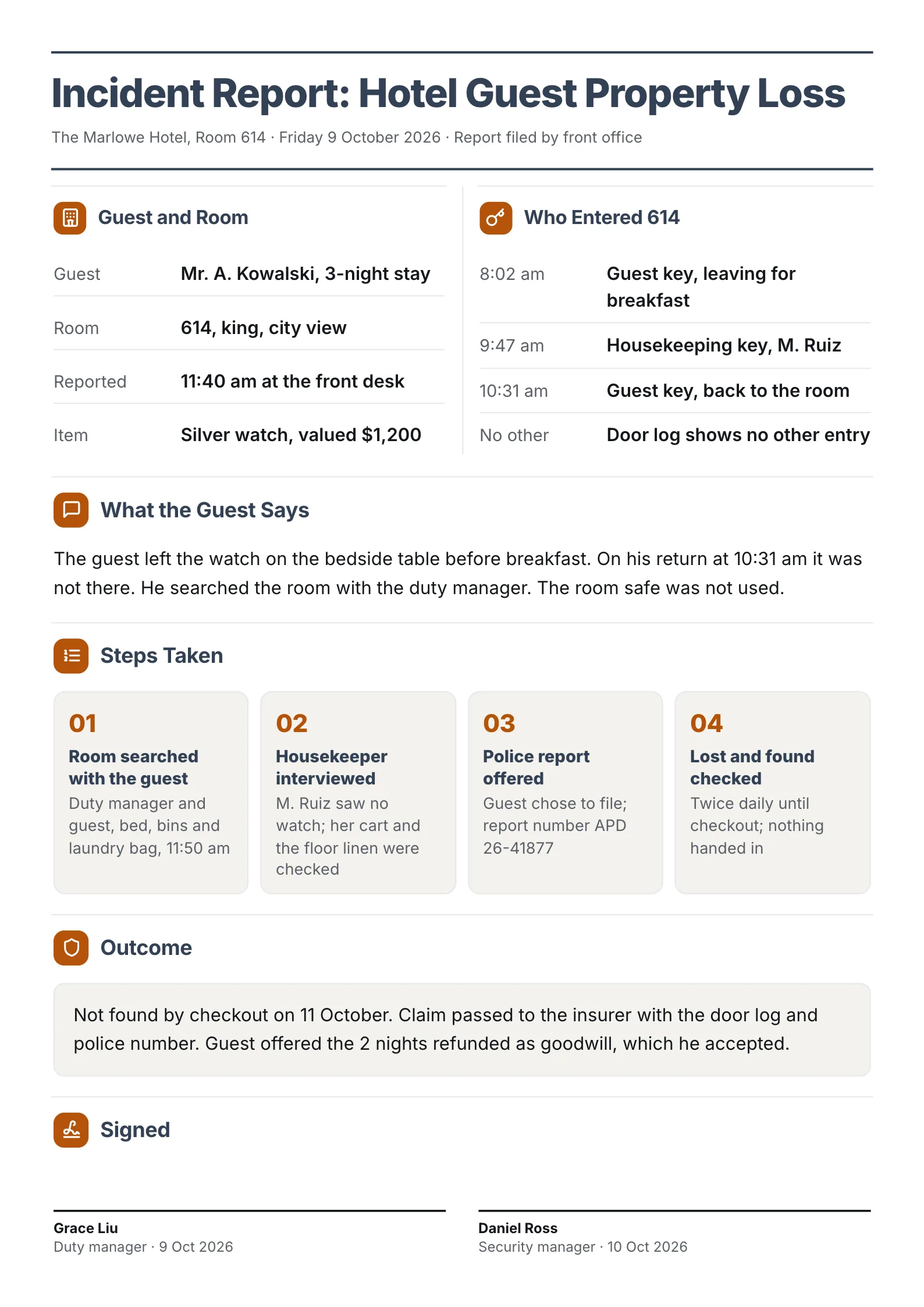 Incident Report: Hotel Guest Property LossEdit for free(opens in a new tab)
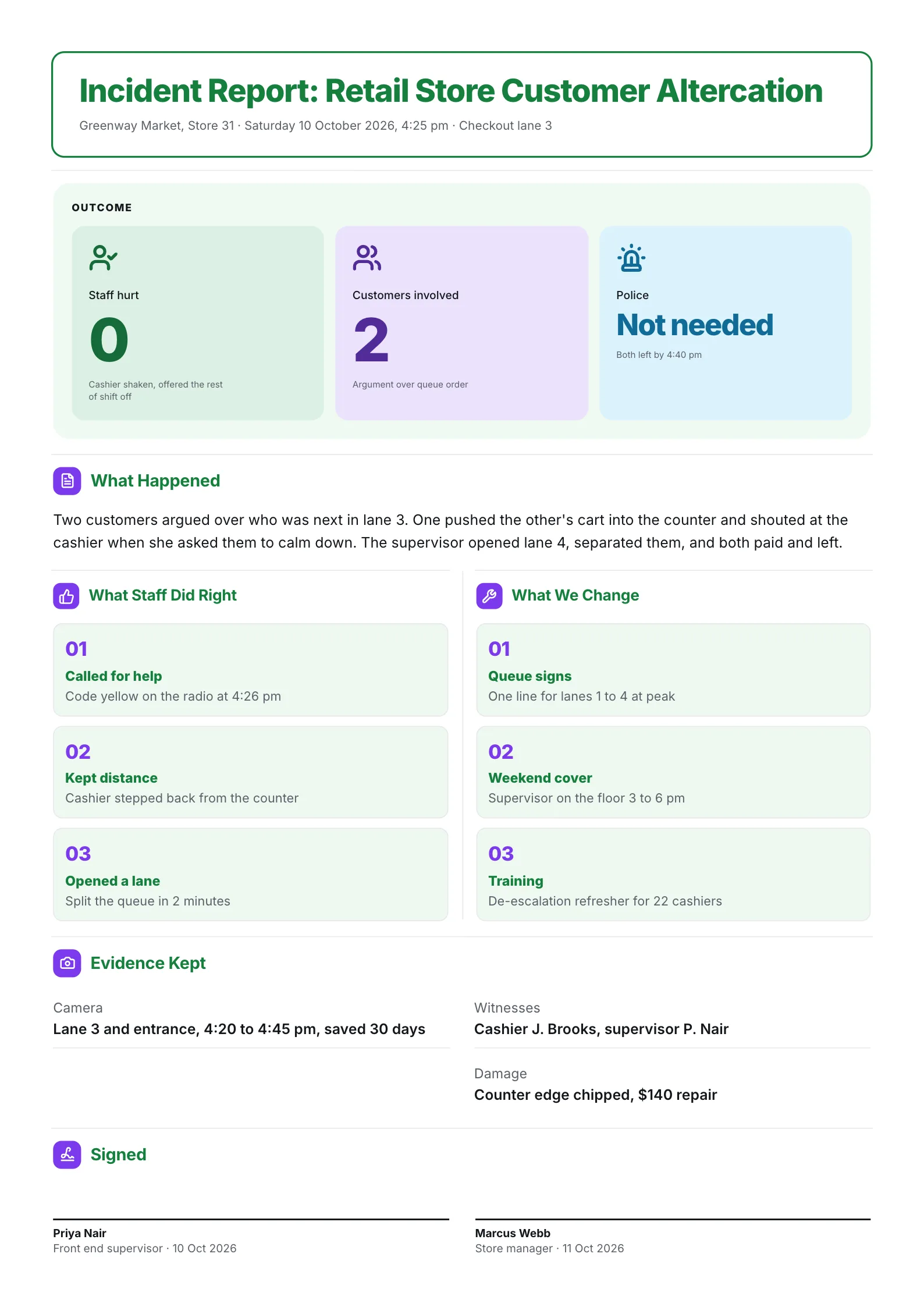 Incident Report: Retail Store Customer AltercationEdit for free(opens in a new tab)
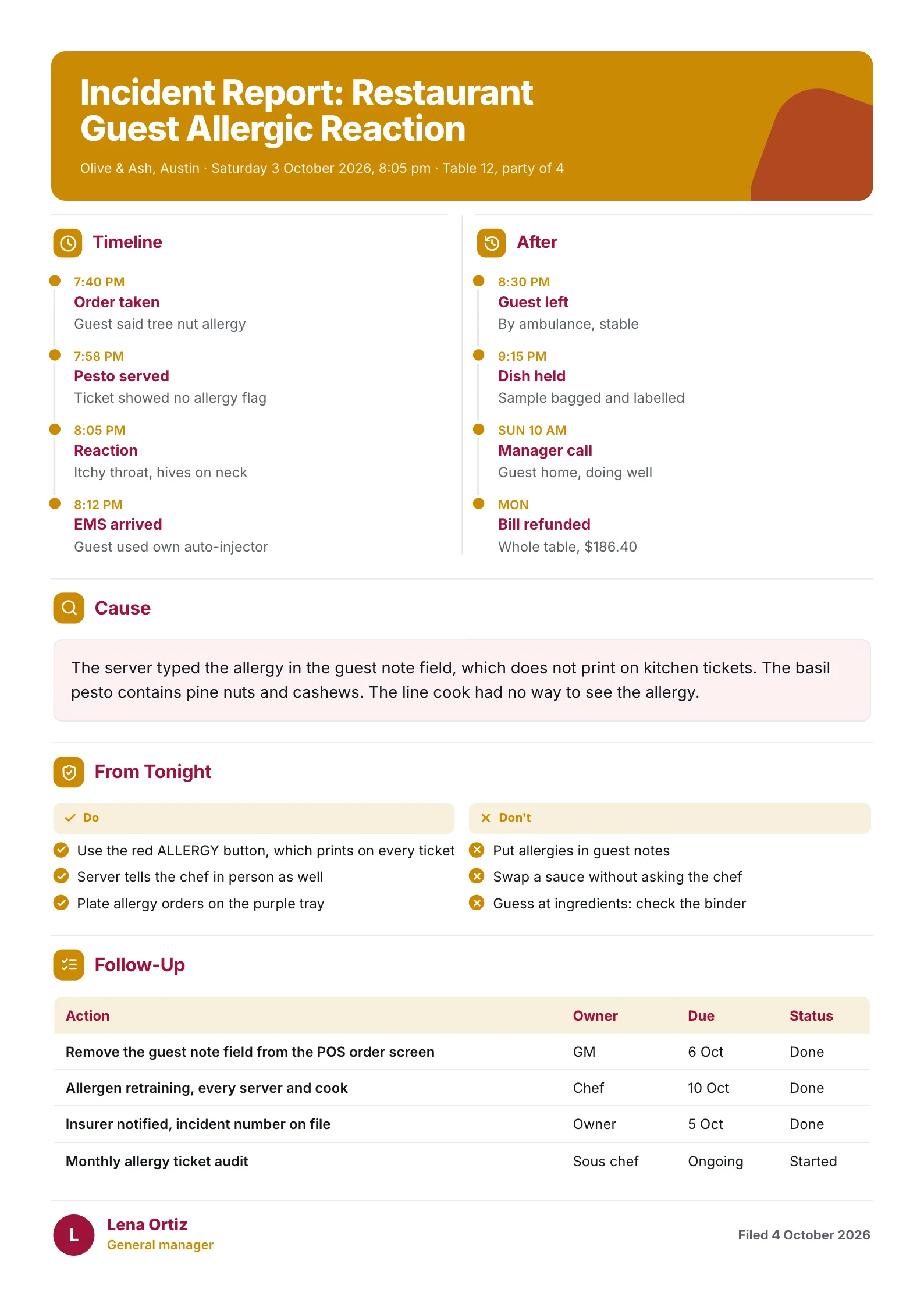 Incident Report: Restaurant Guest Allergic ReactionEdit for free(opens in a new tab)
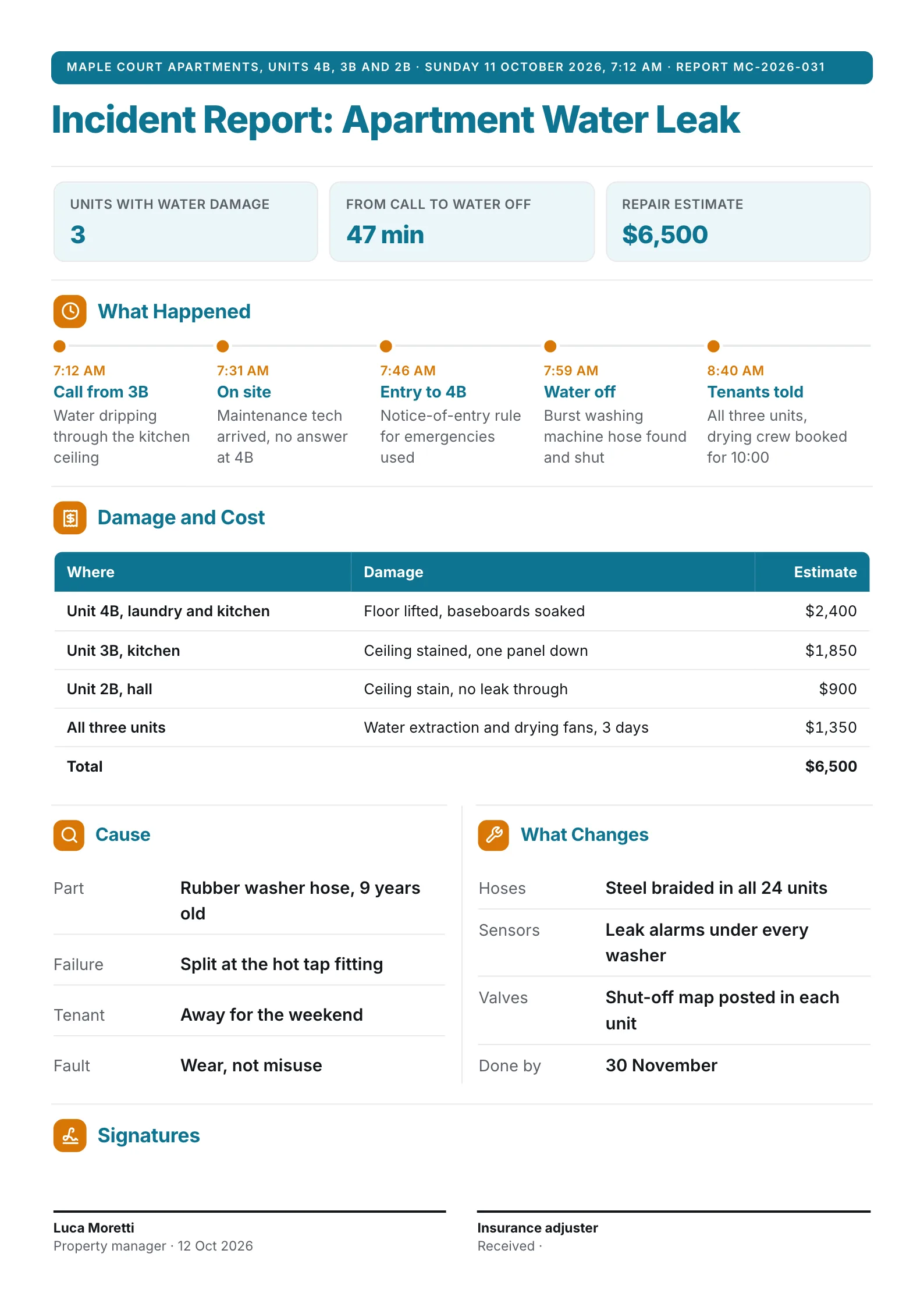 Incident Report: Apartment Building Water LeakEdit for free(opens in a new tab)
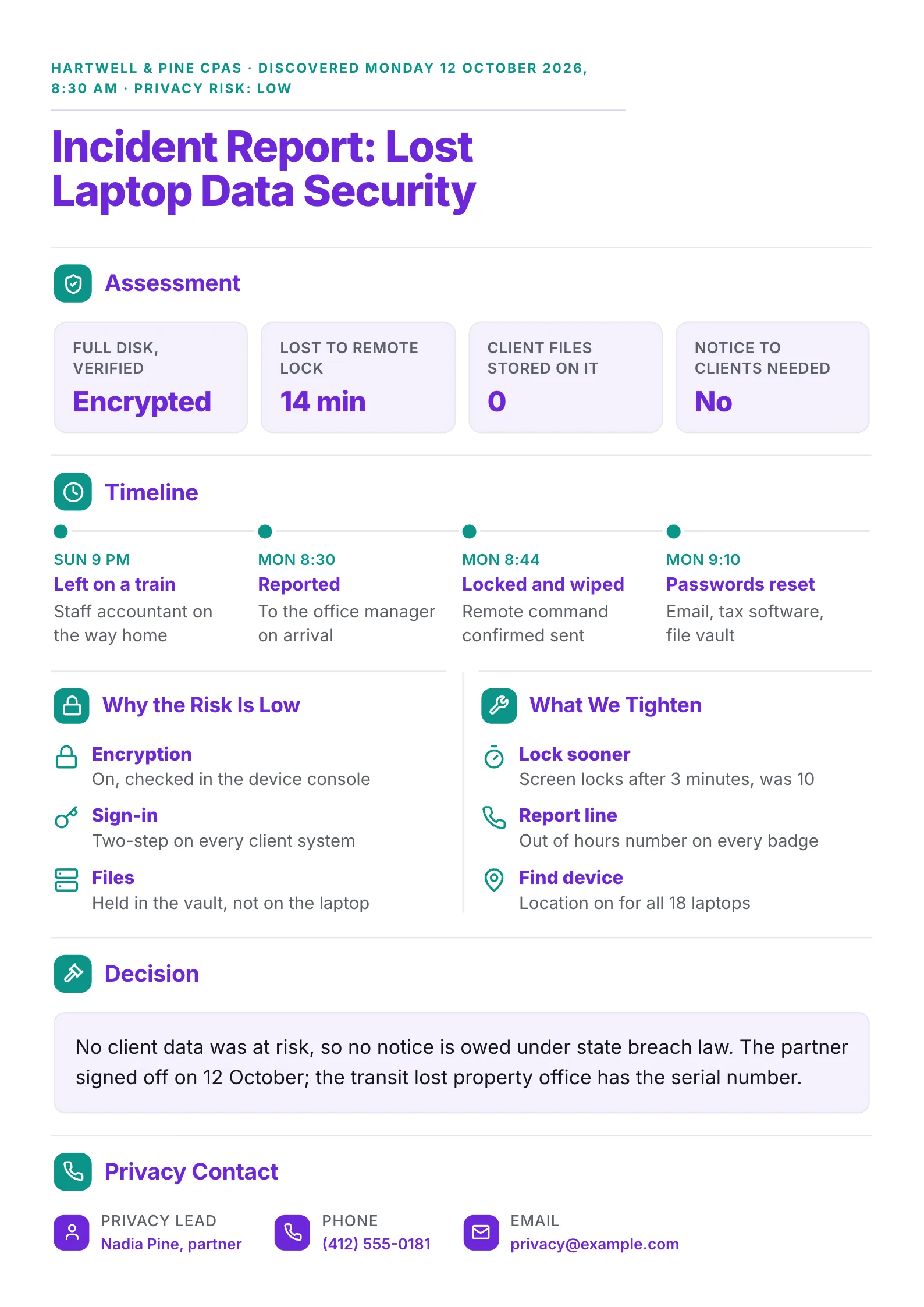 Incident Report: Lost Laptop Data SecurityEdit for free(opens in a new tab)
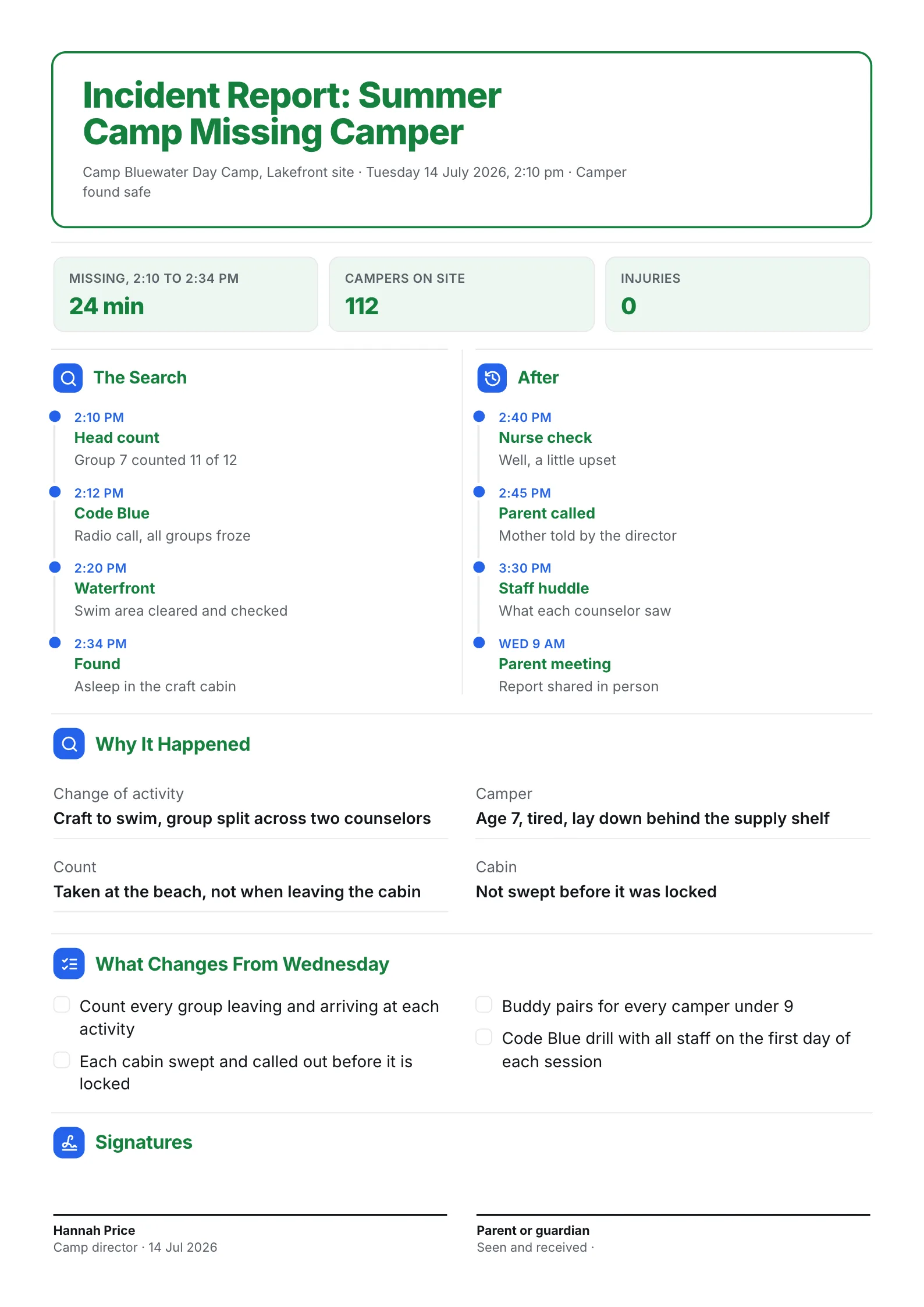 Incident Report: Summer Camp Missing CamperEdit for free(opens in a new tab)
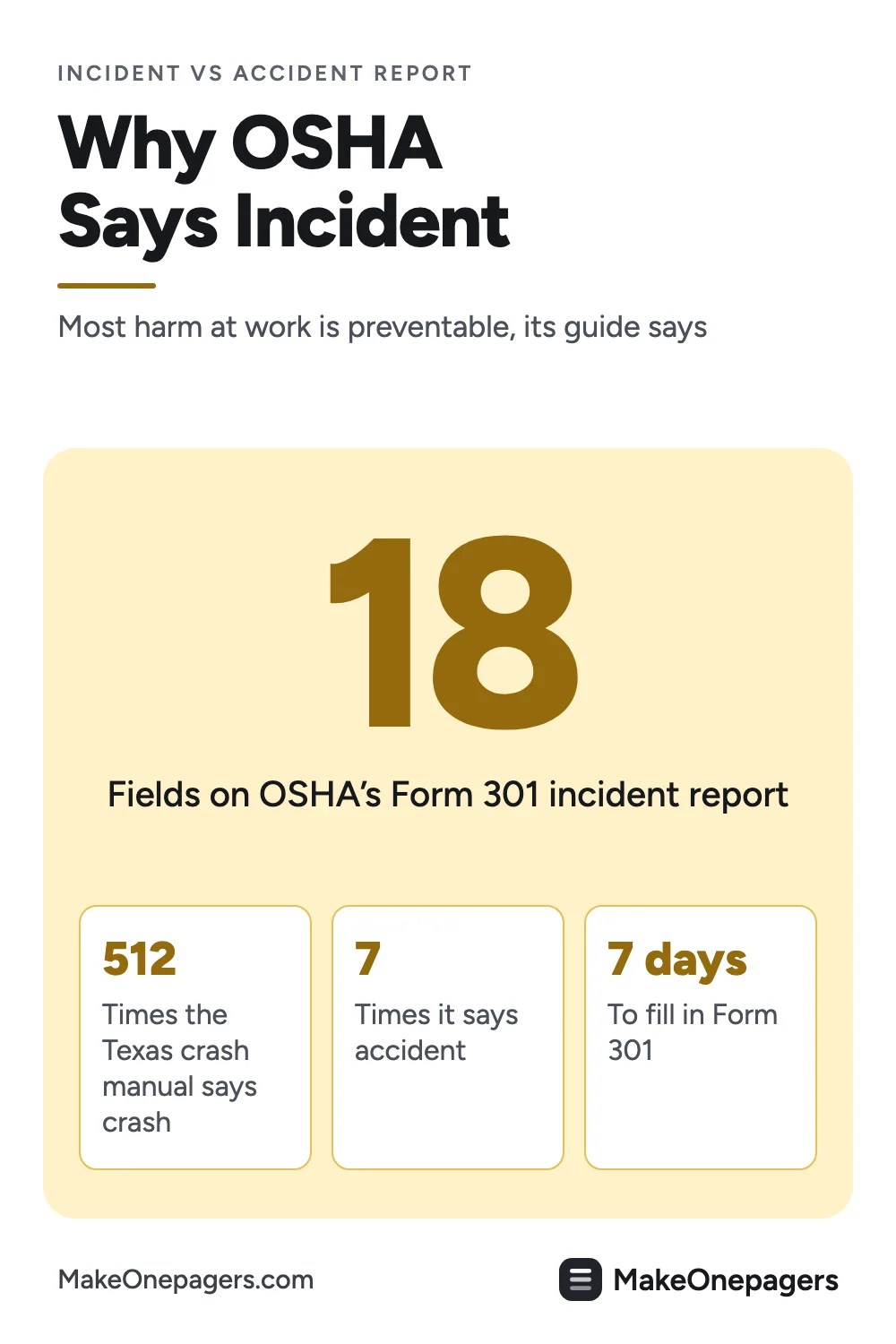
There's a second difference, and it matters more for your report. Both agencies we read for this post have moved away from the word "accident" on purpose. The OSHA guide to incident investigations explains why, and once you read it, you'll see why your form should say incident too.
| Incident report | Accident report | |
|---|---|---|
| What it covers | Any event that caused harm, or could have | An event that caused injury, illness or damage |
| Near misses | Yes | No |
| Who usually writes it | You, your manager or your safety lead | Often someone outside, like a police officer or an insurer |
| What it's for | Finding the cause and fixing it | Recording what happened, often for a claim |
| The word agencies use now | Incident (OSHA) | Crash, for vehicles (Texas DOT) |
Why OSHA says incident
OSHA's guide is titled "Incident [Accident] Investigations: A Guide for Employers," with the old word kept in brackets. After the title page, the bracket disappears. A short section called "The Language of Incident Investigations" gives the reason. The guide uses "the term 'incident', not 'accident'" because accident has come to mean a random event that "could not have been prevented." OSHA's view is the opposite. It calls most harmful incidents at work "wholly preventable."
The guide then defines the words you'll want on your own form.
- Incident: a work-related event in which an injury, illness or death "occurred, or could have occurred."
- Close call: an incident that could have caused serious harm but didn't, "also called a 'near miss.'"
- Root causes: the reasons an unsafe condition existed or a rule wasn't followed.
The guide is clear on scope too. It says every incident, whatever its size, needs "to be investigated." It asks you to follow four steps in order. Preserve and document the scene, collect information, find the root causes, and put the fixes in place. Its sample form, in Appendix A, has five sections that follow the same path, from who was involved to the corrective actions taken.
The 18 fields on OSHA Form 301
When a work injury or illness is serious enough to record, OSHA asks for a Form 301, titled "Injury and Illness Incident Report." Notice the title again. We counted 18 numbered fields in three groups:
| Group | Fields | What they ask |
|---|---|---|
| The employee | 1 to 5 | Name, address, date of birth, date hired, sex |
| The health care provider | 6 to 9 | Who treated them, where, an emergency room visit, an overnight stay |
| The case | 10 to 18 | Case number, date, the time work began, the time of the event, then four questions about what happened, and a date of death if there was one |
Fields 14 to 17 are the heart of any good report, and you can borrow them for yours.
- What was the employee doing just before the incident?
- What happened?
- What was the injury or illness?
- What object or substance directly harmed the employee?
The form's own example for field 15 shows you the level of detail it wants: "When ladder slipped on wet floor, worker fell 20 feet." It says to fill the form in "within 7 calendar days" and keep it for 5 years. OSHA estimates it takes 22 minutes.
What a real accident report looks like
When people say "accident report," they often mean the report police write after a traffic crash. Texas publishes the officers' manual for its crash report, the CR-100 instructions for Form CR-3. It runs 177 pages.
A few things stand out for you as a reader.
- Someone else writes it. The forms are "for use by Texas law enforcement agencies only," and the reports aren't open to the public online.
- It has a deadline. For a crash with an injury or death, the officer must send it in "not later than the 10th day after the date of the crash."
- It's strict. The form has 11 sections, from classification identifiers and the crash location to the narrative, the diagram and the investigator's details. We counted 38 mandatory fields, and a report with one left blank "will be returned."
- It avoids the word too. The manual's glossary defines a crash as "an identified event that produces injury, death, or damage." We counted "crash" 512 times in the manual and "accident" only 7.
Picture your delivery van backing into a parked car. Two reports may exist. The police report, if officers come, belongs to them. Your incident report belongs to you, and it's the one that asks why it happened and what you'll change.
Five incident reports, from a near miss to a crash
The places and people in these MakeOnepagers samples are invented. Each one shows you a different reason to write an incident report instead of waiting for an accident report.
A near miss with no harm
 Edit this template
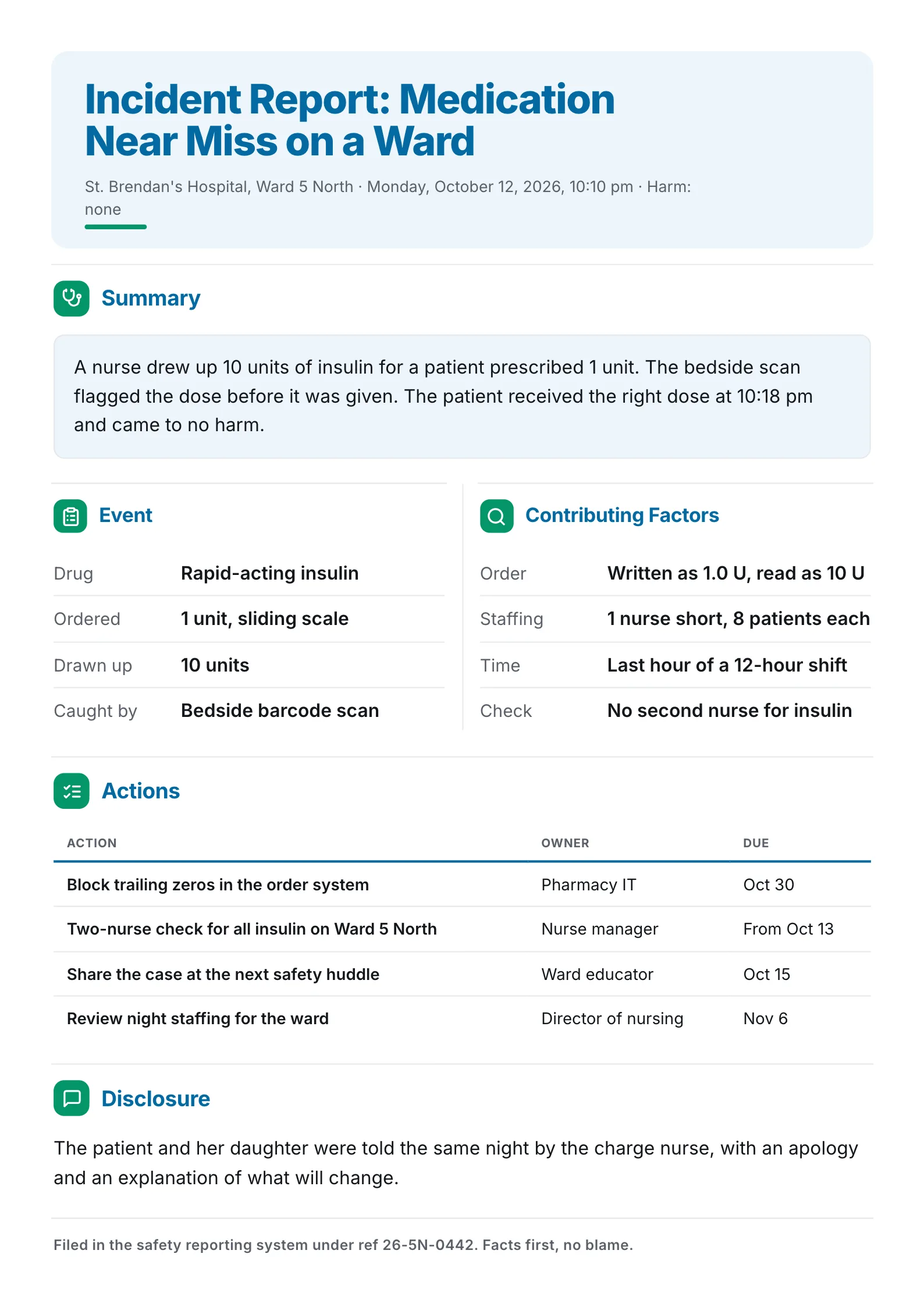
Nobody was hurt, so you'd never see an accident report for this one. This medication near miss report still finds four contributing factors. The order was written "1.0 U" and read as 10, the ward was 1 nurse short, it was the last hour of a 12-hour shift, and there was no second check for insulin. Each fix gets an owner and a date, like blocking trailing zeros in the order system by October 30. That's OSHA's close call rule at work.
A vehicle accident, written as an incident report
 Edit this template
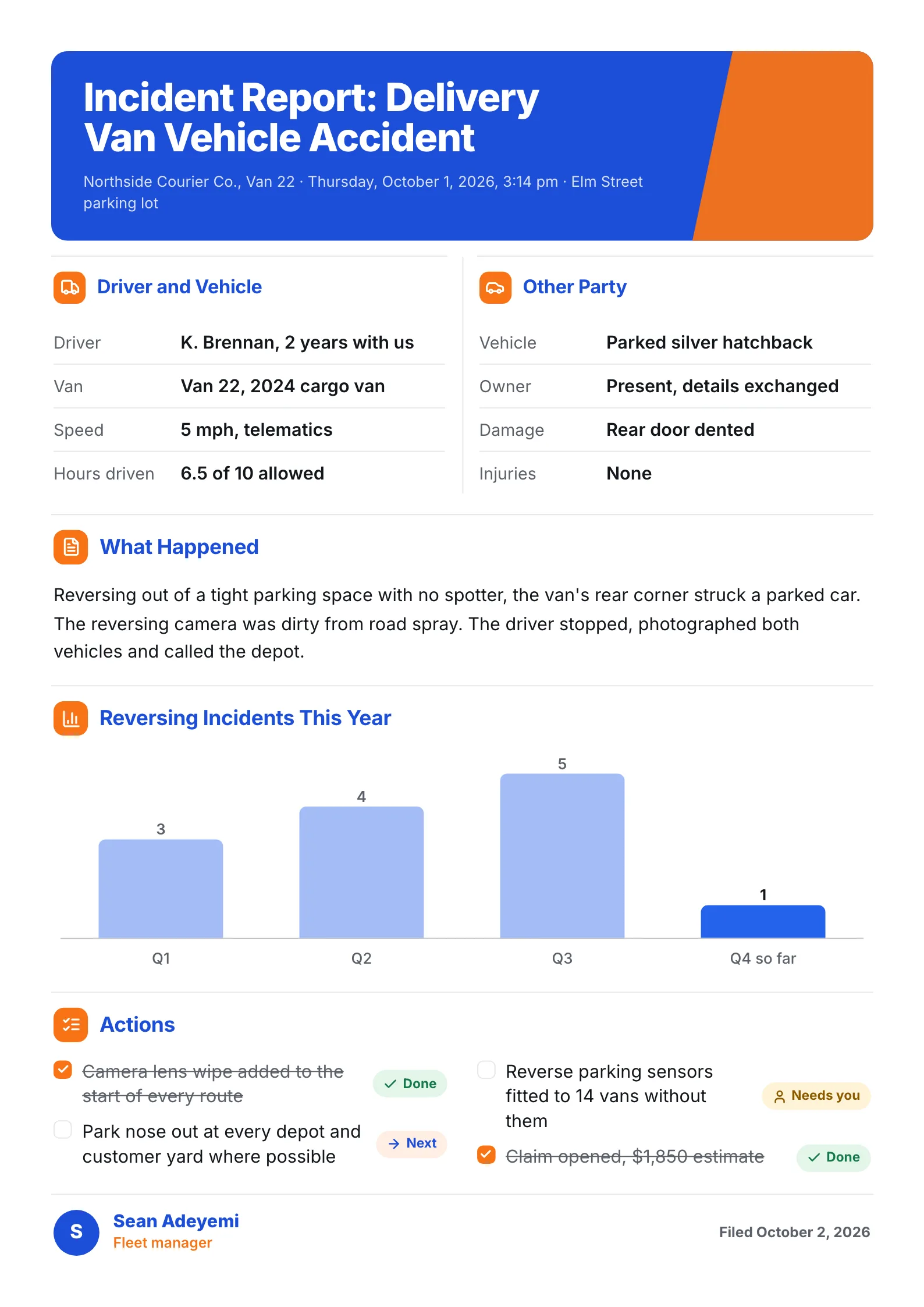
This delivery van accident report uses both words, and that's fine. The event is an accident, and the page is an incident report, because it goes past the dent. The reversing camera was dirty from road spray and there was no spotter. So the fixes are a lens wipe at the start of every route and parking sensors on the 14 vans without them. A chart of reversing incidents by quarter shows you whether this is a pattern.
A crash where police wrote their own report
 Edit this template
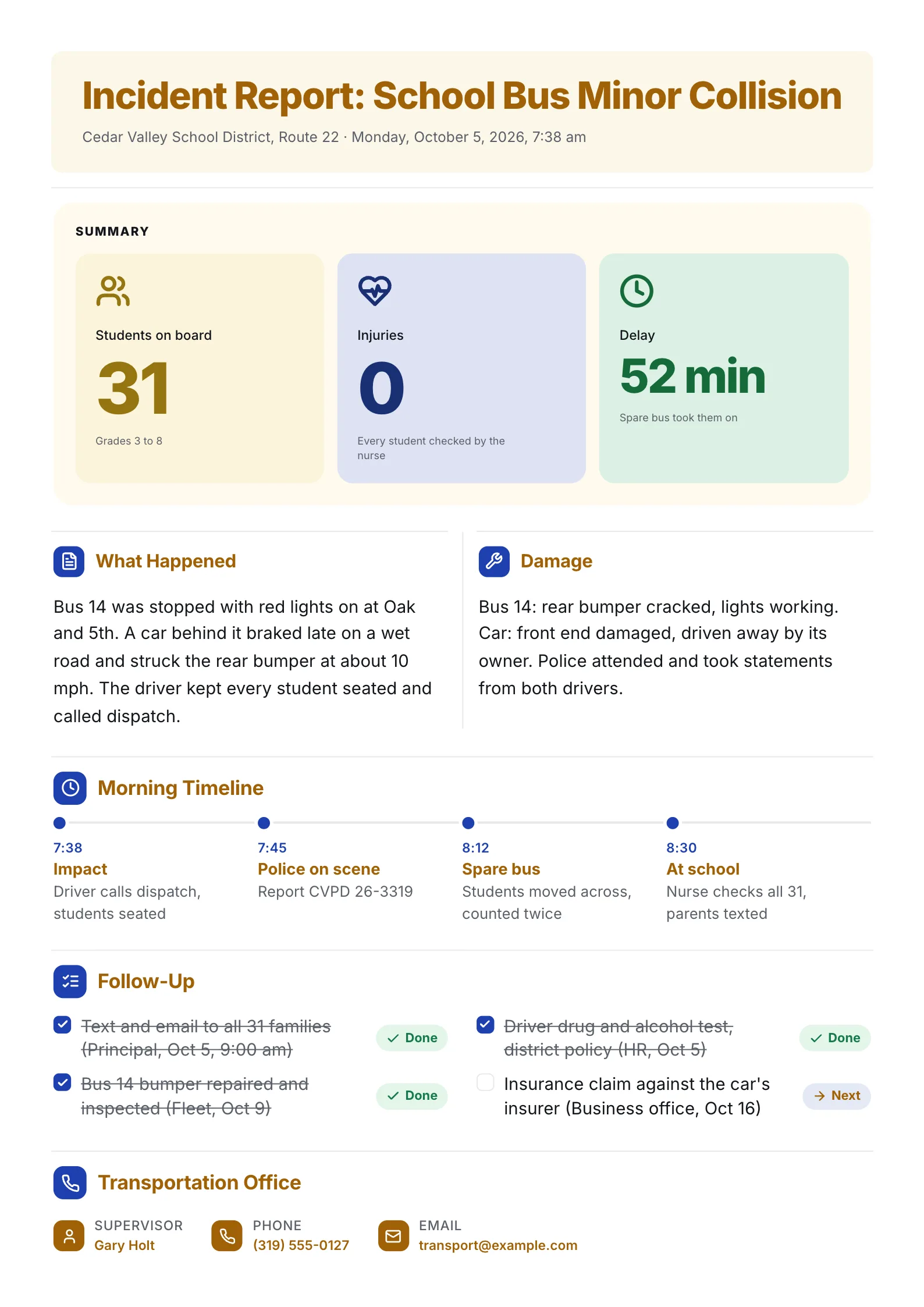
A car hit the back of Bus 14 at about 10 mph. Police came and took statements, and this school bus collision report records their number, CVPD 26-3319, in its timeline. The police report covers the crash. The district's report covers what you'd want to know as a parent: 31 students checked by the nurse, moved to a spare bus and counted twice, with parents texted by 8:30.
A small injury that parents sign
 Edit this template
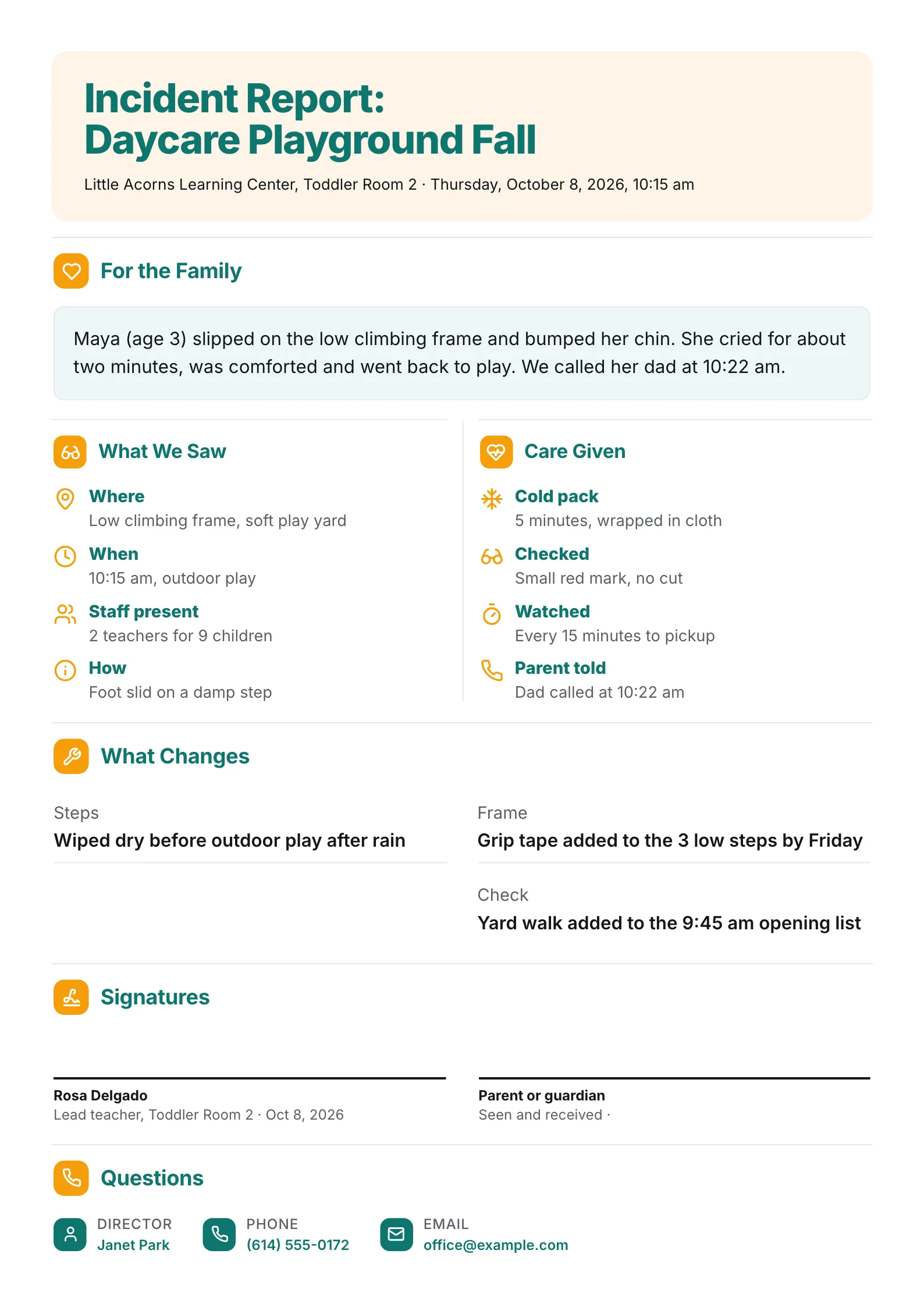
A bumped chin is a small event, and it still gets a written report. This daycare playground fall report records it, with 2 teachers for 9 children and a damp step as the cause. It opens with a short note for the family, and it ends with a line for a parent to sign as "seen and received." Grip tape on the 3 low steps is the fix.
An incident with no injury at all
 Edit this template
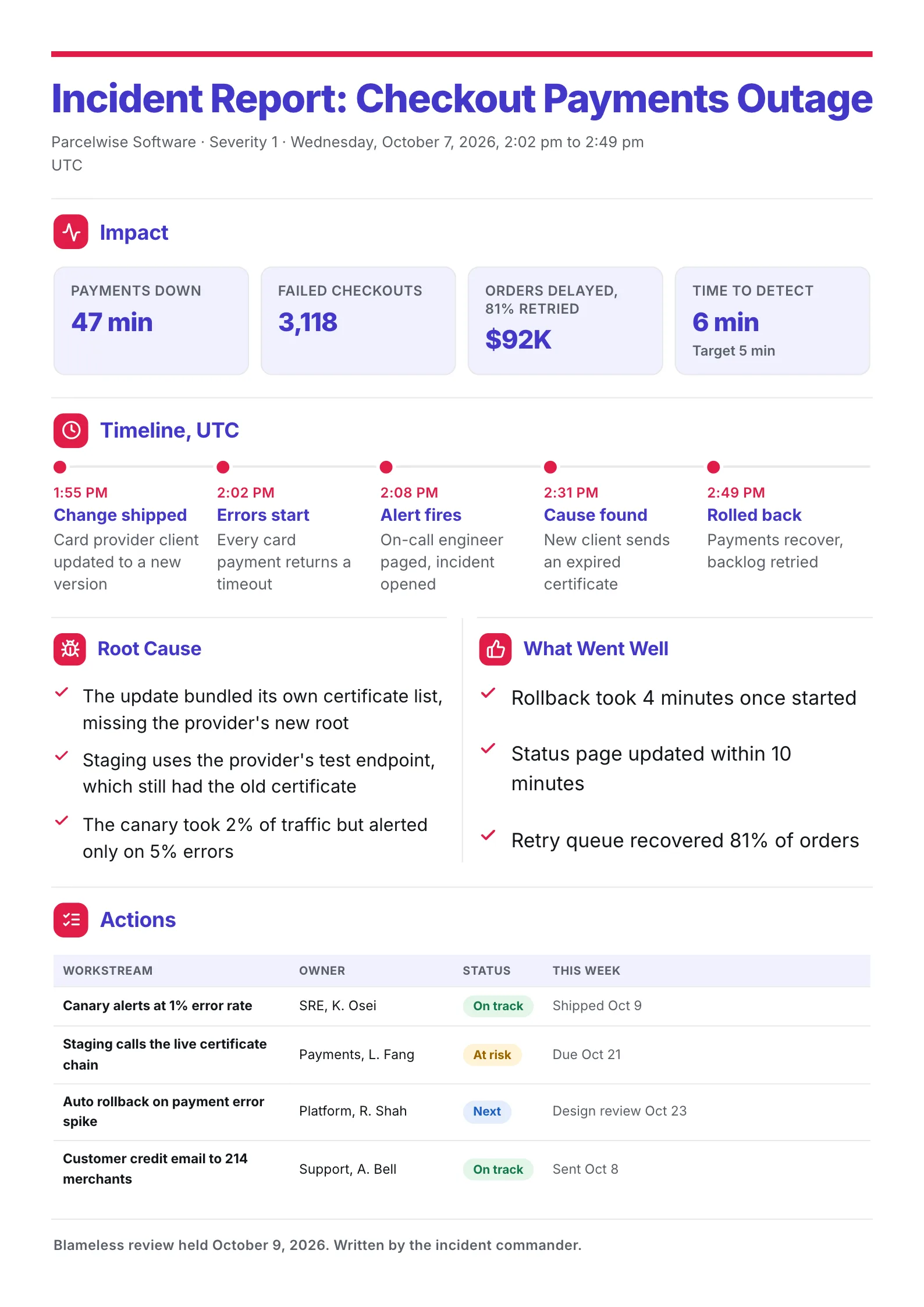
If you work in software, you write incident reports too, and nobody calls them accidents. This payments outage report covers 47 minutes with card payments down and 3,118 failed checkouts. Its root cause section reads like OSHA's: an update shipped with an old certificate list, and the test system didn't catch it because it still had the old certificate too.
Which report should you write?
Use the word incident on your own form, and write one whenever any of these is true:
- Someone was hurt or made ill, at any level.
- Property was damaged, or money was lost.
- Something could have caused harm but didn't, like the insulin dose.
- A rule or safety step was skipped, even if nothing came of it.
Leave "accident report" for the forms other people write about you, like a police crash report or an insurer's claim form. Your report can quote their numbers, the way the bus report quotes the police report number.
Make your incident report
Open the sample in MakeOnepagers that's closest to what happened and replace the facts with yours. Start with OSHA's four questions: what the person was doing, what happened, the injury, and what caused it. If your notes are spread across texts and emails, paste them into the free AI One-Pager generator and check the timeline it lays out. For each section in detail, read how to write an incident report, and see our incident report examples for more layouts.
Frequently asked questions
How is an incident report different from an accident report?
An accident report covers an event that caused injury, illness or damage. An incident report covers those events and also near misses, where harm could have happened but didn't.
Is a near miss an incident?
Yes. OSHA calls it a close call, "also called a 'near miss,'" and treats it as an incident worth investigating.
Why does OSHA use the word incident instead of accident?
Its guide says accident suggests a random event that couldn't have been prevented. OSHA's view is that most incidents at work are preventable, so it avoids the word.
How long do you have to fill out OSHA Form 301?
Within 7 calendar days of learning that a recordable injury or illness happened. You keep the form for 5 years after the year it covers.
Who writes an accident report after a car crash?
The police officer who investigates it, when officers attend. In Texas, crashes with an injury or death must be reported within 10 days on Form CR-3. Your company can still write its own incident report.




