Incident Report Examples: 5 One‑Pagers Run Through OSHA's 18 Questions
Five incident report examples from a hospital ward, a store, a delivery van, a lab and a daycare, each checked against the 18 questions on OSHA Form 301.

OSHA's injury report asks you 18 numbered questions, and not one of them asks what you'll change so it doesn't happen again. Every one of the five incident report examples in this post, each a one-page layout in MakeOnepagers, answers that missing question, with 17 fixes between them. All five also answer six of OSHA's 18, questions 11 and 13 to 17.
One‑Pager examples
Real One-Pagers made with MakeOnepagers. Open any one to edit it as your own.
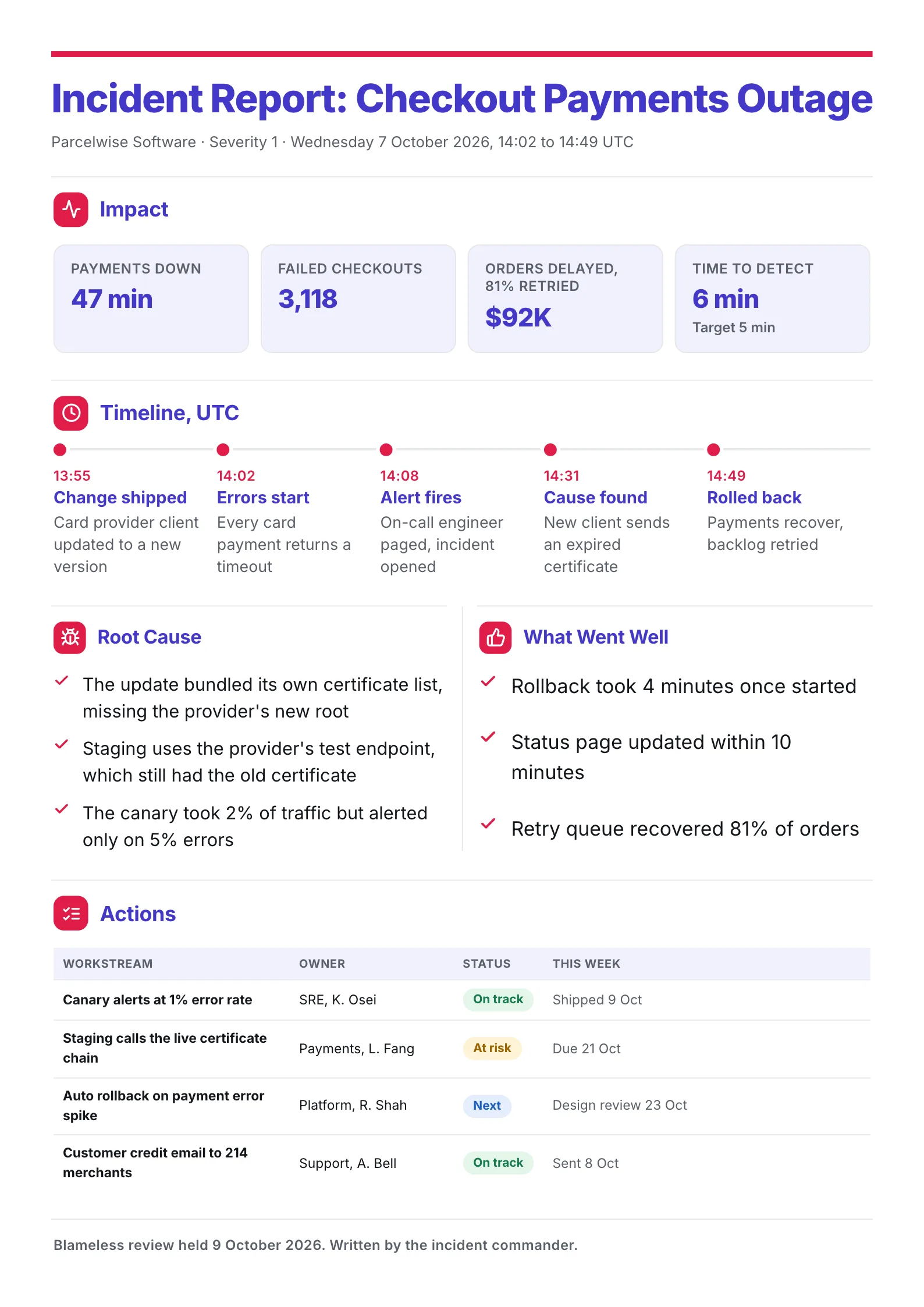 Incident Report: Checkout Payments OutageEdit for free(opens in a new tab)
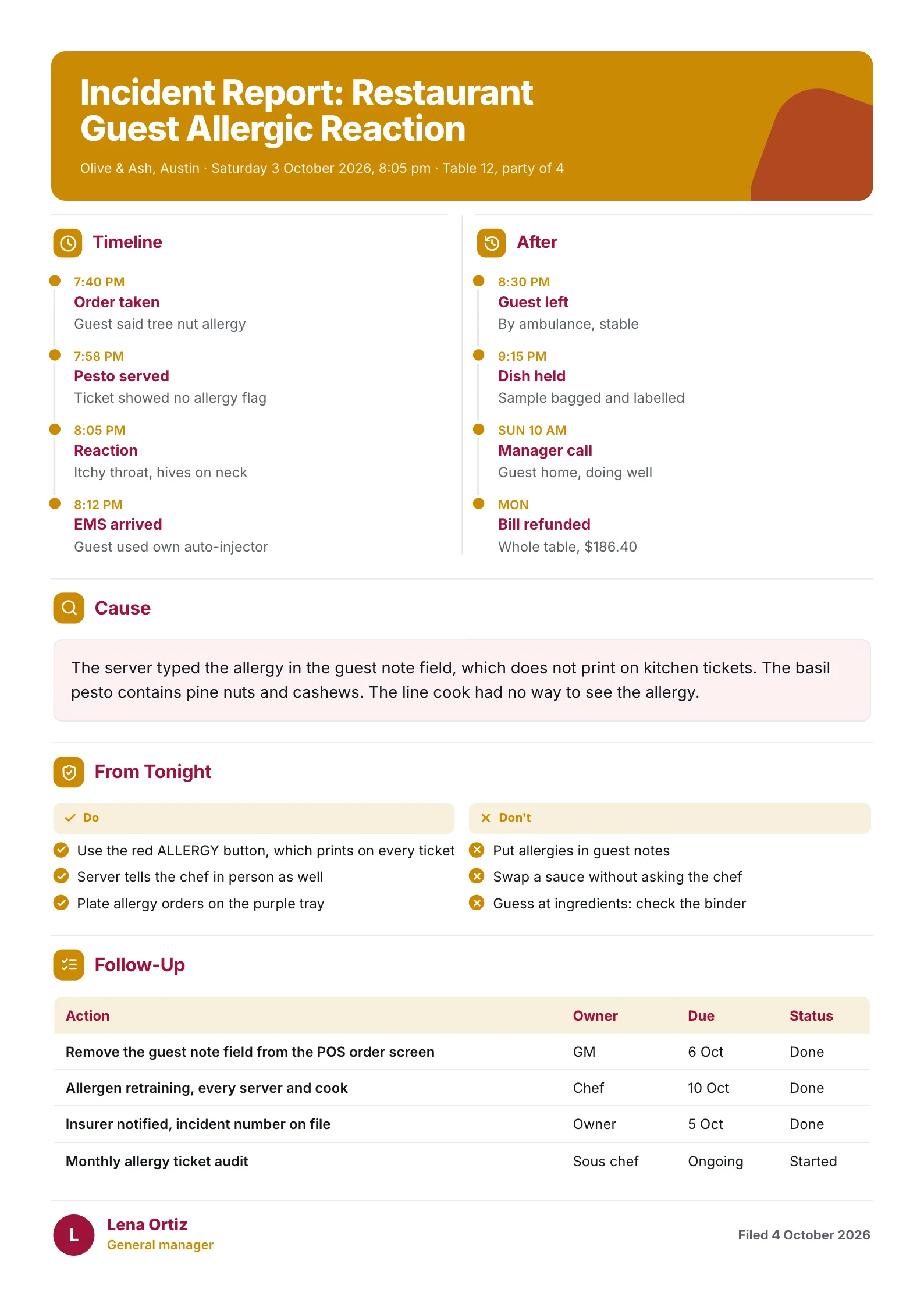 Incident Report: Restaurant Guest Allergic ReactionEdit for free(opens in a new tab)
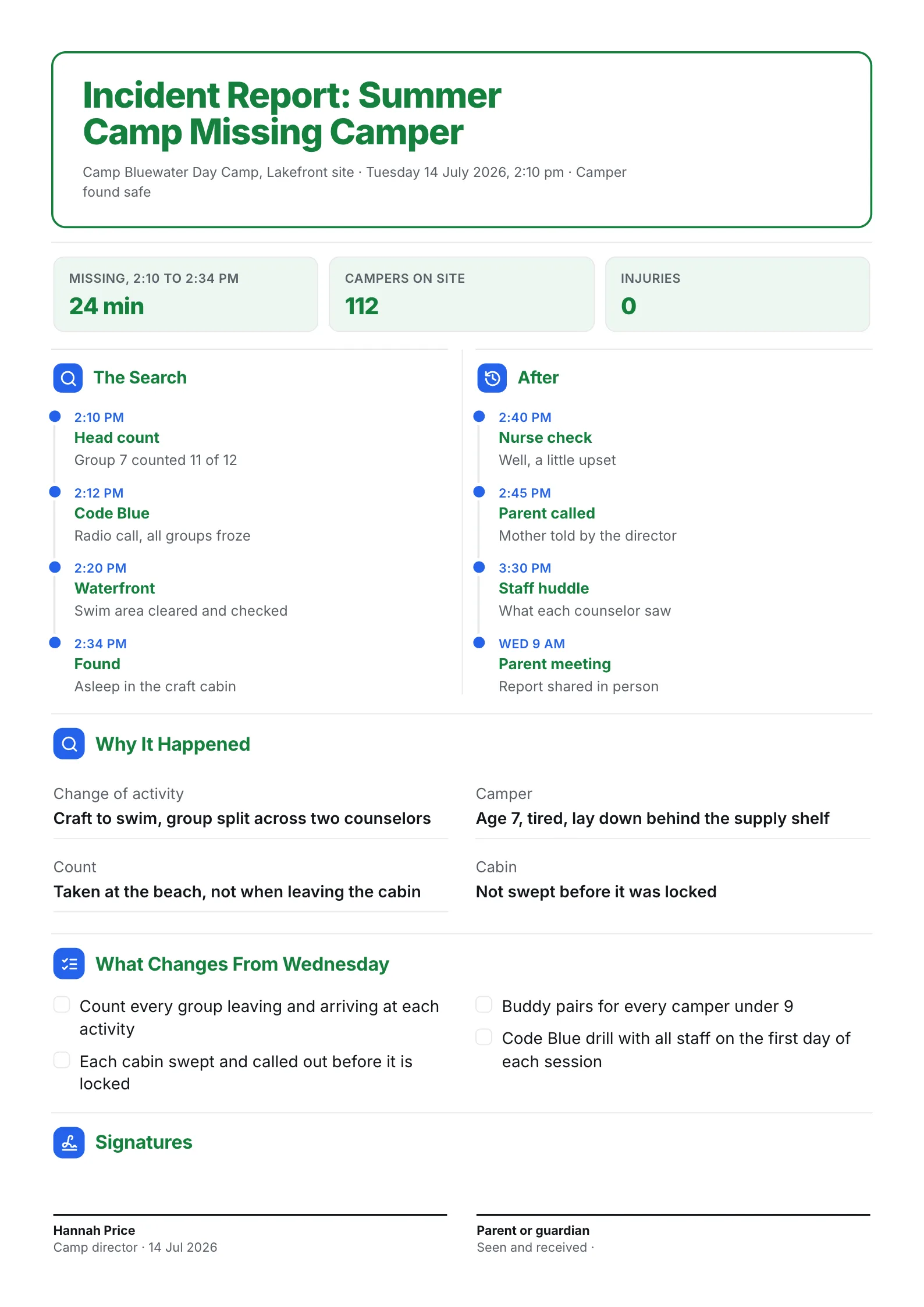 Incident Report: Summer Camp Missing CamperEdit for free(opens in a new tab)
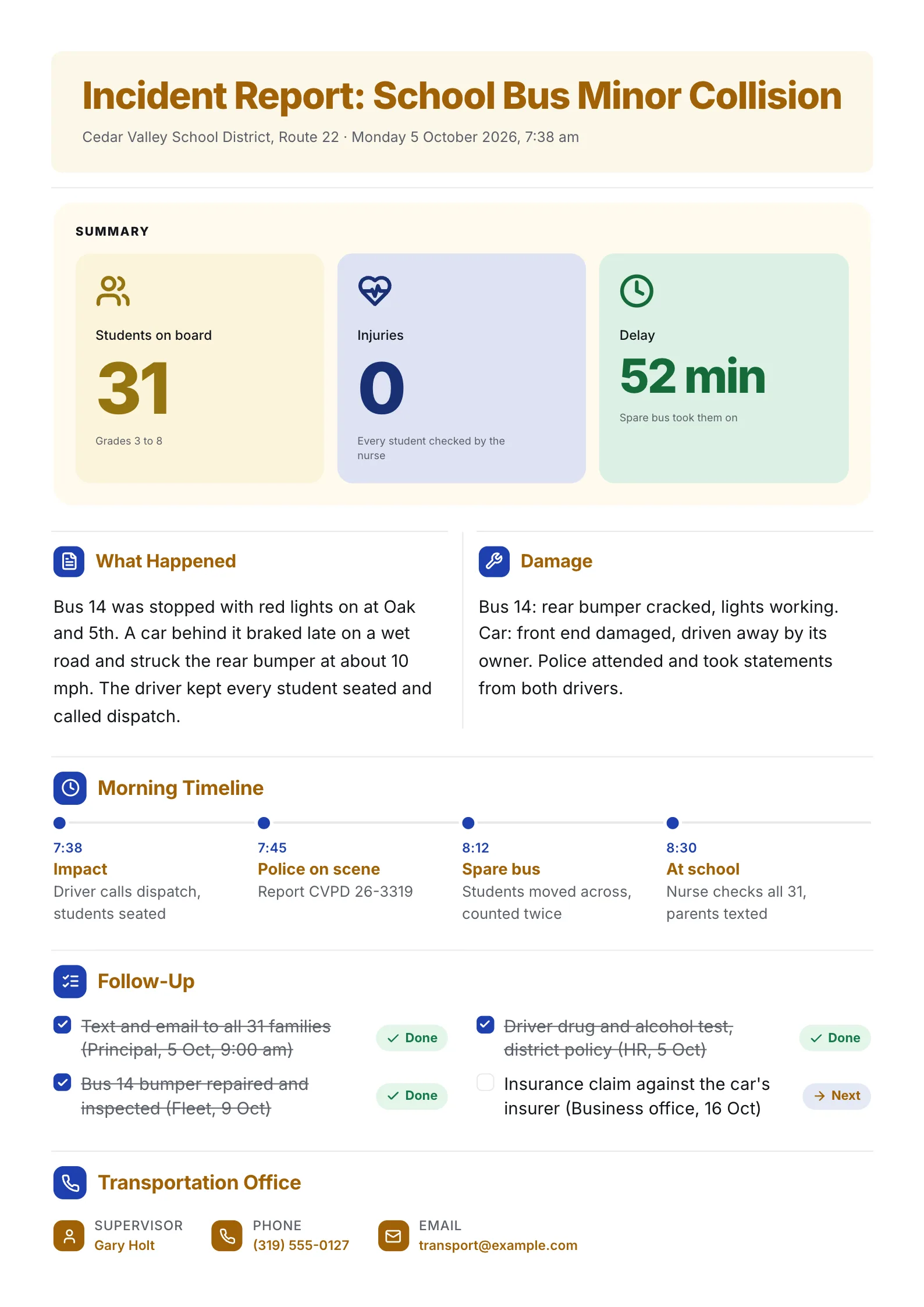 Incident Report: School Bus Minor CollisionEdit for free(opens in a new tab)
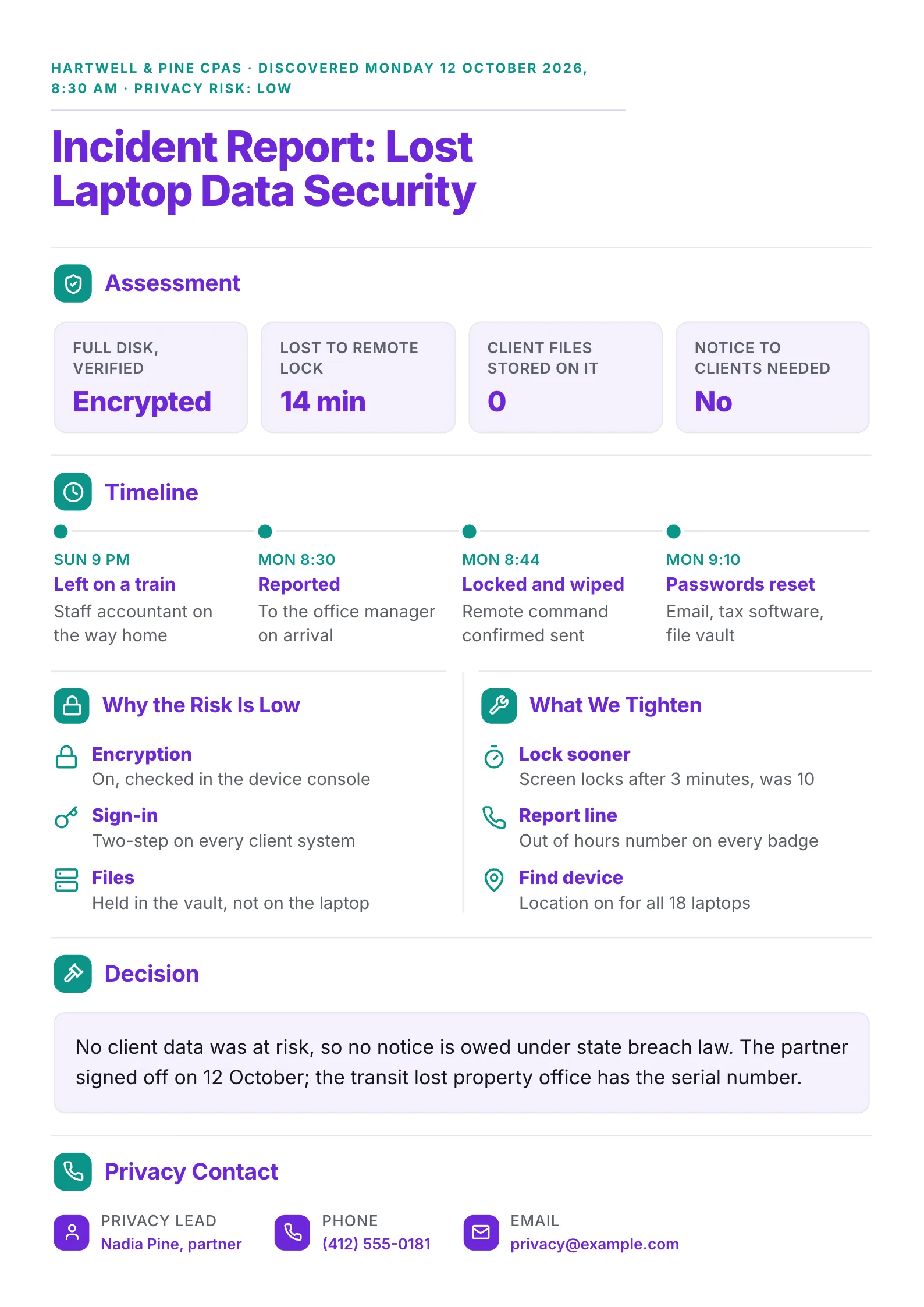 Incident Report: Lost Laptop Data SecurityEdit for free(opens in a new tab)
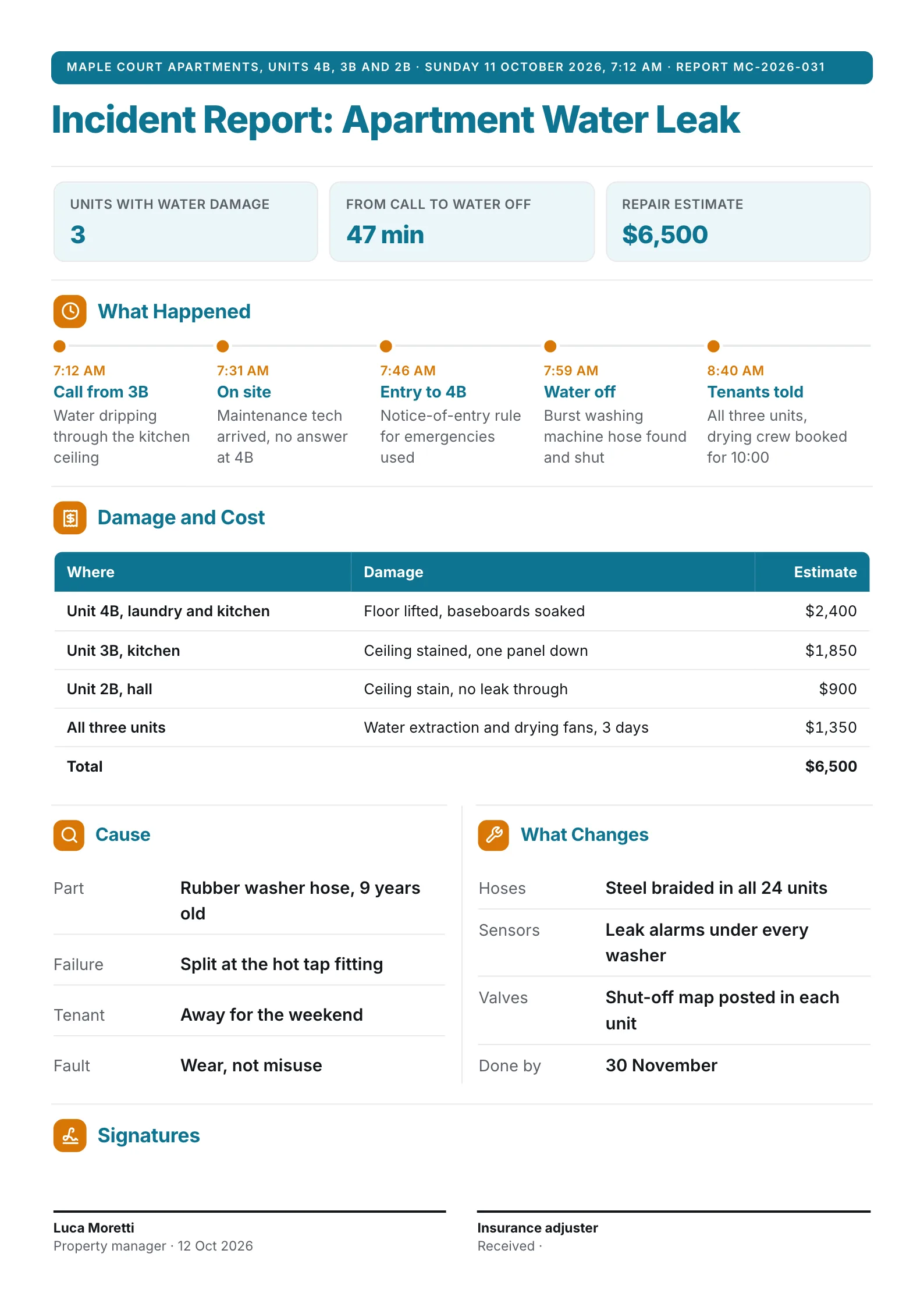 Incident Report: Apartment Building Water LeakEdit for free(opens in a new tab)
The five come from a hospital ward, a grocery store, a delivery van, a university lab and a daycare. Each fits on a page. Each tells you when it happened, what the person was doing, what happened next and who wrote it up.
Then we put all five through a tougher test. OSHA's Form 301 is the federal injury report for US workplaces. We checked which of its questions each example already answers, wrote a model answer for the hardest ones, and read two student accident forms, because schools ask things OSHA never does.
Five incident reports from five kinds of places
A near miss on a hospital ward
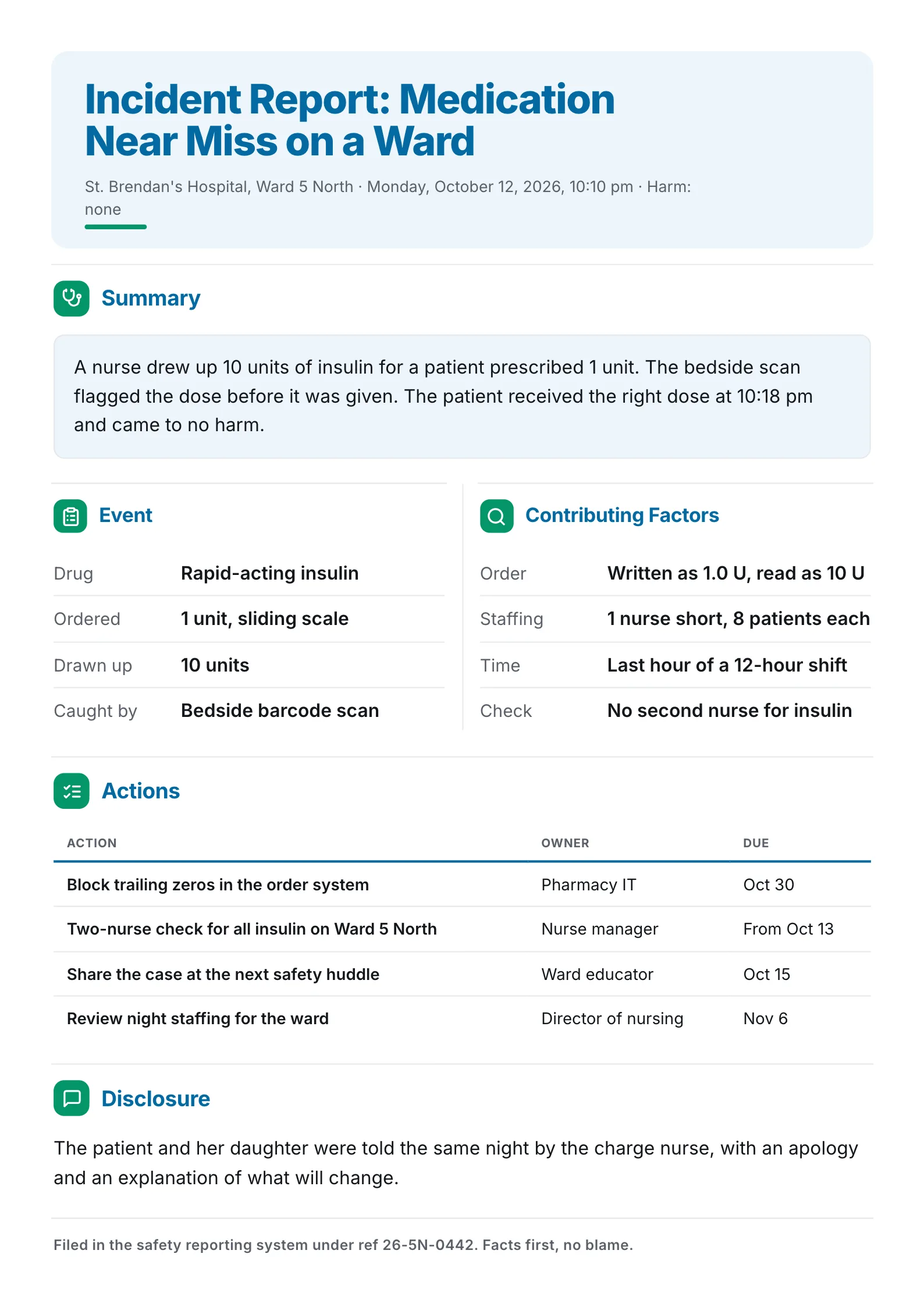
Nobody was hurt here, and the report still runs a full page. A nurse on St. Brendan's Ward 5 North drew up 10 units of insulin for a patient prescribed 1 unit. The bedside barcode scan flagged it, and the patient got the right dose at 10:18 pm.
The report reads like a short case file you could hand to a pharmacist. A small table sets the drug, the dose ordered, the dose drawn up and what caught it side by side. Then come four contributing factors, written in a word or two each. The order said "1.0 U" and was read as 10. The ward was one nurse short. It was the last hour of a 12-hour shift, and no second nurse checked the insulin. You can see the whole chain at a glance, and so can your safety committee.
Four actions follow, each with an owner and a due date. Use this one when your report has to keep the blame out and the facts in. Hospitals, clinics and care homes file near misses like this because the next one might not be caught.
 Edit this template
Four short rows of contributing factors put staffing and timing right next to the misread order.
An argument at a store checkout
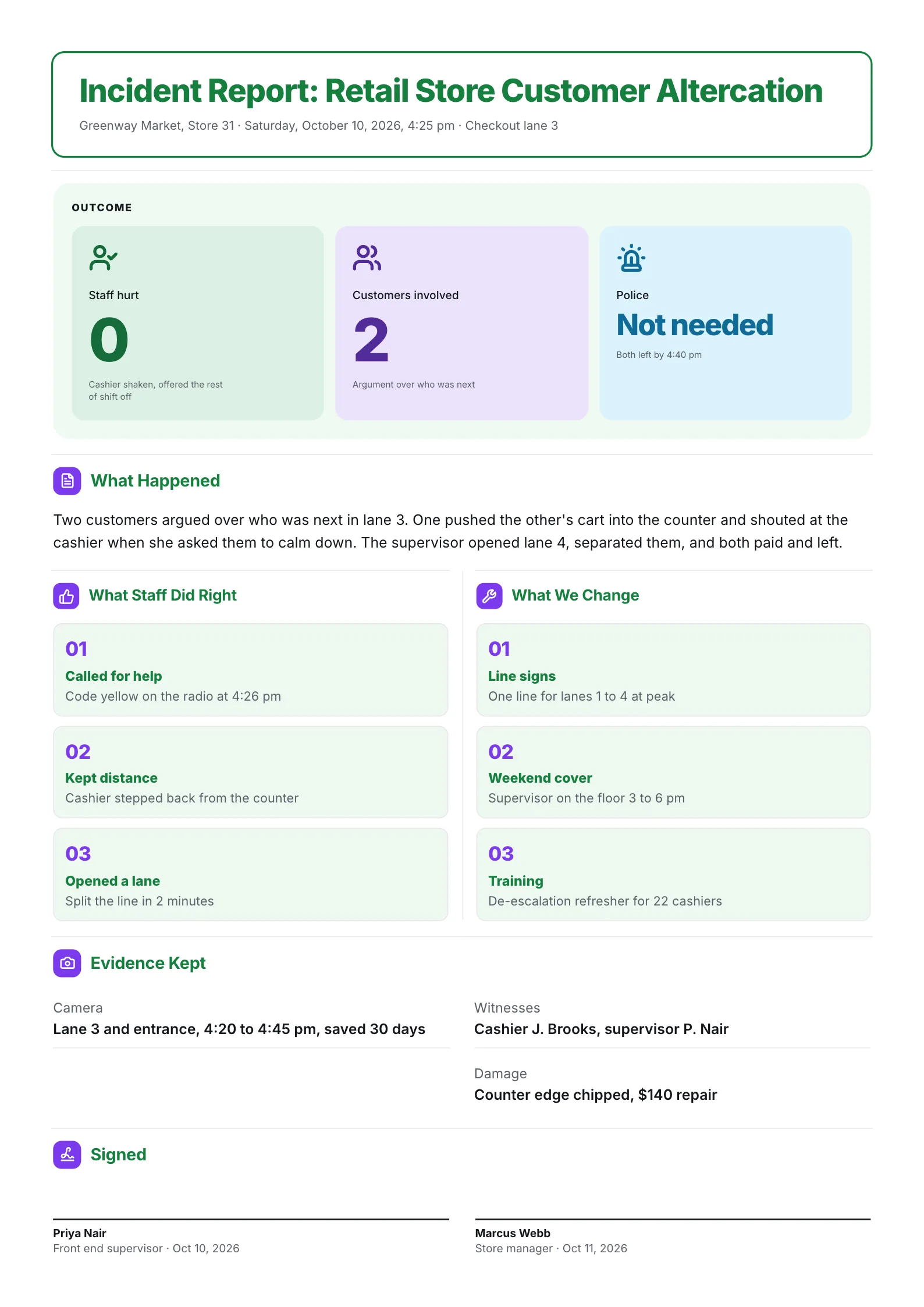
You'd use Greenway Market's report for trouble between customers. It covers two customers who argued over a place in line at lane 3. It opens with the outcome in three boxes. Zero staff were hurt, two customers were involved, and the police weren't needed. You know how serious it was before you read a sentence.
Copy its block called "What Staff Did Right." The cashier stepped back, someone called a code yellow at 4:26 pm, and a supervisor opened a second lane within 2 minutes. Praise like this teaches the rest of your team what to do next time. The report also lists the evidence kept, including camera footage saved for 30 days and a $140 repair to a chipped counter. A front end supervisor and the store manager sign it, on October 10 and October 11.
 Edit this template
Greenway lists what staff did right above its three changes, which makes the report a lesson as well as a record.
A delivery van backing into a parked car
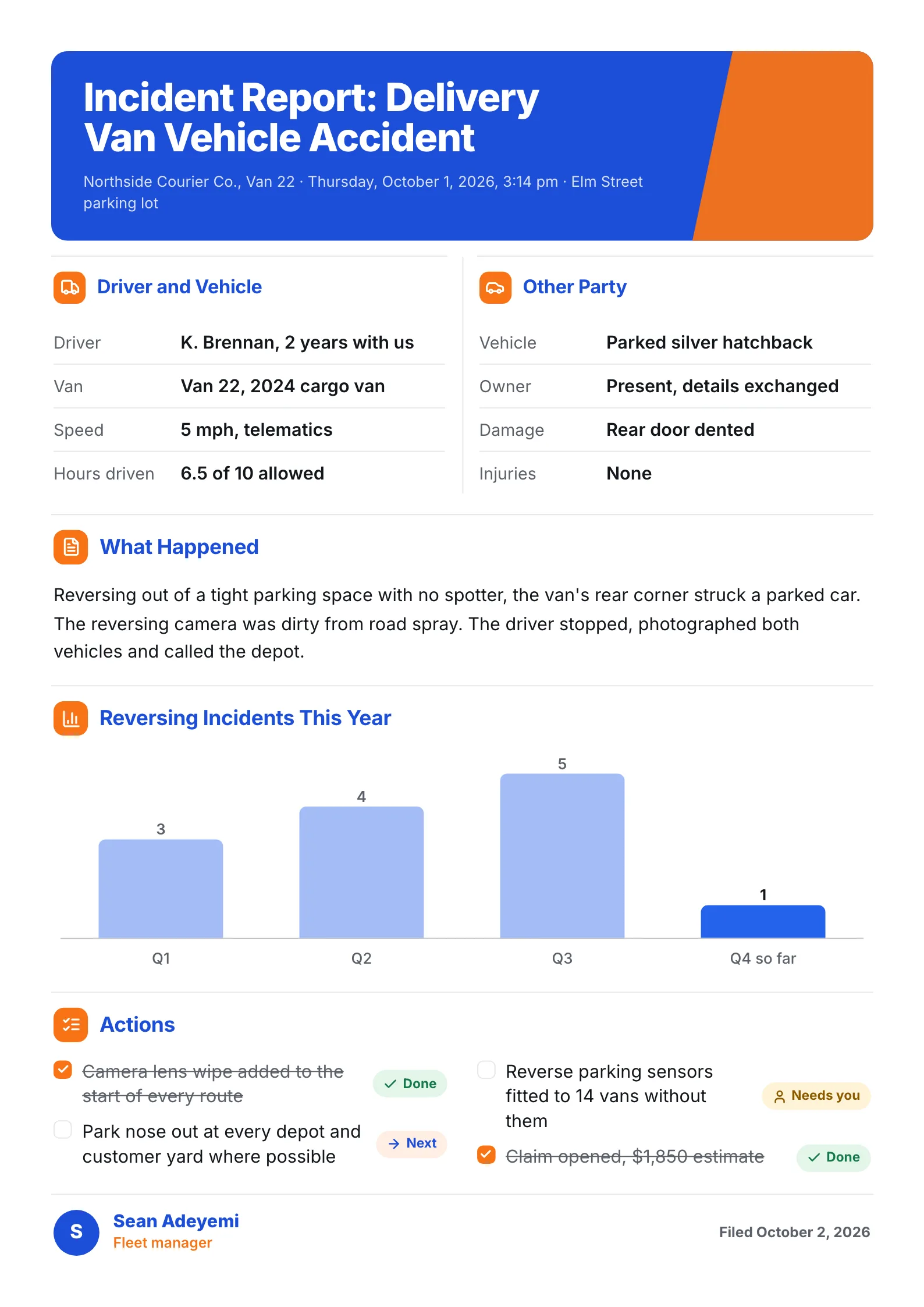
Northside Courier's Van 22 hit a parked car at 5 mph while reversing out of a tight space. No one was hurt. The report gives the driver's time with the company (2 years) and the hours driven that day (6.5 of 10 allowed), straight from the van's telematics.
Then it does something your single-event report probably skips. A small chart counts reversing incidents by quarter, 3, then 4, then 5, then 1 so far in the fourth quarter. One dented door becomes a pattern, and the actions answer the pattern. Sensors go on the 14 vans without them, and every route now starts with wiping the camera lens. Your insurer and your safety lead can both work from this one page.
 Edit this template
The quarterly chart counts 13 reversing incidents this year, this one included.
An acid spill in a teaching lab
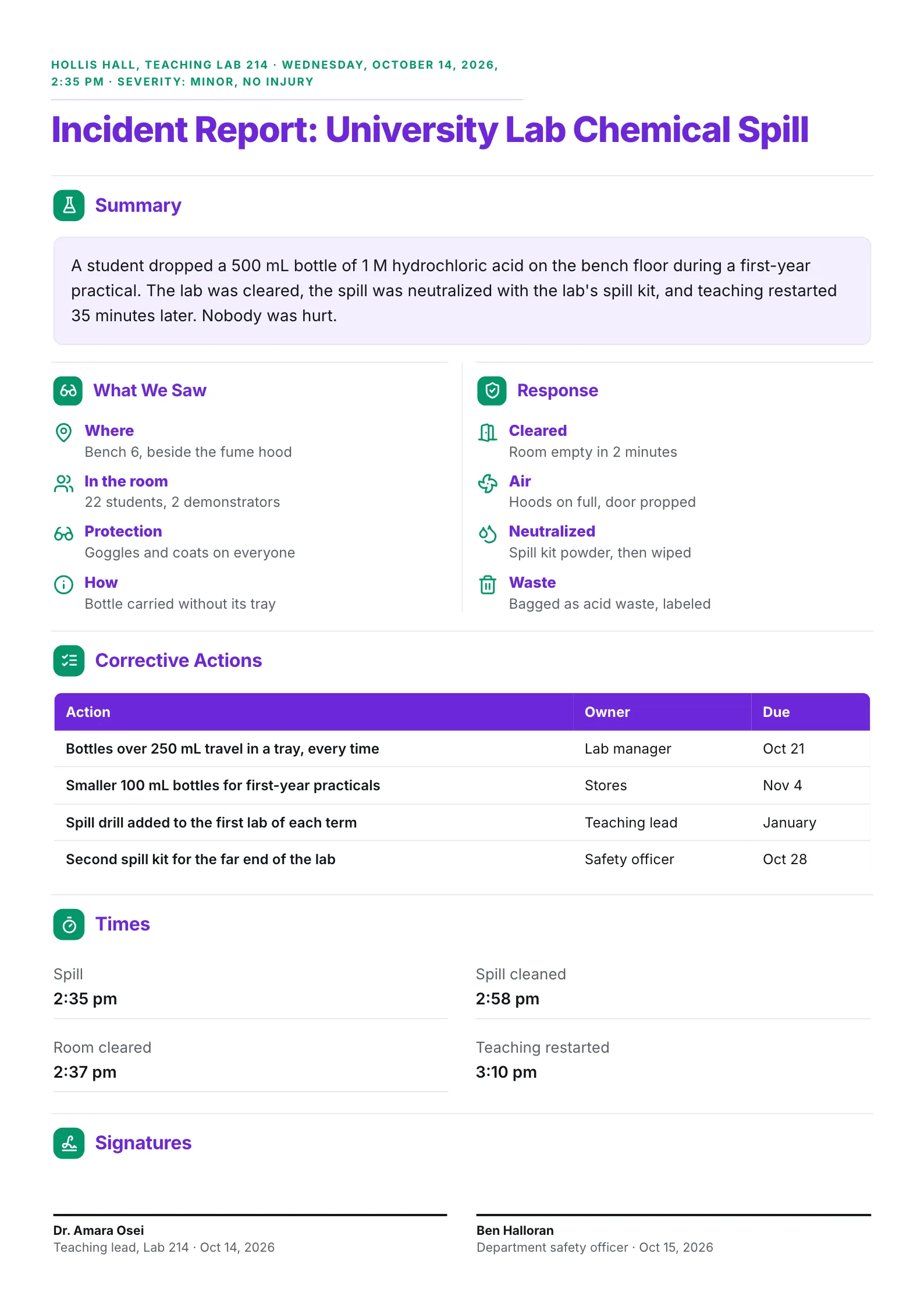
A student dropped a 500 mL bottle of 1 M hydrochloric acid in Hollis Hall's Teaching Lab 214. The report keeps a strict clock you can copy. The spill happened at 2:35 pm, the room was clear at 2:37, the floor was clean by 2:58, and teaching restarted at 3:10. Anyone checking the response can see it took 35 minutes from spill to class.
You can read the cause in one line, "Bottle carried without its tray." Four corrective actions each have an owner and a due date, from trays for every bottle over 250 mL to a spill drill in the first lab of each term. Two people sign it, the teaching lead the same day and the department safety officer the next.
 Edit this template
A row of four times at the foot of the page proves how fast the room was made safe.
A toddler's fall on a daycare playground
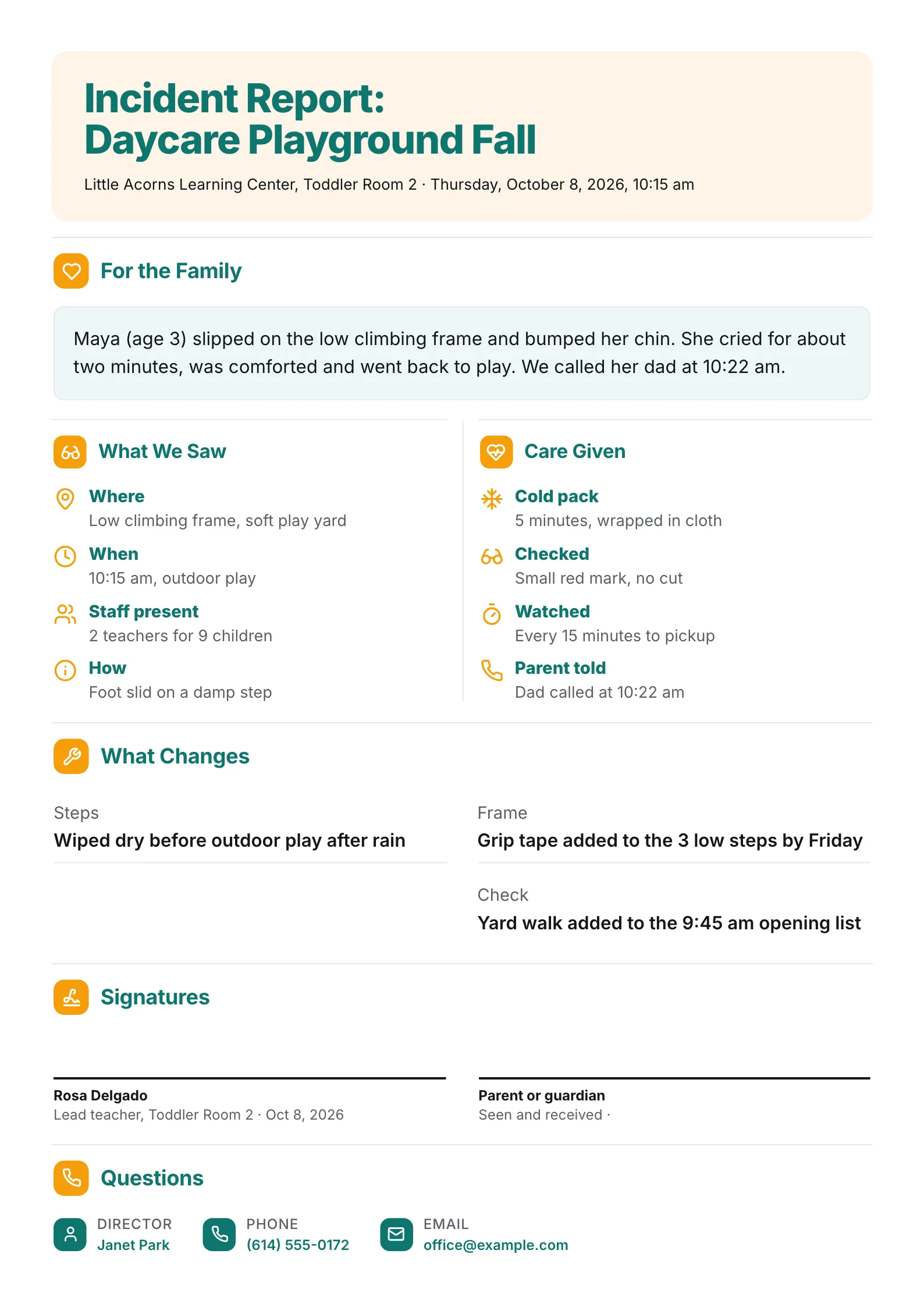
Little Acorns' report is written for a parent first. It opens with a box called "For the Family" in plain words. Maya, age 3, slipped on a damp step and bumped her chin. She cried for about two minutes and went back to play, and her dad got a call at 10:22 am.
Below that, it records what your licensing inspector would ask you. There were 2 teachers for 9 children. The cold pack went on for 5 minutes, and staff checked her every 15 minutes until pickup. The fixes are things you can see. Grip tape goes on the 3 low steps, and the steps get wiped dry after rain. A parent signs a line that reads "Seen and received."
 Edit this template
Maya's dad reads a plain note about his daughter before any of the staff details.
The OSHA 301 field test
OSHA's Form 301 is the form covered US employers fill in when a worker has a recordable injury or illness. You have 7 calendar days from the time you learn of it, and you keep the form for 5 years. Your own form can stand in for it, but only if it asks everything the 301 asks.
None of our five examples involves an injured employee. So we asked a narrower question you can ask of your own report. If a worker had been hurt in each of these events, how many of the 301's questions would the one-pager already answer?
| OSHA 301 question | Hospital ward | Store | Van | Lab | Daycare |
|---|---|---|---|---|---|
| 11. Date of injury or illness | Yes | Yes | Yes | Yes | Yes |
| 12. Time the employee began work | Partly | No | Partly | No | No |
| 13. Time of event | Yes | Yes | Yes | Yes | Yes |
| 14. What the person was doing just before | Yes | Yes | Yes | Yes | Yes |
| 15. What happened | Yes | Yes | Yes | Yes | Yes |
| 16. The injury, if any | Yes | Yes | Yes | Yes | Yes |
| 17. Object or substance that did the harm | Yes | Yes | Yes | Yes | Yes |
| 7 to 9. Treatment given | No harm | No harm | No harm | No harm | Yes |
| Completed by, title and date | No | Yes | Yes | Yes | Yes |
Source: our check of five library examples against OSHA Form 301 (Rev. 04/2004), read October 30, 2026.
Questions 14 to 17 are the heart of the form, and all five examples answer them. They're also the hardest to write well, so draft them first, while your witnesses are still on shift. OSHA's own prompts help. For question 14, it gives the example "climbing a ladder while carrying roofing materials." Aim for that level of detail, an action plus the tool or material.
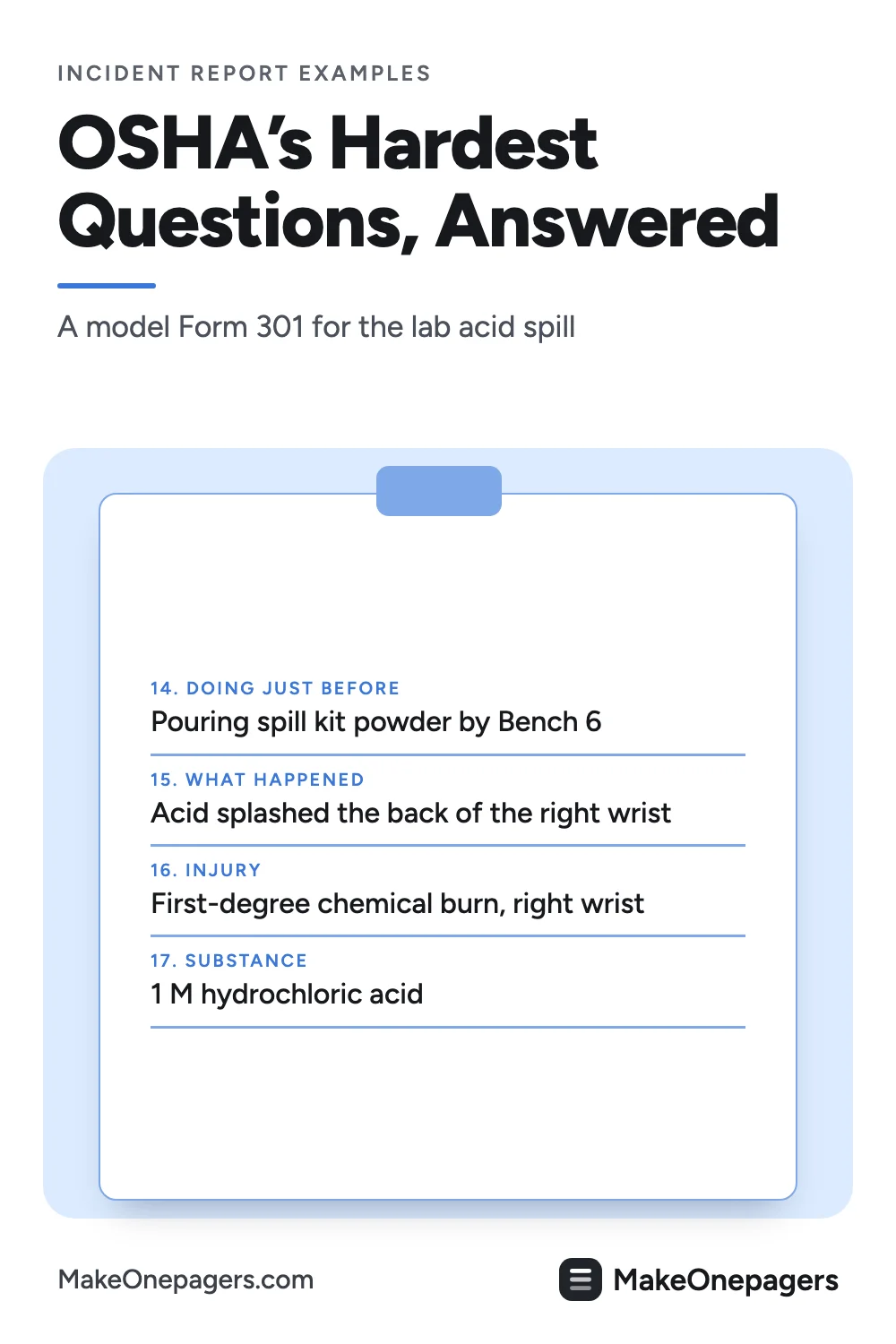
Here's a model you can copy into your own report. Imagine one of the two demonstrators in the Hollis Hall lab had been splashed during the cleanup.
- 12. Time employee began work: 1:00 pm
- 13. Time of event: 2:40 pm
- 14. What the employee was doing just before: Kneeling beside Bench 6, pouring spill kit powder over 1 M hydrochloric acid on the floor, wearing goggles, a lab coat and nitrile gloves.
- 15. What happened: Lifted the broken bottle base, and acid pooled under it splashed onto the back of the right wrist above the glove cuff.
- 16. Injury: First-degree chemical burn, back of right wrist, about 2 cm across.
- 17. Substance: 1 M hydrochloric acid.
You won't see a name in those six answers, which is what OSHA asks of you for fields 14 to 17. Change the facts to yours and keep the level of detail.
Question 12 is the gap. It asks when the employee started work that day, which shows how long they had been on the job. The van report comes closest with "6.5 of 10 hours driven." The hospital report says the error happened in the last hour of a 12-hour shift. The other three don't say. If your report covers a worker, add the start time.
The other gap is in the hospital report. It names a reference number but no person. A report without a name is hard to follow up on. Sign yours with your name, your title and the date.
Questions 1 to 5 ask for the employee's name, address, birth date, date hired and sex. Our examples leave those out, which suits a one-pager you'll share. OSHA itself asks you to keep names, phone numbers and Social Security numbers out of fields 14 to 17. Keep the personal details on the form in the file and the lesson on the page you hand around.
Which injuries need a 301 at all
You don't file a Form 301 for every hurt worker. Under OSHA's general recording criteria, a work injury is recordable when it leads to a death, days away from work, restricted work or a job transfer, medical treatment beyond first aid, or a loss of consciousness. A significant injury or illness diagnosed by a doctor or other licensed health care professional counts too.
"Beyond first aid" needs a definition, and OSHA gives one. It's a list of 14 treatments, and the rule says the list is complete. These five are ones you'll meet often.
- Cleaning, flushing or soaking a wound on the skin
- Bandages, gauze pads, butterfly bandages or Steri-Strips (stitches and staples count as medical treatment)
- Hot or cold therapy
- Elastic bandages, wraps and other supports with no rigid parts
- A nonprescription medicine at nonprescription strength
It doesn't matter who gives the care. OSHA counts these as first aid even when your company doctor or nurse provides them.
Now run two of our examples through that list. Say a Little Acorns teacher had slipped on the damp step instead of Maya, and got the same 5 minutes with a cold pack. That's first aid, and on its own it doesn't make the case recordable. The lab model answer depends on what happened next. Flushing the wrist with water is first aid. A prescription burn cream from a clinic is medical treatment, so that case is recordable and needs a 301 within 7 days.
The forms package puts this check first. Within 7 calendar days of learning about a case, you decide whether it's recordable, and only a recordable case gets a 301. That case also goes on the OSHA 300 log, and the year's summary, Form 300A, stays posted from February 1 to April 30 of the next year.
Write your 301 knowing the worker may read it. Under 29 CFR 1904.35, an employee who asks for a copy of the 301 about their own injury must get it by the end of the next business day. That's one more reason to keep your answers to fields 14 to 17 to the facts, the way the hospital near miss keeps the blame out.
The question OSHA never asks
Read the 301 top to bottom and you won't find a single line about prevention. It records what happened. It doesn't ask what you'll change.
Every one of our five examples does. Between them, they list 17 fixes. The hospital has four, the store three, the van three, the lab four and the daycare three. If you can't name who finishes a fix and by when, split it into smaller fixes until you can. "Block trailing zeros in the order system" and "Grip tape added to the 3 low steps by Friday" are both things someone can finish and prove.
When your company files the 301, keep it, because the law says you must. Then pair it with a one-page report that carries the fixes, an owner and a date. OSHA puts the form at about 22 minutes of your time. Give the one-pager five more, and put the fix your crew can finish this week at the top.
What schools and daycares add
A school doesn't file an OSHA form for a hurt student. Districts usually keep their own accident report instead, and we read two.
Pajaro Valley Unified School District in California has an 18-item Student Accident Report. The employee who saw the accident, or who was supervising, must turn it in within 24 hours. A serious injury gets a phone call to risk management right away. Three of its questions have no match on the 301.
- Who was supervising, and were they there? Item 6 asks for the name and whether that person was present.
- Did the student break a school rule? Item 7 asks it outright.
- Who took the student home? Item 15 asks to whom the student was released, and their relationship.
The Washington State School for the Blind uses a one-page Student Accident Report Form. It asks how a parent was told, plus the date and time. Its location prompt sets the bar for detail, "Playground east side of slide." It ends with a follow-up box, "Problem Corrected: Yes No," and a line for the actions taken to prevent another accident.
Both school forms ask the prevention question that the 301 skips. Pajaro Valley puts it right under the description of the accident. So a report for a school, a camp or a daycare needs a few lines a workplace report can skip. Name the adult in charge and say whether they were there. Give the time a parent was told and how. Say who the child left with.
Little Acorns is nearly there already. The example has the ratio of teachers to children and the call to dad at 10:22 am. Add the name of the adult who picked her up, and it covers what both school forms ask.
When a form isn't enough
Some events need a phone call from you before you write any report. Under OSHA's reporting rule, you must tell OSHA about a work-related death within 8 hours. You have 24 hours for an in-patient hospitalization, an amputation or the loss of an eye.
The calls apply even if your firm is small. A company with 10 or fewer employees all last year usually skips OSHA injury records, yet it still has to make those calls (29 CFR 1904.1). Put the two deadlines at the top of your report template, so whoever writes it sees them first.
Our guide on how to write an incident report goes through the official forms field by field, and the incident report template post has a blank layout with the eight parts in place.
Write the model answer, then beat the 7-day clock
When a worker is hurt, OSHA gives you 7 calendar days to decide whether the case is recordable and fill in the 301. Facts get harder to pin down each day you wait. So write questions 12 to 17 the day it happens, while people still remember the start time and which hand got splashed.
Then write the part the 301 leaves out. List each fix on a one-page report, give it an owner and a date, and file that page beside your form before the 7 days are up.




