Incident Report Template: Free One-Page Incident Report
A free one-page incident report template, the 8 parts every report needs, 6 worked examples from a phishing attack to a lab spill, and US reporting deadlines.

An incident report template gives you a ready form for recording an unplanned event that caused, or could have caused, harm. That might be an injury, a near miss or property damage. It could also be a security breach or a system outage. You use it to record what happened, the time and place, and who was involved. You also note what you did straight away and what will change so it doesn't happen again. Fill it in as soon as you can after the event, while memories are fresh. Below you'll find the parts every incident report needs and a free incident report template you can copy. You'll also get six worked examples and the US reporting deadlines worth knowing. Start from a free one pager template.
One‑Pager examples
Real One-Pagers made with MakeOnepagers. Open any one to edit it as your own.
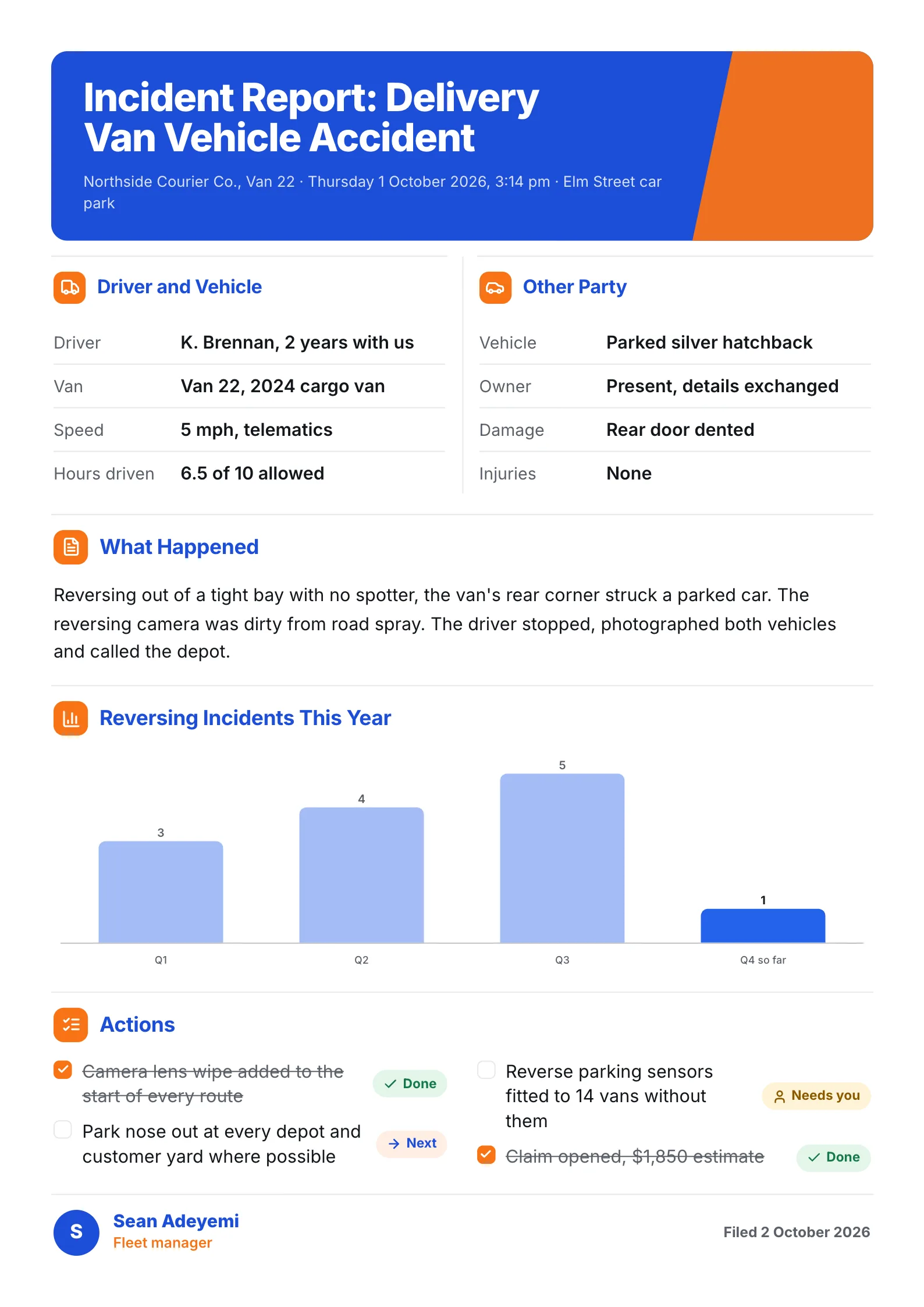 Incident Report: Delivery Van Vehicle AccidentEdit for free(opens in a new tab)
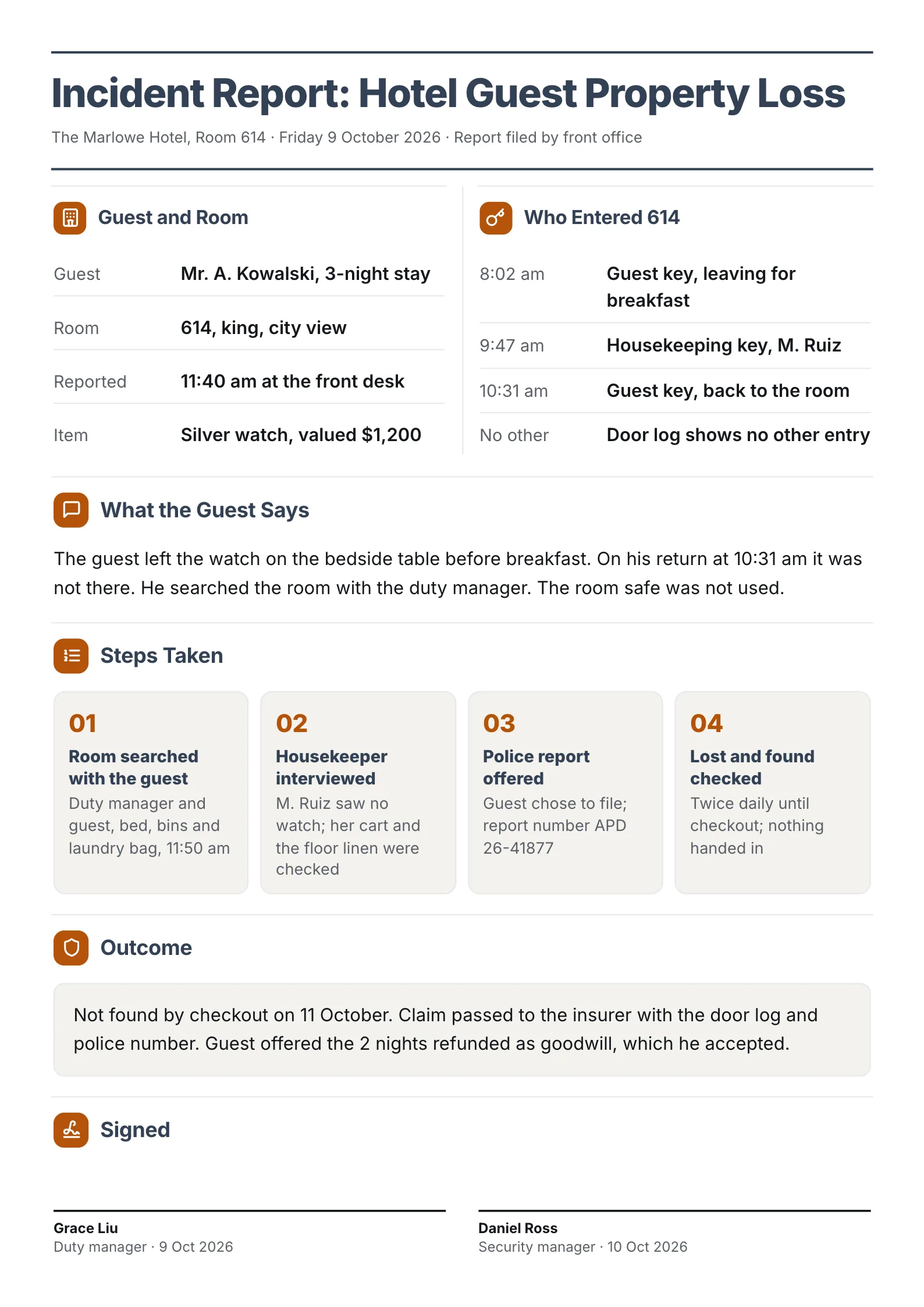 Incident Report: Hotel Guest Property LossEdit for free(opens in a new tab)
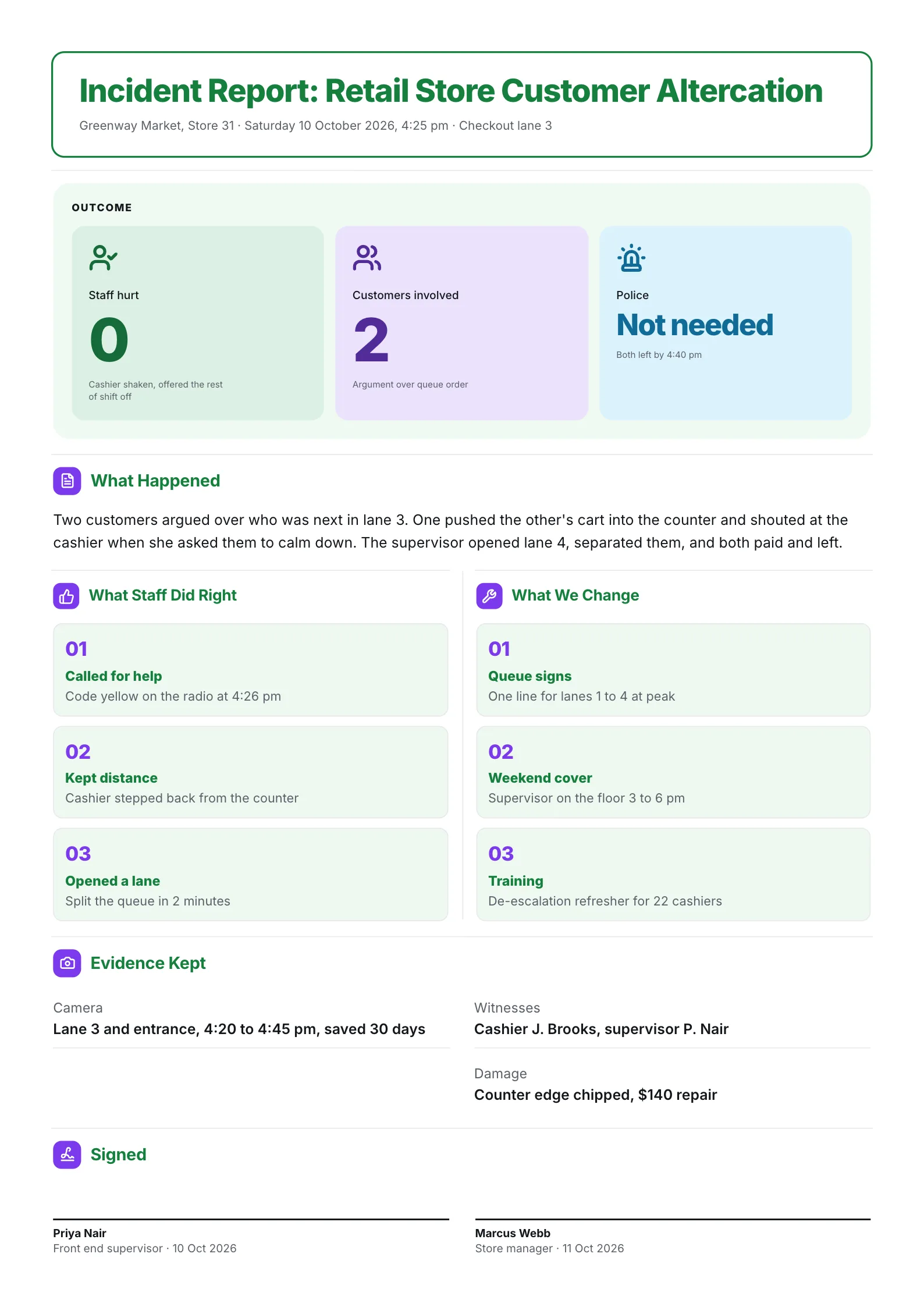 Incident Report: Retail Store Customer AltercationEdit for free(opens in a new tab)
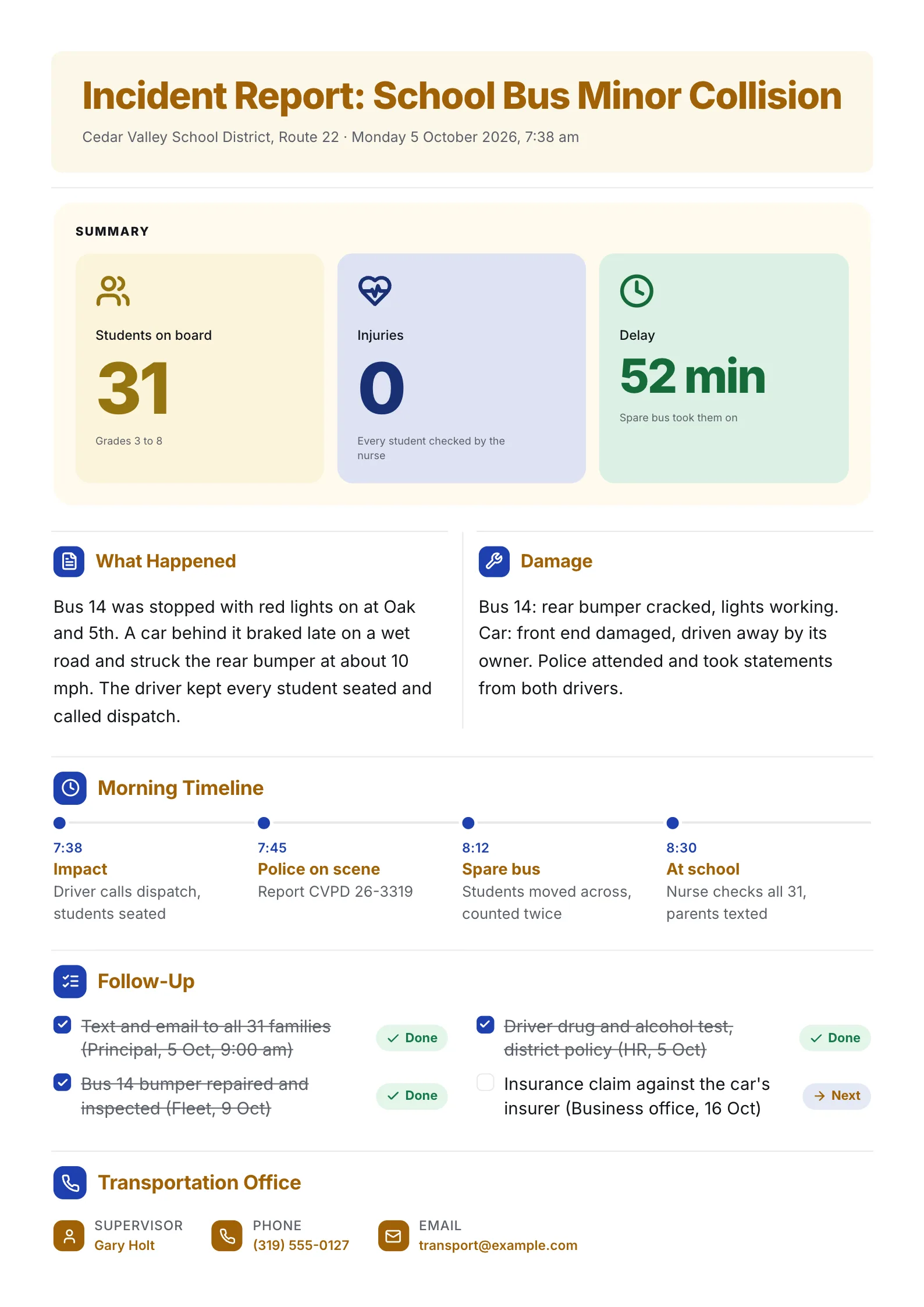 Incident Report: School Bus Minor CollisionEdit for free(opens in a new tab)
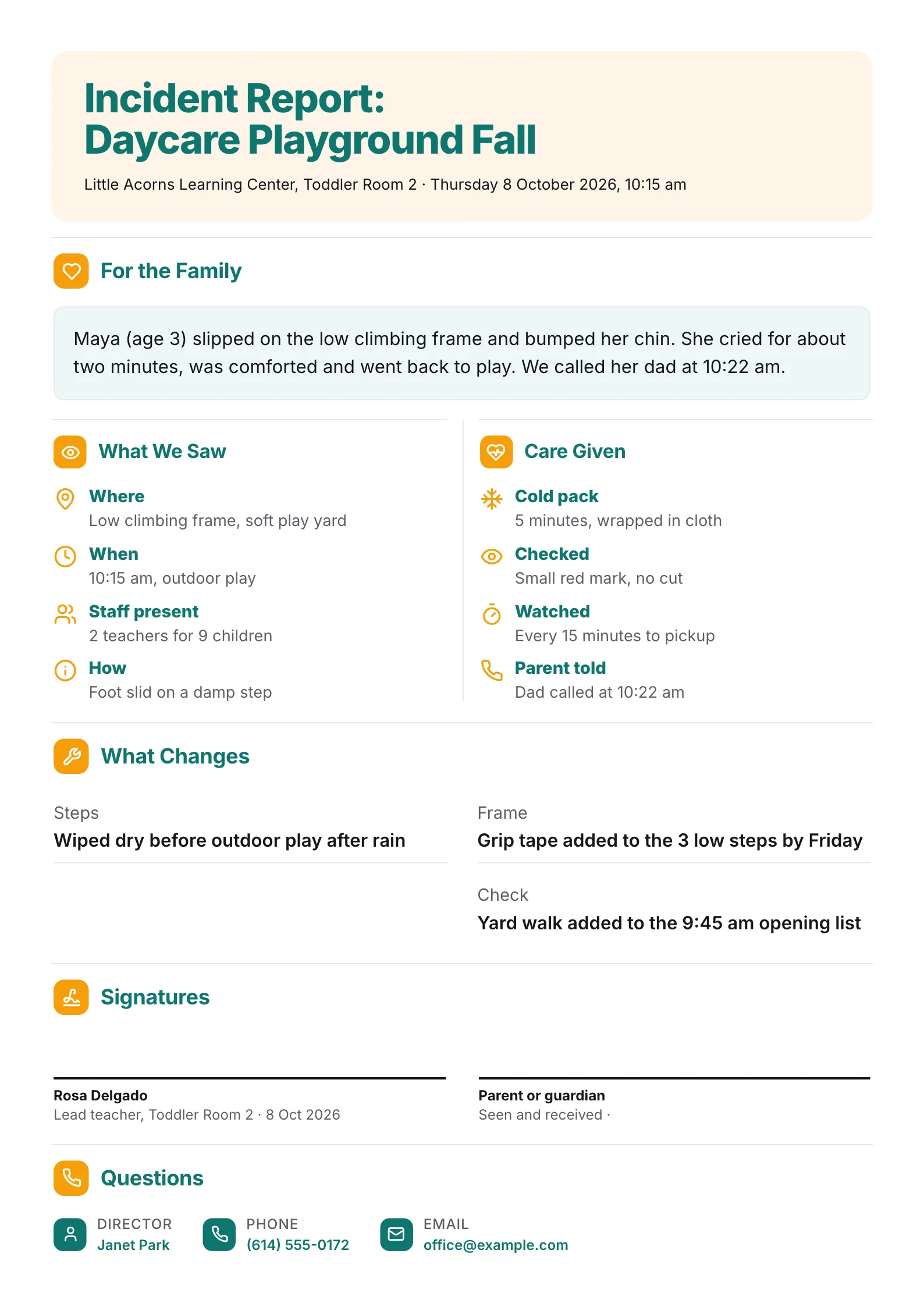 Incident Report: Daycare Playground FallEdit for free(opens in a new tab)
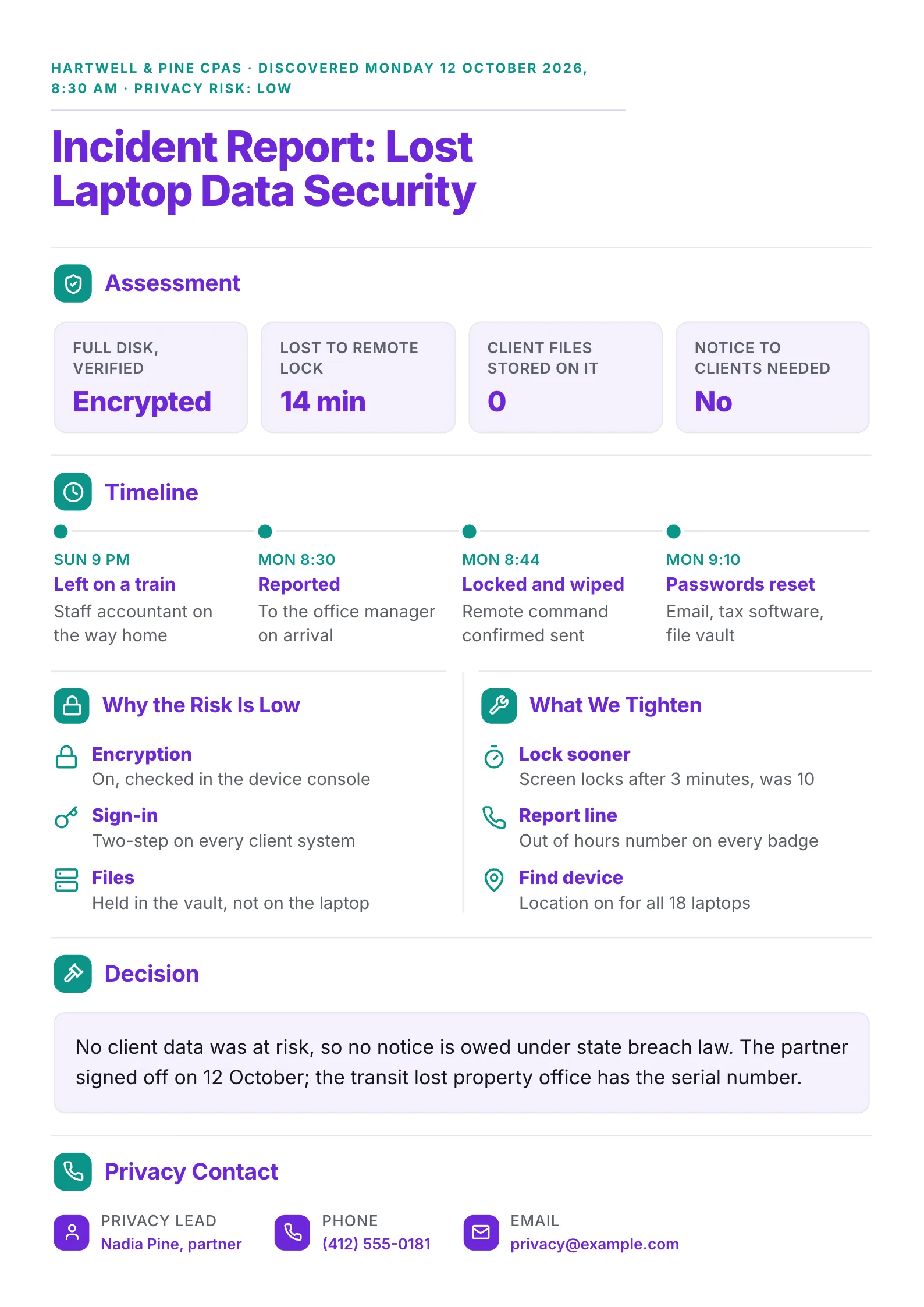 Incident Report: Lost Laptop Data SecurityEdit for free(opens in a new tab)
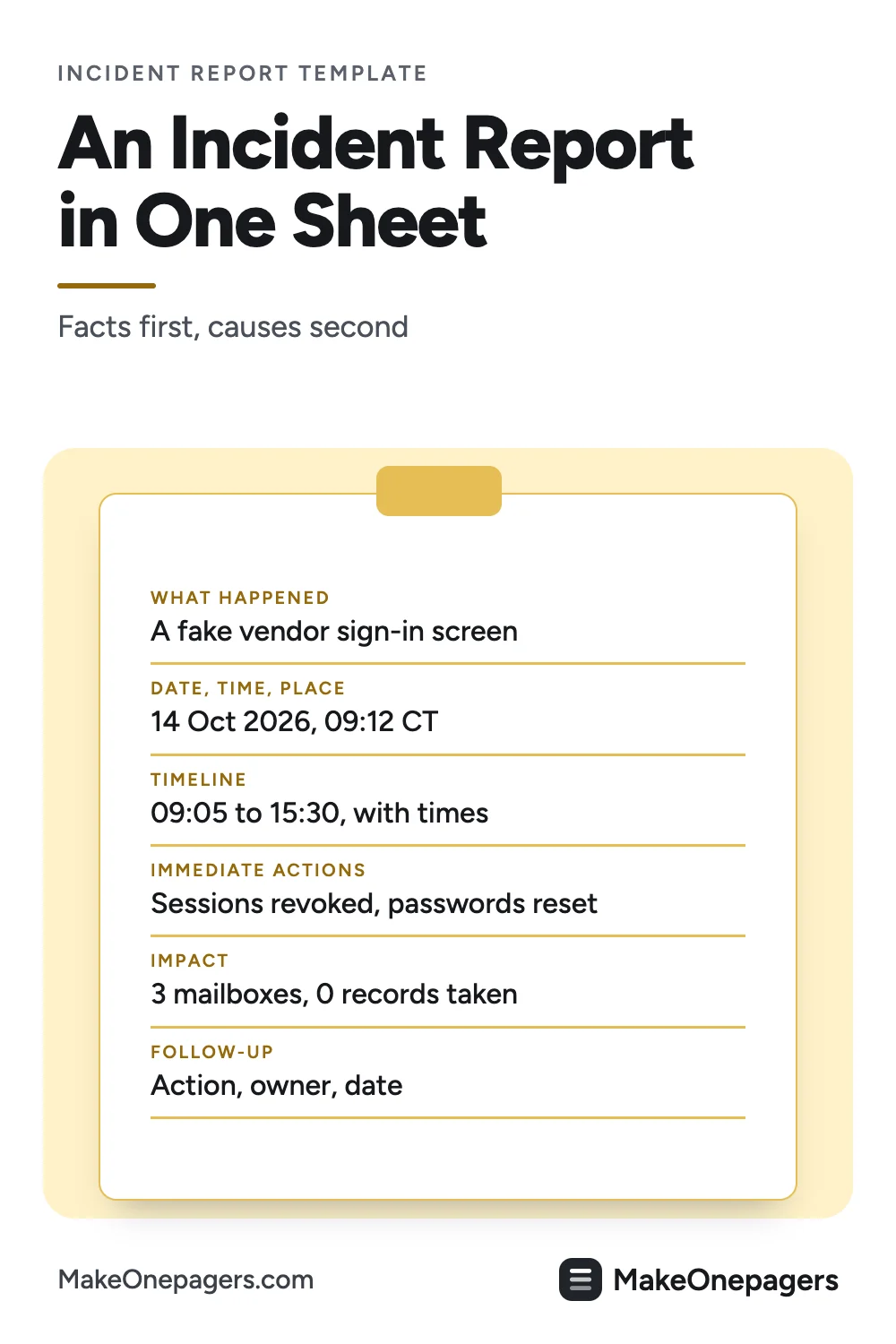
Every example was made with MakeOnepagers. Each one opens as a template you can edit for free. You can change every field and time, then swap the colors to match your brand.
What is an incident report?
An incident report is a written record of an event at work that hurt someone or damaged something. It also covers an event that broke a rule, or came close to doing one of those. Supervisors and safety officers write them, and so do HR, IT security and operations teams.
They have three jobs:
- Record the facts while they are fresh, for insurance, legal and compliance needs.
- Get help to the right people, so the event is contained and anyone affected is looked after.
- Stop it happening again, by finding the cause and assigning actions with owners.
Most organizations use one of four kinds. You'll see a workplace injury or illness report, a near-miss report, a security incident report and an IT or service outage report. The fields are almost the same across all four.
The 8 parts of an incident report
- Header: a reference number, the type of incident, its severity and its status.
- What happened: two or three sentences of plain fact.
- Date, time and place: when it started, when it was found and where.
- People involved: who was hurt or affected, who saw it, who reported it.
- Timeline: what happened, minute by minute or hour by hour, from first sign to resolved.
- Immediate actions: first aid, isolation, shutdown, passwords reset, whatever was done straight away.
- Impact: injuries, damage, downtime, records exposed, customers affected, each as a number.
- Follow-up actions: what will change, who owns each action and by when, plus who signed off the report.
A free incident report template
Copy this into any document you like, or open one of the examples below and edit it.
| Field | What to write, with an example |
|---|---|
| Reference | IR-2026-0412 |
| Type and severity | Phishing, severity high |
| Status | Closed 21 Oct 2026 |
| What happened | A finance user entered their password and a text-message code into a fake vendor sign-in screen |
| Date, time, place | 14 Oct 2026, 09:12 CT, head office |
| People involved | Affected staff, witnesses, the person reporting |
| Timeline | 4 to 6 times with what happened |
| Immediate actions | Sessions revoked, passwords reset |
| Impact | 3 mailboxes for 3 hours, 0 records taken |
| Follow-up | Action, owner, date |
| Sign-off | Name, role, date |
For a workplace injury, swap the impact row for the nature of the injury and the body part. Then add the treatment you gave and whether the person went to hospital.
6 incident report examples
Here are six incidents from six kinds of workplace. They cover a phishing attack, a medication near miss and a water leak in an apartment building. You'll also see a payments outage, an acid spill in a university lab and a guest's allergic reaction. Each keeps the facts first and the follow-up last.
1. Security incident report
 Edit this template
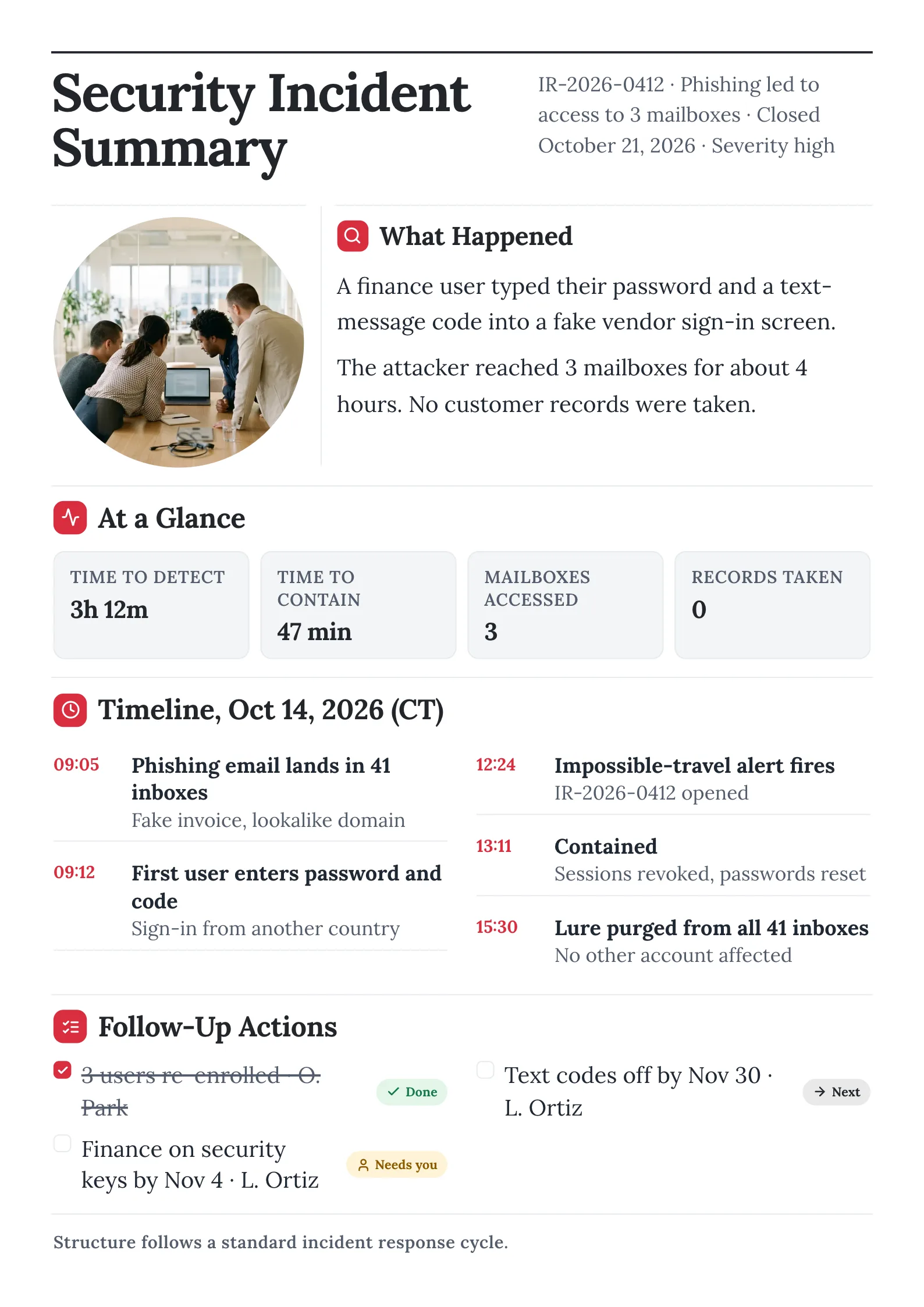
One incident on one sheet, with the facts and the clock up top, then the impact and what changes next.
This is a sample security incident at a fictional company; the people and times are illustrative. The structure follows NIST SP 800-61 Rev. 3 (2025), the US government's incident response guide. What to copy from it:
- What happened, in two sentences. A finance user typed their password and a text-message code into a fake vendor sign-in screen. The attacker reached 3 mailboxes for 3 hours, and no customer records were taken.
- Four numbers at a glance. Time to detect: 3h 12m. Time to contain: 47 min. Mailboxes accessed: 3. Records taken: 0. A reader who stops here still knows how bad it was.
- A timeline with times. 09:05 phishing email lands in 41 inboxes. 09:12 first user enters password and code. 12:24 an impossible-travel alert fires and the report is opened. 13:11 contained: sessions revoked, passwords reset. 15:30 the lure is purged from all 41 inboxes.
- Follow-up actions with owners and status. 3 users re-enrolled: done. Finance on security keys by 4 Nov: needs a decision. Text codes off by 30 Nov: next. Each has a name.
You can edit this incident report template for free.
2. Medication near miss report
 Edit this template
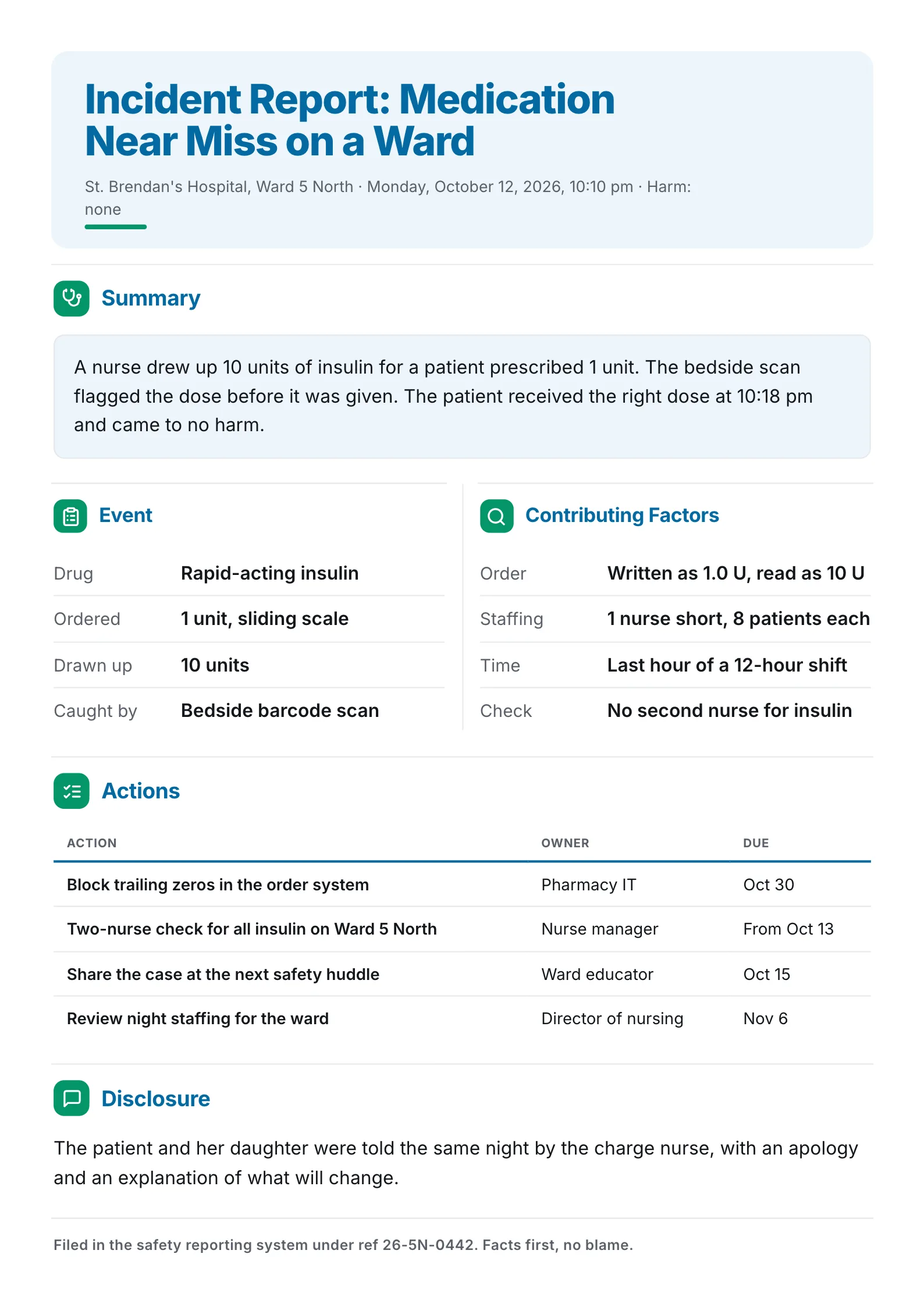
A ward records an insulin error that was caught before it reached the patient.
What to copy:
- The harm level in the header. "Harm: none" is the first thing a reviewer looks for.
- Contributing factors, not a culprit. "1.0 U" read as "10 U", one nurse short, the last hour of a 12-hour shift.
- Disclosure written down. The patient and her daughter were told the same night, with an apology.
You can edit this medication near miss incident report template for free.
3. Apartment water leak report
 Edit this template
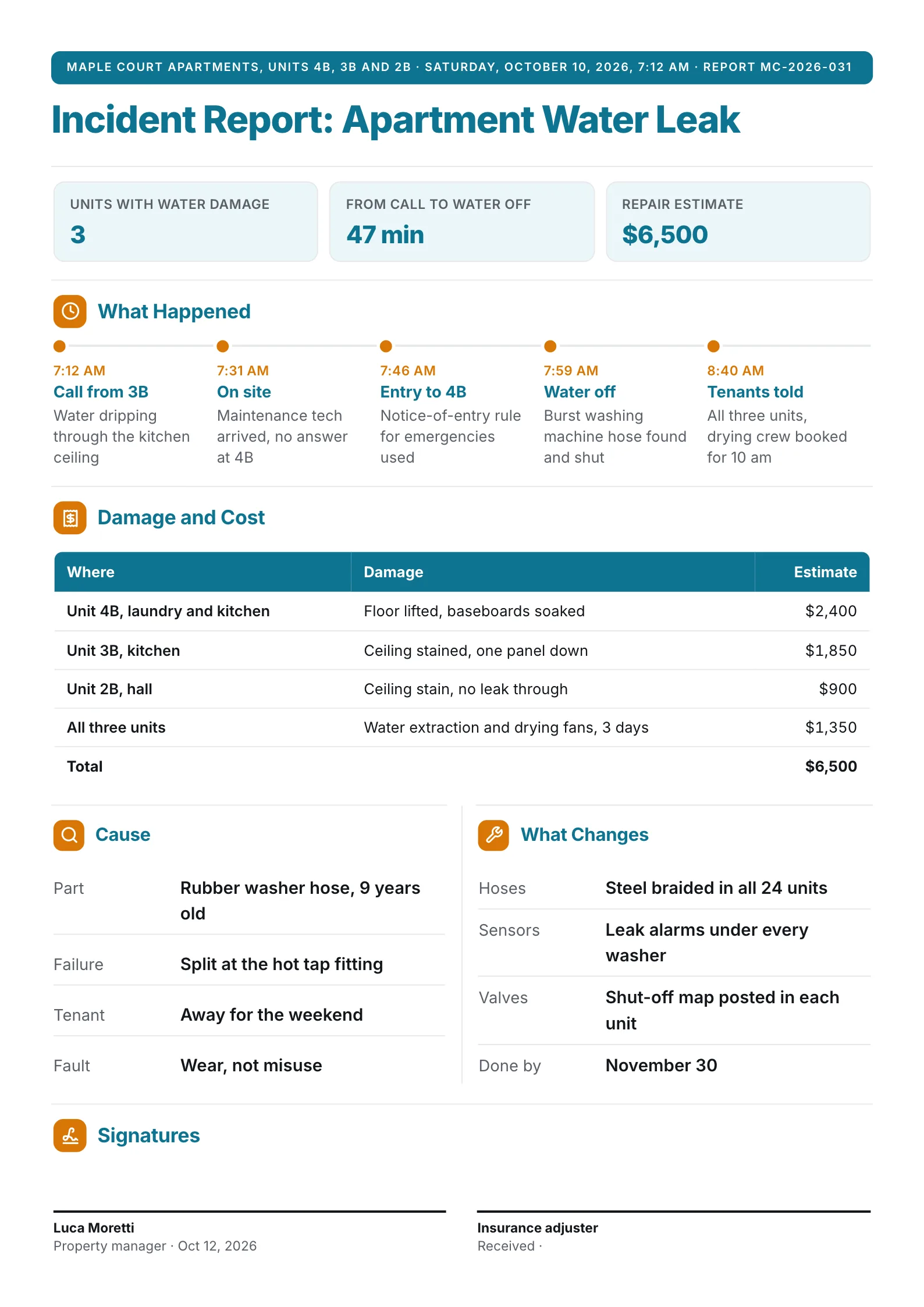
A property manager's report written for the owner and the insurance adjuster on the same sheet.
What to copy:
- Cost by unit, with a total. Four rows add up to the $6,500 estimate the adjuster needs.
- The cause stated plainly. A 9-year-old rubber hose split at the fitting: "wear, not misuse".
- One fix across the building. Steel braided hoses and leak alarms in all 24 units by 30 November.
You can edit this apartment water leak incident report template for free.
4. Payments outage report
 Edit this template
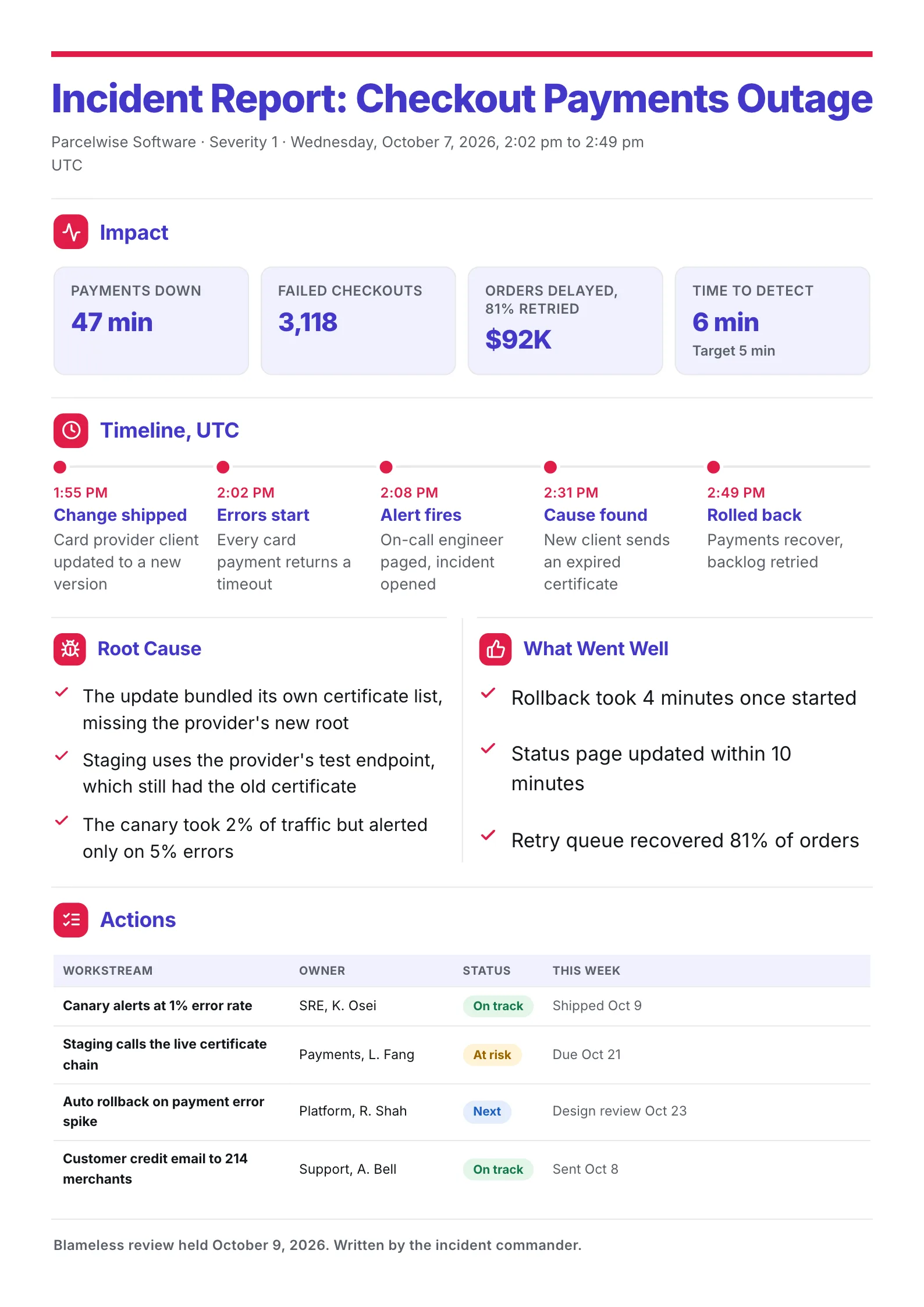
A software team's blameless review of the 47 minutes when payments were down.
What to copy:
- Impact in money as well as minutes. $92K of orders delayed, and 81% recovered by retries.
- Root cause as a chain. A new certificate list, a staging setup that hid it and an alert set too high.
- What went well, too. Rollback took 4 minutes once started.
You can edit this payments outage incident report template for free.
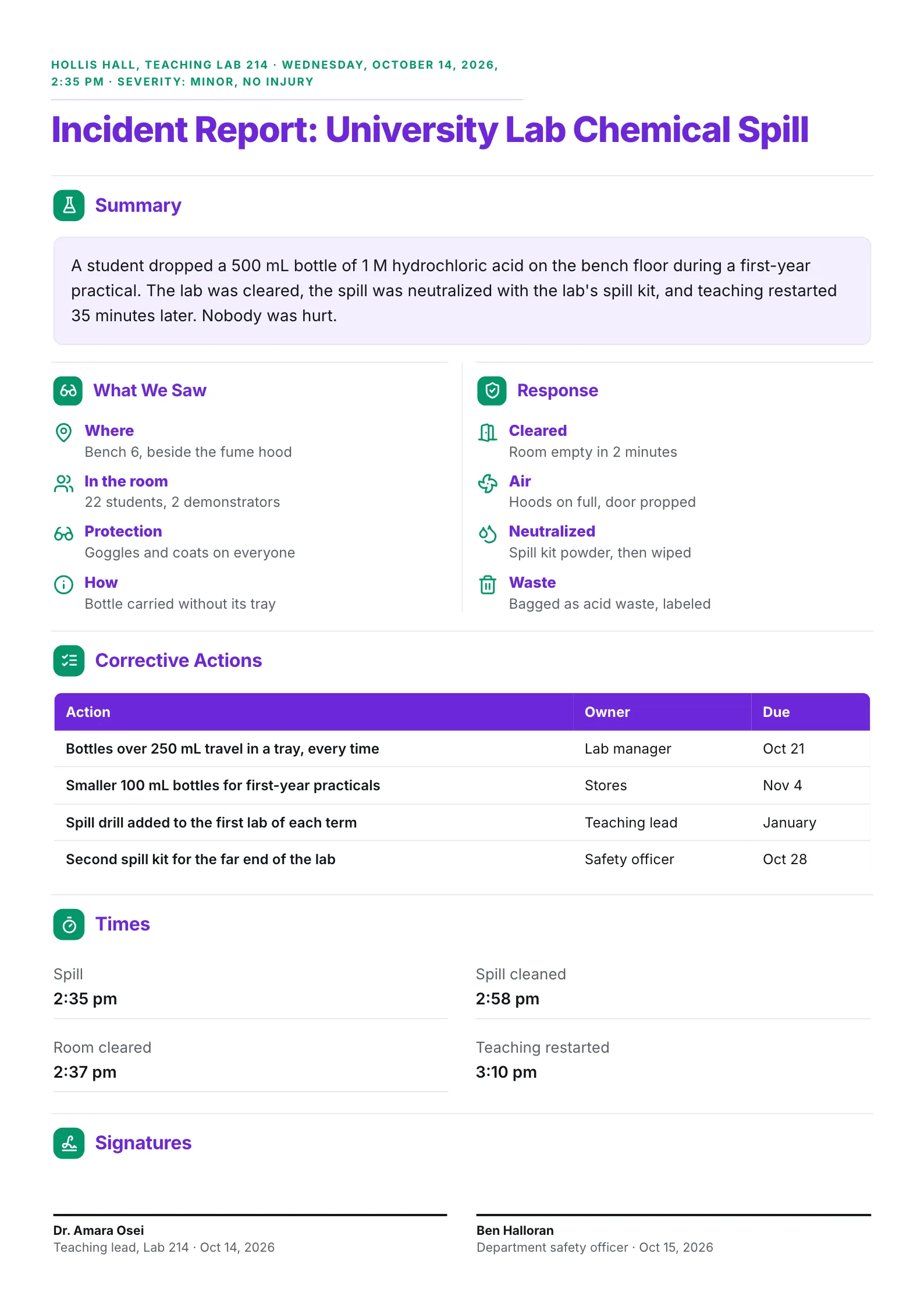
5. University lab chemical spill report
 Edit this template
A minor spill with no injury, written up so the four fixes have names and dates beside them.
What to copy:
- Severity in the subtitle. "Minor, no injury" before anyone reads a line.
- Corrective actions as a table. Action, owner and due date, from bottle trays to a second spill kit.
- Four timestamps. Spill 2:35, cleared 2:37, cleaned 2:58, teaching back at 3:10.
You can edit this university lab chemical spill incident report template for free.
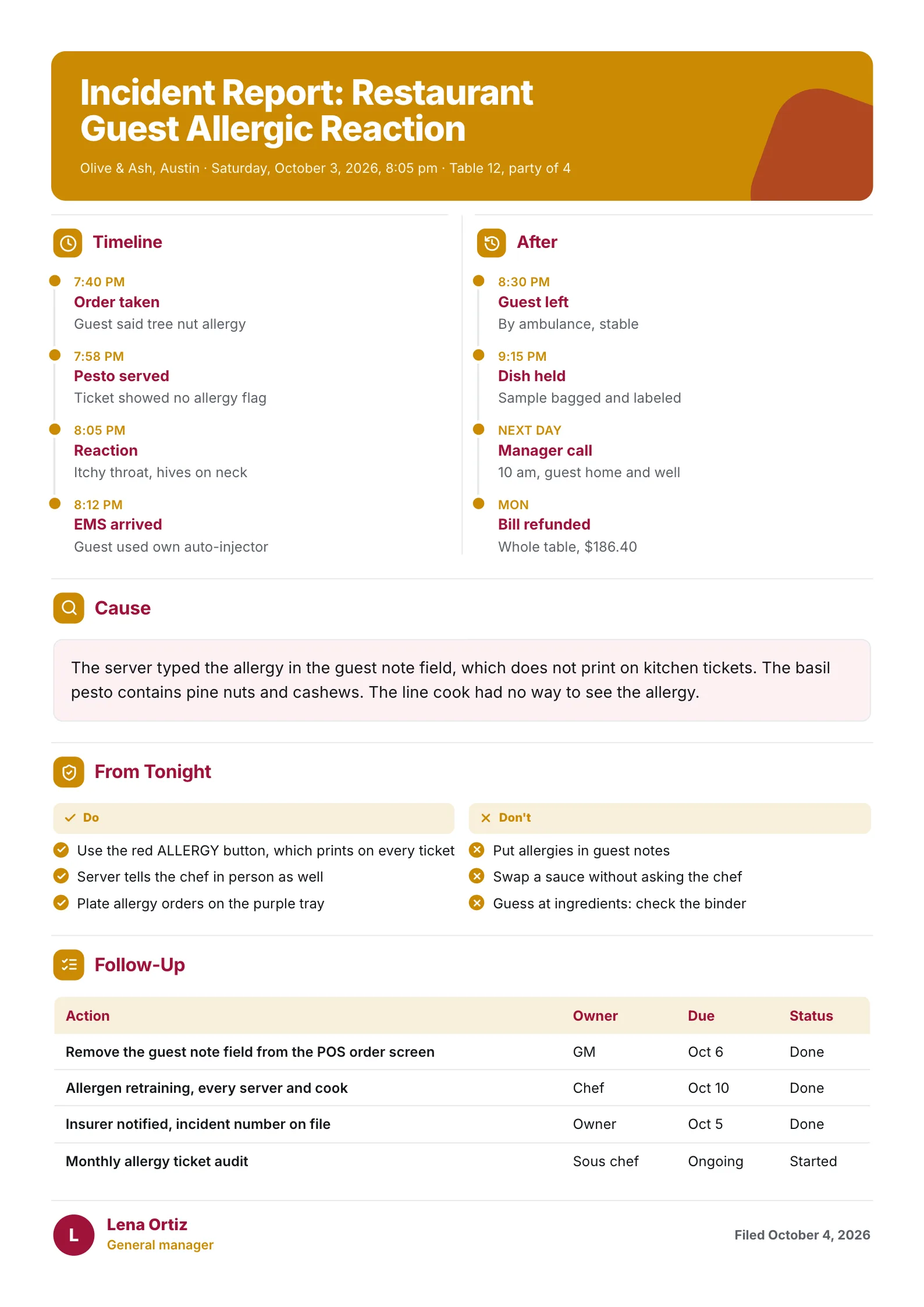
6. Restaurant allergic reaction report
 Edit this template
A restaurant finds out why a guest's nut allergy didn't reach the kitchen.
What to copy:
- Two timelines. The evening minute by minute, then the days after, up to the refund.
- The cause in the system, not the person. The guest note field never prints on kitchen tickets.
- New rules from tonight. Use the red ALLERGY button, and tell the chef in person.
You can edit this restaurant allergic reaction incident report template for free.
How to write an incident report in 6 steps
- Make the area safe first. First aid, isolation or containment comes before paperwork.
- Write it the same day. Facts fade fast. Get statements from the people involved and anyone who saw it before they compare stories.
- Stick to what you know. "The floor was wet near the loading door" is a fact. "Someone was careless" is not. Mark anything you are not sure of as unconfirmed.
- Build the timeline. Use logs, alerts, camera times and statements. Times turn an argument about what happened into a record of it.
- Count the impact. Injuries, hours lost, systems down, people affected, records exposed. Use numbers, even if they are zero.
- Assign every follow-up action. One owner and one date per action. A report without actions is a story, not a fix.
Got notes from a call, a chat thread and a log export? Drop them into the free AI One-Pager generator and you'll get them back as a designed incident report to check and send.
US reporting deadlines to know
Some incidents have to go to a regulator as well as to your own managers. For workplace safety in the US, OSHA requires employers to report a work-related fatality within 8 hours. You have 24 hours to report an in-patient hospitalization or an amputation, or the loss of an eye (29 CFR 1904.39). If you keep OSHA injury records, you must also record a recordable injury or illness on the OSHA 301 form, or an equivalent, within 7 calendar days of learning about it (29 CFR 1904.29).
Security incidents can have their own deadlines under state breach laws, industry rules or contracts. Check which apply to you and write the deadline on your template, so the person filling it in at 2 am doesn't have to look it up.
Incident report vs post-mortem
| Incident report | Post-mortem | |
|---|---|---|
| When | As soon as possible after the event | Days later, once the facts are in |
| Focus | What happened and what was done | Why it happened and what changes |
| Length | One sheet | One sheet to a few pages |
| Written by | The supervisor or responder | The team, often in a meeting |
Your incident report comes first. A post-mortem builds on it to find the cause.
Incident report mistakes
- Waiting. A report written a week later is a memory, not a record.
- Blame in the first line. People stop reporting near misses when reports read like accusations. Facts first, causes later.
- No times. "Later that morning" cannot be checked. "09:12" can.
- Skipping near misses. The incident that almost happened is the cheapest one to learn from.
- Actions without owners. "Improve training" will not happen. "Finance on security keys by 4 Nov, L. Ortiz" will.
Make your incident report
Open the free incident report template and fill in your own event. Or drop your notes into the free AI One-Pager generator and you'll get a finished incident report back.
Frequently asked questions
What should an incident report include?
Start with a reference number, the type and severity, and what happened. Add the date and time, the place and the people involved. Then you need a timeline, the immediate actions and the impact. Finish with follow-up actions that have owners and dates.
How soon should an incident report be written?
Write it as soon as everyone is safe, ideally the same day. Some events also have legal deadlines you need to meet. In the US, OSHA requires a fatality to be reported within 8 hours.
Who writes an incident report?
Usually it's the supervisor or manager closest to the event, or the responder who got there first. They add statements from the people involved and any witnesses.
What is the difference between an incident and an accident?
An accident is an incident that caused injury or damage. Incident is the wider word and also covers near misses, security events and outages where nothing was hurt.
Should near misses be reported?
Yes. A near miss shows you the same cause as an accident, without the injury. Reporting them is one of the cheapest ways for you to prevent the real thing.




