How to Make a Balance Sheet: The 28 Lines of IRS Schedule L, Made Simple
How to make a balance sheet using the order of IRS Schedule L: two dates side by side, assets by how fast they turn to cash, debts split at one year, then equity.

To make a balance sheet, choose one date and list everything the business owns on that day. Then list everything it owes. Owned minus owed is the owners' equity, and the two sides of the sheet must come to the same total. The cleanest model for the order is a government form. Schedule L of IRS Form 1120 is the balance sheet a corporation files with its tax return, and it fits on 28 numbered lines. Start from a free one pager template.
One‑Pager examples
Real One-Pagers made with MakeOnepagers. Open any one to edit it as your own.
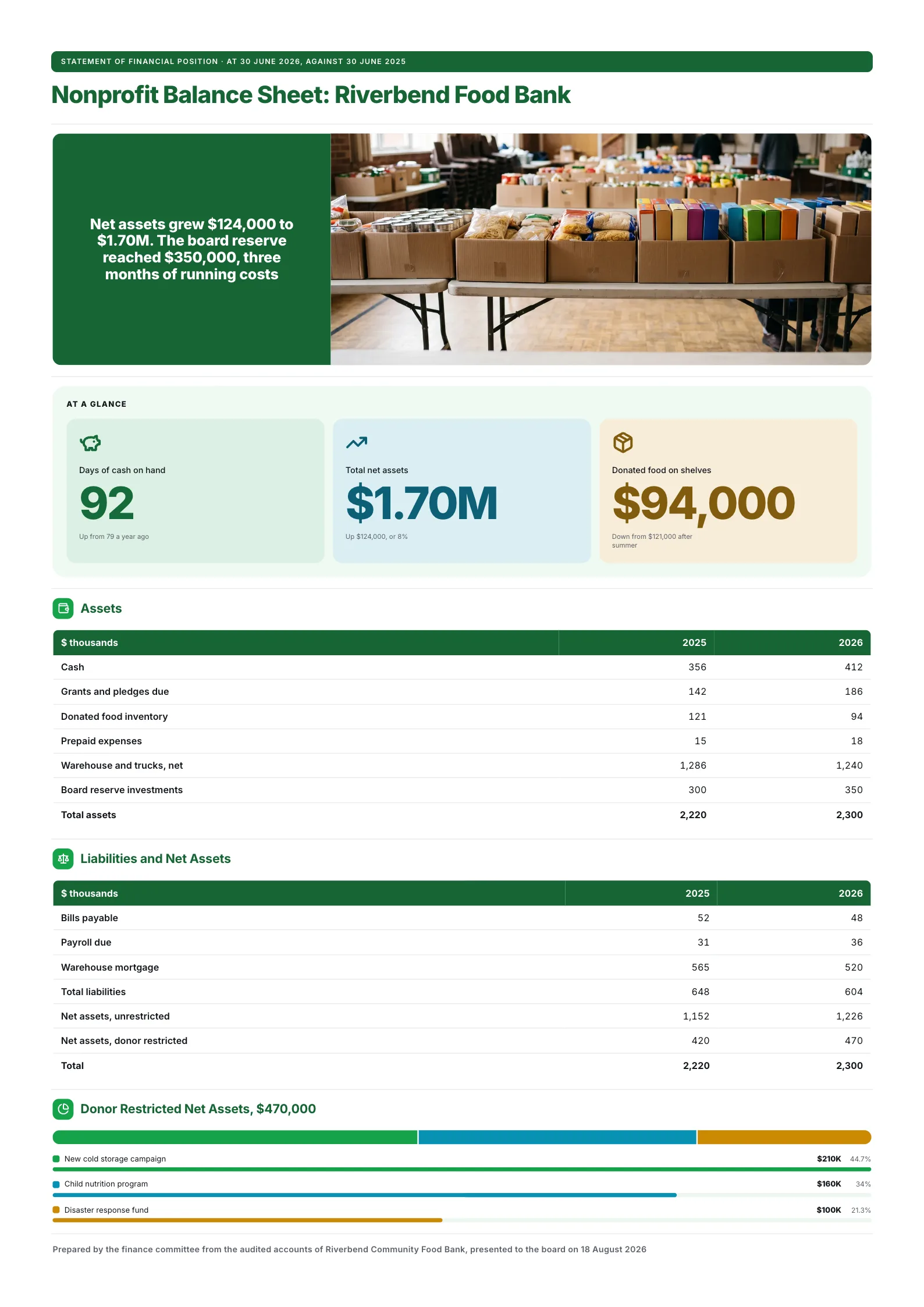 Balance Sheet: NonprofitEdit for free(opens in a new tab)
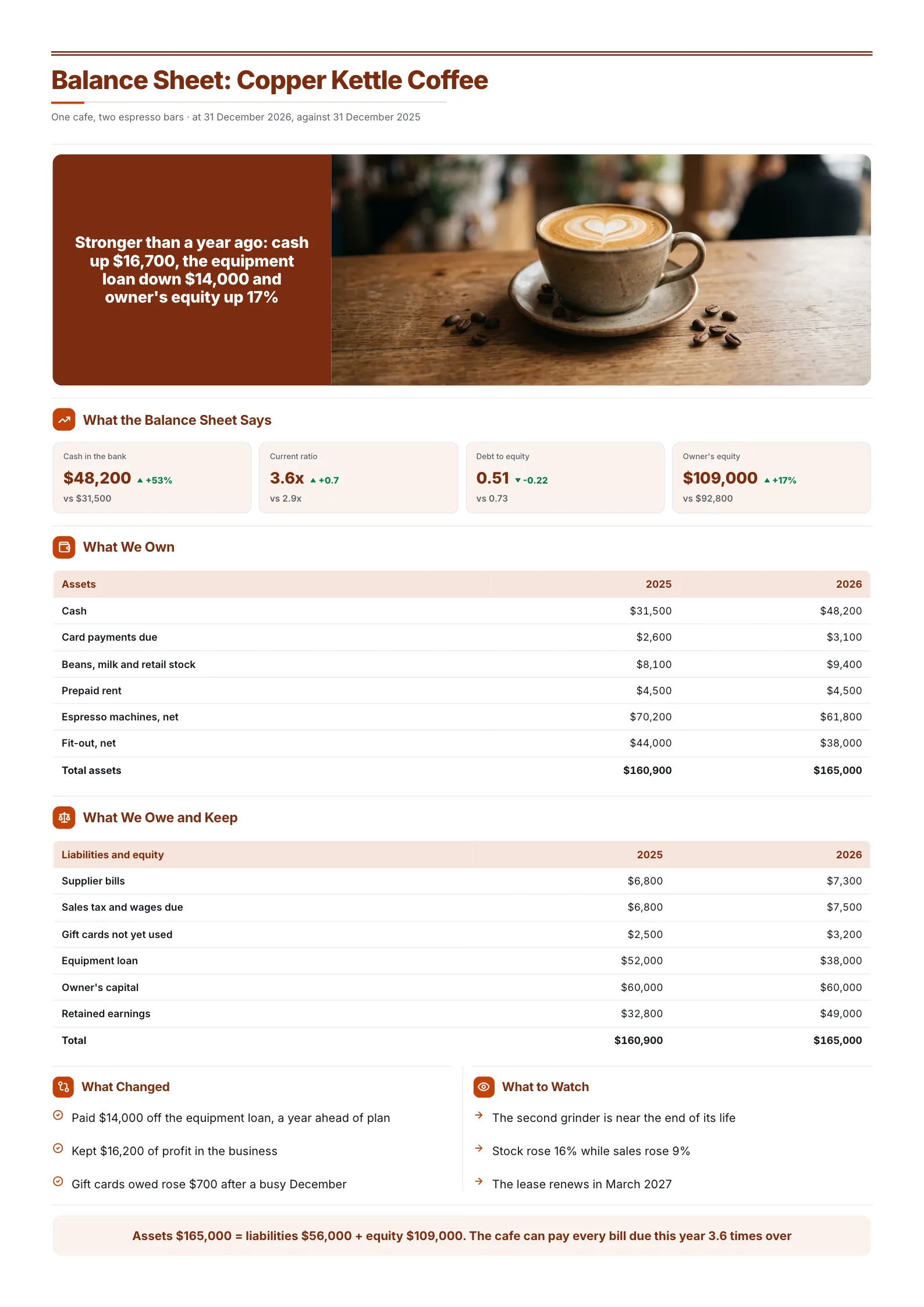 Balance Sheet: CafeEdit for free(opens in a new tab)
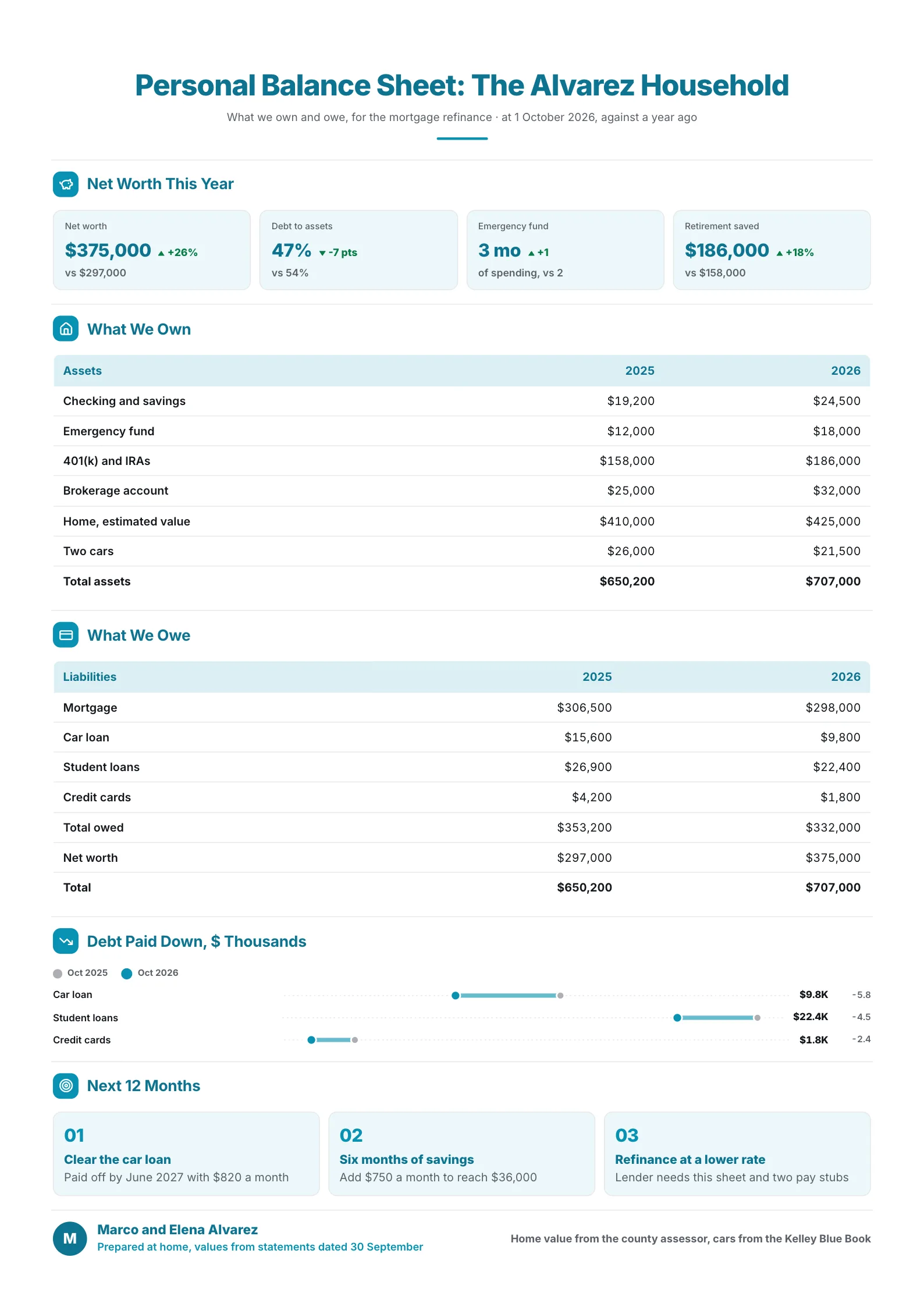 Balance Sheet: PersonalEdit for free(opens in a new tab)
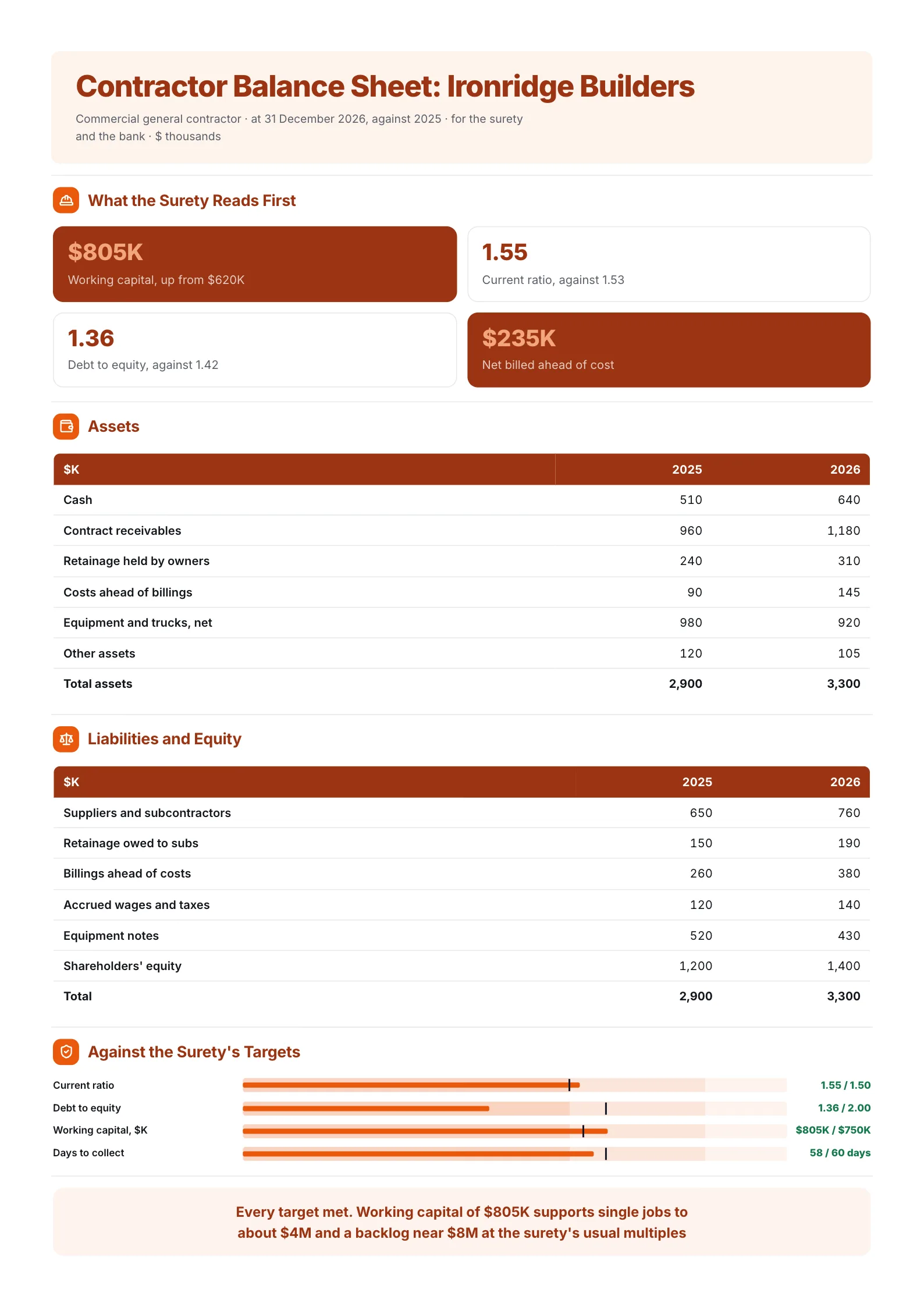 Balance Sheet: ContractorEdit for free(opens in a new tab)
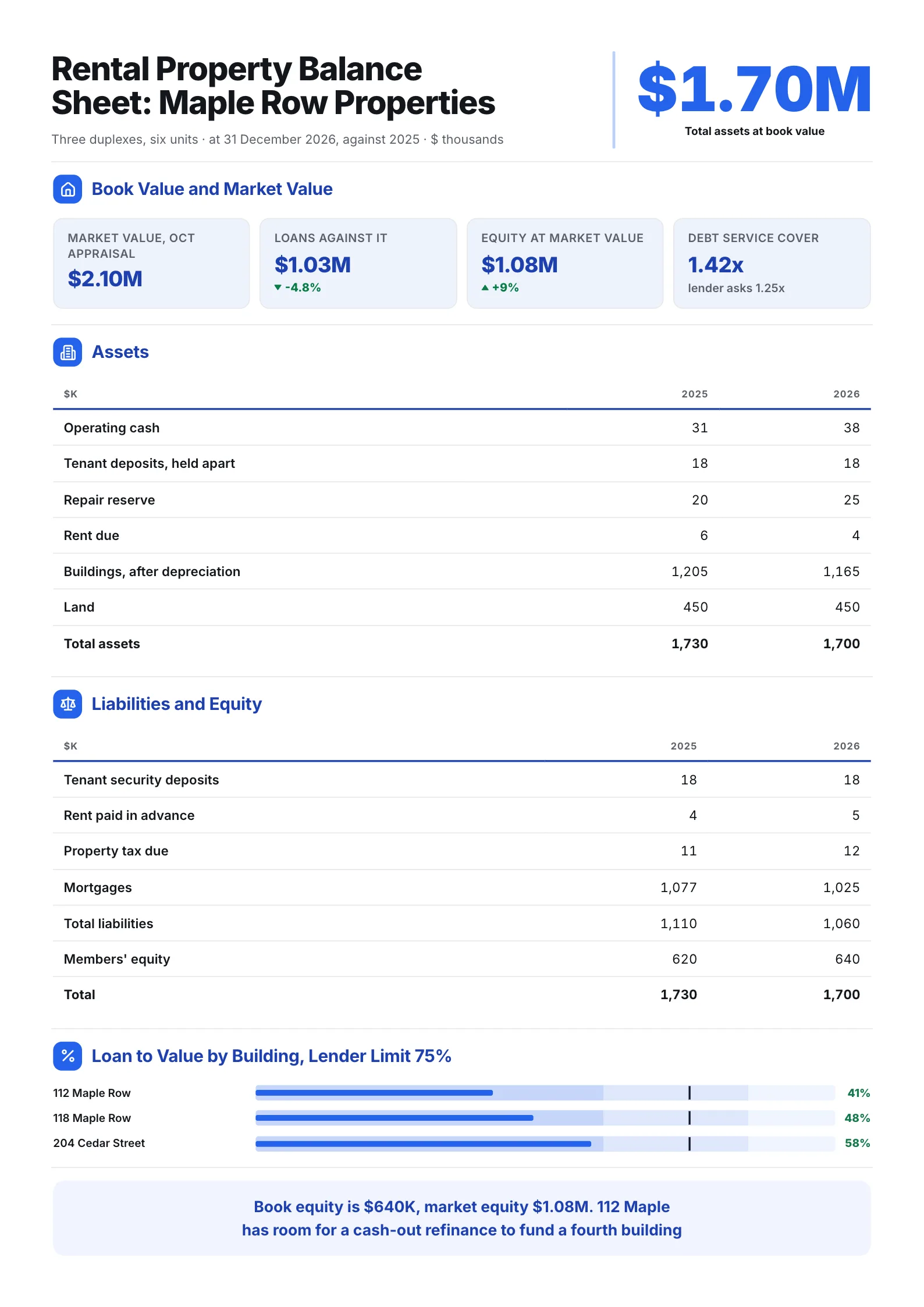 Balance Sheet: Rental PropertyEdit for free(opens in a new tab)
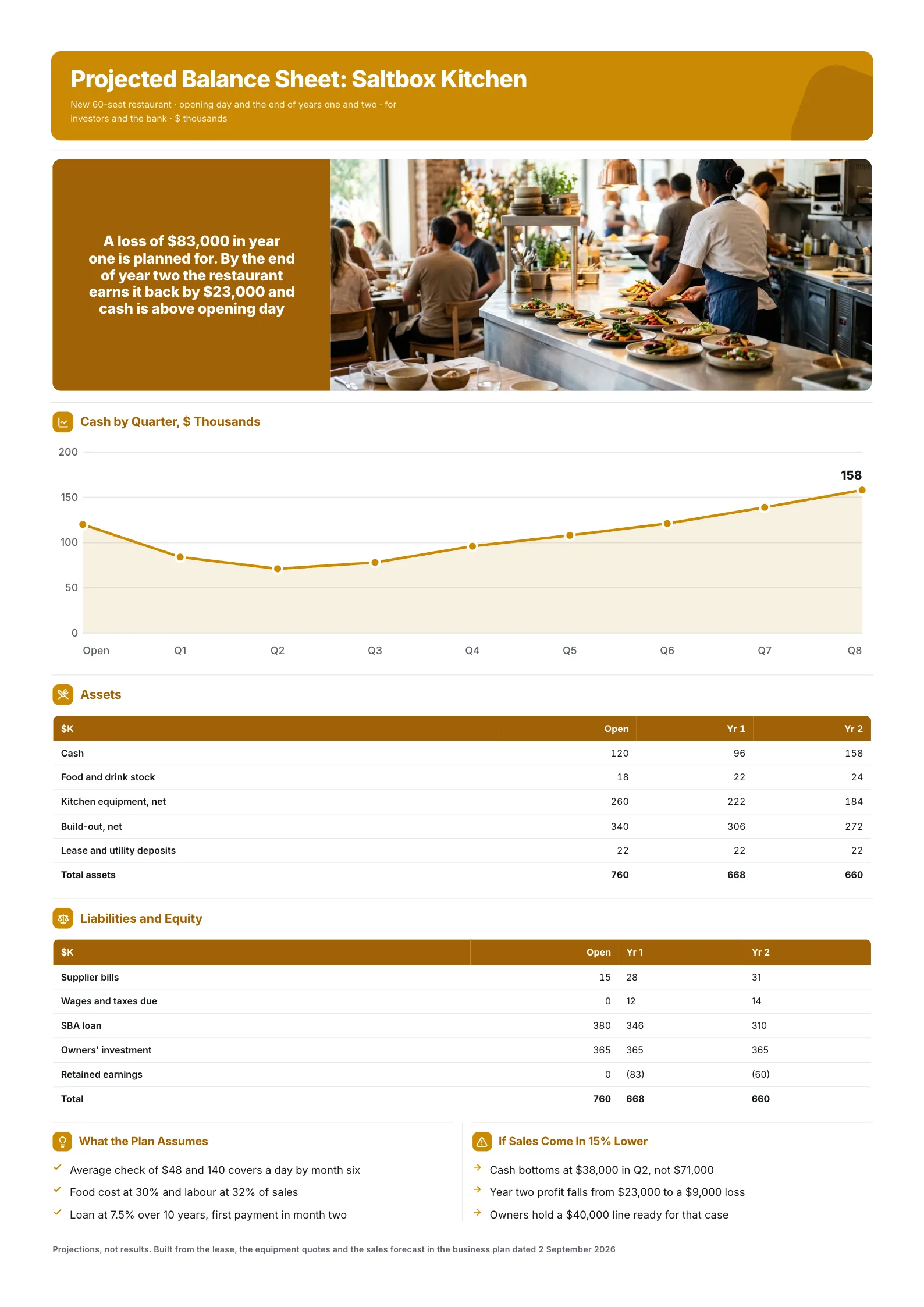 Balance Sheet: ProjectedEdit for free(opens in a new tab)
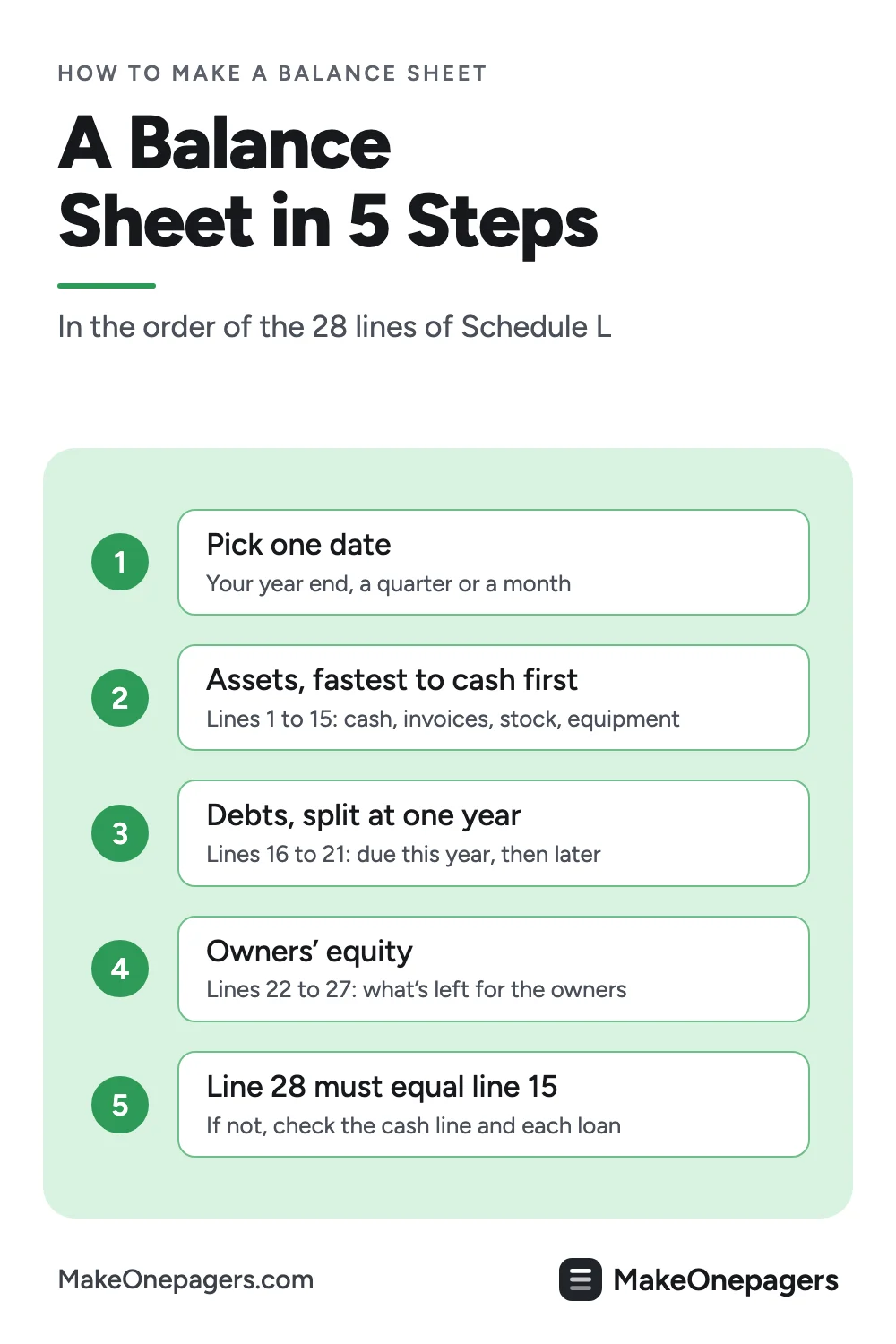
Start with the short version below, then follow the form one block at a time to see how you build yours.
The short version: 28 lines in nine rows
Most small businesses don't need all 28 lines. Here's how they fold into nine rows, five for what you own and four for what you owe and the owners' share. Copy the right column into your spreadsheet as your row labels.
| Schedule L lines | What it covers | One row on your sheet |
|---|---|---|
| 1 | Cash | Cash |
| 2a, 2b | Customer invoices, less bad debts | Money owed to us |
| 3 | Inventory | Stock |
| 4 to 9, 14 | Investments, loans out, other | Other assets |
| 10a to 13b | Buildings, equipment, land, intangibles | Equipment and property, net |
| 16, 18 | Bills and other short-term debts | Bills due |
| 17 | Debt due within a year | Loans due this year |
| 19, 20, 21 | Owner loans, longer debt, other | Owner loans and long-term debt |
| 22a to 27 | Stock, paid-in capital, retained earnings | Owners' equity |
The rest of this guide explains why the rows sit in that order, and what the form asks for at each step.
Where each number comes from
Every row on your sheet should trace to a document you can hand a lender. Cash is your bank balance on the chosen date, less any checks you've written that haven't cleared. Money owed to you is your list of unpaid customer invoices on that date, minus any you don't expect to collect. Stock is what you counted on the shelf, valued at what you paid for it. Equipment and property come from your list of fixed assets, less the depreciation your accountant has booked.
On the other side, bills due is your list of unpaid supplier invoices, and every loan comes from the lender's own statement. Ask each lender to split what falls due in the next 12 months from what falls due later. Owners' equity is the one number you work out instead of looking up. It's what's left when you take the debts away from the assets, and the equity section below shows how the form lays it out.
Put two dates side by side
Schedule L has four money columns. Columns (a) and (b) hold the beginning of the tax year, and (c) and (d) hold the end. So the IRS never looks at a balance sheet alone. It always puts the year before right beside it.
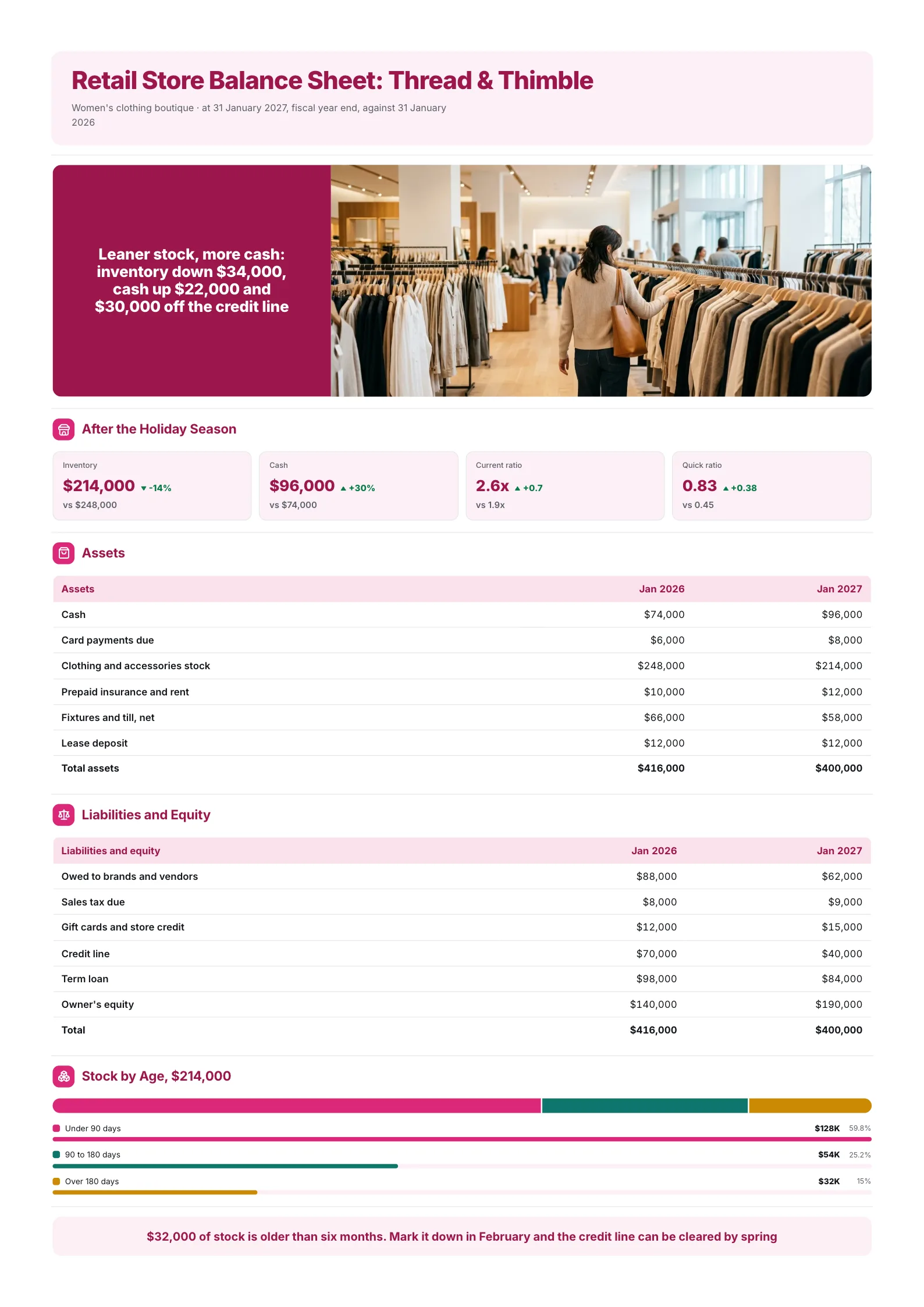
Do the same. Your date is usually the last day of your fiscal year, a quarter or a month. The boutique below closes its year at the end of January, once the holiday returns are in. Put that date's numbers in the right column and the same date a year earlier on the left.
 Edit this template
Columns (a) to (d) in practice: stock fell from $248,000 to $214,000 while cash rose from $74,000 to $96,000. You only see that trade because both years sit side by side. Start from the retail store balance sheet template
Assets, lines 1 to 15: fastest to cash first
Lines 1 to 14 are assets, and their order follows how fast each one turns into cash. Line 1 is the cash you hold. Line 2a is money customers owe you, and 2b takes off what you don't expect to collect. Line 3 is your inventory. Investments and loans you've made come next. Buildings, equipment and land come later, on lines 10a to 12, because they're slow to sell. Line 15 adds them all up.
Three more lines come in pairs that show cost minus the share already used up: buildings and equipment on 10a and 10b (depreciation), oil, timber or minerals on 11a and 11b (depletion), and patents or other intangibles on 13a and 13b (amortization). On your own sheet, one row per asset showing the net amount is fine. Just write "net" in the label, so a reader knows that share is already taken off.
 Edit this template
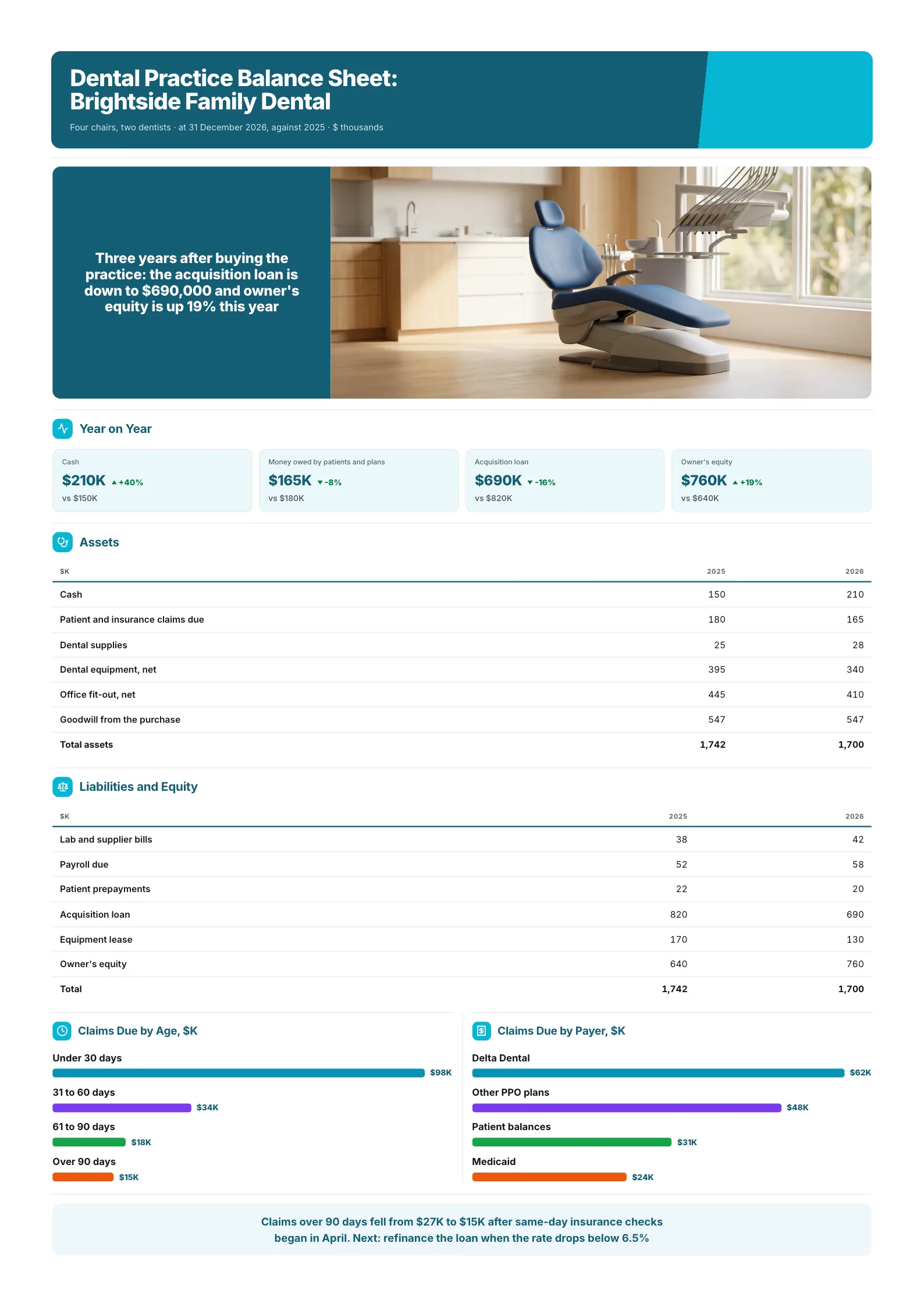
Line 13a in practice: goodwill from buying the practice holds at $547K in both years, while equipment and fit-out carry "net" in their labels. Start from the dental practice balance sheet template
Debts, lines 16 to 21: split at one year
Lines 16 to 21 are liabilities. The form draws one line that matters more than the rest. Line 17 is loans and notes due in less than a year, and line 20 is the same kind of debt due in a year or more. Bills you owe suppliers go on line 16 and other short-term debts on line 18. Money you borrowed from the owners gets its own line, 19.
Keep that one-year split on your sheet. A lender divides what you own within a year by what you owe within a year, and calls it the current ratio. You can't show that number if short and long debt sit in one row.
 Edit this template
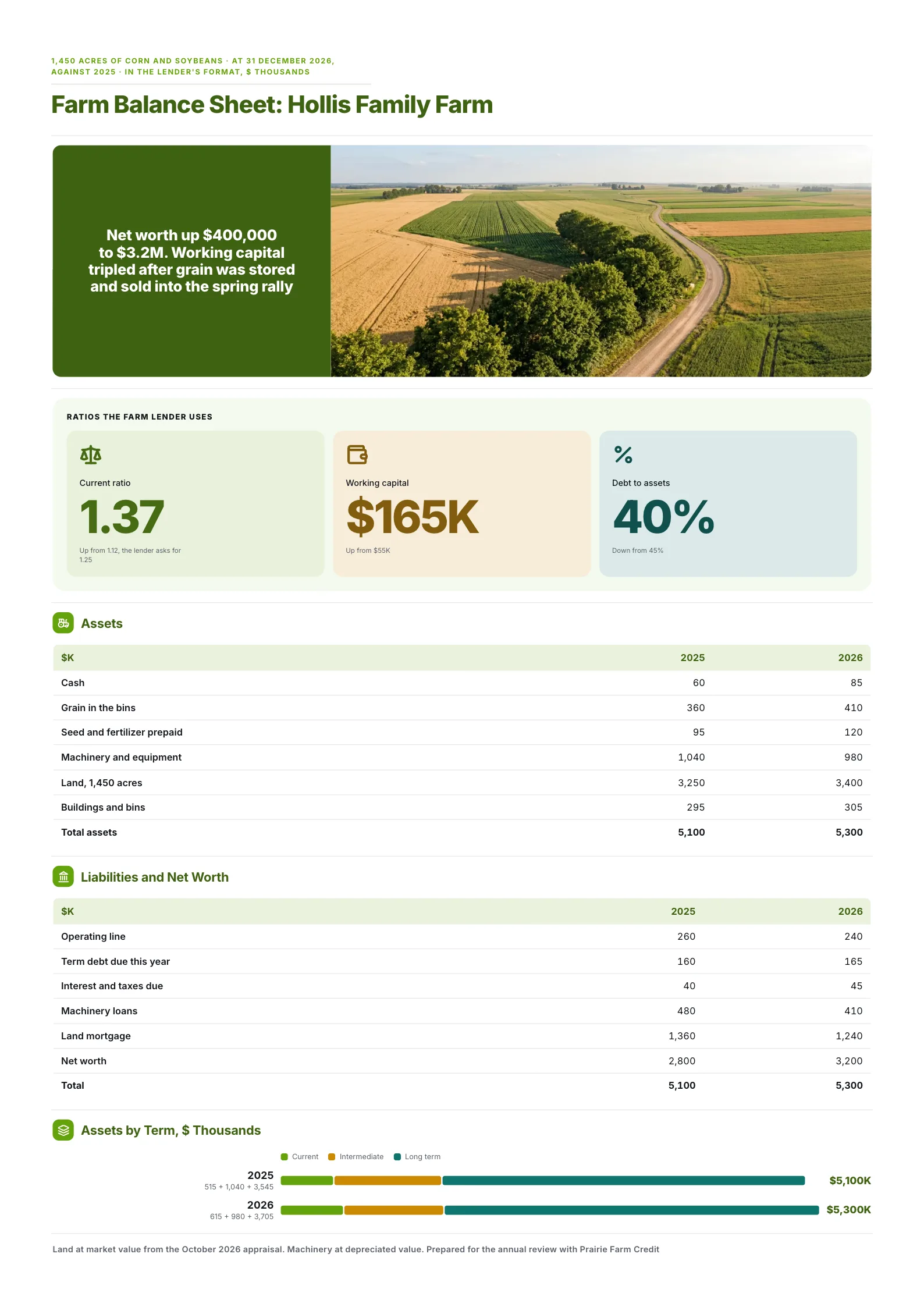
Lines 17 and 20 in practice: $165K of term debt due this year sits apart from the machinery loans and the land mortgage, so the lender can read a 1.37 current ratio against its 1.25. Start from the farm balance sheet template
Equity, lines 22 to 28: the owners' share and the final check
Lines 22 to 27 are the owners' share, what's left for you once every debt is paid. A corporation shows the stock it issued (22a preferred, 22b common), any extra paid in on top (line 23) and the profits it kept over the years (lines 24 and 25). Line 27 takes off any shares the company bought back. If you own the business alone, you can use one row called owner's equity.
Equity can shrink below what the owners put in. A young company that spends investor money before it earns a profit carries an accumulated deficit, a negative number in the retained earnings spot.
Line 28 is total liabilities and shareholders' equity. It has to equal line 15, total assets. If yours don't match, you've missed something or entered it twice. The usual causes are a loan paid off in the bank account but still listed as owed, or a purchase counted as an expense and an asset at the same time.
 Edit this template
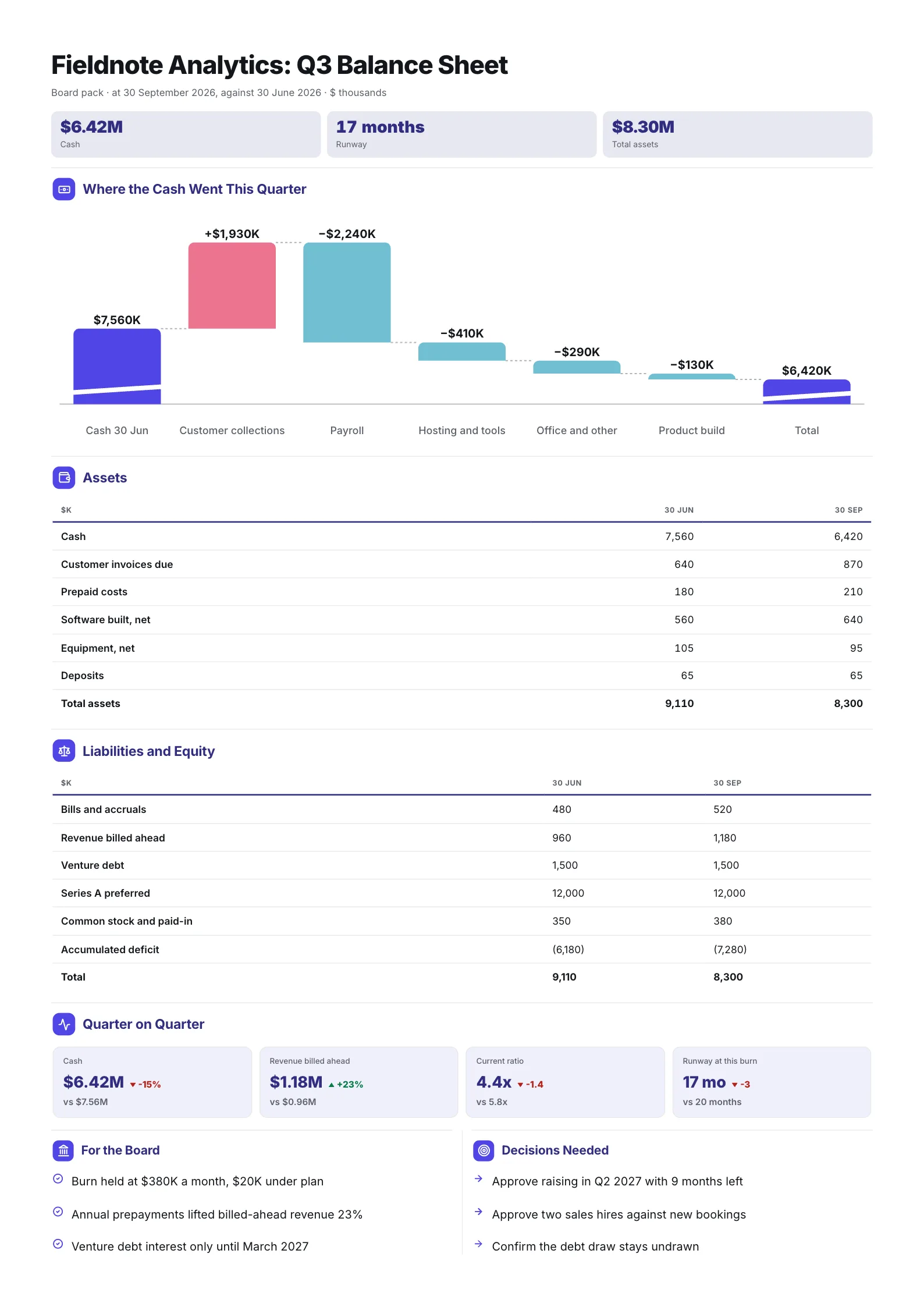
Lines 22a to 25 in practice: Series A preferred of 12,000 and common stock and paid-in capital of 380 sit above an accumulated deficit of (7,280), so equity is 5,100. Add 3,200 of liabilities and you're back at 8,300, the total assets. Start from the startup board balance sheet template
 Edit this template
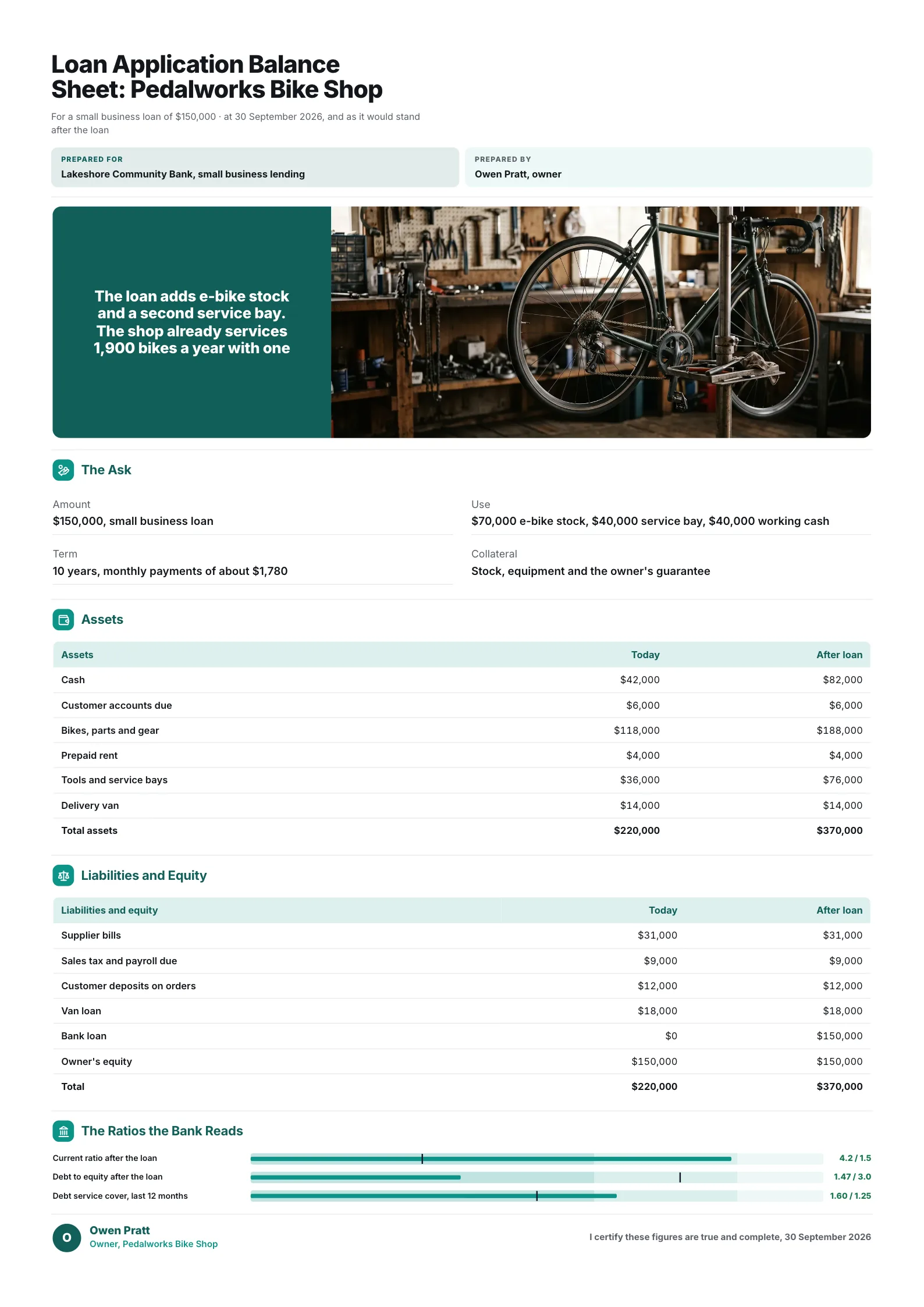
Line 15 equals line 28, before and after the loan: total assets go from $220,000 to $370,000, the new $150,000 bank loan joins the debts, and owner's equity holds at $150,000. Start from the loan application balance sheet template
Do small businesses have to fill in Schedule L?
Not always, and you may not need it for the IRS at all. Line 13 of Schedule K on the same form asks whether total receipts and total assets at year end are both under $250,000. If they are, the corporation doesn't have to complete Schedules L, M-1 and M-2. Your bank or an investor will still ask for a balance sheet, so it's worth keeping one anyway.
Questions people ask about balance sheets
How do I make a balance sheet from a profit and loss statement?
You can't build one from the other alone. Your P&L gives you the year's profit, which adds to retained earnings on the balance sheet. The rest comes from your bank balances, unpaid invoices, loans and assets. Lay the P&L out first with a profit and loss template, then carry its bottom line across.
What order do the items go in?
Assets from the quickest to turn into cash down to the slowest, then debts due within a year, then longer debts, then equity. That's the order Schedule L uses on its 28 lines.
How often should a small business make one?
At least once a year, at your year end. Many owners make one each quarter, and a lender may ask for one with any loan application, dated close to the day you apply.
What if my balance sheet doesn't balance?
Check the cash line against the bank statement first, then each loan against the lender's statement. Most gaps come from a payment recorded on one side and not the other.
Make your balance sheet
Write down your bank balance on your year-end date, then fill the nine rows in the table above for this year and last year. Line 15 and line 28 should land on the same number. If they don't, check the cash line and each loan, as in the answer just above, before you show it to anyone.
Once it balances, the balance sheet template roundup has finished layouts for a cafe, a contractor, a startup board and a household. Every design in MakeOnepagers opens in the editor with sample rows you type over.




