Employee Handbook Template: The One Card a New Hire Will Actually Read
An employee handbook template on one page, shown on 5 crews from home care to a law firm, plus the FMLA notice rule that names handbooks.

Your new hires won't read a 60-page handbook on their first morning. They'll read the part that tells them when payday is, where to clock in and who to call when something goes wrong. A one-page employee handbook template gives you a place to put exactly that, and it points your people back to the full book for everything else. Start from a free one pager template.
One‑Pager examples
Real One-Pagers made with MakeOnepagers. Open any one to edit it as your own.
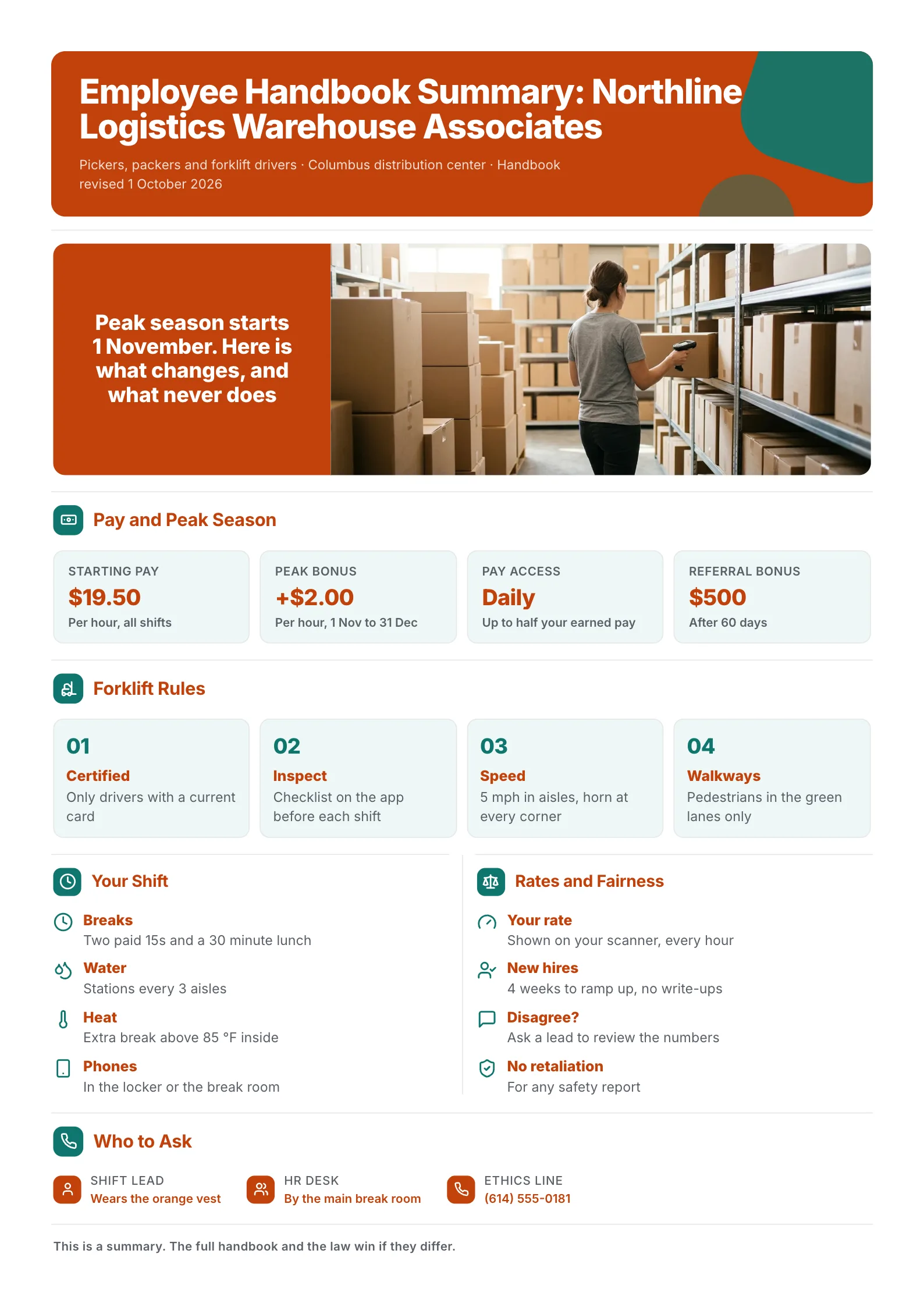 Employee Handbook Summary: Warehouse AssociatesEdit for free(opens in a new tab)
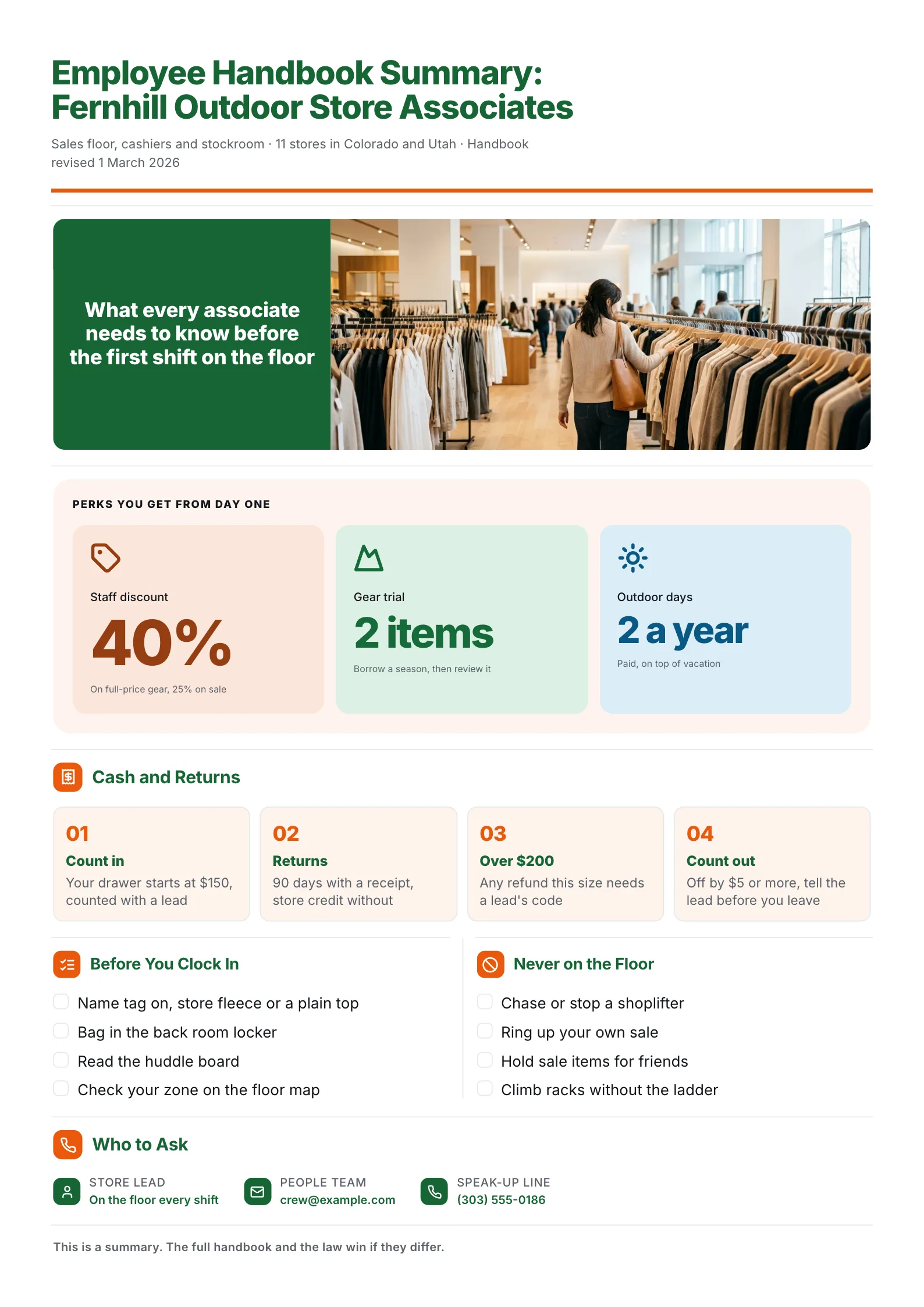 Employee Handbook Summary: Retail Store AssociatesEdit for free(opens in a new tab)
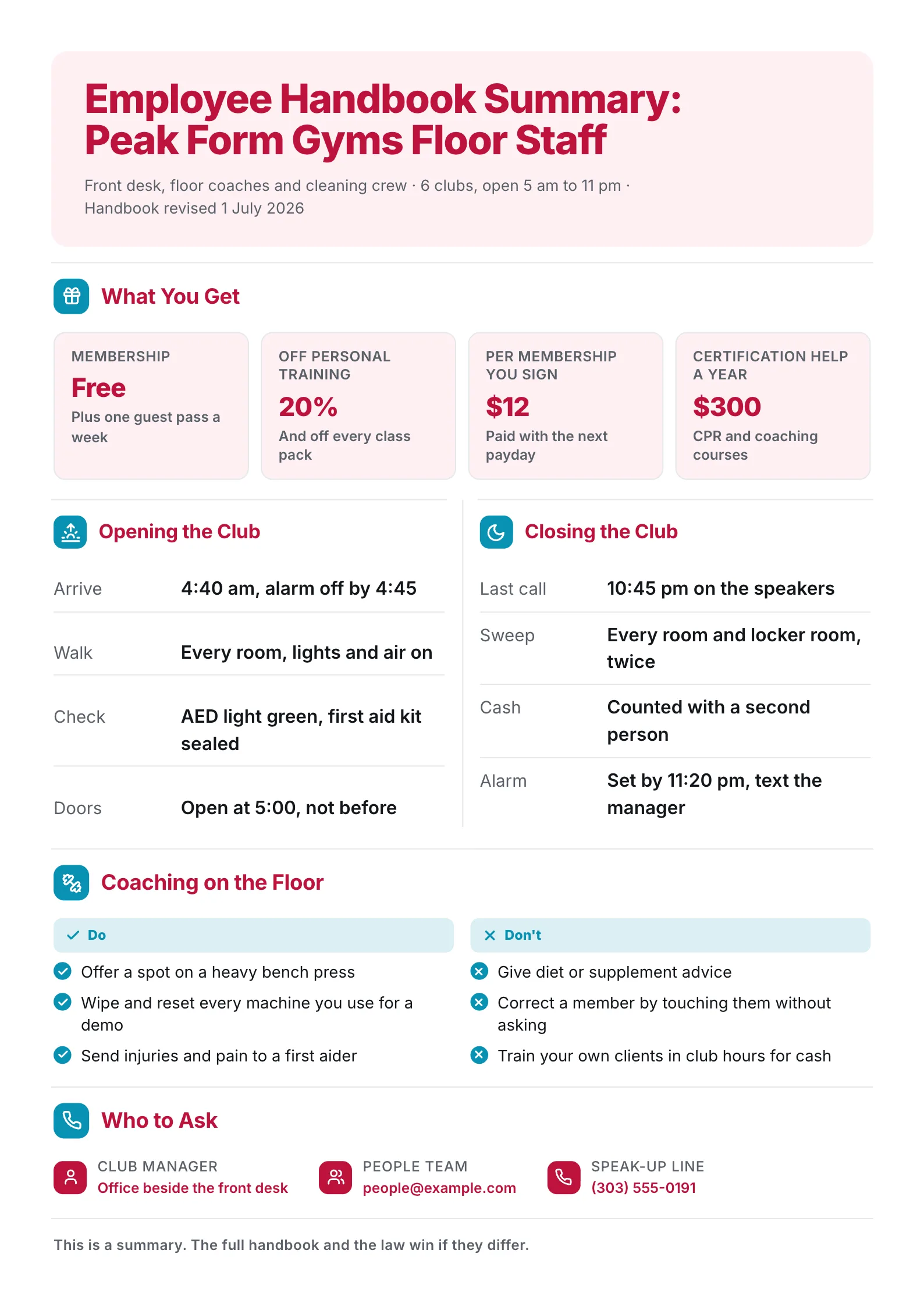 Employee Handbook Summary: Gym Floor StaffEdit for free(opens in a new tab)
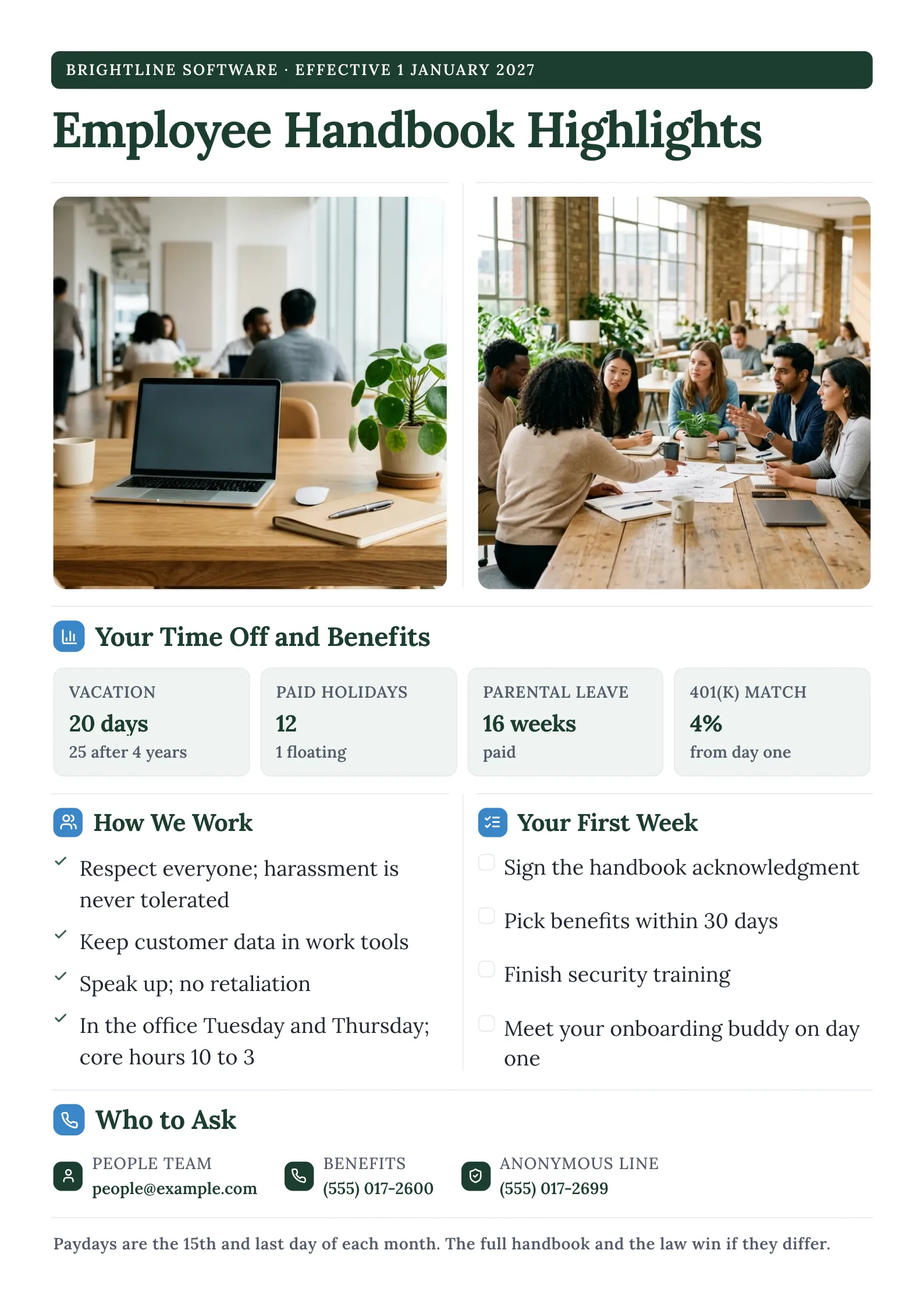 Employee Handbook HighlightsEdit for free(opens in a new tab)
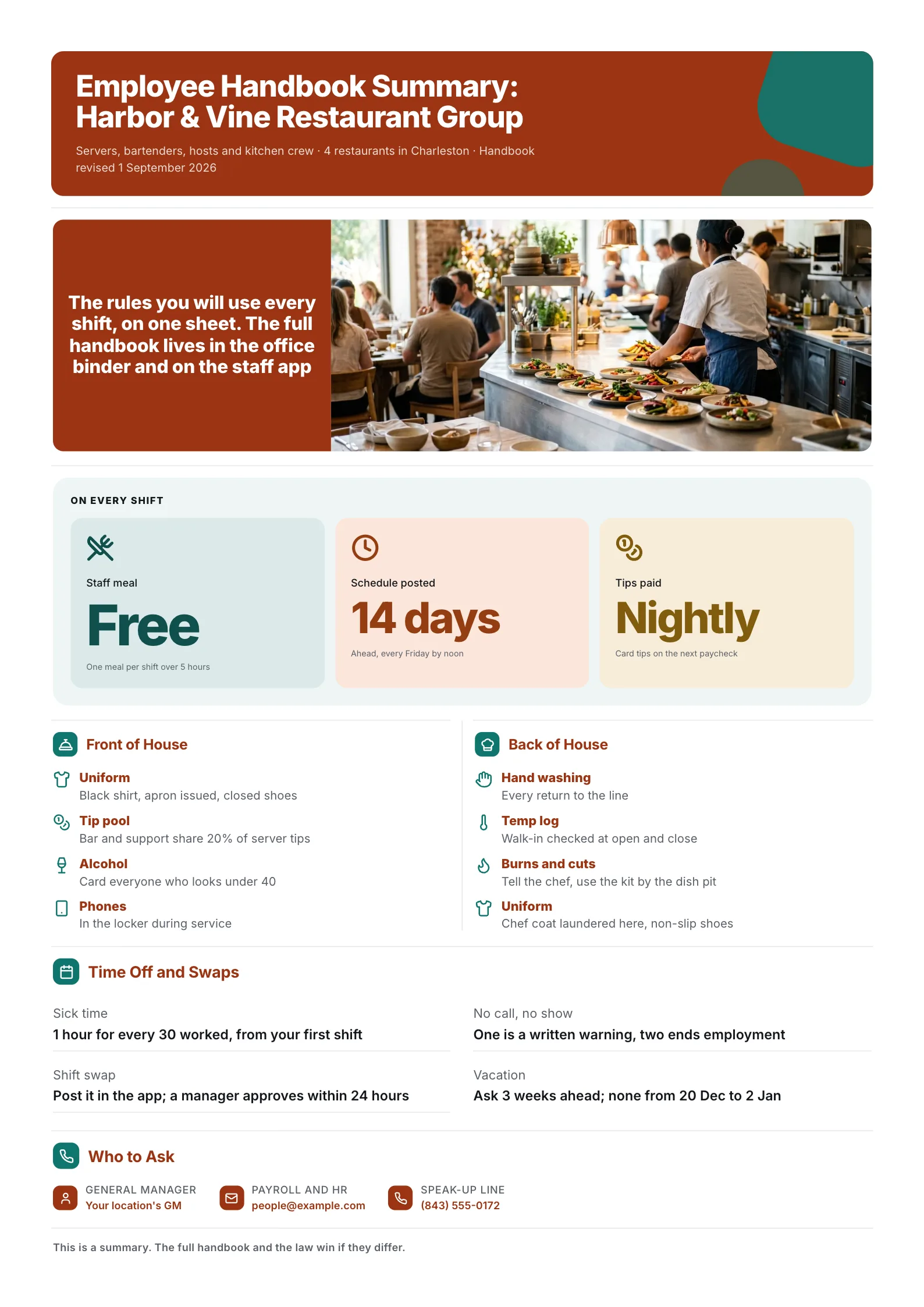 Employee Handbook Summary: Restaurant Group StaffEdit for free(opens in a new tab)
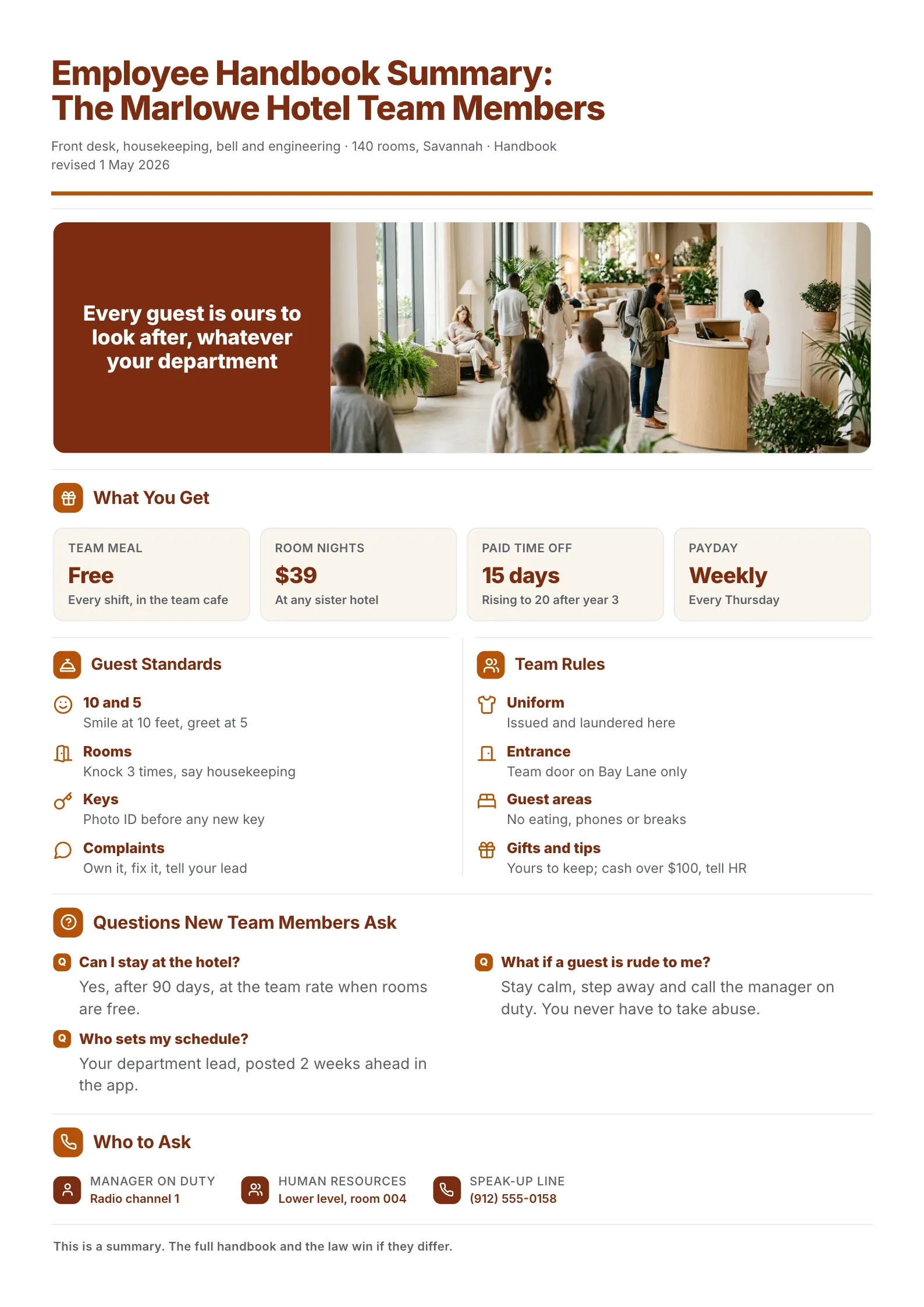 Employee Handbook Summary: Hotel Team MembersEdit for free(opens in a new tab)
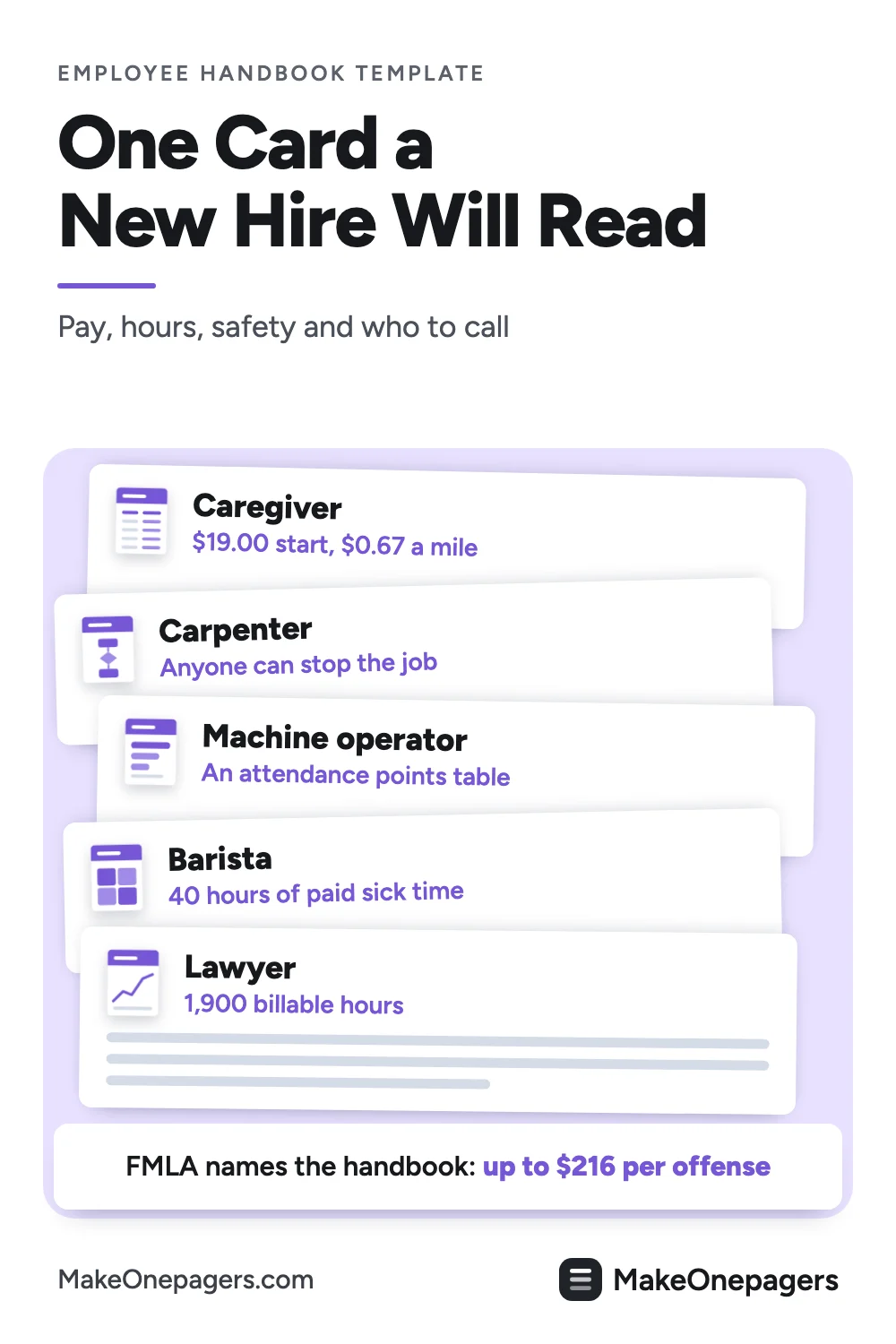
Caregivers who drive between homes, a construction crew, a plastics plant, a coffee chain and a law firm each put different rules on the front of the card, because each job goes wrong in its own way. One federal leave rule mentions handbooks by name, and the last section shows how your summary can point to it.
Caregivers who work alone in clients' homes
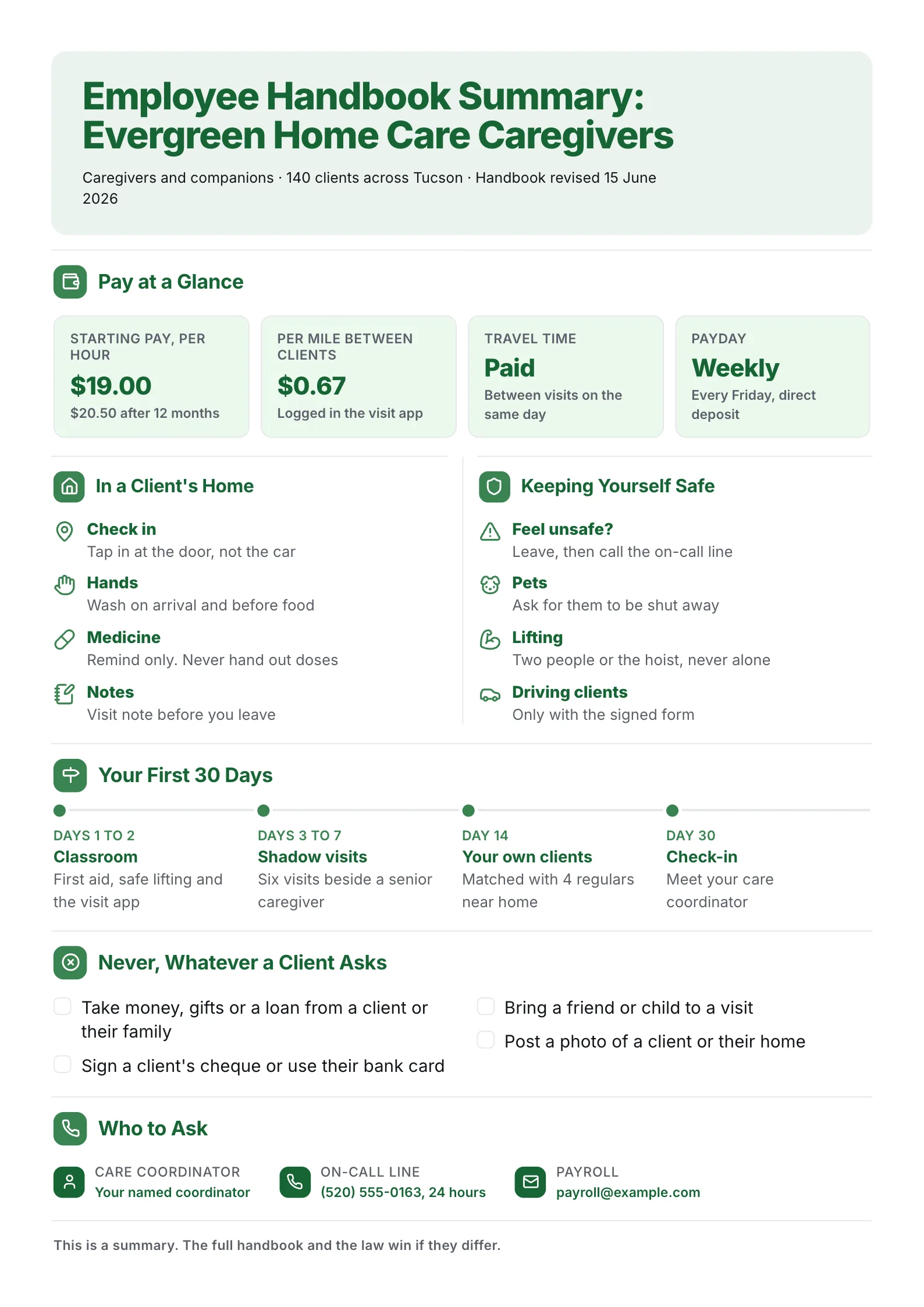
If you run home care, you can't stand next to your staff while they work. Evergreen Home Care's summary is written for 140 clients across Tucson and caregivers who spend the day in other people's houses.
 Edit this template
A made-up agency with sample pay. Every safety rule fits on one line.
Pay comes first, in four tiles: $19.00 an hour to start, $0.67 a mile between clients, paid travel time and a weekly payday. Mileage is the question your new caregivers will ask most, so put the answer where they look first.
The "In a Client's Home" box is short on purpose. Tap in at the door, before you set down your bag. Wash your hands on arrival and before food. Remind clients about medicine but never hand out doses. Write the visit note before you leave.
The safety box speaks straight to the caregiver. If you feel unsafe, leave first and call the on-call line second. Ask for pets to be shut away. Lift with two people or the hoist, never alone. Those lines will do more for your new hire on day one than a chapter of policy.
A construction crew where anyone can stop the job
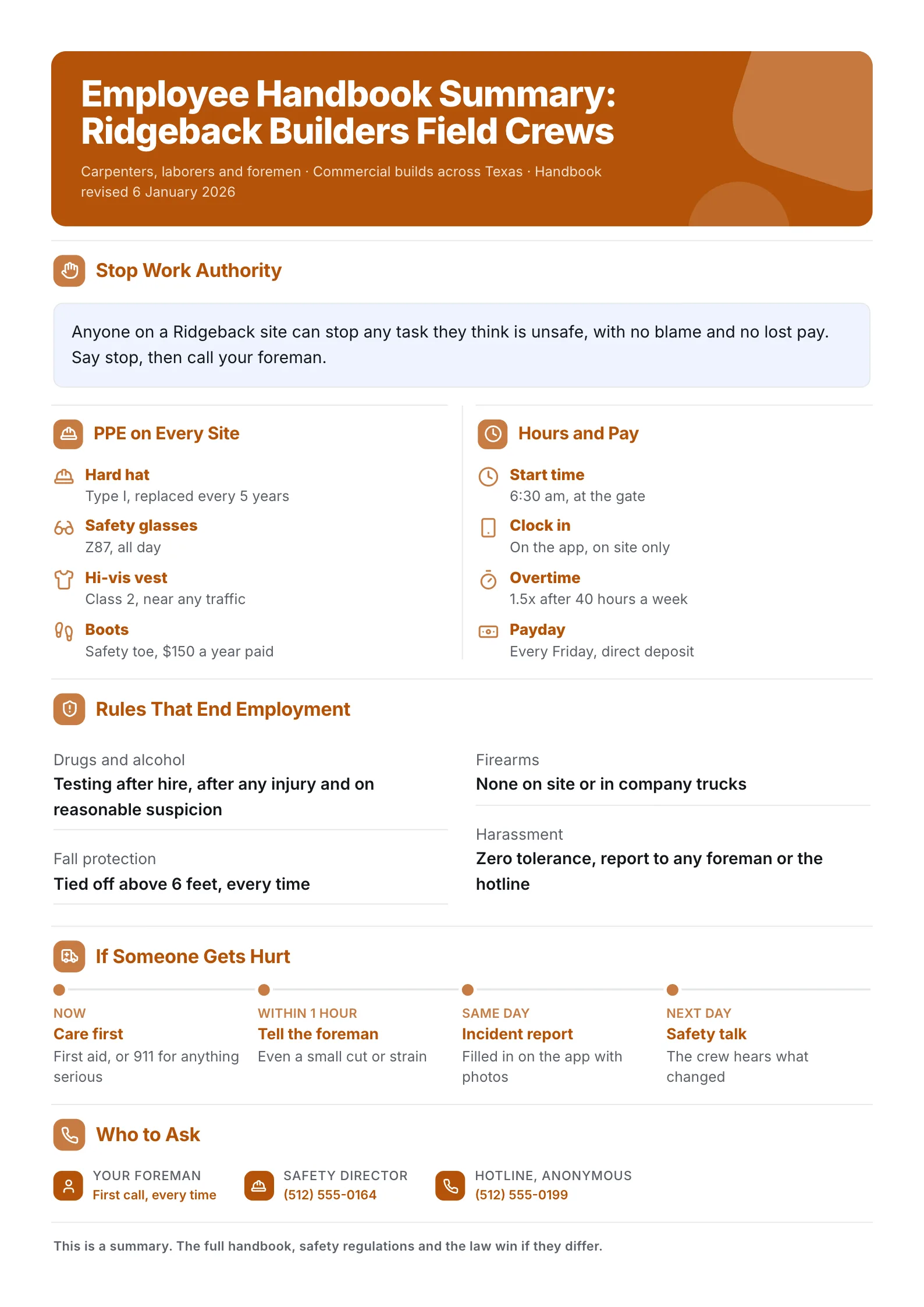
Ridgeback Builders runs commercial builds across Texas with carpenters, laborers and foremen. Their summary opens with a promise, and you can borrow the idea for any job with real hazards.
 Edit this template
Ridgeback is invented. The PPE grid names the standard for each item as well as the item.
The banner says anyone on a Ridgeback site can stop any task they think is unsafe, with no blame and no lost pay. When you put that at the top, a new laborer knows you mean it.
Each item in the PPE grid comes with its standard. A Type I hard hat, replaced every 5 years. Z87 safety glasses, worn all day. A Class 2 hi-vis vest near any traffic. Safety-toe boots, with $150 a year paid toward them. Your worker can check their own gear against that list in the parking lot.
Hours and pay close it out. You start at 6:30 am at the gate, clock in on the app from the site only, and earn overtime at 1.5x after 40 hours a week.
A plastics plant with an attendance points system
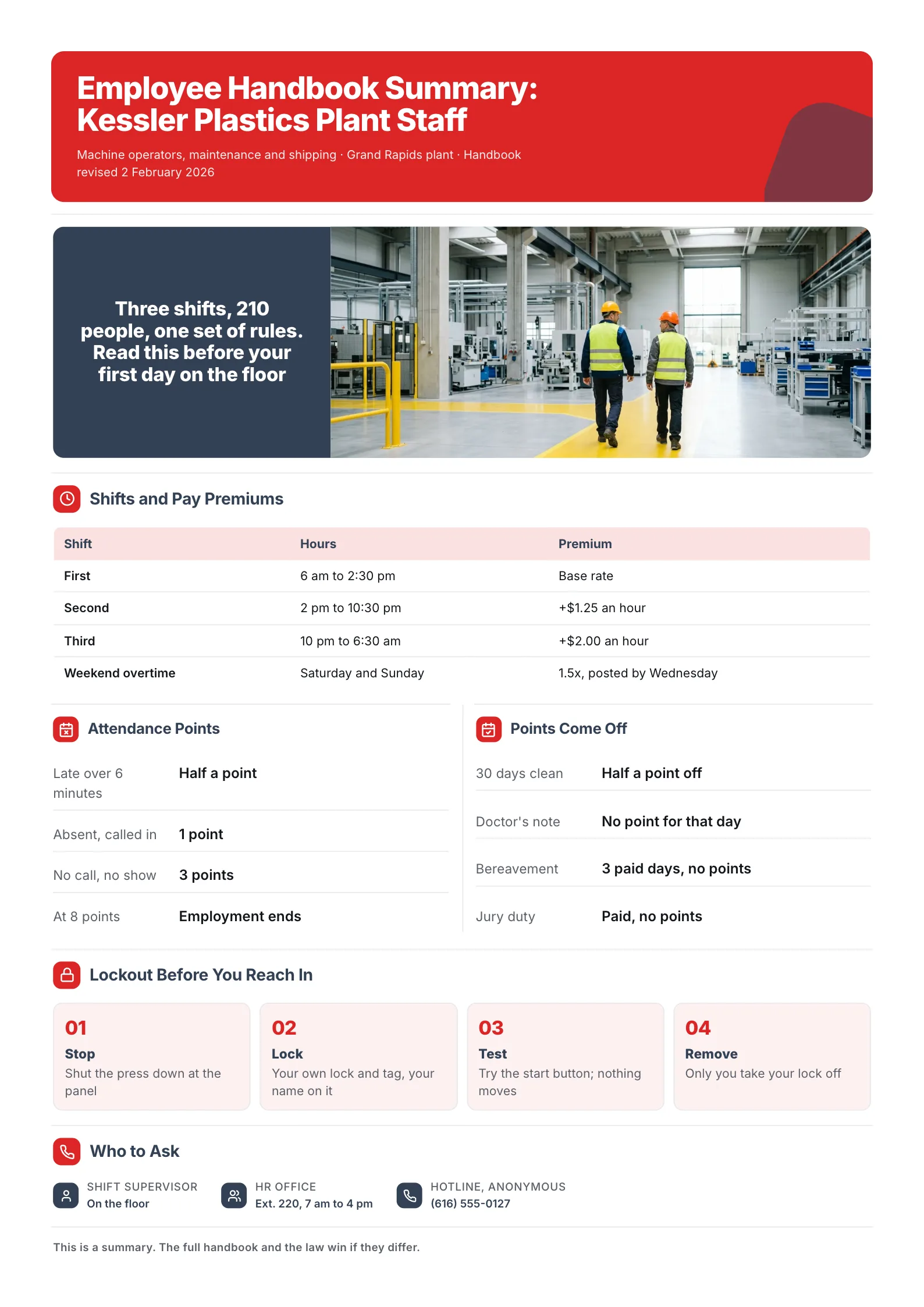
Kessler Plastics runs three shifts and 210 people at a Grand Rapids plant. Their sheet asks you to read it before your first day on the floor, because one set of rules covers every shift.
 Edit this template
Kessler is a sample plant. The points table is the part workers ask about.
Attendance points are what plant workers ask about, so the sheet lays them out as a table. Late by more than 6 minutes costs half a point. A called-in absence costs 1 point. A no call, no show costs 3. At 8 points, employment ends.
Just as useful is how you earn points back. Thirty clean days remove half a point. A note from a doctor wipes out that day's point. Bereavement gets 3 paid days with no points, and jury duty is paid with no points too. When your people can see the way back, they're less likely to give up after a bad month.
The lockout box ends the card with the rule that keeps hands whole: stop and shut the machine down before you reach in.
A coffee chain that writes its standards as numbers
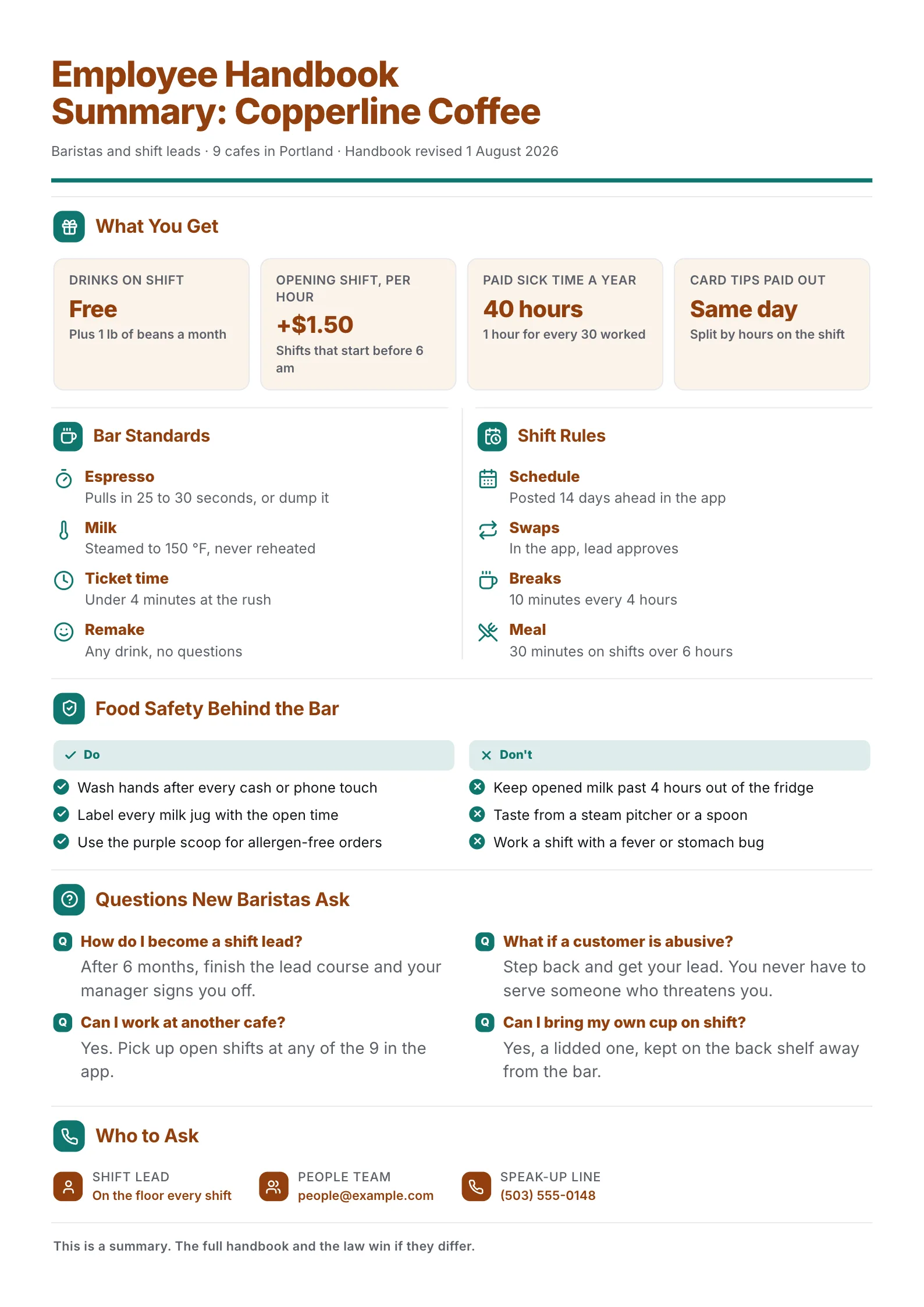
Copperline Coffee has 9 cafes in Portland, staffed by baristas and shift leads. If you manage a counter, you'll like how this summary turns quality into numbers anyone can check at the bar.
 Edit this template
Copperline is invented. The bar standards read like a checklist your lead can audit.
Espresso pulls in 25 to 30 seconds, or you dump it. Milk is steamed to 150 °F and never reheated. Ticket time stays under 4 minutes at the rush. Any drink gets remade with no questions asked. Your new barista knows what "good" means before their first shot.
You get free drinks on shift, +$1.50 an hour for opening, 40 hours of paid sick time a year and card tips paid out the same day.
The shift rules are just as concrete. Your schedule is posted 14 days ahead in the app, and swaps go through the app with a lead's approval. You get a 10-minute break every 4 hours and a 30-minute meal on shifts over 6 hours.
A law firm where the numbers are hours
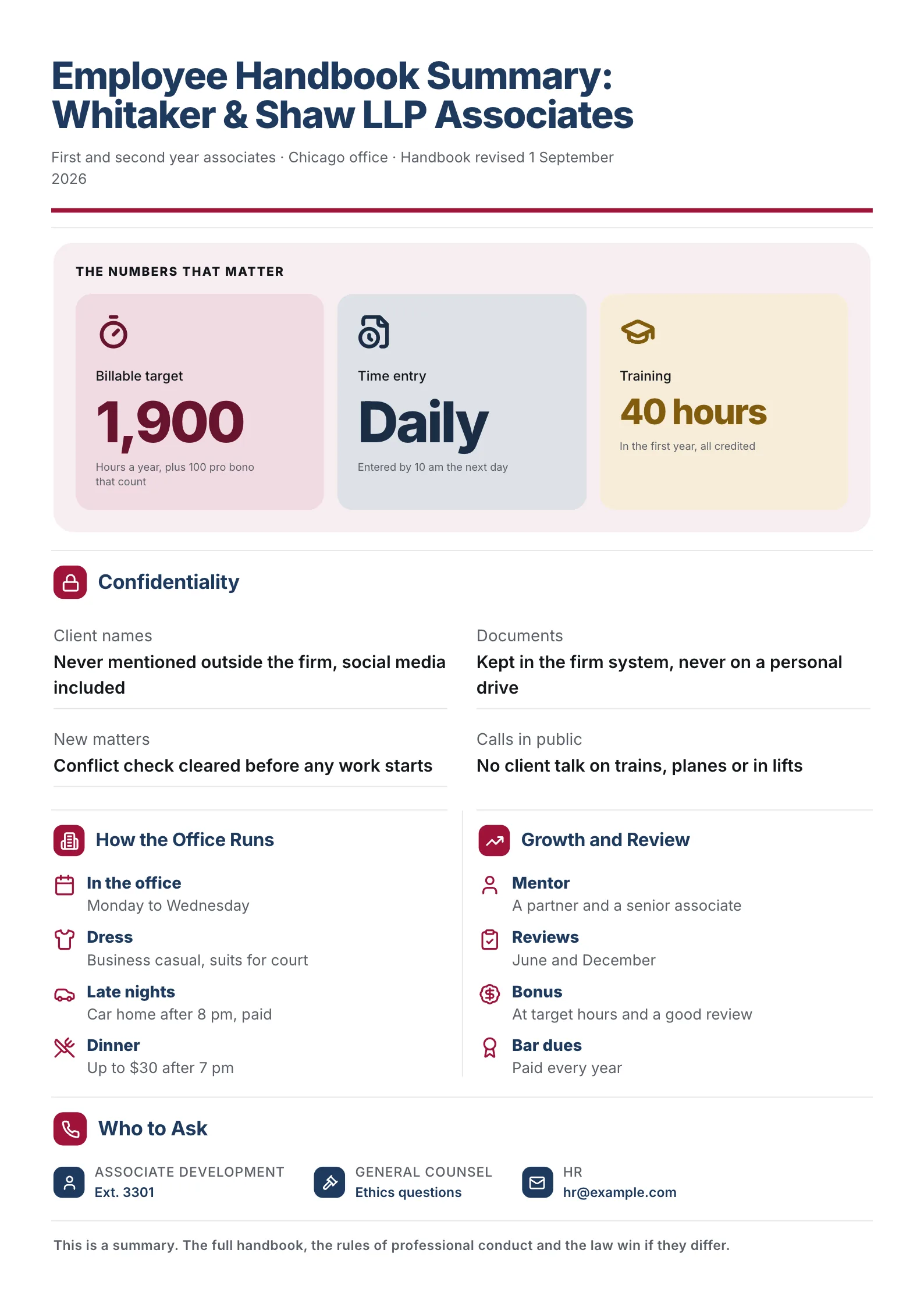
Whitaker & Shaw's summary is for first and second year associates in its Chicago office. Hard hats don't come up here. Billable hours and client secrets do.
 Edit this template
A sample firm. The confidentiality box reads like four short promises.
Your billable target is 1,900 hours a year, plus 100 pro bono hours that count toward it. You enter time daily, by 10 am the next day. Training runs 40 hours in your first year, all credited.
You never mention client names outside the firm, social media included. Every new matter clears a conflict check before any work starts. Your documents stay in the firm system and off personal drives. You don't talk about clients on trains, planes or in elevators.
The FMLA notice and your handbook
If your company is covered by the federal Family and Medical Leave Act, one regulation speaks directly to handbooks. We read 29 CFR 825.300 on the eCFR on October 30, 2026.
| What the rule says | What it means for your summary |
|---|---|
| Covered employers must post a general FMLA notice where employees and applicants can see it | The poster still goes on the wall, even with a summary card |
| If any employees are eligible, the notice also goes in employee handbooks or other written leave guidance | Your full handbook needs the FMLA section; the one-page card can point to it |
| If there's no handbook, the notice goes to each new employee upon hiring | Hand it over in the first-day packet |
| Electronic posting and distribution are allowed | A staff app or intranet copy can count, if every employee and applicant can reach it |
| A willful failure to post can bring a civil money penalty of up to $216 for each separate offense | Check every site you run, including the small ones |
The rule also points you to a prototype notice, WHD Publication 1420, that you can use as written. On your one-page summary, a single line such as "Family and medical leave: see section 6 of the full handbook" keeps the card short and the legal text where it belongs.
One card per crew, one book behind them all
Pick the job whose day looks most like your team's, then put their top four questions on the front: what they're paid, when they work, what keeps them safe and who answers the phone. Each of the five summaries here, from MakeOnepagers, started from the same layout and ended up looking nothing alike. The caregiver's first worry is a dog in the hallway, and the associate's is a client's name said out loud on a train.
Frequently asked questions
What should a one-page employee handbook template include?
Put pay and payday, hours and breaks, the safety rules for that job, time off, and who to call. Add the date your full handbook was revised, so nobody follows an old version. Leave the policy text in the full handbook and point to it.
Is a handbook summary legally binding?
The summaries above say the full handbook and the law win if they differ, and that's the safe way for you to write one. Have whoever owns your full handbook check the summary before it goes out. For the longer document, our guide on how to write an employee handbook walks through each section.
How often should I update it?
Update it every time pay, hours or a rule changes, and at least once a year. Print the revision date at the top. Kessler, Copperline and the others all carry one.
Should each team get its own summary?
Yes, if their days look different. Your plant worker needs the points table and the lockout rule; your lawyer needs billable hours and confidentiality. Keep the same handbook underneath and give each team its own card on top. For more side-by-side cards, see these employee handbook examples.




