Employee Handbook Examples for the Questions New Hires Ask in Week One
Employee handbook examples built around six questions new hires ask in week one, with real wording from a school district, 37signals and Valve.

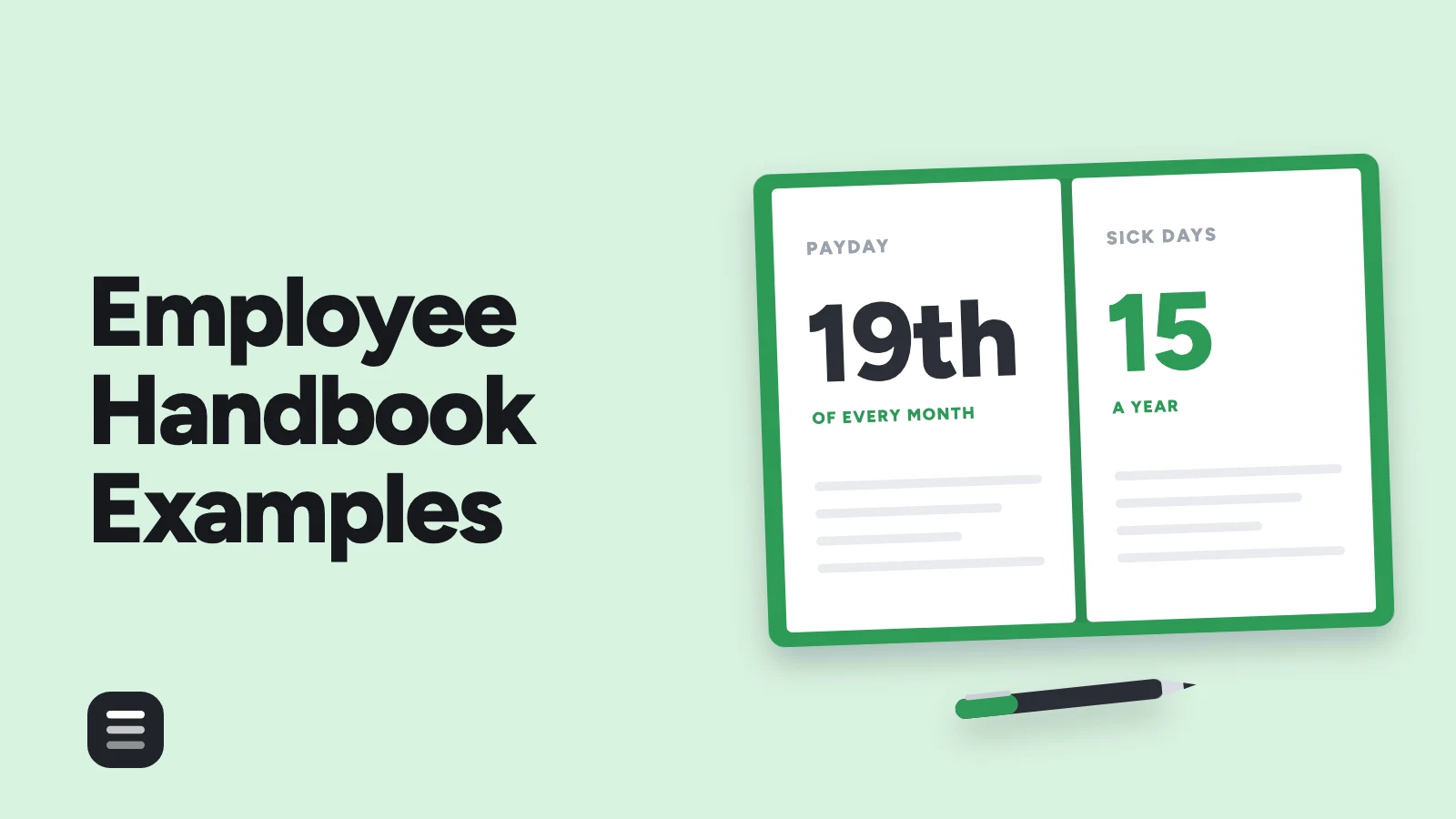
Federal law doesn't tell your employer when to pay you, and it doesn't promise you a single paid sick day. So for many new hires, the handbook is the only place those answers live. We read three real handbooks and two US Department of Labor pages to see how employers answer them, then matched each answer to one of our employee handbook examples. Start from a free one pager template.
One‑Pager examples
Real One-Pagers made with MakeOnepagers. Open any one to edit it as your own.
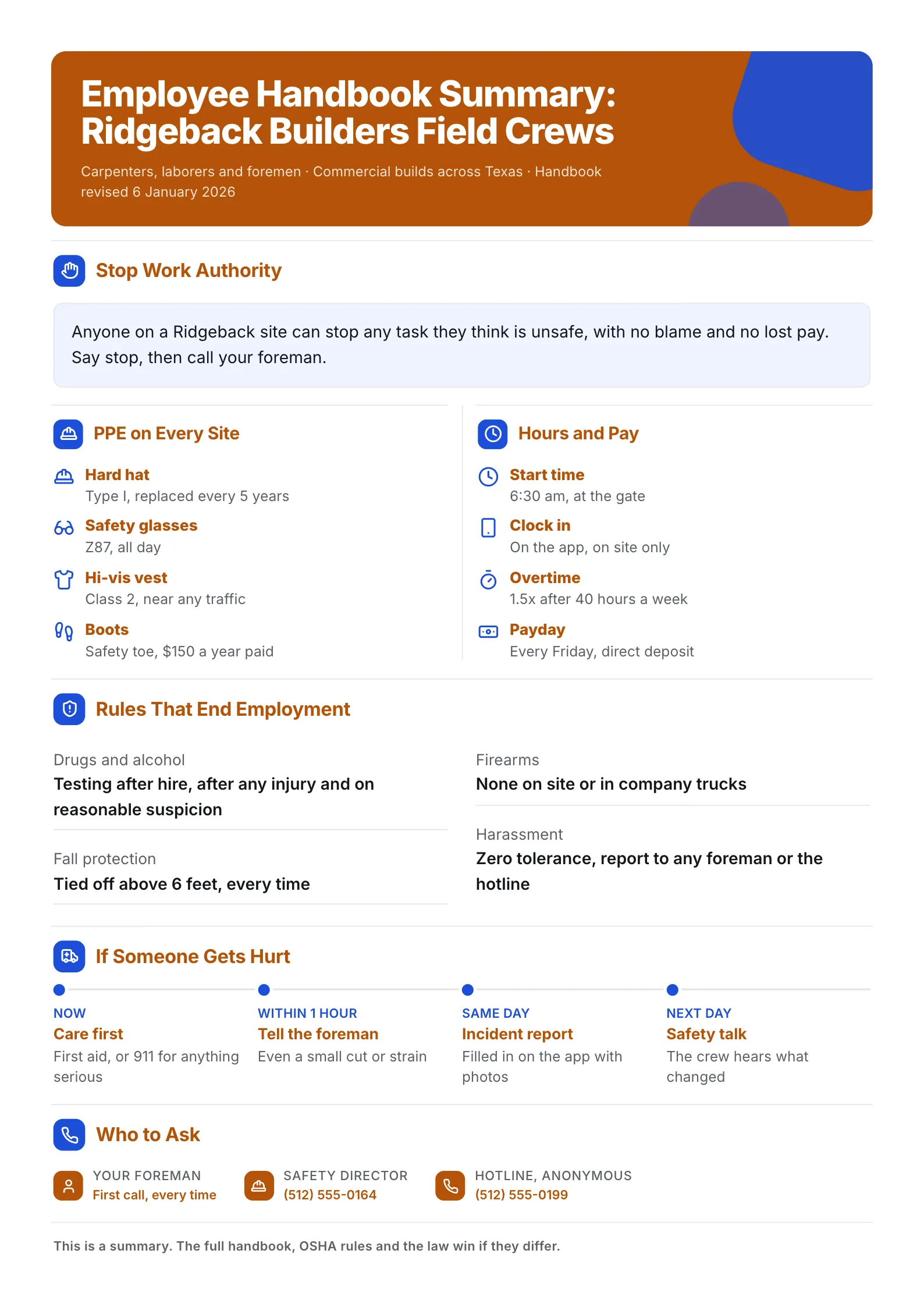 Employee Handbook Summary: Construction Field CrewsEdit for free(opens in a new tab)
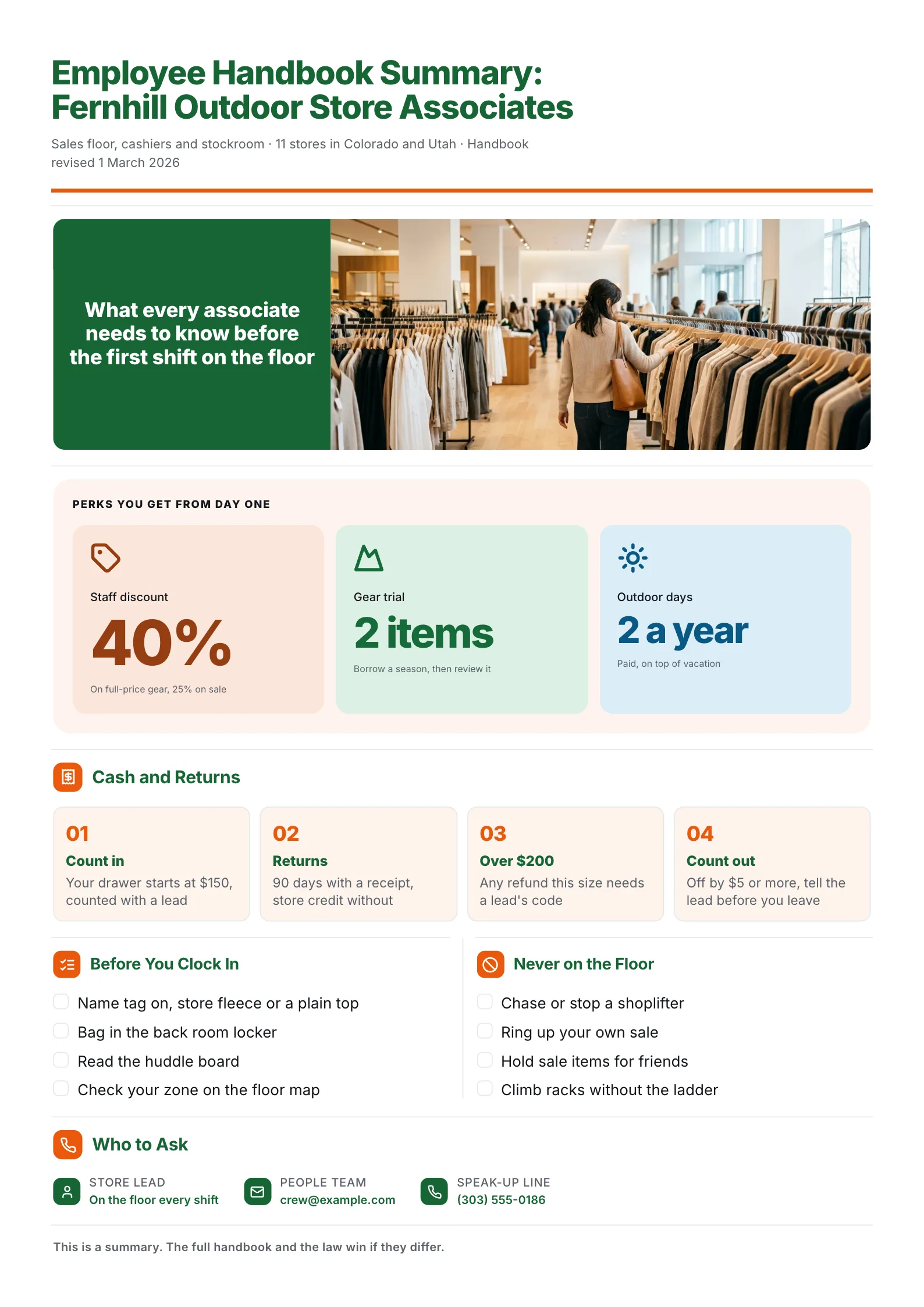 Employee Handbook Summary: Retail Store AssociatesEdit for free(opens in a new tab)
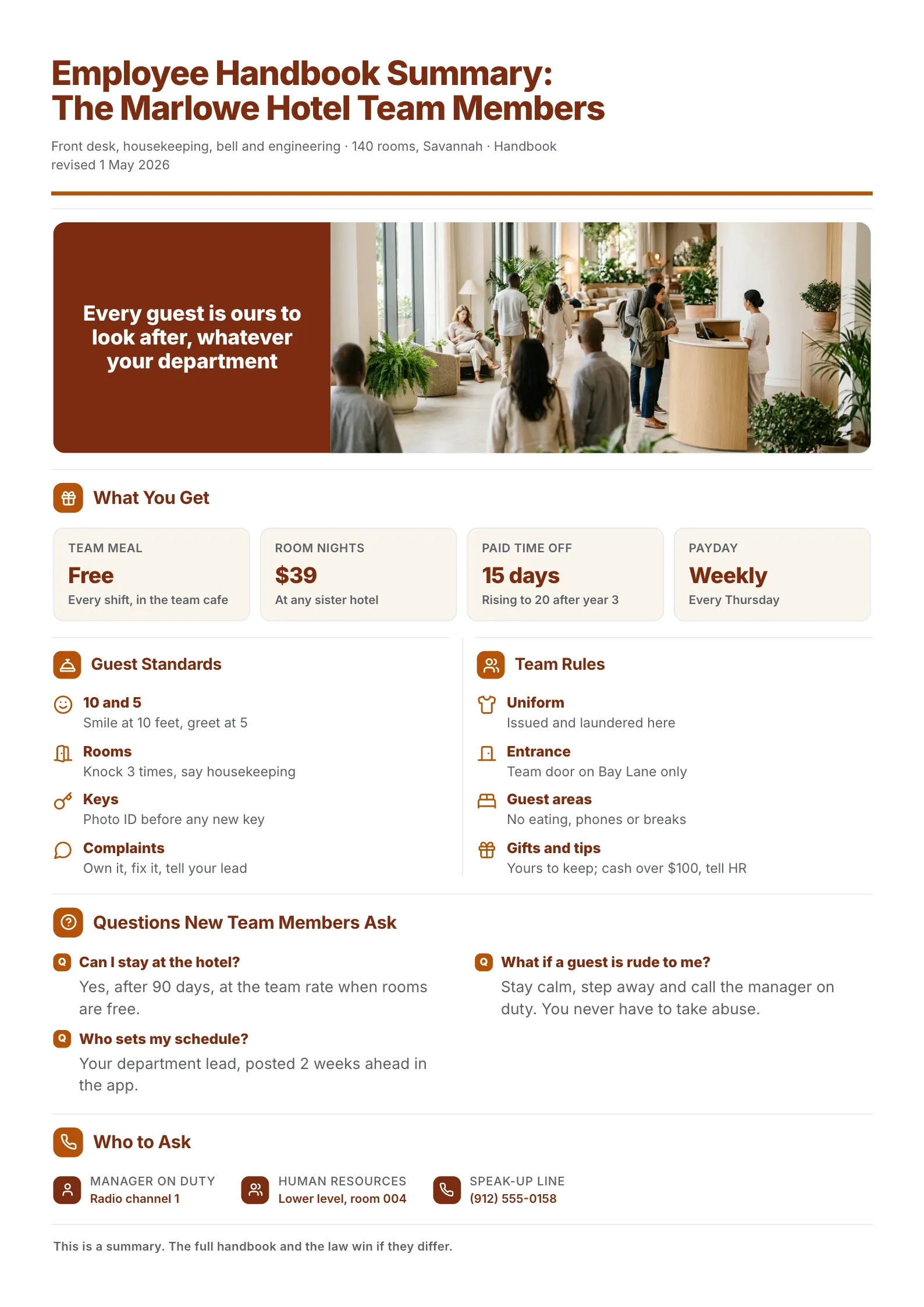 Employee Handbook Summary: Hotel Team MembersEdit for free(opens in a new tab)
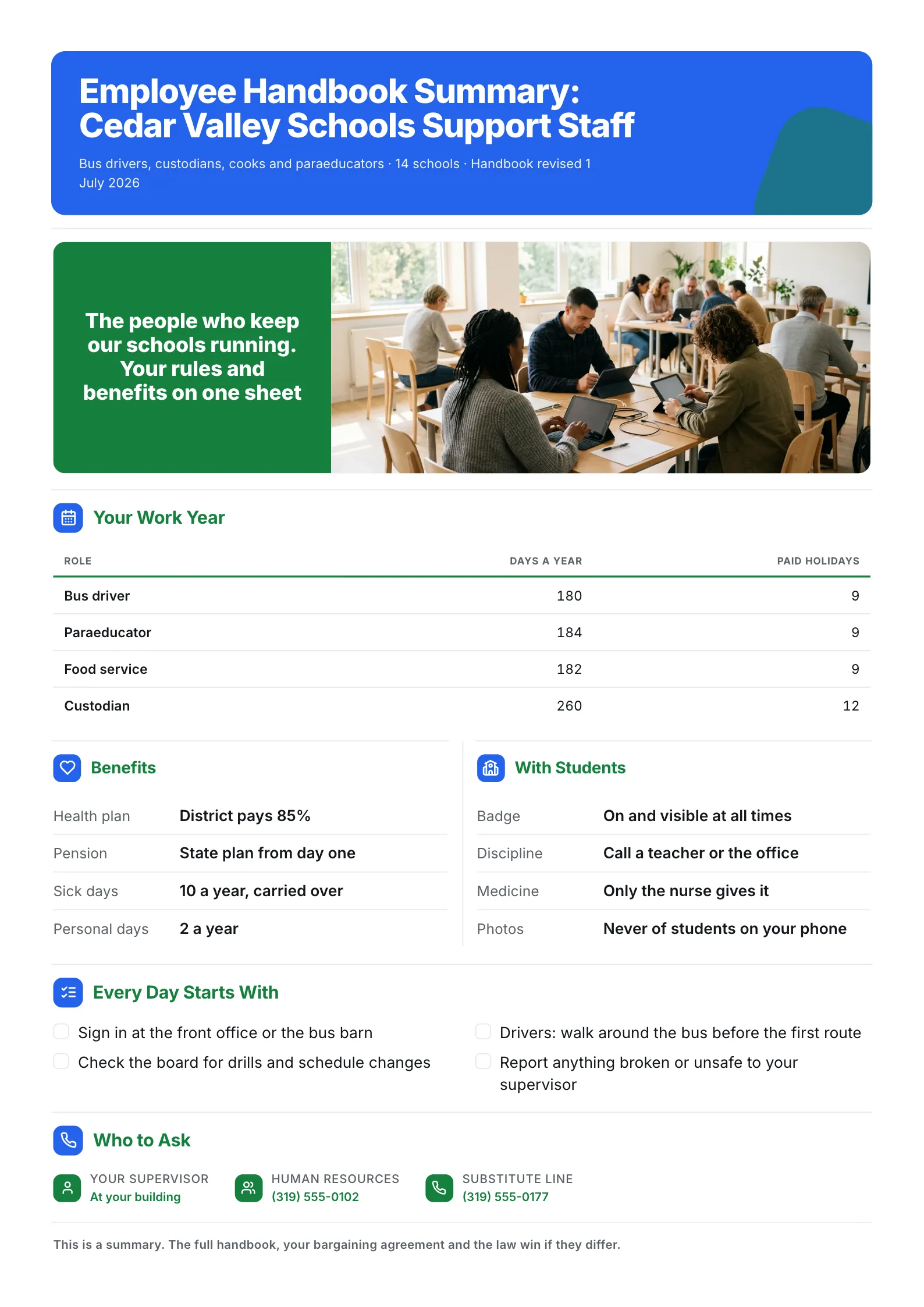 Employee Handbook Summary: School Support StaffEdit for free(opens in a new tab)
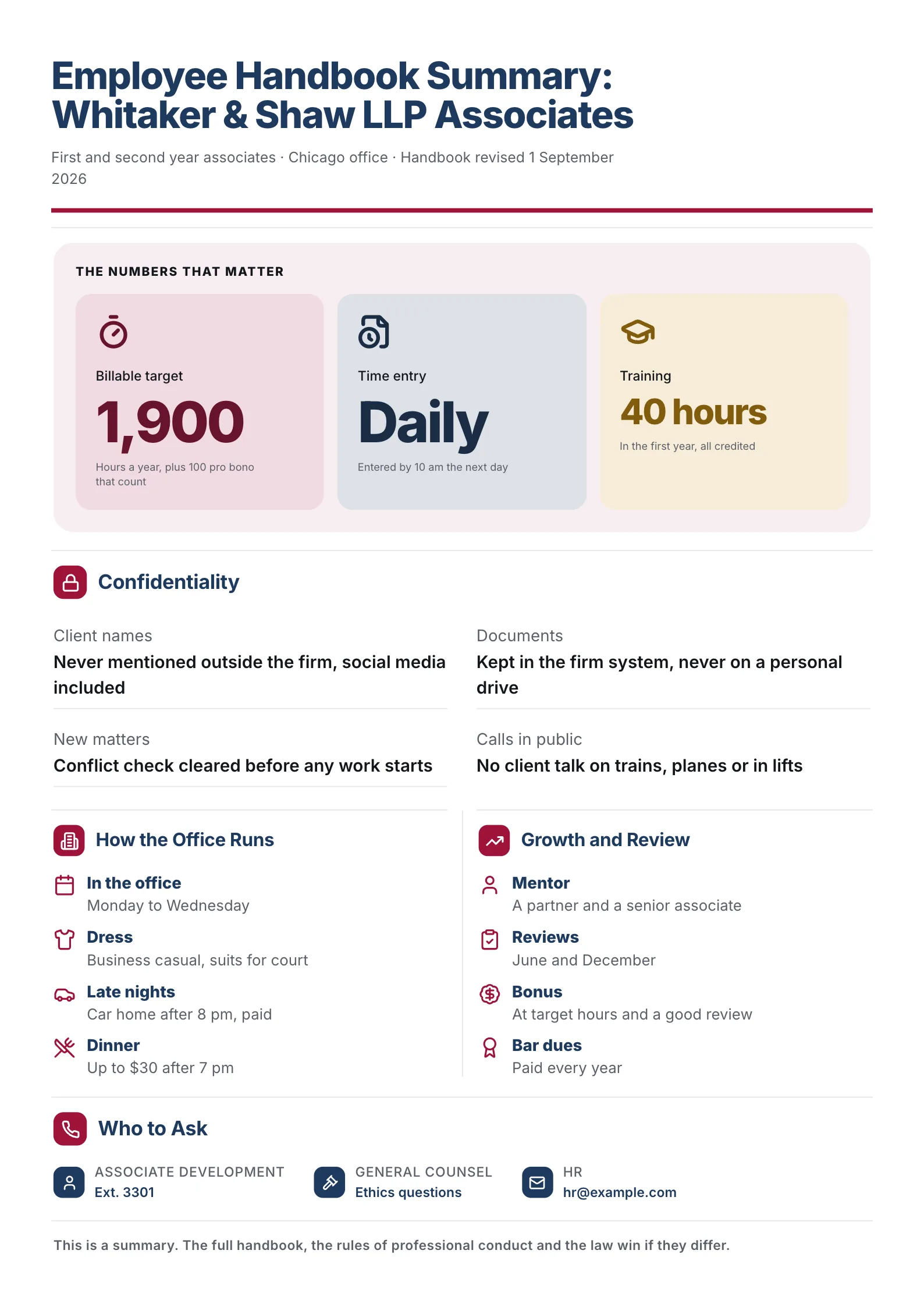 Employee Handbook Summary: Law Firm AssociatesEdit for free(opens in a new tab)
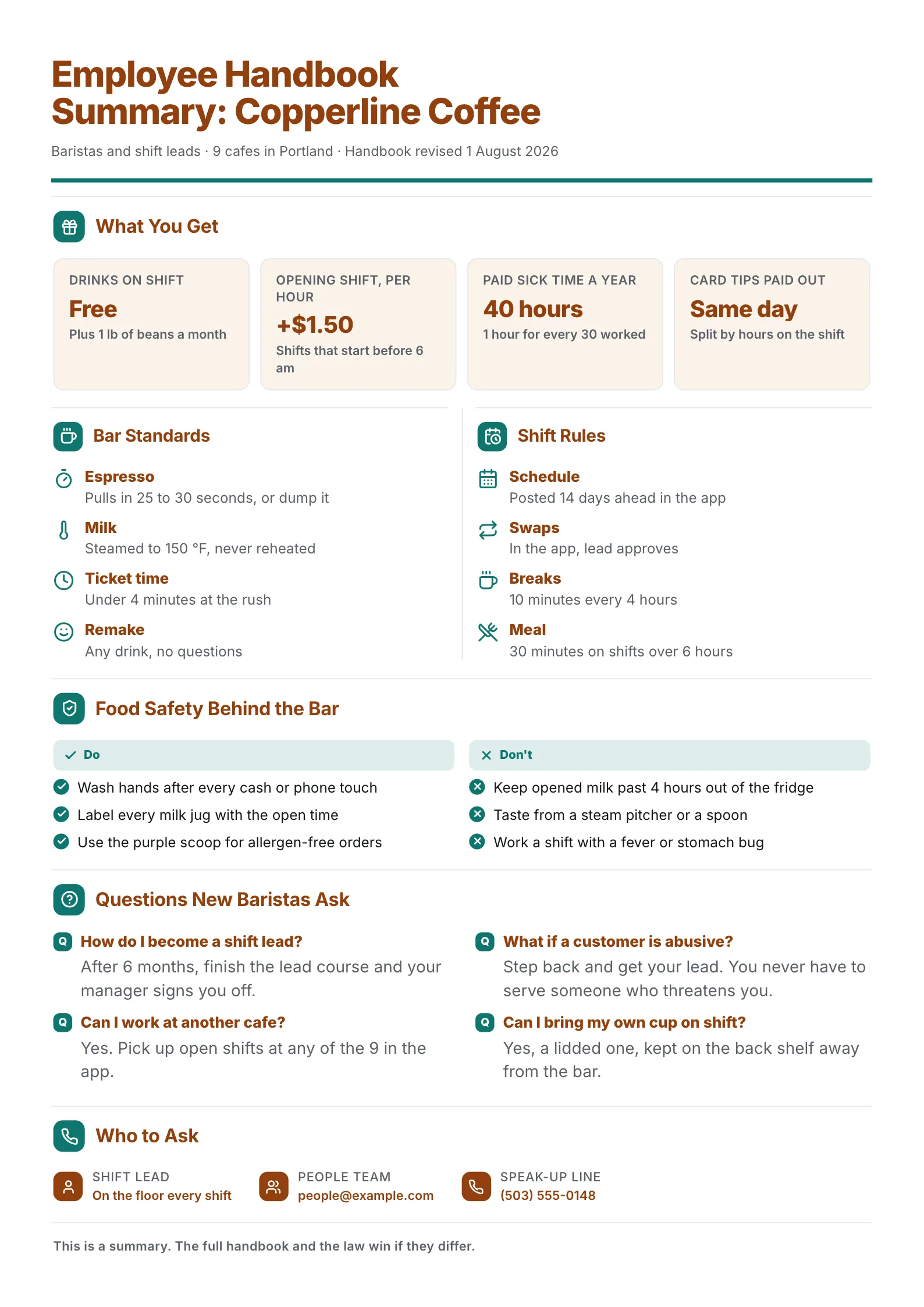 Employee Handbook Summary: Coffee Shop BaristasEdit for free(opens in a new tab)
Think back to your own first week in a new job. You probably didn't read the handbook front to back. You searched it for a few answers. When's payday? What do I do if I wake up sick? Can I work from home?
Each section below starts with one of those questions, then a one-page example from MakeOnepagers that answers it, plus the wording a real employer uses for the same thing. Our sources are the Department of Labor's guidance on paydays and leave, the 28-page Clarinda Community School District classified handbook from Iowa, and two famous public handbooks from tech companies, 37signals and Valve.
"When do I get paid?"
This is the first question almost everyone asks, and it's the one your handbook can't skip. Federal law doesn't set a payday for you. The Department of Labor keeps a table of state payday requirements, and the rules are all over the map.
Alabama and Florida have no rule at all. Arizona wants two or more paydays a month, no more than 16 days apart. New York wants manual workers paid every week. So your handbook has to say the day, because your new hire can't look it up anywhere else.
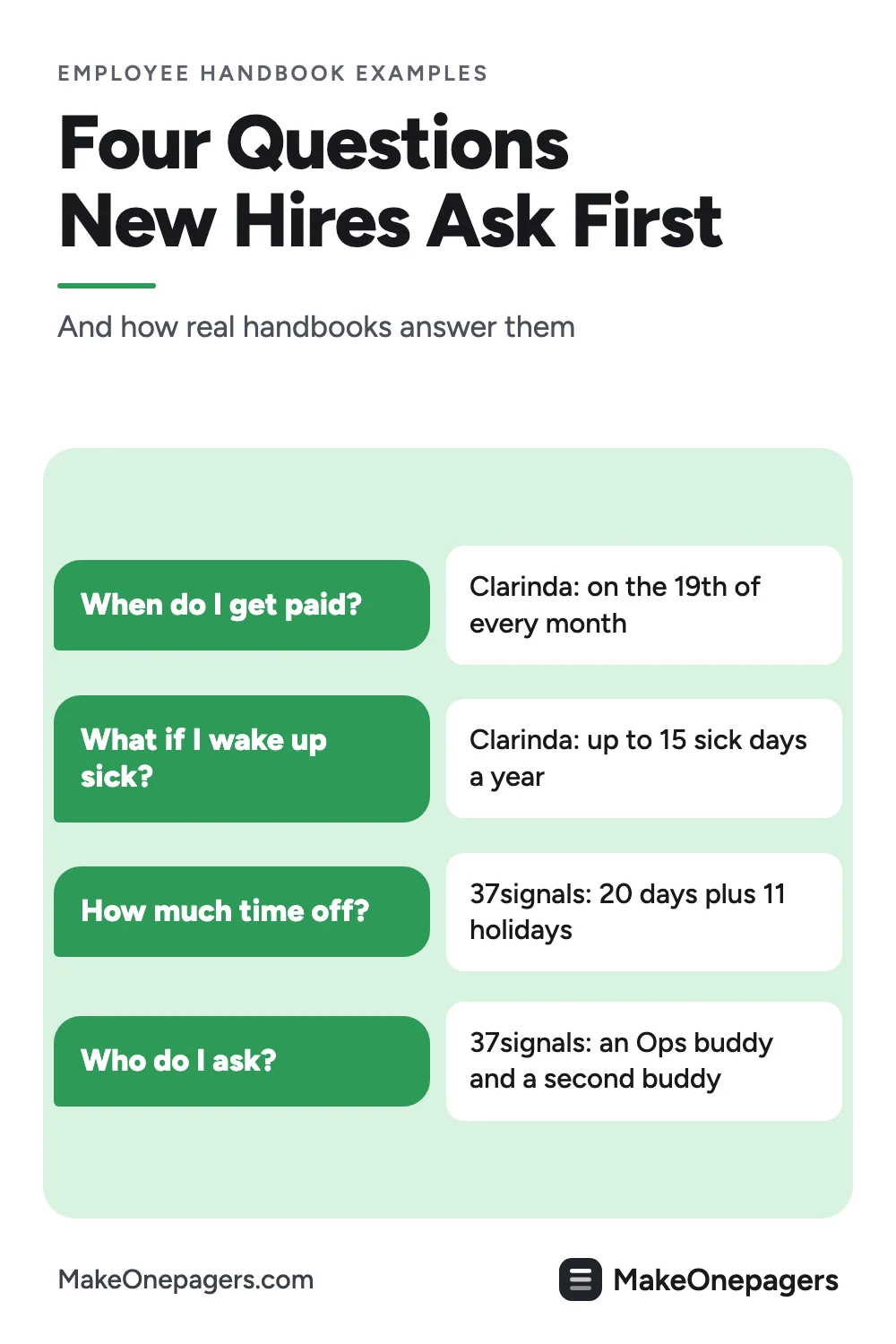
Here's how Clarinda says it, in one sentence. Classified staff "shall be paid monthly on the 19th day of the month." Contracted staff get their pay spread over 12 months, so a bus driver still gets a check in July.
 Edit this template
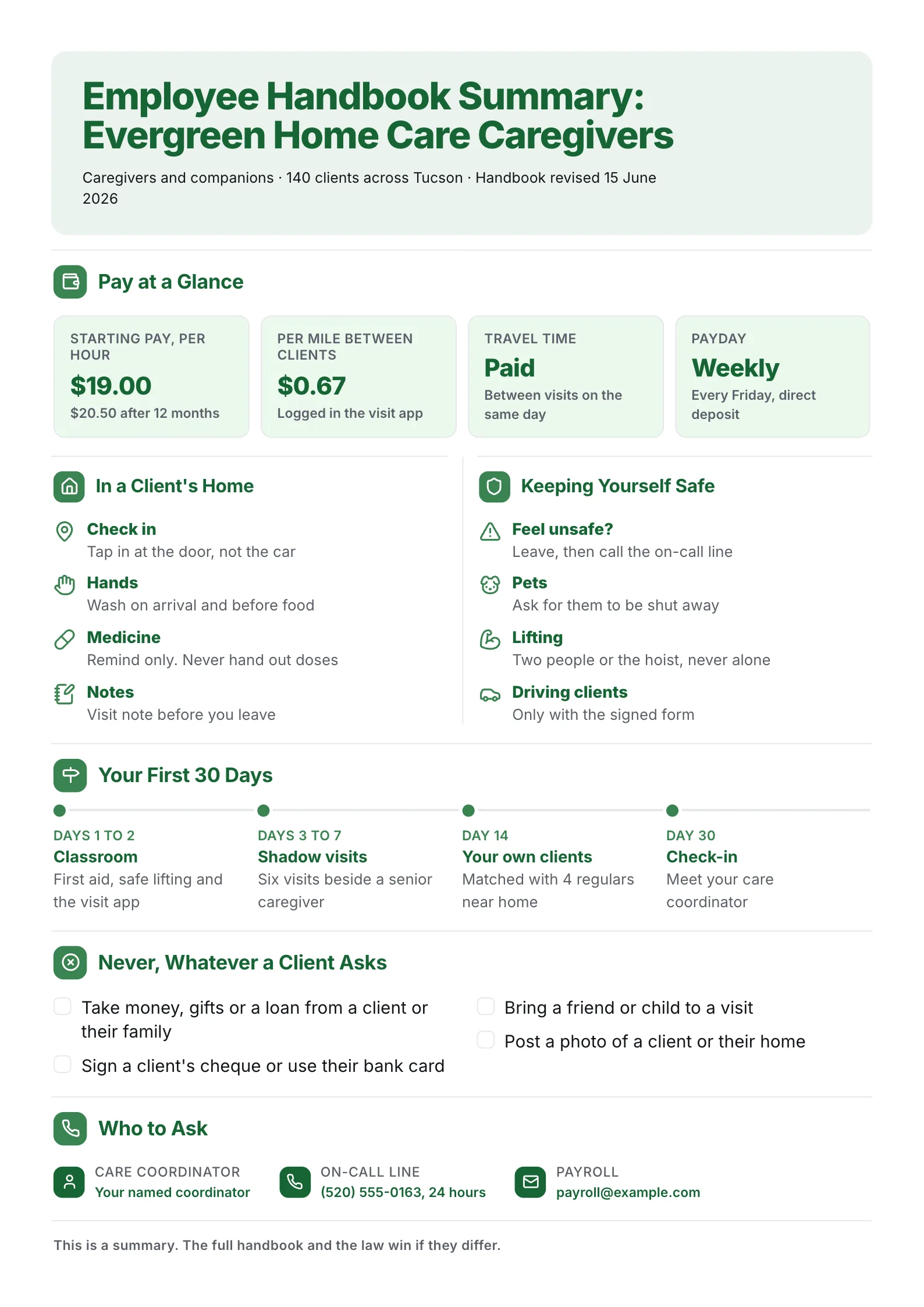
Evergreen puts pay in four boxes at the top, so a caregiver sees $19.00 an hour and a Friday payday before anything else.
This home care example leads with money on purpose. Starting pay is $19.00 an hour, rising to $20.50 after 12 months. Mileage between clients pays $0.67 a mile. Travel time between visits is paid too, which is the line caregivers worry about most. Payday is every Friday by direct deposit.
If your team drives between job sites, copy that layout. Put every way you pay people on one row. Then add your payday, written as a day of the week or a date. "Biweekly" leaves your new hire guessing which Friday. "Every other Friday, starting January 8" doesn't.
"What if I wake up sick?"
Here's a fact that surprises a lot of new managers. The Department of Labor's page on vacation and sick leave says the Fair Labor Standards Act "does not require payment for time not worked." That covers vacation, holidays and sick leave. Some states and cities do require paid sick time, so check yours. Either way, your handbook is where your people find out what they get. Our guide on how to write an employee handbook covers the full document, leave policy included.
The three handbooks took very different paths.
Clarinda gives a set number of days. Staff on 10- to 12-month contracts get 15 sick days a year, and 9-month staff get 10. Unused days build up to 105, for up to 120 available in a year. If you're out two or more days, the district may ask for a note from your doctor.
37signals went the other way. Its employee handbook on GitHub says plainly that it doesn't offer "a bank of sick days." Nobody tracks them either. You tell your manager as soon as you know you'll be out, and for how long. If you'll be out more than 7 work days in a row, that may move to a short-term disability claim.
 Edit this template
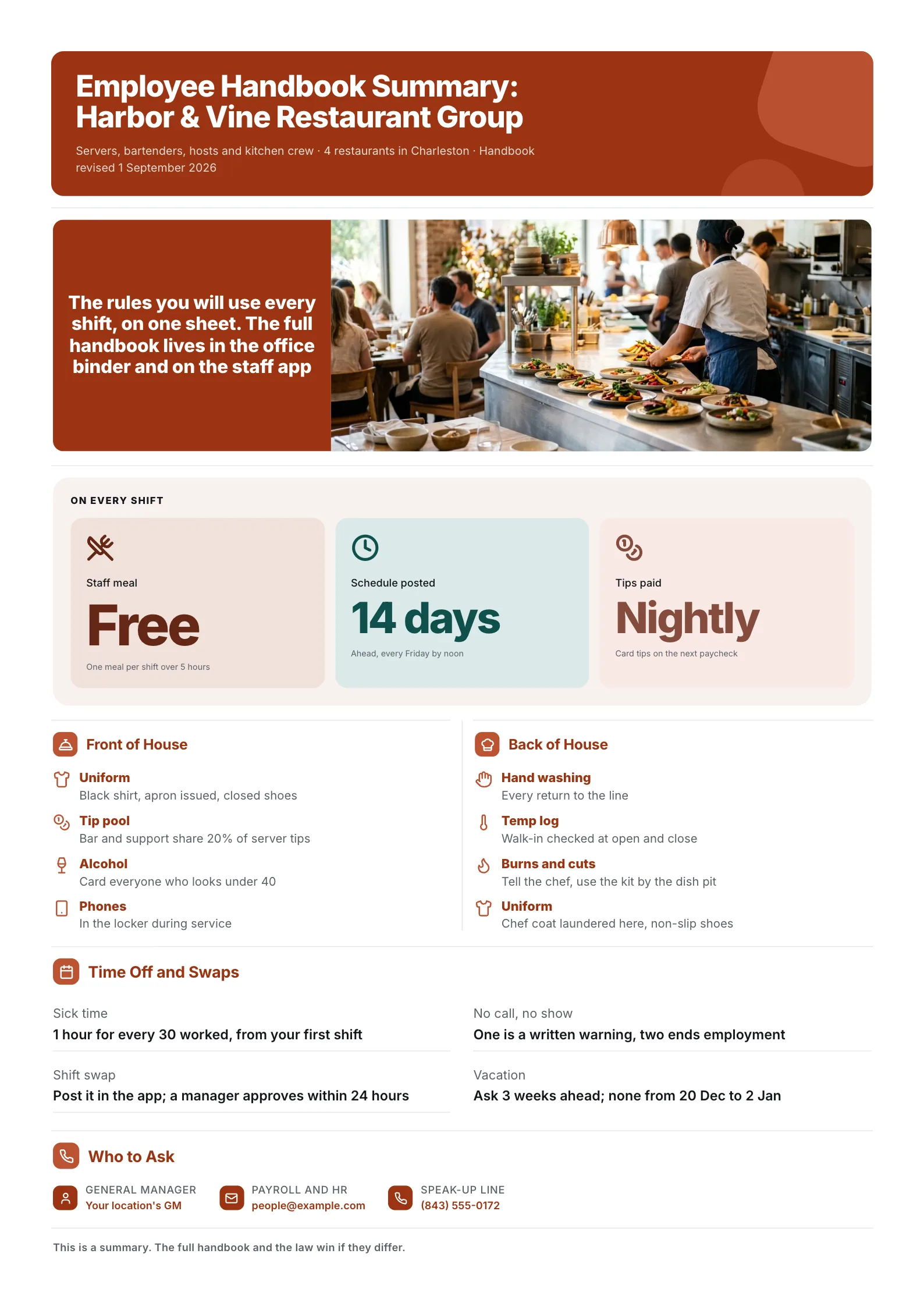
Harbor & Vine answers the sick time question in one line, an hour earned for every 30 worked from your very first shift.
A restaurant has to answer this fast, because a sick cook on the line is a health risk. This example gives sick time its own row under "Time Off and Swaps." You earn 1 hour for every 30 you work, starting with your first shift. Right next to it sits the swap rule. Post the swap through the app, and a manager approves it within 24 hours. Your server knows what to do before the shift starts.
"What happens if I'm late, or miss a shift?"
New hires on hourly shifts want this answered before day one, even if they don't ask out loud. Vague rules here make people nervous. Clear rules make them relax.
Clarinda asks every hourly employee to "complete, sign, and turn in a daily time record." Falsifying it is grounds for discipline. Overtime past 40 hours a week pays one and a half times the regular rate, and only with a supervisor's approval.
 Edit this template
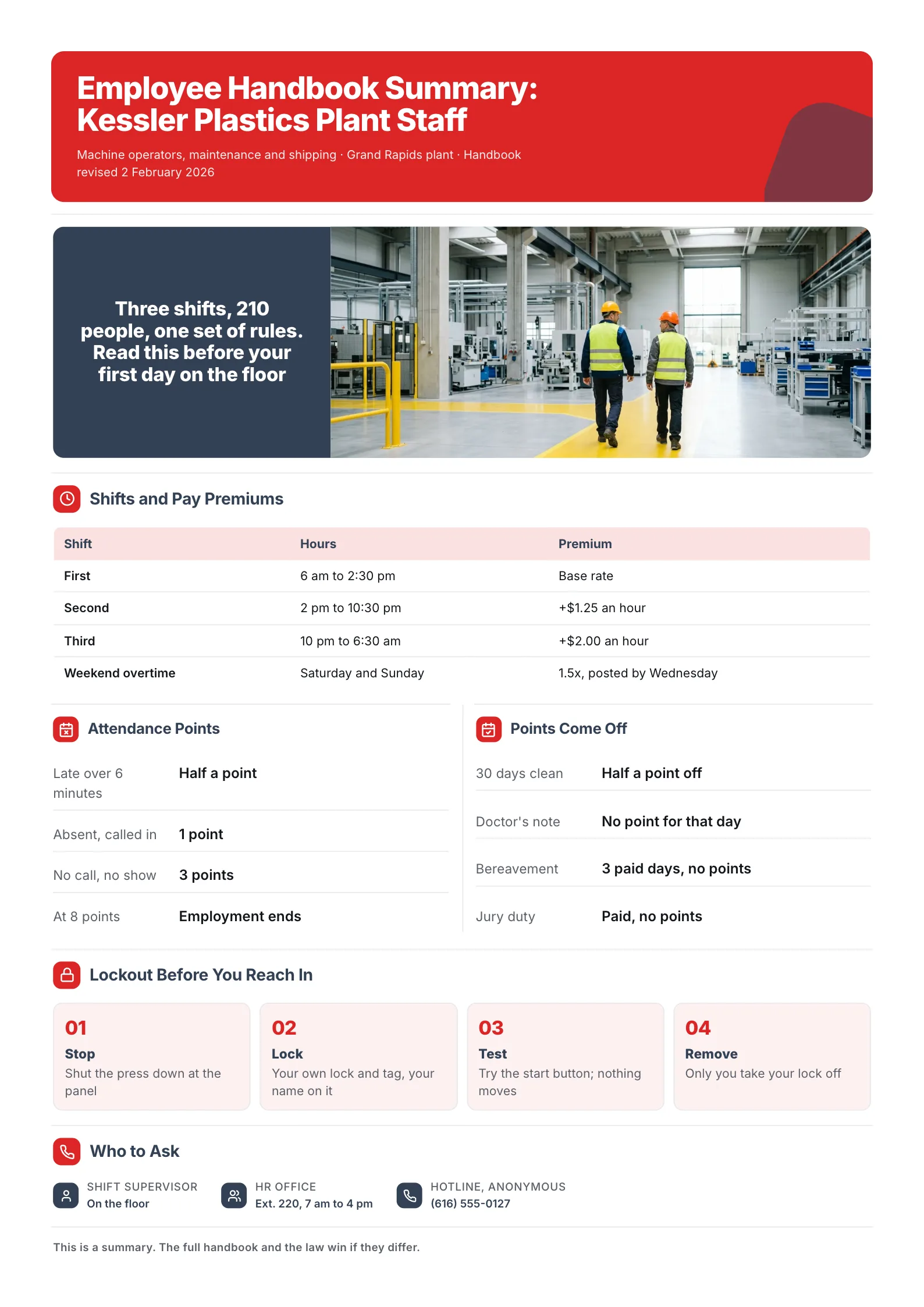
Kessler Plastics turns attendance into a points table, so every one of its 210 people knows where the line is.
This plant runs three shifts with 210 people, so it spells the rules out in points. Late by more than 6 minutes costs half a point. Calling in absent costs 1 point. A no call, no show costs 3. At 8 points, employment ends.
The part we like most is the way back. Thirty clean days takes half a point off. A doctor's note means no point for that day. Bereavement and jury duty never cost points either, so nobody loses ground over a funeral or a court date.
"How much time off do I get?"
This one usually comes up in the interview, then again in week one when someone wants to book a trip. A good handbook answers it with numbers your new hire can count on a calendar.
37signals gives 20 days of vacation and personal days, plus 11 local holidays, every year. Unused days roll over to a bank of 27. In summer the whole company works four-day weeks, from May 1 through August 31. Every three years you can take a 6-week paid sabbatical.
Clarinda is more traditional, and just as clear. You can read the leave rules in a few minutes. Staff who work all 12 months get six paid holidays, plus Good Friday when school isn't in session. After a full year you get two weeks of vacation, and three weeks after 15 years. Days carried over from last year are lost if you don't use them by July 1.
 Edit this template
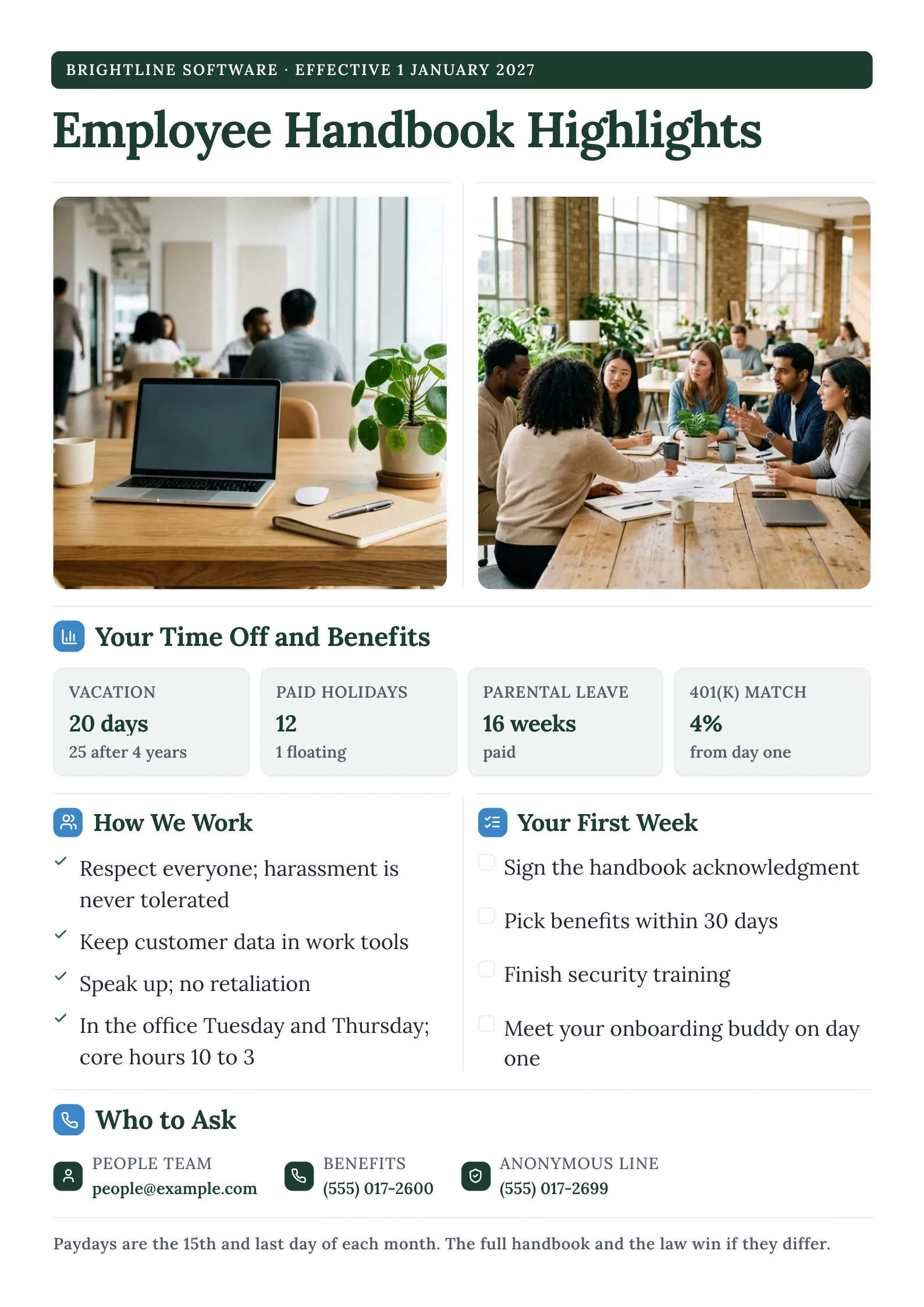
Brightline's four big numbers cover vacation, holidays, parental leave and the 401(k) match in one glance.
This highlights page gets its answer into four big numbers. You see 20 days of vacation, rising to 25 after 4 years. You see 12 paid holidays plus a floating one, 16 weeks of paid parental leave and a 4% 401(k) match from day one. Paydays, the 15th and the last day of each month, sit in the footer. Our employee handbook summary guide breaks down every part of a page like this one. Benefits that help you hire deserve this kind of space.
"Can I work from home?"
If any of your roles could be done remotely, expect this question early. Your handbook should answer it with rules a new hire can check against their own setup.
37signals is fully remote, with people on 5 continents. Its handbook says you can work from anywhere. The one catch is that you tell People Ops when you move across a state or country border. The work week is 40 hours, and 32 in summer.
The software company's highlights page above takes a middle path. You're in the office Tuesday and Thursday, with core hours from 10 to 3.
 Edit this template
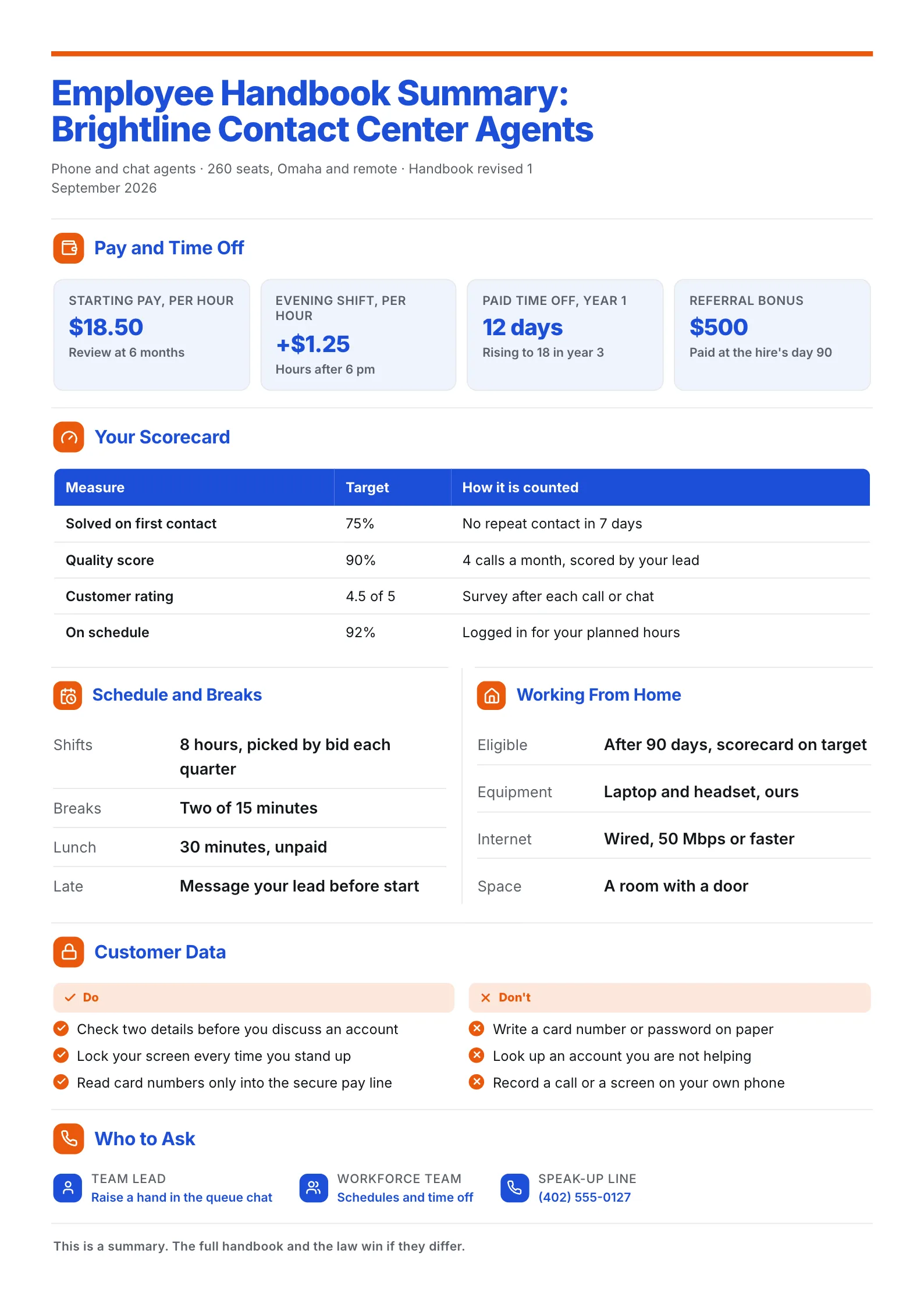
The contact center example spells out home working down to the internet speed, 50 Mbps or faster on a wired line.
This contact center example makes home working something you earn. You're eligible after 90 days, once your scorecard is on target. The company provides your laptop and headset. You supply wired internet at 50 Mbps or faster, plus a room with a door. Every rule is one your agent can check before asking. With 260 seats to staff, your team lead won't field the same question 260 times.
"Who do I ask when I'm stuck?"
The last question is the one that decides whether week one feels lonely. The best handbooks we read give you a real person to ask. A department inbox comes second.
37signals gives every new hire two helpers. There's an Ops buddy who sets up accounts with you, and a 37signals buddy from outside your team who's been around a while. On day one you open a welcome project with your name on it, full of to-do lists made for your role. You also meet your manager that day. The handbook says most people feel up to speed in about 3 months, which tells you it's fine to still be learning in week six.
The Valve Handbook for New Employees takes a bolder line. Its glossary defines a manager as "The kind of people we don't have any of." So who do you ask? The handbook's answer is anyone. It tells you the chair next to anyone's desk is always open, and to plant yourself in it often. Even the furniture backs this up. Your desk has wheels, so you can roll it over to the people you're working with. You probably won't buy wheeled desks. You can still tell your new hire, in writing, exactly whose chair to pull up to.
All five examples in this post finish on a "Who to Ask" box. The home care page lists a named care coordinator and an on-call line staffed 24 hours. The plant lists the HR office extension and its hours. Copy that box, whatever else you change. To plan the rest of that first week, pair your page with an onboarding checklist.
Put payday and sick days in your first two lines
Federal law leaves both answers to the employer, and only one of the three handbooks we read gives both as a number. Clarinda pays on the 19th and gives up to 15 sick days a year. 37signals explains its sick time with care but never names a payday. Valve's 37 pages mention neither. Those were the first two questions in this post, and your handbook is where a new hire will look for both.
So open your one page with them. Write payday as a date, the way Clarinda names the 19th, and sick time as a number of days your new hire can plan around.




