Onboarding Checklist: Free One-Page New Hire Checklist
Free one-page onboarding checklist for new hires: before day one, day one and weeks one to four, with 5 examples from sales to restaurants.

An onboarding checklist lists everything your new hire needs to do and learn in their first weeks, plus what they should receive. Each item has an owner and a date beside it. It covers the days before they start, their first day, their first week and their first month. Put it on one sheet, and both your new person and their manager can see at a glance what's done and what's next. Below you'll find what to include and a free onboarding checklist you can copy. After that come five worked examples and the mistakes that leave new people waiting. Start from a free one pager template.
One‑Pager examples
Real One-Pagers made with MakeOnepagers. Open any one to edit it as your own.
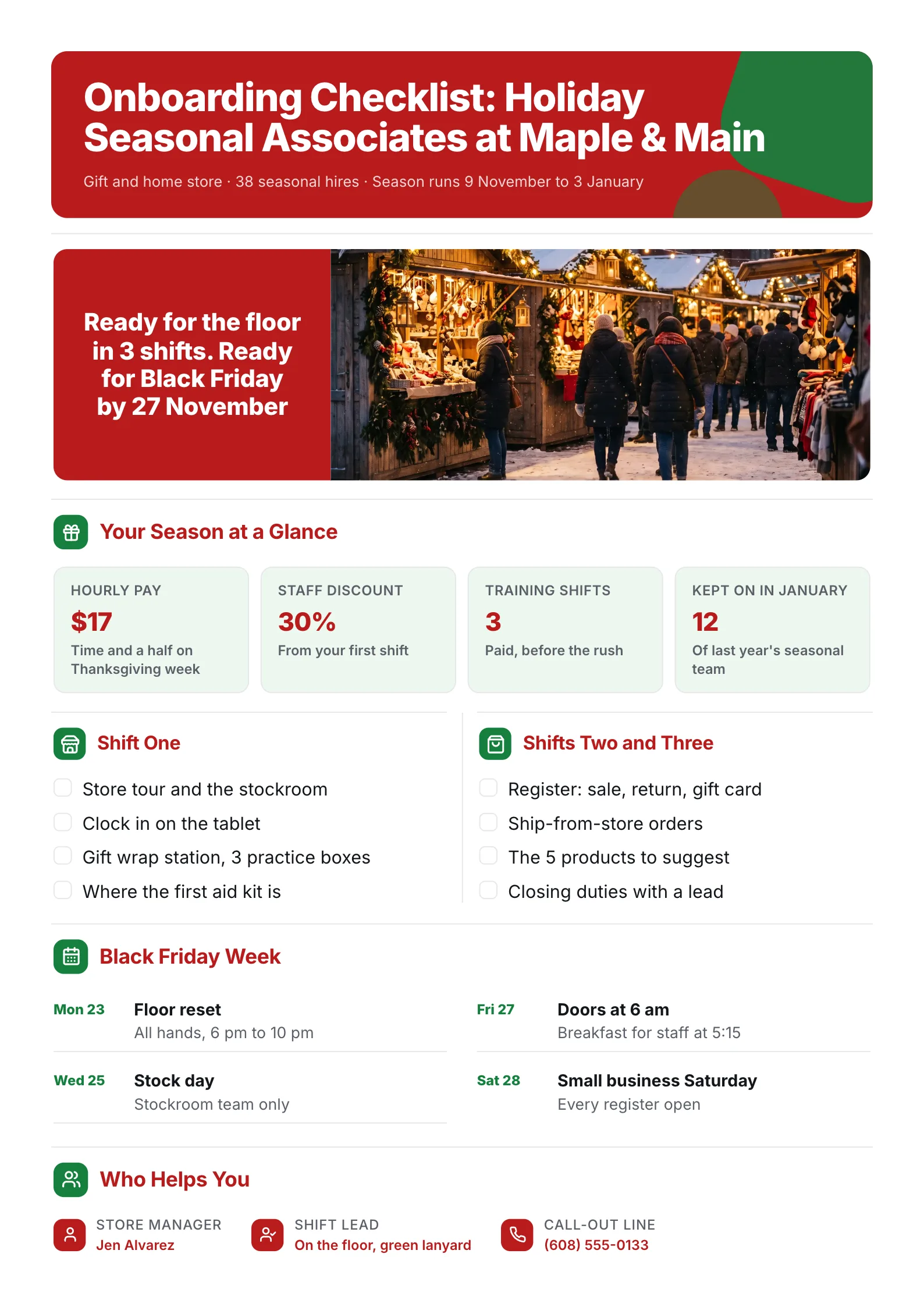 Onboarding Checklist: Seasonal Retail AssociatesEdit for free(opens in a new tab)
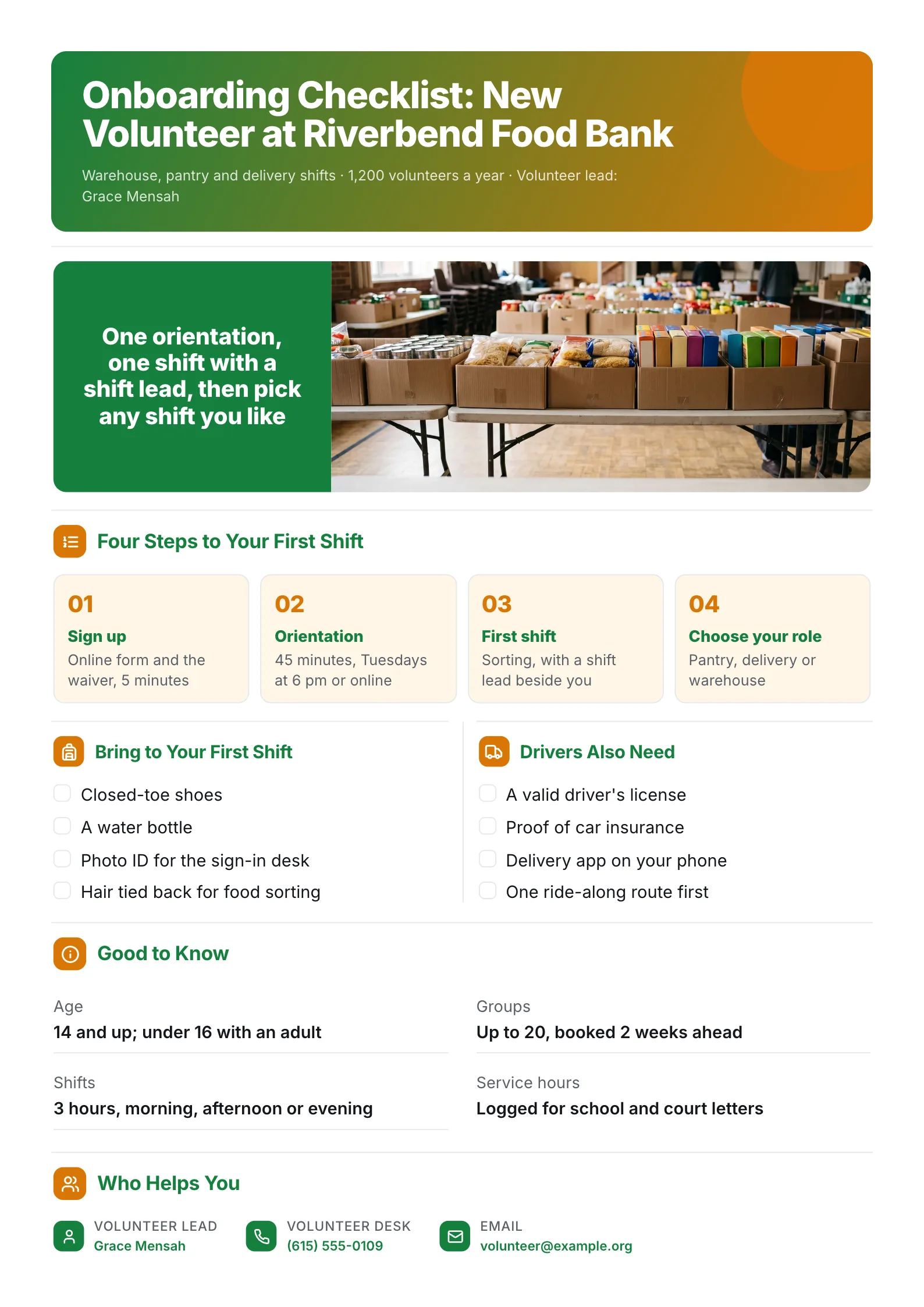 Onboarding Checklist: Food Bank VolunteerEdit for free(opens in a new tab)
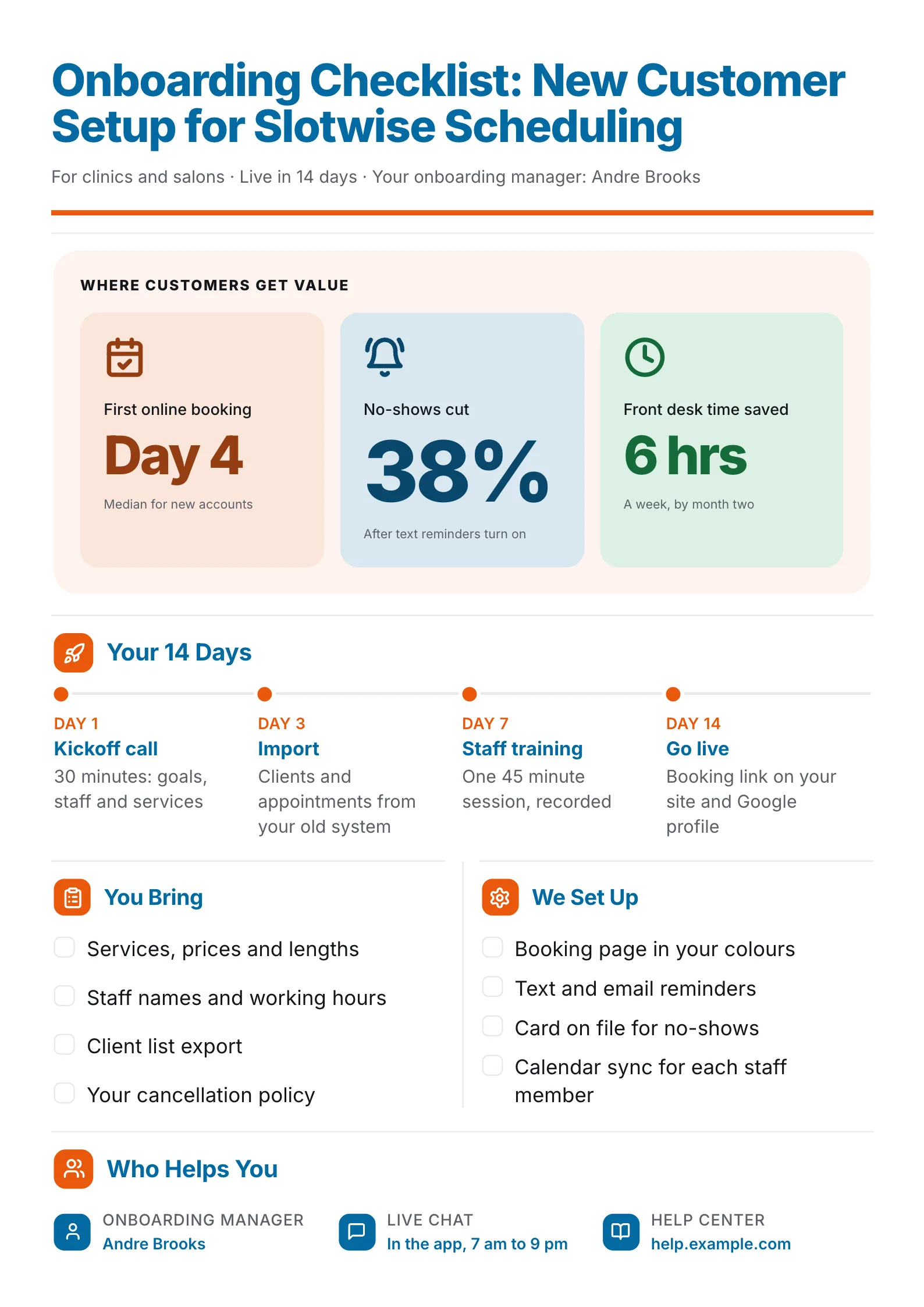 Onboarding Checklist: SaaS Customer SetupEdit for free(opens in a new tab)
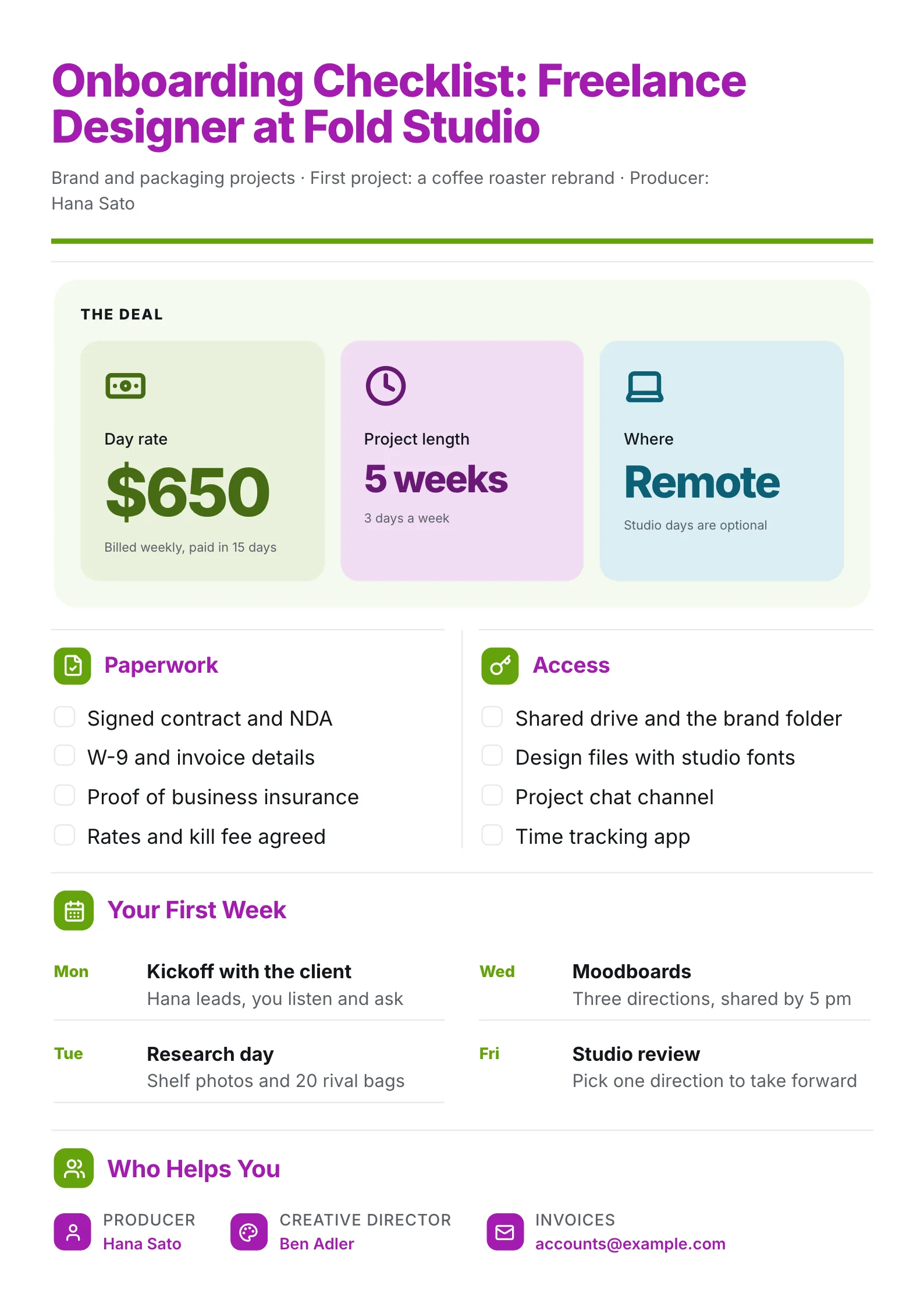 Onboarding Checklist: Freelance DesignerEdit for free(opens in a new tab)
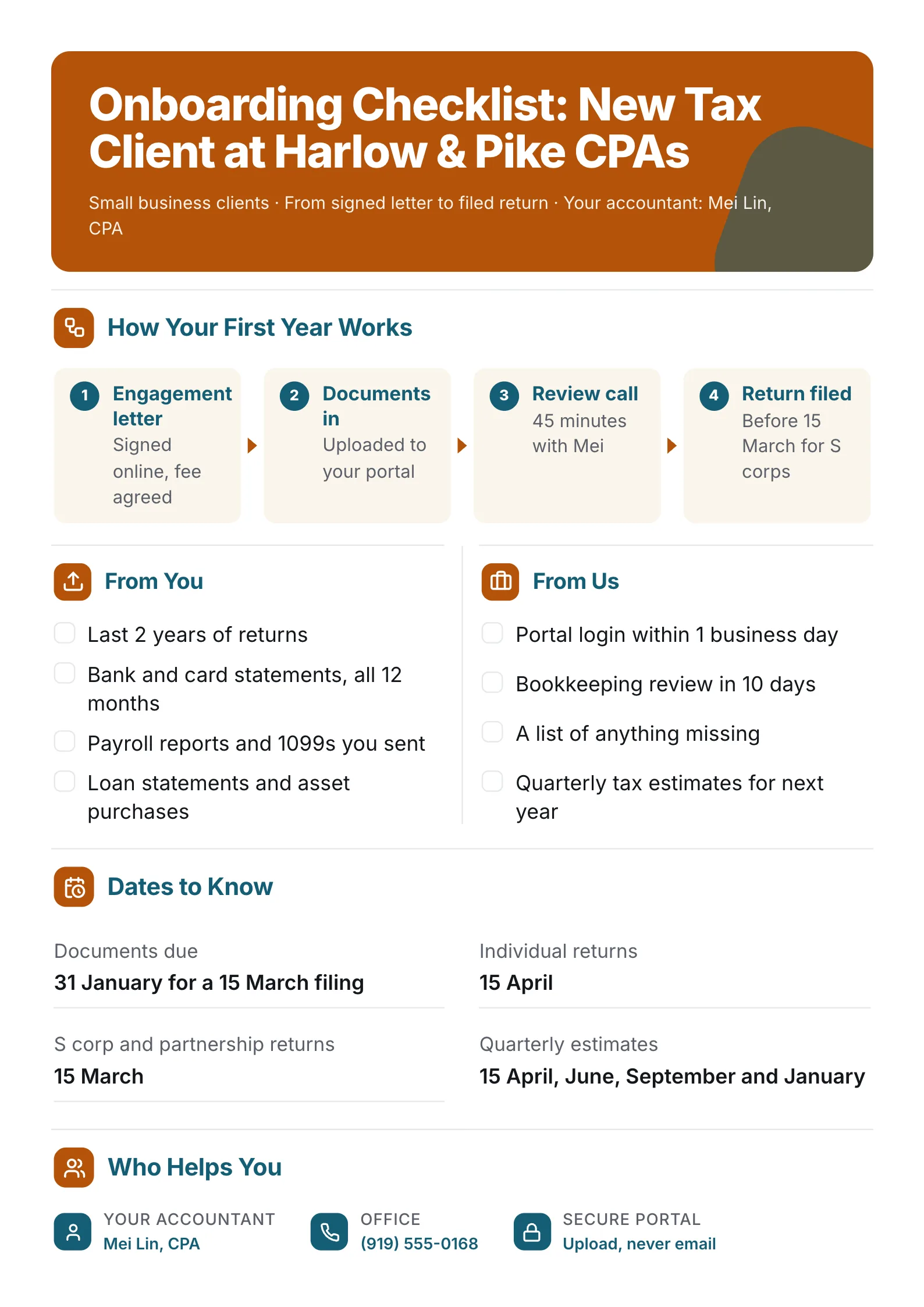 Onboarding Checklist: New Accounting ClientEdit for free(opens in a new tab)
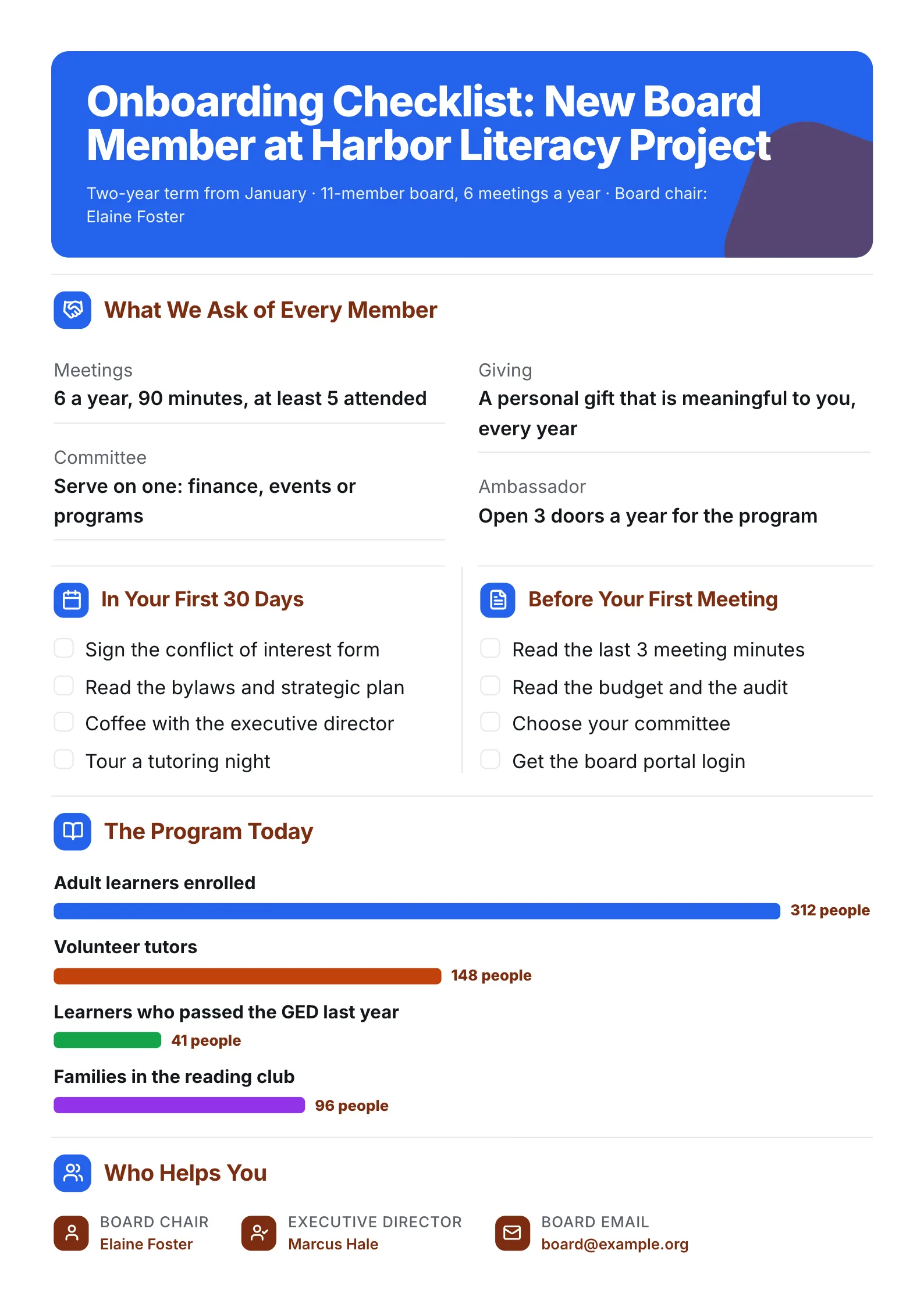 Onboarding Checklist: Nonprofit Board MemberEdit for free(opens in a new tab)
We made every example with MakeOnepagers. Each one opens as a template, and you can edit it for free, from each word and date down to the colors.
What is an onboarding checklist?
An onboarding checklist (or new hire checklist, employee onboarding checklist) is a short, ordered list of tasks that turns your new employee into a productive member of the team. HR usually owns the paperwork part of it. The hiring manager owns the rest, from introductions and tools to first projects and goals.
It's different from orientation. Orientation is one session, often on day one, about the company. Onboarding is the whole first month or more, about the job. A checklist keeps that longer stretch from falling apart, because you don't have to remember what comes next.
Most onboarding checklists split the work into phases:
- Before day one (often called pre-boarding): offer signed, paperwork sent, equipment ordered, accounts created.
- Day one: a welcome, a working laptop, the first conversation with the manager.
- Week one: introductions, the mission and values, how the team works.
- Weeks two to four: tools, training, shadowing and the first real work.
- First 90 days: goals agreed, a check-in at 30, 60 and 90 days.
Why a one-page onboarding checklist works
Long onboarding documents get skimmed once and lost. One sheet does three things a long document cannot:
- The new hire sees the whole month at once. Knowing that week three is for shadowing calls means week one feels less like a test.
- The manager can check it in a one-to-one. Five minutes on Friday: what is ticked, what slipped, what needs help.
- It is the same for everyone. The second hire in a team gets the same start as the first, even if a different person runs it.
What to include in an onboarding checklist
| Part | What to write, with an example |
|---|---|
| Header | Company, team, role, the period it covers. Arcline Civil, summer engineering intern, 1 June to 7 August |
| Before day one | Paperwork, equipment, accounts. Laptop ordered, email created, start time sent |
| Day one | A short schedule with times and places. Badge, laptop and CAD licence, then lunch with the intern class |
| Week one | Who to meet and what to read. Meet ops, marketing and finance leads |
| Weeks two and three | Tools, training, shadowing. Finish CRM training and log 5 leads |
| Week four | The first real ownership. Take over 5 client accounts with your lead |
| Who to ask | Manager, buddy, IT help, with a way to reach each |
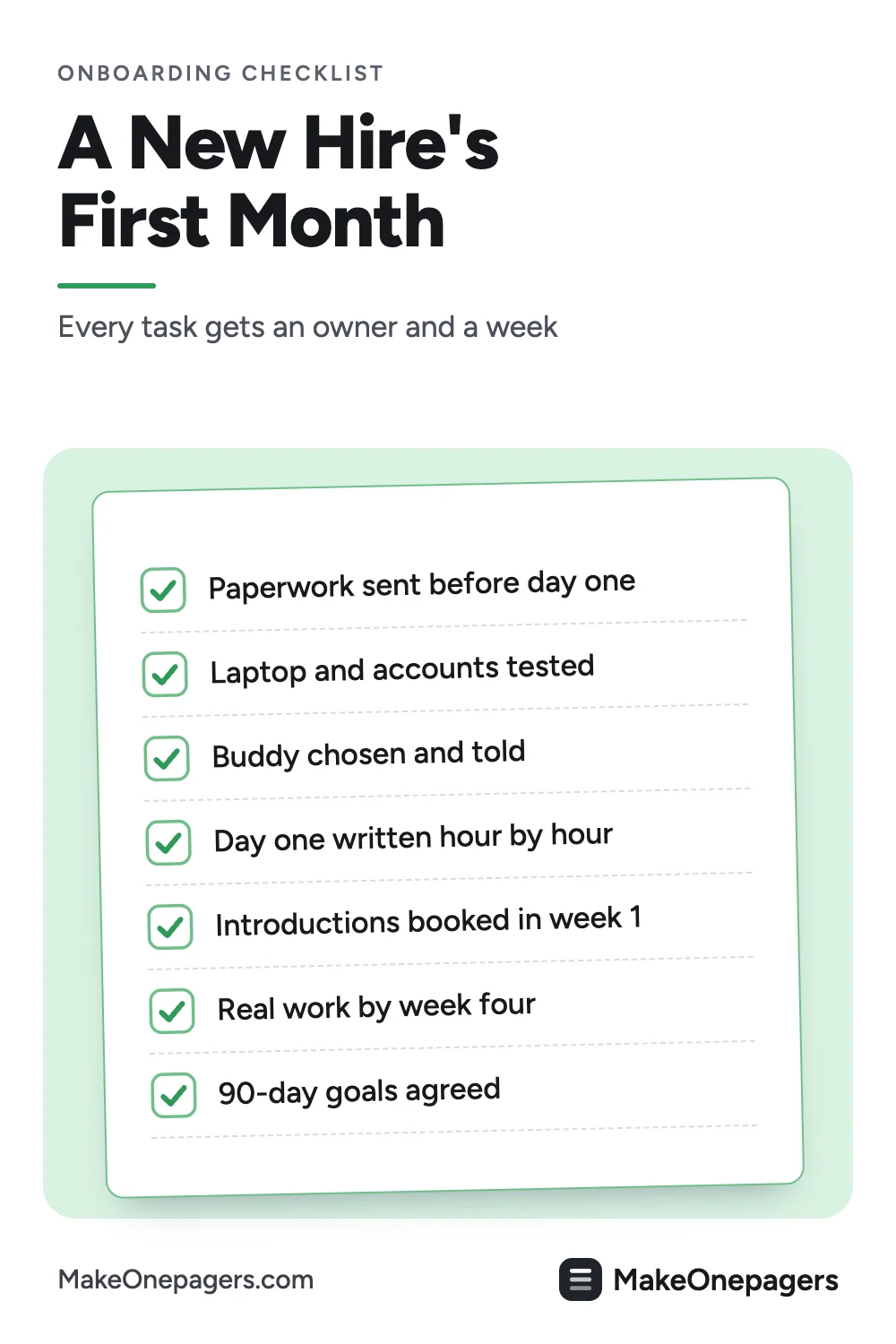
A free onboarding checklist you can copy into any document:
- [ ] Offer letter signed and returned
- [ ] Tax and employment forms sent before the start date
- [ ] Laptop, phone and access badge ordered
- [ ] Email, chat and core tools set up and tested
- [ ] Start time, address and first-day contact sent
- [ ] Buddy chosen and told
- [ ] Day one schedule written, with times
- [ ] First week of introductions booked in calendars
- [ ] Handbook shared and acknowledgment signed
- [ ] Required training listed with due dates
- [ ] First small project picked
- [ ] 30, 60 and 90 day check-ins booked
- [ ] 90-day goals agreed with the manager
In the US, one item on your list has a legal clock. Your employee completes Section 1 of Form I-9 by their first day of work, and as the employer, you complete Section 2 within three business days of that first day (USCIS, Form I-9 instructions, 2025). Put both dates on your checklist so nobody has to look them up.
5 onboarding checklist examples
Here are five new starters with very different first weeks. You'll see a sales hire and a software engineer, then a home health aide. The last two are a remote marketer and a restaurant server. Each one gives every task an owner and a week.
1. Intern onboarding checklist for a summer
 Edit this template
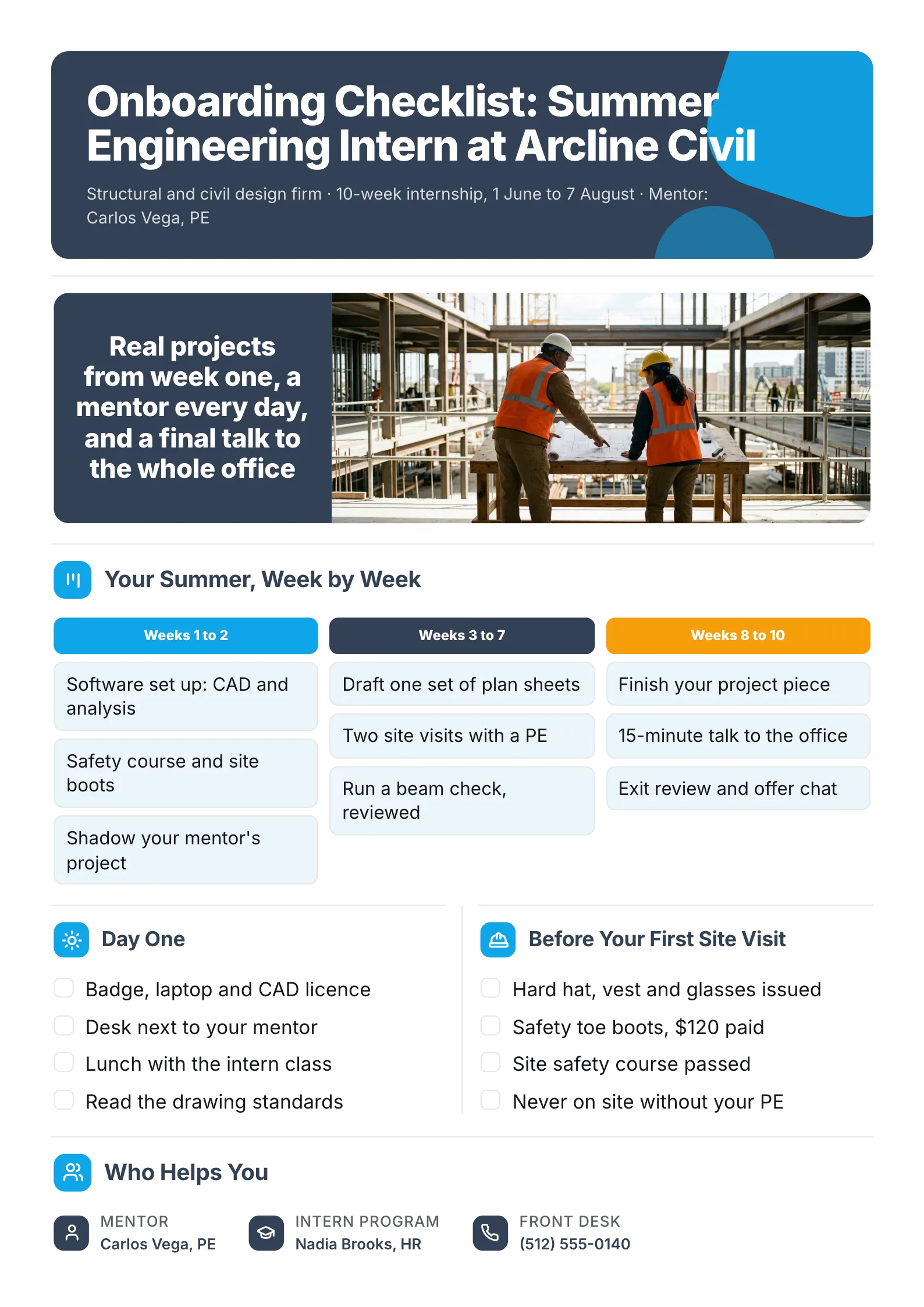
Here's a whole summer on one sheet. Your intern knows what each stage is for, and their mentor knows what to check each week.
This is a sample for a fictional firm, Arcline Civil, bringing on a summer engineering intern for ten weeks. Here's how it's built:
- The weeks sit on a board. Weeks 1 to 2 are for setup and shadowing. Weeks 3 to 7 are for real drafting and two site visits. Weeks 8 to 10 are for finishing the project piece. Your intern can see where they are on any day.
- Day one is a short list you can tick. Badge, laptop and CAD licence. A desk next to the mentor. Lunch with the intern class. Read the drawing standards.
- Safety comes before the site. A separate list covers what must happen before the first site visit, from the hard hat and vest to the safety course. The last line says it plainly: never on site without your PE.
- The summer ends on real work. Your intern finishes a project piece, gives a 15-minute talk to the office and has an exit review.
- Who helps closes it. The mentor, the intern program contact in HR and the front desk number. An intern who knows who to ask speaks up sooner.
You can edit this intern onboarding checklist template for free.
2. Software engineer onboarding checklist
 Edit this template
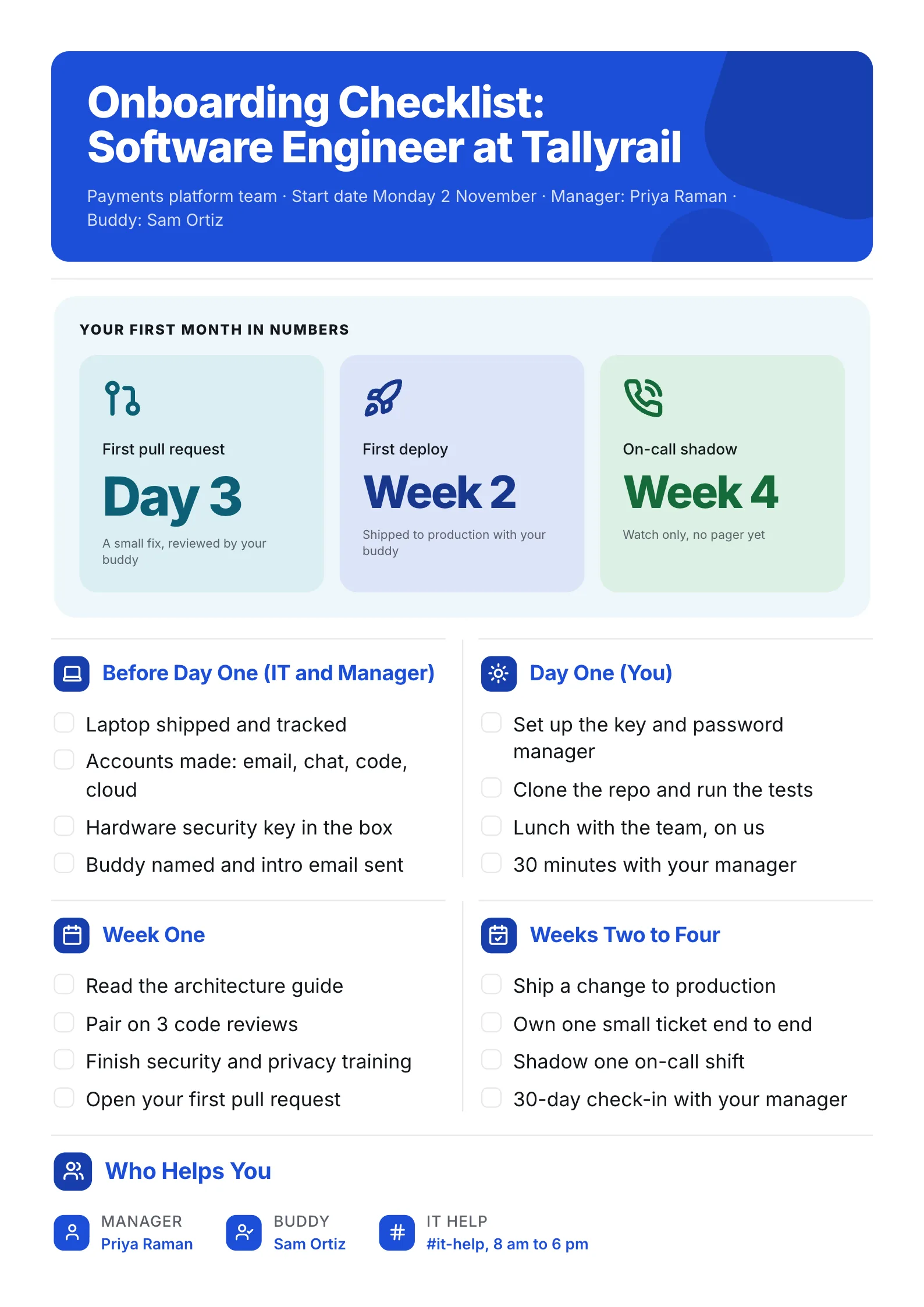
This engineering team splits the list by who acts. IT and the manager act before day one, and the new hire takes over after that.
What to copy:
- Milestones as dates. First pull request on day 3, first deploy in week 2, an on-call shadow in week 4.
- The team's half of the work. Laptop shipped, accounts made and a buddy named before the first morning.
- A check-in at the end. A 30-day talk with the manager closes the month.
You can edit this software engineer onboarding checklist template for free.
3. Home health aide onboarding checklist
 Edit this template
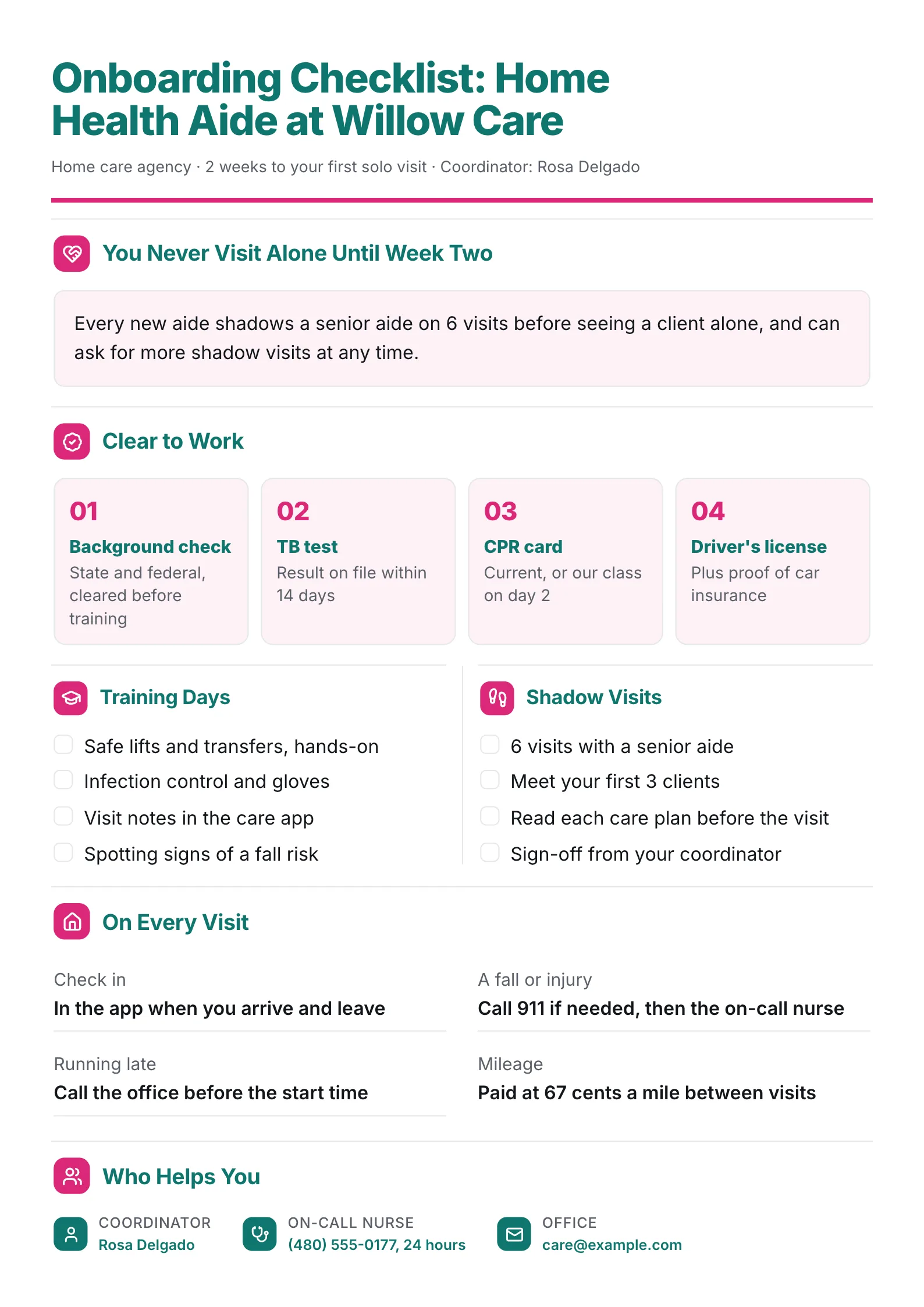
A home care agency makes sure a new aide never walks into a client's home alone too soon.
What to copy:
- The promise in a box at the top. 6 shadow visits with a senior aide before any solo visit.
- Clear-to-work checks, in order. Background check, TB test, CPR card and driver's license.
- What to do when it goes wrong. A fall or injury: call 911 if needed, then the 24-hour on-call nurse.
Open this home health aide onboarding checklist template and edit it for free.
4. Remote employee onboarding checklist
 Edit this template
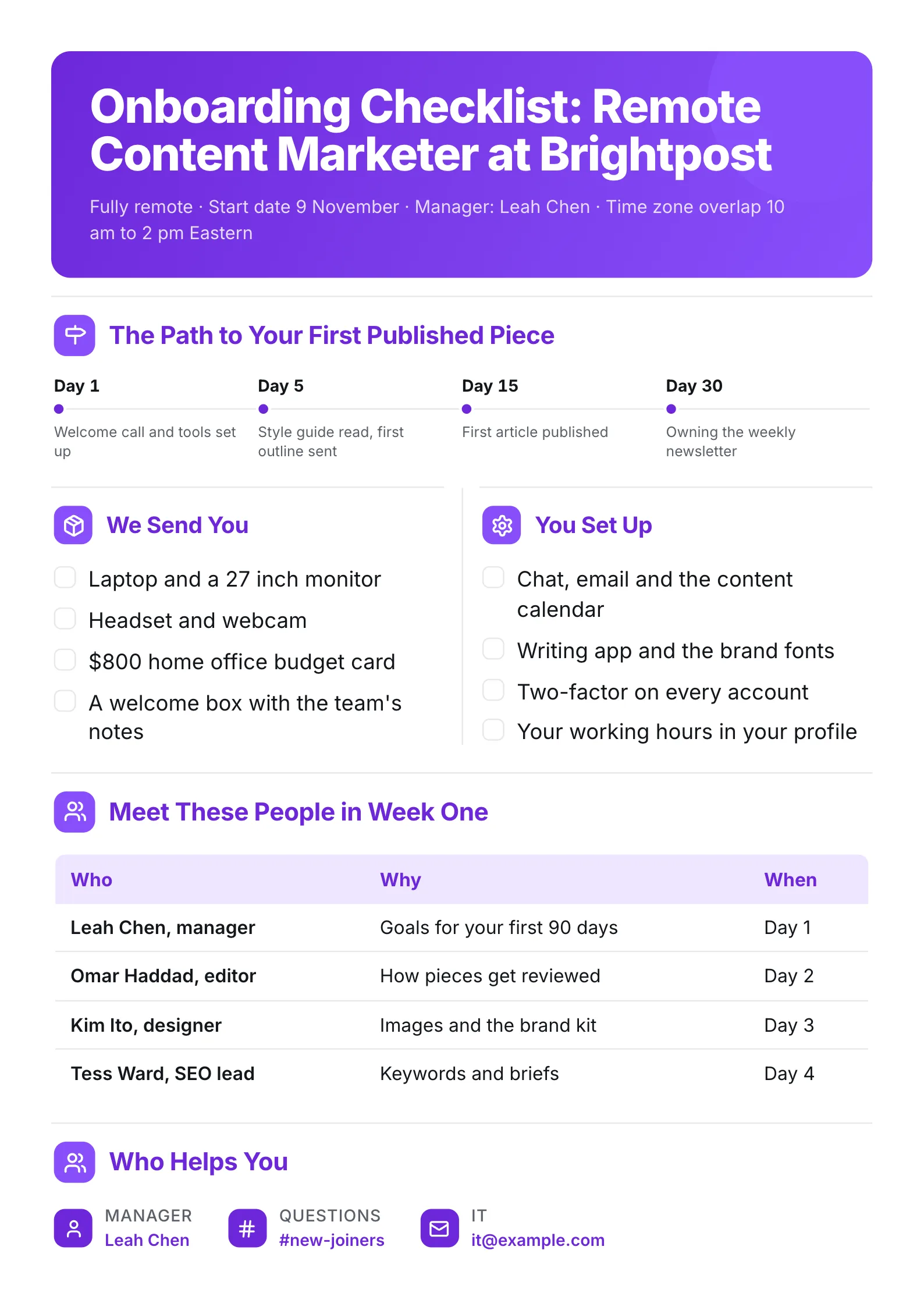
A remote team ships the desk to the new hire and books every first meeting ahead.
What to copy:
- One goal for the first month. First article published on day 15.
- What arrives at the door. A laptop, a 27 inch monitor, a headset and an $800 home office budget.
- Who to meet, and why. The editor on day 2 to learn how pieces get reviewed.
You can make this remote employee onboarding checklist template yours for free.
5. Restaurant server onboarding checklist
 Edit this template
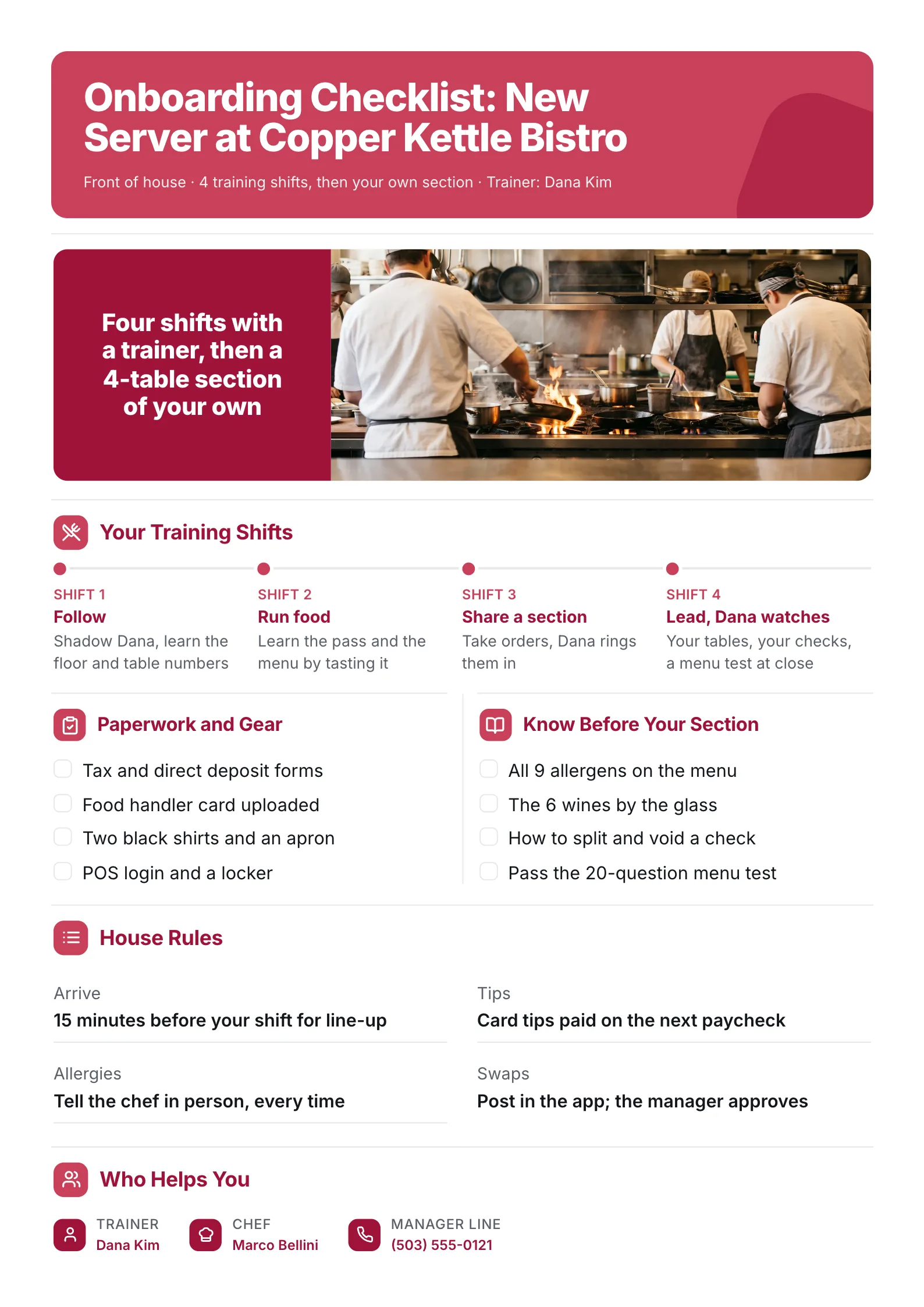
A bistro trains a new server over four shifts, then hands over four tables.
What to copy:
- Training shifts with one job each. Follow, run food, share a section, then take one alone.
- A test before the section. All 9 allergens, the 6 wines by the glass and a 20-question menu test.
- House rules in one line each. Tell the chef about an allergy in person, every time.
Edit this restaurant server onboarding checklist template for free and add your own house rules.
How to make an onboarding checklist in 6 steps
- Start from the last day of the period. Write what the new hire should be doing on their own by day 30 (or day 90). Everything above it on the sheet is the path there.
- List the paperwork and set-up separately. These are HR and IT tasks with deadlines. Keep them in the before-day-one section so they are done before the person arrives.
- Write day one hour by hour. Three or four time slots is enough. Leave space; day one is tiring.
- Give each week one theme and three or four tasks. More than four and the list stops being checked.
- Put a name beside every task. The new hire, the manager, the buddy, HR or IT. If two people own it, nobody does.
- Book the check-ins now. A 30-day check-in that is not in the calendar on day one rarely happens.
Is your old onboarding document spread across three files, with a welcome email in one and a training plan in another? Drop them into the free AI One-Pager generator, and you'll get them back as one designed onboarding checklist.
Onboarding checklist for remote hires
Remote onboarding uses the same checklist with three changes:
- Equipment ships early. Send the laptop so it arrives at least two working days before the start date, and test the login on a call before day one.
- Introductions are booked, not left to chance. In an office a new person meets people at the coffee machine. Remotely, every introduction is a calendar invite. Book them in the first week.
- The buddy checks in daily for the first week. Ten minutes a day replaces the questions a new hire would ask the person at the next desk.
Onboarding checklist mistakes
- Only paperwork. A checklist that ends when the forms are signed leaves the new hire alone for the part that matters: learning the job.
- No owners. "Set up CRM access" with no name means the new person spends their second week asking who does that.
- No dates. Without a week beside each task, everything is due now, which feels the same as nothing being due.
- Too long. Forty tasks on day one is a test, not a welcome. Spread the work across the weeks.
- The same list for every role. Keep the company part the same and change the role part. A sales hire and an engineer do not need the same week three.
- Nobody reviews it. Ask each new hire what was missing at their 30-day check-in, and add it for the next person.
Onboarding checklist vs onboarding plan
| Onboarding checklist | Onboarding plan | |
|---|---|---|
| Question it answers | What do I do this week? | What should I achieve by day 90? |
| Made of | Tasks with owners and dates | Goals and measures by stage |
| Covers | Usually the first 30 days | Usually 30, 60 and 90 days |
| Used | Daily and weekly | At check-ins |
Most teams use both. Your checklist gets the new person started, and a 30 60 90 day plan says where they're headed.
Make your onboarding checklist
Open a free onboarding checklist, like the intern onboarding checklist template, and put in your team and your first weeks, with your own names. Or drop your current onboarding notes into the free AI One-Pager generator, and you'll get a finished onboarding checklist back.
Frequently asked questions
What should be on a new hire onboarding checklist?
Start with paperwork and set-up before day one, then a day one schedule. Week one is for introductions and reading. Weeks two and three cover tools and training, and week four brings the first real work. Add your check-in dates and who your new hire can ask for help.
How long should onboarding last?
Your checklist usually covers the first 30 days, with goals set for 90 days. Many teams keep check-ins going for the first three to six months.
Who is responsible for onboarding?
HR owns the paperwork and the benefits and compliance tasks. The hiring manager owns the role itself, from introductions to first projects and goals. A buddy helps your new hire with the day-to-day questions.
What is pre-boarding?
It's everything between the signed offer and the first day. You send the forms and the start time with a welcome message. You also get their equipment and accounts ready. Good pre-boarding means your new hire can work on day one instead of waiting for a laptop.
Should onboarding checklists be the same for every employee?
Keep the company steps the same for everyone and change the role steps. Your paperwork and values stay shared, and so do your tools. The people to meet change by team, and so do the training and the first project.




