How to Write an Employee Handbook (Plus the 3 Policies Most Often Missing)
Lactation breaks are federal law, yet only 3 of 8 city employee handbooks explain them. Learn how to write an employee handbook with the protective pages first.

How do you write an employee handbook your people will use? Start with two short lists, one of who it covers and one of the laws that apply to you. Write the protective pages first, then one short policy per topic in plain words, and give every policy a person to ask. Put a date on the cover, have an employment lawyer read it, and ask each employee to sign that they got it. Start from a free one pager template.
One‑Pager examples
Real One-Pagers made with MakeOnepagers. Open any one to edit it as your own.
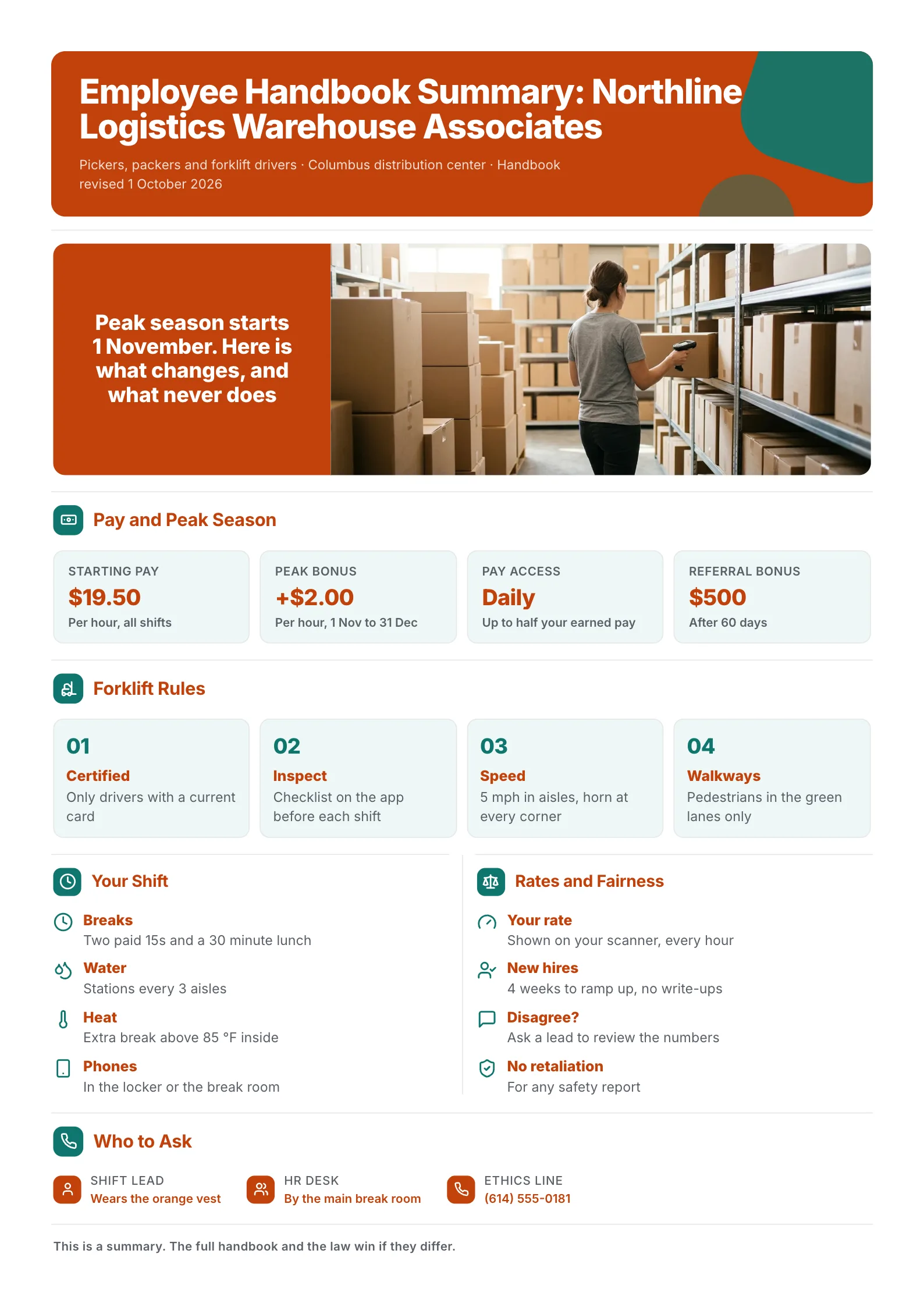 Employee Handbook Summary: Warehouse AssociatesEdit for free(opens in a new tab)
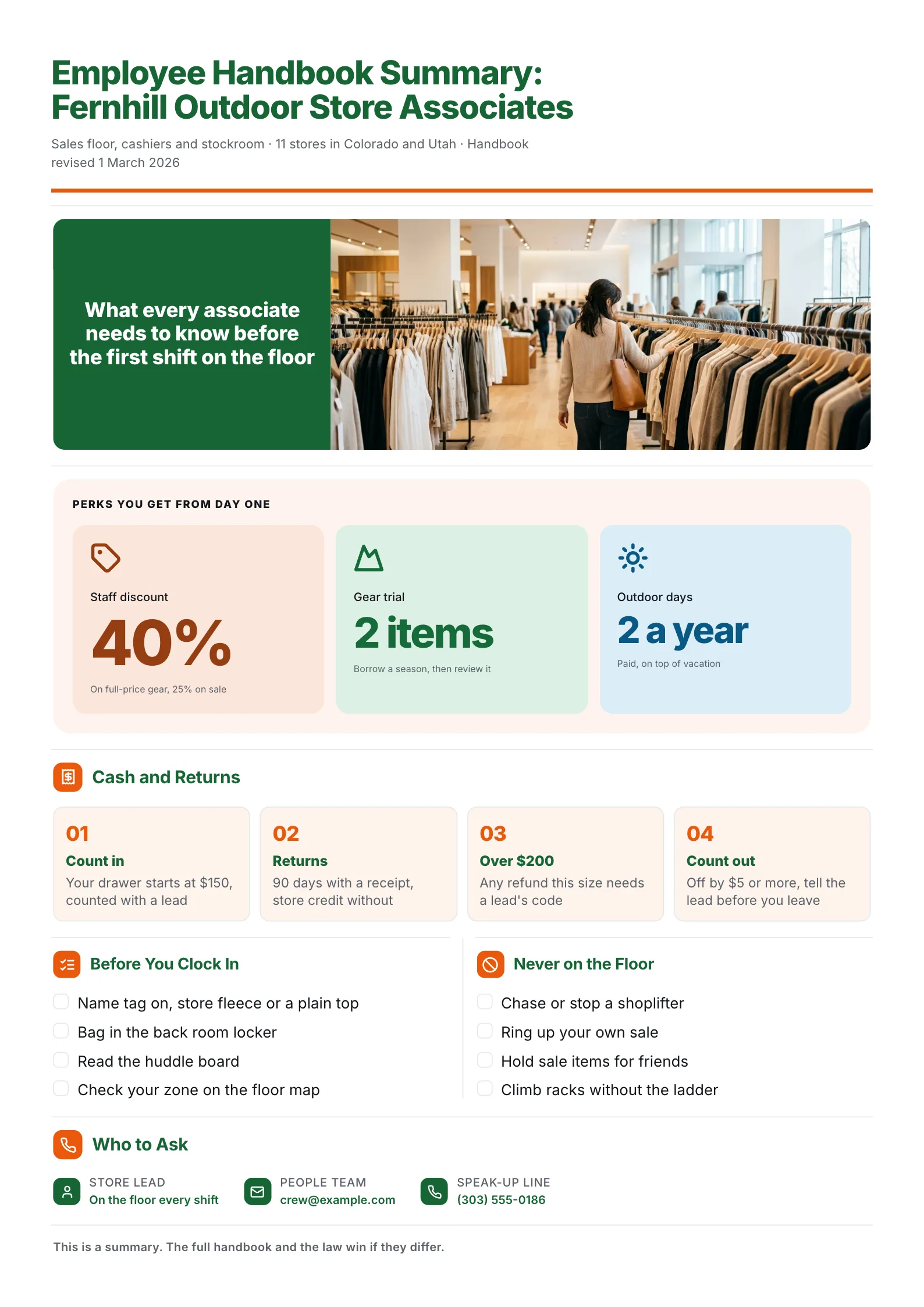 Employee Handbook Summary: Retail Store AssociatesEdit for free(opens in a new tab)
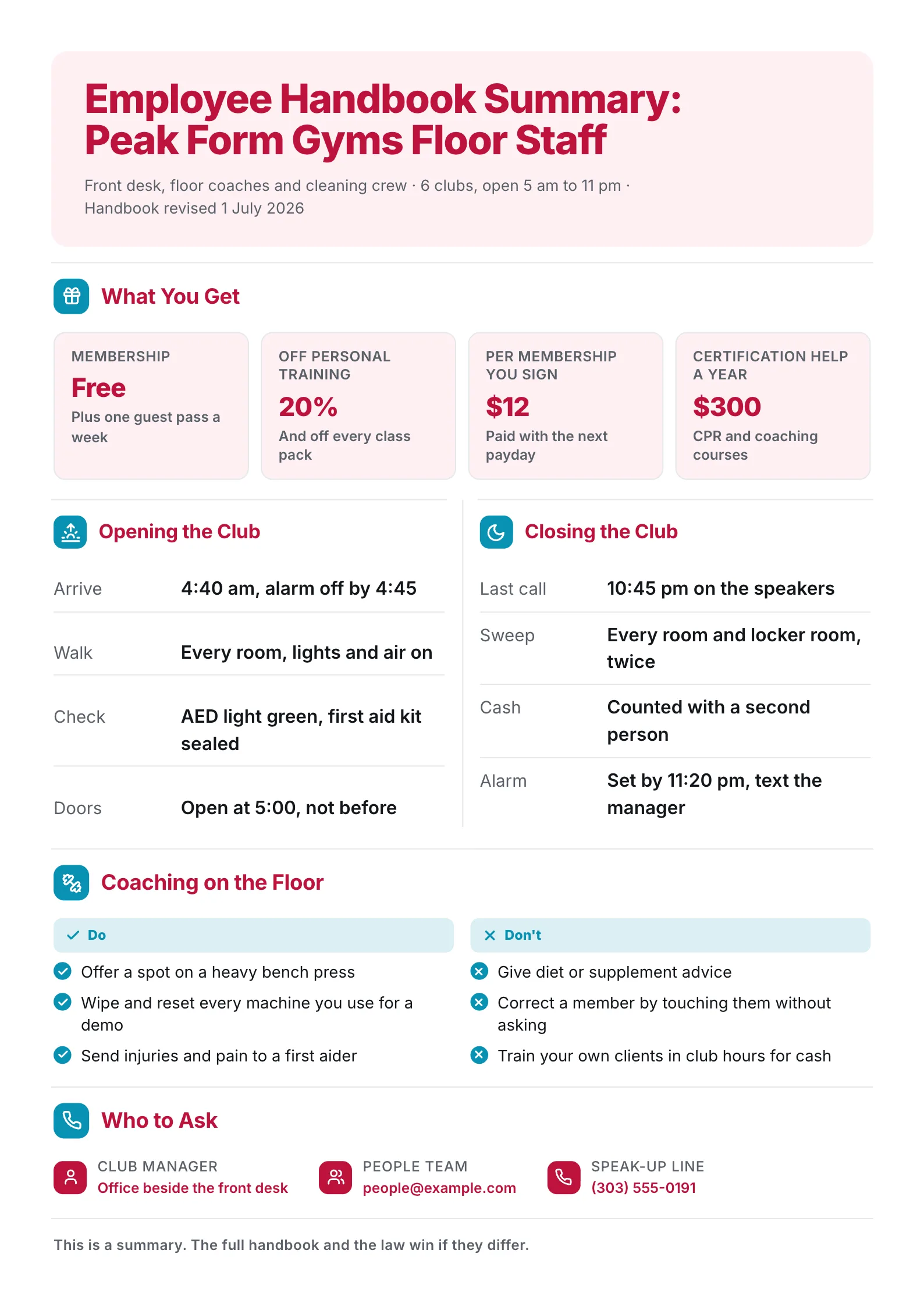 Employee Handbook Summary: Gym Floor StaffEdit for free(opens in a new tab)
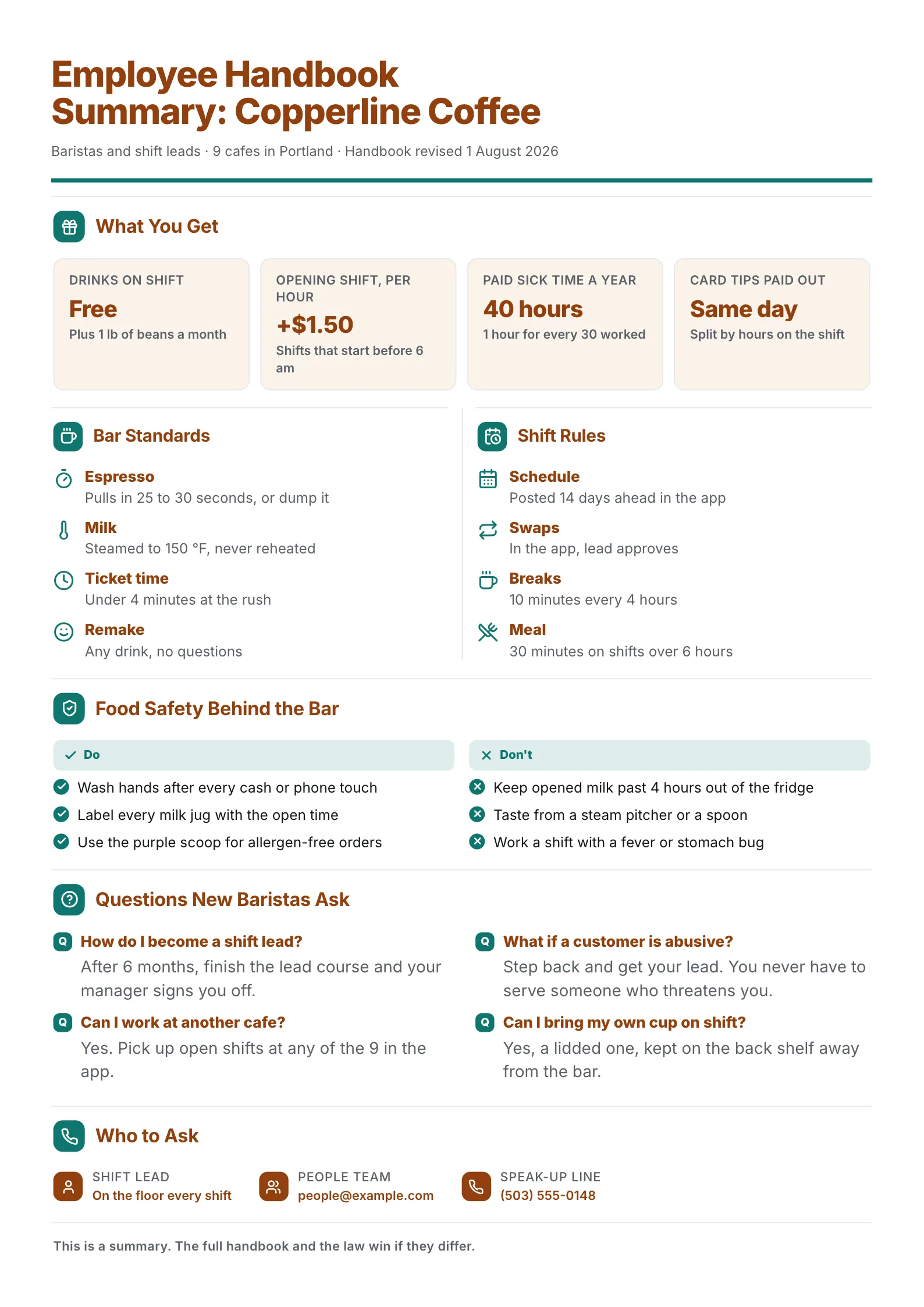 Employee Handbook Summary: Coffee Shop BaristasEdit for free(opens in a new tab)
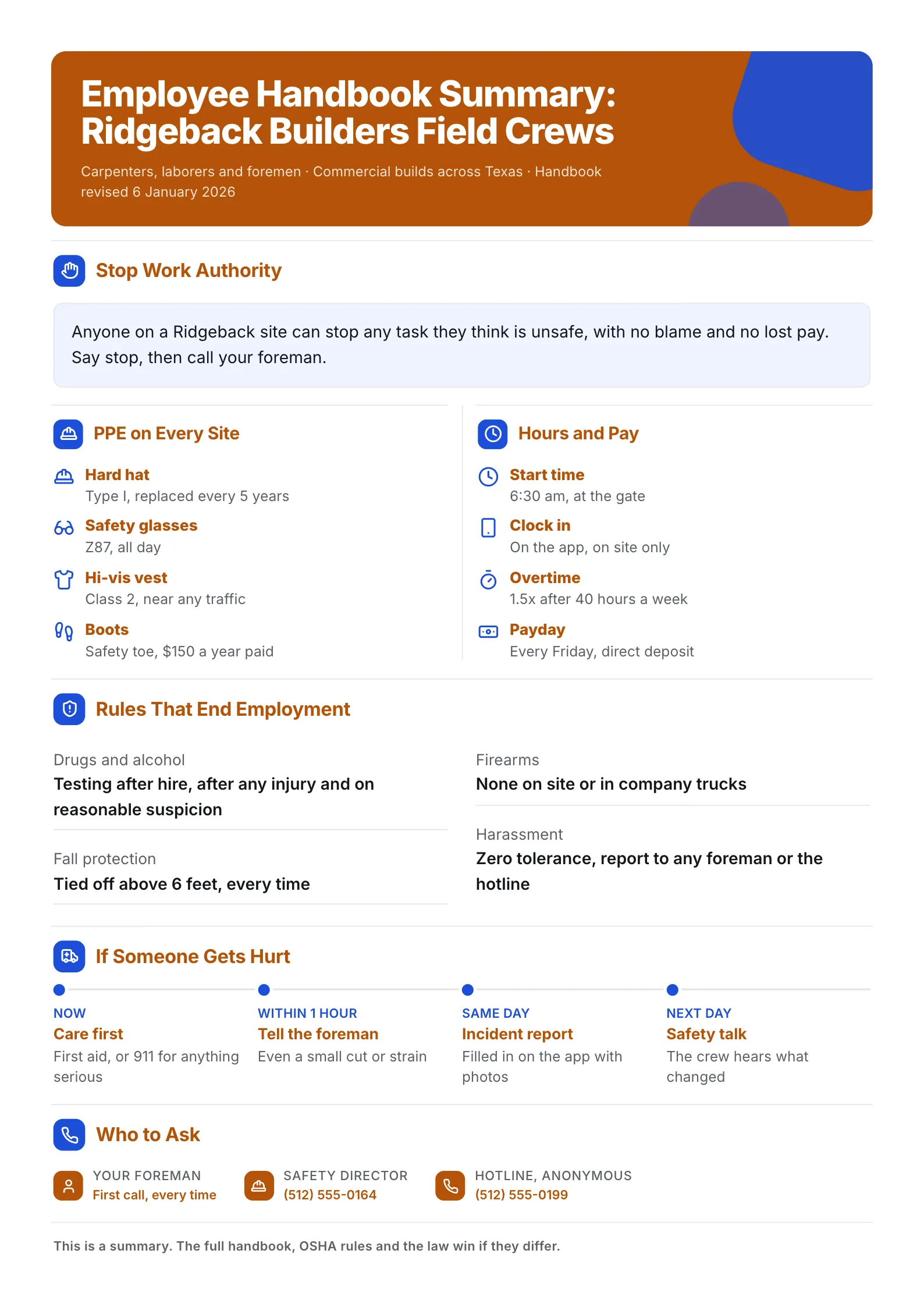 Employee Handbook Summary: Construction Field CrewsEdit for free(opens in a new tab)
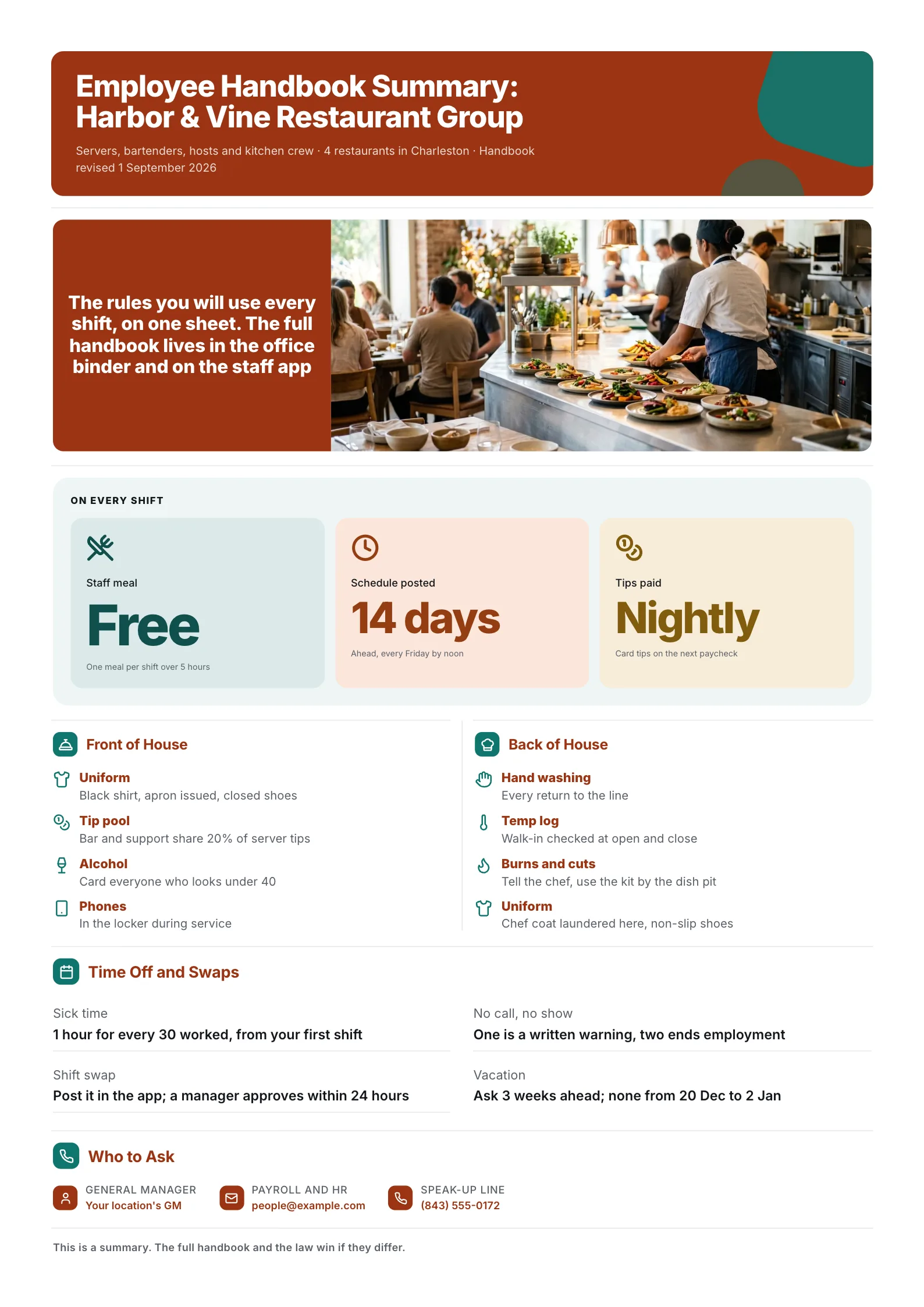 Employee Handbook Summary: Restaurant Group StaffEdit for free(opens in a new tab)
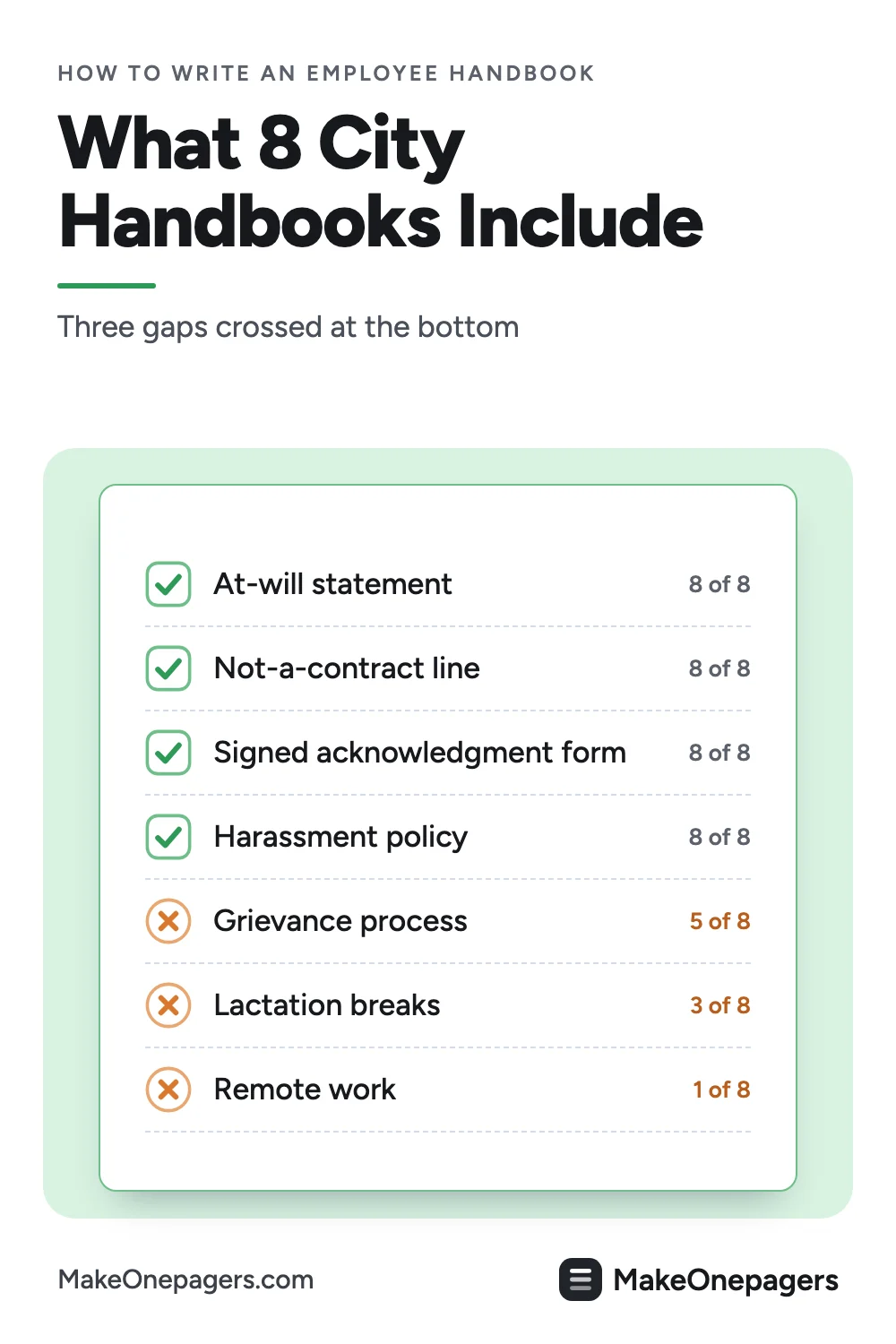
To see what a finished one looks like, we went through 8 handbooks that US cities publish for their own staff. They run from 34 pages to 137, with a median of 52. The at-will statement, the line saying the handbook is not a contract and a form your employee signs turn up in every one of them. The lactation breaks federal law requires turn up in 3, and a written remote work policy in just 1.
What 8 real employee handbooks include
| Section | Handbooks that have it |
|---|---|
| At-will employment statement | 8 of 8 |
| "This is not a contract" disclaimer | 8 of 8 |
| Signed acknowledgment form | 8 of 8 |
| Equal employment opportunity | 8 of 8 |
| Harassment policy | 8 of 8 |
| Drug and alcohol rules | 8 of 8 |
| Social media | 8 of 8 |
| Overtime | 8 of 8 |
| Paid holidays | 8 of 8 |
| Discipline | 8 of 8 |
| Right to change the policies | 7 of 8 |
| Protection from retaliation | 7 of 8 |
| Family and medical leave (FMLA) | 7 of 8 |
| Workplace violence or weapons | 7 of 8 |
| Dress and appearance | 7 of 8 |
| A grievance or appeal process | 5 of 8 |
| Lactation breaks | 3 of 8 |
| A remote work policy | 1 of 8 |
Source: our read of 8 public city employee handbooks, October 30, 2026. Each one is linked at the end.
City handbooks make a fair test because anyone can download them, and several are adopted by a city council vote. All 8 were revised in 2025 or 2026. A private company's handbook has fewer civil service rules, but the core sections are the same.
Three gaps we found in 8 city handbooks
The most common miss in our sample was remote work. Only Statham's 2026 policy gives it a section, under alternative work schedules. Beaufort says working from home is discouraged and needs a work plan, and Chickasha requires the city manager's written approval. If any of your people work from home even one day a week, write down the hours they must be reachable and how they keep company data safe. Spell out the equipment you provide as well.
The second miss was lactation breaks, covered by just 3 of 8. It's a federal requirement for most employers, and it takes one paragraph.
A third is the grievance process. Three of the 8 handbooks have no appeal step at all. A clear path for complaints tells your people you'll listen before a problem reaches a lawyer.
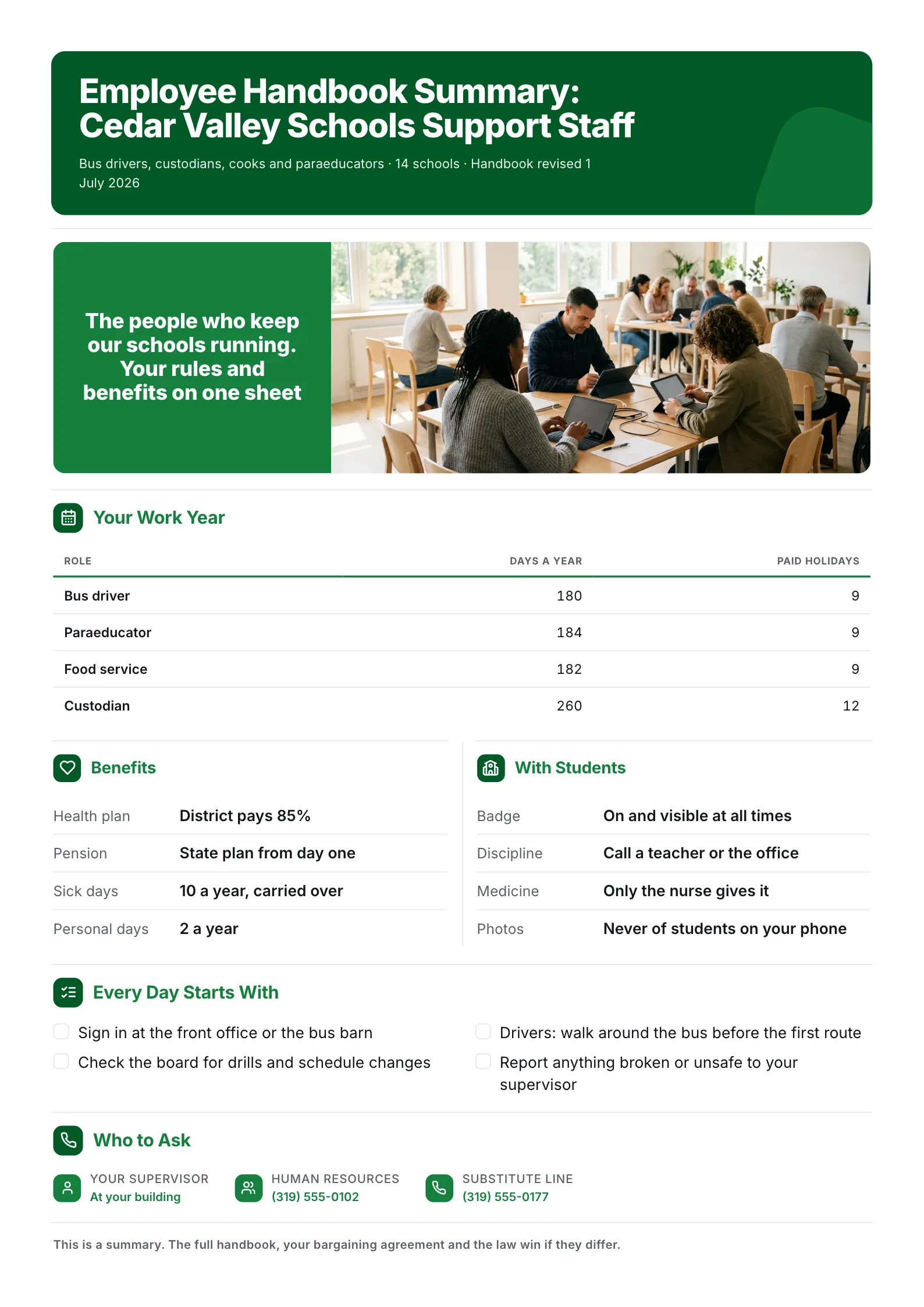 Edit this template
A school district's support staff summary with work days by role, benefits, rules around students and a daily checklist.
Step 1. Decide who the handbook covers and which laws apply
Start by listing who will read it. Full-time staff, part-time staff, seasonal workers and interns often get different benefits, and your handbook has to say which rules apply to whom. Spring Hill, Kansas, opens with a whole section on coverage. Somerset, Kentucky, gives police and firefighters a 12-month introductory period while other new hires follow different rules.
Then count your employees, because several federal laws switch on at a headcount. The Family and Medical Leave Act covers a private employer once it employs 50 or more people for each working day in 20 or more weeks this year or last. If you're under that line, an FMLA chapter would promise leave the law doesn't require, so leave it out.
State law matters as much. Your state may set its own paid sick leave, final paycheck deadline or meal breaks. That's why a handbook copied from a company in another state is a risk. Write down your state and city before you start, and check each policy against them.
Step 2. Write the protective pages first
Three short statements show up in nearly every handbook we read, and they belong near the front.
- The at-will statement. Say that you or your employee can end the job at any time, with or without a reason. All 8 cities say it, and Paola, Kansas, spells out what "at will" means in one sentence.
- The not-a-contract line. Say the handbook is a guide and does not create an employment contract. All 8 have it, and most repeat it on the signature form.
- The right to change. Say you can update any policy, and how you'll tell people. Seven of the 8 reserve that right. Beaufort, South Carolina, reserves it only for benefits.
Then write the last page, the acknowledgment form. Your employee signs that they received the handbook and understand it isn't a contract. Every one of the 8 handbooks has this form. Somerset numbers it as "HR Form 01" and puts a second form right after it for the drug and alcohol policy. Keep the signed copy in each personnel file. It's your proof that your employee saw the rules.
Step 3. Build the table of contents from what people ask
Most handbooks follow the same order. They start with a welcome and the protective pages. Next come the hiring and employment terms, then pay and hours, then time off and benefits. Conduct and discipline follow, and the forms close it out. You can borrow that order. The table above is your checklist of sections.
What you leave out matters too. A 137-page handbook is hard to search, and nobody reads it front to back. Your employees open it to answer one question. How many vacation days do I get? Who do I call if I'm sick? When is payday? Put those answers early, and keep each policy short enough to read in a minute.
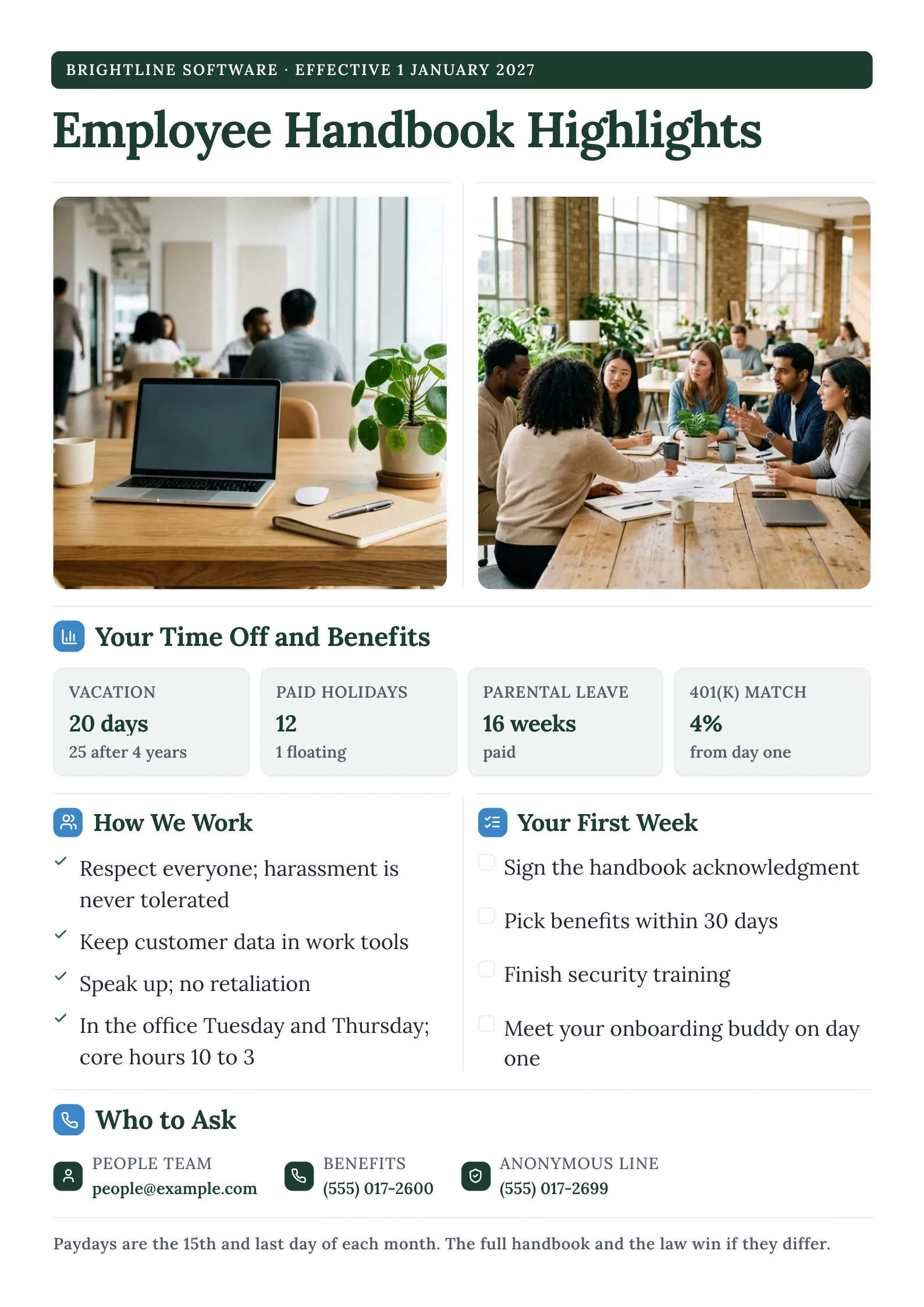 Edit this template
A software company's handbook highlights with time off, how the team works, the first-week checklist and who to ask.
Step 4. Write each policy in plain words
Handbooks drift into legal language because they're often drafted from older policies or a lawyer's model. Here's a real 49-word sentence from the Statham, Georgia, personnel policy, rewritten for your new hire.
| Before | After |
|---|---|
| Except as provided for in the Department's specific rules and policies, employees shall be identifiable as an employee of the City with a neat, tidy, and professional appearance, including appropriate dress and grooming to ensure that employee presents a professional image to the citizens and customers of the City. | Dress neatly and look like you work for the city, so the people you serve see a professional. Your department may have its own dress rules, and those come first. |
The rule didn't change. The second version is 30 words, uses "you" and puts the exception where you'll see it. Try that test on every policy you write. Could your newest hire act on it after reading it once?
A few habits help.
- Lead with the rule. Say what to do in the first sentence, then the details.
- Use numbers. "Two weeks' notice" beats "reasonable notice." "Paid on the 15th and the last day of the month" beats "paid semimonthly."
- Say why when it isn't obvious. A lockout rule makes sense once your reader knows a press can start on its own.
- Point to the long version. For benefits, summarize the plan and name the document that governs it, so a typo in the handbook can't rewrite your health plan.
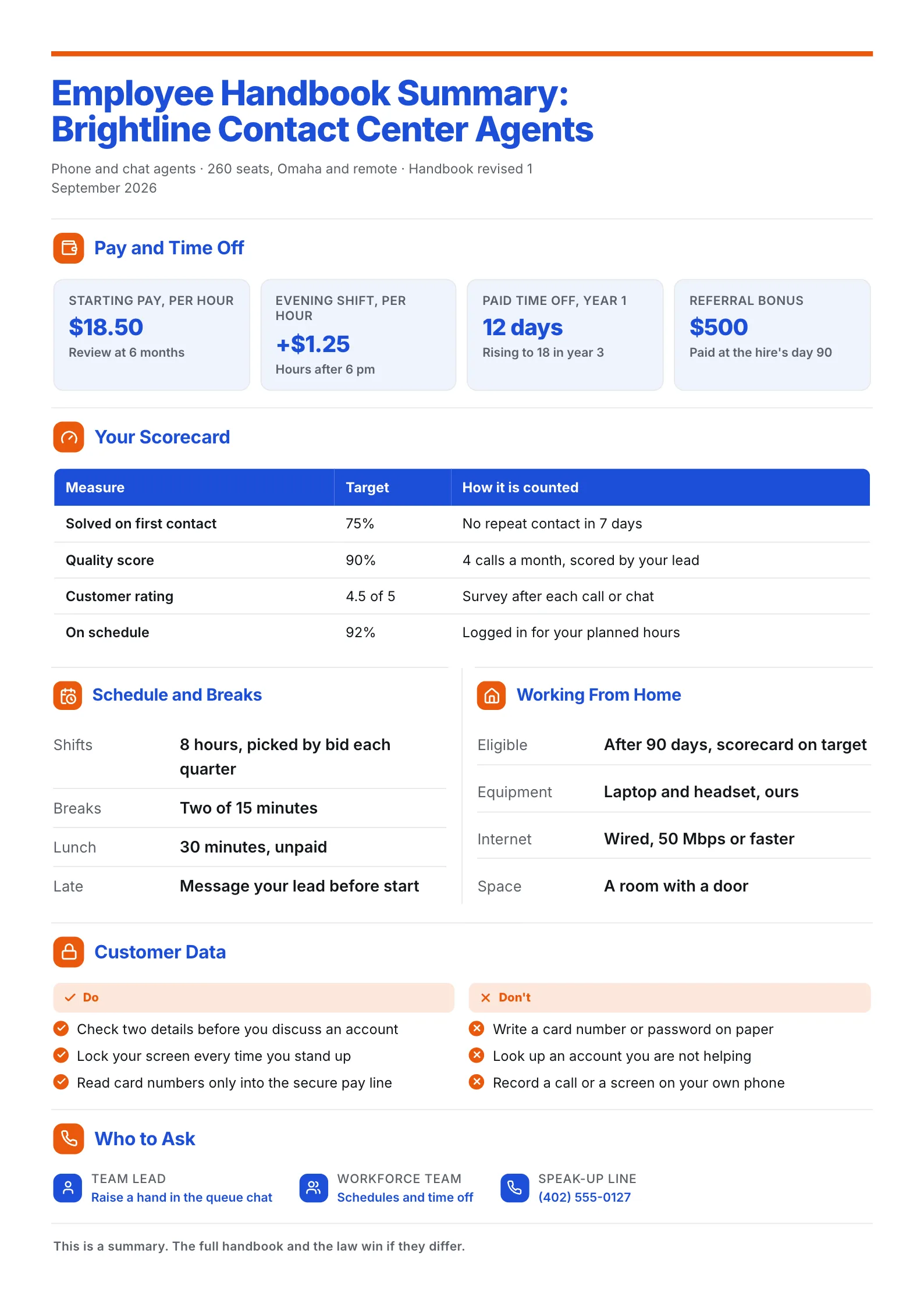 Edit this template
A contact center summary that puts pay and time off in numbers and says how each scorecard target is counted.
Step 5. Add the notices the law requires
Some sections aren't optional once you reach a certain size. We checked two of them at the source.
- FMLA. If you're covered and have eligible employees, federal rules say the general FMLA notice must go into your employee handbook or other written leave materials, if you have them (29 CFR 825.300(a)(3)). Seven of the 8 cities include a full FMLA section. Statham names FMLA only in passing inside its paid time off policy.
- Lactation breaks. The federal PUMP Act requires reasonable break time to pump for up to one year after a child's birth, plus a private space that isn't a bathroom (U.S. Department of Labor). Only Harrah, Somerset and Spring Hill put it in their handbooks. Spring Hill does it in one short paragraph under "Nursing Breaks."
Your state may add its own required notices, such as paid sick leave or jury duty. Your lawyer can give you the list for your state.
Step 6. Give every policy a person to ask
A rule without a contact gets ignored or argued about. The best handbooks name a job title, a phone extension or an email for each topic. Name a role, such as "your supervisor" or "the HR director," so the handbook doesn't go stale when someone leaves.
This matters most for harassment. All 8 handbooks have a harassment policy, and 7 of the 8 also promise that nobody will be punished for reporting. Give your people more than one place to report, so that someone whose supervisor is the problem can go around them. Statham sends reports to the supervisor or the city administrator, and to the mayor when the complaint involves either of them.
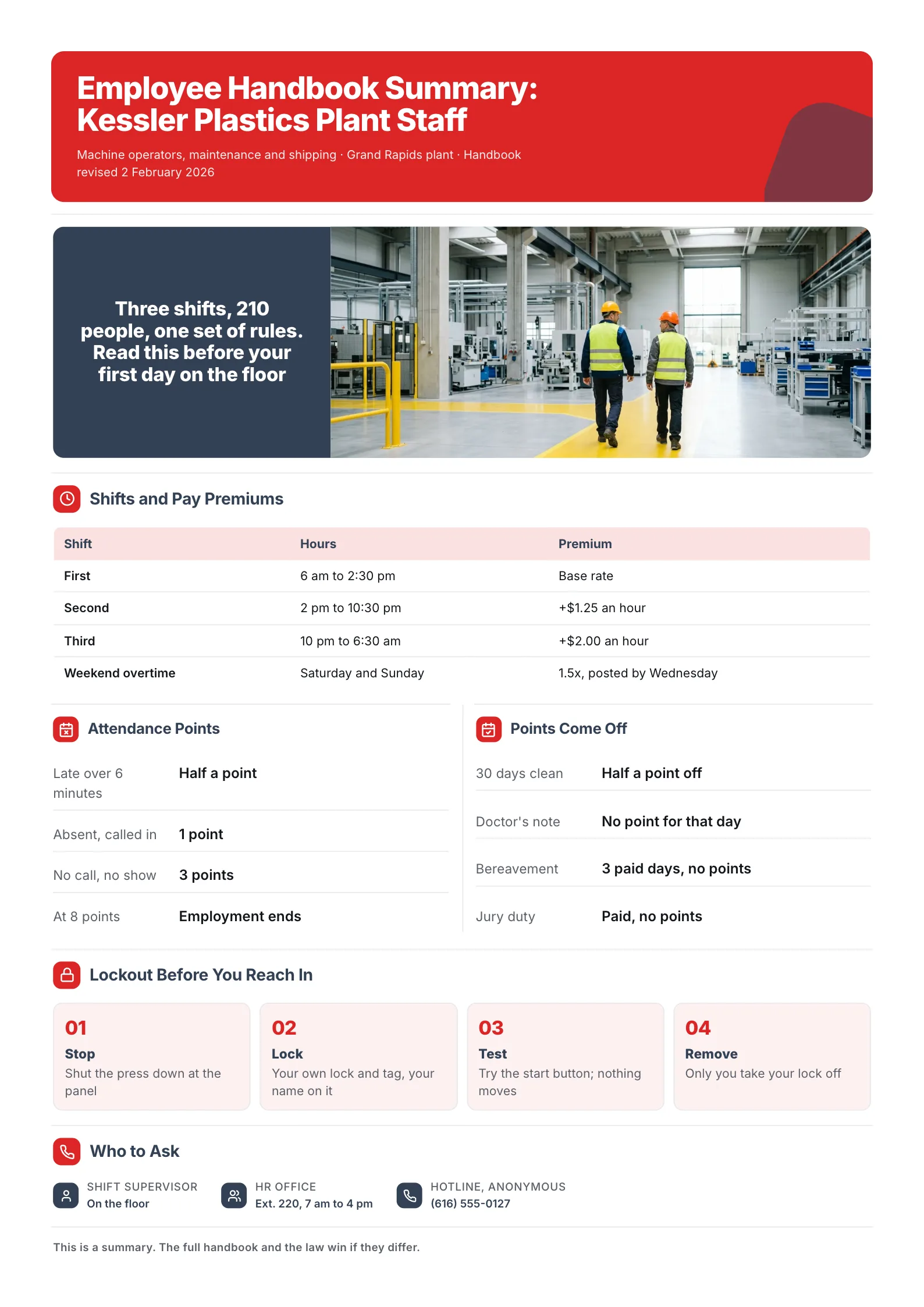 Edit this template
A plant's summary that gives three places to ask, the shift supervisor, the HR office and an anonymous hotline, and spells out its lockout rule in four steps.
Discipline needs the same care. All 8 handbooks explain discipline, but only 5 describe how your employee can appeal or file a grievance. If you have no appeal step, say who reviews a firing decision anyway.
 Edit this template
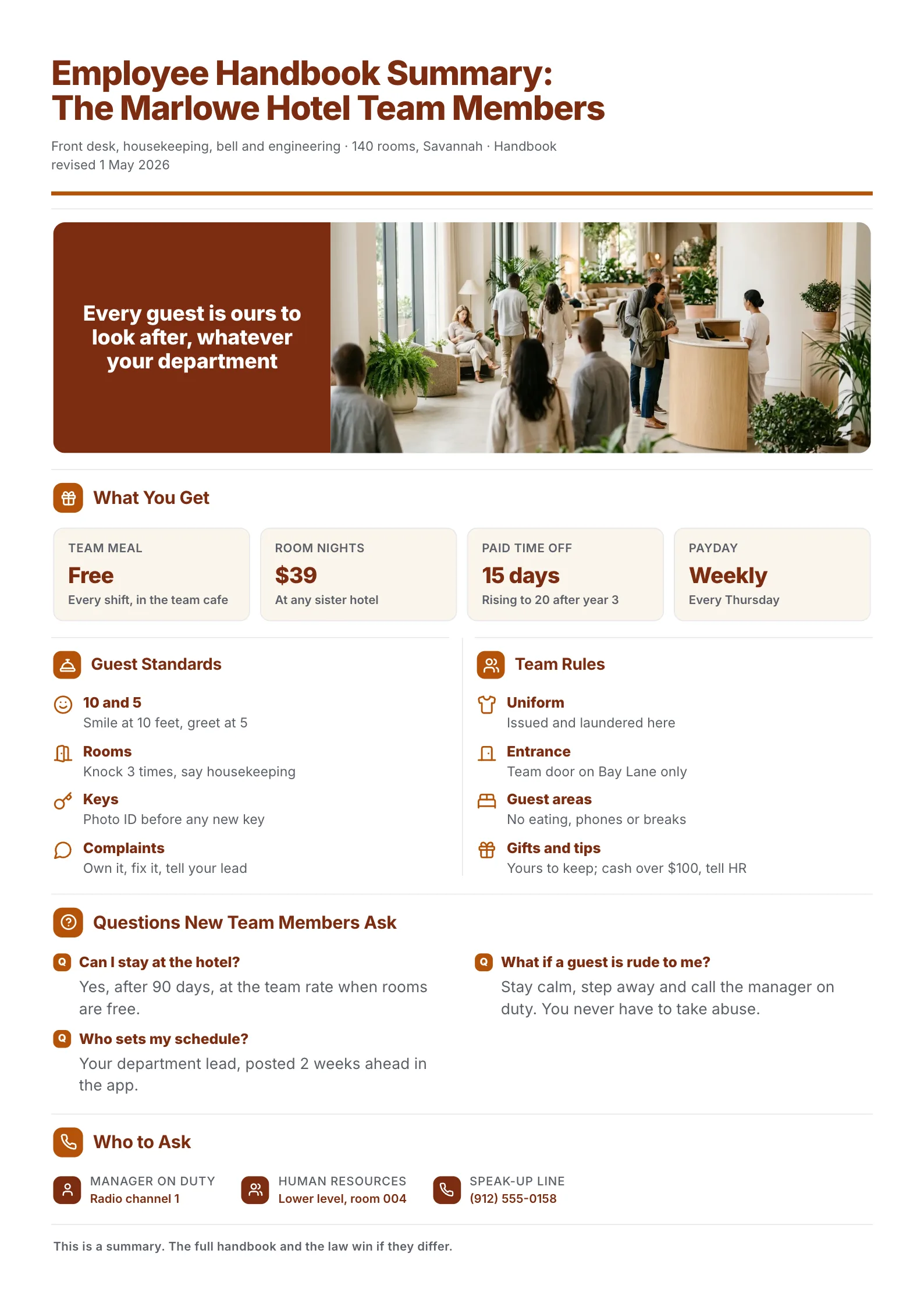
A hotel's summary with team perks, guest standards, team rules, new team member questions and a speak-up line.
Step 7. Date it, review it and hand it out
Put a revision date on the cover. Seven of our 8 handbooks print a revision or adoption date, from Devils Lake, North Dakota, at December 15, 2025, to Harrah, Oklahoma, at August 5, 2026. When you get a question about an old rule, the date tells you which version your employee signed.
Then have an employment lawyer read the whole draft. A single word like "will" or "guarantee" can turn a guideline into a promise you have to keep. Spring Hill adopted its latest edition by council resolution on December 11, 2025.
Last, hand it out the same way every time. Give it to every new hire on day one, collect the signed form, and send a short note with each update that says what changed.
Put the highlights on one page
Your full handbook is the official record. Most of your people will never read the whole thing, though. So give them a one-page version with time off, pay dates, the rules that end employment and who to ask. Say on it that the full handbook and the law win if they differ, and update both on the same day.
We wrote a whole guide on that sheet, with six worked examples, in our employee handbook summary post. Every template below is a fair place to begin.
 Edit this template
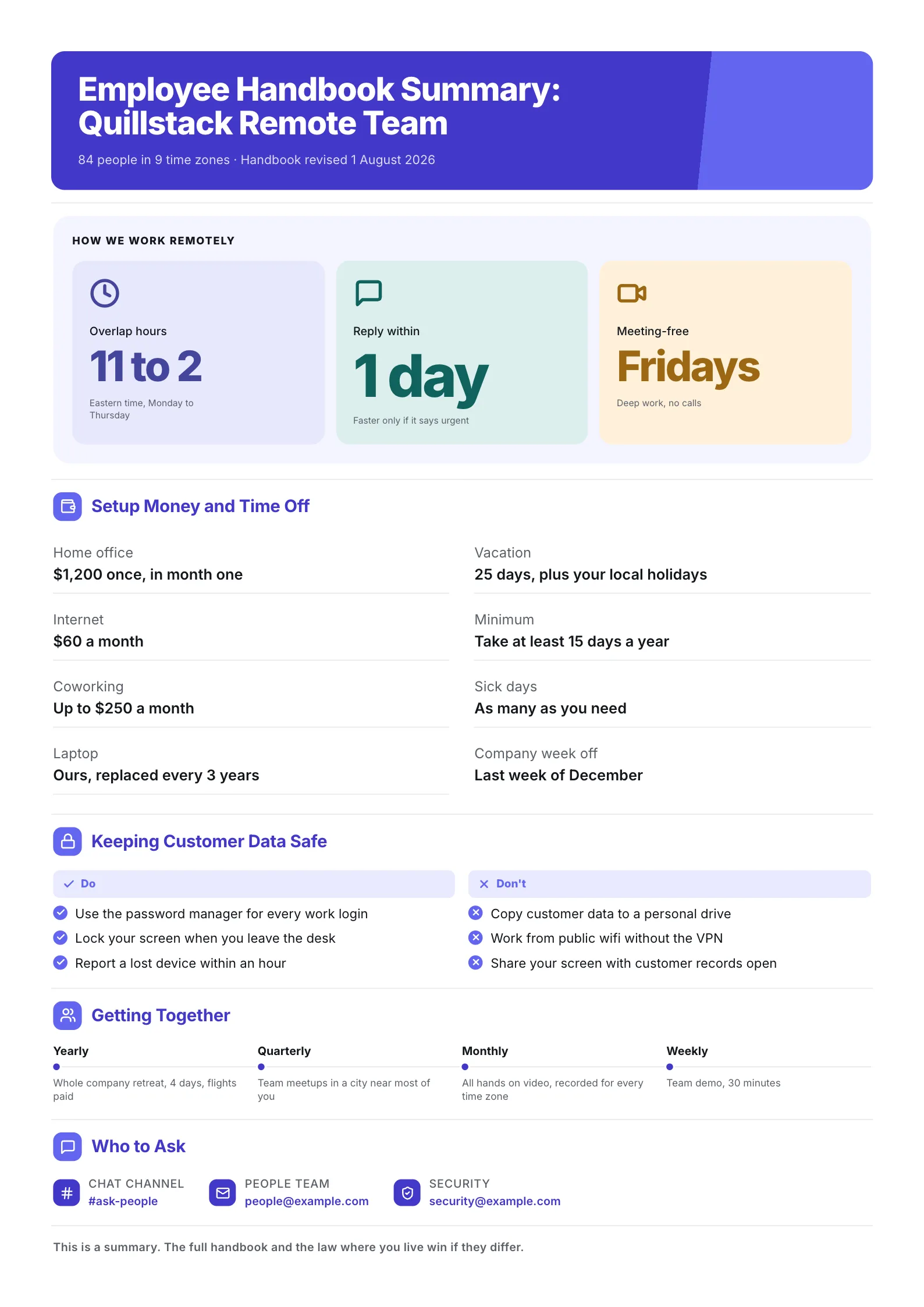
A remote company's summary with overlap hours, home office money, time off, data safety rules and team meetups.
The 8 handbooks we read
Each count in this post comes from one of these public documents. Page counts are from each PDF itself.
| Handbook | Revised | Pages |
|---|---|---|
| City of Statham, Georgia, Personnel Policy | January 20, 2026 | 34 |
| City of Devils Lake, North Dakota, Employee Manual | December 15, 2025 | 44 |
| City of Harrah, Oklahoma, Employee Handbook | August 5, 2026 | 51 |
| City of Beaufort, South Carolina, Employee Handbook | December 2025 | 52 |
| City of Chickasha, Oklahoma, Employee Manual | February 17, 2025 | 52 |
| City of Paola, Kansas, Employee Handbook | May 14, 2025 | 60 |
| City of Spring Hill, Kansas, Employee Handbook | December 11, 2025 | 84 |
| City of Somerset, Kentucky, Employee Handbook | 2025 | 137 |
Your team keeps the one page
Your handbook protects you and answers your people's questions, but only if they can find the answer. Write the full version for the record. Then give your team the one page they'll actually keep. Pick a template from MakeOnepagers, add your own time off, pay dates and contacts, and print it with the handbook.
Frequently asked questions
How long should an employee handbook be?
As long as your policies need and no longer. The 8 we read ran from 34 to 137 pages, with a median of 52 and about 20,000 words. A small company will usually need fewer pages than a city, since it has no civil service or police rules to cover.
Is an employee handbook required by law?
No federal law requires a handbook. But some required notices, like the FMLA general notice, must go into your handbook if you have one. And a handbook gives the policies you'll need to point to later one home everyone can find.
Can I use an employee handbook template?
Yes, as a starting point. Change every policy to match your state, your headcount and how you actually work, then have a lawyer read it. A template from another state can promise leave you don't owe or miss leave you do.
Who should write the employee handbook?
Usually the owner or HR lead drafts it, with managers checking the policies for their teams. An employment lawyer reviews the final draft before anyone signs.
How often should I update my employee handbook?
Read it once a year and whenever a law or a benefit changes. Put the new date on the cover, tell everyone what changed and collect a new signed form.




