Creative Brief vs Design Brief: What 8 Real Briefs Ask For
Creative brief vs design brief, checked on 8 real briefs: the creative ones ask about the message, and 3 of 4 design briefs ask for a budget.

A creative brief tells the team what to say, who to say it to and why they should believe it. A design brief tells a designer what to make, at what size, with which text and pictures, by when and for how much. We read 8 real briefs, 4 of each kind, from universities, a health system and a designers' association. None of the 4 creative briefs asks for a budget, a size, the text or the images. 3 of the 4 design briefs ask for a budget, and all 4 ask for a date. Start from a free one pager template.
One‑Pager examples
Real One-Pagers made with MakeOnepagers. Open any one to edit it as your own.
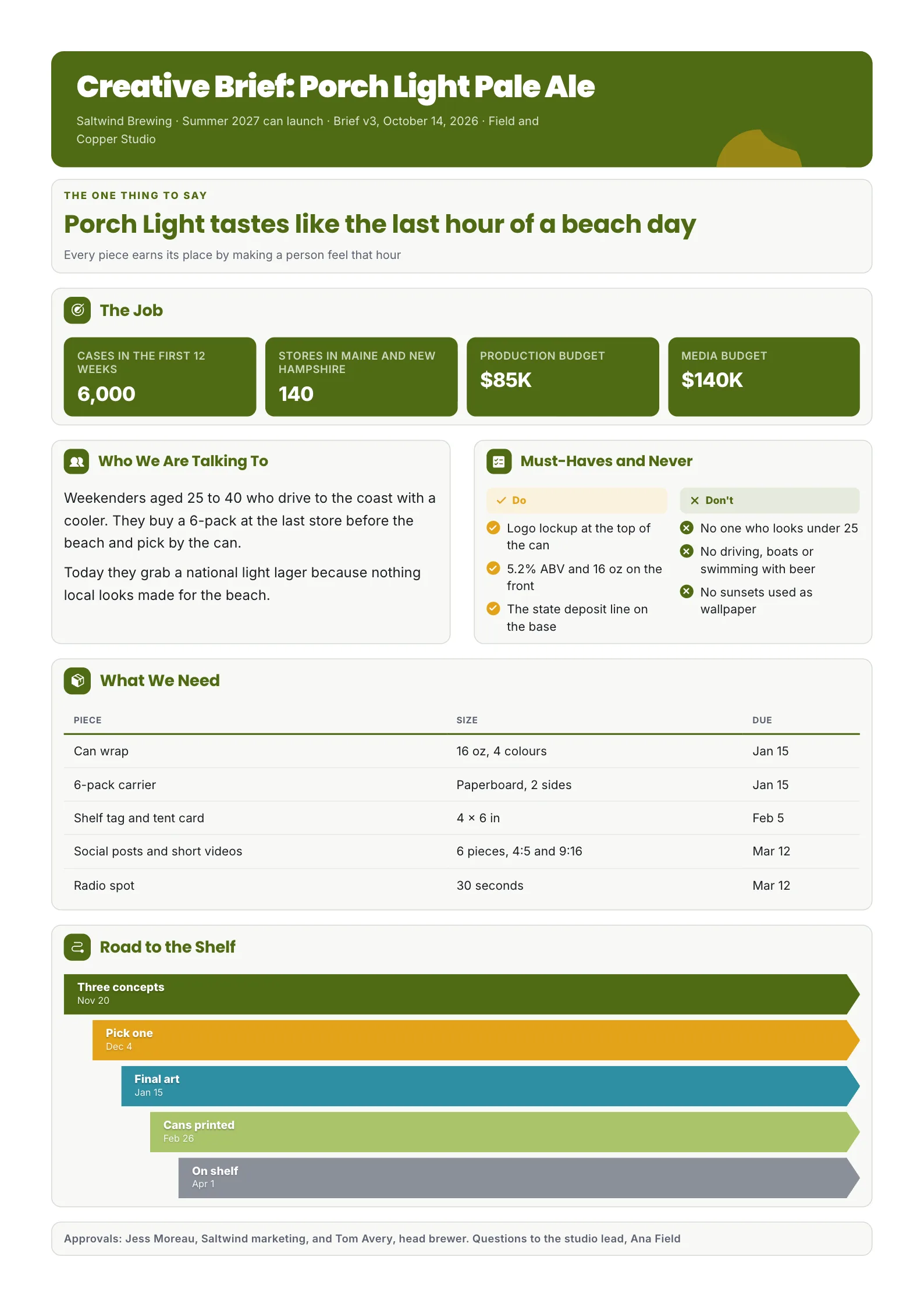 Creative BriefEdit for free(opens in a new tab)
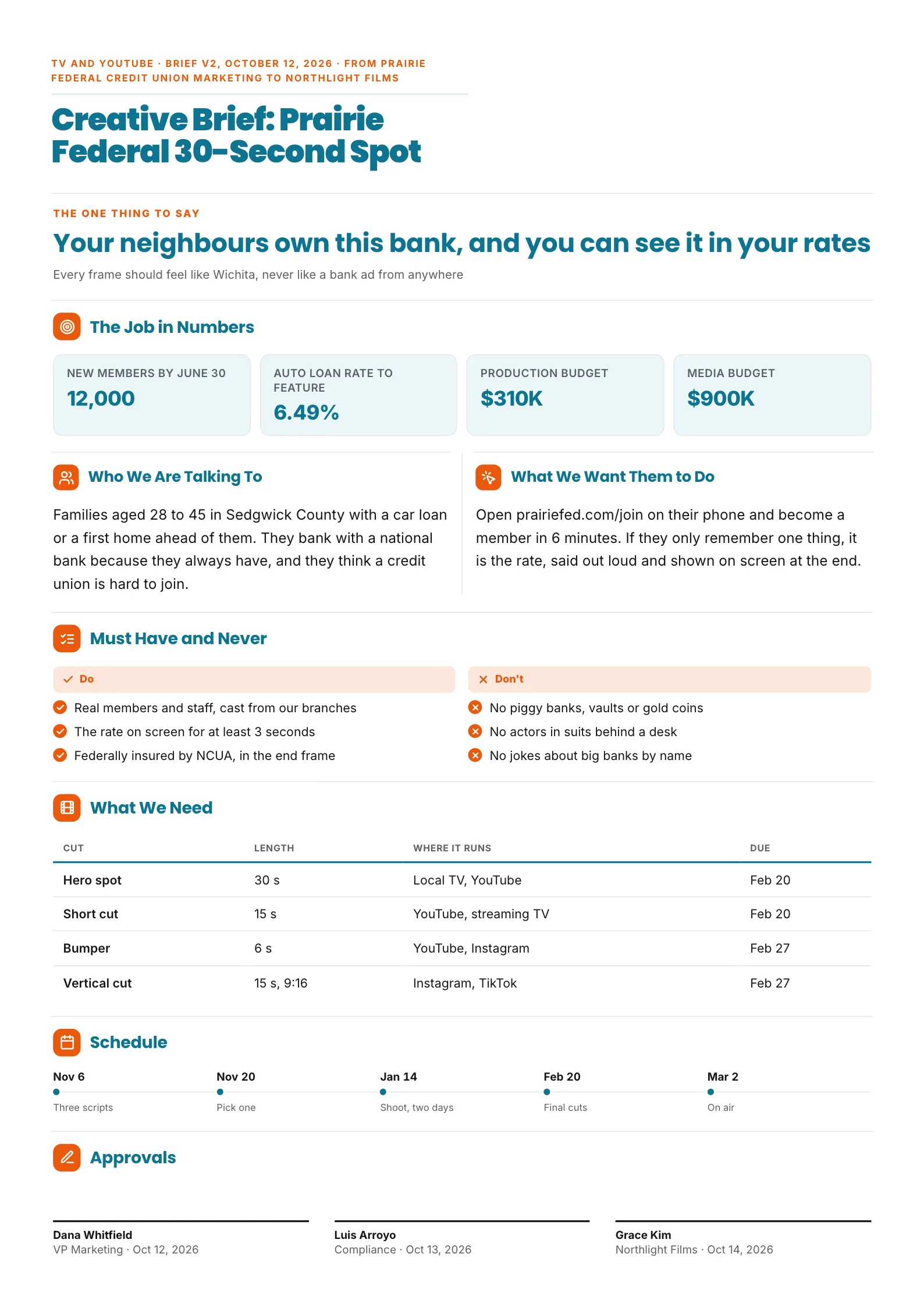 Creative Brief: Video AdEdit for free(opens in a new tab)
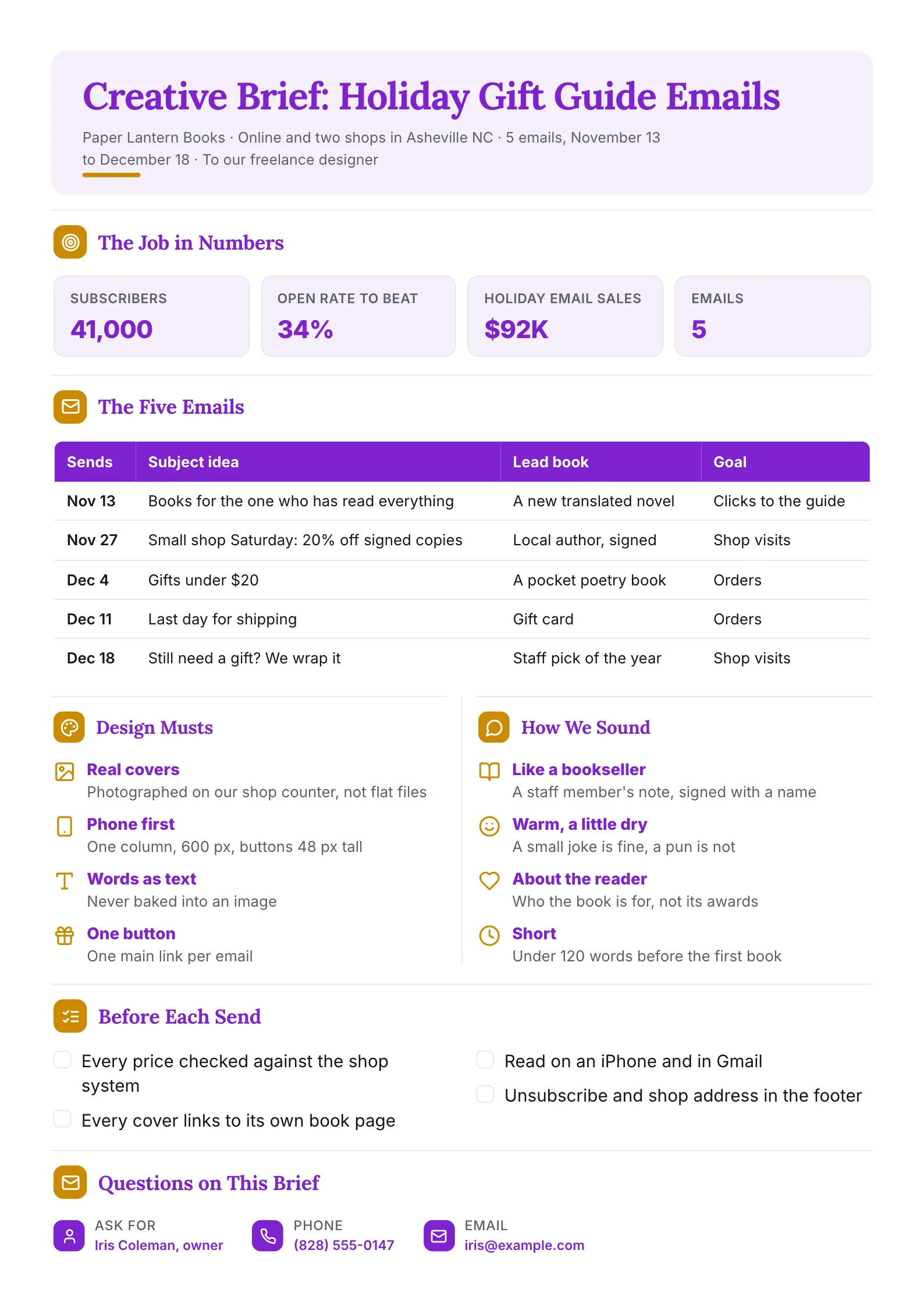 Creative Brief: Email CampaignEdit for free(opens in a new tab)
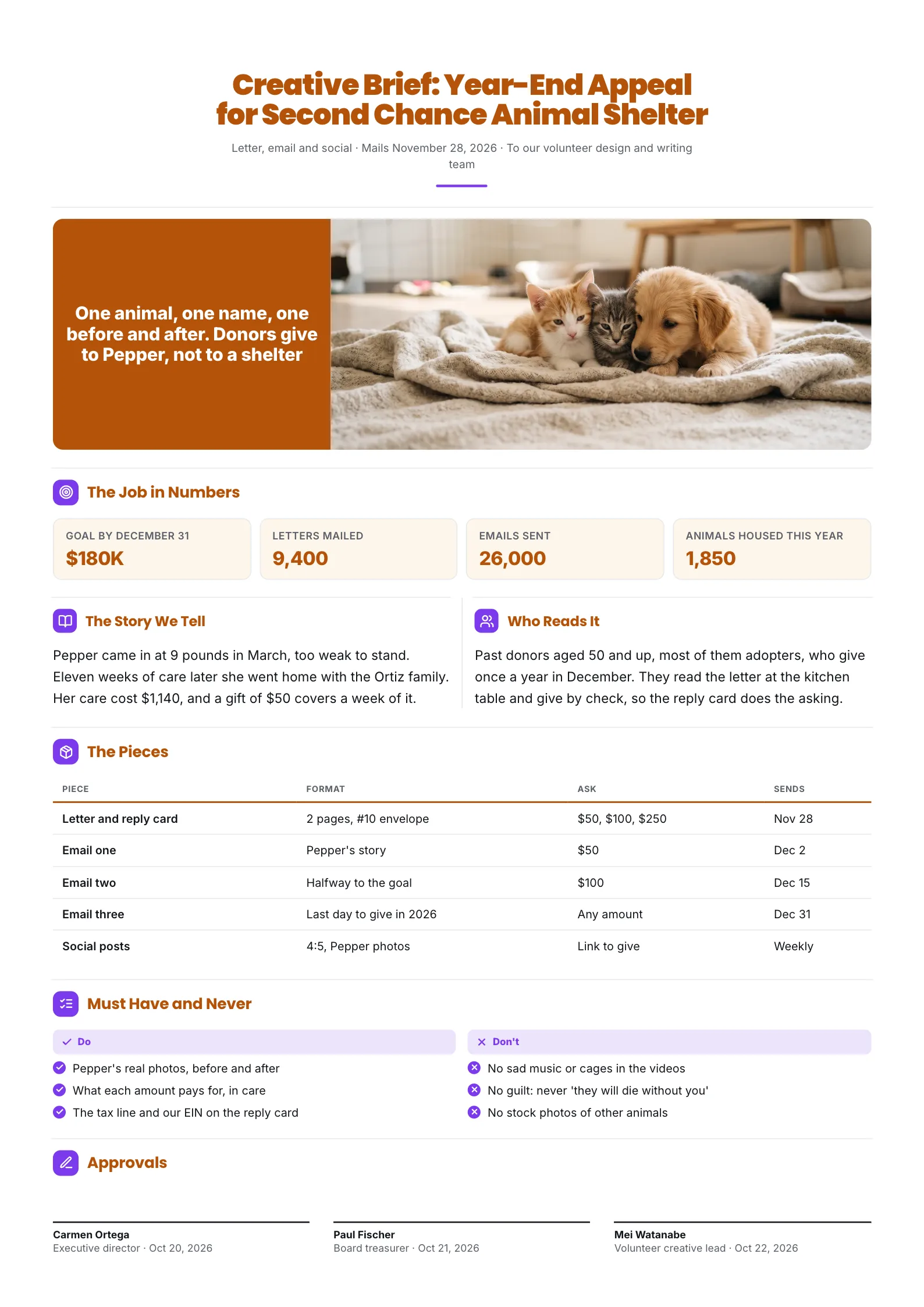 Creative Brief: Fundraising AppealEdit for free(opens in a new tab)
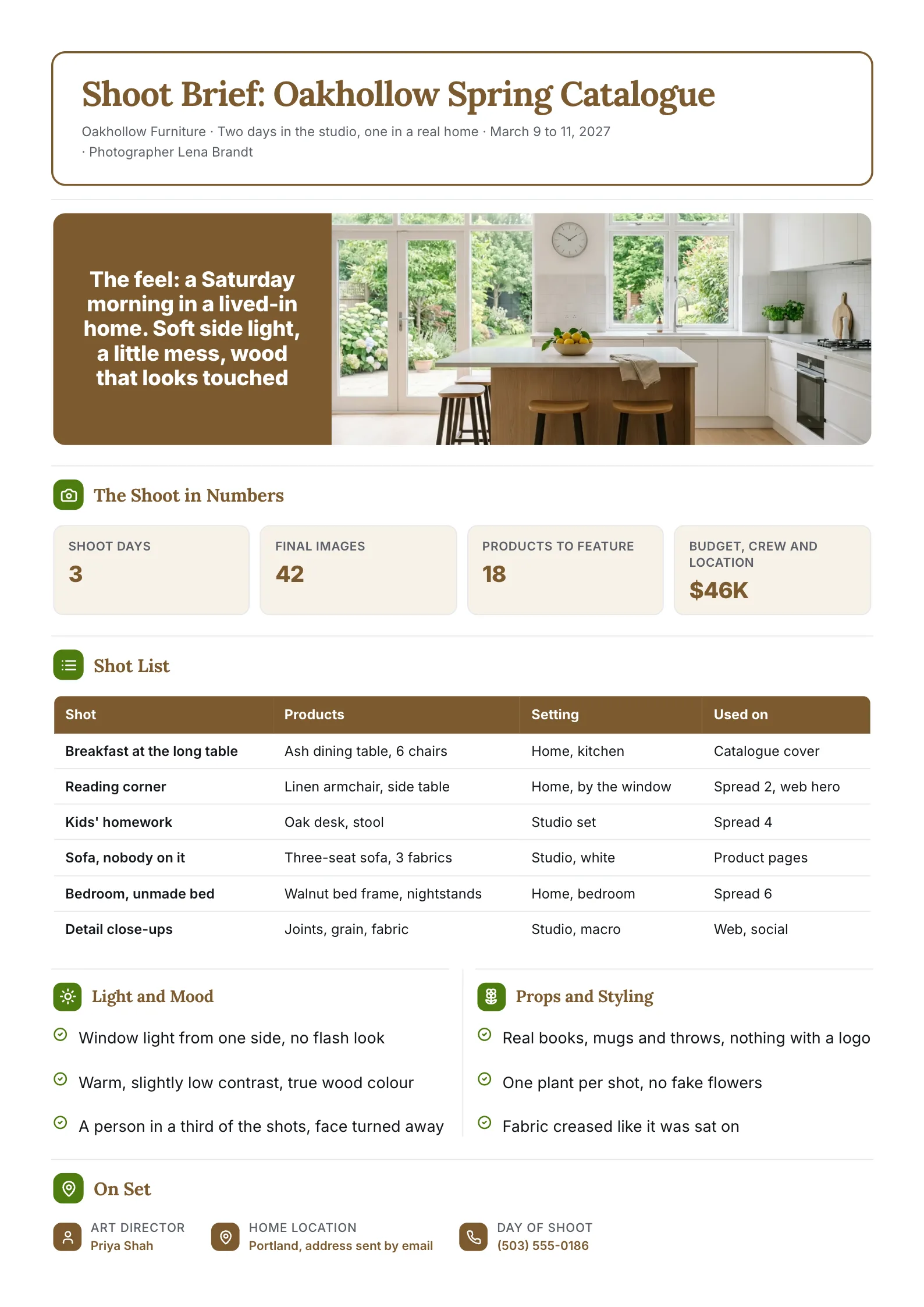 Creative Brief: Photo ShootEdit for free(opens in a new tab)
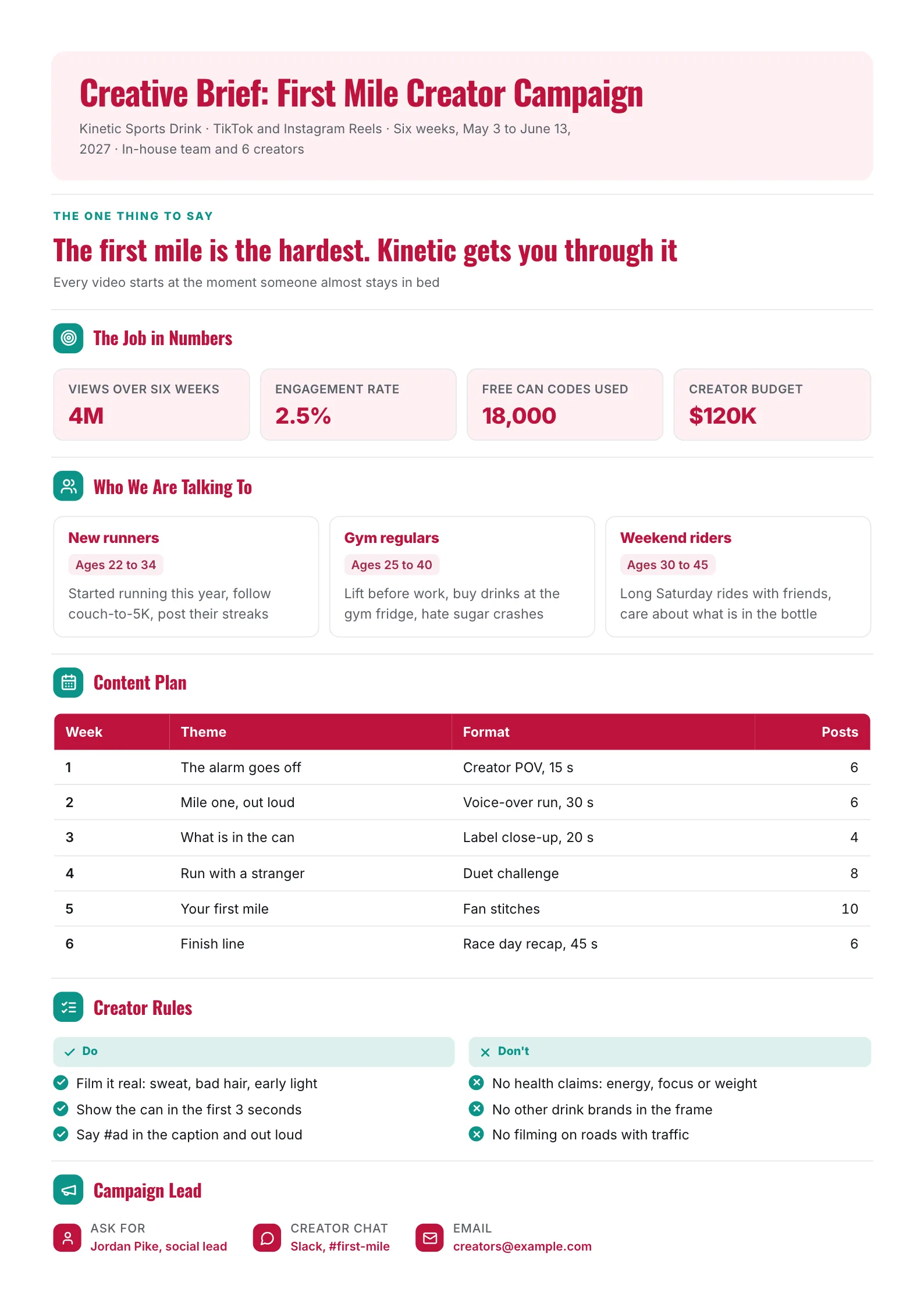 Creative Brief: Social Media CampaignEdit for free(opens in a new tab)
So the names point at two jobs. Use the first to find your message. Use the second to get a finished file made.
| Creative brief | Design brief | |
|---|---|---|
| The job it does | Decides the message | Gets a piece designed |
| Who reads it | Writers, designers, the whole campaign team | The designer or studio |
| Questions it leans on | Audience, main idea, tone, proof, the action you want | Size, text, images, budget, due date |
| Scope | A campaign, often many pieces | Usually one piece or one set |
| Written | Before anyone has an idea | Once you know what the piece will say |
The 8 briefs we read
Each one is a blank form a real office hands to the people who ask it for work. We read them all in full on November 5, 2026.
Creative briefs
- Xavier University's communication department: one page with "these nine sections," from Project to Extra.
- University of North Georgia: 16 numbered questions you fill in before a marketing meeting.
- St. Peter's Health, the health system in Helena, Montana: 8 short prompts for its ads.
- Berry College: a Word form its marketing office asks for on campaigns, videos and new writing.
Design briefs
- University of Southampton's Print Centre: titled "Print Centre design brief."
- University of Glasgow: a Word form titled "Design brief."
- RGD, the Association of Registered Graphic Designers in Canada: its two-page "Client/Design Brief."
- Cal State San Bernardino's student affairs team: an online "Design Request Form."
What each kind asks, question by question
We checked every form for the same 10 questions. Use the table to see which questions your own brief skips.
| Question | Creative briefs (of 4) | Design briefs (of 4) |
|---|---|---|
| Who is it for? | 4 | 4 |
| What is the one message? | 4 | 3 |
| What tone should it take? | 3 | 1 |
| What proof or benefits back it up? | 3 | 1 |
| What should people do? | 3 | 2 |
| When is it due? | 2 | 4 |
| What's the budget? | 0 | 3 |
| What size, or how many pages? | 0 | 2 |
| What text will you hand over? | 0 | 2 |
| Which images will it use? | 0 | 2 |
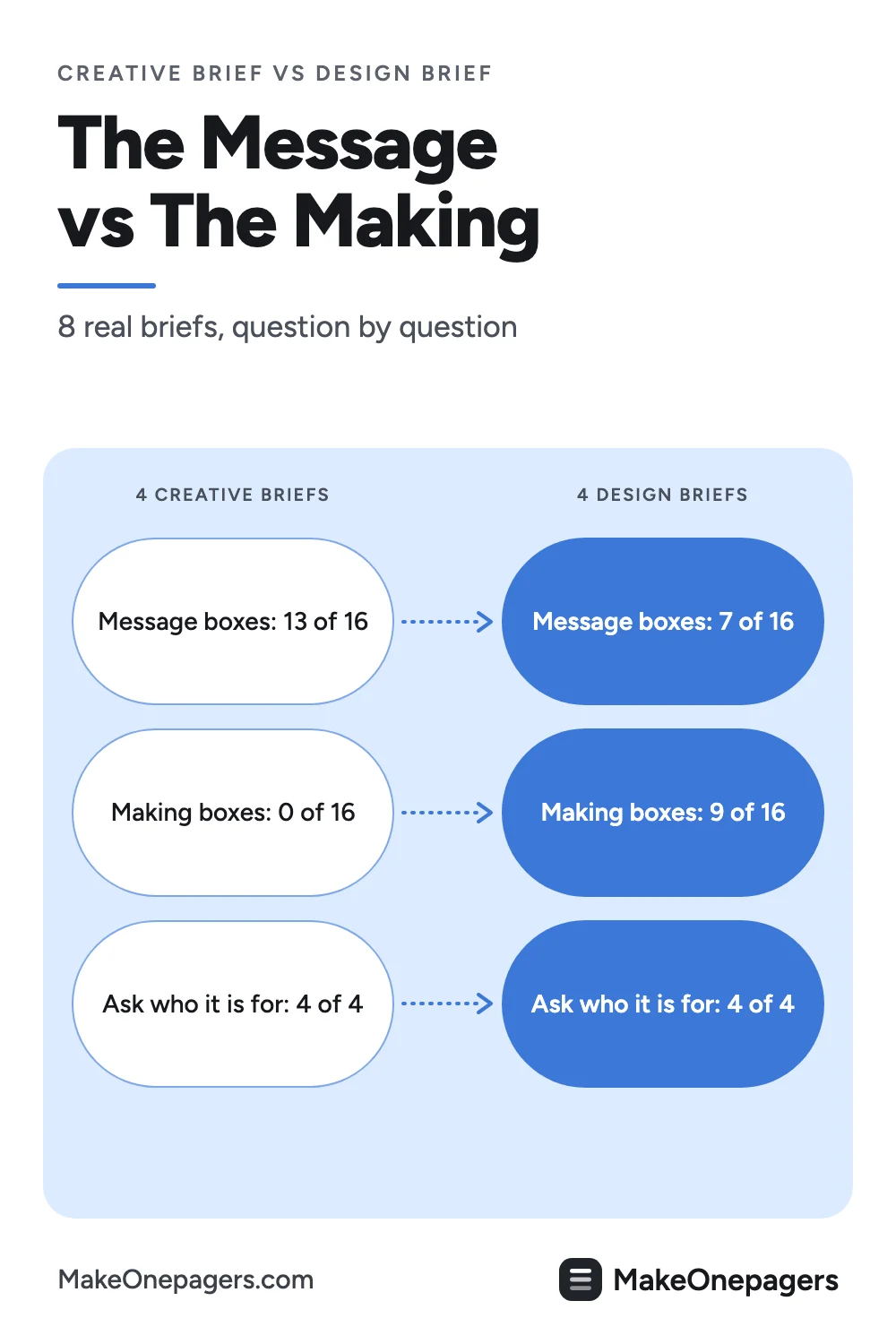
Now look at the four message rows (message, tone, proof, action). The creative briefs fill 13 of those 16 boxes, and the design briefs fill 7. In the four making rows (budget, size, text, images), the creative briefs fill none. The design briefs fill 9 of 16.
The only question all 8 ask is who the work is for. That's why the two documents get mixed up. They open the same way and then split.
What a creative brief asks you to decide
Creative briefs push you to boil the job down before anyone designs a thing. Xavier asks for the main idea "in no more than one sentence" and says the tone "should be no more than three or four words." It also has a Marketplace section on "factors and competition," so the team knows what else the audience could pick.
North Georgia's form is all questions, with no boxes for specs. Three of its 16 are worth stealing for any brief:
- "What is the most important thing to say that will help the audience believe the message?"
- "What are important proof points to build trust and validate our claims about the benefits we offer?"
- "What action do you want them to take in response to this campaign?"
St. Peter's Health keeps its version to 8 prompts, and each one is a plain question. "Who are we talking to?" "What do we want the viewer reader to do?" It also asks "What makes us unique?" under Benefits, and ends on the legal lines that must appear.
Berry College's form is the longest of the four. It has 16 fields for every job, then 12 more in short sections for print, digital, photo and news work. Even so, it never asks for a budget or a size. Its print section asks only which medium, such as a postcard or a brochure.
What a design brief asks you to hand over
Design briefs assume the message is settled. They ask for the things a designer can't make up.
Your words. Southampton asks "What text will you be supplying?" and wants it "as a word document." Cal State San Bernardino asks you to "provide any text you may want on your design." A designer can lay out your words, but you have to supply them.
Your pictures. Southampton asks which images you'll send, and if you want its team to find some for you. Glasgow asks if you already have images "or do you need to commission new photography."
The size. Glasgow wants "what size and shape? how many pages? how many copies?" Cal State San Bernardino lists set sizes, from "4x6 (postcard)" to "8.5x11 (full flyer)."
The money and the date. Southampton, Glasgow and RGD each have a Budget line. RGD splits it into five steps, from creative to delivery, each with its own amount and date. Glasgow adds a warning to plan "at least an additional week upon final sign off" before the piece is delivered.
The rules you can't break. Glasgow reminds you that its charity line, "The University of Glasgow, charity number Sc004401," must appear on all printed documents. Cal State San Bernardino asks which logos must be on it and your "preferred color scheme." It also limits each job to 3 rounds of changes.
Where the two names blur
The line isn't sharp everywhere. RGD's form is the most complete design brief we read, and it asks almost everything a creative brief does: benefits, "Support for benefit claims," competition, key message and "Tone & manner." Its own page says "In-house departments could use this as a creative brief."
So don't judge a brief by its name. Read what it asks, then fill in what's missing. If your agency sends a "design brief" that asks for tone and proof, it's doing creative brief work too. If your "creative brief" has a size and a budget, it already holds part of a design brief.
Turn your creative brief into a design brief
Most jobs need both, one after the other. Here's how to carry the first into the second without losing the message.
- Copy over the audience and the one message. Every form we read asks who it's for, so keep your exact words. Your designer should read the same sentence your writer did.
- Turn the tone into rules a designer can see. Xavier keeps tone to three or four words. Next to each word, write what it means on the piece, such as "calm" meaning lots of white space and no red.
- List every piece with its size. Write the size or page count for each one, the way Glasgow and Cal State San Bernardino ask. "Social posts" is too vague. Write how many, and in which shape.
- Hand over your text and pictures. Send the final words as a document, like Southampton asks, and say which photos you already have. If you need new photos, say so before the designer starts.
- Add the money, the date and who signs off. Give the budget, the due date and a week of room after the final yes, as Glasgow advises. Name the one person who approves it.
- Keep the must-haves. Add the logos, colors and legal lines that must appear. At St. Peter's Health, that's the Mandatories line. At Glasgow, it's the charity number.
Check it with one test before you send it. Could your designer start work today without asking you a single question? If not, find the missing answer and add it.
Which one do you need?
Berry College gives the clearest rule we found. It asks for a creative brief up front on jobs that need an idea or new words, such as "Advertising or promotional campaigns," "Video projects" and "Projects that require new content to be written - including emails." A printed piece is on the list when it will "require conceptualization." Liverpool John Moores University does the same split from the other side. Straightforward jobs go through "this simple form," while "full marketing campaigns" start with a meeting.
Use that as your test:
- New campaign, new message, more than one piece: write a creative brief first.
- One piece, message already decided: a design brief is enough.
- A big piece with a new message, like a website or a rebrand: write the creative half first, then add the specs. One sheet can hold both.
5 One-Pager briefs that hold both halves
Our briefs put the message on top and the specs underneath, so a small team can send one sheet. Each one below is sample data, and each leans to one side of the split.
A logo design brief built around where the mark must work
 Edit this template
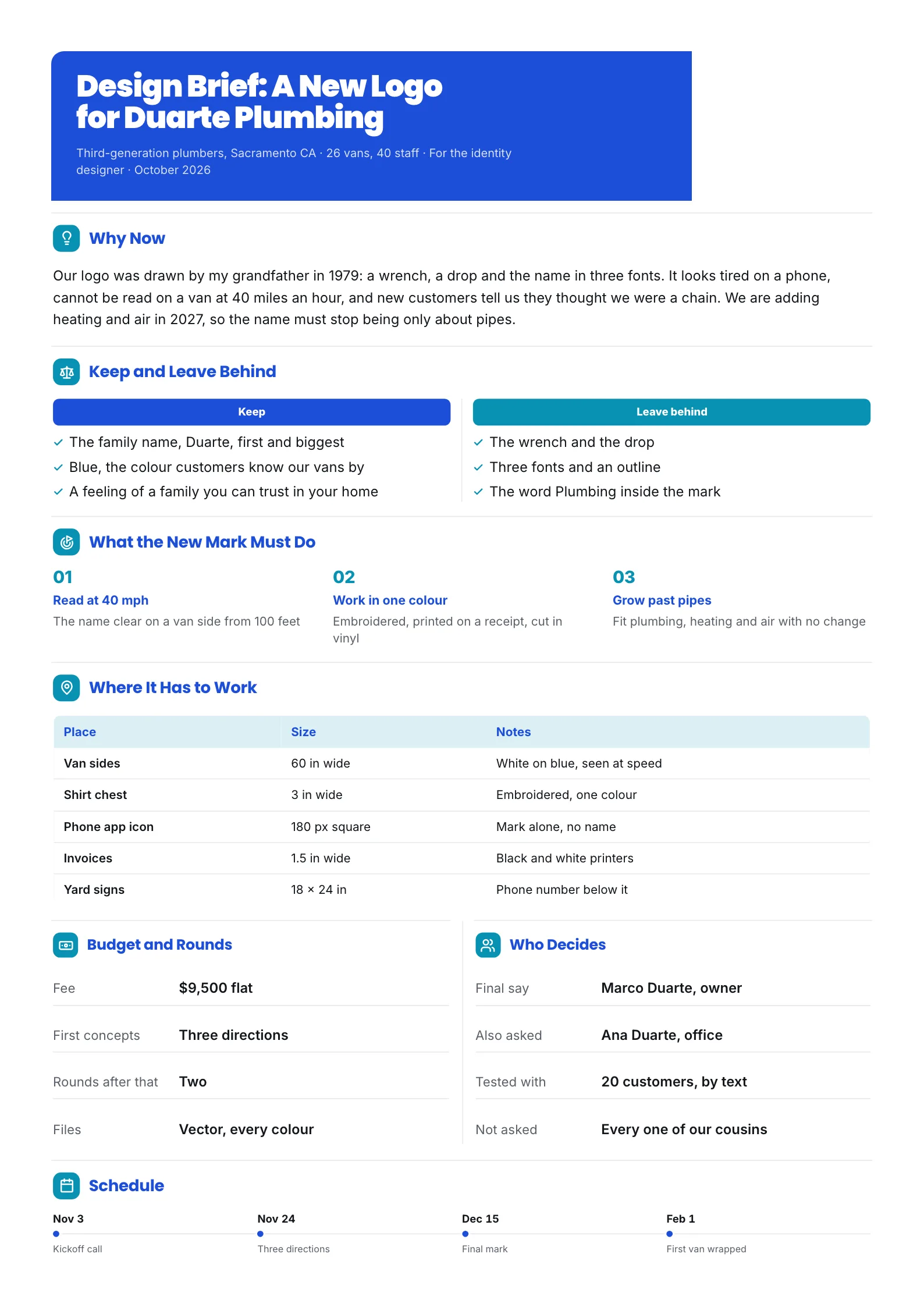
This logo design brief is titled as a design brief, and it reads like one. It has a table of every place the mark has to fit, from van sides 60 inches wide to a phone app icon 180 pixels square. It names the fee up front, a flat $9,500, and caps the work at three first ideas plus two rounds of changes. Its one creative line is a job for the mark: "Read at 40 mph."
A packaging brief where color does the work
 Edit this template
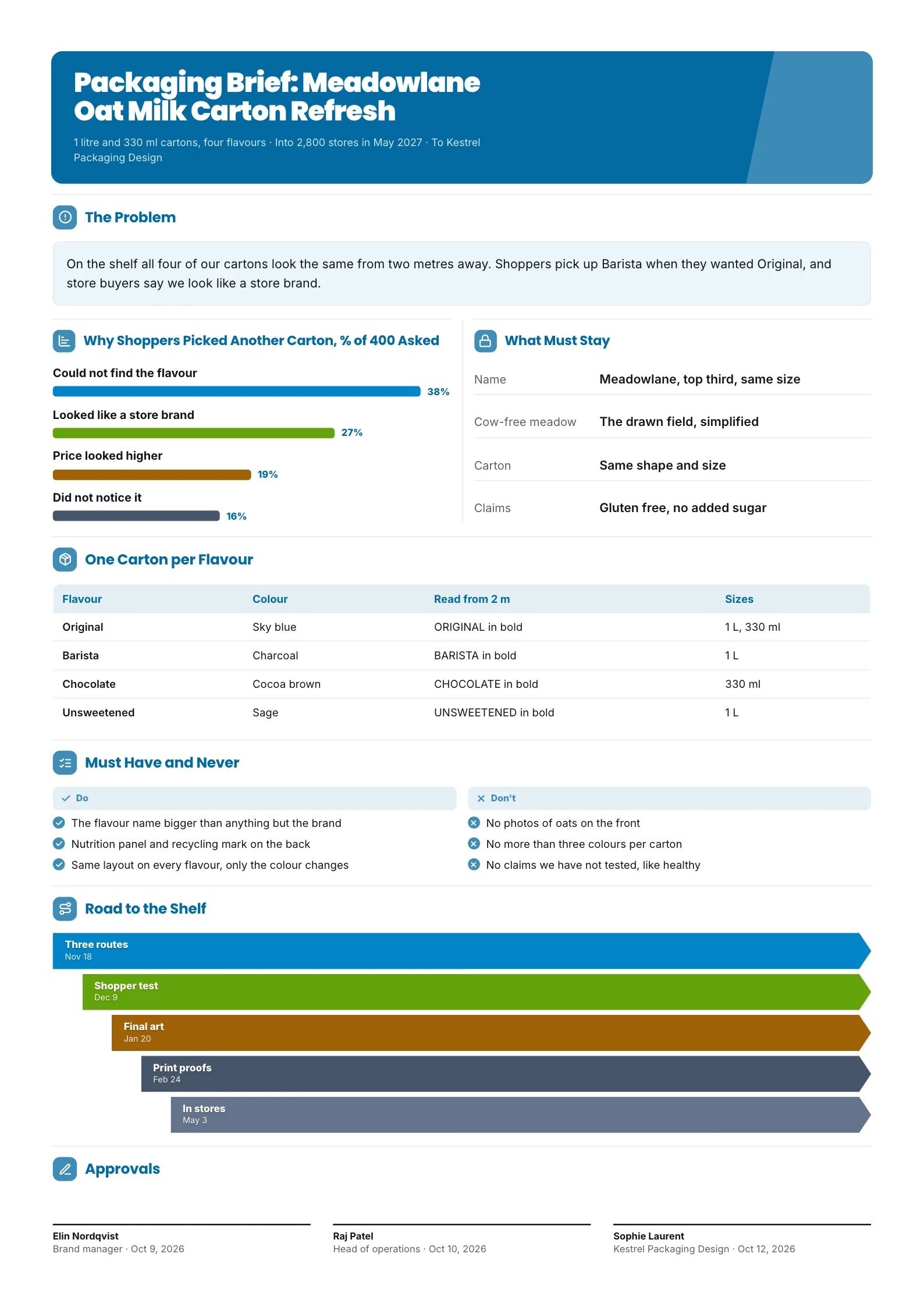
This packaging brief starts with the problem, then backs it with a chart of why 400 shoppers picked another carton. Then it gives the designer exact answers: sky blue for Original, charcoal for Barista, cocoa brown for Chocolate and sage for Unsweetened. Its rule "No more than three colors per carton" is the kind of spec none of our 4 creative briefs asked for.
A website redesign brief that sets how visitors should feel
 Edit this template
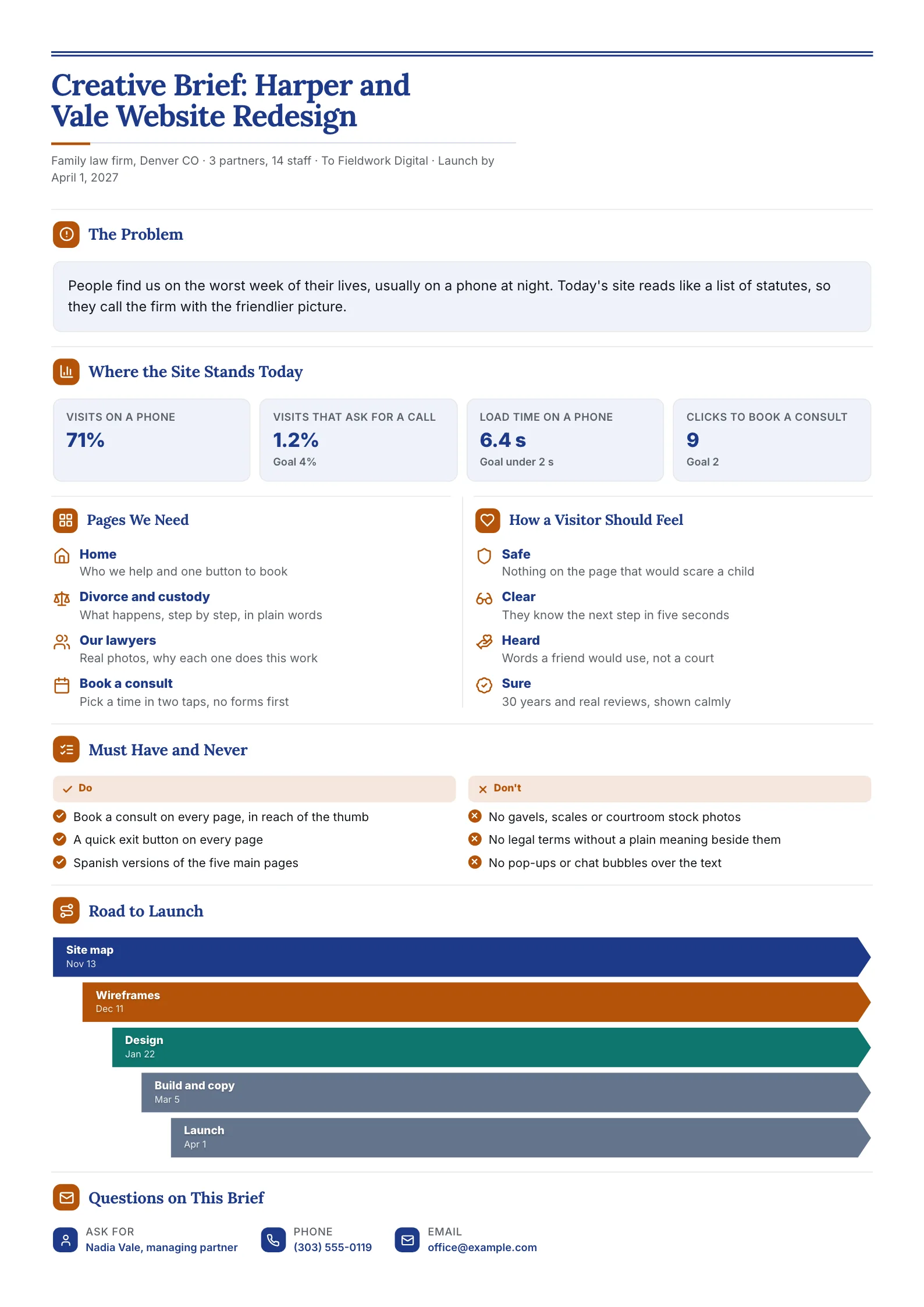
A website is where you need both halves. This website redesign brief has the specs, like a phone load time of 6.4 seconds against a goal under 2. It also has the creative part, four words for how a visitor should feel: Safe, Clear, Heard and Sure. One must-have is a safety rule rather than a style choice: "A quick exit button on every page."
A radio ad brief with one line to say
 Edit this template
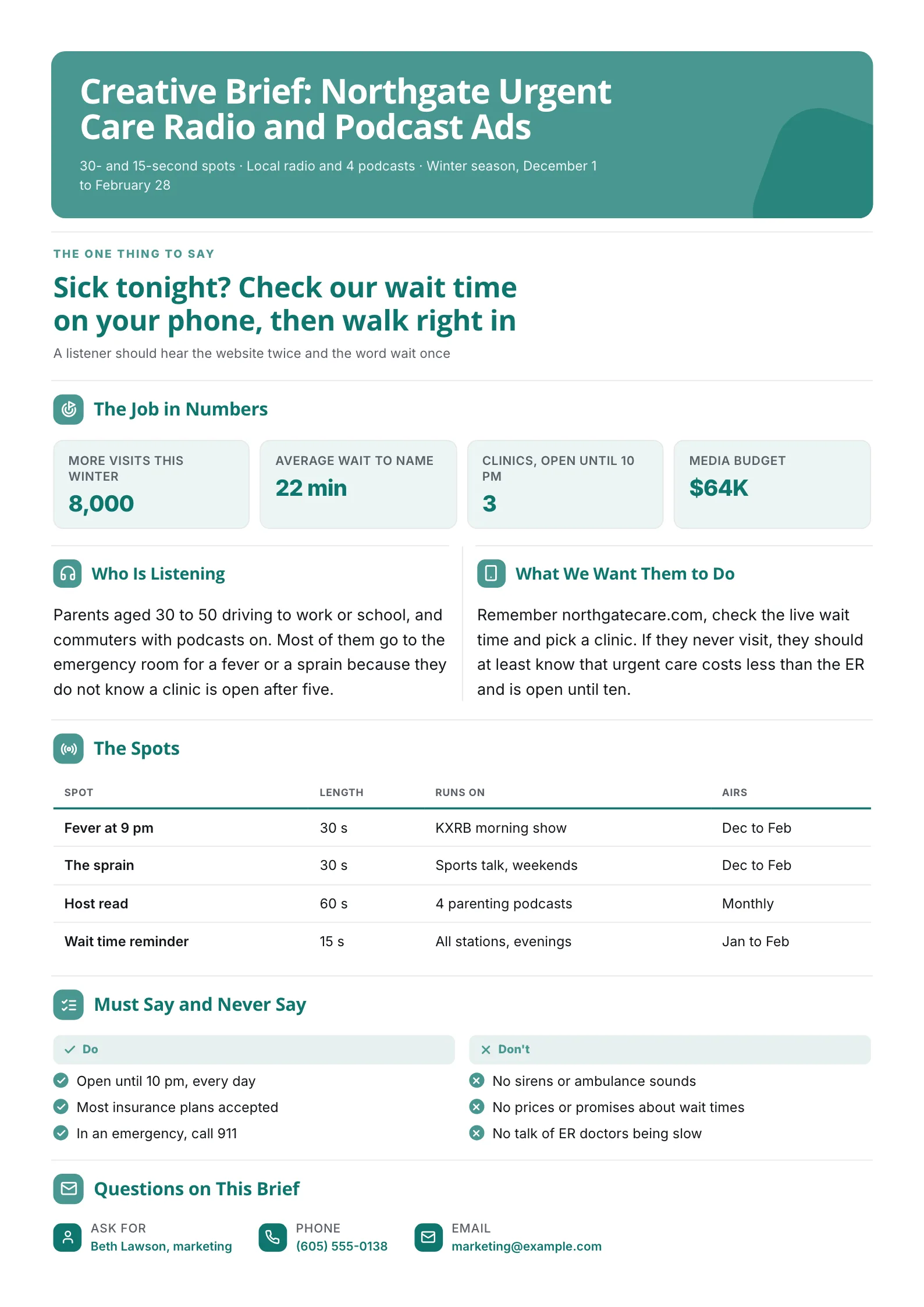
This radio and podcast ad brief is a creative brief at heart. It opens on the one thing to say: "Sick tonight? Check our wait time on your phone, then walk right in." Then it adds a listening rule: "A listener should hear the website twice and the word wait once." The specs are short, just the four spots and a $64K media budget.
A billboard brief where the message sets the design rule
 Edit this template
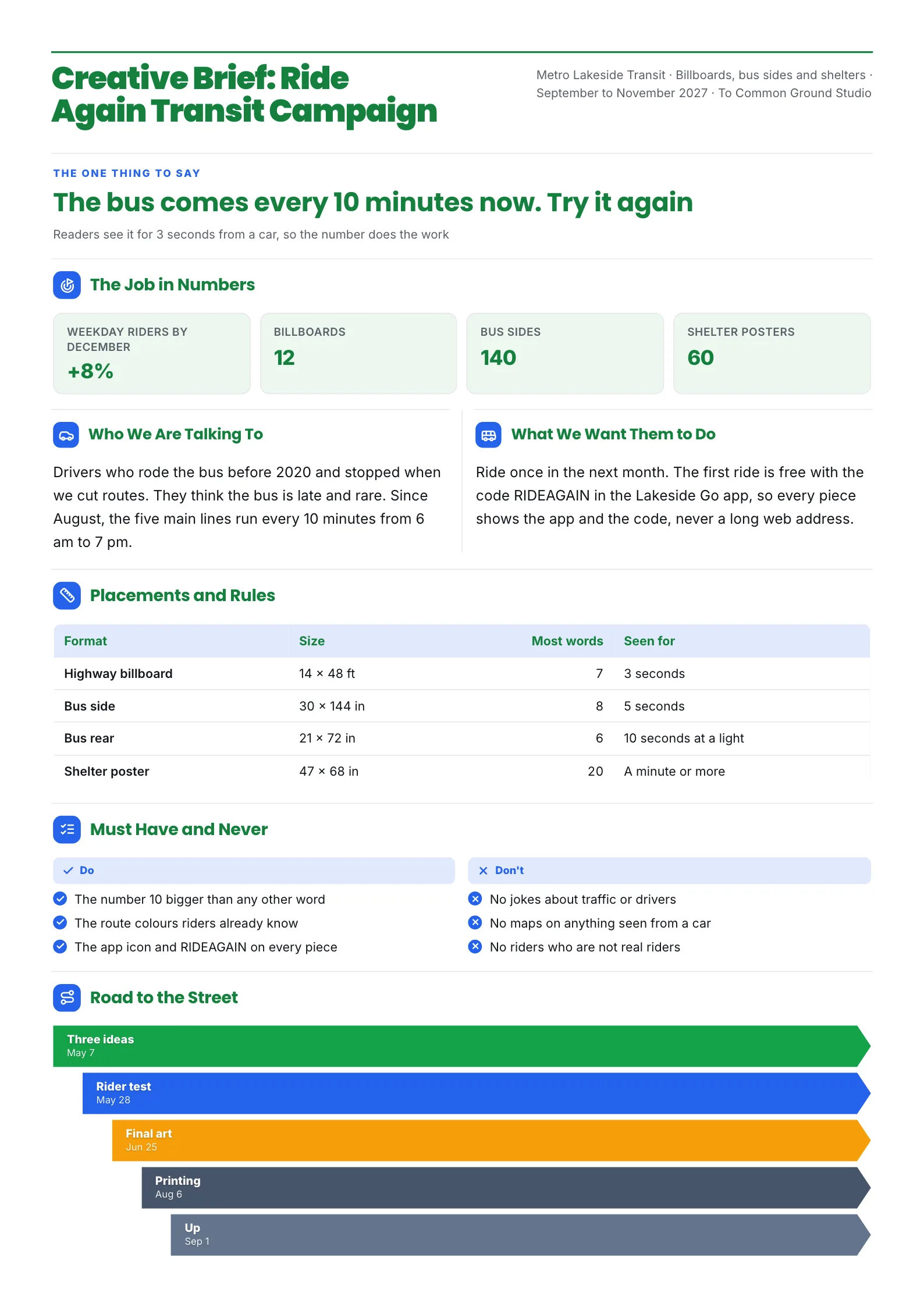
This billboard brief shows how the creative half turns into design rules. The message is "The bus comes every 10 minutes now. Try it again." Because "Readers see it for 3 seconds from a car," the brief makes the number the hero: "The number 10 bigger than any other word." Its size table then caps the words, 7 on a 14 x 48 ft highway board and 20 on a shelter poster.
Make your brief
Start with the MakeOnepagers brief closest to your job. Fill the top half before you talk to a designer: who it's for, the one message, the tone and the action. Then fill the bottom half: sizes, text, images, budget and the date. Short on time? Give your meeting notes to the free AI One-Pager generator, then edit the draft it writes. For the creative half, see how to write a creative brief and the 14 creative brief questions we checked against real forms.
Frequently asked questions
Is a design brief the same as a creative brief?
Not quite. They share the audience question, but in our 8 forms the creative briefs asked about tone and proof far more often, and only the design briefs asked about budget, size, text and images. Some forms, like RGD's, cover both.
Should a creative brief include a budget?
None of the 4 creative briefs we read has a budget line. Budget showed up in 3 of the 4 design briefs. If one sheet must do both jobs, put the budget in the specs half.
Who fills out the design brief?
Usually the person asking for the work fills it out. At Southampton and Cal State San Bernardino, the form asks for your department and contact details, then goes to the in-house design team.
Do I need a creative brief for a simple flyer?
Usually not. Berry College asks for a creative brief up front on printed pieces that "require conceptualization." For a flyer with a set message, a design brief with the size, text and date is enough.
What goes in a design brief that a creative brief leaves out?
The making details: the size or page count, the text you'll supply, the images, the budget and the due date. In our count, the creative briefs asked for none of the first four.




