Creative Brief Questions: 14 to Ask, Checked Against 6 Real Forms
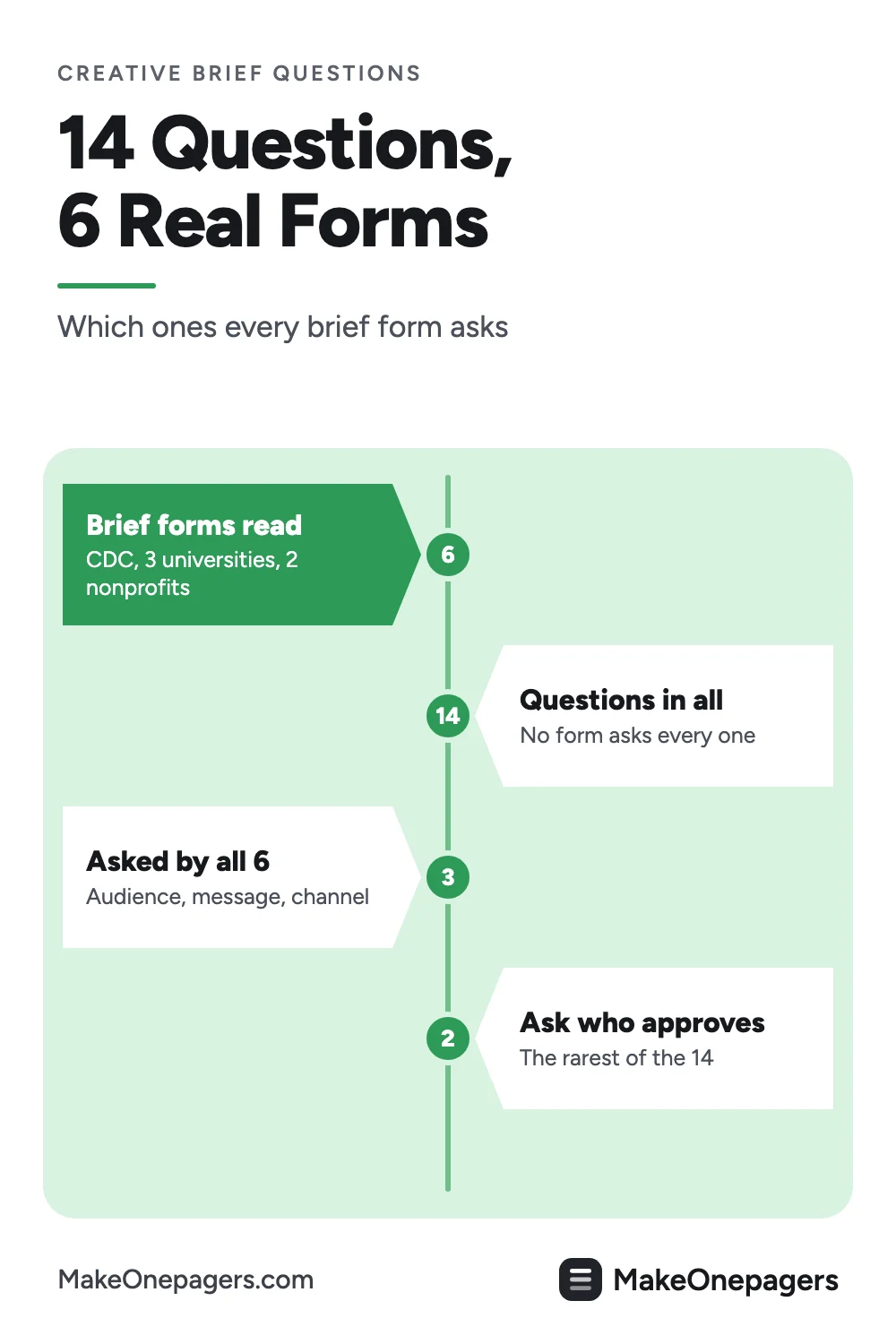
Creative brief questions from 6 real brief forms by the CDC, 3 universities and 2 nonprofits: 14 questions, and the 3 every form asks.

The right creative brief questions get you answers your designer or writer can act on: what the work must do, who it's for, the one thing it must say, where it will run, what it can cost, when it's due and who signs off. We read 6 published brief forms side by side and found 14 questions between them. Only 3 appear in all 6. Just 2 forms ask who approves the work, though one of them warns the approver is often not the person who wrote the brief. Start from a free one pager template.
One‑Pager examples
Real One-Pagers made with MakeOnepagers. Open any one to edit it as your own.
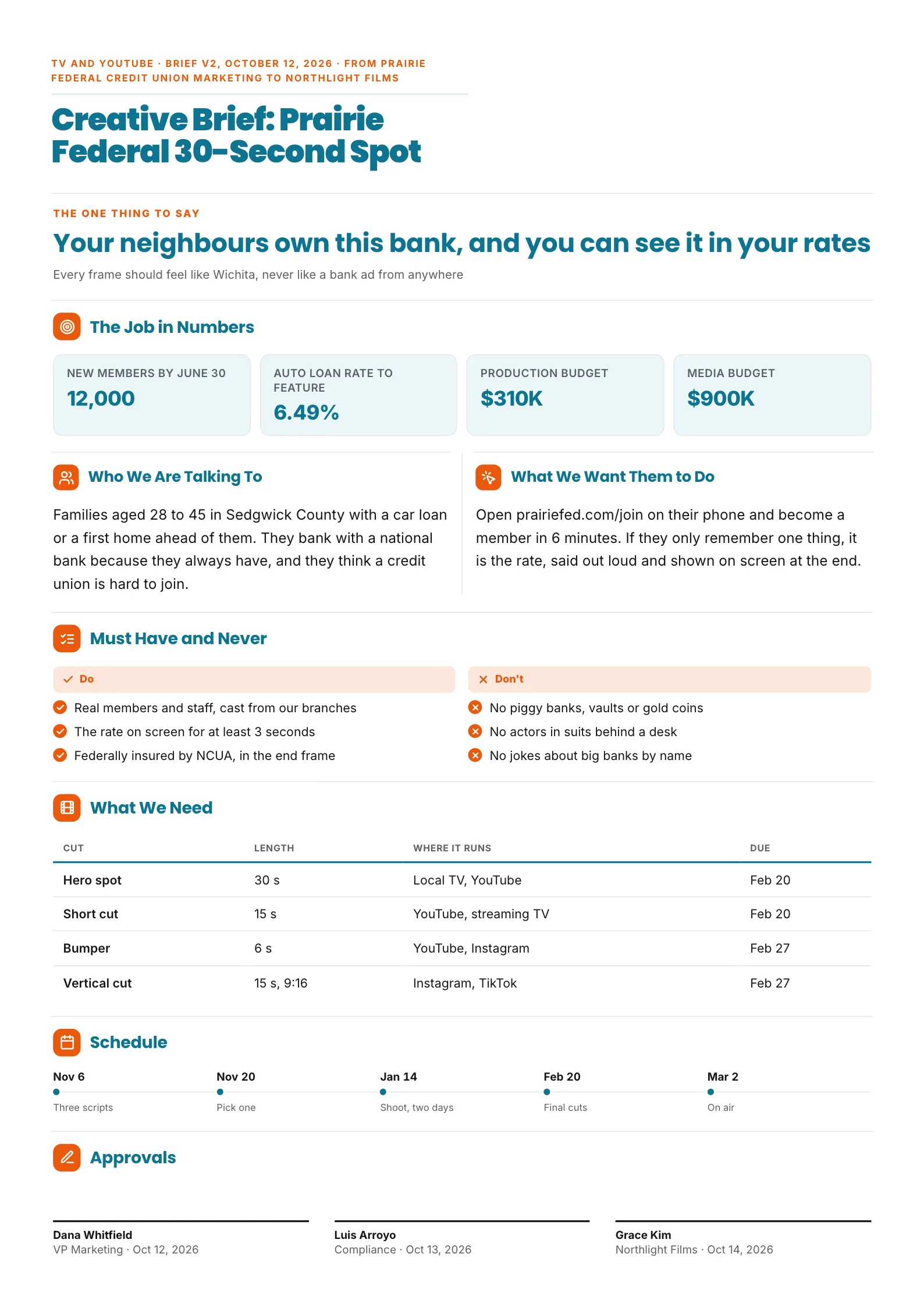 Creative Brief: Video AdEdit for free(opens in a new tab)
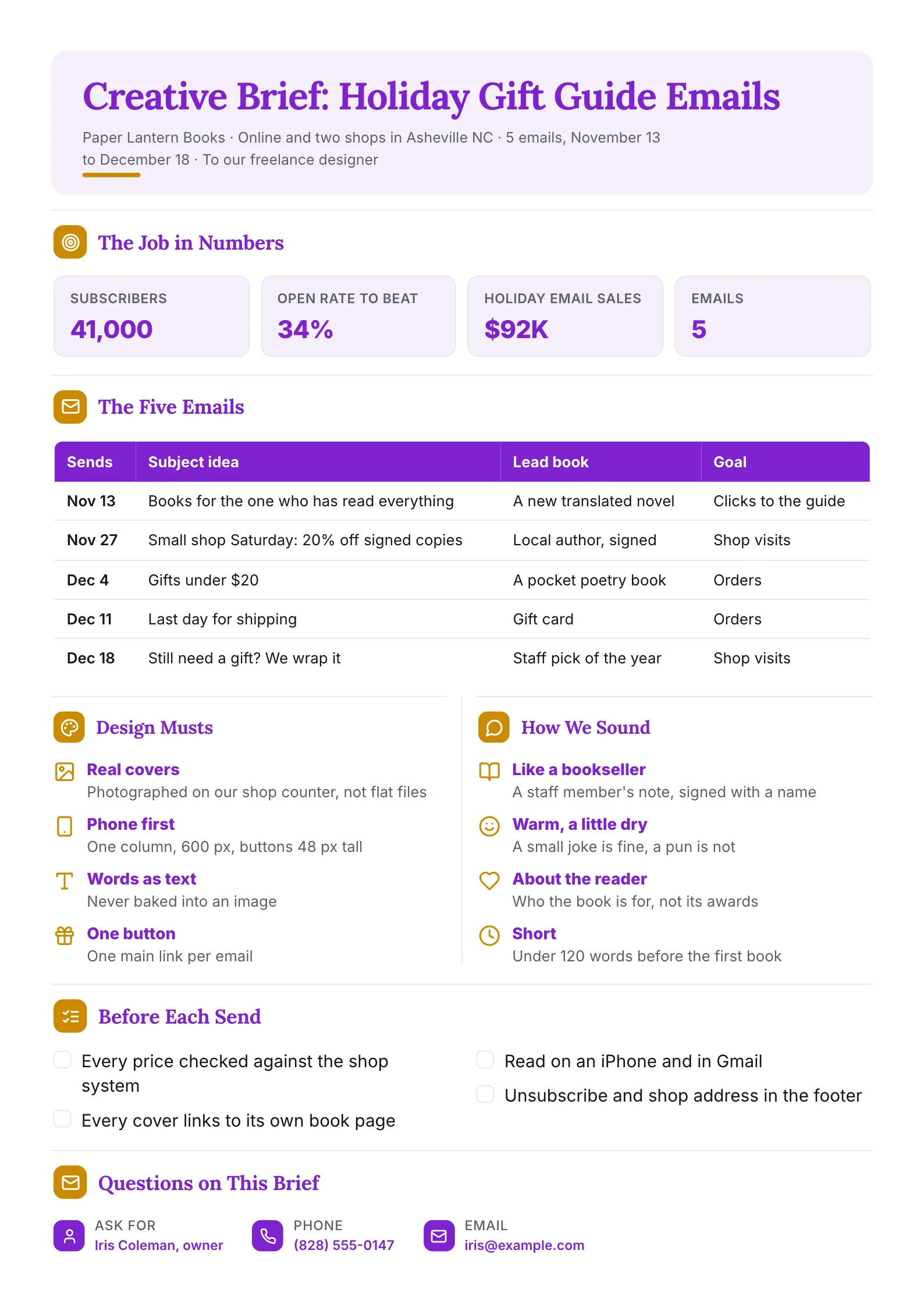 Creative Brief: Email CampaignEdit for free(opens in a new tab)
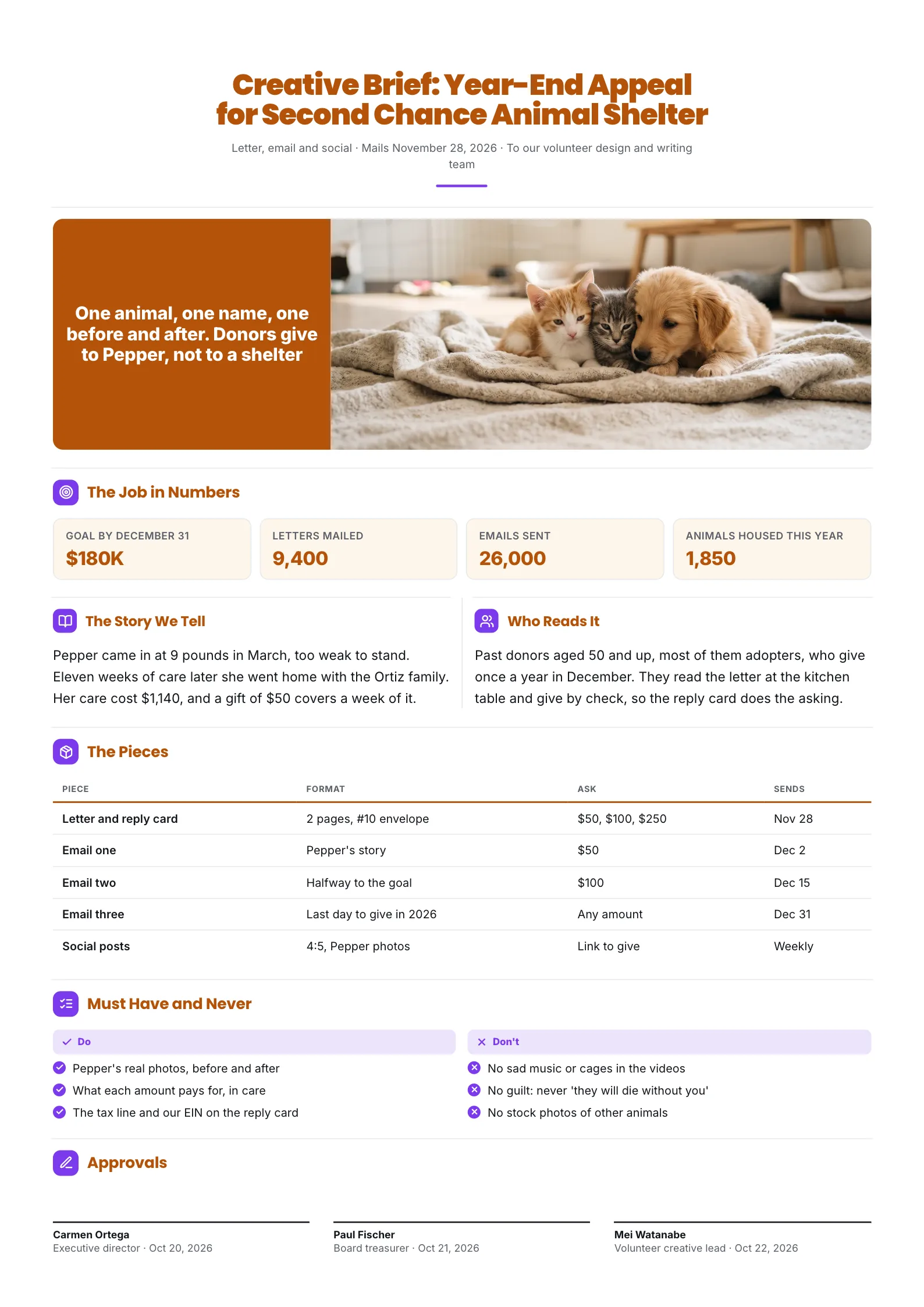 Creative Brief: Fundraising AppealEdit for free(opens in a new tab)
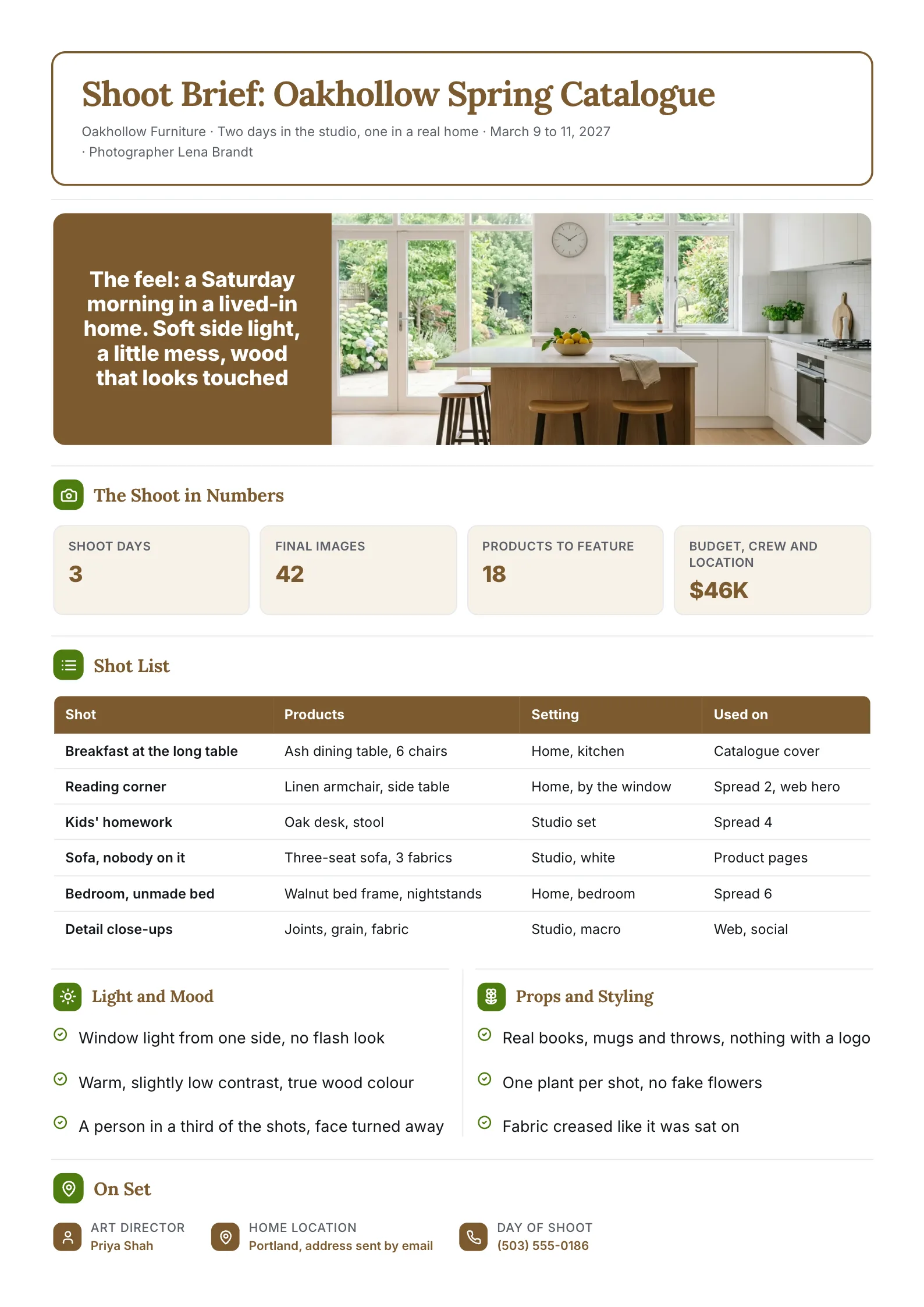 Creative Brief: Photo ShootEdit for free(opens in a new tab)
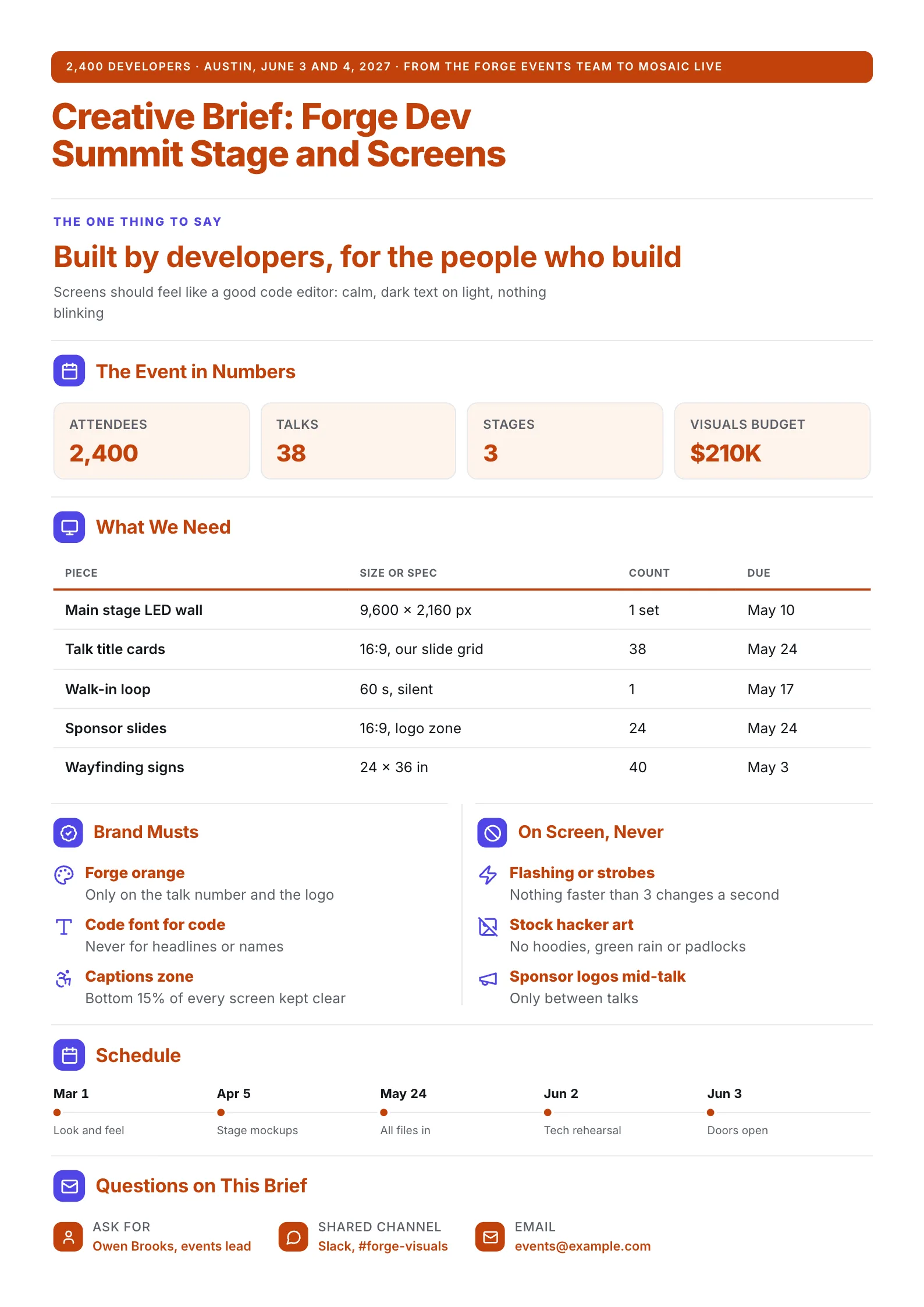 Creative Brief: Event Stage and ScreensEdit for free(opens in a new tab)
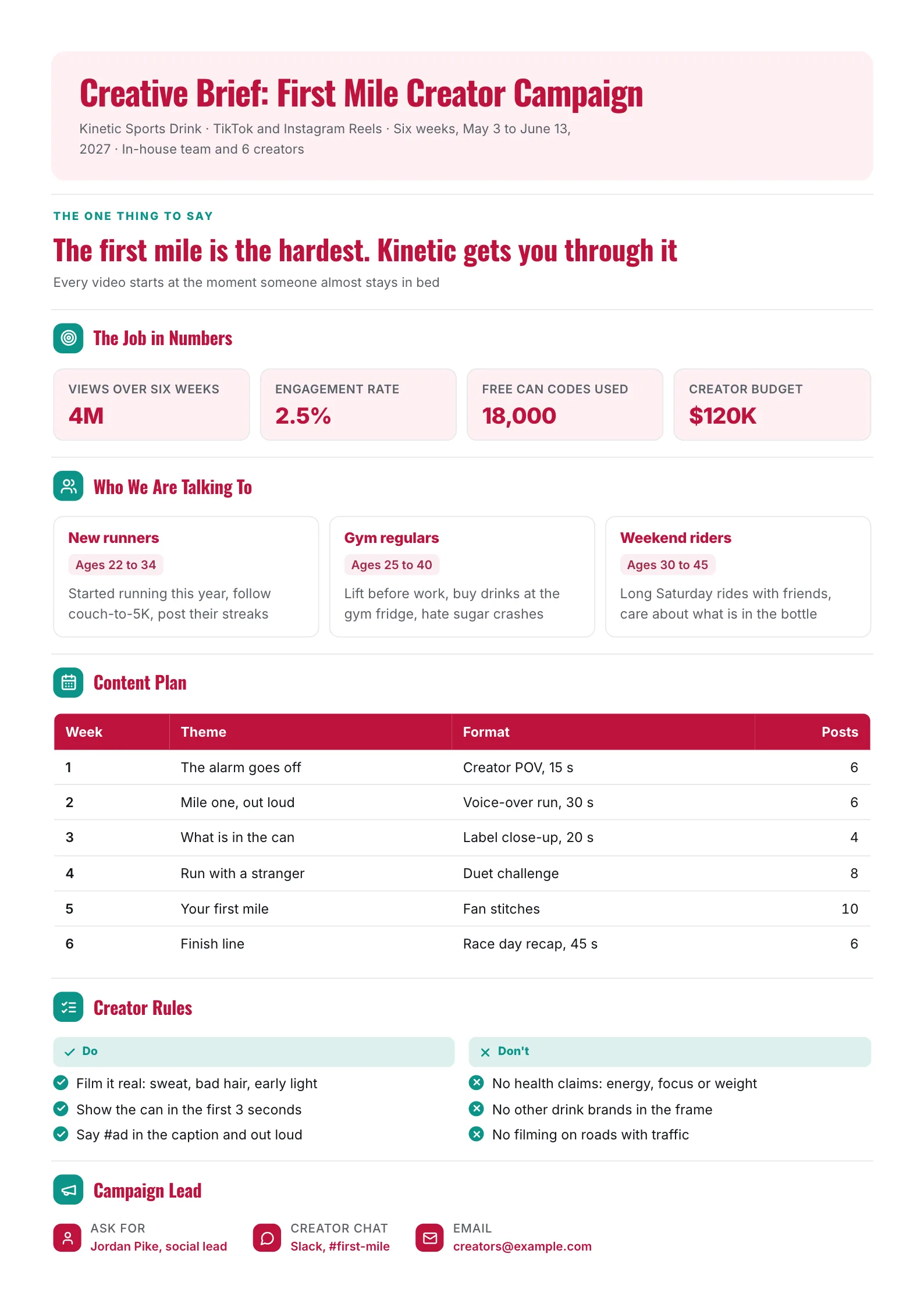 Creative Brief: Social Media CampaignEdit for free(opens in a new tab)
Below is each question, how many of the 6 forms ask it, the exact wording that works best, and an editable MakeOnepagers brief that answers it.
The 6 forms we read
We picked forms that are public and that none of our other creative brief guides used. All six were opened and read start to finish on November 5, 2026.
- CDC: a draft creative brief dated February 20, 2013, filled in for a campaign promoting self-management education to people with chronic disease.
- Center for Health, Environment & Justice: a one-page brief that calls itself "a Q&A memo, composed of the six questions below."
- Elon University: the creative brief guide on its University Communications site, 7 prompts long.
- UC Berkeley: the brand toolkit's creative brief, 9 elements.
- Western Washington University: a generic creative brief from a marketing course by Ann Marie Stone, 4 pages with a note under its boxes.
- Vermont Sustainable Jobs Fund: a guide to creative briefs for small business owners, dated October 24, 2023.
The 14 questions, counted
| Question | Forms that ask it (of 6) |
|---|---|
| Who is it for? | 6 |
| What is the one message? | 6 |
| Where will they see it? | 6 |
| What should this work achieve? | 5 |
| Why should they believe it? | 5 |
| How should it feel? | 5 |
| What must it include? | 5 |
| What do they think or know now? | 4 |
| What should they do? | 4 |
| What is the budget? | 4 |
| What else could they choose? | 3 |
| When is it due? | 3 |
| How will we measure success? | 3 |
| Who approves it? | 2 |
No form asks all 14. Elon's comes closest with 13, and it has no question about tone. CHEJ's covers 7 of the 14 with its six questions. For the CDC brief, which is filled in, we counted a question when the brief answers it.
The 3 questions every form asks
Who is it for?
All 6 ask, and the best forms push you to narrow it. Berkeley's key audience prompt reads, "Students? Parents? Choose one." CHEJ warns, "You might be inclined to say, “Everyone!”" and then asks you to "Be very specific." The CDC brief named "People living with chronic disease(s)" aged 45 to 70.
What is the one message?
Every form asks for one idea, and most give you a size limit. CHEJ says "Just one sentence." Elon wants "a single idea, expressed in a single sentence." The CDC form asks it the most usefully: "If the customer remembers only one thing, what should it be?"
 Edit this template
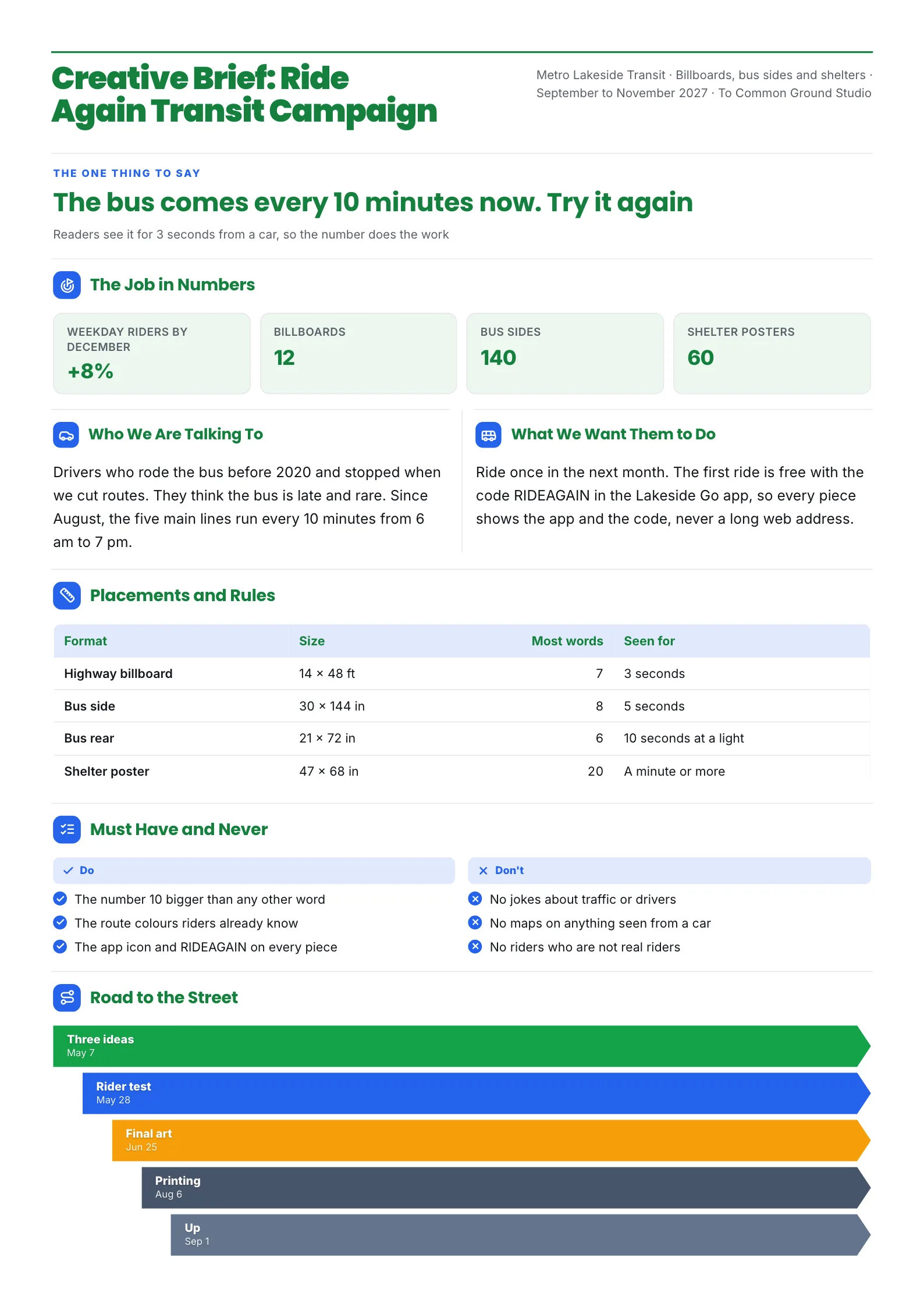
This billboard creative brief answers the one-message question in two short sentences: "The bus comes every 10 minutes now. Try it again." Its placement table explains why they're short. A highway billboard gets 7 words at most and is seen for 3 seconds, so a highway board could carry the first sentence alone.
Where will they see it?
All 6 forms ask about the channel, in very different ways. Berkeley asks, "Is it an email, a poster, a web page, an event?" CHEJ offers three options to weigh: "a press conference or opinion article or public forum?" The answer shapes what the creative team makes, so put it near the top of your brief.
The 4 questions that 5 of 6 forms ask
- What should this work achieve? Elon asks, "What are you trying to achieve?" Berkeley is the one form that skips it.
- Why should they believe it? Berkeley asks for proof points, "2 or 3 points that help support the elevator pitch." CHEJ skips it.
- How should it feel? Berkeley has you "Choose 2 or 3 tones from the selection of 8." WWU asks for "the mood or feeling the consumer should feel." Elon skips it.
- What must it include? The Vermont guide lists "trademarks, patented technologies, brand colors, etc." CHEJ skips it.
 Edit this template
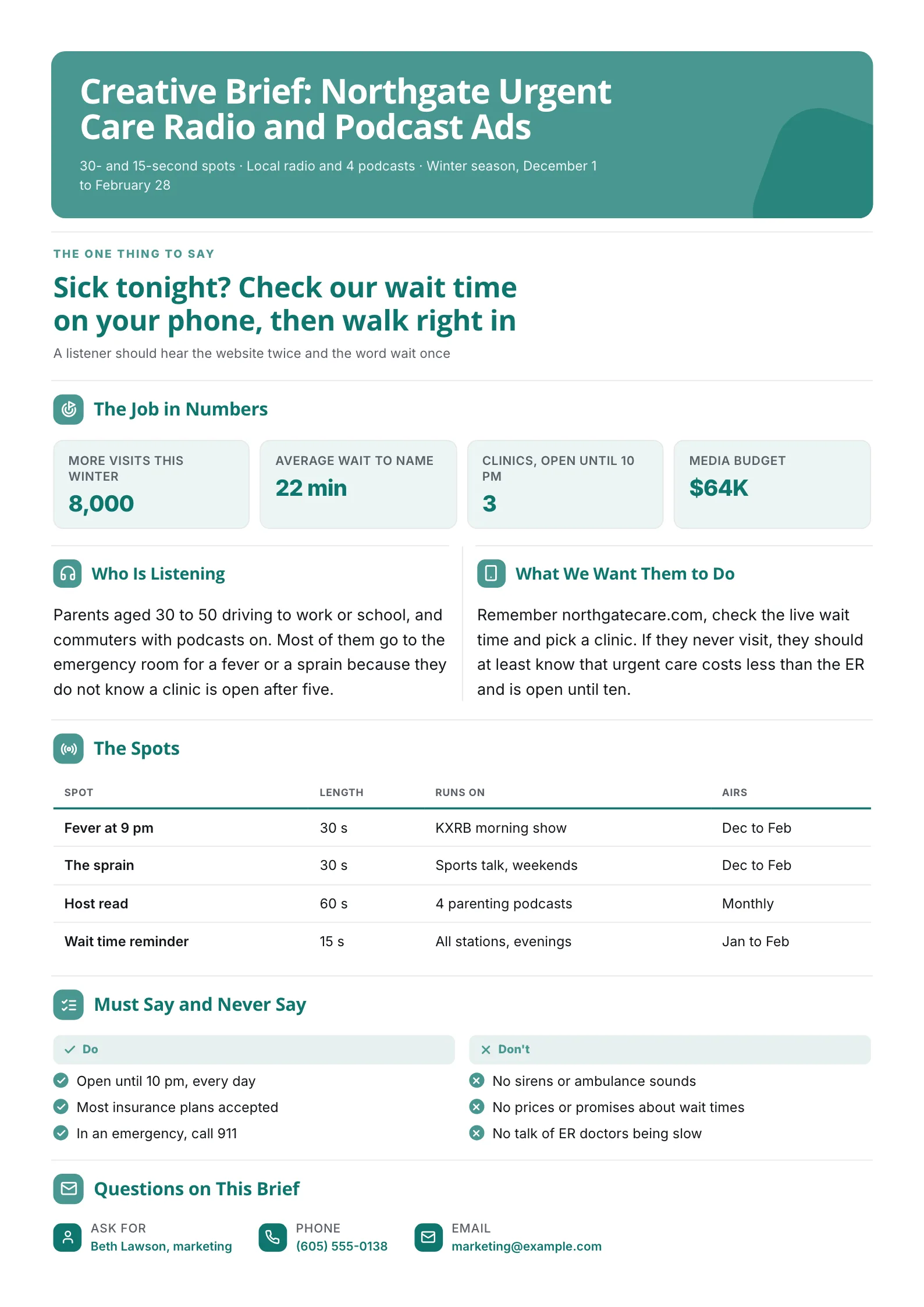
A "never" list answers the must-include question from the other side. This radio and podcast ad creative brief says what every spot has to include, like "Open until 10 pm, every day," and what it must leave out, like "No prices or promises about wait times." Your writer gets both before drafting a single line.
The 3 questions only 4 of 6 forms ask
What do they think or know now?
This is the question that turns a list of people into an insight. The Vermont guide asks what customers think of your brand "right now (“boring”, “fun”, “not for me”, etc.)." CHEJ asks, "What do we know about them that will help you?" The CDC and Berkeley forms skip it.
 Edit this template
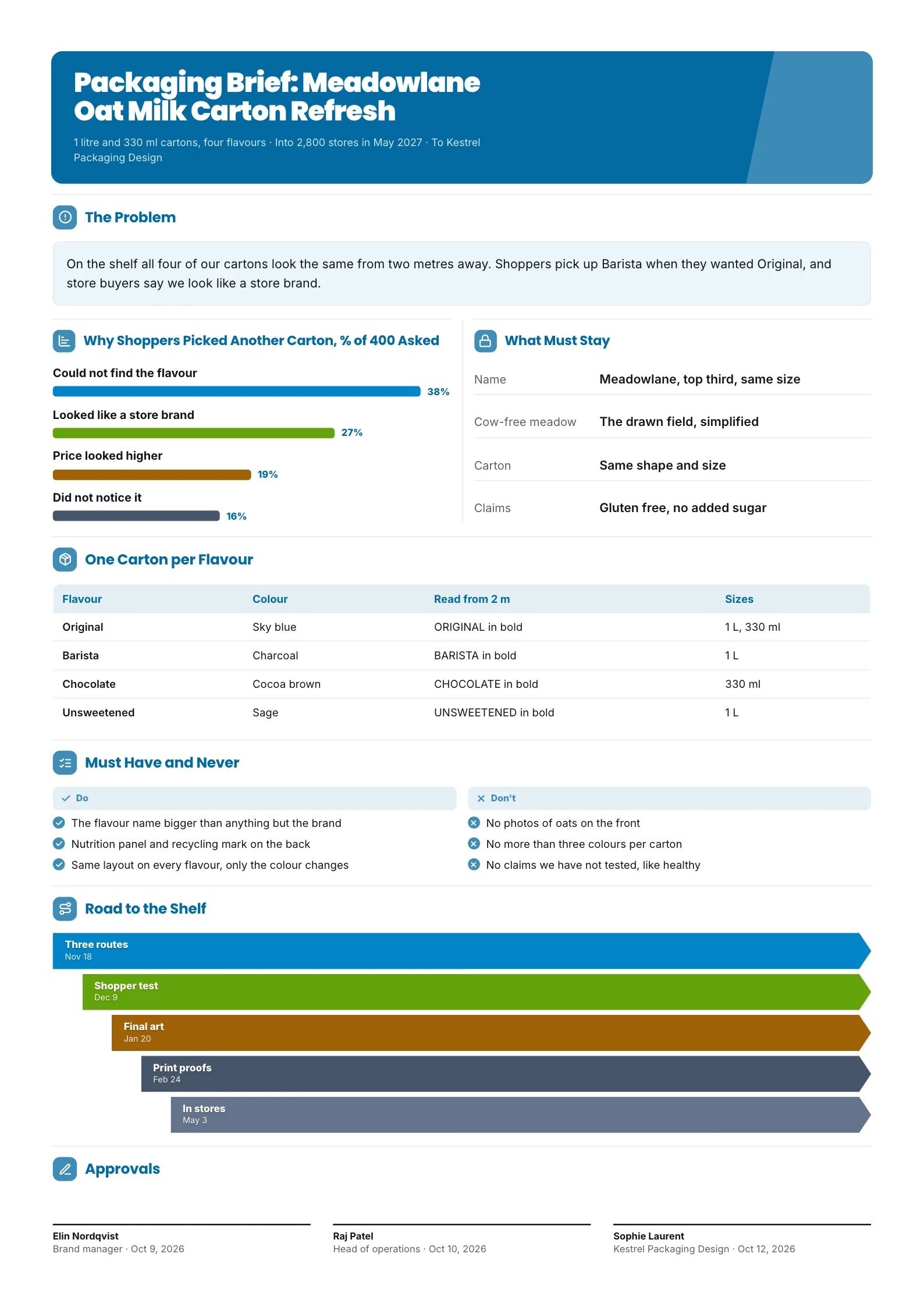
This packaging design creative brief answers it with a survey. Its chart shows why 400 shoppers picked another carton, from "Could not find the flavor" to "Looked like a store brand." The designer starts from what shoppers already think, then fixes it.
What should they do?
Four forms ask for a call to action. The Vermont guide asks, "What customer action would make the campaign “successful”? Fill out a form? Click a link? Call the business?" The CDC brief shows what happens when it's left open. It lists several calls to action to test, then says "CDC will need to decide on call to action." If you can't answer this one yet, say so in the brief, as the CDC did.
What is the budget?
Four forms ask. The CDC form puts it as a creative question: "Does the budget dictate creative direction?" WWU splits it into three lines: creative, media placement and "evaluation, tracking & analytics," which it notes is "Often overlooked." CHEJ and the Vermont guide don't ask about money.
The 4 questions half the forms or fewer ask
What else could they choose?
Three forms ask about the competition. The CDC brief's answer is worth copying. Under Competition, it didn't list other programs. It listed "Medication" and "Not doing anything." Your real competition is often whatever people do instead of acting at all.
When is it due?
Three forms ask. WWU adds a tip: "publish a date a day or two before its really required."
How will we measure success?
Three forms ask. Elon asks, "What does success look like for your project?" WWU says to "list the desired metrics before the campaign is developed."
 Edit this template
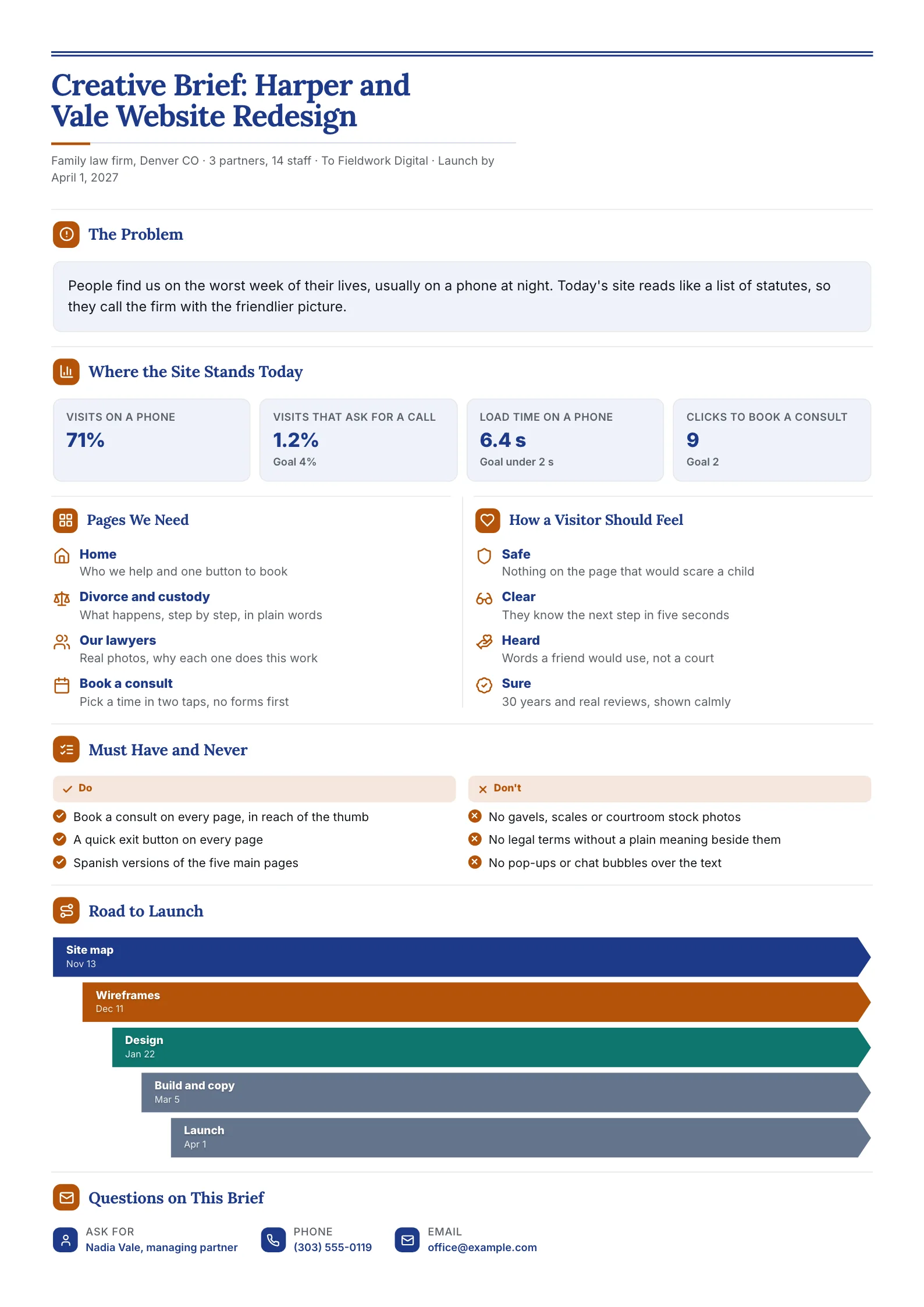
This website redesign creative brief puts today's number beside every goal. Only 1.2% of visits ask for a call, and the goal is 4%. It takes 9 clicks to book a consult, and the goal is 2. Your team knows what "better" means before the first sketch.
Who approves it?
This is the rarest question of the 14. Only Elon ("Who has final say?") and WWU ask it. WWU explains why it matters: it tells the creative team "who they are selling their ideas to. Often this is not the person writing the brief."
 Edit this template
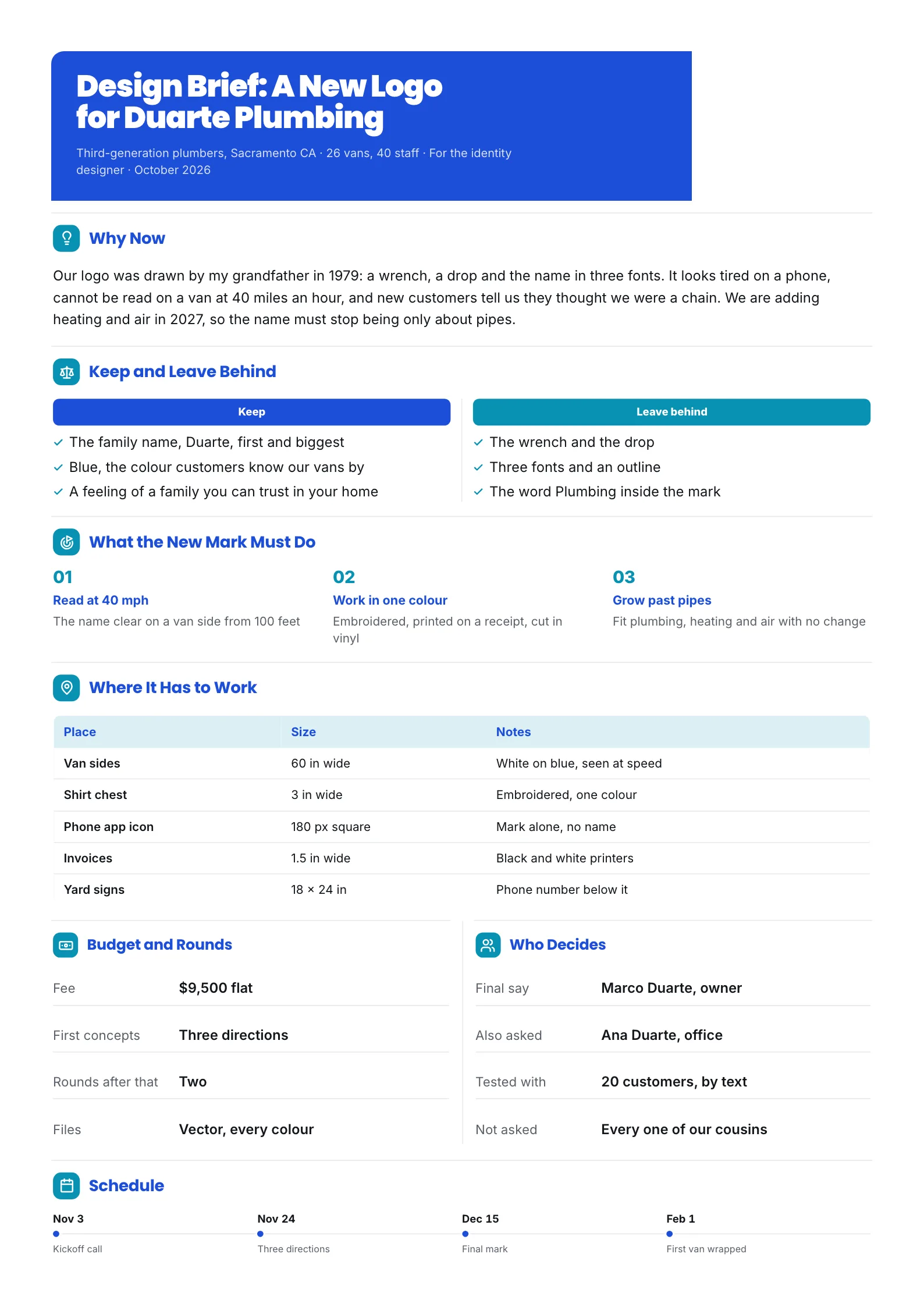
This logo design creative brief answers the approval question four ways. Marco Duarte, the owner, has final say. Ana Duarte in the office is also asked, 20 customers test it by text, and "Every one of our cousins" is listed under "Not asked." It also sets the budget at $9,500 flat, with three directions and two rounds after that.
How to use these questions
Ask them in the order your team needs the answers. Start with the 3 every form asks, then the 4 that most ask, then the rest. If you're writing the brief for someone else, send the questions before the kickoff call, so you get answers in writing.
Fill each answer in one or two sentences. If one takes a paragraph, you probably haven't decided it yet. Our creative brief format guide shows how to lay the answers out on a single sheet. For the full writing process, read how to write a creative brief.
Make your creative brief
Choose the MakeOnepagers brief closest to your project and replace each answer with yours. Or paste your answers to the 14 questions into the free AI One-Pager generator and get them laid out on one page. You'll find a blank starting point in our creative brief template post.
Frequently asked questions
How many questions should a creative brief have?
There's no set number. The six forms we read each covered between 7 and 13 of our 14 questions. CHEJ covered 7 with just six questions, so a short list can still do a lot.
What questions do you ask a client before writing a creative brief?
Start with the three every form we read asks: who the work is for, the one message, and where people will see it. Then ask about the budget and the deadline, and ask who approves the work, which only 2 of the 6 forms did.
Which creative brief question is the hardest to answer?
Usually the one message. All six forms ask for it, and most limit it to one sentence. The CDC's version helps: "If the customer remembers only one thing, what should it be?"
Should a creative brief say who approves the work?
Yes. Only 2 of the 6 forms we read ask, but the Western Washington University form explains why it matters: "Often this is not the person writing the brief." Naming them up front tells your team who they are really presenting to.
What if you can't answer one of the questions yet?
Write that down in the brief. The CDC's 2013 brief listed several calls to action to test and noted that "CDC will need to decide on call to action." An open question in writing beats a guess your team builds on.




