A Creative Brief Format That Answers the Agency's Questions First
A creative brief format built from 39 questions agencies asked a state department before bidding: 8 blocks in order, what each answers, and 5 one-page briefs.

Every blank in your creative brief comes back to you as a question, usually by email and usually in the week the work should start. A good creative brief format answers those questions in the order a creative team asks them, so your team spends its first week on the work itself. Start from a free one pager template.
One‑Pager examples
Real One-Pagers made with MakeOnepagers. Open any one to edit it as your own.
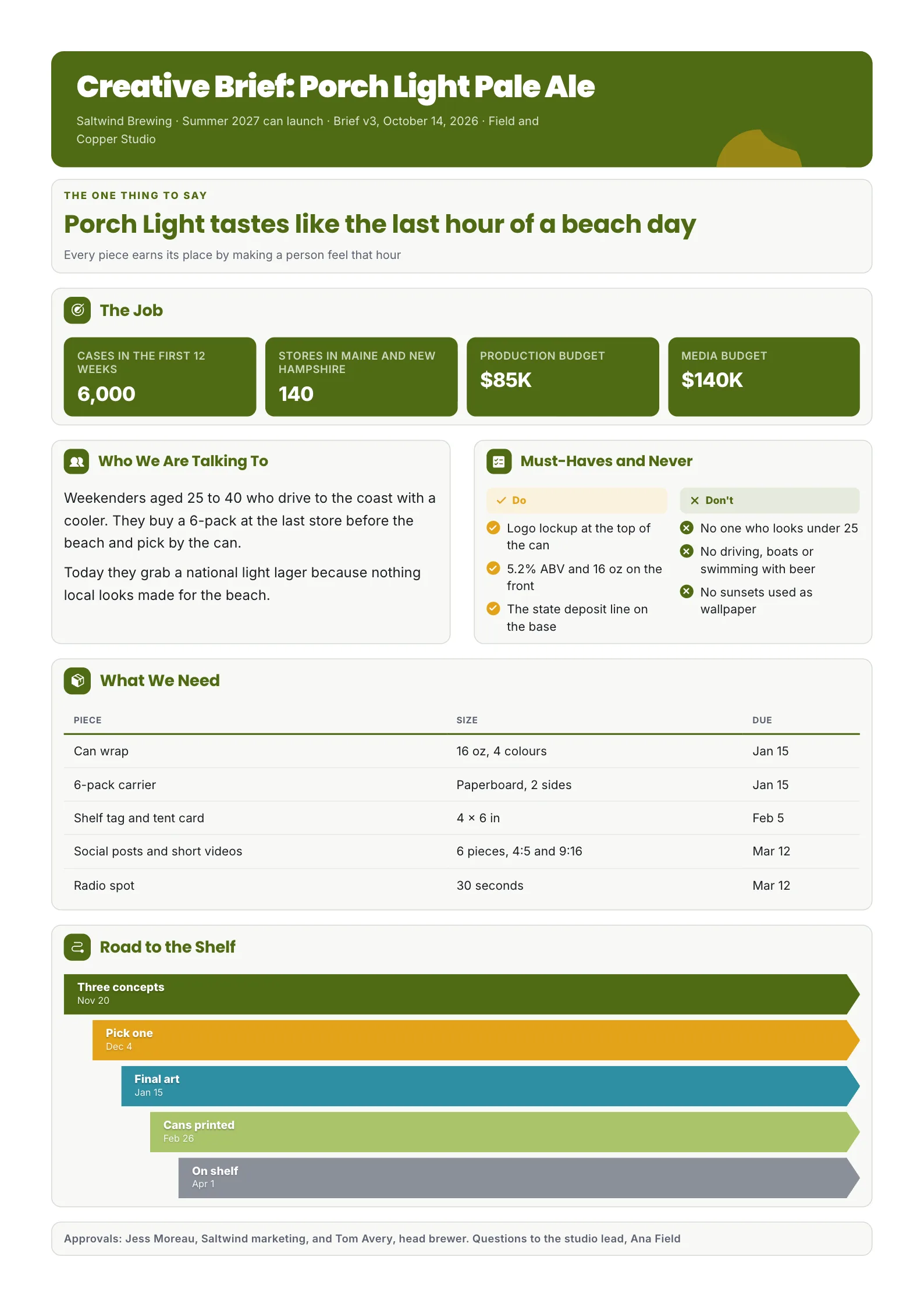 Creative BriefEdit for free(opens in a new tab)
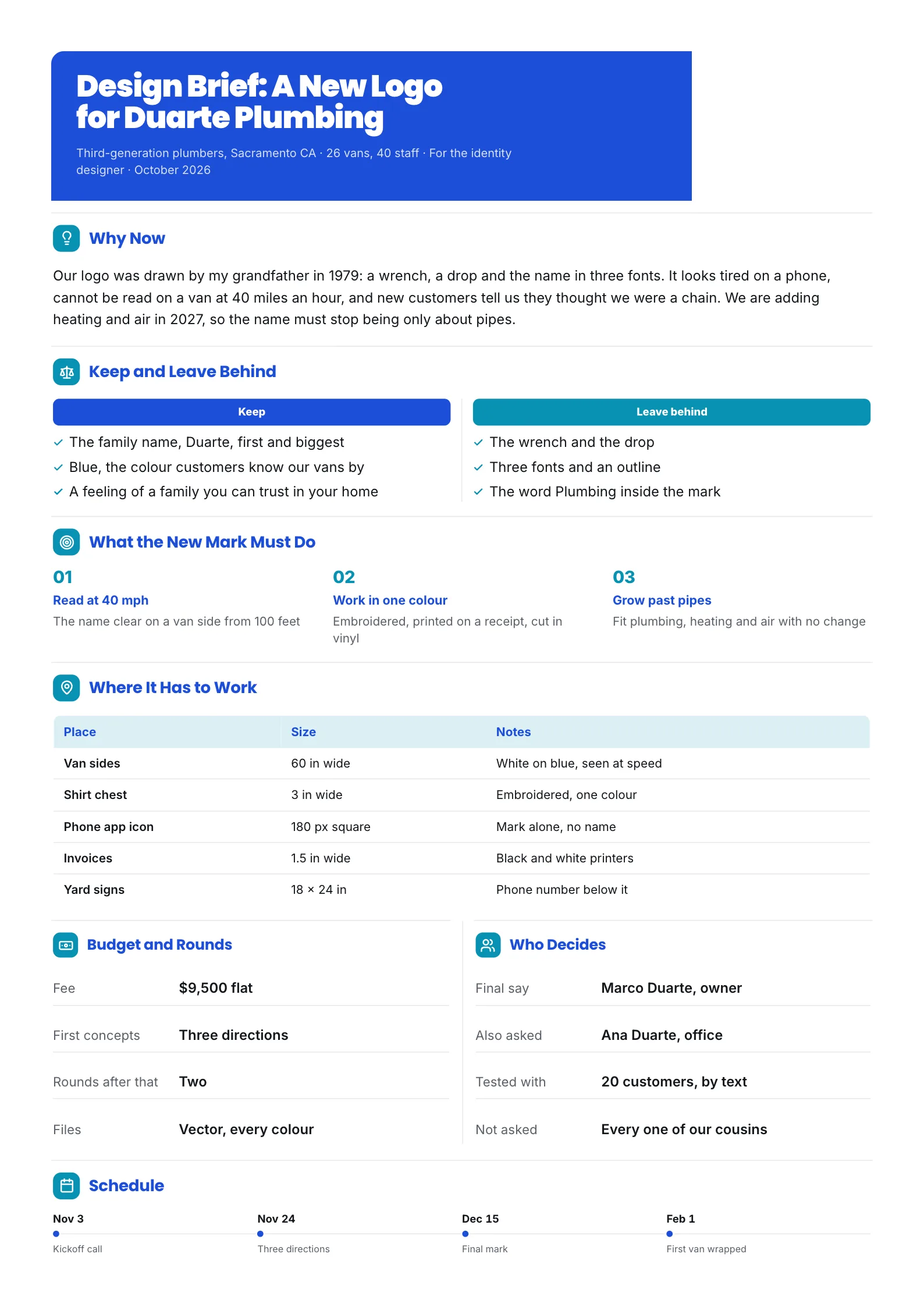 Creative Brief: Logo DesignEdit for free(opens in a new tab)
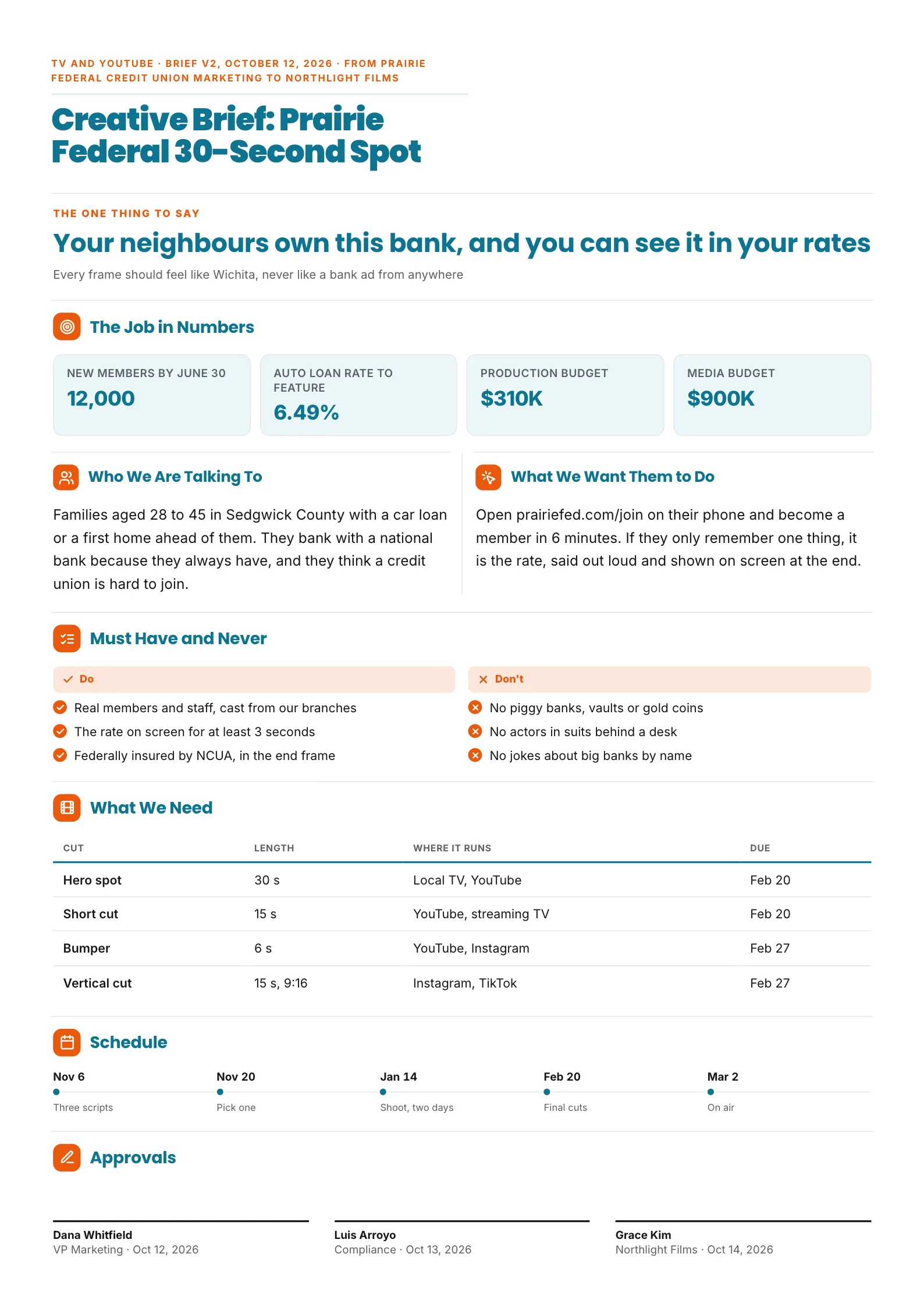 Creative Brief: Video AdEdit for free(opens in a new tab)
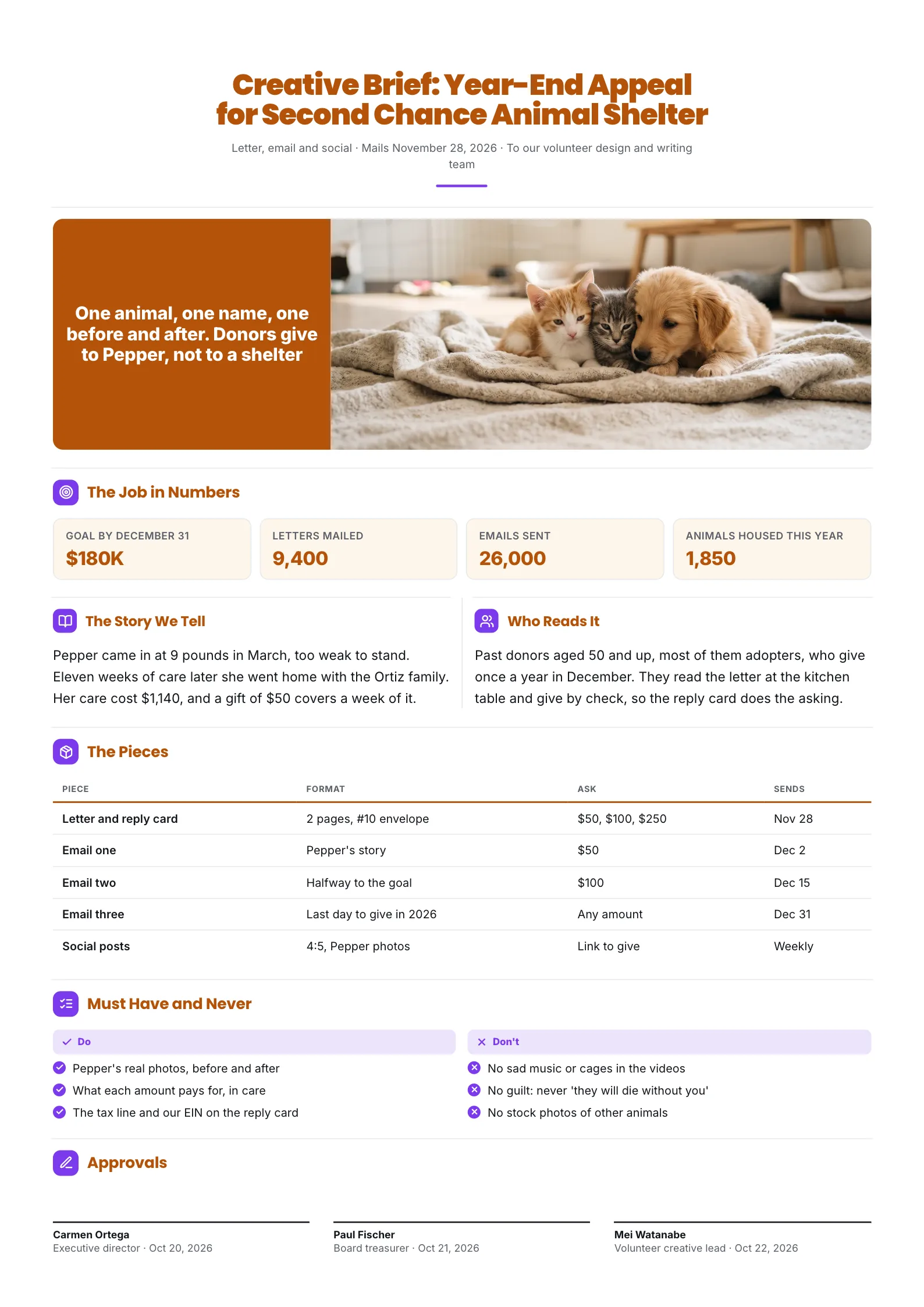 Creative Brief: Fundraising AppealEdit for free(opens in a new tab)
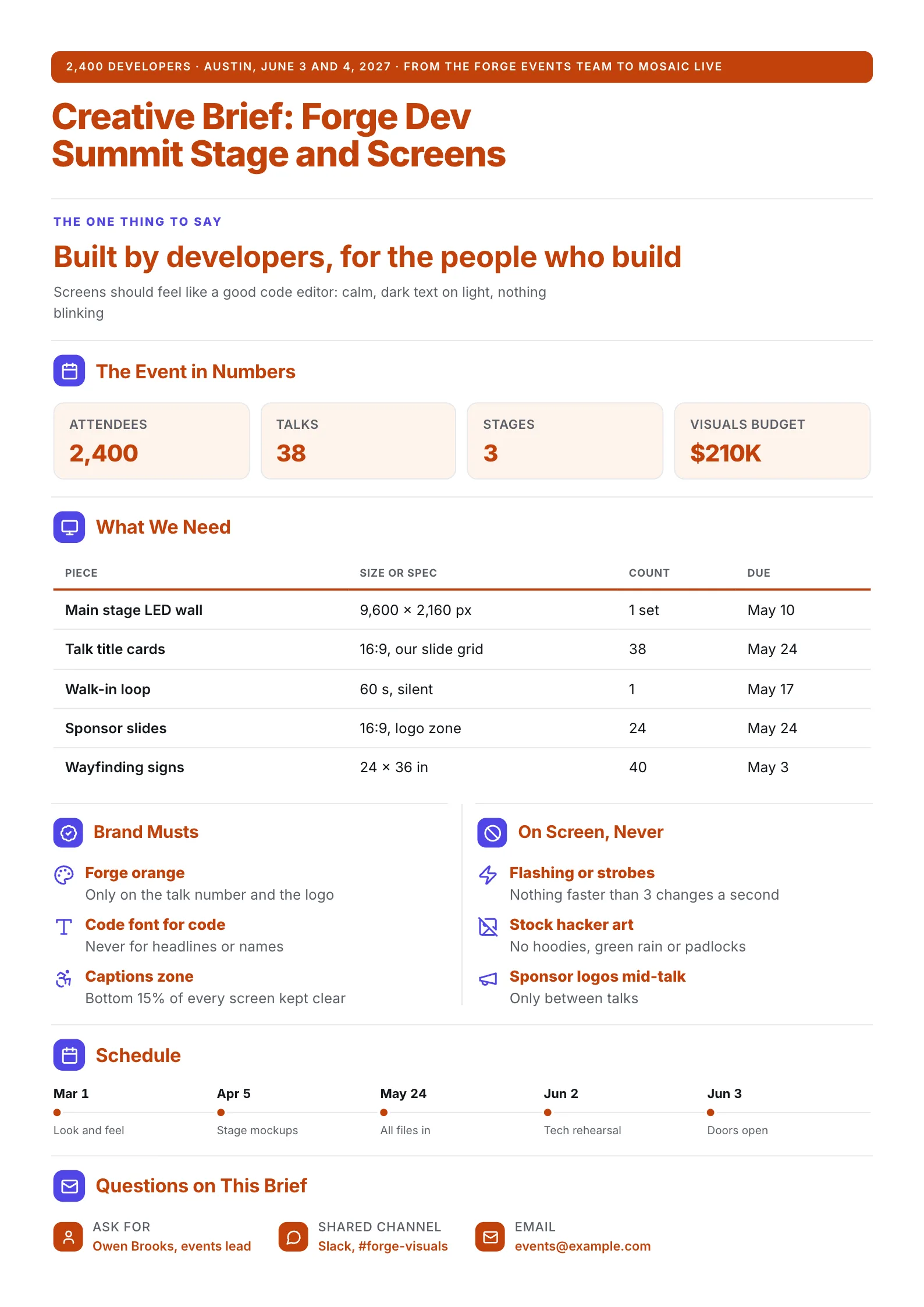 Creative Brief: Event Stage and ScreensEdit for free(opens in a new tab)
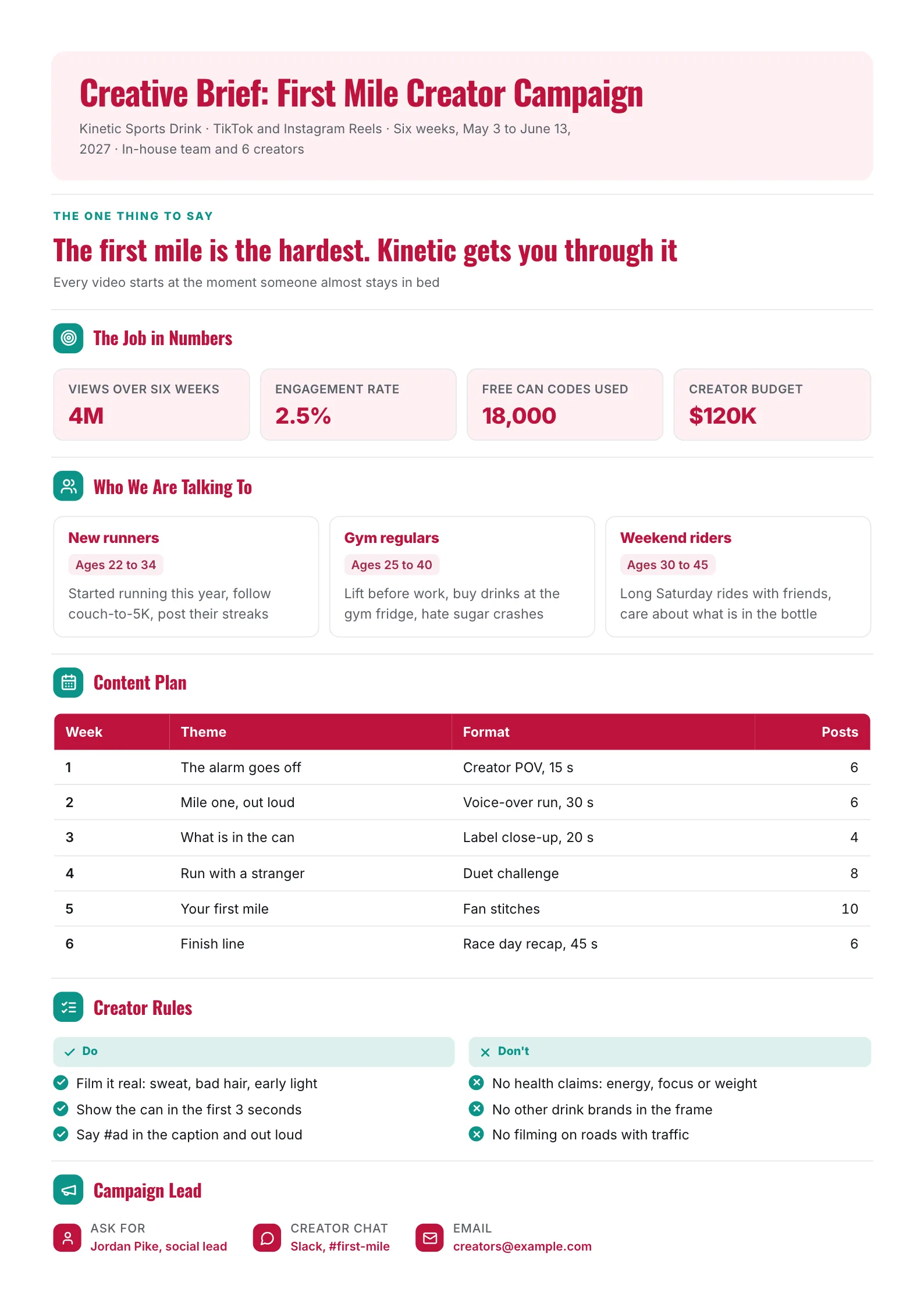 Creative Brief: Social Media CampaignEdit for free(opens in a new tab)
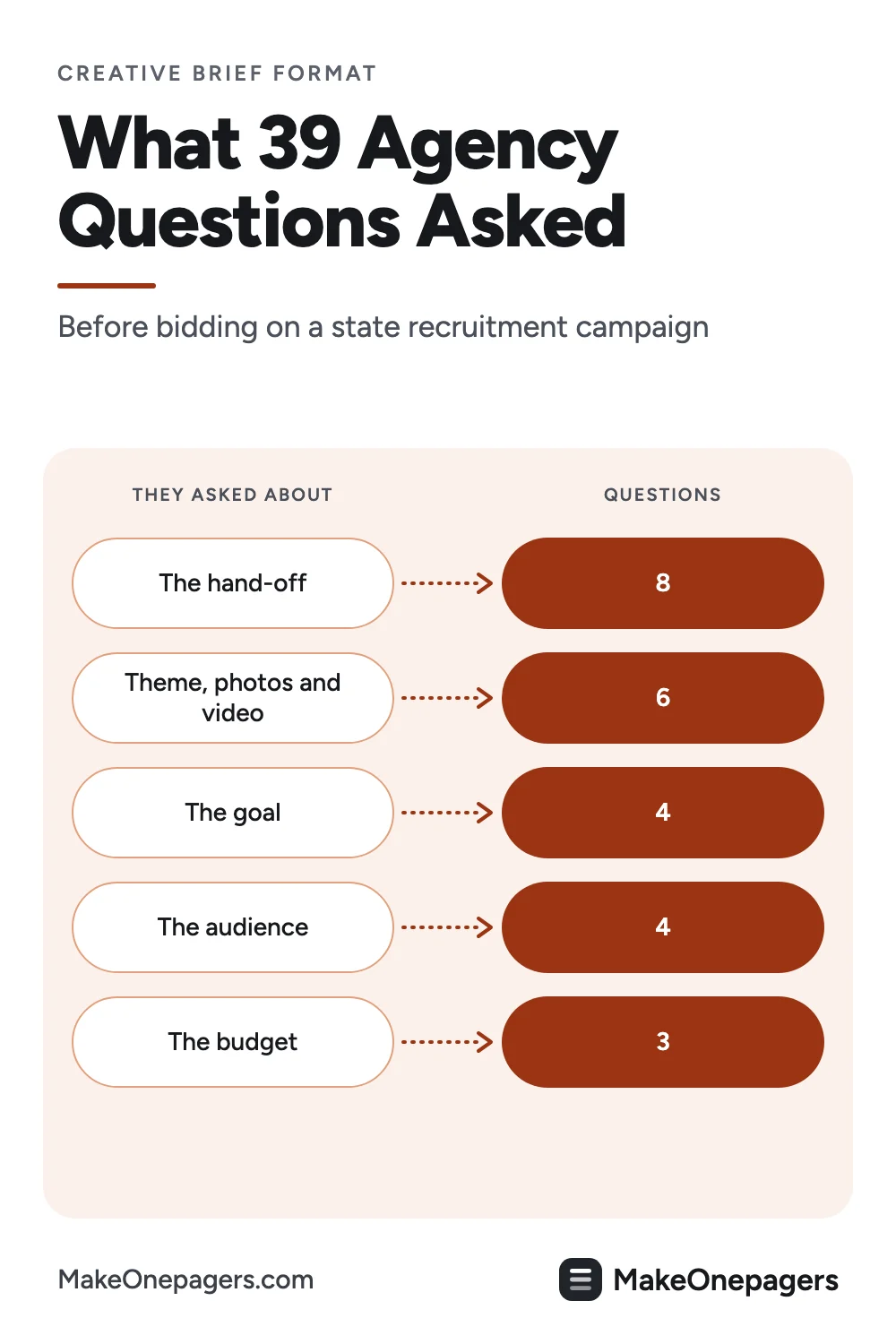
A public record shows which questions come first: the vendor questions and answers for the New Jersey Department of Corrections' 2025 Custody Recruitment Campaign. Agencies bidding to recruit correctional police officers sent in 39 questions, and the department answered each one in a 6-page document. Below, we sort those questions into the blocks of a one-page brief, with samples from MakeOnepagers that use invented names and figures.
What 39 agency questions asked for
| What they asked about | Questions | What the department answered |
|---|---|---|
| Hand-off: website, email, social posts, printing, job sites and tracking systems | 8 | No backend access to the website, so the agency supplies creative files, and those files go to the state for printing |
| The existing theme, photos and video | 6 | Keep building on "Serve with Honor, Protect with Pride", and use the photo and video already on file |
| Scope: past results, events, PR and what a phrase meant | 5 | Paid ads, events and promotion have been tried, and the agency recommends how many events |
| The goal and how success is measured | 4 | 230 officers per academy class, two or three classes a year |
| The audience and the competition | 4 | Local law enforcement, county correctional agencies and the state police |
| Budget | 3 | About $400,000 for fiscal 2025 |
| Timing | 3 | A quick start, with new creative phased in around the hiring schedule |
| People to film and coach | 3 | Officers of different ranks, locations, genders and ethnicities will be available |
| Forms and where updates are posted | 2 | Forms already on a vendor's state profile count |
| How the work may be used later | 1 | Only for recruiting |
Budget came up three times, and two of those answers match word for word. The hiring target came up twice. When several bidders ask for the same number, your brief left it out, and you'll answer it by email until you add it.
The answers are short, too. "Local law enforcement, county correctional agencies, state police" is a single line, and it tells an agency who it's up against. Most of what these bidders needed fits in lines that size. Put the goal and the budget side by side and an agency can size the plan before it calls you: two or three classes of 230 means 460 to 690 new officers a year, on about $400,000.
The format, block by block
A one-page brief can hold every answer above in eight blocks. Here they are in the order your team will read them.
1. The problem, in plain words
Say what's wrong today, the way your customer would say it.
 Edit this template
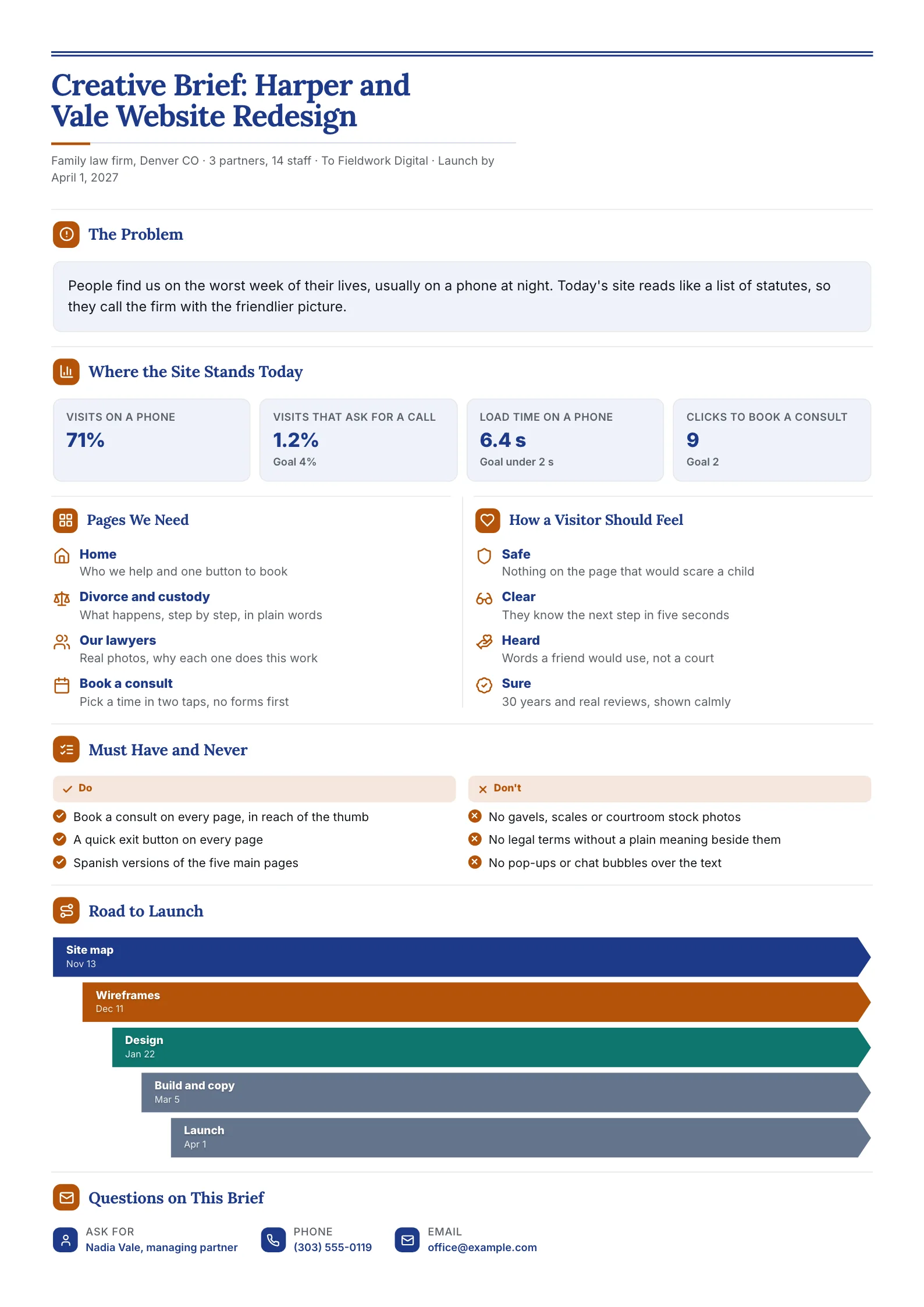
This website redesign brief opens on its problem. People find the firm in the worst week of their lives, usually on a phone at night, and today's site reads like a list of statutes.
2. The goal, with today's number beside it
The department's goal was a full academy class. Yours needs a number and the place you're starting from. The same website brief puts 1.2% of visits asking for a call beside a goal of 4%, and 9 clicks to book a consult beside a goal of 2. Your agency can test every idea against those two lines.
3. Who you're talking to, and what else they could choose
Bidders asked for candidate profiles and for the competition. Your brief should answer both.
 Edit this template
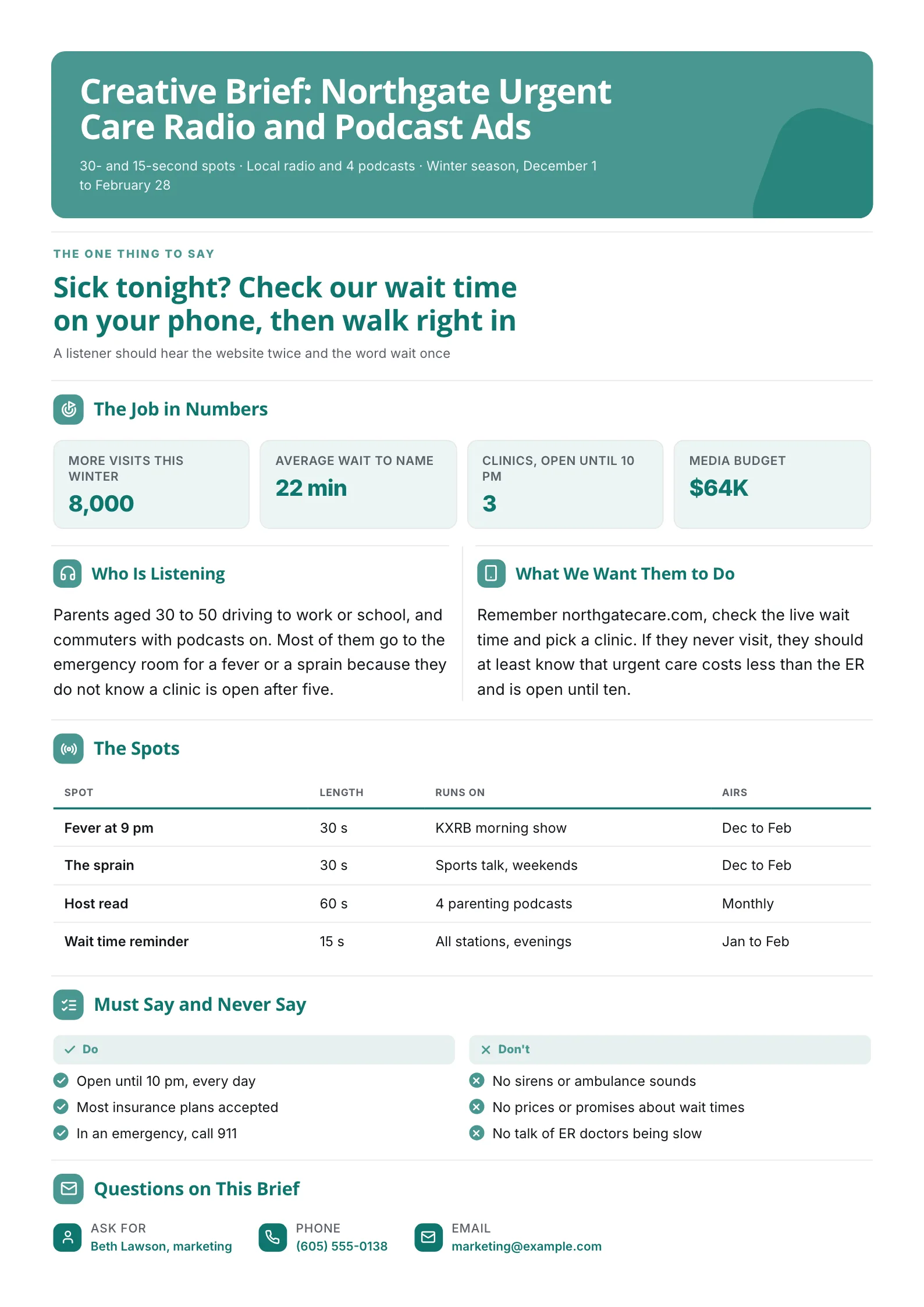
The radio and podcast ad brief names parents aged 30 to 50 driving to work or school. Then it names the real rival, the emergency room, where many of them go for a fever because they don't know a clinic is open after five.
4. What already exists, and what must stay
Six questions asked about the existing theme and assets. If your agency has to keep a slogan, a logo or a shape, write it down.
 Edit this template
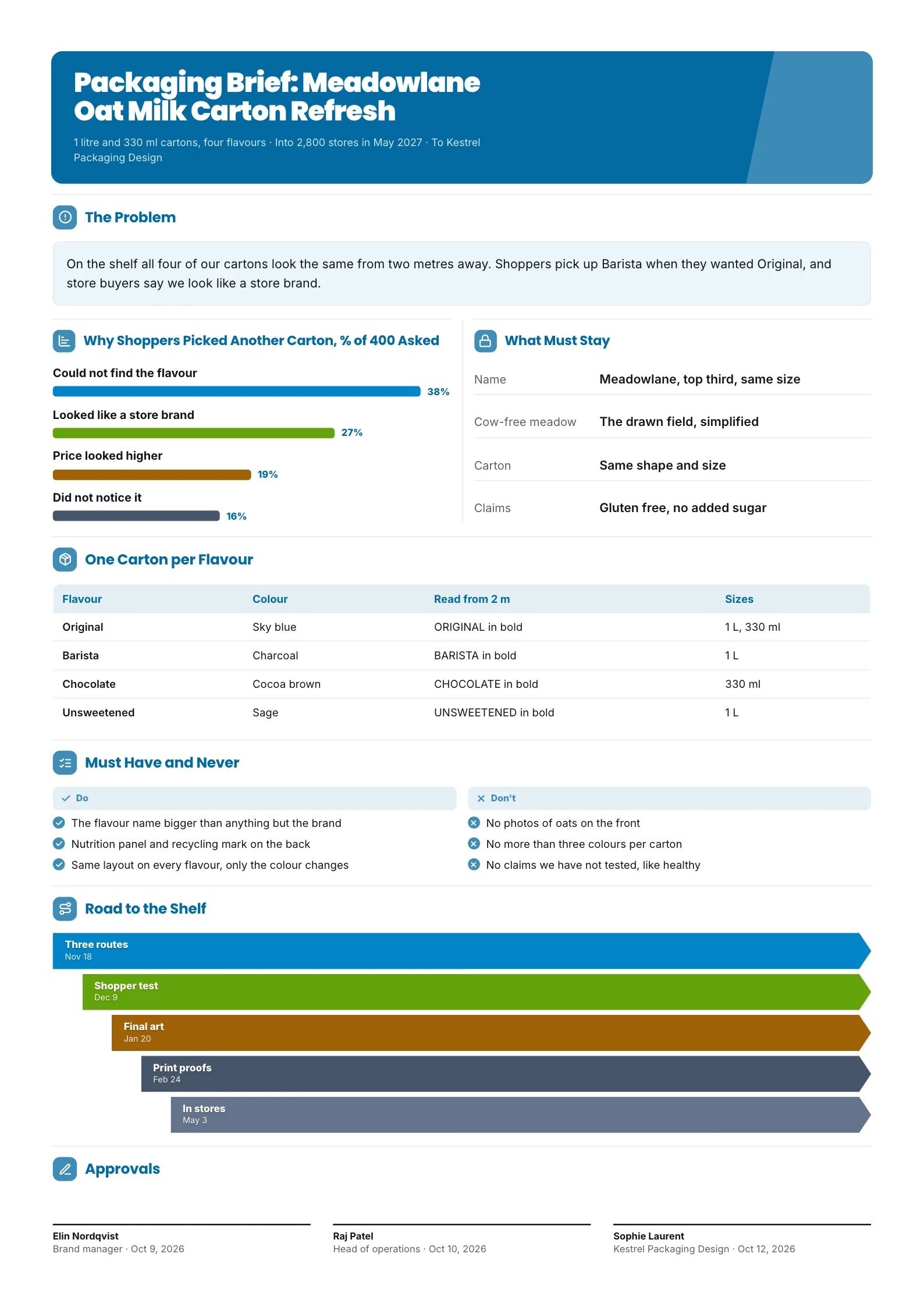
The packaging design brief has a block called "What Must Stay" with four rows: the name in the top third, the drawn meadow, the carton shape and two claims. Its research chart shows why everything else can change, because 38% of the 400 shoppers asked couldn't find their flavor.
5. Every piece you need, with its spec and count
A list of pieces turns "some photos" into work your agency can price.
 Edit this template
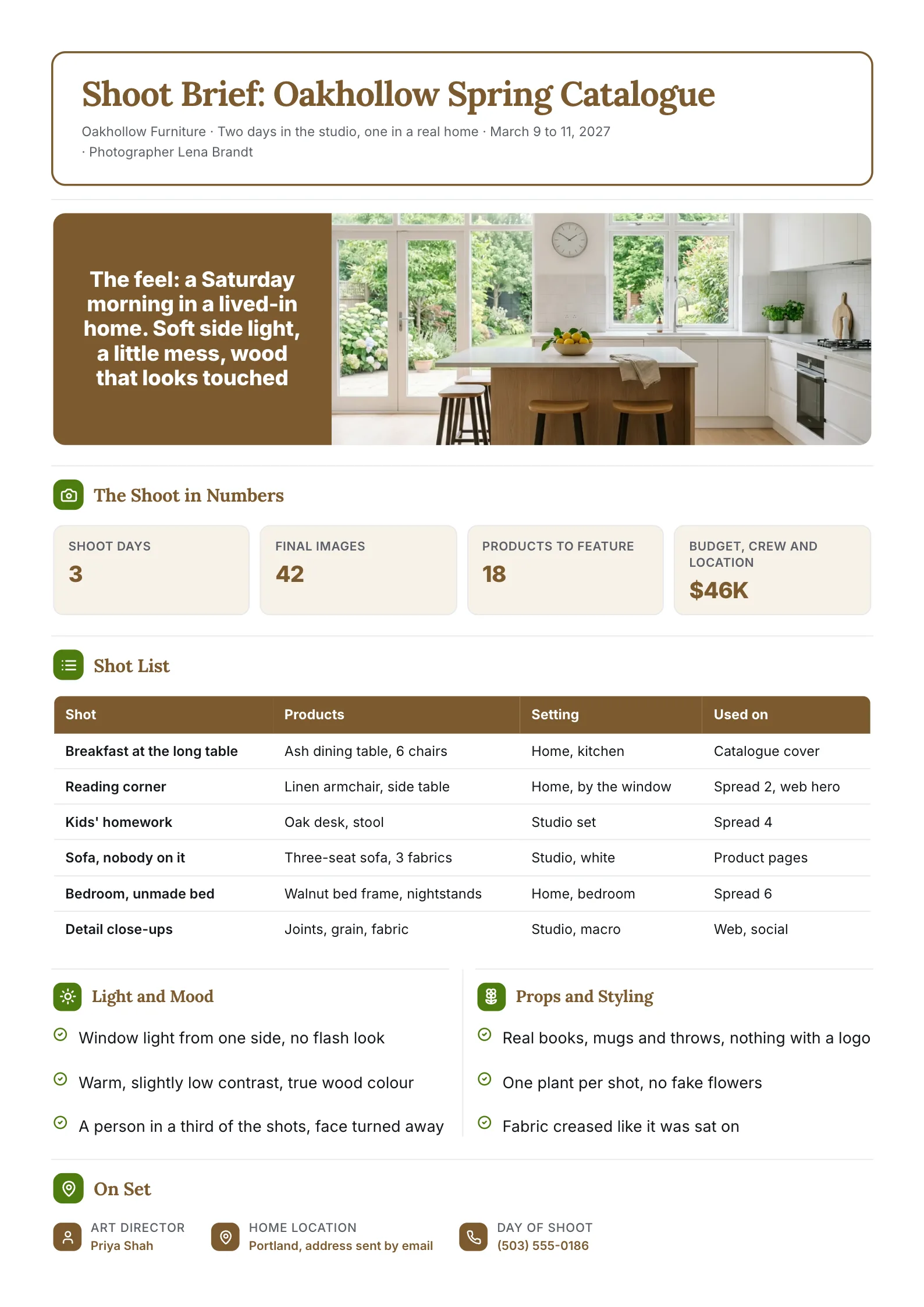
This photo shoot brief lists six shots, each with its products, its setting and where the picture will be used, from the catalog cover to the product pages. The total is set at 42 final images.
6. The budget, and what it covers
Give the figure and what it pays for. The photo shoot brief says $46K covers the crew and the location for 3 shoot days, so a photographer can see that a fourth day isn't on the table.
7. The dates, from first idea to launch
Bidders asked when the campaign should be "in market". Put your dates on the page. The website brief runs from a site map on November 13 to launch on April 1, in five steps.
8. The hand-off: files, channels and who answers
This was the biggest group, 8 of the 39 questions. Who sends the emails? Who prints? Can the agency touch your website? Settle them before the brief goes out.
 Edit this template
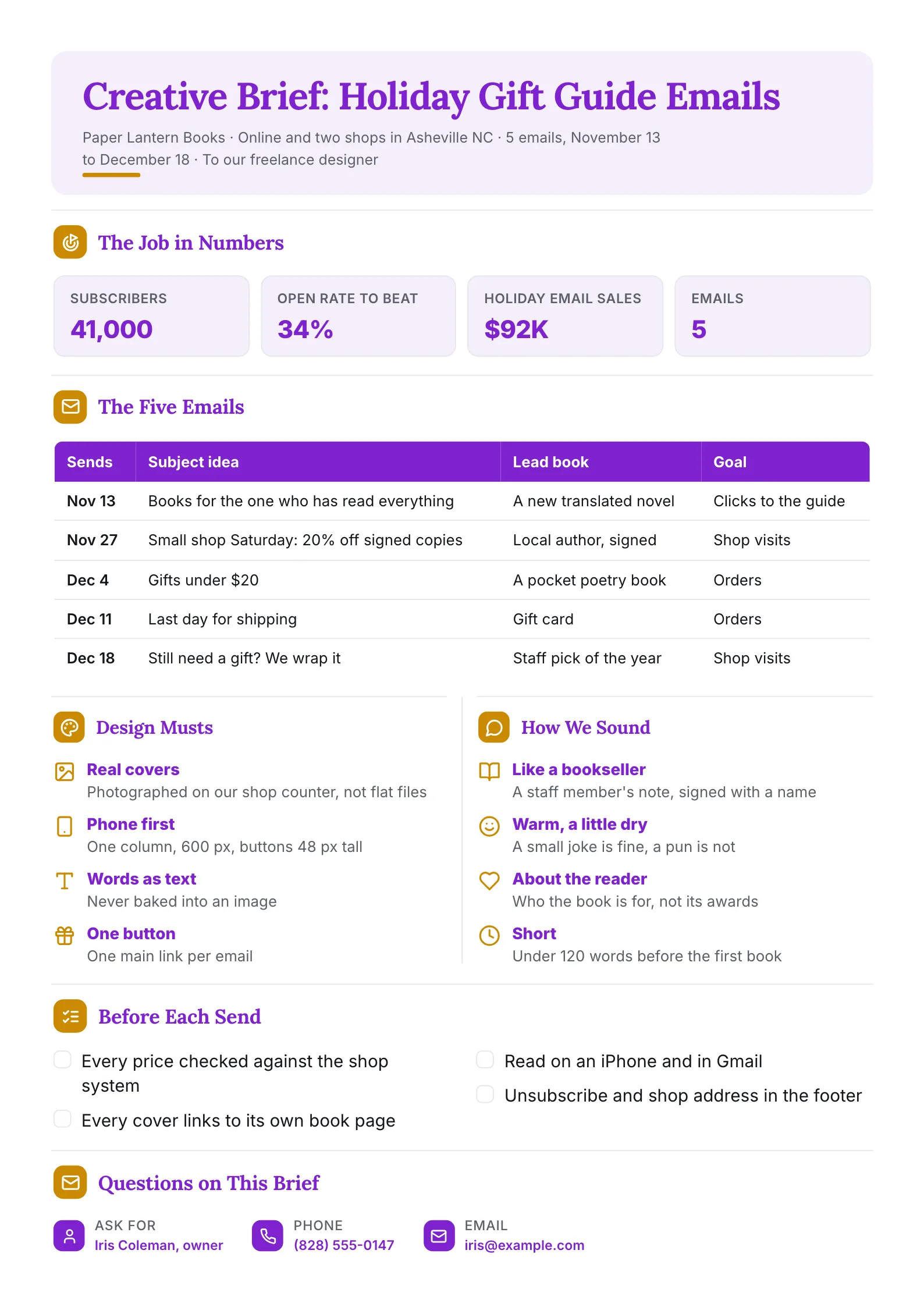
The email campaign brief spells out the hand-off for a freelance designer: one column at 600 px, buttons 48 px tall and every word as live text. Four checks run before each send, and the owner's name and phone sit at the bottom for questions.
Answer once, for everyone
The department posted every question and answer in one document, so each bidder worked from the same facts. If you're briefing several agencies, you can do the same. Collect questions until a set date, then send one answer sheet to all of them. When a question shows up twice, move its answer into your brief for next time.
Make your creative brief
Start with the block you'd find hardest to fill, which is usually the budget or the hand-off. Pick a creative brief in MakeOnepagers and swap the sample figures for yours. Have last year's request for proposals or a long project email? Paste it into the free AI One-Pager generator and edit the page it lays out. For the writing itself, how to write a creative brief walks through the one-line promise, and our creative brief template has a blank you can fill in.
Frequently asked questions
What is the best format for a creative brief?
One page in a fixed order: the problem, the goal with a number, the audience and their alternatives, what must stay, the deliverables with specs, the budget, the dates and the hand-off. Your team can read it in a few minutes and come back to it all project long.
Should a creative brief include the budget?
Yes. In the New Jersey questions, budget came up three times. Without a figure, each agency guesses at the size of the job, and you can't compare their proposals.
Should a creative brief name competitors?
Yes, in one line. The department answered with three: local law enforcement, county correctional agencies and the state police. That line tells your agency what your audience is weighing you against.
How do you list deliverables in a creative brief?
Use a table with one row per piece, giving the size or length, the count, where it runs and the due date. The photo shoot sample adds a column for where each shot will be used.
What should you do when agencies send questions about your brief?
Set a deadline for questions, answer them all in one document and send it to every agency. Then add those answers to your brief, so your next round starts with them.




