How to Write a Creative Brief Around One Promise
Most creative briefs leave out the money and the dates. Learn to write one around a single promise, from 6 public briefs by the CDC, Kaiser and Destination DC.

A creative brief tells designers, writers or an agency who you're talking to, what you want those people to do, and the one thing your work must say to them. To write one, you fill in about a dozen short boxes, and most of them take a sentence each. The hard part is deciding what goes in them, and how much. Start from a free one pager template.
One‑Pager examples
Real One-Pagers made with MakeOnepagers. Open any one to edit it as your own.
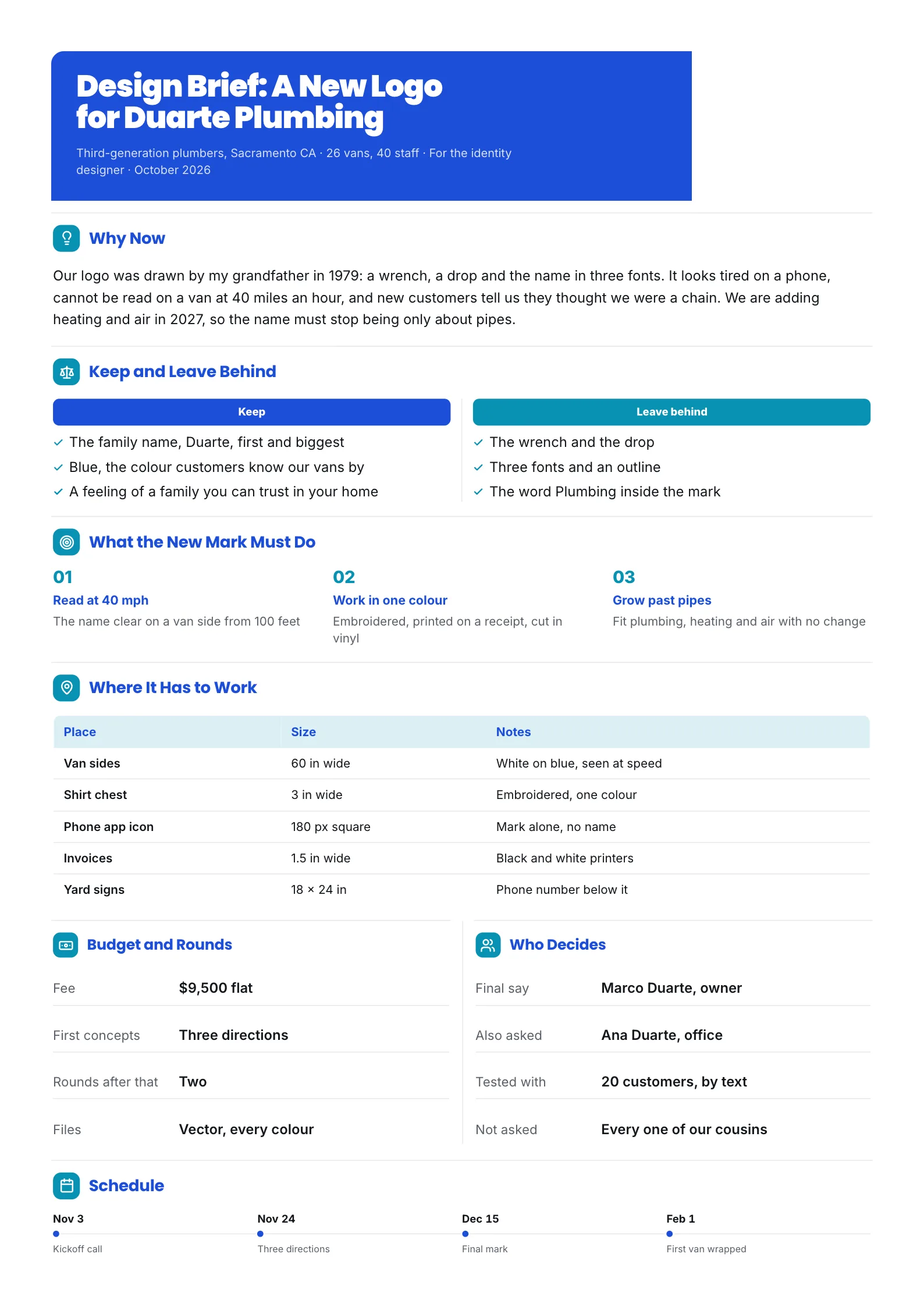 Creative Brief: Logo DesignEdit for free(opens in a new tab)
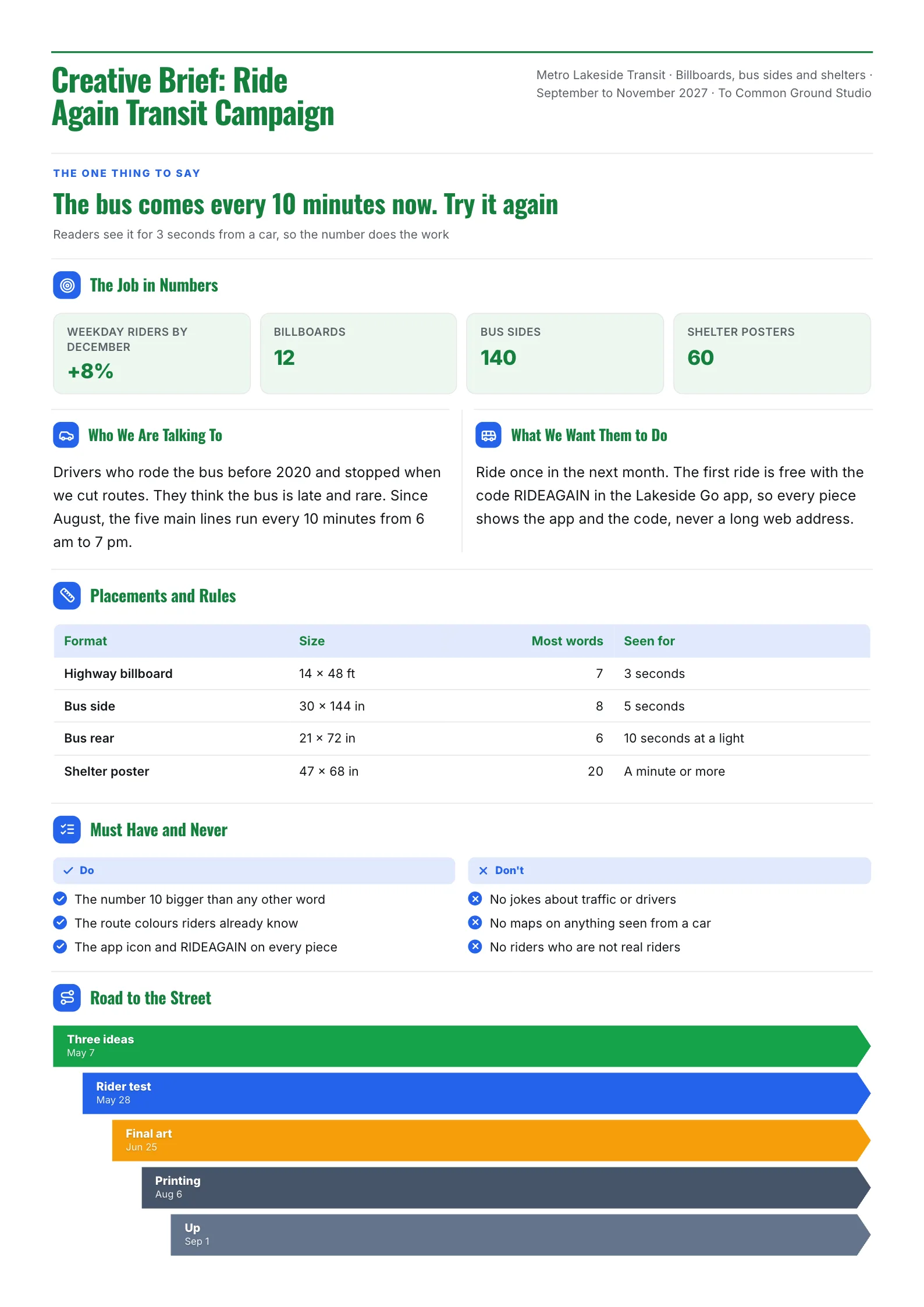 Creative Brief: Billboard and Out-of-HomeEdit for free(opens in a new tab)
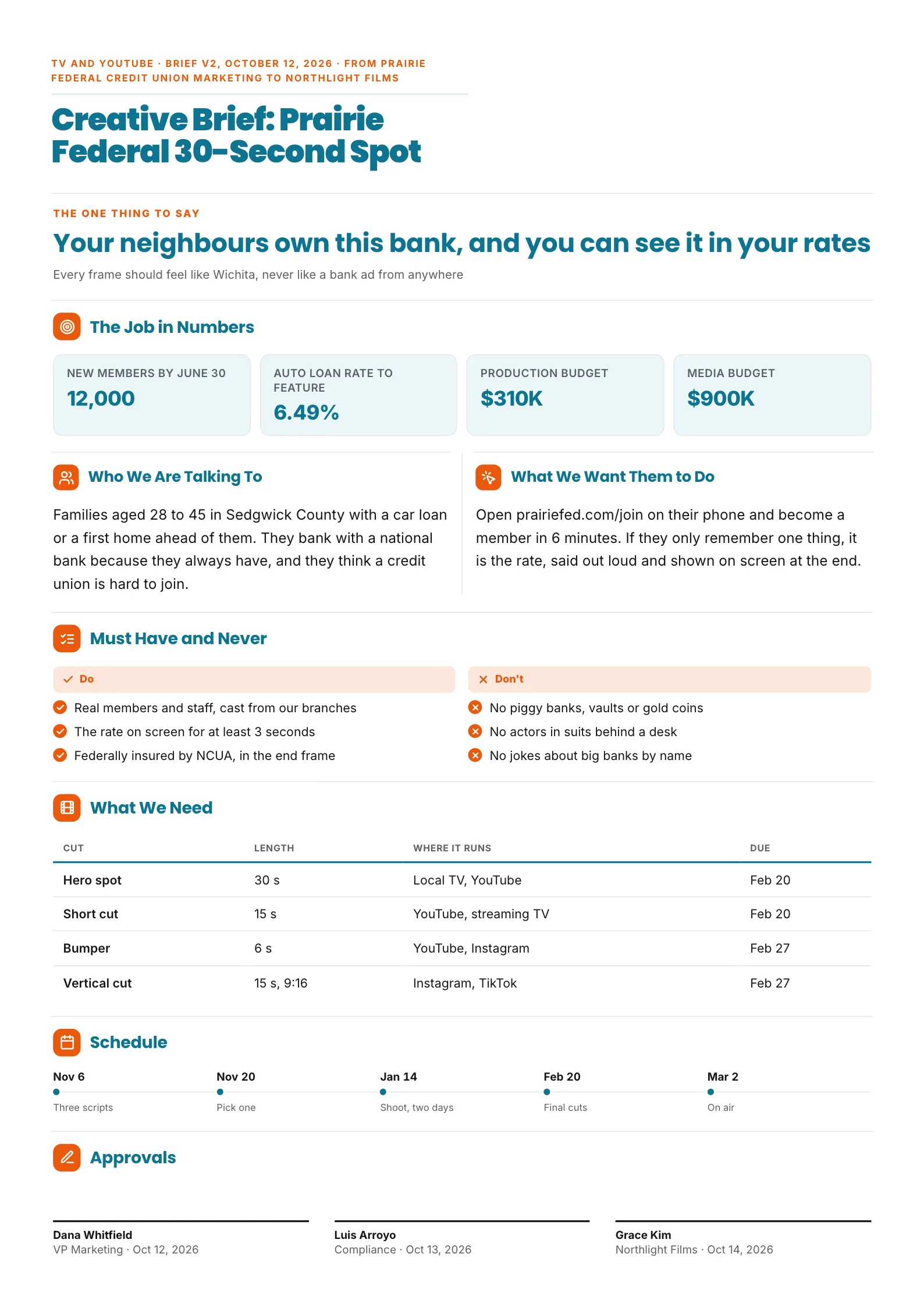 Creative Brief: Video AdEdit for free(opens in a new tab)
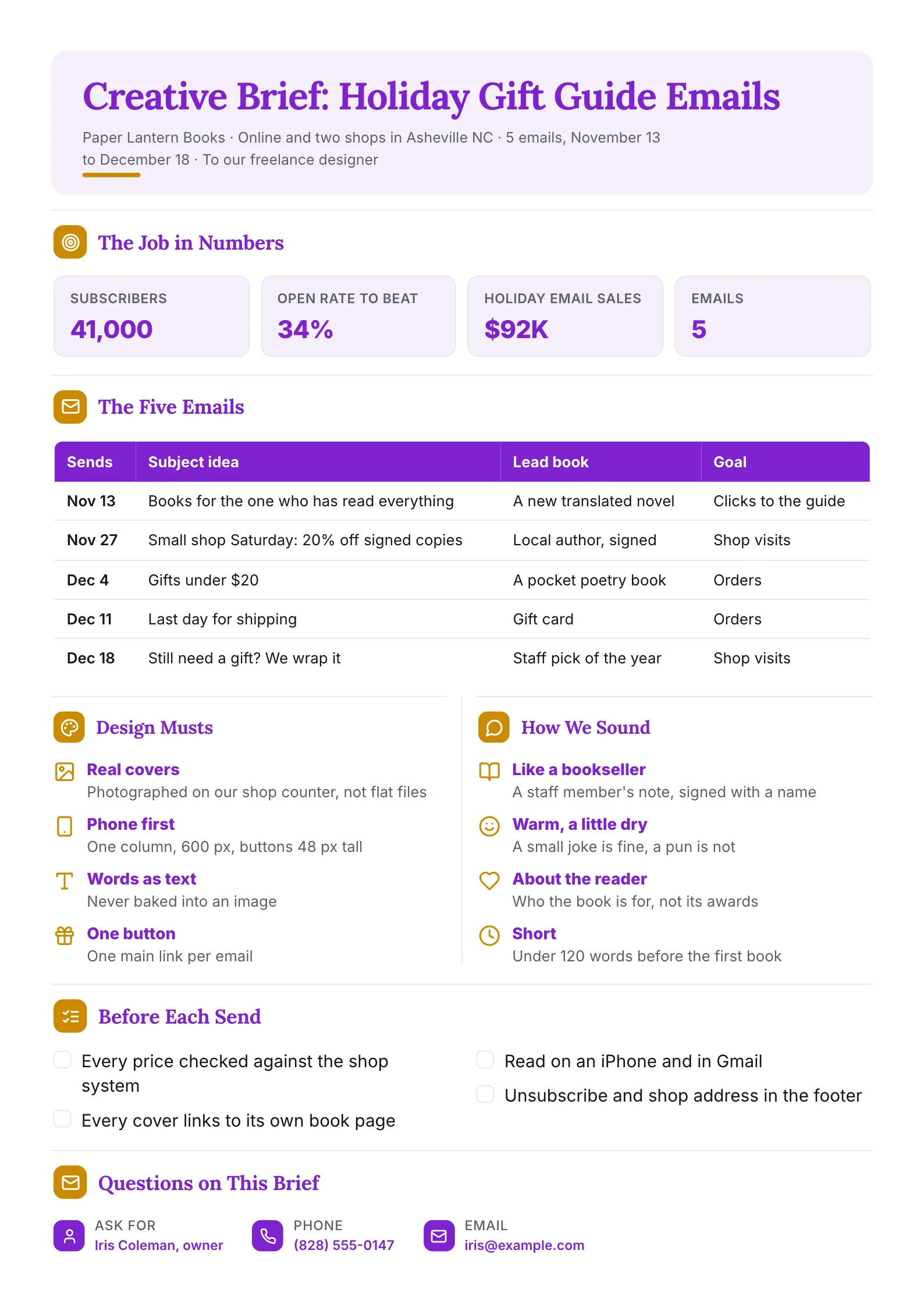 Creative Brief: Email CampaignEdit for free(opens in a new tab)
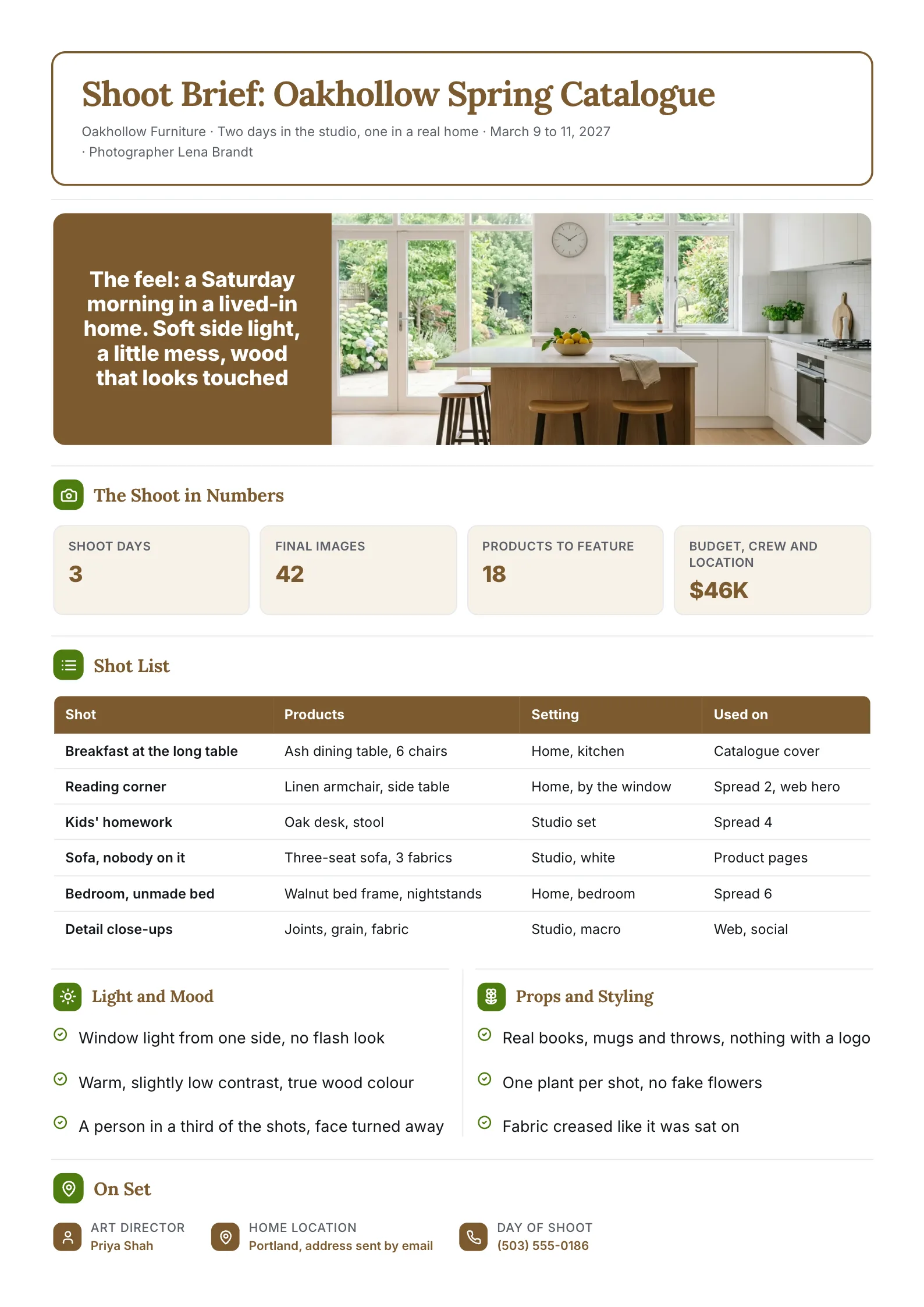 Creative Brief: Photo ShootEdit for free(opens in a new tab)
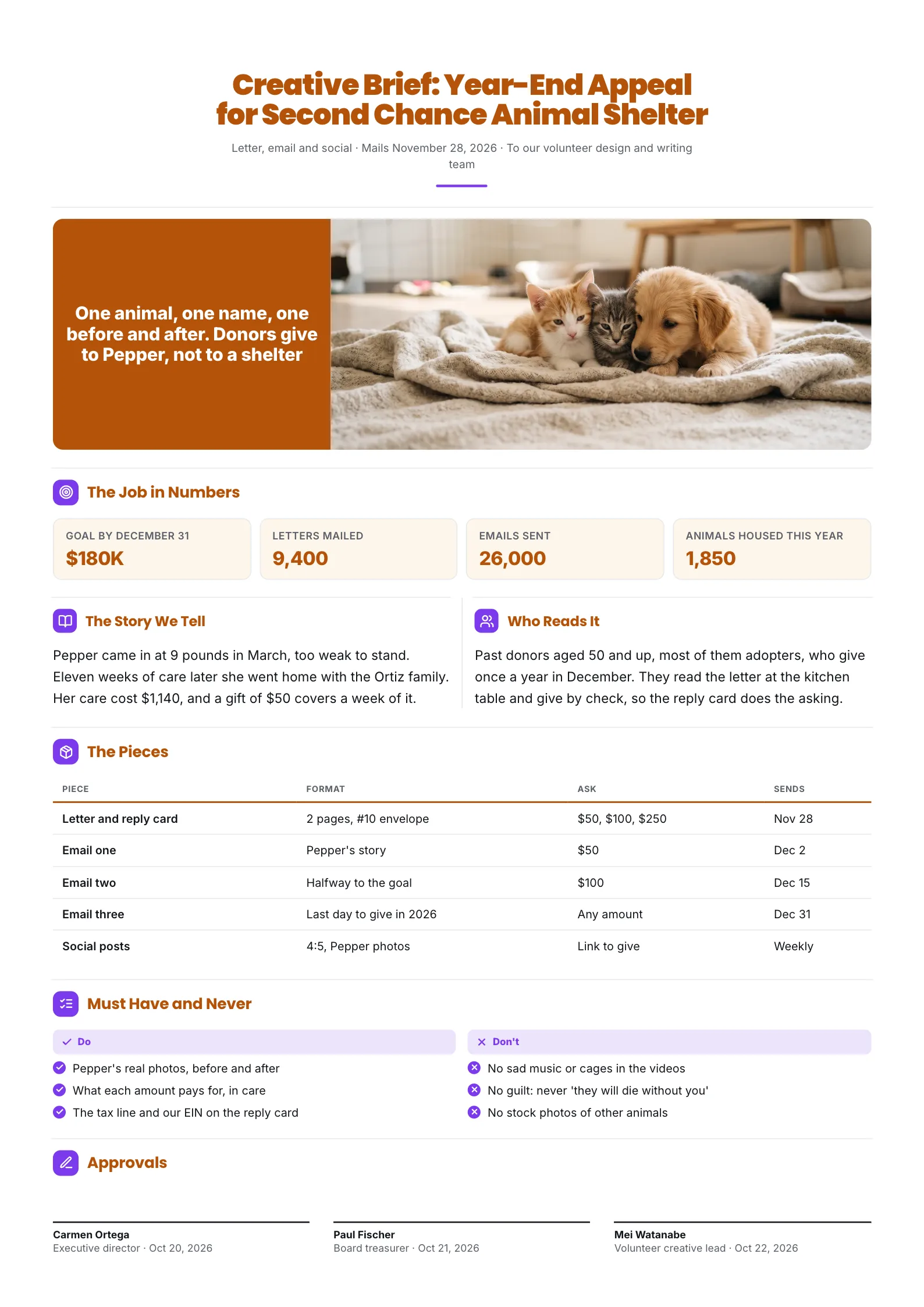 Creative Brief: Fundraising AppealEdit for free(opens in a new tab)
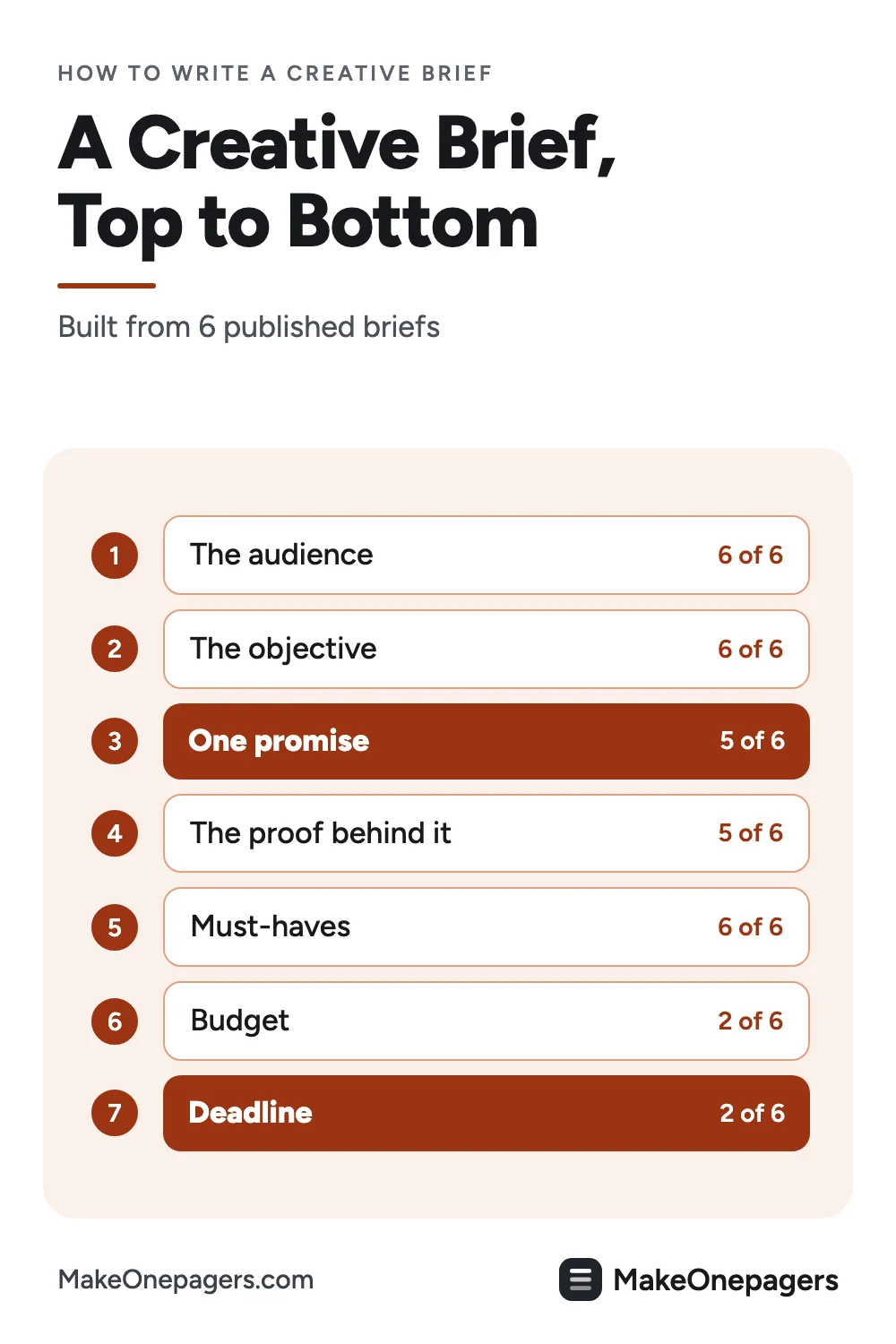
Public health bodies, hospitals and a tourism office have posted 6 creative briefs and brief forms online, and those 6 are the ones we read. Every one asks who the audience is and what they should do, and five boil the message down to one promise. Money and dates are the rare parts, with a budget in 2 of them and dates in 2. Most parts below come with the line from a real brief that does it well.
What 6 published creative briefs ask for
| Part of the brief | Briefs that ask for it |
|---|---|
| The audience | 6 of 6 |
| The objective | 6 of 6 |
| Must-haves and creative rules | 6 of 6 |
| One promise or key takeaway | 5 of 6 |
| Reasons to believe the promise | 5 of 6 |
| What stops the audience today | 4 of 6 |
| Tone | 4 of 6 |
| A call to action | 4 of 6 |
| How success is measured | 3 of 6 |
| Channels or deliverables | 3 of 6 |
| Budget | 2 of 6 |
| Deadline or dates | 2 of 6 |
Source: our read of 6 published creative briefs and forms, October 30, 2026. Each one is linked at the end.
Two of the 6 are filled-in briefs for real campaigns, two are forms with worked examples, and two are a blank form and a how-to guide. The C-Bulletin from C-Change, a USAID project run by FHI 360, says a brief usually runs 2 to 3 pages. Kaiser Permanente Georgia's form, with its guidance and examples, runs 3 pages, and UF Health's is a single web form.
Name one audience, and describe a real person
Every brief we read starts with the audience. The best ones give you more than an age range. The CDC's flu shot brief names people with diabetes aged 25 to 54. Kaiser Permanente Georgia's form warns that "Moms" is too general. Its better version is new moms who recently joined and haven't yet seen a primary care doctor.
Write your audience as one person you could picture. Give their age, their situation and what they already believe about you. If you have two audiences, you probably need two briefs.
 Edit this template
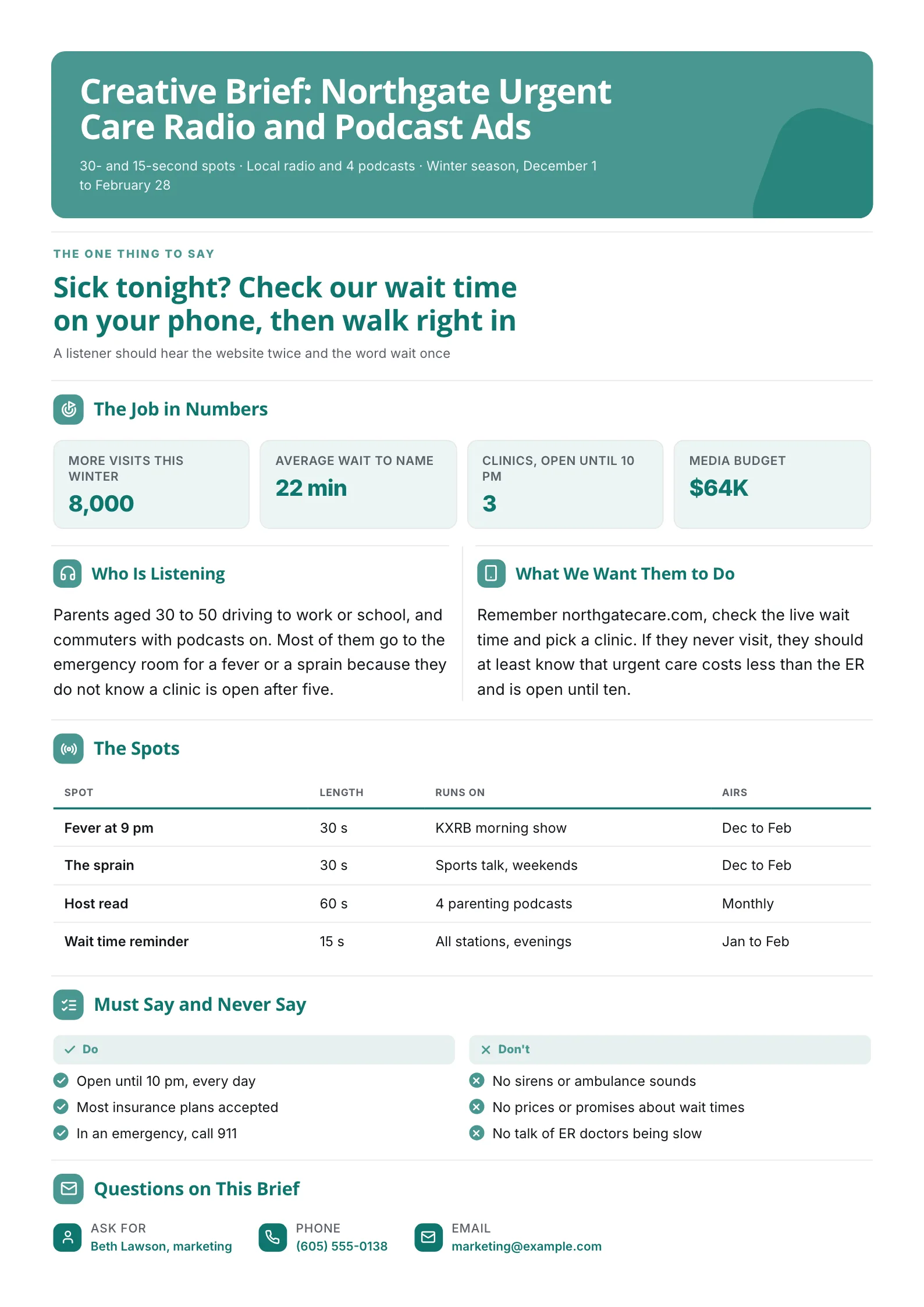
Sample names and figures. The audience box describes real listeners, parents aged 30 to 50 on the drive to work or school, and the one thing to say sits in large type at the top.
Write the objective as something people will do
All 6 briefs ask for an objective. FHI 360's form splits it in two. It asks for a behavior objective (what the audience will do) and a communication objective (what they need to hear first). Its worked example opens with research showing willingness to take a COVID vaccine rose 31% from January to March 2021, then builds the objectives on that.
Kaiser's form puts it most bluntly: "Don't assume they know what you want them to do. Tell them." Write your objective with a verb the audience does, like book, visit, buy or sign up. Then add a number if you can.
Boil the message down to one promise
Five of the 6 briefs ask for a single promise or takeaway. The CDC, FHI 360 and the C-Bulletin all call it the Key Promise. It's written from the audience's side as a benefit. The CDC's version starts "If I take preventive measures like getting a flu shot," then says what the person gets.
The one brief without this box, UF Health's, asks for the "top three things" instead. Three messages give your designer three places to start. One promise gives them one. Try writing yours as the sentence you'd want a stranger to repeat after seeing your ad.
 Edit this template
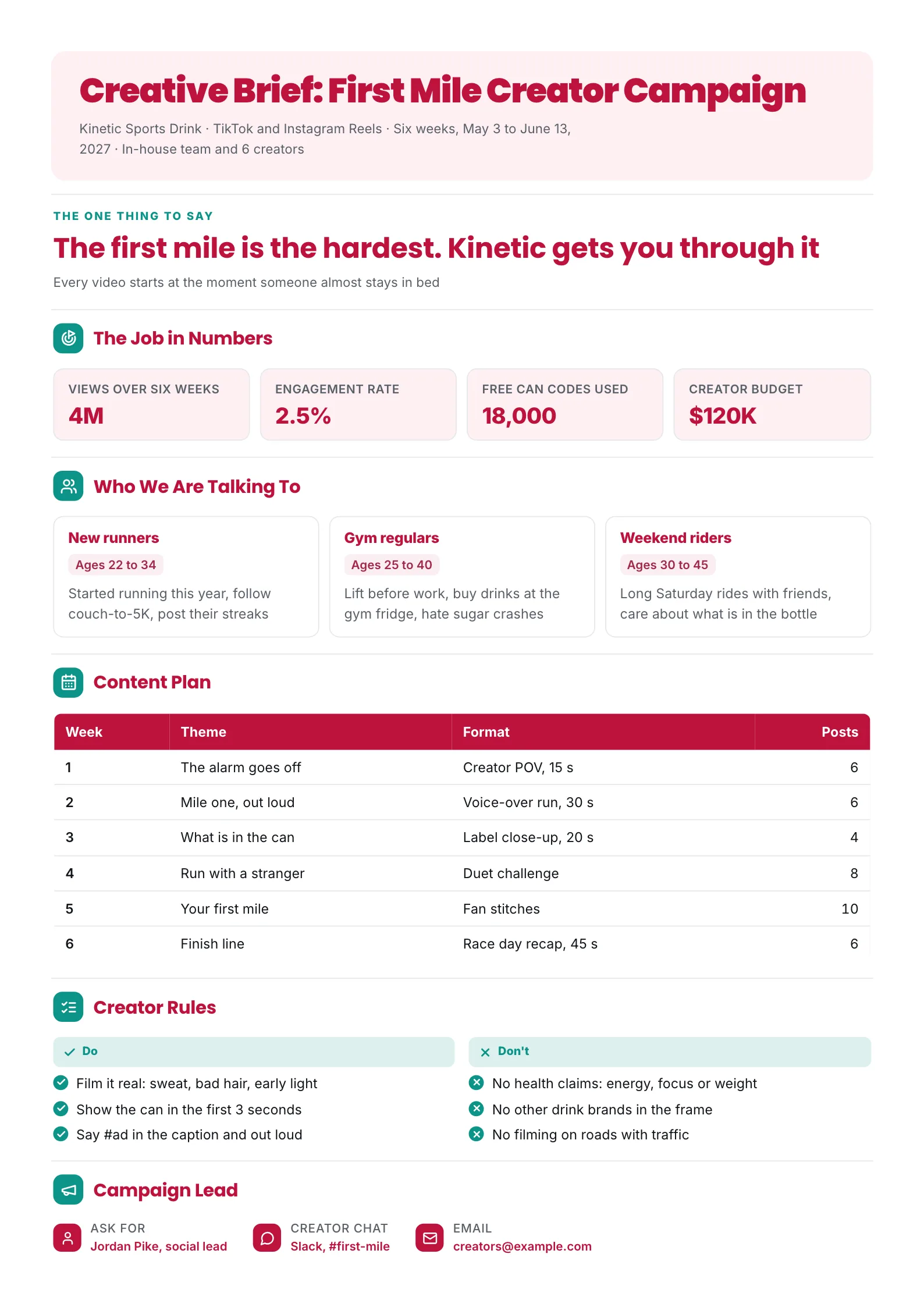
Sample names and figures. The dates sit in the header, and one campaign line leads the page with the goals and budget underneath it.
Add the proof and the barriers
Five briefs ask for reasons the audience should believe the promise. The CDC's support line says people with diabetes are almost three times more likely to die from pneumonia and influenza. Destination DC backed its promise with survey data, noting that 74% of travelers were concerned about their health.
Four briefs also ask what stops the audience today. The CDC calls these obstacles, and Kaiser calls them friction points. Your creative team can only knock down a barrier you've named for them. A fact or two from your own research is worth more here than an adjective.
 Edit this template
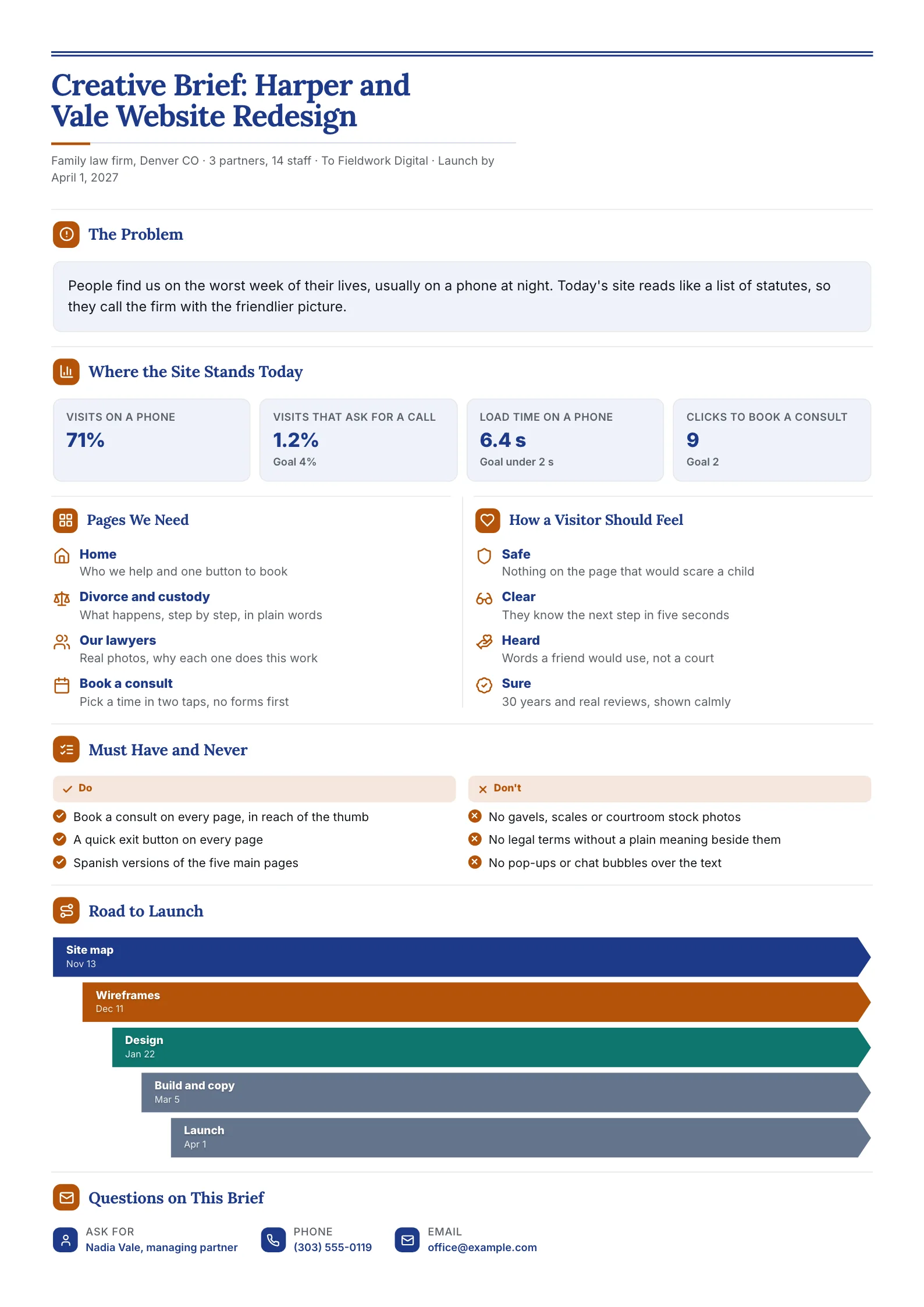
Sample names and figures. The proof is four tiles of today's numbers, three of them with the goal printed underneath.
List the must-haves, the tone and the call to action
All 6 briefs have a box for must-haves. Destination DC told its agency to show groups of three people or fewer and to use its "masked" logo while masks were required. The CDC's brief asked for printed pieces in Spanish and English. These rules save you a round of edits, because your designer sees them before drawing anything.
Four briefs ask you for tone, often as a short list of adjectives. UF Health asks for a few words that describe the feel. Four also ask for a call to action, the exact step at the end of the ad. Keep both short. Three adjectives and one action are plenty.
Name every piece you need
Three of the 6 briefs ask for the channels or the pieces, and FHI 360's form wants the formats and channels you'll use named, like radio, TV or social media. List each piece with its size or length and where it will run, like a 30-second radio spot or a vertical video for Instagram Reels. Your team can't quote or plan a piece you forgot to list. The radio sample above does this in its table of spots.
Say what it can cost and when it's due
Only 2 of the 6 briefs put a budget in the brief itself. UF Health asks for budget considerations, and the C-Bulletin includes cost. Destination DC stated a $400,000 budget in its request for proposals, but left it out of the brief. Dates are just as rare. FHI 360's brief gives an activity duration from June to September 2021, run in two waves, and UF Health's form ends with a timeline that asks you for four dates: first concepts, final approval, production start and production finished.
A budget changes what the team will propose. With $5,000 they'll plan stock photos and one round of edits, and with $50,000 they may plan a shoot. A deadline shapes the schedule the same way, so give a date for the first draft, the final files and the launch. If the brief covers several pieces, put a due date beside each one, the way the event sample below does. The Compass for SBC's own how-to guide ends on the same two steps, a timeline and then a budget, and gives you a template for each.
 Edit this template
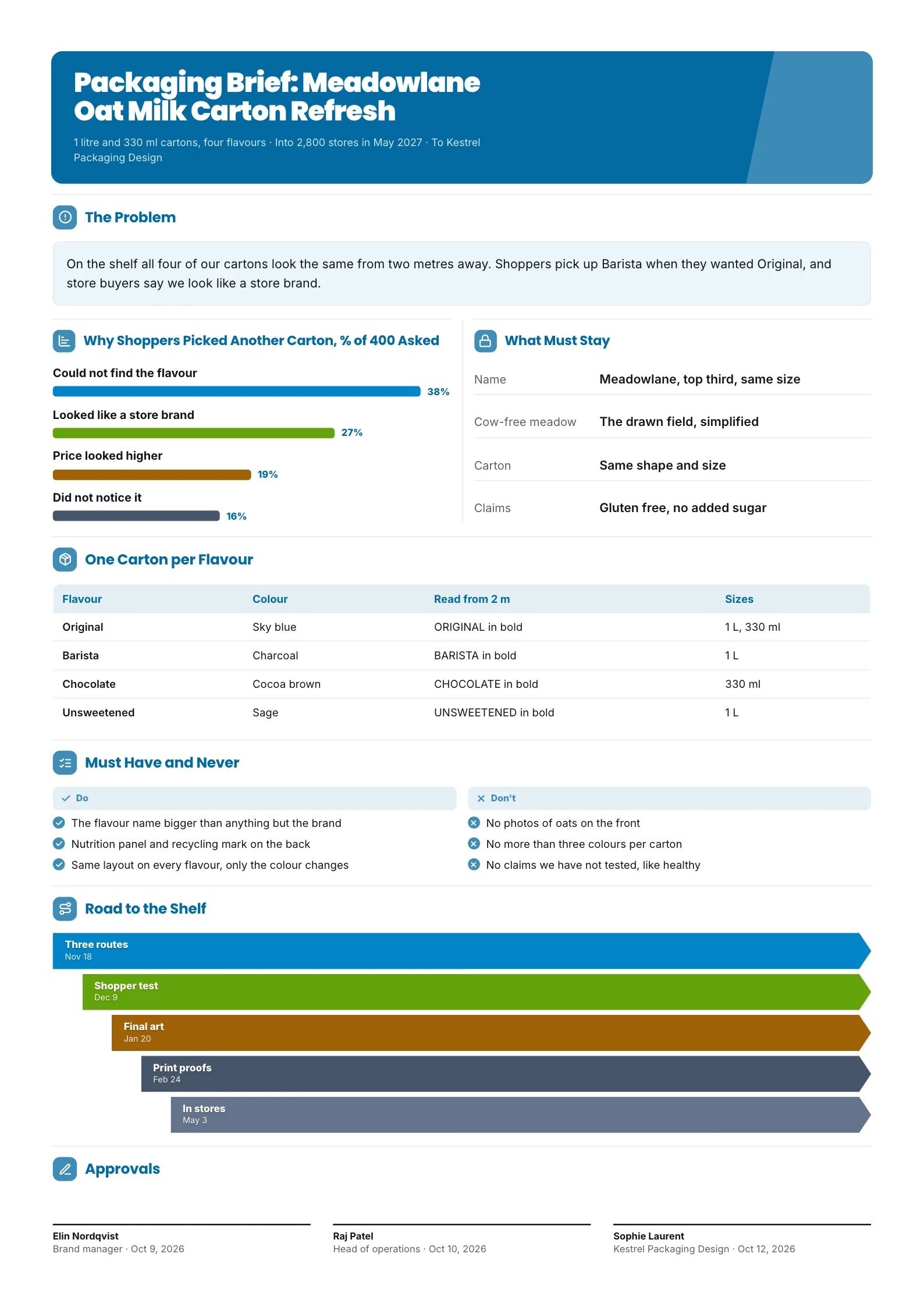
Sample names and figures. The road to shelf gives a date for each step from November 18 to May 3, and the survey numbers are the proof.
Say how you'll measure success
Three of the 6 briefs ask how you'll measure success. Destination DC set a target of 2% to 3% growth a month in web traffic and social engagement. Kaiser and UF Health both have a box for it.
Your measure tells the creative team what to aim for. An ad built for clicks looks different from one built to be remembered. Pick one number, and say when you'll check it.
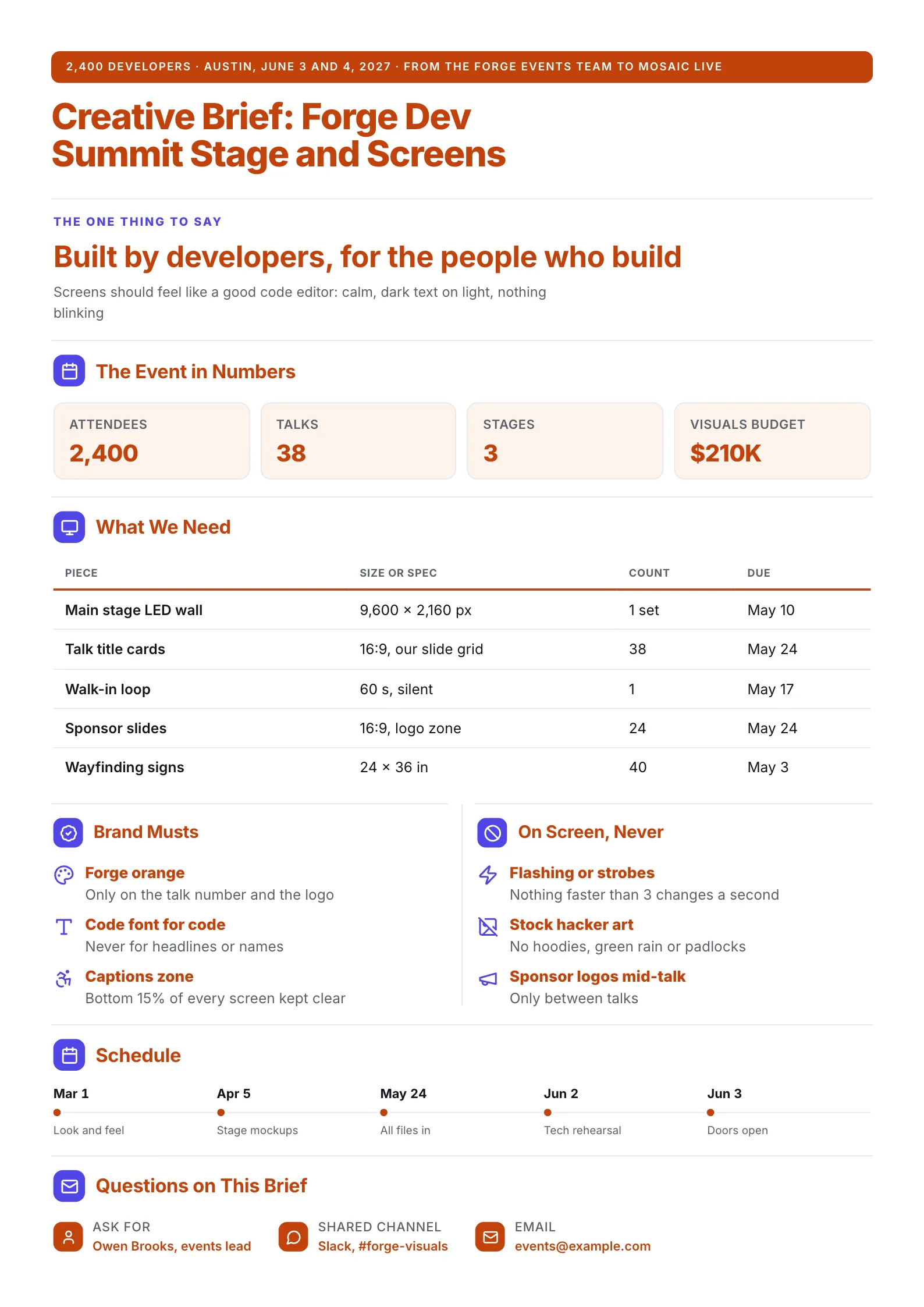 Edit this template
Sample names and figures. Every piece of work in the list carries its own due date, and the visuals budget is printed at the top.
A creative brief checklist from the 6 briefs
Before you send your brief, check that it has:
- One audience, described as a person
- An objective with a verb the audience does
- One promise, written from the audience's side
- Proof: one or two facts that back the promise
- Barriers the work must get past
- Must-haves such as logos, languages, legal lines
- Every piece, with its size and where it runs
- Tone in a few adjectives, plus the call to action
- A success measure with a number
- The budget
- A deadline, with a date for each piece
Our creative brief designs fit these parts on one page, and the samples above show where a budget and a date for each piece can go. Our creative brief template post shows five more filled-in examples. If the brief is for a whole project rather than a piece of creative work, our project brief template post covers that version.
The 6 creative briefs we read
| Organization | Brief | Year |
|---|---|---|
| CDC (CDCynergy) | Flu shots for people with diabetes | 1997 |
| Destination DC | Recovery campaign brief, in a creative RFP | 2021 |
| FHI 360 | Brief form with a vaccine example | 2021 |
| Kaiser Permanente Georgia | Creative Brief v2 form | 2024 |
| UF Health Creative Services | Creative brief form | 2013 |
| C-Change, hosted by The Compass for SBC | C-Bulletin 3, Developing a Creative Brief | 2012 |
We read each brief in full on October 30, 2026.
One promise, then the rest of the brief
Take a blank page and write only your one promise, in your audience's words. If it holds two benefits, you have two campaigns. Once it fits in one, everything else in the brief follows quickly. Then open a MakeOnepagers creative brief design and replace its sample text with your own.
Frequently asked questions
What are the key parts of a creative brief?
The audience, the objective and the must-haves appear in all 6 briefs we read. Five also ask for one promise and the proof behind it. Add the budget and a deadline too, since the creative team needs both to plan.
How long should a creative brief be?
One or two pages for most jobs. The C-Bulletin guide says briefs usually run 2 to 3 pages, but a single ad or post fits on one. If yours runs longer, check whether it holds more than one audience or more than one promise.
Who writes the creative brief?
You write it if you own the goal, as a marketing manager, a client or a program lead usually does. The designers and writers read it and ask questions. Agree on it before any work starts, so feedback later can point back to it.
What is a key promise in a creative brief?
It's the single benefit your audience gets if they act, written in their words. The CDC, FHI 360 and the C-Bulletin all use the term. Everything in the finished ad should support that one sentence.




