Content Calendar Examples, Plus How Often NPR and NASA Really Post
Content calendar examples for a realtor, a skincare brand, a software blog, a food bank and a podcast, set beside how often NPR, NASA and 4 others post.

NPR's Bluesky account posted about 26 times a day in the last week of October 2026: 100 posts between the morning of October 26 and the morning of October 30, a span of 3.9 days. NASA's Houston We Have a Podcast went out once a week, on 12 of the 13 Fridays from July 31 to October 23. Both are content calendar examples doing their job, and the gap between them is the first choice you'll make. How often will you post, send or publish, and can your team keep that up in a busy month? Start from a free one pager template.
One‑Pager examples
Real One-Pagers made with MakeOnepagers. Open any one to edit it as your own.
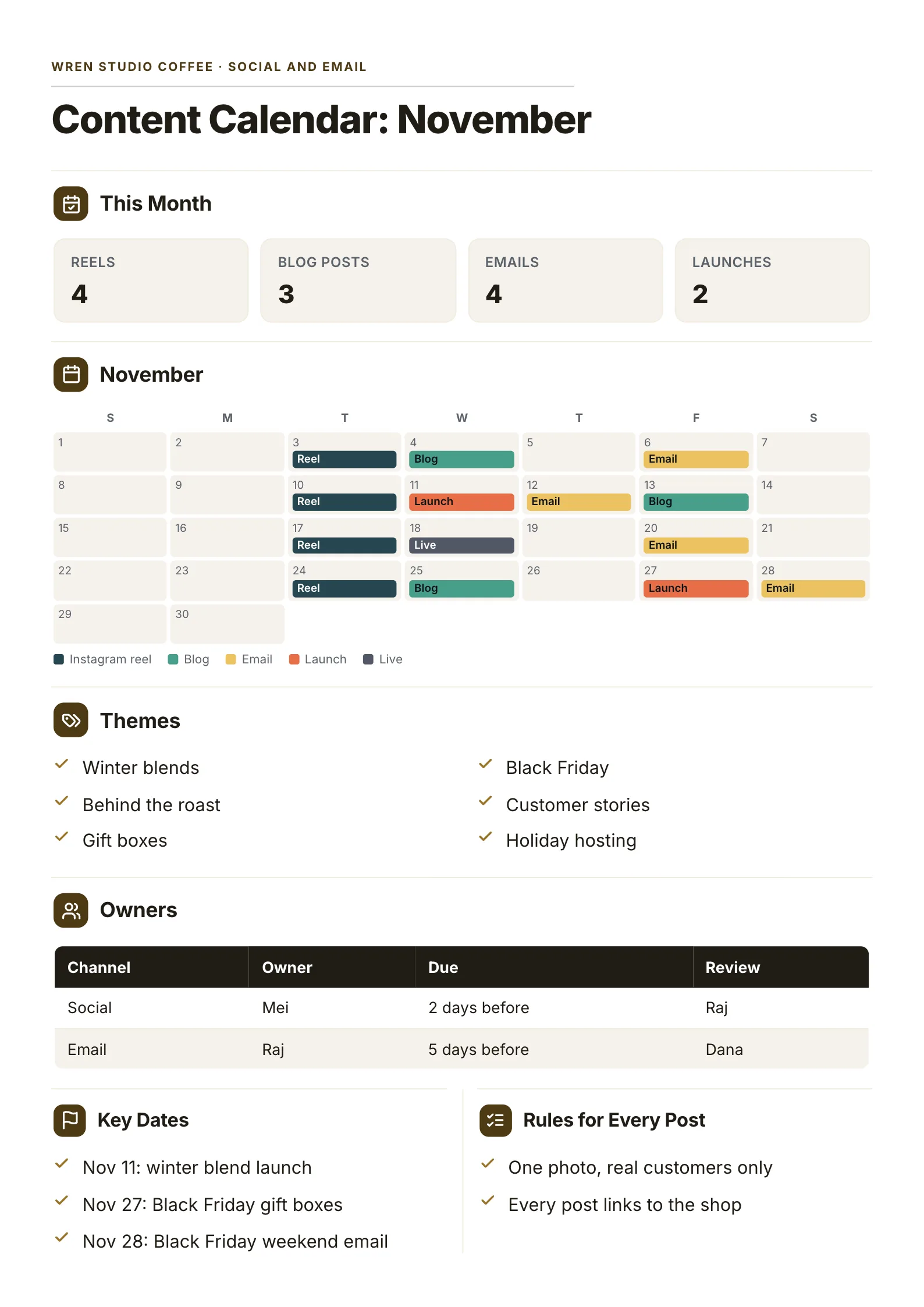 Content CalendarEdit for free(opens in a new tab)
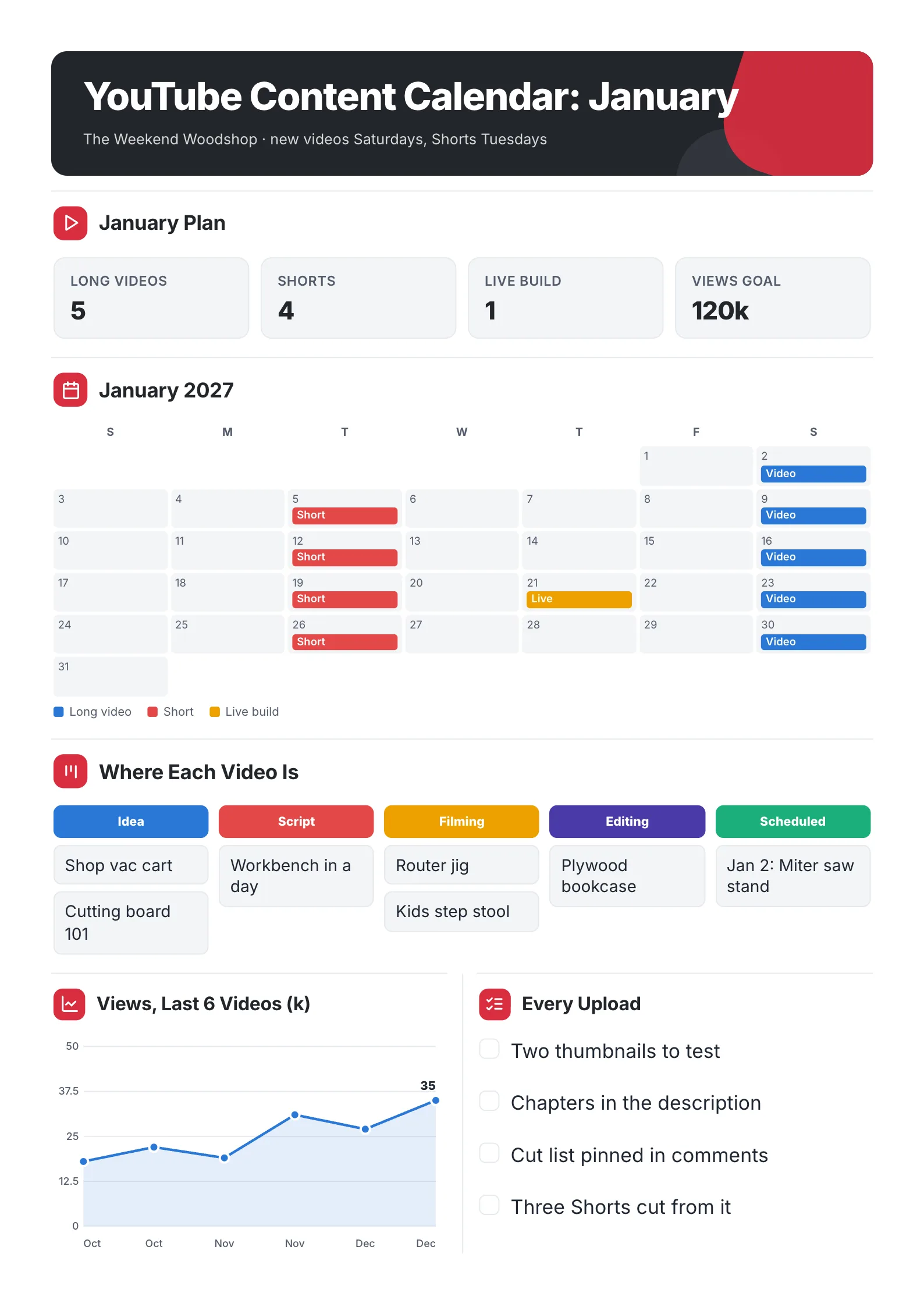 YouTube Content CalendarEdit for free(opens in a new tab)
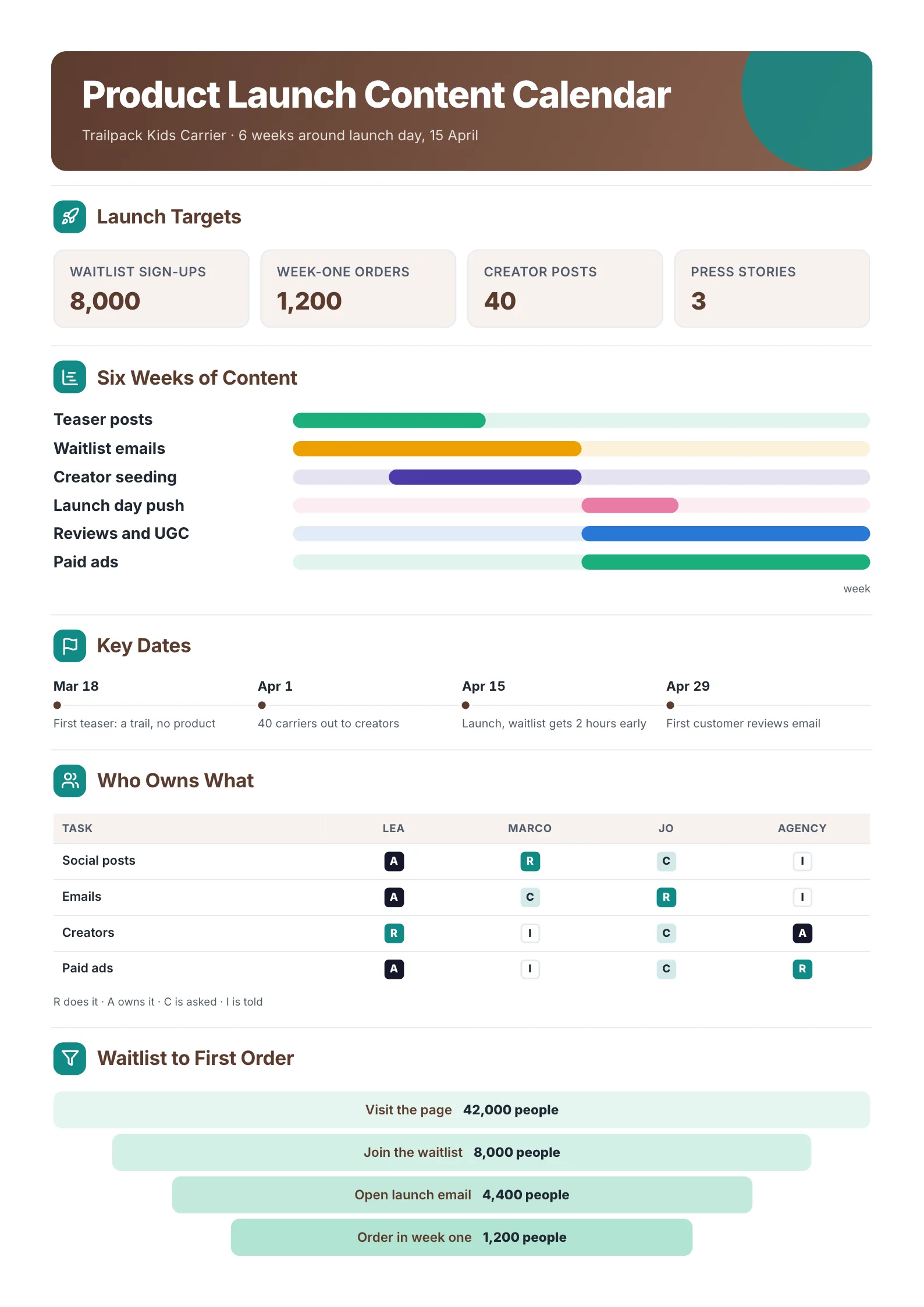 Product Launch Content CalendarEdit for free(opens in a new tab)
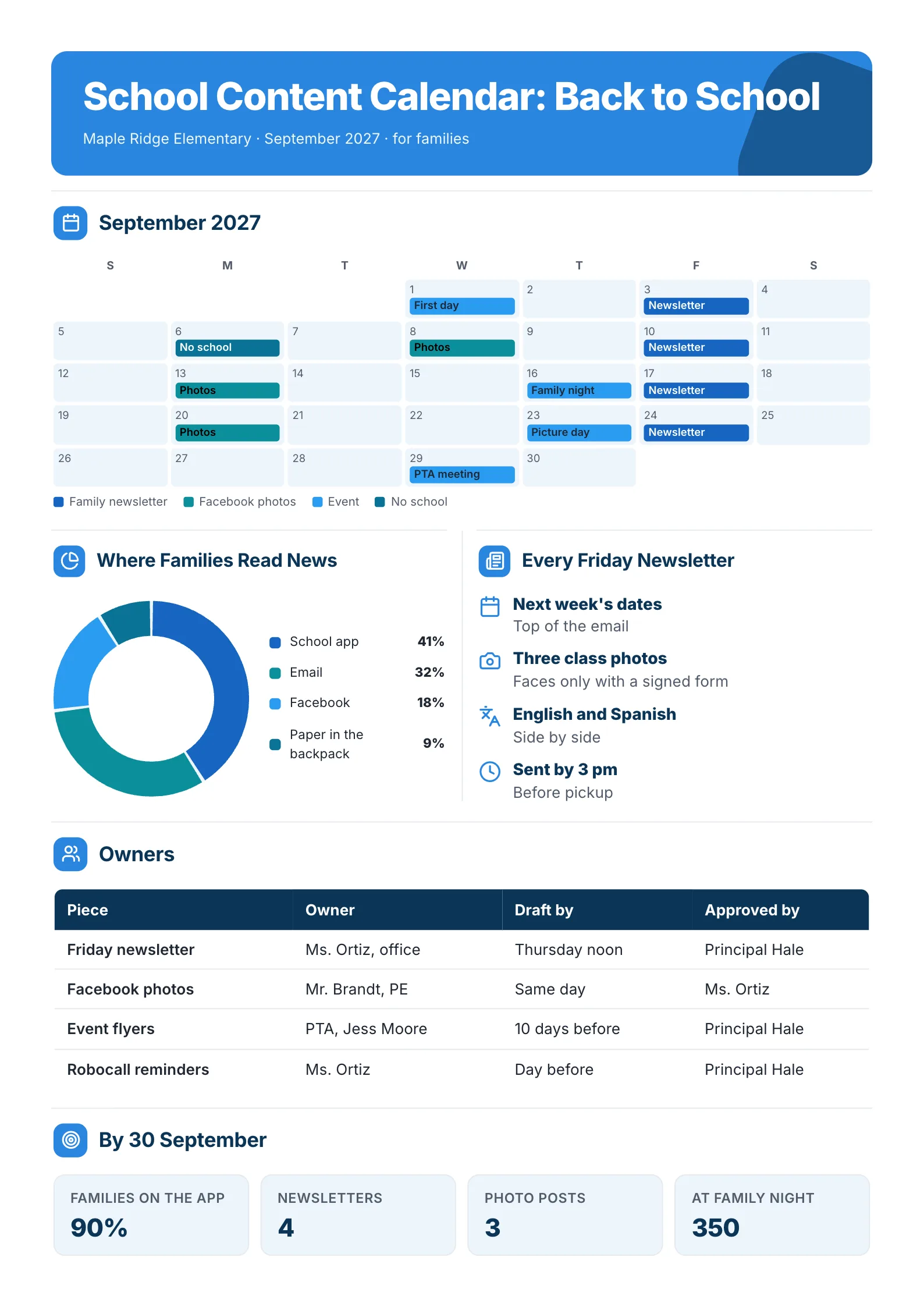 School Content CalendarEdit for free(opens in a new tab)
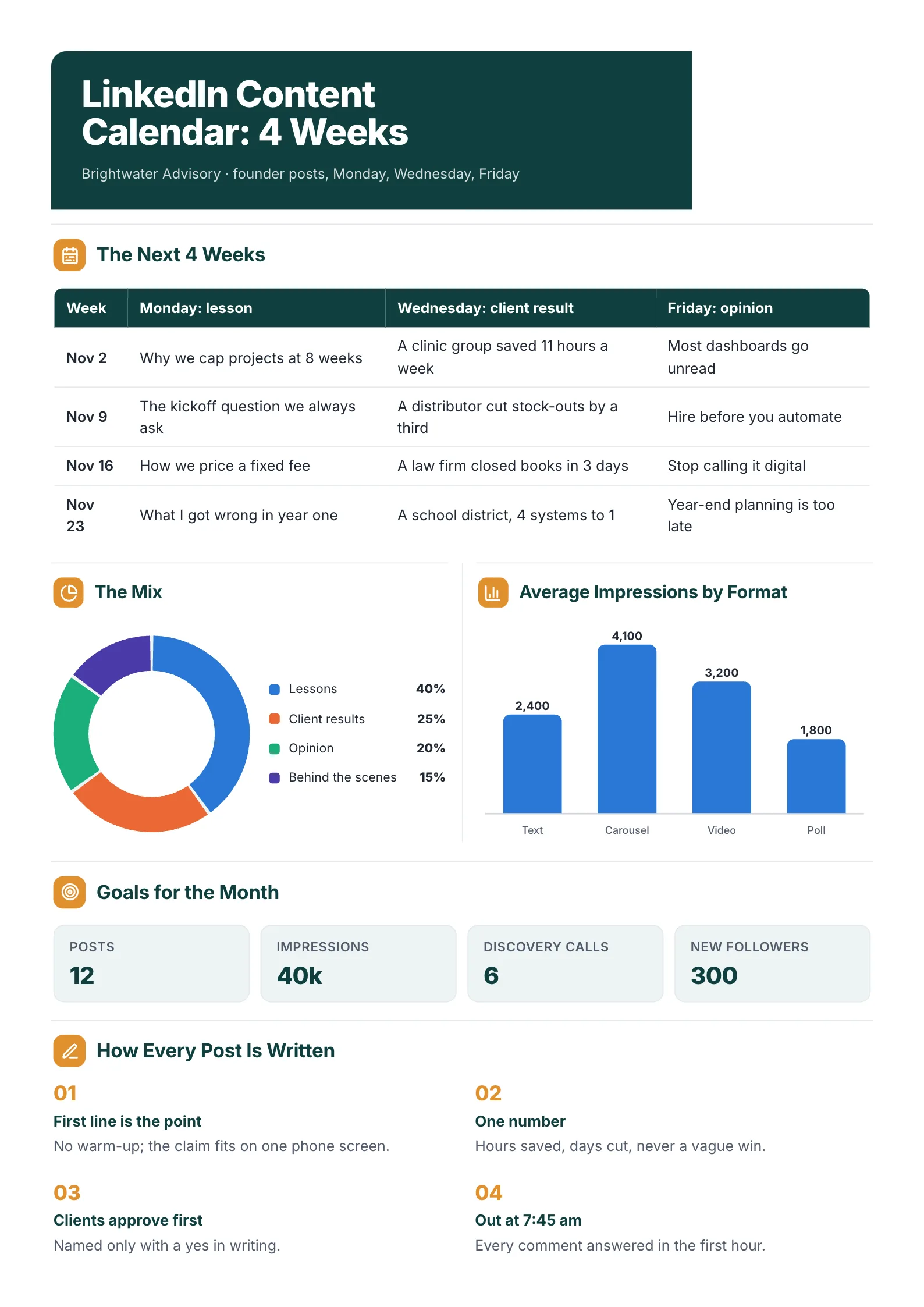 LinkedIn Content CalendarEdit for free(opens in a new tab)
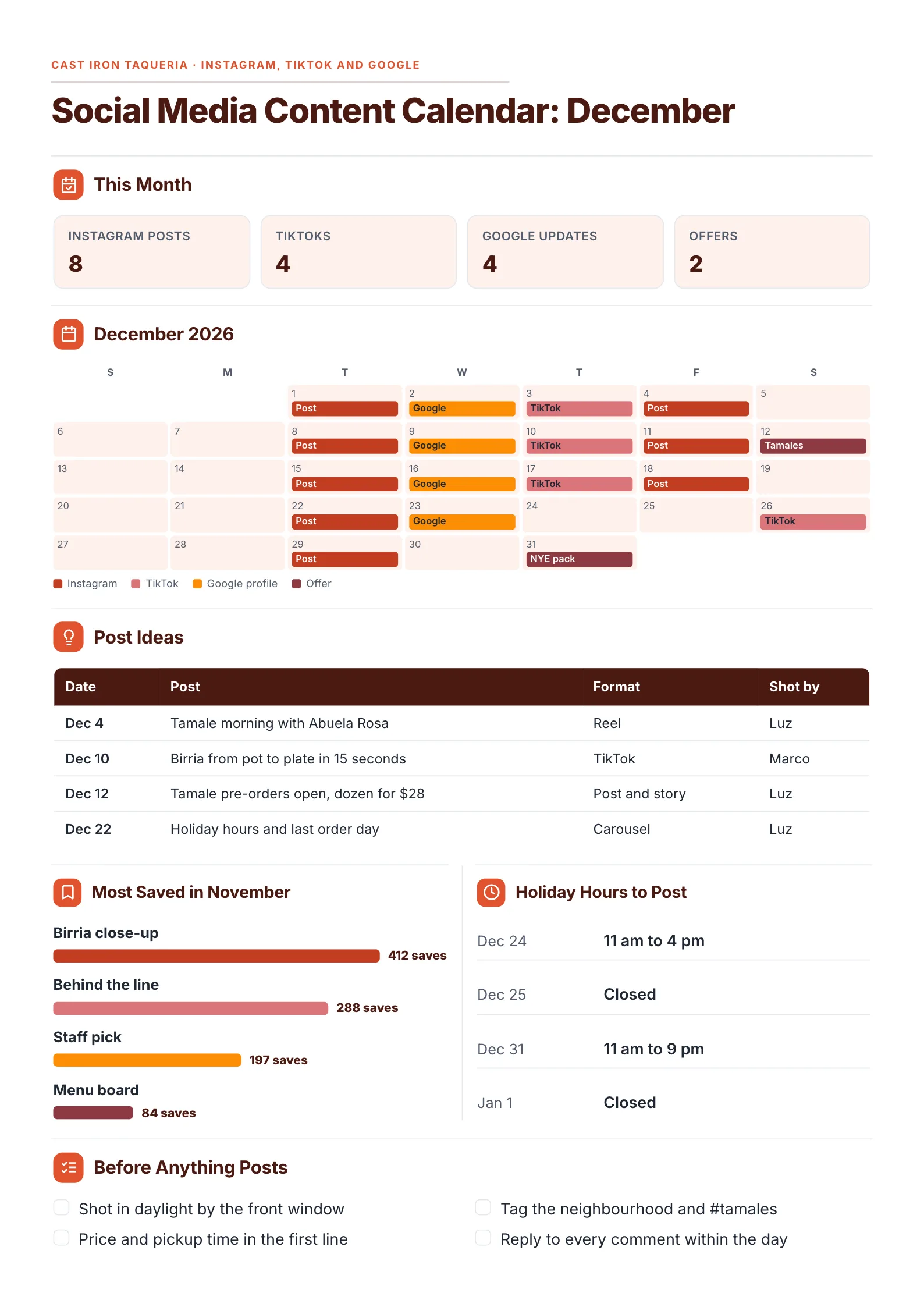 Restaurant Social Media Content CalendarEdit for free(opens in a new tab)
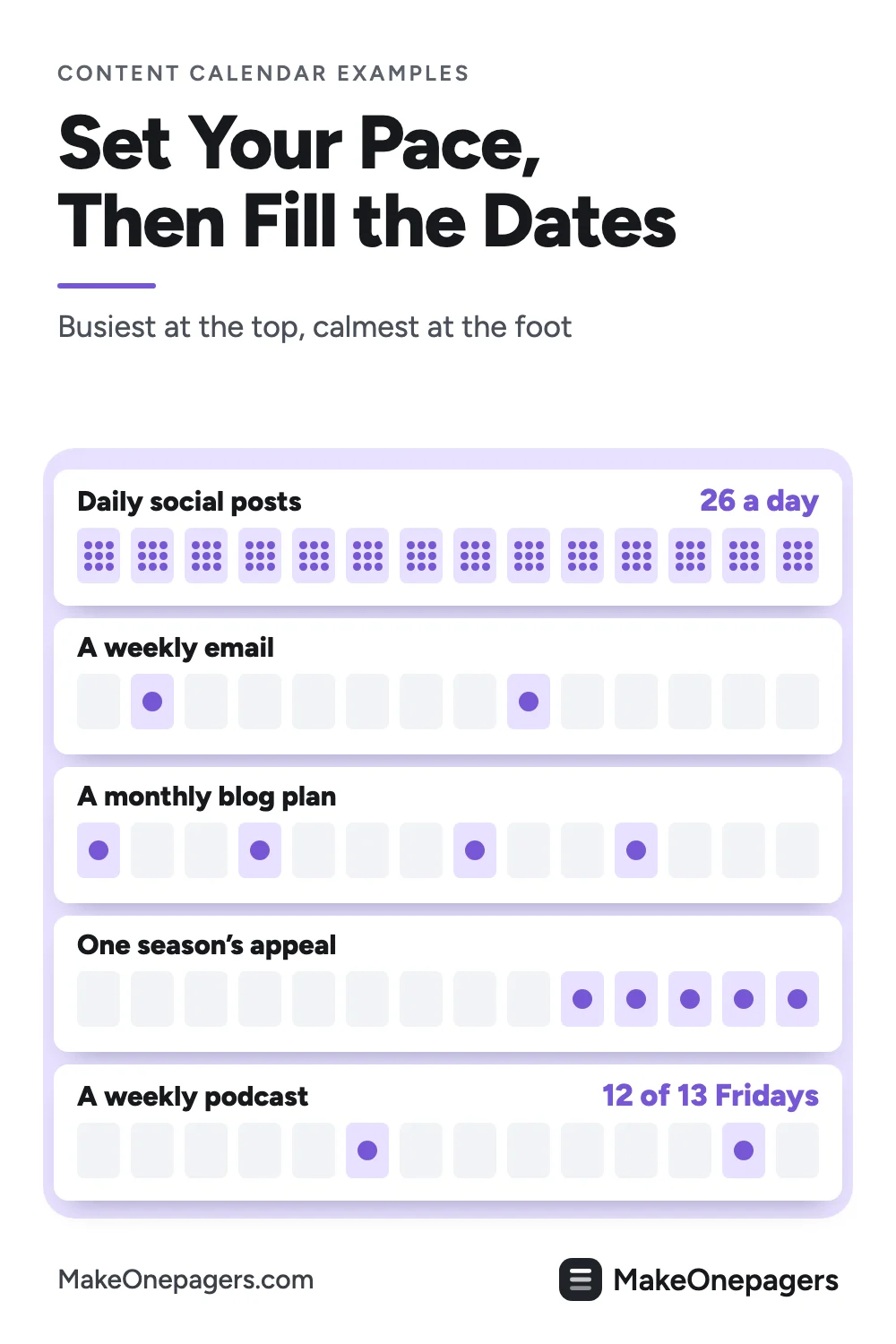
Each content calendar example here is built around one pace, so you can start from the one that matches yours. A realtor posts every day, a skincare brand emails each week and a software blog publishes 8 posts a month. A food bank plans one season, and a podcast ships every Thursday. Each page shows you the pace first, then who does what and by when.
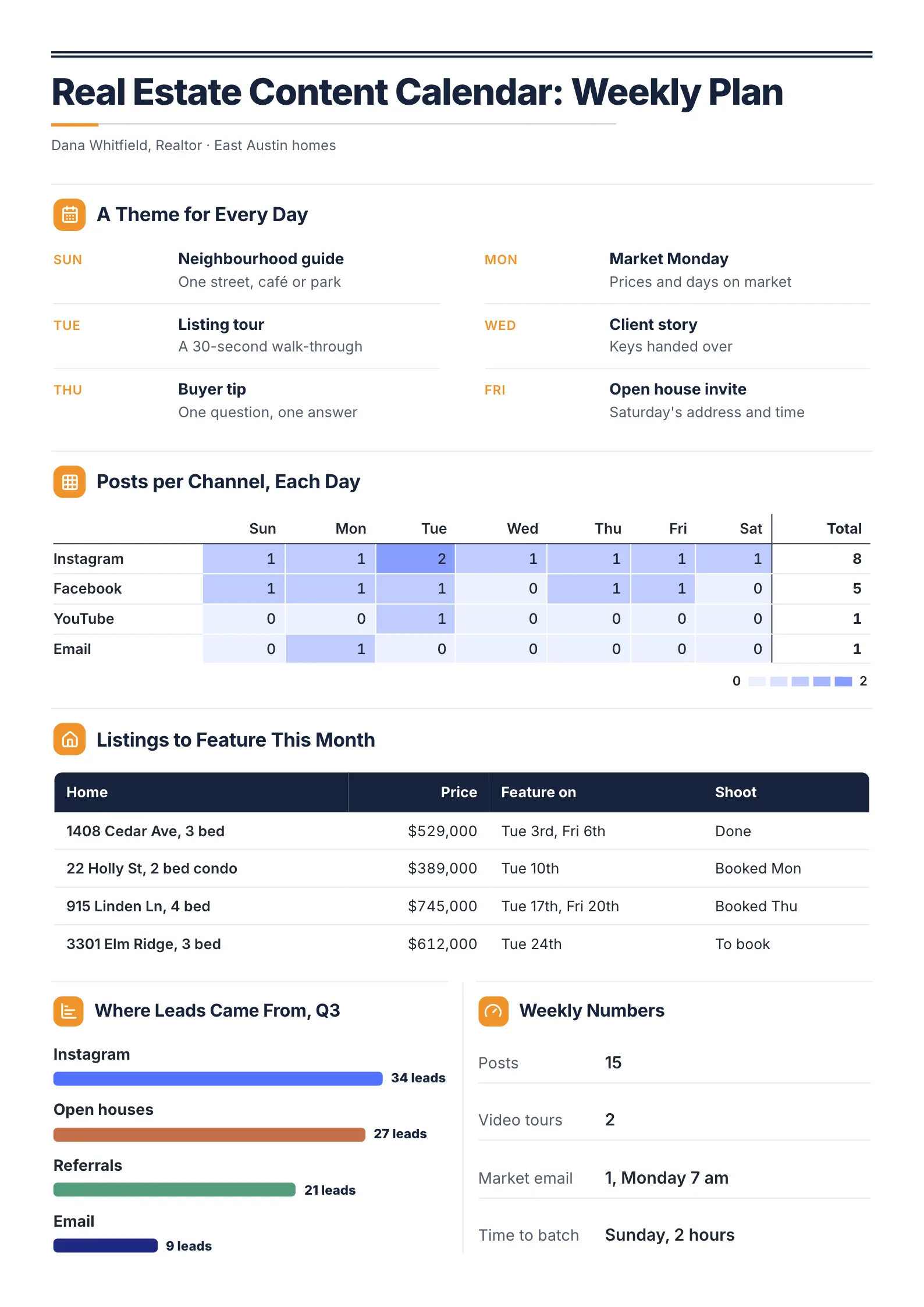
Daily social posts: a realtor's week, six themed days
Dana Whitfield, a Realtor in East Austin, plans 15 posts a week across four channels, and her calendar makes that doable by giving six days of the week one theme each. Monday is market numbers, Tuesday is a 30-second listing tour, Wednesday is a client story, Thursday is a buyer tip and Friday is the open house invite. When you sit down to post, you never have to decide what kind of post it is.
A heat map shows how many posts go on each channel each day, with Instagram getting at least one every day of the week. The leads chart tells you why. Instagram brought in 34 leads in the third quarter, more than open houses (27) or referrals (21). The weekly numbers at the bottom add the habit that keeps it going, two hours every Friday to batch the week ahead.
 Edit this template
Sample agent, listings and lead counts. The daily themes do the planning, so your week only needs filling in.
A weekly email: a skincare brand's holiday sends
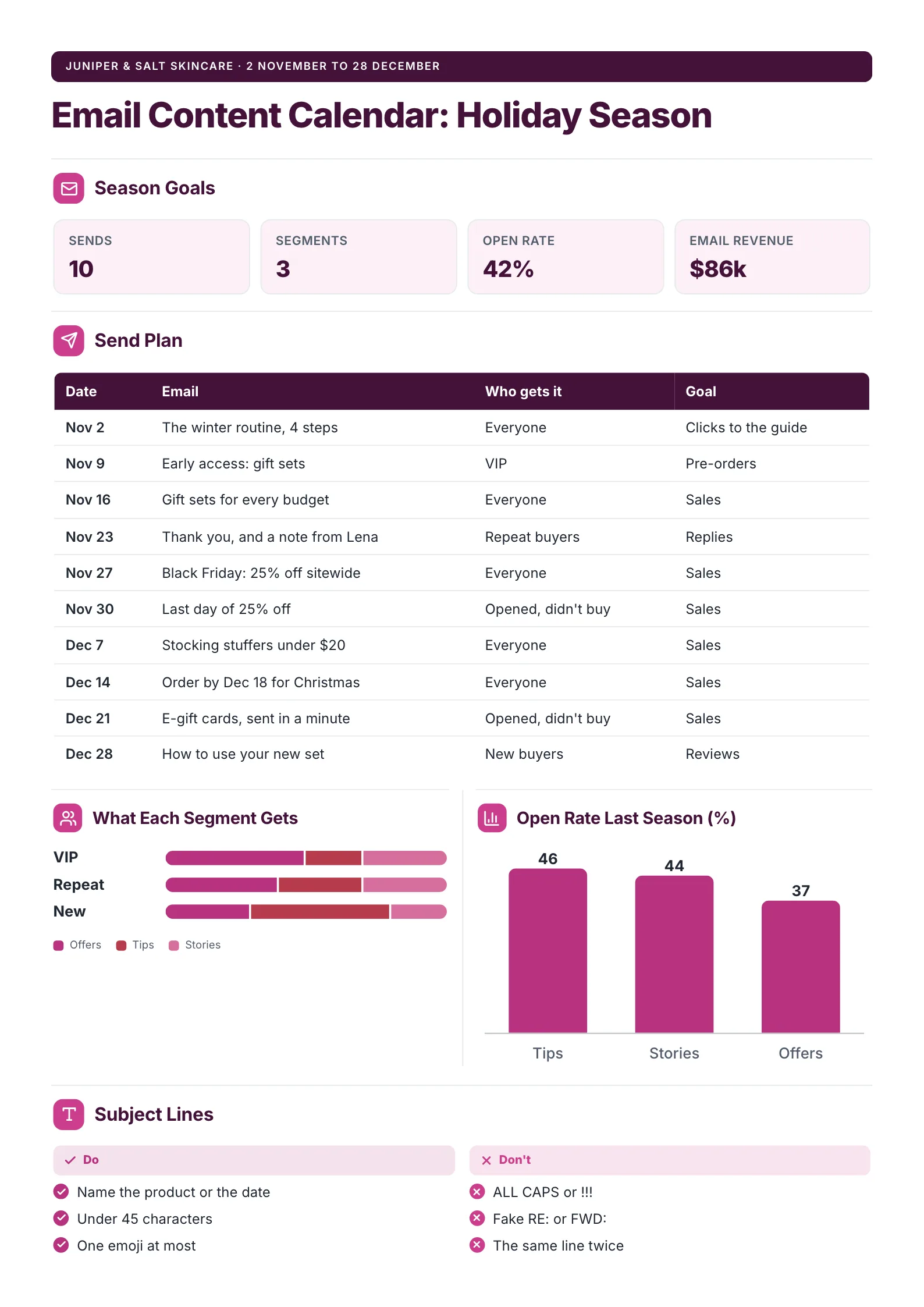
Juniper & Salt plans 10 emails between November 2 and December 28, about one a week with two extra around Black Friday. Each row of the send plan names the date, the email, who gets it and its goal. The first email is a winter routine guide, and the last one shows new buyers how to use their set.
The segments do the clever work. VIP customers get early access on November 9, and people who opened but didn't buy get the "last day" email on November 30. Last season's open rates sit beside the plan. Tips emails opened at 46% and offers at 37%, so your calendar should mix in more than sales. The do and don't list for subject lines keeps every one under 45 characters, with one emoji at most.
 Edit this template
A made-up brand with sample results. The open rate chart is your reason to send tips, and it sits right beside the plan.
A monthly blog plan: a software blog's quarter, 8 posts a month
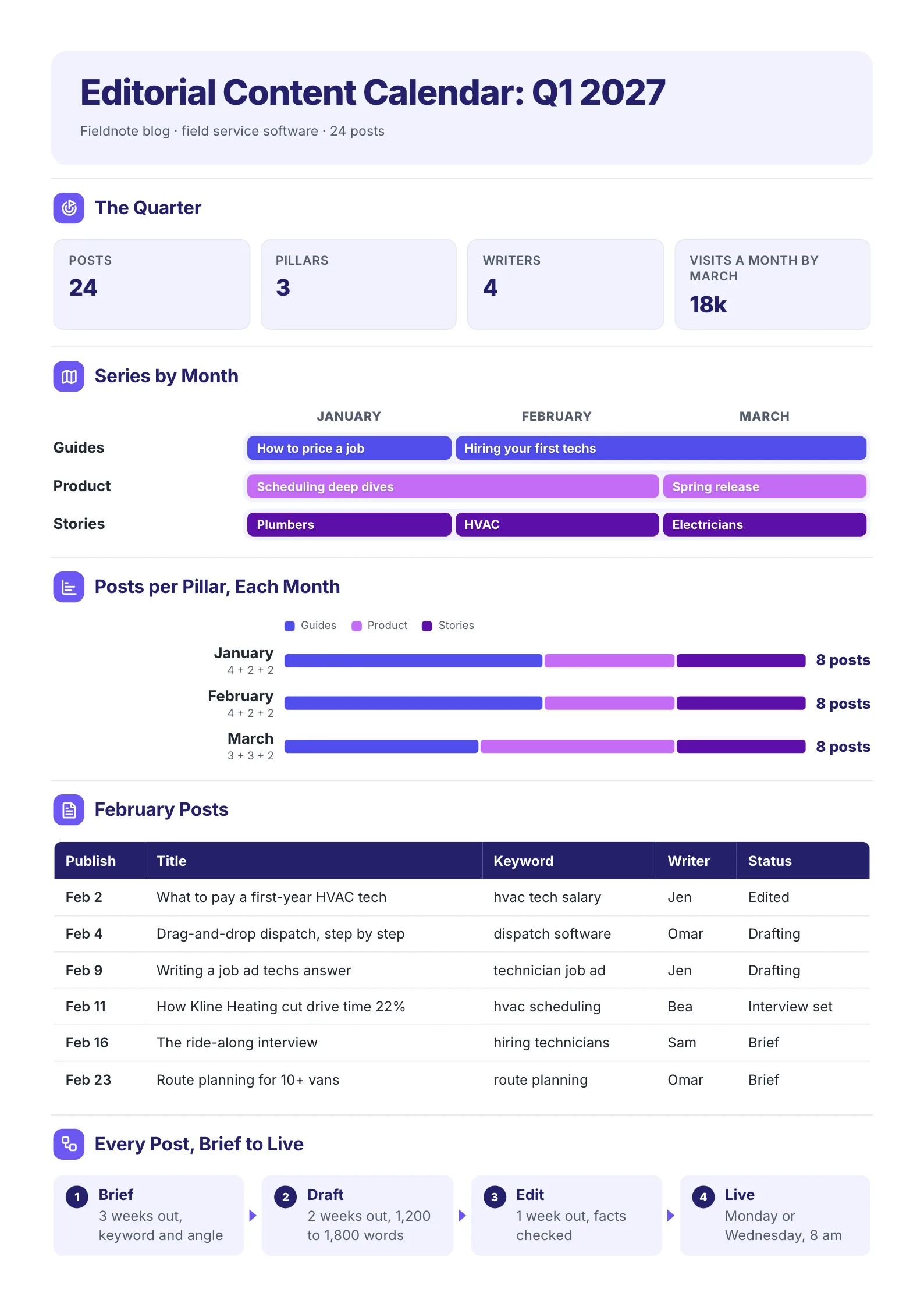
The Fieldnote blog plans 24 posts for the first quarter of 2027, about 8 a month across three pillars, guides, product news and customer stories. A stacked bar shows the split each month, so you can see at a glance that guides lead with 4 posts in January and February.
The February table holds six posts with a publish date, a title, the keyword it targets, the writer and its status, from "Edited" to "Brief." Underneath, a four-step flow sets the deadlines your writers work to for every post. The brief is due 3 weeks out, the draft 2 weeks out at 1,200 to 1,800 words, and the edit 1 week out. A blog that keeps slipping usually has no date for the brief or the draft, and this flow gives it both.
 Edit this template
Sample blog, writers and keywords. Each February post carries its own keyword, so your writer knows what it must rank for.
One season: a food bank's year-end appeal
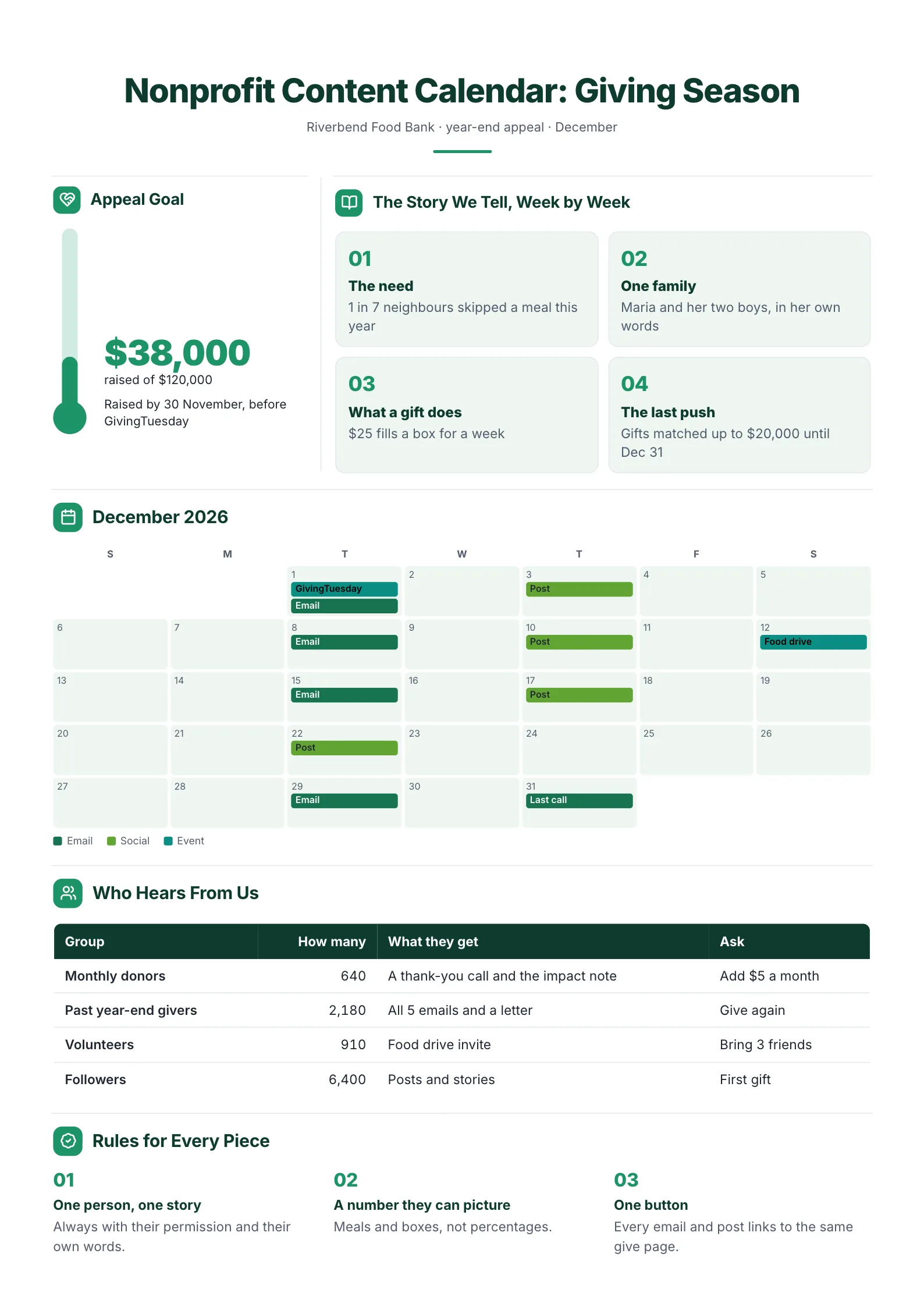
Riverbend Food Bank's December calendar is built around one goal, $120,000 by December 31, with $38,000 raised before GivingTuesday. The month holds 5 emails, 4 social posts and a food drive on December 12, all on one grid.
Your season plan works when its story moves week by week. The first week shares the need, that 1 in 7 neighbors skipped a meal this year. The second tells one family's story, then the third shows that $25 fills a box for a week. The last push names a match of up to $20,000 until December 31. A table splits the list into four groups, from 640 monthly donors to 6,400 followers, each with its own ask.
 Edit this template
Sample food bank, donors and figures. Your story plan sits above the grid, so each email knows which part of the story it tells.
An episode schedule: a podcast season, one episode every Thursday
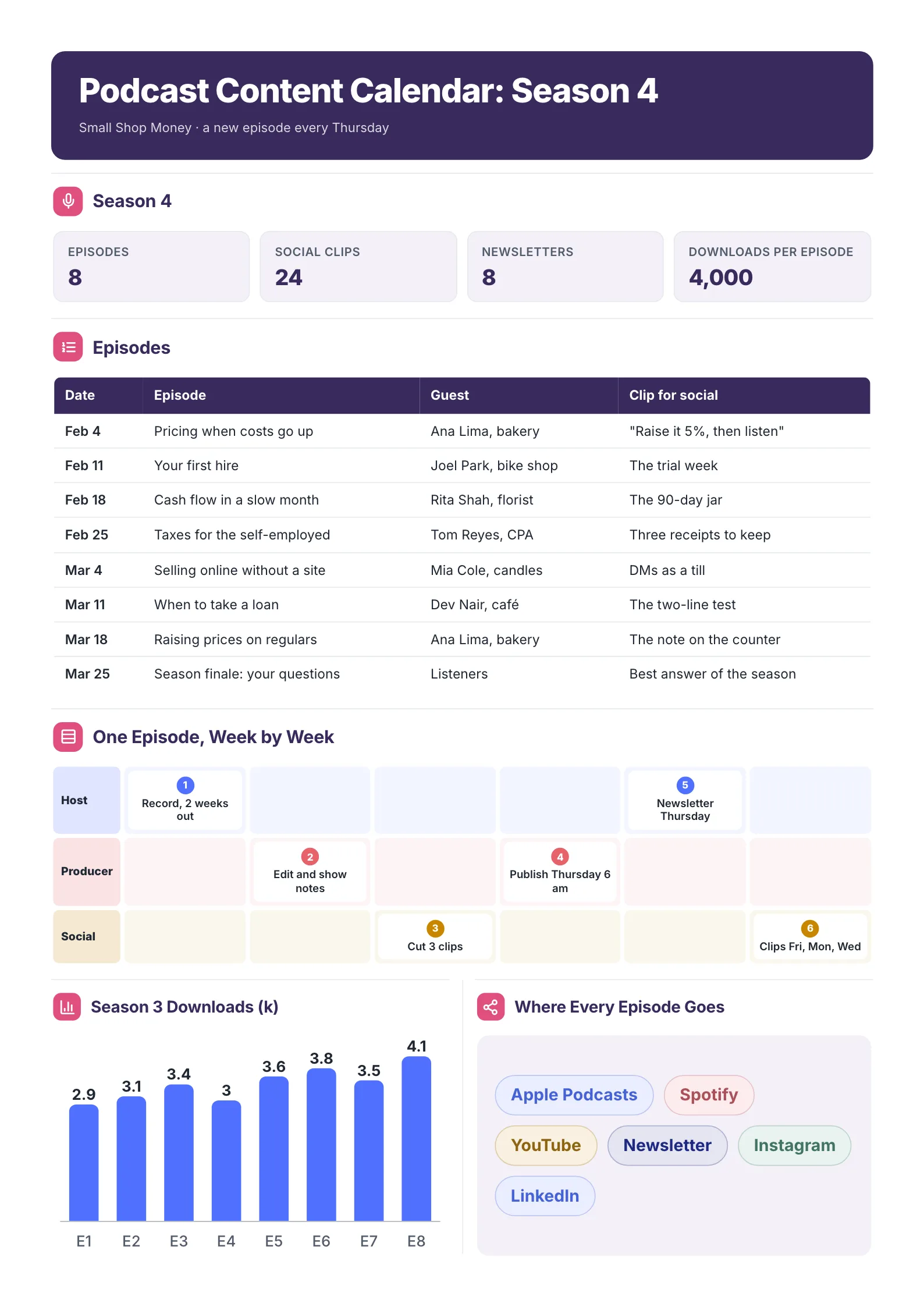
Small Shop Money's Season 4 runs 8 episodes, one every Thursday from February 4 to March 25. Each episode feeds 3 social clips and a newsletter, so the season produces 24 clips from 8 recordings. The episode table names the guest and the clip line for each date.
Swim lanes show you who does what for one episode. The host records 2 weeks out, the producer edits and writes show notes, and the social lead cuts the clips that go out Friday, Monday and Wednesday. Last season's downloads climbed from 2.9k to 4.1k by episode 8, which is why the goal is 4,000 per episode. That layout keeps each recording two weeks ahead of its release day.
 Edit this template
Sample show, guests and download numbers. The swim lanes turn one release day into a week of work with three owners.
How often public organizations post
To show you what these paces look like in practice, we read the latest items from nine public feeds on October 30, 2026 and divided the count by the days between the oldest and newest item. On Bluesky we counted only each account's own posts, leaving out reposts and replies.
| Organization | Channel | What we counted | Pace |
|---|---|---|---|
| NPR | Bluesky | 100 posts, October 26 to 30 | About 26 a day |
| Nature | Bluesky | 99 posts, October 20 to 29 | About 11 a day |
| ACLU | Bluesky | 96 posts, October 15 to 30 | About 7 a day |
| Science (AAAS) | Bluesky | 65 posts, October 19 to 29 | About 6 a day |
| NASA | YouTube | 15 uploads, October 4 to 29 | About 4 a week |
| NASA Space Station blog | Blog | 10 posts, October 20 to 29 | About 8 a week |
| Library of Congress, Inside Adams | Blog | 20 posts, May 26 to October 29 | About 1 a week |
| Library of Congress, Headlines and Heroes | Blog | 20 posts, April 15 to October 27 | About 3 a month |
| NASA, Houston We Have a Podcast | Podcast | 12 episodes, July 31 to October 23 | Every Friday, 12 of 13 weeks |
The newsrooms post far more than you need to. NPR and Nature publish news all day, so a daily calendar for them is really a queue. Your organization probably isn't a newsroom, and the realtor's 15 posts a week is a far more realistic daily plan.
The pace drops fast once a piece takes real work, and yours will too. Both Library of Congress blogs, Inside Adams and Headlines and Heroes, publish roughly once a week or less, and the second posted mostly on Tuesdays and Wednesdays. NASA's space station blog runs at about 8 a week because it posts a crew update every weekday, and on spacewalk day, October 29, it posted three times. Your calendar can plan for busy days like that around your own launches and seasons.
The steadiest feed is the podcast, the format closest to your own episode schedule. NASA put out an episode every Friday from July 31 to October 23 except September 4. Pick one day and protect it, the way the Small Shop Money calendar does with Thursdays.
The nine feeds we counted on October 30, 2026:
- NPR on Bluesky, Nature on Bluesky, ACLU on Bluesky and Science on Bluesky, read through Bluesky's public feed
- NASA's YouTube channel, its 15 latest uploads
- NASA's Space Station blog
- Inside Adams and Headlines and Heroes, Library of Congress
- Houston We Have a Podcast, NASA
One calendar row, filled in
Here's one row from the podcast calendar, the February 11 episode, with every column you and your team need filled in. The dates for recording and clips come from the swim lanes on the same page.
| Column | What goes in it | For February 11 |
|---|---|---|
| Publish date | The day and time it goes live | Thursday, February 11, 6 am |
| Title | What the listener sees | Your first hire |
| Guest | Who you're recording | Joel Park, bike shop |
| Record by | Two weeks before the publish date | Thursday, January 28 |
| Clip | The one line you'll cut for social | The trial week |
| Clip dates | When the clips go out | Friday, February 12, Monday, February 15 and Wednesday, February 17 |
| Channels | Where the episode goes | Apple Podcasts, Spotify, YouTube, the newsletter, Instagram and LinkedIn |
| Goal | The number you'll check | 4,000 downloads |
Fill every row this way and your calendar answers any question your team asks without a meeting. If a column is often blank, like the clip line, start next month's plan with that column.
Plan a backup for every slot
Even NASA's podcast missed one Friday in 13. Give each slot on your calendar a backup piece, something finished you can run when your planned one slips, and set your pace at what you really kept up last month. The columns every calendar needs are listed in the content calendar template post, with the build itself in how to write a content calendar.
On the software blog calendar in MakeOnepagers, every February post carries a status from "Brief" to "Edited," and a post marked Edited is the one you move up when another slips.




