Competitive Analysis vs Benchmarking: 15 Peers, 8 Rivals, 1 Name in Common
Competitive analysis vs benchmarking, shown in real filings: e.l.f. Beauty benchmarks against 15 peers and names 8 industry giants. Only 1 is on both lists.

Use a competitive analysis when you need to win customers from the rivals they choose between. Use benchmarking when you want to measure yourself against a group of comparable organizations on the same numbers, so you can see where you fall behind. Your benchmark peers don't have to compete with you at all. Start from a free one pager template.
One‑Pager examples
Real One-Pagers made with MakeOnepagers. Open any one to edit it as your own.
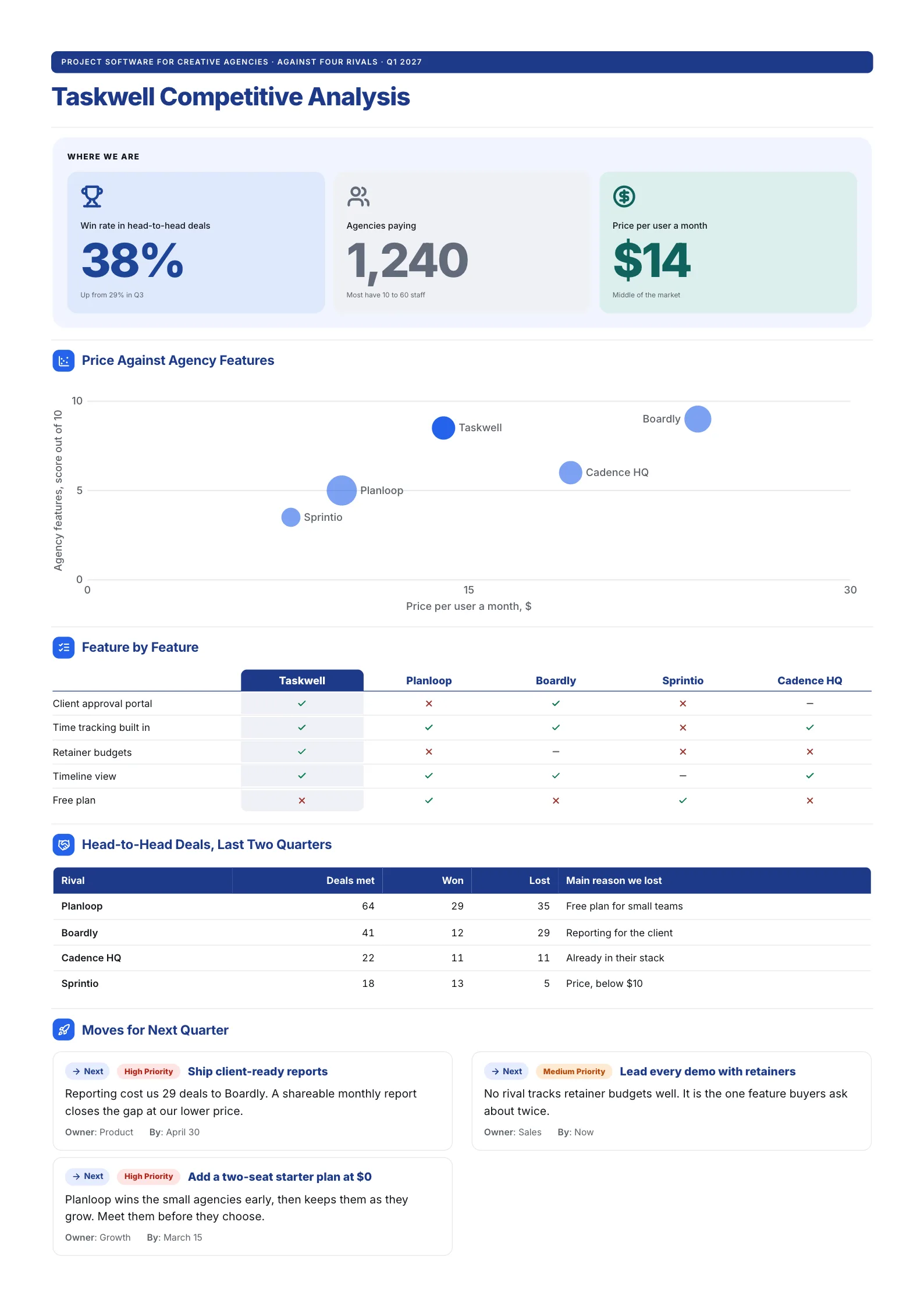 Competitive Analysis: SaaS ProductEdit for free(opens in a new tab)
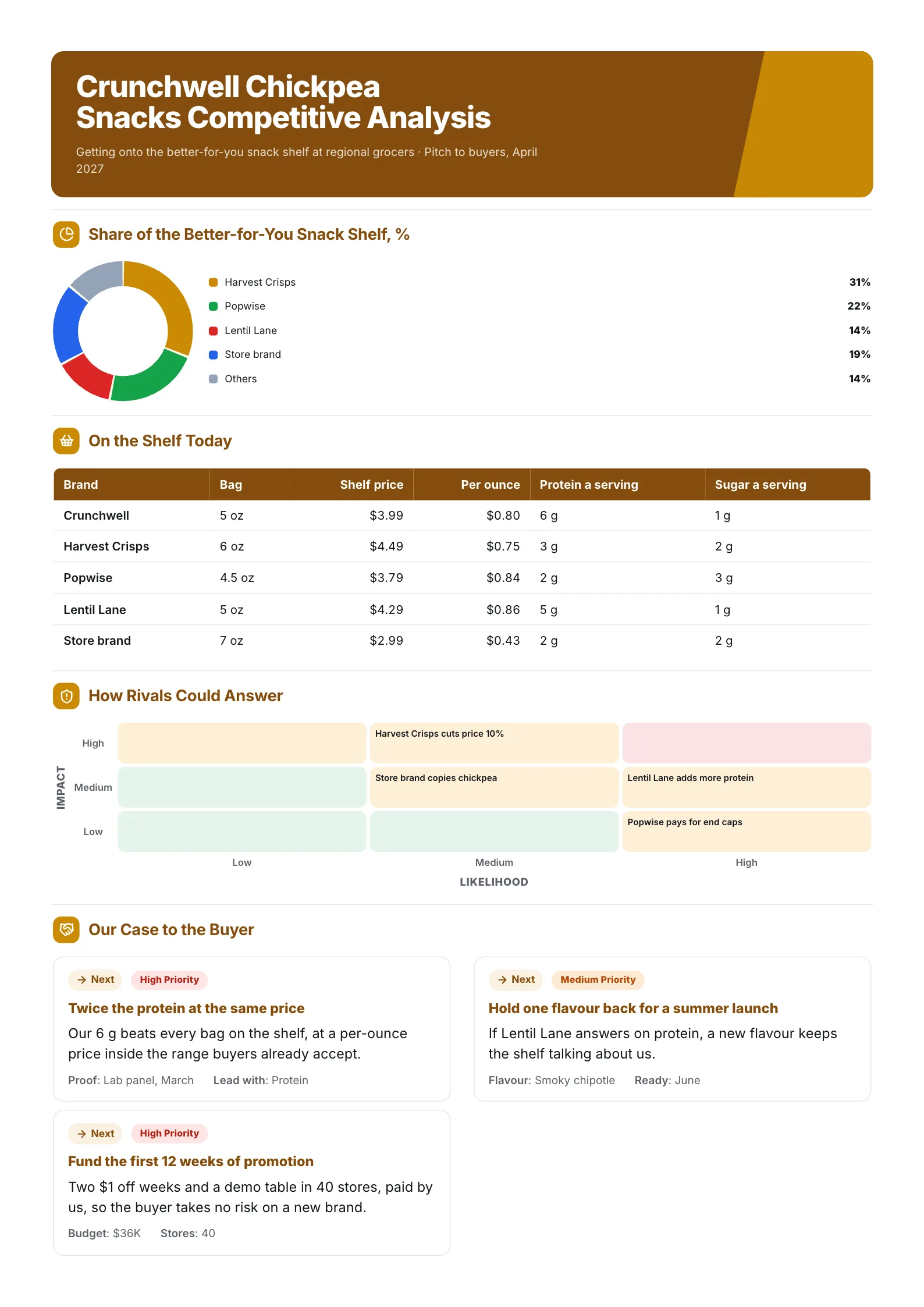 Competitive Analysis: Snack Product LaunchEdit for free(opens in a new tab)
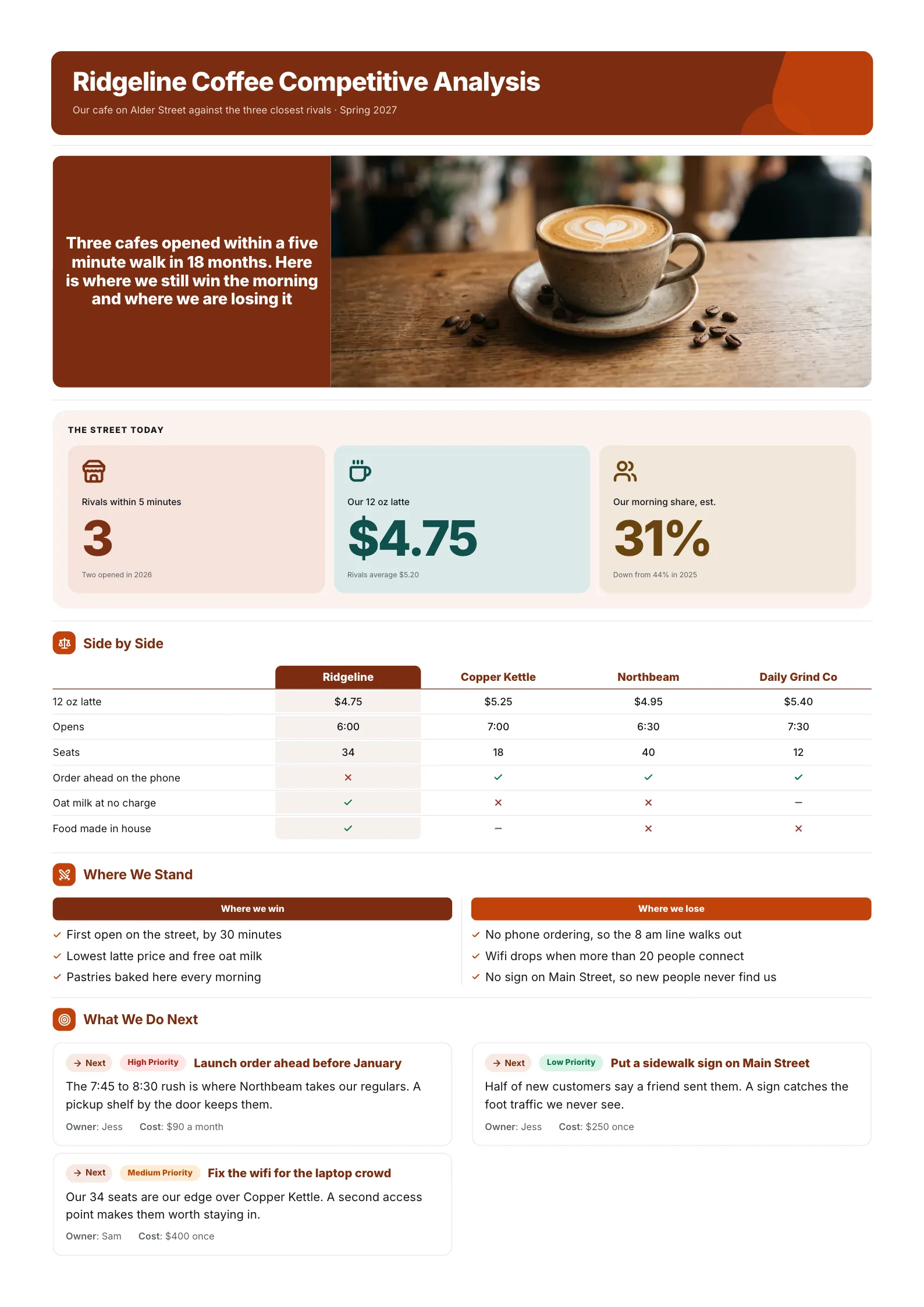 Competitive Analysis: Coffee ShopEdit for free(opens in a new tab)
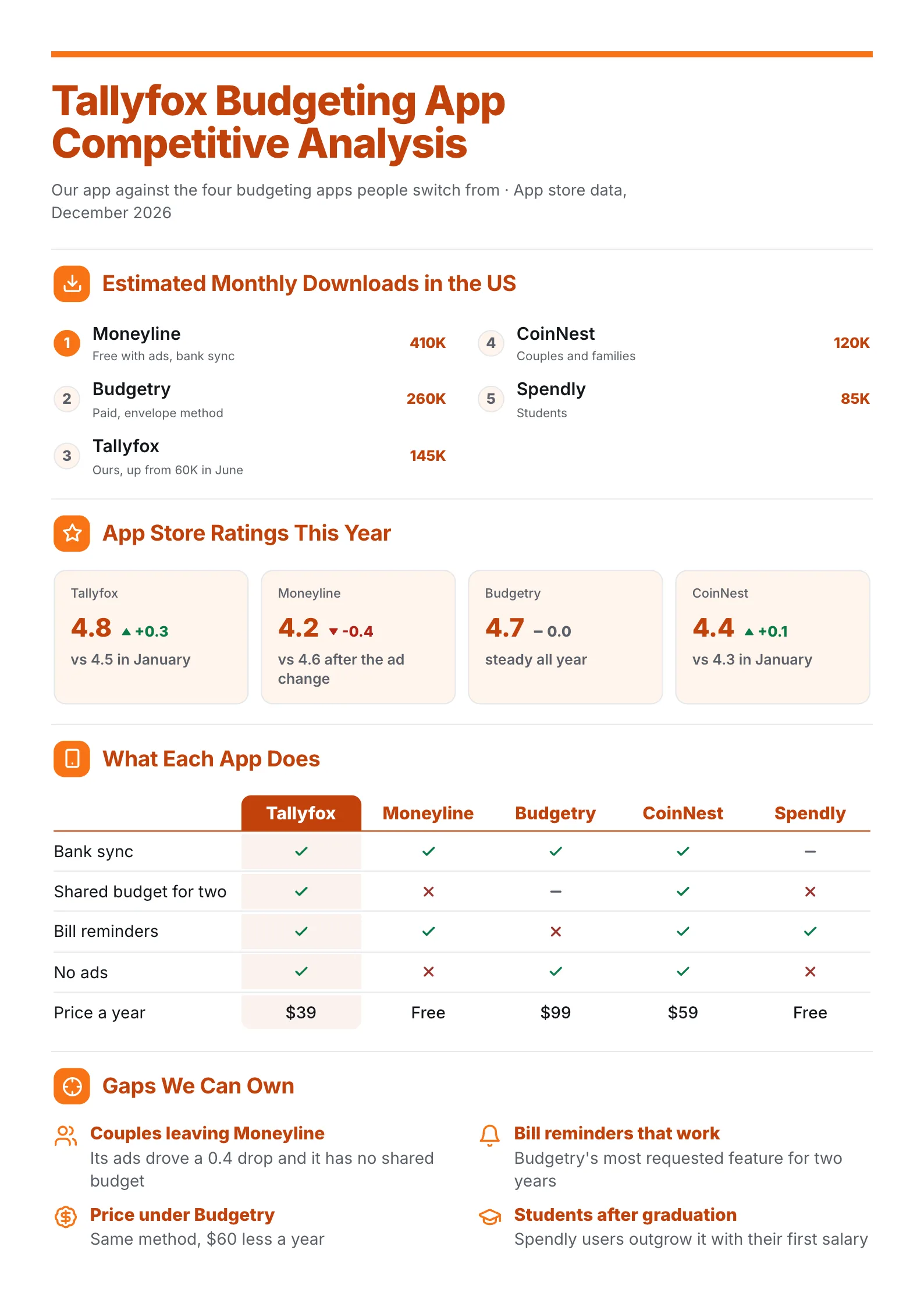 Competitive Analysis: Mobile AppEdit for free(opens in a new tab)
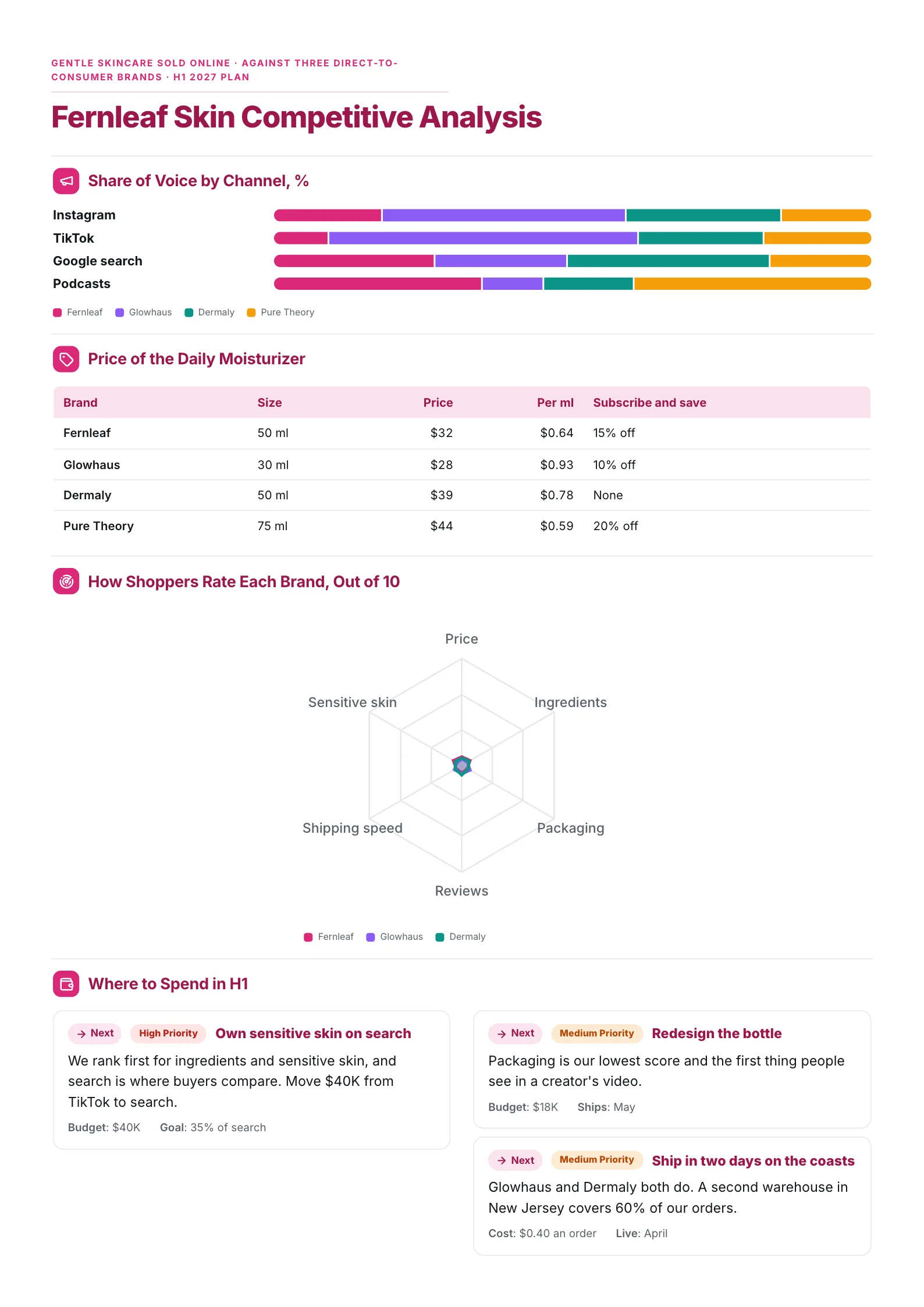 Competitive Analysis: Skincare BrandEdit for free(opens in a new tab)
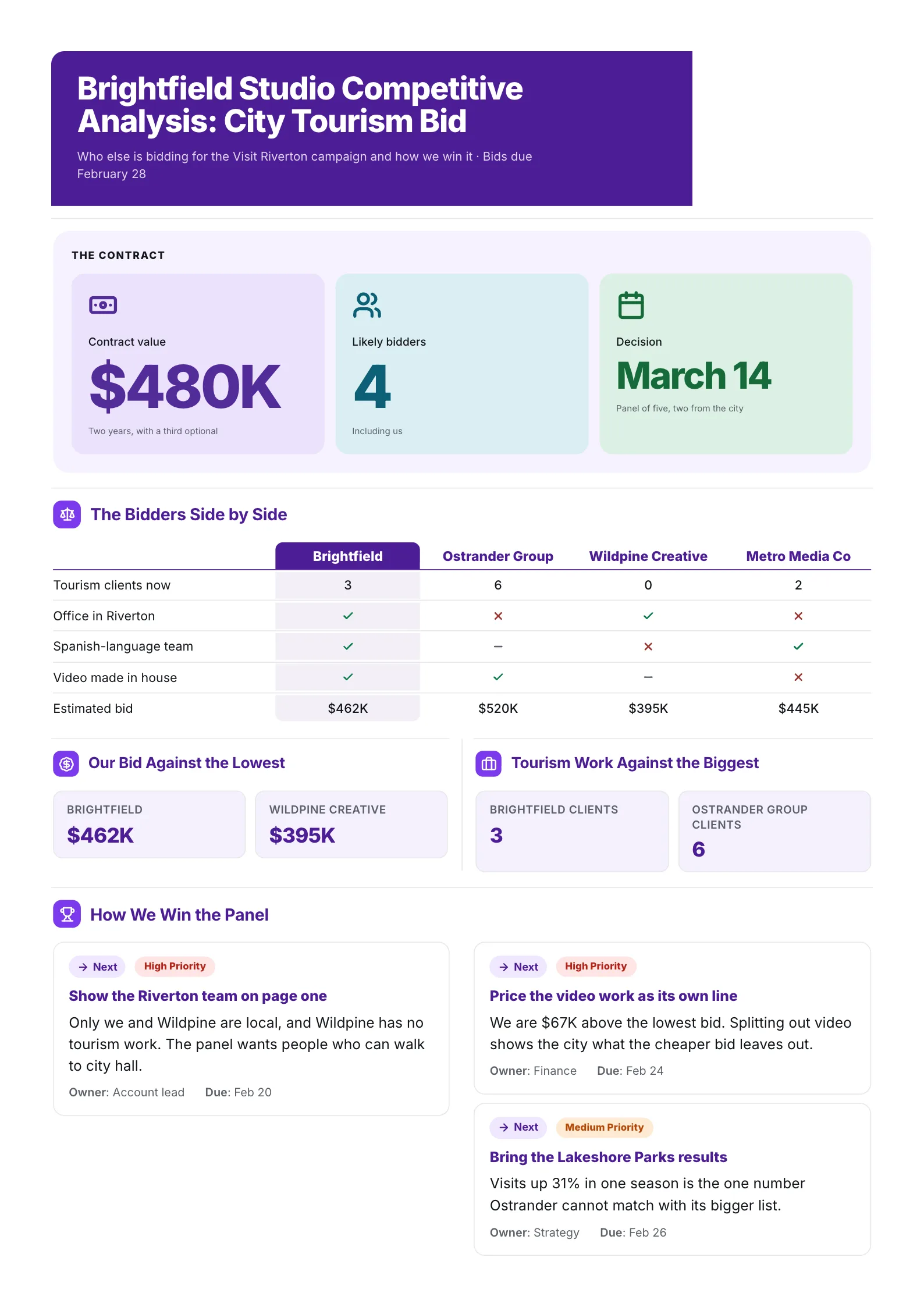 Competitive Analysis: Agency BidEdit for free(opens in a new tab)
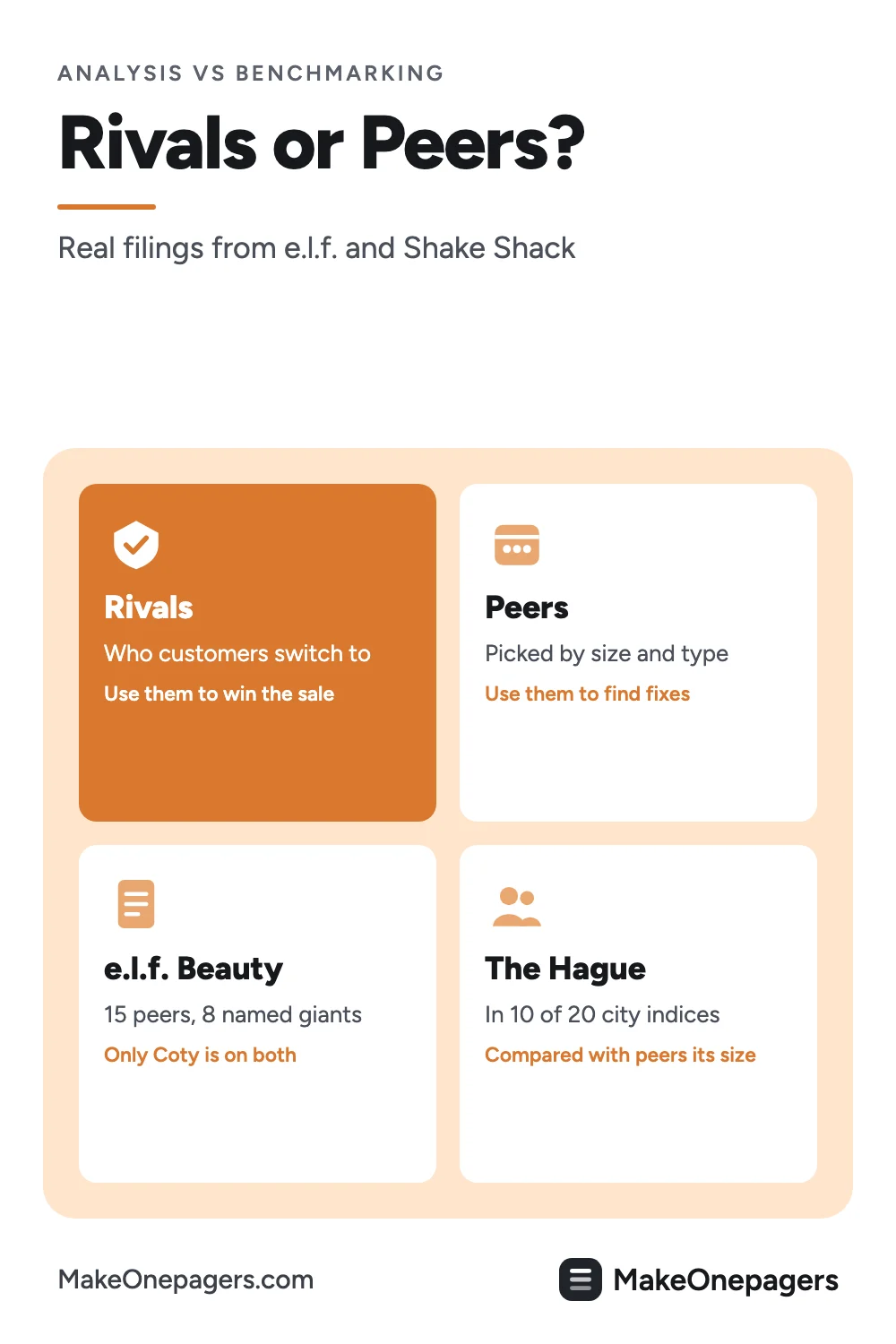
You can see the gap in two filings from one company. e.l.f. Beauty benchmarks its executive pay against 15 peer companies. Its annual report names 8 large companies whose brands make up a big share of US beauty sales. Only one company, Coty, appears on both lists.
| Competitive analysis | Benchmarking | |
|---|---|---|
| The question | Why do customers pick them over us? | Are we as good as similar organizations at this? |
| Who's on the list | Rivals your customers switch between | Peers picked by size, type or best practice |
| Can a non-rival be on it? | No | Yes, often |
| What you compare | The things buyers weigh: price, features, speed, location | Measures you can track: cost, time, rates, ratings |
| How often | Before a launch, a pitch or a price change | The same numbers every year or quarter |
| What it leads to | Where to compete and how to win the sale | What to fix, and how far behind you are |
Two lists from the same company
e.l.f. Beauty files two documents each year that line up well for this. Its annual report for the year ended March 31, 2026 has a section called "Markets and Competition." Its July 2026 proxy statement lists the peer group its board uses to set executive pay.
The competition section says a few large companies own the brands behind a significant share of US beauty sales, and it names 8 of them: "L’Oréal, Estee Lauder, Coty, Unilever, LVMH, Shiseido, Beiersdorf and Procter & Gamble." That's 8 names. Its risk factors then list 11 things beauty companies compete on, from "pricing of products" and "brand awareness" to "in-store presence and visibility."
The peer group has 15 companies, picked a different way. The proxy says the board chose companies "reasonably similar to e.l.f. Beauty on the basis of, among other things, industry, consumer focus, revenue, market cap and geography." It also sets a size window, from 0.5x to 2.5x e.l.f.'s revenue and 0.3x to 3x its market value.
| e.l.f.'s list | How many | How they were chosen | Examples |
|---|---|---|---|
| Companies named in the competition section | 8 | Who owns the big beauty brands | L’Oréal, Estee Lauder, Procter & Gamble |
| Pay peer group | 15 | Similar size, consumer focus, industry | CAVA, Planet Fitness, WD-40, YETI, Coty |
| On both lists | 1 | Coty |
So the benchmark list holds a restaurant chain, CAVA, a gym chain, Planet Fitness, plus WD-40 Company and the stock photo site Shutterstock. None of them sells you mascara. They're on the list because they're consumer companies of about the same size, which makes their pay a fair yardstick. The proxy even says e.l.f. sat at the "50th percentile for trailing twelve-month revenue and the 82nd percentile for 30-day average market capitalization."
That's the core difference. A benchmark peer only has to be comparable, while a rival has to be someone your customer could pick instead of you.
A burger chain that names no rivals at all
Shake Shack's annual report for 2025 shows the other side of a competitive analysis. Its competition section doesn't name a single company. It names the fronts restaurants fight on instead: "taste, price, food quality, service, location and the ambiance and condition of the restaurant." That's 6 factors.
It also names rival types, and some of them aren't restaurants. Shake Shack says it competes "with companies outside of the traditional restaurant industry, such as grocery store chains, meal subscription services and delicatessens." Shake Shack's pay benchmark, below, has no grocery chain on it. A competitive analysis has to include one, because a family deciding on dinner weighs both.
Its 2026 proxy statement then lists 13 pay peers, all restaurant companies, from Wingstop and Domino's to The Cheesecake Factory. The proxy says they "were selected because they are of similar size and scope." The table beside them shows the peer median revenue at $2,054 million and Shake Shack's at $1,445 million.
Both proxies also compare their stock against an index rather than rivals. Shake Shack uses the S&P 600 Restaurants Index, and e.l.f. uses the S&P 500 Consumer Discretionary Index. A group of companies stands in for "how the field did."
A city that says what its benchmark is not
Benchmarking isn't only for public companies. The Hague published a 54-page review in July 2026, Benchmarking The Hague, that compares the city with others in global rankings. Near the start it lists what the report is not, and one line is "Not a comprehensive competitiveness analysis of The Hague."
Its peers are chosen by likeness. The report looks for "cities that share comparable inherited assets, international functions, or quality of life propositions." It says the city's range of functions "means that it has multiple groups of peers," and one group runs from Oslo and Vienna to Kyoto and Louisville.
The report tracks 20 city indices, and The Hague has appeared in 10 of them. In the Mercer Quality of Living survey it went from 11th of 240 cities to 14th of 241. That drift is the point of a benchmark. The report puts it plainly: "The Hague can improve and still slip if peers improve faster."
How to tell which one you need
Start by asking what decision your page will help someone make.
- You're setting a price, pitching a buyer or planning a launch. That's a competitive analysis. List the rivals your customers actually weigh, and the factors they choose on.
- You want to know if your costs, speed or quality are normal. That's benchmarking. Pick peers of your size, plus one or two that are the best at the thing you measure, even outside your industry.
- You want to know if you're getting better. That's benchmarking against yourself. Compare this year with last year, using the same measures.
- You lost a deal or a customer. Start with competitive analysis. A benchmark won't tell you why someone left.
Then pick your list the right way. For rivals, ask your last five lost customers where they went, and add every place they named, even if it's not in your industry. For peers, write down your rule before you pick names, the way e.l.f. set a size window first. Your rule stops you from choosing peers that only make you look good.
Keep your measures the same every time. If you change them each year, your benchmark can't show you a trend. Three or four numbers you can pull in an hour beat twelve you have to estimate. We go deeper on picking rivals in how to write a competitive analysis, and on the four-box version in competitive analysis vs SWOT.
Five One-Pagers that mix both
You can put both on one sheet, with a few rivals plus a few numbers measured against a group or against last year. These five MakeOnepagers samples show different mixes. For more layouts, see our competitive analysis examples.
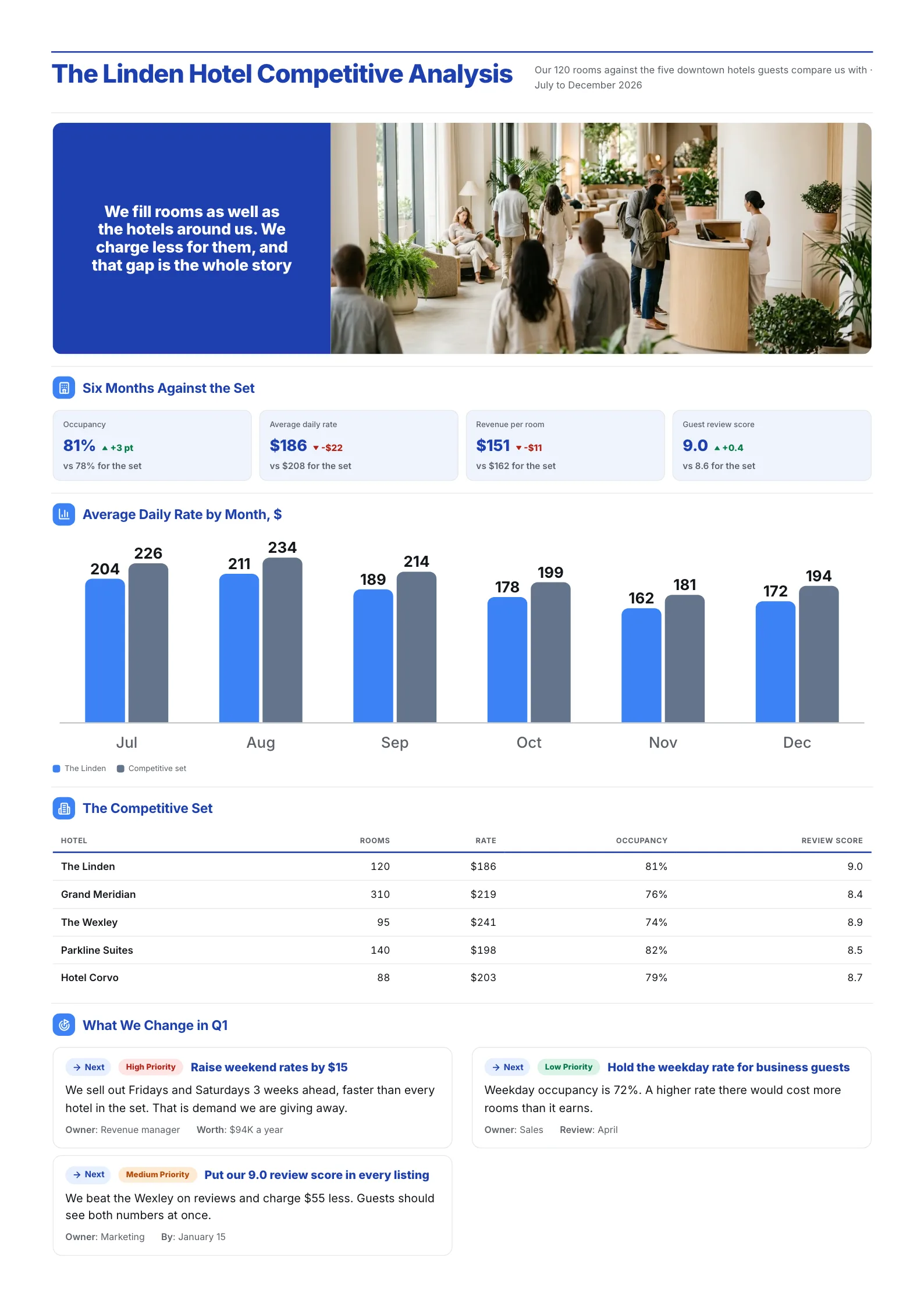
A hotel that benchmarks against its "set"
 Edit this template
This hotel competitive analysis sits right where the two methods meet. It scores The Linden against "the five downtown hotels guests compare us with," so the peers are real rivals. Then it tracks four numbers against the set's average: 81% occupancy against 78%, and a $186 daily rate against $208. The first move follows from the gap. It raises weekend rates by $15, worth $94K a year, because the hotel sells out Fridays and Saturdays 3 weeks ahead.
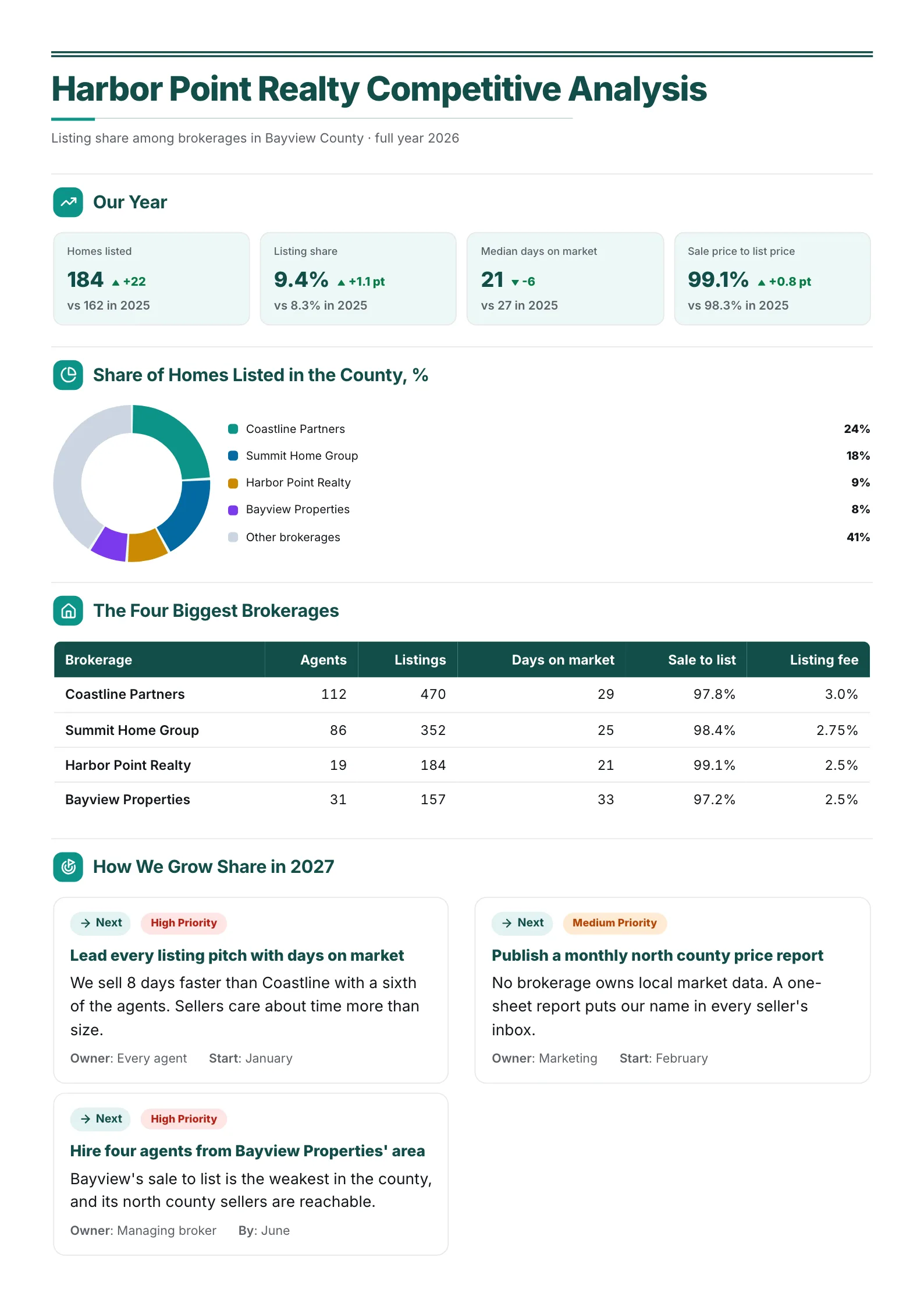
A brokerage that benchmarks against its own last year
 Edit this template
This real estate brokerage competitive analysis opens with a benchmark against itself. Homes listed went from 162 in 2025 to 184, and median days on market fell from 27 to 21. Below that sits the competitive part, a table of the four biggest brokerages. The pitch it builds is "We sell 8 days faster than Coastline with a sixth of the agents."
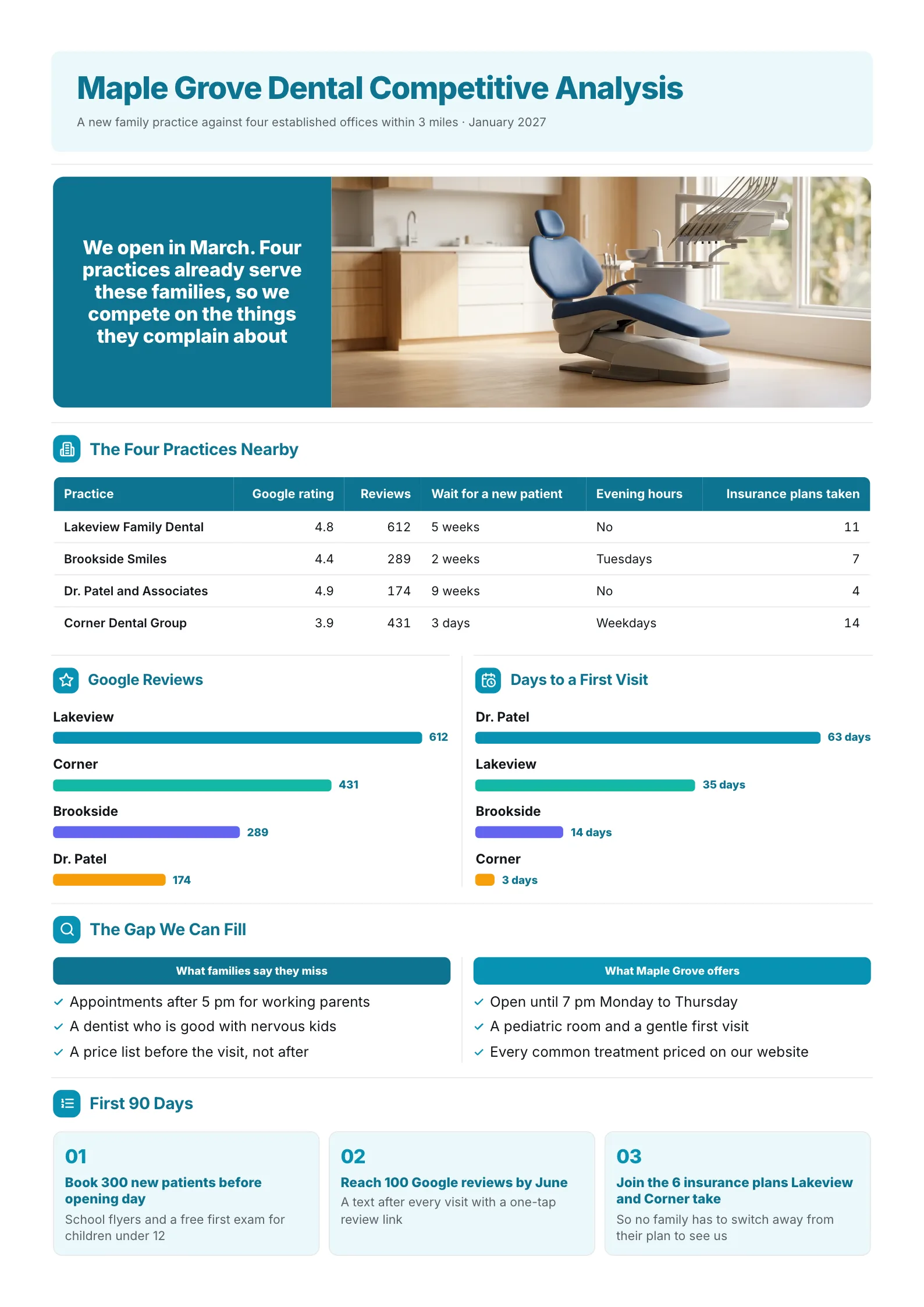
A new dental practice with rivals and no history yet
 Edit this template
A business that hasn't opened has no past to benchmark against, so this dental practice competitive analysis is pure competition. It compares four offices within 3 miles, where the wait for a new patient runs from 3 days to 9 weeks. Then it targets what families miss, like appointments after 5 pm. Its first goals, 300 new patients before opening day and 100 Google reviews by June, become the numbers it will track later.
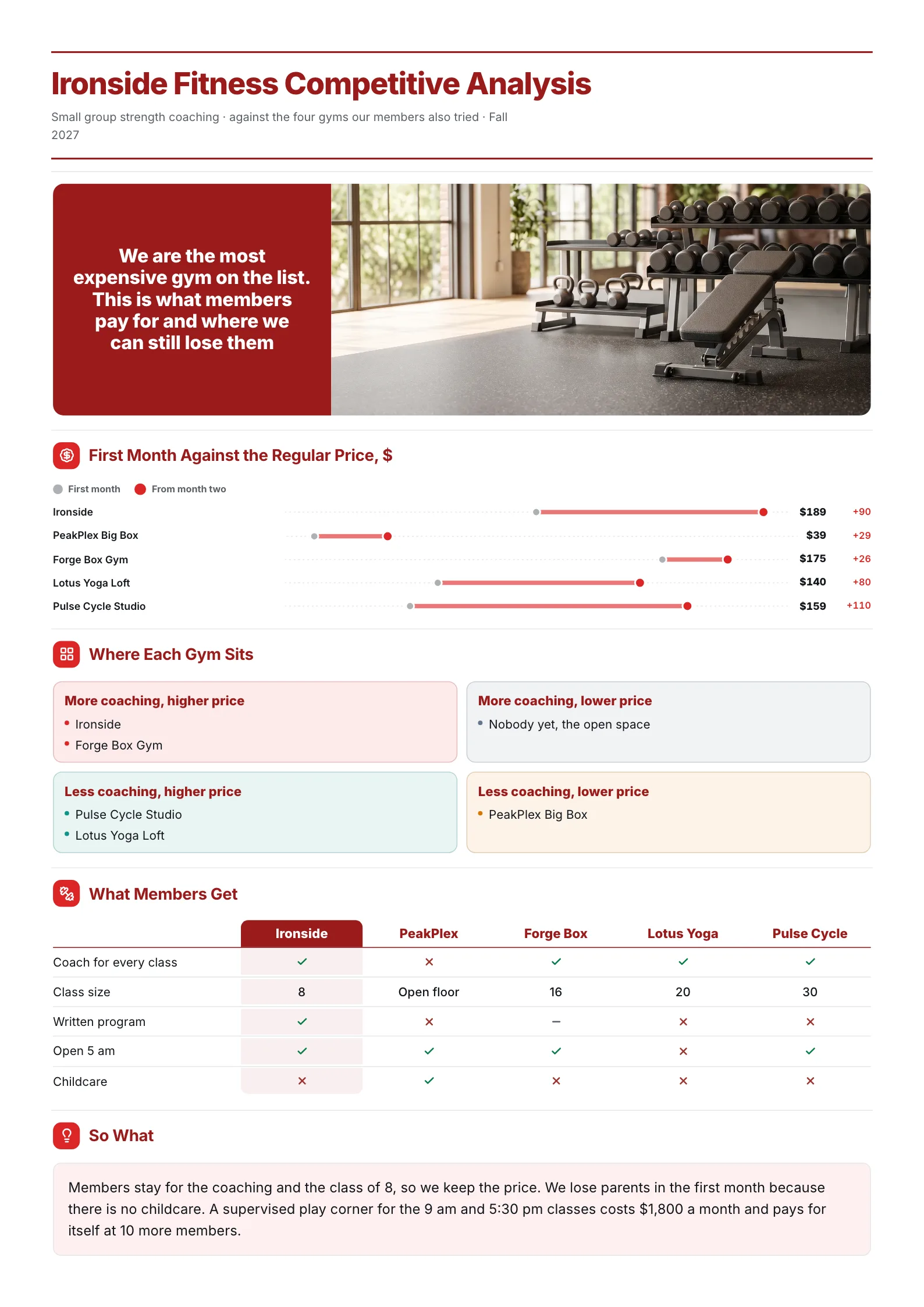
A gym that picks rivals from its own members
 Edit this template
This gym competitive analysis chooses rivals the right way, as "the four gyms our members also tried." A yoga loft and a cycle studio make the list, even though Ironside sells small group strength coaching. Its table shows a class of 8 against 16, 20 and 30, and that only the big box gym offers childcare. The fix comes with a price. A supervised play corner costs $1,800 a month and pays for itself at 10 more members.
A bike shop whose biggest rival isn't a shop
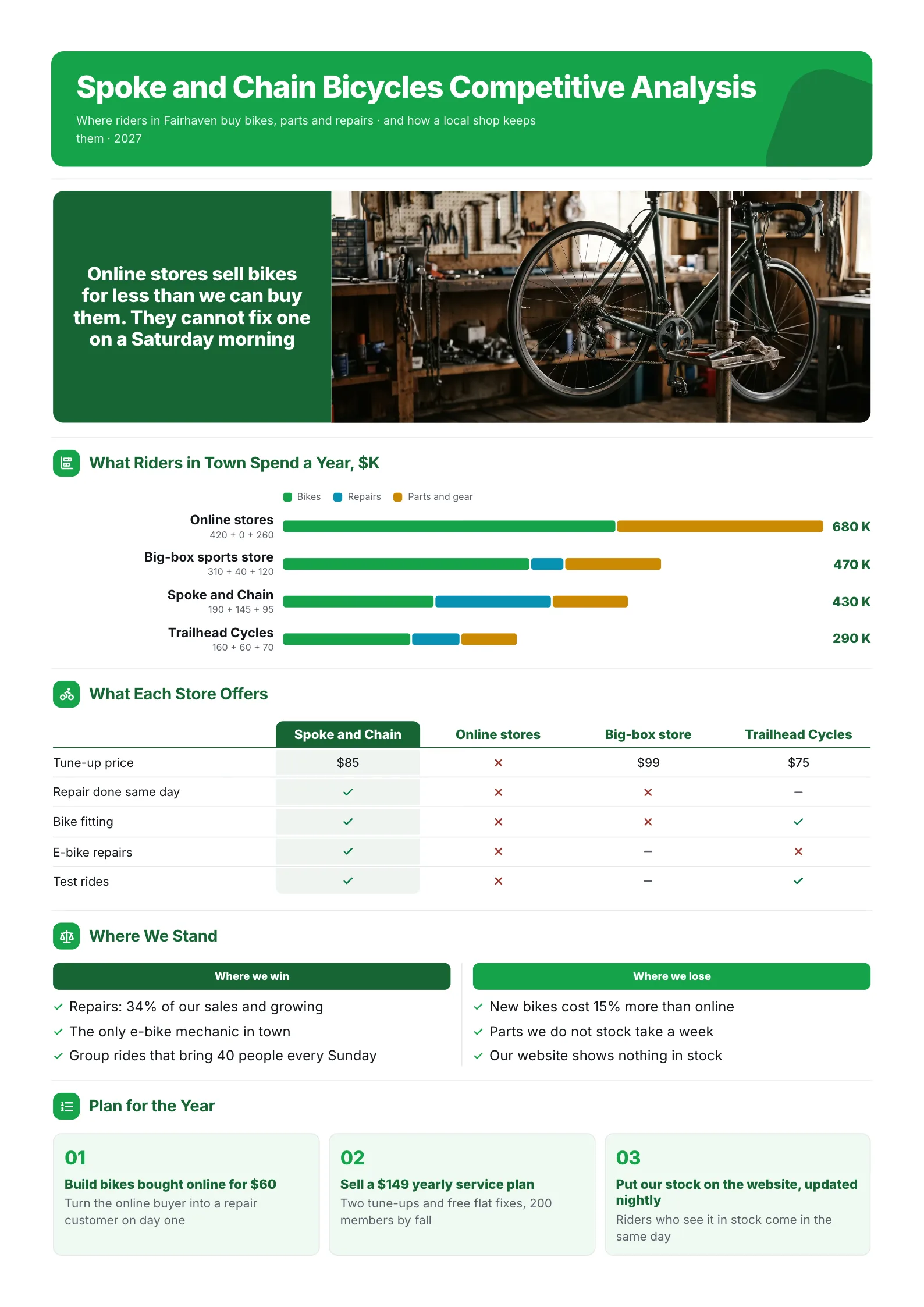 Edit this template
Like Shake Shack listing grocery chains, this bike shop competitive analysis counts "Online stores" as a rival. Online stores can't do a tune-up, and the shop charges $85 for one against $99 at the big-box store. Repairs are 34% of its sales, so the plan turns online buyers into repair customers. It offers a $149 yearly service plan, with a goal of 200 members by fall.
Put yours on one page
Start with the list that fits your decision. If it's a sale, name the rivals and the factors your buyers weigh. If it's a fix, pick peers with a written rule and track the same three or four numbers. Choose a MakeOnepagers competitive analysis, or describe your business to the free AI One-Pager generator and it will draft the layout for you to edit.
Frequently asked questions
Is benchmarking part of a competitive analysis?
It can be. A competitive analysis often borrows a few benchmark numbers, like price per unit or a review score, and compares them across rivals. Benchmarking on its own goes further, tracking the same measures over time against peers that may not be rivals at all.
Who should be in a benchmarking peer group?
Organizations you can fairly compare yourself with. e.l.f. Beauty picks companies of similar size, consumer focus and industry, within 0.5x to 2.5x of its revenue. Add one or two that are the best at the thing you're measuring, even from another field.
What is competitive benchmarking?
It's benchmarking where the peers are your direct rivals. The hotel sample above measures occupancy and daily rate against the five hotels guests compare it with, and it calls that group "The Competitive Set."
Can a company benchmark against businesses in other industries?
Yes. Shutterstock, WD-40 and Planet Fitness all sit in e.l.f.'s pay peer group, and none of them sells beauty products. For a process like shipping or hiring, the best example may come from a company that does that one task far better than anyone in your field.
How often should you redo each one?
Track benchmarks on a fixed schedule, like every quarter or year, so the numbers line up over time. Redo a competitive analysis when the field moves, such as when a new rival opens nearby or you plan a price change or launch.




