Communication Plan vs Stakeholder Engagement Plan: What One Town Put in Each
Communication plan vs stakeholder engagement plan: one town's 32-page engagement plan holds its communication plan as 1 of 7 sections. See what each part does.

Ask which way a plan points, and you'll know which kind you're holding. A communication plan decides who hears what, through which channel, and how often. A stakeholder engagement plan decides who you ask, how you ask them, and what their answers can change. When people can still change the outcome, you don't pick one: the first sits inside the second. Start from a free one pager template.
One‑Pager examples
Real One-Pagers made with MakeOnepagers. Open any one to edit it as your own.
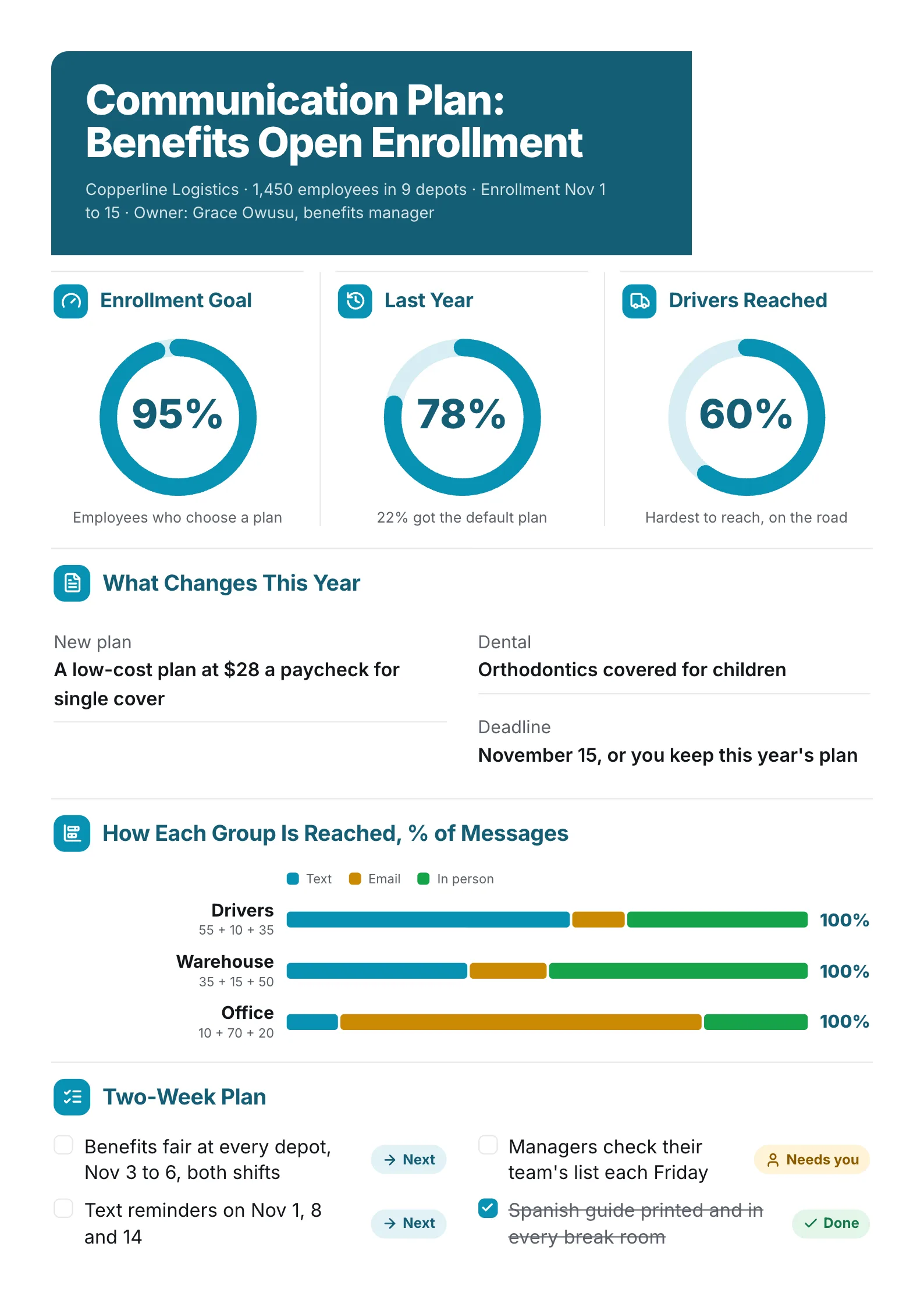 Communication Plan: Benefits EnrollmentEdit for free(opens in a new tab)
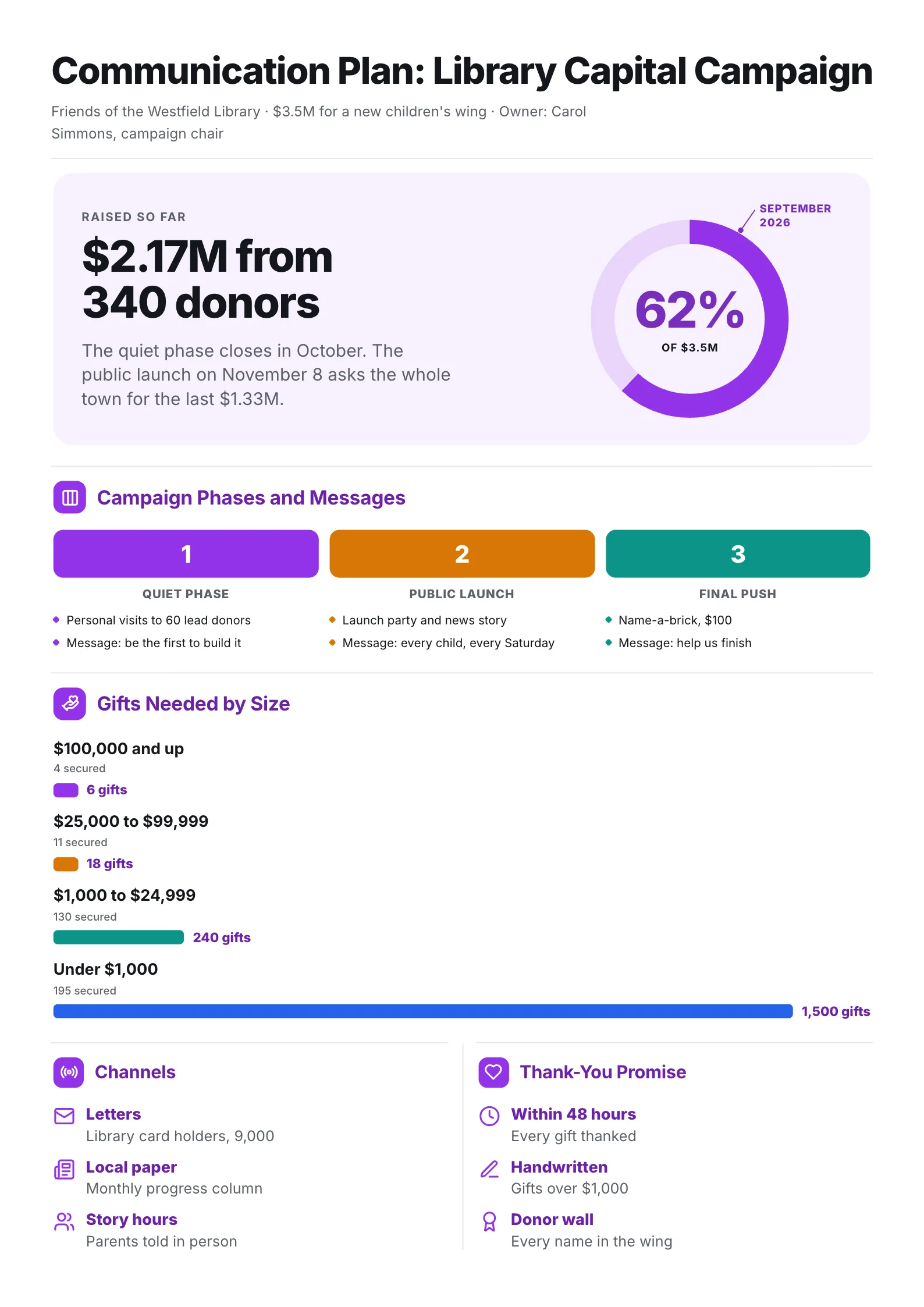 Communication Plan: Fundraising CampaignEdit for free(opens in a new tab)
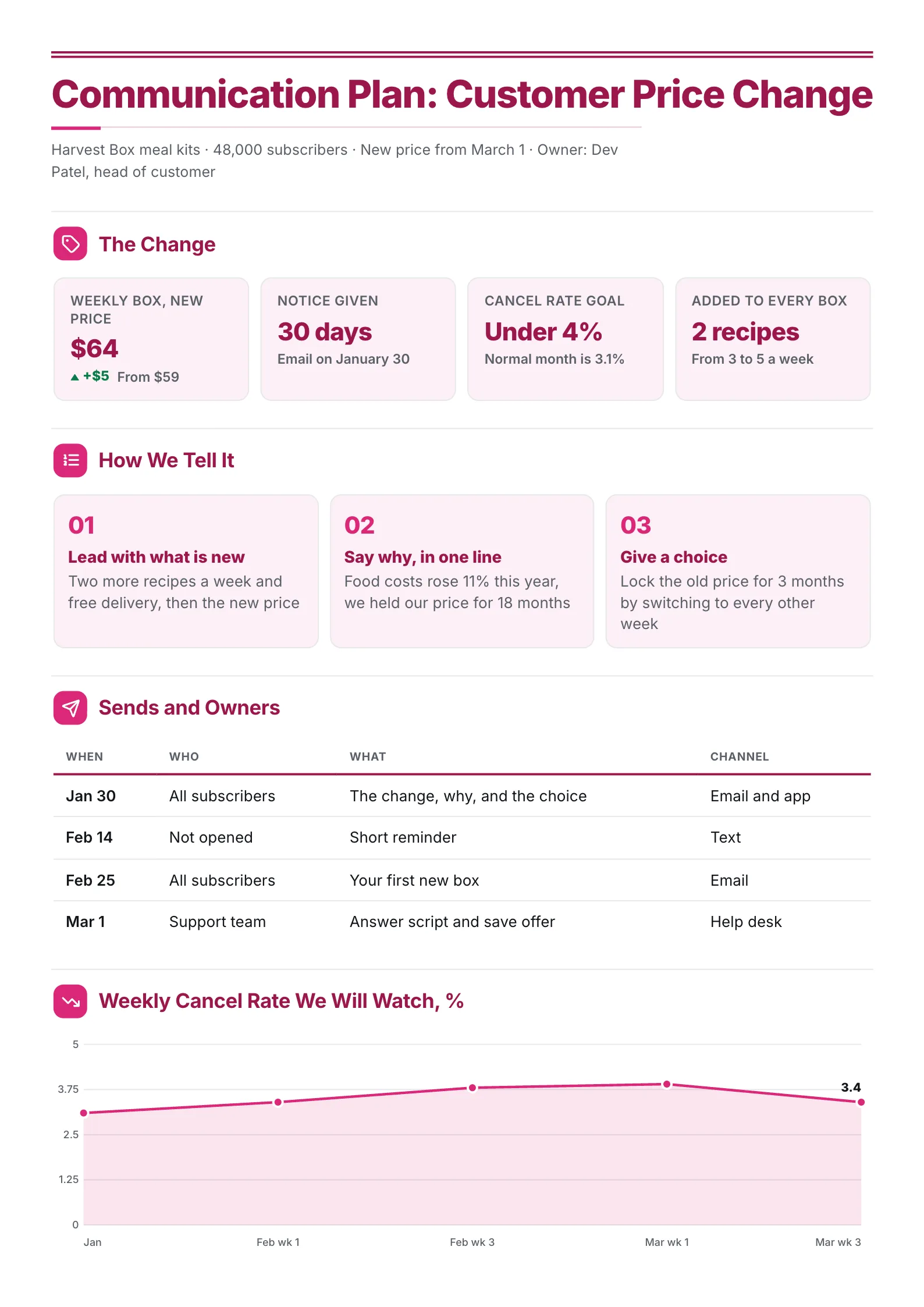 Communication Plan: Customer Price ChangeEdit for free(opens in a new tab)
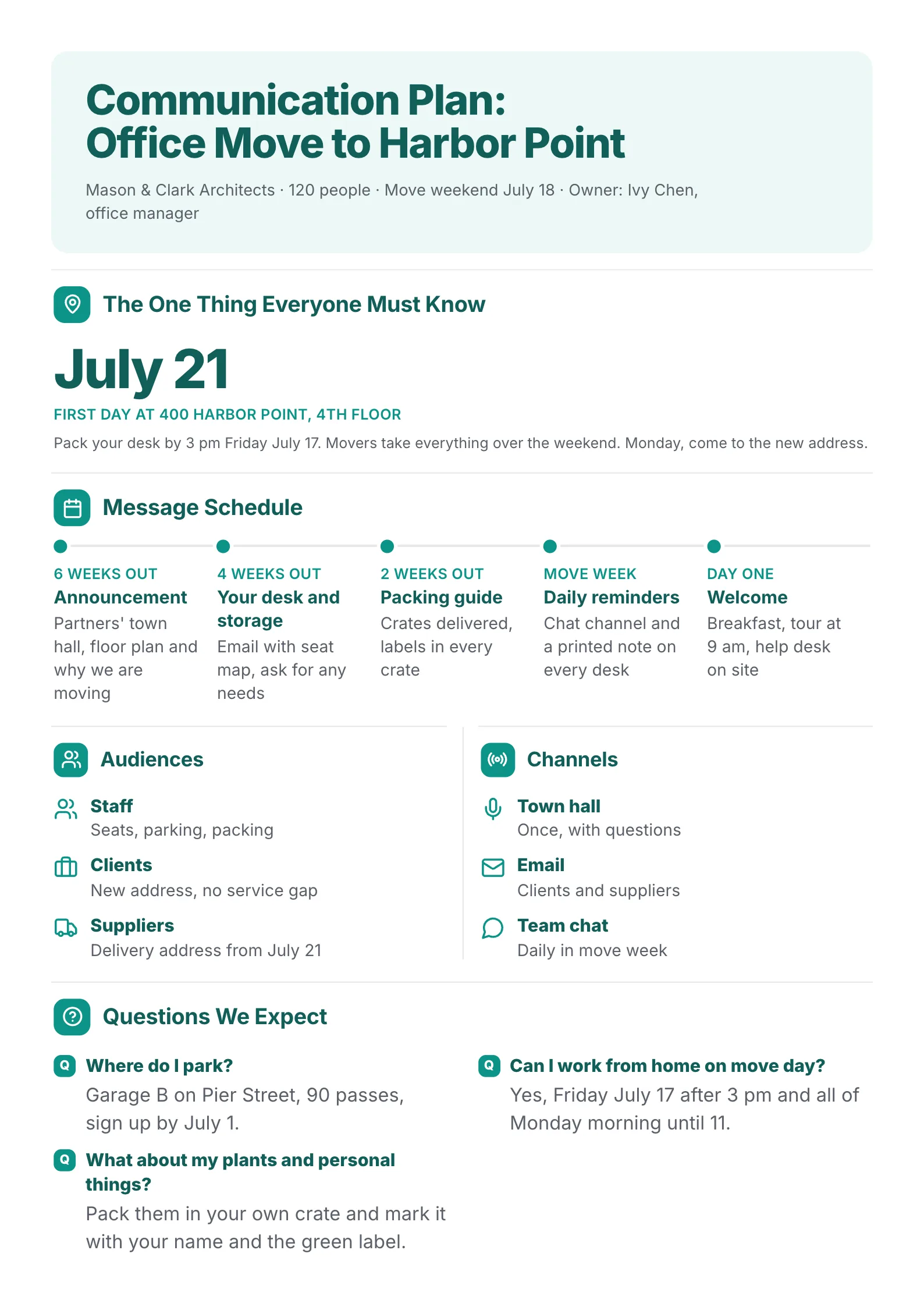 Communication Plan: Office MoveEdit for free(opens in a new tab)
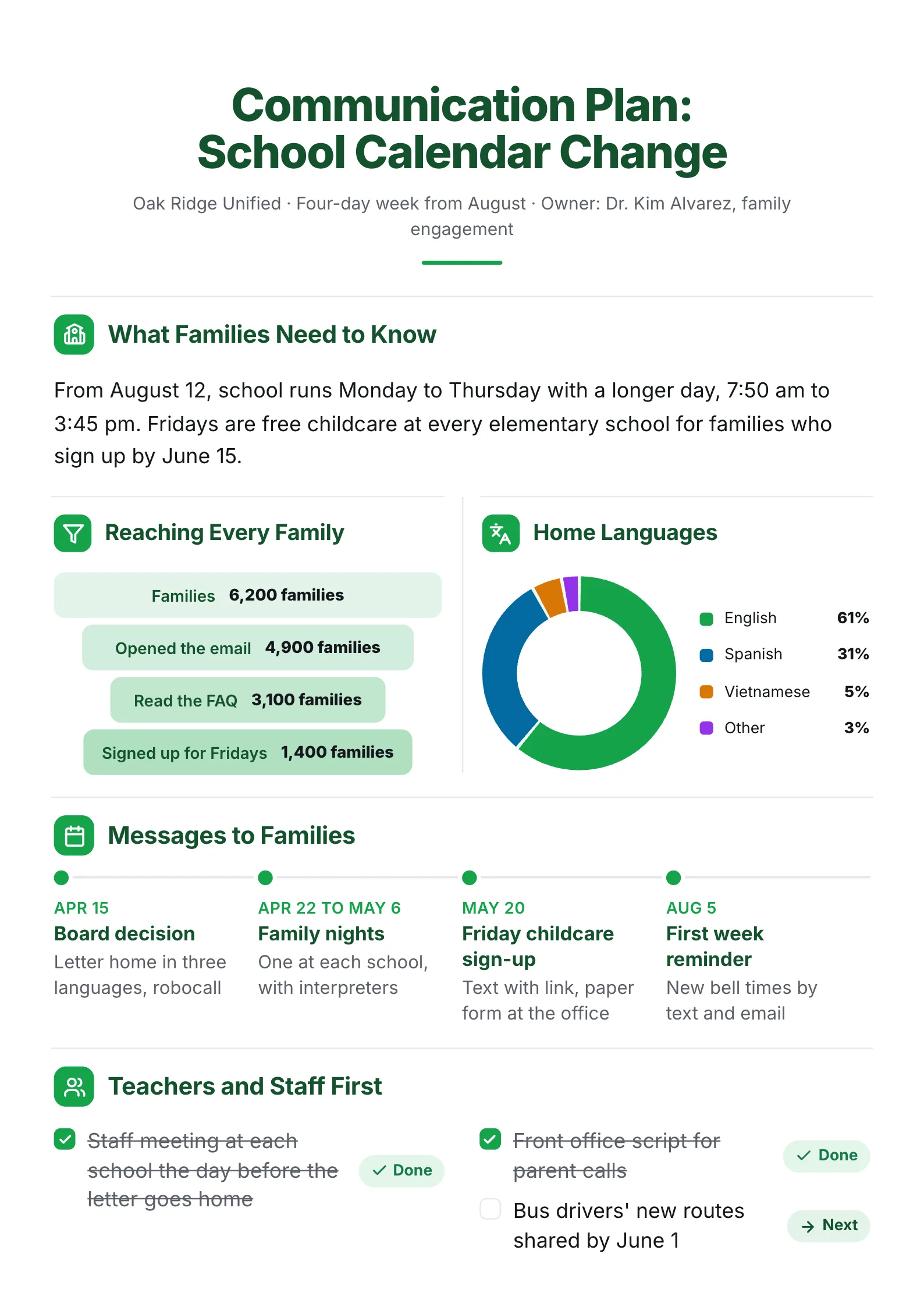 Communication Plan: School FamiliesEdit for free(opens in a new tab)
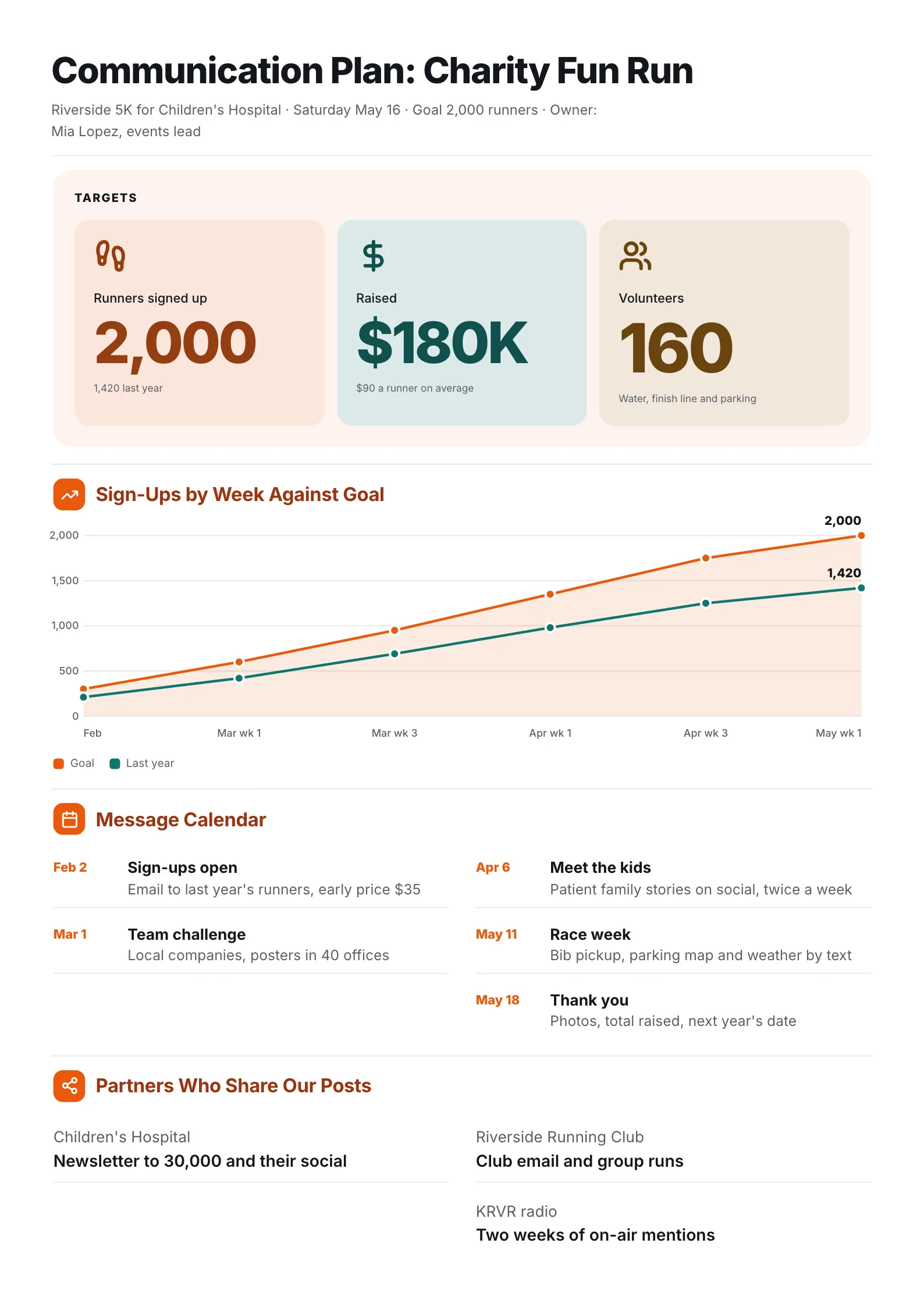 Communication Plan: Charity EventEdit for free(opens in a new tab)
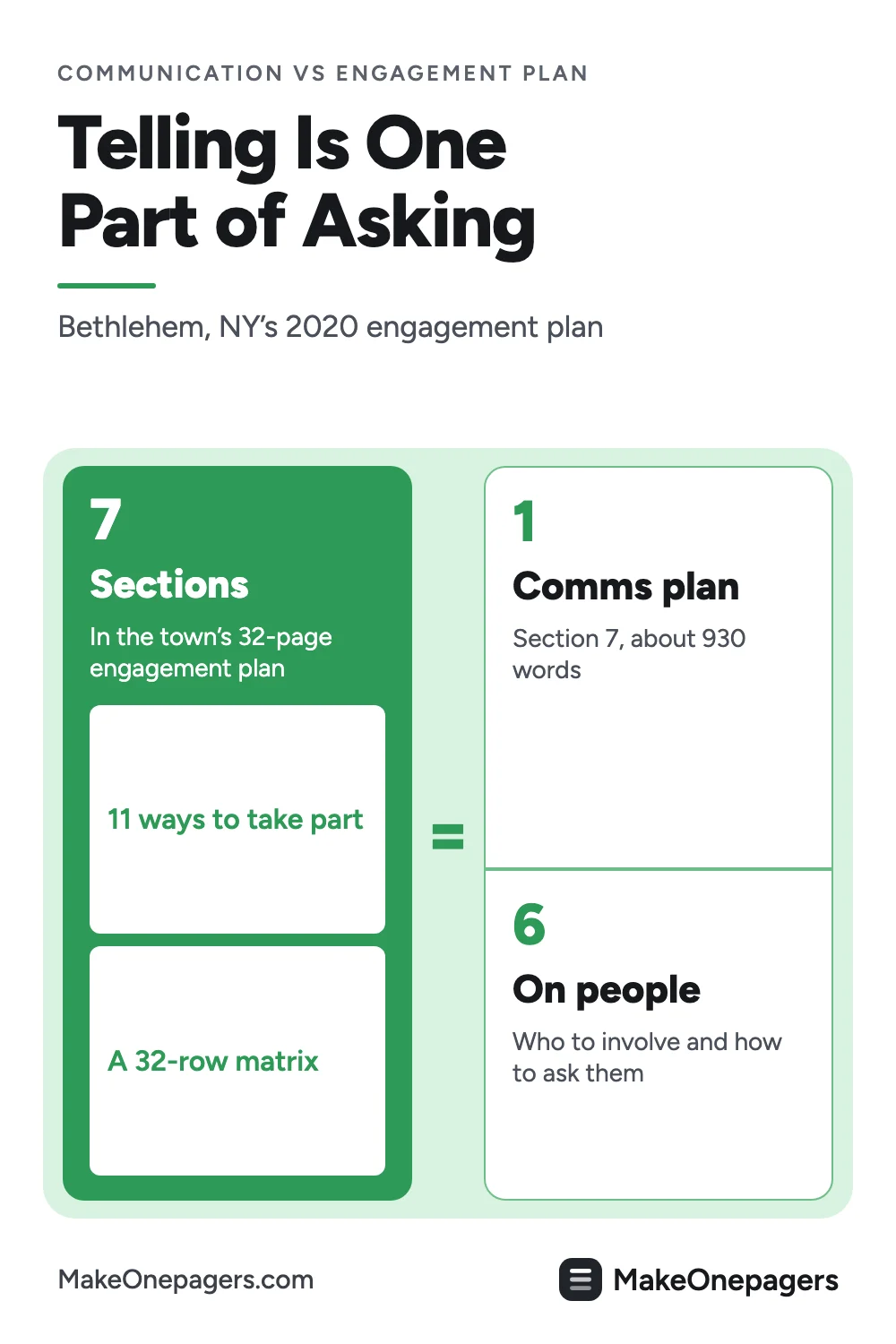
We read a real one to check. The Town of Bethlehem, New York, wrote a 32-page Stakeholder Engagement Plan, dated October 12, 2020, for its Comprehensive Plan update. It has 7 numbered parts. Only the last one, part 7, is called "Communications Plan." By our count it runs about 930 of the 4,422 words in the main text. The other six parts are about people, and how to ask them.
| Communication plan | Stakeholder engagement plan | |
|---|---|---|
| Its main question | Who hears what, and when? | Who do we ask, and what do we do with the answers? |
| Which way it points | Mostly out | Out and back |
| Typical parts | Audiences, messages, channels, dates, owners | Groups of people, the choice on the table, ways to take part, a log of what people said, a date to report back |
| What you count | Who got the message | Who took part, and what changed because of it |
| Where it lives | Often one part of the bigger plan | Often the bigger document |
| When it's done | When the last message goes out | When people see how their input was used |
To keep this short, we'll call the first one the comms plan from here on.
One town plan that holds both
Bethlehem's plan was written to guide a public process scheduled through 2020 and 2021. Here's how its parts split.
- Parts 1 to 6 (about 3,492 words): the project, the team, the advisory committee, five groups of people and 11 ways to take part.
- Part 7 (about 930 words): the comms plan.
- Four appendices: a 32-row matrix of dates, a draft meeting agenda, a draft survey and a list of channels.
The plan names its goal in one line: "to build and sustain two-way communication with town residents, property and business owners, and other stakeholders." Two-way is the whole difference in two words. Keep that word in mind as you read your own draft.
What the comms part does
Part 7 has four pieces, and each one moves news or keeps a record.
- A project website on PublicInput.com, with a sign-up list. Through it, the team "will also send up to 2,000 text messages."
- A Public Input Log, "a continuous log of all community and stakeholder engagement activities and input received."
- Nine kinds of handouts and posts: press releases, the website, a brochure, an FAQ, flyers, digital copies, social posts, phone calls and a named press contact.
- A plan to promote the survey and each event, through news outlets, the town website, social media, email lists, text messages and print.
Look at what those pieces are for. They announce meetings, push the survey and keep a record. On their own, they don't settle anything. If your draft has only pieces like these, you've written a comms plan.
What only the engagement part does
The first six parts do the work a comms plan can't do alone. Check your own plan for each of these four.
It names what's being decided. Bethlehem's line reads, "By Fall 2021, the Town of Bethlehem Board will adopt an update to its Comprehensive Plan to establish a shared community vision for the future and an action plan to achieve it." The plan says the line will be used in press releases, at the start of public meetings and in the final document. Write yours in one sentence, with a date and the group that will vote.
It asks before it plans. The plan was "prepared using input from eight key stakeholders." Those were eight 20-minute phone calls in September 2020, and they shaped which channels the plan chose. Before you pick your channels, call a few of the people you need to reach.
It lists 11 ways to take part. Five are run by the project team: committee meetings, interviews, three public meetings, topic groups and two surveys. Six are run by committee members: pop-up events, visits to meetings other groups already hold, a Meeting-in-a-Box kit, door-to-door visits, social media and articles. Give people more than one way in, because a Zoom meeting won't reach everyone.
It promises to report back. One of its four principles reads, "We will clearly articulate the scope of the public's influence in the project and the results of the input received throughout the process." The third public meeting is set up to "demonstrate how public input was used in the development of recommendations." Put that meeting, or that email, on your calendar before the first survey goes out.
That last promise is the clearest line between the two plans. A comms plan is done when the message lands. An engagement plan is done when people can see what their input changed.
A plan called "Communications Plan" that asks at every step
Names don't always match what's inside. The Municipality of Brighton, Ontario, published a Communications Plan for its Transportation Master Plan, dated February 9, 2024. Its purpose line sounds like a textbook comms plan. It covers "who will receive communications, how communications will be delivered, what information will be communicated, and the frequency of communications."
Now look at its two tables of tactics. There are 8 rows. All 8 ask for something back.
- Phase 1, 4 rows: a Notice of Study Commencement "requesting public input," then a working group meeting, an interest group meeting and a public information centre, each held to gather input.
- Phase 2, 4 rows: a session with high school students, a second working group meeting, a second interest group meeting and a second public information centre, each held to gather input or feedback.
Six of the 8 rows also say a survey will be prepared and handed out. So Brighton's file is titled a comms plan, but it works like an engagement plan. When someone hands you a "comms plan" to review, skip the title. Read each row and ask which way it points.
The official line between the two
Public agencies often draw the line with the IAP2 Spectrum of Public Participation. IAP2 says the Spectrum "is found in public participation plans around the world." It has five levels. Inform is at the bottom. At the top, the public makes the final call.
Only the bottom level is a pure comms plan. Its goal is "to provide the public with balanced and objective information," and its promise is short: "We will keep you informed." The next level up is Consult. There, IAP2 promises to "provide feedback on how public input influenced the decision." At the top level the promise is, "We will implement what you decide."
Pick your level before you write either plan.
- Are you only telling people? Write a comms plan. A price change or an office move often fits here.
- Are you asking, and can the answers change something? Write an engagement plan, and put your comms plan inside it as one part.
- Not sure? Ask yourself what people can still change. If the answer is nothing, don't run a survey that pretends otherwise.
Which one do you need?
Match your project to one of these four.
- The choice is made and people just need the facts: a comms plan. Name the audiences, the message for each, the channel, the date and the owner.
- People can still change the outcome: an engagement plan. Start with the line that says what's being decided, list the groups, choose how each can take part, and set the date you'll report back.
- A big public project: both, the way Bethlehem did it. The engagement plan leads, and the comms plan inside it gets people to each meeting and survey.
- A project at work with a few key people: often both on one page. Sort your people by how much they care and how much sway they have, then give each group its messages and dates.
Five sample plans, from telling to asking
These five MakeOnepagers samples sit at different points on that scale. The names and numbers in them are made up. Replace them with your project's real people and dates.
A merger announcement that only tells
 Edit this template
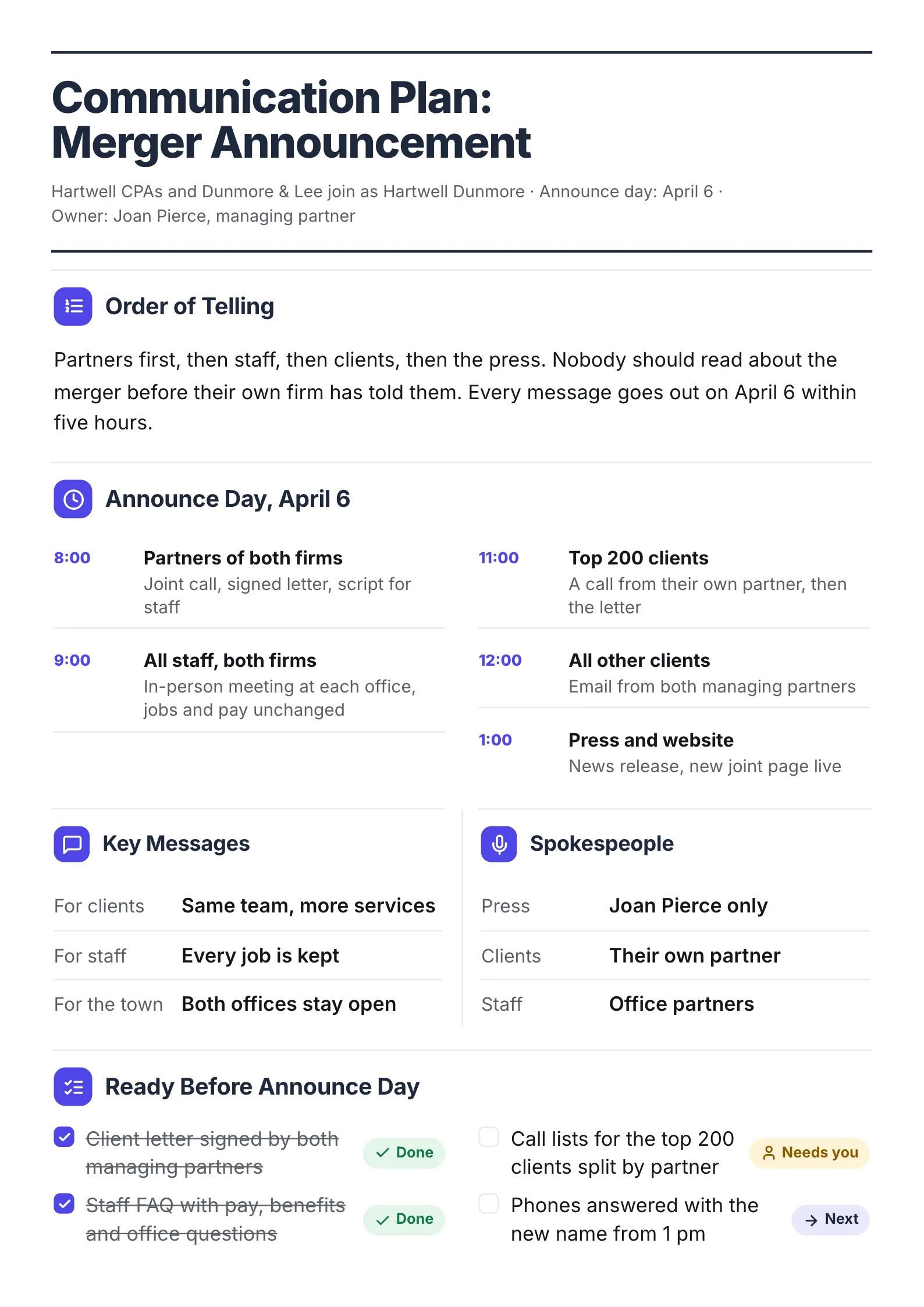
This merger announcement communication plan sits at the bottom level. Its rule is "Partners first, then staff, then clients, then the press." Every message goes out on April 6 within five hours, and only Joan Pierce speaks to the press. Nobody is asked to weigh in, because the deal is signed. That's a comms plan doing exactly its job.
A data breach plan that tells, then learns from the calls
 Edit this template
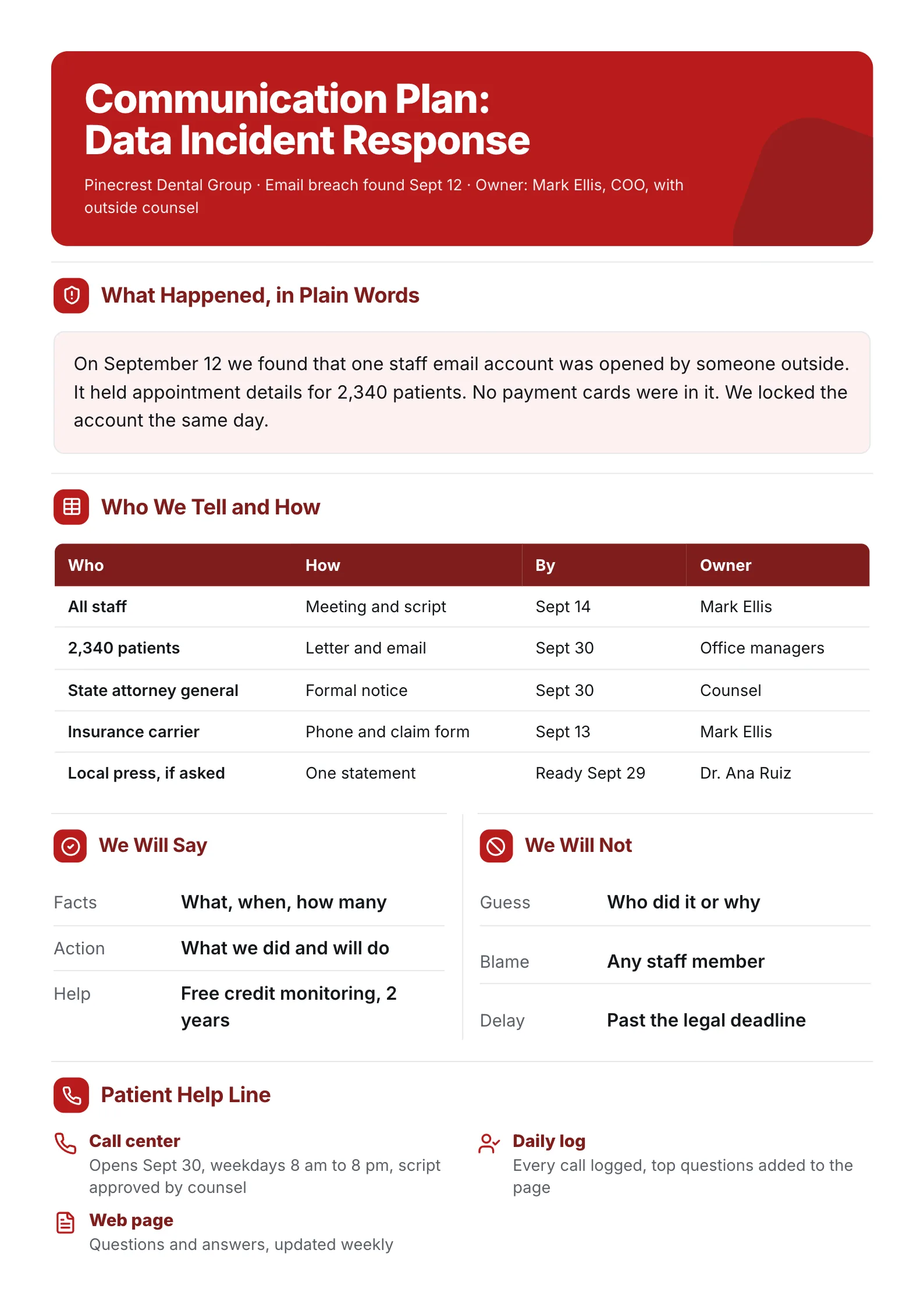
In this crisis communication plan, 2,340 patients get a letter and email by September 30, and the state attorney general gets formal notice the same day. Then it adds one small loop back. The help line logs every call, and the top questions go onto a web page that's updated weekly. It's still a comms plan, but it learns from what people ask.
A new CEO plan that moves from telling to listening
 Edit this template
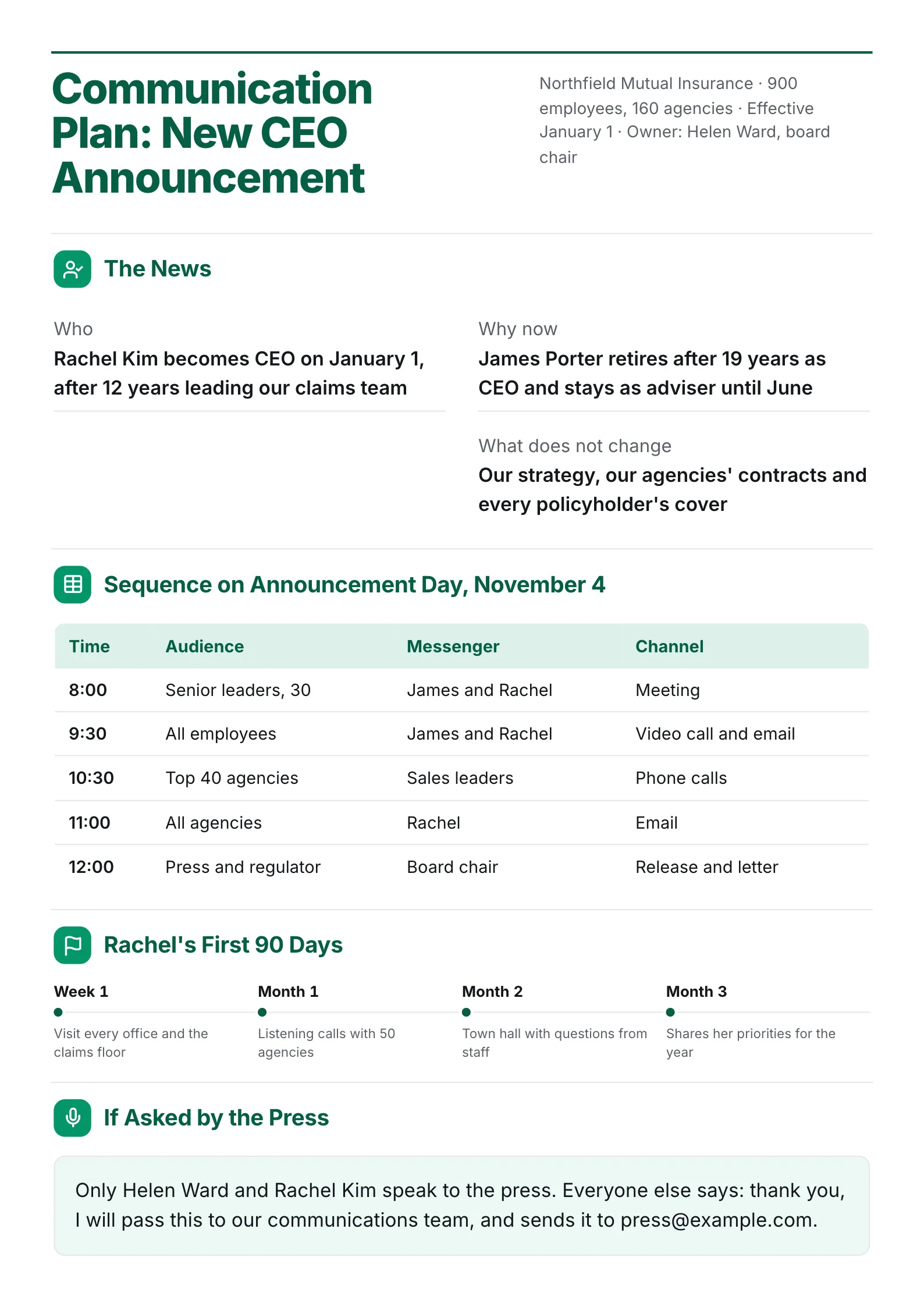
This leadership change communication plan tells everyone in order on November 4, from 30 senior leaders at 8 am to the press at noon. Then the first 90 days switch direction. Month 1 is listening calls with 50 agencies. Month 2 is a town hall with questions from staff. Only in month 3 does the new CEO share her priorities.
A system rollout with a weekly feedback loop
 Edit this template
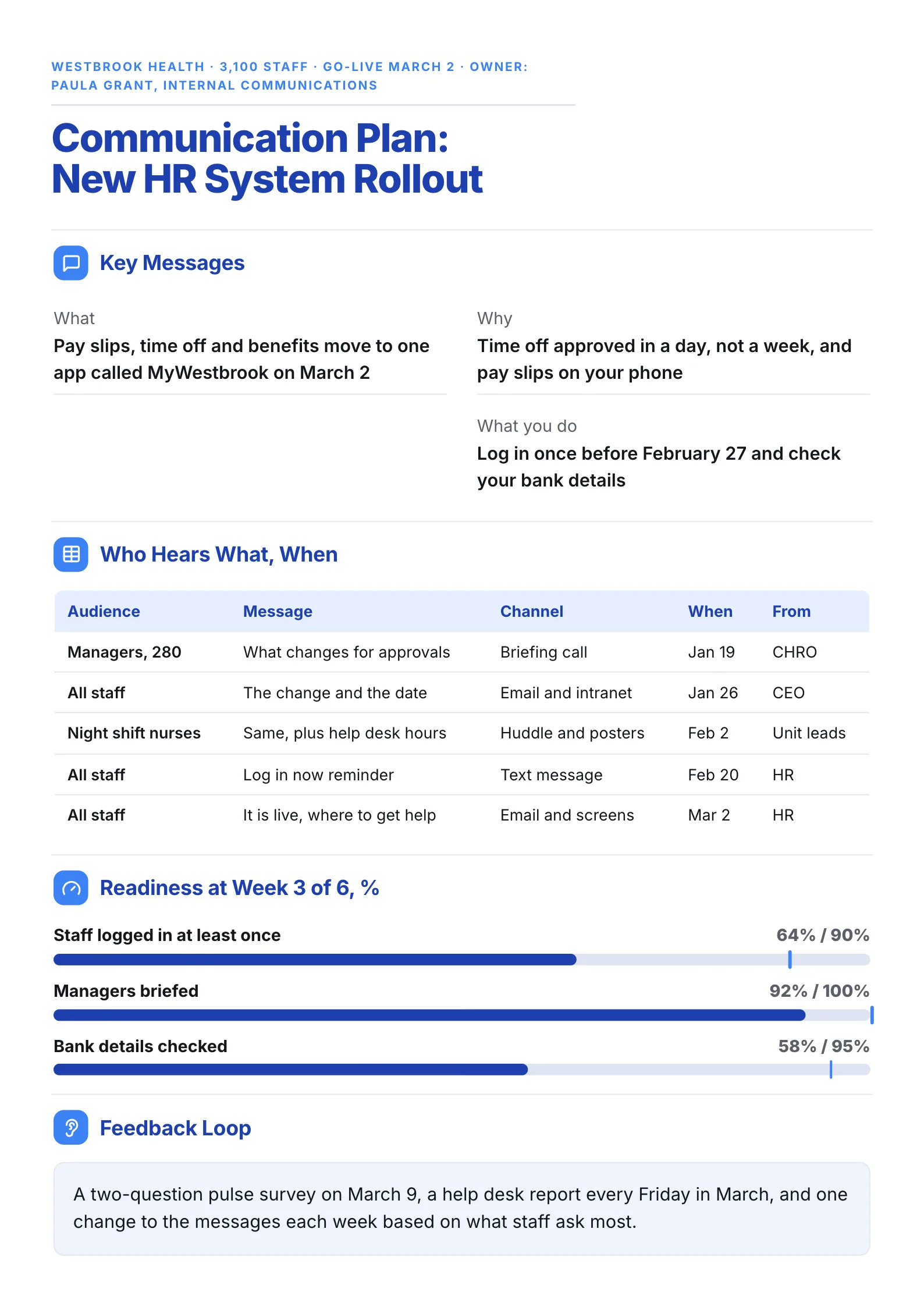
In this system rollout communication plan, 3,100 staff are told to log in once before February 27. Its last box leans toward engagement: "A two-question pulse survey on March 9, a help desk report every Friday in March, and one change to the messages each week based on what staff ask most." Staff answers change the messages, though not the go-live date.
A road works plan that maps people first
 Edit this template
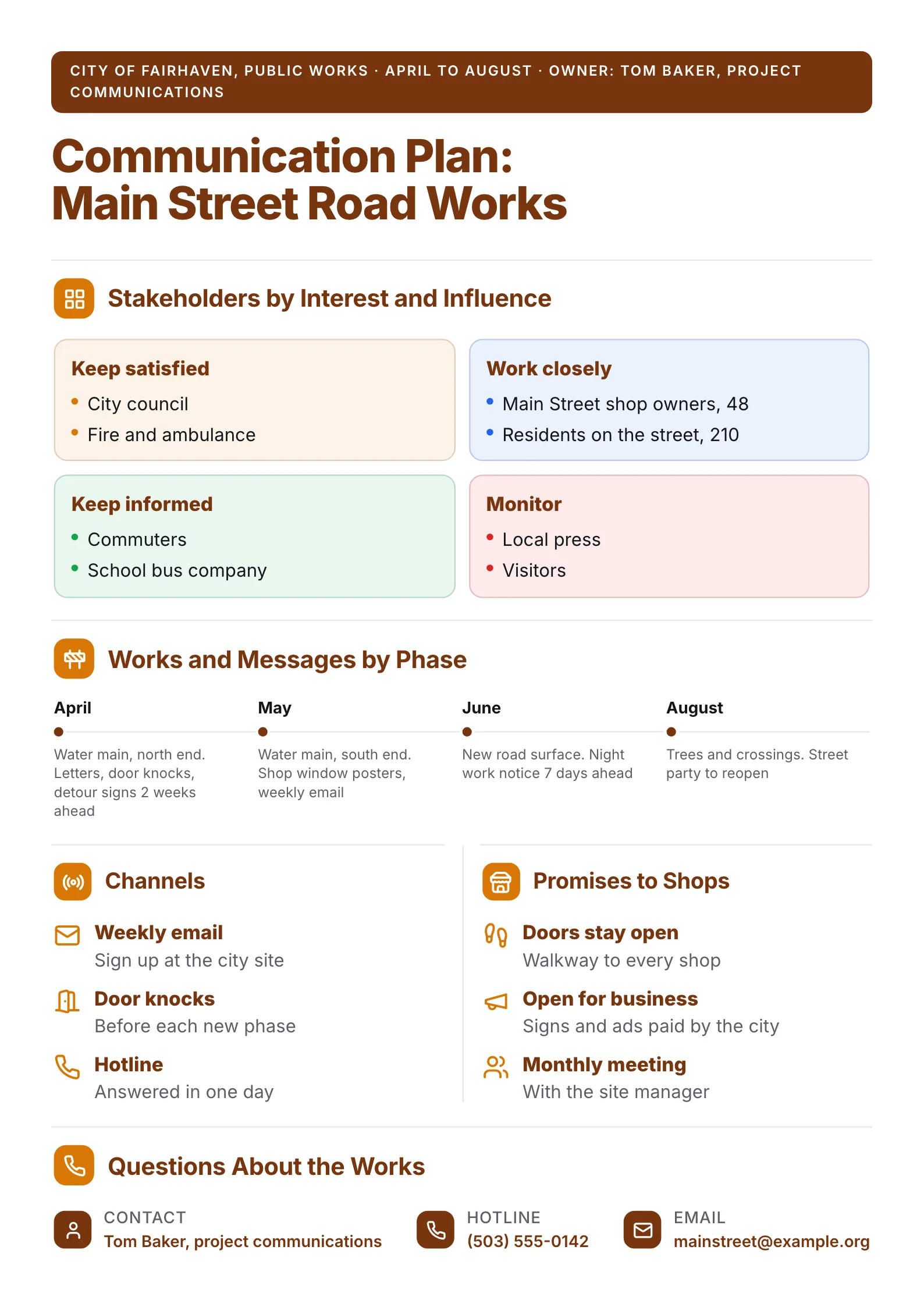
This construction project communication plan opens the way an engagement plan does. It sorts people by interest and influence, with the 48 Main Street shop owners and 210 residents in the "Work closely" box. Everyone gets door knocks before each new phase and a hotline answered in one day, and the shops also get a monthly meeting with the site manager. If your project has neighbors, start with a grid like this one.
Put your plan on one page
Open the MakeOnepagers communication plan that fits your project, then add the parts your level needs. For the steps, read how to write a communication plan, and run your finished draft through our communication plan checklist. Have a long engagement plan already? The free AI One-Pager generator can boil it down to a single sheet your team reads in a minute.
Frequently asked questions
Is a communication plan part of a stakeholder engagement plan?
Often, yes. In Bethlehem's 2020 plan, the comms plan is part 7 of 7. It exists to get people to the meetings and surveys the other parts set up. For a plain announcement, a comms plan can stand alone.
What's the main difference in one line?
A comms plan sends news out. A stakeholder engagement plan also brings input back and says what that input can change.
Can a plan be called a communication plan and still be an engagement plan?
Yes. Brighton, Ontario's 2024 Communications Plan has 8 rows of tactics, and all 8 ask for input or feedback. Judge a plan by what its steps do, whatever its cover says.
What does an engagement plan include that a comms plan leaves out?
A line naming what's being decided, the groups of people, the ways each can take part, a log of what you hear, and a date to show people how it was used. Bethlehem's plan has all five.
How do I pick the right level?
Use IAP2's five levels, from Inform at the bottom to the public deciding at the top. If you're only informing, a comms plan is enough. From Consult up, write the engagement plan first.




