How to Write a Communication Plan: Lessons From 6 Local Plans
How to write a communication plan, from 6 city and county plans: research, a goal with a number, audiences, messages, channels and owners.

Here's how to write a communication plan: find out what your people already hear, then set a goal with a number. Name each audience, write one to three key messages, and give every channel a date and an owner. Then plan what you'll say when something goes wrong. We learned that order from 6 communication plans that US cities and counties published, and we counted what each one includes. Start from a free one pager template.
One‑Pager examples
Real One-Pagers made with MakeOnepagers. Open any one to edit it as your own.
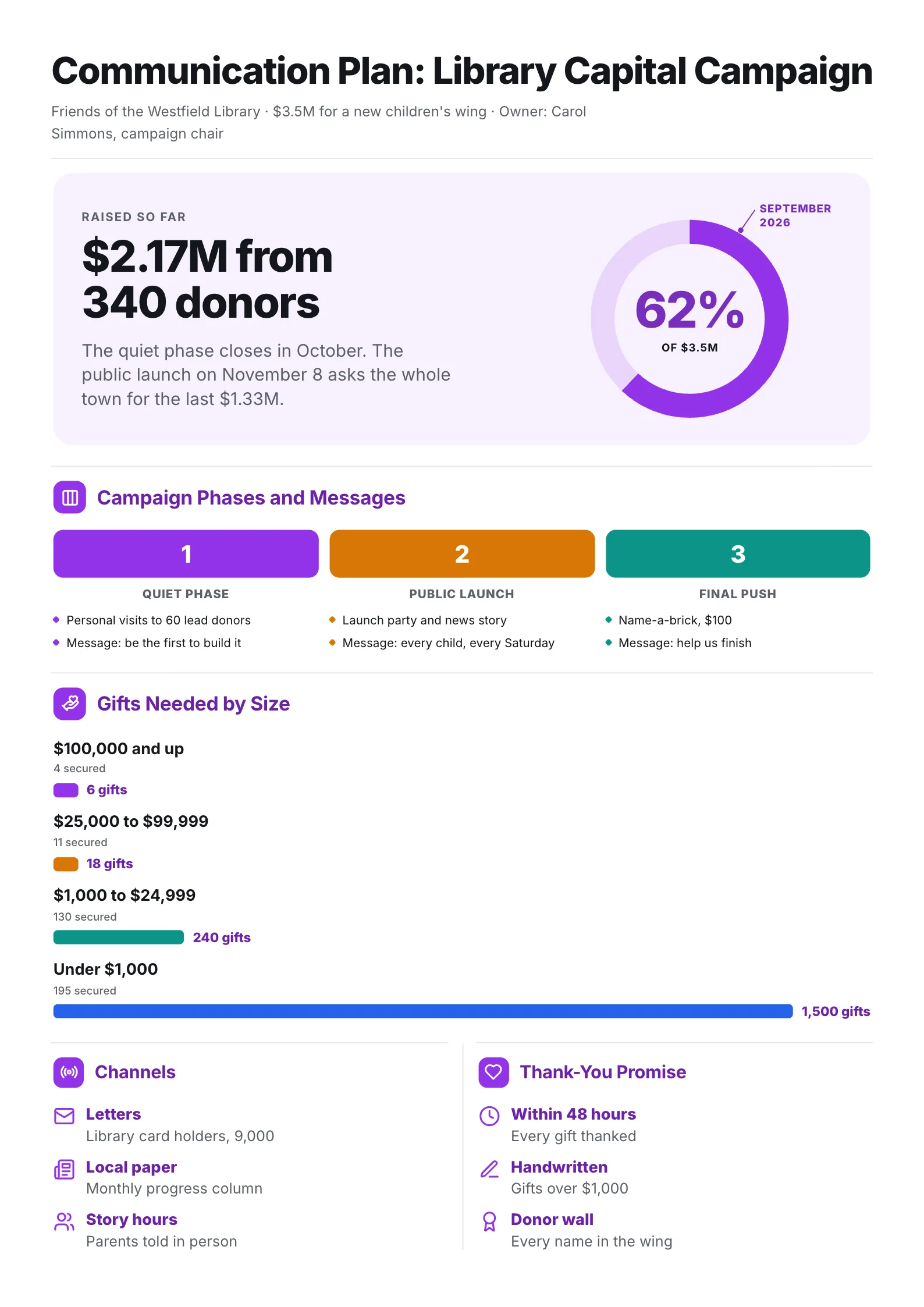 Communication Plan: Fundraising CampaignEdit for free(opens in a new tab)
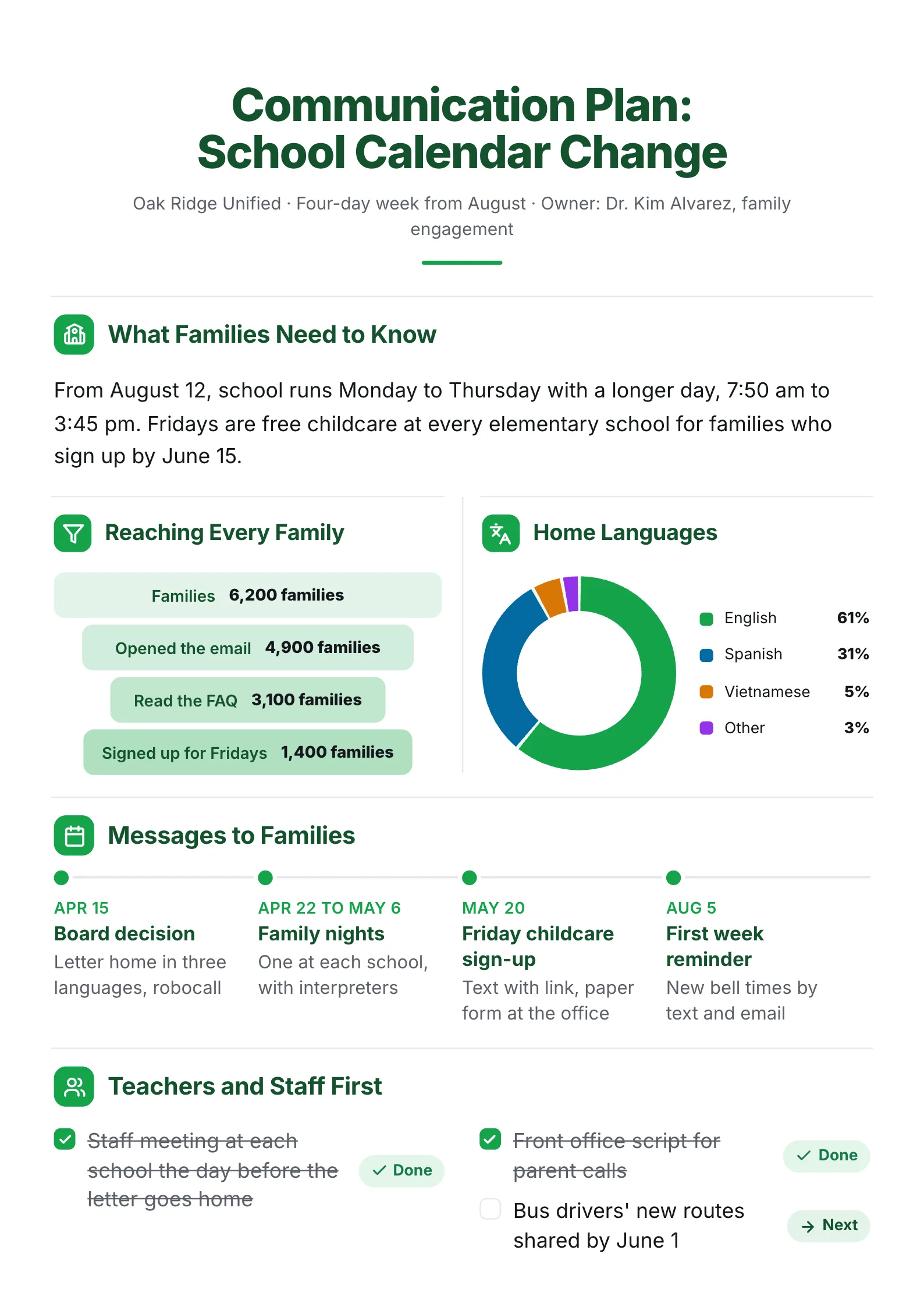 Communication Plan: School FamiliesEdit for free(opens in a new tab)
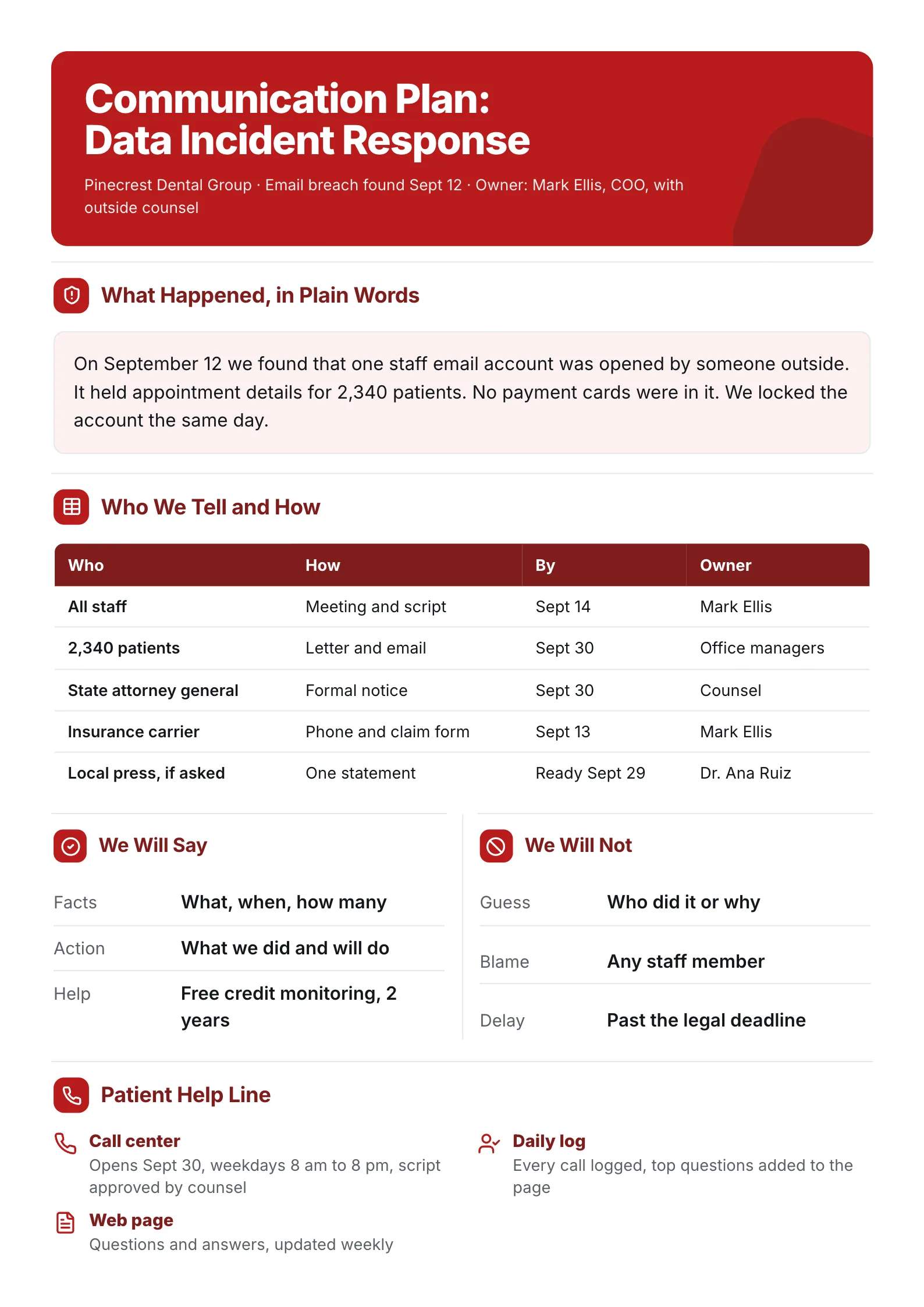 Communication Plan: Crisis and Data IncidentEdit for free(opens in a new tab)
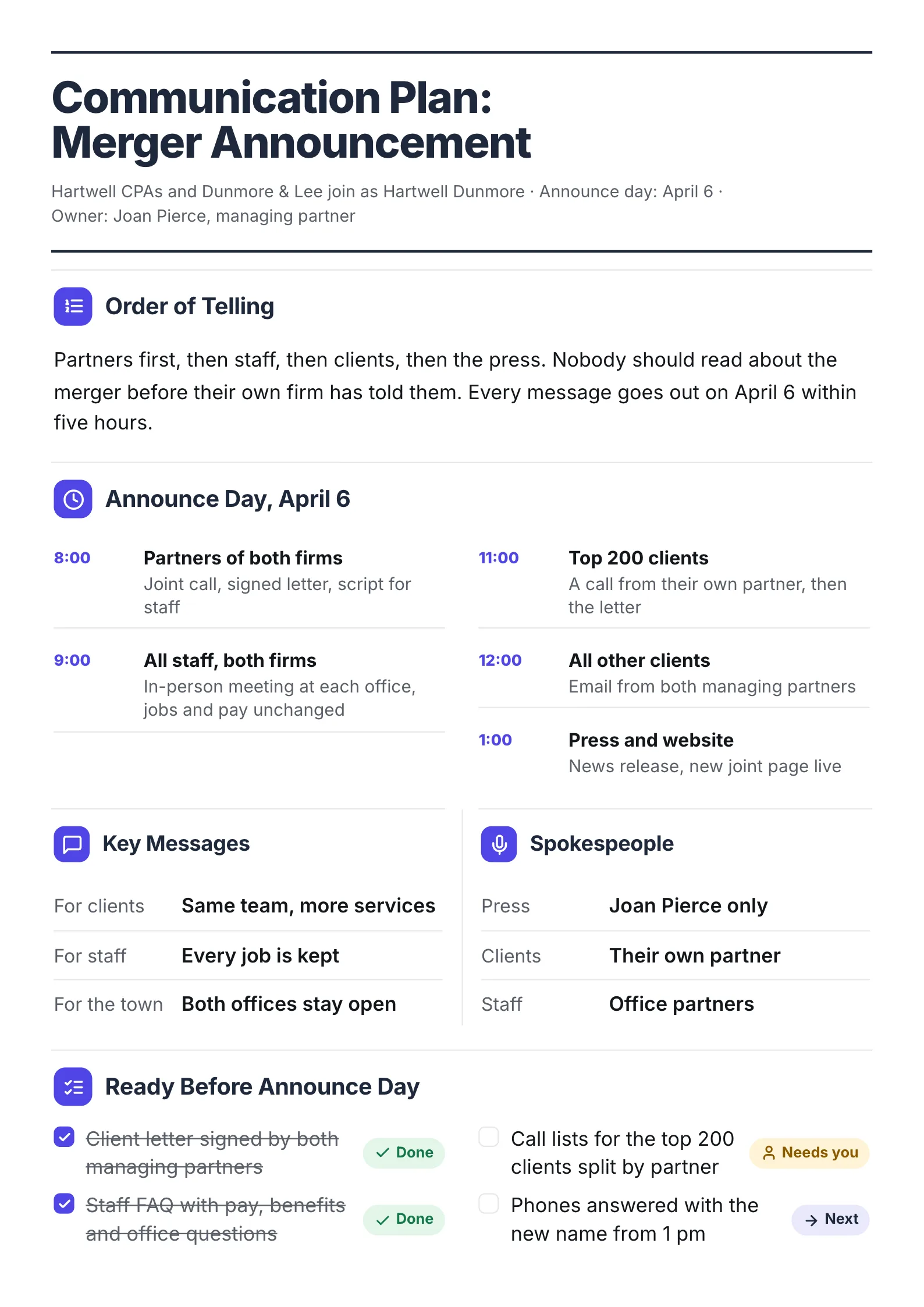 Communication Plan: Merger AnnouncementEdit for free(opens in a new tab)
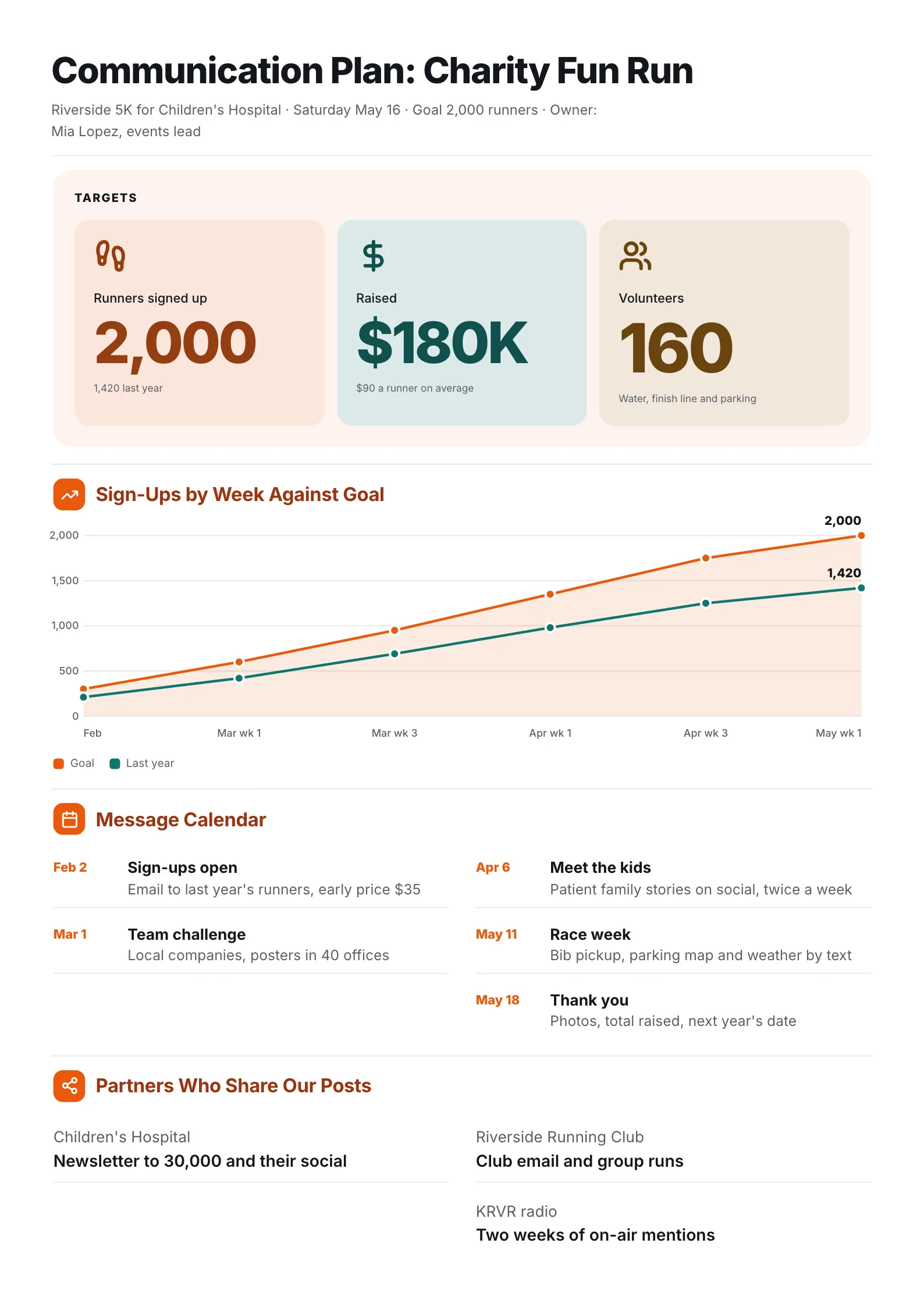 Communication Plan: Charity EventEdit for free(opens in a new tab)
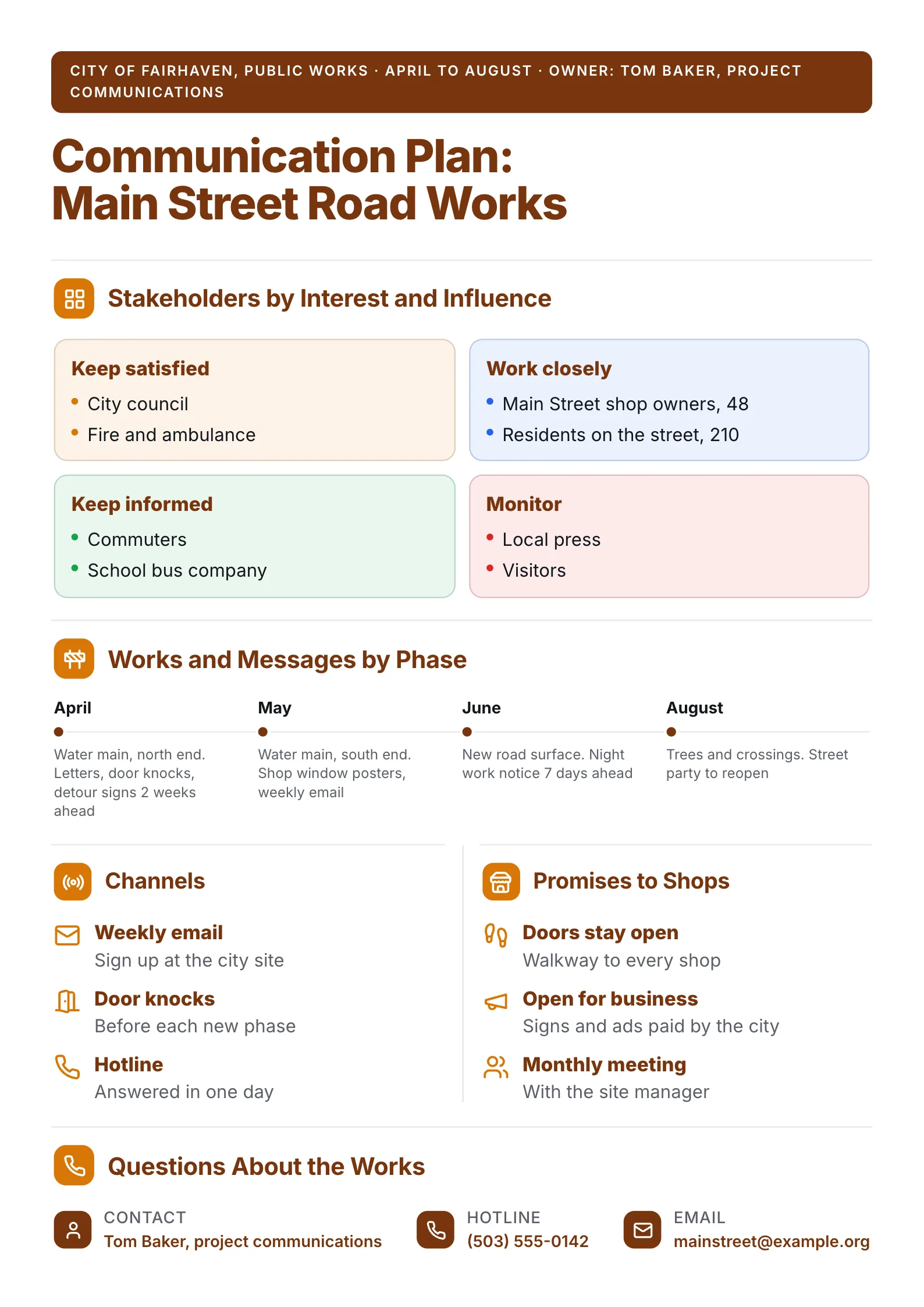 Communication Plan: Construction Project NeighboursEdit for free(opens in a new tab)
City halls make a good model. They talk to residents, businesses, staff and the press at once, and they publish their plans for anyone to read. Your plan may be for one project, like a new system or an office move. The same parts still apply, just smaller.
The 6 plans we read
On October 27, 2026, we searched for communication plans that US cities and counties posted as full documents. We read the 6 below that came up as PDFs. Two more turned up and wouldn't open: Cudahy, California's file refused our request, and Auburn, Maine's link was gone.
| Plan | Length | What it covers |
|---|---|---|
| Mountain House, California, drafted February 4, 2025 | 25 pages | The whole city, from press releases to emergencies |
| Madison, Wisconsin, Engineering Division, 2024 | 21 pages | One city division and its projects |
| Redmond, Washington, 2027 to 2028 | 21 pages | The whole city, with its own emergency section |
| Turlock, California, September 2025 | 80 pages | The whole city, plus a worksheet for each project |
| Morrisville, North Carolina, fiscal 2026 to 2029 | 23 pages | The town's communications department |
| Clackamas County, Oregon, 2026 | 44-page board packet | The county, presented to its board on June 10, 2026 |
What the 6 plans include
| What the plan includes | Plans that do |
|---|---|
| Goals for the plan | 6 of 6 |
| A list of audiences | 6 of 6 |
| The channels and tools it will use | 6 of 6 |
| What it will measure | 6 of 6 |
| Research done before writing it | 3 of 6 |
| Key messages written out word for word | 3 of 6 |
| A crisis plan that names who does what | 4 of 6 |
| A number to hit for at least one measure | 2 of 6 |
Source: MakeOnepagers.com read of 6 US city and county communication plans (Mountain House, Madison, Redmond, Turlock, Morrisville and Clackamas County), October 27, 2026.
Every plan covers the basics. The gaps show up in the parts that make a plan easy to check later, so the steps below spend the most time there.
Step 1: Find out what people already hear
Three of the 6 did research before they wrote a word. Mountain House reviewed its past press releases, website updates, social posts and newsletters, then sorted what it found into strengths, weaknesses, opportunities and threats. Turlock built its plan from interviews, focus groups, surveys and an audit of its digital channels. Clackamas County includes a situation analysis of its own.
You can do a small version in an hour. Read the last ten messages your team sent to your audience. Ask five people from each audience where they get their news from you. Note which channel they named most and what they say they never heard.
Step 2: Set a goal with a number
All 6 plans say what they'll measure: email open rates, website visits, social media reach, media mentions. Only 2 set a number to hit. Redmond aims to grow subscriptions to its City eNews by 2% a year. Its emergency alert system had nearly 900 sign-ups by the time the plan was written, and the goal is 1,200 in 2027. Madison's engineering website aims for zero broken links and for at least 75% of its pages to read at a fifth-grade level.
A measure without a number can't tell you whether your plan worked. So pick one or two results that matter, write today's figure next to each, and add the figure you want by a date. If you can't get today's number, make your first task finding it.
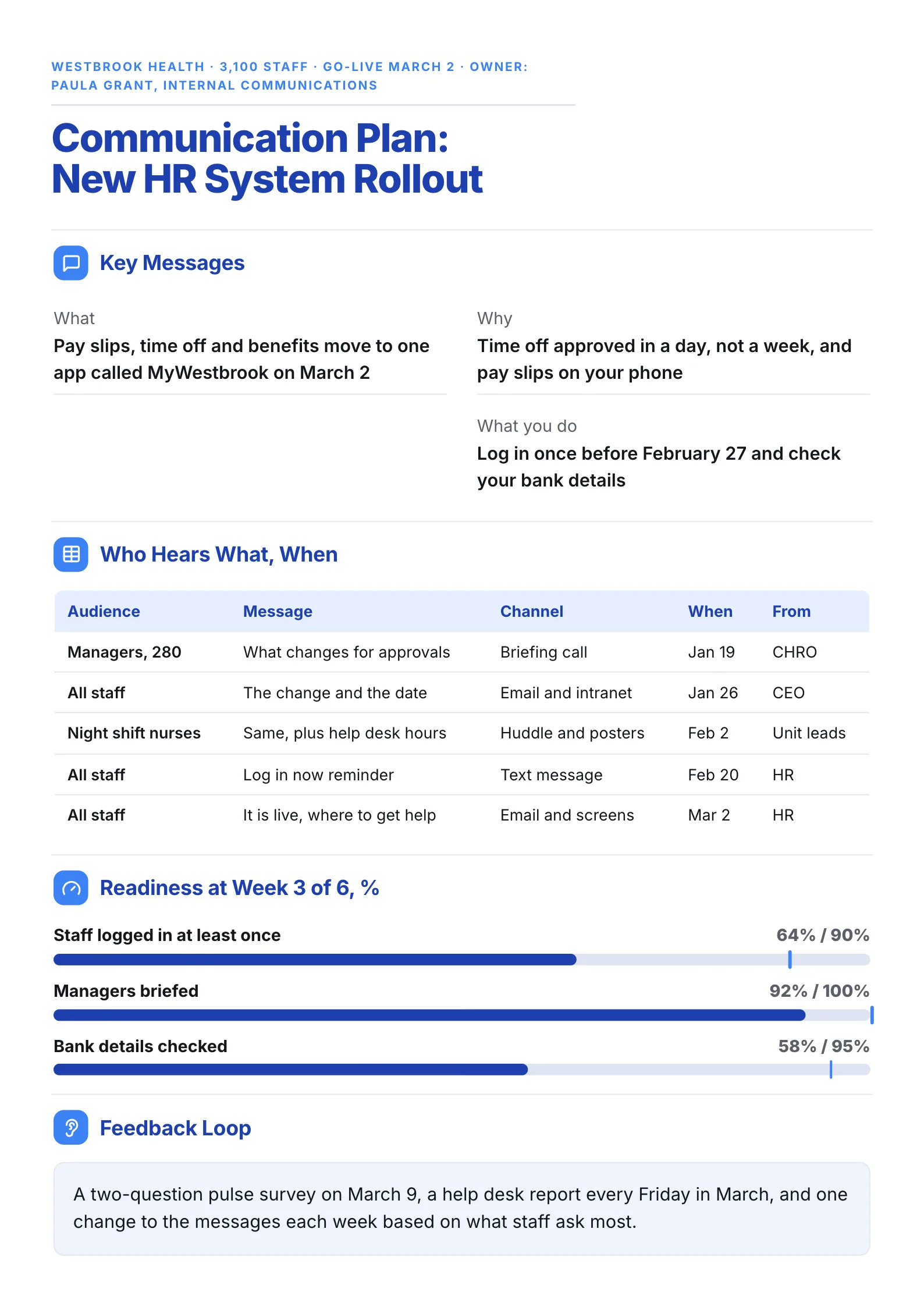 Edit this template
Sample names and figures. Each readiness bar shows today's figure against its target, such as 64% of staff logged in against a goal of 90%, so the team knows by week 3 whether the plan is working.
Step 3: Name every audience
All 6 plans list their audiences, and the best lists get specific. Madison's engineering team names neighbors of major project sites, contractors, companies that might bid and its own employees, not just "the public." Mountain House splits its list into primary audiences, who use city services directly, and secondary ones.
Do the same for your plan. Name each of your groups by what it needs from you, then put a count beside it if you have one. "Managers, 280" tells your team how big each send will be. Staff almost always belong on the list, because they hear questions first.
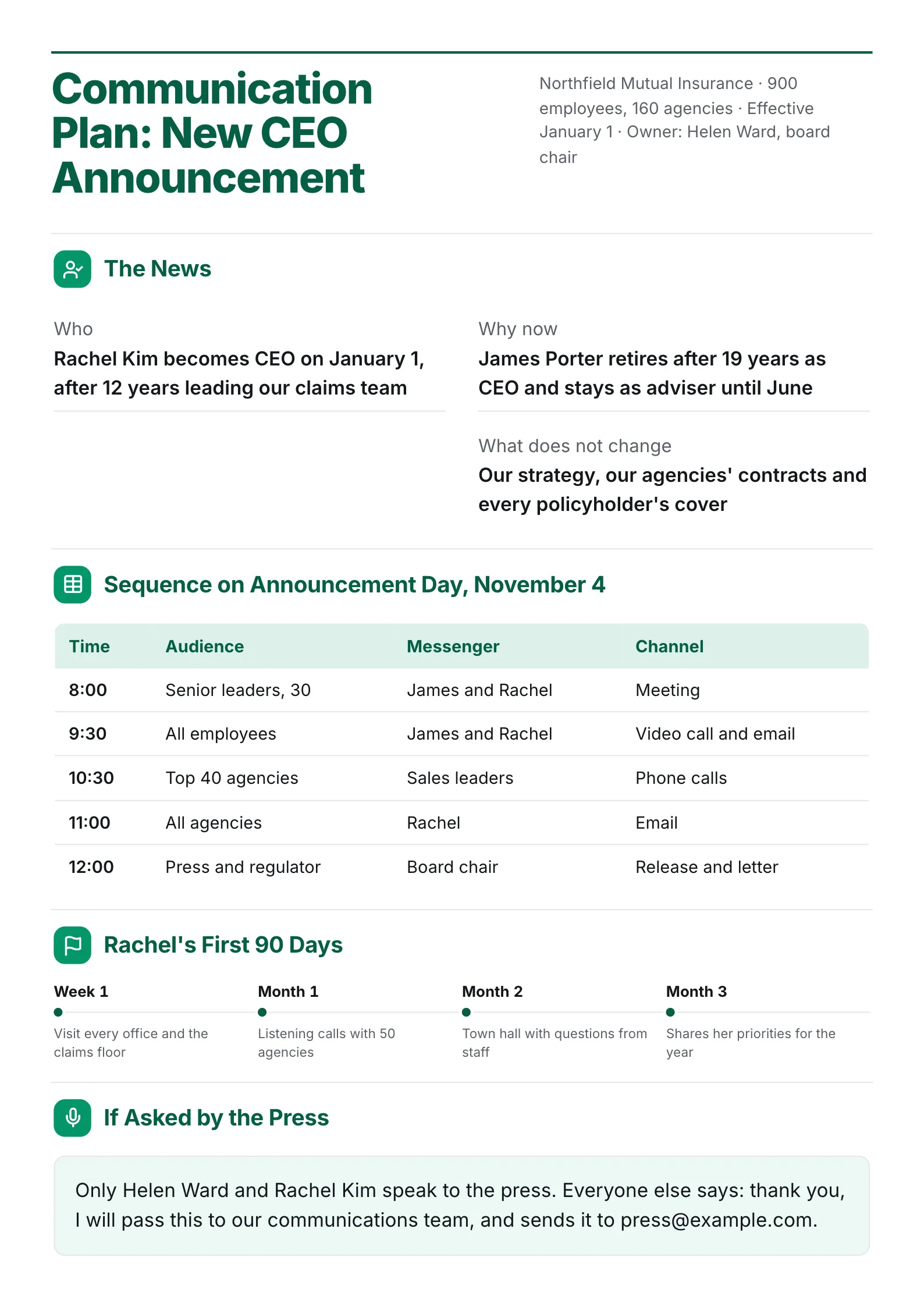 Edit this template
Sample names and figures. The announcement runs in order of who should hear first, from 30 senior leaders to every agency and then the press, so staff and agencies hear the news from the company before the press does.
Step 4: Write one to three key messages
Turlock's project worksheet says a project should have 1 to 3 key messages. Every piece of communication, it adds, should support at least one of them. Only 3 of the 6 plans write their own messages out in full. Clackamas County writes two numbered messages for each of its five priorities, each one a single sentence. Morrisville lists eight in one block, one for each town goal. Mountain House goes further and adds sample quotes that its staff can use word for word.
Write yours as full sentences someone could say out loud. Test each one by asking if a person who reads only that line would know what changes for them. Then reuse the same words in every email, post and meeting, so your audience hears one story.
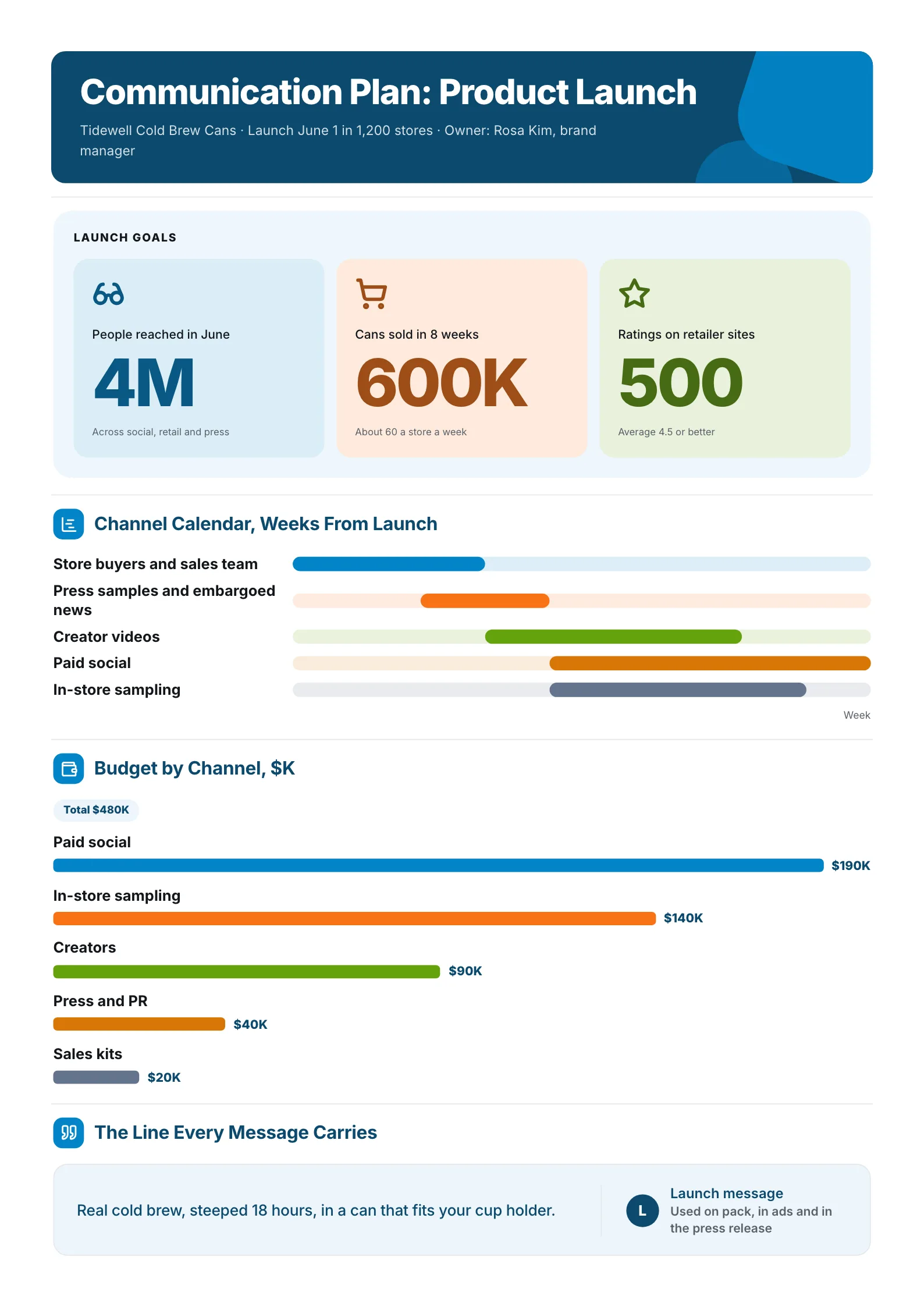 Edit this template
Sample names and figures. One line goes on the pack, in the ads and in the press release, and three goals with numbers sit above the calendar.
Step 5: Give each channel a date and an owner
All 6 plans list their channels, and Morrisville turns its list into a table. Each tool gets an estimated reach, how often it goes out, how much notice the team needs and what it's best for. Its Connection newsletter goes out twice a year and needs six weeks' notice. Turlock's worksheet asks for an implementation schedule with key dates and how often you'll send. Its planning steps also ask who will take the lead.
For your plan, a simple table works: who hears it, what they hear, which channel, which date and who sends it. Give every row one name. When a row has two owners, it often ends up with none. Add one line for cost too: what each channel costs and whose time it takes.
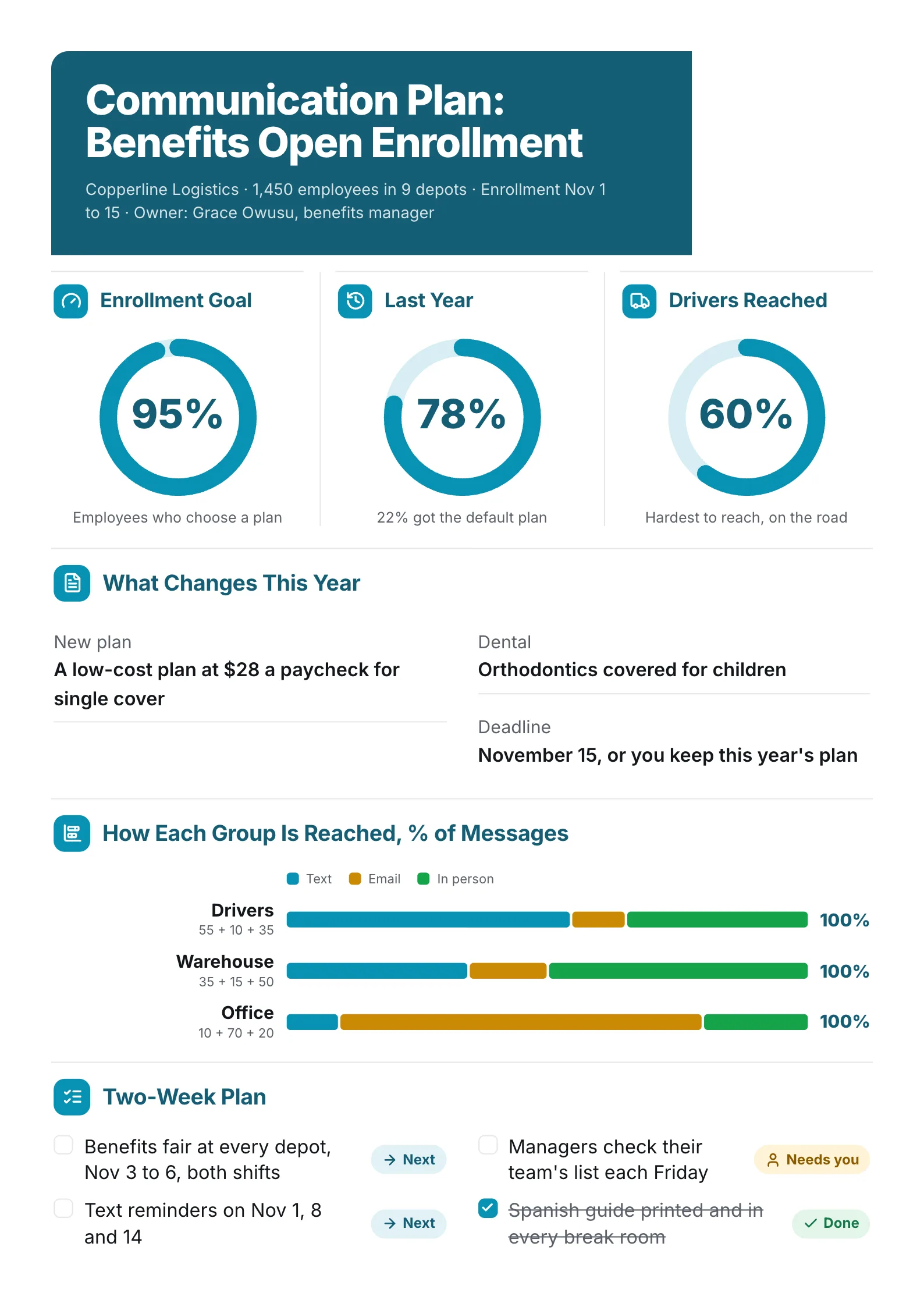 Edit this template
Sample names and figures. Drivers get most of their messages by text and the office mostly by email, because the plan matches each channel to where each group actually is.
Step 6: Plan what you'll say when something goes wrong
Four of the 6 plans name who does what in a crisis or emergency. Redmond's names the public information officer's duties and the tools it will use in an emergency. Turlock's crisis section sets out the roles and steps for sharing information promptly. Mountain House makes a crisis framework one of its five goals and names who sits on its crisis team. Madison's engineering plan says its public information officers represent every city agency in an emergency and share information from one place.
Your project probably won't face a flood. It can still face a delay, a leak or a wrong date in an email. Write down who speaks for you, who approves your words and how fast you'll answer, before you need it.
Step 7: Check in and change course
Turlock tells its staff to check their numbers during a project and to change tools that aren't working. Redmond reviews its social media every quarter and runs a community survey each year. Clackamas County plans a quarterly performance review. Set your own check-in date when you write your plan, and put it on the calendar with a name next to it.
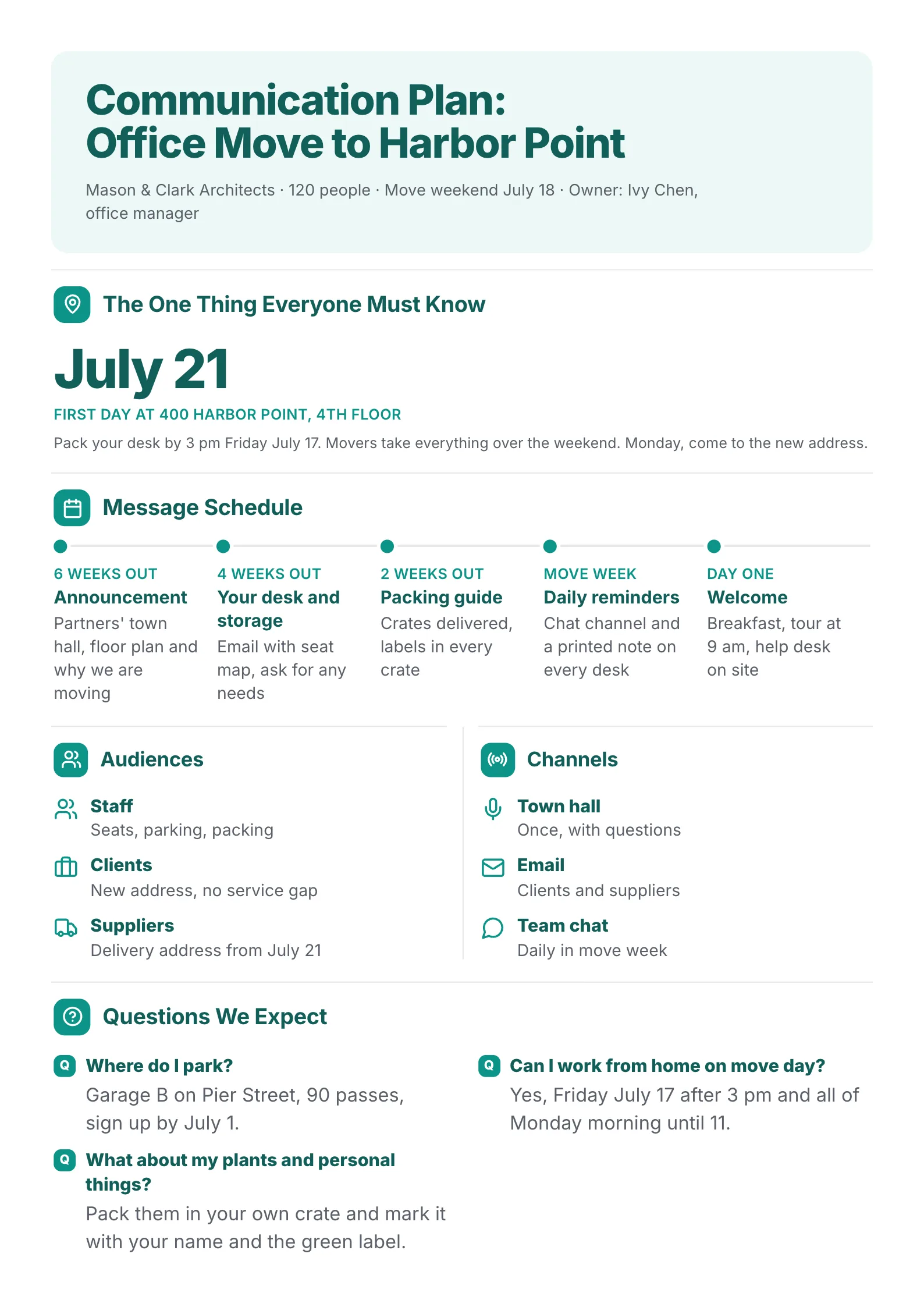 Edit this template
Sample names and figures. The Questions We Expect section answers parking, personal things and working from home before staff have to ask.
Fit your communication plan on one sheet
The 6 local plans run 21 to 80 pages, and most of them cover a whole city, town or county. Yours is probably for one project you lead. A one-sheet plan that your team will actually open has these parts, in this order:
| Part | What to write |
|---|---|
| Title line | The project, the date it starts and the owner |
| Goal | One or two results, each with today's number and a target |
| Audiences | Each group, with a count where you have one |
| Key messages | One to three sentences anyone can repeat |
| Who hears what, when | Audience, message, channel, date and sender, one row each |
| If something goes wrong | Who speaks, who approves and how fast you'll answer |
| Budget and resources | What it costs, who has time for it and which tools you'll use |
| Check-in | The date you'll review the numbers and who does it |
In Word or Google Docs, a table covers the who-hears-what part and a shaded box at the top holds your goal. In MakeOnepagers, the tables, timelines and number boxes come set, and your text resizes to fit one sheet. For more layouts, see our communication plan template post.
Questions people ask about communication plans
What should a communication plan include?
All 6 plans we read include goals, audiences, channels and what they'll measure. Add key messages written out in full, a number to hit, an owner for every send and a section on what to do when something goes wrong.
How long should a communication plan be?
For one project, one sheet is usually enough. The local plans we read run 21 to 80 pages, and most of them cover a whole city, town or county. Turlock still gives each project a worksheet that fits on a single page.
Who should write the communication plan?
Your project lead or communications lead usually writes it, with input from each group it covers. Turlock asks each project team to agree on roles and who leads before the plan is drawn up.
How often should you update a communication plan?
Check your numbers during the project and change what isn't working. Redmond reviews its social media every quarter, and a short project might need a weekly check.
Write your goal line first
Only 2 of the 6 local plans we read set a number to hit, so start your plan with that line. Write today's figure and the one you want by a date. Then open a communication plan design in MakeOnepagers, add your audiences and key messages, and give every send a name.




