Communication Plan Checklist: 12 Checks From 3 Published Lists and 6 Real Plans
A communication plan checklist built from 3 published lists and 6 public plans. All 6 name goals and audiences, yet only 2 set a number to hit.

Your communication plan checklist should ask who owns the plan, who hears what and when, what counts as success, and when you'll review it. We built the 12 checks below from three checklists that organizations publish for their own staff, plus our reading of six public plans. Start from a free one pager template.
One‑Pager examples
Real One-Pagers made with MakeOnepagers. Open any one to edit it as your own.
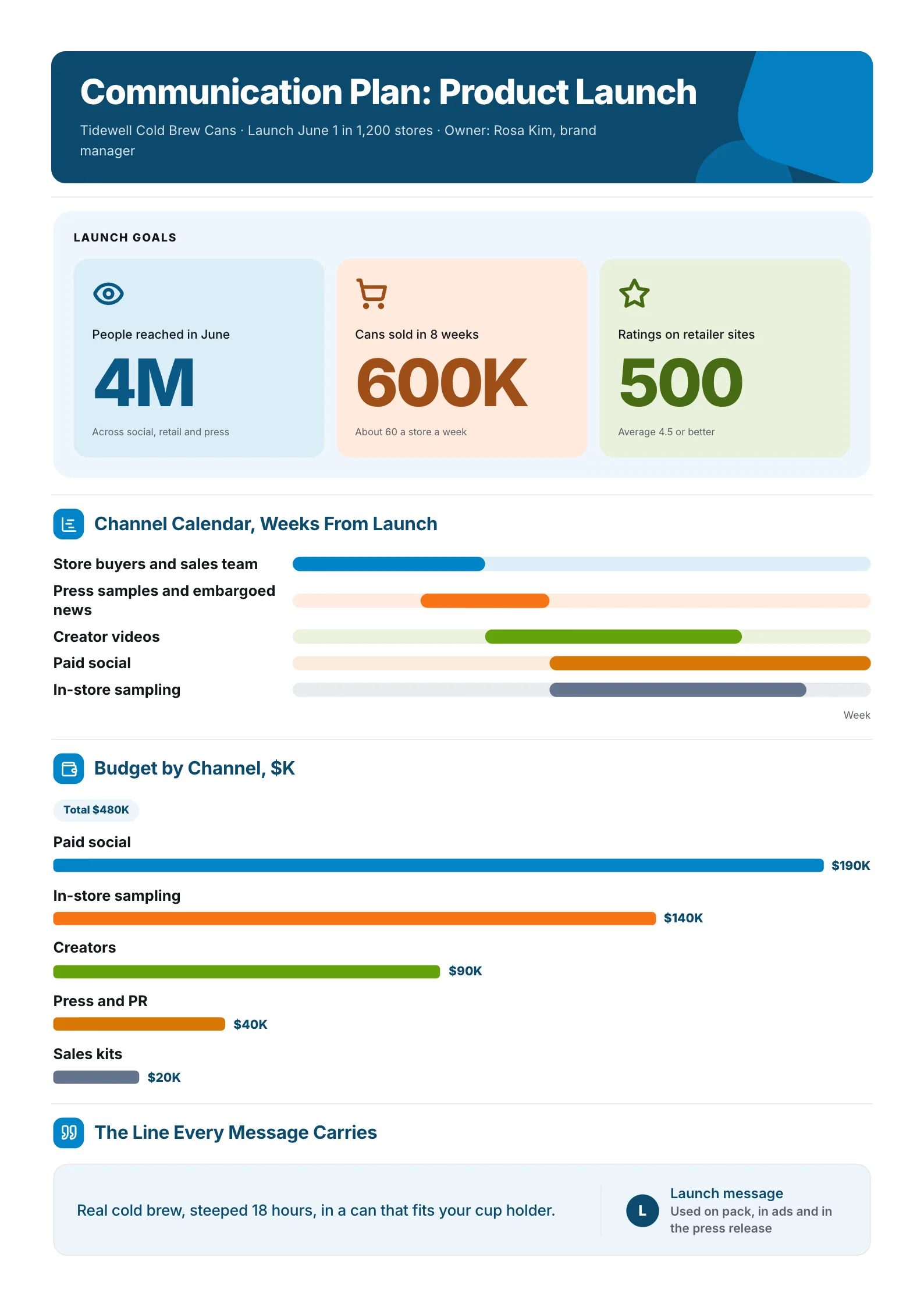 Communication Plan: Product LaunchEdit for free(opens in a new tab)
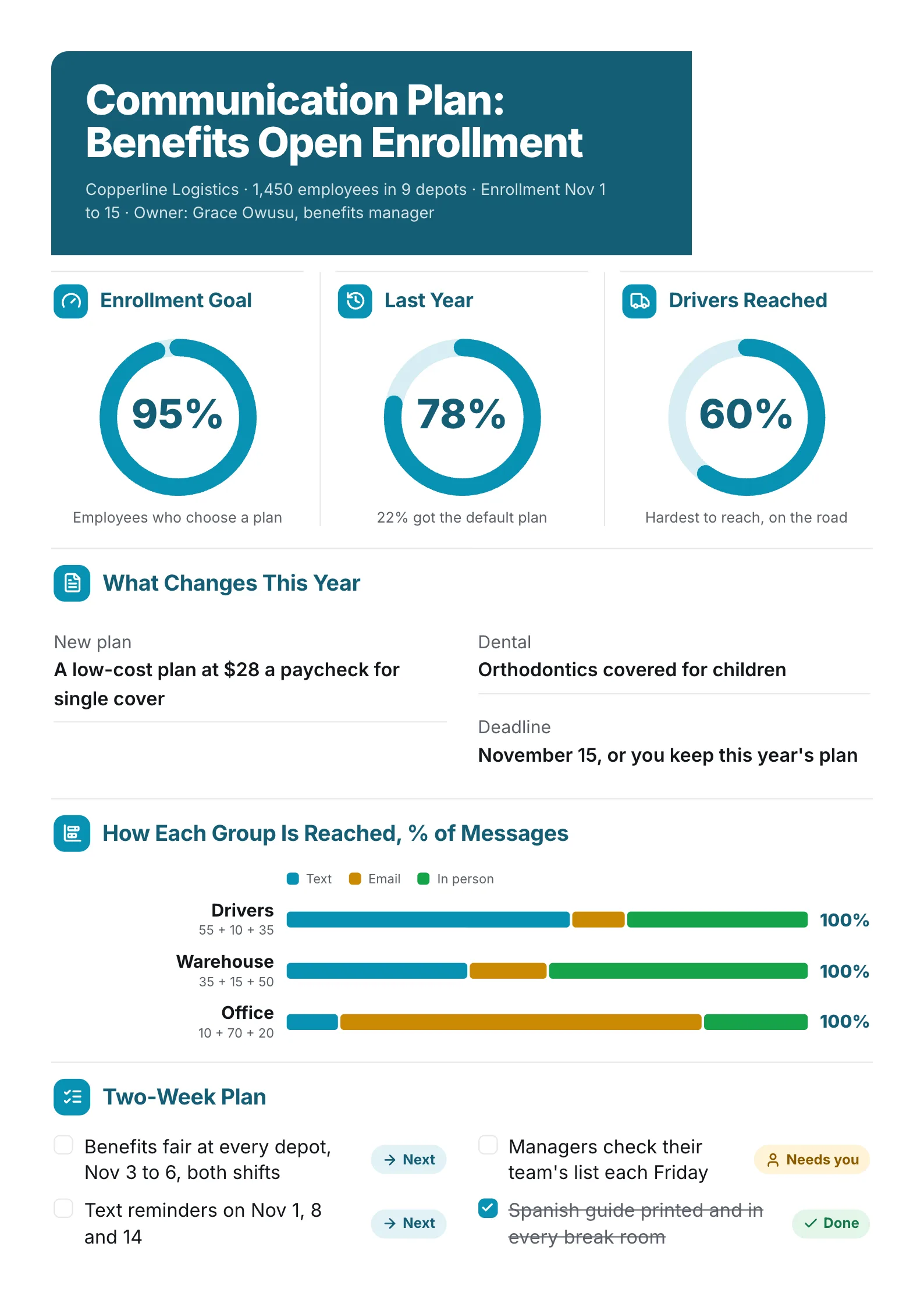 Communication Plan: Benefits EnrollmentEdit for free(opens in a new tab)
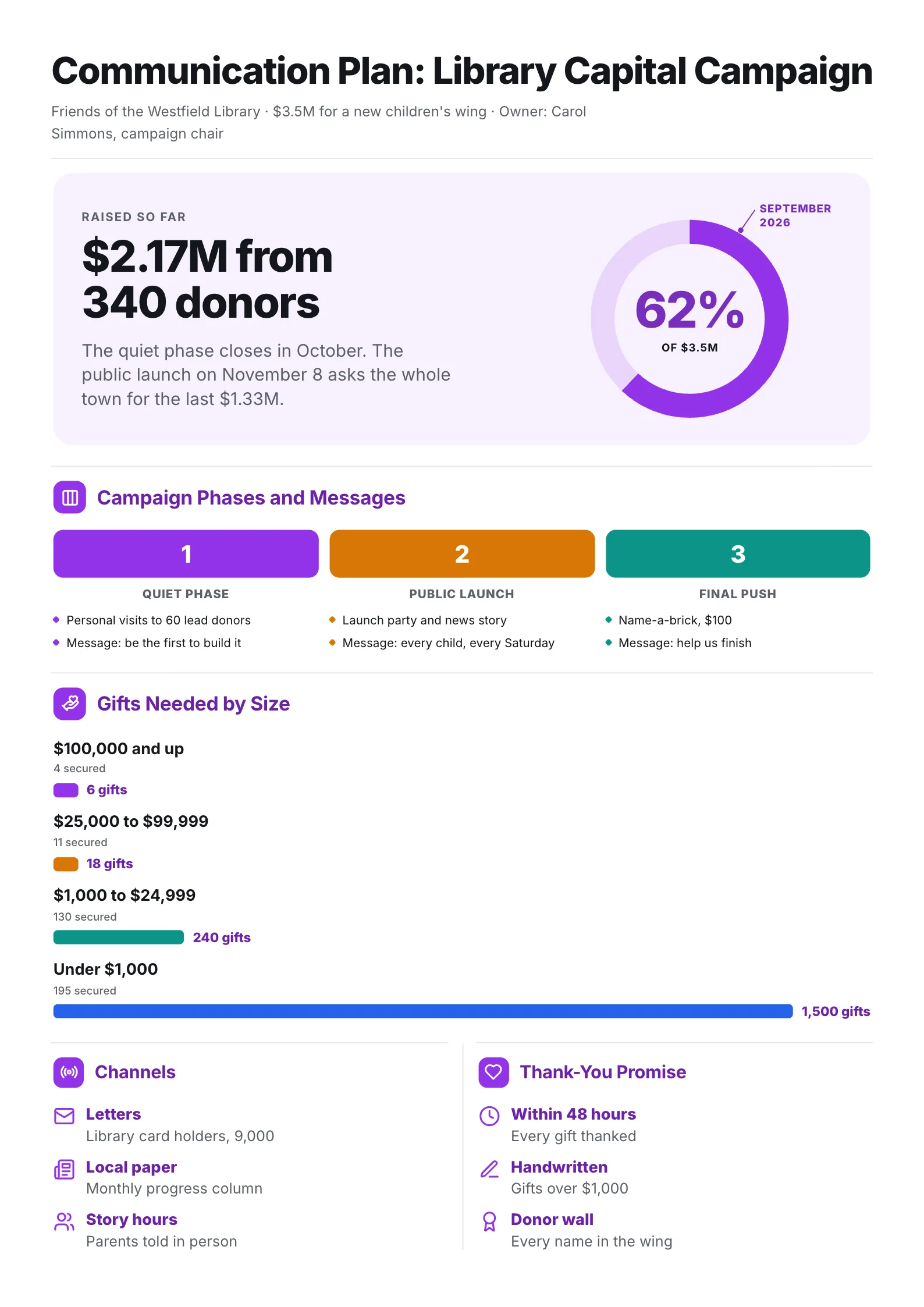 Communication Plan: Fundraising CampaignEdit for free(opens in a new tab)
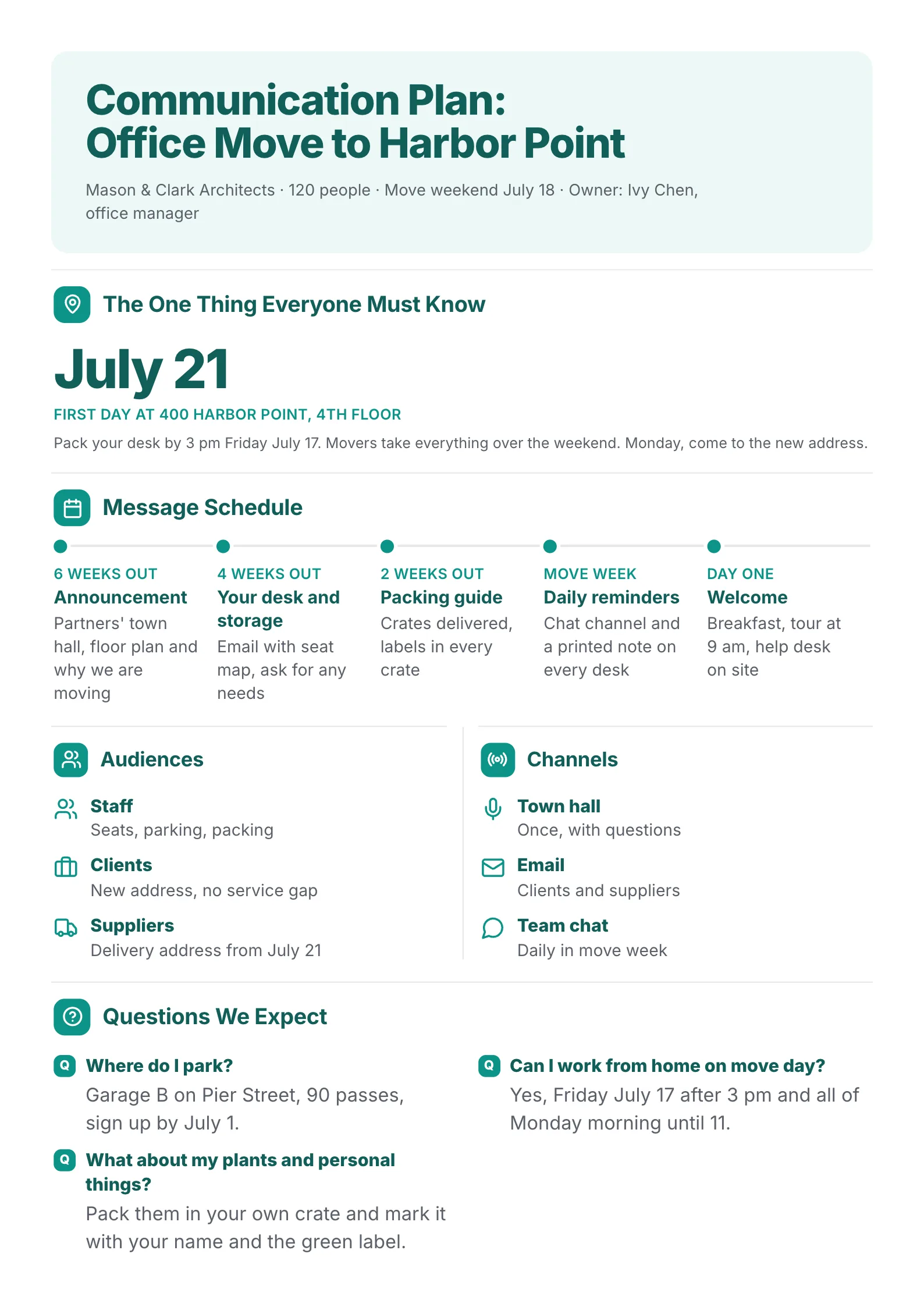 Communication Plan: Office MoveEdit for free(opens in a new tab)
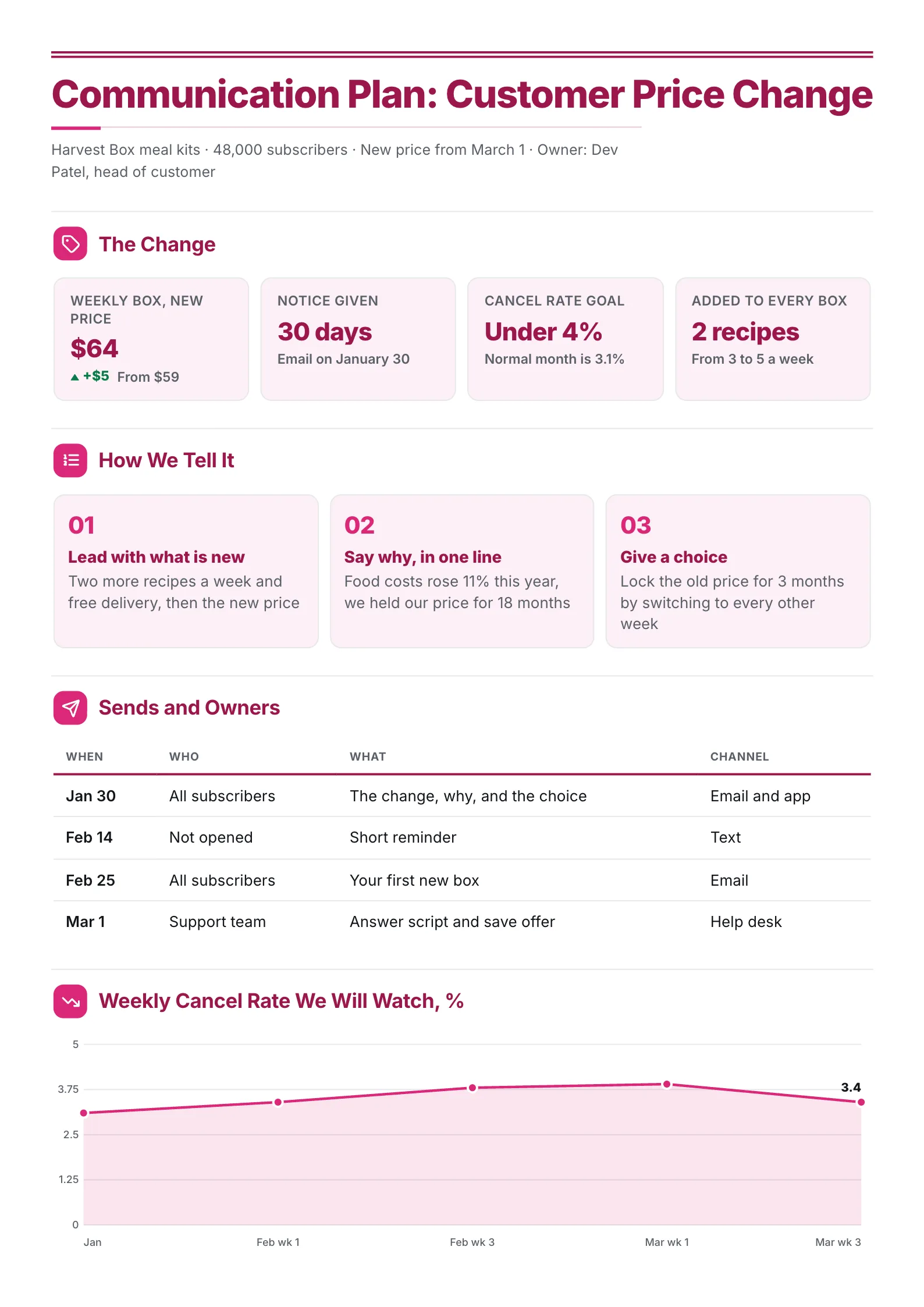 Communication Plan: Customer Price ChangeEdit for free(opens in a new tab)
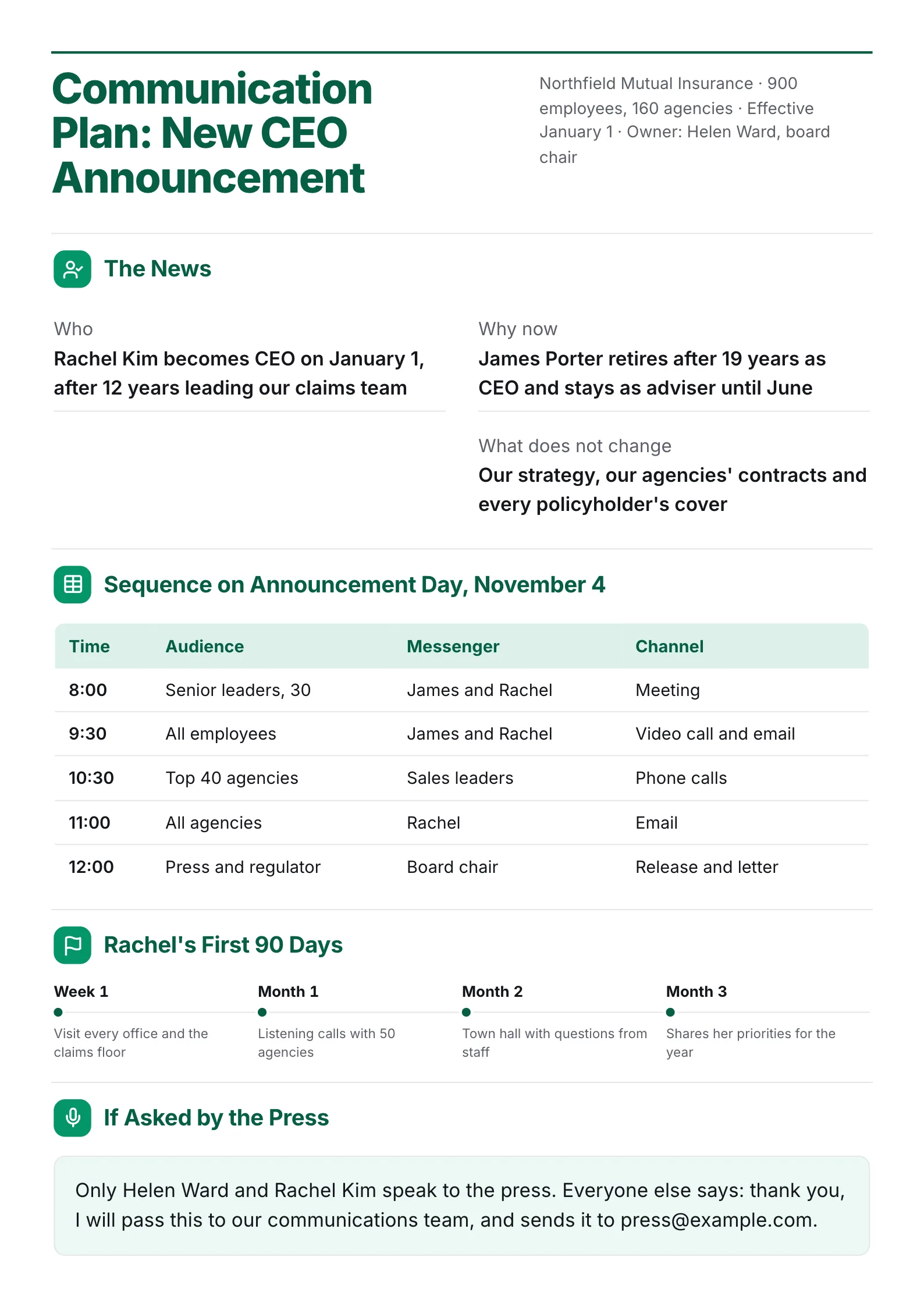 Communication Plan: Leadership ChangeEdit for free(opens in a new tab)
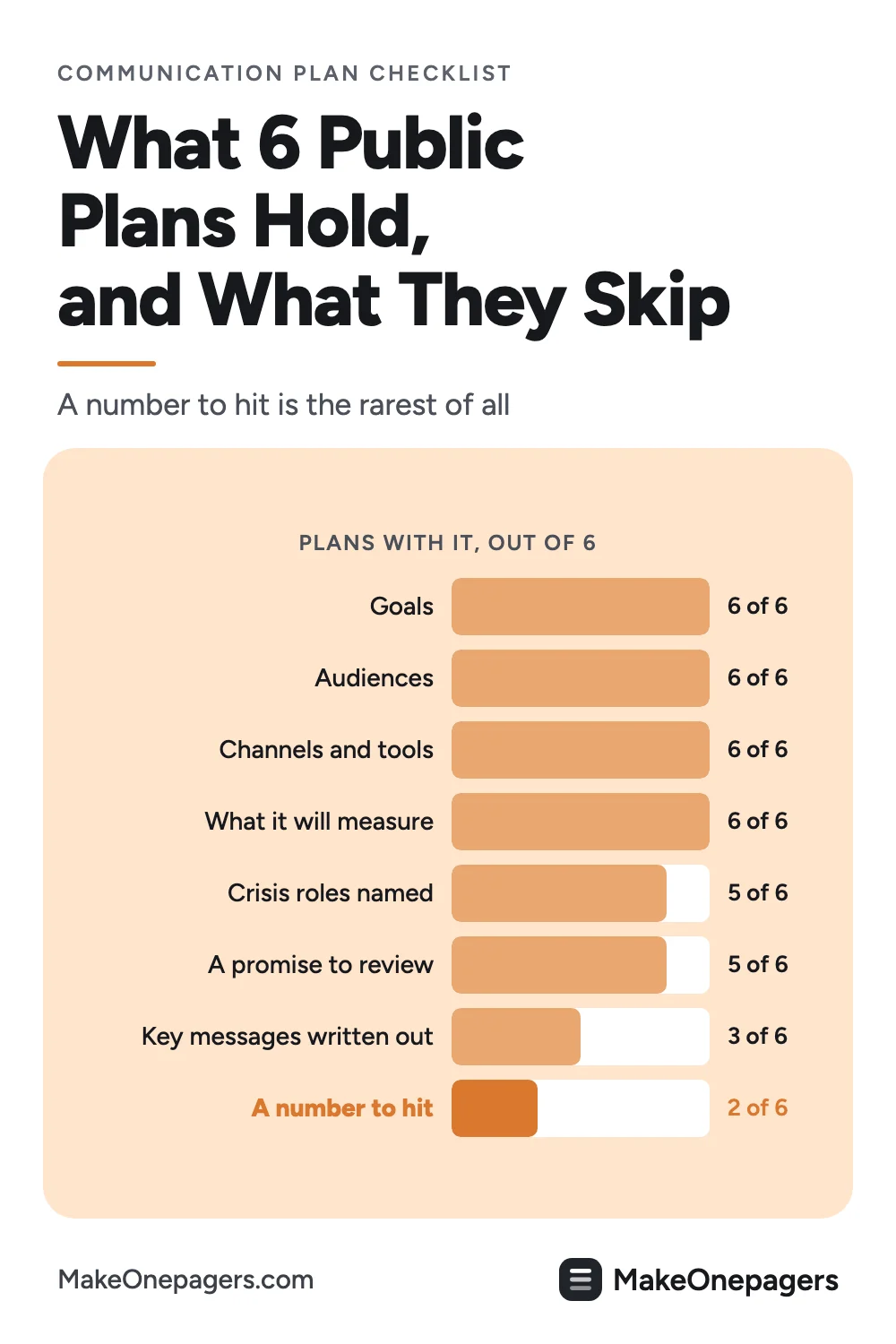
Those plans did well on the parts you'd expect. All six name goals, audiences, channels and measures, yet only three write out their messages and only two set a number to hit. So run the whole list before you send a plan around, and pay extra attention to checks 3 and 4.
The 12 checks to run on your plan
Who is responsible
- 1. One owner. A named person keeps the plan and answers for it.
- 2. A current contact list. Every stakeholder is listed, and you've confirmed how each one prefers to be reached.
What you're saying
- 3. A goal with a number. You could say on a set date whether you hit it.
- 4. Messages written out. One to three lines, in the words you'll really use.
Who hears it, and when
- 5. A channel for each audience. Night shift staff may need something different from office staff.
- 6. A date and a sender for each message. "Early in the project" doesn't count.
- 7. An order of telling. People close to the news hear before the wider public.
Who can speak and approve
- 8. Spokespeople and a crisis line. You've decided who talks to the press and who takes over when something goes wrong.
- 9. An approver with a turnaround time. Drafts don't sit waiting in someone's inbox.
How it stays alive
- 10. The plan has been shared. Your team and key stakeholders have a copy.
- 11. Regular meetings. The date and the format are set.
- 12. A review at each phase. Feedback gets tracked, and the plan is updated and sent out again.
Where the 12 checks come from
Each published list was written for a different job, and none of the three covers everything you'll need. That's why your list should combine them.
| Published checklist | Written for | What it adds |
|---|---|---|
| Cornell University, Project Communication Plan Checklist, 10 boxes | Campus building projects | Checks 2, 10 and 12 |
| EvaluATE, Communication Plan Checklist, 4 decisions | Grant project teams and evaluators | Checks 1, 9 and 11 |
| Australian Maritime Safety Authority, Communication Plan advisory, 29 question lines | Marine oil spill response | Checks 1, 8 and 10 |
Cornell's list asks you to confirm that contact details are current and to "review, update, and redistribute" the plan at each phase. EvaluATE tells teams to meet at least monthly and not to rely on email for those talks. The maritime advisory opens by asking who coordinates the plan, then spends most of its length on radios and phones, because a spill response can lose power and signal.
How 6 public plans score
We read each plan's own text and marked what it holds, so you can compare yours row by row. The sample is small and comes from public bodies, so treat these counts as a look at real practice, and don't read them as a national rate.
| What the plan holds | Plans with it |
|---|---|
| Goals | 6 of 6 |
| Audiences | 6 of 6 |
| Channels and tools | 6 of 6 |
| What it will measure | 6 of 6 |
| Crisis roles named | 5 of 6 |
| A promise to adjust or review | 5 of 6 |
| Key messages written out | 3 of 6 |
| A number to hit | 2 of 6 |
The six are Mountain House, California, Madison, Wisconsin's engineering division, Redmond, Washington, Turlock, California, Clackamas County, Oregon and the Texas Department of Transportation's I-35 Waco plan.
Redmond passes check 3 in a way you can copy. It wants City eNews subscriptions up 2% a year and emergency alert opt-ins at 1,200 in 2027. Madison wants at least 75% of its website at a 5th grade reading level. TxDOT shows the more common pattern: 7 goals and 12 objectives, most of them built on words like "timely" that nobody can score at the end of the project.
Check 4 can trip you up on a long plan too. Turlock's plan runs 80 pages, and its worksheet tells each project to have 1 to 3 key messages, then leaves those lines blank for each project team.
Five sample plans, and the checks each one passes
These samples, made with MakeOnepagers, use invented organizations. Look at how little room a check needs once you've made the decision behind it.
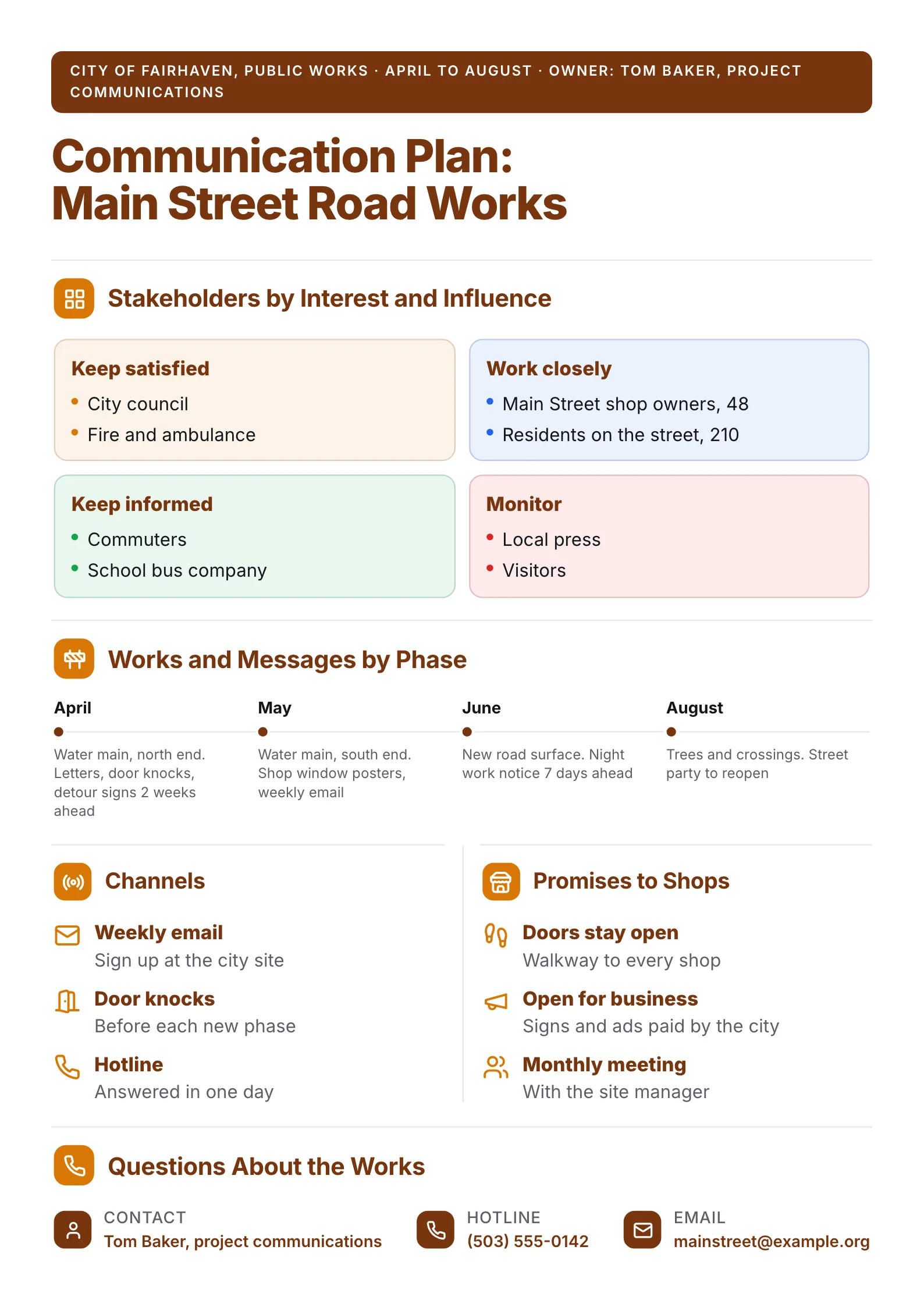
Checks 1 and 6: the owner and the dated phases
The Main Street road works plan puts its owner, Tom Baker, in the top line and again in the contact box. Each phase names its notice: detour signs go up 2 weeks ahead, and night work gets 7 days' warning.
 Edit this template
Shop owners sit in the "work closely" box, with their number beside them: 48.
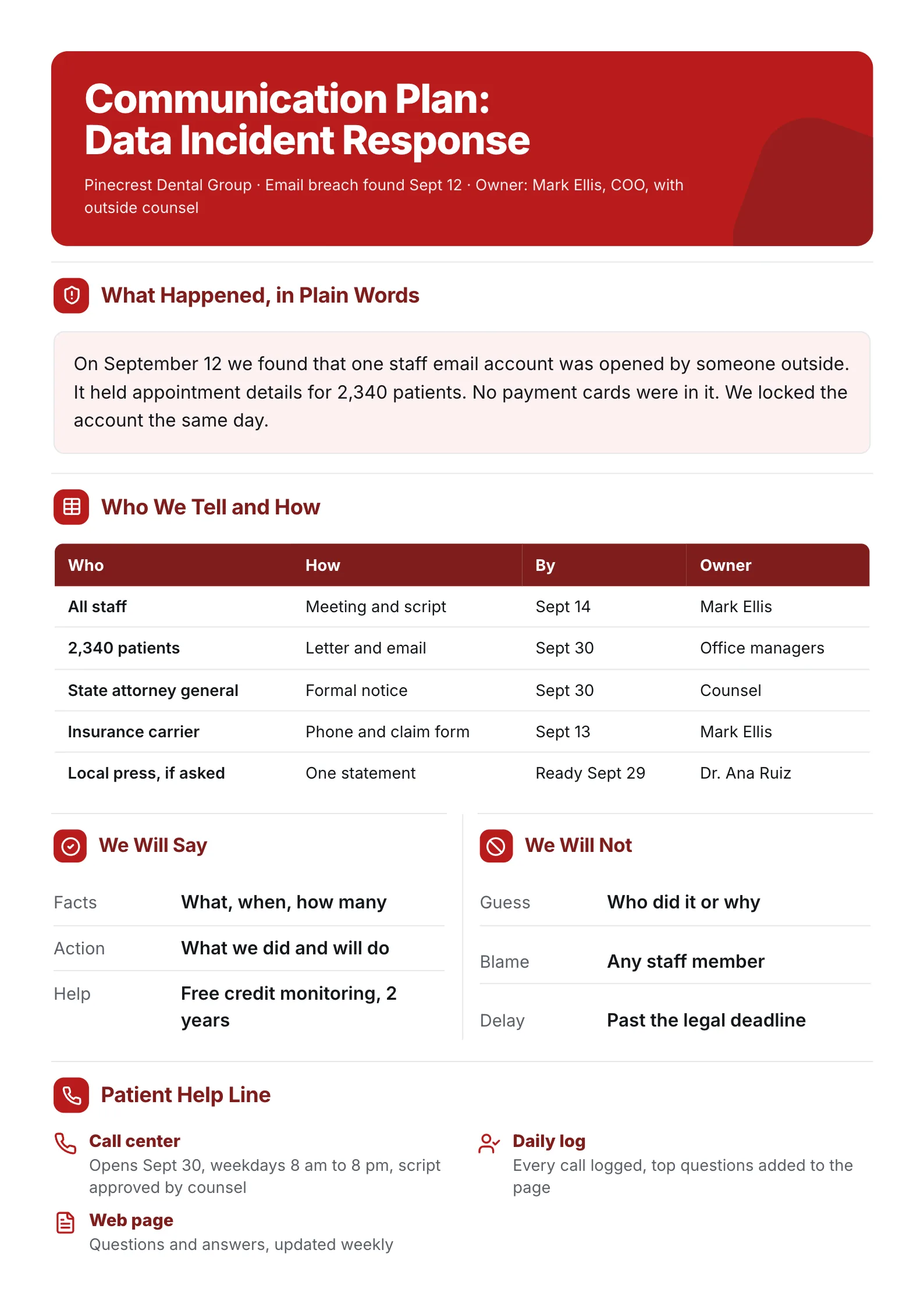
Check 8: who says what when it goes wrong
A dental group's data incident plan gives every audience a deadline and an owner. Then it lists what the group will say and what it won't, including no guessing about who did it.
 Edit this template
Dr. Ana Ruiz handles the press, and a statement is ready before anyone asks.
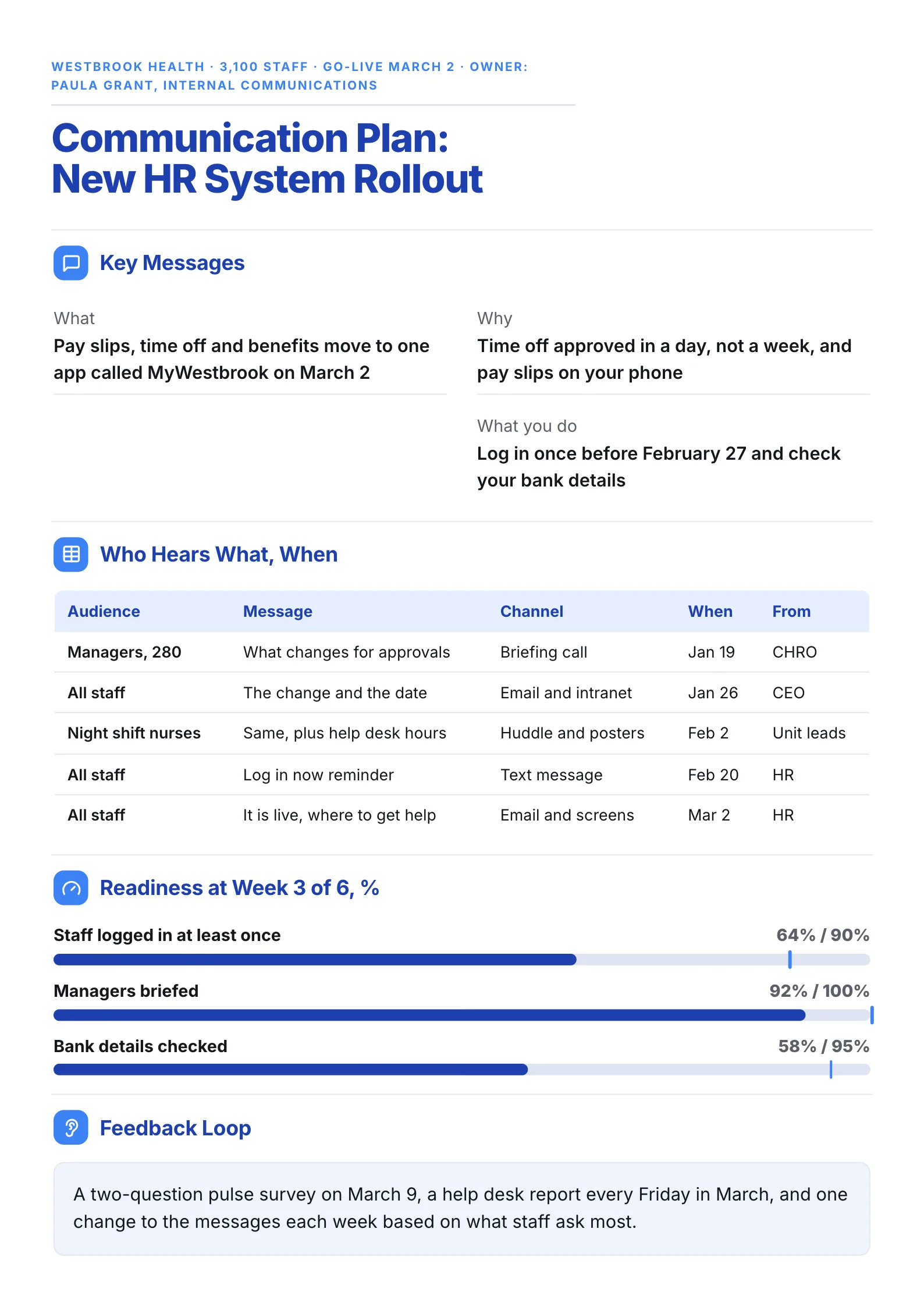
Checks 3, 4 and 12: messages, numbers and a feedback loop
An HR system rollout passes three checks in one sheet. Its key message tells staff what to do: log in once before February 27 and check your bank details. Readiness bars then track that request, with 64% logged in against a target of 90%.
 Edit this template
"One change to the messages each week" turns feedback into a habit.
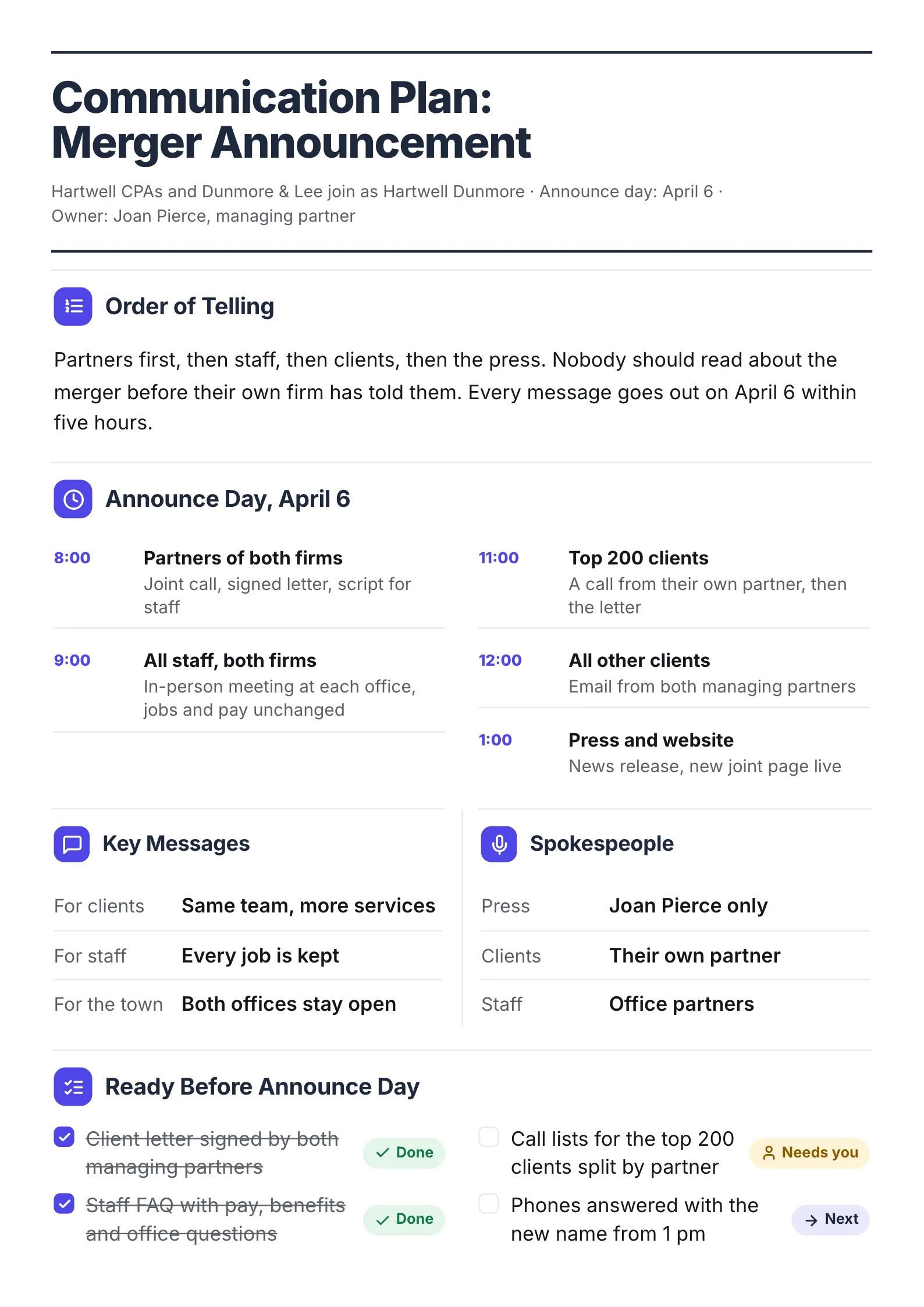
Checks 7 and 8: the order of telling
Two accounting firms announcing a merger give the order in one sentence: partners, staff, clients, then the press. The day runs from 8:00 to 1:00, and Joan Pierce is the only person who talks to reporters.
 Edit this template
A short checklist at the foot shows you what's done and what still needs an owner.
Check 3: a target you can watch
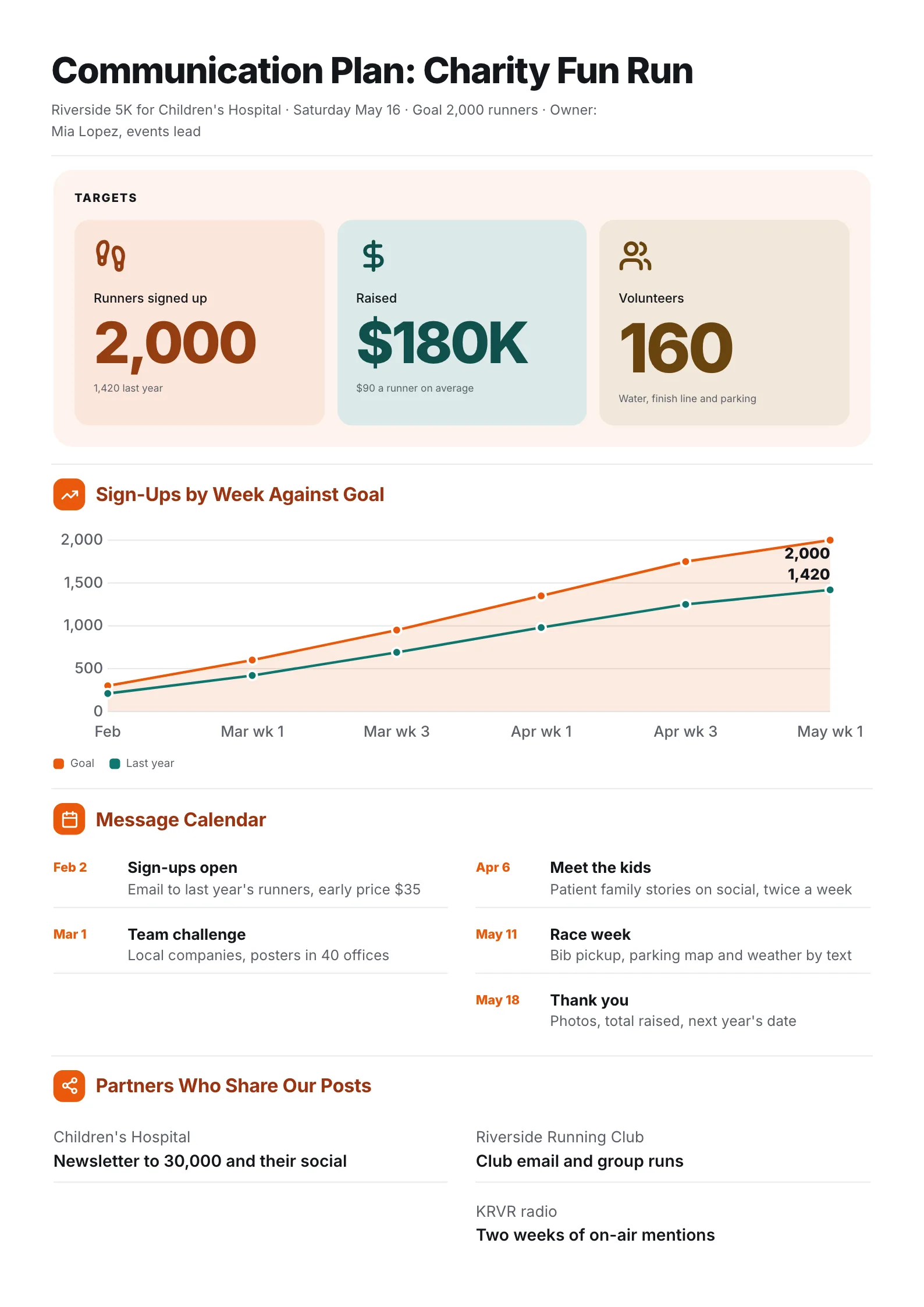
A charity fun run sets numbers everyone can follow: 2,000 runners, $180K raised and 160 volunteers. Its chart compares sign-ups by week with last year, so you'd spot a slow March while there's time to act.
 Edit this template
You could copy its five dated messages, from sign-ups opening to a thank you two days after the race.
Start with the two checks most plans miss
Before you format anything, write your three message lines and one number you could check on a set date. If you can't write them yet, the plan isn't ready, however complete the other ten checks look.
Frequently asked questions
What should a communication plan include?
At minimum, include an owner, your goals, audiences, messages, channels, dates and a way to measure results. Our guide on how to write a communication plan walks through each step using local government plans.
How long should a communication plan be?
The six plans here run from 21 to 80 pages, because they cover a whole city or a multi-year road project. If you're planning one change or one event, a single sheet can hold every check. Start from a communication plan template.
How often should you update a communication plan?
Review it at each project phase, as Cornell's list says, and after any surprise. Redmond reviews its social media quarterly, and TxDOT says its plan will be revised throughout construction.
Is a communication plan the same as a stakeholder map?
They're different documents. A stakeholder map shows you who matters and how much, while your plan says what each of those people hears, from whom and on what date.




