Budget Format: Pick the Layout That Matches the Day You Get Paid
Pick a budget format that fits how you're paid: 50/30/20, zero-based, per paycheck, monthly or yearly, each on one page, beside 2025 federal spending data.

A monthly table doesn't help when your rent is due before your second paycheck lands, and a paycheck plan won't remind you about the car insurance bill in March. Picking the right budget format means matching the page to how money actually reaches you. Start from a free one pager template.
One‑Pager examples
Real One-Pagers made with MakeOnepagers. Open any one to edit it as your own.
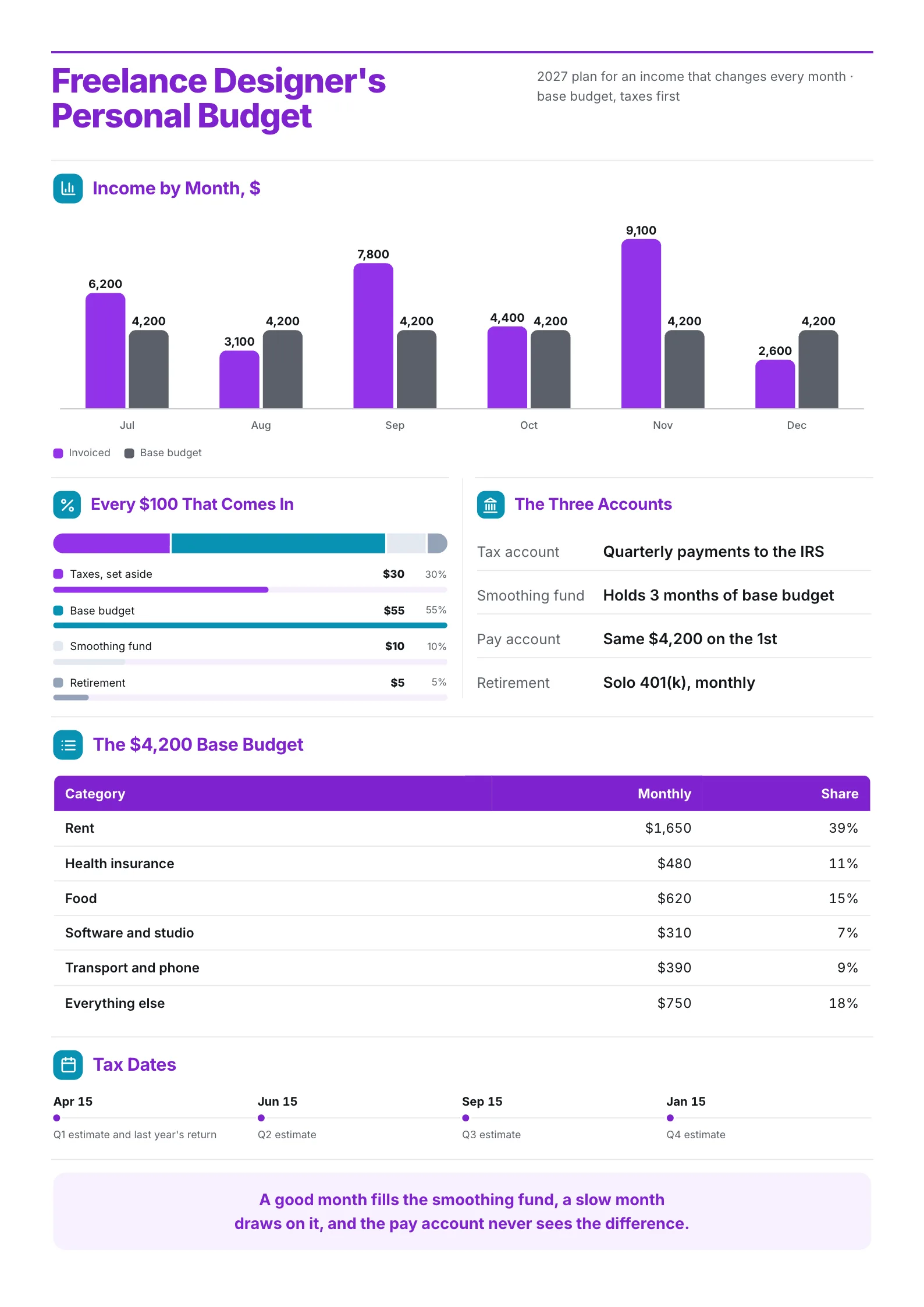 Personal Budget: Freelancer Uneven IncomeEdit for free(opens in a new tab)
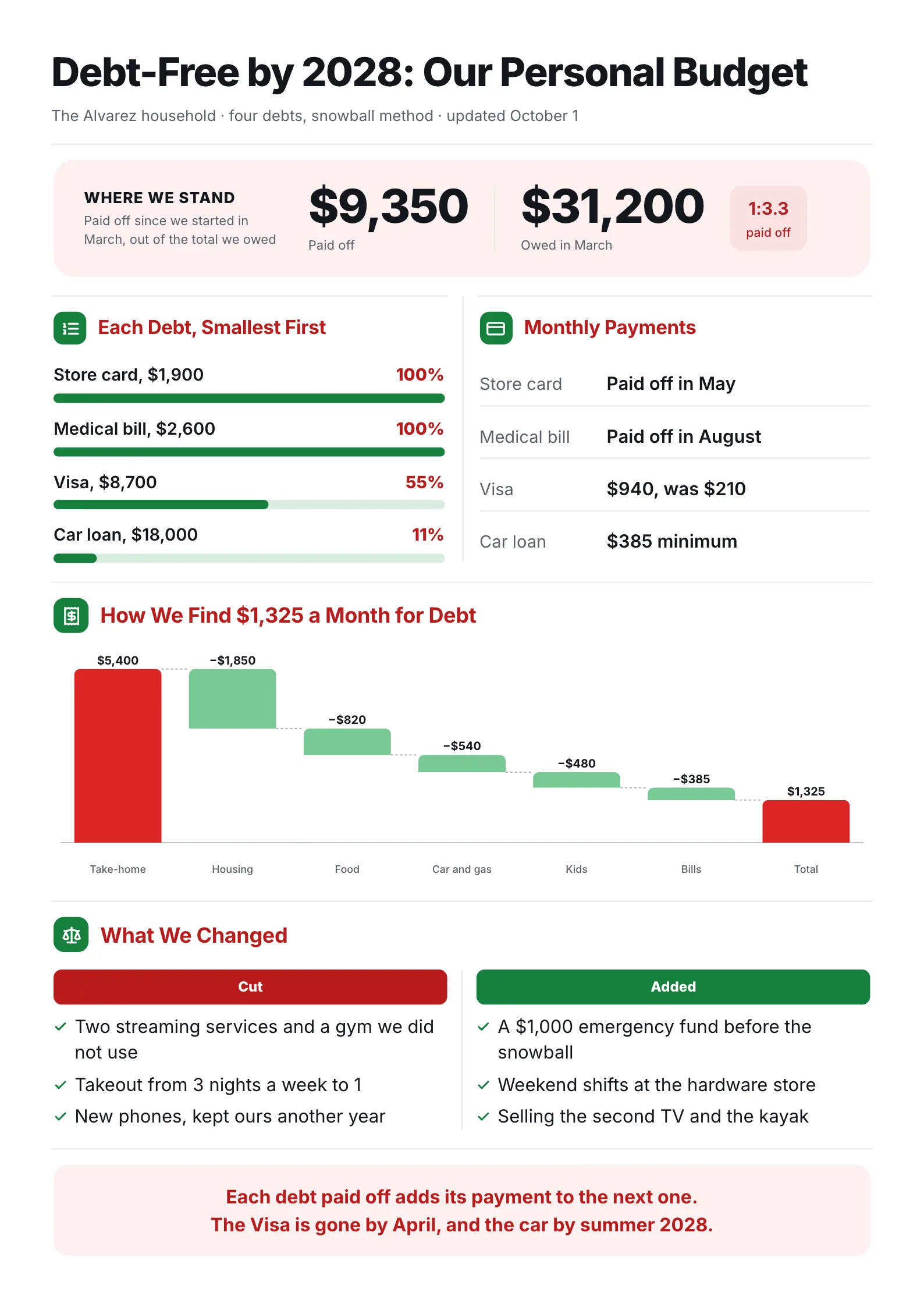 Personal Budget: Debt Payoff SnowballEdit for free(opens in a new tab)
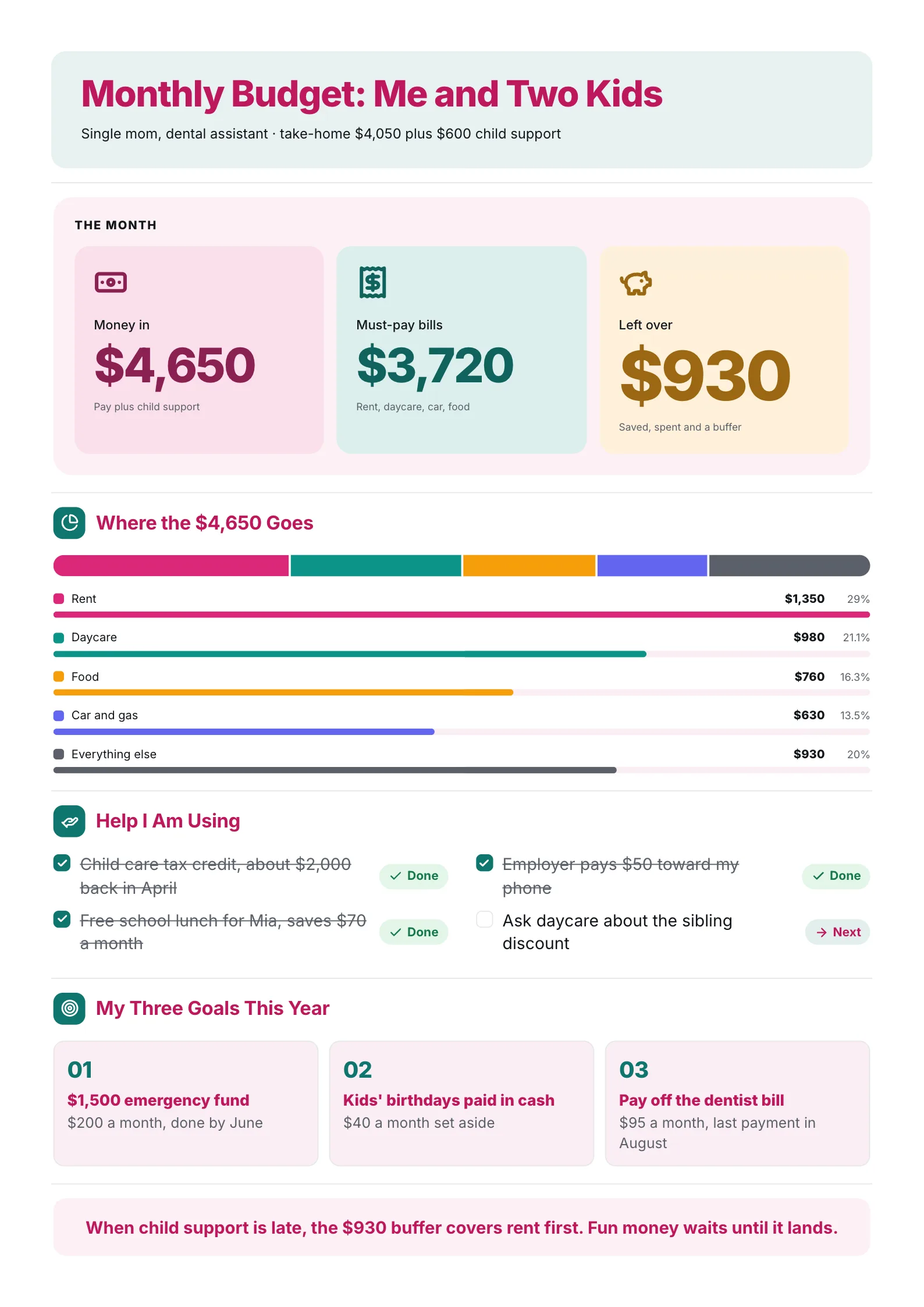 Personal Budget: Single Parent MonthlyEdit for free(opens in a new tab)
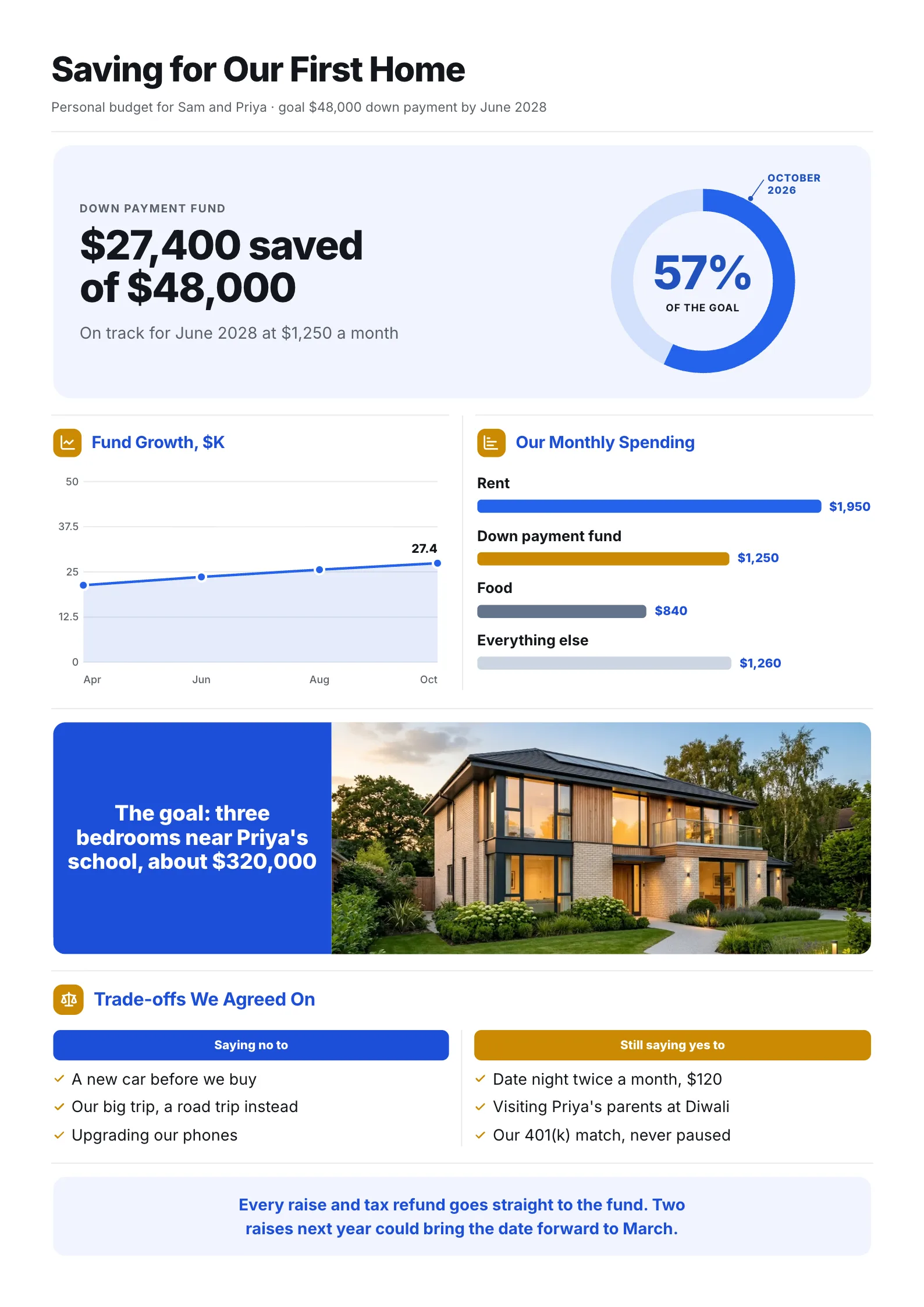 Personal Budget: Saving for a HouseEdit for free(opens in a new tab)
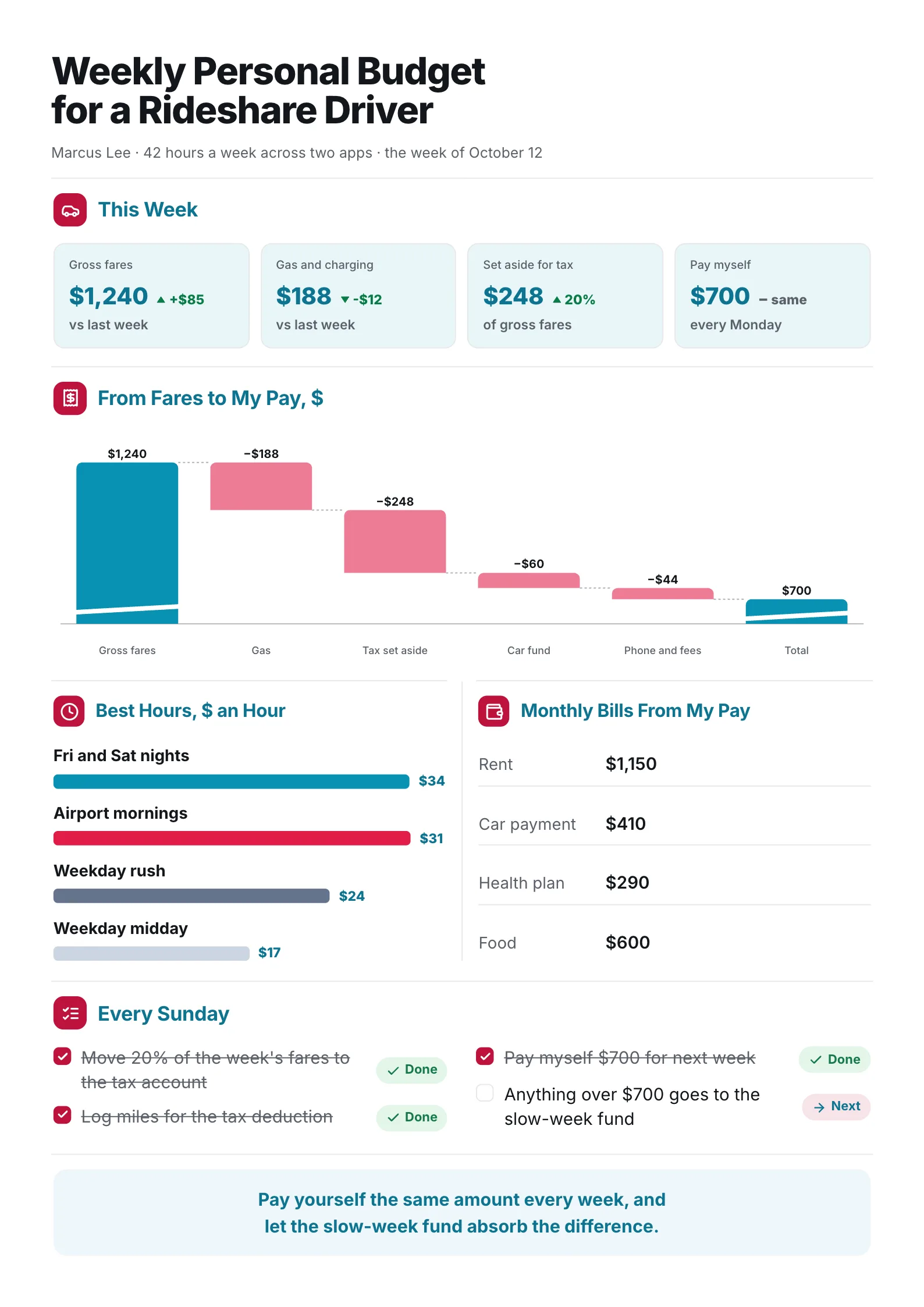 Personal Budget: Gig Driver WeeklyEdit for free(opens in a new tab)
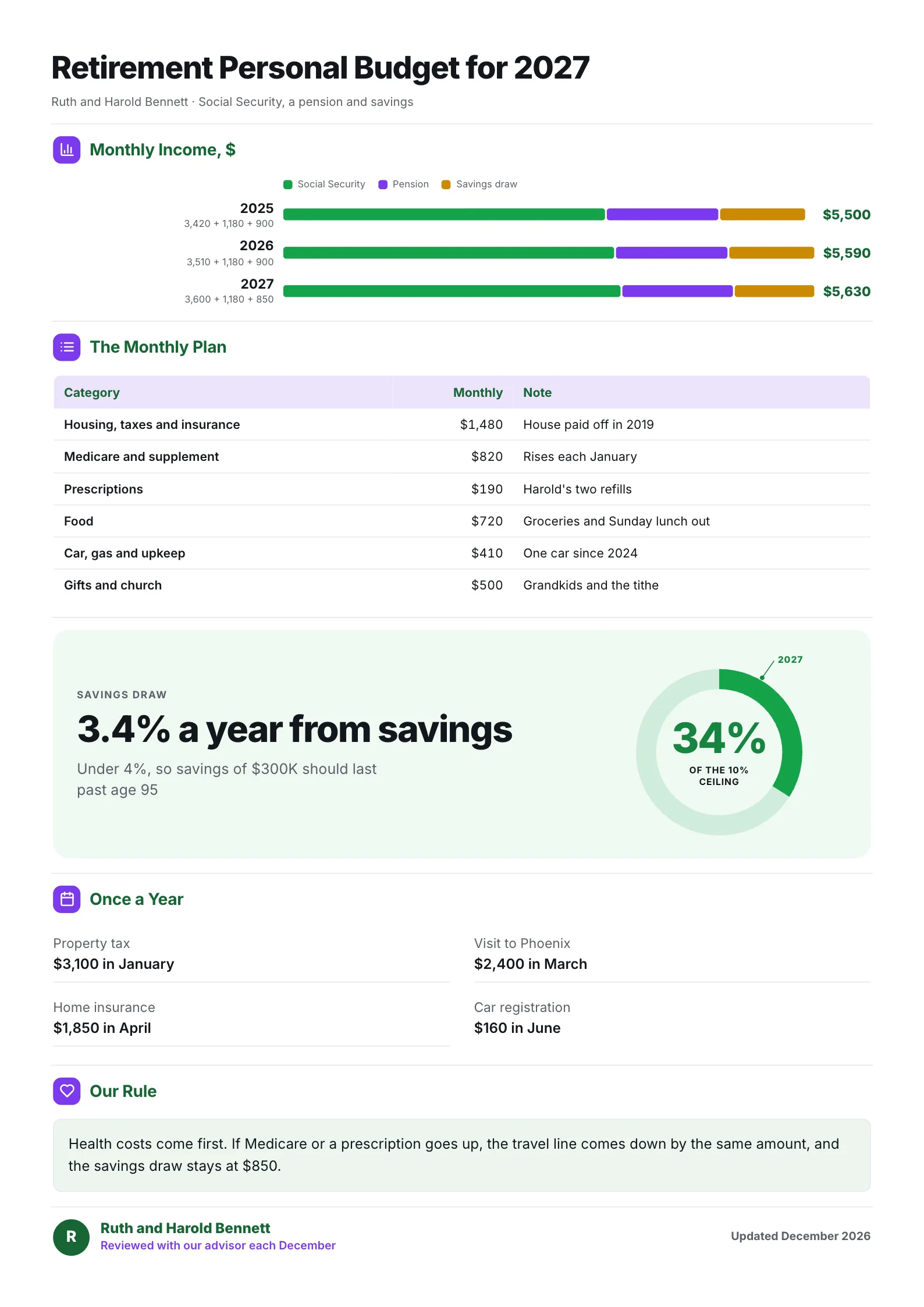 Personal Budget: Retirement Fixed IncomeEdit for free(opens in a new tab)
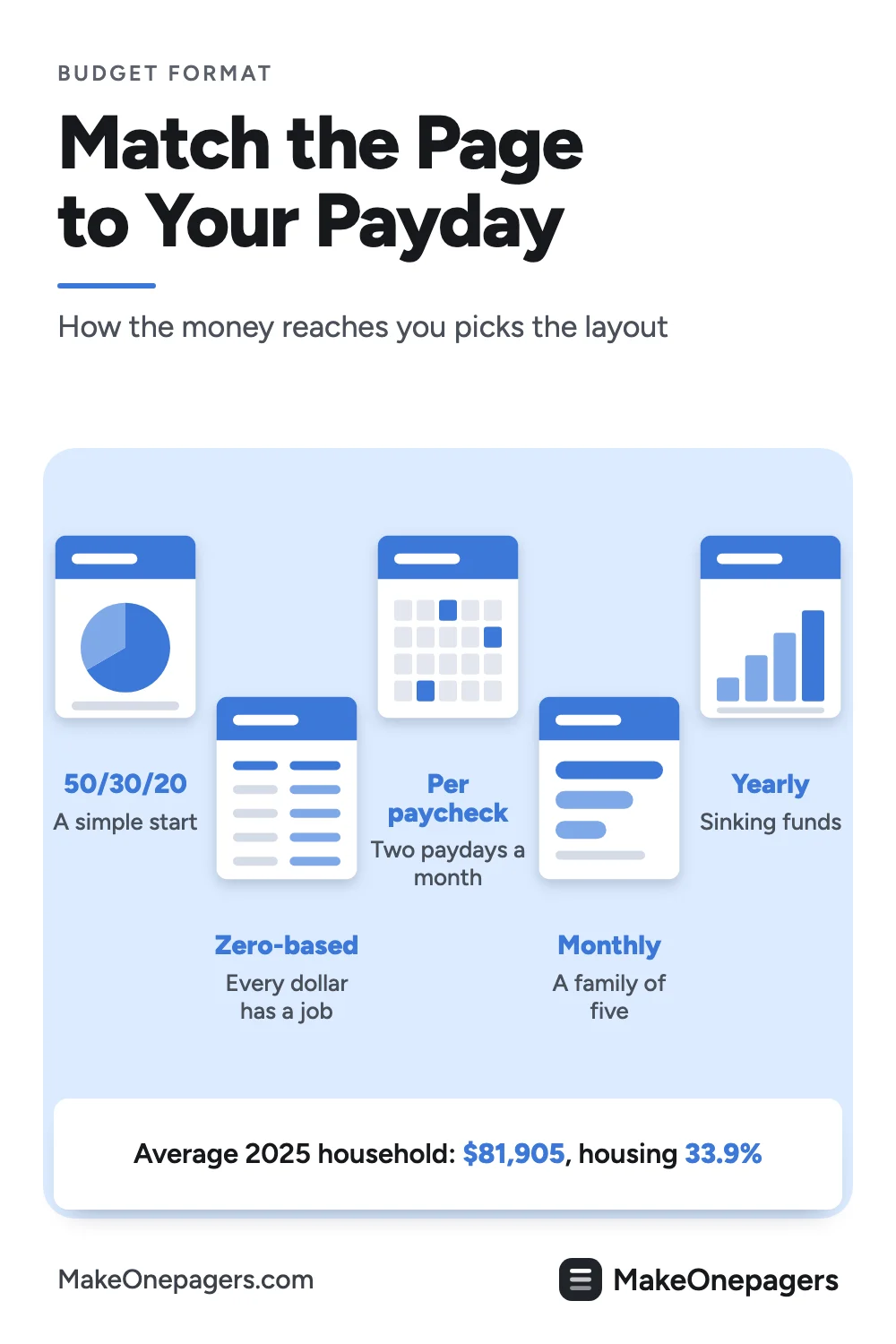
A fixed split suits a steady paycheck, a zero-based budget suits a tight month, and a paycheck plan suits two paydays that land either side of the rent. A family's monthly budget and a yearly plan with sinking funds round out the five. The federal government's newest figures then give you a line to hold your own spending against, what the average American household spent in 2025.
The 50/30/20 split, for a simple start
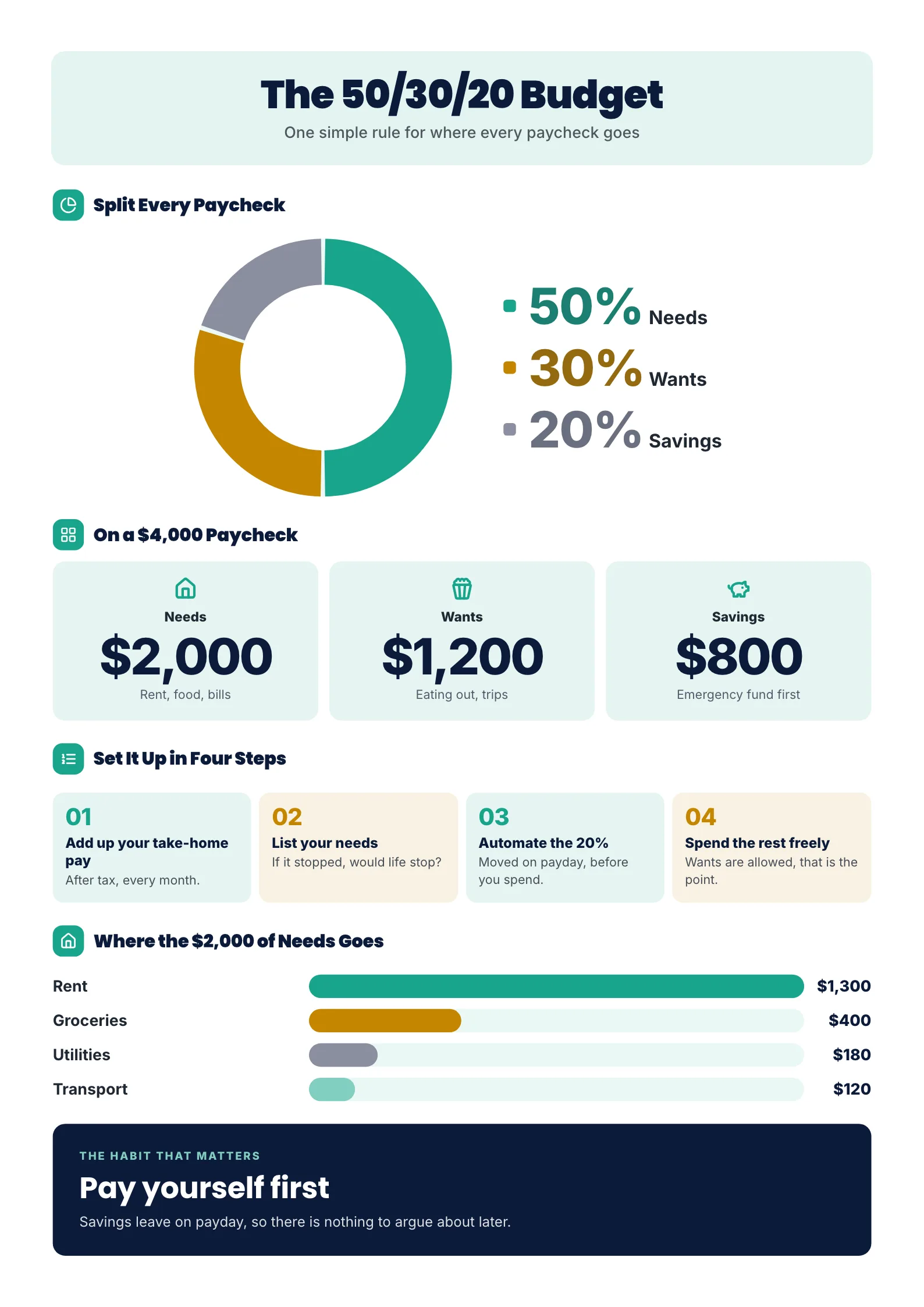
This format gives you one rule for every paycheck. Half goes to needs, 30% to wants and 20% to savings.
 Edit this template
A sample split on a sample paycheck. The whole budget fits in three numbers.
On a $4,000 paycheck, that's $2,000 for needs like rent, food and bills, $1,200 for wants like eating out and trips, and $800 for savings, with an emergency fund first.
Add up your take-home pay after tax. List your needs, asking yourself whether life would stop if it stopped. Automate the 20% so it moves on payday, before you spend. Then spend the rest freely, because wants are allowed.
The footer sums up why this format is easy to keep. Savings leave on payday, so there's nothing for you to argue about later.
Zero-based, for when every dollar needs a job
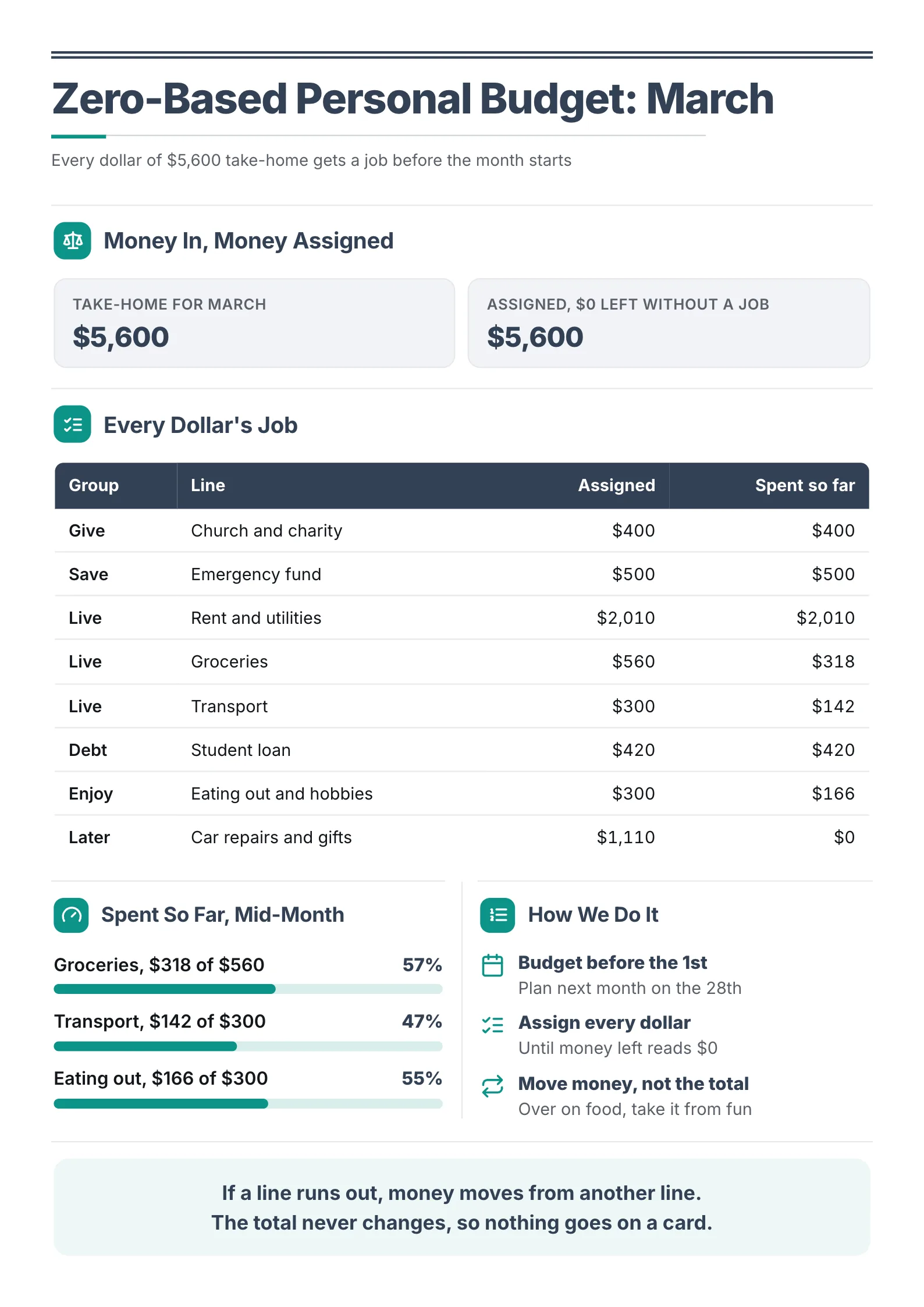
The zero-based format plans March for a household taking home $5,600. Its subtitle states the method: every dollar gets a job before the month starts.
 Edit this template
A sample household. The two matching $5,600 tiles are the whole idea of this format.
Two tiles sit side by side: $5,600 take-home and $5,600 assigned, with $0 left without a job. When those match, your plan is done.
"Spent So Far, Mid-Month" makes the format useful during the month. Groceries are at $318 of $560, transport at $142 of $300 and eating out at $166 of $300. You can see where you've got room.
Plan next month on the 28th. Assign every dollar until the money-left line reads $0. When a line runs out, move money from another line, so the total never changes and nothing goes on a card.
Per paycheck, for two paydays a month
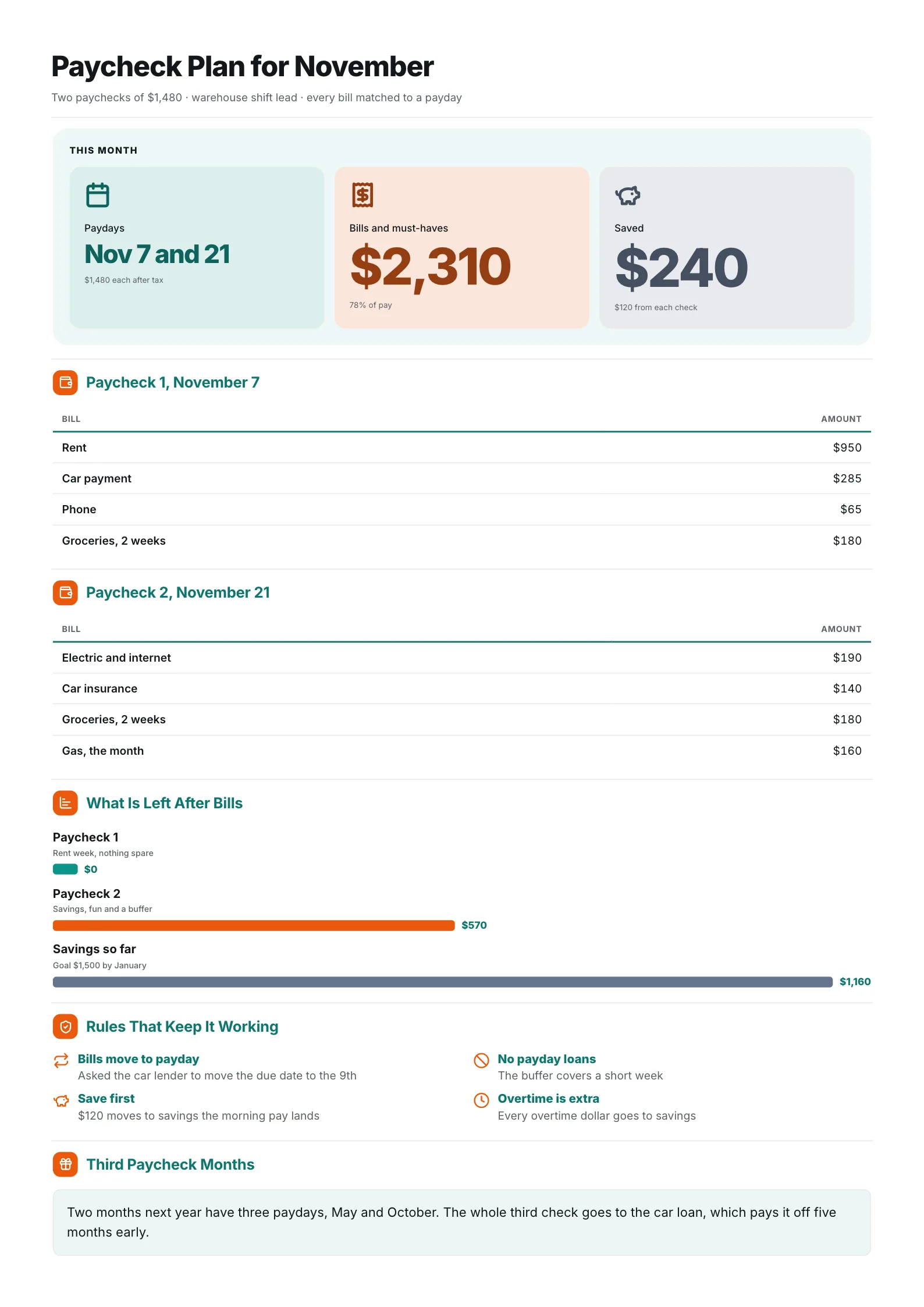
A warehouse shift lead gets two paychecks of $1,480 in November, on the 7th and the 21st. A monthly budget would hide the problem this page solves: rent is due before the second check.
 Edit this template
A sample worker with sample pay. Each bill is placed under the check that pays it.
Bills and must-haves come to $2,150, or 73% of pay. Paycheck 1 is rent week, with nothing spare. Paycheck 2 carries savings, fun and a buffer. Seeing each check on its own tells you why the first half of the month feels tight.
The car lender gets asked to move the due date to the 9th. $240 moves to savings the morning paycheck 2 lands. There are no payday loans, because the buffer covers a short week. Every overtime dollar goes to savings.
"Third Paycheck Months" plans for the extra check. Next year, January and July have three paydays, and the whole third check goes to the car loan. That pays it off five months early.
Monthly, for a family of five
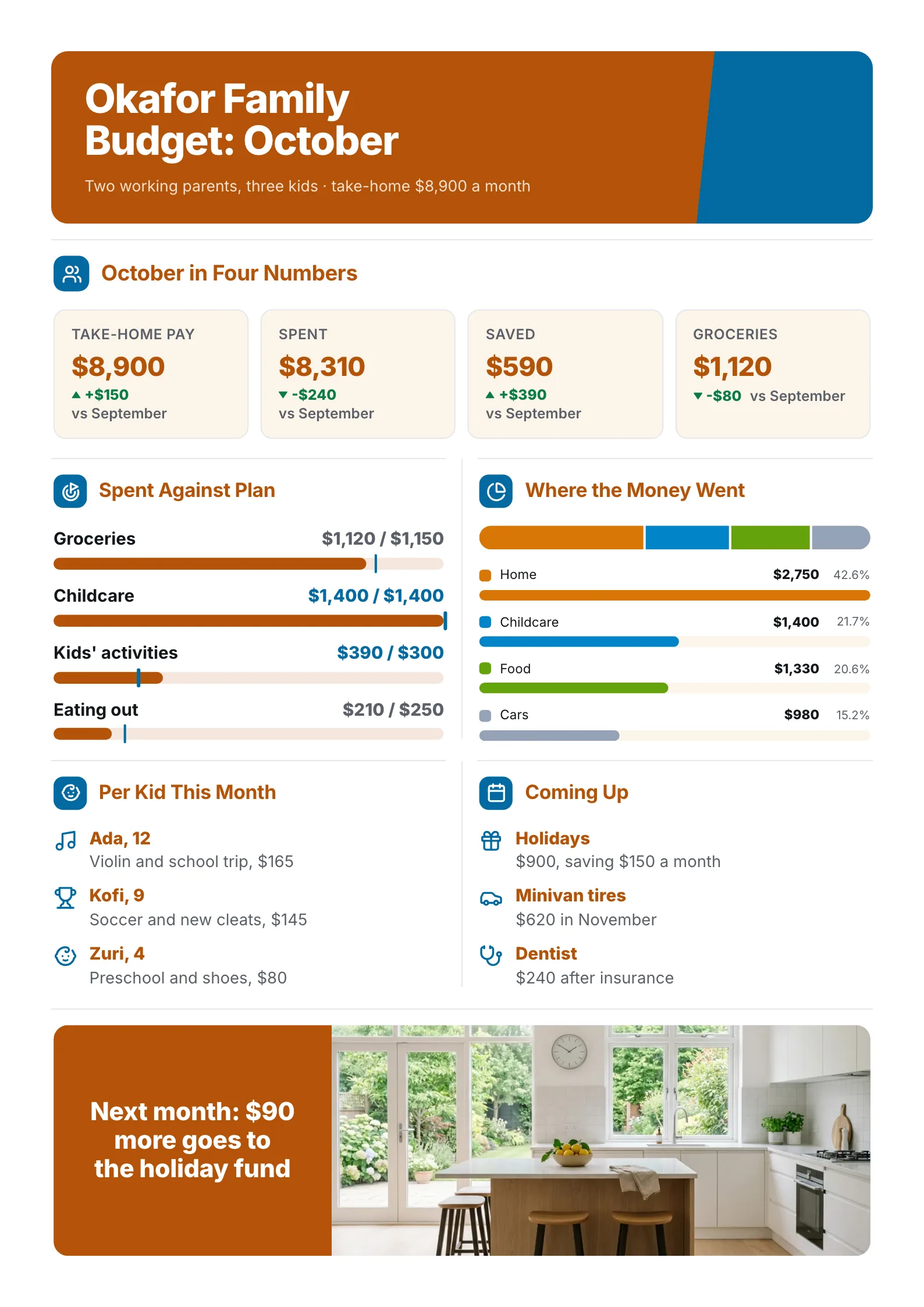
The Okafor family has two working parents, three kids and $8,900 a month in take-home pay. Their October budget is a look back at the month as much as a plan.
 Edit this template
The Okafors are invented. "Per Kid This Month" is the box parents tend to copy.
October came in at $8,900 take-home, $8,310 spent and $590 saved, with $1,120 of the spending on groceries. "Spent Against Plan" shows you which categories ran over.
"Per Kid This Month" splits the spending by child. Ada, 12, had violin and a school trip for $165. Kofi, 9, had soccer and new cleats for $145. Zuri, 4, had preschool and shoes for $80. With three kids, you'll see quickly whose activities are growing.
"Coming Up" looks ahead. The holidays need $900, with $150 a month going aside. Minivan tires are $620 in November, and the dentist is $240 after insurance.
Yearly, with sinking funds for big bills
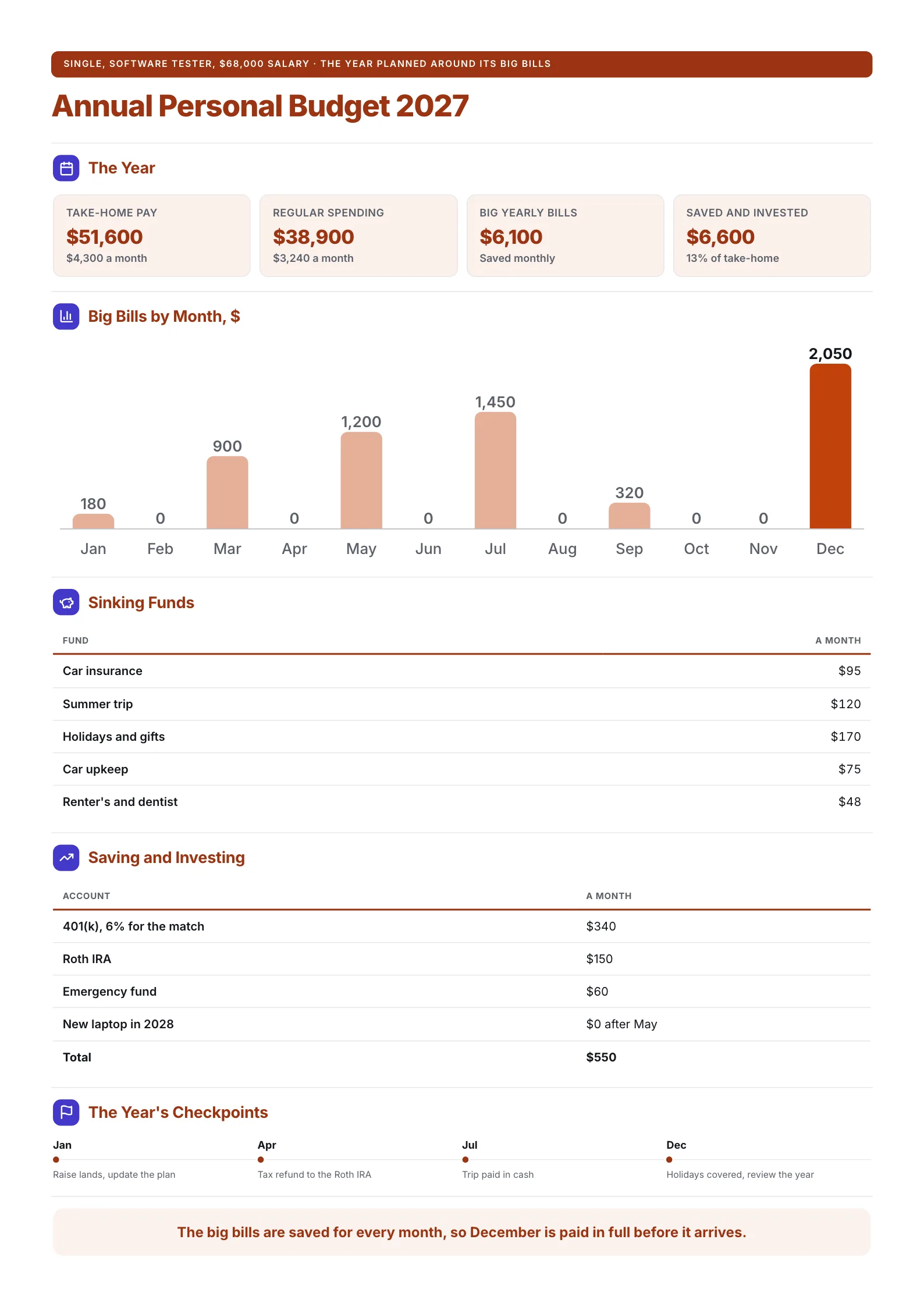
This annual plan is for a single software tester earning a $68,000 salary in 2027. The subtitle says it's the year planned around its big bills.
 Edit this template
A sample saver with a sample salary. The four year totals add up to take-home pay.
The year has four numbers: $51,600 take-home, $38,900 of regular spending, $6,100 of big yearly bills and $6,600 saved and invested. They add up exactly, which is your check that nothing's missing.
A chart shows the big bills by month, so you can see the lumpy months coming. Sinking funds set money aside every month for each one, so December is paid in full before it arrives.
"The Year's Checkpoints" gives you four dates to review the plan: when the raise lands, when the tax refund goes to the Roth IRA, when the trip gets paid in cash, and at the holidays.
How the average household spent in 2025
The Bureau of Labor Statistics surveys what households spend every year. We read the Consumer Expenditures release for 2025, published October 29, 2026 (USDL-26-1619), on October 30, 2026.
| Category | 2025 average | Share of spending |
|---|---|---|
| Housing | $27,790 | 33.9% |
| Transportation | $13,492 | 16.5% |
| Food | $10,633 | 13.0% |
| Personal insurance and pensions | $10,175 | 12.4% |
| Healthcare | $6,470 | 7.9% |
| Entertainment | $4,084 | 5.0% |
| All spending | $81,905 |
Average income before taxes was $110,847. Your budget won't match the average, and it shouldn't. But if housing eats well past a third of what you spend, you'll feel it in every other line, and this table tells you how far past you are.
Match the page to your payday
Write down the dates money lands in your account this month, then choose the shape. Two dates and a tight first week point to the paycheck plan from MakeOnepagers, the one that asks to move a car payment to the 9th. One date and a few big annual bills point to the yearly plan. The numbers come after the shape.
Frequently asked questions
What is the best budget format for beginners?
The 50/30/20 split, because it's three numbers. Once that feels easy, a monthly or zero-based format gives you more control. Our guide on how to write a budget walks through the first month.
Should I budget monthly or by paycheck?
Budget by paycheck if you're paid every two weeks and bills bunch up early in the month. Budget monthly if you're on a fixed salary paid once or twice on set dates.
What is a sinking fund?
Money you set aside each month for a bill you know is coming once or twice a year, like insurance, holidays or tires. The yearly plan above uses them so no month comes as a shock. For more one-page layouts, see our budget summary template.




