Balance Sheet Mistakes: 4 Real Errors Towns and a Nonprofit Had to Fix
Balance sheet mistakes from real 2024 audits: a paid-off loan still listed, grant money owed back, a bond $113,424 too low, plus the IRS checks that catch them.

The balance sheet mistakes that cost the most are rarely bad math. They're amounts on the wrong side, or amounts that should be gone. We read three audit reports for 2024, for two Florida towns and an Oregon nonprofit. In them, 4 balances had to be restated, from $5,082 to $113,424. Here's what each one got wrong, the IRS rules that catch this kind of error, and five sample sheets checked against all of it. Start from a free one pager template.
One‑Pager examples
Real One-Pagers made with MakeOnepagers. Open any one to edit it as your own.
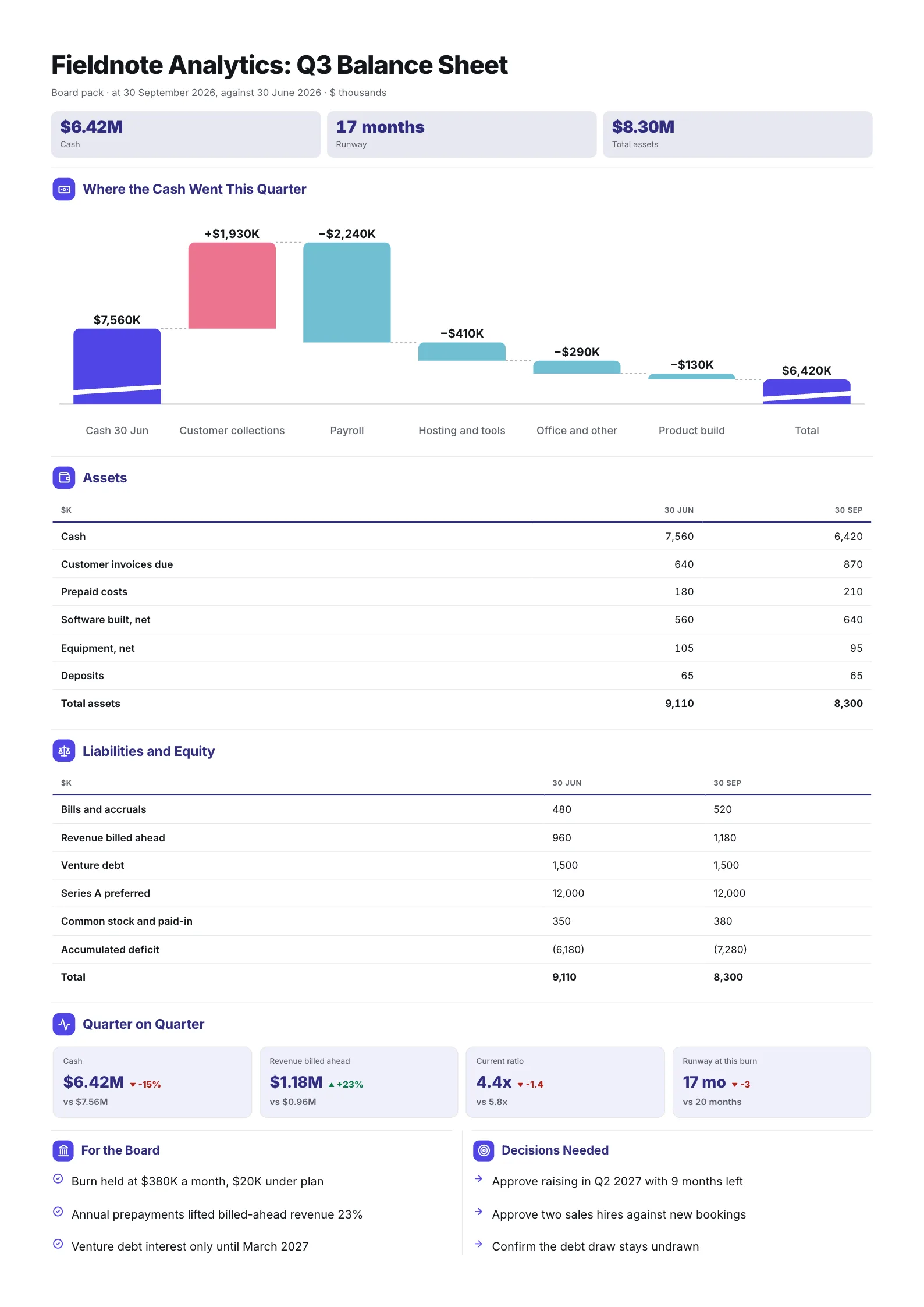 Balance Sheet: Startup BoardEdit for free(opens in a new tab)
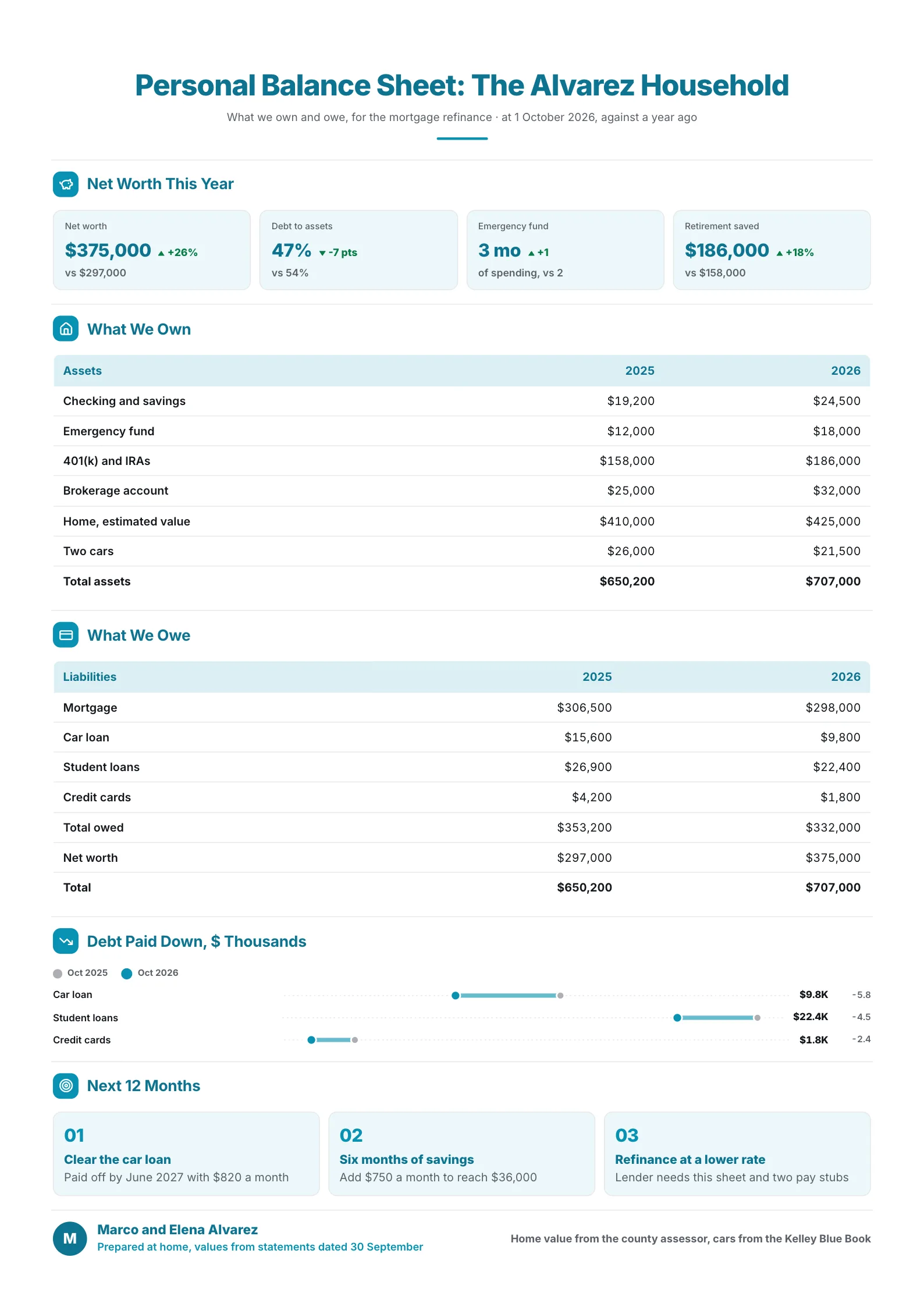 Balance Sheet: PersonalEdit for free(opens in a new tab)
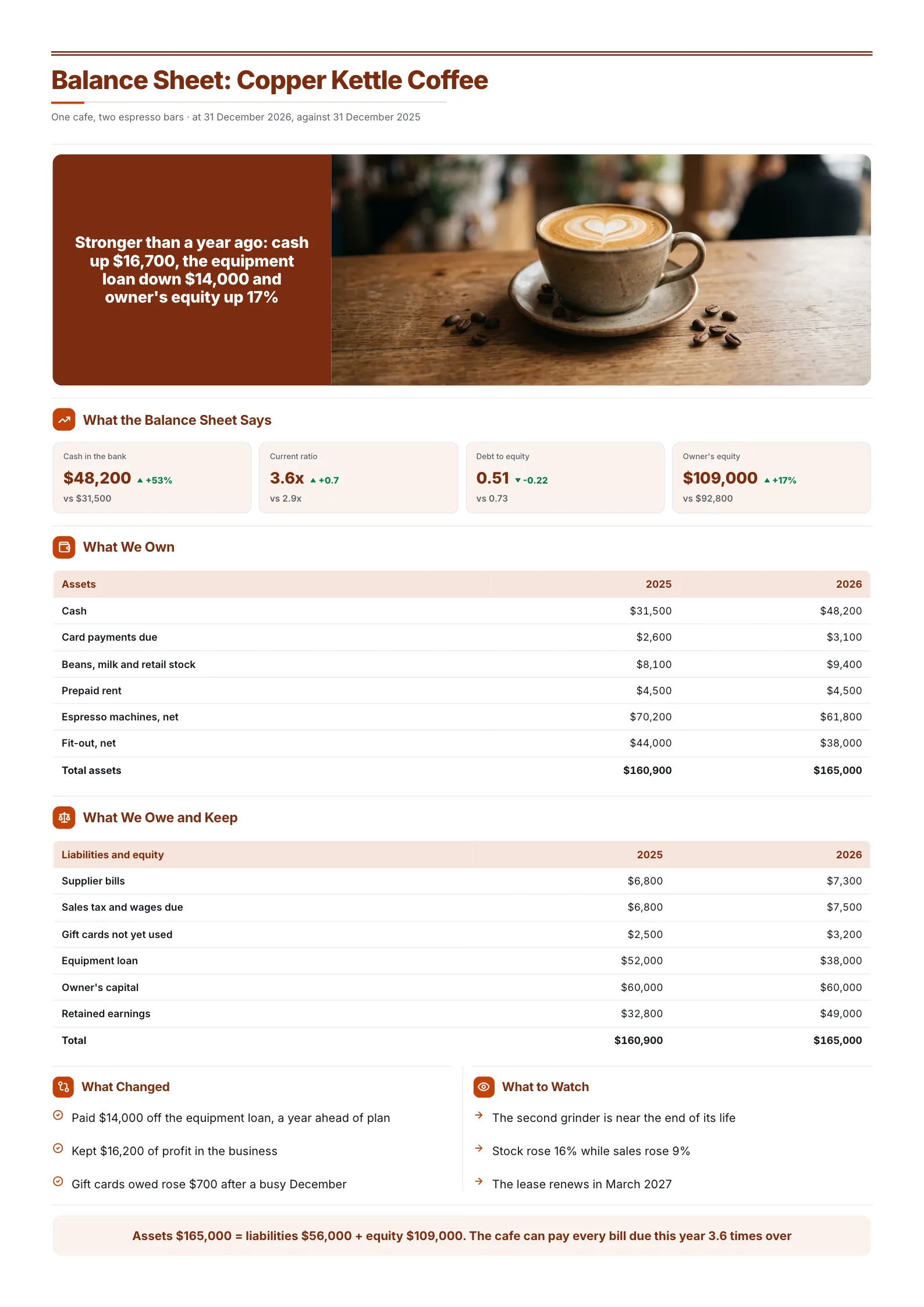 Balance Sheet: CafeEdit for free(opens in a new tab)
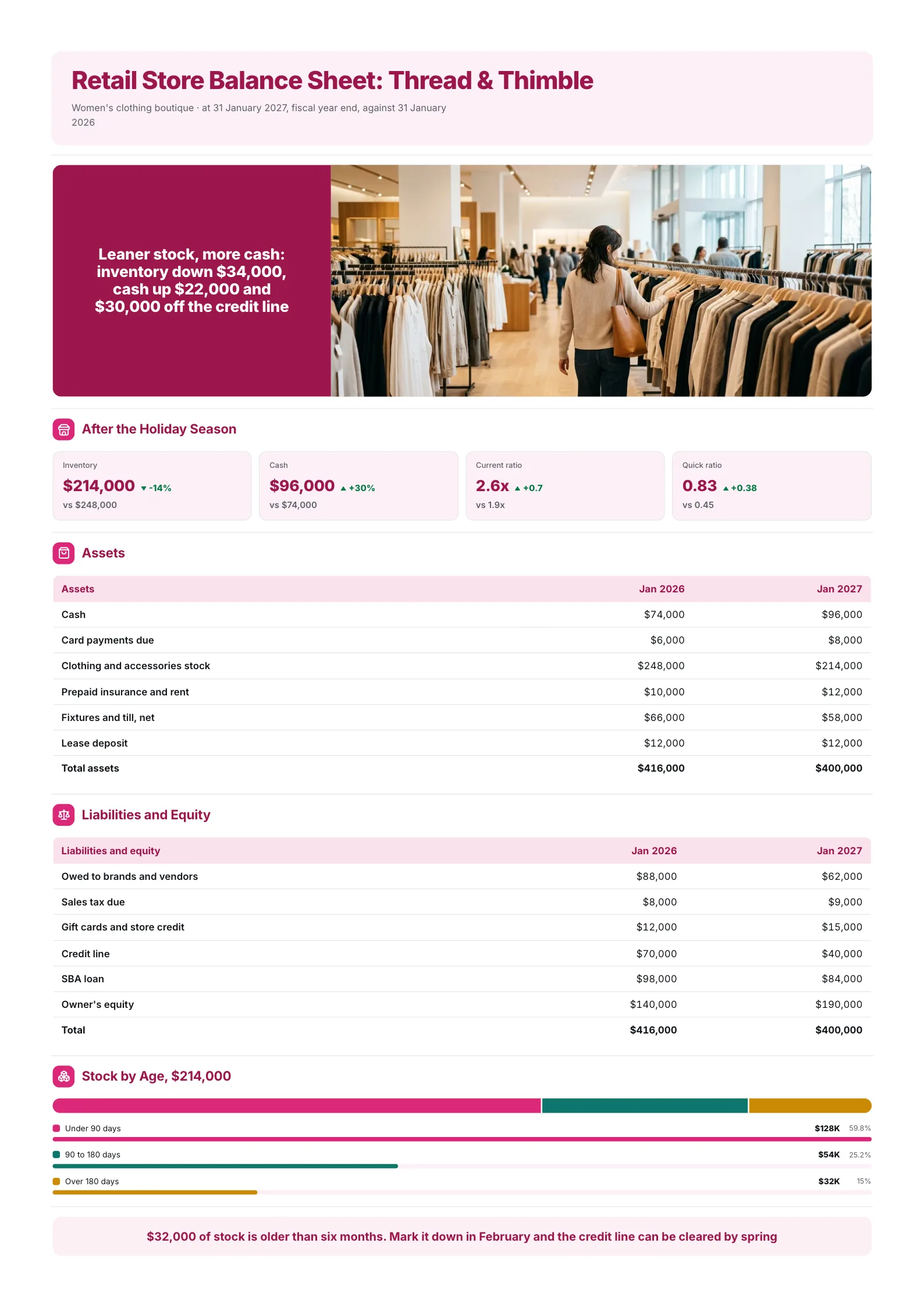 Balance Sheet: Retail StoreEdit for free(opens in a new tab)
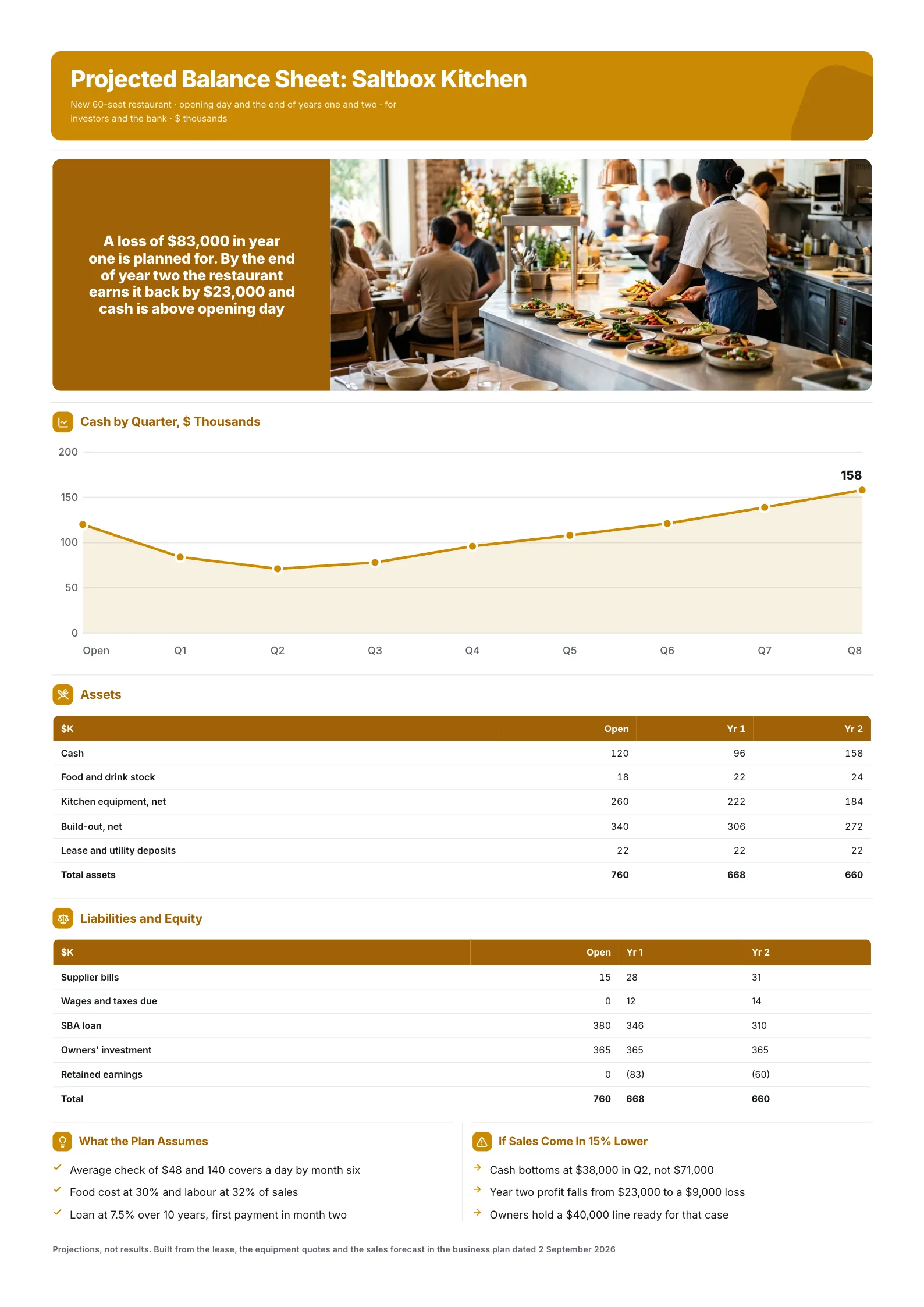 Balance Sheet: ProjectedEdit for free(opens in a new tab)
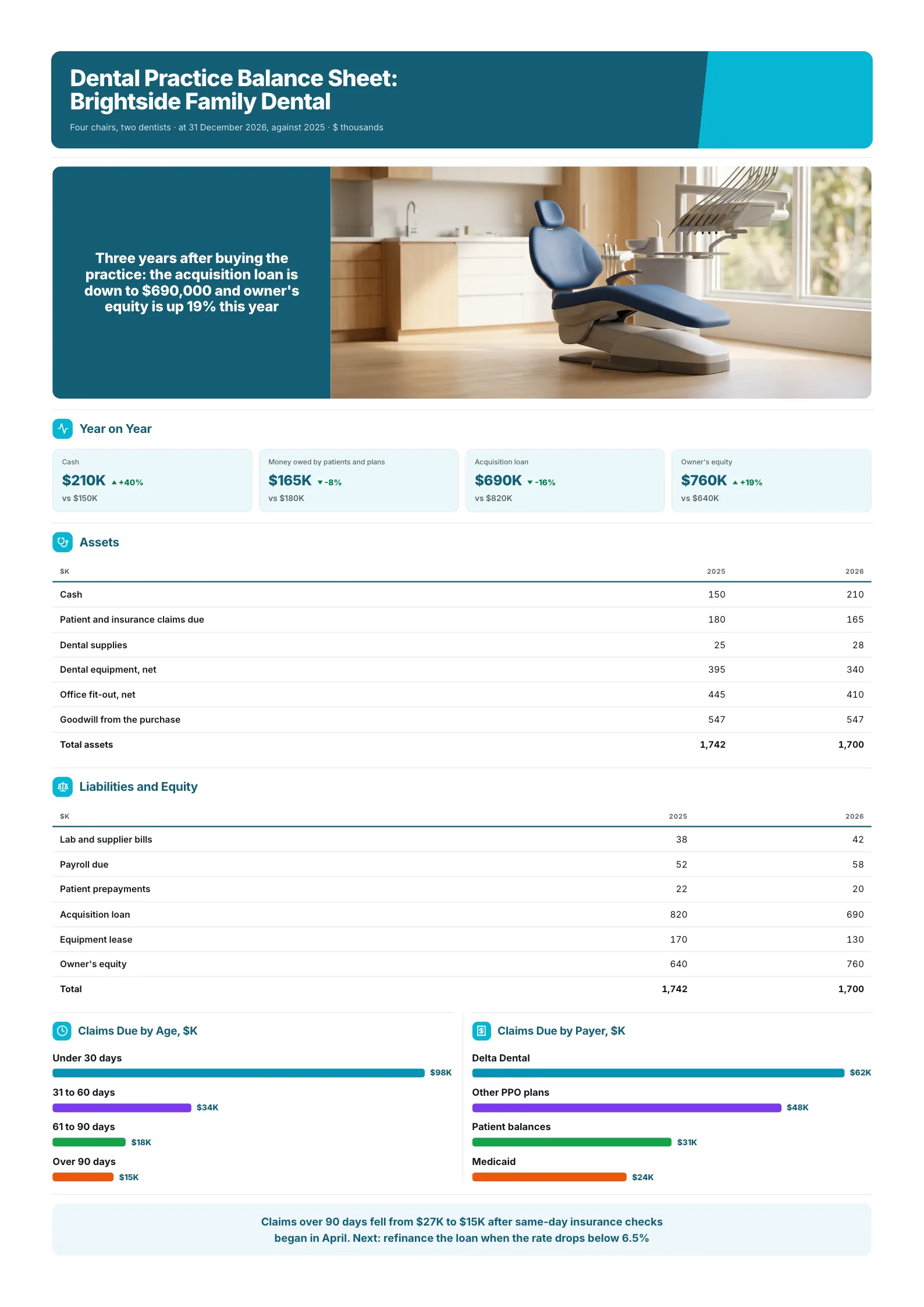 Balance Sheet: Dental PracticeEdit for free(opens in a new tab)
One thing stood out in all three reports. Every balance sheet added up. Total assets matched total liabilities plus net assets before the fix and after it. So the first lesson is simple. A sheet that balances can still be wrong.
The 4 errors at a glance
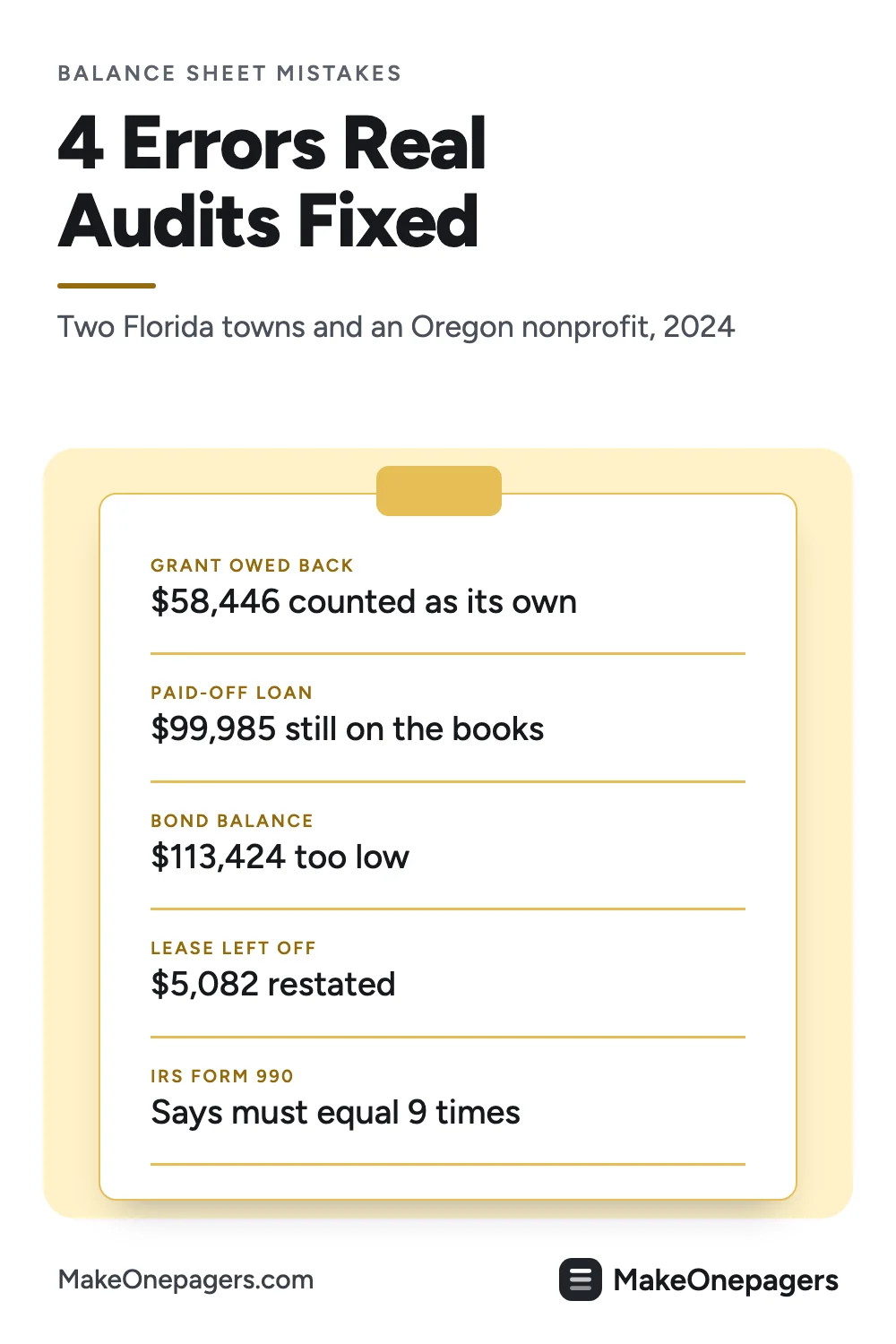
| Who | Year ended | What was wrong | Amount restated |
|---|---|---|---|
| FosterClub, a nonprofit in Seaside, Oregon | December 31, 2023 | Grant money it had to give back sat in its own net assets | $58,446 |
| Town of Greenville, Florida | September 30, 2023 | A line of credit it had paid off was still listed as debt | $99,985 |
| Town of Callahan, Florida | September 30, 2023 | A bond's balance was figured wrong, so the debt was too low | $113,424 |
| Town of Greenville, Florida | September 30, 2023 | A lease the town rents out was left off one statement | $5,082 |
Each fix was found the following year, written up in a note, and the earlier year's numbers were restated. The auditors were Kern & Thompson for FosterClub and Powell and Jones CPA for both towns. In both town reports, the auditor wrote that its opinions "are not modified with respect to this matter." The old numbers were wrong, and the note shows the fix in full for anyone who reads the report.
Mistake 1: money you owe back, counted as yours
FosterClub's audited statements for 2024 carry a note called "Prior Year Restatement." It says the December 31, 2023 numbers were changed "to reflect a cost reimbursement grant" that FosterClub never used and refunded to the grantor.
On the first version, that $58,446 sat in unrestricted net assets, as if FosterClub could spend it on anything. After the fix, unrestricted net assets fell from $4,646,389 to $4,587,943. A new liability called "refundable advance" rose from $0 to $58,446. Total liabilities and net assets didn't move at all.
To avoid it, put any money you may have to return under what you owe until you've earned it. That covers your unspent grant money, deposits and payments for work you haven't done yet. Ask yourself one question about every large receipt. Could anyone ask you for this back?
Mistake 2: a loan you paid off, still on the books
The Town of Greenville's 2024 report says "the Town paid off an outstanding line of credit prior to the end of the 2023 fiscal year." Then it adds, "This payment was not reflected on those financial statements."
So the town's sheet showed $99,985 of debt it no longer had. Once that debt came off, net position for its governmental activities rose from $4,058,147 as first reported to $4,158,132 restated.
To avoid it, check every loan line on your sheet against the lender's own statement for the same date. If you can't match a loan balance to a statement, you're guessing. When you pay off a debt, keep the payoff letter with your year-end papers.
Mistake 3: a loan balance that drifted
The Town of Callahan's 2024 report found the opposite problem. A bond was "understated due to the incorrect amortization of the bond's outstanding principal balance." In plain words, the payment schedule used to track how much principal was left had been worked out wrong.
Long-term liabilities went from $1,416,199 to $1,529,623 after the fix. Total net position dropped by the same amount, from $17,256,269 to $17,142,845. That's $113,424 the town owed but hadn't shown.
To avoid it, split each loan payment you make into its interest and its principal, and take only the principal off your balance. Then check your balance against the lender's amortization schedule once a year.
Mistake 4: something you own, left off
The same Greenville note has a second fix. The town owns property that it rents out, and "the lease receivable and corresponding deferred inflows of resources were omitted" from one set of statements. The town's general fund balance was restated from $311,211 to $316,293, a $5,082 change.
It's the smallest amount on the list, and it's the easiest to miss. Nobody sends you a bill for an asset you forgot to write down, so you have to go looking.
To avoid it, list every contract that pays you over time, such as a lease, a payment plan or a pledge. Then make sure each one has its own line on your sheet.
The IRS checks that catch the rest
Nonprofits that file Form 990 get a built-in test. The 2025 instructions for Form 990 set out how to fill in Part X, the balance sheet, and they use the words "must equal" 9 times in that section. Most of those ties link a Part X line to a supporting schedule. Here are the rules worth copying into your own routine, even if you never file a 990.
- Start where last year ended. For the beginning-of-year column, "enter the amount from the preceding year's Form 990, column (B)." Each of the four errors above meant the opening numbers no longer matched last year's report, so each fix shows up as a restatement.
- Both sides match, twice. Line 16, total assets, "must equal the amounts on line 33 for both the beginning and end of the year."
- Big assets tie to their own list. The cost of land, buildings and equipment on line 10a, and the depreciation on line 10b, must each equal the totals on Schedule D, Part VI.
- No blanks on the totals. On lines 16, 26, 32 and 33, the filer "must enter a zero or a dollar amount."
- Use their order. "No substitute balance sheet will be accepted."
Part XI of the form adds two more ties. Its line 4, opening net assets, "should be the same amount" reported at the end of the prior year. Its line 10 "must equal" the year-end net assets in Part X. And its line 8 names what the four reports above were doing. A prior-period adjustment corrects "errors in financial statements of prior years," including "math errors, mistakes in applying accounting principles, or oversight or misuse of facts."
Five balance sheets checked for these mistakes
Every sample below comes from MakeOnepagers, with made-up names and numbers. Each one shows a line where one of the four mistakes above could slip in, and how the sheet keeps it out.
A food bank that keeps donor money apart
 Edit this template
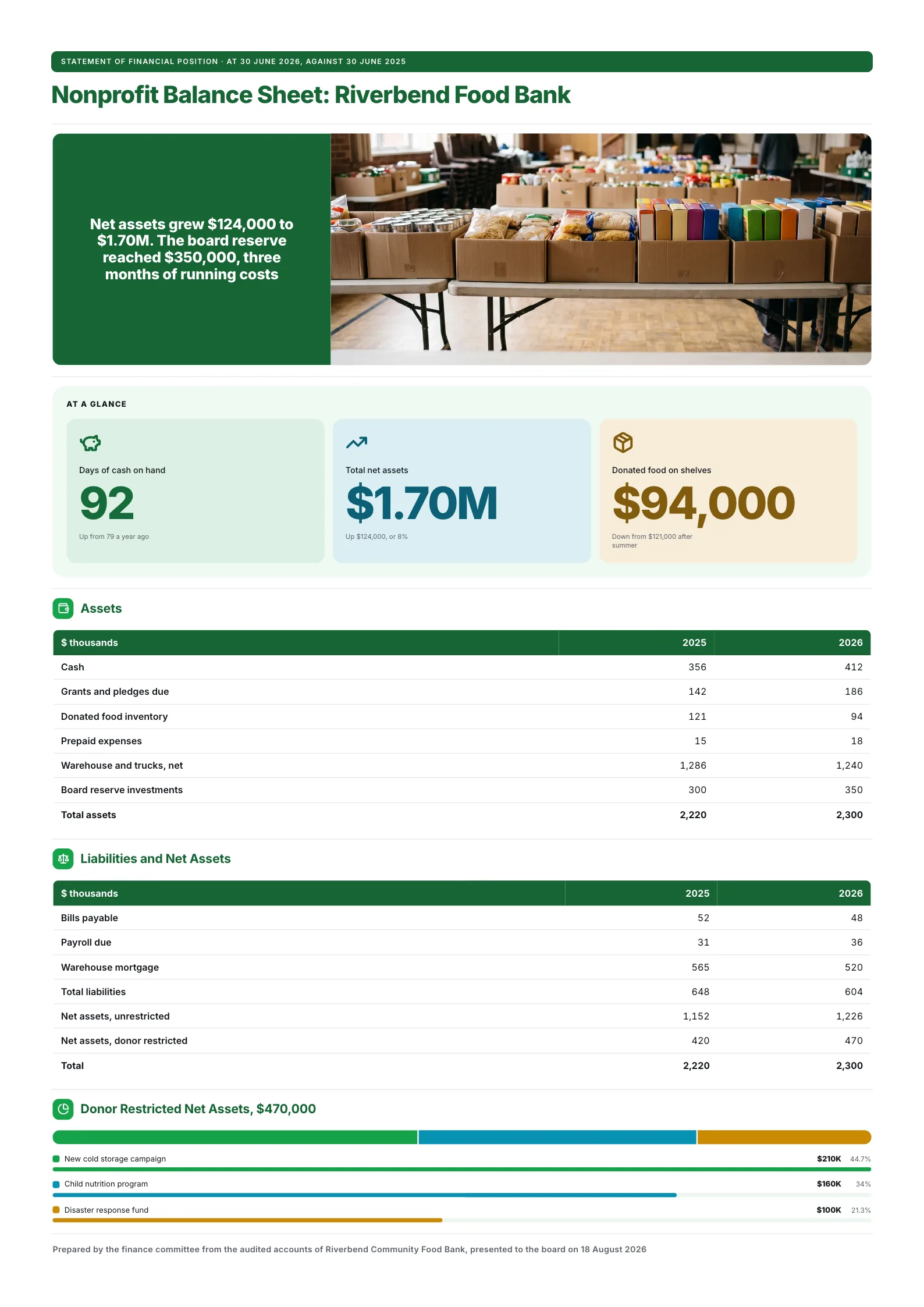
This nonprofit balance sheet splits net assets into $1,226,000 unrestricted and $470,000 donor restricted, and names the three funds behind the second number. A cold storage campaign, a child nutrition program and a disaster response fund each have a donor's purpose attached. FosterClub's grant came with conditions too, and it landed in the pile that looked free to spend. If you run a nonprofit, keep any money with strings on it out of the pile you can spend freely. The board reserve of $350,000 sits in assets as investments. On a 990, money a board sets aside still goes on line 27, net assets without donor restrictions, "regardless of the existence of any board designations."
Three duplexes with tenant deposits on both sides
 Edit this template
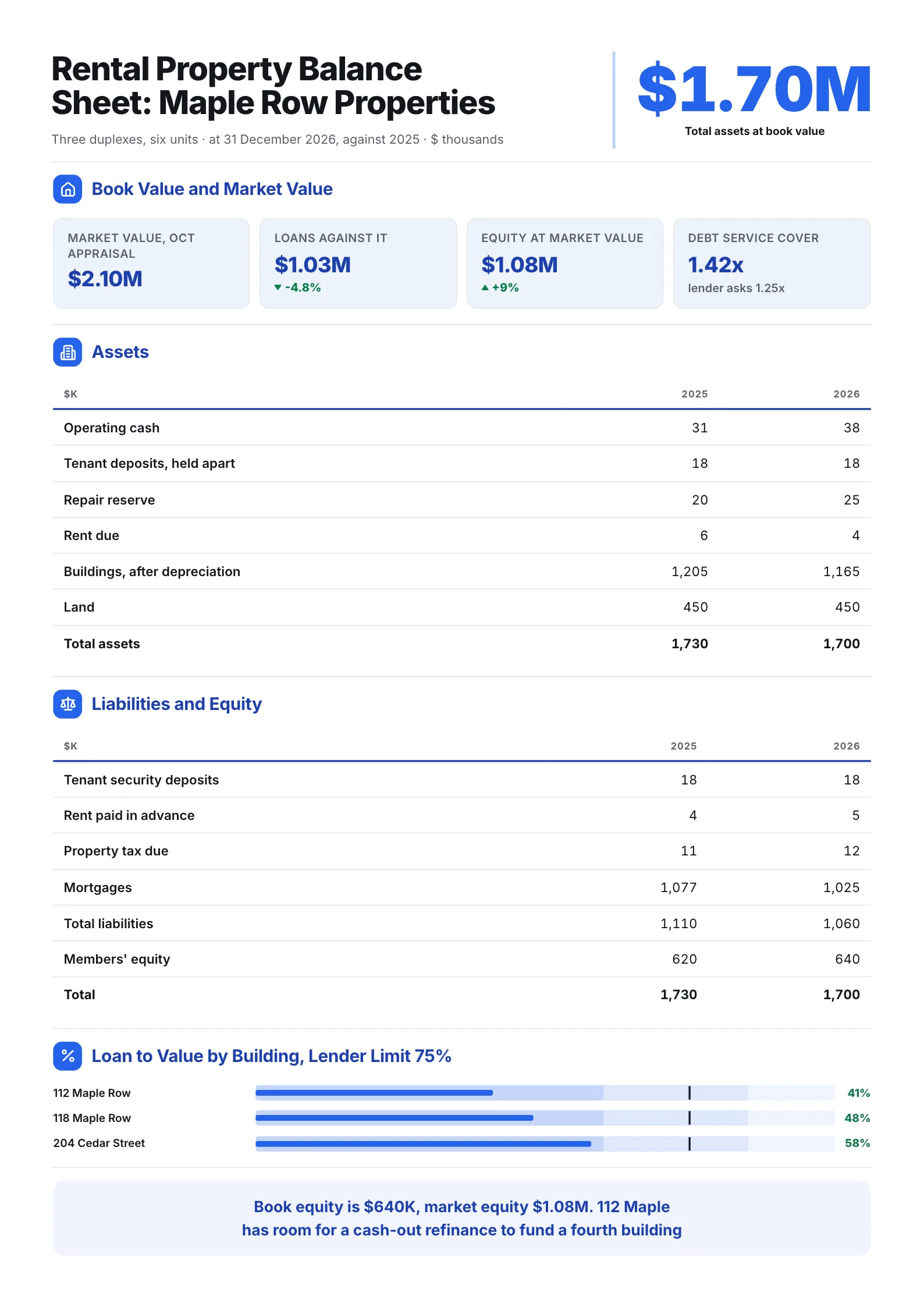
This rental property balance sheet shows $18,000 of "Tenant deposits, held apart" as an asset and $18,000 of "Tenant security deposits" as a liability. If you leave out the second line, your equity looks $18,000 bigger than it is. The 990 instructions pair money held in escrow for others the same way, with the cash as an asset and the matching liability on line 21. Rent paid in advance, $5,000, also sits with what the owners owe, since the months haven't been lived in yet.
A bike shop's loan, shown on both sides
 Edit this template
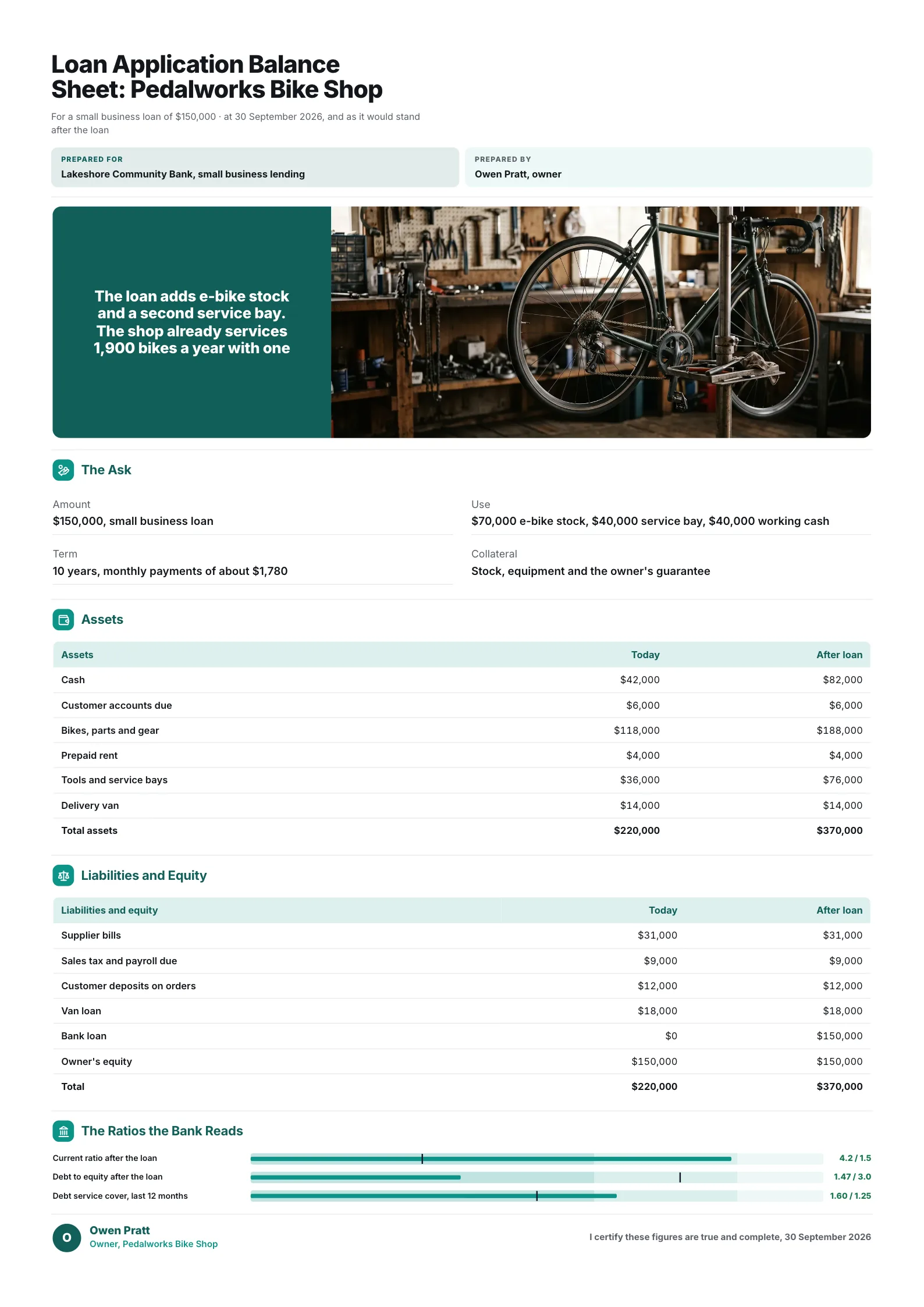
This loan application balance sheet adds a second column for how the shop would look after a $150,000 loan. The loan appears twice. On the asset side, it lands as $70,000 more e-bike stock, a $40,000 service bay and $40,000 of extra cash, so total assets go from $220,000 to $370,000. On the other side, the bank loan goes from $0 to $150,000, and owner's equity stays at $150,000. If you show a loan only in cash, you look $150,000 richer than you are.
A contractor that bills ahead of the work
 Edit this template
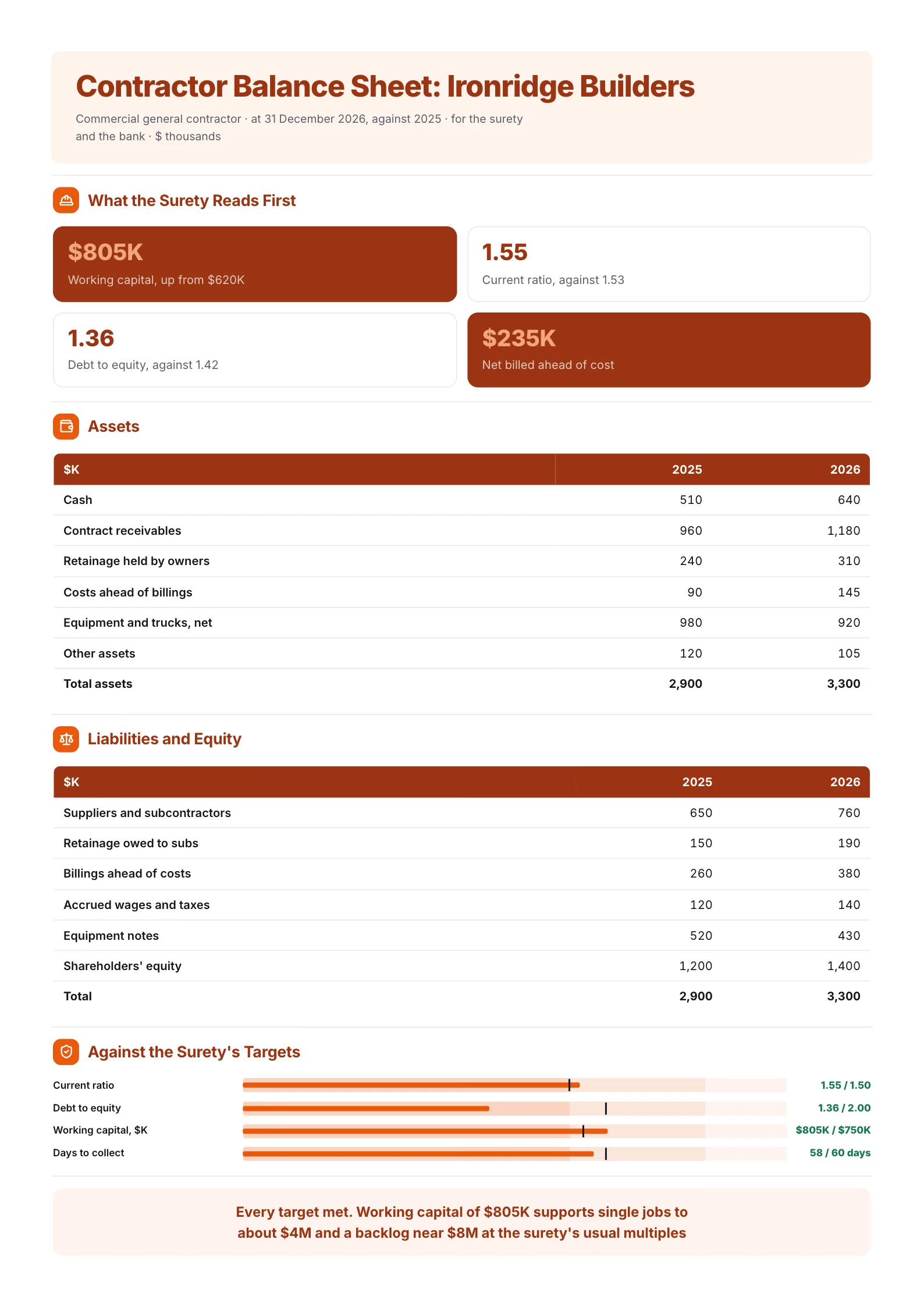
This contractor balance sheet lists $380,000 of "Billings ahead of costs" as a liability. That's money billed for work the crew hasn't done yet, the same idea as FosterClub's grant. On the asset side, $145,000 of "Costs ahead of billings" is work done but not yet billed. The sheet shows both lines in full and reports the gap, $235,000, as a separate figure for the surety. If you bill ahead, show both lines too. Netting them into one would hide how much work you still owe.
A farm that splits its debt by year
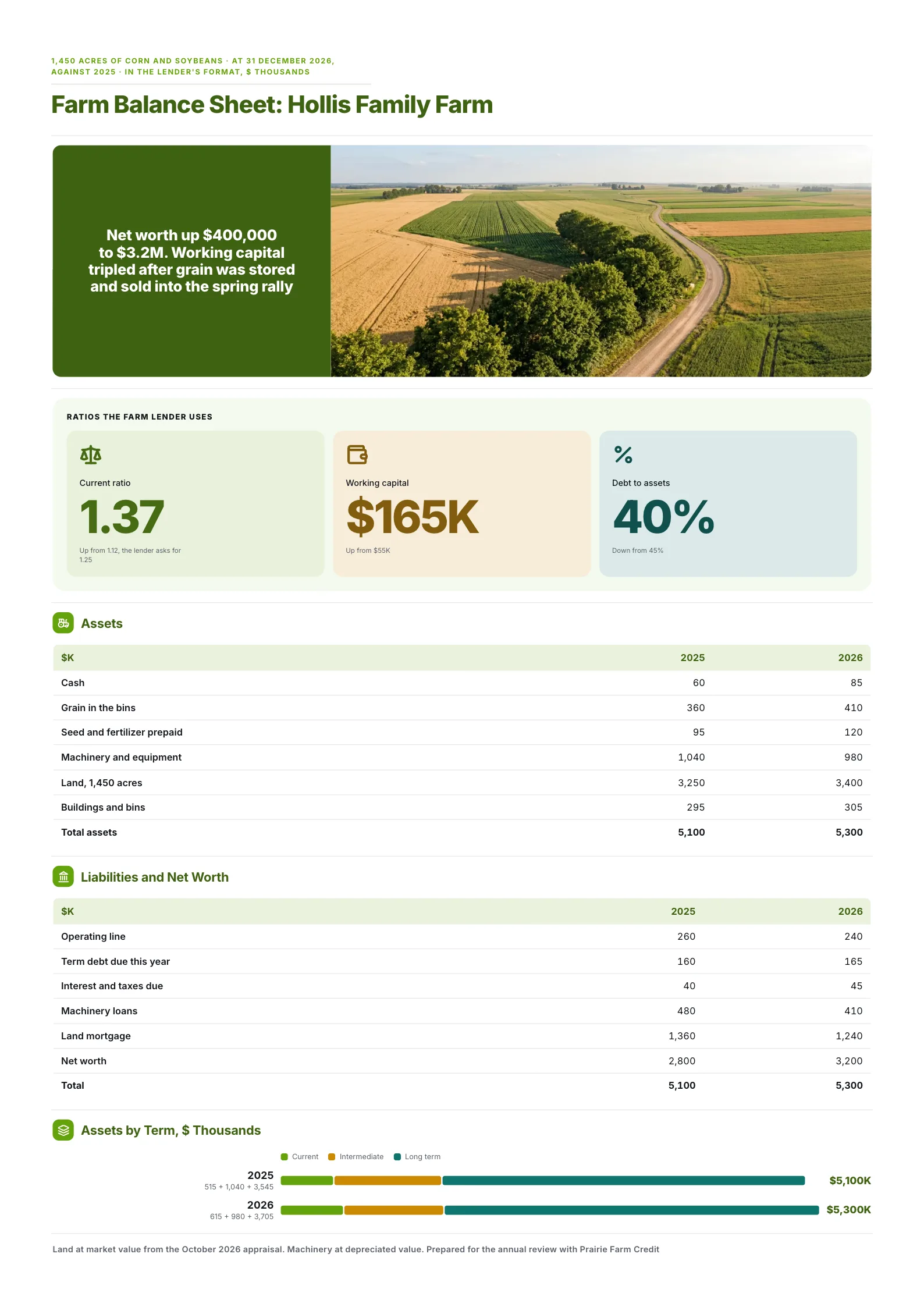 Edit this template
This farm balance sheet breaks out $165,000 of "Term debt due this year" from the $1,240,000 land mortgage and the $410,000 of machinery loans. That split is what makes the current ratio of 1.37 honest. It's also where Callahan's kind of error hides, because each year's principal has to come off the right loan. The footnote says land is at market value from an October 2026 appraisal. That suits the farm lender. On a 990, line 10a asks for "cost or other basis," so a market value there would need its own label and explanation.
A 6-step check before you share yours
Run these on any balance sheet, from a cafe to a church:
- Add both sides. Total assets equal liabilities plus equity. If not, stop and find it.
- Match the opening column. Last year's closing numbers, exactly, with no rounding changes.
- Tie every loan to the lender. Use the lender's statement for the same date, and split each payment into interest and principal.
- Ask who could want money back. Grants, deposits and advance payments go under what you owe until they're earned.
- Hunt for missing assets. Leases, payment plans and pledges that pay you over time each need a line.
- Label anything at market value. Say which lines use an appraisal and which use cost.
Steps 3 to 5 cover the four restatements above. Step 1 alone wouldn't have caught any of them.
Make your balance sheet
Start from the MakeOnepagers balance sheet built for a business like yours, a farm, a contractor or a food bank, and type in your own lines. Got last year's numbers in a spreadsheet or a PDF? Drop them into the free AI One-Pager generator, then run the six steps on the sheet you get back. For the line order lenders expect, read our balance sheet format guide. To build one from your own records, start with how to make a balance sheet, and see finished ones in our balance sheet examples.
Frequently asked questions
Can a balance sheet balance and still be wrong?
Yes. In the three 2024 audit reports above, every sheet balanced before and after its fix. Three of the four errors moved an amount between what was owed and net assets, so the totals stayed the same.
How do you fix a mistake on last year's balance sheet?
You restate it. The correction goes in a note that shows the amount as first reported, the change and the restated amount, as Greenville, Callahan and FosterClub each did. On Form 990, the change shows up on Part XI, line 8, as a prior-period adjustment.
Where does unspent grant money go on a balance sheet?
If you may have to return it, it goes under liabilities. FosterClub moved $58,446 out of its net assets and into a "refundable advance" when a grant went unused and was sent back.
Should a paid-off loan stay on the balance sheet?
No. Take it off as of the payoff date. Greenville's 2023 statements kept a line of credit it had already paid, which overstated its debt by $99,985.
Can a nonprofit use its own balance sheet layout on Form 990?
Not in Part X. The IRS instructions say "No substitute balance sheet will be accepted," so your audited statements get mapped onto the form's 33 lines.




