Balance Sheet Format: The Line Order Public Companies Follow
The balance sheet format public companies follow, from the SEC's own rule: what goes in each section, in what order, and when a line needs its own row.

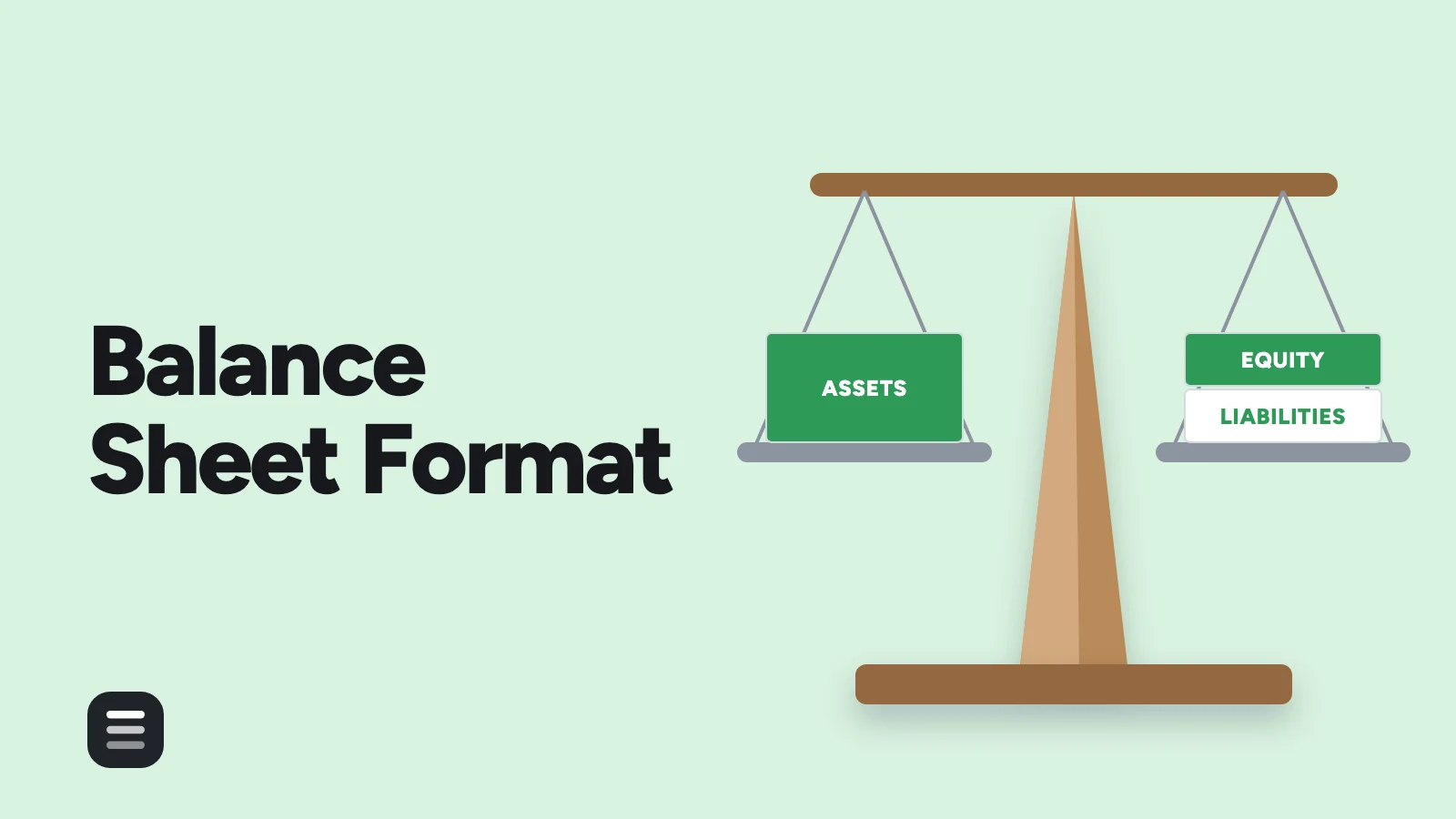
The standard balance sheet format has three blocks in a fixed order. Assets come first, then liabilities, then equity. Inside each block you list the items you can turn into cash soonest at the top and the slow ones at the bottom. Total liabilities plus equity must equal total assets, and that's why it's called a balance sheet. Start from a free one pager template.
One‑Pager examples
Real One-Pagers made with MakeOnepagers. Open any one to edit it as your own.
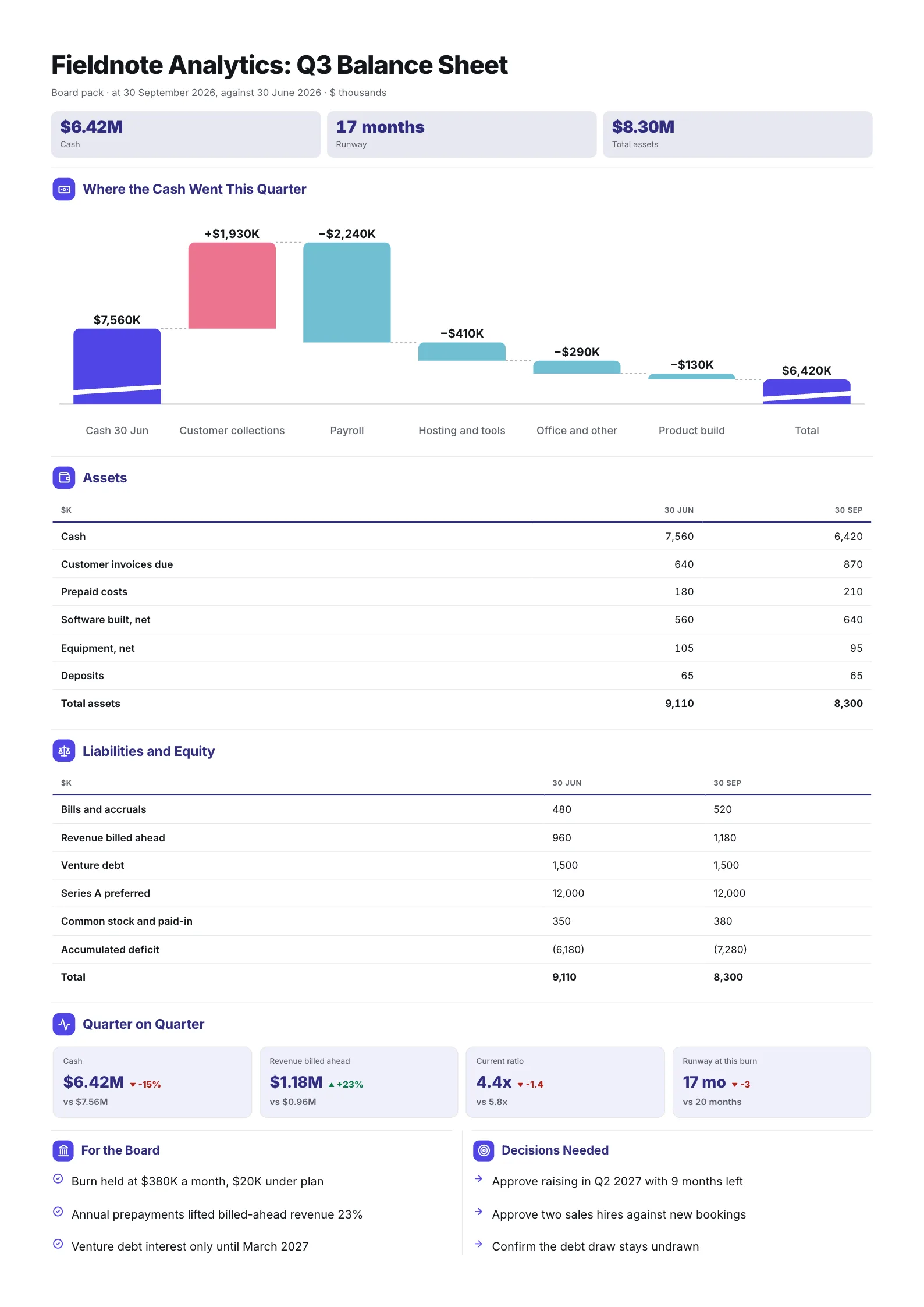 Balance Sheet: Startup BoardEdit for free(opens in a new tab)
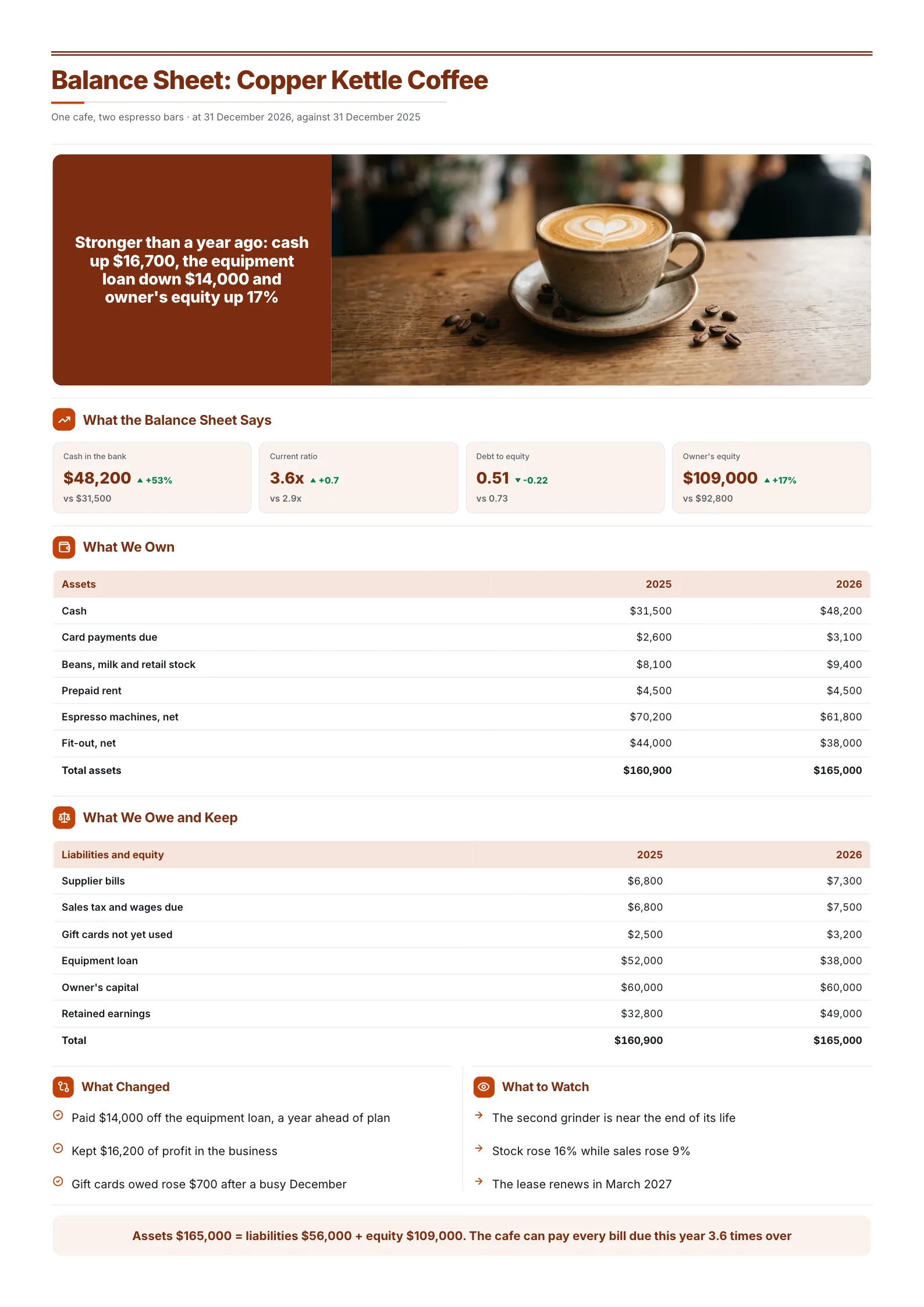 Balance Sheet: CafeEdit for free(opens in a new tab)
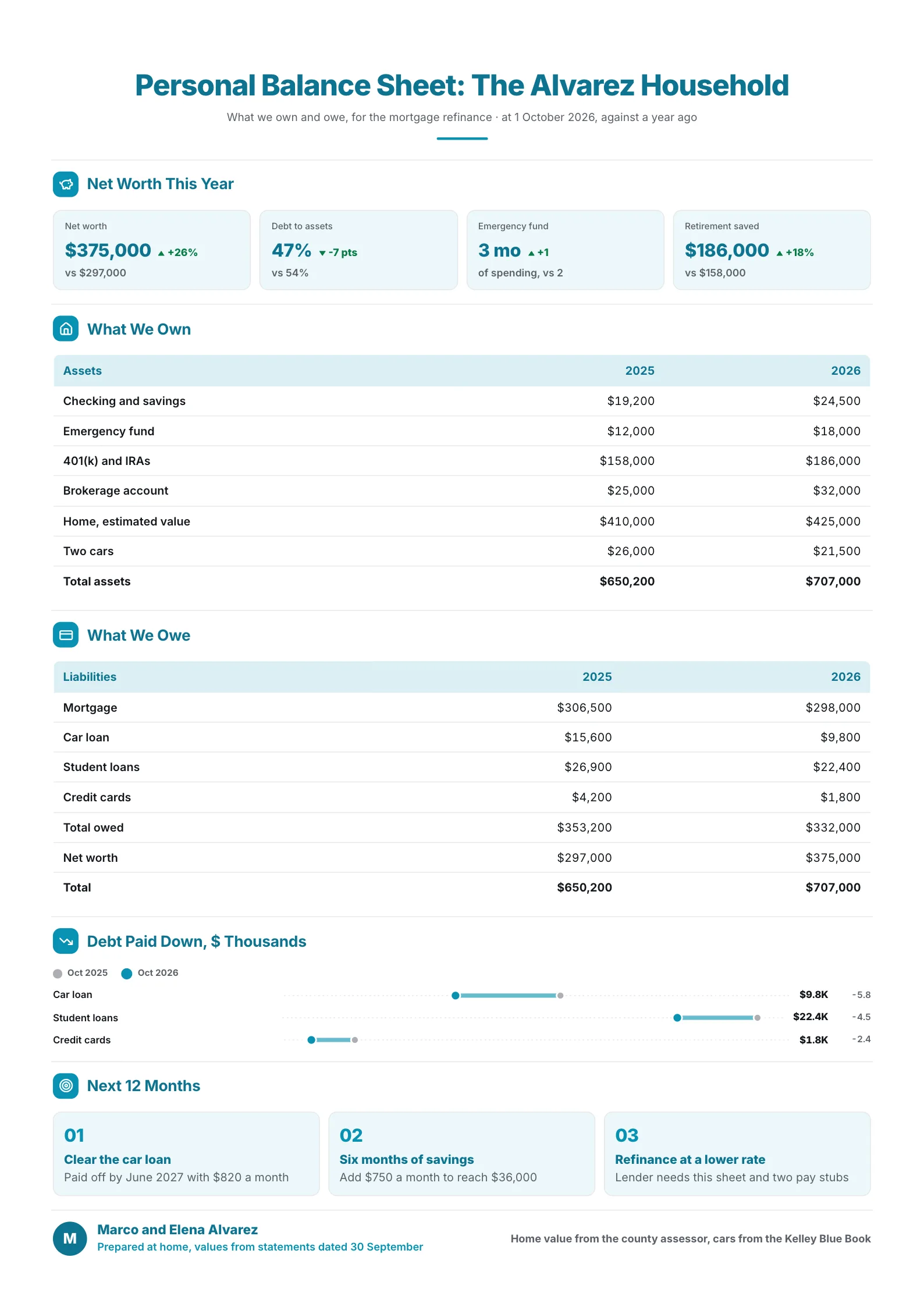 Balance Sheet: PersonalEdit for free(opens in a new tab)
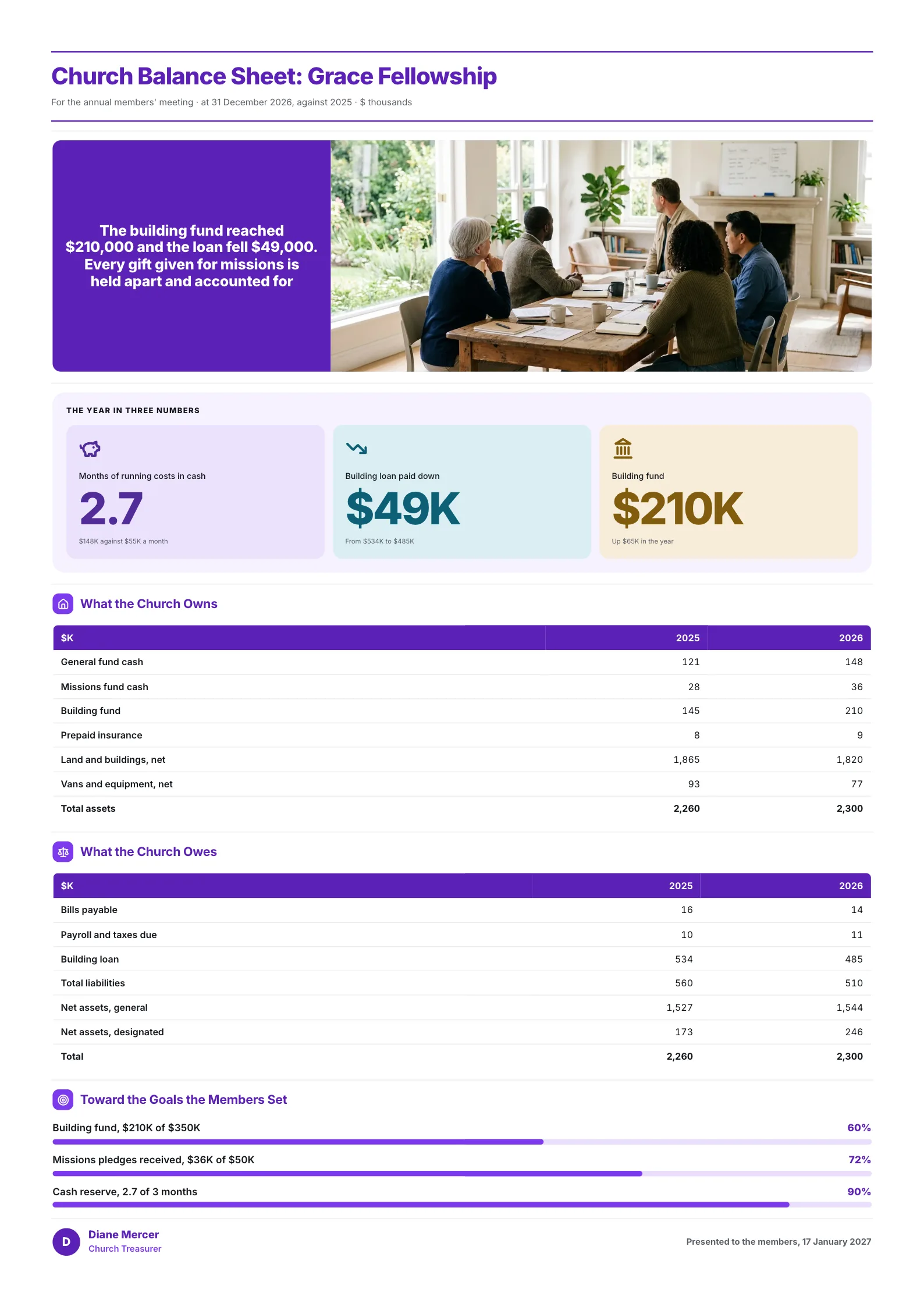 Balance Sheet: ChurchEdit for free(opens in a new tab)
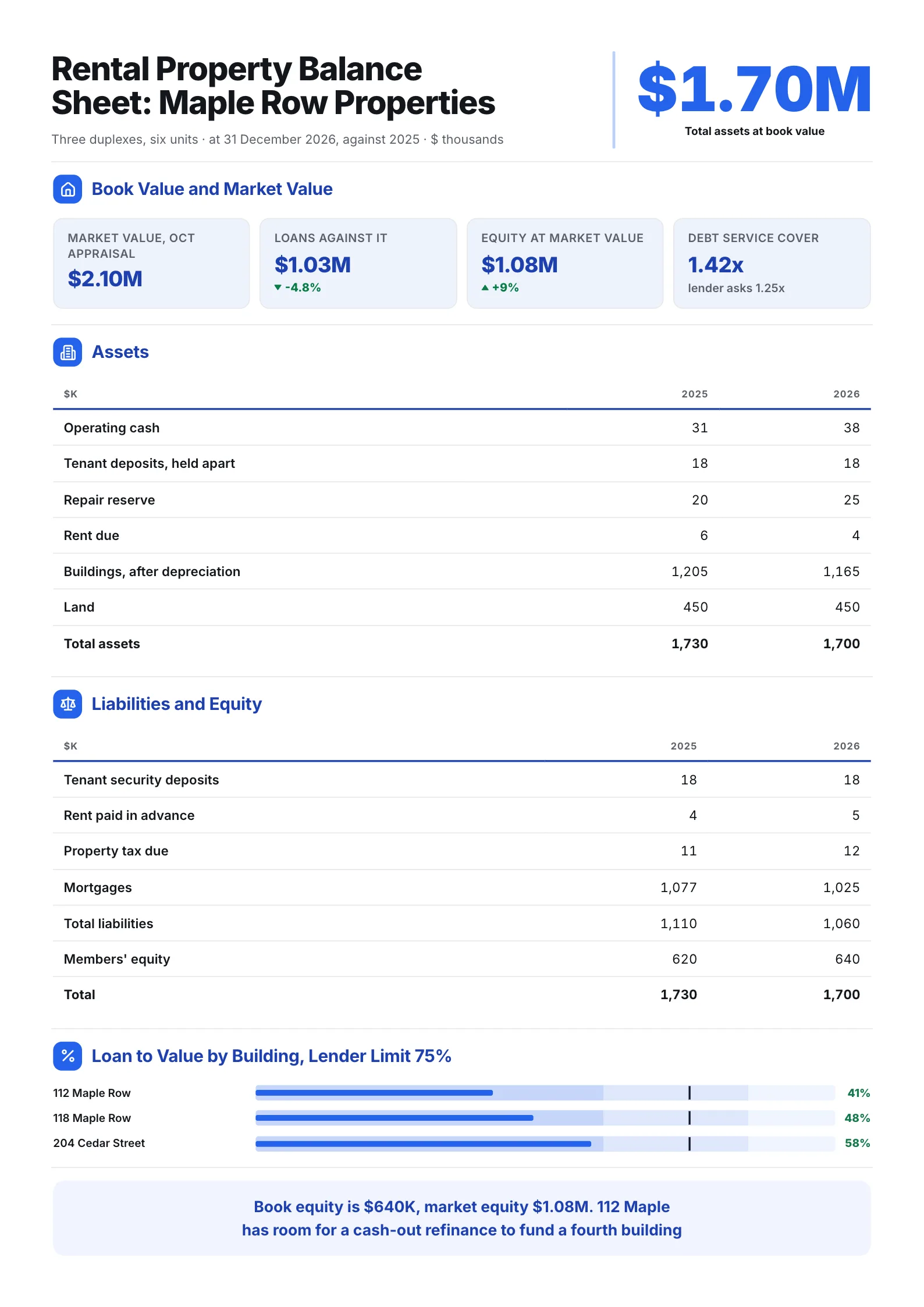 Balance Sheet: Rental PropertyEdit for free(opens in a new tab)
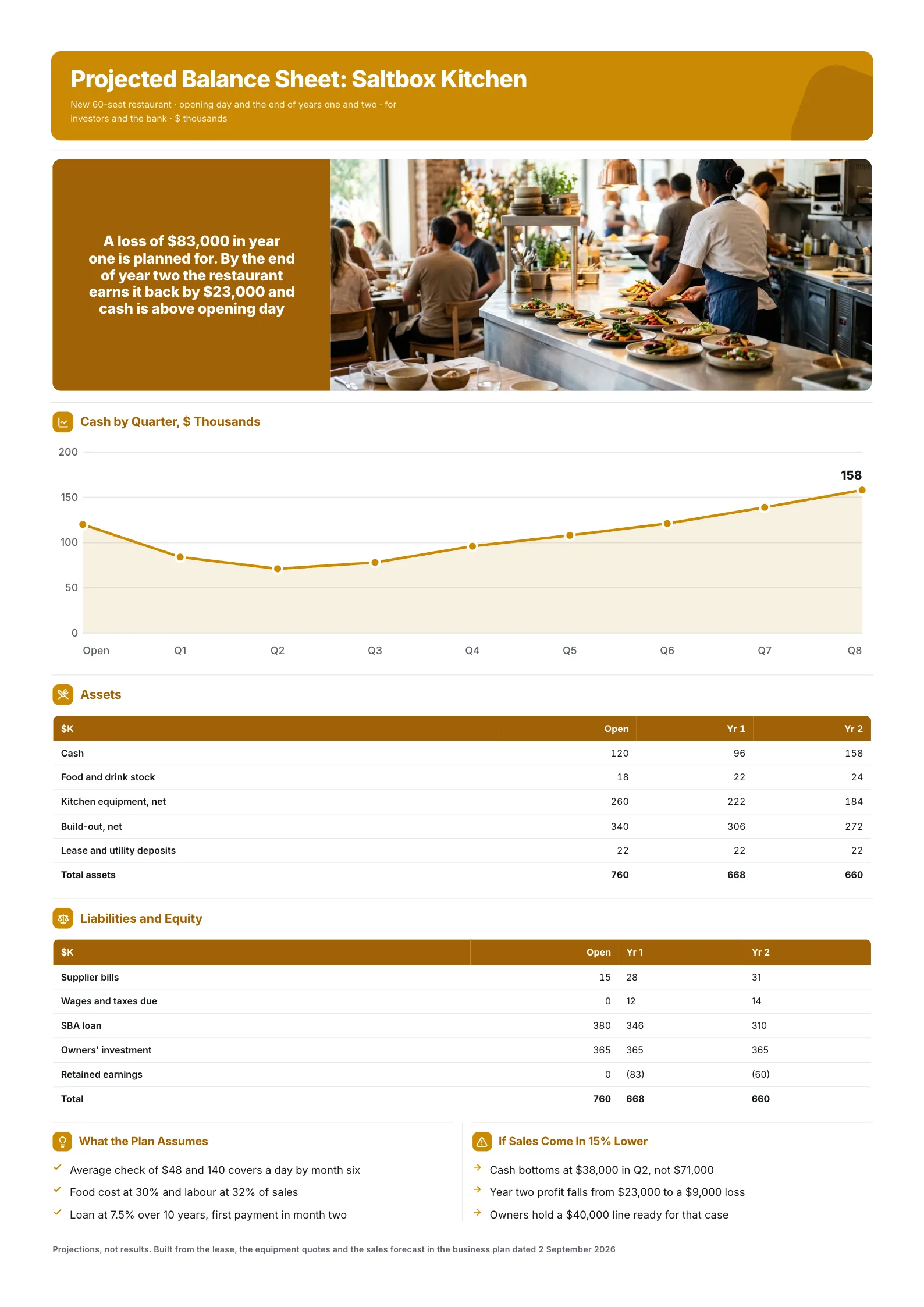 Balance Sheet: ProjectedEdit for free(opens in a new tab)
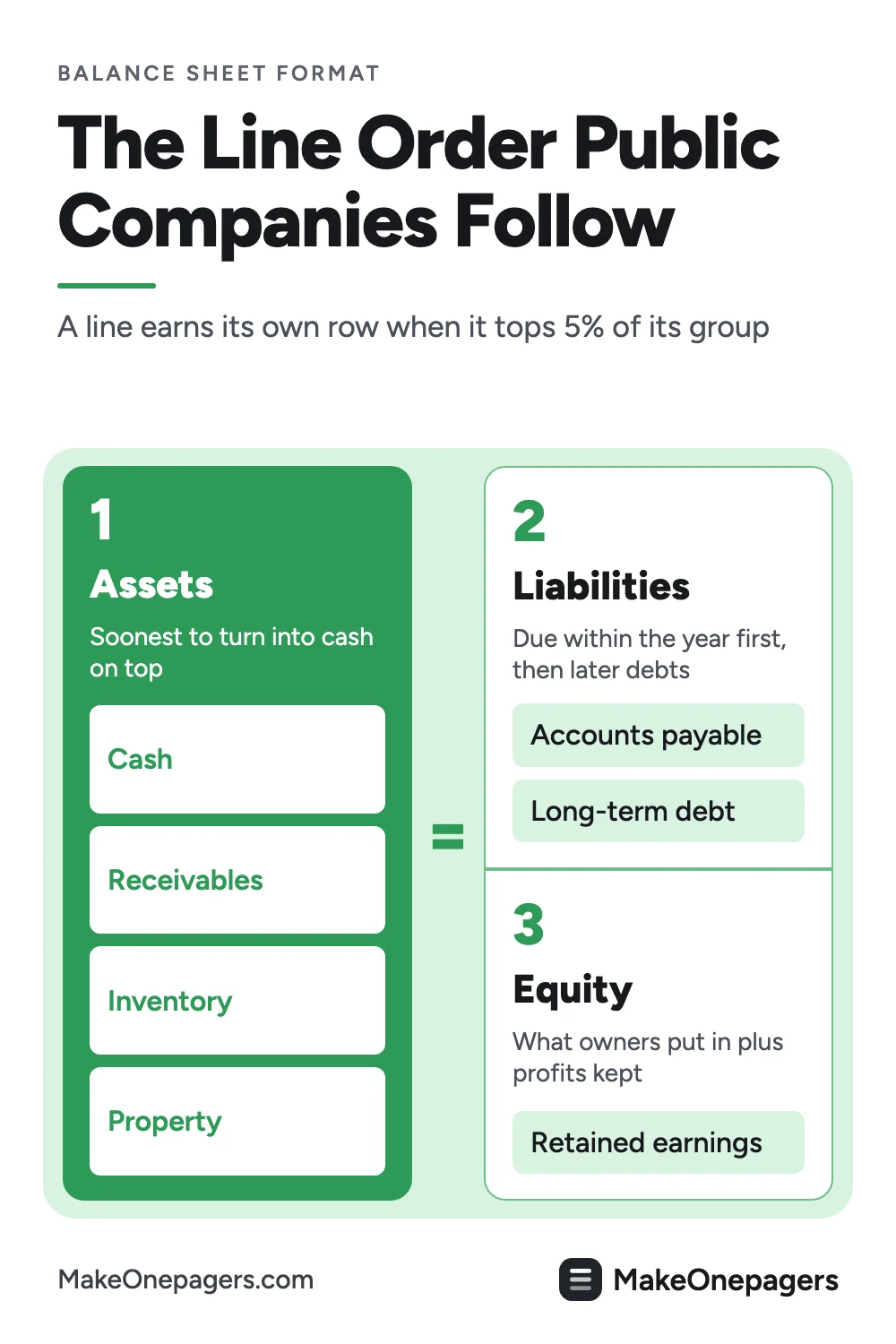
You don't have to guess at that order. Most US public companies follow one written rule for it (banks and insurers have their own): Rule 5-02 of the SEC's Regulation S-X. It lists 32 numbered captions, from cash at the top to total liabilities and equity at the bottom. You'll never file with the SEC, but the rule is still the cleanest checklist you can borrow. It tells you what goes where, and it gives you a simple test for when a line is big enough to show on its own.
The format in one table
Here is the order Rule 5-02 sets, grouped the way you'd lay it out on a page.
| Block | Captions in Rule 5-02 | What you'd write on your own sheet |
|---|---|---|
| Current assets | 1 to 9 | Cash, money customers owe you, stock, prepaid costs |
| Long-term assets | 10 to 17 | Equipment and buildings, less depreciation, then intangibles and other assets |
| Total assets | 18 | One line |
| Current liabilities | 19 to 21 | Bills you owe, wages owed, loan payments due within the year |
| Long-term liabilities | 22 to 26 | Loans due after this year, leases, deferred income |
| Preferred stock and equity | 27 to 31 | Preferred stock, if you have any, then what owners put in plus profits kept in the business |
| Total liabilities and equity | 32 | One line, equal to total assets |
Source: 17 CFR 210.5-02, read October 30, 2026. The rule says current assets and current liabilities are shown "when appropriate", so a business with no clear operating cycle may skip that split.
The 5% rule: when a line gets its own row
This is the part of the rule worth stealing. Several captions say a catch-all line, like "other current assets", must be broken out when one item in it is more than 5% of its group.
- Other current assets (caption 8): split out any item over 5% of total current assets.
- Intangibles (caption 15): show any class over 5% of total assets on its own.
- Other assets (caption 17): same test, 5% of total assets.
- Other current liabilities (caption 20): split out anything over 5% of total current liabilities. The rule's own examples are accrued payroll and the current part of long-term debt.
- Other liabilities (caption 24): any item over 5% of total liabilities.
On a one-page sheet, this gives you a fair cutoff. Anything under 5% of its group can sit in "other". Anything over it gets a row your reader can see. You keep the page short, and nobody can say you buried something.
Here's how it works in practice. Say your current assets total $200,000 and $14,000 of that is a deposit you paid a supplier. That's 7% of the group, so it gets its own row, labeled plainly. A $3,000 prepaid insurance bill is 1.5%, so it can stay in other current assets. Run the same test on your liabilities. The contractor sheet below ends up with six rows and a total on each side, which fits on one page with room for a short note.
Current assets, the way a contractor shows them
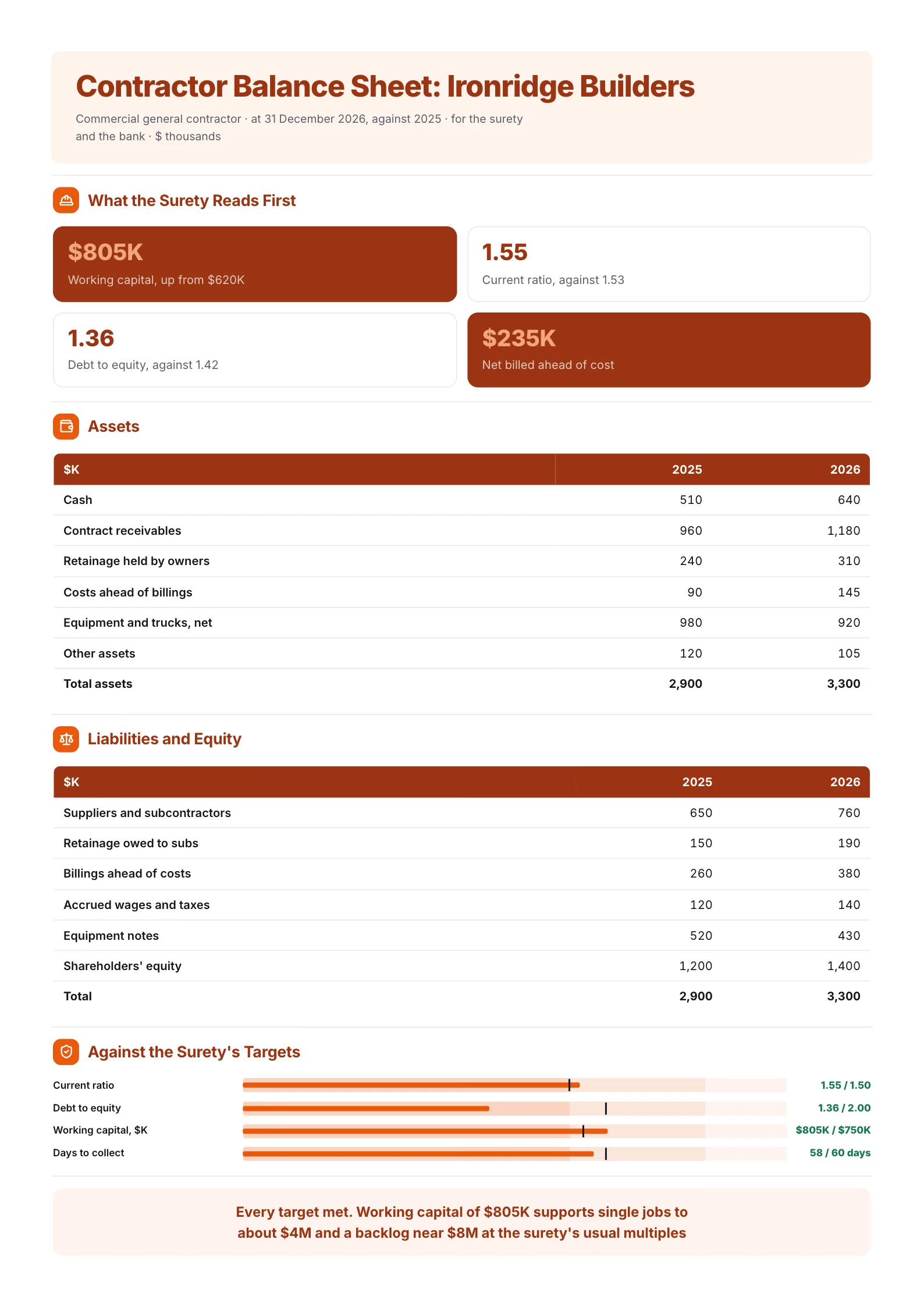
Rule 5-02 asks for receivables to be broken into kinds, and it names one that most small businesses never think about. Caption 3(c)(1) covers retainage: money you've billed a customer that they're holding back until the job is finished. If you build, remodel or install for a living, that's real money owed to you, and it belongs on its own line.
The contractor sheet below does exactly that. Retainage held by owners is $310,000, shown apart from regular receivables. It also shows $380,000 of billings ahead of costs as a liability, because the company has billed for work it hasn't done yet.
 Edit this template
Sample names and figures. Current ratio 1.55 and working capital $805K, with retainage on its own row.
Stock: one line or several?
Caption 6 asks public companies to show their main classes of inventory, such as finished goods, work in process, raw materials and supplies. Your shop may only have one kind, finished goods on the shelf, and one line is fine. If you make what you sell, split it, because raw materials and half-made goods turn into cash much more slowly.
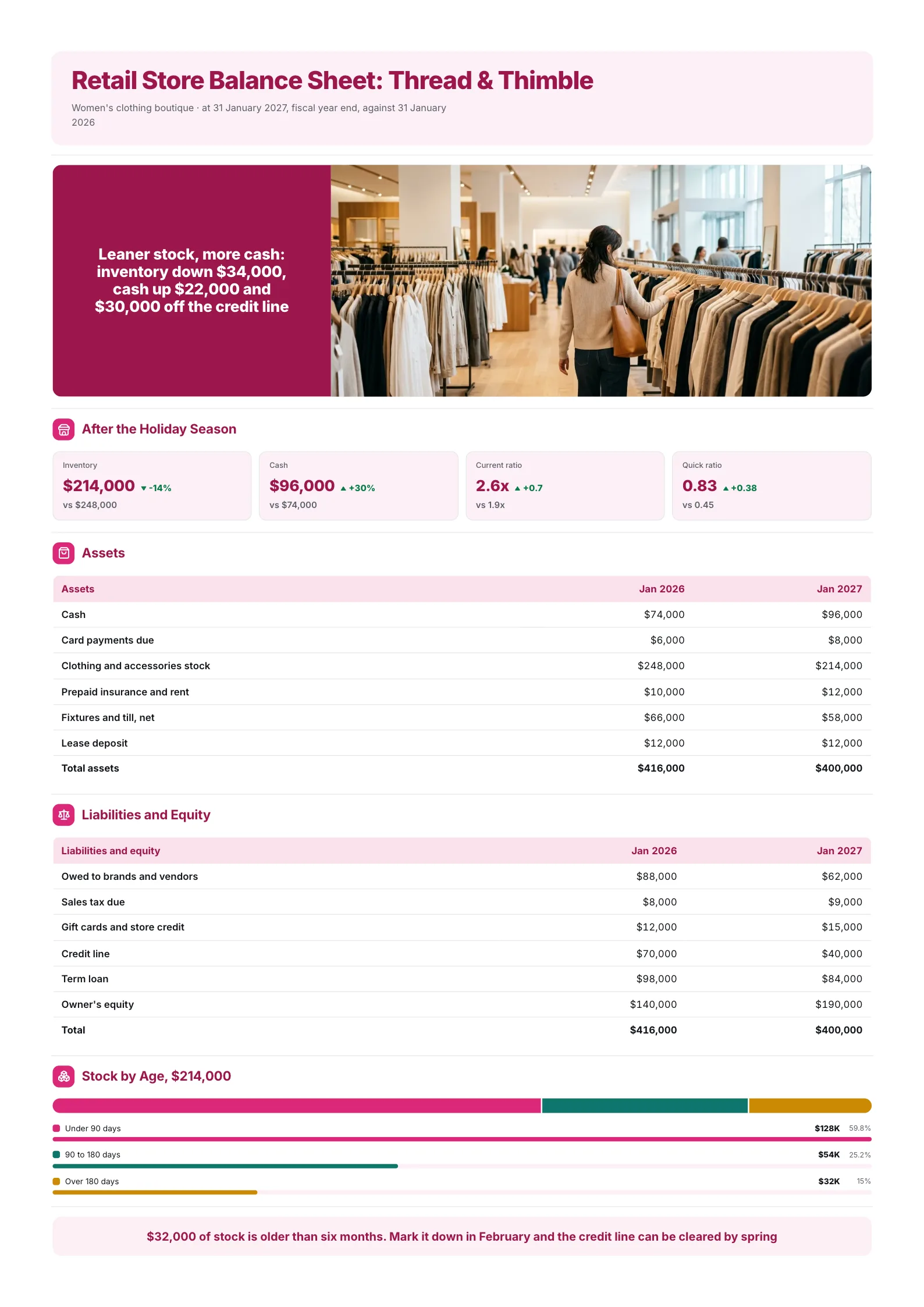
Stock also explains why two ratios can tell you different things. The retail store below has a current ratio of 2.6, which looks very safe. Its quick ratio, which leaves stock out, is 0.83. Most of the store's current assets are $214,000 of merchandise, and your bank will look at both numbers.
 Edit this template
Sample names and figures. The same sheet reads safe on the current ratio and tight on the quick ratio.
Long-term assets and the intangibles test
Equipment and buildings come next, at cost less depreciation. Then come intangibles, like goodwill from buying a business, a customer list or a patent. Caption 15's 5% test matters most here, because goodwill is often large and easy to tuck away.
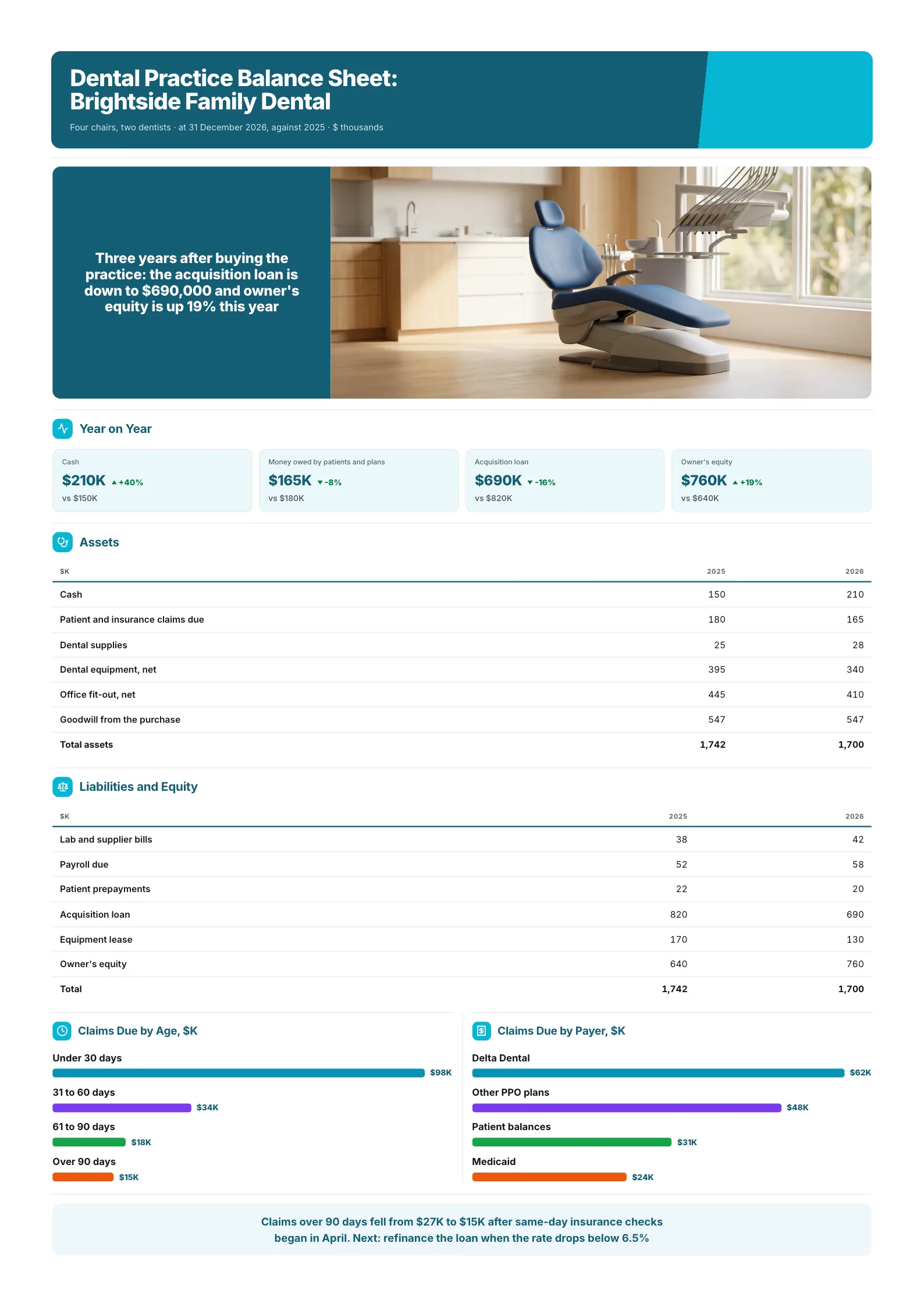
The dental practice below bought an existing office. Goodwill is $547,000 of $1.7 million in total assets, about 32%. That's far over 5%, so it gets its own line, right beside the $690,000 acquisition loan that paid for it. Your reader sees in one glance what the practice bought and what it still owes on it.
 Edit this template
Sample names and figures. Goodwill is 32% of total assets, so it gets its own row.
Liabilities: the current part of your long-term debt
Caption 20 names the current portion of long-term debt as one of the items to split out. This is the line people most often miss. If you have a five-year loan, the payments due in the next 12 months are a current liability, and the rest is long-term.
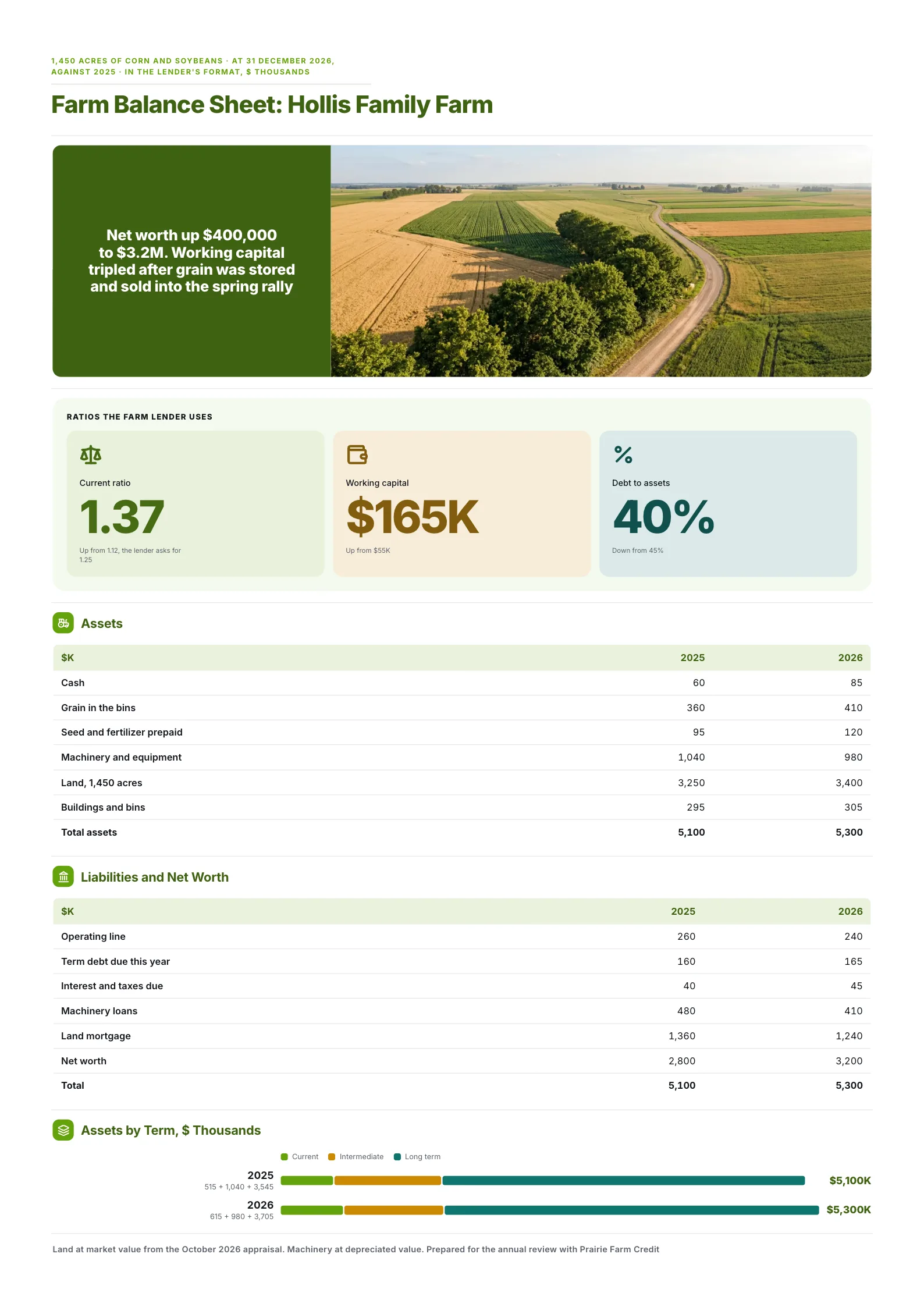
It changes your ratios. The farm below owes $165,000 of term debt this year, and its working capital is also $165,000. Its current ratio is 1.37 and its debt is 40% of assets, on $5.3 million in total assets. Move that one line to long-term and the farm would look healthier than it is.
 Edit this template
Sample names and figures. The term debt due this year sits in current liabilities, where it belongs.
Caption 22 also asks for each long-term loan's interest rate and due date. On a one-page sheet you can put both in a short note under the row.
Equity, and what replaces it at a nonprofit
Captions 29 to 31 cover equity: the stock or capital owners put in, other equity such as paid-in capital and retained earnings, and any part of the business held by outside partners. For a small company, two lines usually cover it: what you put in and the profits you've kept.
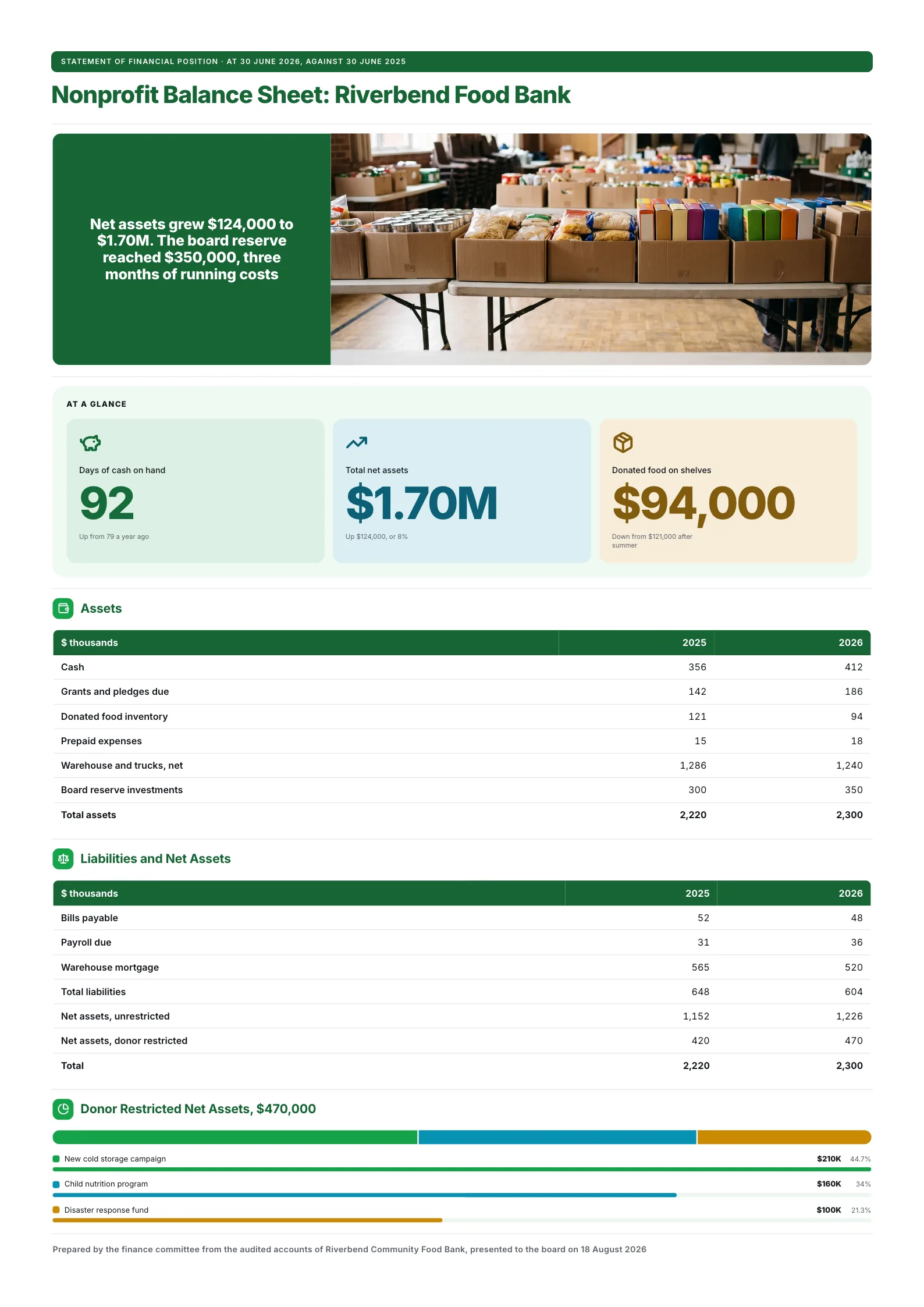
A nonprofit has no owners, so the block is called net assets instead. It splits by whether donors limited how the money can be used. The sheet below shows $1,226,000 without donor restrictions and $470,000 with them, about $1.70 million in net assets, against $2.3 million in total assets.
 Edit this template
Sample names and figures. Net assets take the place of equity, split by donor restriction.
Account form or report form?
You'll see two layouts. In report form, assets sit above liabilities and equity in one column, which is how most annual reports print it. In account form, assets sit on the left and liabilities and equity on the right, like the two sides of a scale. Rule 5-02 sets the order of the captions, not the layout, so either one is fine. On a one-page sheet you share as a PDF, report form usually reads better on a phone.
For a blank layout you can fill in, see our balance sheet template post. Building one from your books for the first time? How to make a balance sheet walks you through each step.
Borrow the order, keep the page short
The SEC wrote its rule for companies with thousands of accounts. You only need its order and its 5% cutoff. Put your items in that sequence, give anything over 5% of its group its own row, and add one sentence on top that says what changed since last time. Then lay it out in a MakeOnepagers balance sheet design, with the three blocks already in place.
Frequently asked questions
What is the correct order of a balance sheet?
Assets, then liabilities, then equity. Within assets and liabilities, current items come first. Rule 5-02 lists 32 captions in that order, ending with total liabilities and equity.
Do assets have to equal liabilities plus equity?
Yes, every time. Equity is what's left after you subtract what you owe from what you own, so the two sides always match. If yours don't, a number is missing or entered twice. Check the loan balances against your lender's statement first.
Which items go in current assets?
Cash and anything you expect to turn into cash within a year, or within your normal operating cycle if it's longer. That means money customers owe you, stock and prepaid costs.
Should a small business use the SEC format?
You don't have to, and you can drop captions that don't apply to you. The order and the 5% test still help, because your bank and any buyer will read your sheet in that order.




