Account Plan vs Success Plan: Who Each Page Is For
Account plan vs success plan: one stays inside your team, the other is built with your customer. See which lines go where, across 5 sample account plans.

An account plan and a success plan can describe the same customer, the same quarter and the same goals. What sets them apart is who gets to read them. Your account plan stays inside your company. Your success plan is written with the customer and sits open on both sides of the table. Start from a free one pager template.
One‑Pager examples
Real One-Pagers made with MakeOnepagers. Open any one to edit it as your own.
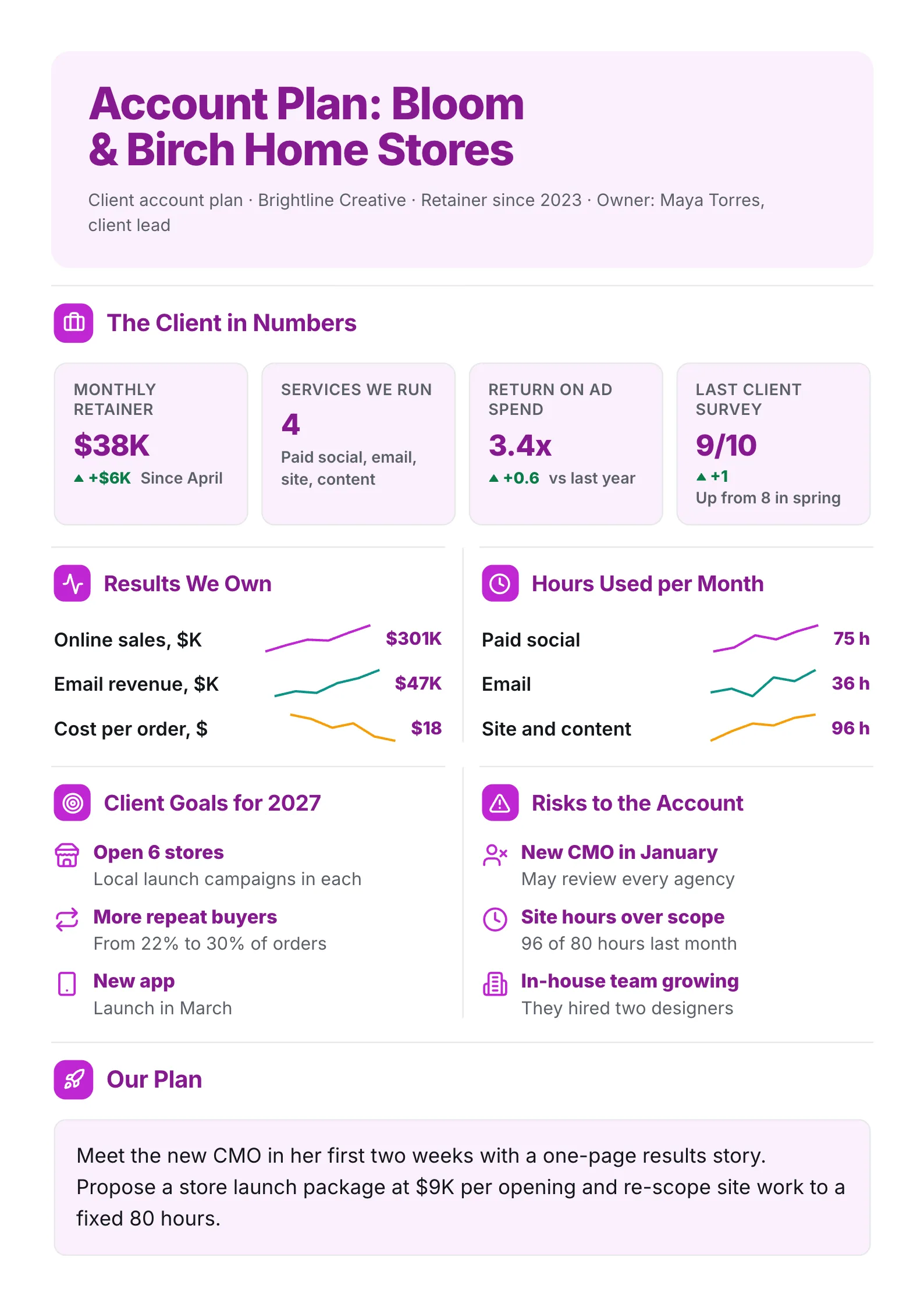 Account Plan: Agency Client RetainerEdit for free(opens in a new tab)
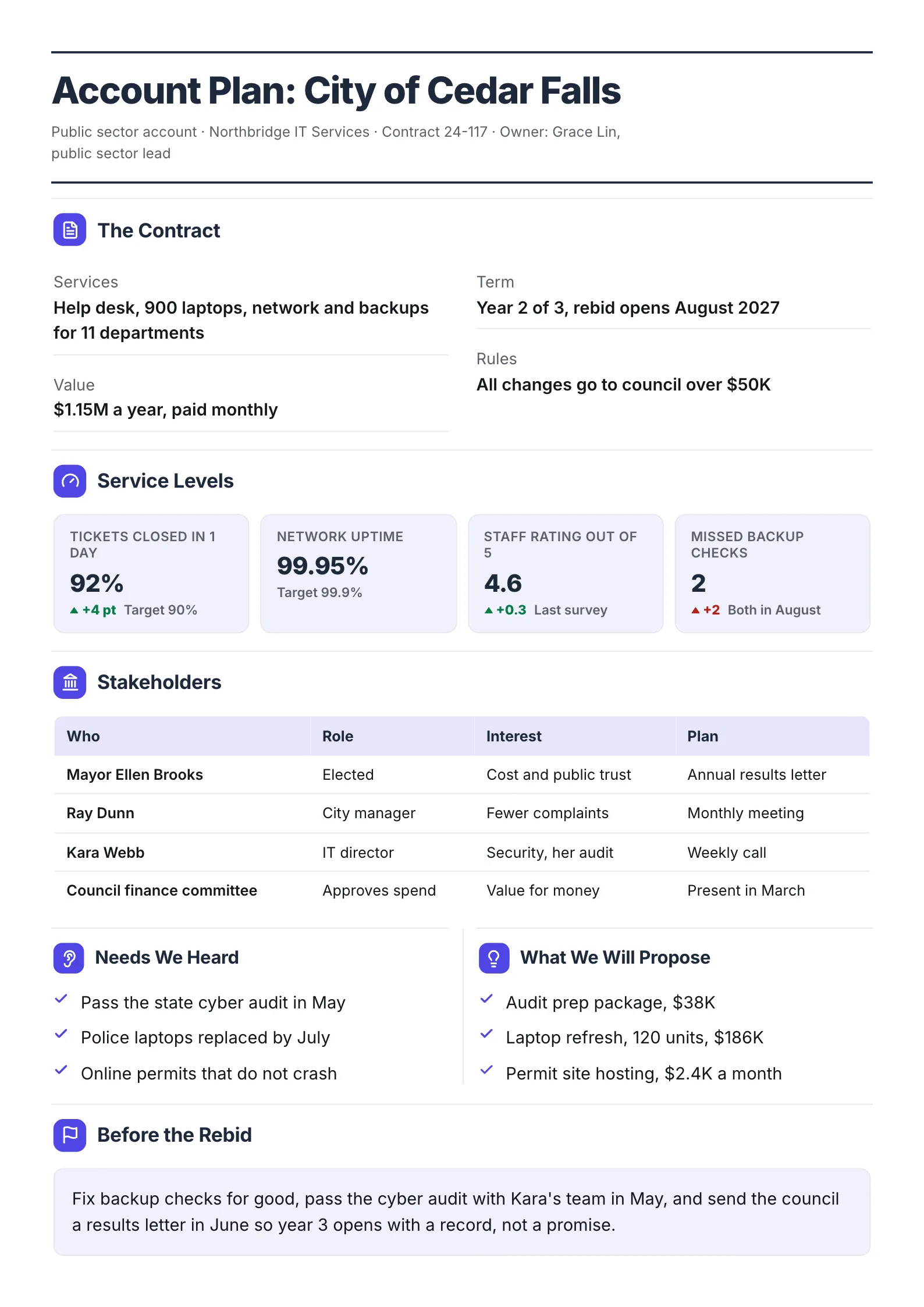 Account Plan: City Government ContractEdit for free(opens in a new tab)
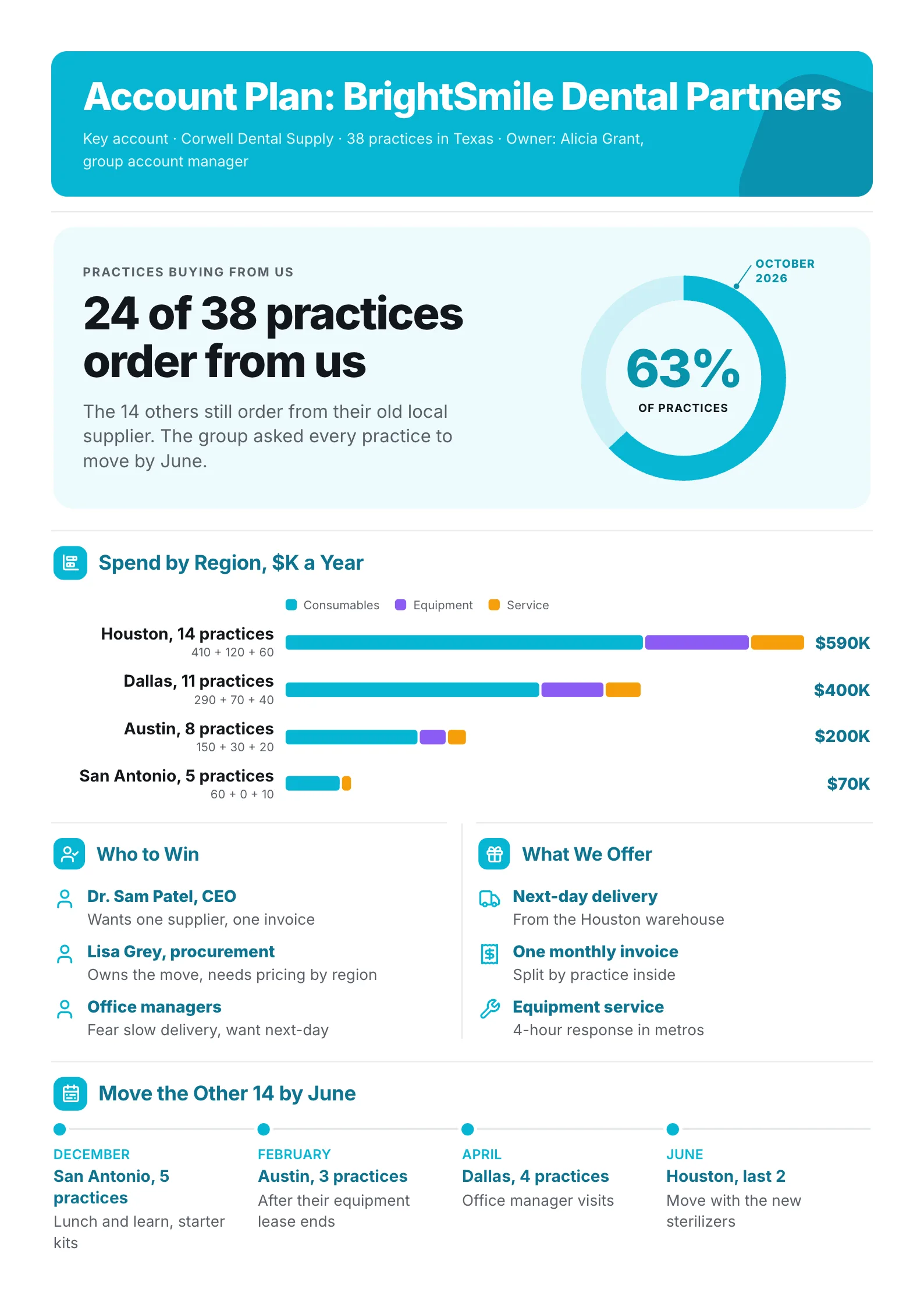 Account Plan: Dental Group SupplyEdit for free(opens in a new tab)
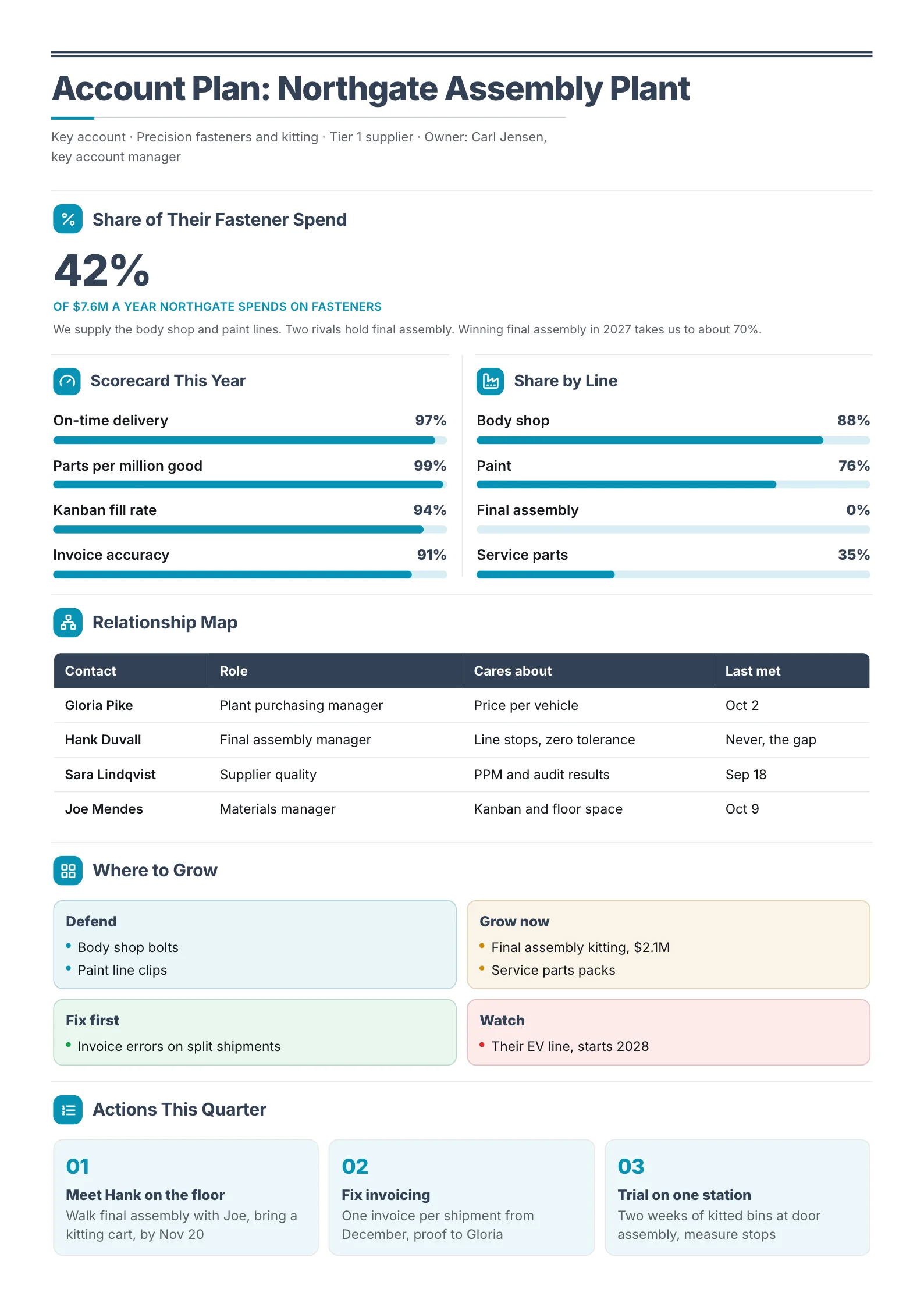 Account Plan: Manufacturing Plant SupplierEdit for free(opens in a new tab)
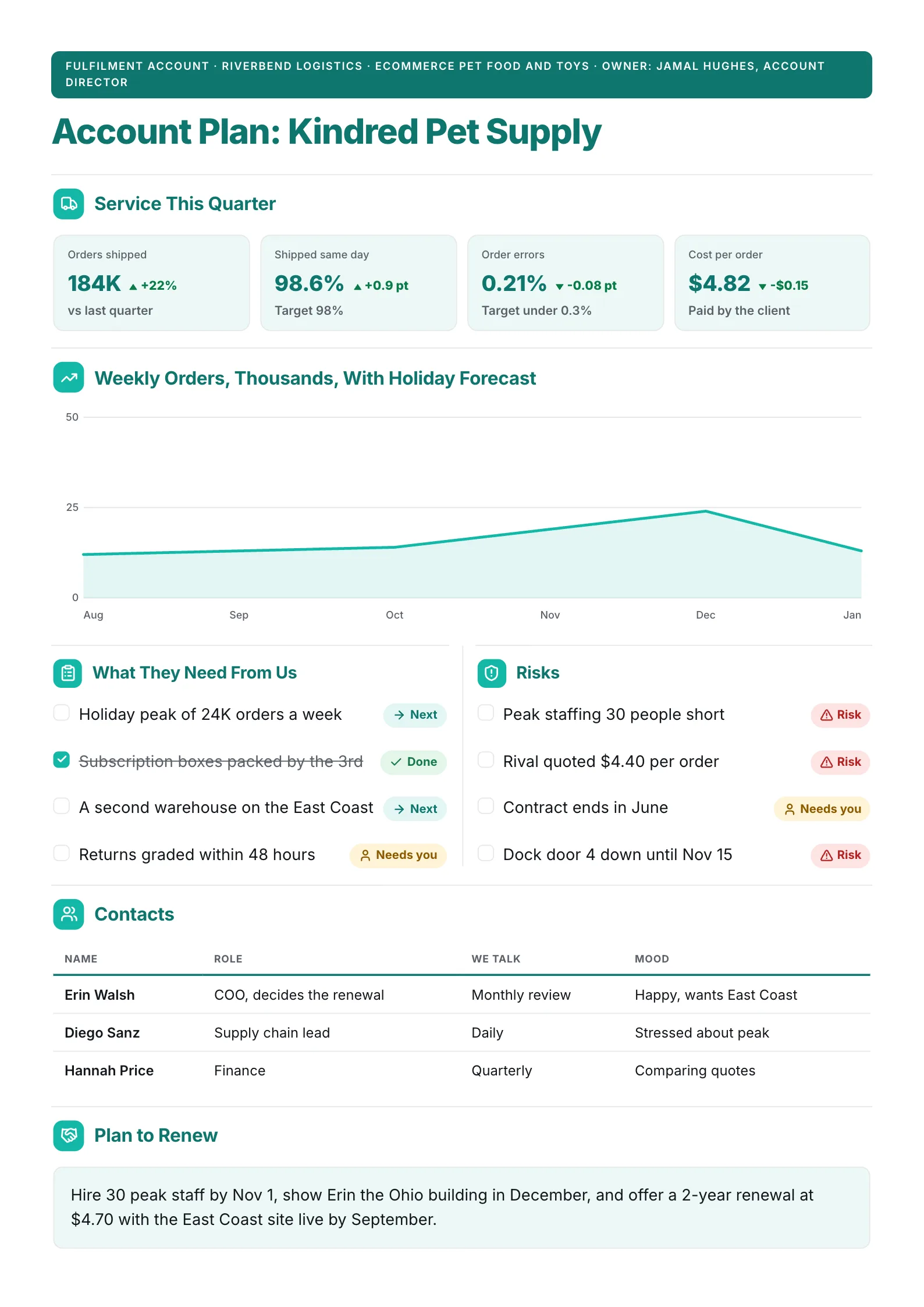 Account Plan: Ecommerce Fulfilment ClientEdit for free(opens in a new tab)
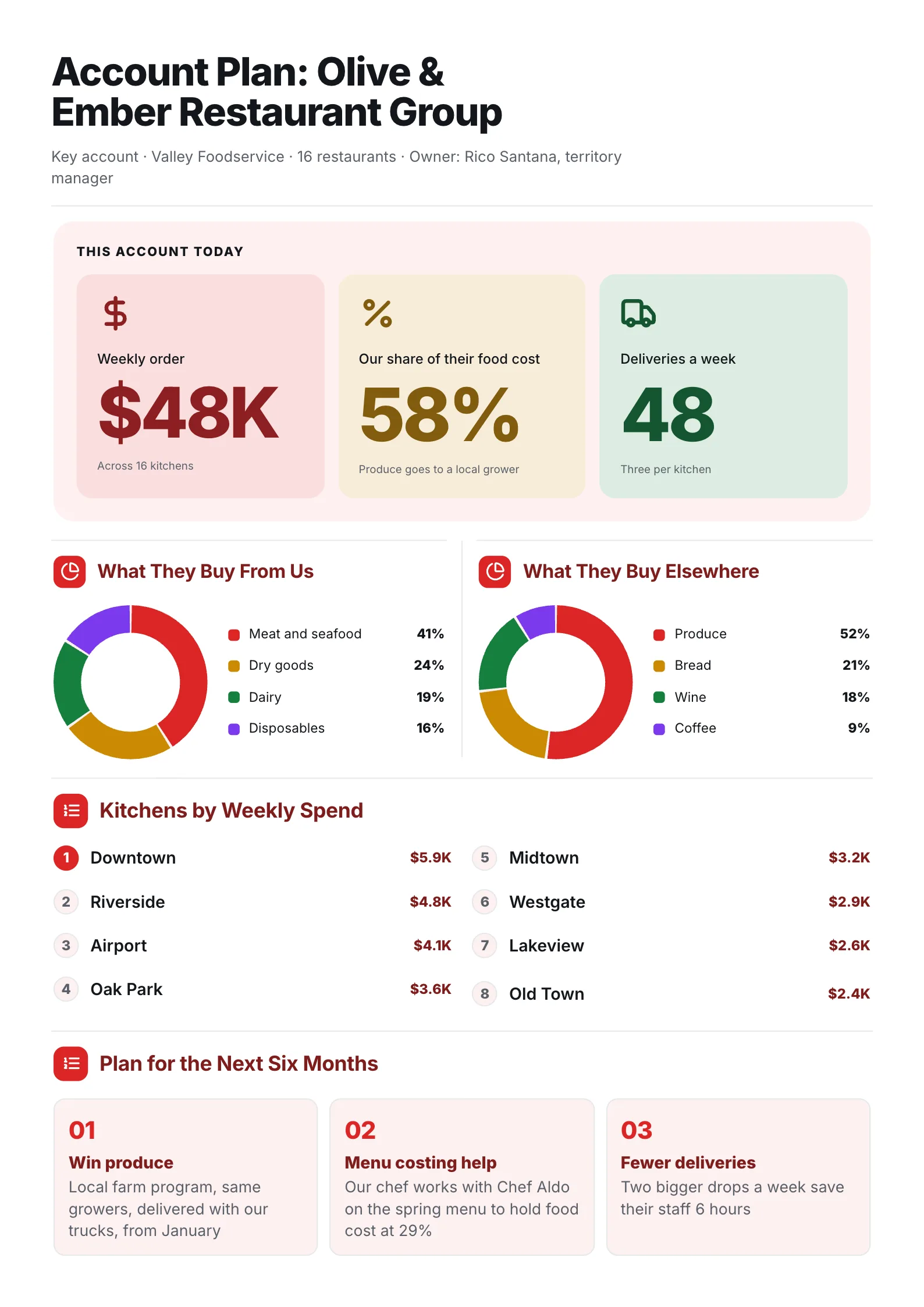 Account Plan: Restaurant Group DistributorEdit for free(opens in a new tab)
Vitally, a customer success software company, calls account plans "behind-the-scenes playbooks that are only for your teammates' eyes." HubSpot's guide to success plans draws the same line from the other side. A success plan, it says, gets built with the customer and works as a shared roadmap for the whole relationship.
| Account plan | Success plan | |
|---|---|---|
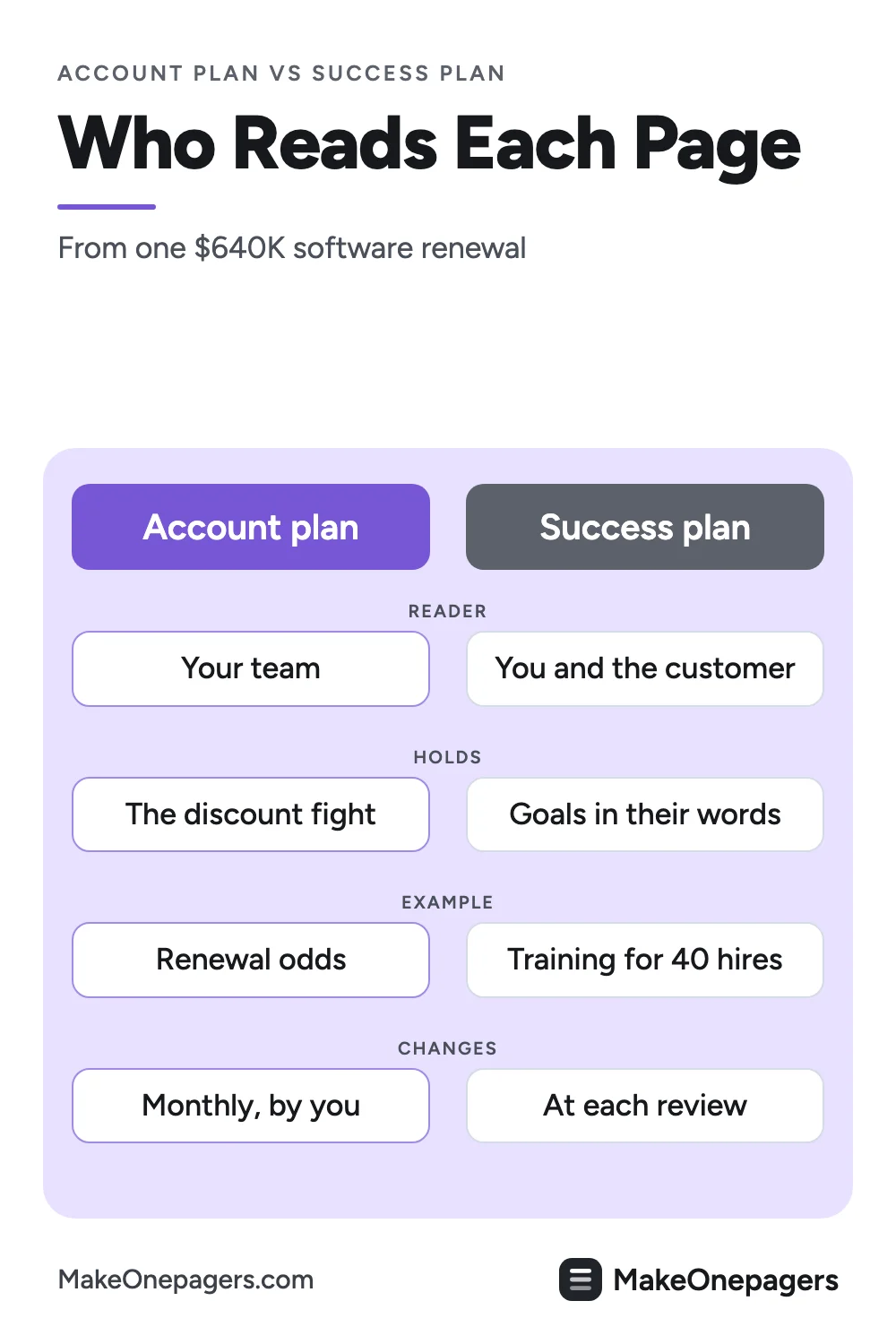
| Who reads it | Your team, from sales to success to your manager | You and the customer |
| The question it answers | What do we want from this account, and how do we get it? | What does the customer want, and how will both sides get there? |
| Typical contents | Revenue, renewal odds, who decides, risks, growth targets | Goals in the customer's words, milestones, metrics, named owners |
| How value is shown | Contract value, discounts, margin | Results the customer can measure |
| How often it changes | Each month or quarter, by your team | At each review with the customer |
| Who writes it | The account owner, with sales and implementation | The customer success manager, with the customer |
The test for every line
Read each line of your plan and ask one question. Would you be comfortable if the customer saw it on a shared screen? If the answer is no, it belongs in the account plan. "Procurement is pushing for a 10% discount" helps your team and would be awkward in front of the buyer. "Export times under 10 seconds by November 12" is something the customer wants to see, so it can sit in both.
The five samples below are all account plans. For each one, you'll see which lines stay inside and which ones could move into a success plan you share.
Five account plans, split line by line
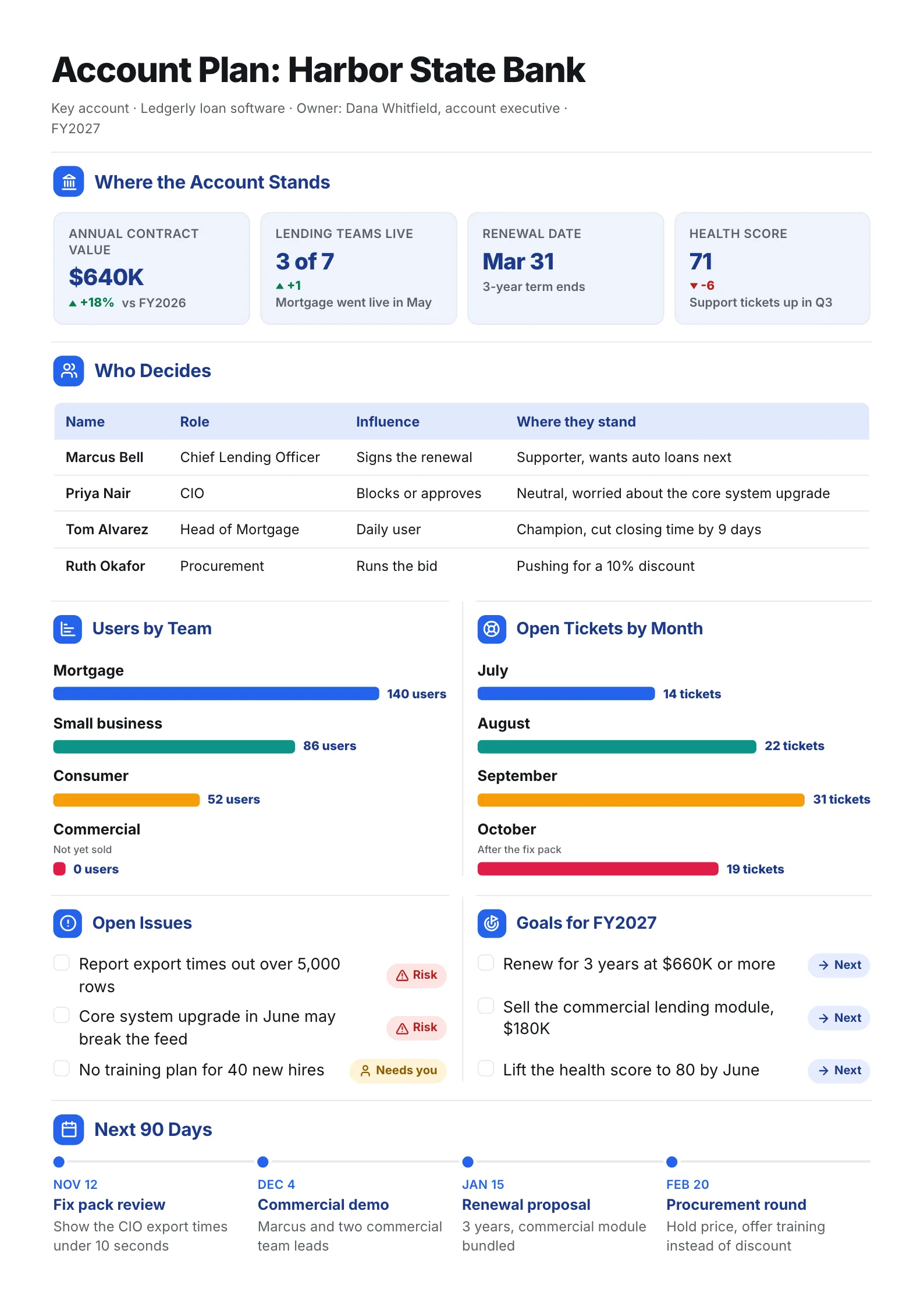
A software renewal with a discount fight
 Edit this template
This bank software account plan is a renewal plan, and most of it is for your eyes only. The "Who Decides" table says the CIO is neutral and procurement wants 10% off. The last step in the 90-day plan is to hold price and offer training instead of a discount. None of that goes to the bank.
Plenty of it can, though. The bank cares about the report export that times out over 5,000 rows, a training plan for 40 new hires and the 3 lending teams already live. Those lines make a fair start on a success plan once each has a date and a named person on the bank's side.
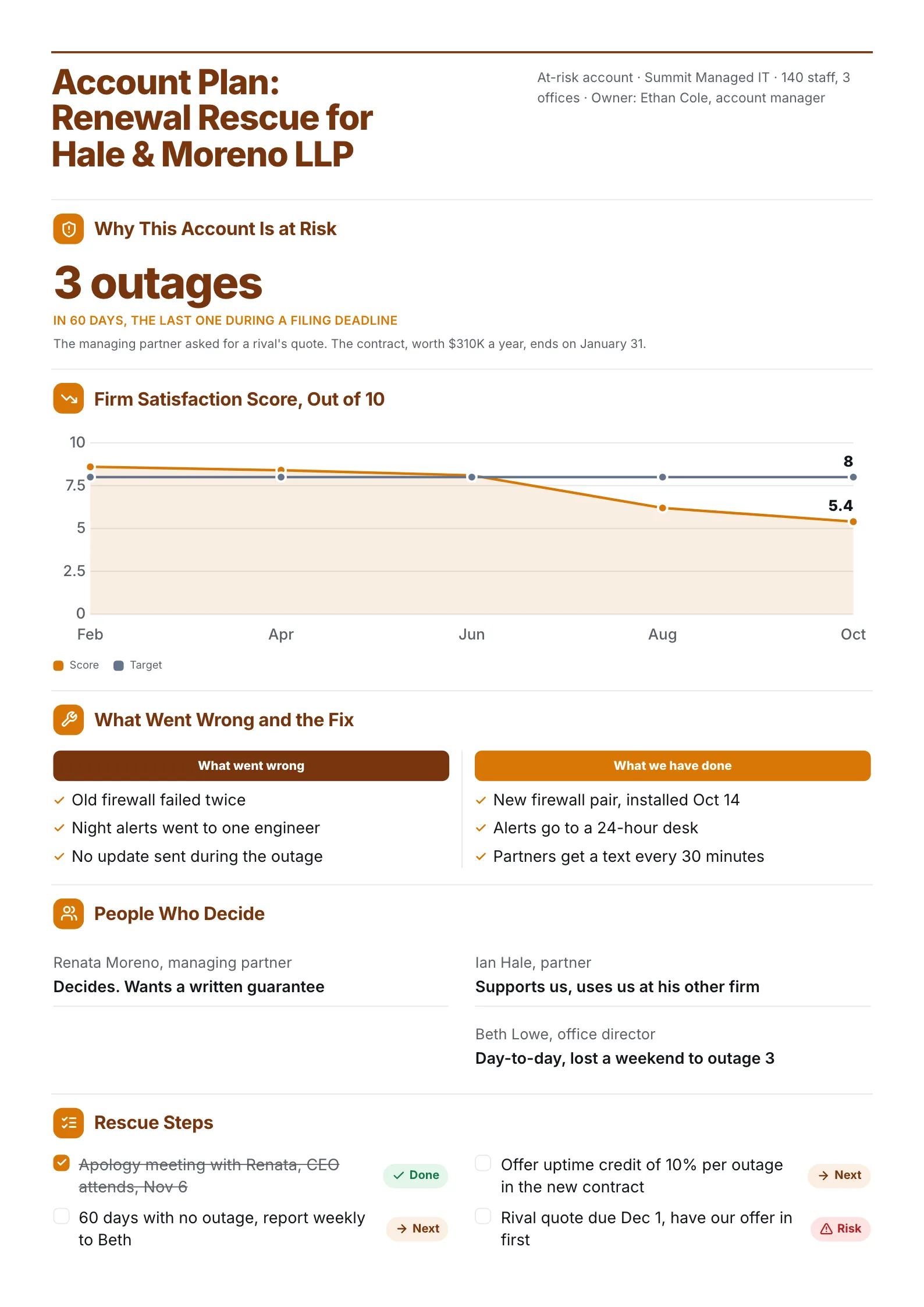
An account that's about to leave
 Edit this template
For a churn risk, Vitally's advice is to set the goal as "retain them" and leave the big upsell for later. The at-risk renewal plan does exactly that. Three outages in 60 days pushed the managing partner to ask a rival for a quote, and the contract is worth $310K a year.
Keep the rival's quote date, December 1, and your notes on who decides in the account plan. The fix list is different. A new firewall pair, alerts routed to a 24-hour desk and a text to the partners every 30 minutes during an outage are promises your client should hold you to. Put them on a shared page beside the weekly no-outage report.
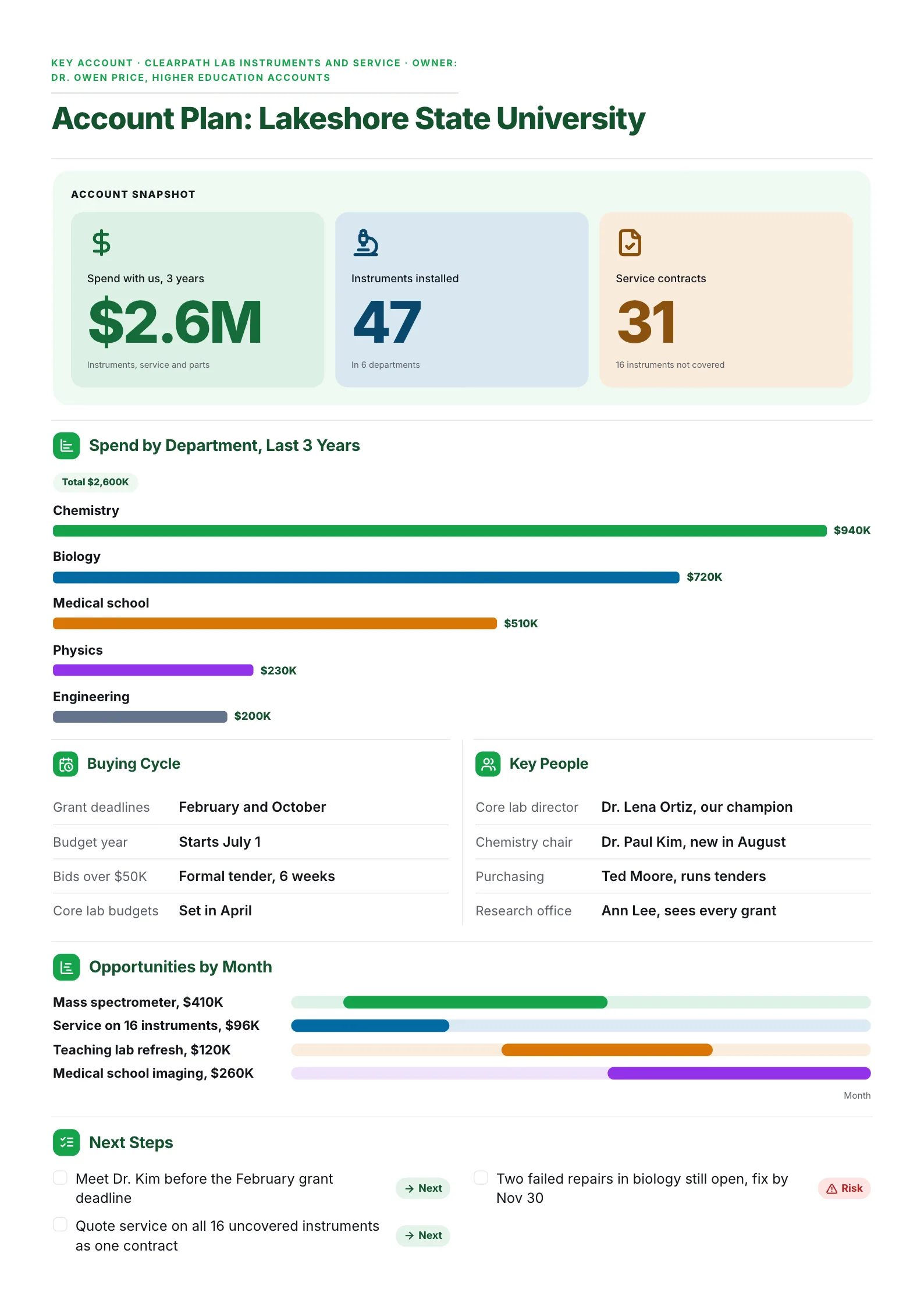
A university with its own calendar
 Edit this template
The buying cycle block is pure account planning. Grant deadlines fall in February and October, the budget year starts July 1, and any bid over $50K goes to a 6-week tender. You need that to time your quotes, and the university doesn't need you to explain its own calendar back to it.
The next steps hold one line that belongs on a shared page. Two failed repairs in biology are still open, due to be fixed by November 30. Written down with a date and an owner, it's a promise the lab can check. Start from the university lab account plan if your customers buy on a grant calendar.
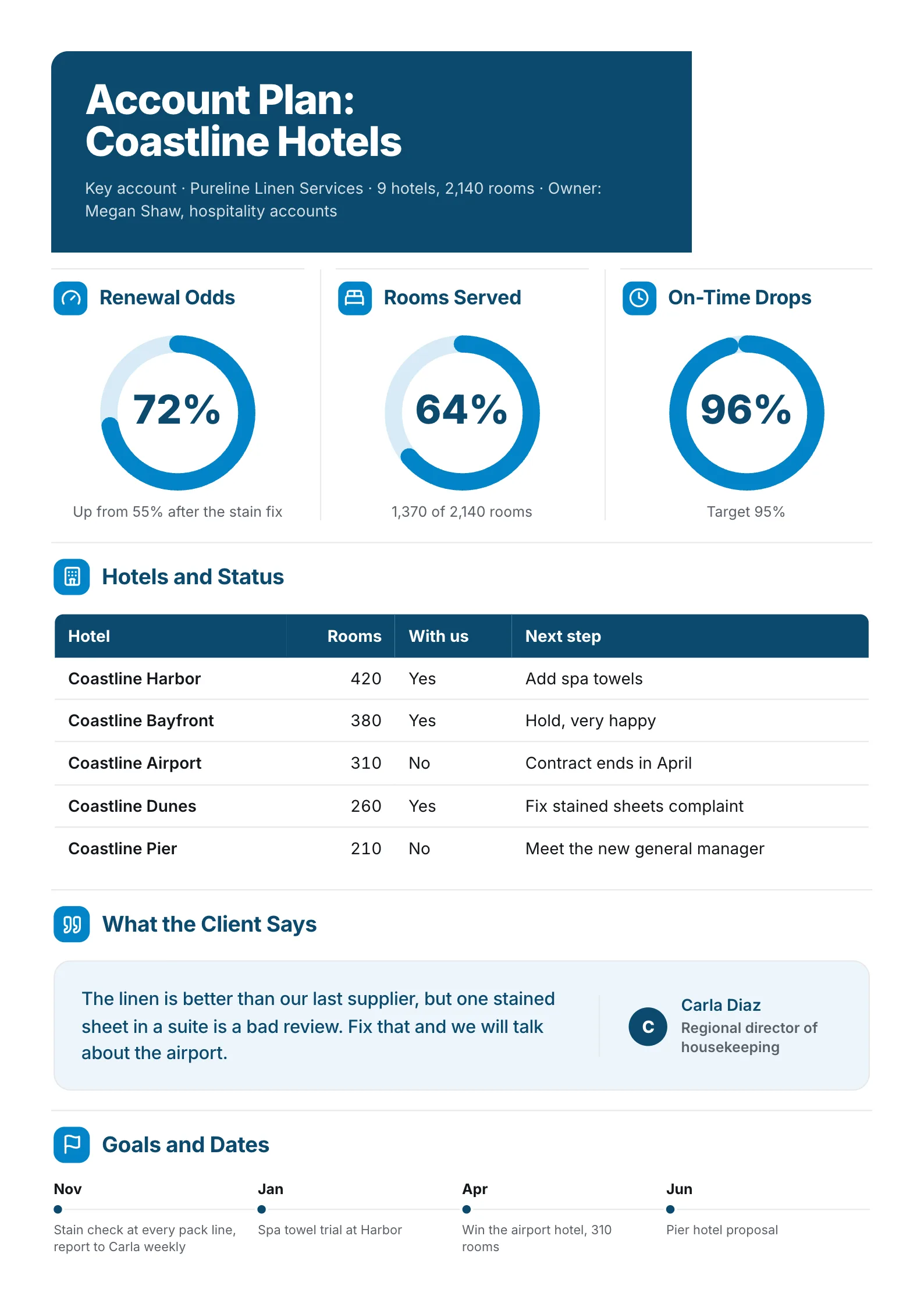
A hotel group that told you what it wants
 Edit this template
A 72% chance of renewal is a number your team uses to rank its week. Showing it to the client would be odd. The quote from the regional director of housekeeping is another matter. She says one stained sheet in a suite means a bad review, and that a fix opens the talk about the airport hotel.
That quote is a success plan goal in the customer's own words. The hotel group account plan already has the matching action, a stain check at every pack line reported to her weekly. Share that line and its date. Keep the airport hotel, 310 rooms in April, as your own target.
A retailer that plans with you
 Edit this template
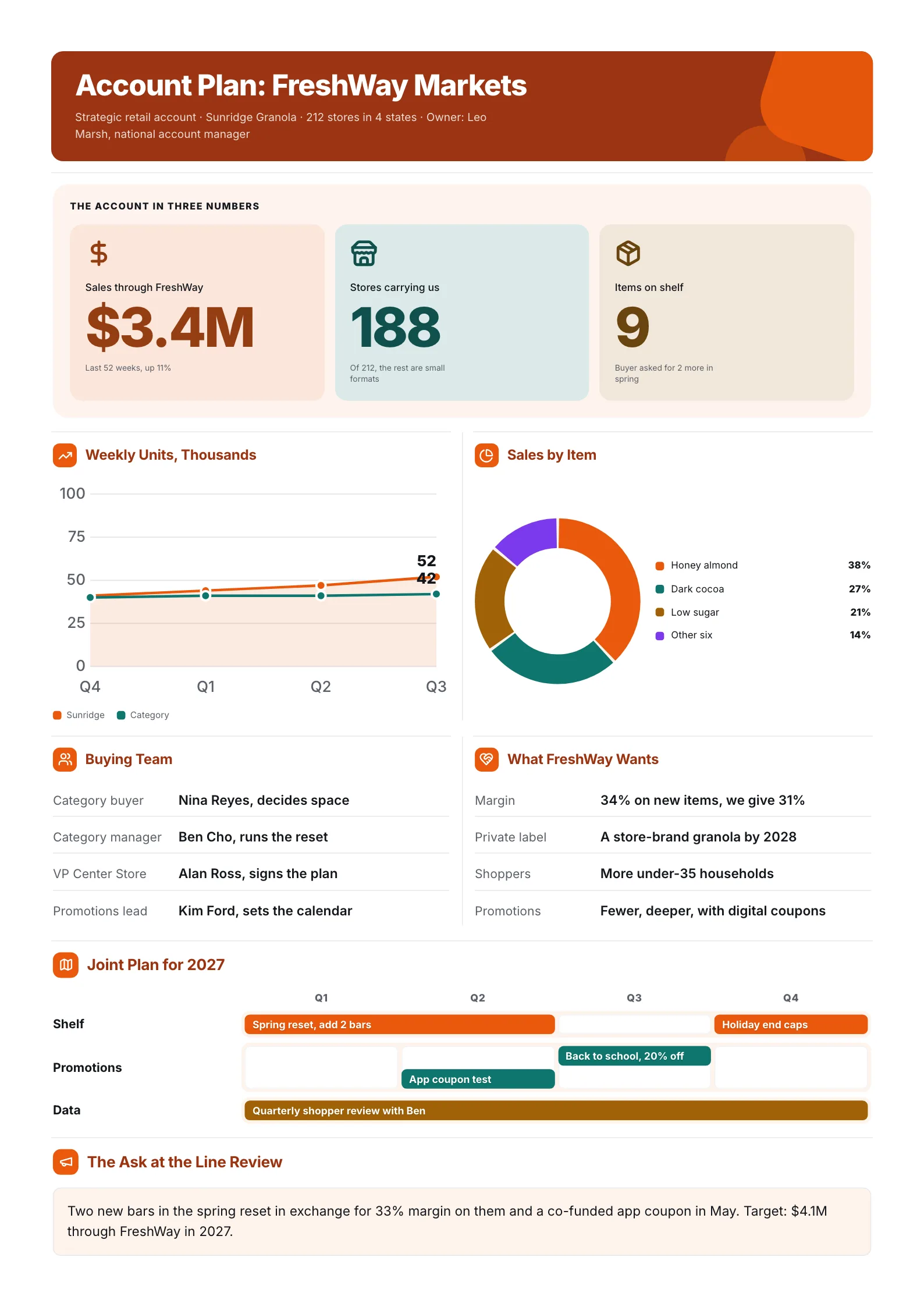
Some customers want to build the plan with you. HubSpot calls this a joint success plan, where both sides agree on goals and success criteria together. The "Joint Plan for 2027" in this grocery retail account plan is that kind of block, with a spring reset, holiday end caps and a quarterly shopper review with the category manager.
The margin line stays home. The retailer wants 34% on new items and the brand gives 31%, and the ask at the line review trades two new bars for 33%. That's your negotiating position, so it lives in the account plan.
What a success plan adds
HubSpot's guide lists seven parts of a customer success plan. Here's how they line up against the account plans above.
| Success plan part | Already in your account plan? |
|---|---|
| Customer profile and context | Mostly. Take out the revenue and risk notes before you share it |
| Defined success outcomes | Rarely. Write them as the customer's own numbers |
| Milestones and timeline | Often, as next steps. Add the customer's dates too |
| Success metrics and KPIs | Partly. Keep your health score inside |
| Stakeholder map | Yes, as "who decides." The shared version lists roles and leaves out where each person stands |
| Risk register | Yes. Share the risks the customer can help with |
| Action items and owners | Often. Name a person on each side |
One habit from the HubSpot guide is worth copying. Give every task to a named person with a date. "Marketing will provide assets" leads nowhere, while a name and a deadline get it done.
How often should you look again? HubSpot suggests monthly reviews for high-touch accounts and quarterly ones for scaled accounts. For account plans, Vitally passes on one manager's routine: block one day a month and go through your book account by account, or just your top 10 highest-value accounts if that's too many.
Which one to write first
If the account is new, start with the success plan, since it sets the goals you'll be judged on at renewal. If the account is at risk, start with the account plan. You'll want to know who decides and what a rival is offering before you put promises in writing. For a steady account, keep both and update them on the same day.
The Vitally article adds one more internal piece, the account map. It lists who you've already sold to and who else in the customer's company could use you. Before you reach out to a new team, tell your champion first.
Make your account plan
Open the account plan in MakeOnepagers that looks most like your customer, then swap in your own names and numbers. Save a copy with the private lines removed, and you have the start of a success plan. Have CRM notes and a review deck from last quarter? Paste them into the free AI One-Pager generator and trim what it lays out. For the full method, read how to write an account plan. For the meeting where you'd walk the customer through it, see how to write a quarterly business review.
Frequently asked questions
What is the difference between an account plan and a success plan?
An account plan is an internal document about what your company wants from a customer, such as revenue, renewal and growth. A success plan is built with the customer around their goals, milestones and owners, and both sides can see it.
Who owns the success plan?
Usually the customer success manager, with a named owner on the customer's side for each goal. The account plan usually belongs to the account manager or account executive.
Does a small account need a success plan?
A full one rarely pays off. HubSpot's guide describes low-touch success plans for smaller accounts that run on automated emails, help articles and in-app guidance, with a person stepping in when something triggers it.
Is a success plan the same as a project plan?
No. A project plan ends when the project does. HubSpot's guide says a success plan keeps going through the whole relationship and can cover several projects, from setup to expansion.
Can one document do both jobs?
It can, if you keep two versions. Write the account plan first, then copy it and delete the lines about money, discounts, renewal odds and where each person stands. What's left is a draft success plan to finish with your customer.




