How to Write an Account Plan for the Customer You Can't Afford to Lose
In 8 annual reports, 5 companies had a customer worth 10% or more of revenue, and big customers came and went in a year. Plan for yours.

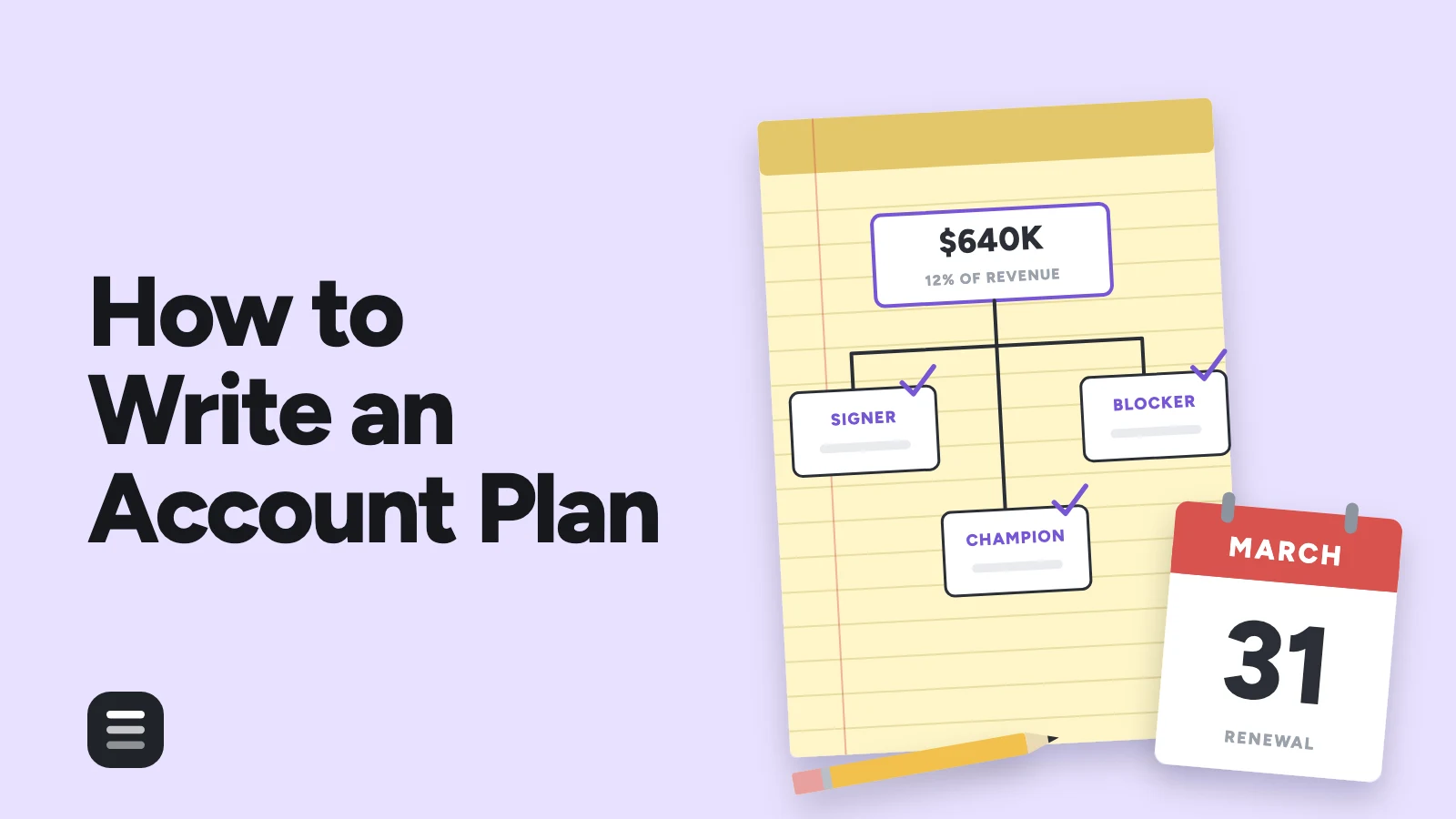
Which customers can't you afford to lose? An account plan is a one-page plan for one important customer. It says what they buy now, who decides, where the account can grow, what could go wrong and what you'll do next. You write one for each account that matters most to your revenue. Start with how much of your revenue each customer brings in. Start from a free one pager template.
One‑Pager examples
Real One-Pagers made with MakeOnepagers. Open any one to edit it as your own.
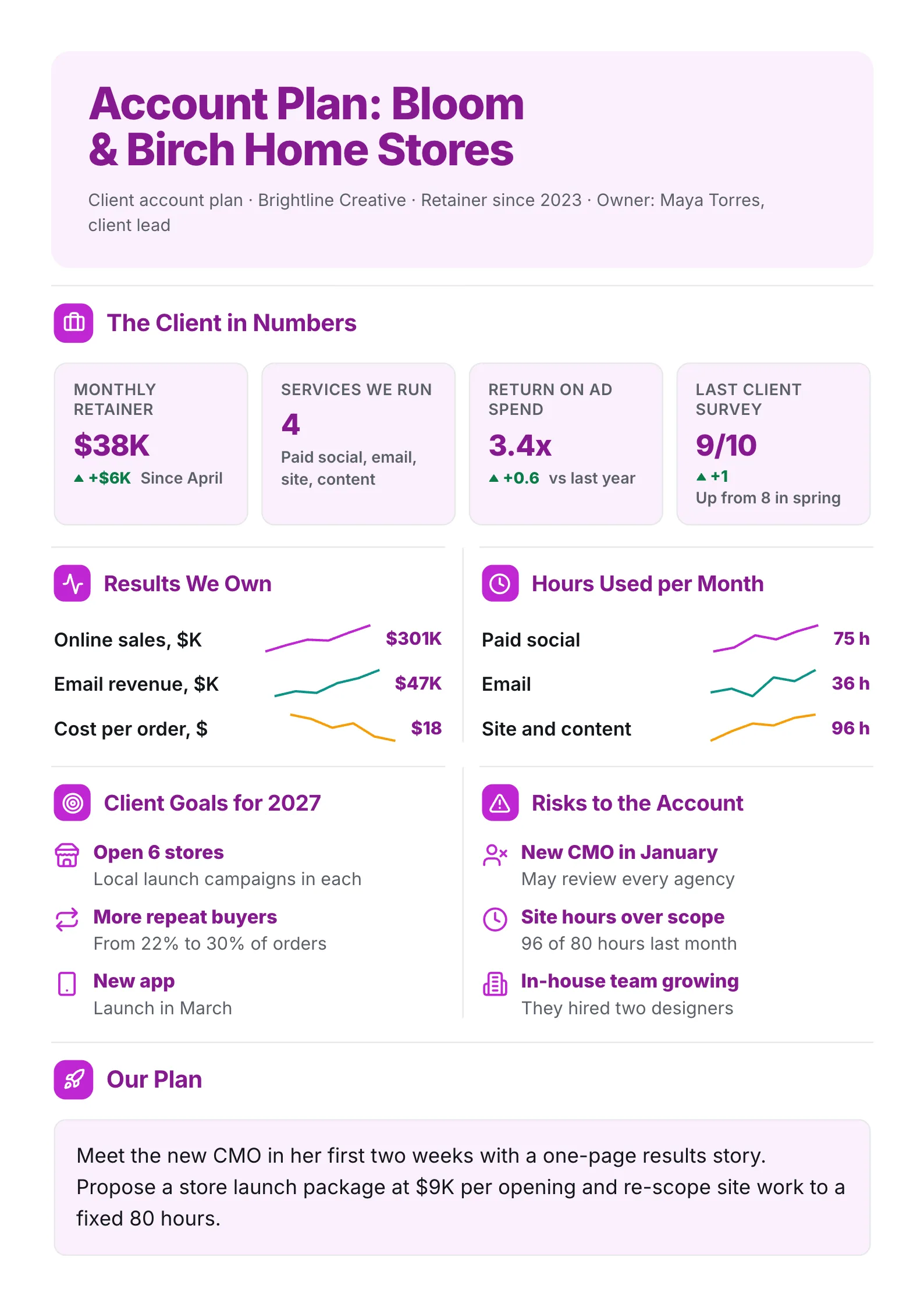 Account Plan: Agency Client RetainerEdit for free(opens in a new tab)
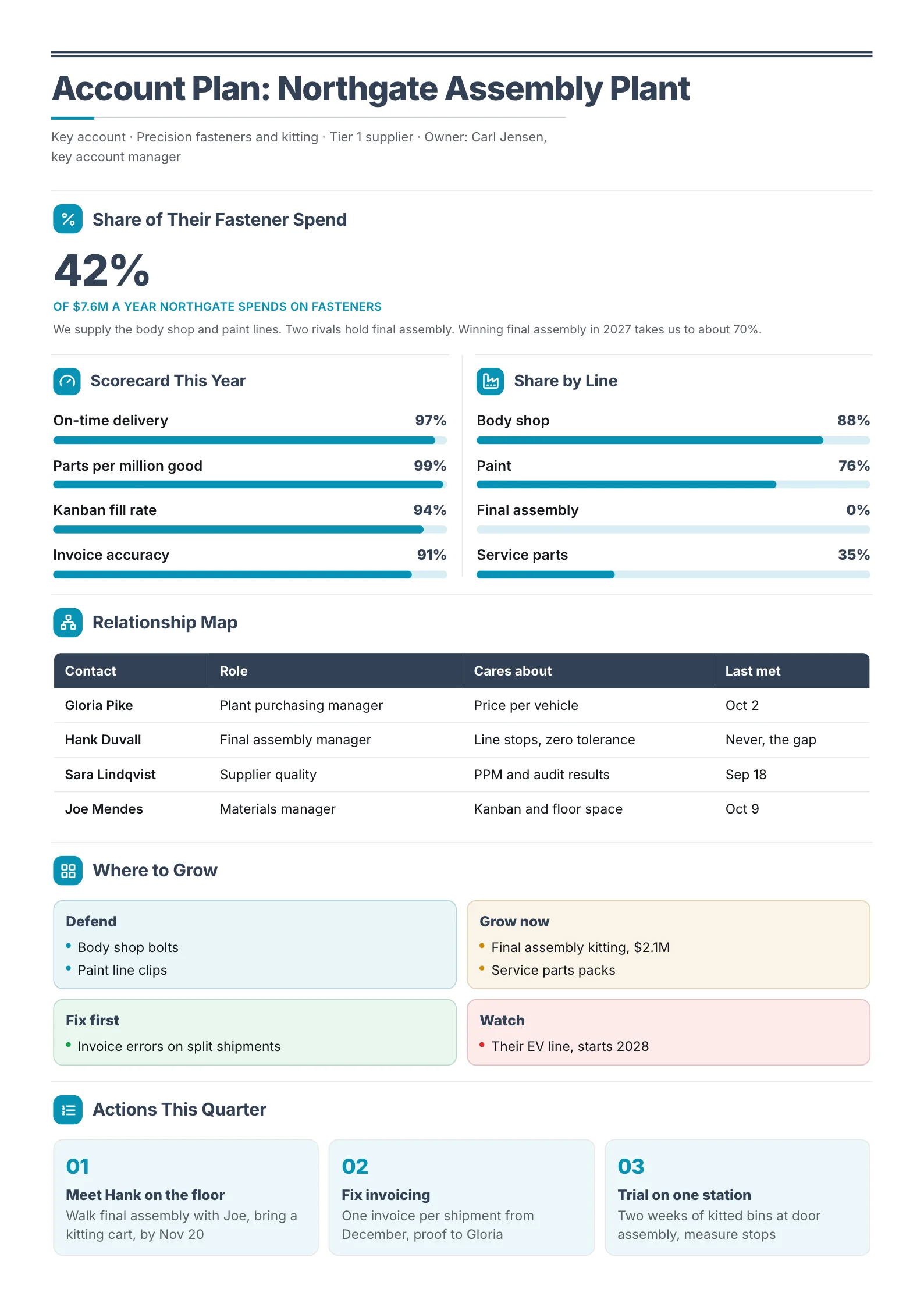 Account Plan: Manufacturing Plant SupplierEdit for free(opens in a new tab)
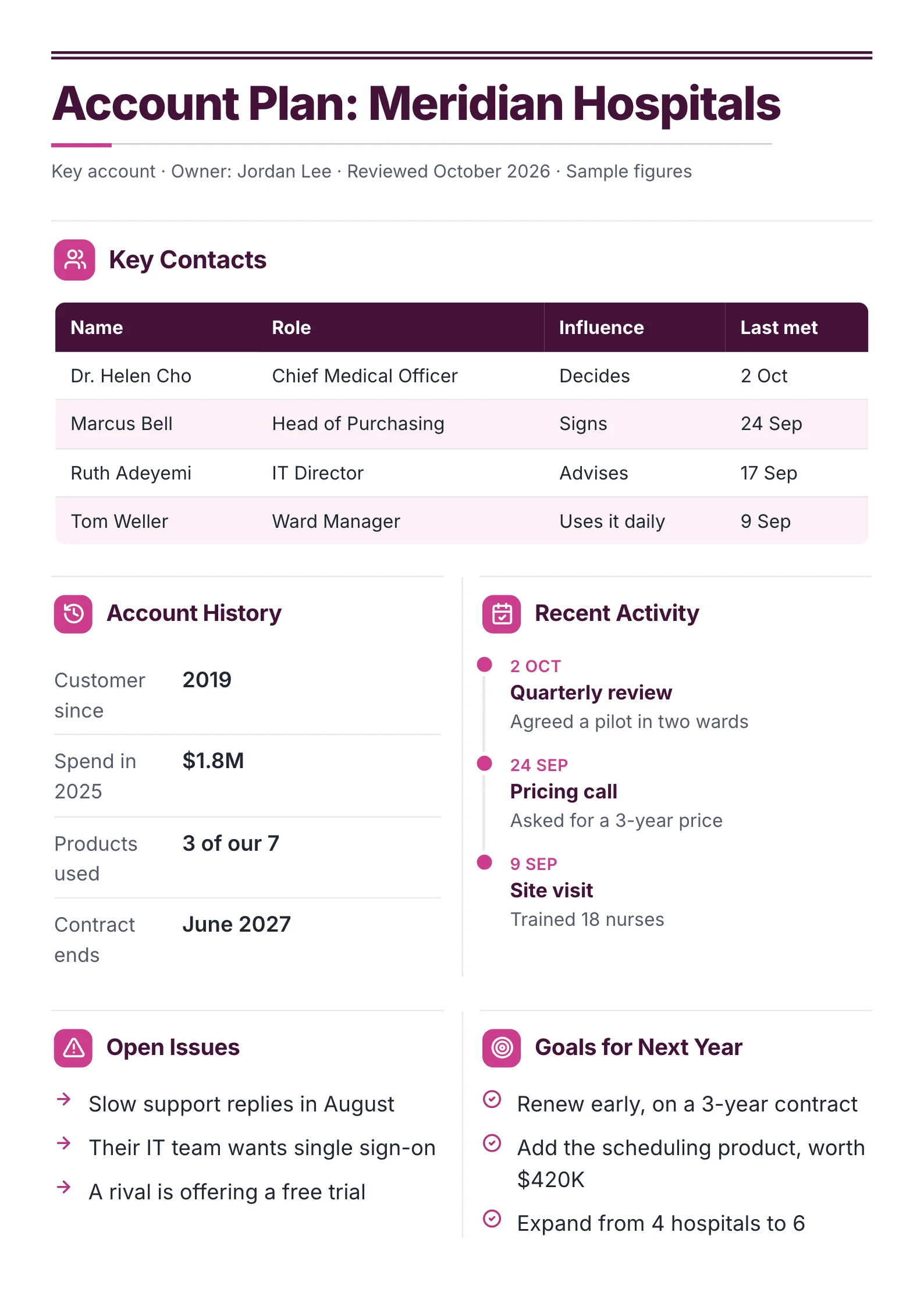 Account PlanEdit for free(opens in a new tab)
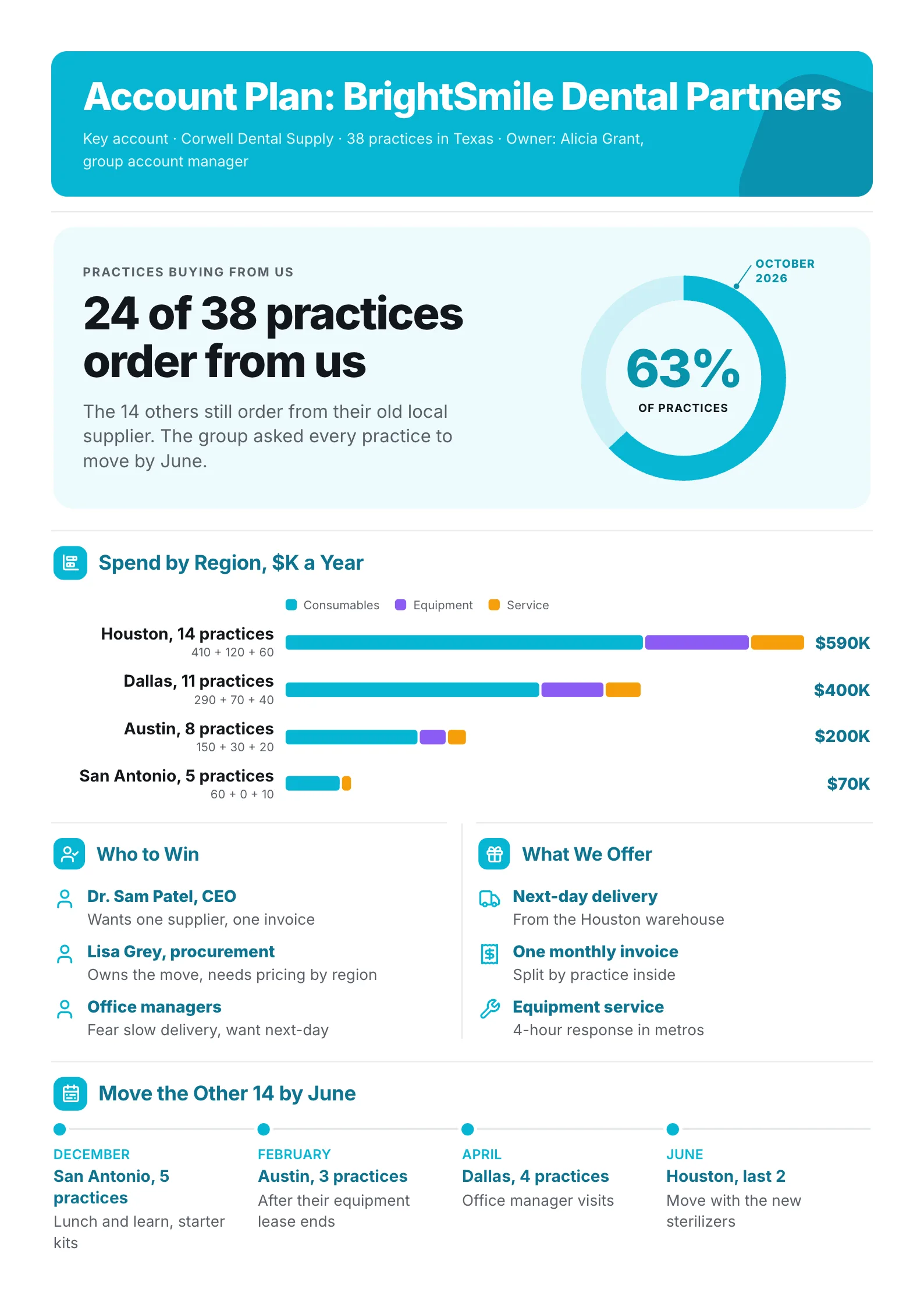 Account Plan: Dental Group SupplyEdit for free(opens in a new tab)
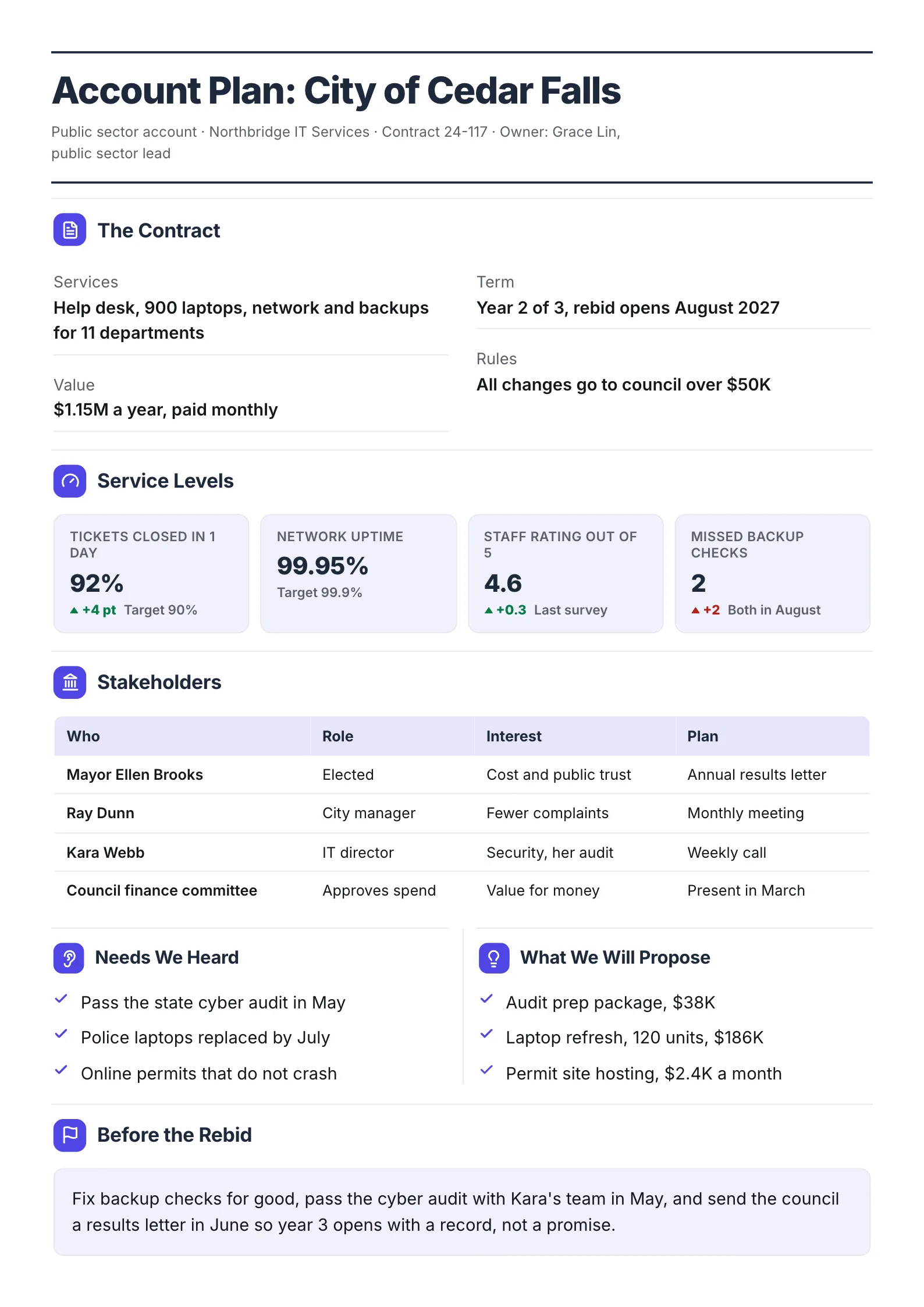 Account Plan: City Government ContractEdit for free(opens in a new tab)
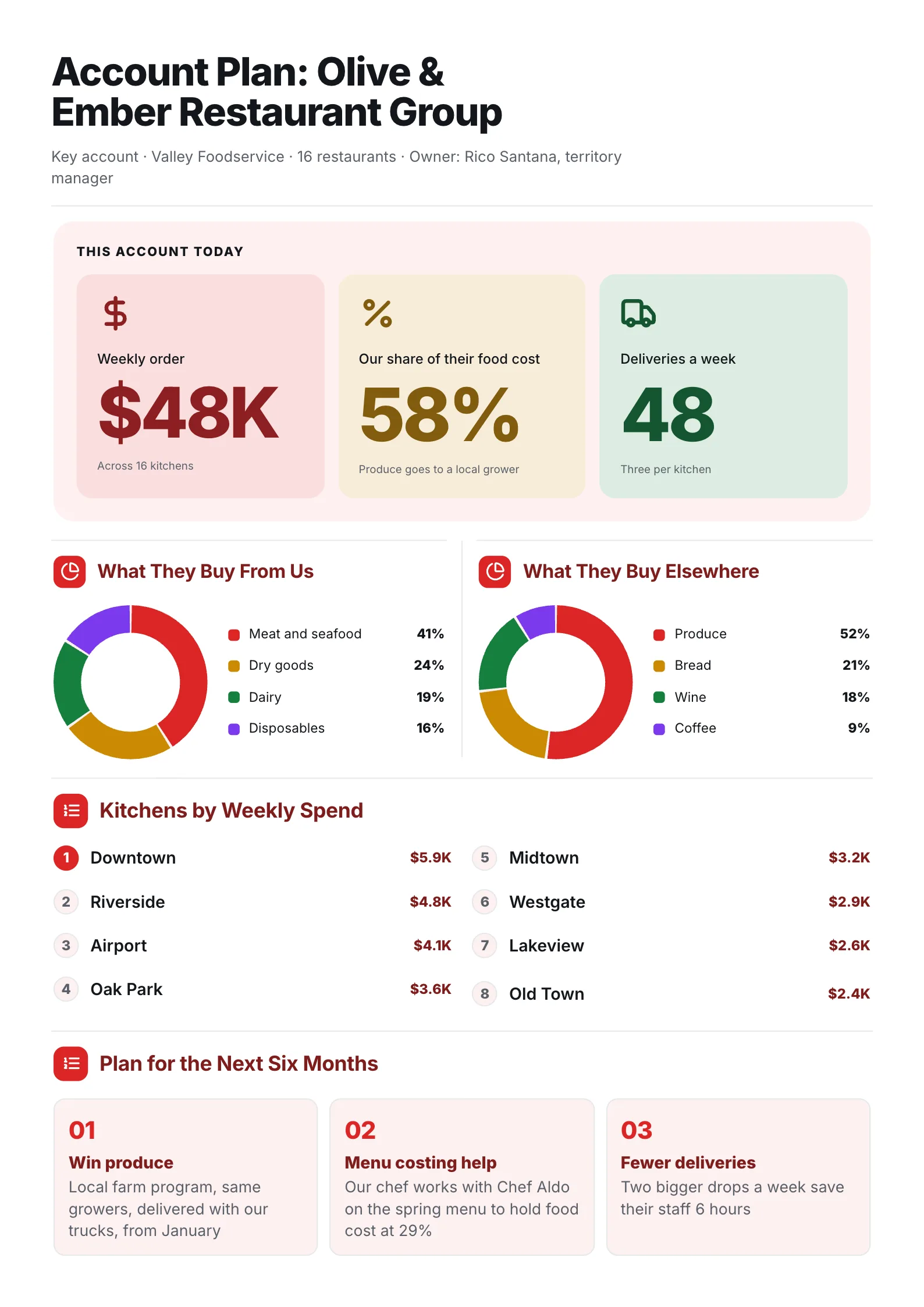 Account Plan: Restaurant Group DistributorEdit for free(opens in a new tab)
Public companies have to tell investors when one customer gets big. Under US accounting rules, any single customer worth 10% or more of revenue must be disclosed. We read that note in 8 annual reports filed in 2026. Five of the 8 had at least one customer over 10%. Those big customers also moved fast. Rumble had one at 16% of revenue in 2024 and none above 10% in 2025.
Rank your customers by share of revenue
Pull last year's revenue by customer and sort it from biggest to smallest. Work out each one's share of your total. The 10% line from the accounting rule is a good first cut. Any customer above it gets a full account plan.
| Company | Customers at 10% or more of revenue |
|---|---|
| Barfresh Food Group | 4, at 16%, 15%, 11% and 10% |
| Sabine Pass Liquefaction | 4, at 23%, 16%, 15% and 14% |
| Western Digital | 3, at 16%, 15% and 13% in fiscal 2026, none in fiscal 2024 |
| NCS Multistage | 1 at 18%, formed when two of its largest customers merged |
| Everus Construction | 1 at 17% in 2025, none in 2024 |
| Rumble | None in 2025, one at 16% in 2024 |
| Hawkins | None |
| Heartflow | None |
Source: MakeOnepagers read of 8 annual reports on Form 10-K filed in 2026, read on October 28, 2026. Each one is linked at the end of this post.
Your business doesn't have to be public for this to matter. If one customer is a tenth of your revenue, losing them is a bad quarter. That customer needs a plan.
Then look at the top 10 together. Everus's top 10 customers made up 43% of its revenue in 2025, up from 33% the year before. Western Digital's top 10 reached 73% in fiscal 2026. If your top few carry that much, plan for every one of them.
The rule also gives you a useful counting tip. Companies under common control count as one customer, and the federal government counts as one too. Three hospitals owned by the same group add up to one customer.
Write what the account buys now, and the trend
Open each plan with three or four numbers. What they spend a year, how that changed, how much of their need you supply and when the contract renews. Your reader sees the account's health in those four numbers.
Watch the trend, since big accounts can change fast. Western Digital had no customer over 10% in fiscal 2024 and three in fiscal 2026. Two of NCS Multistage's largest customers merged, and together they made up 18% of its 2025 revenue. A merger like that changes who you sell to overnight.
 Edit this template
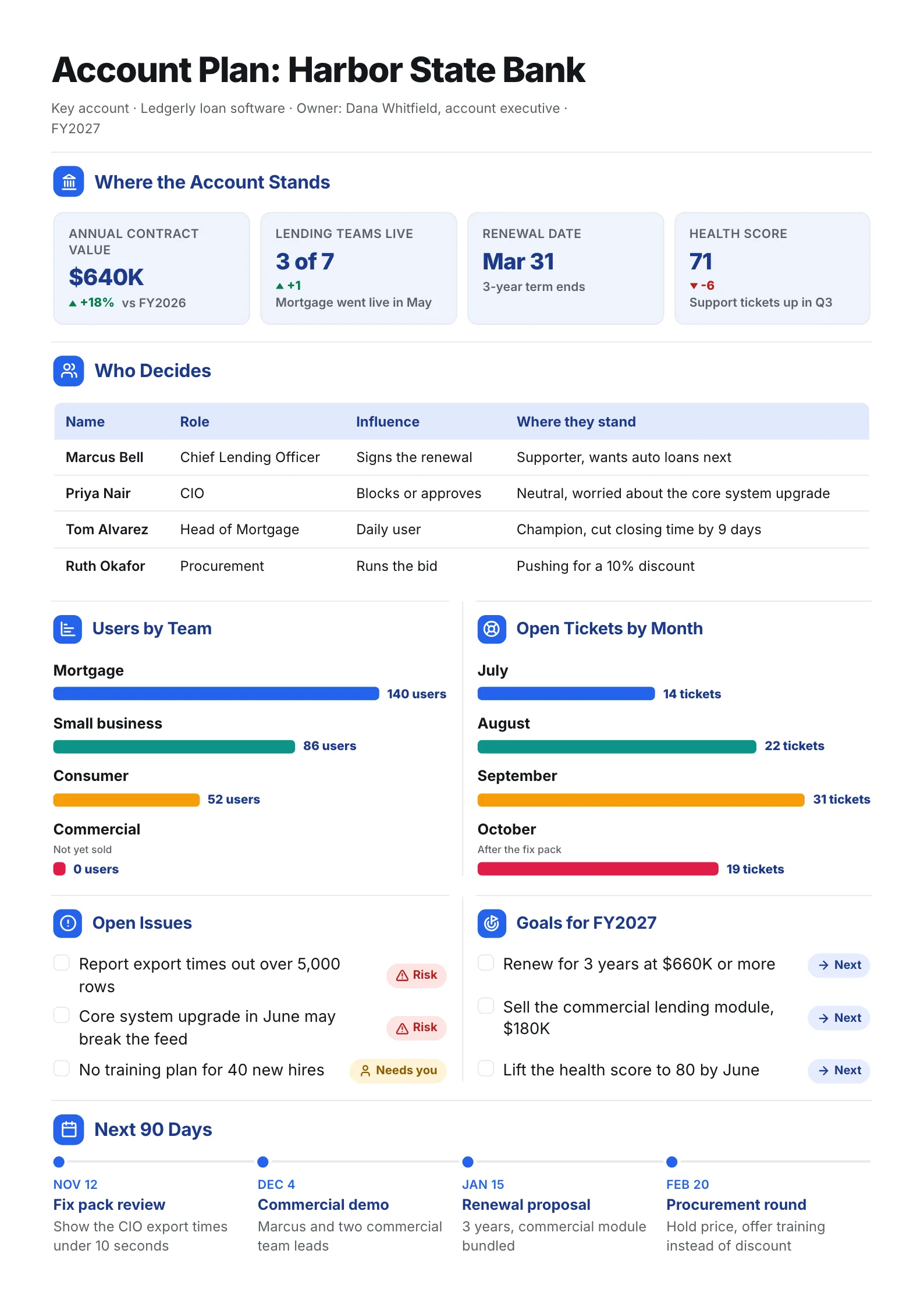
Sample names and figures. The renewal date sits in the top row beside the contract value, so nobody forgets it.
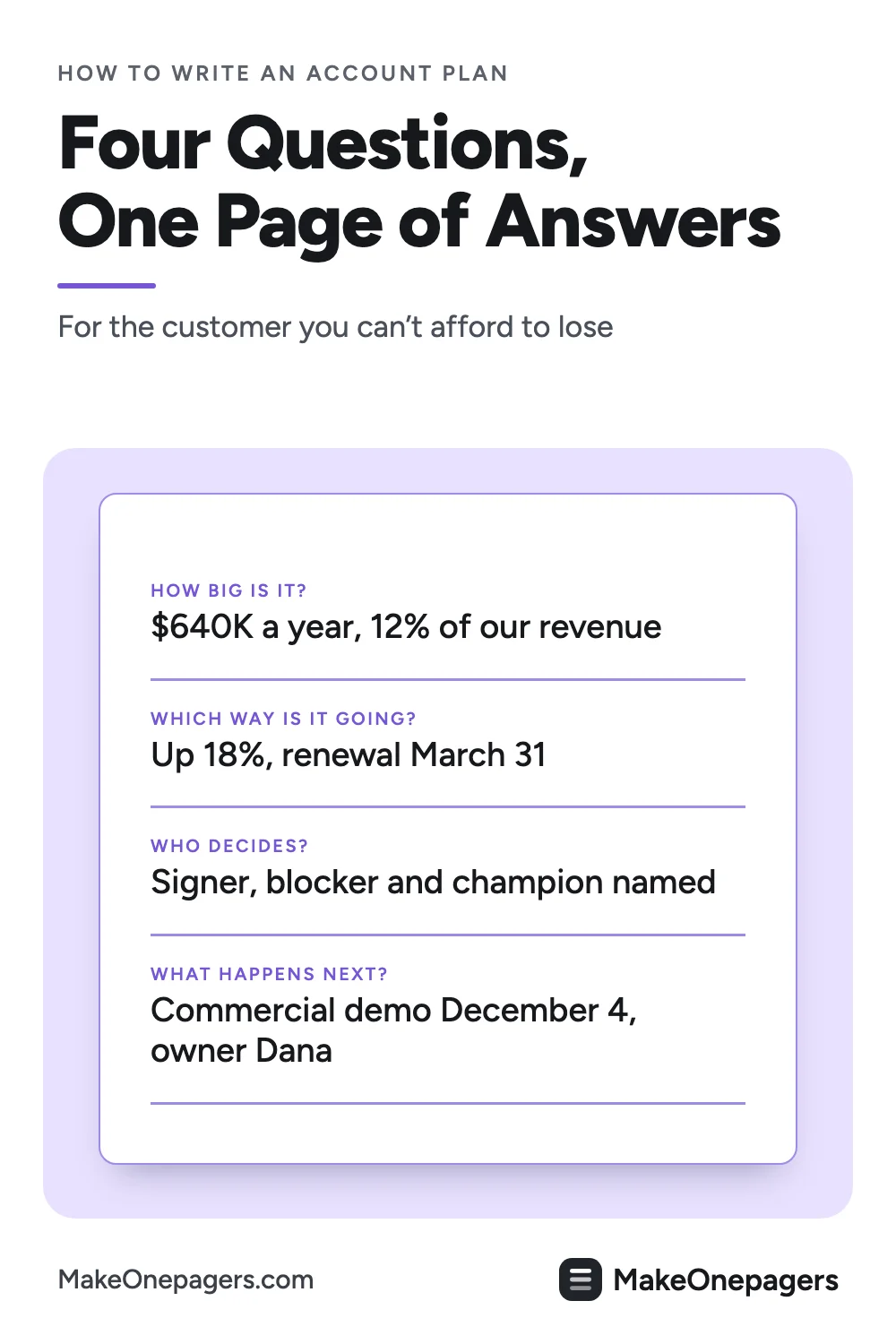
That sample bank account is a good one to test your own notes against. Say the bank brings in 12% of your revenue. Here it is as many teams keep it in their CRM, and as a full account plan.
| On the page | CRM summary | Account plan |
|---|---|---|
| Size | Big customer | $640K a year, 12% of our revenue |
| Trend | Growing | Up 18%, renewal March 31 |
| People | Main contact Tom | Signer, blocker and champion named |
| Growth | Upsell | Commercial lending module, $180K, 4 of 7 teams not live |
| Risk | Not listed | Procurement wants 10% off, tickets up in Q3 |
| Next | Check in soon | Commercial demo December 4, owner Dana |
Every line on the right carries a figure, a person or a deadline. The rest of this post shows where each one comes from.
Map the people who decide
Every account has a few people who sign, a few who use the product every day and someone who can block a deal. List them by name with their role, how much say they have and where they stand today. Mark your champion, the person who'd speak up for you when you're not in the room.
Note what each person wants. A chief lending officer might want auto loans next. A CIO might worry about a system upgrade. Procurement often wants a discount. Your plan should give each of them a reason to keep working with you.
 Edit this template
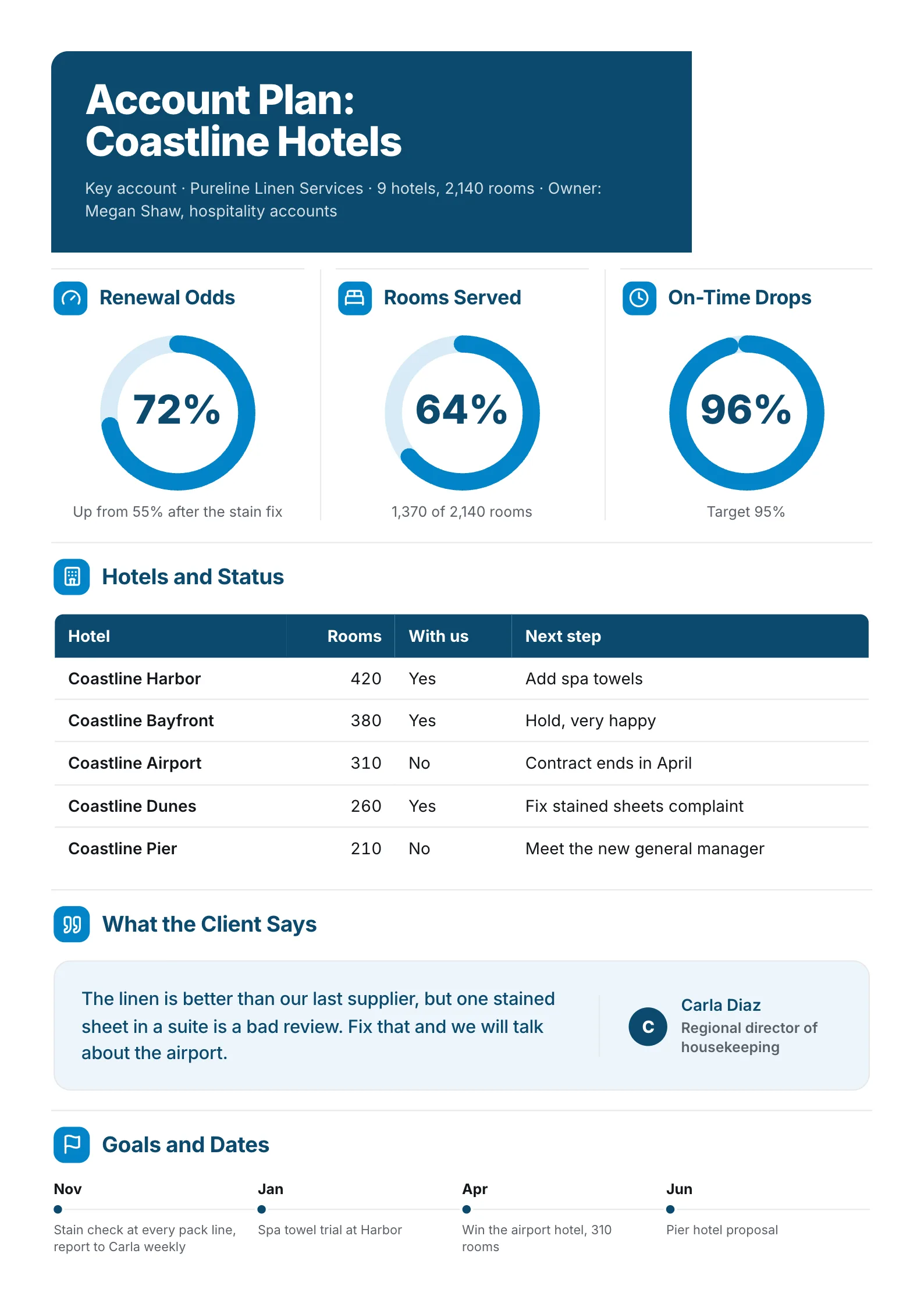
Sample names and figures. The client's own words name the fix and the next hotel, which is the people map turned into a plan.
Find where the account can grow
Look for the parts of the customer you don't serve yet. That might be teams, sites, products or regions. Write the share you have and the share left, like 1,370 of 2,140 rooms or 3 of 7 teams.
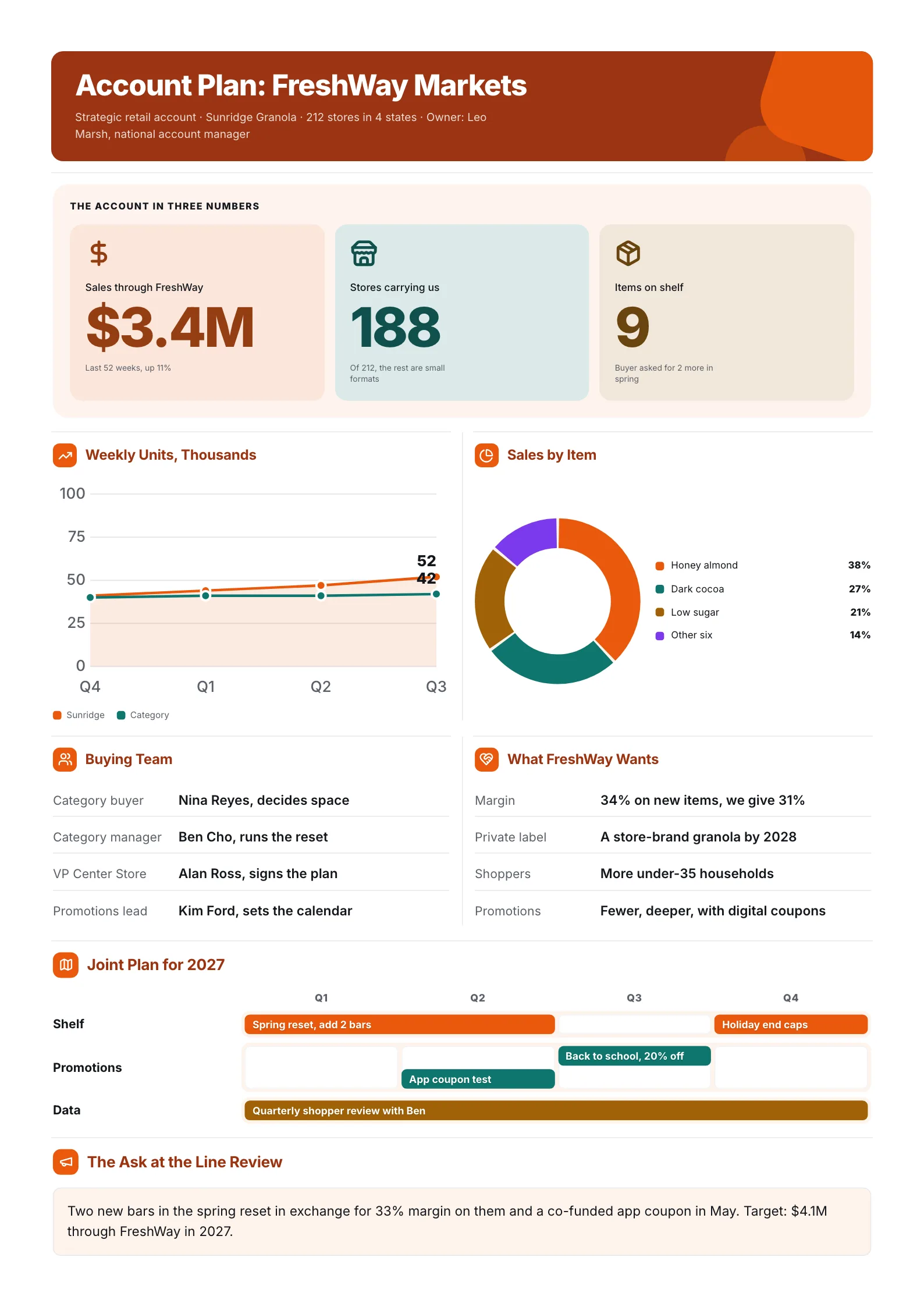
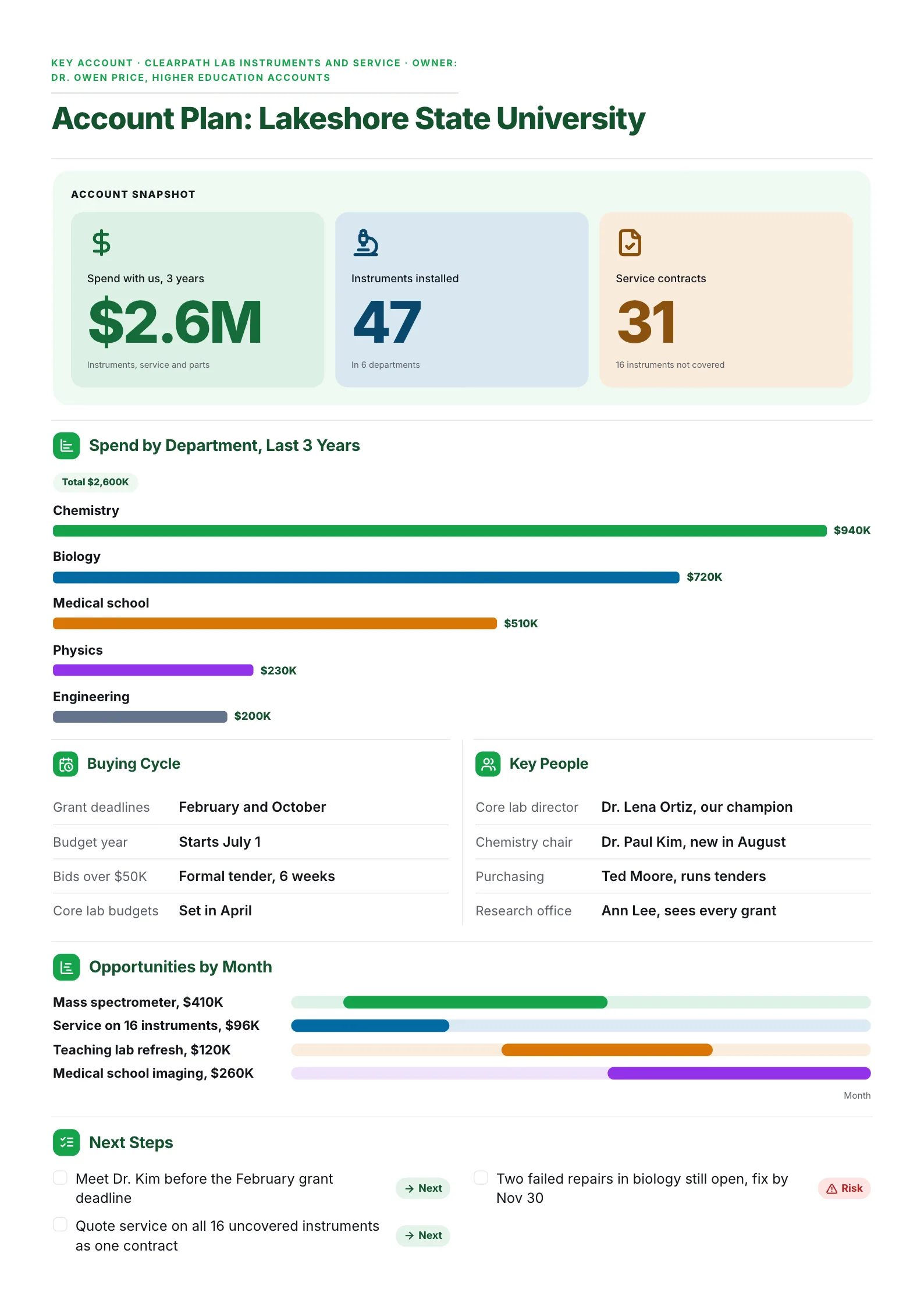
Then rank the openings by how likely and how big they are. Pick one or two for this year. A grocery chain that sells your granola in most of its 212 stores might add two more items in spring. A university might have 16 instruments with no service contract.
 Edit this template
Sample names and figures. The buyer's request for two more items is the growth line, written where the account manager can't miss it.
 Edit this template
Sample names and figures. The buying cycle shows when money opens up, so the growth plan has dates.
List what could shrink the account
Write down what could shrink or end the account. A renewal date, a new decision maker, a rival's quote, a service problem or a merger on the customer's side. Give each risk a date if it has one.
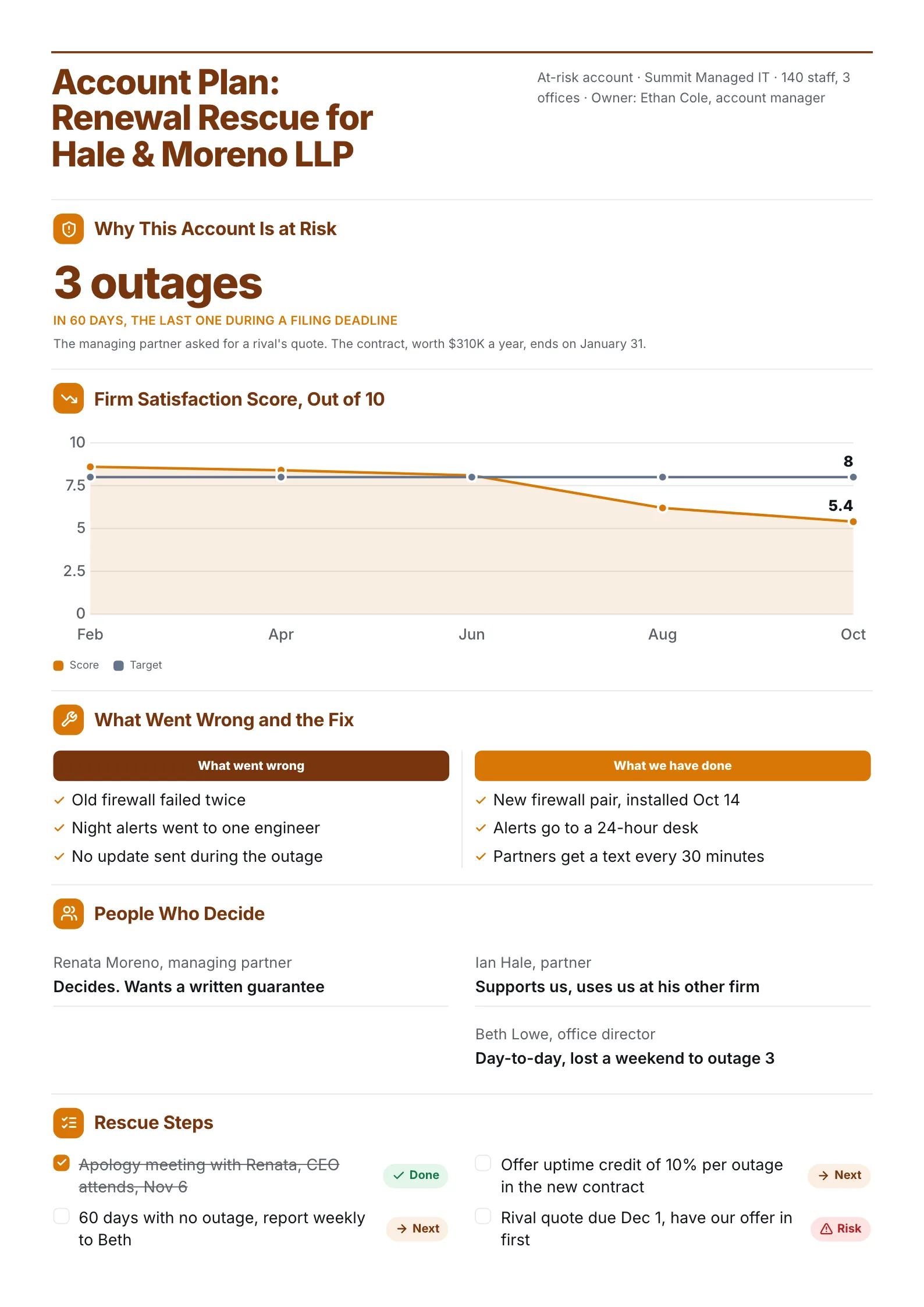
Then put your fix beside each risk. If outages are the problem, say what you've changed and when. If a new chair started in August, plan the first meeting.
 Edit this template
Sample names and figures. Each failure sits beside the fix already made, so the partner sees the account manager acted.
Set actions, owners and a review date
Close with three to five actions. Each one names what will happen, who owns it and by when. Tie each one to a person, an opening or a risk from above. Meet the new chair by September 15, propose two items by March 1, finish the firewall swap by October 14.
Add a review date at the top. Big accounts change quickly, as the 10-Ks show, so look at the plan each quarter. Update the numbers, check the actions and move any risk that's getting closer.
One account, one page
One page per account is enough. Put the account's numbers at the top, the people in a small table, the growth and risks side by side and the actions at the bottom. Keep the detail in your CRM and link to it.
Every account plan design in MakeOnepagers gives you a numbers row across the top, a people table and a box for risks and actions. Type in your account and the plan fits on one page. Finished account plans to copy are in our account plan template post. The quarterly business review template post spells out what to bring to a review meeting with that customer.
The 8 annual reports and the 10% rule
| Annual report | Filed |
|---|---|
| Barfresh Food Group 10-K | April 15, 2026 |
| Everus Construction Group 10-K | February 25, 2026 |
| Hawkins 10-K | May 13, 2026 |
| Heartflow 10-K | March 18, 2026 |
| NCS Multistage 10-K | March 5, 2026 |
| Rumble 10-K | March 5, 2026 |
| Sabine Pass Liquefaction 10-K | February 26, 2026 |
| Western Digital 10-K | August 14, 2026 |
We read the major customer notes in each one on EDGAR on October 28, 2026. The 10% rule is ASC 280-10-50-42, which we read in Deloitte's guide to segment reporting the same day.
Start with the account you'd least like to lose
Sort last year's revenue by customer and circle anyone above 10%. For each one, write the numbers, name the people and list one growth line and one risk with dates. Add three actions with owners. Do your biggest account first in MakeOnepagers, then put a review on the calendar three months out.
Frequently asked questions
What is an account plan?
It's a plan for one important customer. It covers what they buy, who decides, where you can grow, what could go wrong and the actions you'll take, with owners and dates.
Which customers need an account plan?
Start with any customer above 10% of your revenue, the same line public companies must disclose. Then add your top 10, or any account with a renewal or a big opening in the next six months.
How often should I update an account plan?
Each quarter is a good rhythm. The 10-Ks we read show big customers can appear or drop off within a year, so a plan you wrote once and never opened won't keep up.
Who should see the account plan?
Everyone who works on the account, from sales to service and finance. Some teams share a short version with the customer too, focused on goals and next steps.




