Account Plan Examples: Growing, At Risk, New Business, Public and Multi-Site
Five account plan examples, one per account situation, plus what Oracle, Salesforce, Altify and a UK government buyer playbook ask a plan to hold.

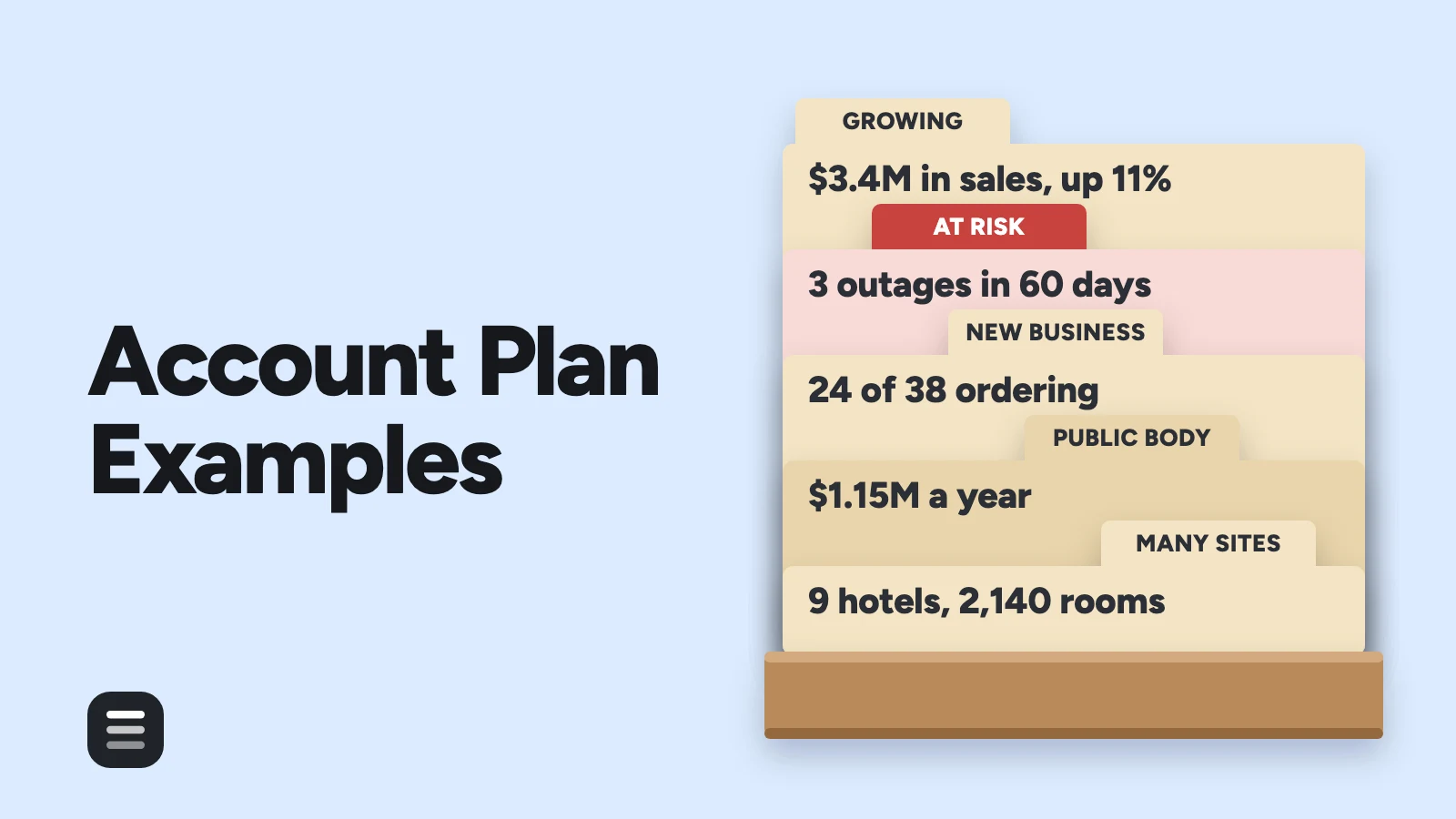
An account plan is one page about one customer. It says where you stand with them, who makes the decisions, what you want from the next year and the steps that get you there. What goes at the top depends on the account's situation. In the examples below, a renewal at risk and a growing chain open on very different first lines. Start from a free one pager template.
One‑Pager examples
Real One-Pagers made with MakeOnepagers. Open any one to edit it as your own.
 Account Plan: Agency Client RetainerEdit for free(opens in a new tab)
 Account Plan: Regional Bank Software RenewalEdit for free(opens in a new tab)
 Account Plan: Manufacturing Plant SupplierEdit for free(opens in a new tab)
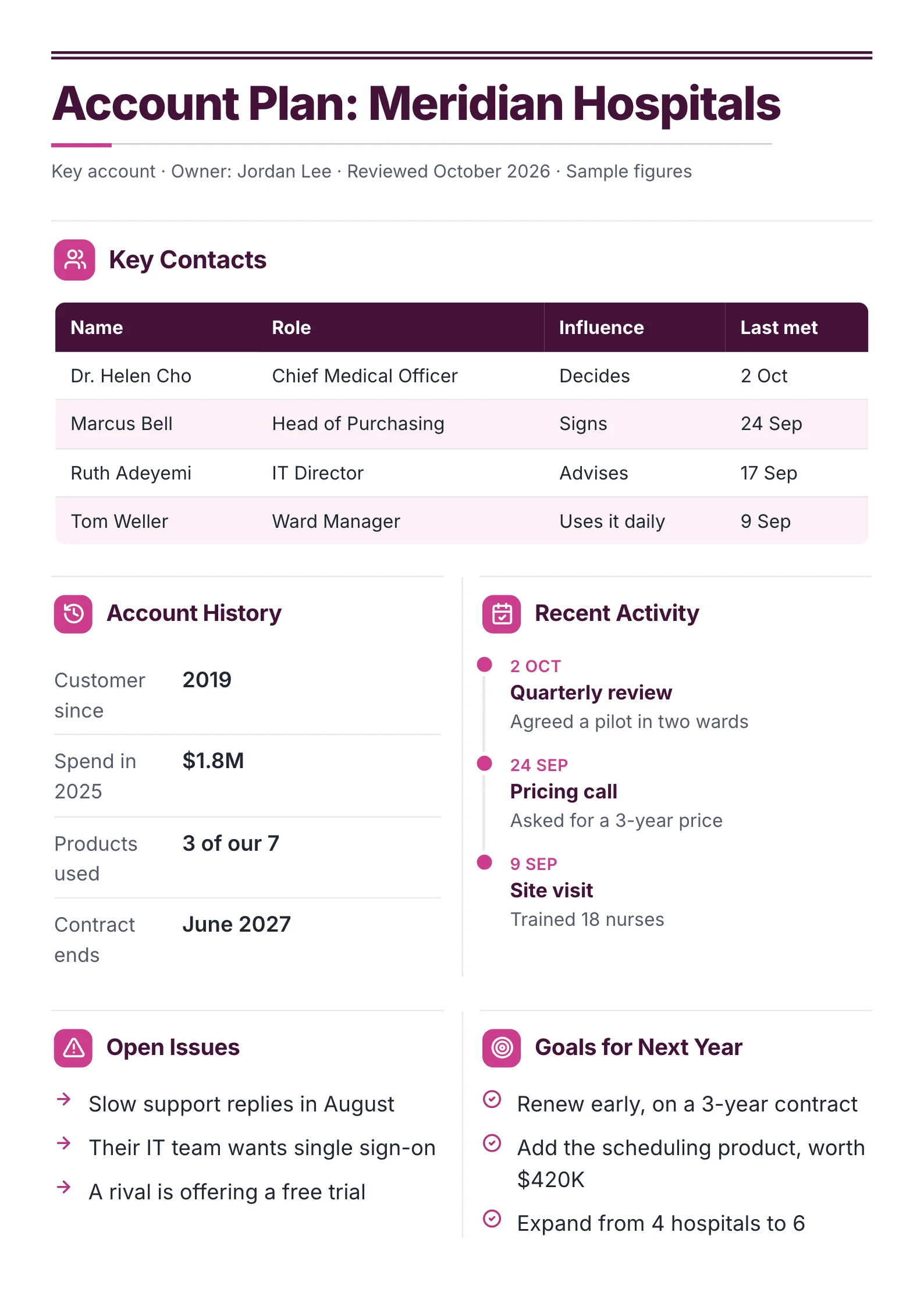 Account PlanEdit for free(opens in a new tab)
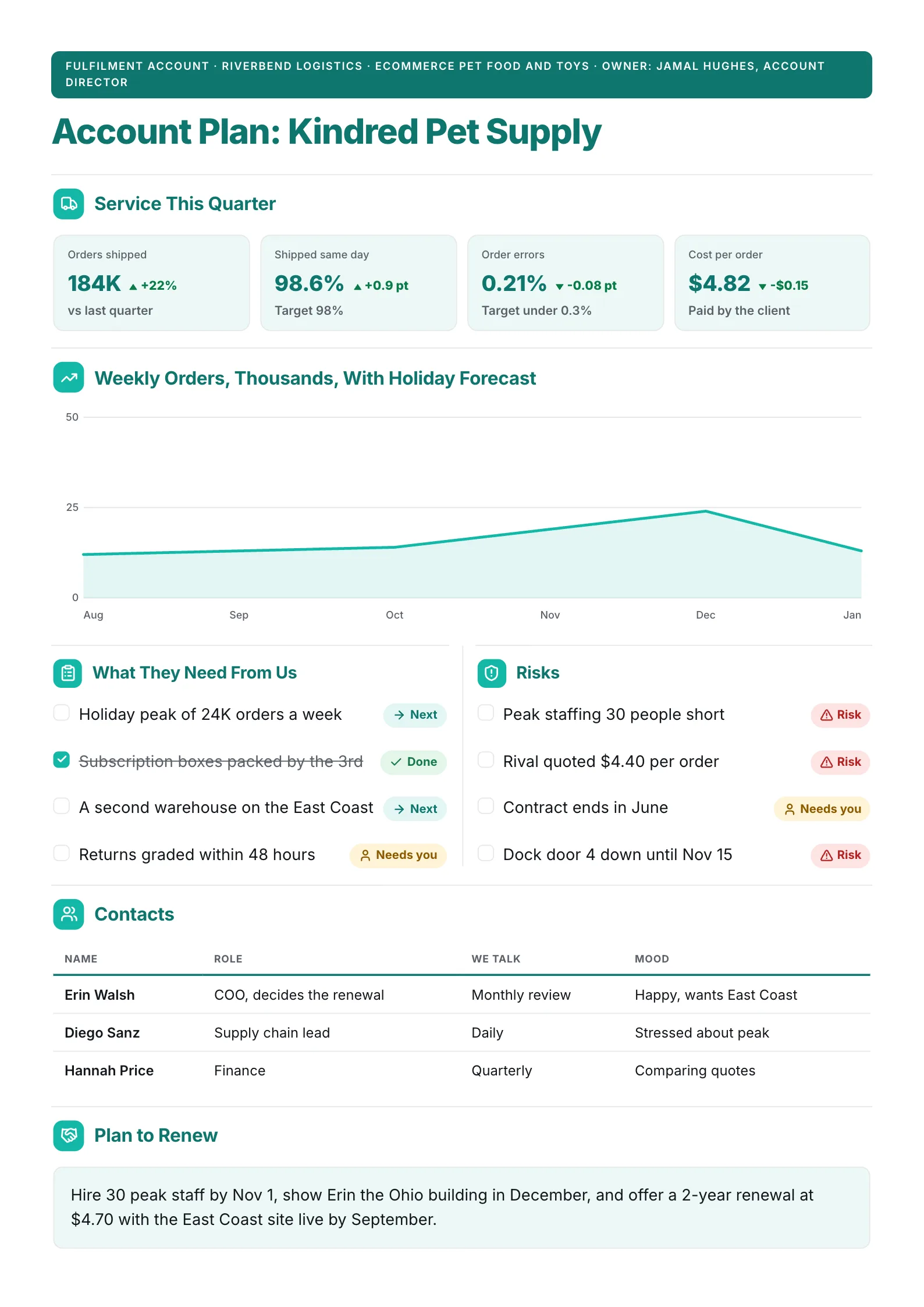 Account Plan: Ecommerce Fulfilment ClientEdit for free(opens in a new tab)
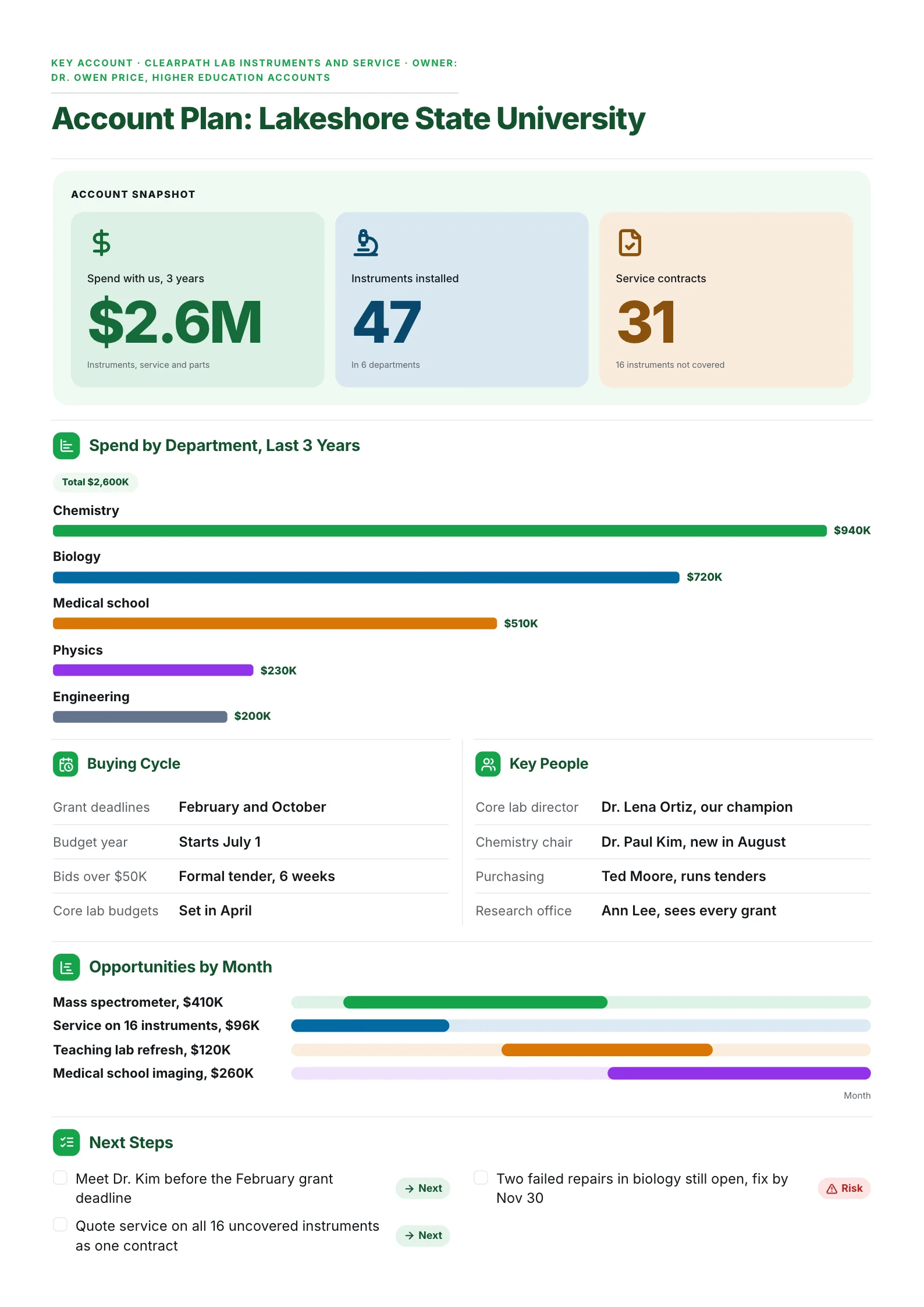 Account Plan: University Lab CustomerEdit for free(opens in a new tab)
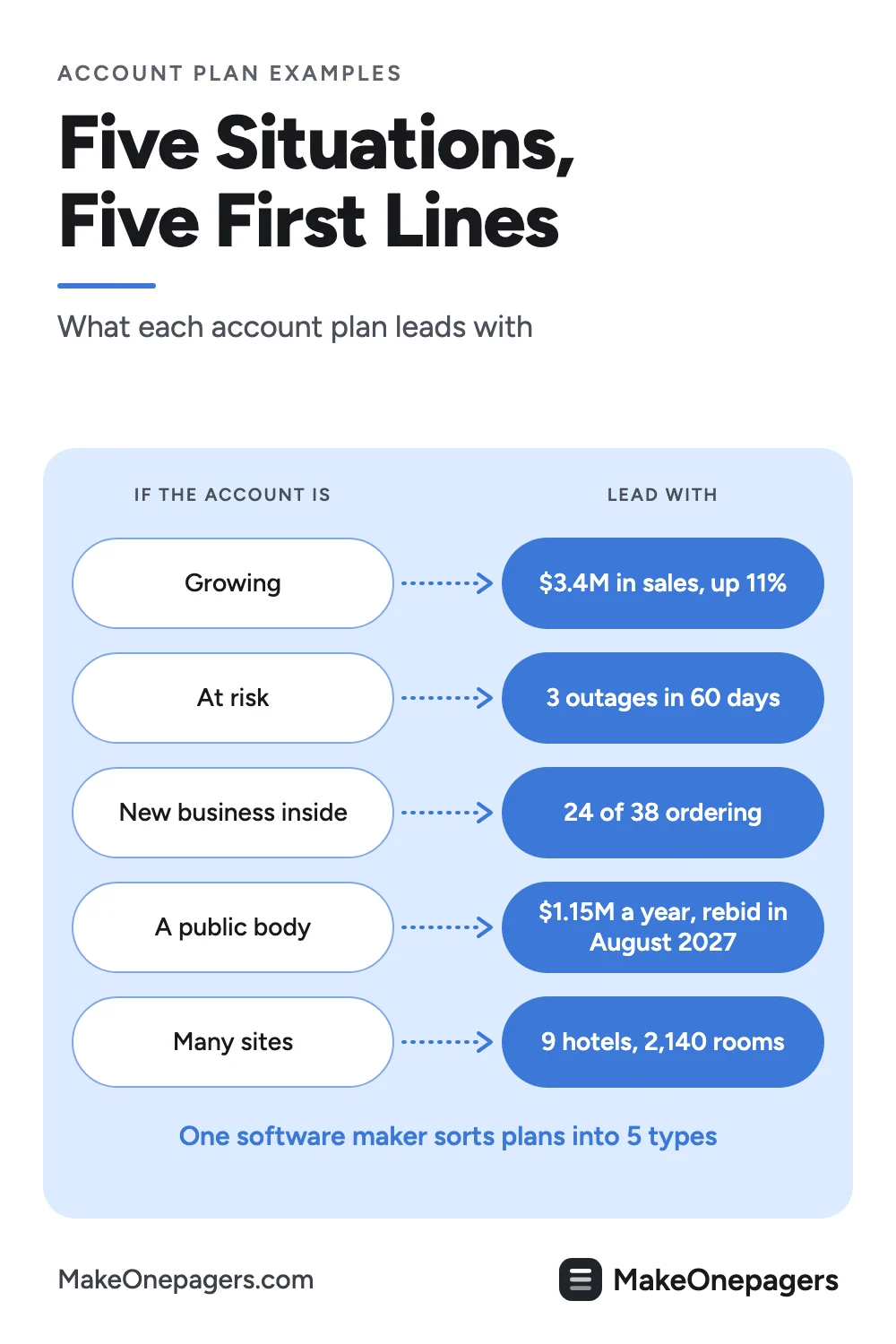
Upland's Altify, account planning software we read on October 30, 2026, sorts plans in a similar way, with 5 plan types that run from a large existing customer to a portfolio of new business. The five MakeOnepagers plans below take one situation each, and each shows what to lead with when your account is in that spot.
When the account is growing
 Edit this template
Sample brands and buyers. Your account's numbers go in the same places.
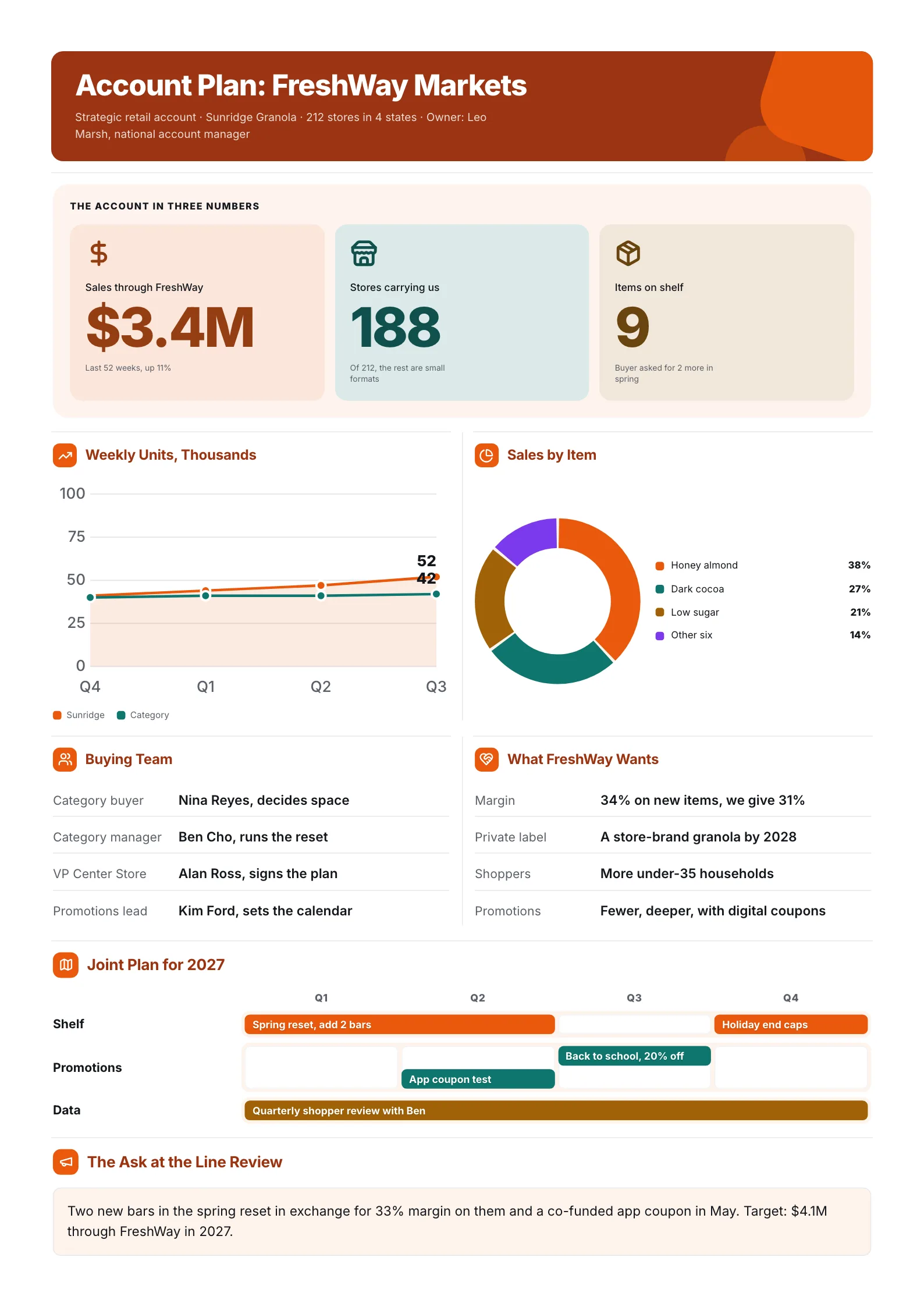
A growing account plan should end in a bigger order next year. This grocery plan opens with three numbers. Sales through the chain hit $3.4 million over 52 weeks, up 11%. The granola sits in 188 of 212 stores, and the buyer has already asked for 2 more items.
The line chart proves the growth isn't the whole category rising. Weekly units climbed from 41,000 to 52,000 while the category barely moved. Then the plan writes down what the customer wants. FreshWay wants 34% margin on new items against the 31% you give, a store brand by 2028 and more shoppers under 35.
It ends on a trade. You ask for two new bars in the spring reset and offer 33% margin on them plus a co-funded app coupon, aiming for $4.1 million in 2027. Your buyer can see what they get and what you get on the same line.
When the account is at risk
 Edit this template
Firm and people are samples. Swap in your own account's story.
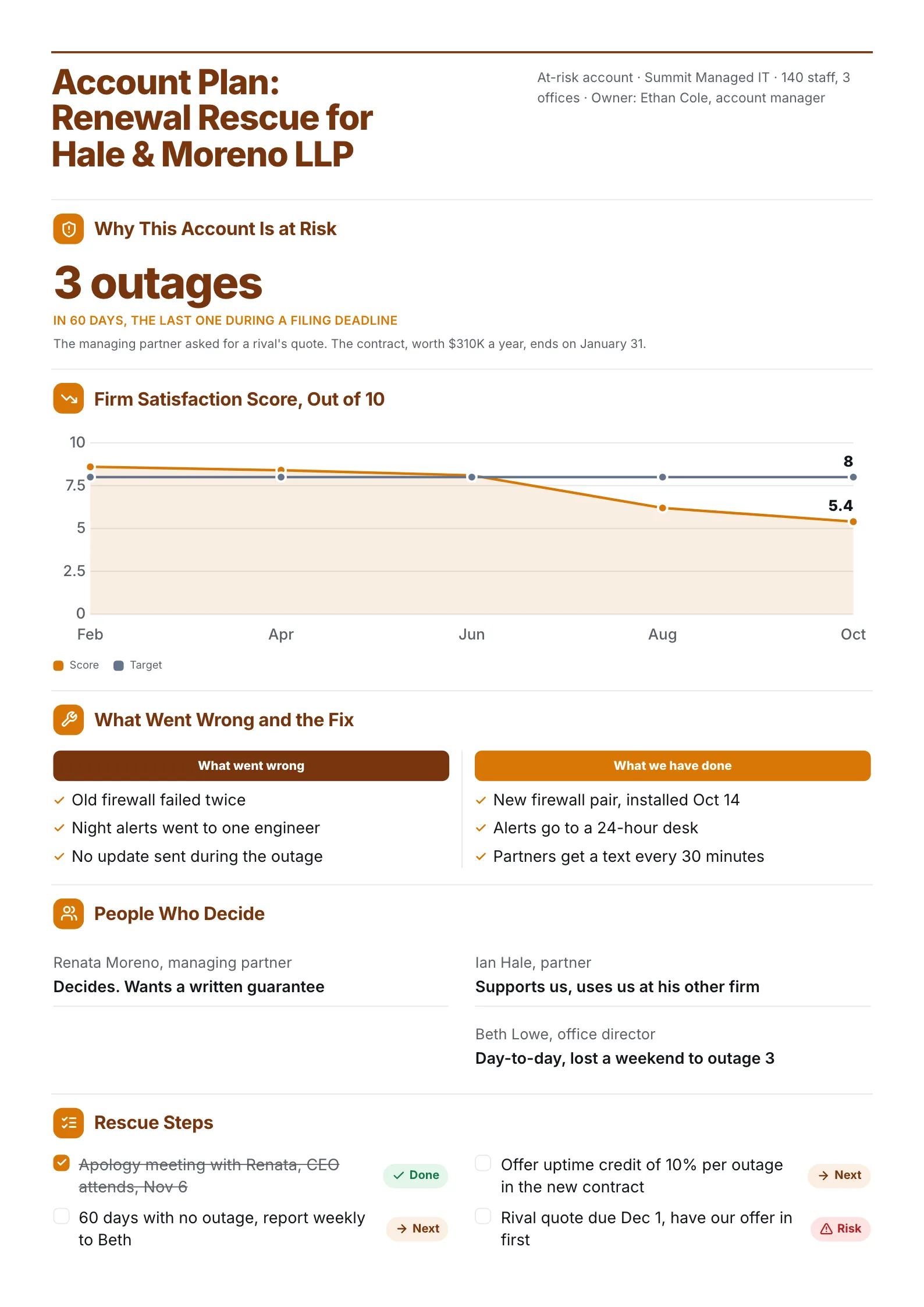
When a renewal is in danger, lead with the reason. This rescue plan opens on three outages in 60 days, the last one during a filing deadline. The managing partner has already asked a rival for a quote, and the $310,000-a-year contract ends on January 31.
The satisfaction line makes the drop impossible to argue with, sliding from 8.6 in February to 5.4 in October. Next comes a two-column box that puts each failure beside its fix, so the old firewall that failed twice sits next to the new pair installed on October 14.
The people block is honest about where everyone stands. The managing partner decides and wants a written guarantee, one partner supports you, and the office director lost a weekend to the third outage. The checklist then sets the order of the rescue, with your offer due before the rival's quote on December 1.
When you're winning new business inside an account
 Edit this template
Dental group, regions and figures are made up for the sample.
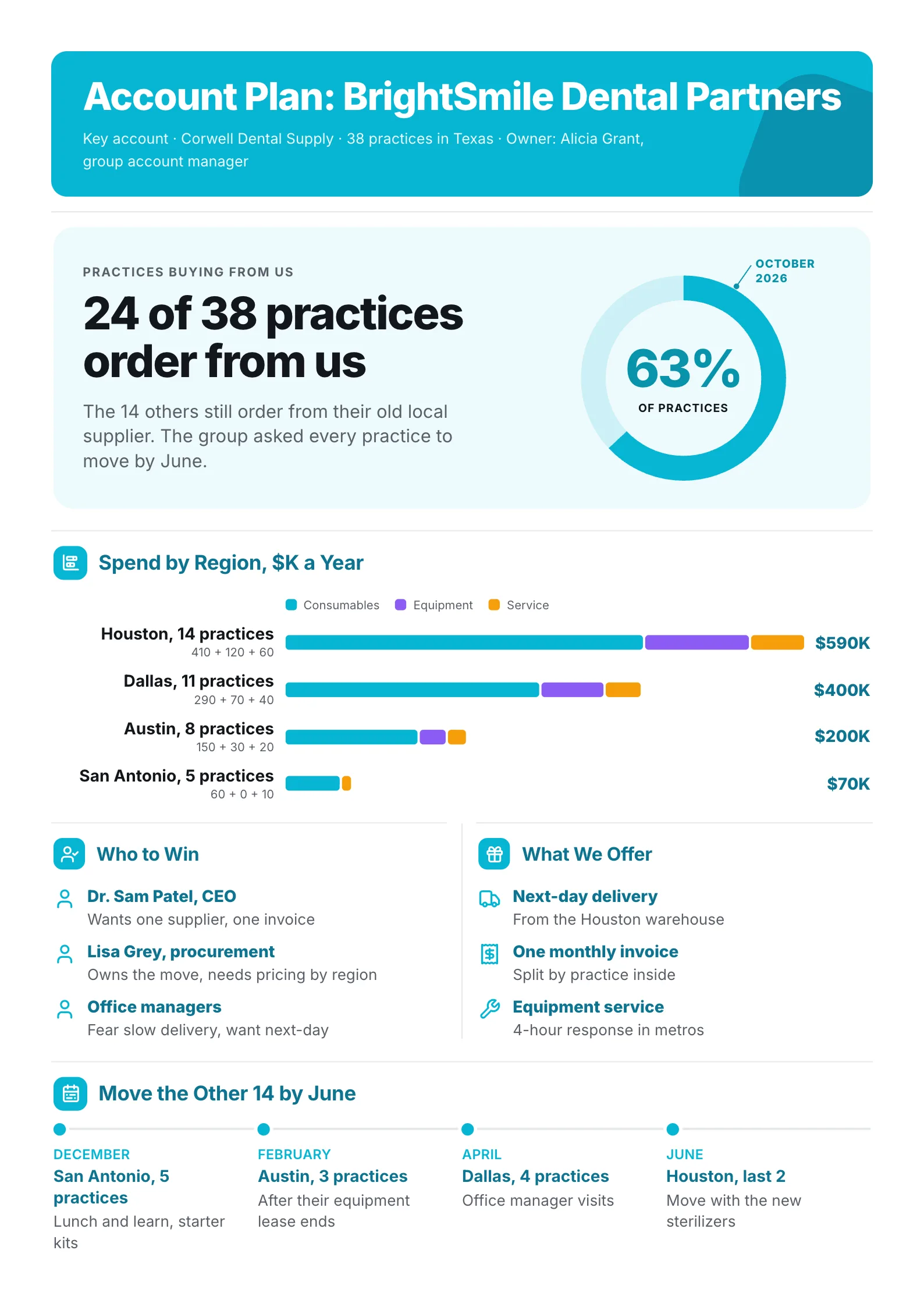
Some of your best new business sits inside a customer you already have. This dental supply plan starts with the gap, 24 of 38 practices ordering, and the group has asked every practice to switch by June.
The plan treats the other 14 practices as a sales campaign. It names three people to win, from the CEO who wants one supplier and one invoice to office managers who fear slow delivery. It answers each worry with an offer, like next-day delivery from the Houston warehouse. Then a timeline moves the practices region by region, starting with San Antonio in December and finishing with the last 2 in Houston in June.
This layout is built for share inside an account. In Altify's terms it's an Enterprise plan, built to retain and grow revenue in a large existing customer.
When the customer is a public body
 Edit this template
City, contract number and names are samples.
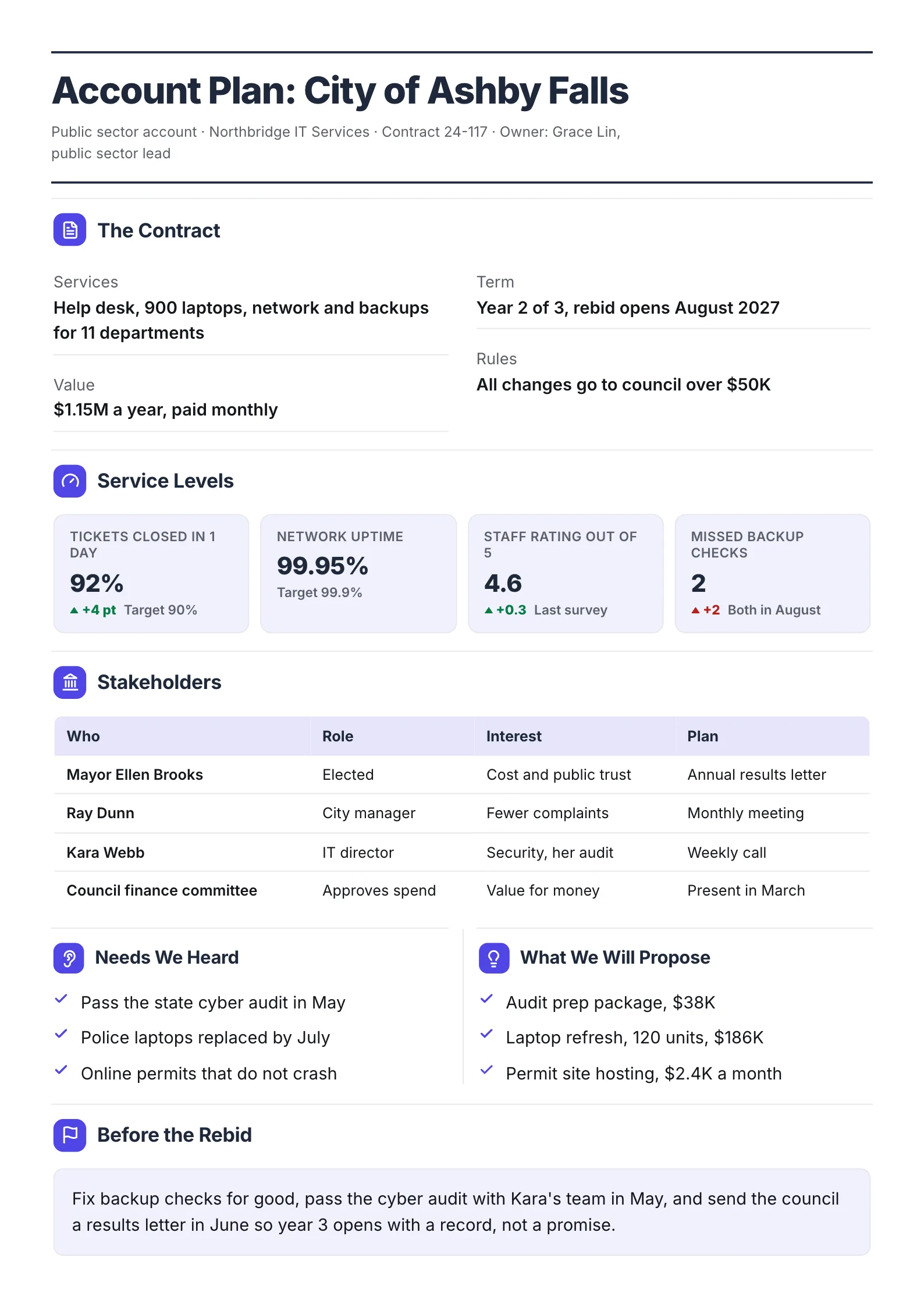
A public contract runs on rules, so this plan puts them first. The contract block gives the scope, the $1.15 million value, the term in year 2 of 3 and the rule that any change over $50,000 goes to council. The rebid opens in August 2027, and everything on the page points at it.
Service levels come next, because a city has to show value for money. Tickets closed in a day sit at 92% against a 90% target, network uptime beats its target, and the plan doesn't hide the 2 missed backup checks in August.
Lift the stakeholder table into your own plan. It lists the mayor, the city manager, the IT director and the council finance committee, each with what they care about and how often you'll meet them. The callout sums up the year in one aim, which is a results letter to the council in June, so year 3 opens with a record of results instead of a promise.
When the account has many sites
 Edit this template
Hotel group, sites and counts are samples.
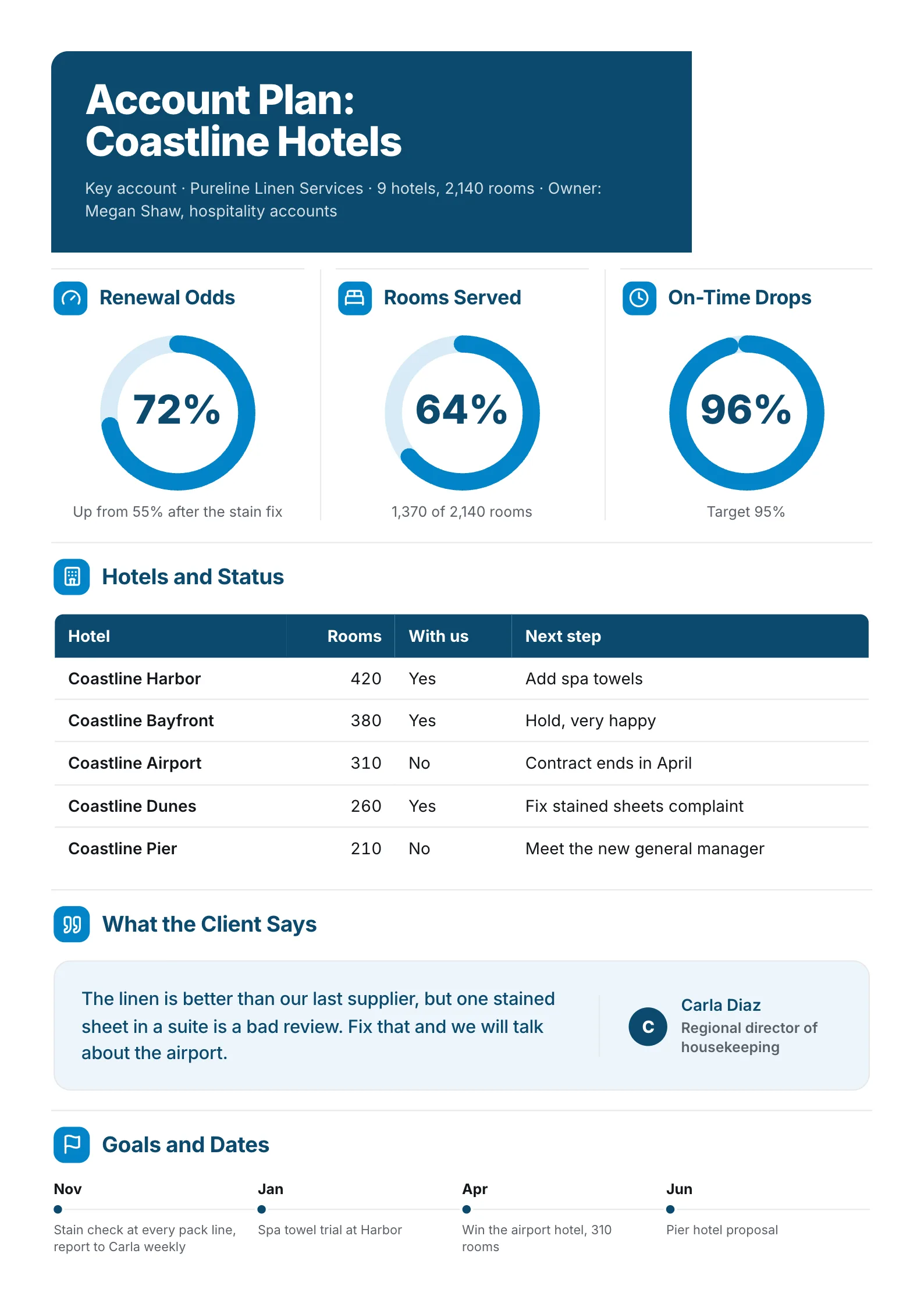
When one customer has many locations, your plan needs a row for each. This linen plan covers a group of 9 hotels and 2,140 rooms, and you serve 1,370 of them today. Three gauges sum up the account, with renewal odds at 72%, up from 55% after a fix for stained sheets.
The hotel table carries the strategy. Each property gets its room count, whether it's with you and the next step. One hotel is "very happy" and left alone, one needs the stain complaint fixed, and the 310-room airport hotel is the prize when its contract ends in April.
A quote from the regional housekeeping director ties it together. The director's message is to fix the stains first, and then the airport is on the table. The dated goals follow her order exactly, with stain checks in November and the airport win in April.
Six more plans, sorted the same way
The grid at the bottom of this page holds six more account plans. Each one fits one of the five situations above, for a reason you can read straight off the page.
| Plan | Situation | What puts it there |
|---|---|---|
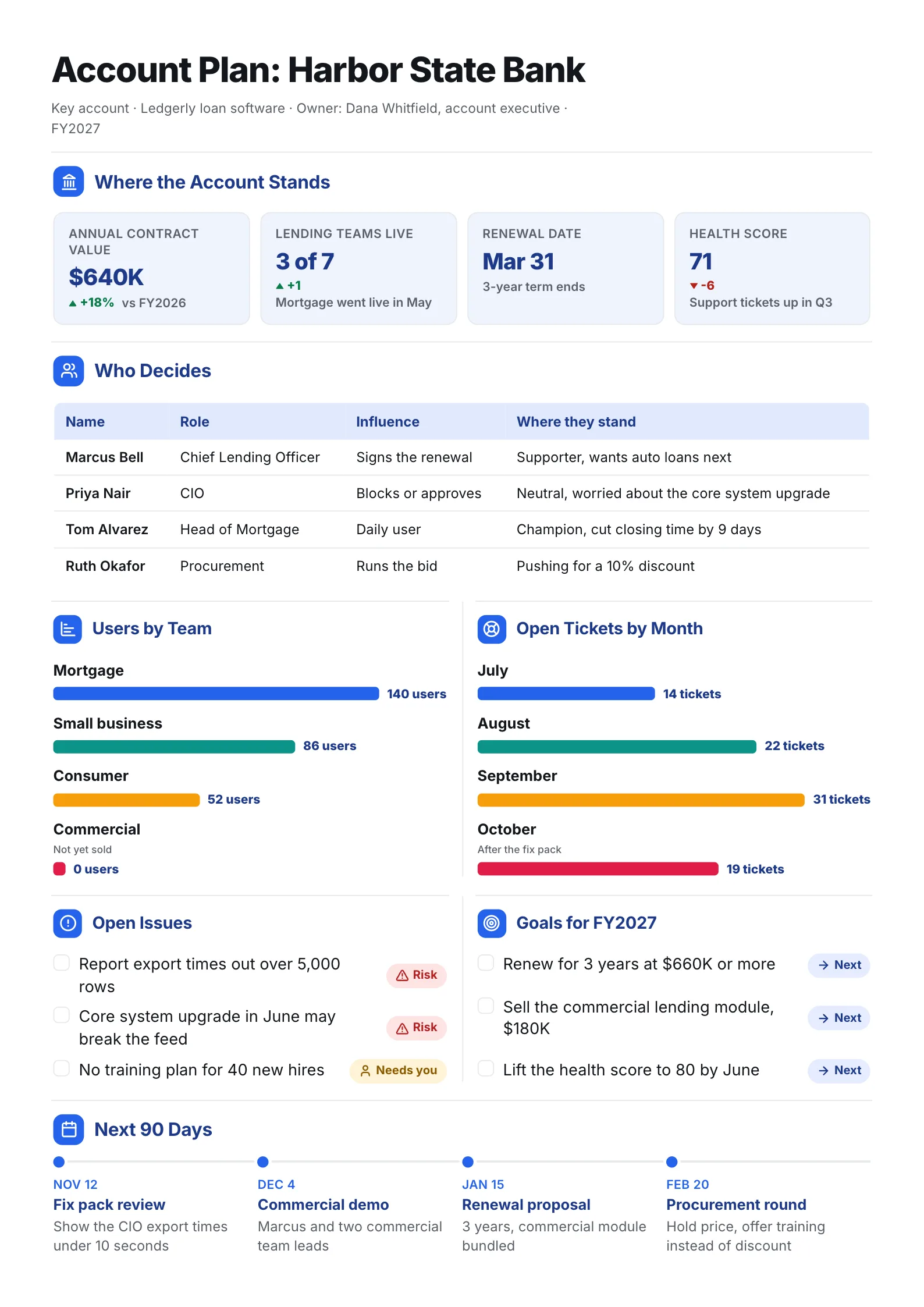
| Harbor State Bank, loan software | Growing | $640,000 a year, up 18%, with 3 of 7 lending teams live and a renewal on March 31 |
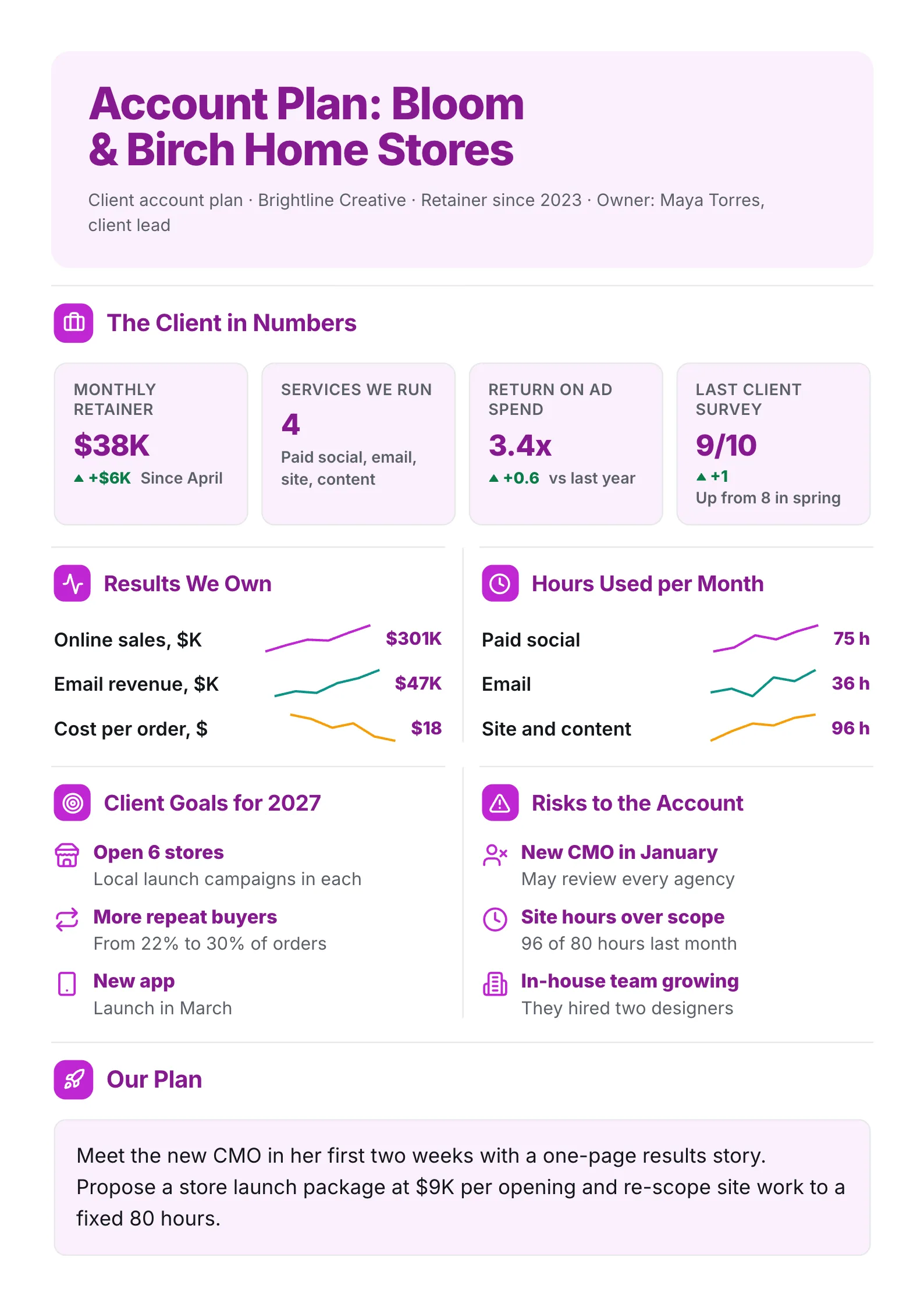
| Bloom & Birch Home Stores, agency retainer | At risk | A new marketing chief starting in January who may review every agency, on a $38,000 monthly retainer |
| Kindred Pet Supply, order fulfillment | At risk | A rival's quote of $4.40 an order, and a contract that ends in June |
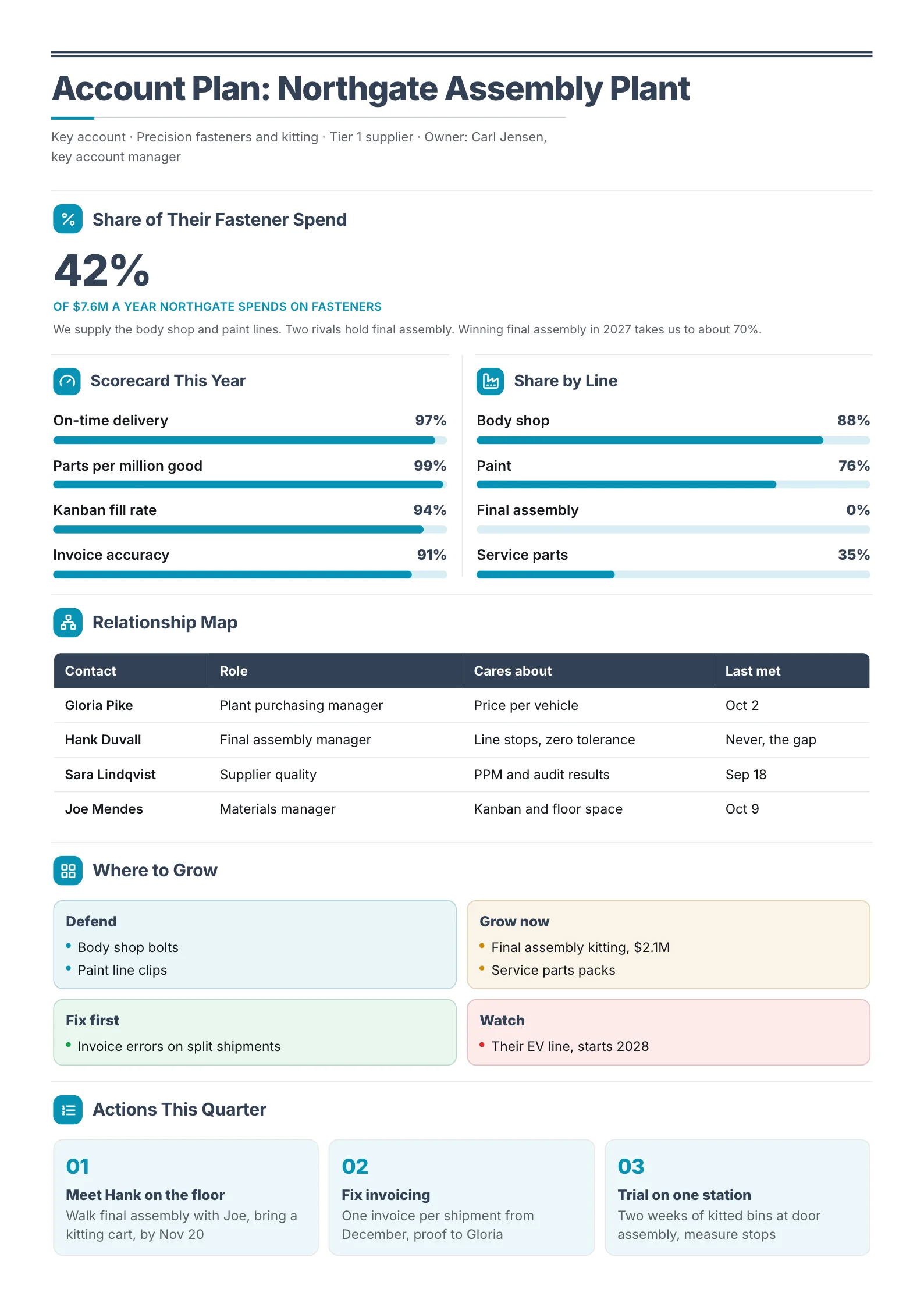
| Northgate Assembly Plant, fasteners | New business inside the account | 42% of $7.6 million in yearly fastener spend, and about 70% if final assembly is won |
| Lakeshore State University, lab instruments | Public body | $2.6 million over 3 years, with any bid over $50,000 going to a 6-week tender |
| Meridian Hospitals, key account | Many sites | $1.8 million spent in 2025, and a goal to grow from 4 hospitals to 6 |
The two at-risk plans each answer their threat on the page. The agency will meet the new marketing chief in her first two weeks with a one-page results story. The fulfillment firm offers a 2-year renewal at $4.70 an order with an East Coast site live by September, so instead of matching the rival's price it adds the second warehouse the customer asked for. The university plan shows the public body rules again, this time as a buying cycle with grant deadlines in February and October and a budget year that starts July 1.
What published key account frameworks ask for
We read four published sources on October 30, 2026. Three are help pages for account planning software. The fourth is the UK government's playbook for buyers, which shows how your customer may be planning you.
| What the plan holds | Oracle PeopleSoft | Upland Altify | Salesforce Trailhead | UK Cabinet Office playbook |
|---|---|---|---|---|
| The account's situation | A plan type field, but its values are by team (marketing, partner, sales, service, support) | 5 plan types, from enterprise to new business | Not covered in the module we read | Suppliers sorted by risk, value and how critical they are |
| Goals with a number | Yes, a target as an amount, percent, quantity or other | Sustain revenue or develop new revenue, by type | Optional: a measure such as $0 to $500,000, or none for a qualitative objective | Not a target: benefits in 4 groups |
| Dates | Targets can be spread over time, so $3 million in 90 days shows $1 million on day 30 | Not covered in the page we read | A start and end date on every objective | 4 stages, Prepare, Engage, Collaborate and Deliver |
| Who owns it | A plan team | Not covered in the page we read | An owner on every objective | A clear meeting and reporting structure |
| The steps | A status that moves from Draft to Active | Not covered in the page we read | Action plans under each objective, starting at zero | Joint work in the Collaborate stage |
| The customer's role | Not covered in the page we read | Enterprise plans are often built with the customer | Not covered in the module we read | The buyer runs the relationship |
Oracle asks for a target on every goal. Salesforce allows objectives with no number, but its sample tracks savings in dollars. Give your goal a number and a date as well.
The buyer has a plan too. The Cabinet Office playbook tells government buyers to sort suppliers by risk, value and how critical they are. If your account is a public body, expect them to know which group you're in. The Ashby Falls plan above answers that with service levels and a results letter.
A public buyer may grade the contract itself. The playbook sorts contracts into gold, silver and bronze by how critical, complex and valuable they are. Central government bodies should publish KPIs quarterly on their gold contracts and on silver contracts above £5 million. So on a public account, your plan's service level block may be the same numbers the buyer prints. Keep the two matching, so you're never arguing with your customer's own report.
Lock the goals and date the review
An account plan written in January and opened again in December has done half its job. The software we read builds checks into the plan so that doesn't happen. In Oracle PeopleSoft, a plan you set to Active locks its goals, and only a plan owner can move it back to Draft to change them. Each plan also carries a time frame with a start date and an end date. Salesforce does the same at a smaller scale, with a start date, an end date and an owner on every objective.
You can copy both habits on paper. Put a review date in the corner of your page, and update the three numbers at the top each quarter. When a step slips, give it a new month and keep the old one crossed out, so the history stays visible. And when the account's situation changes, say a growing account misses two deliveries, switch to the matching plan above and rebuild the first block before you touch anything else.
Ten minutes to a first draft
You don't need a full day to start an account plan. This gets a usable first page done in ten minutes, then you can fill in the gaps with your team.
- Minute 1. Pick your account's situation from the five above. It decides which block goes first.
- Minutes 2 and 3. Write three numbers about the account, like revenue, your share and a health score. Use last year's figure beside each one.
- Minutes 4 and 5. List the people at your customer who decide, one line each, with what each of them wants. Mark the one who signs.
- Minutes 6 and 7. Write one goal with a target and a date, the way Oracle asks for an amount, a percent or a quantity.
- Minutes 8 and 9. Add three to five steps, each with an owner on your team and a month.
- Minute 10. Write the ask for your next meeting in one sentence.
Then read it the way your customer would. A first block they'd agree with means you picked the right situation. For a longer walk-through, our guide on how to write an account plan covers each block, and the sales plan templates help when you're planning a whole territory instead of one account.
The renewal that comes up soonest
Begin with whichever of your accounts has the contract that ends soonest. Harbor State Bank's renewal is March 31, and its plan works back from that date in four meetings, from a fix pack review on November 12 to a procurement round on February 20. You'll also find Harbor's plan among the five in our account plan templates post.
Look at who you meet first. Marcus Bell signs the renewal, but the November 12 fix pack review is for Priya Nair, the CIO, who can block it and is marked neutral. Two of the plan's three open issues sit in her systems, the export that times out over 5,000 rows and the feed a June upgrade may break. On your own plan in MakeOnepagers, find the person who can say no to you and hasn't picked a side yet, and book your first meeting with them.




