Strategic Plan vs Business Plan: What 3 Real Plans Leave Out
Strategic plan vs business plan: we checked a city, a school district and a hospital plan against the SBA's 8 business plan sections. Here's what's missing.

A business plan sells your business to someone with money. A strategic plan tells the people already inside where your next few years are going. That's the core of the strategic plan vs business plan question. If you're asking for a loan or an investment, you need a business plan. If you're setting goals for a team or a board, you need a strategic plan. Start from a free one pager template.
One‑Pager examples
Real One-Pagers made with MakeOnepagers. Open any one to edit it as your own.
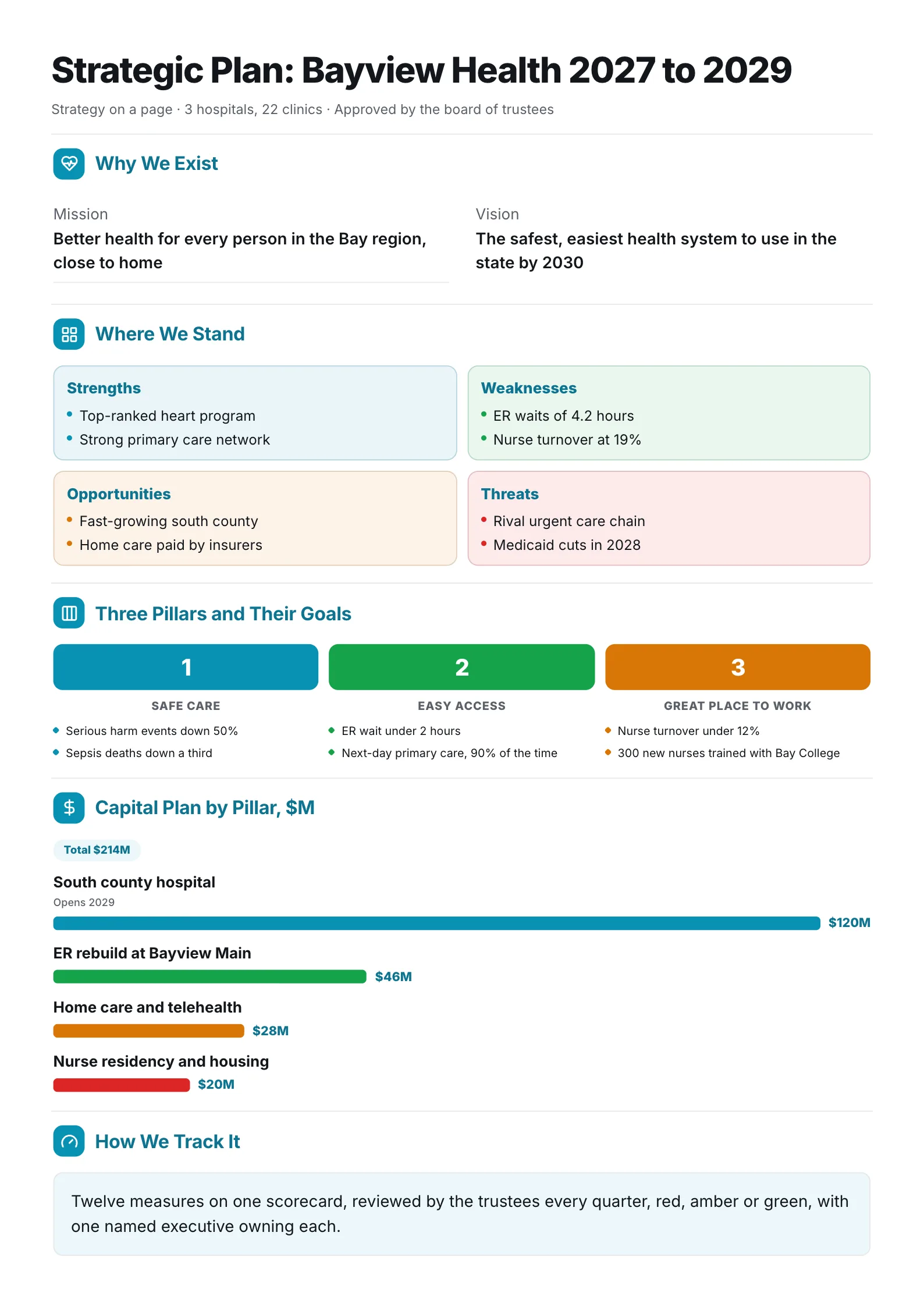 Strategic Plan: Hospital Health SystemEdit for free(opens in a new tab)
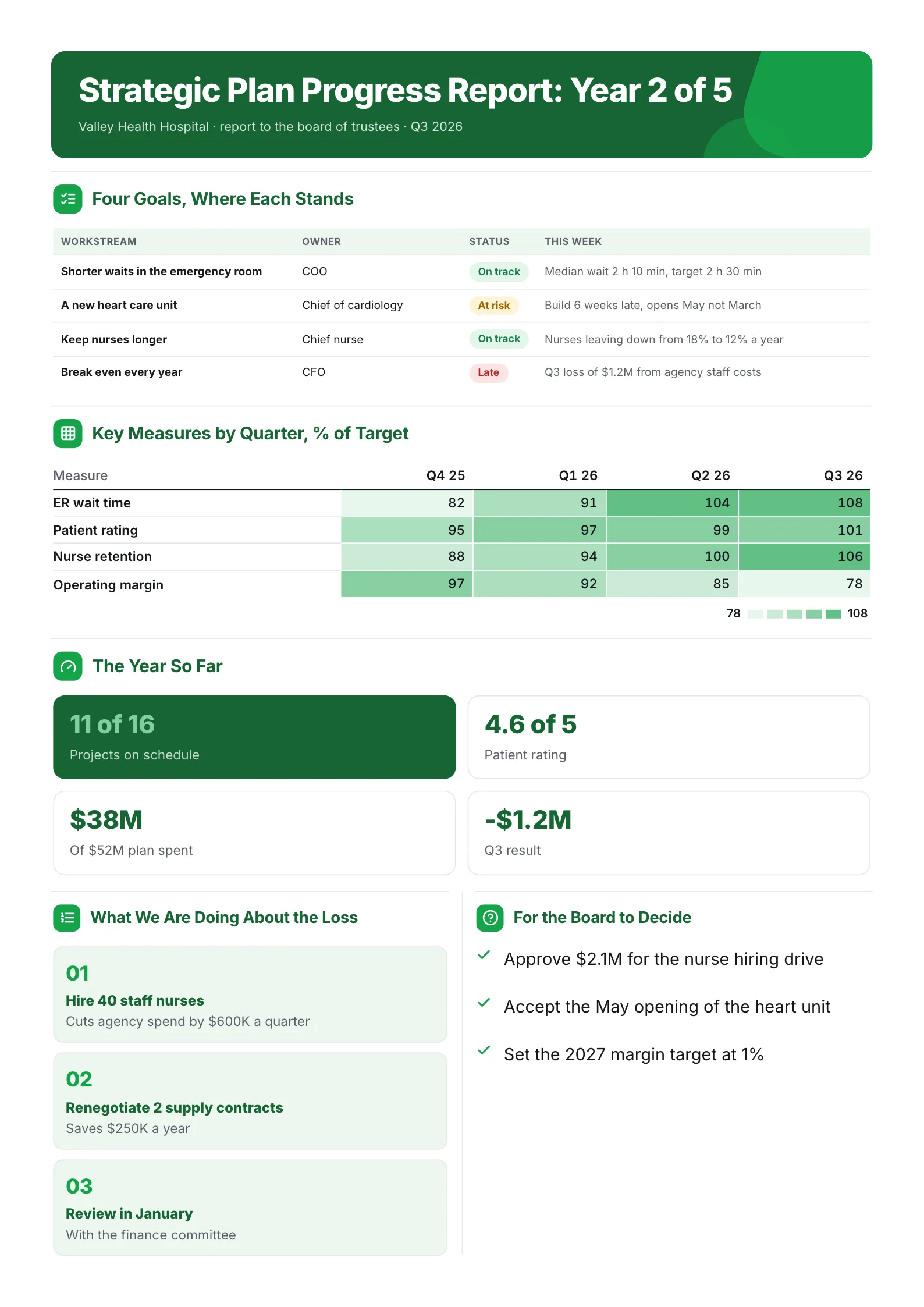 Progress Report: Strategic PlanEdit for free(opens in a new tab)
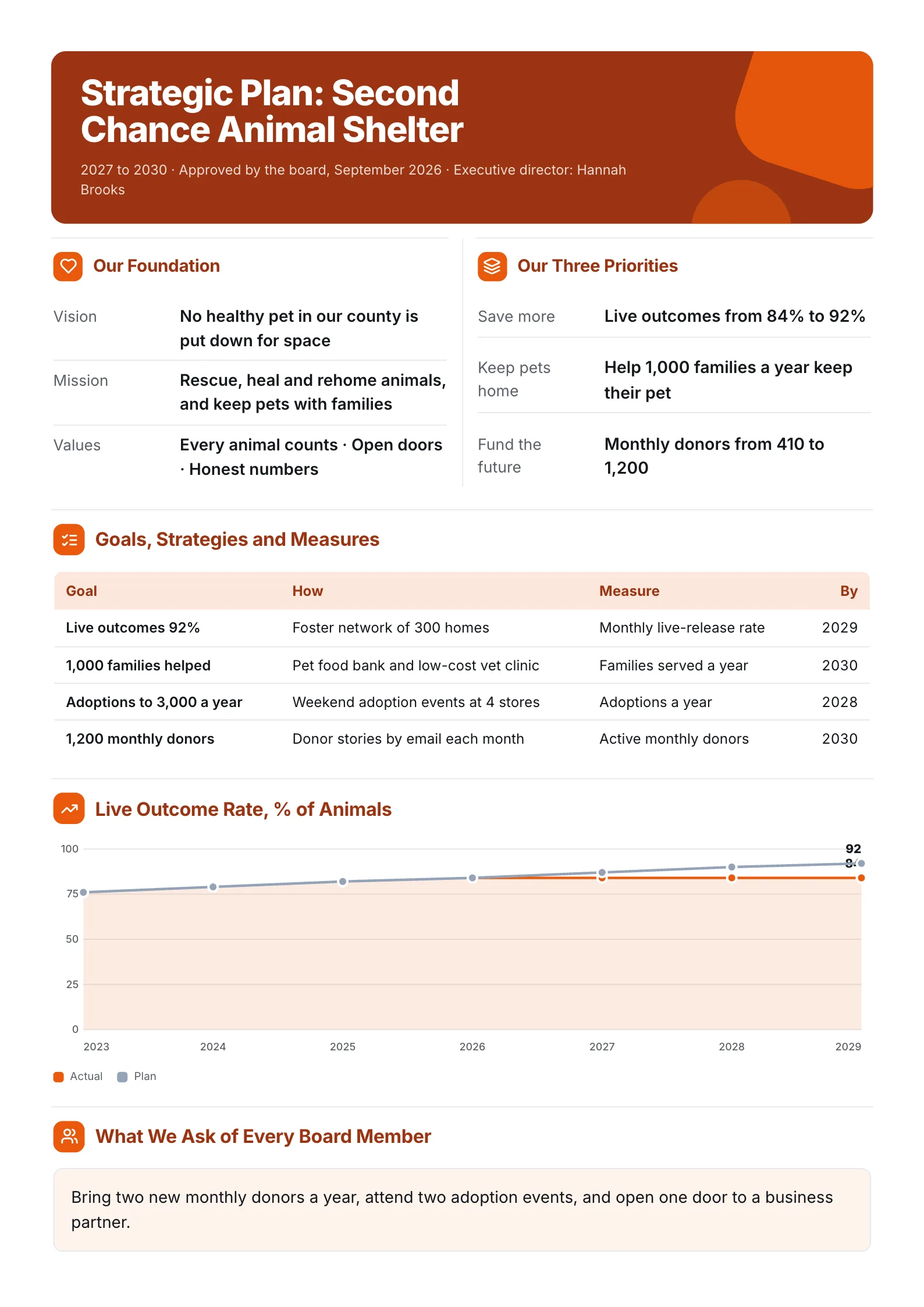 Strategic Plan: Nonprofit Animal ShelterEdit for free(opens in a new tab)
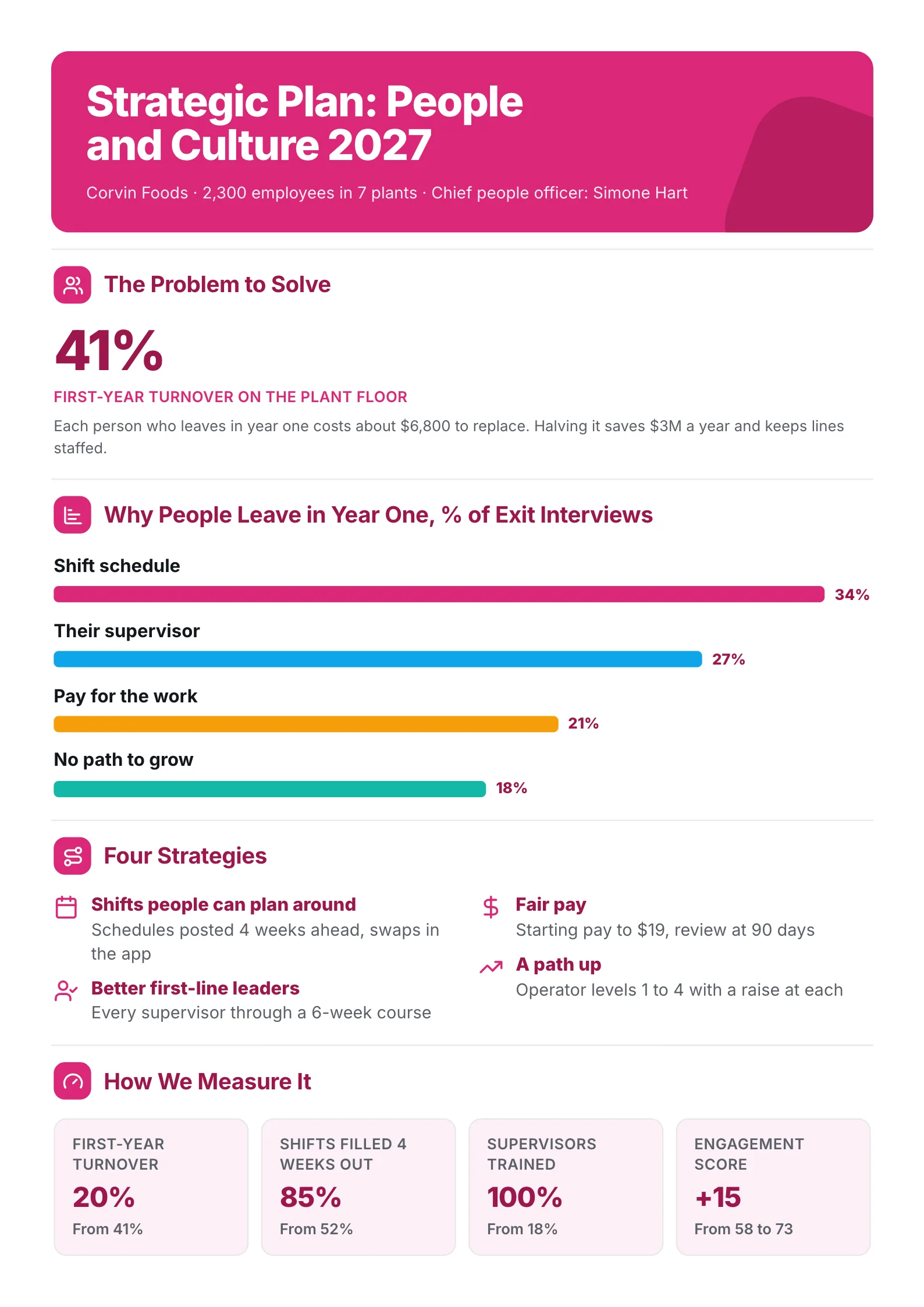 Strategic Plan: HR People and CultureEdit for free(opens in a new tab)
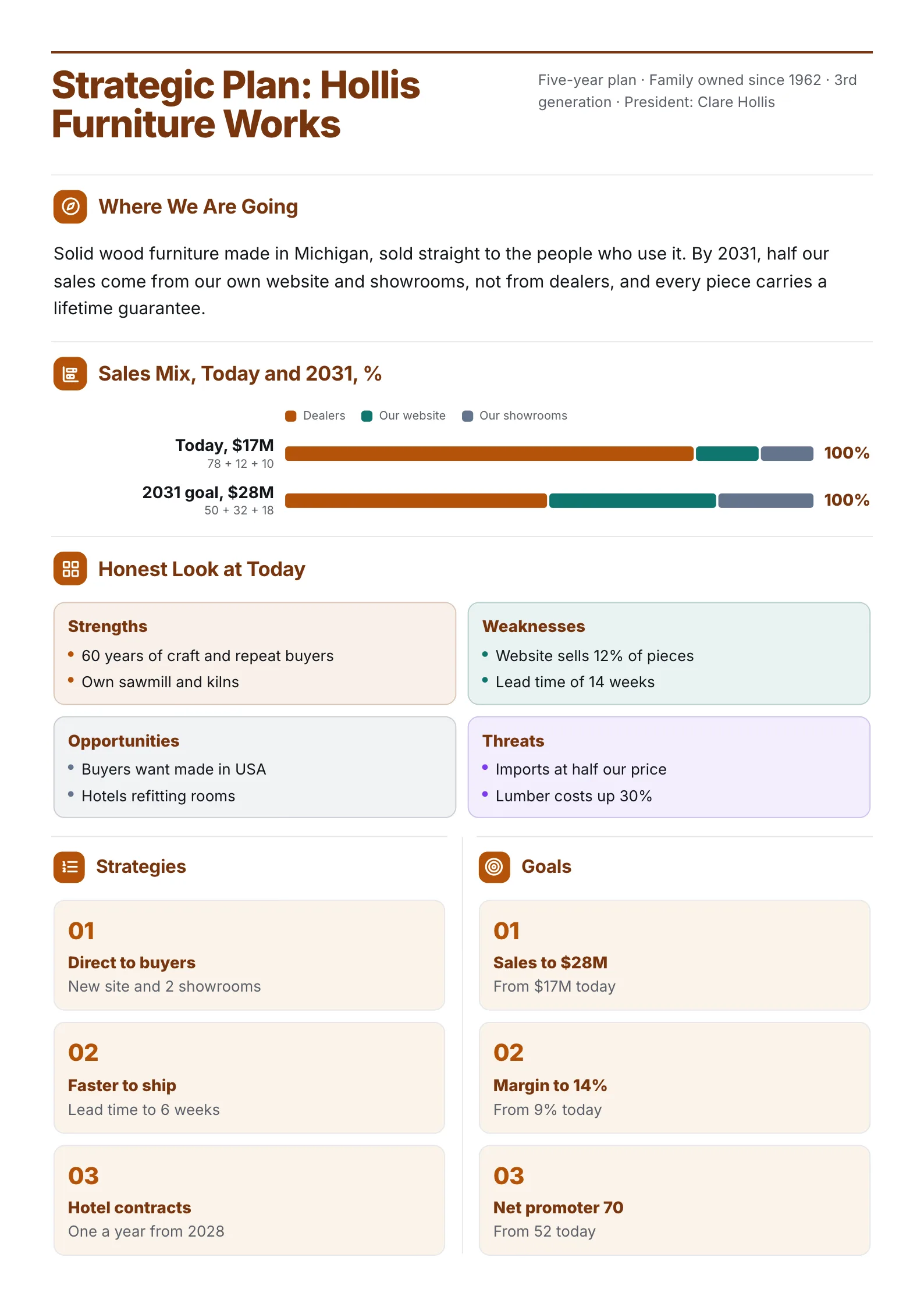 Strategic Plan: Family ManufacturerEdit for free(opens in a new tab)
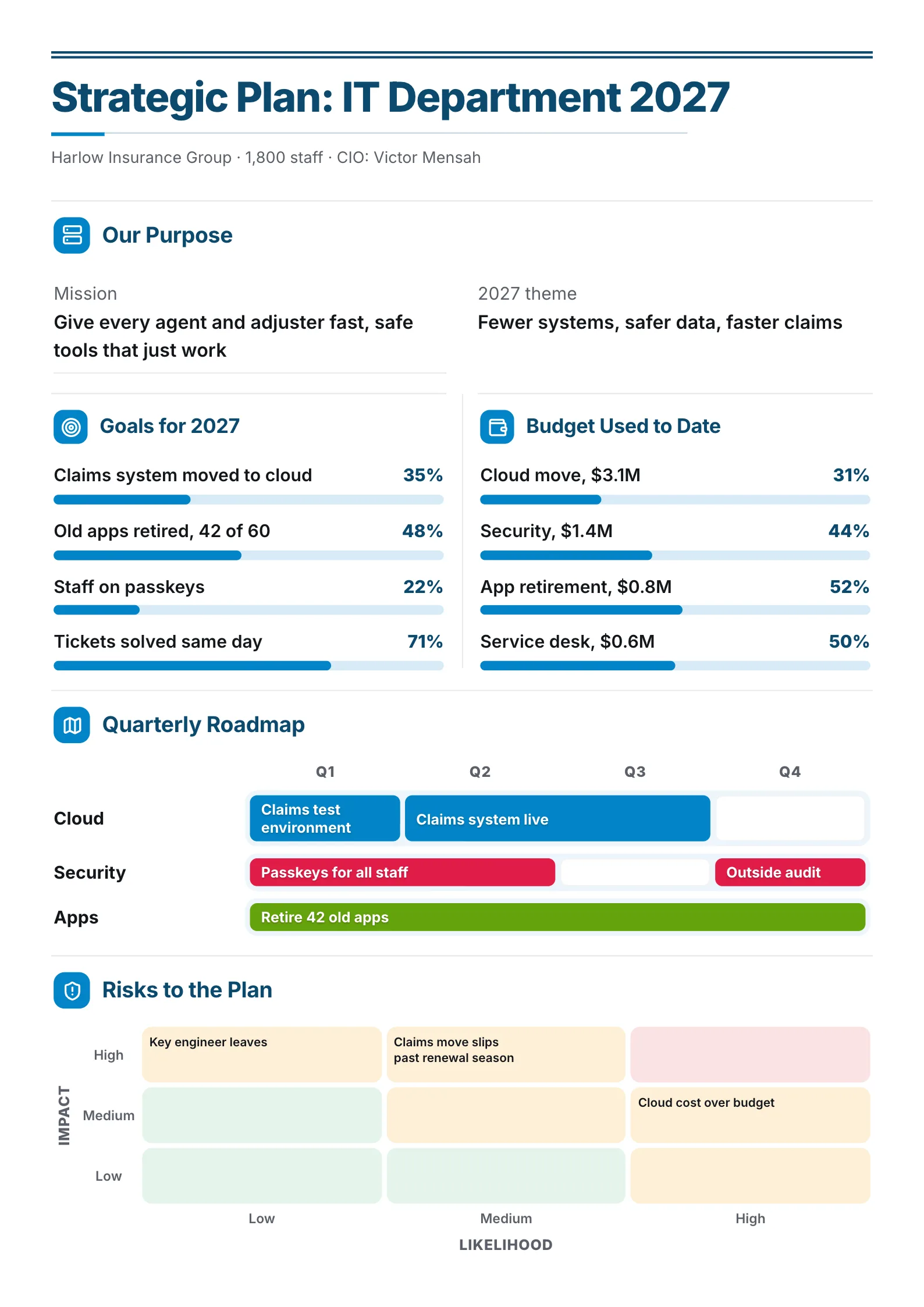 Strategic Plan: IT DepartmentEdit for free(opens in a new tab)
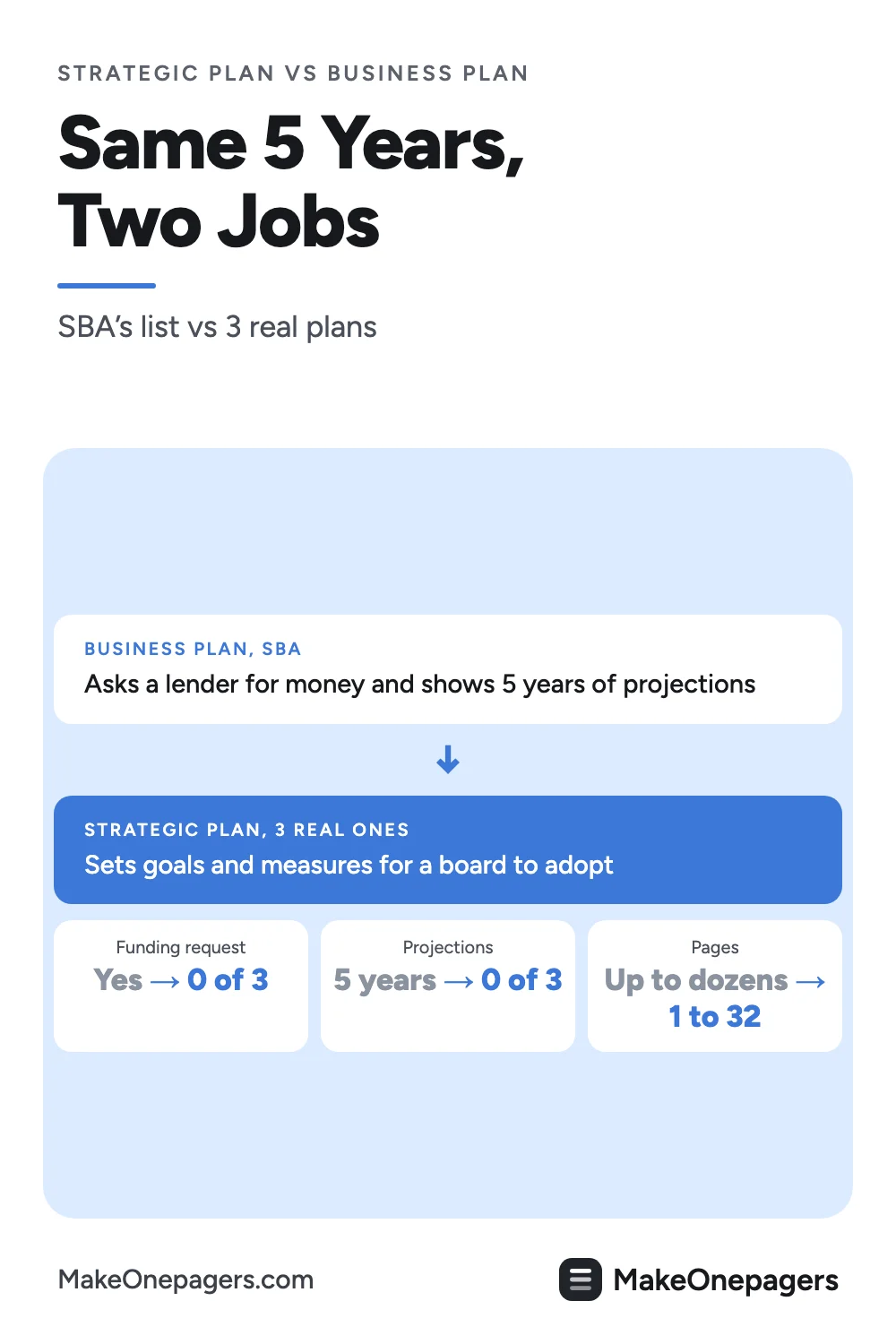
We read three strategic plans published in 2025 and 2026, from a city, a school district and a hospital. Then we checked each one against the 8 business plan sections that the U.S. Small Business Administration lists. Not one of the three plans has a funding request. Not one has financial projections. Not one names a competitor.
| Business plan | Strategic plan | |
|---|---|---|
| Who reads it | A lender or investor | Your board, council or staff |
| What it asks for | Money, with terms | Agreement on goals |
| The numbers in it | Income, cash flow, balance sheets | Targets and measures |
| Competitors | A market analysis section | 0 of our 3 name one |
| Length | "Dozens of pages" or one page | 1 to 32 pages in our three |
| Time span | Five years of projections | Five years of goals |
The SBA's 8 business plan sections
The SBA's Write your business plan guide describes two kinds of business plan. A traditional one "can be dozens of pages long," and "Lenders and investors commonly request this plan." A lean one is "typically only one page."
The page says to "Explore the nine most common sections," but the list under it holds eight:
- Executive summary
- Company description
- Market analysis
- Organization and management
- Service or product line
- Marketing and sales
- Funding request
- Financial projections
The last two are where the money lives. The funding request explains "how much funding you'll need over the next five years and what you'll use it for," and asks you to choose debt or equity. The projections give "a prospective financial outlook for the next five years," with income statements, balance sheets and cash flow statements. For the first year, the SBA asks for quarterly or even monthly figures.
So a business plan is built for one decision, and the reader makes it. Should they lend to you or invest in you? Write every section so it helps answer that.
Three strategic plans, checked against that list
A city: Fort Collins, Colorado, 2026 to 2030
Fort Collins adopted its 2026-2030 Strategic Plan on March 3, 2026. It runs 13 pages. We counted 7 outcome areas, 18 objectives, 63 numbered actions and 35 performance measures, such as "Median response time to Police Priority 1 Calls."
The dollar sign appears 0 times. So do the words forecast, projection, market and investor. The plan still touches money, just from the other direction. Its council resolution says the plan "will serve as the basis of the City's budget and operational plan for 2026 and 2027." The plan sets the goals first. The budget then pays for them. If you run a public office, copy that order. Agree on your goals, then build your budget around them.
A school district: Kalamazoo Public Schools, 2025 to 2030
Kalamazoo's board adopted its 2025-2030 Strategic Plan on August 7, 2025. It's 32 pages with six pillars, and each one has "a goal statement, strategies that will be used to achieve the goal, and the measures of success." All six lists of measures start with the same words: "By the 2029-2030 school year."
The planning began with over 60 SWOT sessions at schools and in the community in April and May 2024. That's the closest the plan gets to a market analysis, and it looks inward. It lists strengths like "Dedicated and engaged teachers and staff" and weaknesses like "Budget constraints," and it names no rival districts.
One pillar is Fiscal Responsibility, and it still holds no forecast. Its measures read like promises, such as "Receive an annual audit with an unmodified opinion." The only dollar figure in all 32 pages is history: more than $210 million in Kalamazoo Promise scholarships awarded to past graduates.
A hospital: Western Wisconsin Health, 2026 to 2030
Western Wisconsin Health put its whole 2026-2030 Strategic Plan on one page. It shows 3 pillars, each with 2 priorities, under the line "CARE · INNOVATE · SUSTAIN." The six priorities range from "Transformative Outcome-Based Care" to "Effective Patient-Centered Reimbursement."
The only numbers on it are the years. That's the leanest strategic plan of the three, and it does a strategic plan's main job. Anyone at the hospital can read it in a minute and know the three things that matter. If your board keeps asking for a shorter plan, show them this one.
What the count shows
Here are the three plans against the SBA's two money sections, plus the one about rivals.
| SBA section | Fort Collins | Kalamazoo | Western Wisconsin Health |
|---|---|---|---|
| Funding request | No | No | No |
| Financial projections | No | No | No |
| Competitors named | No | No | No |
| Pages | 13 | 32 | 1 |
| Priority areas | 7 | 6 | 3 |
Two things stand out. First, all three plans cover five years, and so does the SBA's funding request. So the time span doesn't tell the two plans apart. The reader does. A business plan's reader decides whether to hand over money. A strategic plan's reader, a council, a school board or a hospital board, has already decided the group exists and wants to know where it's going.
Second, a strategic plan can be 1 page or 32, and it still works if every goal has a measure. The SBA's lean format makes the same point for business plans. Keep yours as short as your reader allows, and give every goal a number you can check.
Turning your strategic plan into a business plan
Say your strategic plan is done and now you need a loan to pay for it. You don't start over. Keep your goals, and add the parts the SBA lists that a strategic plan skips.
- Name your rivals. The SBA's market analysis asks what other businesses are doing and what their strengths are. None of our three plans did this, so you'll write it fresh.
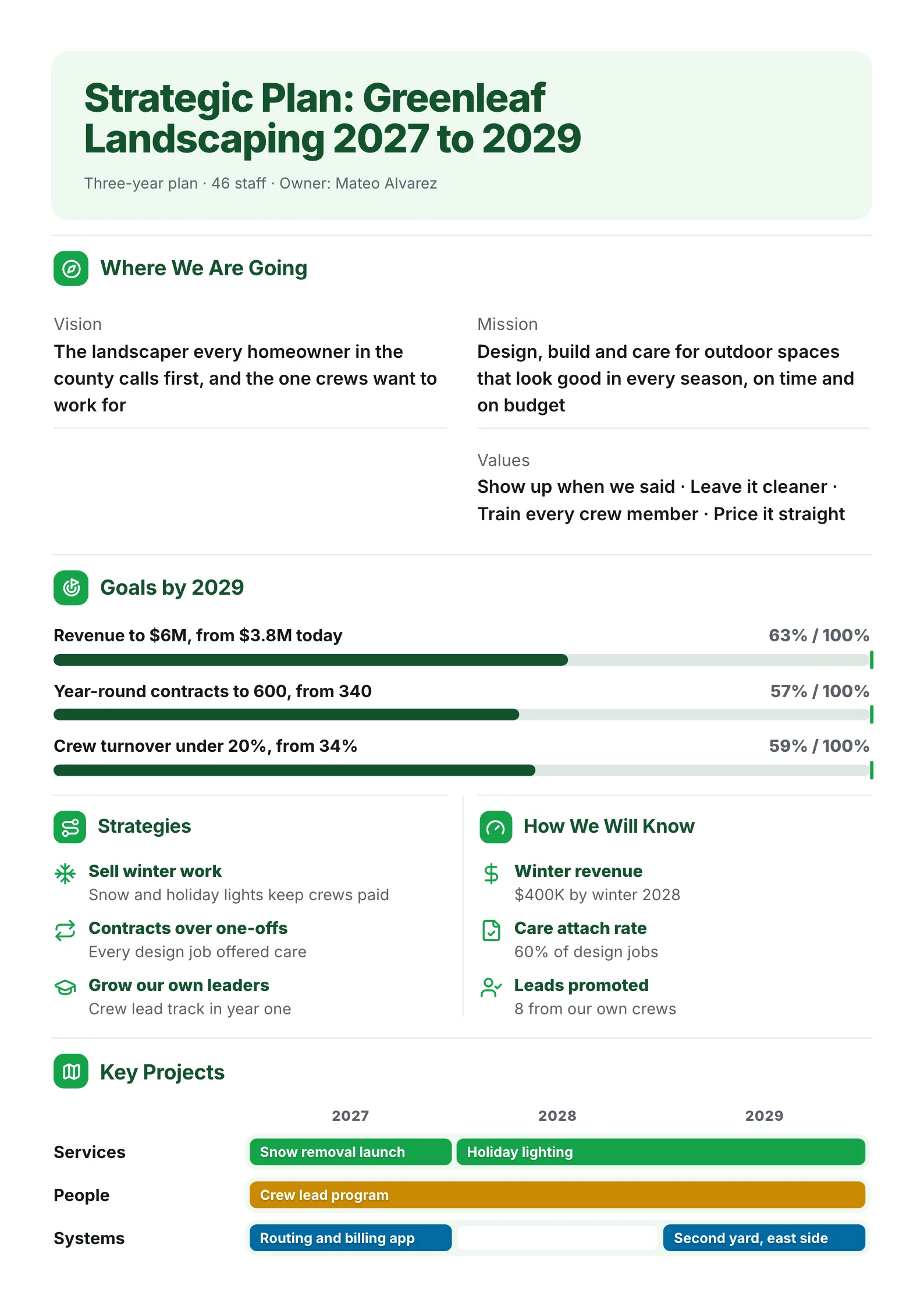
- Put a cost and a date on each goal. The landscaper below plans to "Sell winter work." For a lender, that goal needs what the snow removal launch costs and when it starts.
- Write the funding request. Say how much you need over the next five years, what it pays for, and whether you want debt or equity.
- Add the projections. Give five years of income, cash flow and balance sheets. Break the first year into quarters or months.
- Keep the strategic plan as your summary. Your goals and measures already tell the lender where you're going. The new sections show them how you'll pay it back.
Going the other way is simpler. Take your business plan's executive summary and goals, drop the funding request and projections, and give each goal a measure and a date.
Which plan do you need?
- You're asking a bank or an investor for money: a business plan, with the funding request and five years of projections.
- You're starting a business and need to think it through: a lean business plan on one page first.
- Your business already runs and you want to set goals for the next 3 to 5 years: a strategic plan.
- You lead a city office, a school, a hospital or a nonprofit: a strategic plan. Your board approves it, and your budget follows it.
- You're a growing company raising money: both. The strategic plan sets the goals. The business plan prices them for the lender.
Five strategic plans on one page, and where money shows up
These samples from MakeOnepagers are strategic plans with invented names. A few carry money targets, which a business can do. None asks anyone for funding.
A small business with a revenue goal
 Edit this template
This small business strategic plan for a 46-person landscaper sets revenue to $6M by 2029, from $3.8M today. That's a goal for the team, with no forecast behind it for a bank. Its other goals aren't about money at all, like crew who stay a year rising from 66% to 80%. If this owner later wanted a loan for the second yard on the east side, a business plan would add the cash flow and the ask.
A startup that writes down what it won't do
 Edit this template
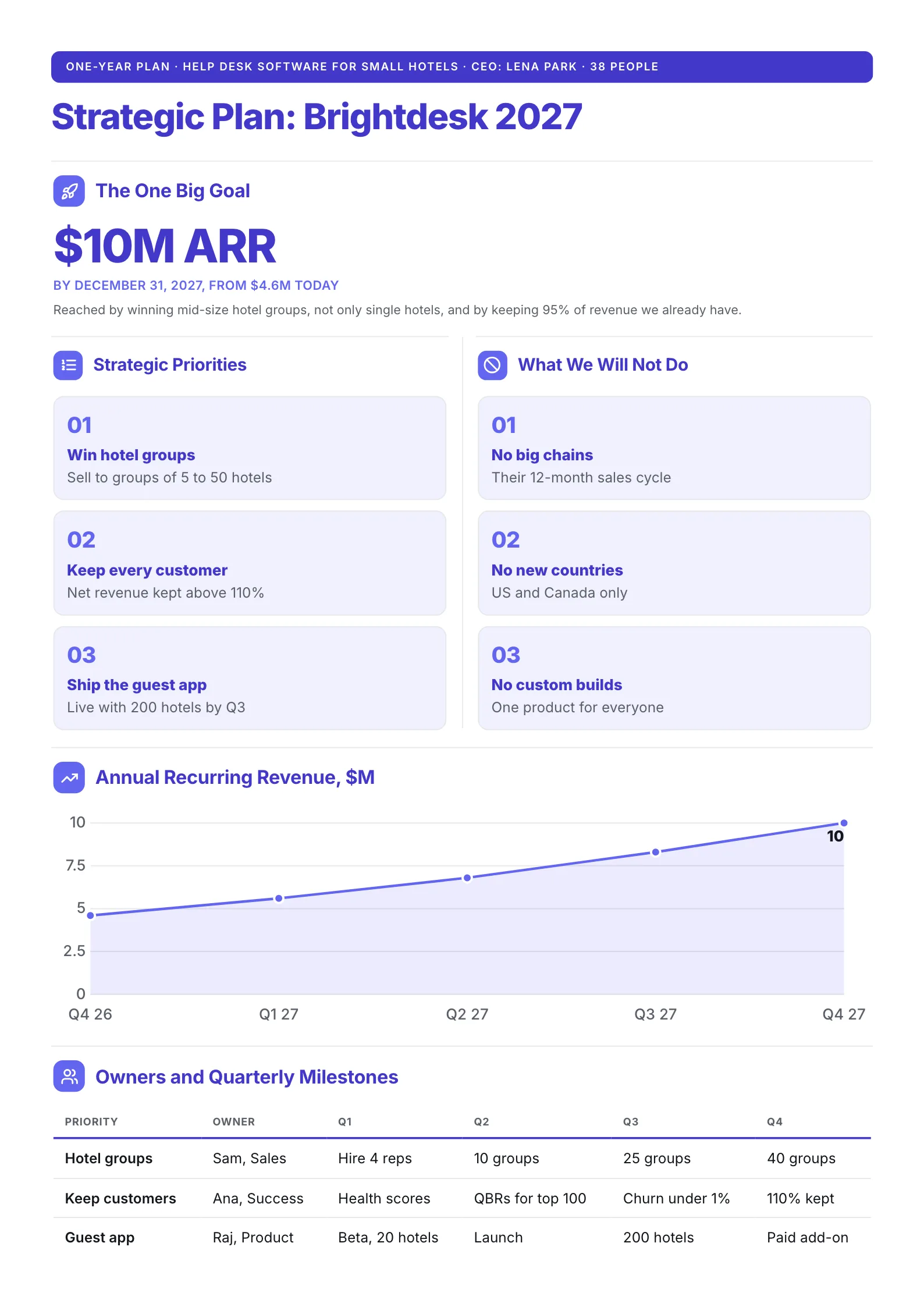
A startup's investors read the business plan. Its team reads this one. This software startup strategic plan aims for $10M in annual recurring revenue by December 31, 2027, from $4.6M. It also lists three things the company won't do, such as no big chains because of their 12-month sales cycle. Each priority has an owner, like Sam in Sales and Raj in Product.
A credit union with members and loans as goals
 Edit this template
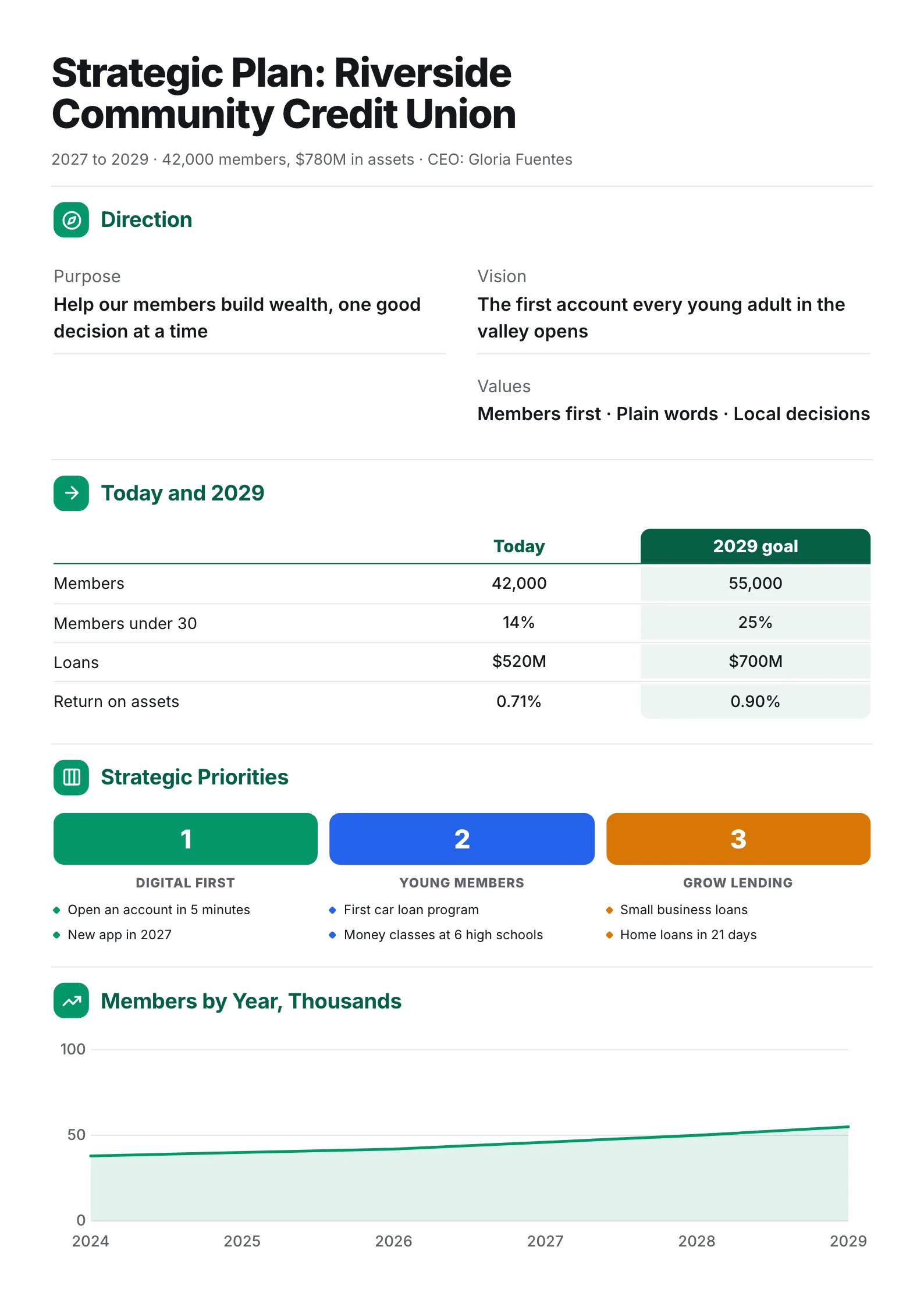
Here money is the product, so the goals carry dollars. This credit union strategic plan grows loans from $520M to $700M and members from 42,000 to 55,000 by 2029. Each target sits beside today's number. Still, there's no funding request. The board is setting direction, and nobody is being asked for capital.
A city, like Fort Collins but on one page
 Edit this template
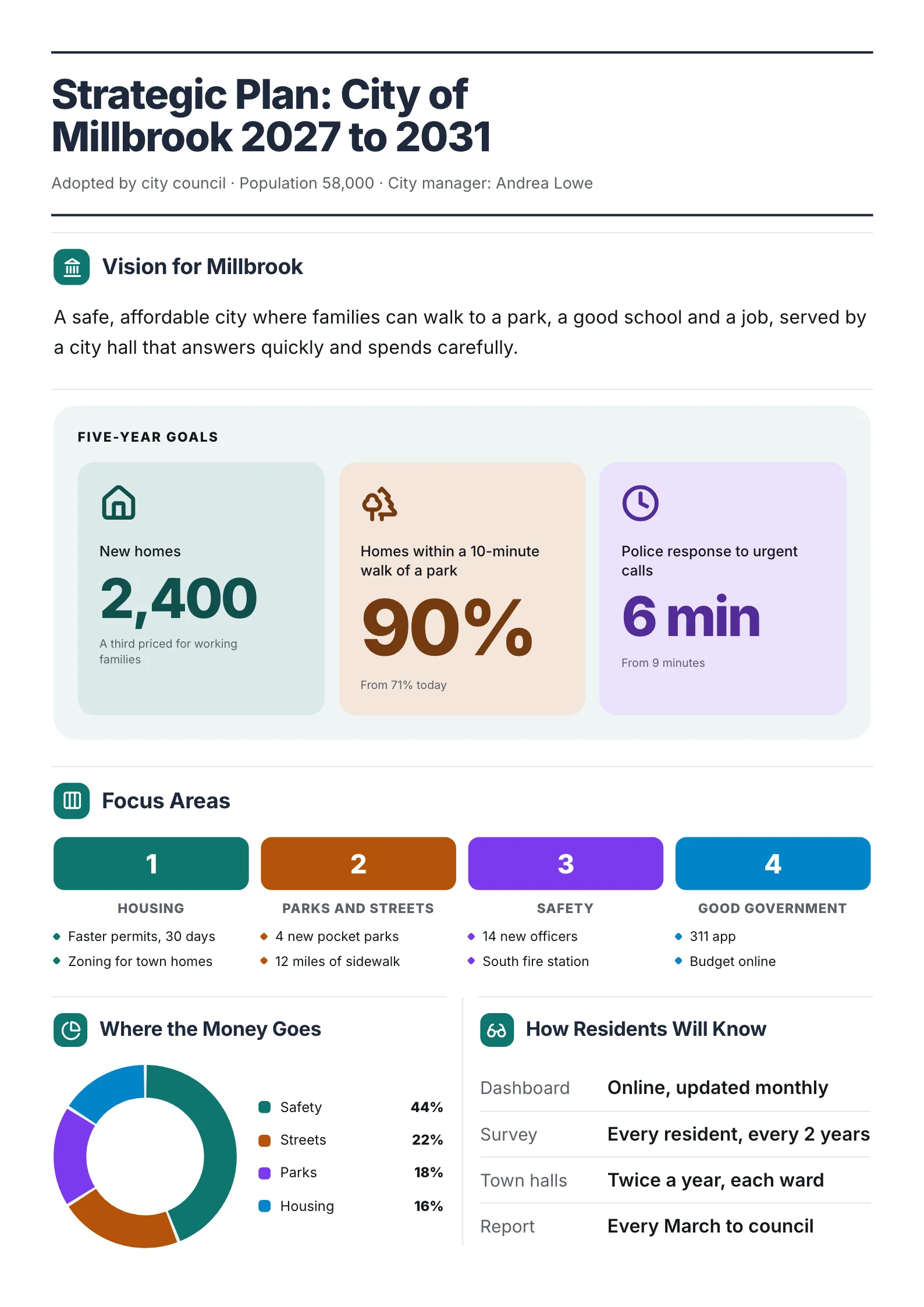
Fort Collins needed 13 pages. This city government strategic plan fits a smaller city onto one. It sets three five-year goals, two of them with a before and after, such as police response to urgent calls in 6 minutes, from 9. It also tells residents how they'll know, with a dashboard updated monthly and a report to council every March.
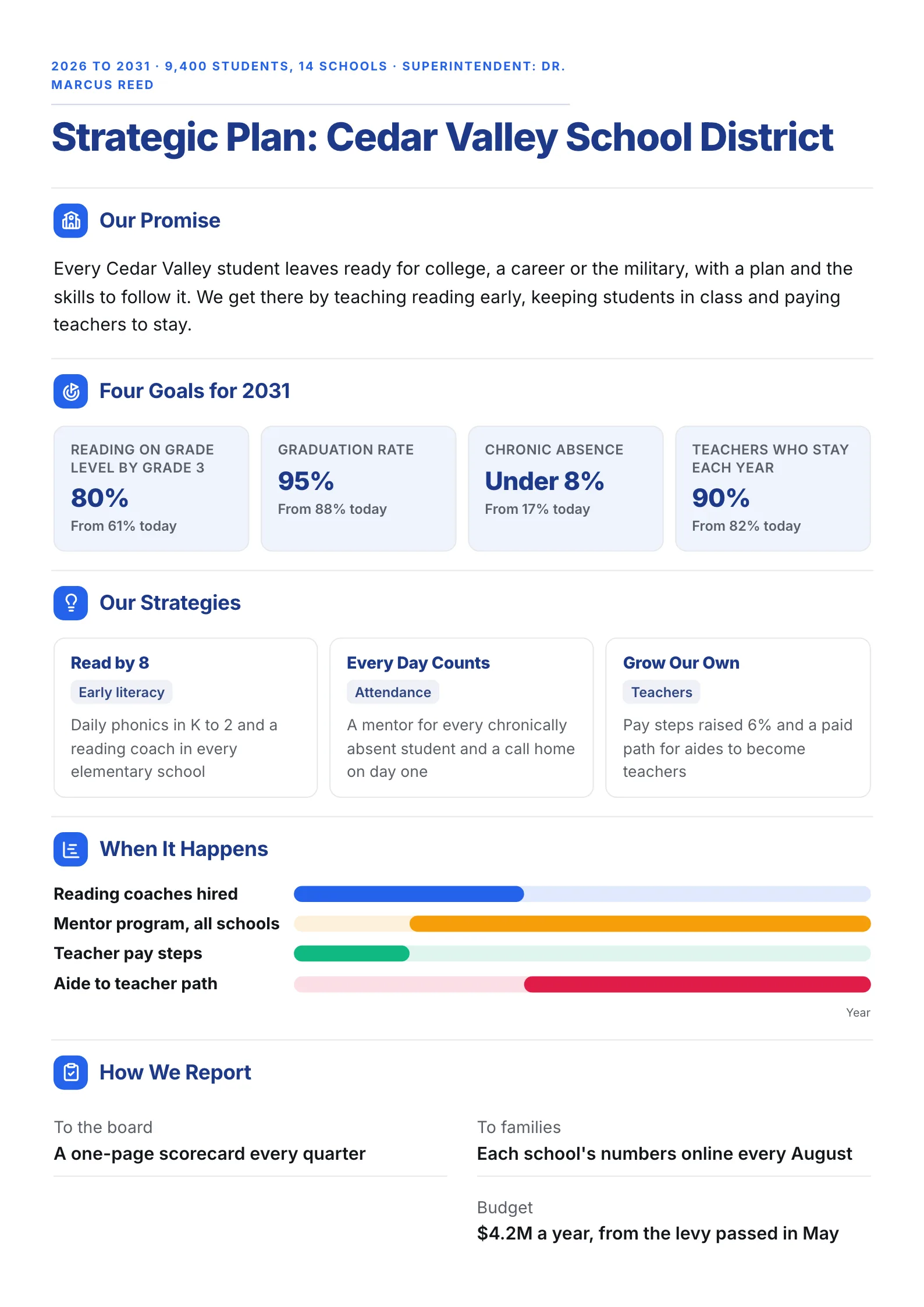
A school district, like Kalamazoo but with targets
 Edit this template
Many of Kalamazoo's measures start with "Increase" or "Reduce" and stop there. This school district strategic plan puts a number on each one, like reading on grade level by Grade 3 rising to 80% from 61%. It names its budget too, $4.2M a year from the levy passed in May. That's money the district already has, which is why it isn't a funding request.
Make your plan
Need a lender's version? Start with our one page business plan template. Setting goals for a team or a board? Pick the MakeOnepagers strategic plan that matches your kind of group and put in your own numbers. To see how other groups count their goals, browse our strategic plan examples, or fit every part on a single sheet with the one page strategic plan guide. Got a long plan already? Drop it into the free AI One-Pager generator and it will lay the plan out on a single sheet you can edit.
Frequently asked questions
Can a strategic plan replace a business plan?
Only if nobody is asking you for money. A lender wants the funding request and financial projections the SBA lists, and none of the three strategic plans we read had either one.
Which comes first, a business plan or a strategic plan?
A new business usually writes the business plan first, to get started and funded. Once it runs, a strategic plan sets the next three to five years of goals, and the budget is built around it, as Fort Collins does.
How long is a strategic plan compared with a business plan?
It varies more than you'd think. The three strategic plans we read ran 1, 13 and 32 pages. The SBA says a traditional business plan can run dozens of pages, and a lean one is usually a single page.
Does a strategic plan include a budget?
Usually it points to one rather than holding one. Fort Collins says its plan is the basis of the city's budget, and Kalamazoo says its plan will guide the funding it needs, but neither lists dollar amounts for its goals.
Who approves a strategic plan?
The group's governing body. Fort Collins's city council adopted its plan by resolution, and Kalamazoo's Board of Education adopted its plan on August 7, 2025. A business plan has no approval step. It's judged by the lender or investor who reads it.




